

ISO 22567:2026
(Main)General requirements for establishing muscular strength databases
- Abstract
This document specifies general requirements for establishing muscular strength databases and their associated reports, which contain measurements taken in accordance with ISO 25033-1.1)
- Status
- Published
- Publication Date
- 04-Oct-2026
- Technical Committee
- ISO/TC 159/SC 3 - Anthropometry and biomechanics
- Drafting Committee
- ISO/TC 159/SC 3 - Anthropometry and biomechanics
- Current Stage
- 6060 - International Standard published
- Start Date
- 05-Oct-2026
- Due Date
- 27-Sep-2026
- Completion Date
- 05-Oct-2026
ISO 22567:2026 is an International Standard from ISO for establishing muscular strength databases and the associated reports. It specifies how to plan the data collection, record participant and strength data, format the database, and prepare statistics for measurements taken in accordance with ISO 25033-1. It is intended for researchers, ergonomics specialists, and others who need muscular strength data that can be compared across populations.
What does ISO 22567:2026 specify?
ISO 22567:2026 specifies general requirements for building muscular strength databases and the reports that describe them. The document centers on static muscular strength data collected with the measurement definitions, instrumentation, and protocol of ISO 25033-1, so users can assemble data in a consistent way for technological design and comparison between population groups.
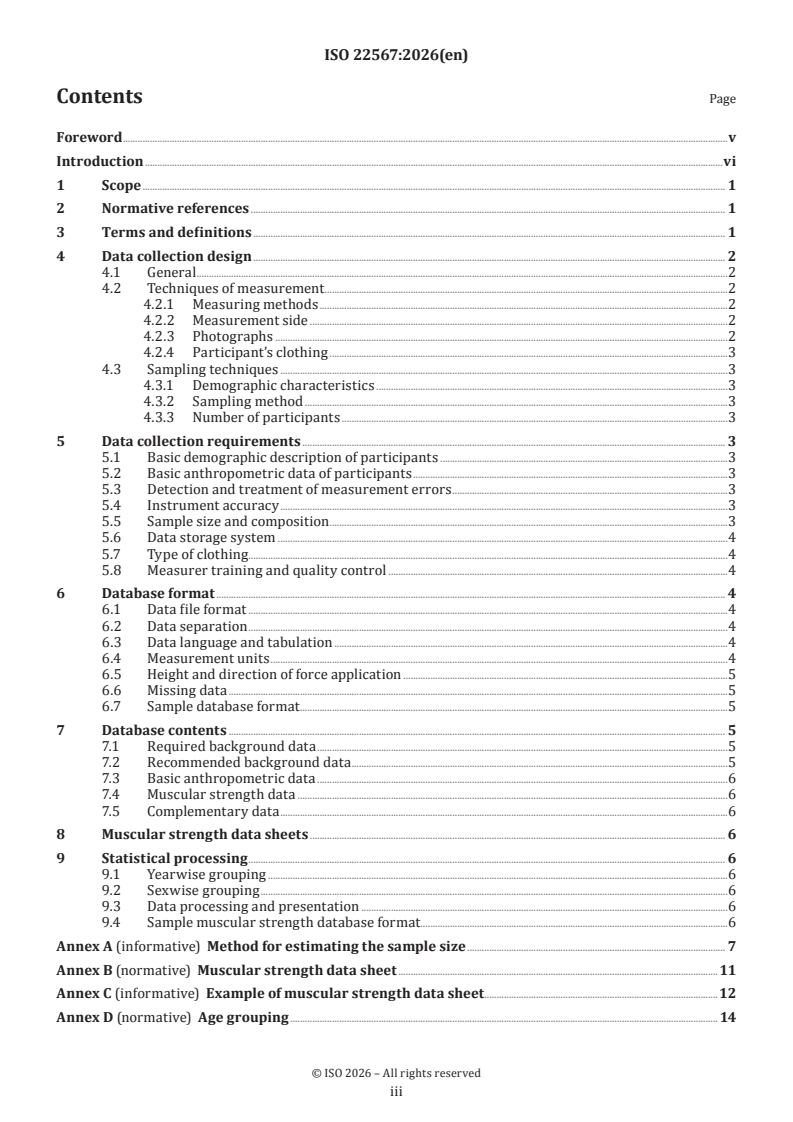
The standard is organized into clauses on scope, references, terms, data collection design, data collection requirements, database format, database contents, data sheets, and statistical processing, followed by annexes that give the supporting methods and examples.
| Annex | What it covers |
|---|---|
| Annex A | Method for estimating sample size |
| Annex B | Muscular strength data sheet |
| Annex C | Example of muscular strength data sheet |
| Annex D | Age grouping |
| Annex E | Procedure for preparing data and statistics |
| Annex F | Muscular strength sample database format |
What are the key requirements of ISO 22567:2026?
ISO 22567:2026 sets out how to collect, record, format, and process muscular strength data so databases are usable beyond one study site. The most important points are the measurement method, the participant information to record, and the way results are cleaned and tabulated.
Data collection design
Clause 4 requires the measuring methods from ISO 25033-1 to be used. If a study departs from them, the muscular strength report has to say so and explain the definitions, instruments, and units used. In practice, this is what makes one database comparable with another instead of being a one-off local dataset.
Clause 4 also requires the report to show which body side was measured when left and right are both possible, and it recommends photographs or sketches of the setup. Those images should not identify the people photographed, which matters for privacy and for letting others understand the posture and test arrangement.
Sampling and participant description
Clause 4 and Clause 5 require the demographic characteristics of the population to be stated clearly, including any subgroup structure used in sampling or reporting. Random or stratified sampling should be used, and the sample size should be justified statistically, with Annex A giving the method.
Clause 5 requires basic biographic data such as sex, date of birth, survey date, and survey location, plus basic anthropometric data: stature, body mass, and shoulder height. This matters because muscle strength depends strongly on age, sex, and body size, so the database needs these fields for interpretation.
Measurement quality and recording rules
Clause 5 requires instrument accuracy of the nearest Newton for muscular strength and the nearest 500 g for body mass. It also requires routine measurer training and quality control, with repeated readings to assess inter- and intra-measurer differences. In practice, this is how the database limits avoidable measurement noise.
Clause 5 says clothing type shall be coded when relevant, and Clause 6 requires all records to be stored digitally where possible. That makes later analysis and sharing easier, while also keeping track of clothing conditions that can affect movement and force output.
Database format and data fields
Clause 6 requires ASCII code according to ISO/IEC 8859-1, tab-separated items, and English field names in the first row. Measurements must use SI units: millimetres or kilograms for body data, Newton for force, and Newton metres for torque, with lever arm length in metres. Missing data are recorded as 9999.
Clause 7 sets the core database contents. It requires participant number, sex, measurement location, measurement date, birth date, age, occupation, dominant hand, the anthropometric fields from Clause 5, and the muscular strength values from ISO 25033-1. Any extra strength items are added after the ISO 25033-1 items in alphabetical order.
Statistics and presentation
Clause 9 requires separate tabulation by sex and recommends age grouping in 5-year divisions, with 10-year or 20-year divisions where needed. Before statistics are calculated, irregular values must be reviewed, and Annex E gives the procedure for checking mean, standard deviation, scatter diagrams, and outliers.
Annex E also lists the descriptive statistics that should be presented, including participant counts, minimum and maximum, mean, standard deviation, coefficient of variation, frequency distribution, skewness, kurtosis, and selected percentiles. The percentile values are to come from the actual sample distribution, which matters when the database will be used for design values such as low-percentile strength.
What terms does ISO 22567:2026 define?
ISO 22567:2026 defines the main population and data terms used in muscular strength database work.
- Population segment - a group of people with one or more shared background characteristics that affect anthropometric distributions.
- User population - the population segment or segments for whom a technological design is intended.
- Random sample - a sample selected so each individual in the population has an equal chance of being chosen.
- Stratified sample - a sample drawn from sub-populations, or strata, with a specified number of randomly selected people from each stratum.
- Demographic data - background information such as sex, dwelling or working place, occupation, and education used to describe the user population or population segments.
- Muscular strength - the maximal force or torque an individual can voluntarily exert on an external test object under given conditions; for this document, it means static isometric strength.
- Muscular strength database - a collection of individual muscular strength data and background information recorded on a group of people.
- Muscular strength report - a technical report on the origin, contents, methods, and statistical characteristics of the muscular strength database.
Who uses ISO 22567:2026?
ISO 22567:2026 is used by ergonomics and anthropometry specialists, researchers, and national standards bodies that compile muscular strength data for design work. It also helps product and workplace designers who need comparable strength values when setting force limits, choosing control forces, or evaluating user capability.
In practice, these users apply the standard to plan surveys, choose sampling methods, record participant characteristics, build tabular databases, and prepare statistical summaries that can be compared across studies or population groups.
Which standards are used with ISO 22567:2026?
ISO 22567:2026 relies on three normative references.
- ISO 7250-1 - provides body measurement definitions and landmarks for the anthropometric data required in the database.
- ISO/IEC 8859-1 - provides the 8-bit character set used for the ASCII-based data file format.
- ISO 25033-1 - provides the muscular strength measurement definitions, instrumentation, and protocol that Clause 4 requires for the measurements themselves.
The document also uses ISO 3166-1 for country codes and ISO 8601-1 for date formatting in the database fields, so the location and time data can be recorded consistently.
What does the ISO 22567:2026 document contain?
ISO 22567:2026 contains the methods and templates needed to assemble a muscular strength database from participant-level records. Annex A gives sample size methods, including percentile-based calculations; Annex B gives the required data sheet content; and Annex C shows an example sheet. Annex D provides age group divisions, Annex E gives the data cleaning and statistical preparation procedure, and Annex F shows a sample database format.
The body of the standard gives the rules for measurement design, participant description, data file structure, required fields, and statistical grouping. Together, these clauses and annexes support survey planning, database construction, and reporting for technological design and other ergonomics applications.
Get Certified
Connect with accredited certification bodies for this standard

BSI Group
BSI (British Standards Institution) is the business standards company that helps organizations make excellence a habit.

Bureau Veritas
Bureau Veritas is a world leader in laboratory testing, inspection and certification services.

DNV
DNV is an independent assurance and risk management provider.
Sponsored listings
Frequently Asked Questions
ISO 22567:2026 is a standard published by the International Organization for Standardization (ISO). Its full title is "General requirements for establishing muscular strength databases". This standard covers: This document specifies general requirements for establishing muscular strength databases and their associated reports, which contain measurements taken in accordance with ISO 25033-1.1)
This document specifies general requirements for establishing muscular strength databases and their associated reports, which contain measurements taken in accordance with ISO 25033-1.1)
ISO 22567:2026 is classified under the following ICS (International Classification for Standards) categories: 03.120.30 - Application of statistical methods; 13.180 - Ergonomics. The ICS classification helps identify the subject area and facilitates finding related standards.
ISO 22567:2026 is available in PDF format for immediate download after purchase. The document can be added to your cart and obtained through the secure checkout process. Digital delivery ensures instant access to the complete standard document.
Standards Content (Sample)
International
Standard
ISO 22567
First edition
General requirements for
2026-10
establishing muscular strength
databases
Exigences générales relatives à l'établissement de bases de
données sur la force musculaire
Reference number
© ISO 2026
All rights reserved.
This ISO publication is protected by copyright and is owned by ISO and/or its licensors.
The content of this ISO publication is provided under licence, not sold. Use is subject to the applicable licence terms issued by ISO,
an ISO member body, or an authorized third-party distributor.
Except as required for implementation or expressly permitted by a separate licence, no part of this ISO publication may be
reproduced, distributed, modified, used, or made available in any form or by any means – electronic or mechanical, including
photocopying, scanning, recording, or posting on internal or external digital platforms.
Any use beyond the scope of the granted rights is prohibited and may result in legal action.
ISO copyright office
CP 401 • CH-1214 Vernier, Geneva
Phone: +41 22 749 01 11
Email: copyright@iso.org
Website: www.iso.org
Published in Switzerland
ii
Contents Page
Foreword .v
Introduction .vi
1 Scope . 1
2 Normative references . 1
3 Terms and definitions . 1
4 Data collection design . 2
4.1 General .2
4.2 Techniques of measurement .2
4.2.1 Measuring methods .2
4.2.2 Measurement side .2
4.2.3 Photographs .2
4.2.4 Participant’s clothing .3
4.3 Sampling techniques .3
4.3.1 Demographic characteristics .3
4.3.2 Sampling method .3
4.3.3 Number of participants .3
5 Data collection requirements . 3
5.1 Basic demographic description of participants .3
5.2 Basic anthropometric data of participants .3
5.3 Detection and treatment of measurement errors .3
5.4 Instrument accuracy .3
5.5 Sample size and composition .3
5.6 Data storage system .4
5.7 Type of clothing.4
5.8 Measurer training and quality control .4
6 Database format . 4
6.1 Data file format .4
6.2 Data separation .4
6.3 Data language and tabulation .4
6.4 Measurement units .4
6.5 Height and direction of force application .5
6.6 Missing data .5
6.7 Sample database format .5
7 Database contents . 5
7.1 Required background data .5
7.2 Recommended background data .5
7.3 Basic anthropometric data .6
7.4 Muscular strength data .6
7.5 Complementary data .6
8 Muscular strength data sheets . 6
9 Statistical processing . 6
9.1 Yearwise grouping .6
9.2 Sexwise grouping .6
9.3 Data processing and presentation .6
9.4 Sample muscular strength database format .6
Annex A (informative) Method for estimating the sample size . 7
Annex B (normative) Muscular strength data sheet .11
Annex C (informative) Example of muscular strength data sheet .12
Annex D (normative) Age grouping . 14
iii
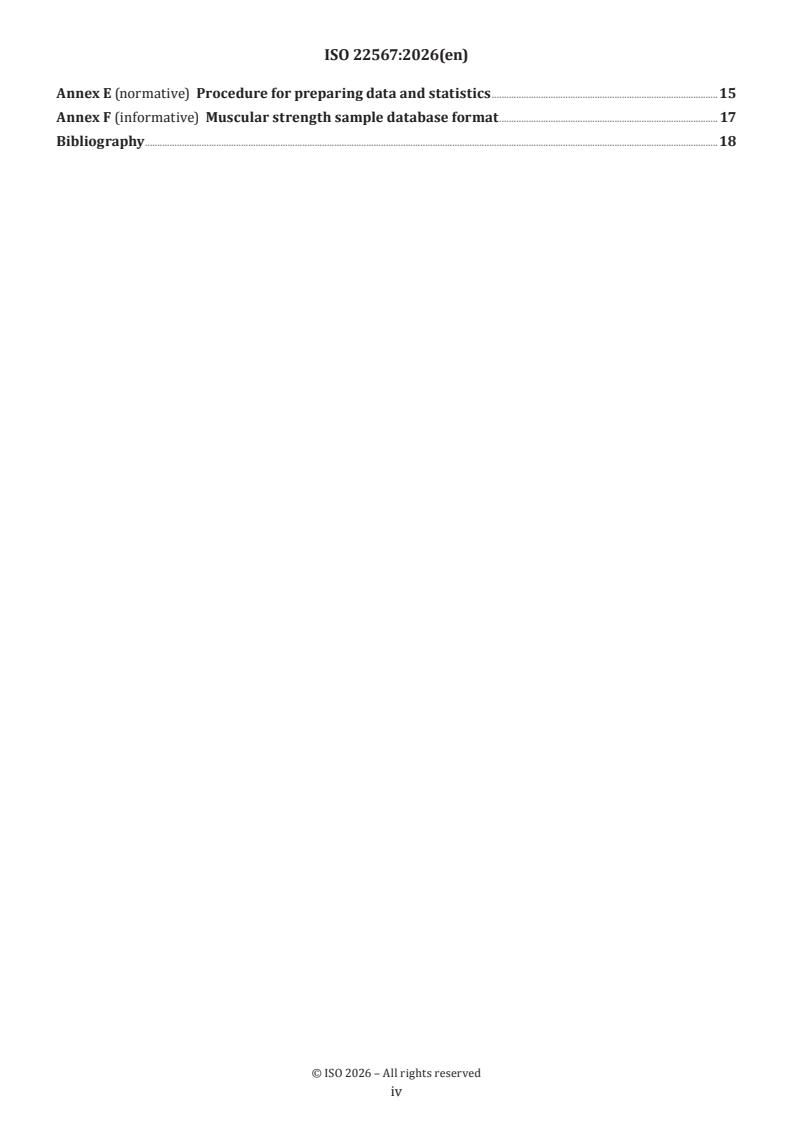
Annex E (normative) Procedure for preparing data and statistics .15
Annex F (informative) Muscular strength sample database format . 17
Bibliography .18
iv
Foreword
ISO (the International Organization for Standardization) is a worldwide federation of national standards
bodies (ISO member bodies). The work of preparing International Standards is normally carried out through
ISO technical committees. Each member body interested in a subject for which a technical committee
has been established has the right to be represented on that committee. International organizations,
governmental and non-governmental, in liaison with ISO, also take part in the work. ISO collaborates closely
with the International Electrotechnical Commission (IEC) on all matters of electrotechnical standardization.
The procedures used to develop this document and those intended for its further maintenance are described
in the ISO/IEC Directives, Part 1. In particular, the different approval criteria needed for the different types
of ISO document should be noted. This document was drafted in accordance with the editorial rules of the
ISO/IEC Directives, Part 2 (see www.iso.org/directives).
ISO draws attention to the possibility that the implementation of this document may involve the use of (a)
patent(s). ISO takes no position concerning the evidence, validity or applicability of any claimed patent
rights in respect thereof. As of the date of publication of this document, ISO had not received notice of (a)
patent(s) which may be required to implement this document. However, implementers are cautioned that
this may not represent the latest information, which may be obtained from the patent database available at
www.iso.org/patents. ISO shall not be held responsible for identifying any or all such patent rights.
Any trade name used in this document is information given for the convenience of users and does not
constitute an endorsement.
For an explanation of the voluntary nature of standards, the meaning of ISO specific terms and expressions
related to conformity assessment, as well as information about ISO's adherence to the World Trade
Organization (WTO) principles in the Technical Barriers to Trade (TBT), see www.iso.org/iso/foreword.html.
This document was prepared by Technical Committee ISO/TC 159, Ergonomics, Subcommittee SC 3,
Anthropometry and biomechanics.
Any feedback or questions on this document should be directed to the user’s national standards body. A
complete listing of these bodies can be found at www.iso.org/members.html.
v
Introduction
Human muscular strength, also referred to as muscular strength, is the force which the muscles can develop
during their contraction. Muscular strength refers to the amount of force a human can produce via muscle
or muscle group activation with a single maximal effort, depending on posture and direction of force
transferred to the environment. Muscular strength measurement is of two types namely, static (isometric)
and dynamic (e.g. isotonic). Isometric strength refers to the muscular force generated during an isometric
contraction, where the muscles produce tension without changing their length and, without movement of
the joint. Static muscular force is usually larger than dynamic force. The dynamic force, depending on the
velocity of the shortening muscles, amounts to about 50 % to 90 % of the maximal static force. Generally, it
is a common practice to measure the static strength to compare different populations or to set the limits for
force application. Muscular strength depends not only on the muscle mass, but also on health and training,
technique and experience, and motivation. The personal and task factors that influence muscular strength
are age, gender, posture, body mass, reach distance, arm and wrist orientations, speed of exertion, and
duration and frequency of efforts. This strength is maximum at a young age, and it goes on decreasing with
age.
Muscular strength databases of different populations help in formulating design criteria and safe limits.
However, direct inference of muscular strength to safe levels should be restricted since knowledge on their
association is often limited. One of the major difficulties in generating international databases on muscular
strength parameters of various populations is that the available studies cannot be comparable with each
other. Because, either the definitions of parameters differ, or the methods used for measurement can also
be different. Muscular strength is a vector quantity, and therefore, in its measurement, magnitude as well as
direction of application of force are important parameters.
This document will help different researchers and national standard bodies in generating internationally
compatible muscular strength databases. It provides necessary information, such as characteristics of the
user population, sampling methods, measurement items and statistics, to make international comparison
possible among various population segments.
vi
International Standard ISO 22567:2026(en)
General requirements for establishing muscular strength
databases
1 Scope
This document specifies general requirements for establishing muscular strength databases and their
1)
associated reports, which contain measurements taken in accordance with ISO 25033-1.
2 Normative references
The following documents are referred to in the text in such a way that some or all of their content constitutes
requirements of this document. For dated references, only the edition cited applies. For undated references,
the latest edition of the referenced document (including any amendments) applies.
ISO 7250-1, Basic human body measurements for technological design — Part 1: Body measurement definitions
and landmarks
ISO/IEC 8859-1, Information technology — 8-bit single-byte coded graphic character sets — Part 1: Latin
alphabet No. 1
ISO 25033-1, Basic muscular strength measurements for technological design — Part 1 Muscular strength
measurements definitions, instrumentation, and protocol
3 Terms and definitions
For the purposes of this document, the following terms and definitions apply.
ISO and IEC maintain terminology databases for use in standardization at the following addresses:
— ISO Online browsing platform: available at https:// www .iso .org/ obp
— IEC Electropedia: available at https:// www .electropedia .org/
3.1
population segment
group of people having one or more common background characteristics that influence their anthropometric
distributions
3.2
user population
population segment (3.1) or segments for whom a technological design is intended
3.3
random sample
sample established by following a set of procedures to ensure that each and every individual in the
population has an equal chance of being selected
3.4
stratified sample
sample established by a procedure in which the population is divided into sub-populations (strata), each one
of which contributes with a specified number of randomly selected individuals
1) ISO 25033-1 is in accordance with ISO 7250-1 and includes strength parameter definitions, measurement setups,
protocol for data collection and other details.
3.5
demographic data
background information (such as sex, dwelling or working place, occupation, education) used to describe
members of the user population (3.2) and/or population segments (3.1)
3.6
muscular strength
maximal force or torque which an individual can voluntarily exert on an external test object under given
conditions
Note 1 to entry: For the purpose of this document, muscular strength refers to static (isometric) muscular strength.
3.7
muscular strength data
muscular strength measurement values of parameters (such as pull force, push force. hand grip force etc.)
exerted by a person
3.8
muscular strength database
collection of individual muscular strength parameter data and background information (demographic data)
recorded on a group of people (the sample)
3.9
muscular strength report
technical report describing the origin, contents, methods, and statistical characteristics of the muscular
strength database (3.8)
3.10
relative accuracy
ratio of accuracy of measurement to the population mean of the parameter in question
4 Data collection design
4.1 General
The following methods shall be used in assembling internationally compatible muscular strength databases.
4.2 Techniques of measurement
4.2.1 Measuring methods
The measuring methods given in ISO 25033-1 shall be used. Any deviation from this shall be indicated in the
muscular strength report. Items other than those specified by ISO 25033-1 shall be measured according to
the purpose of the investigation. In such cases, definitions, methods, instruments and measurement units
shall be clearly indicated in the report.
4.2.2 Measurement side
When a measurement is taken on both the left and right sides of the human body, the report shall clearly
indicate on which side the measurement has been taken.
4.2.3 Photographs
Photographs or detailed sketches of the measurements taken should be provided and the measurement
procedures should be documented. Photographs should be such that it shall not be possible to identify the
individuals in the photographs.
4.2.4 Participant’s clothing
The participant shall be wearing normal clothing and shoes. If the measurement is taken without shoes,
the same shall be mentioned. The type of clothing, if relevant, shall be coded on the muscular strength data
sheet.
4.3 Sampling techniques
4.3.1 Demographic characteristics
The demographic characteristics of the population shall be indicated as clearly as possible in the report. In
the event that the population is divided into several subgroups, e.g. survey location and dwelling location for
either sampling or statistical reporting, this shall be stated in the report.
4.3.2 Sampling method
Random or stratified sampling methods should be used. However, if this is impossible, the report shall
indicate the sampling method used.
4.3.3 Number of participants
The number of participants needed for a database should be established using a statistical formula based on
the accuracy of results desired by the investigator (see Annex A).
5 Data collection requirements
5.1 Basic demographic description of participants
Biographic data shall be collected (e.g., by using a questionnaire) to provide information about sex, date of
birth, date of survey, and survey location. Other demographic information may be included depending upon
the purpose of the study.
5.2 Basic anthropometric data of participants
For all the participants whose muscular strength data is to be collected, three anthropometric parameters,
namely, stature (body height), body mass (weight), and shoulder (acromion) height, shall be measured. For
this purpose, instructions given in ISO 7250-1 shall be followed.
5.3 Detection and treatment of measurement errors
The editing of obvious anomalies during data collection should be carried out using, for example, computer
software specifically written for the purpose of detecting figures that lie outside any reasonable range of
data given for that parameter (see Annex E).
5.4 Instrument accuracy
Muscular strength measuring instruments shall measure to the nearest Newton. Instruments for measuring
body mass shall weigh to the nearest 500 g.
5.5 Sample size and composition
The sample size shall be sufficient to estimate the v
...