

ISO 20682:2026
(Main)Autonomous underwater vehicles — Risk and reliability
General Information
- Abstract
This document specifies the risks and reliability of an autonomous underwater vehicle (AUV) in its underwater realm. It covers sensors, communication devices, and any other pieces and parts directly influencing the “digital mission” of the vehicle. This document does not cover the manufacturing or operation of the following items: autonomous underwater gliders (AUGs), as they use a narrowly modifiable set of operational commands; batteries for the use of AUVs; electrical motors for the use of AUVs.
- Status
- Published
- Publication Date
- 12-Feb-2026
- Technical Committee
- ISO/TC 8/SC 13 - Marine technology
- Drafting Committee
- ISO/TC 8/SC 13 - Marine technology
- Current Stage
- 6060 - International Standard published
- Start Date
- 13-Feb-2026
- Due Date
- 18-Apr-2026
- Completion Date
- 13-Feb-2026
Overview
ISO 20682:2026 - Autonomous Underwater Vehicles - Risk and Reliability is a key international standard developed by ISO to address the risk and reliability aspects of autonomous underwater vehicles (AUVs) in their operational environments. The standard defines guidance and specifications for assessing and managing the risks and reliability of AUVs, emphasizing components such as sensors, communication devices, and modules directly affecting their “digital mission.” It specifically excludes autonomous underwater gliders, AUV batteries, and electrical motors.
By establishing a common approach for risk identification, system reliability, and mitigation strategies, ISO 20682:2026 enhances the safety and performance of AUV missions in often unpredictable marine conditions. This standard is relevant to AUV manufacturers, operators, engineers, and risk managers focused on reliability, mission success, and operational safety in the underwater domain.
Key Topics
Modules & Subsystems: The standard describes critical AUV modules such as control, sensors, structure, mechanical moving elements, power, navigation, communication, and product traceability. Each module's risk profile and potential impacts are discussed.
Digital Mission Engineering: ISO 20682:2026 underscores the importance of digital mission planning and analysis in identifying risks and improving mission reliability. Simulations, virtual testing, and verification are highlighted for managing complex or extreme underwater missions.
Risk Assessment & Reduction: It lays out methodologies for risk assessment-drawing on ISO 31000-and reduction, utilizing tools like fault tree analysis and Markov models to predict, model, and manage potential operational failures.
Reliability Methods: The document introduces system availability calculations, fault management strategies (fail-operational, fail-safe, fail-soft), and the integration of dependability engineering throughout the AUV lifecycle.
Safety Communication & Hardware Controls: Focus is given to the necessity of both technical (hardware/software) and administrative safety controls, including robust sensor data filtering, redundancy, contingency planning, and effective safety communication protocols.
Applications
ISO 20682:2026 is essential wherever AUVs are deployed for critical underwater missions, including:
- Marine Research & Exploration: Provides guidelines for reliability in harsh or unmonitored marine environments, supporting scientific data collection and exploration missions.
- Offshore Inspection & Maintenance: Facilitates safe and reliable AUV operations around submerged infrastructure, pipelines, and cables, reducing human exposure to hazardous environments.
- Environmental Monitoring & Emergency Response: Supports rapid risk analysis and dependable operation in dynamic settings such as oil spill response or underwater habitat monitoring.
- Defence & Security: Assists in developing robust, failure-tolerant AUV operations for defense applications, where resilience to unknown hazards and communication loss is critical.
- Product Quality & Traceability: Outlines identification and traceability best practices, aiding in lifecycle management, regulatory compliance, and interoperability across suppliers and operators.
The standard benefits organizations by decreasing downtime, improving mission success rates, ensuring safety compliance, and offering a structured approach to hazard mitigation and recovery.
Related Standards
Organizations implementing ISO 20682:2026 may also reference these related international standards for comprehensive system safety and reliability:
- ISO 31000: Risk Management – Principles and Guidelines
- ISO 15434: Syntax for product identification and traceability
- ISO 26262: Functional Safety for Road Vehicles (relevant for safety concepts in autonomy)
- ISO 21448: Safety of the Intended Functionality (SOTIF)
- IEC Electropedia & ISO Online Browsing Platform: For standardized terminology
- International Regulations for Preventing Collisions at Sea (COLREG): For navigation and safety requirements
By integrating ISO 20682:2026 with these standards, organizations can establish a comprehensive framework that addresses risk, reliability, traceability, and safety across the entire lifecycle of autonomous underwater vehicles.
Get Certified
Connect with accredited certification bodies for this standard

DNV
DNV is an independent assurance and risk management provider.

Lloyd's Register
Lloyd's Register is a global professional services organisation specialising in engineering and technology.

FSC International
Forest Stewardship Council certification.
Sponsored listings
Frequently Asked Questions
ISO 20682:2026 is a standard published by the International Organization for Standardization (ISO). Its full title is "Autonomous underwater vehicles — Risk and reliability". This standard covers: This document specifies the risks and reliability of an autonomous underwater vehicle (AUV) in its underwater realm. It covers sensors, communication devices, and any other pieces and parts directly influencing the “digital mission” of the vehicle. This document does not cover the manufacturing or operation of the following items: autonomous underwater gliders (AUGs), as they use a narrowly modifiable set of operational commands; batteries for the use of AUVs; electrical motors for the use of AUVs.
This document specifies the risks and reliability of an autonomous underwater vehicle (AUV) in its underwater realm. It covers sensors, communication devices, and any other pieces and parts directly influencing the “digital mission” of the vehicle. This document does not cover the manufacturing or operation of the following items: autonomous underwater gliders (AUGs), as they use a narrowly modifiable set of operational commands; batteries for the use of AUVs; electrical motors for the use of AUVs.
ISO 20682:2026 is classified under the following ICS (International Classification for Standards) categories: 47.080 - Small craft. The ICS classification helps identify the subject area and facilitates finding related standards.
ISO 20682:2026 is available in PDF format for immediate download after purchase. The document can be added to your cart and obtained through the secure checkout process. Digital delivery ensures instant access to the complete standard document.
Standards Content (Sample)
International
Standard
ISO 20682
First edition
Autonomous underwater vehicles —
2026-02
Risk and reliability
Reference number
© ISO 2026
All rights reserved. Unless otherwise specified, or required in the context of its implementation, no part of this publication may
be reproduced or utilized otherwise in any form or by any means, electronic or mechanical, including photocopying, or posting on
the internet or an intranet, without prior written permission. Permission can be requested from either ISO at the address below
or ISO’s member body in the country of the requester.
ISO copyright office
CP 401 • Ch. de Blandonnet 8
CH-1214 Vernier, Geneva
Phone: +41 22 749 01 11
Email: copyright@iso.org
Website: www.iso.org
Published in Switzerland
ii
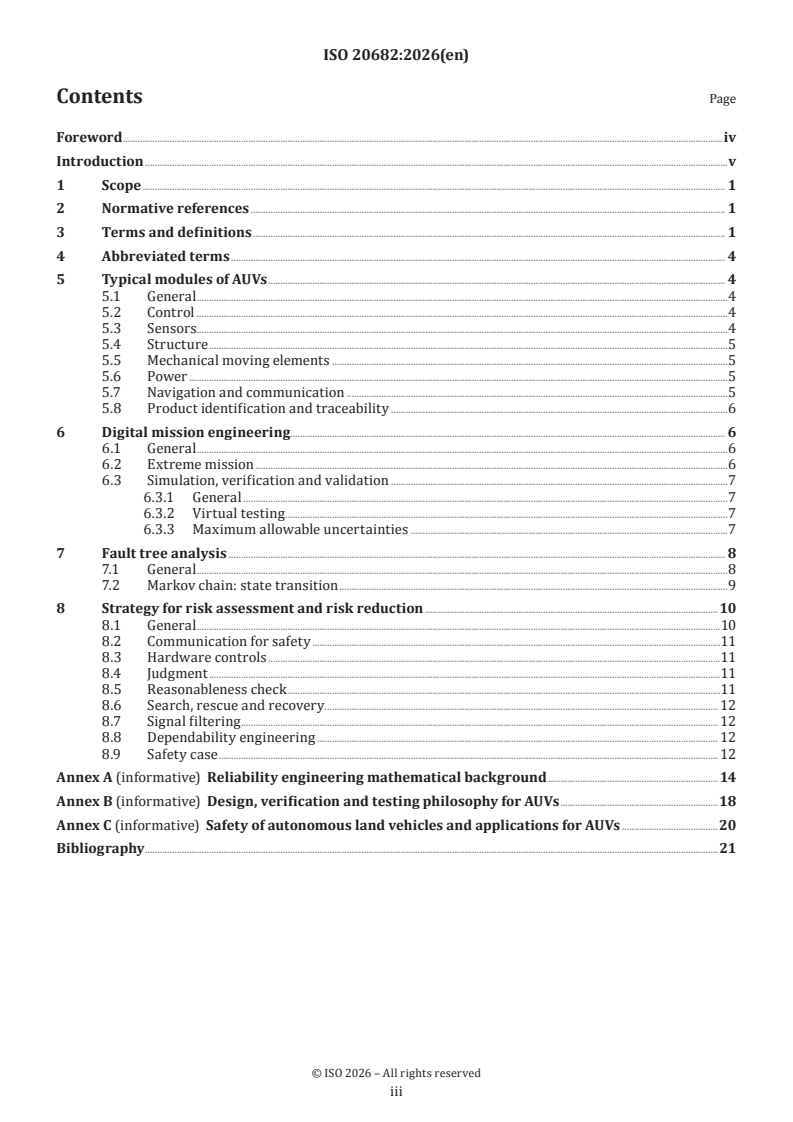
Contents Page
Foreword .iv
Introduction .v
1 Scope . 1
2 Normative references . 1
3 Terms and definitions . 1
4 Abbreviated terms . 4
5 Typical modules of AUVs . 4
5.1 General .4
5.2 Control .4
5.3 Sensors . .4
5.4 Structure .5
5.5 Mechanical moving elements .5
5.6 Power .5
5.7 Navigation and communication .5
5.8 Product identification and traceability .6
6 Digital mission engineering. 6
6.1 General .6
6.2 Extreme mission .6
6.3 Simulation, verification and validation .7
6.3.1 General .7
6.3.2 Virtual testing .7
6.3.3 Maximum allowable uncertainties .7
7 Fault tree analysis . 8
7.1 General .8
7.2 Markov chain: state transition .9
8 Strategy for risk assessment and risk reduction . 10
8.1 General .10
8.2 Communication for safety .11
8.3 Hardware controls .11
8.4 Judgment .11
8.5 Reasonableness check .11
8.6 Search, rescue and recovery . . 12
8.7 Signal filtering . . 12
8.8 Dependability engineering . 12
8.9 Safety case . 12
Annex A (informative) Reliability engineering mathematical background . 14
Annex B (informative) Design, verification and testing philosophy for AUVs .18
Annex C (informative) Safety of autonomous land vehicles and applications for AUVs .20
Bibliography .21
iii
Foreword
ISO (the International Organization for Standardization) is a worldwide federation of national standards
bodies (ISO member bodies). The work of preparing International Standards is normally carried out through
ISO technical committees. Each member body interested in a subject for which a technical committee
has been established has the right to be represented on that committee. International organizations,
governmental and non-governmental, in liaison with ISO, also take part in the work. ISO collaborates closely
with the International Electrotechnical Commission (IEC) on all matters of electrotechnical standardization.
The procedures used to develop this document and those intended for its further maintenance are described
in the ISO/IEC Directives, Part 1. In particular, the different approval criteria needed for the different types
of ISO document should be noted. This document was drafted in accordance with the editorial rules of the
ISO/IEC Directives, Part 2 (see www.iso.org/directives).
ISO draws attention to the possibility that the implementation of this document may involve the use of (a)
patent(s). ISO takes no position concerning the evidence, validity or applicability of any claimed patent
rights in respect thereof. As of the date of publication of this document, ISO had not received notice of (a)
patent(s) which may be required to implement this document. However, implementers are cautioned that
this may not represent the latest information, which may be obtained from the patent database available at
www.iso.org/patents. ISO shall not be held responsible for identifying any or all such patent rights.
Any trade name used in this document is information given for the convenience of users and does not
constitute an endorsement.
For an explanation of the voluntary nature of standards, the meaning of ISO specific terms and expressions
related to conformity assessment, as well as information about ISO's adherence to the World Trade
Organization (WTO) principles in the Technical Barriers to Trade (TBT), see www.iso.org/iso/foreword.html.
This document was prepared by Technical Committee ISO/TC 8, Ships and Marine Technology, Subcommittee
SC 13, Marine Technology.
Any feedback or questions on this document should be directed to the user’s national standards body. A
complete listing of these bodies can be found at www.iso.org/members.html.
iv
Introduction
Autonomous underwater vehicles (AUVs) are uncrewed vehicles. They rely on sensors, control units, and
mechanical parts to manoeuvre and complete mostly pre-defined tasks in the ocean environment. A growing
trend in underwater technology is to face the extreme environment, which refers to, for example, polar
environments, rapid currents, extremely high temperatures due to underwater volcanoes, underwater oil
plumes, etc. The side effect of using AUVs in extreme environments, however, is a higher risk and probability
of failure. The capacity for uncrewed underwater vehicles to perform an extreme mission, which is to
perform in an increased level of difficulty, is unknown. Usually, a team of experts employs the vehicle within
a trial-and-error process to:
a) achieve the system identification, and
b) measure (most of the time qualitatively) the reliability of the AUV for a specific mission.
This document specifies how an AUV can carry out the actions described in a) and b). This document can
therefore be used by the owners and operators of AUVs when designing missions. It should be noted that
risk and reliability by nature are probabilistic. This document serves as a linkage between the capabilities
of the vehicle and its intended mission, so as to avoid foreseeable undesired settings and circumstances.
Despite this ability to foresee problems, faults and failures of the vehicle can be due to uniquely encountered
states that have never been observed before. In such cases, dynamic risk analysis and online topic models
can be used to expand the operational proficiency of an autonomous vehicle.
v
International Standard ISO 20682:2026(en)
Autonomous underwater vehicles — Risk and reliability
1 Scope
This document specifies the risks and reliability of an autonomous underwater vehicle (AUV) in its
underwater realm. It covers sensors, communication devices, and any other pieces and parts directly
influencing the “digital mission” of the vehicle. This document does not cover the manufacturing or operation
of the following items:
— autonomous underwater gliders (AUGs), as they use a narrowly modifiable set of operational commands;
— batteries for the use of AUVs;
— electrical motors for the use of AUVs.
2 Normative references
There are no normative references in this document.
3 Terms and definitions
For the purposes of this document, the following terms and definitions apply.
ISO and IEC maintain terminology databases for use in standardization at the following addresses:
— ISO Online browsing platform: available at https:// www .iso .org/ obp
— IEC Electropedia: available at https:// www .electropedia .org/
3.1
abort
to terminate, in a controlled manner, a processing activity in a computer system because it is impossible,
undesirable, or unsafe for an activity to proceed
3.2
availability
degree to which a system or resource is ready when needed
3.3
backout and recovery
activity conducted to bring the system back to a stable state, ending the accident life cycle
3.4
built-in test
test that can be designed into the system by various techniques regarding automation, software, and
firmware, and considering the life cycle of the potential accident
3.5
burn-in test
accelerated production test that is designed to detect infant mortality, that is to flush out weaknesses within
the component, device or subsystem
3.6
characteristic value
value of a parameter (either an action or a property of a member or a material) that has a specified probability
of not being exceeded
Note 1 to entry: Action refers to external load applied to the vehicle, or an imposed deformation or acceleration.
[SOURCE: ISO 8930:2021, 3.2.2, modified — note to entry added to define the term “action” in this context.]
3.7
code calibration
determination of the reliability elements in a given code format in order to reach the reliability target
3.8
command
control signal or a request from a terminal for the performance of an operation or execution of a particular
program
3.9
design value
value to be used in the deterministic design procedure, i.e. characteristic value (3.6) multiplied by the safety
factor
3.10
deterministic method
calculation method in which the basic variables are treated as non-random
3.11
design point
most probable outcome of the basic variables when failure (3.16) occurs
Note 1 to entry: The design point is the point on the limit-state surface with the highest probability density.
3.12
digital mission engineering
modelling of things that move through space in six degrees of freedom (DoF) and time, involving sensors
and information transfer
Note 1 to entry: The term was originally coined in assisting the successful conduction of outer space missions.
3.13
error
discrepancy between a computed, observed, or measured value or condition and the true, specified, or
theoretically correct value or condition
3.14
fail-operational
design of a subsystem or device in a way that it can continue operation despite the occurrence of a discrete
malfunction
3.15
fail-safe
characteristic of a system whereby any malfunction affecting the system safety will cause the system to
revert to a state that is known to be within acceptable risk parameters
3.16
fail-soft
characteristic of a system that continues to provide partial operational capability in the event of a certain
malfunction
3.17
failure
inadvertent termination of a capability of a functional unit to perform its required operation
3.18
fault
inadvertent condition that causes a function to fail to perform in a required (appropriate) manner
3.19
node
point where one or more functional units interconnect, or the representation of a state or an event by means
of a point in a diagram
Note 1 to entry: In a tree structure, a node is a point at which subordinate items of data and information originate.
3.20
normal operation
conditions that arise from the intended use and application of the vehicle, including associated condition
and integrity monitoring, maintenance, and repair
Note 1 to entry: Normal operations include steady manoeuvring over the full range of design speeds, as well as possible
abrupt turns and stopping.
[SOURCE: ISO 16708:2006, 3.28, modified — “pipeline” has been changed to “vehicle” for the use of this
document.]
3.21
redundancy
existence in a system of more than one means of accomplishing a given function
3.22
reliability
ability of a system to perform its required functions under stated conditions for a specified period of time
Note 1 to entry: A reliable system is no total assurance of acceptable risk.
3.23
safety case
structured argument backed by evidence
3.24
sensor
device that converts measurable elements of a physical process into data that is meaningful to a computer
3.25
system effectiveness
function of availability, dependability, and capability:
P(E) = P(A) · P(D) · P(C)
3.26
unit
lowest level of hardware assembly for which acceptance and qualification tests are required
[SOURCE: ISO 19683:2017, 3.4]
3.27
validation
checking of data for correctness or compliance with applicable standards, rules, and conventions
3.28
verification
act of determining whether an operation has been accomplished correctly
4 Abbreviated terms
AUV autonomous underwater vehicle
COTS commercial-off-the-shelf
GPS Global Positioning System
Dgps differential GPS
MTBF Mean Time to Failure
SaFAD Safety First for Automated Driving
SOTIF Safety of the Intended Functionality
5 Typical modules of AUVs
5.1 General
AUVs have been employed in the subsea industry for the past few decades. They have shown effective
performance in alignment with the emerging trends in science and technology. More rapid production and
versatile utilization of these vehicles is foreseen in the future because they have both a robust design and an
adaptive performance. Typical modules of a modern AUV are described in 5.2 to 5.8.
NOTE The major subsystems of an AUV include the propulsion system, navigation system, communication system,
[1]
power system, security detection system and sensor system.
5.2 Control
The control unit has the most direct involvement in the fault incident. Although it is not physically engaged
with the AUV mission, the control module of the vehicle shall correctly receive inputs from and send
commands to other units.
5.3 Sensors
For this document, the sensors gather every input that must be known for either data acquisition or control
purposes of the vehicle. For data acquisition, where data are gathered for subsequent analysis and processing
of the mission conditions, a fault incident is not critically detrimental to the mission. At a later time, the
operator decides to either replicate or interpolate and extrapolate the missing part of the data. Where data
are used as input to the control module, a sensor fault means one or both of the following.
a) Data input is completely interrupted in a way that one or many of the input parameters are completely
missing. Depending on the input-output relations, that is the parametric response, the vehicle is
susceptible to either incremental or immediate malfunction. Based on such a response, the autonomous
vehicle decides on how to abort the mission. In other words, mission abort is a definite result, while the
vehicle can hinder abort if this helps to avoid a more severe failure (i.e. fail-soft).
b) Data input is a parasitic intermittent signal. Two scenarios can be imagined:
1) signal disturbance sustains at a level that does not invoke an emergency action (i.e. fail-operational);
2) signal disturbance excites an increasing level of errors that interfere with mission integrity (i.e.
fail-safe).
5.4 Structure
The vehicle structure carries all the static and dynamic loads that are present in the sea. These include
contact and non-contact forces and moments. A fault in a structural module falls under a wide range of
exceedance criteria for stress, strain, leakage, breakage, rupture, etc. The present technology is incapable
of the online recognition and cure of a structural fault. Biomimetics can progress the technology of future
uncrewed vehicles to have “living” tissues that sense “pain” as a fault. At present, a fault in the structure
is indirectly detected through the sensor module as an exceeded level of elements such as pressure or
moisture.
NOTE The structure of the vehicle is the boundary that encapsulates and therefore protects all parts of the
vehicle from outside harm. Any part that protrudes the structural boundary can itself have a shield or shroud to act as
a safety guard.
5.5 Mechanical moving elements
These include every actuator, manipulator and machine that works for one or both of the following purposes:
a) to move and manoeuvre the AUV either on the surface of the sea or subsea;
b) to trigger a change of mode of motion between different mission phases.
A fault in mechanical moving elements respective to the above types is categorized as:
c) having an immediate effect on the vehicle motion;
d) being hidden until a trigger is commanded.
5.6 Power
The power module of the vehicle has the most obvious fault symptom as compared to the other modules:
depleted or malfunctioning power immobilizes the vehicle.
NOTE Electric motors and batteries are not covered in this document. It is assumed that electric motors and
batteries work within their prescribed range of safe operation.
5.7 Navigation and communication
[2]
AUV navigation and localization tools and techniques can be categorized as follows.
a) Inertial or dead reckoning, which may function in the form of one or several of the following technologies:
1) compass
2) doppler velocity logger (DVL)
3) inertial measuring unit (IMU)
4) pressure sensor
b) Acoustic transponders, which are commonly chosen among the following technologies:
1) single fixed beacon
2) short baseline
3) ultra-short baseline (USBL)
4) long baseline (LBL) or GPS intelligent buoys (GIBs)
c) Geophysical, which can use any of the following technologies:
1) optical, which uses cameras, and they are varied by their capability in recognizing scales and
dimensions as follows:
i) monocular
ii) stereo
2) acoustic, which is used in the geophysical sense, that is to use a sound navigation and ranging device
(SONAR) for building an acoustic image of the surroundings by either of the following technologies:
i) imaging sonar
ii) ranging sonar
3) magnetic, which uses the magnetic field maps for localization by the following technology:
i) magnetometer
A safe-navigation capability specified in International Regulations for Preventing Collisions at Sea (COLREG)
[3]
can be implemented when deploying autonomous marine vehicles.
5.8 Product identification and traceability
The establishment of a common set of data and well-defined definitions and formats for product identification
and traceability provides the base on which to build specific requirements for the exchange of product life
cycle information.
ISO/IEC 15434 defines a syntax that is used in many applications.
6 Digital mission engineering
6.1 General
In digital mission engineering, the moving objects that are traced also communicate together, thus enabling
[4]
the engineer to analyse and plan a mission.
Digital mission engineering can increase the reliability of AUVs by analysing of elements and components of
their missions. It analyses the engineering trade-offs at different levels of the system stack and their impact
on the mission, such as the virtual what-if possibilities when the AUV is deployed in the real world and
[4]
becomes operational.
For a successful mission, it is a subject of increasing importance to accurately plan, predict, estimate, and
follow detailed pieces of information in time and space. The successful completion of a mission (failure-free
[5]
mission) increases vehicle reliability.
The success of a digital mission means that a successful algorithm guides the vehicle to achieve its sequential
and final goal.
6.2 Extreme mission
Underwater explorations, considering that the place is unoccupied by humans, belong to extreme
environments. As a result, every underwater journey is originally aidless when viewed from the human
civilization point of view. Elements of hazard control such as backout and recovery, built-in test, burn-in test,
and redundancy, can save the system in such conditions.
When a mission has new features concerning either geographical location or speed, or both, as well as the
dynamic and interactive circumstances that occur, then the journey is even more aidless than before. The
best chance that the AUV does not fail in such conditions is described by aspects such as characteristic
value, code calibration, design value, deterministic method, design point, normal operation and system
effectiveness.
In summary, the probability of failure in an extreme mission is higher than in a typical mission if they are
both tried for a sufficiently large number of repetitions. It means that when the system goes by its design
value, assuming a deterministic method is run and code calibration performed, then during adverse
conditions, hazard control is run, the vehicle is more likely to survive if the mission is not extreme.
An example of an extreme mission is the sea trials of the AUV named Explorer in response to an underwater
[6] [7]
oil spill. Azarsina analysed this case by calculating the performance margins of the control planes.
The following three states are defined for each of the components.
— U is the up state (i.e. actuation of the correct hydrodynamic force from one node to the next within a
given actuating time), P(U) = 0,979 probability of the up state.
— D is the down state (i.e. no actuation of the planes due to failure of the component, e.g. gears stuck,
electric lines broke, or exceedance of actuating time), and
— P(D) = 0,02 is the probability of the down state.
According to Reference [7], it is known that there have been not many instances of a down state. There
have been instances when fish (squid) or large kelp have obstructed or constrained plane movement. A
probability of down state of 2 % is likely a reasonable estimate. The fault state, F, is the running of a fault
actuation, e.g. wrong order of actuation, coupling of motions, or corruption of signal. The probability of the
fault state is P(F) = 0,001.
In the future, climate change and an increased use of underwater space by humans could push subsea
technology further into extreme missions. The virtual what-if scenarios defined in digital mission
engineering can help decrease uncertainty in every condition.
NOTE Human operators of an uncrewed vehicle, which is designed to work in hazardous environments, such as a
[8]
mine sweeper, can stay in an “assist vehicle” during the procedure and are never exposed to a minefield, etc.
6.3 Simulation, verification and validation
6.3.1 General
The autonomous system involves multiple failure modes. Simulation is increasingly important in enabling
many cases and
...