


ISO/PRF 24037
(Main)Ships and marine technology — Requirements and guidance for training, qualification and competency of submersible system crew and other key personnel
Ships and marine technology — Requirements and guidance for training, qualification and competency of submersible system crew and other key personnel
To provide a Standard for the competency of personnel involved in operating untethered manned submersible vehicle systems (MSVS).
Titre manque
General Information
- Status
- Not Published
- Technical Committee
- ISO/TC 8/SC 13 - Marine technology
- Drafting Committee
- ISO/TC 8/SC 13 - Marine technology
- Current Stage
- 5020 - FDIS ballot initiated: 2 months. Proof sent to secretariat
- Start Date
- 13-Apr-2026
- Completion Date
- 18-Apr-2026
Overview
ISO/PRF 24037 establishes comprehensive requirements and guidance for training, qualification, and competency of crew and other key personnel involved in operating untethered manned submersible vehicle systems (MSVS). Developed by ISO/TC 8/SC 13, this standard addresses the absence of industry-wide benchmarks for competency in the growing sector of manned submersible systems, promoting higher safety, operational consistency, and transferability of skills across the marine industry.
This standard is relevant for organizations and professionals responsible for manned submersible system operation, maintenance, engineering, and safety management. It is specifically intended for untethered and non-conventional submersible vehicles-not including naval submarines or diving bells.
Key Topics
Training and Qualification Frameworks
- Defines fundamental competency requirements for all personnel involved in manned submersible system operations.
- Sets forth guidelines for the establishment of structured training programs and career path methodologies, including apprenticeship, on-job learning, and specialist training.
- Aligns qualification processes and certification standards with recognized international marine training standards (IMO, STCW).
Roles and Responsibilities
- Outlines critical crew positions such as Pilot, Co-Pilot, MSS Engineering and Maintenance Manager, Passenger Safety Officer, Operation Supervisor, Launch and Recovery System Supervisor, and more.
- Details essential qualifications, competency assessments, and the allocation of responsibilities for safety-critical tasks.
Training Management System (TMS)
- Recommends implementing a systematic TMS comprising analysis, design, delivery, and assurance stages to ensure ongoing competency and safety.
- Supports continuous assessment, record-keeping, and updating of qualifications in alignment with international standards like ISO 9001 and ISO 45001.
- Emphasizes the importance of gap analysis, equivalency assessments, and recovery of lapsed certifications for personnel currency.
Compliance with IMO and International Standards
- References requirements from the International Maritime Organization (IMO) and other relevant global conventions for seafarer training and certification.
- Encourages harmonization of training protocols with marine sector best practices.
Applications
ISO/PRF 24037 supports a wide range of operational and management applications in the submersible systems sector:
- Manned Submersible Operators: Establishes a consistent framework to train and qualify pilots, maintenance engineers, and safety officers, ensuring they meet minimum safety and competency standards.
- Training Providers & Marine Academies: Offers clear benchmarks for designing curriculum and competency assessments tailored for manned submersible system crew.
- Safety and Compliance Management: Assists organizations in meeting regulatory requirements and implementing effective competence assurance and incident risk mitigation.
- Transition of Personnel: Facilitates mobility and career progression for marine professionals by standardizing qualifications, thereby minimizing induction and crossover training costs for new recruits.
- Project Planning & Operations: Supports operational planning through structured workforce management and by ensuring that only qualified personnel occupy safety-critical roles.
Related Standards
Organizations looking to implement ISO/PRF 24037 should be aware of the following related standards to ensure a comprehensive approach to quality and safety in marine operations:
- ISO 9001: Quality management systems – Requirements
- ISO 45001: Occupational health and safety management systems – Requirements with guidance for use
- ISO 5411: Ships and marine technology – Submersibles – Vocabulary
- STCW (International Convention on Standards of Training, Certification and Watchkeeping for Seafarers)
- IMO Guidelines for Passenger Submersible Craft
Practical Value
Implementing ISO/PRF 24037 ensures that all personnel involved in manned submersible system operations are trained and competent, reducing operational risk, preventing incidents, and providing assurance to stakeholders. By setting baseline requirements and harmonizing competency standards, this standard supports safer, more effective marine operations and helps organizations meet both regulatory obligations and industry best practices.
Buy Documents

ISO/PRF 24037 - Ships and marine technology — Requirements and guidance for training, qualification and competency of submersible system crew and other key personnel

ISO/PRF 24037 - Ships and marine technology — Requirements and guidance for training, qualification and competency of submersible system crew and other key personnel

REDLINE ISO/PRF 24037 - Ships and marine technology — Requirements and guidance for training, qualification and competency of submersible system crew and other key personnel
Get Certified
Connect with accredited certification bodies for this standard

DNV
DNV is an independent assurance and risk management provider.

Lloyd's Register
Lloyd's Register is a global professional services organisation specialising in engineering and technology.

BSI Group
BSI (British Standards Institution) is the business standards company that helps organizations make excellence a habit.
Sponsored listings
Frequently Asked Questions
ISO/PRF 24037 is a draft published by the International Organization for Standardization (ISO). Its full title is "Ships and marine technology — Requirements and guidance for training, qualification and competency of submersible system crew and other key personnel". This standard covers: To provide a Standard for the competency of personnel involved in operating untethered manned submersible vehicle systems (MSVS).
To provide a Standard for the competency of personnel involved in operating untethered manned submersible vehicle systems (MSVS).
ISO/PRF 24037 is classified under the following ICS (International Classification for Standards) categories: 03.100.30 - Management of human resources; 47.080 - Small craft. The ICS classification helps identify the subject area and facilitates finding related standards.
ISO/PRF 24037 is available in PDF format for immediate download after purchase. The document can be added to your cart and obtained through the secure checkout process. Digital delivery ensures instant access to the complete standard document.
Standards Content (Sample)
DRAFT
International
Standard
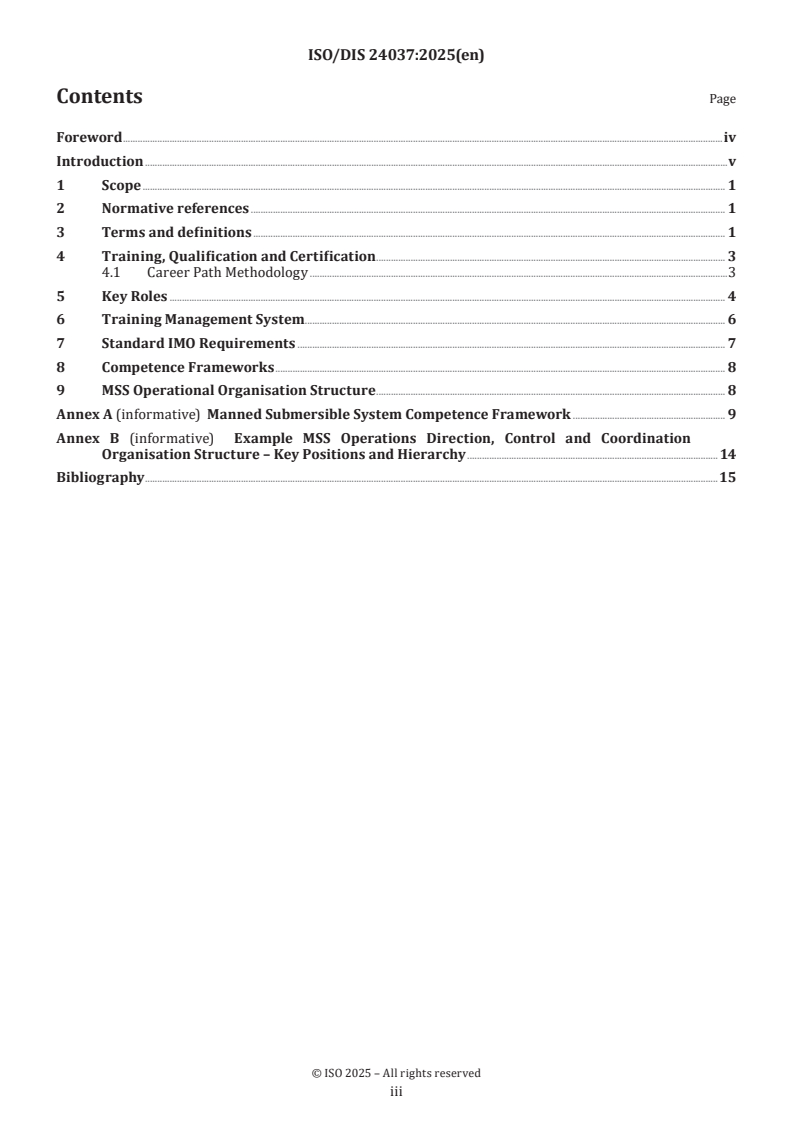
ISO/DIS 24037
ISO/TC 8/SC 13
Training, qualification and
Secretariat: SAC
competency standards for manned
Voting begins on:
submersible system crew and other
2025-09-09
key personnel
Voting terminates on:
ICS: 03.100.30; 47.080
2025-12-02
THIS DOCUMENT IS A DRAFT CIRCULATED
FOR COMMENTS AND APPROVAL. IT
IS THEREFORE SUBJECT TO CHANGE
AND MAY NOT BE REFERRED TO AS AN
INTERNATIONAL STANDARD UNTIL
PUBLISHED AS SUCH.
IN ADDITION TO THEIR EVALUATION AS
BEING ACCEPTABLE FOR INDUSTRIAL,
TECHNOLOGICAL, COMMERCIAL AND
USER PURPOSES, DRAFT INTERNATIONAL
STANDARDS MAY ON OCCASION HAVE TO
This document has not been edited by the ISO Central Secretariat.
BE CONSIDERED IN THE LIGHT OF THEIR
POTENTIAL TO BECOME STANDARDS TO
WHICH REFERENCE MAY BE MADE IN
NATIONAL REGULATIONS.
RECIPIENTS OF THIS DRAFT ARE INVITED
TO SUBMIT, WITH THEIR COMMENTS,
NOTIFICATION OF ANY RELEVANT PATENT
RIGHTS OF WHICH THEY ARE AWARE AND TO
PROVIDE SUPPORTING DOCUMENTATION.
Reference number
ISO/DIS 24037:2025(en)
DRAFT
ISO/DIS 24037:2025(en)
International
Standard
ISO/DIS 24037
ISO/TC 8/SC 13
Training, qualification and
Secretariat: SAC
competency standards for manned
Voting begins on:
submersible system crew and other
key personnel
Voting terminates on:
ICS: 03.100.30; 47.080
THIS DOCUMENT IS A DRAFT CIRCULATED
FOR COMMENTS AND APPROVAL. IT
IS THEREFORE SUBJECT TO CHANGE
AND MAY NOT BE REFERRED TO AS AN
INTERNATIONAL STANDARD UNTIL
PUBLISHED AS SUCH.
IN ADDITION TO THEIR EVALUATION AS
BEING ACCEPTABLE FOR INDUSTRIAL,
© ISO 2025
TECHNOLOGICAL, COMMERCIAL AND
USER PURPOSES, DRAFT INTERNATIONAL
All rights reserved. Unless otherwise specified, or required in the context of its implementation, no part of this publication may
STANDARDS MAY ON OCCASION HAVE TO
be reproduced or utilized otherwise in any form or by any means, electronic or mechanical, including photocopying, or posting on
This document has not been edited by the ISO Central Secretariat. BE CONSIDERED IN THE LIGHT OF THEIR
the internet or an intranet, without prior written permission. Permission can be requested from either ISO at the address below
POTENTIAL TO BECOME STANDARDS TO
WHICH REFERENCE MAY BE MADE IN
or ISO’s member body in the country of the requester.
NATIONAL REGULATIONS.
ISO copyright office
RECIPIENTS OF THIS DRAFT ARE INVITED
CP 401 • Ch. de Blandonnet 8
TO SUBMIT, WITH THEIR COMMENTS,
CH-1214 Vernier, Geneva
NOTIFICATION OF ANY RELEVANT PATENT
Phone: +41 22 749 01 11
RIGHTS OF WHICH THEY ARE AWARE AND TO
PROVIDE SUPPORTING DOCUMENTATION.
Email: copyright@iso.org
Website: www.iso.org
Published in Switzerland Reference number
ISO/DIS 24037:2025(en)
ii
ISO/DIS 24037:2025(en)
Contents Page
Foreword .iv
Introduction .v
1 Scope . 1
2 Normative references . 1
3 Terms and definitions . 1
4 Training, Qualification and Certification . 3
4.1 Career Path Methodology .3
5 Key Roles . 4
6 Training Management System . . 6
7 Standard IMO Requirements . 7
8 Competence Frameworks . 8
9 MSS Operational Organisation Structure . 8
Annex A (informative) Manned Submersible System Competence Framework . 9
Annex B (informative) Example MSS Operations Direction, Control and Coordination
Organisation Structure – Key Positions and Hierarchy . 14
Bibliography .15
iii
ISO/DIS 24037:2025(en)
Foreword
ISO (the International Organization for Standardization) is a worldwide federation of national standards
bodies (ISO member bodies). The work of preparing International Standards is normally carried out through
ISO technical committees. Each member body interested in a subject for which a technical committee
has been established has the right to be represented on that committee. International organizations,
governmental and non-governmental, in liaison with ISO, also take part in the work. ISO collaborates closely
with the International Electrotechnical Commission (IEC) on all matters of electrotechnical standardization.
The procedures used to develop this document and those intended for its further maintenance are described
in the ISO/IEC Directives, Part 1. In particular, the different approval criteria needed for the different types
of ISO documents should be noted. This document was drafted in accordance with the editorial rules of the
ISO/IEC Directives, Part 2 (see www.iso.org/directives).
Attention is drawn to the possibility that some of the elements of this document may be the subject of patent
rights. ISO shall not be held responsible for identifying any or all such patent rights. Details of any patent
rights identified during the development of the document will be in the Introduction and/or on the ISO list of
patent declarations received (see www.iso.org/patents).
Any trade name used in this document is information given for the convenience of users and does not
constitute an endorsement.
For an explanation of the voluntary nature of standards, the meaning of ISO specific terms and expressions
related to conformity assessment, as well as information about ISO's adherence to the World Trade
Organization (WTO) principles in the Technical Barriers to Trade (TBT), see www.iso.org/iso/foreword.html.
This document was prepared by Technical Committee ISO/TC 8, Ships and marine technology, Subcommittee
SC 13, Marine technology.
This is the first edition.
Any feedback or questions on this document should be directed to the user’s national standards body. A
complete listing of these bodies can be found at www.iso.org/members.html.
iv
ISO/DIS 24037:2025(en)
Introduction
The growing number of manned submersible systems (MSS) in use around the world are operated by
personnel filling the key roles of piloting, atmosphere control, power management, passenger safety,
submersible system maintenance, operational management and other essential positions. These MSS vary in
complexity, capability and function; however, the common attribute is that they are all relatively small and
designed to be operated independently underwater by single or small numbers of crew.
There is some industry guidance available from recognised bodies concerning the operation of MSS, however
there is no industry Standard for competency levels that are comparable to other marine sector professionals
such as dynamic positioning operators. Therefore, there is a need to provide an operating safety benchmark
for personnel designated as crew members, maintenance engineers or MSS operational management, all
of whom are required to be adequately trained and qualified to be competent to operate MSS and to be
competent to respond to all reasonably foreseeable emergencies. For each system, the details of the specific
special to type/class training will need to be configured to the explicit requirements of the submersible
vehicle. This will usually be done in-house by the MSS operators. However, there are fundamental theoretical
and practical competency requirements for personnel engaged or planning to engage in this professional
area and these can be reasonably acquired through training methodologies in specialist marine educational
facilities or industry sponsored training programmes. These programmes should cover the minimum
required skill levels which must be considered in submersible operator training solutions.
The aim of this Standard is to provide guidance on common competence requirements and qualifications
for manned submersible operations to enable operators to develop their own competence schemes, thereby
enabling an industry-wide commonality.
The objectives of the Standard are to:
a. Provide confidence that all personnel appointed to safety-critical and other key positions can carry out
their jobs in an effective manner.
b. Develop an industry recognised competent workforce Standard.
c. Outline a baseline competence framework.
d. Reduce operating risk and improve safety.
e. Support an effective assessment procedure.
f. Specify minimum standards for qualifications.
g. Recommend minimum levels of experience required for achievement of competence.
h. Develop industry accepted procedures, criteria and recording system for competence management.
In providing baseline levels of competency and parameters for the award of appropriate qualifications
for such personnel, the ISO’s intent is to provide all stakeholders including operators, clients, authorising
agencies and the general public, with appropriate confidence in the operating safety assurance system for
this marine specialisation.
v
DRAFT International Standard ISO/DIS 24037:2025(en)
Training, qualification and competency standards for manned
submersible system crew and other key personnel
1 Scope
This Standard is designed to be applicable to any manned submersible system (MSS) or craft. Because of
the wide variety of design, task and operating circumstances of such craft specific qualifications and skill
training requirements will reflect the specific needs of the submersible. However, the fundamental principles
of these qualification and training requirements are likely to be common and it is the aim of this Standard
to describe these to provide guidance to submersible operators. Conventional and nuclear powered naval
submarines, and diving bells are not addressed in this Standard.
2 Normative references
The following documents are referred to in the text in such a way that some or all of their content constitutes
requirements of this document.
ISO 9001:2015, Quality management systems — Requirements
ISO 45001:2018, Occupational health and safety management systems — Requirements with guidance for use
ISO 5411, Ships and marine technology — Submersibles — Vocabulary
3 Terms and definitions
For the purposes of this document, the following terms and definitions apply.
3.1
breathing air supply system
the equipment providing breathing air to the manned compartment(s) while the manned submersible is
surfaced or submerged
3.2
emergency breathing air supply and CO2 adsorption system
the equipment which provides an independent emergency air supply and CO2 removal to the occupants via
either full-face masks, oral-nasal masks or self-contained rebreathers as a contingency for a situation in
which the atmosphere in the submersible was contaminated or compromised by toxins resulting from fire
or other causes term
3.3
launch and recovery system
LARS
system supporting launch, recovery and other handling operations of a submersible
3.4
launch and recovery procedure
procedures by which the submersible is normally launched and recovered using the launch and recovery
equipment
3.5
life support system
equipment and systems required to maintain a manned submersible (3.1.2) in a habitable condition in all
anticipated operating conditions
ISO/DIS 24037:2025(en)
3.6
manned submersible system
MSS
vessel and supporting ancillary equipment that is used to carry personnel and/or passengers while
operating underwater, submerging, surfacing and remaining afloat with the internal pressure of the manned
compartment normally maintained at or near one atmosphere
3.7
passenger
every person other than the pilot and crew within a transport submersible, who has no formal role in the
operation of the submersible
3.8
passenger submersible
passenger-carrying submersible, which primarily operates underwater and relies on surface support
3.9
pilot
person appointed and qualified to command a submersible
3.10
atmosphere control system
atmosphere control system maintains the habitability of the internal pressure module’s conditions including
the onboard breathing gas supplies, gas mixing and CO2 scrubbing systems.
3.11
power management control
vessel power generation, supply and reserve power control system
3.12
pressure hull
shell capable of withstanding the internal and external design pressure (3.2.10) , in which occupants and the
required equipment are housed
3.13
reserve breathing air supply and CO2 adsorption system
equipment used to supply breathing air and CO2 removal to the crew of a manned compartment when there
is a situation that prevents the submersible from reaching the surface of the water.
3.14
scrubbers
equipment used to remove certain molecules from the atmospheres inside submersible vessels – usually
related to the removal by absorption of carbon dioxide (CO2).
3.15
underwater telephone
UWT
device which is designed to establish a real-time communication link between a manned submersible and a
support ship [or other craft] by through water audio.
3.16
occupied compartment
the compartment or compartments inside the submersible’s pressure hull in which people are carried,
generally maintained at a pressure of one atmosphere but for rescue submersibles this may not be the case.
3.17
person under training
any personnel undergoing training to fill a role as a competent operator, who is unqualified in that role and
who therefore cannot be given direct responsibility for the fulfilment of that role until such time as they
have been assessed they are competent to do so.
ISO/DIS 24037:2025(en)
3.18
MOSHIP
a surface vessel onto which a submersible has been mobilised or embarked and from which it is transported
to a selected operating area and launched and recovered.
4 Training, Qualification and Certification
4.1 Career Path Methodology
4.1.1 While some national authorities have implemented regulatory requirements, there are no specific
internationally recognised instructions covering the training and certification needed for the crew or
operational staff for MSS operations. The International Maritime Organisation (IMO) Safety Committee
Circular 981 dated 29 January 2001 ‘Guidelines for the design, construction and operation of passenger
submersible craft’ has been used as a benchmark in the absence of more detailed guidance.
4.1.2 Currently, for personnel employed or seeking to be employed in the manned submersibles industry,
the career pathway is a familiar process common to most marine professional roles. Most people will
undergo a period of training gained either through an apprenticeship or on job training with an existing
MSS operator, or specialist training by a commercial or naval training provider, imbuing individuals with
relevant necessary skills and a degree of competency. Ideally this training is consolidated by testing and
examination to achieve ‘qualified’ status and culminates in a certification of competence procedure that
conveys professional certified status on the individual in their specialisation. This aligns with the IMO
Guidelines.
4.1.3 From this basic level of competency, companies should seek to develop and improve the professional
skill levels of their personnel through a coherent personal development process. This should include ongoing
assessment and professionally challenging personal objectives being applied during operational activity. By
implementing a career skill development process, MSS operators can enable their employees who wish to
progress and advance themselves, to achieve this goal through a structured and accredited appraisal process
as part of a Training Management System (TMS). This will also satisfy the quality, effectiveness, efficiency
and operating safety expectations of national and international regulatory and industry stakeholders.
4.1.4 Performance appraisal and competence assessment and verification are the main elements of
the process whereby skills are assessed and personnel can develop their career in a systematic manner.
Training needs are identified and opportunities for future roles are facilitated when an appraisal system
and competence scheme operate in an integrated manner.
4.1.5 An individual’s competence records are maintained to ensure that training, skill base development,
experience and knowledge acquisition gained by individuals can be used to demonstrate their competence
and be assessed against relevant specialist criteria. MSS operators should adopt a suitable and credible
Human Resource (HR) management system to record competence for their personnel. These HR management
systems shall comply with relevant personal data protection regulations and enable trained personnel to
transfer the details of their personal professional record to other industry domains, national authorities and
employers.
4.1.6 Individual company schemes conforming to an industry standard adopted by all stakeholders has
mutual benefit for all by improving the overall ability of the trained cohort within the industry. This can
facilitate a more rapid transition for incoming personnel when required to meet demanding project timelines
and minimise induction and crossover training costs.
4.1.7 Training received in submersible simulation rigs and equipment (including virtual reality systems)
can offer considerable benefits to the training outcome. This is very dependent on the quality and accuracy of
the simulator and the fidelity of the simulation software programming. However, simulation is successfully
used widely in the aviation and other industries and subject to the quality of the simulator, there is no reason
this philosophy could not be applied to MSS operations.
ISO/DIS 24037:2025(en)
5 Key Roles
5.1 There are a number of functions or roles that require personnel to be trained to a specified competence
level to ensure the safe operation of the system. Some can and often are completed by one person fulfilling
several functions or roles, but this will depend on the complexity, size and nature of the MSS operations. MSS
operating companies will need to make a judgement on the workforce level required to deliver the training,
qualification and assurance appropriate for their operations.
5.1.1 Pilots – Normally the submersible’s qualified pilot, or if two or more pilots are in the crew, the
lead or senior pilot may be the vessel’s Master. They have to be trained to operate the submersible in all
conditions within the vessel’s designed safe operating envelope. This must include being able to use all the
equipment and systems in the vessel in its primary and reversionary modes and have a complete knowledge
of standard and emergency operating procedures. They are personally responsible for the safe operation of
the vehicle including its navigation, propulsion and buoyancy systems and for manoeuvring the vehicle in the
water. This also includes operating the vessel’s communications and any vessel fitted launch and recovery
systems. They are required to achieve an agreed level of competency before being certified to operate the
submersible as a qualified pilot. Until this has been achieved they are pilots under training.
5.1.1.1 – The second pilot on a larger MSS is also known as the co-pilot and does not have to be a fully
qualified pilot. They must however be qualified in the co-pilot or ‘Pilot 2’ role.
5.1.1.2 - The pilot or pilots will manage the vessel’s power systems. They must be able to operate the
power control system in all its modes of operation including the emergency fallback options. They must be
capable of fault finding and, where feasible, have an appropriate ability to carry out repairs to maintain the
submersible’s power supply requirements while it is operating in the water. They must understand how to
manage and operate the onboard power supplies including the engagement of the reserve and emergency
power supply options.
5.1.1.3 - The pilot or pilots may be responsible for operating the atmosphere control system in all its
modes of operation including the emergency fallback options. They must be capable of an adequate level
of fault finding and have an appropriate ability to effect repairs to maintain the submersible’s atmosphere
during its in-water operation. They must understand how to manage and operate the onboard breathing gas
supplies, any gas mixing requirements and CO2 scrubbers, absorption or removal systems.
5.1.2 MSS Engineering and Maintenance Manager – any MSS will require some form of planned
maintenance management and the system’s engineering needs must be factored into the operating
program or schedule. To ensure that these requirements are adequately met an individual should be
assigned to coherently manage this. An individual with the necessary qualified technical ability and
managerial experience should be assigned to fulfil this role. Training in the specific submersible vessel or
vessels technical specifications and the MSS operator’s maintenance management system are the essential
requirements for enabling the individual to carry out the role. They shall be capable of managing the work
of technical engineers subordinate to them and to allocate maintenance tasks accordingly and in compliance
with the vessel manufacturer’s specifications. They will hold overall responsibility for ensuring that the
MSS are kept in a state that ensures the submersible’s ‘safe to operate’ status. This role can be fulfilled by
any member of the crew including the pilot.
5.1.3 MSS Maintenance Technician/Engineer – all maintenance and engineering needs of the
submersible will be carried out by a suitably qualified and experienced engineering technician(s). They
shall be capable of carrying out all maintenance tasks and of completing the engineering tasks specified
in their areas of responsibility. They will be responsible for ensuring that the equipment and systems they
are maintaining are kept in a state that supports the overall objective of ensuring the submersible is safe
to operate. They shall be provided with the training necessary to ensure that they have sufficient technical
knowledge of the specific vessel or vessels are responsible for, to enable them to carry out their tasks safely
and effectively.
ISO/DIS 24037:2025(en)
5.1.4 Passenger Safety Officer / Manager(PSO/M)/Rescue Chamber Operator (RCO) – the safety
of passengers in a submersible should, together with that of the crew, be the highest priority for any MSS
operator. While the safety of passengers will fall directly under the overall responsibility of the vessel’s
Master, where appropriate a member o
...
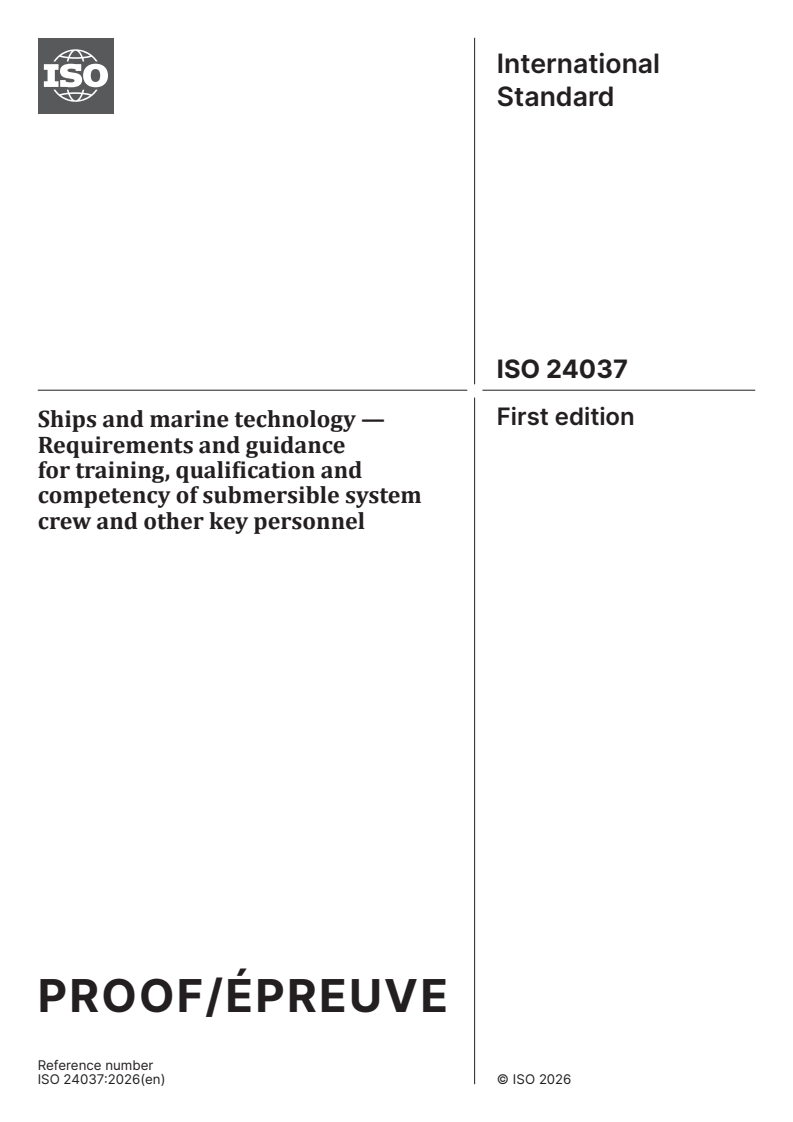
International
Standard
ISO 24037
First edition
Ships and marine technology —
Requirements and guidance
for training, qualification and
competency of submersible system
crew and other key personnel
PROOF/ÉPREUVE
Reference number
ISO 24037:2026(en) © ISO 2026
ISO 24037:2026(en)
© ISO 2026
All rights reserved. Unless otherwise specified, or required in the context of its implementation, no part of this publication may
be reproduced or utilized otherwise in any form or by any means, electronic or mechanical, including photocopying, or posting on
the internet or an intranet, without prior written permission. Permission can be requested from either ISO at the address below
or ISO’s member body in the country of the requester.
ISO copyright office
CP 401 • Ch. de Blandonnet 8
CH-1214 Vernier, Geneva
Phone: +41 22 749 01 11
Email: copyright@iso.org
Website: www.iso.org
Published in Switzerland
PROOF/ÉPREUVE
ii
ISO 24037:2026(en)
Contents Page
Foreword .iv
Introduction .v
1 Scope . 1
2 Normative references . 1
3 Terms and definitions . 1
4 Training, qualification and certification . 2
5 Key roles. 3
5.1 General .3
5.2 Pilots .4
5.3 Engineering and maintenance manager .4
5.4 Maintenance technician .4
5.5 Passenger safety officer (PSO) .4
5.6 Operations manager .5
5.7 Launch and recovery system supervisor .5
5.8 Launch and recovery system operator .5
5.9 Designated person ashore .5
5.10 Training manager and trainer .6
5.11 Health, safety and environmental protection (HSEP) manager .6
6 System for training management. 6
7 General IMO provisions . 7
8 Competence frameworks . 8
9 CSS operational organization structure . 8
Annex A (informative) CSS competence frameworks . 10
Annex B (informative) Example of CSS organizational structure . 14
Bibliography .15
PROOF/ÉPREUVE
iii
ISO 24037:2026(en)
Foreword
ISO (the International Organization for Standardization) is a worldwide federation of national standards
bodies (ISO member bodies). The work of preparing International Standards is normally carried out through
ISO technical committees. Each member body interested in a subject for which a technical committee
has been established has the right to be represented on that committee. International organizations,
governmental and non-governmental, in liaison with ISO, also take part in the work. ISO collaborates closely
with the International Electrotechnical Commission (IEC) on all matters of electrotechnical standardization.
The procedures used to develop this document and those intended for its further maintenance are described
in the ISO/IEC Directives, Part 1. In particular, the different approval criteria needed for the different types
of ISO document should be noted. This document was drafted in accordance with the editorial rules of the
ISO/IEC Directives, Part 2 (see www.iso.org/directives).
ISO draws attention to the possibility that the implementation of this document may involve the use of (a)
patent(s). ISO takes no position concerning the evidence, validity or applicability of any claimed patent
rights in respect thereof. As of the date of publication of this document, ISO had not received notice of (a)
patent(s) which may be required to implement this document. However, implementers are cautioned that
this may not represent the latest information, which may be obtained from the patent database available at
www.iso.org/patents. ISO shall not be held responsible for identifying any or all such patent rights.
Any trade name used in this document is information given for the convenience of users and does not
constitute an endorsement.
For an explanation of the voluntary nature of standards, the meaning of ISO specific terms and expressions
related to conformity assessment, as well as information about ISO's adherence to the World Trade
Organization (WTO) principles in the Technical Barriers to Trade (TBT), see www.iso.org/iso/foreword.html.
This document was prepared by Technical Committee ISO/TC 8, Ships and marine technology, Subcommittee
SC 13, Marine technology.
Any feedback or questions on this document should be directed to the user’s national standards body. A
complete listing of these bodies can be found at www.iso.org/members.html.
PROOF/ÉPREUVE
iv
ISO 24037:2026(en)
Introduction
The growing number of crewed submersible systems (CSS) in use around the world are operated by
personnel filling the key roles of piloting, atmosphere control, power management, passenger safety,
submersible system maintenance, operational management and other essential positions. These CSS vary
in complexity, capability and function; however, the common attribute is that they are all relatively small
and designed to be operated independently underwater by a single member or small numbers of crew. Given
the wide variety of design, task and operating circumstances of such crafts, the specific qualifications and
skill training requirements for each submersible will reflect its specific needs. However, the fundamental
principles of these qualification and training requirements are likely to be common and it is the aim of this
document to describe these to provide guidance to submersible operators.
There is some industry guidance available from recognized bodies concerning the operation of CSS,
however there is no industry standard for competency levels that are comparable to other marine sector
professionals such as dynamic positioning operators. Therefore, there is a need to provide an operating
safety benchmark for personnel designated as crew members, maintenance engineers or CSS operational
management, all of whom are required to be adequately trained and qualified to be competent to operate
such systems and to respond to all reasonably foreseeable emergencies. For each system, specific training
should be configured to the submersible’s operational requirements. This will usually be done in-house by
the CSS operators. However, there are fundamental theoretical and practical competency requirements
for personnel engaged or planning to engage in this professional area, which can be reasonably acquired
through training methodologies in specialist marine educational facilities or industry sponsored training
programmes. These programmes should cover the minimum required skill levels, which must be considered
in submersible operator training solutions.
The aim of this document is to provide guidance and requirements on common competence requirements
and qualifications for crewed submersible operations to enable operators to develop their own competence
schemes, thereby enabling an industry-wide commonality.
The objectives of this document are to:
a) provide confidence that all personnel appointed to safety-critical and other key positions can carry out
their jobs in an effective manner;
b) develop a standard that can be used and recognized across the industry to create a competent workforce;
c) outline a baseline competence framework;
d) reduce operating risk and improve safety;
e) support an effective assessment procedure;
f) specify minimum criteria for qualifications;
g) recommend minimum levels of experience required for achievement of competence;
h) develop industry accepted procedures, criteria and recording systems for competence management.
PROOF/ÉPREUVE
v
International Standard ISO 24037:2026(en)
Ships and marine technology — Requirements and guidance
for training, qualification and competency of submersible
system crew and other key personnel
1 Scope
This document provides requirements and guidance on common competence requirements and
qualifications for crewed submersible operations to enable operators to develop their own competence
schemes. It is applicable to any crewed submersible system (CSS) or craft. Conventional and nuclear powered
naval submarines, and diving bells are not addressed in this document.
2 Normative references
There are no normative references in this document.
3 Terms and definitions
For the purposes of this document, the following terms and definitions apply.
ISO and IEC maintain terminology databases for use in standardization at the following addresses:
— ISO Online browsing platform: available at https:// www .iso .org/ obp
— IEC Electropedia: available at https:// www .electropedia .org/
3.1
breathing gas supply system
equipment providing breathing gas to the crewed compartment(s) while the submersible is surfaced or
submerged
3.2
launch and recovery system
LARS
system supporting launch, recovery and other handling operations of a submersible
[SOURCE: ISO 5411:2024, 3.8.5, modified — note 1 to entry has been deleted.]
3.3
launch and recovery procedure
procedures by which the submersible is normally launched and recovered using the launch and recovery
equipment
3.4
life support system
equipment and systems required to maintain a crewed submersible system (3.5) in a habitable condition in all
anticipated operating conditions
3.5
crewed submersible system
CSS
vessel and supporting ancillary equipment that is used to carry personnel, passengers (3.6) or both, while
operating underwater, submerging, surfacing and remaining afloat with the internal pressure of the crewed
compartment normally maintained at or near one atmosphere
PROOF/ÉPREUVE
ISO 24037:2026(en)
3.6
passenger
every person other than the pilot (3.8) and crew within a transport submersible, who has no formal role in
the operation of the submersible
3.7
passenger submersible
passenger-carrying submersible, which primarily operates underwater and relies on surface support
[SOURCE: ISO 5411:2024, 3.1.6]
3.8
pilot
person appointed and qualified to command a submersible
[SOURCE: ISO 5411:2024, 3.11.1]
3.9
atmosphere control system
equipment that maintains the habitability of the internal pressure module’s conditions including the onboard
breathing gas supplies, gas mixing and carbon dioxide (CO2) scrubbing systems
3.10
power management control
operation of the vessel power generation, supply and reserve power control system
3.11
scrubbers
equipment used to remove certain molecules from the atmospheres inside submersible vessels, usually
related to the removal by absorption of carbon dioxide (CO2)
3.12
underwater telephone
UWT
device which is designed to establish a real-time audio communication link between a crewed submersible
and a support ship (or other craft) through water
3.13
occupied compartment
compartment inside the submersible’s pressure hull in which people are carried, generally maintained at a
pressure of one atmosphere but possibly not applicable for rescue submersibles
3.14
person under training
any personnel undergoing training to fill a role as a competent operator, who is unqualified in that role
and who therefore cannot be given direct responsibility for the fulfilment of that role until they have been
assessed and declared as competent to do so
3.15
submersible mobilisation vessel
MOSHIP
surface vessel onto which a submersible has been mobilised or embarked and from which it is transported
to a selected operating area and launched and recovered
4 Training, qualification and certification
4.1 While some national authorities have implemented regulatory requirements on the training and
certification for the crew or operational staff for CSS operations, there are no specific internationally
[1]
recognized regulations. MSC/Circular.981 of the International Maritime Organization (IMO) Marine Safety
Committee has been used as a benchmark in the absence of more detailed guidance.
PROOF/ÉPREUVE
ISO 24037:2026(en)
4.2 For personnel employed or seeking to be employed in the crewed submersibles industry, the career
pathway is a familiar process common to most marine professional roles. Most people undergo a period of
training gained either through an apprenticeship or on-the-job training with an existing CSS operator, or
specialized training by a commercial or naval training provider, imbuing individuals with relevant necessary
skills and a degree of competency. Ideally, this training is consolidated by testing and examination to enable
an individual to be considered qualified in their role. The process is expected to culminate in a certification
of competence procedure that conveys professional certified status on the individual in their specialization.
[2]
This aligns with IMO Guidelines.
4.3 From this initial level of competency, companies should seek to develop and improve the professional
skill levels of their personnel through a coherent personal development process. This should include
ongoing assessment by line managers and professionally challenging personal objectives being applied
during operational activity. Assessment processes and criteria should be described in company training
management policy. By implementing a career skill development process, CSS companies can facilitate
their employees' progress in achieving this goal through a structured and accredited appraisal process as
part of a company system for training management (STM) (6.1). This is also expected to satisfy the quality,
effectiveness, efficiency and operating safety expectations of national and international regulatory and
industry stakeholders.
4.4 Performance appraisal and competence assessment and verification are the main elements of
the process whereby skills are assessed and personnel can develop their career in a systematic manner.
Training needs are identified and opportunities for future roles are facilitated when an appraisal system
and competence scheme operate in an integrated manner.
4.5 An individual’s competence records are maintained to ensure that training, skill base development,
experience and knowledge acquisition gained by individuals can be used to demonstrate their competence
and be assessed against relevant specialist criteria. CSS operators should adopt a suitable and credible
human resource (HR) management process to record competence for their personnel. These HR management
processes should enable trained personnel to transfer the details of their personal professional record to
other industry domains, national authorities and employers.
NOTE Legal requirements can apply.
4.6 Individual company certification schemes that conform to an industry standard adopted by all
stakeholders have mutual benefit for all by improving the overall ability of the trained cohort within the
industry. Adoption of such schemes can facilitate a more rapid transition for incoming personnel when
required to meet demanding project timelines and can minimize induction and crossover training costs.
4.7 Training received in submersible simulators and other modern training equipment (including virtual
reality training aids) can offer considerable benefits to the training outcome. This is highly dependent on the
quality and accuracy of the simulator and the fidelity of the simulation software programming. Nevertheless,
simulation is widely and successfully used in the aviation industry, among others, and could therefore be
applied to CSS operations.
5 Key roles
5.1 General
There are a number of roles that require personnel to be trained to a specified competence level to ensure
the safe operation of the system. It is often the case that one person fulfils several functions or roles, but
this depends on the complexity, size and nature of the CSS operations. CSS operating companies must make
a judgement on the workforce level required to deliver the training, qualification and assurance appropriate
for their operations.
PROOF/ÉPREUVE
ISO 24037:2026(en)
5.2 Pilots
5.2.1 Normally the submersible’s qualified pilot may be the vessel’s Master. If two or more pilots are in the
crew, the lead or senior pilot may be the vessel’s Master. They shall be trained to operate the submersible
in all conditions within the vessel’s designed safe operating envelope (see Table A.1). This includes being
able to use all the equipment and systems in the vessel in its primary and reversionary modes and having
a complete knowledge of standard and emergency operating procedures. Pilots are responsible for the safe
operation of the vehicle including its navigation, propulsion and buoyancy systems and for manoeuvring the
vehicle in the water. This also includes operating the vessel’s communications e.g. underwater telephone
(UWT) and any vessel-fitted launch and recovery systems. Pilots are required to achieve an agreed level
of competency before being certified to operate the submersible as a qualified pilot. Until this has been
achieved, they are considered a person under training.
5.2.2 The second pilot on a larger CSS is also known as the co-pilot and is not required to be fully qualified.
They shall be qualified in the co-pilot or "Pilot 2" role. The requirements of this role are dependent on the
type of the submersible and its specific operating procedures, and are determined by the CSS company.
5.2.3 The pilot or pilots manage the vessel’s power systems. They shall be able to operate the power
management control system in all its modes of operation including the emergency fallback options. They shall
be capable of fault finding and, where feasible, have an appropriate ability to carry out repairs to maintain
the submersible’s power supply requirements while it is operating in the water. They shall understand how
to manage and operate the onboard power supplies including the engagement of the reserve and emergency
power supply options.
5.2.4 Pilots may be responsible for operating the atmosphere control system in all its modes of operation
including the emergency fallback options. They shall be capable of an adequate level of fault finding and
have an appropriate ability to effect repairs to maintain the submersible’s atmosphere during its in-water
operation. They shall understand how to manage and operate the onboard breathing gas supply system, any
gas mixing requirements and CO scrubbers, absorption or removal systems.
5.3 Engineering and maintenance manager
All CSS require some form of planned maintenance management. It is necessary for the system’s engineering
needs to be factored into the operating programme or schedule. To ensure that these requirements are
adequately met, an individual should be assigned to manage all engineering aspects of the submersible
operation. The assigned individual should have the necessary qualified technical ability and managerial
experience to fulfil this role, i.e. training in the specific submersible vessel's technical specifications and the
CSS operator’s maintenance system (see Table A.2). The assigned individuals shall be capable of managing
the work of technical engineers subordinate to them and allocating maintenance tasks accordingly and in
compliance with the vessel manufacturer’s specifications. They hold overall responsibility for ensuring that
the CSS are kept in a state that ensures the submersible’s “safe to operate” status. This role can be fulfilled
by any member of the crew, including the pilot.
5.4 Maintenance technician
All maintenance and engineering needs of the submersible shall be carried out by a suitably qualified and
experienced engineering technician(s). They shall be capable of carrying out all maintenance tasks and
of completing the engineering tasks specified in their areas of responsibility. They shall be responsible
for ensuring that the equipment and systems they are maintaining are kept in a state that ensures the
submersible is safe to operate. They shall be provided with the training necessary to ensure that they have
sufficient technical knowledge of the specific vessel or vessels for which they are responsible, to enable them
to carry out their tasks safely and effectively.
5.5 Passenger safety officer (PSO)
The safety of passengers and the crew in a submersible should be the highest priority for any CSS operator.
While the safety of passengers falls directly under the overall responsibility of the vessel’s Master, a member
PROOF/ÉPREUVE
ISO 24037:2026(en)
of the crew shall be assigned to be continuously responsible for the safety and well-being of passengers in
the occupied compartment of the submersible, where appropriate. This enables the Master/pilot to focus on
their primary task of the safe and effective operation of the submersible. For rescue submersibles, this role is
described as a rescue chamber operator (RCO) and include being responsible for doing this in a normobaric
or hyperbaric environment. The PSO or RCO shall know the standard and emergency operating procedures
of the life suppor
...
Style Definition
...
Style Definition
...
Style Definition
...
Style Definition
...
Style Definition
...
ISO/DISPRF 24037:2025(en)
Style Definition
...
ISO /TC 08 8/SC 13/WG 1
Style Definition
...
Style Definition
...
Secretariat: SAC
Style Definition
...
Date:2025-11-17 2026-04-13
Style Definition
...
Style Definition
...
Style Definition
...
Style Definition
...
Style Definition
...
Style Definition
...
Ships and marine technology — Requirements and guidance for
Style Definition
...
training, qualification and competency of submersible system
Style Definition
...
crew and other key personnel
Style Definition
...
Style Definition
...
Style Definition
...
Style Definition
...
Style Definition
...
Style Definition
...
Style Definition
...
Style Definition
...
Style Definition
...
Style Definition
...
Style Definition
...
Style Definition
...
Style Definition
...
Style Definition
...
Style Definition
...
Style Definition
...
Style Definition
...
Style Definition
...
Style Definition
...
Style Definition
...
Style Definition
...
Style Definition
...
Style Definition
...
Style Definition
...
Style Definition
...
Style Definition
...
Style Definition
...
Style Definition
...
Style Definition
...
Style Definition
...
Style Definition
...
Style Definition
...
Style Definition
...
Style Definition
...
Style Definition
...
Style Definition
...
Style Definition
...
Style Definition
...
Style Definition
...
Style Definition
...
Style Definition
PROOF
ISO /PRF 24037:20252026(en) Formatted: Font: 11 pt, Bold
Formatted: Font: 11 pt, Bold
Formatted: Font: 11 pt, Bold
Formatted: HeaderCentered, Space After: 0 pt, Line
spacing: single
All rights reserved. Unless otherwise specified, or required in the context of its implementation, no part of this publication
may be reproduced or utilized otherwise in any form or by any means, electronic or mechanical, including photocopying, Formatted: Default Paragraph Font
or posting on the internet or an intranet, without prior written permission. Permission can be requested from either ISO
Formatted: Adjust space between Latin and Asian text,
at the address below or ISO’s member body in the country of the requester.
Adjust space between Asian text and numbers
Formatted: Right: 1.5 cm, Bottom: 1 cm, Gutter: 0 cm,
ISO copyright office
Header distance from edge: 1.27 cm, Footer distance
CP 401 • Ch. de Blandonnet 8
from edge: 0.5 cm
CH-1214 Vernier, Geneva
Phone: + 41 22 749 01 11
Email: copyright@iso.org
E-mail: copyright@iso.org
Website: www.iso.orgwww.iso.org
Formatted: German (Germany)
Formatted: German (Germany)
Published in Switzerland
Formatted: zzCopyright address, Adjust space between
Latin and Asian text, Adjust space between Asian text
and numbers
Formatted: Font: 10 pt
Formatted: Font: 10 pt
Formatted: Font: 11 pt
Formatted: FooterPageRomanNumber, Space After: 0
pt, Line spacing: single
ii © ISO 24037 2026 – All rights reserved
ii
ISO/DISPRF 24037:20252026(en) Formatted: Font: 11 pt, Bold
Formatted: Font: 11 pt, Bold
Formatted: Font: 11 pt, Bold
Contents
Formatted: HeaderCentered, Left, Space After: 0 pt,
Line spacing: single
Foreword . v
Formatted: Adjust space between Latin and Asian text,
Introduction . vi Adjust space between Asian text and numbers
1 Scope . 1
2 Normative references . 1
3 Terms and definitions . 1
4 Training, qualification and certification . 3
5 Key roles . 4
5.1 General. 4
5.2 Pilots . 4
5.3 Engineering and maintenance manager . 4
5.4 Maintenance technician . 5
5.5 Passenger safety officer (PSO) . 5
5.6 Operations manager . 5
5.7 Launch and recovery system supervisor . 5
5.8 Launch and recovery system operator . 6
5.9 Designated person ashore . 6
5.10 Training manager and trainer . 6
5.11 Health, safety and environmental protection (HSEP) manager . 6
6 System for training management . 7
7 General IMO provisions . 8
8 Competence frameworks . 9
9 CSS operational organization structure. 9
Annex A (informative) CSS competence frameworks . 10
Annex B (informative) Example of CSS organizational structure . 16
Bibliography . 17
Foreword . iv
Introduction . v
1 Scope . 1
2 Normative references . 1
3 Terms and definitions . 1
4 Training, qualification and certification . 3
5 Key roles . 4
6 Training Management System . 7
Formatted: Font: 10 pt
7 Standard IMO Requirements . 8
Formatted: Font: 10 pt
8 Competence Frameworks . 9
Formatted: FooterCentered, Left, Space Before: 0 pt,
9 CSS Operational Organisation Structure . 9
Tab stops: Not at 17.2 cm
Formatted: Font: 11 pt
Annex A (informative) CSS Competence Framework . 11
Formatted: FooterPageRomanNumber, Left, Space
A.1 Pilot . 11
After: 0 pt, Tab stops: Not at 17.2 cm
iii
ISO /PRF 24037:20252026(en) Formatted: Font: 11 pt, Bold
Formatted: Font: 11 pt, Bold
Formatted: Font: 11 pt, Bold
A.2 CSS Maintenance Manager & Technician/Engineer . 13
Formatted: HeaderCentered, Space After: 0 pt, Line
A.3 Passenger Safety Officer and Rescue Chamber Operator . 14
spacing: single
A.4 CSS Operation Manager and Supervisor . 15
A.5 Launch and Recovery System Manager /Supervisor & Operator . 16
A.6 Designated Person Ashore (DPA) . 17
A.7 Training Manager/Trainer . 18
A.8 Health, Safety and Environmental Protection Manager/Advisor . 19
Annex B . 20
Bibliography . 21
Formatted: Font: 10 pt
Formatted: Font: 10 pt
Formatted: Font: 11 pt
Formatted: FooterPageRomanNumber, Space After: 0
pt, Line spacing: single
iv © ISO 24037 2026 – All rights reserved
iv
ISO/DISPRF 24037:20252026(en) Formatted: Font: 11 pt, Bold
Formatted: Font: 11 pt, Bold
Formatted: Font: 11 pt, Bold
Foreword
Formatted: HeaderCentered, Left, Space After: 0 pt,
Line spacing: single
ISO (the International Organization for Standardization) is a worldwide federation of national standards
Formatted: Adjust space between Latin and Asian text,
bodies (ISO member bodies). The work of preparing International Standards is normally carried out through
Adjust space between Asian text and numbers
ISO technical committees. Each member body interested in a subject for which a technical committee has been
established has the right to be represented on that committee. International organizations, governmental and
non-governmental, in liaison with ISO, also take part in the work. ISO collaborates closely with the
International Electrotechnical Commission (IEC) on all matters of electrotechnical standardization.
The procedures used to develop this document and those intended for its further maintenance are described
in the ISO/IEC Directives, Part 1. In particular, the different approval criteria needed for the different types of
ISO document should be noted. This document was drafted in accordance with the editorial rules of the
ISO/IEC Directives, Part 2 (see www.iso.org/directives).
ISO draws attention to the possibility that the implementation of this document may involve the use of (a)
patent(s). ISO takes no position concerning the evidence, validity or applicability of any claimed patent rights
in respect thereof. As of the date of publication of this document, ISO had not received notice of (a) patent(s)
Formatted: Font color: Auto
which may be required to implement this document. However, implementers are cautioned that this may not
represent the latest information, which may be obtained from the patent database available at
www.iso.org/patents.www.iso.org/patents. ISO shall not be held responsible for identifying any or all such
patent rights.
Any trade name used in this document is information given for the convenience of users and does not
constitute an endorsement.
For an explanation of the voluntary nature of standards, the meaning of ISO specific terms and expressions
related to conformity assessment, as well as information about ISO's adherence to the World Trade
Organization (WTO) principles in the Technical Barriers to Trade (TBT), see
www.iso.org/iso/foreword.htmlwww.iso.org/iso/foreword.html.
This document was prepared by Technical Committee ISO/TC 8, Ships and marine technology, Subcommittee
Formatted: Font: Not Italic
SC 13, Marine technology.
Formatted: Adjust space between Latin and Asian text,
Adjust space between Asian text and numbers
Any feedback or questions on this document should be directed to the user’s national standards body. A
complete listing of these bodies can be found at www.iso.org/members.htmlwww.iso.org/members.html.
Formatted: Font: 10 pt
Formatted: Font: 10 pt
Formatted: FooterCentered, Left, Space Before: 0 pt,
Tab stops: Not at 17.2 cm
Formatted: Font: 11 pt
Formatted: FooterPageRomanNumber, Left, Space
After: 0 pt, Tab stops: Not at 17.2 cm
v
ISO /PRF 24037:20252026(en) Formatted: Font: 11 pt, Bold
Formatted: Font: 11 pt, Bold
Formatted: Font: 11 pt, Bold
Introduction
Formatted: HeaderCentered, Space After: 0 pt, Line
spacing: single
The growing number of crewed submersible systems (CSS) in use around the world are operated by personnel
Formatted: Adjust space between Latin and Asian text,
filling the key roles of piloting, atmosphere control, power management, passenger safety, submersible system
Adjust space between Asian text and numbers
maintenance, operational management and other essential positions. These CSS vary in complexity, capability
and function; however, the common attribute is that they are all relatively small and designed to be operated
independently underwater by a single member or small numbers of crew. Given the wide variety of design,
task and operating circumstances of such crafts, the specific qualifications and skill training requirements for
each submersible will reflect theits specific needs of the submersible. However, the fundamental principles of
these qualification and training requirements are likely to be common and it is the aim of this document to
describe these to provide guidance to submersible operators.
There is some industry guidance available from recognisedrecognized bodies concerning the operation of CSS,
however there is no industry standard for competency levels that are comparable to other marine sector
professionals such as dynamic positioning operators. Therefore, there is a need to provide an operating safety
benchmark for personnel designated as crew members, maintenance engineers or CSS operational
management, all of whom are required to be adequately trained and qualified to be competent to operate such
systems and to respond to all reasonably foreseeable emergencies. For each system, specific training should
be configured to the submersible’s operational requirements. This will usually be done in-house by the CSS
operators. However, there are fundamental theoretical and practical competency requirements for personnel
engaged or planning to engage in this professional area, which can be reasonably acquired through training
methodologies in specialist marine educational facilities or industry sponsored training programmes. These
programmes should cover the minimum required skill levels, which must be considered in submersible
operator training solutions.
The aim of this document is to provide guidance and requirements on common competence requirements and
qualifications for mannedcrewed submersible operations to enable operators to develop their own
competence schemes, thereby enabling an industry-wide commonality.
The objectives of this document are to:
a) a) provide confidence that all personnel appointed to safety-critical and other key positions can
Formatted: Numbered + Level: 1 + Numbering Style: a,
carry out their jobs in an effective manner;
b, c, … + Start at: 1 + Alignment: Left + Aligned at: 0
cm + Indent at: 0 cm, Adjust space between Latin and
b) b) develop a standard that can be used and recognized across the industry to create a competent Asian text, Adjust space between Asian text and
workforce; numbers, Tab stops: Not at 0.7 cm + 1.4 cm + 2.1 cm
+ 2.8 cm + 3.5 cm + 4.2 cm + 4.9 cm + 5.6 cm + 6.3
cm + 7 cm
c) c) outline a baseline competence framework;
d) d) reduce operating risk and improve safety;
e) e) support an effective assessment procedure;
f) f) specify minimum criteria for qualifications;
g) g) recommend minimum levels of experience required for achievement of competence;
h) h) develop industry accepted procedures, criteria and recording systemsystems for competence
management.
Formatted: Font: 10 pt
Formatted: Font: 10 pt
Formatted: Font: 11 pt
Formatted: FooterPageRomanNumber, Space After: 0
pt, Line spacing: single
vi © ISO 24037 2026 – All rights reserved
vi
DRAFT International Standard ISO/DIS 24037:2025(en)
Formatted: Tab stops: 9.96 cm, Left
Formatted: Font: 16 pt
Ships and marine technology — Requirements and guidance for
training, qualification and competency of submersible system crew
and other key personnel
1 Scope Formatted: Left: 1.5 cm, Top: 1.4 cm, Bottom: 1 cm,
Gutter: 0 cm, Header distance from edge: 1.27 cm,
This document provides requirements and guidance on common competence requirements and qualifications Footer distance from edge: 0.5 cm
for crewed submersible operations to enable operators to develop their own competence schemes. It is
Formatted: Adjust space between Latin and Asian text,
applicable to any crewed submersible system (CSS) or craft. Conventional and nuclear powered naval
Adjust space between Asian text and numbers
submarines, and diving bells are not addressed in this document.
2 Normative references
There are no normative references in this document.
3 Terms and definitions
Formatted: Adjust space between Latin and Asian text,
Adjust space between Asian text and numbers
For the purposes of this document, the following terms and definitions apply.
ISO and IEC maintain terminology databases for use in standardization at the following addresses:
Formatted: Font: 11 pt
— — ISO Online browsing platform: available at https://www.iso.org/obphttps://www.iso.org/obp
— — IEC Electropedia: available at https://www.electropedia.org/https://www.electropedia.org/
3.1 3.1
Formatted: TermNum2, Adjust space between Latin
breathing gas supply system and Asian text, Adjust space between Asian text and
equipment providing breathing gas to the crewed compartment(s) while the submersible is surfaced or numbers
submerged
3.2 3.2
[8]
launch and recovery system
LARS
Formatted: Font: Bold
system supporting launch, recovery and other handling operations of a submersible
3.3[SOURCE: ISO 5411:2024, 3.8.5, modified — note 1 to entry has been deleted.]
3.3
Formatted: TermNum2, Adjust space between Latin
launch and recovery procedure
and Asian text, Adjust space between Asian text and
procedures by which the submersible is normally launched and recovered using the launch and recovery numbers
equipment
3.4 3.4
life support system
equipment and systems required to maintain a crewed submersible system (3.5)(3.5) in a habitable condition
Formatted: Font: Not Italic
in all anticipated operating conditions
Formatted: Footer, Left, Space After: 0 pt, Line
spacing: single, Tab stops: Not at 17.2 cm
ISO /PRF 24037:20252026(en) Formatted: Font: 11 pt, Bold
Formatted: Font: 11 pt, Bold
Formatted: Font: 11 pt, Bold
3.5 3.5
Formatted: HeaderCentered, Space After: 0 pt, Line
crewed submersible system
spacing: single
CSS
vessel and supporting ancillary equipment that is used to carry personnel, passengers (3.6) or both, while
Formatted: Font: Bold
operating underwater, submerging, surfacing and remaining afloat with the internal pressure of the crewed
Formatted: Font: Italic
compartment normally maintained at or near one atmosphere
3.6 3.6
passenger
every person other than the pilot (3.8) and crew within a transport submersible, who has no formal role in the
Formatted: Font: Italic
operation of the submersible
3.7 3.7
[7]
passenger submersible
passenger-carrying submersible, which primarily operates underwater and relies on surface support
3.8
[SOURCE: ISO 5411:2024, 3.1.6]
3.8
[7]
pilot
Formatted: Adjust space between Latin and Asian text,
person appointed and qualified to command a submersible
Adjust space between Asian text and numbers
3.9[SOURCE: ISO 5411:2024, 3.11.1]
3.9
Formatted: TermNum2, Adjust space between Latin
atmosphere control system
and Asian text, Adjust space between Asian text and
equipment that maintains the habitability of the internal pressure module’s conditions including the onboard numbers
breathing gas supplies, gas mixing and carbon dioxide (CO2) scrubbing systems
3.10 3.10
power management control
operation of the vessel power generation, supply and reserve power control system
3.11 3.11
scrubbers
equipment used to remove certain molecules from the atmospheres inside submersible vessels, usually
related to the removal by absorption of carbon dioxide (CO2)
3.12 3.12
[7]
underwater telephone
UWT
Formatted: Font: Bold
device which is designed to establish a real-time audio communication link between a crewed submersible
and a support ship (or other craft) through water
3.13 3.13
occupied compartment
compartment inside the submersible’s pressure hull in which people are carried, generally maintained at a
pressure of one atmosphere but possibly not applicable for rescue submersibles
Formatted: Font: 10 pt
3.14 3.14
person under training
Formatted: Font: 10 pt
any personnel undergoing training to fill a role as a competent operator, who is unqualified in that role and
Formatted: Font: 11 pt
who therefore cannot be given direct responsibility for the fulfilment of that role until they have been assessed
Formatted: FooterPageNumber, Space After: 0 pt, Line
and declared as competent to do so
spacing: single
2 © ISO 24037 2026 – All rights reserved
ISO/DISPRF 24037:20252026(en) Formatted: Font: 11 pt, Bold
Formatted: Font: 11 pt, Bold
Formatted: Font: 11 pt, Bold
3.15 3.15
Formatted: HeaderCentered, Left, Space After: 0 pt,
submersible mobilisation vessel
Line spacing: single
MOSHIP
surface vessel onto which a submersible has been mobilised or embarked and from which it is transported to
Formatted: Font: Bold
a selected operating area and launched and recovered
4 4 Training, qualification and certification
4.1 4.1 While some national authorities have implemented regulatory requirements on the training
Formatted: Font: 11 pt, Not Bold
and certification for the crew or operational staff for CSS operations, there are no specific internationally
Formatted: p2, Adjust space between Latin and Asian
[1][1]
recognisedrecognized regulations. MSC/Circular.981 of the International Maritime Organization
text, Adjust space between Asian text and numbers, Tab
(IMO) Marine Safety Committee has been used as a benchmark in the absence of more detailed guidance.
stops: Not at 0.7 cm + 1.4 cm + 2.1 cm + 2.8 cm +
3.5 cm + 4.2 cm + 4.9 cm + 5.6 cm + 6.3 cm + 7 cm
4.2 4.2 For personnel employed or seeking to be employed in the mannedcrewed submersibles
Formatted: Font: 11 pt, Not Bold
industry, the career pathway is a familiar process common to most marine professional roles. Most
people undergo a period of training gained either through an apprenticeship or on-the-job training with
Formatted: Font: 11 pt, Not Bold
an existing CSS operator, or specialized training by a commercial or naval training provider, imbuing
Formatted: Font: Not Bold
individuals with relevant necessary skills and a degree of competency. Ideally, this training is
consolidated by testing and examination to enable an individual to be considered qualified in their role. Formatted: Font: 11 pt, Not Bold
The process is expected to culminate in a certification of competence procedure that conveys
Formatted: Font: 11 pt, Not Bold
professional certified status on the individual in their specialisation.specialization. This aligns with
[2] [2]
Formatted: Font: 11 pt, Not Bold
IMO Guidelines. .
Formatted: Font: Not Bold
4.3 4.3 From this initial level of competency, companies should seek to develop and improve the
Formatted: Font: 11 pt, Not Bold
professional skill levels of their personnel through a coherent personal development process. This
should include ongoing assessment by line managers and professionally challenging personal objectives
being applied during operational activity. Assessment processes and criteria should be described in
company training management policy. By implementing a career skill development process, CSS
companies can facilitate their employees' progress in achieving this goal through a structured and
accredited appraisal process as part of a company system for training management (STM) (6.1).(6.1).
Formatted: Font: 11 pt, Not Bold
This is also expected to satisfy the quality, effectiveness, efficiency and operating safety expectations of
national and international regulatory and industry stakeholders.
Formatted: Font: Not Bold
4.4 4.4 Performance appraisal and competence assessment and verification are the main elements of
Formatted: Font: 11 pt, Not Bold
the process whereby skills are assessed and personnel can develop their career in a systematic manner.
Training needs are identified and opportunities for future roles are facilitated when an appraisal system
and competence scheme operate in an integrated manner.
Formatted: Font: Not Bold
4.5 4.5 An individual’s competence records are maintained to ensure that training, skill base
Formatted: Font: 11 pt, Not Bold
development, experience and knowledge acquisition gained by individuals can be used to demonstrate
their competence and be assessed against relevant specialist criteria. CSS operators should adopt a
suitable and credible human resource (HR) management process to record competence for their
personnel. These HR management systemsprocesses should enable trained personnel to transfer the
Formatted: Font: 11 pt, Not Bold
details of their personal professional record to other industry domains, national authorities and
employers.
Formatted: Font: Not Bold
NOTE Legal requirements can apply.
Formatted: Font: 11 pt, Not Bold
Formatted: Font: Not Bold
4.6 4.6 Individual company certification schemes that conform to an industry standard adopted by all
Formatted: Font: 11 pt, Not Bold
stakeholders have mutual benefit for all by improving the overall ability of the trained cohort within the
industry. Adoption of such schemes can facilitate a more rapid transition for incoming personnel when
Formatted: Font: 10 pt
required to meet demanding project timelines and can minimize induction and crossover training costs.
Formatted: Font: 10 pt
4.7 4.7 Training received in submersible simulators and other modern training equipment (including
Formatted: FooterCentered, Left, Space Before: 0 pt,
virtual reality training aids) can offer considerable benefits to the training outcome. This is highly
Line spacing: single, Tab stops: Not at 17.2 cm
dependent on the quality and accuracy of the simulator and the fidelity of the simulation software
Formatted: Font: 11 pt
ISO /PRF 24037:20252026(en) Formatted: Font: 11 pt, Bold
Formatted: Font: 11 pt, Bold
Formatted: Font: 11 pt, Bold
programming. HoweverNevertheless, simulation is widely and successfully used in the aviation
Formatted: HeaderCentered, Space After: 0 pt, Line
industry, among others, and could therefore be applied to CSS operations.
spacing: single
5 Key roles Formatted: Font: 11 pt, Not Bold
Formatted: Font: 11 pt, Not Bold
5.1 General
Formatted: Font: Not Bold
There are a number of roles that require personnel to be trained to a specified competence level to ensure the
Formatted
...
safe operation of the system. Some can andIt is often are completed bythe case that one person fulfillingfulfils
several functions or roles, but this depends on the complexity, size and nature of the CSS operations. CSS
operating companies must make a judgement on the workforce level required to deliver the training,
qualification and assurance appropriate for their operations.
5.2 Pilots
Formatted: Font: Not Bold
[7]
5.2.1 5.2.1 Normally the submersible’s qualified pilot (3.8) may be the vessel’s Master. If two or more Formatted: Font: Not Bold, Not Italic
pilots are in the crew, the lead or senior pilot may be the vessel’s Master. They shall be trained to
Formatted
...
operate the submersible in all conditions within the vessel’s designed safe operating envelope (See
Table A.1).see Table A.1). This includes being able to use all the equipment and systems in the vessel
Formatted: Font: Not Bold, Not Italic
in its primary and reversionary modes and having a complete knowledge of standard and emergency
Formatted: Font: Not Bold
operating procedures. Pilots are responsible for the safe operation of the vehicle including its
navigation, propulsion and buoyancy systems and for manoeuvring the vehicle in the water. This also
Formatted: Font: Not Bold
[7]
includes operating the vessel’s communications e.g. underwater telephone (UWT) (3.12) and any
Formatted: Font: Not Bold, Not Italic
vessel-fitted launch and recovery systems. Pilots are required to achieve an agreed level of
competency before being certified to operate the submersible as a qualified pilot. Until this has been
Formatted: Font: Not Bold
achieved, they are considered a person under training (3.14).
Formatted: Font: Not Bold
5.2.2 5.2.2 The second pilot on a larger CSS is also known as the co-pilot and is not required to be fully Formatted: Font: Not Bold
qualified. They shall be qualified in the co-pilot or ‘"Pilot 2’2" role. The requirements of this role will
Formatted: Font: Not Bold, Not Italic
beare dependent on the type and operating procedures of the submersible and its specific operating
procedures, and are determined by the CSS company.
Formatted: Font: Not Bold
Formatted: Font: Not Bold
5.2.3 5.2.3 The pilot or pilots manage the vessel’s power systems. They shall be able to operate the power
management control (3.10) system in all its modes of operation including the emergency fallback
Formatted: Font: Not Bold
options. They shall be capable of fault finding and, where feasible, have an appropriate ability to carry
Formatted: Font: Not Bold
out repairs to maintain the submersible’s power supply requirements while it is operating in the
water. They shall understand how to manage and operate the onboard power supplies including the
Formatted: Font: Not Bold
engagement of the reserve and emergency power supply options.
Formatted: Font: Not Bold
5.2.4 5.2.4 Pilots may be responsible for operating the atmosphere control system (3.9) in all its modes Formatted: Font: Not Bold
of operation including the emergency fallback options. They shall be capable of an adequate level of
Formatted: Font: Not Bold
fault finding and have an appropriate ability to effect repairs to maintain the submersible’s
atmosphere during its in-water operation. They shall understand how to manage and operate the
Formatted: Font: Not Bold, Not Italic
onboard breathing gas supply system, any gas mixing requirements and CO scrubbers (3.11),,
Formatted: Font: Not Bold
absorption or removal systems.
Formatted: Font: Not Bold
5.3 Engineering and maintenance manager
Formatted: Font: Not Bold, Not Italic
Formatted: Font: Not Bold
All CSS require some form of planned maintenance management. It is necessary for the system’s engineering
needs to be factored into the operating programme or schedule. To ensure that these requirements are
Formatted: Font: Not Bold, Not Italic
adequately met, an individual should be assigned to manage all engineering aspects of the submersible
Formatted: Font: Not Bold
operation. The assigned individual should have the necessary qualified technical ability and managerial
Formatted
experience to fulfil this role, i.e. training in the specific submersible vessel's technical specifications and the .
CSS operator’s maintenance system (See Table A.2).see Table A.2). The assigned individuals shall be capable
Formatted: Font: 10 pt
of managing the work of technical engineers subordinate to them and allocating maintenance tasks
Formatted: Font: 10 pt
accordingly and in compliance with the vessel manufacturer’s specifications. They hold overall responsibility
for ensuring that the CSS are kept in a state that ensures the submersible’s "“safe to operate"” status. This role Formatted: Font: 11 pt
can be fulfilled by any member of the crew, including the pilot.
Formatted
...
4 © ISO 24037 2026 – All rights reserved
ISO/DISPRF 24037:20252026(en) Formatted: Font: 11 pt, Bold
Formatted: Font: 11 pt, Bold
Formatted: Font: 11 pt, Bold
5.4 Maintenance technician
Formatted: HeaderCentered, Left, Space After: 0 pt,
Line spacing: single
All maintenance and engineering needs of the submersible shall be carried out by a suitably qualified and
experienced engineering technician(s). They shall be capable of carrying out all maintenance tasks and of
Formatted: Body Text, Adjust space between Latin and
completing the engineering tasks specified in their areas of responsibility. They shall be responsible for Asian text, Adjust space between Asian text and
ensuring that the equipment and systems they are maintaining are kept in a state that ensures the submersible numbers, Tab stops: Not at 0.7 cm + 1.4 cm + 2.1 cm
+ 2.8 cm + 3.5 cm + 4.2 cm + 4.9 cm + 5.6 cm + 6.3
is safe to operate. They shall be provided with the training necessary to ensure that they have sufficient
cm + 7 cm
technical knowledge of the specific vessel or vessels for which they are responsible, to enable them to carry
out their tasks safely and effectively.
5.5 Passenger safety officer (PSO)
The safety of passengers and the crew in a submersible should be the highest priority for any CSS operator.
Formatted: Body Text, Adjust space between Latin and
While the safety of passengers falls directly under the overall responsibility of the vessel’s Master, a member Asian text, Adjust space between Asian text and
of the crew shall be assigned to be continuously responsible for the safety and well-being of passengers in the numbers, Tab stops: Not at 0.7 cm + 1.4 cm + 2.1 cm
occupied compartment (3.13) of the submersible, where appropriate. This enables the Master/Pilotpilot to + 2.8 cm + 3.5 cm + 4.2 cm + 4.9 cm + 5.6 cm + 6.3
cm + 7 cm
focus on their primary task of the safe and effective operation of the submersible. For rescue submersibles,
this role is described as a ‘Rescue Chamber Operator’rescue chamber operator (RCO) and include being
Formatted: Font: Not Bold, Not Italic, English (United
responsible for doing this in a normobaric or hyperbaric environment. The PSO or RCO shall know the
Kingdom)
standard and emergency operating procedures of the life support systems, including reversionary modes in
the passenger carrying compartment of the submersible (See Table A.3).see Table A.3). The PSO or RCO shall
be capable of providing a safety brief to the passengers and in the event of an emergency, ensure the safe
management inside or evacuation from the vessel of the passengers. The passengers shall be required to
comply with the direction and instructions of the PSO or RCO as a condition of carriage as a passenger in the
submersible.
[8]
5.6 Operations manager
The leadership, management, direction and conduct of safe CSS operations is essential for all CSS operators.
Formatted: Body Text, Adjust space between Latin and
There can be a hierarchy of operational management with associated levels of operating safety risk holding
Asian text, Adjust space between Asian text and
ownership. Simply this is the person withThe operations manager has the authority to permissionallow an numbers, Tab stops: Not at 0.7 cm + 1.4 cm + 2.1 cm
+ 2.8 cm + 3.5 cm + 4.2 cm + 4.9 cm + 5.6 cm + 6.3
activity that carries a degree of safety risk. The person or persons assigned to fulfil such roles shall have the
cm + 7 cm
necessary training, experience, knowledge and managerial acumen to do so (See Table A.4). see Table A.4).
They should be in overall control of the operation and be in communication with the submersible throughout
its operation by UWT (3.12) or equivalent system. Operational planning shall include the consideration of all
Formatted: Font: Not Bold, Not Italic, English (United
standard submersible dive operation parameters e.g. weather and sea conditions, and requirements, as well
Kingdom)
as the appropriate contingencies necessary to deal with all reasonably foreseeable emergency situations. This
shall include ensuring that all personnel involved in the operations are adequately trained and experienced
and have the necessary qualifications so that the CSS can be operated safely. The operational planning shall
Formatted: Body Text
also ensure that the crew members involved in any submersible diving operation are current in their
respective competences. Use of the relevant HR management tool referred to in 4.54.5 is integral to this
Formatted: Font: Not Bold, Not Italic, English (United
requirement. If more than one CSS is in operation, the co-ordination of such simultaneous operations shall be
Kingdom)
the responsibility of the operation supervisor to ensure that there is a coherent plan for the prevention of
Formatted: Font: Not Bold, Not Italic, English (United
mutual interference and risk of collision in the water space in which the submersibles are operating.
Kingdom)
Formatted: Font: Not Bold, Not Italic, English (United
5.7 Launch and recovery system supervisor
Kingdom)
The safe and efficient launch and recovery procedure of a submersible may be conducted using lifting and
Formatted: Font: Not Bold, Not Italic, English (United
lowering machinery such as an A-frame or launch and recovery system (LARS) (3.2).). Where necessary this
Kingdom)
element of the operation should be under the direction of a suitably trained and experienced person (See Table
Formatted: Font: 10 pt
A.5).see Table A.5). This is particularly important where launch and recovery is conducted from a surface
Formatted: Font: 10 pt
vessel onto which the CSS has been mobilisedmobilized, otherwise known as a submersible
mobilisationmobilization vessel (MOSHIP) (3.15).). Launch and recovery of a CSS while underway requires Formatted: FooterCentered, Left, Space Before: 0 pt,
careful consideration of a multitude of factors including the system limitations and the environmental forces Line spacing: single, Tab stops: Not at 17.2 cm
acting on the MOSHIP, the submersible and the LARS (3.2). Depending on the design and construction of the
Formatted: Font: 11 pt
ISO /PRF 24037:20252026(en) Formatted: Font: 11 pt, Bold
Formatted: Font: 11 pt, Bold
Formatted: Font: 11 pt, Bold
LARS, it can be necessary for the MOSHIP to be under the manoeuvring control of the LARS supervisor during
Formatted: HeaderCentered, Space After: 0 pt, Line
the launch and recovery of the submersible.
spacing: single
5.8 Launch and recovery system operator
The design and construction of the LARS (3.2) determines how many personnel are needed to operate it and
Formatted: Font: Not Bold, Not Italic, English (United
carry out the safe launch and recovery of the submersible. Operators shall be able to operate the system’s
Kingdom)
controls correctly and be aware of the hazards and safety precautions necessary to use the equipment (See
Formatted: Body Text, Adjust space between Latin and
Table A.5). see Table A.5). Such personnel can require complementary qualifications such as small boat
Asian text, Adjust space between Asian text and
operator, crane operator or commercial diver.
numbers, Tab stops: Not at 0.7 cm + 1.4 cm + 2.1 cm
+ 2.8 cm + 3.5 cm + 4.2 cm + 4.9 cm + 5.6 cm + 6.3
5.9 Designated person ashore
cm + 7 cm
Where necessary, CSS operators should designate an individual who is based ashore to provide what can be
Formatted: Body Text, Adjust space between Latin and
described as a "“controlling mind’"” for the company’s CSS operations. Their responsibilities and power of
Asian text, Adjust space between Asian text and
authority are dependent on the size, structure and nature of operational activity of the enterprise. They shall numbers, Tab stops: Not at 0.7 cm + 1.4 cm + 2.1 cm
have the training, qualification and experience required by the IMO for such personnel (See Table A.6). see + 2.8 cm + 3.5 cm + 4.2 cm + 4.9 cm + 5.6 cm + 6.3
Table A.6). Their responsibilities can include but not be limited to: cm + 7 cm
— authorizing operations and associated operating procedures;
— ensuring safe operation of the CSS;
— providing a link between company and the operations team;
— implementing pollution prevention policy;
— coordinating resources and shore -based support for CSS operations.
[7]
By definition, passenger submersibles (3.7) rely on a surface ship or shore-based facilities, for operational
Formatted: Font: Not Bold, Not Italic, English (United
support and for recharging one or more of the following: power supply, high pressure air/gas and consumable
Kingdom)
life-support equipment.
Formatted: Body Text, Adjust space between Latin and
5.10 Training manager and trainer
Asian text, Adjust space between Asian text and
numbers, Tab stops: Not at 0.7 cm + 1.4 cm + 2.1 cm
While the requirements for dedicated training staff are dependent on the size, structure and nature of
+ 2.8 cm + 3.5 cm + 4.2 cm + 4.9 cm + 5.6 cm + 6.3
operational activity of the enterprise, the training delivery shall be managed effectively and efficiently. It is
cm + 7 cm
therefore necessary that the management of training is handled by appropriately qualified and experienced
Formatted: Default Paragraph Font, Font: Not Bold,
personnel (See Table A.7).see Table A.7). The number of personnel to be trained in the CSS company will
English (United Kingdom)
determinedetermines the size and structure of the training delivery workforce, which can include trainers and
a training manager. Also, the ability to be an effective and efficient trainer, requires appropriate "“train the
Formatted: Default Paragraph Font, Font: Not Bold,
[5][5]
trainer"” provision, which aligns with the principles of ISO 9001 (see 7.2).7.2). The training delivery is a English (United Kingdom
...
Questions, Comments and Discussion
Ask us and Technical Secretary will try to provide an answer. You can facilitate discussion about the standard in here.
Loading comments...