

ISO 8041-1:2017
(Main)Human response to vibration — Measuring instrumentation — Part 1: General purpose vibration meters
General Information
- Abstract
ISO 8041-1:2017 specifies the performance specifications and tolerance limits for instruments designed to measure vibration values, for the purpose of assessing human response to vibration. It includes requirements for pattern evaluation, or validation, periodic verification and in situ checks, and the specification of vibration calibrators for in situ checks. Vibration instruments specified in this document can be single instruments, combinations of instrumentation or computer-based acquisition and analysis systems. Vibration instruments specified in this document are intended to measure vibration for one or more applications, such as the following: - hand-transmitted vibration (see ISO 5349‑1); - whole-body vibration (see ISO 2631‑1, ISO 2631‑2 and ISO 2631‑4); - low-frequency whole-body vibration in the frequency range from 0,1 Hz to 0,5 Hz (see ISO 2631‑1). Vibration instruments can be designed for measurement according to one or more of the frequency weightings defined within each of these applications. Three levels of performance testing are defined in this document: a) pattern evaluation or validation: pattern evaluation, i.e. a full test of the instrument against the specifications defined in this document; validation of one-off instruments, i.e. a limited set of tests of an individual vibration measuring system against the relevant specifications defined in this document; b) periodic verification, i.e. an intermediate set of tests designed to ensure that an instrument remains within the required performance specification; c) in situ checks, i.e. a minimum level of testing required to indicate that an instrument is likely to be functioning within the required performance specification.
- Status
- Published
- Publication Date
- 02-May-2017
- Technical Committee
- ISO/TC 108 - Mechanical vibration, shock and condition monitoring
- Current Stage
- 9093 - International Standard confirmed
- Start Date
- 24-Oct-2022
- Completion Date
- 29-Aug-2026
Buy Documents

ISO 8041-1:2017 - Human response to vibration -- Measuring instrumentation

ISO 8041-1:2017 - Human response to vibration — Measuring instrumentation — Part 1: General purpose vibration meters/3/2017

ISO 8041-1:2017 - Réponse des individus aux vibrations -- Appareillage de mesure

ISO 8041-1:2017 - Réponse des individus aux vibrations — Appareillage de mesure — Partie 1: Instrument de mesure à usage général/3/2017
Overview
ISO 8041-1:2017 - "Human response to vibration - Measuring instrumentation - Part 1: General purpose vibration meters" specifies performance requirements, tolerance limits and testing procedures for instruments used to measure vibration relevant to human response. The standard applies to standalone meters, combinations of instrumentation and computer-based acquisition/analysis systems used for hand-transmitted vibration, whole-body vibration and low-frequency whole-body vibration (notably 0.1 Hz to 0.5 Hz). It also defines requirements for pattern evaluation/validation, periodic verification, and in situ checks, plus the specification of vibration calibrators for field checks.
Key topics and requirements
- Performance specifications: general characteristics, display resolution, refresh rates, timing and electrical outputs.
- Frequency weightings and responses: support for the frequency weightings used in hand-arm and whole-body applications and tolerances for filters and band-limiting behavior.
- Amplitude linearity and signal-burst response: criteria to ensure accurate measurement across amplitudes and transient events.
- Instrument noise, overload and under-range indication: limits and notification requirements for reliable readings.
- Transducer characteristics and mounting: requirements for vibration transducers and recommended mounting practices.
- Environmental and electromagnetic criteria: temperature, humidity, electrostatic discharge, radio-frequency immunity and ingress protection considerations.
- Testing and calibration: procedures for laboratory calibration, pattern evaluation, validation of one-off instruments, and field (in situ) checks using vibration calibrators.
- Three levels of testing:
- Pattern evaluation / validation: full or limited tests for instrument design or a one-off system.
- Periodic verification: intermediate checks to confirm ongoing conformance.
- In situ checks: minimal field checks to indicate likely conformance.
Applications
ISO 8041-1 is intended for practical use in:
- Occupational health & safety assessments of workers exposed to vibration.
- Machine and tool vibration testing (hand-held tools, vehicle seats, platforms).
- Research into human response to vibration (biomechanics, ergonomics).
- Calibration and conformity testing in calibration laboratories and test houses.
- Field verification by service engineers using vibration calibrators.
Who should use this standard
- Instrument manufacturers designing general-purpose vibration meters.
- Calibration laboratories and test houses performing pattern evaluation and verification.
- Occupational hygienists, ergonomists, and safety professionals conducting exposure assessments.
- R&D teams and vehicle/equipment test engineers requiring standardized measurement practices.
Related standards
- ISO 5349-1 (hand-transmitted vibration)
- ISO 2631-1, ISO 2631-2, ISO 2631-4 (whole-body vibration)
- ISO 8041 series (measuring instrumentation for human response to vibration)
Keywords: ISO 8041-1, vibration meters, measuring instrumentation, human response to vibration, pattern evaluation, periodic verification, in situ checks, vibration calibrators, whole-body vibration, hand-transmitted vibration.
Relations
- Effective Date
- 25-Aug-2026
- Effective Date
- 25-Aug-2026
- Effective Date
- 25-Aug-2026
- Effective Date
- 25-Aug-2026
- Effective Date
- 25-Aug-2026
- Effective Date
- 12-Feb-2026
- Effective Date
- 06-Jun-2022
- Consolidated By
ISO 25649-2:2024 - Floating leisure articles for use on and in the water — Part 2: Consumer information - Effective Date
- 06-Jun-2022
- Effective Date
- 23-Jan-2016
Buy Documents
ISO 8041-1:2017 - Human response to vibration -- Measuring instrumentation
ISO 8041-1:2017 - Human response to vibration — Measuring instrumentation — Part 1: General purpose vibration meters/3/2017
ISO 8041-1:2017 - Réponse des individus aux vibrations -- Appareillage de mesure
ISO 8041-1:2017 - Réponse des individus aux vibrations — Appareillage de mesure — Partie 1: Instrument de mesure à usage général/3/2017
Get Certified
Connect with accredited certification bodies for this standard

CIS Institut d.o.o.
Personal Protective Equipment (PPE) certification body. Notified Body NB-2890 for EU Regulation 2016/425 PPE.

Kiwa BDA Testing
Building and construction product certification.
Kmetijski inštitut Slovenije
Agricultural Institute of Slovenia. Soil testing, plant health, agricultural product analysis.
Sponsored listings
Frequently Asked Questions
ISO 8041-1:2017 is a standard published by the International Organization for Standardization (ISO). Its full title is "Human response to vibration — Measuring instrumentation — Part 1: General purpose vibration meters". This standard covers: ISO 8041-1:2017 specifies the performance specifications and tolerance limits for instruments designed to measure vibration values, for the purpose of assessing human response to vibration. It includes requirements for pattern evaluation, or validation, periodic verification and in situ checks, and the specification of vibration calibrators for in situ checks. Vibration instruments specified in this document can be single instruments, combinations of instrumentation or computer-based acquisition and analysis systems. Vibration instruments specified in this document are intended to measure vibration for one or more applications, such as the following: - hand-transmitted vibration (see ISO 5349‑1); - whole-body vibration (see ISO 2631‑1, ISO 2631‑2 and ISO 2631‑4); - low-frequency whole-body vibration in the frequency range from 0,1 Hz to 0,5 Hz (see ISO 2631‑1). Vibration instruments can be designed for measurement according to one or more of the frequency weightings defined within each of these applications. Three levels of performance testing are defined in this document: a) pattern evaluation or validation: pattern evaluation, i.e. a full test of the instrument against the specifications defined in this document; validation of one-off instruments, i.e. a limited set of tests of an individual vibration measuring system against the relevant specifications defined in this document; b) periodic verification, i.e. an intermediate set of tests designed to ensure that an instrument remains within the required performance specification; c) in situ checks, i.e. a minimum level of testing required to indicate that an instrument is likely to be functioning within the required performance specification.
ISO 8041-1:2017 specifies the performance specifications and tolerance limits for instruments designed to measure vibration values, for the purpose of assessing human response to vibration. It includes requirements for pattern evaluation, or validation, periodic verification and in situ checks, and the specification of vibration calibrators for in situ checks. Vibration instruments specified in this document can be single instruments, combinations of instrumentation or computer-based acquisition and analysis systems. Vibration instruments specified in this document are intended to measure vibration for one or more applications, such as the following: - hand-transmitted vibration (see ISO 5349‑1); - whole-body vibration (see ISO 2631‑1, ISO 2631‑2 and ISO 2631‑4); - low-frequency whole-body vibration in the frequency range from 0,1 Hz to 0,5 Hz (see ISO 2631‑1). Vibration instruments can be designed for measurement according to one or more of the frequency weightings defined within each of these applications. Three levels of performance testing are defined in this document: a) pattern evaluation or validation: pattern evaluation, i.e. a full test of the instrument against the specifications defined in this document; validation of one-off instruments, i.e. a limited set of tests of an individual vibration measuring system against the relevant specifications defined in this document; b) periodic verification, i.e. an intermediate set of tests designed to ensure that an instrument remains within the required performance specification; c) in situ checks, i.e. a minimum level of testing required to indicate that an instrument is likely to be functioning within the required performance specification.
ISO 8041-1:2017 is classified under the following ICS (International Classification for Standards) categories: 13.160 - Vibration and shock with respect to human beings. The ICS classification helps identify the subject area and facilitates finding related standards.
ISO 8041-1:2017 has the following relationships with other standards: It is inter standard links to EN ISO 5349-3:2025, EN ISO 19432-1:2020, EN ISO 22867:2021, EN ISO 8041-2:2021, EN ISO 7096:2020, EN ISO 8041-1:2017, ISO 13930:2015, ISO 25649-2:2024, ISO 8041:2005. Understanding these relationships helps ensure you are using the most current and applicable version of the standard.
ISO 8041-1:2017 is available in PDF format for immediate download after purchase. The document can be added to your cart and obtained through the secure checkout process. Digital delivery ensures instant access to the complete standard document.
Standards Content (Sample)
INTERNATIONAL ISO
STANDARD 8041-1
First edition
2017-05
Human response to vibration —
Measuring instrumentation —
Part 1:
General purpose vibration meters
Réponse des individus aux vibrations — Appareillage de mesure —
Partie 1: Instrument de mesure à usage général
Reference number
©
ISO 2017
© ISO 2017, Published in Switzerland
All rights reserved. Unless otherwise specified, no part of this publication may be reproduced or utilized otherwise in any form
or by any means, electronic or mechanical, including photocopying, or posting on the internet or an intranet, without prior
written permission. Permission can be requested from either ISO at the address below or ISO’s member body in the country of
the requester.
ISO copyright office
Ch. de Blandonnet 8 • CP 401
CH-1214 Vernier, Geneva, Switzerland
Tel. +41 22 749 01 11
Fax +41 22 749 09 47
copyright@iso.org
www.iso.org
ii © ISO 2017 – All rights reserved
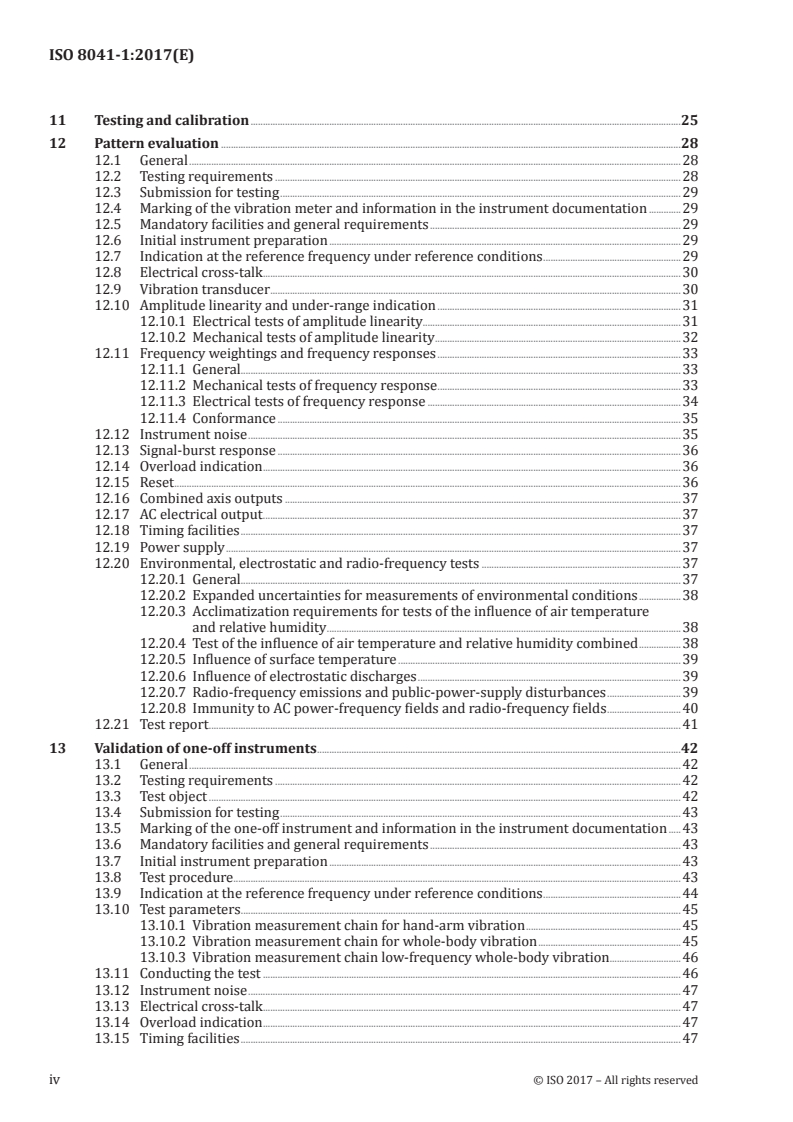
Contents Page
Foreword .vi
Introduction .vii
1 Scope . 1
2 Normative references . 1
3 Terms, definitions and symbols . 2
3.1 Terms and definitions . 2
3.1.1 General. 2
3.1.2 Frequency-weighted values . 4
3.2 Symbols . 6
4 Reference environmental conditions . 8
5 Performance specifications . 8
5.1 General characteristics . 8
5.2 Display of signal magnitude .10
5.2.1 General.10
5.2.2 Resolution and refresh rate .10
5.2.3 Stabilization, measurement start and display times .11
5.3 Electrical output .11
5.4 Vibration sensitivity .11
5.5 Accuracy of indication at reference frequency under reference conditions .12
5.6 Frequency weightings and frequency responses .12
5.6.1 Parameters .12
5.6.2 Band-limiting filter .13
5.6.3 a-v transition filter .13
5.6.4 Upward-step filter .14
5.6.5 Overall frequency weighting .14
5.6.6 Tolerances .14
5.7 Amplitude linearity .15
5.8 Instrument noise .16
5.9 Signal-burst response .16
5.10 Overload indication .19
5.11 Under-range indication .20
5.12 Time averaging .20
5.13 Running r.m.s. acceleration.20
5.14 Reset .21
5.15 Timing facilities .21
5.16 Electrical cross-talk .21
5.17 Vibration transducer characteristics .21
5.18 Power supply .21
6 Mounting .22
7 Environmental and electromagnetic criteria .22
7.1 General .22
7.2 Air temperature .22
7.3 Surface temperature .23
7.4 Electrostatic discharge .23
7.5 Radio-frequency emissions and public-power-supply disturbances .23
7.6 Immunity to AC power-frequency fields and radio-frequency fields .24
7.7 Ingress of water and dust .24
8 Provision for use with auxiliary devices.25
9 Instrument marking .25
10 Instrument documentation .25
11 Testing and calibration .25
12 Pattern evaluation .28
12.1 General .28
12.2 Testing requirements .28
12.3 Submission for testing .29
12.4 Marking of the vibration meter and information in the instrument documentation .29
12.5 Mandatory facilities and general requirements .29
12.6 Initial instrument preparation .29
12.7 Indication at the reference frequency under reference conditions .29
12.8 Electrical cross-talk .30
12.9 Vibration transducer .30
12.10 Amplitude linearity and under-range indication .31
12.10.1 Electrical tests of amplitude linearity . .31
12.10.2 Mechanical tests of amplitude linearity .32
12.11 Frequency weightings and frequency responses .33
12.11.1 General.33
12.11.2 Mechanical tests of frequency response .33
12.11.3 Electrical tests of frequency response .34
12.11.4 Conformance .35
12.12 Instrument noise .35
12.13 Signal-burst response .36
12.14 Overload indication .36
12.15 Reset .36
12.16 Combined axis outputs .37
12.17 AC electrical output .37
12.18 Timing facilities .37
12.19 Power supply .37
12.20 Environmental, electrostatic and radio-frequency tests .37
12.20.1 General.37
12.20.2 Expanded uncertainties for measurements of environmental conditions .38
12.20.3 Acclimatization requirements for tests of the influence of air temperature
and relative humidity .38
12.20.4 Test of the influence of air temperature and relative humidity combined .38
12.20.5 Influence of surface temperature .39
12.20.6 Influence of electrostatic discharges .39
12.20.7 Radio-frequency emissions and public-power-supply disturbances .39
12.20.8 Immunity to AC power-frequency fields and radio-frequency fields .40
12.21 Test report .41
13 Validation of one-off instruments .42
13.1 General .42
13.2 Testing requirements .42
13.3 Test object .42
13.4 Submission for testing .43
13.5 Marking of the one-off instrument and information in the instrument documentation .43
13.6 Mandatory facilities and general requirements .43
13.7 Initial instrument preparation .43
13.8 Test procedure .43
13.9 Indication at the reference frequency under reference conditions .44
13.10 Test parameters .45
13.10.1 Vibration measurement chain for hand-arm vibration .45
13.10.2 Vibration measurement chain for whole-body vibration .45
13.10.3 Vibration measurement chain low-frequency whole-body vibration.46
13.11 Conducting the test .46
13.12 Instrument noise .47
13.13 Electrical cross-talk .47
13.14 Overload indication .47
13.15 Timing facilities .47
iv © ISO 2017 – All rights reserved
13.16 Test report .48
14 Periodic verification .48
14.1 General .48
14.2 Testing requirements .48
14.3 Test object .48
14.4 Submission for testing .48
14.5 Preliminary inspection .49
14.6 Marking of the vibration meter and information in the instrument documentation .49
14.7 Test procedure .49
14.8 Test parameters .50
14.8.1 Vibration measurement chain for hand-arm vibration .50
14.8.2 Vibration measurement chain for whole-body vibration .50
14.8.3 Vibration measurement chain low-frequency whole-body vibration.50
14.9 Conducting the test .51
14.10 Test report .51
15 In situ checks .51
15.1 General .51
15.2 Preliminary inspection .52
15.3 Vibration sensitivity (field calibration) .52
Annex A (normative) Specification for field vibration calibrator .53
Annex B (informative) Frequency weightings.55
Annex C (informative) Realization of frequency weighting filters .74
Annex D (informative) Running r.m.s. time averaging .78
Annex E (informative) Vibration transducer characteristics .81
Annex F (informative) Tests for mounting systems .84
Annex G (normative) Instrument documentation.87
Annex H (normative) Phase response requirements for measurement of non-r.m.s. quantities .92
Annex I (informative) Guidelines for the estimation of the instrumental
measurement uncertainty .100
Bibliography .106
Foreword
ISO (the International Organization for Standardization) is a worldwide federation of national standards
bodies (ISO member bodies). The work of preparing International Standards is normally carried out
through ISO technical committees. Each member body interested in a subject for which a technical
committee has been established has the right to be represented on that committee. International
organizations, governmental and non-governmental, in liaison with ISO, also take part in the work.
ISO collaborates closely with the International Electrotechnical Commission (IEC) on all matters of
electrotechnical standardization.
The procedures used to develop this document and those intended for its further maintenance are
described in the ISO/IEC Directives, Part 1. In particular the different approval criteria needed for the
different types of ISO documents should be noted. This document was drafted in accordance with the
editorial rules of the ISO/IEC Directives, Part 2 (see www .iso .org/ directives).
Attention is drawn to the possibility that some of the elements of this document may be the subject of
patent rights. ISO shall not be held responsible for identifying any or all such patent rights. Details of
any patent rights identified during the development of the document will be in the Introduction and/or
on the ISO list of patent declarations received (see www .iso .org/ patents).
Any trade name used in this document is information given for the convenience of users and does not
constitute an endorsement.
For an explanation on the voluntary nature of standards, the meaning of ISO specific terms and
expressions related to conformity assessment, as well as information about ISO’s adherence to the
World Trade Organization (WTO) principles in the Technical Barriers to Trade (TBT) see the following
URL: w w w . i s o .org/ iso/ foreword .html.
This document was prepared by Technical Committee ISO/TC 108, Mechanical vibration, shock
and condition monitoring, Subcommittee SC 3, Use and calibration of vibration and shock measuring
instruments.
This first edition cancels and replaces ISO 8041:2005, which has been technically revised. It also
incorporates the Technical Corrigendum ISO 8041:2005/Cor. 1:2007. The following main changes have
been made:
— addition of an Introduction explaining the reasons for this revision;
— addition of a validation test for one-off instruments;
— revision and simplification of the verification test;
— addition of Annex I, which gives example estimates of the instrumental measurement uncertainty;
— correction of errors in formulae, numbers and figures.
A list of parts in the ISO 8041 series can be found on the ISO website.
vi © ISO 2017 – All rights reserved
Introduction
Until 2005, when the previous edition of this document was published, measuring instrumentation
for human response to vibration (vibration meters) normally consisted of a signal processing unit
and a detachable vibration transducer. According to recent developments, however, part of the
signal processing steps can be integrated in the transducer unit, so that the signal coming out of the
transducer’s sensing element and going into the signal conditioning unit is not accessible any more.
These transducer units include, for example, IEPE and MEMS transducers.
Some of the test procedures specified in this document, however, presume that this point in the signal
path is accessible (electrical input). Since such an input is not mandatory these tests can only be
performed on a vibration meter having an electrical input or after some technical modifications to the
instrumentation, e.g. internal access to signal paths. Or those tests can only be performed mechanically,
which in certain cases requires modifications to some test procedures. Such modifications to test
procedures, however, are beyond the present scope of this document.
Some of the test procedures specified in this document can only be performed if an electrical output
is available, see for example 5.13. Since such an output is not mandatory these tests can only be
performed on a vibration meter having an electrical output or after some technical modifications to the
instrumentation, e.g. internal access to signal paths.
The verification test now specified in this document is practicable and has the objective of identifying an
instrument which is adequately calibrated for the intended applications and is suitable for its purpose,
at a cost reasonable for the calibration laboratory and affordable for the end user. Therefore, the
verification test is strongly reduced in its extent compared to the full pattern evaluation, or validation,
and only tests the most relevant characteristics of a vibration meter.
INTERNATIONAL STANDARD ISO 8041-1:2017(E)
Human response to vibration — Measuring
instrumentation —
Part 1:
General purpose vibration meters
1 Scope
This document specifies the performance specifications and tolerance limits for instruments designed
to measure vibration values, for the purpose of assessing human response to vibration. It includes
requirements for pattern evaluation, or validation, periodic verification and in situ checks, and the
specification of vibration calibrators for in situ checks.
Vibration instruments specified in this document can be single instruments, combinations of
instrumentation or computer-based acquisition and analysis systems.
Vibration instruments specified in this document are intended to measure vibration for one or more
applications, such as the following:
— hand-transmitted vibration (see ISO 5349-1);
— whole-body vibration (see ISO 2631-1, ISO 2631-2 and ISO 2631-4);
— low-frequency whole-body vibration in the frequency range from 0,1 Hz to 0,5 Hz (see ISO 2631-1).
Vibration instruments can be designed for measurement according to one or more of the frequency
weightings defined within each of these applications.
Three levels of performance testing are defined in this document:
a) pattern evaluation or validation:
1) pattern evaluation, i.e. a full test of the instrument against the specifications defined in this
document;
2) validation of one-off instruments, i.e. a limited set of tests of an individual vibration measuring
system against the relevant specifications defined in this document;
b) periodic verification, i.e. an intermediate set of tests designed to ensure that an instrument remains
within the required performance specification;
c) in situ checks, i.e. a minimum level of testing required to indicate that an instrument is likely to be
functioning within the required performance specification.
2 Normative references
The following documents are referred to in the text in such a way that some or all of their content
constitutes requirements of this document. For dated references, only the edition cited applies. For
undated references, the latest edition of the referenced document (including any amendments) applies.
ISO 2631-1, Mechanical vibration and shock — Evaluation of human exposure to whole-body vibration —
Part 1: General requirements
ISO 2631-2, Mechanical vibration and shock — Evaluation of human exposure to whole-body vibration —
Part 2: Vibration in buildings (1 Hz to 80 Hz)
ISO 2631-4:2001, Mechanical vibration and shock — Evaluation of human exposure to whole-body
vibration — Part 4: Guidelines for the evaluation of the effects of vibration and rotational motion on
passenger and crew comfort in fixed-guideway transport systems
ISO 5347 (all parts), Methods for the calibration of vibration and shock pick-ups
ISO 5348, Mechanical vibration and shock — Mechanical mounting of accelerometers
ISO 5349-1:2001, Mechanical vibration — Measurement and evaluation of human exposure to hand-
transmitted vibration — Part 1: General requirements
ISO 16063 (all parts), Methods for the calibration of vibration and shock transducers
ISO/IEC Guide 98-3, Uncertainty of measurement — Part 3: Guide to the expression of uncertainty in
me a s ur ement (GUM: 1995)
IEC 61000-4-2:2008, Electromagnetic compatibility (EMC) — Part 4-2: Testing and measurement
techniques – Electrostatic discharge immunity test
IEC 61000-4-3:2006, Electromagnetic compatibility (EMC) — Part 4-3: Testing and measurement
techniques – Radiated, radio-frequency, electromagnetic field immunity test
IEC 61000-4-6, Electromagnetic compatibility (EMC) — Part 4-6: Testing and measurement techniques –
Immunity to conducted disturbances, induced by radio-frequency fields
IEC 61000-6-2:2005, Electromagnetic compatibility (EMC) — Part 6-2: Generic standards – Immunity for
industrial environments
CISPR 22:2008, Information technology equipment — Radio disturbance characteristics — Limits and
methods of measurement
3 Terms, definitions and symbols
3.1 Terms and definitions
For the purposes of this document, the terms and definitions given in ISO 2041, ISO/IEC Guide 99 and
the following apply.
ISO and IEC maintain terminological databases for use in standardization at the following addresses:
— IEC Electropedia: available at http:// www .electropedia .org/
— ISO Online browsing platform: available at http:// www .iso .org/ obp
3.1.1 General
3.1.1.1
vibration acceleration
component of acceleration, where the axis of measurement is specified by application standards
3.1.1.2
band-limiting frequency weighting
component of a frequency weighting defined by the high- and low-pass band-limiting filters
3.1.1.3
band-limited frequency range
frequency range defined by the band-limiting component of a frequency weighting
3.1.1.4
nominal frequency range
frequency range of interest, as defined in the relevant measurement standard
2 © ISO 2017 – All rights reserved
3.1.1.5
linear operating range
range between lower and upper boundaries, on each measurement range, over which the linearity
errors do not exceed the applicable tolerance limits specified in this document
3.1.1.6
overload
condition that occurs when the upper boundary of the linear operating range is exceeded
3.1.1.7
under-range
condition that occurs when the vibration value is below the lower boundary of the linear operating range
3.1.1.8
reference measurement range
level range specified for testing the characteristics of the vibration instrumentation
Note 1 to entry: This range is used for measuring the reference vibration.
3.1.1.9
reference vibration signal
sinusoidal vibration signal, the magnitude and frequency of which are specified in this document for
testing the electromechanical performance of a human-vibration meter
Note 1 to entry: Different reference vibration signals are specified according to the application of the
instrumentation.
3.1.1.10
calibration check frequency
frequency specified for providing a check of the vibration sensitivity of the instrument
3.1.1.11
tone burst
one or more complete cycles of a sinusoidal signal that start and end at a zero crossing of the waveform
3.1.1.12
signal burst
one or more complete cycles of a periodic signal (such as saw tooth) that start and end at a zero crossing
of the waveform
3.1.1.13
vibration measuring instrumentation
combination of a vibration transducer, signal processor and display, being any single instrument, or a
collection of instruments, which is/are capable of measuring parameters relating to human response to
vibration
Note 1 to entry: See Figures 1 and 2.
3.1.1.14
instrument documentation
instruction manual, operating procedure or other documentation provided for the use of users of the
vibration measurement instrument
3.1.2 Frequency-weighted values
3.1.2.1
time-averaged weighted acceleration value
frequency-weighted root-mean-square (r.m.s.) vibration acceleration value in a specified axis, a , in
w
metres per second squared or radians per second squared, as defined by the expression
2
T
a = a ξξd
()
ww
∫
T
where
a (ξ) is the translational or rotational, frequency-weighted vibration acceleration in a specified
w
direction or around a specified axis as a function of the instantaneous time, ξ in metres per
2 2
second squared (m/s ) or radians per second squared (rad/s ), respectively;
T is the duration of the measurement.
3.1.2.2
time-averaged weighted acceleration level
frequency-weighted r.m.s. vibration acceleration level expressed in decibels, as defined by
a
w
L =20 lg dB
w
a
where
a is the frequency-weighted r.m.s. acceleration value;
w
−6 2
a is the reference acceleration (in ISO 1683 for translational acceleration defined as 10 m/s ).
3.1.2.3
running r.m.s. acceleration value
frequency-weighted running r.m.s. vibration acceleration, in metres per second squared, defined by the
expression
2
t
1
at = a ξξd
() ()
ww,θ ∫
θ
t−θ
where
a (ξ) is the frequency-weighted instantaneous vibration acceleration at time ξ, in metres per
w
second squared or radians per second squared (rad/s ), respectively;
θ is the integration time of the measurement;
t is the instantaneous time.
Note 1 to entry: Exponential averaging may be used for the running r.m.s. method, as an approximation of the
linear averaging. The exponential averaging is defined as follows:
t
1 ξ −t
at = a ξ expdξ
() ()
ww,τ ∫
τ τ
−∞
where τ is the time constant.
4 © ISO 2017 – All rights reserved
3.1.2.4
maximum transient vibration value
MTVV
maximum value of the running r.m.s. vibration acceleration value when the integration time is equal to 1 s
3.1.2.5
motion sickness dose value
MSDV
1,5
integral of the squared frequency-weighted instantaneous vibration acceleration a (t) in m/s as
w
defined by the expression
Φ
MSDV = a ξξd
()
∫ w
where Φ is the total period during which motion could occur
Note 1 to entry: The motion sickness dose value can be obtained from the frequency-weighted r.m.s. vibration
acceleration through multiplication by Φ .
Note 2 to entry: For measurement instrumentation, the exposure period, Φ, is likely to be assumed to be equal to
the measurement period, T, unless otherwise indicated.
3.1.2.6
vibration dose value
VDV
integral of the fourth power of the frequency-weighted instantaneous vibration acceleration a (t) in
w
1,75
m/s as defined by the expression
Φ
VDVd= a ξξ
()
w
∫
where Φ is the total (daily) period for which vibration exposure occurs
Note 1 to entry: The vibration dose value is more sensitive to peaks than is the r.m.s. value.
Note 2 to entry: For measurement instrumentation, the exposure period, Φ, is likely to be assumed to be equal to
the measurement period, T, unless otherwise indicated.
3.1.2.7
vibration total value
combined vibration from three axes of translational vibration, as defined by the expression
222 2 2 2
ak=+ak ak+ a
wv xxw yyw zzw
where
a , a and a are the weighted vibration values in the three orthogonal axes x, y and z;
wx wy wz
k , k and k are multiplying constants whose values depend on the measurement application
x y z
3.1.2.8
peak vibration value
maximum modulus of the instantaneous (positive and negative) peak values of the frequency-weighted
acceleration
3.1.2.9
crest factor
parameter for a measurement period, given by the peak vibration value divided by the r.m.s. vibration
value, with both values having the same frequency weighting
3.2 Symbols
For the purposes of this document, the following symbols and abbreviated terms apply.
a time-averaged frequency-weighted single-axis vibration acceleration
w
a (t), a (ξ) instantaneous frequency-weighted translational or rotational single-axis acceleration
w w
at time t, or time ξ
f frequency
H overall frequency weighting function
k multiplying constants applied to the whole-body frequency-weighted
i
acceleration value for axis i
n one-third-octave band number
s variable of the Laplace transform
t or ξ instantaneous time
T measurement duration
W frequency weighting
x
Φ exposure duration
maximum peak value deviation
DP
max
Δφ phase error
∆ϑ phase delay time difference
τ exponential averaging time constant
θ linear averaging time
MSDV motion sickness dose value
MTVV maximum transient vibration value
VDV vibration dose value
6 © ISO 2017 – All rights reserved
Key
1 transducer 8 frequency weighting — including band-limiting
2 mounting system 9 band-limited output
3 vibrating surface 10 frequency-weighted output
4 cable 11 time weighting
5 electrical input 12 additional processing
6 signal conditioning 13 display
7 band limiting
Figure 1 — Example of the basic functional path of a vibration measurement instrument or
measurement system — time-domain signal processing
Key
1 transducer 8 band limiting (calculation)
2 mounting system 9 frequency weighting — including band limiting
(calculation)
3 vibrating surface 10 band-limited output
4 cable 11 frequency-weighted output
5 electrical input 12 accumulation of frequency bands
6 signal conditioning 13 display
7 frequency analysis time weighting time averaging
Figure 2 — Example of the basic functional path of a vibration measurement instrument
or measurement system — frequency-domain signal processing (not applicable to VDV
processing)
4 Reference environmental conditions
Reference environmental conditions for specifying the performance of a vibration meter are
— air temperature: 23 °C, and
— relative humidity: 50 %.
5 Performance specifications
5.1 General characteristics
The performance specifications of this clause apply under the reference environmental conditions.
8 © ISO 2017 – All rights reserved
As a minimum, human-vibration measuring instrumentation shall provide a means of displaying
— time-averaged weighted vibration acceleration value over the measurement duration, a ,
w
— time-averaged band-limited vibration acceleration value over the measurement duration, and
— measurement duration, T.
The human-vibration measuring instrument shall also provide a means of indicating whether an
overload occurred at any time within the
...
INTERNATIONAL ISO
STANDARD 8041-1
First edition
2017-05
Human response to vibration —
Measuring instrumentation —
Part 1:
General purpose vibration meters
Réponse des individus aux vibrations — Appareillage de mesure —
Partie 1: Instrument de mesure à usage général
Reference number
©
ISO 2017
© ISO 2017, Published in Switzerland
All rights reserved. Unless otherwise specified, no part of this publication may be reproduced or utilized otherwise in any form
or by any means, electronic or mechanical, including photocopying, or posting on the internet or an intranet, without prior
written permission. Permission can be requested from either ISO at the address below or ISO’s member body in the country of
the requester.
ISO copyright office
Ch. de Blandonnet 8 • CP 401
CH-1214 Vernier, Geneva, Switzerland
Tel. +41 22 749 01 11
Fax +41 22 749 09 47
copyright@iso.org
www.iso.org
ii © ISO 2017 – All rights reserved
Contents Page
Foreword .vi
Introduction .vii
1 Scope . 1
2 Normative references . 1
3 Terms, definitions and symbols . 2
3.1 Terms and definitions . 2
3.1.1 General. 2
3.1.2 Frequency-weighted values . 4
3.2 Symbols . 6
4 Reference environmental conditions . 8
5 Performance specifications . 8
5.1 General characteristics . 8
5.2 Display of signal magnitude .10
5.2.1 General.10
5.2.2 Resolution and refresh rate .10
5.2.3 Stabilization, measurement start and display times .11
5.3 Electrical output .11
5.4 Vibration sensitivity .11
5.5 Accuracy of indication at reference frequency under reference conditions .12
5.6 Frequency weightings and frequency responses .12
5.6.1 Parameters .12
5.6.2 Band-limiting filter .13
5.6.3 a-v transition filter .13
5.6.4 Upward-step filter .14
5.6.5 Overall frequency weighting .14
5.6.6 Tolerances .14
5.7 Amplitude linearity .15
5.8 Instrument noise .16
5.9 Signal-burst response .16
5.10 Overload indication .19
5.11 Under-range indication .20
5.12 Time averaging .20
5.13 Running r.m.s. acceleration.20
5.14 Reset .21
5.15 Timing facilities .21
5.16 Electrical cross-talk .21
5.17 Vibration transducer characteristics .21
5.18 Power supply .21
6 Mounting .22
7 Environmental and electromagnetic criteria .22
7.1 General .22
7.2 Air temperature .22
7.3 Surface temperature .23
7.4 Electrostatic discharge .23
7.5 Radio-frequency emissions and public-power-supply disturbances .23
7.6 Immunity to AC power-frequency fields and radio-frequency fields .24
7.7 Ingress of water and dust .24
8 Provision for use with auxiliary devices.25
9 Instrument marking .25
10 Instrument documentation .25
11 Testing and calibration .25
12 Pattern evaluation .28
12.1 General .28
12.2 Testing requirements .28
12.3 Submission for testing .29
12.4 Marking of the vibration meter and information in the instrument documentation .29
12.5 Mandatory facilities and general requirements .29
12.6 Initial instrument preparation .29
12.7 Indication at the reference frequency under reference conditions .29
12.8 Electrical cross-talk .30
12.9 Vibration transducer .30
12.10 Amplitude linearity and under-range indication .31
12.10.1 Electrical tests of amplitude linearity . .31
12.10.2 Mechanical tests of amplitude linearity .32
12.11 Frequency weightings and frequency responses .33
12.11.1 General.33
12.11.2 Mechanical tests of frequency response .33
12.11.3 Electrical tests of frequency response .34
12.11.4 Conformance .35
12.12 Instrument noise .35
12.13 Signal-burst response .36
12.14 Overload indication .36
12.15 Reset .36
12.16 Combined axis outputs .37
12.17 AC electrical output .37
12.18 Timing facilities .37
12.19 Power supply .37
12.20 Environmental, electrostatic and radio-frequency tests .37
12.20.1 General.37
12.20.2 Expanded uncertainties for measurements of environmental conditions .38
12.20.3 Acclimatization requirements for tests of the influence of air temperature
and relative humidity .38
12.20.4 Test of the influence of air temperature and relative humidity combined .38
12.20.5 Influence of surface temperature .39
12.20.6 Influence of electrostatic discharges .39
12.20.7 Radio-frequency emissions and public-power-supply disturbances .39
12.20.8 Immunity to AC power-frequency fields and radio-frequency fields .40
12.21 Test report .41
13 Validation of one-off instruments .42
13.1 General .42
13.2 Testing requirements .42
13.3 Test object .42
13.4 Submission for testing .43
13.5 Marking of the one-off instrument and information in the instrument documentation .43
13.6 Mandatory facilities and general requirements .43
13.7 Initial instrument preparation .43
13.8 Test procedure .43
13.9 Indication at the reference frequency under reference conditions .44
13.10 Test parameters .45
13.10.1 Vibration measurement chain for hand-arm vibration .45
13.10.2 Vibration measurement chain for whole-body vibration .45
13.10.3 Vibration measurement chain low-frequency whole-body vibration.46
13.11 Conducting the test .46
13.12 Instrument noise .47
13.13 Electrical cross-talk .47
13.14 Overload indication .47
13.15 Timing facilities .47
iv © ISO 2017 – All rights reserved
13.16 Test report .48
14 Periodic verification .48
14.1 General .48
14.2 Testing requirements .48
14.3 Test object .48
14.4 Submission for testing .48
14.5 Preliminary inspection .49
14.6 Marking of the vibration meter and information in the instrument documentation .49
14.7 Test procedure .49
14.8 Test parameters .50
14.8.1 Vibration measurement chain for hand-arm vibration .50
14.8.2 Vibration measurement chain for whole-body vibration .50
14.8.3 Vibration measurement chain low-frequency whole-body vibration.50
14.9 Conducting the test .51
14.10 Test report .51
15 In situ checks .51
15.1 General .51
15.2 Preliminary inspection .52
15.3 Vibration sensitivity (field calibration) .52
Annex A (normative) Specification for field vibration calibrator .53
Annex B (informative) Frequency weightings.55
Annex C (informative) Realization of frequency weighting filters .74
Annex D (informative) Running r.m.s. time averaging .78
Annex E (informative) Vibration transducer characteristics .81
Annex F (informative) Tests for mounting systems .84
Annex G (normative) Instrument documentation.87
Annex H (normative) Phase response requirements for measurement of non-r.m.s. quantities .92
Annex I (informative) Guidelines for the estimation of the instrumental
measurement uncertainty .100
Bibliography .106
Foreword
ISO (the International Organization for Standardization) is a worldwide federation of national standards
bodies (ISO member bodies). The work of preparing International Standards is normally carried out
through ISO technical committees. Each member body interested in a subject for which a technical
committee has been established has the right to be represented on that committee. International
organizations, governmental and non-governmental, in liaison with ISO, also take part in the work.
ISO collaborates closely with the International Electrotechnical Commission (IEC) on all matters of
electrotechnical standardization.
The procedures used to develop this document and those intended for its further maintenance are
described in the ISO/IEC Directives, Part 1. In particular the different approval criteria needed for the
different types of ISO documents should be noted. This document was drafted in accordance with the
editorial rules of the ISO/IEC Directives, Part 2 (see www .iso .org/ directives).
Attention is drawn to the possibility that some of the elements of this document may be the subject of
patent rights. ISO shall not be held responsible for identifying any or all such patent rights. Details of
any patent rights identified during the development of the document will be in the Introduction and/or
on the ISO list of patent declarations received (see www .iso .org/ patents).
Any trade name used in this document is information given for the convenience of users and does not
constitute an endorsement.
For an explanation on the voluntary nature of standards, the meaning of ISO specific terms and
expressions related to conformity assessment, as well as information about ISO’s adherence to the
World Trade Organization (WTO) principles in the Technical Barriers to Trade (TBT) see the following
URL: w w w . i s o .org/ iso/ foreword .html.
This document was prepared by Technical Committee ISO/TC 108, Mechanical vibration, shock
and condition monitoring, Subcommittee SC 3, Use and calibration of vibration and shock measuring
instruments.
This first edition cancels and replaces ISO 8041:2005, which has been technically revised. It also
incorporates the Technical Corrigendum ISO 8041:2005/Cor. 1:2007. The following main changes have
been made:
— addition of an Introduction explaining the reasons for this revision;
— addition of a validation test for one-off instruments;
— revision and simplification of the verification test;
— addition of Annex I, which gives example estimates of the instrumental measurement uncertainty;
— correction of errors in formulae, numbers and figures.
A list of parts in the ISO 8041 series can be found on the ISO website.
vi © ISO 2017 – All rights reserved
Introduction
Until 2005, when the previous edition of this document was published, measuring instrumentation
for human response to vibration (vibration meters) normally consisted of a signal processing unit
and a detachable vibration transducer. According to recent developments, however, part of the
signal processing steps can be integrated in the transducer unit, so that the signal coming out of the
transducer’s sensing element and going into the signal conditioning unit is not accessible any more.
These transducer units include, for example, IEPE and MEMS transducers.
Some of the test procedures specified in this document, however, presume that this point in the signal
path is accessible (electrical input). Since such an input is not mandatory these tests can only be
performed on a vibration meter having an electrical input or after some technical modifications to the
instrumentation, e.g. internal access to signal paths. Or those tests can only be performed mechanically,
which in certain cases requires modifications to some test procedures. Such modifications to test
procedures, however, are beyond the present scope of this document.
Some of the test procedures specified in this document can only be performed if an electrical output
is available, see for example 5.13. Since such an output is not mandatory these tests can only be
performed on a vibration meter having an electrical output or after some technical modifications to the
instrumentation, e.g. internal access to signal paths.
The verification test now specified in this document is practicable and has the objective of identifying an
instrument which is adequately calibrated for the intended applications and is suitable for its purpose,
at a cost reasonable for the calibration laboratory and affordable for the end user. Therefore, the
verification test is strongly reduced in its extent compared to the full pattern evaluation, or validation,
and only tests the most relevant characteristics of a vibration meter.
INTERNATIONAL STANDARD ISO 8041-1:2017(E)
Human response to vibration — Measuring
instrumentation —
Part 1:
General purpose vibration meters
1 Scope
This document specifies the performance specifications and tolerance limits for instruments designed
to measure vibration values, for the purpose of assessing human response to vibration. It includes
requirements for pattern evaluation, or validation, periodic verification and in situ checks, and the
specification of vibration calibrators for in situ checks.
Vibration instruments specified in this document can be single instruments, combinations of
instrumentation or computer-based acquisition and analysis systems.
Vibration instruments specified in this document are intended to measure vibration for one or more
applications, such as the following:
— hand-transmitted vibration (see ISO 5349-1);
— whole-body vibration (see ISO 2631-1, ISO 2631-2 and ISO 2631-4);
— low-frequency whole-body vibration in the frequency range from 0,1 Hz to 0,5 Hz (see ISO 2631-1).
Vibration instruments can be designed for measurement according to one or more of the frequency
weightings defined within each of these applications.
Three levels of performance testing are defined in this document:
a) pattern evaluation or validation:
1) pattern evaluation, i.e. a full test of the instrument against the specifications defined in this
document;
2) validation of one-off instruments, i.e. a limited set of tests of an individual vibration measuring
system against the relevant specifications defined in this document;
b) periodic verification, i.e. an intermediate set of tests designed to ensure that an instrument remains
within the required performance specification;
c) in situ checks, i.e. a minimum level of testing required to indicate that an instrument is likely to be
functioning within the required performance specification.
2 Normative references
The following documents are referred to in the text in such a way that some or all of their content
constitutes requirements of this document. For dated references, only the edition cited applies. For
undated references, the latest edition of the referenced document (including any amendments) applies.
ISO 2631-1, Mechanical vibration and shock — Evaluation of human exposure to whole-body vibration —
Part 1: General requirements
ISO 2631-2, Mechanical vibration and shock — Evaluation of human exposure to whole-body vibration —
Part 2: Vibration in buildings (1 Hz to 80 Hz)
ISO 2631-4:2001, Mechanical vibration and shock — Evaluation of human exposure to whole-body
vibration — Part 4: Guidelines for the evaluation of the effects of vibration and rotational motion on
passenger and crew comfort in fixed-guideway transport systems
ISO 5347 (all parts), Methods for the calibration of vibration and shock pick-ups
ISO 5348, Mechanical vibration and shock — Mechanical mounting of accelerometers
ISO 5349-1:2001, Mechanical vibration — Measurement and evaluation of human exposure to hand-
transmitted vibration — Part 1: General requirements
ISO 16063 (all parts), Methods for the calibration of vibration and shock transducers
ISO/IEC Guide 98-3, Uncertainty of measurement — Part 3: Guide to the expression of uncertainty in
me a s ur ement (GUM: 1995)
IEC 61000-4-2:2008, Electromagnetic compatibility (EMC) — Part 4-2: Testing and measurement
techniques – Electrostatic discharge immunity test
IEC 61000-4-3:2006, Electromagnetic compatibility (EMC) — Part 4-3: Testing and measurement
techniques – Radiated, radio-frequency, electromagnetic field immunity test
IEC 61000-4-6, Electromagnetic compatibility (EMC) — Part 4-6: Testing and measurement techniques –
Immunity to conducted disturbances, induced by radio-frequency fields
IEC 61000-6-2:2005, Electromagnetic compatibility (EMC) — Part 6-2: Generic standards – Immunity for
industrial environments
CISPR 22:2008, Information technology equipment — Radio disturbance characteristics — Limits and
methods of measurement
3 Terms, definitions and symbols
3.1 Terms and definitions
For the purposes of this document, the terms and definitions given in ISO 2041, ISO/IEC Guide 99 and
the following apply.
ISO and IEC maintain terminological databases for use in standardization at the following addresses:
— IEC Electropedia: available at http:// www .electropedia .org/
— ISO Online browsing platform: available at http:// www .iso .org/ obp
3.1.1 General
3.1.1.1
vibration acceleration
component of acceleration, where the axis of measurement is specified by application standards
3.1.1.2
band-limiting frequency weighting
component of a frequency weighting defined by the high- and low-pass band-limiting filters
3.1.1.3
band-limited frequency range
frequency range defined by the band-limiting component of a frequency weighting
3.1.1.4
nominal frequency range
frequency range of interest, as defined in the relevant measurement standard
2 © ISO 2017 – All rights reserved
3.1.1.5
linear operating range
range between lower and upper boundaries, on each measurement range, over which the linearity
errors do not exceed the applicable tolerance limits specified in this document
3.1.1.6
overload
condition that occurs when the upper boundary of the linear operating range is exceeded
3.1.1.7
under-range
condition that occurs when the vibration value is below the lower boundary of the linear operating range
3.1.1.8
reference measurement range
level range specified for testing the characteristics of the vibration instrumentation
Note 1 to entry: This range is used for measuring the reference vibration.
3.1.1.9
reference vibration signal
sinusoidal vibration signal, the magnitude and frequency of which are specified in this document for
testing the electromechanical performance of a human-vibration meter
Note 1 to entry: Different reference vibration signals are specified according to the application of the
instrumentation.
3.1.1.10
calibration check frequency
frequency specified for providing a check of the vibration sensitivity of the instrument
3.1.1.11
tone burst
one or more complete cycles of a sinusoidal signal that start and end at a zero crossing of the waveform
3.1.1.12
signal burst
one or more complete cycles of a periodic signal (such as saw tooth) that start and end at a zero crossing
of the waveform
3.1.1.13
vibration measuring instrumentation
combination of a vibration transducer, signal processor and display, being any single instrument, or a
collection of instruments, which is/are capable of measuring parameters relating to human response to
vibration
Note 1 to entry: See Figures 1 and 2.
3.1.1.14
instrument documentation
instruction manual, operating procedure or other documentation provided for the use of users of the
vibration measurement instrument
3.1.2 Frequency-weighted values
3.1.2.1
time-averaged weighted acceleration value
frequency-weighted root-mean-square (r.m.s.) vibration acceleration value in a specified axis, a , in
w
metres per second squared or radians per second squared, as defined by the expression
2
T
a = a ξξd
()
ww
∫
T
where
a (ξ) is the translational or rotational, frequency-weighted vibration acceleration in a specified
w
direction or around a specified axis as a function of the instantaneous time, ξ in metres per
2 2
second squared (m/s ) or radians per second squared (rad/s ), respectively;
T is the duration of the measurement.
3.1.2.2
time-averaged weighted acceleration level
frequency-weighted r.m.s. vibration acceleration level expressed in decibels, as defined by
a
w
L =20 lg dB
w
a
where
a is the frequency-weighted r.m.s. acceleration value;
w
−6 2
a is the reference acceleration (in ISO 1683 for translational acceleration defined as 10 m/s ).
3.1.2.3
running r.m.s. acceleration value
frequency-weighted running r.m.s. vibration acceleration, in metres per second squared, defined by the
expression
2
t
1
at = a ξξd
() ()
ww,θ ∫
θ
t−θ
where
a (ξ) is the frequency-weighted instantaneous vibration acceleration at time ξ, in metres per
w
second squared or radians per second squared (rad/s ), respectively;
θ is the integration time of the measurement;
t is the instantaneous time.
Note 1 to entry: Exponential averaging may be used for the running r.m.s. method, as an approximation of the
linear averaging. The exponential averaging is defined as follows:
t
1 ξ −t
at = a ξ expdξ
() ()
ww,τ ∫
τ τ
−∞
where τ is the time constant.
4 © ISO 2017 – All rights reserved
3.1.2.4
maximum transient vibration value
MTVV
maximum value of the running r.m.s. vibration acceleration value when the integration time is equal to 1 s
3.1.2.5
motion sickness dose value
MSDV
1,5
integral of the squared frequency-weighted instantaneous vibration acceleration a (t) in m/s as
w
defined by the expression
Φ
MSDV = a ξξd
()
∫ w
where Φ is the total period during which motion could occur
Note 1 to entry: The motion sickness dose value can be obtained from the frequency-weighted r.m.s. vibration
acceleration through multiplication by Φ .
Note 2 to entry: For measurement instrumentation, the exposure period, Φ, is likely to be assumed to be equal to
the measurement period, T, unless otherwise indicated.
3.1.2.6
vibration dose value
VDV
integral of the fourth power of the frequency-weighted instantaneous vibration acceleration a (t) in
w
1,75
m/s as defined by the expression
Φ
VDVd= a ξξ
()
w
∫
where Φ is the total (daily) period for which vibration exposure occurs
Note 1 to entry: The vibration dose value is more sensitive to peaks than is the r.m.s. value.
Note 2 to entry: For measurement instrumentation, the exposure period, Φ, is likely to be assumed to be equal to
the measurement period, T, unless otherwise indicated.
3.1.2.7
vibration total value
combined vibration from three axes of translational vibration, as defined by the expression
222 2 2 2
ak=+ak ak+ a
wv xxw yyw zzw
where
a , a and a are the weighted vibration values in the three orthogonal axes x, y and z;
wx wy wz
k , k and k are multiplying constants whose values depend on the measurement application
x y z
3.1.2.8
peak vibration value
maximum modulus of the instantaneous (positive and negative) peak values of the frequency-weighted
acceleration
3.1.2.9
crest factor
parameter for a measurement period, given by the peak vibration value divided by the r.m.s. vibration
value, with both values having the same frequency weighting
3.2 Symbols
For the purposes of this document, the following symbols and abbreviated terms apply.
a time-averaged frequency-weighted single-axis vibration acceleration
w
a (t), a (ξ) instantaneous frequency-weighted translational or rotational single-axis acceleration
w w
at time t, or time ξ
f frequency
H overall frequency weighting function
k multiplying constants applied to the whole-body frequency-weighted
i
acceleration value for axis i
n one-third-octave band number
s variable of the Laplace transform
t or ξ instantaneous time
T measurement duration
W frequency weighting
x
Φ exposure duration
maximum peak value deviation
DP
max
Δφ phase error
∆ϑ phase delay time difference
τ exponential averaging time constant
θ linear averaging time
MSDV motion sickness dose value
MTVV maximum transient vibration value
VDV vibration dose value
6 © ISO 2017 – All rights reserved
Key
1 transducer 8 frequency weighting — including band-limiting
2 mounting system 9 band-limited output
3 vibrating surface 10 frequency-weighted output
4 cable 11 time weighting
5 electrical input 12 additional processing
6 signal conditioning 13 display
7 band limiting
Figure 1 — Example of the basic functional path of a vibration measurement instrument or
measurement system — time-domain signal processing
Key
1 transducer 8 band limiting (calculation)
2 mounting system 9 frequency weighting — including band limiting
(calculation)
3 vibrating surface 10 band-limited output
4 cable 11 frequency-weighted output
5 electrical input 12 accumulation of frequency bands
6 signal conditioning 13 display
7 frequency analysis time weighting time averaging
Figure 2 — Example of the basic functional path of a vibration measurement instrument
or measurement system — frequency-domain signal processing (not applicable to VDV
processing)
4 Reference environmental conditions
Reference environmental conditions for specifying the performance of a vibration meter are
— air temperature: 23 °C, and
— relative humidity: 50 %.
5 Performance specifications
5.1 General characteristics
The performance specifications of this clause apply under the reference environmental conditions.
8 © ISO 2017 – All rights reserved
As a minimum, human-vibration measuring instrumentation shall provide a means of displaying
— time-averaged weighted vibration acceleration value over the measurement duration, a ,
w
— time-averaged band-limited vibration acceleration value over the measurement duration, and
— measurement duration, T.
The human-vibration measuring instrument shall also provide a means of indicating whether an
overload occurred at any time within the
...
NORME ISO
INTERNATIONALE 8041-1
Première édition
2017-05
Réponse des individus aux
vibrations — Appareillage de
mesure —
Partie 1:
Instrument de mesure à usage général
Human response to vibration — Measuring instrumentation —
Part 1: General purpose vibration meters
Numéro de référence
©
ISO 2017
DOCUMENT PROTÉGÉ PAR COPYRIGHT
© ISO 2017, Publié en Suisse
Droits de reproduction réservés. Sauf indication contraire, aucune partie de cette publication ne peut être reproduite ni utilisée
sous quelque forme que ce soit et par aucun procédé, électronique ou mécanique, y compris la photocopie, l’affichage sur
l’internet ou sur un Intranet, sans autorisation écrite préalable. Les demandes d’autorisation peuvent être adressées à l’ISO à
l’adresse ci-après ou au comité membre de l’ISO dans le pays du demandeur.
ISO copyright office
Ch. de Blandonnet 8 • CP 401
CH-1214 Vernier, Geneva, Switzerland
Tel. +41 22 749 01 11
Fax +41 22 749 09 47
copyright@iso.org
www.iso.org
ii © ISO 2017 – Tous droits réservés
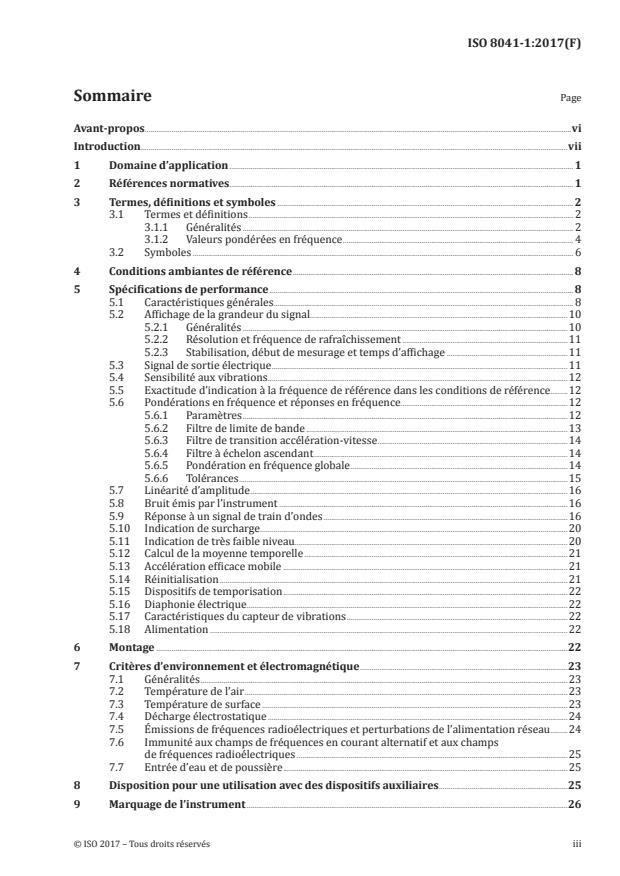
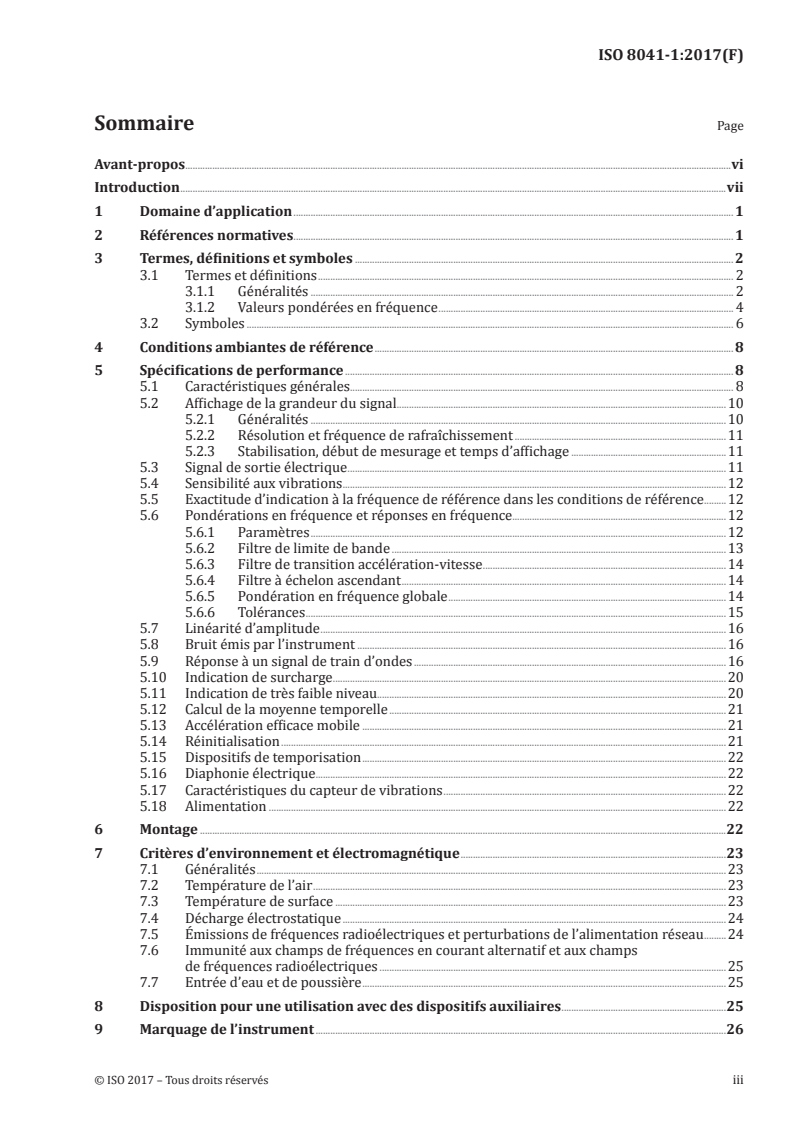
Sommaire Page
Avant-propos .vi
Introduction .vii
1 Domaine d’application . 1
2 Références normatives . 1
3 Termes, définitions et symboles . 2
3.1 Termes et définitions . 2
3.1.1 Généralités . 2
3.1.2 Valeurs pondérées en fréquence . 4
3.2 Symboles . 6
4 Conditions ambiantes de référence . 8
5 Spécifications de performance . 8
5.1 Caractéristiques générales. 8
5.2 Affichage de la grandeur du signal .10
5.2.1 Généralités .10
5.2.2 Résolution et fréquence de rafraîchissement .11
5.2.3 Stabilisation, début de mesurage et temps d’affichage .11
5.3 Signal de sortie électrique .11
5.4 Sensibilité aux vibrations .12
5.5 Exactitude d’indication à la fréquence de référence dans les conditions de référence .12
5.6 Pondérations en fréquence et réponses en fréquence.12
5.6.1 Paramètres .12
5.6.2 Filtre de limite de bande .13
5.6.3 Filtre de transition accélération-vitesse .14
5.6.4 Filtre à échelon ascendant .14
5.6.5 Pondération en fréquence globale .14
5.6.6 Tolérances .15
5.7 Linéarité d’amplitude .16
5.8 Bruit émis par l’instrument .16
5.9 Réponse à un signal de train d’ondes .16
5.10 Indication de surcharge .20
5.11 Indication de très faible niveau.20
5.12 Calcul de la moyenne temporelle .21
5.13 Accélération efficace mobile .21
5.14 Réinitialisation .21
5.15 Dispositifs de temporisation .22
5.16 Diaphonie électrique .22
5.17 Caractéristiques du capteur de vibrations .22
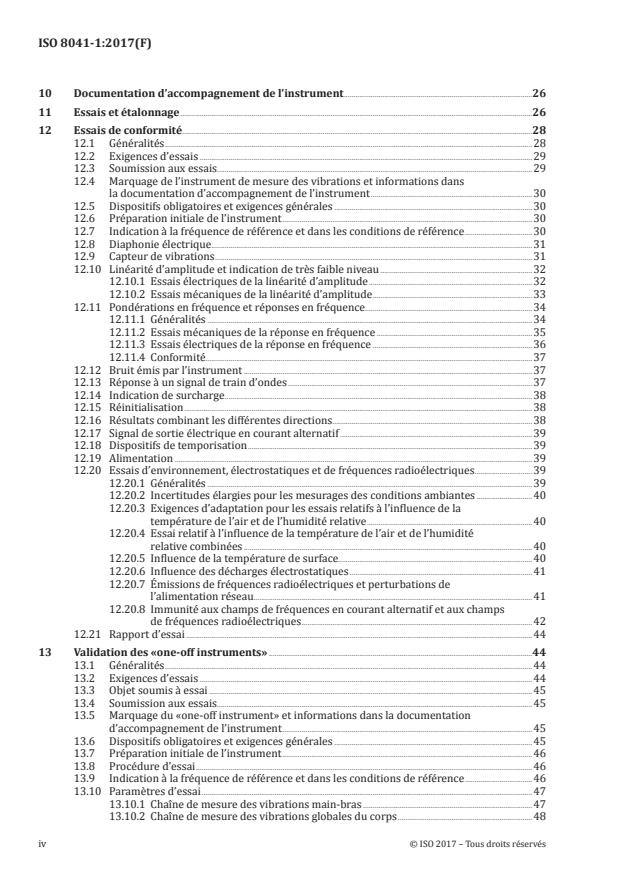
5.18 Alimentation .22
6 Montage .22
7 Critères d’environnement et électromagnétique .23
7.1 Généralités .23
7.2 Température de l’air .23
7.3 Température de surface .23
7.4 Décharge électrostatique .24
7.5 Émissions de fréquences radioélectriques et perturbations de l’alimentation réseau .24
7.6 Immunité aux champs de fréquences en courant alternatif et aux champs
de fréquences radioélectriques .25
7.7 Entrée d’eau et de poussière .25
8 Disposition pour une utilisation avec des dispositifs auxiliaires .25
9 Marquage de l’instrument .26
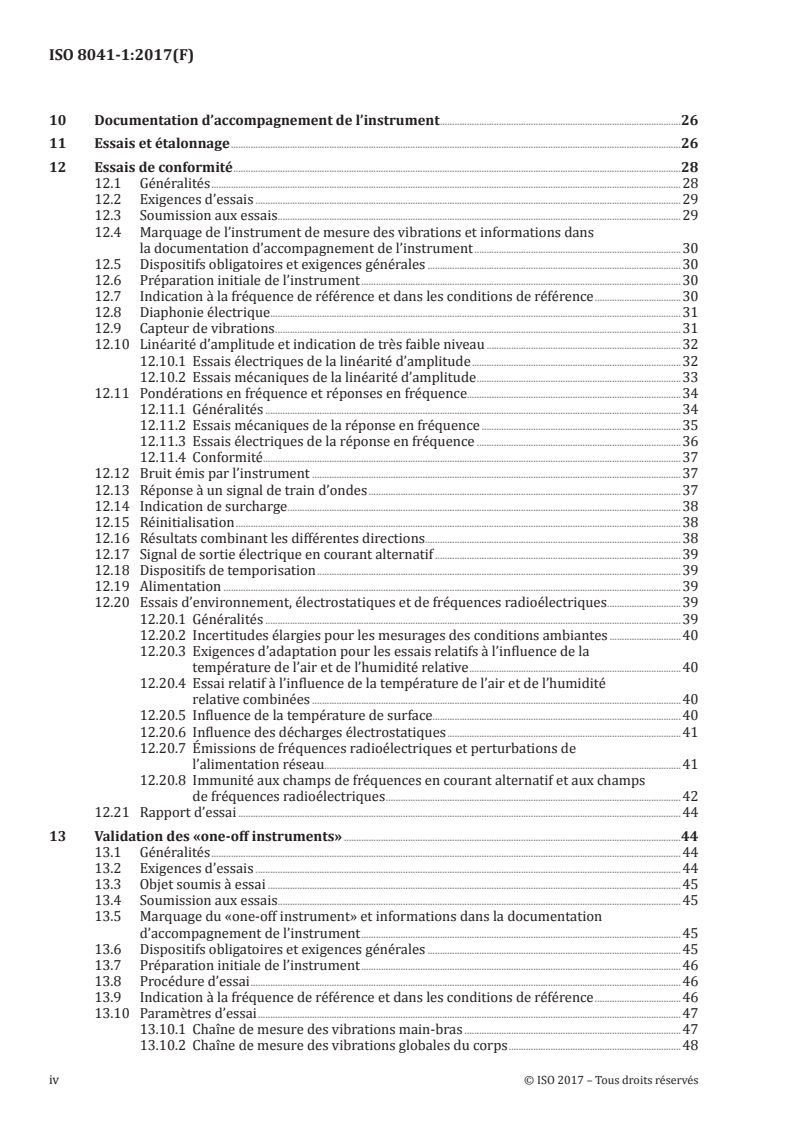
10 Documentation d’accompagnement de l’instrument .26
11 Essais et étalonnage .26
12 Essais de conformité .28
12.1 Généralités .28
12.2 Exigences d’essais .29
12.3 Soumission aux essais.29
12.4 Marquage de l’instrument de mesure des vibrations et informations dans
la documentation d’accompagnement de l’instrument .30
12.5 Dispositifs obligatoires et exigences générales .30
12.6 Préparation initiale de l’instrument .30
12.7 Indication à la fréquence de référence et dans les conditions de référence .30
12.8 Diaphonie électrique .31
12.9 Capteur de vibrations .31
12.10 Linéarité d’amplitude et indication de très faible niveau .32
12.10.1 Essais électriques de la linéarité d’amplitude .32
12.10.2 Essais mécaniques de la linéarité d’amplitude .33
12.11 Pondérations en fréquence et réponses en fréquence.34
12.11.1 Généralités .34
12.11.2 Essais mécaniques de la réponse en fréquence .35
12.11.3 Essais électriques de la réponse en fréquence .36
12.11.4 Conformité.37
12.12 Bruit émis par l’instrument .37
12.13 Réponse à un signal de train d’ondes .37
12.14 Indication de surcharge .38
12.15 Réinitialisation .38
12.16 Résultats combinant les différentes directions .38
12.17 Signal de sortie électrique en courant alternatif .39
12.18 Dispositifs de temporisation .39
12.19 Alimentation .39
12.20 Essais d’environnement, électrostatiques et de fréquences radioélectriques .39
12.20.1 Généralités .39
12.20.2 Incertitudes élargies pour les mesurages des conditions ambiantes .40
12.20.3 Exigences d’adaptation pour les essais relatifs à l’influence de la
température de l’air et de l’humidité relative .40
12.20.4 Essai relatif à l’influence de la température de l’air et de l’humidité
relative combinées .40
12.20.5 Influence de la température de surface.40
12.20.6 Influence des décharges électrostatiques .41
12.20.7 Émissions de fréquences radioélectriques et perturbations de
l’alimentation réseau.41
12.20.8 Immunité aux champs de fréquences en courant alternatif et aux champs
de fréquences radioélectriques .42
12.21 Rapport d’essai .44
13 Validation des «one-off instruments» .44
13.1 Généralités .44
13.2 Exigences d’essais .44
13.3 Objet soumis à essai .45
13.4 Soumission aux essais.45
13.5 Marquage du «one-off instrument» et informations dans la documentation
d’accompagnement de l’instrument .45
13.6 Dispositifs obligatoires et exigences générales .45
13.7 Préparation initiale de l’instrument .46
13.8 Procédure d’essai .46
13.9 Indication à la fréquence de référence et dans les conditions de référence .46
13.10 Paramètres d’essai .47
13.10.1 Chaîne de mesure des vibrations main-bras .47
13.10.2 Chaîne de mesure des vibrations globales du corps .48
iv © ISO 2017 – Tous droits réservés
13.10.3 Chaîne de mesure des vibrations globales du corps en basses fréquences .48
13.11 Réalisation de l’essai .49
13.12 Bruit émis par l’instrument .49
13.13 Diaphonie électrique .50
13.14 Indication de surcharge .50
13.15 Dispositifs de temporisation .50
13.16 Rapport d’essai .50
14 Vérification périodique .51
14.1 Généralités .51
14.2 Exigences d’essais .51
14.3 Objet soumis à essai .51
14.4 Soumission aux essais.51
14.5 Inspection préliminaire .52
14.6 Marquage de l’instrument de mesure des vibrations et informations dans la
documentation d’accompagnement de l’instrument .52
14.7 Procédure d’essai .52
14.8 Paramètres d’essai .53
14.8.1 Chaîne de mesure des vibrations main-bras .53
14.8.2 Chaîne de mesure des vibrations globales du corps .53
14.8.3 Chaîne de mesure des vibrations globales du corps en basses fréquences .53
14.9 Réalisation de l’essai .54
14.10 Rapport d’essai .54
15 Contrôles in situ .55
15.1 Généralités .55
15.2 Inspection préliminaire .55
15.3 Sensibilité aux vibrations (étalonnage de champ vibratoire) .55
Annexe A (normative) Spécification relative au calibrateur de vibration .56
Annexe B (informative) Pondérations en fréquence .58
Annexe C (informative) Réalisation des filtres de pondération en fréquence .77
Annexe D (informative) Calcul de la moyenne temporelle efficace mobile .81
Annexe E (informative) Caractéristiques du capteur de vibrations.84
Annexe F (informative) Essais relatifs aux systèmes de montage .87
Annexe G (normative) Documentation d’accompagnement de l’instrument .90
Annexe H (normative) Exigences relatives à la réponse en phase pour le mesurage
des grandeurs non efficaces .96
Annexe I (informative) Lignes directrices sur l’estimation de l’incertitude de
mesure instrumentale .104
Bibliographie .110
Avant-propos
L’ISO (Organisation internationale de normalisation) est une fédération mondiale d’organismes
nationaux de normalisation (comités membres de l’ISO). L’élaboration des Normes internationales est
en général confiée aux comités techniques de l’ISO. Chaque comité membre intéressé par une étude
a le droit de faire partie du comité technique créé à cet effet. Les organisations internationales,
gouvernementales et non gouvernementales, en liaison avec l’ISO participent également aux travaux.
L’ISO collabore étroitement avec la Commission électrotechnique internationale (IEC) en ce qui
concerne la normalisation électrotechnique.
Les procédures utilisées pour élaborer le présent document et celles destinées à sa mise à jour sont
décrites dans les Directives ISO/IEC, Partie 1. Il convient, en particulier de prendre note des différents
critères d’approbation requis pour les différents types de documents ISO. Le présent document a été
rédigé conformément aux règles de rédaction données dans les Directives ISO/IEC, Partie 2 (voir www
.iso .org/ directives).
L’attention est appelée sur le fait que certains des éléments du présent document peuvent faire l’objet de
droits de propriété intellectuelle ou de droits analogues. L’ISO ne saurait être tenue pour responsable
de ne pas avoir identifié de tels droits de propriété et averti de leur existence. Les détails concernant
les références aux droits de propriété intellectuelle ou autres droits analogues identifiés lors de
l’élaboration du document sont indiqués dans l’Introduction et/ou dans la liste des déclarations de
brevets reçues par l’ISO (voir www .iso .org/ brevets).
Les appellations commerciales éventuellement mentionnées dans le présent document sont données
pour information, par souci de commodité, à l’intention des utilisateurs et ne sauraient constituer un
engagement.
Pour une explication de la nature volontaire des normes, la signification des termes et expressions
spécifiques de l’ISO liés à l’évaluation de la conformité, ou pour toute information au sujet de l’adhésion
de l’ISO aux principes de l’Organisation mondiale du commerce (OMC) concernant les obstacles
techniques au commerce (OTC), voir le lien suivant: w w w . i s o .org/ iso/ fr/ avant -propos .html.
Le présent document a été élaboré par le comité technique ISO/TC 108, Vibrations et chocs mécaniques,
et leur surveillance, sous-comité SC 3, Utilisation et étalonnage des instruments de mesure des vibrations
et des chocs.
Cette première édition annule et remplace l’ISO 8041:2005 qui a fait l’objet d’une révision technique. Elle
intègre également le Rectificatif technique ISO 8041:2005/Cor. 1:2007. Les principales modifications
qui ont été apportées sont les suivantes:
— ajout d’une Introduction expliquant les raisons de la présente révision;
— ajout d’un essai de validation des instruments développés pour cette seule application sur la base
d’éléments disponible dans le commerce; ils seront appelés les «one-off instruments»;
— révision et simplification de l’essai de vérification;
— ajout de l’Annexe I, qui donne un exemple d’estimation de l’incertitude de mesure instrumentale;
— correction d’erreurs dans les formules, de chiffres et de figures.
Une liste des parties de la série ISO 8041 est disponible sur le site web de l’ISO.
vi © ISO 2017 – Tous droits réservés
Introduction
Jusqu’à 2005, année de parution de la première édition du présent document, l’appareillage de mesure
de la réponse des individus aux vibrations était constitué d’une unité de traitement du signal et d’un
capteur de vibrations déporté. Toutefois, grâce à de récentes avancées, une partie des étapes de
traitement du signal peuvent être intégrées dans le capteur, de sorte que le signal sortant de l’élément
sensible du capteur et entrant dans l’unité de traitement du signal n’est plus accessible. Ces capteurs
incluent par exemple des capteurs IEPE (capteur piézoélectrique à électronique intégrée) et MEMS
(microsystème électromécanique).
Certains des modes opératoires d’essai spécifiés dans le présent document supposent néanmoins que ce
point sur le trajet du signal soit accessible (entrée électrique). Étant donné qu’une telle entrée n’est pas
obligatoire, ces essais ne peuvent être effectués que sur un instrument de mesure des vibrations ayant
une entrée électrique ou qu’après avoir apporté certaines modifications techniques à l’appareillage, par
exemple l’ajout d’un accès interne aux trajets des signaux. Or ces essais ne peuvent être effectués que de
manière mécanique, ce qui dans certains cas demande de modifier plusieurs modes opératoires d’essai.
Toutefois, ces modifications des modes opératoires d’essai ne relèvent pas du domaine d’application du
présent document.
Certains des modes opératoires d’essai spécifiés dans le présent document ne peuvent être effectués que
si une sortie électrique est disponible, voir par exemple 5.13. Étant donné qu’une telle sortie n’est pas
obligatoire, ces essais ne peuvent être effectués que sur un instrument de mesure des vibrations ayant
une sortie électrique ou qu’après avoir apporté certaines modifications techniques à l’appareillage, par
exemple l’ajout d’un accès interne aux trajets des signaux.
L’essai de vérification à présent spécifié dans le présent document est réalisable et vise à identifier un
instrument qui est correctement étalonné pour les applications prévues et est adapté à son objectif,
avec un coût raisonnable pour le laboratoire d’étalonnage et abordable pour l’utilisateur final. Par
conséquent, l’essai de vérification est fortement réduit par rapport aux essais de conformité complets,
ou à la validation, et ne teste que les caractéristiques les plus pertinentes d’un instrument de mesure
des vibrations.
NORME INTERNATIONALE ISO 8041-1:2017(F)
Réponse des individus aux vibrations — Appareillage de
mesure —
Partie 1:
Instrument de mesure à usage général
1 Domaine d’application
Le présent document donne les spécifications de performances et les limites de tolérance pour les
instruments destinés à mesurer les valeurs de vibration afin d’évaluer la réponse des individus aux
vibrations. Il inclut les exigences relatives aux essais de conformité, ou à la validation, à la vérification
périodique et aux contrôles in situ, ainsi que la spécification concernant les calibrateurs de vibration
destinés aux contrôles in situ.
Les instruments de mesure des vibrations spécifiés dans le présent document peuvent être des
instruments simples, des combinaisons d’instruments ou des systèmes d’acquisition et d’analyse
informatisés.
Les instruments de mesure des vibrations spécifiés dans le présent document sont destinés à mesurer
les vibrations pour une ou plusieurs applications, telles que:
— les vibrations transmises par la main (voir ISO 5349-1);
— les vibrations globales du corps (voir ISO 2631-1, ISO 2631-2 et ISO 2631-4); et
— les vibrations globales du corps en basses fréquences dans la gamme de fréquences comprises entre
0,1 Hz et 0,5 Hz (voir ISO 2631-1).
Les instruments de mesure des vibrations peuvent être conçus pour effectuer un mesurage selon une
ou plusieurs pondérations en fréquence définies pour chacune de ces applications.
Trois niveaux d’essais de performances sont définis dans le présent document:
a) essais de conformité ou validation:
1) essais de conformité, c’est-à-dire un essai complet de l’instrument par rapport aux spécifications
définies dans le présent document;
2) validation des «one-off instruments», c’est-à-dire un ensemble limité d’essais d’un système
de mesure des vibrations individuel par rapport aux spécifications définies dans le présent
document;
b) vérification périodique, c’est-à-dire un ensemble intermédiaire d’essais destinés à s’assurer qu’un
instrument donné relève effectivement de la spécification de performances requise;
c) contrôles in situ, c’est-à-dire un niveau minimal de vérification à appliquer pour indiquer que
l’instrument donné fonctionne vraisemblablement selon la spécification de performances requise.
2 Références normatives
Les documents suivants cités dans le texte constituent, pour tout ou partie de leur contenu, des
exigences du présent document. Pour les références datées, seule l’édition citée s’applique. Pour les
références non datées, la dernière édition du document de référence s’applique (y compris les éventuels
amendements).
ISO 2631-1, Vibrations et chocs mécaniques — Évaluation de l’exposition des individus à des vibrations
globales du corps — Partie 1: Spécifications générales
ISO 2631-1, Vibrations et chocs mécaniques — Évaluation de l’exposition des individus à des vibrations
globales du corps — Partie 1: Spécifications générales
ISO 2631-2, Vibrations et chocs mécaniques — Évaluation de l’exposition des individus à des vibrations
globales du corps — Partie 2: Vibrations dans les bâtiments (1 Hz à 80 Hz)
ISO 2631-4:2001, Vibrations et chocs mécaniques — Évaluation de l’exposition des individus à des vibrations
globales du corps — Partie 4: Lignes directrices pour l’évaluation des effets des vibrations et du mouvement
de rotation sur le confort des passagers et du personnel dans les systèmes de transport guidé
ISO 5347 (toutes les parties), Méthodes pour l’étalonnage de capteurs de vibrations et de chocs
ISO 5348, Vibrations et chocs mécaniques — Fixation mécanique des accéléromètres
ISO 5349-1:2001, Vibrations mécaniques — Mesurage et évaluation de l’exposition des individus aux
vibrations transmises par la main — Partie 1: Exigences générales
ISO 16063 (toutes les parties), Méthodes pour l’étalonnage des transducteurs de vibrations et de chocs
Guide ISO/IEC 98-3, Incertitude de mesure — Partie 3: Guide pour l’expression de l’incertitude de mesure
(GUM: 1995)
IEC 61000-4-2:2008, Compatibilité électromagnétique (CEM) — Partie 4-2: Techniques d’essai et de
mesure — Essai d’immunité aux décharges électrostatiques
IEC 61000-4-3:2006, Compatibilité électromagnétique (CEM) — Partie 4-3: Techniques d’essai et de
mesure — Essai d’immunité aux champs électromagnétiques rayonnés aux fréquences radioélectriques
IEC 61000-4-6, Compatibilité électromagnétique (CEM) — Partie 4-6: Techniques d’essai et de mesure —
Immunité aux perturbations conduites, induites par les champs radioélectriques
IEC 61000-6-2:2005, Compatibilité électromagnétique (CEM) — Partie 6-2: Normes génériques —
Immunité pour les environnements industriels
CISPR 22:2008, Appareils de traitement de l’information — Caractéristiques des perturbations
radioélectriques — Limites et méthodes de mesure
3 Termes, définitions et symboles
3.1 Termes et définitions
Pour les besoins du présent document, les termes et définitions donnés dans l’ISO 2041,
l’Guide ISO/IEC 99 ainsi que les suivants s’appliquent.
L’ISO et l’IEC tiennent à jour des bases de données terminologiques destinées à être utilisées en
normalisation, consultables aux adresses suivantes:
— IEC Electropedia: disponible à l’adresse http:// www .electropedia .org/
— ISO Online browsing platform: disponible à l’adresse http:// www .iso .org/ obp
3.1.1 Généralités
3.1.1.1
accélération de vibration
élément d’accélération dont l’axe de mesurage est spécifié par les normes d’application
2 © ISO 2017 – Tous droits réservés
3.1.1.2
pondération en fréquence à limite de bande
élément d’une pondération en fréquence défini par les filtres de limite de bandes passe-haut et passe-bas
3.1.1.3
gamme de fréquences à limite de bande
gamme de fréquences définie par l’élément limiteur de bande d’une pondération en fréquence
3.1.1.4
gamme de fréquences nominale
gamme de fréquences représentative, telle que définie dans l’étalon approprié
3.1.1.5
plage de fonctionnement linéaire
gamme comprise entre les limites inférieure et supérieure, pour chaque gamme de mesure, à l’intérieur
desquelles les erreurs de linéarité ne dépassent pas les limites de tolérance applicables spécifiées dans
le présent document
3.1.1.6
surcharge
condition se produisant en cas de dépassement de la limite supérieure de la plage de fonctionnement
linéaire
3.1.1.7
sous estimation
condition se produisant lorsque la valeur de vibration se situe en dessous de la limite inférieure de la
plage de fonctionnement linéaire
3.1.1.8
gamme de mesure de référence
gamme de niveau spécifiée pour la vérification des caractéristiques des instruments de mesure des
vibrations
Note 1 à l’article: Cette gamme est utilisée pour mesurer les vibrations de référence.
3.1.1.9
signal de vibration de référence
signal de vibration sinusoïdal, dont l’amplitude et la fréquence sont spécifiées dans le présent document
en vue de la vérification des performances électromécaniques d’un instrument de mesure de la réponse
des individus aux vibrations
Note 1 à l’article: Différents signaux de vibration de référence sont spécifiés selon l’application des appareillages.
3.1.1.10
fréquence de contrôle d’étalonnage
fréquence spécifiée pour un contrôle de la sensibilité de l’instrument aux vibrations
3.1.1.11
train d’ondes
un ou plusieurs cycles complets de signal sinusoïdal, qui commencent et finissent à une intersection
zéro de la forme d’onde
3.1.1.12
signal de train d’ondes
un ou plusieurs cycles complets d’un signal périodique (tel qu’un signal en dents de scie), qui
commencent et finissent à une intersection zéro de la forme d’onde
3.1.1.13
appareillage de mesure des vibrations
combinaison d’un capteur de vibrations, d’un dispositif de traitement des signaux et d’un dispositif de
signalisation se présentant sous la forme d’un appareil unique ou d’un ensemble d’appareils, capable(s)
de mesurer des paramètres liés à la réponse des individus aux vibrations
Note 1 à l’article: Voir Figures 1 et 2.
3.1.1.14
documentation d’accompagnement de l’instrument
notice technique, mode opératoire ou autre documentation fournis à l’usage des utilisateurs de
l’appareil de mesure des vibrations
3.1.2 Valeurs pondérées en fréquence
3.1.2.1
moyenne temporelle de valeur d’accélération pondérée
valeur d’accélération de vibration efficace pondérée en fréquence sur un axe spécifié, a , en mètres par
w
seconde carrée ou en radians par seconde carrée, telle que définie par l’expression
2
T
a = a ξξd
()
ww
∫
T
où
a (ξ) est l’accélération en translation ou en rotation de vibration pondérée en fréquence, selon une
w
direction spécifiée ou autour d’un axe spécifié, en fonction du temps instantané, ξ, en mètres
2 2
par seconde carrée (m/s ) ou en radians par seconde carrée (rad/s ), respectivement;
T est la durée du mesurage.
3.1.2.2
moyenne temporelle du niveau d’accélération pondérée
niveau d’accélération de vibration efficace pondéré en fréquence, exprimé en décibels, tel que défini par
a
w
L =20lg dB
w
a
où
a est la valeur d’accélération efficace pondérée en fréquence;
w
a est l’accélération de référence (établie dans l’ISO 1683 pour l’accélération en translation à
−6 2
10 m/s ).
3.1.2.3
valeur efficace mobile de l’accélération
valeur efficace mobile de l’accélération de vibration pondérée en fréquence, exprimée en mètres par
seconde carrée, définie par l’expression suivante
2
t
at = a ξξd
() ()
ww,θ ∫
θ
t−θ
où
4 © ISO 2017 – Tous droits réservés
a (ξ) est l’accélération de vibration instantanée pondérée en fréquence à l’instant ξ, exprimée en
w
mètres par seconde carrée ou en radians par seconde carrée (rad/s ), respectivement;
θ est la durée d’intégration du mesurage;
t est le temps instantané.
Note 1 à l’article: Le calcul de la moyenne exponentielle peut être utilisé pour la méthode de la valeur efficace
mobile, comme valeur approximative du calcul de la moyenne linéaire. Il se définit comme suit:
t 2
1 ξ − t
at = a ξ expdξ
() ()
ww,τ ∫
τ τ
−∞
où τ est la constante de temps.
3.1.2.4
valeur maximale de la vibration transitoire
MTVV
valeur maximale de la valeur efficace mobile de l’accélération de vibration lorsque la durée d’intégration
est égale à 1 s
3.1.2.5
valeur de la dose relative au mal des transports
MSDV
1,5
intégrale de l’accélération de vibration instantanée pondérée en fréquence a (t) en m/s mise au
w
carré, telle que définie par l’expression
Φ
MSDV = a ξξd
()
w
∫
où Φ est la période totale au cours de laquelle un déplacement peut se produire
Note 1 à l’article: La valeur de la dose relative au mal des transports peut être obtenue à partir de la valeur
efficace de l’accélération de vibration pondérée en fréquence multipliée par Φ .
Note 2 à l’article: Pour les appareillages de mesure, la période d’exposition, Φ, est supposée être égale à la période
de mesurage, T, sauf indication contraire.
3.1.2.6
valeur de dose vibratoire
VDV
1,75
intégrale de l’accélération de vibration instantanée pondérée en fréquence a (t) en m/s mise à la
w
puissance quatre, telle que définie par l’expression
Φ
VDVd= a ξξ
()
w
∫
où Φ est la période (quotidienne) totale d’exposition effective aux vibrations
Note 1 à l’article: La valeur de dose vibratoire est plus sensible aux crêtes que la valeur efficace.
Note 2 à l’article: Pour les appareillages de mesure, la période d’exposition, Φ, est supposée être égale à la période
de mesurage, T, sauf indication contraire.
3.1.2.7
valeur de vibration totale
vibration combinée à partir de trois axes de vibration en translation, telle que définie par l’expression
222 2 2 2
ak=+ak ak+ a
wv xxw yyw zzw
où
a , a et a sont les valeurs de vibration pondérées sur les trois axes orthogonaux x, y et z;
wx wy wz
k , k et k sont des constantes de multiplication dont les valeurs dépendent de l’application
x y z
de mesurage.
3.1.2.8
valeur de vibration de crête
module maximal des valeurs de crête instantanées (positive et négative) de l’accélération pondérée en
fréquence
3.1.2.9
facteur de crête
paramètre relatif à une période de mesurage, donné par la valeur de vibration de crête divisée par la
valeur efficace de vibration, les deux valeurs ayant la même pondération en fréquence
3.2 Symboles
Pour les besoins du présent document, les symboles et les termes abrégés suivants s’appliquent.
a
...
NORME ISO
INTERNATIONALE 8041-1
Première édition
2017-05
Réponse des individus aux
vibrations — Appareillage de
mesure —
Partie 1:
Instrument de mesure à usage général
Human response to vibration — Measuring instrumentation —
Part 1: General purpose vibration meters
Numéro de référence
©
ISO 2017
DOCUMENT PROTÉGÉ PAR COPYRIGHT
© ISO 2017, Publié en Suisse
Droits de reproduction réservés. Sauf indication contraire, aucune partie de cette publication ne peut être reproduite ni utilisée
sous quelque forme que ce soit et par aucun procédé, électronique ou mécanique, y compris la photocopie, l’affichage sur
l’internet ou sur un Intranet, sans autorisation écrite préalable. Les demandes d’autorisation peuvent être adressées à l’ISO à
l’adresse ci-après ou au comité membre de l’ISO dans le pays du demandeur.
ISO copyright office
Ch. de Blandonnet 8 • CP 401
CH-1214 Vernier, Geneva, Switzerland
Tel. +41 22 749 01 11
Fax +41 22 749 09 47
copyright@iso.org
www.iso.org
ii © ISO 2017 – Tous droits réservés
Sommaire Page
Avant-propos .vi
Introduction .vii
1 Domaine d’application . 1
2 Références normatives . 1
3 Termes, définitions et symboles . 2
3.1 Termes et définitions . 2
3.1.1 Généralités . 2
3.1.2 Valeurs pondérées en fréquence . 4
3.2 Symboles . 6
4 Conditions ambiantes de référence . 8
5 Spécifications de performance . 8
5.1 Caractéristiques générales. 8
5.2 Affichage de la grandeur du signal .10
5.2.1 Généralités .10
5.2.2 Résolution et fréquence de rafraîchissement .11
5.2.3 Stabilisation, début de mesurage et temps d’affichage .11
5.3 Signal de sortie électrique .11
5.4 Sensibilité aux vibrations .12
5.5 Exactitude d’indication à la fréquence de référence dans les conditions de référence .12
5.6 Pondérations en fréquence et réponses en fréquence.12
5.6.1 Paramètres .12
5.6.2 Filtre de limite de bande .13
5.6.3 Filtre de transition accélération-vitesse .14
5.6.4 Filtre à échelon ascendant .14
5.6.5 Pondération en fréquence globale .14
5.6.6 Tolérances .15
5.7 Linéarité d’amplitude .16
5.8 Bruit émis par l’instrument .16
5.9 Réponse à un signal de train d’ondes .16
5.10 Indication de surcharge .20
5.11 Indication de très faible niveau.20
5.12 Calcul de la moyenne temporelle .21
5.13 Accélération efficace mobile .21
5.14 Réinitialisation .21
5.15 Dispositifs de temporisation .22
5.16 Diaphonie électrique .22
5.17 Caractéristiques du capteur de vibrations .22
5.18 Alimentation .22
6 Montage .22
7 Critères d’environnement et électromagnétique .23
7.1 Généralités .23
7.2 Température de l’air .23
7.3 Température de surface .23
7.4 Décharge électrostatique .24
7.5 Émissions de fréquences radioélectriques et perturbations de l’alimentation réseau .24
7.6 Immunité aux champs de fréquences en courant alternatif et aux champs
de fréquences radioélectriques .25
7.7 Entrée d’eau et de poussière .25
8 Disposition pour une utilisation avec des dispositifs auxiliaires .25
9 Marquage de l’instrument .26
10 Documentation d’accompagnement de l’instrument .26
11 Essais et étalonnage .26
12 Essais de conformité .28
12.1 Généralités .28
12.2 Exigences d’essais .29
12.3 Soumission aux essais.29
12.4 Marquage de l’instrument de mesure des vibrations et informations dans
la documentation d’accompagnement de l’instrument .30
12.5 Dispositifs obligatoires et exigences générales .30
12.6 Préparation initiale de l’instrument .30
12.7 Indication à la fréquence de référence et dans les conditions de référence .30
12.8 Diaphonie électrique .31
12.9 Capteur de vibrations .31
12.10 Linéarité d’amplitude et indication de très faible niveau .32
12.10.1 Essais électriques de la linéarité d’amplitude .32
12.10.2 Essais mécaniques de la linéarité d’amplitude .33
12.11 Pondérations en fréquence et réponses en fréquence.34
12.11.1 Généralités .34
12.11.2 Essais mécaniques de la réponse en fréquence .35
12.11.3 Essais électriques de la réponse en fréquence .36
12.11.4 Conformité.37
12.12 Bruit émis par l’instrument .37
12.13 Réponse à un signal de train d’ondes .37
12.14 Indication de surcharge .38
12.15 Réinitialisation .38
12.16 Résultats combinant les différentes directions .38
12.17 Signal de sortie électrique en courant alternatif .39
12.18 Dispositifs de temporisation .39
12.19 Alimentation .39
12.20 Essais d’environnement, électrostatiques et de fréquences radioélectriques .39
12.20.1 Généralités .39
12.20.2 Incertitudes élargies pour les mesurages des conditions ambiantes .40
12.20.3 Exigences d’adaptation pour les essais relatifs à l’influence de la
température de l’air et de l’humidité relative .40
12.20.4 Essai relatif à l’influence de la température de l’air et de l’humidité
relative combinées .40
12.20.5 Influence de la température de surface.40
12.20.6 Influence des décharges électrostatiques .41
12.20.7 Émissions de fréquences radioélectriques et perturbations de
l’alimentation réseau.41
12.20.8 Immunité aux champs de fréquences en courant alternatif et aux champs
de fréquences radioélectriques .42
12.21 Rapport d’essai .44
13 Validation des «one-off instruments» .44
13.1 Généralités .44
13.2 Exigences d’essais .44
13.3 Objet soumis à essai .45
13.4 Soumission aux essais.45
13.5 Marquage du «one-off instrument» et informations dans la documentation
d’accompagnement de l’instrument .45
13.6 Dispositifs obligatoires et exigences générales .45
13.7 Préparation initiale de l’instrument .46
13.8 Procédure d’essai .46
13.9 Indication à la fréquence de référence et dans les conditions de référence .46
13.10 Paramètres d’essai .47
13.10.1 Chaîne de mesure des vibrations main-bras .47
13.10.2 Chaîne de mesure des vibrations globales du corps .48
iv © ISO 2017 – Tous droits réservés
13.10.3 Chaîne de mesure des vibrations globales du corps en basses fréquences .48
13.11 Réalisation de l’essai .49
13.12 Bruit émis par l’instrument .49
13.13 Diaphonie électrique .50
13.14 Indication de surcharge .50
13.15 Dispositifs de temporisation .50
13.16 Rapport d’essai .50
14 Vérification périodique .51
14.1 Généralités .51
14.2 Exigences d’essais .51
14.3 Objet soumis à essai .51
14.4 Soumission aux essais.51
14.5 Inspection préliminaire .52
14.6 Marquage de l’instrument de mesure des vibrations et informations dans la
documentation d’accompagnement de l’instrument .52
14.7 Procédure d’essai .52
14.8 Paramètres d’essai .53
14.8.1 Chaîne de mesure des vibrations main-bras .53
14.8.2 Chaîne de mesure des vibrations globales du corps .53
14.8.3 Chaîne de mesure des vibrations globales du corps en basses fréquences .53
14.9 Réalisation de l’essai .54
14.10 Rapport d’essai .54
15 Contrôles in situ .55
15.1 Généralités .55
15.2 Inspection préliminaire .55
15.3 Sensibilité aux vibrations (étalonnage de champ vibratoire) .55
Annexe A (normative) Spécification relative au calibrateur de vibration .56
Annexe B (informative) Pondérations en fréquence .58
Annexe C (informative) Réalisation des filtres de pondération en fréquence .77
Annexe D (informative) Calcul de la moyenne temporelle efficace mobile .81
Annexe E (informative) Caractéristiques du capteur de vibrations.84
Annexe F (informative) Essais relatifs aux systèmes de montage .87
Annexe G (normative) Documentation d’accompagnement de l’instrument .90
Annexe H (normative) Exigences relatives à la réponse en phase pour le mesurage
des grandeurs non efficaces .96
Annexe I (informative) Lignes directrices sur l’estimation de l’incertitude de
mesure instrumentale .104
Bibliographie .110
Avant-propos
L’ISO (Organisation internationale de normalisation) est une fédération mondiale d’organismes
nationaux de normalisation (comités membres de l’ISO). L’élaboration des Normes internationales est
en général confiée aux comités techniques de l’ISO. Chaque comité membre intéressé par une étude
a le droit de faire partie du comité technique créé à cet effet. Les organisations internationales,
gouvernementales et non gouvernementales, en liaison avec l’ISO participent également aux travaux.
L’ISO collabore étroitement avec la Commission électrotechnique internationale (IEC) en ce qui
concerne la normalisation électrotechnique.
Les procédures utilisées pour élaborer le présent document et celles destinées à sa mise à jour sont
décrites dans les Directives ISO/IEC, Partie 1. Il convient, en particulier de prendre note des différents
critères d’approbation requis pour les différents types de documents ISO. Le présent document a été
rédigé conformément aux règles de rédaction données dans les Directives ISO/IEC, Partie 2 (voir www
.iso .org/ directives).
L’attention est appelée sur le fait que certains des éléments du présent document peuvent faire l’objet de
droits de propriété intellectuelle ou de droits analogues. L’ISO ne saurait être tenue pour responsable
de ne pas avoir identifié de tels droits de propriété et averti de leur existence. Les détails concernant
les références aux droits de propriété intellectuelle ou autres droits analogues identifiés lors de
l’élaboration du document sont indiqués dans l’Introduction et/ou dans la liste des déclarations de
brevets reçues par l’ISO (voir www .iso .org/ brevets).
Les appellations commerciales éventuellement mentionnées dans le présent document sont données
pour information, par souci de commodité, à l’intention des utilisateurs et ne sauraient constituer un
engagement.
Pour une explication de la nature volontaire des normes, la signification des termes et expressions
spécifiques de l’ISO liés à l’évaluation de la conformité, ou pour toute information au sujet de l’adhésion
de l’ISO aux principes de l’Organisation mondiale du commerce (OMC) concernant les obstacles
techniques au commerce (OTC), voir le lien suivant: w w w . i s o .org/ iso/ fr/ avant -propos .html.
Le présent document a été élaboré par le comité technique ISO/TC 108, Vibrations et chocs mécaniques,
et leur surveillance, sous-comité SC 3, Utilisation et étalonnage des instruments de mesure des vibrations
et des chocs.
Cette première édition annule et remplace l’ISO 8041:2005 qui a fait l’objet d’une révision technique. Elle
intègre également le Rectificatif technique ISO 8041:2005/Cor. 1:2007. Les principales modifications
qui ont été apportées sont les suivantes:
— ajout d’une Introduction expliquant les raisons de la présente révision;
— ajout d’un essai de validation des instruments développés pour cette seule application sur la base
d’éléments disponible dans le commerce; ils seront appelés les «one-off instruments»;
— révision et simplification de l’essai de vérification;
— ajout de l’Annexe I, qui donne un exemple d’estimation de l’incertitude de mesure instrumentale;
— correction d’erreurs dans les formules, de chiffres et de figures.
Une liste des parties de la série ISO 8041 est disponible sur le site web de l’ISO.
vi © ISO 2017 – Tous droits réservés
Introduction
Jusqu’à 2005, année de parution de la première édition du présent document, l’appareillage de mesure
de la réponse des individus aux vibrations était constitué d’une unité de traitement du signal et d’un
capteur de vibrations déporté. Toutefois, grâce à de récentes avancées, une partie des étapes de
traitement du signal peuvent être intégrées dans le capteur, de sorte que le signal sortant de l’élément
sensible du capteur et entrant dans l’unité de traitement du signal n’est plus accessible. Ces capteurs
incluent par exemple des capteurs IEPE (capteur piézoélectrique à électronique intégrée) et MEMS
(microsystème électromécanique).
Certains des modes opératoires d’essai spécifiés dans le présent document supposent néanmoins que ce
point sur le trajet du signal soit accessible (entrée électrique). Étant donné qu’une telle entrée n’est pas
obligatoire, ces essais ne peuvent être effectués que sur un instrument de mesure des vibrations ayant
une entrée électrique ou qu’après avoir apporté certaines modifications techniques à l’appareillage, par
exemple l’ajout d’un accès interne aux trajets des signaux. Or ces essais ne peuvent être effectués que de
manière mécanique, ce qui dans certains cas demande de modifier plusieurs modes opératoires d’essai.
Toutefois, ces modifications des modes opératoires d’essai ne relèvent pas du domaine d’application du
présent document.
Certains des modes opératoires d’essai spécifiés dans le présent document ne peuvent être effectués que
si une sortie électrique est disponible, voir par exemple 5.13. Étant donné qu’une telle sortie n’est pas
obligatoire, ces essais ne peuvent être effectués que sur un instrument de mesure des vibrations ayant
une sortie électrique ou qu’après avoir apporté certaines modifications techniques à l’appareillage, par
exemple l’ajout d’un accès interne aux trajets des signaux.
L’essai de vérification à présent spécifié dans le présent document est réalisable et vise à identifier un
instrument qui est correctement étalonné pour les applications prévues et est adapté à son objectif,
avec un coût raisonnable pour le laboratoire d’étalonnage et abordable pour l’utilisateur final. Par
conséquent, l’essai de vérification est fortement réduit par rapport aux essais de conformité complets,
ou à la validation, et ne teste que les caractéristiques les plus pertinentes d’un instrument de mesure
des vibrations.
NORME INTERNATIONALE ISO 8041-1:2017(F)
Réponse des individus aux vibrations — Appareillage de
mesure —
Partie 1:
Instrument de mesure à usage général
1 Domaine d’application
Le présent document donne les spécifications de performances et les limites de tolérance pour les
instruments destinés à mesurer les valeurs de vibration afin d’évaluer la réponse des individus aux
vibrations. Il inclut les exigences relatives aux essais de conformité, ou à la validation, à la vérification
périodique et aux contrôles in situ, ainsi que la spécification concernant les calibrateurs de vibration
destinés aux contrôles in situ.
Les instruments de mesure des vibrations spécifiés dans le présent document peuvent être des
instruments simples, des combinaisons d’instruments ou des systèmes d’acquisition et d’analyse
informatisés.
Les instruments de mesure des vibrations spécifiés dans le présent document sont destinés à mesurer
les vibrations pour une ou plusieurs applications, telles que:
— les vibrations transmises par la main (voir ISO 5349-1);
— les vibrations globales du corps (voir ISO 2631-1, ISO 2631-2 et ISO 2631-4); et
— les vibrations globales du corps en basses fréquences dans la gamme de fréquences comprises entre
0,1 Hz et 0,5 Hz (voir ISO 2631-1).
Les instruments de mesure des vibrations peuvent être conçus pour effectuer un mesurage selon une
ou plusieurs pondérations en fréquence définies pour chacune de ces applications.
Trois niveaux d’essais de performances sont définis dans le présent document:
a) essais de conformité ou validation:
1) essais de conformité, c’est-à-dire un essai complet de l’instrument par rapport aux spécifications
définies dans le présent document;
2) validation des «one-off instruments», c’est-à-dire un ensemble limité d’essais d’un système
de mesure des vibrations individuel par rapport aux spécifications définies dans le présent
document;
b) vérification périodique, c’est-à-dire un ensemble intermédiaire d’essais destinés à s’assurer qu’un
instrument donné relève effectivement de la spécification de performances requise;
c) contrôles in situ, c’est-à-dire un niveau minimal de vérification à appliquer pour indiquer que
l’instrument donné fonctionne vraisemblablement selon la spécification de performances requise.
2 Références normatives
Les documents suivants cités dans le texte constituent, pour tout ou partie de leur contenu, des
exigences du présent document. Pour les références datées, seule l’édition citée s’applique. Pour les
références non datées, la dernière édition du document de référence s’applique (y compris les éventuels
amendements).
ISO 2631-1, Vibrations et chocs mécaniques — Évaluation de l’exposition des individus à des vibrations
globales du corps — Partie 1: Spécifications générales
ISO 2631-1, Vibrations et chocs mécaniques — Évaluation de l’exposition des individus à des vibrations
globales du corps — Partie 1: Spécifications générales
ISO 2631-2, Vibrations et chocs mécaniques — Évaluation de l’exposition des individus à des vibrations
globales du corps — Partie 2: Vibrations dans les bâtiments (1 Hz à 80 Hz)
ISO 2631-4:2001, Vibrations et chocs mécaniques — Évaluation de l’exposition des individus à des vibrations
globales du corps — Partie 4: Lignes directrices pour l’évaluation des effets des vibrations et du mouvement
de rotation sur le confort des passagers et du personnel dans les systèmes de transport guidé
ISO 5347 (toutes les parties), Méthodes pour l’étalonnage de capteurs de vibrations et de chocs
ISO 5348, Vibrations et chocs mécaniques — Fixation mécanique des accéléromètres
ISO 5349-1:2001, Vibrations mécaniques — Mesurage et évaluation de l’exposition des individus aux
vibrations transmises par la main — Partie 1: Exigences générales
ISO 16063 (toutes les parties), Méthodes pour l’étalonnage des transducteurs de vibrations et de chocs
Guide ISO/IEC 98-3, Incertitude de mesure — Partie 3: Guide pour l’expression de l’incertitude de mesure
(GUM: 1995)
IEC 61000-4-2:2008, Compatibilité électromagnétique (CEM) — Partie 4-2: Techniques d’essai et de
mesure — Essai d’immunité aux décharges électrostatiques
IEC 61000-4-3:2006, Compatibilité électromagnétique (CEM) — Partie 4-3: Techniques d’essai et de
mesure — Essai d’immunité aux champs électromagnétiques rayonnés aux fréquences radioélectriques
IEC 61000-4-6, Compatibilité électromagnétique (CEM) — Partie 4-6: Techniques d’essai et de mesure —
Immunité aux perturbations conduites, induites par les champs radioélectriques
IEC 61000-6-2:2005, Compatibilité électromagnétique (CEM) — Partie 6-2: Normes génériques —
Immunité pour les environnements industriels
CISPR 22:2008, Appareils de traitement de l’information — Caractéristiques des perturbations
radioélectriques — Limites et méthodes de mesure
3 Termes, définitions et symboles
3.1 Termes et définitions
Pour les besoins du présent document, les termes et définitions donnés dans l’ISO 2041,
l’Guide ISO/IEC 99 ainsi que les suivants s’appliquent.
L’ISO et l’IEC tiennent à jour des bases de données terminologiques destinées à être utilisées en
normalisation, consultables aux adresses suivantes:
— IEC Electropedia: disponible à l’adresse http:// www .electropedia .org/
— ISO Online browsing platform: disponible à l’adresse http:// www .iso .org/ obp
3.1.1 Généralités
3.1.1.1
accélération de vibration
élément d’accélération dont l’axe de mesurage est spécifié par les normes d’application
2 © ISO 2017 – Tous droits réservés
3.1.1.2
pondération en fréquence à limite de bande
élément d’une pondération en fréquence défini par les filtres de limite de bandes passe-haut et passe-bas
3.1.1.3
gamme de fréquences à limite de bande
gamme de fréquences définie par l’élément limiteur de bande d’une pondération en fréquence
3.1.1.4
gamme de fréquences nominale
gamme de fréquences représentative, telle que définie dans l’étalon approprié
3.1.1.5
plage de fonctionnement linéaire
gamme comprise entre les limites inférieure et supérieure, pour chaque gamme de mesure, à l’intérieur
desquelles les erreurs de linéarité ne dépassent pas les limites de tolérance applicables spécifiées dans
le présent document
3.1.1.6
surcharge
condition se produisant en cas de dépassement de la limite supérieure de la plage de fonctionnement
linéaire
3.1.1.7
sous estimation
condition se produisant lorsque la valeur de vibration se situe en dessous de la limite inférieure de la
plage de fonctionnement linéaire
3.1.1.8
gamme de mesure de référence
gamme de niveau spécifiée pour la vérification des caractéristiques des instruments de mesure des
vibrations
Note 1 à l’article: Cette gamme est utilisée pour mesurer les vibrations de référence.
3.1.1.9
signal de vibration de référence
signal de vibration sinusoïdal, dont l’amplitude et la fréquence sont spécifiées dans le présent document
en vue de la vérification des performances électromécaniques d’un instrument de mesure de la réponse
des individus aux vibrations
Note 1 à l’article: Différents signaux de vibration de référence sont spécifiés selon l’application des appareillages.
3.1.1.10
fréquence de contrôle d’étalonnage
fréquence spécifiée pour un contrôle de la sensibilité de l’instrument aux vibrations
3.1.1.11
train d’ondes
un ou plusieurs cycles complets de signal sinusoïdal, qui commencent et finissent à une intersection
zéro de la forme d’onde
3.1.1.12
signal de train d’ondes
un ou plusieurs cycles complets d’un signal périodique (tel qu’un signal en dents de scie), qui
commencent et finissent à une intersection zéro de la forme d’onde
3.1.1.13
appareillage de mesure des vibrations
combinaison d’un capteur de vibrations, d’un dispositif de traitement des signaux et d’un dispositif de
signalisation se présentant sous la forme d’un appareil unique ou d’un ensemble d’appareils, capable(s)
de mesurer des paramètres liés à la réponse des individus aux vibrations
Note 1 à l’article: Voir Figures 1 et 2.
3.1.1.14
documentation d’accompagnement de l’instrument
notice technique, mode opératoire ou autre documentation fournis à l’usage des utilisateurs de
l’appareil de mesure des vibrations
3.1.2 Valeurs pondérées en fréquence
3.1.2.1
moyenne temporelle de valeur d’accélération pondérée
valeur d’accélération de vibration efficace pondérée en fréquence sur un axe spécifié, a , en mètres par
w
seconde carrée ou en radians par seconde carrée, telle que définie par l’expression
2
T
a = a ξξd
()
ww
∫
T
où
a (ξ) est l’accélération en translation ou en rotation de vibration pondérée en fréquence, selon une
w
direction spécifiée ou autour d’un axe spécifié, en fonction du temps instantané, ξ, en mètres
2 2
par seconde carrée (m/s ) ou en radians par seconde carrée (rad/s ), respectivement;
T est la durée du mesurage.
3.1.2.2
moyenne temporelle du niveau d’accélération pondérée
niveau d’accélération de vibration efficace pondéré en fréquence, exprimé en décibels, tel que défini par
a
w
L =20lg dB
w
a
où
a est la valeur d’accélération efficace pondérée en fréquence;
w
a est l’accélération de référence (établie dans l’ISO 1683 pour l’accélération en translation à
−6 2
10 m/s ).
3.1.2.3
valeur efficace mobile de l’accélération
valeur efficace mobile de l’accélération de vibration pondérée en fréquence, exprimée en mètres par
seconde carrée, définie par l’expression suivante
2
t
at = a ξξd
() ()
ww,θ ∫
θ
t−θ
où
4 © ISO 2017 – Tous droits réservés
a (ξ) est l’accélération de vibration instantanée pondérée en fréquence à l’instant ξ, exprimée en
w
mètres par seconde carrée ou en radians par seconde carrée (rad/s ), respectivement;
θ est la durée d’intégration du mesurage;
t est le temps instantané.
Note 1 à l’article: Le calcul de la moyenne exponentielle peut être utilisé pour la méthode de la valeur efficace
mobile, comme valeur approximative du calcul de la moyenne linéaire. Il se définit comme suit:
t 2
1 ξ − t
at = a ξ expdξ
() ()
ww,τ ∫
τ τ
−∞
où τ est la constante de temps.
3.1.2.4
valeur maximale de la vibration transitoire
MTVV
valeur maximale de la valeur efficace mobile de l’accélération de vibration lorsque la durée d’intégration
est égale à 1 s
3.1.2.5
valeur de la dose relative au mal des transports
MSDV
1,5
intégrale de l’accélération de vibration instantanée pondérée en fréquence a (t) en m/s mise au
w
carré, telle que définie par l’expression
Φ
MSDV = a ξξd
()
w
∫
où Φ est la période totale au cours de laquelle un déplacement peut se produire
Note 1 à l’article: La valeur de la dose relative au mal des transports peut être obtenue à partir de la valeur
efficace de l’accélération de vibration pondérée en fréquence multipliée par Φ .
Note 2 à l’article: Pour les appareillages de mesure, la période d’exposition, Φ, est supposée être égale à la période
de mesurage, T, sauf indication contraire.
3.1.2.6
valeur de dose vibratoire
VDV
1,75
intégrale de l’accélération de vibration instantanée pondérée en fréquence a (t) en m/s mise à la
w
puissance quatre, telle que définie par l’expression
Φ
VDVd= a ξξ
()
w
∫
où Φ est la période (quotidienne) totale d’exposition effective aux vibrations
Note 1 à l’article: La valeur de dose vibratoire est plus sensible aux crêtes que la valeur efficace.
Note 2 à l’article: Pour les appareillages de mesure, la période d’exposition, Φ, est supposée être égale à la période
de mesurage, T, sauf indication contraire.
3.1.2.7
valeur de vibration totale
vibration combinée à partir de trois axes de vibration en translation, telle que définie par l’expression
222 2 2 2
ak=+ak ak+ a
wv xxw yyw zzw
où
a , a et a sont les valeurs de vibration pondérées sur les trois axes orthogonaux x, y et z;
wx wy wz
k , k et k sont des constantes de multiplication dont les valeurs dépendent de l’application
x y z
de mesurage.
3.1.2.8
valeur de vibration de crête
module maximal des valeurs de crête instantanées (positive et négative) de l’accélération pondérée en
fréquence
3.1.2.9
facteur de crête
paramètre relatif à une période de mesurage, donné par la valeur de vibration de crête divisée par la
valeur efficace de vibration, les deux valeurs ayant la même pondération en fréquence
3.2 Symboles
Pour les besoins du présent document, les symboles et les termes abrégés suivants s’appliquent.
a
...