

ISO 19891-1:2017
(Main)Ships and marine technology — Specifications for gas detectors intended for use on board ships — Part 1: Portable gas detectors for atmosphere testing of enclosed spaces
General Information
- Abstract
ISO 19891-1:2017 provides specifications on performance, gases to be measured, sensitivities, indications, alarm levels, protection against shock, temperature and water ingress, and testing requirements of portable gas detectors used for atmosphere testing of enclosed spaces onboard ships prior to entry into those spaces. ISO 19891-1:2017 specifies suitable portable gas detectors for compliance with SOLAS regulation XI-1/7 "Atmosphere testing instrument for enclosed spaces", and may be used for deciding whether portable gas detectors available on the market are suitable for compliance with these SOLAS requirements. NOTE 1 SOLAS regulation XI-1/7 requires appropriate portable atmosphere testing instrument or instruments to be carried onboard ships, by 1 July 2016. The SOLAS regulation requires, as a minimum, the appropriate portable atmosphere testing instrument or instruments to be capable of measuring concentrations of oxygen, flammable gases or vapours, hydrogen sulphide and carbon monoxide prior to entry into enclosed spaces. For the purpose of measurement of concentrations of flammable gases or vapours, this document specifies the flammable gas as either "methane" or "propane and butane", and requires clear marking of types of flammable gases which can be measured by the portable gas detectors. Flammable vapours/gases which are not marked cannot be measured or detected by the portable gas detector. NOTE 2 Iso-butane is an alternative calibration gas of portable gas detectors in measuring propane and butane. ISO 19891-1:2017 does not give any indication of toxicity of the flammable gases.
- Status
- Published
- Publication Date
- 24-Jul-2017
- Technical Committee
- ISO/TC 8/SC 1 - Maritime safety
- Drafting Committee
- ISO/TC 8/SC 1/WG 3 - Fire protection
- Current Stage
- 9093 - International Standard confirmed
- Start Date
- 14-Dec-2022
- Completion Date
- 29-Aug-2026
Buy Documents


ISO 19891-1:2017 - Ships and marine technology -- Specifications for gas detectors intended for use on board ships

ISO 19891-1:2017 - Ships and marine technology — Specifications for gas detectors intended for use on board ships — Part 1: Portable gas detectors for atmosphere testing of enclosed spaces/25/2017
Overview
ISO 19891-1:2017 defines specifications for portable gas detectors used aboard ships for atmosphere testing of enclosed spaces prior to entry. Aligned with SOLAS regulation XI-1/7, the standard sets out required measurement gases, performance criteria, environmental protection, and testing requirements to help ship operators and procurement teams select detectors suitable for enclosed-space safety checks.
Key features of the standard include: clear marking of measurable gases, self-test and calibration procedures, portability and battery operation, and requirements for protection against shock, temperature and water ingress. The standard also identifies methane or propane/butane as the representative flammable gases and notes iso-butane as an alternative calibration gas for propane/butane measurements.
Key Topics
- Gases to be measured: Oxygen, flammable gases/vapours (represented by methane or propane/butane), hydrogen sulphide (H2S) and carbon monoxide (CO). Additional toxic gases may be required by flag State Administrations.
- Performance and accuracy: Oxygen detectors shall have an accuracy of at least ±1% by volume in air (0 °C to 40 °C). Default alarm recommendations include 18% O2 (if not set by Administration) and 30% of LFL for flammable gases (if Administration does not specify). H2S default alarm 10 ppm where not otherwise determined.
- Measurement method: Detectors must sample and measure atmospheres from outside enclosed spaces without entry, and conform to response time requirements when using suction hoses or remote sampling in accordance with referenced IEC documents.
- Design and usability: Portable instruments must be easily carried, battery-operated with a minimum 10-hour operating capability, display measured concentrations, provide clear visual and audible alarms, perform self-tests on activation, and include documented re-calibration procedures.
- Modularity: Multi-gas instruments may use permanently installed sensors or external replaceable modules; modules must be clearly marked and accompanied by mounting/dismounting instructions and unique identifiers.
Applications
ISO 19891-1:2017 is practical for:
- Ship operators and safety officers procuring portable atmosphere testers to comply with SOLAS XI-1/7.
- Shipyards, flag State administrations and maritime inspectors evaluating detector suitability and marking claims.
- Crews performing pre-entry atmosphere checks of cargo tanks, cargo pump-rooms, void spaces, ballast tanks and other enclosed spaces.
Benefits include improved consistency in detector selection, clearer marking and documentation of sensor capability, and alignment with IMO and SOLAS requirements for enclosed-space safety.
Related Standards
Key normative references and related documents referenced by ISO 19891-1:2017:
- IEC 60079-0, IEC 60079-29-1, IEC 60079-29-2 (explosive atmospheres and gas detector performance/selection)
- IEC 60529 (IP protection), IEC 60092-504 (ship electrical installations)
- IMO Resolution A.1050(27) (recommendations for entering enclosed spaces)
- SOLAS regulation XI-1/7 (Atmosphere testing instrument for enclosed spaces)
Keywords: ISO 19891-1:2017, portable gas detectors, SOLAS XI-1/7, enclosed spaces, oxygen, methane, propane, butane, hydrogen sulphide, carbon monoxide, LFL, calibration.
Relations
- Effective Date
- 25-Jun-2016
Buy Documents
ISO 19891-1:2017 - Ships and marine technology -- Specifications for gas detectors intended for use on board ships
ISO 19891-1:2017 - Ships and marine technology — Specifications for gas detectors intended for use on board ships — Part 1: Portable gas detectors for atmosphere testing of enclosed spaces/25/2017
Get Certified
Connect with accredited certification bodies for this standard

DNV
DNV is an independent assurance and risk management provider.

Lloyd's Register
Lloyd's Register is a global professional services organisation specialising in engineering and technology.

FSC International
Forest Stewardship Council certification.
Sponsored listings
Frequently Asked Questions
ISO 19891-1:2017 is a standard published by the International Organization for Standardization (ISO). Its full title is "Ships and marine technology — Specifications for gas detectors intended for use on board ships — Part 1: Portable gas detectors for atmosphere testing of enclosed spaces". This standard covers: ISO 19891-1:2017 provides specifications on performance, gases to be measured, sensitivities, indications, alarm levels, protection against shock, temperature and water ingress, and testing requirements of portable gas detectors used for atmosphere testing of enclosed spaces onboard ships prior to entry into those spaces. ISO 19891-1:2017 specifies suitable portable gas detectors for compliance with SOLAS regulation XI-1/7 "Atmosphere testing instrument for enclosed spaces", and may be used for deciding whether portable gas detectors available on the market are suitable for compliance with these SOLAS requirements. NOTE 1 SOLAS regulation XI-1/7 requires appropriate portable atmosphere testing instrument or instruments to be carried onboard ships, by 1 July 2016. The SOLAS regulation requires, as a minimum, the appropriate portable atmosphere testing instrument or instruments to be capable of measuring concentrations of oxygen, flammable gases or vapours, hydrogen sulphide and carbon monoxide prior to entry into enclosed spaces. For the purpose of measurement of concentrations of flammable gases or vapours, this document specifies the flammable gas as either "methane" or "propane and butane", and requires clear marking of types of flammable gases which can be measured by the portable gas detectors. Flammable vapours/gases which are not marked cannot be measured or detected by the portable gas detector. NOTE 2 Iso-butane is an alternative calibration gas of portable gas detectors in measuring propane and butane. ISO 19891-1:2017 does not give any indication of toxicity of the flammable gases.
ISO 19891-1:2017 provides specifications on performance, gases to be measured, sensitivities, indications, alarm levels, protection against shock, temperature and water ingress, and testing requirements of portable gas detectors used for atmosphere testing of enclosed spaces onboard ships prior to entry into those spaces. ISO 19891-1:2017 specifies suitable portable gas detectors for compliance with SOLAS regulation XI-1/7 "Atmosphere testing instrument for enclosed spaces", and may be used for deciding whether portable gas detectors available on the market are suitable for compliance with these SOLAS requirements. NOTE 1 SOLAS regulation XI-1/7 requires appropriate portable atmosphere testing instrument or instruments to be carried onboard ships, by 1 July 2016. The SOLAS regulation requires, as a minimum, the appropriate portable atmosphere testing instrument or instruments to be capable of measuring concentrations of oxygen, flammable gases or vapours, hydrogen sulphide and carbon monoxide prior to entry into enclosed spaces. For the purpose of measurement of concentrations of flammable gases or vapours, this document specifies the flammable gas as either "methane" or "propane and butane", and requires clear marking of types of flammable gases which can be measured by the portable gas detectors. Flammable vapours/gases which are not marked cannot be measured or detected by the portable gas detector. NOTE 2 Iso-butane is an alternative calibration gas of portable gas detectors in measuring propane and butane. ISO 19891-1:2017 does not give any indication of toxicity of the flammable gases.
ISO 19891-1:2017 is classified under the following ICS (International Classification for Standards) categories: 13.220.20 - Fire protection; 47.020.01 - General standards related to shipbuilding and marine structures. The ICS classification helps identify the subject area and facilitates finding related standards.
ISO 19891-1:2017 has the following relationships with other standards: It is inter standard links to ISO/PAS 19891-1:2016. Understanding these relationships helps ensure you are using the most current and applicable version of the standard.
ISO 19891-1:2017 is available in PDF format for immediate download after purchase. The document can be added to your cart and obtained through the secure checkout process. Digital delivery ensures instant access to the complete standard document.
Standards Content (Sample)
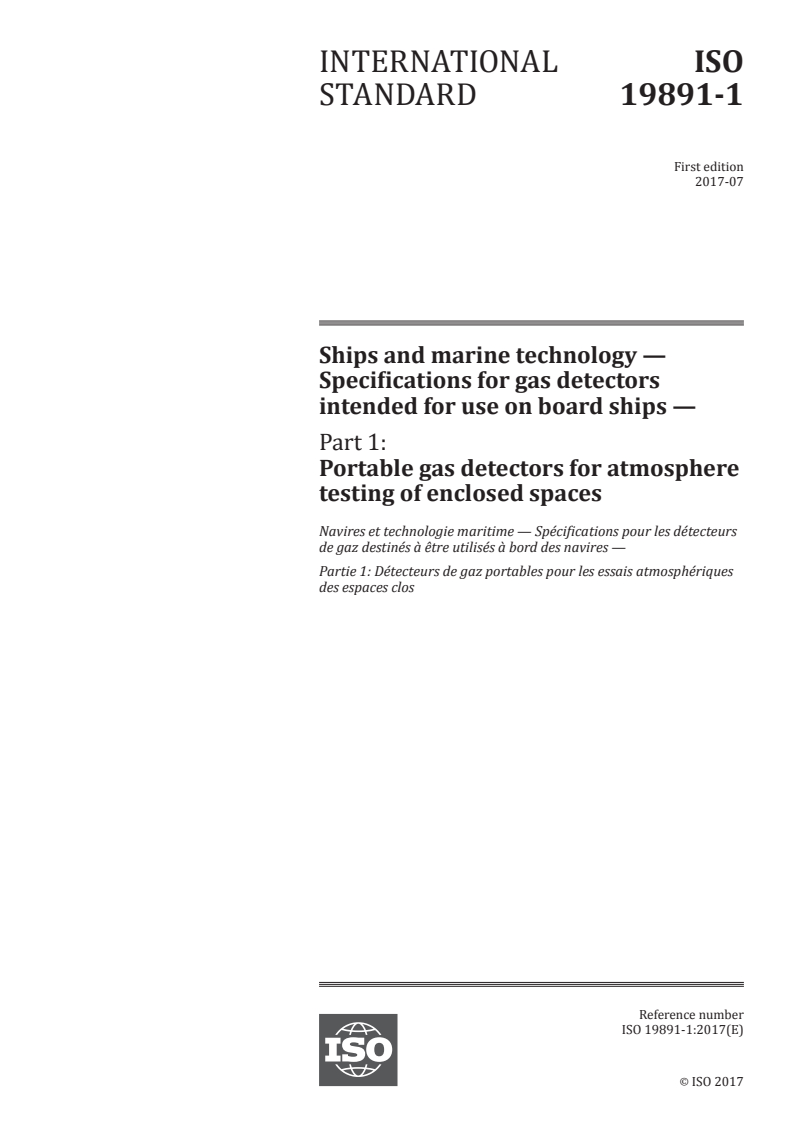
INTERNATIONAL ISO
STANDARD 19891-1
First edition
2017-07
Ships and marine technology —
Specifications for gas detectors
intended for use on board ships —
Part 1:
Portable gas detectors for atmosphere
testing of enclosed spaces
Navires et technologie maritime — Spécifications pour les détecteurs
de gaz destinés à être utilisés à bord des navires —
Partie 1: Détecteurs de gaz portables pour les essais atmosphériques
des espaces clos
Reference number
©
ISO 2017
© ISO 2017, Published in Switzerland
All rights reserved. Unless otherwise specified, no part of this publication may be reproduced or utilized otherwise in any form
or by any means, electronic or mechanical, including photocopying, or posting on the internet or an intranet, without prior
written permission. Permission can be requested from either ISO at the address below or ISO’s member body in the country of
the requester.
ISO copyright office
Ch. de Blandonnet 8 • CP 401
CH-1214 Vernier, Geneva, Switzerland
Tel. +41 22 749 01 11
Fax +41 22 749 09 47
copyright@iso.org
www.iso.org
ii © ISO 2017 – All rights reserved
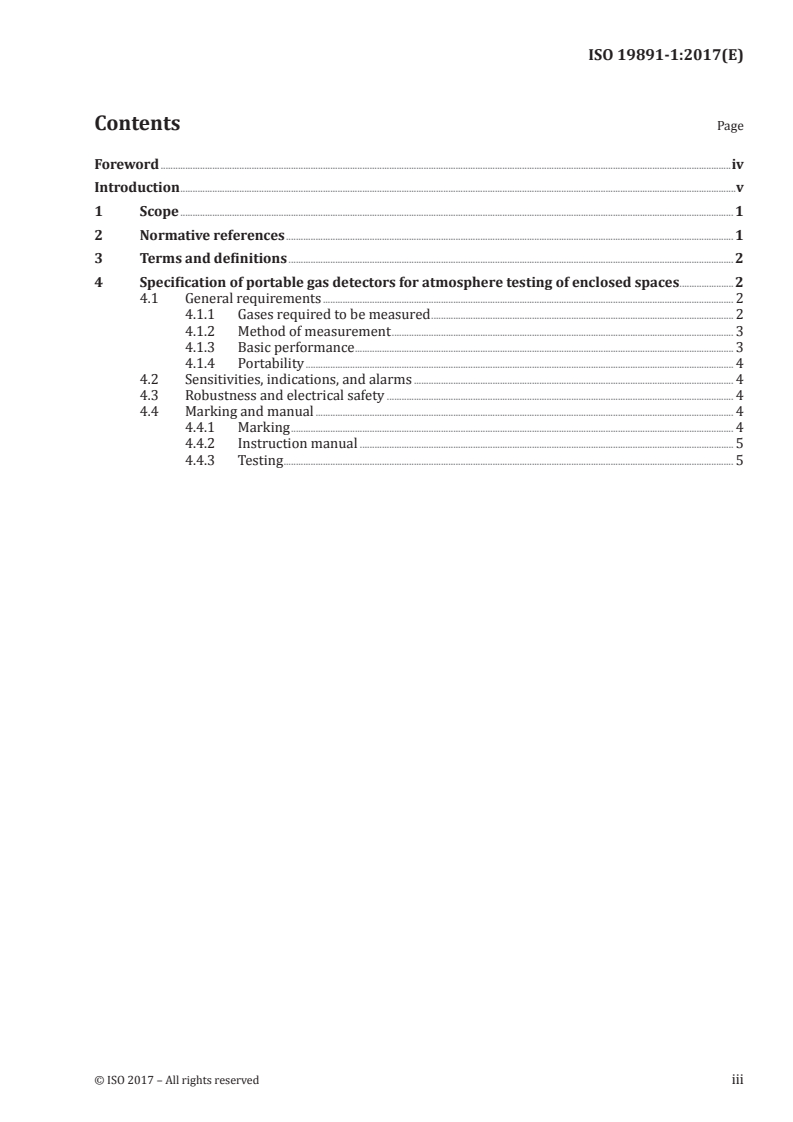
Contents Page
Foreword .iv
Introduction .v
1 Scope . 1
2 Normative references . 1
3 Terms and definitions . 2
4 Specification of portable gas detectors for atmosphere testing of enclosed spaces .2
4.1 General requirements . 2
4.1.1 Gases required to be measured . 2
4.1.2 Method of measurement . 3
4.1.3 Basic performance . 3
4.1.4 Portability . 4
4.2 Sensitivities, indications, and alarms . 4
4.3 Robustness and electrical safety . 4
4.4 Marking and manual . 4
4.4.1 Marking . 4
4.4.2 Instruction manual . 5
4.4.3 Testing . 5
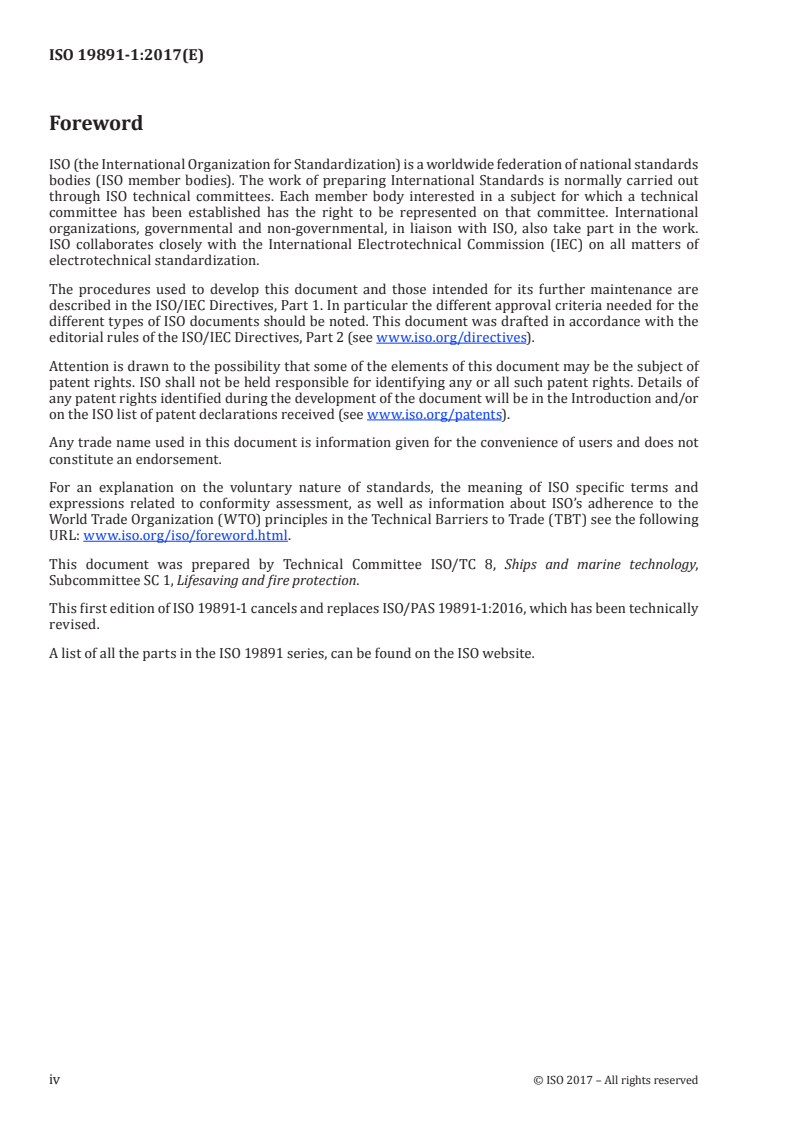
Foreword
ISO (the International Organization for Standardization) is a worldwide federation of national standards
bodies (ISO member bodies). The work of preparing International Standards is normally carried out
through ISO technical committees. Each member body interested in a subject for which a technical
committee has been established has the right to be represented on that committee. International
organizations, governmental and non-governmental, in liaison with ISO, also take part in the work.
ISO collaborates closely with the International Electrotechnical Commission (IEC) on all matters of
electrotechnical standardization.
The procedures used to develop this document and those intended for its further maintenance are
described in the ISO/IEC Directives, Part 1. In particular the different approval criteria needed for the
different types of ISO documents should be noted. This document was drafted in accordance with the
editorial rules of the ISO/IEC Directives, Part 2 (see www .iso .org/ directives).
Attention is drawn to the possibility that some of the elements of this document may be the subject of
patent rights. ISO shall not be held responsible for identifying any or all such patent rights. Details of
any patent rights identified during the development of the document will be in the Introduction and/or
on the ISO list of patent declarations received (see www .iso .org/ patents).
Any trade name used in this document is information given for the convenience of users and does not
constitute an endorsement.
For an explanation on the voluntary nature of standards, the meaning of ISO specific terms and
expressions related to conformity assessment, as well as information about ISO’s adherence to the
World Trade Organization (WTO) principles in the Technical Barriers to Trade (TBT) see the following
URL: w w w . i s o .org/ iso/ foreword .html.
This document was prepared by Technical Committee ISO/TC 8, Ships and marine technology,
Subcommittee SC 1, Lifesaving and fire protection.
This first edition of ISO 19891-1 cancels and replaces ISO/PAS 19891-1:2016, which has been technically
revised.
A list of all the parts in the ISO 19891 series, can be found on the ISO website.
iv © ISO 2017 – All rights reserved
Introduction
This document specifies performance, gases to be measured, tolerances for gas measurement, and
testing requirements of portable gas detectors used for testing of the atmosphere in enclosed spaces
onboard ships prior to entry into those spaces, as required by SOLAS regulation XI-1/7 “Atmosphere
testing instrument for enclosed spaces”.
This document specifies the characteristics that portable gas detectors should be assessed against
items such as: which gases can be measured, sensitivities, indications, alarm levels, protection against
shock, temperature and water ingress, and additional requirements for spaces or areas where a risk of
explosion exists.
This document specifies the marine environmental conditions in which portable gas detectors are
expected to be used.
This document does not define differences between gases and vapours, nor does it give technical detail
on calculations and methodology for explosive limits and operational exposure levels. The intent of
this document is to simplify the subject to the essentials and use references for the actual scientific
standards if more detailed explanations are required.
Portable gas detectors conforming to this document should only be used onboard ships in accordance
with IMO requirements and procedures.
This document does not provide a specification on how to use portable gas detectors, or how to enter
enclosed spaces.
INTERNATIONAL STANDARD ISO 19891-1:2017(E)
Ships and marine technology — Specifications for gas
detectors intended for use on board ships —
Part 1:
Portable gas detectors for atmosphere testing of
enclosed spaces
1 Scope
This document provides specifications on performance, gases to be measured, sensitivities, indications,
alarm levels, protection against shock, temperature and water ingress, and testing requirements of
portable gas detectors used for atmosphere testing of enclosed spaces onboard ships prior to entry into
those spaces.
This document specifies suitable portable gas detectors for compliance with SOLAS regulation XI-1/7
“Atmosphere testing instrument for enclosed spaces”, and may be used for deciding whether portable
gas detectors available on the market are suitable for compliance with these SOLAS requirements.
NOTE 1 SOLAS regulation XI-1/7 requires appropriate portable atmosphere testing instrument or instruments
to be carried onboard ships, by 1 July 2016. The SOLAS regulation requires, as a minimum, the appropriate
portable atmosphere testing instrument or instruments to be capable of measuring concentrations of oxygen,
flammable gases or vapours, hydrogen sulphide and carbon monoxide prior to entry into enclosed spaces.
For the purpose of measurement of concentrations of flammable gases or vapours, this document
specifies the flammable gas as either “methane” or “propane and butane”, and requires clear marking
of types of flammable gases which can be measured by the portable gas detectors. Flammable
vapours/gases which are not marked cannot be measured or detected by the portable gas detector.
NOTE 2 Iso-butane is an alternative calibration gas of portable gas detectors in measuring propane and butane.
This document does not give any indication of toxicity of the flammable gases.
2 Normative references
The following documents are referred to in the text in such a way that some or all of their content
constitutes requirements of this document. For dated references, only the edition cited applies. For
undated references, the latest edition of the referenced document (including any amendments) applies.
IEC 60079-0, Explosive atmospheres — Part 0: Equipment — General requirements
IEC 60079-29-1, Explosive atmospheres — Part 29-1: Gas detectors — Performance requirements of
detectors for flammable gases
IEC 60079-29-2, Explosive atmospheres — Part 29-2: Gas detectors — Selection, installation, use and
maintenance of detectors for flammable gases and oxygen
IEC 60092-504, Electrical installations in ships — Part 5
...
INTERNATIONAL ISO
STANDARD 19891-1
First edition
2017-07
Ships and marine technology —
Specifications for gas detectors
intended for use on board ships —
Part 1:
Portable gas detectors for atmosphere
testing of enclosed spaces
Navires et technologie maritime — Spécifications pour les détecteurs
de gaz destinés à être utilisés à bord des navires —
Partie 1: Détecteurs de gaz portables pour les essais atmosphériques
des espaces clos
Reference number
©
ISO 2017
© ISO 2017, Published in Switzerland
All rights reserved. Unless otherwise specified, no part of this publication may be reproduced or utilized otherwise in any form
or by any means, electronic or mechanical, including photocopying, or posting on the internet or an intranet, without prior
written permission. Permission can be requested from either ISO at the address below or ISO’s member body in the country of
the requester.
ISO copyright office
Ch. de Blandonnet 8 • CP 401
CH-1214 Vernier, Geneva, Switzerland
Tel. +41 22 749 01 11
Fax +41 22 749 09 47
copyright@iso.org
www.iso.org
ii © ISO 2017 – All rights reserved
Contents Page
Foreword .iv
Introduction .v
1 Scope . 1
2 Normative references . 1
3 Terms and definitions . 2
4 Specification of portable gas detectors for atmosphere testing of enclosed spaces .2
4.1 General requirements . 2
4.1.1 Gases required to be measured . 2
4.1.2 Method of measurement . 3
4.1.3 Basic performance . 3
4.1.4 Portability . 4
4.2 Sensitivities, indications, and alarms . 4
4.3 Robustness and electrical safety . 4
4.4 Marking and manual . 4
4.4.1 Marking . 4
4.4.2 Instruction manual . 5
4.4.3 Testing . 5
Foreword
ISO (the International Organization for Standardization) is a worldwide federation of national standards
bodies (ISO member bodies). The work of preparing International Standards is normally carried out
through ISO technical committees. Each member body interested in a subject for which a technical
committee has been established has the right to be represented on that committee. International
organizations, governmental and non-governmental, in liaison with ISO, also take part in the work.
ISO collaborates closely with the International Electrotechnical Commission (IEC) on all matters of
electrotechnical standardization.
The procedures used to develop this document and those intended for its further maintenance are
described in the ISO/IEC Directives, Part 1. In particular the different approval criteria needed for the
different types of ISO documents should be noted. This document was drafted in accordance with the
editorial rules of the ISO/IEC Directives, Part 2 (see www .iso .org/ directives).
Attention is drawn to the possibility that some of the elements of this document may be the subject of
patent rights. ISO shall not be held responsible for identifying any or all such patent rights. Details of
any patent rights identified during the development of the document will be in the Introduction and/or
on the ISO list of patent declarations received (see www .iso .org/ patents).
Any trade name used in this document is information given for the convenience of users and does not
constitute an endorsement.
For an explanation on the voluntary nature of standards, the meaning of ISO specific terms and
expressions related to conformity assessment, as well as information about ISO’s adherence to the
World Trade Organization (WTO) principles in the Technical Barriers to Trade (TBT) see the following
URL: w w w . i s o .org/ iso/ foreword .html.
This document was prepared by Technical Committee ISO/TC 8, Ships and marine technology,
Subcommittee SC 1, Lifesaving and fire protection.
This first edition of ISO 19891-1 cancels and replaces ISO/PAS 19891-1:2016, which has been technically
revised.
A list of all the parts in the ISO 19891 series, can be found on the ISO website.
iv © ISO 2017 – All rights reserved
Introduction
This document specifies performance, gases to be measured, tolerances for gas measurement, and
testing requirements of portable gas detectors used for testing of the atmosphere in enclosed spaces
onboard ships prior to entry into those spaces, as required by SOLAS regulation XI-1/7 “Atmosphere
testing instrument for enclosed spaces”.
This document specifies the characteristics that portable gas detectors should be assessed against
items such as: which gases can be measured, sensitivities, indications, alarm levels, protection against
shock, temperature and water ingress, and additional requirements for spaces or areas where a risk of
explosion exists.
This document specifies the marine environmental conditions in which portable gas detectors are
expected to be used.
This document does not define differences between gases and vapours, nor does it give technical detail
on calculations and methodology for explosive limits and operational exposure levels. The intent of
this document is to simplify the subject to the essentials and use references for the actual scientific
standards if more detailed explanations are required.
Portable gas detectors conforming to this document should only be used onboard ships in accordance
with IMO requirements and procedures.
This document does not provide a specification on how to use portable gas detectors, or how to enter
enclosed spaces.
INTERNATIONAL STANDARD ISO 19891-1:2017(E)
Ships and marine technology — Specifications for gas
detectors intended for use on board ships —
Part 1:
Portable gas detectors for atmosphere testing of
enclosed spaces
1 Scope
This document provides specifications on performance, gases to be measured, sensitivities, indications,
alarm levels, protection against shock, temperature and water ingress, and testing requirements of
portable gas detectors used for atmosphere testing of enclosed spaces onboard ships prior to entry into
those spaces.
This document specifies suitable portable gas detectors for compliance with SOLAS regulation XI-1/7
“Atmosphere testing instrument for enclosed spaces”, and may be used for deciding whether portable
gas detectors available on the market are suitable for compliance with these SOLAS requirements.
NOTE 1 SOLAS regulation XI-1/7 requires appropriate portable atmosphere testing instrument or instruments
to be carried onboard ships, by 1 July 2016. The SOLAS regulation requires, as a minimum, the appropriate
portable atmosphere testing instrument or instruments to be capable of measuring concentrations of oxygen,
flammable gases or vapours, hydrogen sulphide and carbon monoxide prior to entry into enclosed spaces.
For the purpose of measurement of concentrations of flammable gases or vapours, this document
specifies the flammable gas as either “methane” or “propane and butane”, and requires clear marking
of types of flammable gases which can be measured by the portable gas detectors. Flammable
vapours/gases which are not marked cannot be measured or detected by the portable gas detector.
NOTE 2 Iso-butane is an alternative calibration gas of portable gas detectors in measuring propane and butane.
This document does not give any indication of toxicity of the flammable gases.
2 Normative references
The following documents are referred to in the text in such a way that some or all of their content
constitutes requirements of this document. For dated references, only the edition cited applies. For
undated references, the latest edition of the referenced document (including any amendments) applies.
IEC 60079-0, Explosive atmospheres — Part 0: Equipment — General requirements
IEC 60079-29-1, Explosive atmospheres — Part 29-1: Gas detectors — Performance requirements of
detectors for flammable gases
IEC 60079-29-2, Explosive atmospheres — Part 29-2: Gas detectors — Selection, installation, use and
maintenance of detectors for flammable gases and oxygen
IEC 60092-504, Electrical installations in ships — Part 5
...