

ISO/IEC 11179-30:2023
(Main)Information technology — Metadata registries (MDR) — Part 30: Basic attributes of metadata
General Information
- Abstract
This document specifies “basic attributes” which are required to describe metadata in situations where a complete ISO/IEC 11179-3 metadata registry is not appropriate (e.g. in the specification of other International Standards).
- Status
- Published
- Publication Date
- 15-Jan-2023
- Technical Committee
- ISO/IEC JTC 1/SC 32 - Data management and interchange
- Drafting Committee
- ISO/IEC JTC 1/SC 32 - Data management and interchange
- Current Stage
- 6060 - International Standard published
- Start Date
- 16-Jan-2023
- Due Date
- 14-Sep-2024
- Completion Date
- 16-Jan-2023

Overview
ISO/IEC 11179-30:2023 - Information technology - Metadata registries (MDR) - Part 30: Basic attributes of metadata defines a minimal, standardized set of basic attributes needed to describe metadata where a full ISO/IEC 11179-3 metadata registry is not appropriate. Published in 2023, this part of the ISO/IEC 11179 series provides a simplified set of metadata descriptors suitable for use in other International Standards, data dictionaries, and lightweight metadata specifications. It supports consistent interpretation, interchange and referencing of metadata across systems and documents.
Key topics and requirements
- Defines the notion of basic attributes for metadata items and provides terms and definitions for core concepts such as data element, data element concept, conceptual domain, value domain, permissible value, and value meaning.
- Specifies common attribute categories used to describe metadata items, including:
- Identifying attributes (unique identifiers)
- Naming attributes (labels and preferred names)
- Definitional attributes (definitions and explanatory notes)
- Administrative attributes (status, versioning, provenance)
- Relational attributes (links between metadata items)
- Lists attributes specific to different metadata objects: data element concepts, data elements, conceptual domains, value domains, permissible values, and value meanings.
- Includes a conformance framework describing degrees of conformance (e.g., strictly conforming implementations, conforming implementations) and requires an Implementation Conformance Statement (ICS) for declared conformance.
- No normative references are required for this document, emphasizing its role as a lightweight attribute specification.
Applications and who uses it
ISO/IEC 11179-30:2023 is practical for organizations and professionals who need standardized metadata without implementing a full metadata registry:
- Standards developers embedding metadata requirements in other International Standards
- Data architects and data modelers creating consistent data element specifications
- Data stewards and governance teams preparing data dictionaries and catalogs
- System integrators and software developers implementing interoperable data exchange formats, code lists or lightweight MDRs
- Government agencies and regulated industries standardizing national or sectoral data collections
Benefits include improved metadata consistency, clearer data definitions, easier data interchange, and streamlined documentation for compliance and interoperability.
Related standards
- ISO/IEC 11179 series (meta-model family for metadata registries)
- ISO/IEC 11179-31 (metamodel for data specification registration) - referenced in the 2023 revision notes
Keywords: ISO/IEC 11179-30:2023, metadata registries, MDR, basic attributes, metadata, data element, value domain, data element concept, permissible values, data governance.
Relations
- Effective Date
- 06-Jun-2022
Get Certified
Connect with accredited certification bodies for this standard

BSI Group
BSI (British Standards Institution) is the business standards company that helps organizations make excellence a habit.

NYCE
Mexican standards and certification body.
Sponsored listings
Frequently Asked Questions
ISO/IEC 11179-30:2023 is a standard published by the International Organization for Standardization (ISO). Its full title is "Information technology — Metadata registries (MDR) — Part 30: Basic attributes of metadata". This standard covers: This document specifies “basic attributes” which are required to describe metadata in situations where a complete ISO/IEC 11179-3 metadata registry is not appropriate (e.g. in the specification of other International Standards).
This document specifies “basic attributes” which are required to describe metadata in situations where a complete ISO/IEC 11179-3 metadata registry is not appropriate (e.g. in the specification of other International Standards).
ISO/IEC 11179-30:2023 is classified under the following ICS (International Classification for Standards) categories: 35.040.50 - Automatic identification and data capture techniques. The ICS classification helps identify the subject area and facilitates finding related standards.
ISO/IEC 11179-30:2023 has the following relationships with other standards: It is inter standard links to ISO/IEC TS 11179-30:2019. Understanding these relationships helps ensure you are using the most current and applicable version of the standard.
ISO/IEC 11179-30:2023 is available in PDF format for immediate download after purchase. The document can be added to your cart and obtained through the secure checkout process. Digital delivery ensures instant access to the complete standard document.
Standards Content (Sample)
INTERNATIONAL ISO/IEC
STANDARD 11179-30
First edition
2023-01
Information technology — Metadata
registries (MDR) —
Part 30:
Basic attributes of metadata
Reference number
© ISO/IEC 2023
© ISO/IEC 2023
All rights reserved. Unless otherwise specified, or required in the context of its implementation, no part of this publication may
be reproduced or utilized otherwise in any form or by any means, electronic or mechanical, including photocopying, or posting on
the internet or an intranet, without prior written permission. Permission can be requested from either ISO at the address below
or ISO’s member body in the country of the requester.
ISO copyright office
CP 401 • Ch. de Blandonnet 8
CH-1214 Vernier, Geneva
Phone: +41 22 749 01 11
Email: copyright@iso.org
Website: www.iso.org
Published in Switzerland
ii
© ISO/IEC 2023 – All rights reserved
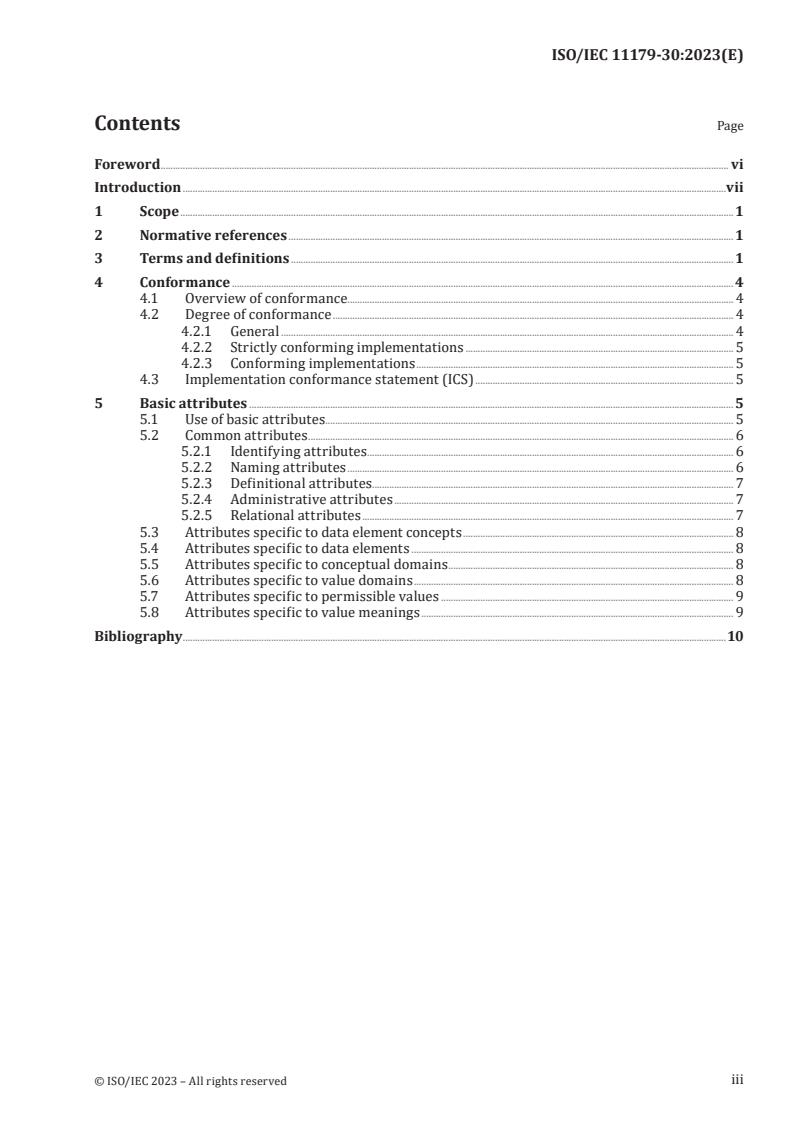
Contents Page
Foreword . vi
Introduction .vii
1 Scope . 1
2 Normative references . 1
3 Terms and definitions . 1
4 Conformance . 4
4.1 Overview of conformance . . 4
4.2 Degree of conformance . 4
4.2.1 General . 4
4.2.2 Strictly conforming implementations . 5
4.2.3 Conforming implementations . 5
4.3 Implementation conformance statement (ICS) . 5
5 Basic attributes . 5
5.1 Use of basic attributes . 5
5.2 Common attributes . 6
5.2.1 Identifying attributes . 6
5.2.2 Naming attributes . 6
5.2.3 Definitional attributes. 7
5.2.4 Administrative attributes . 7
5.2.5 Relational attributes . 7
5.3 Attributes specific to data element concepts . 8
5.4 Attributes specific to data elements . 8
5.5 Attributes specific to conceptual domains . 8
5.6 Attributes specific to value domains . 8
5.7 Attributes specific to permissible values . 9
5.8 Attributes specific to value meanings . 9
Bibliography .10
iii
© ISO/IEC 2023 – All rights reserved
List of Figures
iv
© ISO/IEC 2023 – All rights reserved
List of Tables
Table 1 — Identifying attributes . 6
Table 2 — Naming attributes .6
Table 3 — Definitional attributes .7
Table 4 — Administrative attributes. 7
Table 5 — Relational attributes . 7
Table 6 — Attributes specific to data element concepts . 8
Table 7 — Attributes specific to data elements . 8
Table 8 — Attributes specific to conceptual domains . 8
Table 9 — Attributes specific to value domains . 8
Table 10 — Attributes specific to permissible values . 9
Table 11 — Attributes specific to value meanings . 9
v
© ISO/IEC 2023 – All rights reserved
Foreword
ISO (the International Organization for Standardization) and IEC (the International Electrotechnical
Commission) form the specialized system for worldwide standardization. National bodies that are
members of ISO or IEC participate in the development of International Standards through technical
committees established by the respective organization to deal with particular fields of technical
activity. ISO and IEC technical committees collaborate in fields of mutual interest. Other international
organizations, governmental and non-governmental, in liaison with ISO and IEC, also take part in the
work.
The procedures used to develop this document and those intended for its further maintenance
are described in the ISO/IEC Directives, Part 1. In particular, the different approval criteria
needed for the different types of document should be noted. This document was drafted in
accordance with the editorial rules of the ISO/IEC Directives, Part 2 (see www.iso.org/directives or
www.iec.ch/members_experts/refdocs).
Attention is drawn to the possibility that some of the elements of this document may be the subject
of patent rights. ISO and IEC shall not be held responsible for identifying any or all such patent
rights. Details of any patent rights identified during the development of the document will be in the
Introduction and/or on the ISO list of patent declarations received (see www.iso.org/patents) or the IEC
list of patent declarations received (see https://patents.iec.ch).
Any trade name used in this document is information given for the convenience of users and does not
constitute an endorsement.
For an explanation of the voluntary nature of standards, the meaning of ISO specific terms and
expressions related to conformity assessment, as well as information about ISO's adherence to
the World Trade Organization (WTO) principles in the Technical Barriers to Trade (TBT) see
www.iso.org/iso/foreword.html. In the IEC, see www.iec.ch/understanding-standards.
This document was prepared by Joint Technical Committee ISO/IEC/JTC 1, Information technology,
Subcommittee SC 32, Data management and interchange.
This first edition of ISO/IEC 11179-30 cancels and replaces ISO/IEC TS 11179-30:2019, which has been
technically revised.
The main changes are as follows:
[4]
— removed the prior dependence on ISO/IEC 11179-3 , since this document is intended for use when
a metadata registry is not appropriate;
— reflect the relocation of the metamodel for data specification registration from ISO/IEC 11179-3 to
[5]
ISO/IEC 11179-31 .
A list of all parts in the ISO/IEC 11179 series can be found on the ISO and IEC websites.
Any feedback or questions on this document should be directed to the user’s national standards
body. A complete listing of these bodies can be found at www.iso.org/members.html and
www.iec.ch/national-committees.
vi
© ISO/IEC 2023 – All rights reserved
Introduction
Data processing and electronic data interchange rely heavily on accurate, reliable, controllable and
verifiable data recorded in databases. A prerequisite for correct and proper use and interpretation
of data is that both users and owners of data have a common understanding of the meaning and
representation of the data. To facilitate this common understanding, a number of characteristics, or
attributes, of the data have to be defined. These characteristics of data are known as “metadata”, that is,
“data that describe data”. The ISO/IEC 11179 series provides a family of conceptual metamodels for the
attributes of data elements and associated metadata to be specified and registered as metadata items
in a metadata registry (MDR).
This document provides a simplified presentation of the basic attributes which are required to describe
data elements and associated metadata, and which might be used in situations where a complete
ISO/IEC 11179-3 metadata registry is not appropriate (e.g. in the specification of other International
Standards).
This document applies to the definition, specification and contents of collections of metadata, including
interchanging or referencing among such collections.
vii
© ISO/IEC 2023 – All rights reserved
INTERNATIONAL STANDARD ISO/IEC 11179-30:2023(E)
Information technology — Metadata registries (MDR) —
Part 30:
Basic attributes of metadata
1 Scope
This document specifies “basic attributes” which are required to describe metadata in situations where
[4]
a complete ISO/IEC 11179-3 metadata registry is not appropriate (e.g. in the specification of other
International Standards).
2 Normative references
There are no normative references in this document.
3 Terms and definitions
For the purposes of this document, the following terms and definitions apply.
ISO and IEC maintain terminological databases for use in standardization at the following addresses:
— ISO Online browsing platform: available at https:// www .iso .org/ obp
— IEC Electropedia: available at https:// www .electropedia .org/
3.1
object
anything perceivable or conceivable
Note 1 to entry: Objects can be material (e.g. 'engine', 'sheet of paper', 'diamond'), immaterial (e.g. 'conversion
ratio', 'project plan') or imagined (e.g. 'unicorn', 'scientific hypothesis').
[SOURCE: ISO 1087:2019, 3.1.1]
3.2
property
feature of an object (3.1)
EXAMPLE 1 'Being made of wood' as a property of a given 'table'.
EXAMPLE 2 'Belonging to person A' as a property of a given 'pet'.
EXAMPLE 3 'Having been formulated by Einstein' as a property of the equation 'E = mc '.
EXAMPLE 4 'Being compassionate' as a property of a given 'person'.
EXAMPLE 5 'Having a given cable' as a property of a given 'computer mouse'.
Note 1 to entry: One or more objects can have the same property.
[SOURCE: ISO 1087:2019, 3.1.3]
© ISO/IEC 2023 – All rights reserved
3.3
characteristic
abstraction of a property (3.2)
EXAMPLE 'Having a cable for connecting with a computer' as a characteristic of the concept 'cord mouse'.
Note 1 to entry: Characteristics are used for describing concepts (3.4).
[SOURCE: ISO 1087:2019, 3.2.1]
3.4
concept
unit of knowledge created by a unique combination of characteristics (3.3)
Note 1 to entry: Concepts are not necessarily bound to particular natural languages. They are, however,
influenced by the social or cultural background which often leads to different categorizations.
Note 2 to entry: A concept is independent of its representation.
[SOURCE: ISO 1087:2019, 3.2.7, modified — Note 2 to entry has been changed]
3.5
attribute
characteristic (3.3) of an object (3.1) or set of objects
[SOURCE: ISO/IEC 11179-3:2023, 3.1.11]
3.6
basic attribute
attribute (3.5) of a metadata item (3.10) commonly needed in its specification
[SOURCE: ISO/IEC 11179-3:2023, 3.2.72, modified — “registry item” has been replaced by “metadata
item” since this document applies to metadata outside the context of a registry.]
3.7
data
reinterpretable representation of information in a formalized manner suitable for communication,
interpretation or processing
Note 1 to entry: Data can be processed by humans or by automatic means.
Note 2 to entry: Data may also be described using the terminological notions defined in ISO 1087 and the
computational notions defined in ISO/IEC 11404:2007. A datum is a designation of a concept with a notion of
equality defined for t
...