

ISO/IEC 6523-1:2023
(Main)Information technology — Structure for the identification of organizations and organization parts — Part 1: Identification of organization identification schemes
General Information
- Abstract
This document specifies a structure for globally and unambiguously identifying organizations, and parts thereof, for the purpose of information interchange. This document also gives recommendations regarding cases where prior agreements can be concluded between interchange partners. This document does not specify file organization techniques, storage media, languages, etc. to be used in its implementation. NOTE The procedure for registration of organization identification schemes is specified in ISO/IEC 6523-2.
- Status
- Published
- Publication Date
- 13-Aug-2023
- Technical Committee
- ISO/IEC JTC 1/SC 32 - Data management and interchange
- Drafting Committee
- ISO/IEC JTC 1/SC 32 - Data management and interchange
- Current Stage
- 6060 - International Standard published
- Start Date
- 14-Aug-2023
- Due Date
- 03-Dec-2023
- Completion Date
- 14-Aug-2023
Overview
ISO/IEC 6523-1:2023 defines a global structure for unambiguous identification of organizations and their parts for electronic information interchange. Rather than prescribing a single universal identifier, the standard provides a uniform framework to reference existing organization identification schemes, enabling interoperable machine-to-machine exchange across systems, industries and borders. It does not mandate file formats, storage media or languages - only the identification structure and related rules.
Key topics and technical requirements
International Code Designator (ICD)
- Uniquely identifies an organization identification scheme.
- ICD values are integers from 1 to 9999. Values must be unique and not reallocated once assigned. Registration procedures are handled in ISO/IEC 6523-2.
Organization Identifier (OI)
- The identifier assigned to an organization within a given scheme.
- OI must be expressible in ISO/IEC 10646 UTF‑8 encoding, up to 255 octets, and be a single-line field using graphic and space characters as defined by ISO/IEC 10646.
Organization Part Identifier (OPI) (optional)
- Used to identify departments, services or other sub-entities within an organization.
- OPIs can be assigned by the same identification scheme or by alternate methods agreed by interchange partners.
OPI Source Indicator (OPIS) (optional)
- Indicates the source of the OPI. In the 2023 edition OPIS content is limited to a single digit (0–9).
Structure components
- The identification structure consists of: ICD, OI, optional OPI, and optional OPIS. The document defines their purposes, usage rules and mechanisms to associate them.
Applications and who uses this standard
ISO/IEC 6523-1:2023 is relevant for organizations and technology professionals needing reliable cross‑system identification:
- Systems integrators, enterprise architects and software developers implementing B2B or B2G data exchange.
- Standards bodies and registries that manage or register identification schemes (see ISO/IEC 6523-2).
- Public sector agencies, financial institutions, logistics providers and supply‑chain platforms requiring unambiguous organization IDs for automated processing.
- Message and document standards (EDI, XML/JSON schemas) that reference external organization identifiers.
Benefits include improved accuracy in data interchange, reduced manual reconciliation, faster agreement on interchange rules and lower integration costs.
Related standards
- ISO/IEC 6523-2 - Registration of organization identification schemes (procedure for allocating ICD values).
- ISO/IEC 10646 - Universal coded character set (character repertoire requirements referenced for OI).
Keywords: ISO/IEC 6523-1:2023, organization identification, International Code Designator, ICD, organization identifier, OI, organization part identifier, OPI, OPIS, data interchange, identification schemes.
Relations
- Effective Date
- 17-Jun-2026
- Effective Date
- 29-Apr-2026
- Effective Date
- 20-Feb-2026
- Effective Date
- 20-Feb-2026
- Effective Date
- 20-Feb-2026
- Effective Date
- 09-Feb-2026
- Effective Date
- 06-Jun-2022
Get Certified
Connect with accredited certification bodies for this standard

BSI Group
BSI (British Standards Institution) is the business standards company that helps organizations make excellence a habit.

NYCE
Mexican standards and certification body.
Sponsored listings
Frequently Asked Questions
ISO/IEC 6523-1:2023 is a standard published by the International Organization for Standardization (ISO). Its full title is "Information technology — Structure for the identification of organizations and organization parts — Part 1: Identification of organization identification schemes". This standard covers: This document specifies a structure for globally and unambiguously identifying organizations, and parts thereof, for the purpose of information interchange. This document also gives recommendations regarding cases where prior agreements can be concluded between interchange partners. This document does not specify file organization techniques, storage media, languages, etc. to be used in its implementation. NOTE The procedure for registration of organization identification schemes is specified in ISO/IEC 6523-2.
This document specifies a structure for globally and unambiguously identifying organizations, and parts thereof, for the purpose of information interchange. This document also gives recommendations regarding cases where prior agreements can be concluded between interchange partners. This document does not specify file organization techniques, storage media, languages, etc. to be used in its implementation. NOTE The procedure for registration of organization identification schemes is specified in ISO/IEC 6523-2.
ISO/IEC 6523-1:2023 is classified under the following ICS (International Classification for Standards) categories: 35.040.50 - Automatic identification and data capture techniques. The ICS classification helps identify the subject area and facilitates finding related standards.
ISO/IEC 6523-1:2023 has the following relationships with other standards: It is inter standard links to EN 18219:2026, EN 16931-1:2026, EN IEC 62832-1:2020, EN IEC 62832-3:2020, EN IEC 62832-2:2020, CEN/TS 16931-8:2024, ISO/IEC 6523-1:1998. Understanding these relationships helps ensure you are using the most current and applicable version of the standard.
ISO/IEC 6523-1:2023 is available in PDF format for immediate download after purchase. The document can be added to your cart and obtained through the secure checkout process. Digital delivery ensures instant access to the complete standard document.
Standards Content (Sample)
INTERNATIONAL ISO/IEC
STANDARD 6523-1
Second edition
2023-08
Information technology — Structure
for the identification of organizations
and organization parts —
Part 1:
Identification of organization
identification schemes
Technologies de l'information — Structure pour l'identification des
organisations et des parties d'organisations —
Partie 1: Identification des systèmes d'identification d'organisations
Reference number
© ISO/IEC 2023
© ISO/IEC 2023
All rights reserved. Unless otherwise specified, or required in the context of its implementation, no part of this publication may
be reproduced or utilized otherwise in any form or by any means, electronic or mechanical, including photocopying, or posting on
the internet or an intranet, without prior written permission. Permission can be requested from either ISO at the address below
or ISO’s member body in the country of the requester.
ISO copyright office
CP 401 • Ch. de Blandonnet 8
CH-1214 Vernier, Geneva
Phone: +41 22 749 01 11
Email: copyright@iso.org
Website: www.iso.org
Published in Switzerland
ii
© ISO/IEC 2023 – All rights reserved
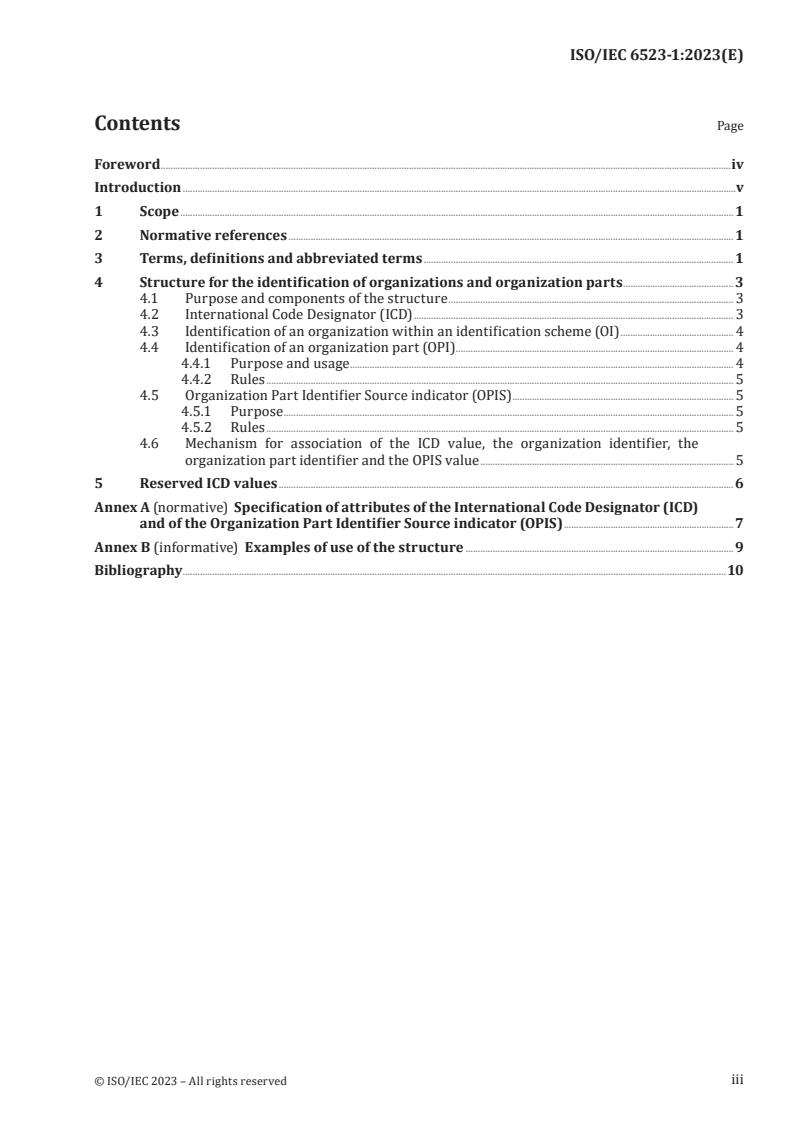
Contents Page
Foreword .iv
Introduction .v
1 Scope . 1
2 Normative references . 1
3 Terms, definitions and abbreviated terms . 1
4 Structure for the identification of organizations and organization parts .3
4.1 Purpose and components of the structure . 3
4.2 International Code Designator (ICD) . 3
4.3 Identification of an organization within an identification scheme (OI) . 4
4.4 Identification of an organization part (OPI) . 4
4.4.1 Purpose and usage . 4
4.4.2 Rules . 5
4.5 Organization Part Identifier Source indicator (OPIS) . 5
4.5.1 Purpose . 5
4.5.2 Rules . 5
4.6 Mechanism for association of the ICD value, the organization identifier, the
organization part identifier and the OPIS value . 5
5 Reserved ICD values . 6
Annex A (normative) Specification of attributes of the International Code Designator (ICD)
and of the Organization Part Identifier Source indicator (OPIS) .7
Annex B (informative) Examples of use of the structure . 9
Bibliography .10
iii
© ISO/IEC 2023 – All rights reserved
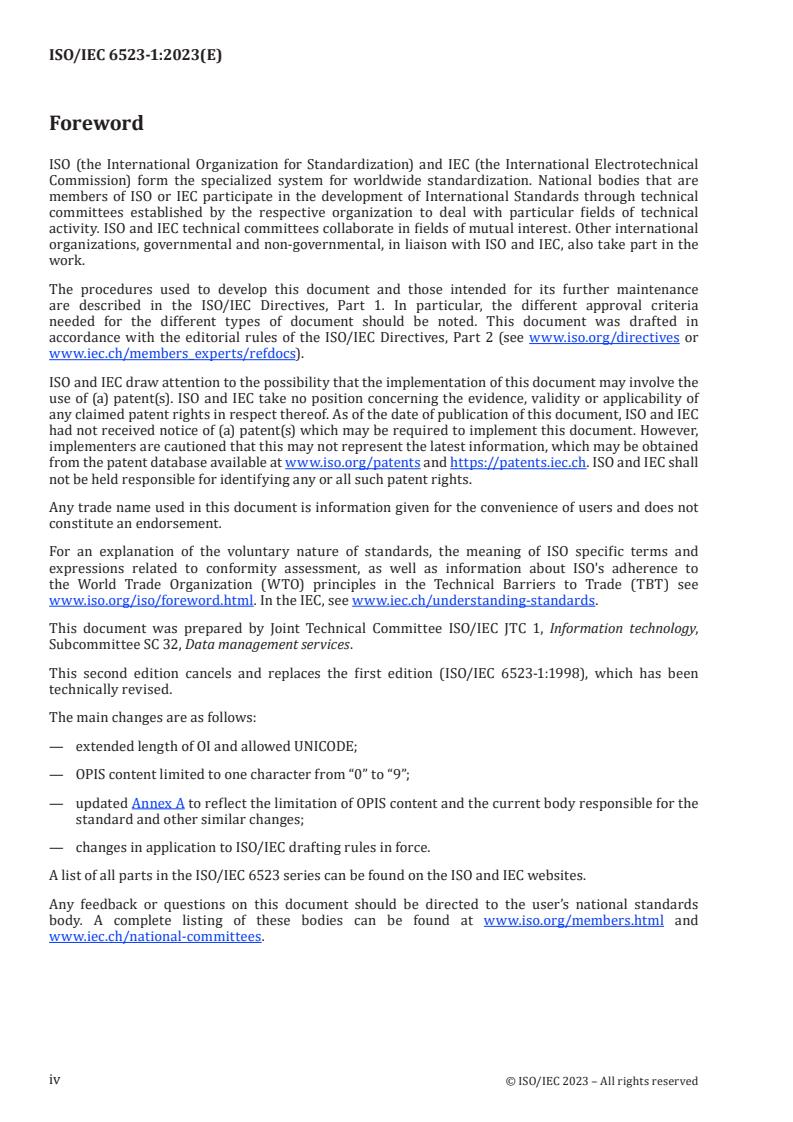
Foreword
ISO (the International Organization for Standardization) and IEC (the International Electrotechnical
Commission) form the specialized system for worldwide standardization. National bodies that are
members of ISO or IEC participate in the development of International Standards through technical
committees established by the respective organization to deal with particular fields of technical
activity. ISO and IEC technical committees collaborate in fields of mutual interest. Other international
organizations, governmental and non-governmental, in liaison with ISO and IEC, also take part in the
work.
The procedures used to develop this document and those intended for its further maintenance
are described in the ISO/IEC Directives, Part 1. In particular, the different approval criteria
needed for the different types of document should be noted. This document was drafted in
accordance with the editorial rules of the ISO/IEC Directives, Part 2 (see www.iso.org/directives or
www.iec.ch/members_experts/refdocs).
ISO and IEC draw attention to the possibility that the implementation of this document may involve the
use of (a) patent(s). ISO and IEC take no position concerning the evidence, validity or applicability of
any claimed patent rights in respect thereof. As of the date of publication of this document, ISO and IEC
had not received notice of (a) patent(s) which may be required to implement this document. However,
implementers are cautioned that this may not represent the latest information, which may be obtained
from the patent database available at www.iso.org/patents and https://patents.iec.ch. ISO and IEC shall
not be held responsible for identifying any or all such patent rights.
Any trade name used in this document is information given for the convenience of users and does not
constitute an endorsement.
For an explanation of the voluntary nature of standards, the meaning of ISO specific terms and
expressions related to conformity assessment, as well as information about ISO's adherence to
the World Trade Organization (WTO) principles in the Technical Barriers to Trade (TBT) see
www.iso.org/iso/foreword.html. In the IEC, see www.iec.ch/understanding-standards.
This document was prepared by Joint Technical Committee ISO/IEC JTC 1, Information technology,
Subcommittee SC 32, Data management services.
This second edition cancels and replaces the first edition (ISO/IEC 6523-1:1998), which has been
technically revised.
The main changes are as follows:
— extended length of OI and allowed UNICODE;
— OPIS content limited to one character from “0” to “9”;
— updated Annex A to reflect the limitation of OPIS content and the current body responsible for the
standard and other similar changes;
— changes in application to ISO/IEC drafting rules in force.
A list of all parts in the ISO/IEC 6523 series can be found on the ISO and IEC websites.
Any feedback or questions on this document should be directed to the user’s national standards
body. A complete listing of these bodies can be found at www.iso.org/members.html and
www.iec.ch/national-committees.
iv
© ISO/IEC 2023 – All rights reserved
Introduction
The increased use of data processing and telecommunications capabilities in commercial, governmental
and other applications has made possible the interchange of information in an effective machine-
processable form. As this type of automated interchange increases, the need for International Standards
covering data also increases. The ISO/IEC 6523 series, defining a structure for a globally unique and
unambiguous identification of organizations and organization parts, is one of a number of International
Standards that have been developed as a means for improving the accuracy and effectiveness of data
processing and data interchange.
In the development of this document, it has been recognized that a single method for identifying all
organizations on an international basis is neither feasible nor practicable. Instead, this document
recognizes existing methods of identification and provides a means for systematically incorporating
these in a uniform structure for the purposes of information interchange. In this document, an
organization can be identified by more than one identification method.
The use of the structure for the identification of organizations and organization parts, for the purpose
of interchange of information, will:
a) improve the accuracy of the identification of organizations and organization parts, and hence of the
interchange of data;
b) reduce the need for human intervention in the interchange of information in machine-to-machine
environments;
c) diminish the time required to specify interchange agreements;
d) as a consequence of the foregoing, reduce the cost of the interchange of data.
Examples illustrating the use of the structure for the identification of organizations and organization
parts are given in Annex B.
v
© ISO/IEC 2023 – All rights reserved
INTERNATIONAL STANDARD ISO/IEC 6523-1:2023(E)
Information technology — Structure for the identification
of organizations and organization parts —
Part 1:
Identification of organization identification schemes
1 Scope
This document specifies a structure for globally and unambiguously identifying organizations, and
parts thereof, for the purpose of information interchange.
This document also gives recommendations regarding cases where prior agreements can be concluded
between interchange partners.
This document does not specify file organization techniques, storage media, languages, etc. to be used
in its implementation.
NOTE The procedure for registration of organization identification schemes is specified in ISO/IEC 6523-2.
2 Normative references
The following documents are referred to in the text in such a way that some or all of their content
constitutes requirements of this document. For dated references, only the edition cited applies. For
undated references, the latest edition of the referenced document (including any amendments) applies.
ISO/IEC 6523-2, Information technology — Structure for the identification of organizations and
organization parts — Part 2: Registration of organization identification schemes
ISO/IEC 10646, Information technology — Universal coded character set (UCS)
3 Terms, definitions and abbreviated terms
For the purposes of this document, the following terms and definitions apply.
ISO and IEC maintain terminology databases for use in standardization at the following addresses:
— ISO Online browsing platform: available at https:// www .iso .org/ obp
— IEC Electropedia: available at https:// www .electropedia .org/
3.1
organization
unique framework of authority within which a person or persons act, or are designated to act, towards
some purpose
EXAMPLE
a) An organization incorporated under law.
b) An unincorporated organization or activity providing goods and/or services including:
1) partnerships;
© ISO/IEC 2023 – All rights reserved
2) social or other non-profit organizations or similar bodies in which ownership or control is
vested in a group of individuals;
3) sole proprietorships;
4) governmental bodies.
c) Groupings of the above types of organizations where there is a need to identify these in information
interchange.
3.2
organization part
any department, service or other entity within an organization (3.1), which needs to be identified for
information interchange
3.3
data element
unit of data that is considered in context to be indivisible
Note 1 to entry: The definition states that a data element is “indivisible” in some context. This means that it is
possible that a data element considered indivisible in one context (e.g., telephone number) may be divisible in
another context, (e.g. country code, area code, local number).
EXAMPLE The data element “age of a person” with values consisting of all combinations of 3 decimal digits.
[SOURCE: ISO/IEC 2382:2015, 2121599, modified — Example moved to the end without the Note to
entry prefix, other Notes to entry replaced by the above].
3.4
data element value
value out of a set of permissible values pertaining to a data element (3.3)
3.5
identifier
character or group of characters constituting a data element value (3.4) used to identify or name an
object and possibly to indicate certain properties of that object
3.6
identification scheme
system for allocating identifiers to registered objects
3.7
organization identification scheme
identification scheme (3.6) dedicated to the unique identification of organizations (3.1)
3.8
International Code Designator
ICD
data element (3.3) used to uniquely identify an organization identification scheme (3.7)
3.9
International Code Designator value
ICD value
identifier (3.5) allocated to a particular organization identification scheme (3.7)
3.10
organization identifier
OI
identifier (3.5) assigned to an organization (3.1) within an organization identification scheme (3.7), and
unique within that scheme
© ISO/IEC 2023 – All rights reserved
3.11
orga
...