


ISO 7001:2023/Amd 2
(Amendment)Graphical symbols — Registered public information symbols — Amendment 2
Graphical symbols — Registered public information symbols — Amendment 2
Symboles graphiques — Symboles destinés à l'information du public enregistrés — Amendement 2
General Information
- Status
- Not Published
- Technical Committee
- ISO/TC 145/SC 1 - Public information symbols
- Drafting Committee
- ISO/TC 145/SC 1/WG 4 - Public information symbols (Revision of ISO 7001)
- Current Stage
- 6000 - International Standard under publication
- Start Date
- 29-Apr-2026
- Completion Date
- 02-May-2026
Relations
- Effective Date
- 20-Sep-2025
Overview
ISO 7001:2023/FDAmd 2 is the second amendment to the internationally recognized standard ISO 7001, which specifies graphical symbols for the purpose of public information. Published by the International Organization for Standardization (ISO), this amendment introduces additional registered public information symbols to enhance accessibility and guidance in public spaces. The standard is maintained by ISO Technical Committee ISO/TC 145/SC 1, focusing on symbols, signs, and guidance systems.
This amendment supports the development of universally understood signage, improving wayfinding, accessibility, and health communication in public environments worldwide.
Key Topics
1. Sign Language Accessibility Symbol (BI AC 024)
- Indicates the availability of sign language accessibility services in public spaces.
- Symbol typically features two intersecting hands, representing sign language, with optional flags for specific languages.
- Intended to make it clear when sign language support is provided, benefitting people who are deaf or hard of hearing.
2. Health Check Symbol (PI PF 085)
- Signals the location where a physical health check can be obtained.
- The symbol typically incorporates imagery such as a clipboard, pencil, stethoscope, and a cross (which may be substituted to fit cultural contexts).
- Designed to direct individuals to health screening facilities or stations.
3. Accessibility and Public Communication
- These symbols help ensure clear, inclusive communication for diverse populations, including those seeking medical services or accessible communication methods.
4. User-Centric Design
- Both symbols are intended for broad user populations, supporting inclusivity regardless of language or physical abilities.
- Recommended to be accompanied by explanatory text to optimize comprehension, especially in unfamiliar settings.
Applications
- Public Facilities and Transportation Hubs
- Airports, train stations, bus terminals, and urban infrastructure use these symbols to indicate availability of services such as sign language support and health checks.
- Healthcare and Community Settings
- Hospitals, clinics, and wellness centers use the health check symbol to inform visitors of medical examination areas.
- Event Venues and Educational Institutions
- Conference centers, sporting arenas, universities, and schools can deploy the sign language accessibility symbol to ensure accessibility for deaf attendees.
- Global Wayfinding and Accessibility Initiatives
- Implementation in international settings supports compliance with accessibility regulations and enhances the experience for persons with disabilities, ensuring equitable access to essential information.
- Culturally Sensitive Adaptation
- The standard allows for certain symbol elements to be adapted to suit local cultural conventions, enhancing global relevance.
Related Standards
- ISO 7001: Graphical symbols - Public information symbols
- The foundational standard to which this amendment applies, providing a comprehensive catalogue of symbols for public information needs.
- ISO 9186-1: Graphical symbols - Test methods
- Supports comprehension testing of symbols to assure understandability in various contexts.
- ISO/TC 145 Series: Graphical symbols
- Encompasses international standards for graphical symbols related to safety, public information, and workplace environments.
- International Accessibility Standards
- Aligns with broader accessibility and inclusion regulations, such as those advocated by the World Federation of the Deaf and international disability alliances.
Practical Value
ISO 7001:2023/FDAmd 2 enhances public information systems by supporting clear, accessible communication through registered symbols. Its adoption by public and private organizations helps foster greater inclusivity for persons with disabilities and improves navigation and information dissemination in high-traffic environments globally. By adhering to this standard, organizations demonstrate a commitment to universal design, public health, and the rights of all community members to access essential services, regardless of language or ability.
Buy Documents
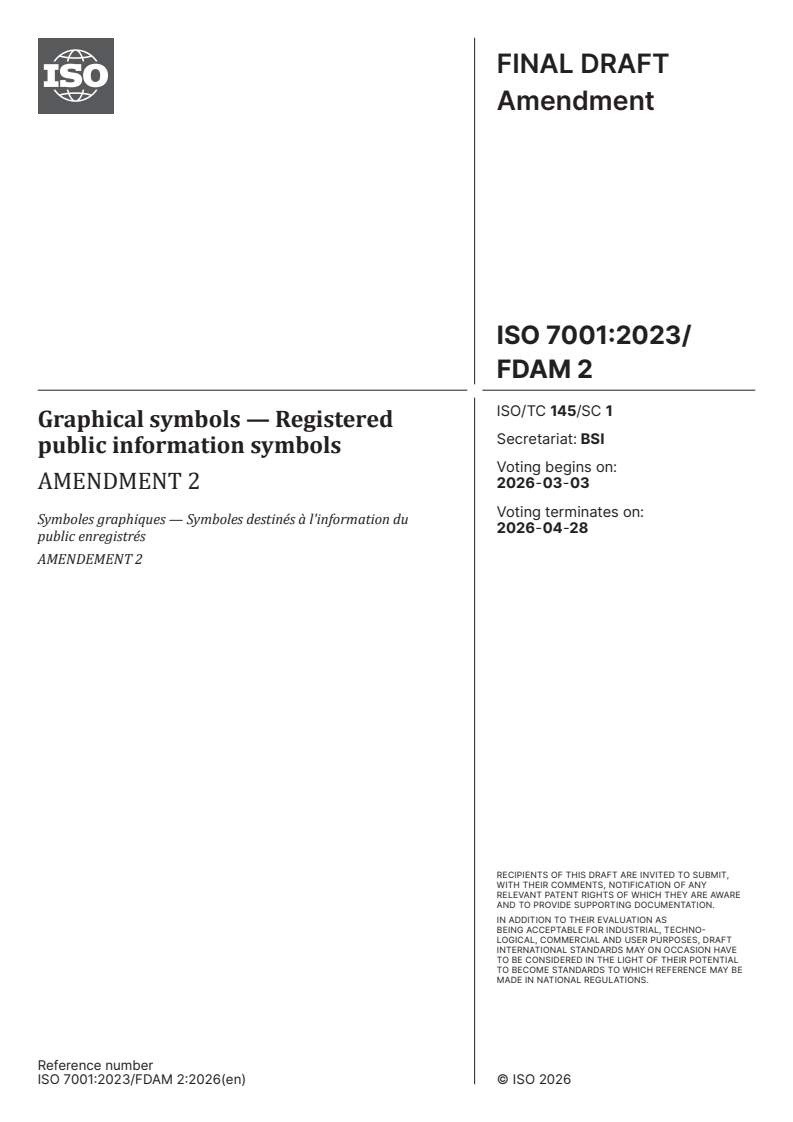

ISO 7001:2023/FDAmd 2 - Graphical symbols — Registered public information symbols — Amendment 2
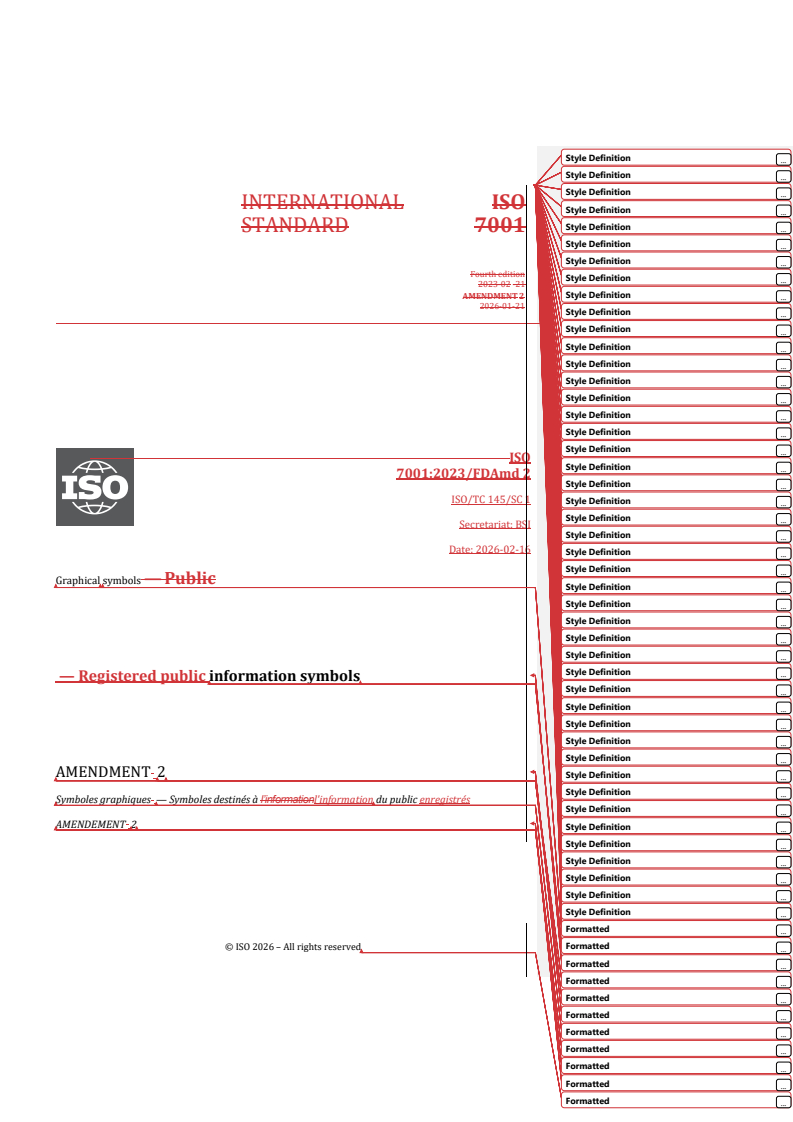
REDLINE ISO 7001:2023/FDAmd 2 - Graphical symbols — Registered public information symbols — Amendment 2
Frequently Asked Questions
ISO 7001:2023/Amd 2 is a draft published by the International Organization for Standardization (ISO). Its full title is "Graphical symbols — Registered public information symbols — Amendment 2". This standard covers: Graphical symbols — Registered public information symbols — Amendment 2
Graphical symbols — Registered public information symbols — Amendment 2
ISO 7001:2023/Amd 2 is classified under the following ICS (International Classification for Standards) categories: 01.080.10 - Public information symbols. Signs. Plates. Labels. The ICS classification helps identify the subject area and facilitates finding related standards.
ISO 7001:2023/Amd 2 has the following relationships with other standards: It is inter standard links to ISO 7001:2023. Understanding these relationships helps ensure you are using the most current and applicable version of the standard.
ISO 7001:2023/Amd 2 is available in PDF format for immediate download after purchase. The document can be added to your cart and obtained through the secure checkout process. Digital delivery ensures instant access to the complete standard document.
Standards Content (Sample)
FINAL DRAFT
Amendment
ISO 7001:2023/
FDAM 2
ISO/TC 145/SC 1
Graphical symbols — Registered
Secretariat: BSI
public information symbols
Voting begins on:
2026-03-03
AMENDMENT 2
Voting terminates on:
Symboles graphiques — Symboles destinés à l'information du
2026-04-28
public enregistrés
AMENDEMENT 2
RECIPIENTS OF THIS DRAFT ARE INVITED TO SUBMIT,
WITH THEIR COMMENTS, NOTIFICATION OF ANY
RELEVANT PATENT RIGHTS OF WHICH THEY ARE AWARE
AND TO PROVIDE SUPPOR TING DOCUMENTATION.
IN ADDITION TO THEIR EVALUATION AS
BEING ACCEPTABLE FOR INDUSTRIAL, TECHNO
LOGICAL, COMMERCIAL AND USER PURPOSES, DRAFT
INTERNATIONAL STANDARDS MAY ON OCCASION HAVE
TO BE CONSIDERED IN THE LIGHT OF THEIR POTENTIAL
TO BECOME STAN DARDS TO WHICH REFERENCE MAY BE
MADE IN NATIONAL REGULATIONS.
Reference number
ISO 7001:2023/FDAM 2:2026(en) © ISO 2026
FINAL DRAFT
ISO 7001:2023/FDAM 2:2026(en)
Amendment
ISO 7001:2023/
FDAM 2
ISO/TC 145/SC 1
Graphical symbols — Registered
Secretariat: BSI
public information symbols
Voting begins on:
AMENDMENT 2
Voting terminates on:
Symboles graphiques — Symboles destinés à l'information du
public enregistrés
AMENDEMENT 2
RECIPIENTS OF THIS DRAFT ARE INVITED TO SUBMIT,
WITH THEIR COMMENTS, NOTIFICATION OF ANY
RELEVANT PATENT RIGHTS OF WHICH THEY ARE AWARE
AND TO PROVIDE SUPPOR TING DOCUMENTATION.
© ISO 2026
IN ADDITION TO THEIR EVALUATION AS
All rights reserved. Unless otherwise specified, or required in the context of its implementation, no part of this publication may
BEING ACCEPTABLE FOR INDUSTRIAL, TECHNO
LOGICAL, COMMERCIAL AND USER PURPOSES, DRAFT
be reproduced or utilized otherwise in any form or by any means, electronic or mechanical, including photocopying, or posting on
INTERNATIONAL STANDARDS MAY ON OCCASION HAVE
the internet or an intranet, without prior written permission. Permission can be requested from either ISO at the address below
TO BE CONSIDERED IN THE LIGHT OF THEIR POTENTIAL
or ISO’s member body in the country of the requester.
TO BECOME STAN DARDS TO WHICH REFERENCE MAY BE
MADE IN NATIONAL REGULATIONS.
ISO copyright office
CP 401 • Ch. de Blandonnet 8
CH-1214 Vernier, Geneva
Phone: +41 22 749 01 11
Email: copyright@iso.org
Website: www.iso.org
Published in Switzerland Reference number
ISO 7001:2023/FDAM 2:2026(en) © ISO 2026
ii
ISO 7001:2023/FDAM 2:2026(en)
Foreword
ISO (the International Organization for Standardization) is a worldwide federation of national standards
bodies (ISO member bodies). The work of preparing International Standards is normally carried out through
ISO technical committees. Each member body interested in a subject for which a technical committee
has been established has the right to be represented on that committee. International organizations,
governmental and non-governmental, in liaison with ISO, also take part in the work. ISO collaborates closely
with the International Electrotechnical Commission (IEC) on all matters of electrotechnical standardization.
The procedures used to develop this document and those intended for its further maintenance are described
in the ISO/IEC Directives, Part 1. In particular, the different approval criteria needed for the different types
of ISO document should be noted. This document was drafted in accordance with the editorial rules of the
ISO/IEC Directives, Part 2 (see www.iso.org/directives).
ISO draws attention to the possibility that the implementation of this document may involve the use of (a)
patent(s). ISO takes no position concerning the evidence, validity or applicability of any claimed patent
rights in respect thereof. As of the date of publication of this document, ISO had not received notice of (a)
patent(s) which may be required to implement this document. However, implementers are cautioned that
this may not represent the latest information, which may be obtained from the patent database available at
www.iso.org/patents. ISO shall not be held responsible for identifying any or all such patent rights.
Any trade name used in this document is information given for the convenience of users and does not
constitute an endorsement.
For an explanation of the voluntary nature of standards, the meaning of ISO specific terms and expressions
related to conformity assessmen
...
Style Definition
...
Style Definition
...
Style Definition
...
INTERNATIONAL ISO
Style Definition
...
Style Definition
STANDARD 7001
...
Style Definition
...
Style Definition
...
Fourth edition
Style Definition
...
2023 - 02 - 2 1
Style Definition
AMENDMENT 2
...
20 26 - 01 - 21
Style Definition
...
Style Definition
...
Style Definition
...
Style Definition
...
Style Definition
...
Style Definition
...
Style Definition
...
Style Definition
...
Style Definition
...
ISO
Style Definition
...
7001:2023/FDAmd 2
Style Definition
...
ISO/TC 145/SC 1
Style Definition
...
Style Definition
...
Secretariat: BSI
Style Definition
...
Date: 2026-02-16
Style Definition
...
Style Definition
...
Graphical symbols — Public
Style Definition
...
Style Definition
...
Style Definition
...
Style Definition
...
Style Definition
...
Style Definition
...
— Registered public information symbols
Style Definition
...
Style Definition
...
Style Definition
...
Style Definition
...
Style Definition
...
AMENDMENT 2 Style Definition
...
Style Definition
...
Symboles graphiques — Symboles destinés à l’informationl'information du public enregistrés
Style Definition
...
AMENDEMENT 2
Style Definition
...
Style Definition
...
Style Definition
...
Style Definition
...
Style Definition
...
Style Definition
...
Formatted
...
Formatted
...
Formatted
...
Formatted
...
Formatted
...
Formatted
...
Formatted
...
Formatted
...
Formatted
...
Formatted
...
Formatted
...
ISO #####-#:####(X)
Formatted: release-version, Left, Indent: Left: 0 cm,
Right: 0 cm, Border: Top: (No border), Bottom: (No
border), Left: (No border), Right: (No border)
WD/CD/DIS/FDIS stage
Warning for WDs and CDs
This document is not an ISO International Standard. It is distributed for review and comment. It is subject to
change without notice and may not be referred to as an International Standard.
Recipients of this draft are invited to submit, with their comments, notification of any relevant patent rights of
which they are aware and to provide supporting documentation.
2 © ISO #### – All rights reserved
Formatted: Font: Bold
ISO #####-#:####(X)
All rights reserved. Unless otherwise specified, or required in the context of its implementation, no part of this
Formatted: Indent: Left: 0 cm, Right: 0 cm, Adjust
publication may be reproduced or utilized otherwise in any form or by any means, electronic or mechanical,
space between Latin and Asian text, Adjust space
including photocopying, or posting on the internet or an intranet, without prior written permission. Permission
between Asian text and numbers
can be requested from either ISO at the address below or ISO’s member body in the country of the requester.
ISO copyright office
CP 401 • Ch. de Blandonnet 8
CH-1214 Vernier, Geneva
Phone: + 41 22 749 01 11
Formatted: French (France)
EmailE-mail: copyright@iso.org
Formatted: French (France)
Website: www.iso.orgwww.iso.org
Formatted: French (France)
Published in Switzerland
Formatted: English (United Kingdom)
Formatted: English (United Kingdom)
Formatted: PAGEBREAK
iv © ISO #### – All rights reserved
ISO 7001:2023/Amd.2:2026(E)
Foreword Formatted: Adjust space between Latin and Asian text,
Adjust space between Asian text and numbers
ISO (the International Organization for Standardization) is a worldwide federation of national standards
bodies (ISO member bodies). The work of preparing International Standards is normally carried out
through ISO technical committees. Each member body interested in a subject for which a technical
committee has been established has the right to be represented on that committee. International
organizations, governmental and non-governmental, in liaison with ISO, also take part in the work. ISO
collaborates closely with the International Electrotechnical Commission (IEC) on all matters of
electrotechnical standardization.
The procedures used to develop this document and those intended for its further maintenance are
described in the ISO/IEC Directives, Part 1. In particular, the different approval criteria needed for the
different types of ISO document should be noted. This document was drafted in accordance with the
editorial rules of the ISO/IEC Directives, Part 2 (see www.iso.org/directives).
Formatted: English (United Kingdom)
ISO draws attention to the possibility that the implementation of this document may involve the use of
(a) patent(s). ISO takes no position concerning the evidence, validity or applicability of any claimed
patent rights in respect thereof. As of the date of publication of this document, ISO had not received
notice of (a) patent(s) which may be required to implement this document. However, implementers are
cautioned that this may not represent the latest information, which may be obtained from the patent
database available at www.iso.org/patents. ISO shall not be held responsible for identifying any or all
Formatted: English (United Kingdom)
such patent rights.
Any trade name used in this document is information given for the convenience of users and does not
constitute an endorsement.
For an explanation of the voluntary nature of standards, the meaning of ISO specific terms and
expressions related to conformity assessment, as well as information about ISO's adherence to the
World Trade Organization (WTO) principles in the Technical Barriers to Trade (TBT), see
www.iso.org/iso/foreword.html.
Formatted: English (United Kingdom)
This document was prepared by Technical Committee ISO/TC 145, Graphical symbols, Subcommittee
SC 1, Public information symbols, signs and guidance systemssystem.
Any feedback or questions on this document should be directed to the user’s national standards body.
A complete listing of these bodies can be found at www.iso.org/members.html.
Formatted: English (United Kingdom)
v
ISO #####-#:####(X)
vi © ISO #### – All rights reserved
ISO 7001:2023/Amd.FDAmd 2:2026(E(en) Formatted: Font: 11 pt, Bold
Formatted: Font: 11 pt, Bold
Formatted: Font: 11 pt, Bold
Formatted: Font: 11 pt, Bold
Formatted: HeaderCentered, Left, Space After: 0 pt,
Line spacing: single
2026-01-21
ISO/TC 145/SC 1/WG 4
Secretariat: BSI
Add the following
Formatted: Font: 10 pt
Formatted: Font: 10 pt
Formatted: Font: 10 pt
Formatted: FooterCentered, Left, Line spacing: single
Formatted: Font: 11 pt
Formatted: FooterPageRomanNumber, Left, Space
After: 0 pt, Line spacing: single
© ISO 2026 – All rights reserved
vii
ISO 7001:2023/FDAmd 2(en)
Formatted: Font: Bold
Formatted: HeaderCentered
Formatted: Font: 16 pt
Graphical symbols — Registered public information symbols
Formatted: Top: 1.4 cm, Bottom: 1 cm, Section start:
AMENDMENT 2
New page, Header distance from edge: 1.27 cm, Footer
distance from edge: 0.5 cm
Add public information symbol BI AC 024 to the alphabetical summary in Table 1, to the summary of all
Formatted: Font: 11 pt
symbols in Table 2 and to Table
...
Questions, Comments and Discussion
Ask us and Technical Secretary will try to provide an answer. You can facilitate discussion about the standard in here.
Loading comments...