

ISO/DTR 26091
(Main)Wood and wood-based products — Background and examples of calculating the forest carbon balance
- Status
- Not Published
- Technical Committee
- ISO/TC 287 - Sustainable processes for wood and wood-based products
- Drafting Committee
- ISO/TC 287/WG 3 - Sustainability aspects
- Current Stage
- 5020 - FDIS ballot initiated: 2 months. Proof sent to secretariat
- Start Date
- 24-Aug-2026
- Completion Date
- 24-Aug-2026
Buy Documents

ISO/DTR 26091 - Wood and wood-based products — Background and examples of calculating the forest carbon balance
REDLINE ISO/DTR 26091 - Wood and wood-based products — Background and examples of calculating the forest carbon balance
ISO/DTR 26091 is an ISO technical report for wood and wood-based products that gives background and worked examples for calculating the forest carbon balance. It is written for people using ISO 13391-2 and explains how forest carbon balance calculations can be set up, supported by data, and reported for different forest management unit arrangements.
What does ISO/DTR 26091 specify?
ISO/DTR 26091 provides background literature and examples for calculating the forest carbon balance for different types of forest management units (FMUs) as defined in ISO 13391-2. It is a guidance document on method and context, not a complete catalogue of all possible cases.
The document is organized into:
- Clause 4 - background to forest carbon balance calculation and reporting
- Clause 5 - examples of FMU characterizations and situations
- Clause 6 - forest carbon balance calculations at the FMU level
- Clause 7 - incorporating effects of large-scale disturbances
- Bibliography
Clause 4 explains the managed land proxy approach, the forest carbon pools used in the ISO 13391 series, and the tiered approach to data. Clause 5 shows how different ownership and sourcing situations affect FMU definition. Clause 6 focuses on data sources, time period handling, land use change, pool calculations, supporting data beyond the FMU, and allocation and prorating. Clause 7 addresses how to separate and report large-scale disturbance effects.
What are the key requirements of ISO/DTR 26091?
ISO/DTR 26091 mainly explains how to apply the methodology behind ISO 13391-2 in practice. The most important points are the boundary choices, the choice of data source, and how to treat incomplete or non-local data so that the forest carbon balance remains representative.
Managed land, forest pools and calculation approach
Clause 4 explains that the ISO 13391 series uses the managed land proxy approach. In practice, that means managed forest land is used as the practical basis for estimating anthropogenic emissions and removals, including land with harvesting, planting, conservation, recreation, or set-aside areas.
Clause 4.3 describes the forest carbon pools used here. The report focuses on five forest pools: above-ground biomass, below-ground biomass, deadwood, litter, and soil organic matter. It also notes that harvested wood products are handled separately in ISO 13391-1, which matters because the forest balance and product balance are not the same thing.
The document explains that both the gain-loss method and the stock-difference method are acceptable under ISO 13391-2. In practice, this gives users two ways to calculate carbon stock change, depending on whether they have change data or stock data at two points in time.
Tiered data use
Clause 4.4 summarizes the tiered approach. Tier 1 uses default or broadly available data, tier 2 uses country or regional parameters, and tier 3 uses higher-resolution primary data for the FMU under study. This matters because the level of data quality affects how directly the calculation reflects the actual forest.
A key point is that Tier 1 cannot be used for above-ground living biomass in ISO 13391-2. That means an FMU cannot be quantified for forest carbon balance unless tier 2 or tier 3 data exist for that pool. For other pools, the report notes that Tier 1 may allow stable assumptions under specific conditions.
FMU definition and sourcing situations
Clause 5 explains how FMUs are characterized. The organization defines an FMU using boundaries, ownership, location, ecology, legal arrangements, and management practices. In practice, that means the FMU must match how wood is sourced and how forest conditions are actually managed.
The document gives examples for:
- forests under own ownership and management
- forests owned by others but under own management
- forest owners associations and other collectives
- forests under ownership and management of other entities
This matters because the same organization may have several FMUs, and some FMUs may need prorating when only part of the harvest flows to the reporting organization.
Data sources and time alignment
Clause 6.1 identifies the main data sources used for calculations:
- forest inventory
- corporate forest inventories and forest management plans
- national forest inventories
- National Inventory Documents (NIDs) to UNFCCC
- remote sensing applications
In practice, the document points users toward data that match the forest area, the management regime, and the reporting year. It also notes that remote sensing is useful for detecting change, but should not usually be the only data source for forest carbon balance.
Clause 6.2 explains how older trend data are brought forward to the current reporting period. The report describes three practical options: use predictive models or activity data, extrapolate a past trend, or assume no change where the historical data support that assumption. This is important because many forest inventories run on long cycles and are not automatically current.
Land use change, pool calculations, and supporting data
Clause 6.3 covers land use change and says it must be included in the system boundary description. In practice, that means users must state how conversions to and from forest land are treated in the carbon balance.
Clauses 6.4 and 6.5 give examples for living biomass above and below ground, and for soil, litter, and deadwood. The report explains that above-ground biomass usually drives the calculation, while below-ground biomass can be estimated using relationships to above-ground data. It also explains when soil carbon, litter, and deadwood may be assumed stable and when modelling or systematic sampling is needed.
Clause 6.6 shows how to use supporting data that extend beyond the FMU when local primary data are not available. The data should represent the FMU’s ecological and management conditions as closely as possible. The document gives examples based on NFIs, NIDs, remote sensing, and scientific studies or established practices.
Allocation and disturbance effects
Clause 6.7 explains allocation and prorating. If only part of the harvest from an FMU is delivered to the organization, the forest carbon balance is allocated in proportion to the volume sourced by that organization. In practice, this is essential for associations, collectives, and downstream users buying wood from external sources.
Clause 7 explains how large-scale disturbances can be separated from the remaining forest area. The document describes a way to partition stands affected by wildfire, pests, storms, or similar events, then reintegrate them once regrowth reaches the chosen condition. This helps readers avoid mixing disturbance-driven fluxes with routine management trends.
What terms does ISO/DTR 26091 define?
ISO/DTR 26091 relies on the terms and definitions in ISO 13391-1 and ISO 13391-2. Key terms used throughout the document include:
- forest carbon balance - the net difference between carbon gains through biomass growth and carbon losses through decomposition, wildfire, and harvesting.
- forest management unit (FMU) - the forest area or area set used to organize the carbon balance calculation for a reporting organization.
- Managed Land Proxy (MLP) - the method that uses managed land as the practical proxy for anthropogenic greenhouse gas emissions and removals.
- National Forest Inventory (NFI) - a systematically sampled inventory used to estimate forest condition and trends over time.
- National Inventory Document (NID) - the national UNFCCC inventory report that provides emissions and removals data, including the LULUCF sector.
- Remote sensing applications (RSAs) - satellite, aircraft, or remotely piloted data used to observe forest change and support biomass or land cover estimates.
- Land Use, Land Use Change and Forestry (LULUCF) - the inventory sector covering forest land and related land-use change accounting.
Who uses ISO/DTR 26091?
ISO/DTR 26091 is used by organizations that calculate forest carbon balance under ISO 13391-2. Typical users include forest owners, forest companies, forest owners associations, and other collectives that manage or source wood from FMUs.
It is also relevant to sawmills, paper mills, energy facilities, and other downstream organizations that procure wood or wood-based products from upstream forest areas. These users need to define sourcing areas, choose data sources, and decide whether prorating is needed.
Public-sector forestry bodies, inventory teams, and analysts can also use the document when comparing FMU-level reporting with NFI or NID data. Quality managers and technical staff will find it useful when documenting assumptions, trend inference, land use change treatment, and disturbance handling.
Which standards are used with ISO/DTR 26091?
ISO/DTR 26091 cites these standards as its normative references and companion parts:
| Standard | What it contributes |
|---|---|
| ISO 13391-1:2025 | Framework for value chain calculations and the broader greenhouse gas dynamics context |
| ISO 13391-2:2025 | Methodology for forest carbon balance calculations, FMU definition, and related reporting rules |
What does the ISO/DTR 26091 document contain?
ISO/DTR 26091 contains background explanation, examples, and supporting literature rather than a prescriptive calculation template. It walks through the managed land proxy approach, forest carbon pools, and tiered data use, then shows how those ideas apply to different FMU structures.
The document includes examples of FMU characterizations, descriptions of common data sources, and practical approaches for bringing trend data to the reporting period. It also explains land use change, biomass and soil-pool calculations, supporting data outside the FMU, allocation and prorating, and the treatment of large-scale disturbances.
Two figures support the explanation: one illustrates the greenhouse gas dynamics of wood and wood-based products, and another shows the generalized carbon cycle of terrestrial ecosystems. The bibliography provides the background studies and guidance sources referenced throughout the report.
Buy Documents
ISO/DTR 26091 - Wood and wood-based products — Background and examples of calculating the forest carbon balance
REDLINE ISO/DTR 26091 - Wood and wood-based products — Background and examples of calculating the forest carbon balance
Get Certified
Connect with accredited certification bodies for this standard

BSI Group
BSI (British Standards Institution) is the business standards company that helps organizations make excellence a habit.

Bureau Veritas
Bureau Veritas is a world leader in laboratory testing, inspection and certification services.

DNV
DNV is an independent assurance and risk management provider.
Sponsored listings
Frequently Asked Questions
ISO/DTR 26091 is a draft published by the International Organization for Standardization (ISO). Its full title is "Wood and wood-based products — Background and examples of calculating the forest carbon balance". This standard covers: Wood and wood-based products — Background and examples of calculating the forest carbon balance
Wood and wood-based products — Background and examples of calculating the forest carbon balance
ISO/DTR 26091 is classified under the following ICS (International Classification for Standards) categories: 13.020.40 - Pollution, pollution control and conservation; 65.020.01 - Farming and forestry in general. The ICS classification helps identify the subject area and facilitates finding related standards.
ISO/DTR 26091 is available in PDF format for immediate download after purchase. The document can be added to your cart and obtained through the secure checkout process. Digital delivery ensures instant access to the complete standard document.
Standards Content (Sample)
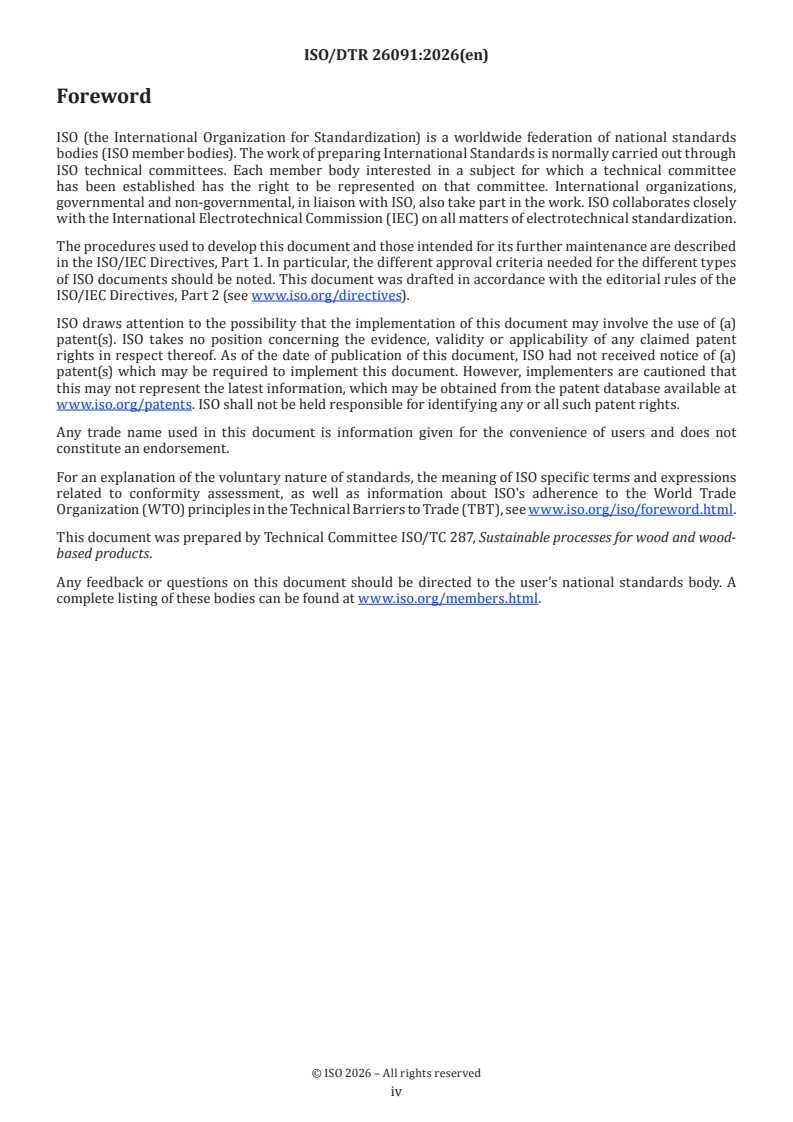
FINAL DRAFT
Technical
Report
ISO/TC 287
Wood and wood-based products —
Secretariat: ABNT
Background and examples of
Voting begins on:
calculating the forest carbon
2026-08-24
balance
Voting terminates on:
2026-10-19
RECIPIENTS OF THIS DRAFT ARE INVITED TO SUBMIT,
WITH THEIR COMMENTS, NOTIFICATION OF ANY
RELEVANT PATENT RIGHTS OF WHICH THEY ARE AWARE
AND TO PROVIDE SUPPOR TING DOCUMENTATION.
IN ADDITION TO THEIR EVALUATION AS
BEING ACCEPTABLE FOR INDUSTRIAL, TECHNO
LOGICAL, COMMERCIAL AND USER PURPOSES, DRAFT
INTERNATIONAL STANDARDS MAY ON OCCASION HAVE
TO BE CONSIDERED IN THE LIGHT OF THEIR POTENTIAL
TO BECOME STAN DARDS TO WHICH REFERENCE MAY BE
MADE IN NATIONAL REGULATIONS.
Reference number
FINAL DRAFT
Technical
Report
ISO/TC 287
Wood and wood-based products —
Secretariat: ABNT
Background and examples of
Voting begins on:
calculating the forest carbon
balance
Voting terminates on:
RECIPIENTS OF THIS DRAFT ARE INVITED TO SUBMIT,
WITH THEIR COMMENTS, NOTIFICATION OF ANY
RELEVANT PATENT RIGHTS OF WHICH THEY ARE AWARE
AND TO PROVIDE SUPPOR TING DOCUMENTATION.
© ISO 2026
IN ADDITION TO THEIR EVALUATION AS
All rights reserved. Unless otherwise specified, or required in the context of its implementation, no part of this publication may
BEING ACCEPTABLE FOR INDUSTRIAL, TECHNO
LOGICAL, COMMERCIAL AND USER PURPOSES, DRAFT
be reproduced or utilized otherwise in any form or by any means, electronic or mechanical, including photocopying, or posting on
INTERNATIONAL STANDARDS MAY ON OCCASION HAVE
the internet or an intranet, without prior written permission. Permission can be requested from either ISO at the address below
TO BE CONSIDERED IN THE LIGHT OF THEIR POTENTIAL
or ISO’s member body in the country of the requester.
TO BECOME STAN DARDS TO WHICH REFERENCE MAY BE
MADE IN NATIONAL REGULATIONS.
ISO copyright office
CP 401 • Ch. de Blandonnet 8
CH-1214 Vernier, Geneva
Phone: +41 22 749 01 11
Email: copyright@iso.org
Website: www.iso.org
Published in Switzerland Reference number
ii
Contents Page
Foreword .iv
Introduction .v
1 Scope . 1
2 Normative references . 1
3 Terms and definitions . 1
4 Background to forest carbon balance calculation and reporting . 1
4.1 General .1
4.2 Managed land proxy approach .2
4.3 Forest carbon pools and calculations .2
4.4 Tiered approaches .4
5 Examples of FMU characterizations and situations . 4
5.1 Background to FMU characterizations .4
5.2 Example: Forest under own ownership and management .5
5.3 Example: Forests owned by others, but under own management .5
5.4 Example: Forest owners association and other collectives .6
5.5 Example: Forests under ownership and management of other entities .6
6 Forest carbon balance calculations at the FMU level . 7
6.1 Data sources . .7
6.1.1 Forest inventory.7
6.1.2 Corporate forest inventories and forest management plans .7
6.1.3 National forest inventories.8
6.1.4 National inventory documents (NIDs) to UNFCCC .8
6.1.5 Remote sensing applications .8
6.2 Time period considerations: Inferring trend data to the current time period .9
6.3 Handling land use change .9
6.4 Calculations for living biomass above and below ground – examples .9
6.5 Calculations for other carbon pools - soil, litter and deadwood – examples .10
6.6 Examples of using supporting data that extend beyond the FMU .11
6.6.1 General .11
6.6.2 Example: Using National Forest Inventory data.11
6.6.3 Example: Using UNFCCC National inventory document data . 12
6.6.4 Example Using data from scientific studies/established practises . 12
6.7 Allocation and prorating. 12
7 Incorporating effects of large-scale disturbances .13
Bibliography . 14
iii
Foreword
ISO (the International Organization for Standardization) is a worldwide federation of national standards
bodies (ISO member bodies). The work of preparing International Standards is normally carried out through
ISO technical committees. Each member body interested in a subject for which a technical committee
has been established has the right to be represented on that committee. International organizations,
governmental and non-governmental, in liaison with ISO, also take part in the work. ISO collaborates closely
with the International Electrotechnical Commission (IEC) on all matters of electrotechnical standardization.
The procedures used to develop this document and those intended for its further maintenance are described
in the ISO/IEC Directives, Part 1. In particular, the different approval criteria needed for the different types
of ISO documents should be noted. This document was drafted in accordance with the editorial rules of the
ISO/IEC Directives, Part 2 (see www.iso.org/directives).
ISO draws attention to the possibility that the implementation of this document may involve the use of (a)
patent(s). ISO takes no position concerning the evidence, validity or applicability of any claimed patent
rights in respect thereof. As of the date of publication of this document, ISO had not received notice of (a)
patent(s) which may be required to implement this document. However, implementers are cautioned that
this may not represent the latest information, which may be obtained from the patent database available at
www.iso.org/patents. ISO shall not be held responsible for identifying any or all such patent rights.
Any trade name used in this document is information given for the convenience of users and does not
constitute an endorsement.
For an explanation of the voluntary nature of standards, the meaning of ISO specific terms and expressions
related to conformity assessment, as well as information about ISO's adherence to the World Trade
Organization (WTO) principles in the Technical Barriers to Trade (TBT), see www.iso.org/iso/foreword.html.
This document was prepared by Technical Committee ISO/TC 287, Sustainable processes for wood and wood-
based products.
Any feedback or questions on this document should be directed to the user’s national standards body. A
complete listing of these bodies can be found at www.iso.org/members.html.
iv
Introduction
ISO 13391-1 defines a framework for calculating greenhouse gas dynamics of wood and wood-based
products. The framework includes four components, one of which is the forest carbon balance. Forest carbon
balance is the difference between:
— sequestration (gains) of carbon in the forest through primary production of biomass by photosynthesis
and;
— losses of carbon through:
a) natural processes, such as decomposition or wildfire, and;
b) harvesting of wood for wood-based products.
See Figure 1.
Figure 1 — Illustration of the components of the greenhouse gas dynamics of wood and wood-based
products
ISO 13391-2 further elaborates on the calculation of these contributions based on changes in carbon
reservoirs (carbon pools) of living biomass, dead biomass and soil organic matter. The ISO 13391 series
considers seven carbon pools, as outlined in ISO 13391-1, of which five are addressed in this document.
Non-CO greenhouse gases are also considered. The methodology is derived from the 2006 IPCC guidelines
[8]
for national greenhouse gas inventories in the agriculture, forestry and other land use (AFOLU) sector,
adapted to the organizational or aggregated level used in the ISO 13391-series. This document provides
additional background and examples to users of ISO 13391-2.
Clause 4 considers the background to forest carbon balance calculation, reporting and the relation to IPCC
Guidelines.
Clause 5 gives background to and examples of FMU characterizations and situations.
Clause 6 considers the data sources and the different inventory methods that provide data for the
calculations. It also deals with time period considerations, allocation and prorating and gives examples of
calculation of the carbon pools.
Clause 7 considers how effects of large-scale disturbances can be incorporated.
NOTE The methods described in this report are largely based on IPCC guidelines; however, approaches for
organizational or national reporting can vary depending on local conditions or legislations.
v
FINAL DRAFT Technical Report ISO/DTR 26091:2026(en)
Wood and wood-based products — Background and examples
of calculating the forest carbon balance
1 Scope
This document provides examples and background literature for calculating the forest carbon balance for
different types of forest management units as defined in ISO 13391-2.
NOTE This document does not provide an exhaustive list of examples, or background literature for calculating the
forest carbon balance according to ISO 13391-2.
2 Normative references
The following documents are referred to in the text in such a way that some or all of their content constitutes
requirements of this document. For dated references, only the edition cited applies. For undated references,
the latest edition of the referenced document (including any amendments) applies.
ISO 13391-1:2025, Wood and wood-based products — Greenhouse gas dynamics — Part 1: Framework for value
chain calculations
ISO 13391-2:2025, Wood and wood-based products — Greenhouse gas dynamics — Part 2: Forest carbon
balance
3 Terms and definitions
For the purposes of this document, the terms and definitions given in ISO 13391-1 and ISO 13391-2 apply.
ISO and IEC maintain terminology databases for use in standardization at the following addresses:
— ISO Online browsing platform: available at https:// www .iso .org/ obp
— IEC Electropedia: available at https:// www .electropedia .org/
4 Background to forest carbon balance calculation and reporting
4.1 General
ISO 13391-1 provides a framework for calculating the greenhouse gas dynamics of a set of wood and wood-
based products on the organizational or aggregated level (the area of study). It covers four components
that, together, represent the greenhouse gas dynamics of a set of wood and wood-based products.
ISO 13391-2 provides a methodology for calculating one of these components, the forest carbon balance.
This methodology is derived from the 2006 IPCC Guidelines for national greenhouse gas inventories in the
[24]
agriculture, forestry and other land use (AFOLU) sector, adapted to the organizational or aggregated
level used in the ISO 13391-series. The IPCC Guidelines are internationally agreed upon guidelines used
globally to estimate country level greenhouse gas inventories and therefore serve as a credible basis for
the ISO 13391 series methodology. Clause 4 provides background information on forest greenhouse gas
emissions and removals calculation and reporting within the IPCC Guidelines for context, as well as the
adapted methodology in ISO 13391-2.
4.2 Managed land proxy approach
The objective of the IPCC Guidelines is to provide countries with a methodology to estimate anthropogenic
greenhouse gas emissions and removals. The AFOLU sector presents some unique challenges regarding the
separation of anthropogenic and non-anthropogenic emissions and removals. To balance the complexities
of AFOLU greenhouse gas dynamics with the need for a practical methodology, emissions and removals on
managed land are used as a proxy for anthropogenic emissions and removals. This approach is referred to as
the Managed Land Proxy (MLP) approach. While there are non-anthropogenic emissions and removals that
can occur on managed land (e.g., from natural disturbance), as well as emissions and removals indirectly
associated with human activity that can occur on unmanaged lands (e.g., from CO fertilization), the MLP
approach offers a practical methodology on the basis that the preponderance of anthropogenic effects occurs
[8]
on managed lands. Managed land is defined by IPCC as “land where human interventions and practices
[8]
have been applied to perform production, ecological or social functions” . For forest land, management can
include activities typically associated with wood production, such as harvesting timber and tree planting. It
can also include practices associated with other forest uses, such as conservation and recreation, including
the decision not to perform specific management activities.
The MLP approach is adopted into the ISO 13391-series by considering the forest carbon balance of a
geographical area corresponding to a set of wood and wood-based products. This area consists of one or
several forest management units (FMU) (see ISO 13391-1:2025, 3.20), including any set-aside areas (see
ISO 13391-2:2025, 3.1), as these areas affect the forest carbon balance of the landscape. This approach allows
for a conservative estimation of forest greenhouse gas emissions and removals attributable to the set of
products under study, following the underlying rationale behind the IPCC approach. Because this approach
considers the forest as a landscape, with a mix of stand ages and management stages represented, it is
possible to capture the effects of a range of management activities, including harvest, within the time period
under study (e.g., one year). Clause 5 provides examples of FMU characterizations for different situations.
4.3 Forest carbon pools and calculations
The IPCC Guidelines define five carbon pools for estimating forest greenhouse gas emissions and removals:
a) above ground biomass, b) below ground biomass, c) deadwood, d) litter, and e) soil organic matter. A sixth
carbon pool is also defined to cover carbon in harvested wood products (HWP). Together, these six pools
represent the total carbon stock changes of a land-use category, see Figure 2.
Key
Increase of carbon stocks due to growth
Carbon fluxes due to discrete events, i.e. from harvest residues and natural disturbance
Transfer of carbon between pools
Carbon fluxes due to continuous processes, i.e. decomposition
NOTE Calculations related to harvested wood products are covered in ISO 13391-1.
Figure 2 — Generalized carbon cycle of terrestrial ecosystems
In the ISO 13391-series, the five forest carbon pools are used to estimate the forest carbon balance
component, and the HWP pool, which is divided into an in-use pool and a landfill pool, is used to estimate
the HWP contribution component. Clause 6 provides guidance on calculating the carbon balance of these
five pools.
Estimates of forest emissions and removals under the IPCC Guidelines can be assessed using two methods:
1) the gain-loss method, in which carbon losses are subtracted from carbon gains to estimate the total
carbon stock change, and 2) the stock-difference method, in which the difference between carbon stocks at
two points in time is used to estimate the total carbon stock change. The use of either approach is allowed
under ISO 13391-2.
The IPCC Guidelines establish two subcategories for reporting forest greenhouse gas emissions and removals:
“Forest Land Remaining Forest Land” and “Land Converted to Forest Land.” Specific guidance is provided for
each subcategory. Importantly, land that is harvested and subsequently regenerated is classified as “Forest
Land Remaining Forest Land” since no land use change occurs. ISO 13391-2 requires that land use change
and the way in which greenhouse gas sources and sinks are accounted for in the case of land use change be
included in describing the system boundary for the forest carbon balance calculation. Subclause 6.3 provides
more information on incorporating IPCC guidance into forest carbon balance calculations for ISO 13391-2
where land use change occurs.
4.4 Tiered approaches
Three tiers are established under the IPCC Guidelines to account for varying degrees of data availability
within different countries. Tier 1 uses the simplest methodology and relies heavily on default parameters
and globally available sources of data. Tier 2 applies country- or regional-specific parameters. Tier 3 utilizes
higher-resolution data, such as data acquired through process-based models or national inventory systems,
with the goal of improving greenhouse gas emissions and removals estimates beyond those of tiers 1 and 2.
The tiered system is adopted in ISO 13391-2. Tier 3 relies on primary data for the FMU(s) under study, while
tier 2 allows for other data sources, such as country or regional secondary data.
Tier 1 cannot be used under ISO 13391-2 to calculate the carbon stock change of living biomass above
ground, meaning that the forest carbon balance cannot be quantified for a given FMU if tier 2 or 3 data do
not exist for living biomass above ground of that FMU. ISO 13391-1:2025 5.2.2 contains guidance on how to
handle situations where primary or secondary data for the FMU(s) are not available. A “null” value can be
reported for the FMU, provided certain requirements can be met. If the requirements cannot be met, “no
assessment” is reported.
According to ISO 13391-2:2025, other forest carbon pools in non-organic soils can be assumed to be stable
(no change) under tier 1, provided that the living biomass above ground, calculated using tier 2 or tier 3
data, is stable or increasing.
5 Examples of FMU characterizations and situations
5.1 Background to FMU characterizations
ISO 13391-2:2025, 4.3, 4.4, and 4.5 provide requirements and guidance for defining FMUs. The following
paragraphs provide a summary of these subclauses. ISO 13391-2:2025, 4.3 requires that FMUs are defined
by the organization based on a set of characteristics. These characteristics can include boundaries (including
land ownership), location and ecology, legal arrangements and forest management practices. The subclause
also includes some general examples.
ISO 13391-2:2025, 4.4 elaborates on land ownership when defining FMUs, providing the following four
situations:
a) “FMU(s) under own ownership and management;
b) FMU(s) owned by other entities, harvested under concessions, or similar arrangements, or managed
within long-term arrangements;
c) FMU(s) representing the land of members of forest owners’ associations or other community
arrangement; or
d) FMU(s) under ownership and management of other entities.”
ISO 13391-2:2025, 4.5 provides requirements for the geographical scale of FMUs, stating that the sourcing
area of all handled wood and woody material is required to be covered and that “the spatial boundaries
applied shall:
e) apply a landscape perspective for the forest carbon balance calculation, where a landscape is defined
as an extension of forest land that considers the forests as a whole system, including all possible age
classes;
f) represent the forest management practices in the geographical area where the volume handled is
harvested;
g) include set-aside areas within the forest landscape. These set-aside areas have an effect on forest carbon
balance, even if they are not harvested.”
Taken together, ISO 13391-2:2025, 4.3 to 4.5 outline a wide range of FMU arrangements for different
organizations. In the following, a set of examples are provided.
The aspect of data availability is not covered in ISO 13391-2:2025, 4.3 to 4.5 but becomes a factor in practical
implementation.
Forest carbon balance outcomes at the FMU and landscape level are influenced by interactions among
multiple land management objectives, including timber production, conservation set asides, ecological
reserves, and others. These interactions affect harvest scheduling, age class distribution, and the temporal
dynamics of carbon stocks and fluxes across the landscape. According to ISO 13391-2:2025, FMUs defined
at a landscape scale include set aside areas, as these areas contribute materially to overall forest carbon
balance outcomes.
ISO 13391-2:2025 requires that FMUs are defined to cover all forest areas where wood is sourced for the
wood-based products that the organization puts on the market. This can refer to direct purchases of wood
harvested by landowners. It can also refer to wood-based products at various stages of processing, in which
case the origins of the wood would be identified through FMUs. For practical reasons, the exact source
location of processed wood might be difficult to establish, in which case the sourcing area, i.e., FMUs, can be
defined as a relatively large geographic region.
5.2 Example: Forest under own ownership and management
An organization can report forest carbon balance according to ISO 13391-2 for forest land under its own
management or administration.
The forest land can be reported as one FMU or divided into several depending on, e.g., size, homogeneity,
availability of data or preference of detail in reporting. Defining more than one FMU can also be motivated if
the forest land is in more than one geographic area.
Generic examples of possible choices are provided below, they do not refer to any specific implementation of
ISO 13391-2:
— A private smallholder owning 50 hectares of forest land in one location can report the entire estate as
one FMU. While subdividing the area into several FMUs is a possibility, it is likely that lack of data argue
against this approach.
— Like the private forest owner example, a forest company owning large areas of forest in one country,
such as Sveaskog in Sweden or Statskog in Norway, can define all its forest as one FMU, or subdivide into
several FMUs. With large areas under management in different parts of a country, it might be relevant
to define several FMUs provided sufficient inventory data are available. Subdivisions can be done in
different ways, for example by geographic regions, or by forest types across the entire estate.
— A forest company that owns forests in several countries can define one FMU for each of the countries
where the forests are located.
5.3 Example: Forests owned by others, but under own management
Organizations that manage forests owned by others can report according to ISO 13391-2, provided that wood
transactions pass through the organization, i.e., the reporting applies to the wood marketed (potentially
following further processing) by the organization.
This example implies some form of concession or similar arrangement where a defined geographic forest
area is contracted for management or wood harvesting to the organization.
The FMU or FMUs would normally be defined by the geographic boundaries of the concession/contract.
However, if the contract is limited to specific harvest or silviculture areas within a larger landscape,
situations can occur where the relevant FMU is larger than the areas contractually specified.
5.4 Example: Forest owners association and other collectives
Forest owners’ associations represent a specific case where the land is owned by members of the association,
but harvested wood to some extent is handled collectively by the association, which in this case is the
reporting organization.
This situation calls for several considerations:
— The collective land of all association members can be defined as one FMU.
— The landowners can sell wood also to other organizations outside of the association. This can motivate
prorating (see 6.6) whereby the forest carbon balance is allocated to the proportion of wood handled
through the association. However, the close arrangement between association members and their
collective wood value chain argues for allocating the full forest carbon balance in the report of the
association.
— The association can also procure wood from landowners outside of the association. These procurement
areas could be defined as additional FMU(s), in which case they would fall under the example in 5.5. The
FMU covering the member-owned areas could also be extended to include these additional procurement
areas.
Other collectives that can use ISO 13391-2 include associations of companies in the wood-based value chain,
such as the Swedish Forest Industries or the American Wood Council that might want to report on the forest
carbon balance in relationship to the activities of their collective of members. This situation is similar to the
forest owner association above, with some variation on considerations:
— The land area where wood is sourced can be defined as one FMU, or several if, for example, wood is
sourced from multiple countries.
— Allocation and prorating of the forest carbon balance (see 6.6) applies for FMUs where only a fraction of
the wood harvest is handled by the membership
5.5 Example: Forests under ownership and management of other entities
When wood (including processed wood or wood-based products) is procured from an upstream organization,
the downstream organization can use ISO 13391-2 to calculate the forest carbon balance associated with
their products. The downstream organization would define the upstream forest areas where the wood was
sourced as FMU(s) in order to make the calculation for these FMU(s).
Sourcing of wood can be either direct when wood is procured from a landowner, or indirect when wood is
procured from an actor(s) placed between landowner(s) and the reporting organization.
Organizations that do not own forests or have direct involvement in wood harvesting as exemplified in
5.2 to 5.4 can only define FMUs that are under ownership and management of other entities. Examples
include sawmills, paper mills or energy facilities that procure all their woody raw material. Forest industry
companies can have a mix of FMUs with direct involvement in wood harvesting, and FMUs under ownership
and management of other entities.
Typically, the wood procured externally by a reporting organization originates from a fairly large geographic
area, either because wood procurements are made geographically dispersed, or because it is difficult to
pinpoint the exact location of wood origins. Further, the wood typically represents only a fraction of the
wood harvested in that area. The FMU can therefore be defined as the area the wood was harvested from
as a whole, provided that calculated forest carbon balance can be related to the fraction sourced by the
organization, see further on allocation and prorating in 6.6.
The sourcing region can be subdivided into several FMUs if differences in forest conditions or data
availability across the region motivates this. For example, if wood is sourced in different countries, it might
be suitable to define FMUs for each country.
6 Forest carbon balance calculations at the FMU level
6.1 Data sources
6.1.1 Forest inventory
Calculating the forest carbon balance requires the use of forest carbon data from a forest inventory.
Inventories can be designed according to various methods, depending on the specific conditions of the
[ ]
forest. Forest inventory designs have been thoroughly investigated in the literature (e.g. 18 ). On a general
level, the subject is concerned with collecting data about the forest in a cost-efficient manner that allows for
accurate reports or informed management decisions.
Over many years, statistical methods and measurement techniques (including field sampling and remote
sensing) have evolved that serve different types of applications at different scales and time horizons. This
subclause provides an overview of types of data sources, and associated methodologies, applicable for
assessing the forest carbon balance in an FMU.
An inventory design can provide direct estimates for all carbon pools, a few carbon pools, or only one carbon
pool, depending on the objectives of the inventory. Most of the time, an inventory design focuses on living
biomass above ground. In this case, it would provide indirect proxy data for other pools, such as deadwood
or living biomass below ground. A different inventory might be designed to provide direct estimates for all
pools except living biomass below ground, for example.
6.1.2 Corporate forest inventories and forest management plans
Corporate forest inventories refer to data collection and analysis for strategic level decisions on e.g.
sustainable harvest levels over the long term. They are designed to provide a statistically accurate overview
of a forest estate, and do not, normally, provide full cover information for each forest stand/compartment.
Field sampling designs can be variants of those applied in national forest inventories or can be specific
to a company. Growth and yield models, which are based on empirical data, can be used to predict future
[ ]
stocking levels or growth trends. 17 Strategic outlooks of growth, harvest and standing volumes can be
[28]
used in companies’ reporting, (see e.g. , p.40)
Corporate forest inventories can be a precise data source for calculating the current carbon balance of living
biomass.
Forest management plans can be another source of data for defining and calculating the carbon balance of an
FMU. Forest management plans often contain estimates of growth at stand/compartment level, aggregated to
the estate level. Plans of this kind are useful for landowners in scheduling forest activities; they can be used
for valuation of estates and are also often required by forest certification systems. The forest management
plan can be prepared based on a combination of remote sensing data and field measurements, but typically
with less focus on overall statistical accuracy compared with corporate forest inventories, as this is a less
significant feature for shorter time planning horizons compared with operational considerations such as
adaptation to terrain and nature conservation needs.
Depending on legal requirements and natural conditions, the design and content of forest management plans
[ ] [31] [35]
vary (e.g., 25 , , ).
Forest management plans can be continuously updated with growth and activity (harvesting) data. This
creates a time series that can be used as a data source for calculating the carbon balance of living biomass
on the estate.
Data and documentation gathered for compliance with forest certification systems (e.g. forest inventories,
harvest records, regeneration requirements, management plans), when available, can serve as secondary
data when representative and methodologically consistent with ISO 13391-2.
6.1.3 National forest inventories
National forest inventories (NFIs), or equivalent regionally based inventories, are based on systematically
[ ]
sampled field plots where a wide range of forest and land variables are measured and recorded. 32
Sometimes the field plot data are complemented with other types of data, notably from remote sensing.
NFIs apply sophisticated statistical and sampling methodologies to facilitate accurate estimates over time
and estimates of statistical errors. The analysis of field plot data also makes extensive use of forest research
results, including functions for estimating volumes and growth of individual trees and stands based on
measured data.
NFIs are typically long-term initiatives by public sector institutions with a main objective to establish
trends over time in support of policy decisions. They are also a suitable data source for reporting under
ISO 13391-2.
NFI designs and data are described in depth for 37 countries by Reference[32]. Several additional countries
have NFI arrangements, although for those established in recent decades, time series data for forest carbon
balance might not yet be available. A 2022 review found 150 countries with full or partial NFIs, but notes
that many countries might not yet have a sufficient number of data collection repetitions for establishing
[ ]
robust time series of forest carbon balance 26 .
6.1.4 National inventory documents (NIDs) to UNFCCC
National inventory documents (NIDs) are submitted to the United Nations Framework Convention on Climate
Change (UNFCCC). NIDs follow the methodology developed by IPCC, including the Common Reporting
[34]
Table (CRT) reporting structure .
NOTE Up until 2023, the term used was National Inventory Report (NIR). After that, the term changed to National
Inventory Document, NID.
NIDs contain details on emissions and removals by sector, including the Land Use, Land Use Change and
Forestry (LULUCF) sector which is of interest here. NIDs are provided annually by countries listed in Annex I
of the Kyoto Protocol (in April 2026, 42 countries plus the European Union). An ambition under the Paris
Agreement is to extend reporting to additional countries.
The LULUCF chapter in a NID contains a description of the methodologies applied – for example how NFI data
have been used, or how soil carbon has been modelled. The report also provides an overview of results for
each subsector within LULUCF, of which Forest is one. Within forests, the report divides the inventory into
carbon pools. The five forest carbon pools (excluding harvested wood products) are the same set of pools
that ISO 13391-2 applies. Consequently, there is a good correspondence between the NID report structure
and the requirements of ISO 13391-2.
NIDs, and the corresponding more detailed CRTs, provide time series of emissions and removals, typically
since 1990. For later years, the data are provided for each year. There is a time lag of about two years,
meaning that a 2024 NID has 2022 as the latest reporting year. All in all, this means that a NID can provide
data for reporting the forest carbon balance according to the requirements of ISO 13391-2.
6.1.5 Remote sensing applications
Remote sensing applications (RSAs) are sometimes suggested for establishing forest trends. RSAs refer to
methodologies that primarily use remote data from satellites, airplanes or remotely piloted aircraft as proxy
measurements which are then converted to real world parameters such as biomass content or land cover
change. While RSAs use field measurements to calibrate their results, the field data are here only considered
as support to the remotely sensed data.
RSAs are often used to detect rapid changes of land cover, such as wood harvesting or deforestation, which
both denote a negative change in forest carbon stocks. For positive changes resulting from biomass growth,
remote sensing applications have proven much less reliable as the changes are slower and gradual. RSAs
are also subject to a number of limitations that decrease the reliability of the collected and inferred data,
including cloud cover and other weather conditions, airborne particles such as dust and smoke, spatial
resolution, temporal accuracy, planimetric accuracy, and thematic accuracy. As a result, it is generally not
recommended to base forest carbon balance calculations solely on remote sensing approaches.
Standalone use of RSAs will primarily indicate changes in above ground biomass. However, RSAs can be
used as one of the data sources for forest carbon balance calculations, when integrated with National Forest
Inventory datasets or other validated ground-based monitoring systems.
6.2 Time period considerations: Inferring trend data to the current time period
ISO 13391-2:2025, 4.6 describes how time periods are handled. The main principle is that forest data
represent the time period selected for reporting the forest carbon balance, typically the current or past year.
Issues arise as forest inventory cycles are usually long (several years to a decade). As a result, the latest
data point for an FMU might not be current. In cases where large-scale inventory data are used, such as
national forest inventory plots, statistical considerations put the latest valid data point several years back.
Additionally, establishing trends in the forest condition requires that even older data points are used
(ISO 13391-2:2025, 4.8.1).
Consequently, the established trends need to be inferred to the selected time period, to establish a current
forest carbon balance. Depending on available data, this can be done in different ways as per below. Applying
different inferring methods for different pools in the same FMU could be appropriate – depending on data
availability (ISO 13391-2:2025, 4.8.1).
a) Use predictive models and/or activity data (gain-loss) since the latest data point to verify or modify the
trend. This effectively combines stock-change and gain-loss approaches to obtain current estimates.
b) Assume that the past observed trend is still valid, by extrapolating the trend to the current time period.
Corollary information that support the assumption of continuity of operations and forest growth in the
period of extrapolation could be provided alongside the data.
c) Assume that no change has occurred since the latest data point. This approach can be used if the
historical data indicate a negligible trend. Corollary information that support the assumption of no or
no negative change in the period of extrapolation could be provided alongside the data.
NOTE ISO 13391-1 offers a mechanism for handling situations where, due to a lack of data, 'null' or 'no assessment'
is reported for forest carbon balance.
6.3 Handling land use change
ISO 13391-2:2025, 4.2 requires that land use change and the way in which greenhouse gas sources and sinks
are accounted for in the case of land use change to and from forestland, be included in describing the system
boundary for the forest carbon balance calculation.
[7]
Chapter 2 of the 2006 IPCC offers guidance for calculating forest carbon stock changes on land converted
to another land use category. Three tiers are established, depending on the level of data availability. Tier
1 assumes no change in carbon stocks due to land use change and is used when previous land uses are
unknown. Tiers 2 and 3 use national or more disaggregated data or models to estimate the carbon stock
change due to land use change. Under ISO 13391-2, the tier 1 approach cannot be used for the aboveground
carbon pool in forests, since primary or secondary data are required.
6.4 Calculations for living biomass above and below ground – examples
Living biomass above ground is normally the carbon pool where data from different types of forest
inventories can be directly used as these are usually focused on an accurate representation of the growing
stock of trees. This is also, normally, the carbon pool where the largest fluctuations can be expected, due
to growth, harvest and natural losses. Managed forest landscapes include a variety of age classes, which
each uniquely contribute to the forest carbon dynamics. For example, early-successional growth often
contributes disproportionately to annual carbon sequestration of living biomass because of rapid post-
disturbance or post-regeneration growth. Therefore, landscape-level assessments are needed to capture the
carbon dynamics of all age classes present.
Additional modelling to establis
...
Style Definition
...
Style Definition
...
Style Definition
ISO/CD TR DTR 26091 – Approval draft (E) .
Style Definition
...
ISO/TC 287
Style Definition
...
Style Definition
Secretariat: ABNT
...
Style Definition
...
Date: 2026-06-0908-07
Style Definition
...
Style Definition
...
Style Definition
...
Style Definition
...
Style Definition
...
Style Definition
Wood and wood-based products — Background and examples of
...
Style Definition
calculating the forest carbon balance
...
Style Definition
...
Style Definition
...
Style Definition
...
Style Definition
...
Style Definition
...
Style Definition
...
Style Definition
...
Style Definition
...
Style Definition
...
Approval stage
Style Definition
...
Style Definition
...
Style Definition
...
Style Definition
...
Style Definition
...
Style Definition
...
Style Definition
...
Style Definition
...
Style Definition
...
Style Definition
...
Style Definition
...
Style Definition
...
Style Definition
...
Style Definition
...
Style Definition
...
Style Definition
...
Style Definition
...
Style Definition
...
Style Definition
...
Style Definition
...
Style Definition
...
Style Definition
...
...
Style Definition
...
Style Definition
...
Style Definition
...
Style Definition
...
Style Definition
...
Style Definition
...
Formatted
...
Formatted
...
Formatted
...
Formatted
...
Formatted
...
F tt d
ISO #####-#:####(X/DTR 26091:(en)
Formatted: Font: 11 pt, Bold
Formatted: Font: 11 pt, Bold
Formatted: HeaderCentered, Left, Space After: 0 pt,
Line spacing: single
Formatted: Indent: Left: 0 cm, Right: 0 cm, Space
All rights reserved. Unless otherwise specified, or required in the context of its implementation, no part of this publication
Before: 0 pt, No page break before, Adjust space
may be reproduced or utilized otherwise in any form or by any means, electronic or mechanical, including photocopying,
between Latin and Asian text, Adjust space between
or posting on the internet or an intranet, without prior written permission. Permission can be requested from either ISO
Asian text and numbers, Border: Top: (No border)
at the address below or ISO’s member body in the country of the requester.
Formatted: Left: 1.5 cm, Right: 1.5 cm, Bottom: 1 cm,
ISO copyright office Header distance from edge: 1.27 cm, Footer distance
from edge: 0.5 cm
CP 401 • Ch. de Blandonnet 8
CH-1214 Vernier, Geneva
Phone: + 41 22 749 01 11
Formatted: French (France)
EmailE-mail: copyright@iso.org
Formatted: French (France)
Website: www.iso.orgwww.iso.org
Formatted: French (France)
Published in Switzerland
Formatted: English (United Kingdom)
Formatted: English (United Kingdom)
Formatted: Font: 10 pt
Formatted: Font: 10 pt
Formatted: Font: 11 pt
Formatted: FooterPageRomanNumber, Space After: 0
pt, Line spacing: single
ii © ISO #### 2026 – All rights reserved
ii
ISO/CDDTR 26091:2026 (E:(en)
Formatted: Font: 11 pt, Bold
Formatted: Font: 11 pt, Bold
Formatted: Font: 11 pt, Bold
Contents
Formatted: HeaderCentered, Left, Space After: 0 pt,
Line spacing: single
Foreword . v
Formatted: Space Before: 48 pt
Introduction . vi
1 Scope . 1
2 Normative references . 1
3 Terms and definitions . 1
4 Background to forest carbon balance calculation and reporting . 1
4.1 General . 1
4.2 Managed land proxy approach . 1
4.3 Forest carbon pools and calculations . 2
4.4 Tiered approaches . 5
5 Examples of FMU characterizations and situations . 6
5.1 Background to FMU characterizations . 6
5.2 Example: Forest under own ownership and management . 7
5.3 Example: Forests owned by others, but under own management . 7
5.4 Example: Forest owners association and other collectives . 7
5.5 Example: Forests under ownership and management of other entities . 8
6 Forest carbon balance calculations at the FMU level . 8
6.1 Data sources . 8
6.2 Time period considerations: Inferring trend data to the current time period . 11
6.3 Handling land use change . 11
6.4 Calculations for living biomass above and below ground – examples . 11
6.5 Calculations for other carbon pools - soil, litter and deadwood – examples. 12
6.6 Examples of using supporting data that extend beyond the FMU . 13
6.7 Allocation and prorating . 15
7 Incorporating effects of large-scale disturbances . 15
Bibliography . 17
Foreword . iv
Introduction . v
1 Scope . 1
2 Normative references . 1
3 ISO 13391-2, Wood and wood-based products – Greenhouse gas dynamics – Part 2: Forest
carbon balance Terms and definitions . 1
4 Background to forest carbon balance calculation and reporting . 1
4.1 General . 1
4.2 Managed land proxy approach . 1
4.3 Forest carbon pools and calculations . 2
Formatted: Font: 10 pt
4.4 Tiered approaches . 4
Formatted: Font: 10 pt
5 Examples of FMU characterizations and situations . 4
Formatted: Font: 10 pt
5.1 Background to FMU characterizations . 4
Formatted: FooterCentered, Left, Line spacing: single
5.2 Example: Forest under own ownership and management . 5
5.3 Example: Forests owned by others, but under own management . 6
Formatted: Font: 11 pt
5.4 Example: Forest owners association and other collectives . 6
Formatted: FooterPageRomanNumber, Left, Space
5.5 Example: Forests under ownership and management of other entities . 6
After: 0 pt, Line spacing: single
© ISO 2026 – All rights reserved
iii
ISO #####-#:####(X/DTR 26091:(en)
Formatted: Font: 11 pt, Bold
Formatted: Font: 11 pt, Bold
Formatted: HeaderCentered, Left, Space After: 0 pt,
6 Forest carbon balance calculations at the FMU level . 7
Line spacing: single
6.1 Data sources . 7
6.1.1 Forest inventory . 7
6.1.2 Corporate forest inventories and forest management plans . 7
6.1.3 National forest inventories . 8
6.1.4 National inventory documents (NIDs) to UNFCCC . 8
6.1.5 Remote sensing applications . 9
6.2 Time period considerations: Inferring trend data to the current time period . 9
6.3 Calculations for living biomass above and below ground – examples . 10
6.4 Calculations for other carbon pools - soil, litter and deadwood – examples . 10
6.5 Examples of using supporting data that extend beyond the FMU . 12
6.5.1 General . 12
6.5.2 Example: Using National Forest Inventory data . 12
6.5.3 Example: Using UNFCCC National Inventory Document data . 12
6.5.4 Example: Using data from remote sensing applications . Error! Bookmark not defined.
6.5.5 Example Using data from scientific studies/established practises . 13
6.6 Allocation and prorating . 13
7 Incorporating effects of large-scale disturbances . 14
8 Literature review of specific topics . Error! Bookmark not defined.
Bibliography . 15
Formatted: Font: 10 pt
Formatted: Font: 10 pt
Formatted: Font: 11 pt
Formatted: FooterPageRomanNumber, Space After: 0
pt, Line spacing: single
iv © ISO #### 2026 – All rights reserved
iv
ISO/CDDTR 26091:2026 (E:(en)
Formatted: Font: 11 pt, Bold
Formatted: Font: 11 pt, Bold
Formatted: Font: 11 pt, Bold
Foreword
Formatted: HeaderCentered, Left, Space After: 0 pt,
Line spacing: single
ISO (the International Organization for Standardization) is a worldwide federation of national standards
bodies (ISO member bodies). The work of preparing International Standards is normally carried out through
ISO technical committees. Each member body interested in a subject for which a technical committee has been
established has the right to be represented on that committee. International organizations, governmental and
non-governmental, in liaison with ISO, also take part in the work. ISO collaborates closely with the
International Electrotechnical Commission (IEC) on all matters of electrotechnical standardization.
The procedures used to develop this document and those intended for its further maintenance are described
in the ISO/IEC Directives, Part 1. In particular, the different approval criteria needed for the different types of
ISO documents should be noted. This document was drafted in accordance with the editorial rules of the
ISO/IEC Directives, Part 2 (see www.iso.org/directiveswww.iso.org/directives).
ISO draws attention to the possibility that the implementation of this document may involve the use of (a)
Formatted: English (United Kingdom)
patent(s). ISO takes no position concerning the evidence, validity or applicability of any claimed patent rights
in respect thereof. As of the date of publication of this document, ISO had not received notice of (a) patent(s)
which may be required to implement this document. However, implementers are cautioned that this may not
represent the latest information, which may be obtained from the patent database available at
www.iso.org/patents.www.iso.org/patents. ISO shall not be held responsible for identifying any or all such
Formatted: English (United Kingdom)
patent rights.
Any trade name used in this document is information given for the convenience of users and does not
constitute an endorsement.
For an explanation of the voluntary nature of standards, the meaning of ISO specific terms and expressions
related to conformity assessment, as well as information about ISO's adherence to the World Trade
Organization (WTO) principles in the Technical Barriers to Trade (TBT), see
Formatted: Font color: Auto
www.iso.org/iso/foreword.htmlwww.iso.org/iso/foreword.html.
This document was prepared by Technical Committee ISO/TC 287, Sustainable processes for wood and wood-
based products.
Any feedback or questions on this document should be directed to the user’s national standards body. A
complete listing of these bodies can be found at www.iso.org/members.htmlwww.iso.org/members.html.
Formatted: Font: 10 pt
Formatted: Font: 10 pt
Formatted: Font: 10 pt
Formatted: FooterCentered, Left, Line spacing: single
Formatted: Font: 11 pt
Formatted: FooterPageRomanNumber, Left, Space
After: 0 pt, Line spacing: single
© ISO 2026 – All rights reserved
v
ISO #####-#:####(X/DTR 26091:(en)
Formatted: Font: 11 pt, Bold
Formatted: Font: 11 pt, Bold
Formatted: HeaderCentered, Left, Space After: 0 pt,
Introduction
Line spacing: single
ISO 13391-1 defines a framework for calculating greenhouse gas dynamics of wood and wood-based products.
The framework includes four components, one of which is the forest carbon balance. Forest carbon balance is
the difference between:
— sequestration (gains) of carbon in the forest through primary production of biomass by photosynthesis;
Formatted: List Continue 1
and;
— losses of carbon through:
1.a) natural processes, such as decomposition or wildfire, and;
Formatted: Numbered + Level: 1 + Numbering Style: a,
b, c, … + Start at: 1 + Alignment: Left + Aligned at: 0
2.b) harvesting of wood for wood-based products.
cm + Indent at: 0 cm
Formatted: Bullets and Numbering
See Figure 1.
See Figure 1.
Formatted: English (United Kingdom)
Formatted: Figure title
Formatted: Font: 10 pt
Formatted: Font: 10 pt
Formatted: Font: 11 pt
Figure 1 — Figure 1 — Illustration of the components of the greenhouse gas dynamics of wood and
wood-based products Formatted: FooterPageRomanNumber, Space After: 0
pt, Line spacing: single
vi © ISO #### 2026 – All rights reserved
vi
ISO/CDDTR 26091:2026 (E:(en)
Formatted: Font: 11 pt, Bold
Formatted: Font: 11 pt, Bold
Formatted: Font: 11 pt, Bold
ISO 13391-2 further elaborates on the calculation of these contributions based on changes in carbon
Formatted: HeaderCentered, Left, Space After: 0 pt,
reservoirs (carbon pools) of living biomass, dead biomass and soil organic matter. The ISO 13391- series
Line spacing: single
considers seven carbon pools, as outlined in ISO 13391-1, of which five are addressed in this document. Non-
CO2 greenhouse gases are also considered. The methodology is derived from the 2006 IPCC Formatted: English (United Kingdom)
Guidelinesguidelines for National Greenhouse Gas Inventoriesnational greenhouse gas inventories in the
Formatted: English (United Kingdom)
[8]
Agriculture, Forestryagriculture, forestry and Other Land Useother land use (AFOLU) sector[8],, adapted to
Formatted: English (United Kingdom)
the organizational or aggregated level used in the ISO 13391-series. This document provides additional
background and examples to users of ISO 13391-2.
Formatted: English (United Kingdom)
Formatted: English (United Kingdom)
Clause 4Clause 4 considers the background to forest carbon balance calculation, reporting and the relation to
Formatted: English (United Kingdom)
IPCC Guidelines.
Formatted: English (United Kingdom)
Clause 5Clause 5 gives background to and examples of FMU characterizations and situations.
Formatted: English (United Kingdom)
Clause 6Clause 6 considers the data sources and the different inventory methods that provide data for the Formatted: English (United Kingdom)
calculations. It also deals with time period considerations, allocation and prorating and gives examples of
Formatted: English (United Kingdom)
calculation of the carbon pools.
Formatted: English (United Kingdom)
Clause 7Clause 7 considers how effects of large-scale disturbances can be incorporated.
Formatted: English (United Kingdom)
Formatted: English (United Kingdom)
NOTE The methods described in this report are largely based on IPCC guidelines; however, approaches for
organizational or national reporting can vary depending on local conditions or legislations.
Formatted: English (United Kingdom)
Formatted: Font: 10 pt
Formatted: Font: 10 pt
Formatted: Font: 10 pt
Formatted: FooterCentered, Left, Line spacing: single
Formatted: Font: 11 pt
Formatted: FooterPageRomanNumber, Left, Space
After: 0 pt, Line spacing: single
© ISO 2026 – All rights reserved
vii
ISO/CDDTR 26091:2026 (E:(en)
Formatted: Font: 11 pt, Bold
Formatted: Font: 11 pt, Bold
Formatted: Font: 11 pt, Bold
Formatted: HeaderCentered, Left, Space After: 0 pt,
Wood and wood-based products — Background and examples of
Line spacing: single
calculating the forest carbon balance
Formatted: Main Title 1, Space After: 0 pt
Formatted: Font: Bold
1 Scope
Formatted: Top: 1.4 cm, Bottom: 1 cm, Section start:
This document provides examples and background literature for calculating the forest carbon balance for
New page, Header distance from edge: 1.27 cm, Footer
different types of forest management units as defined in ISO 13391-2.
distance from edge: 0.5 cm
NOTE This document does not provide an exhaustive list of examples, or background literature for calculating the
forest carbon balance according to ISO 13391-2.
2 Normative references
The following documents are referred to in the text in such a way that some or all of their content constitutes
requirements of this document. For dated references, only the edition cited applies. For undated references,
the latest edition of the referenced document (including any amendments) applies.
ISO 13391-1:2025, Wood and wood-based products –— Greenhouse gas dynamics –— Part 1: Framework for
Formatted: RefNorm
value chain calculations
Formatted: Font: Not Italic
ISO 13391-2:2025, Wood and wood-based products — Greenhouse gas dynamics — Part 2: Forest carbon
balance
Formatted: English (United Kingdom)
3 Terms and definitions
For the purposes of this document, the terms and definitions given in ISO 13391-1 and ISO 13391-2 apply.
ISO and IEC maintain terminology databases for use in standardization at the following addresses:
— ISO Online browsing platform: available at https://www.iso.org/obphttps://www.iso.org/obp
Formatted: No underline, Font color: Auto
Formatted: List Continue 1, No bullets or numbering,
— IEC Electropedia: available at https://www.electropedia.org/ https://www.electropedia.org/
Don't keep with next
4 Background to forest carbon balance calculation and reporting
4.1 General
ISO 13391-1 provides a framework for calculating the greenhouse gas dynamics of a set of wood and wood-
based products on the organizational or aggregated level (the area of study). It covers four components that,
together, represent the greenhouse gas dynamics of a set of wood and wood-based products. ISO 13391-2
provides a methodology for calculating one of these components, the forest carbon balance. This methodology
is derived from the 2006 IPCC Guidelines for National Greenhouse Gas Inventoriesnational greenhouse gas
Formatted: Font: Not Italic
inventories in the Agriculture, Forestryagriculture, forestry and Other Land Useother land use (AFOLU) sector
Formatted: Font: Not Italic
[24]
[24],, adapted to the organizational or aggregated level used in the ISO 13391-series. The IPCC Guidelines
Formatted: Body Text
are internationally agreed upon guidelines used globally to estimate country level greenhouse gas inventories
and therefore serve as a credible basis for the ISO 13391 series methodology. Clause 4Clause 4 provides
Formatted: Font: 10 pt
background information on forest greenhouse gas emissions and removals calculation and reporting within
Formatted: Font: 10 pt
the IPCC Guidelines for context, as well as the adapted methodology in ISO 13391-2.
Formatted: Font: 10 pt
4.2 Managed land proxy approach
Formatted: FooterCentered, Left, Line spacing: single
Formatted: Font: 11 pt
The objective of the IPCC Guidelines is to provide countries with a methodology to estimate anthropogenic
greenhouse gas emissions and removals. The AFOLU sector presents some unique challenges regarding the Formatted: FooterPageNumber, Left, Space After: 0 pt,
Line spacing: single
© ISO 2026 – All rights reserved
ISO #####-#:####(X/DTR 26091:(en)
Formatted: Font: 11 pt, Bold
Formatted: Font: 11 pt, Bold
Formatted: HeaderCentered, Left, Space After: 0 pt,
separation of anthropogenic and non-anthropogenic emissions and removals. To balance the complexities of
Line spacing: single
AFOLU greenhouse gas dynamics with the need for a practical methodology, emissions and removals on
managed land are used as a proxy for anthropogenic emissions and removals. This approach is referred to as
the Managed Land Proxy (MLP) approach. While there are non-anthropogenic emissions and removals that
can occur on managed land (e.g., from natural disturbance), as well as emissions and removals indirectly
associated with human activity that can occur on unmanaged lands (e.g., from CO fertilization), the MLP
approach offers a practical methodology on the basis that the preponderance of anthropogenic effects occurs
[8]
on managed lands [8]. Managed land is defined by IPCC as “land where human interventions and practices
[8]
have been applied to perform production, ecological or social functions” [8].” . For forest land, management
can include activities typically associated with wood production, such as harvesting timber and tree planting.
It can also include practices associated with other forest uses, such as conservation and recreation, including
the decision not to perform specific management activities.
The MLP approach is adopted into the ISO 13391-series by considering the forest carbon balance of a
geographical area corresponding to a set of wood and wood-based products. This area consists of one or
several forest management units (FMU) (see ISO 13391-1:2025, 3.20), including any set-aside areas (see
ISO 13391-2:2025, 3.1), as these areas affect the forest carbon balance of the landscape. This approach allows
for a conservative estimation of forest greenhouse gas emissions and removals attributable to the set of
products under study, following the underlying rationale behind the IPCC approach. Because this approach
considers the forest as a landscape, with a mix of stand ages and management stages represented, it is possible
to capture the effects of a range of management activities, including harvest, within the time period under
study (e.g., one year). Clause 5Clause 5 provides examples of FMU characterizations for different situations.
4.3 Forest carbon pools and calculations
The IPCC Guidelines define five carbon pools for estimating forest greenhouse gas emissions and removals:
Formatted: Font: Not Italic
(1a) above ground biomass, (2b) below ground biomass, (3c) deadwood, (4d) litter, and (5e) soil organic
Formatted: Body Text
matter. A sixth carbon pool is also defined to cover carbon in harvested wood products (HWP). Together, these
six pools represent the total carbon stock changes of a land-use category, see Figure 2.Figure 2.
Formatted: Font: 10 pt
Formatted: Font: 10 pt
Formatted: Font: 11 pt
Formatted: FooterPageNumber, Space After: 0 pt, Line
spacing: single
2 © ISO #### 2026 – All rights reserved
ISO/CDDTR 26091:2026 (E:(en)
Formatted: Font: 11 pt, Bold
Formatted: Font: 11 pt, Bold
Formatted: Font: 11 pt, Bold
Formatted: HeaderCentered, Left, Space After: 0 pt,
Line spacing: single
Formatted: Font: 10 pt
Formatted: Font: 10 pt
Formatted: Font: 10 pt
Formatted: FooterCentered, Left, Line spacing: single
Formatted: Font: 11 pt
Formatted: FooterPageNumber, Left, Space After: 0 pt,
Line spacing: single
© ISO 2026 – All rights reserved
ISO #####-#:####(X/DTR 26091:(en)
Formatted: Font: 11 pt, Bold
Formatted: Font: 11 pt, Bold
Formatted: HeaderCentered, Left, Space After: 0 pt,
Line spacing: single
Key
Formatted: Font: 9 pt
Increase of carbon stocks due to growth
Formatted: Font: Bold
Carbon fluxes due to discrete events, i.e. from harvest residues and natural disturbance
Formatted: Default Paragraph Font
Formatted: Default Paragraph Font
Transfer of carbon between pools Formatted: Default Paragraph Font
Formatted: Figure note, Adjust space between Latin
and Asian text, Adjust space between Asian text and
numbers, Tab stops: Not at 1.4 cm + 2.1 cm + 2.8 cm
Carbon fluxes due to continuous processes, i.e. decomposition
+ 3.5 cm + 4.2 cm + 4.9 cm + 5.6 cm + 6.3 cm + 7
cm
Formatted: Font: 9 pt
Formatted: Font: Bold
NOTE Calculations related to harvested wood products are covered in ISO 13391-1.
Formatted: Font: 10 pt
Key
Formatted: Font: 10 pt
Increase of carbon stocks due to growth
Formatted: Font: 11 pt
Carbon fluxes due to discrete events, i.e. from harvest residues
Formatted: FooterPageNumber, Space After: 0 pt, Line
and natural disturbance
spacing: single
4 © ISO #### 2026 – All rights reserved
ISO/CDDTR 26091:2026 (E:(en)
Formatted: Font: 11 pt, Bold
Formatted: Font: 11 pt, Bold
Formatted: Font: 11 pt, Bold
Transfer of carbon between pools
Formatted: HeaderCentered, Left, Space After: 0 pt,
Carbon fluxes due to continuous processes,
Line spacing: single
i.e. decomposition
Figure 2 — Generalized carbon cycle of terrestrial ecosystems
Formatted: None, Adjust space between Latin and
Asian text, Adjust space between Asian text and
numbers
In the ISO 13391-series, the five forest carbon pools are used to estimate the forest carbon balance component,
Formatted: Body Text
and the HWP pool, which is divided into an in-use pool and a landfill pool, is used to estimate the HWP
contribution component. Clause 6Clause 6 provides guidance on calculating the carbon balance of these five
pools.
Estimates of forest emissions and removals under the IPCC Guidelines can be assessed using two methods: (1)
Formatted: Font: Not Italic
the gain-loss method, in which carbon losses are subtracted from carbon gains to estimate the total carbon
stock change, and (2) the stock-difference method, in which the difference between carbon stocks at two
points in time is used to estimate the total carbon stock change. The use of either approach is allowed under
ISO 13391-2.
The IPCC Guidelines establish two subcategories for reporting forest greenhouse gas emissions and removals:
“Forest Land Remaining Forest Land” and “Land Converted to Forest Land.” Specific guidance is provided for
each subcategory. Importantly, land that is harvested and subsequently regenerated is classified as “Forest
Land Remaining Forest Land” since no land use change occurs. ISO 13391-2 requires that land use change and
the way in which greenhouse gas sources and sinks are accounted for in the case of land use change be
included in describing the system boundary for the forest carbon balance calculation. Subclause
6.3Subclause 6.3 provides more information on incorporating IPCC guidance into forest carbon balance
calculations for ISO 13391-2 where land use change occurs.
4.4 Tiered approaches
Three tiers are established under the IPCC Guidelines to account for varying degrees of data availability within
Formatted: Font: English (United Kingdom)
different countries. Tier 1 uses the simplest methodology and relies heavily on default parameters and globally
Formatted: Font: Not Italic, English (United Kingdom)
available sources of data. Tier 2 applies country- or regional-specific parameters. Tier 3 utilizes higher-
Formatted: Font: English (United Kingdom)
resolution data, such as data acquired through process-based models or national inventory systems, with the
goal of improving greenhouse gas emissions and removals estimates beyond those of tiers 1 and 2. The tiered
Formatted: Body Text
system is adopted in ISO 13391-2. Tier 3 relies on primary data for the FMU(s) under study, while tier 2 allows
for other data sources, such as country or regional secondary data.
Tier 1 cannot be used under ISO 13391-2 to calculate the carbon stock change of living biomass above ground,
meaning that the forest carbon balance cannot be quantified for a given FMU if tier 2 or 3 data do not exist for
living biomass above ground of that FMU. ISO 13391-1:2025 5.2.2 contains guidance on how to handle
situations where primary or secondary data for the FMU(s) are not available. A “null” value can be reported
for the FMU, provided certain requirements can be met. If the requirements cannot be met, “no assessment”
is reported.
Formatted: English (United Kingdom)
According to ISO 13391-2:2025, other forest carbon pools in non-organic soils can be assumed to be stable
Formatted: Font: 10 pt
(no change) under tier 1, provided that the living biomass above ground, calculated using tier 2 or tier 3 data,
Formatted: Font: 10 pt
is stable or increasing.
Formatted: Font: 10 pt
Formatted: FooterCentered, Left, Line spacing: single
Formatted: Font: 11 pt
Formatted: FooterPageNumber, Left, Space After: 0 pt,
Line spacing: single
© ISO 2026 – All rights reserved
ISO #####-#:####(X/DTR 26091:(en)
Formatted: Font: 11 pt, Bold
Formatted: Font: 11 pt, Bold
Formatted: HeaderCentered, Left, Space After: 0 pt,
5 Examples of FMU characterizations and situations
Line spacing: single
5.1 Background to FMU characterizations
SubclausesISO 13391-2:2025, 4.3, 4.4, and 4.5 of ISO 13391-2:2025 provide requirements and guidance for
Formatted: Body Text
defining FMUs. The following paragraphs provide a summary of these subclauses. Subclause 4.3 of ISO 13391-
2:2025, 4.3 requires that FMUs are defined by the organization based on a set of characteristics. These
characteristics can include boundaries (including land ownership), location and ecology, legal arrangements
and forest management practices. The subclause also includes some general examples.
Subclause 4.4 of ISO 13391-2:2025, 4.4 elaborates on land ownership when defining FMUs, providing the
following four situations:
1.a) “FMU(s) under own ownership and management;
Formatted: List Number 1, Indent: Left: 0 cm, First line:
0 cm, Numbered + Level: 1 + Numbering Style: a, b, c,
2.b) FMU(s) owned by other entities, harvested under concessions, or similar arrangements, or managed
… + Start at: 1 + Alignment: Left + Aligned at: 0 cm +
within long-term arrangements;
Indent at: 0 cm
3.c) FMU(s) representing the land of members of forest owners’ associations or other community
arrangement; or
4.d) FMU(s) under ownership and management of other entities.”
Subclause 4.5 of ISO 13391-2:2025, 4.5 provides requirements for the geographical scale of FMUs, stating that
Formatted: Body Text
the sourcing area of all handled wood and woody material is required to be covered and that “the spatial
boundaries applied shall:
1.e) apply a landscape perspective for the forest carbon balance calculation, where a landscape is defined as
Formatted: List Number 1, Indent: Left: 0 cm, First line:
an extension of forest land that considers the forests as a whole system, including all possible age classes;
0 cm, Numbered + Level: 1 + Numbering Style: a, b, c,
… + Start at: 5 + Alignment: Left + Aligned at: 0 cm +
2.f) represent the forest management practices in the geographical area where the volume handled is
Indent at: 0 cm
harvested;
3.g) include set-aside areas within the forest landscape. These set-aside areas have an effect on forest carbon
balance, even if they are not harvested.”
Taken together, subclauses 4.3 – 4.5 of ISO 13391-2:2025, 4.3 to 4.5 outline a wide range of FMU arrangements
Formatted: Body Text
for different organizations. In the following, a set of examples are provided.
The aspect of data availability is not covered in 4.3-4.5 of ISO 13391-2:2025, 4.3 to 4.5 but becomes a factor in
practical implementation.
Forest carbon balance outcomes at the FMU and landscape level are influenced by interactions among multiple
land management objectives, including timber production, conservation set asides, ecological reserves, and
others. These interactions affect harvest scheduling, age class distribution, and the temporal dynamics of
carbon stocks and fluxes across the landscape. In accordance withAccording to ISO 13391-2:2025, FMUs
defined at a landscape scale include set aside areas, as these areas contribute materially to overall forest
carbon balance outcomes.
ISO 13391-2:2025 requires that FMUs are defined to cover all forest areas where wood is sourced for the
Formatted: Font: 10 pt
wood-based products that the organization puts on the market. This can refer to direct purchases of wood
harvested by landowners. It can also refer to wood-based products at various stages of processing, in which
Formatted: Font: 10 pt
case the origins of the wood would be identified through FMUs. For practical reasons, the exact source location
Formatted: Font: 11 pt
of processed wood might be difficult to establish, in which case the sourcing area, i.e., FMUs, can be defined as
Formatted: FooterPageNumber, Space After: 0 pt, Line
a relatively large geographic region.
spacing: single
6 © ISO #### 2026 – All rights reserved
ISO/CDDTR 26091:2026 (E:(en)
Formatted: Font: 11 pt, Bold
Formatted: Font: 11 pt, Bold
Formatted: Font: 11 pt, Bold
5.2 Example: Forest under own ownership and management
Formatted: HeaderCentered, Left, Space After: 0 pt,
Line spacing: single
An organization can report forest carbon balance according to ISO 13391-2 for forest land under its own
management or administration.
Formatted: Body Text
The forest land can be reported as one FMU or divided into several depending on, e.g., size, homogeneity,
availability of data or preference of detail in reporting. Defining more than one FMU can also be motivated if
the forest land is in more than one geographic area.
Generic examples of possible choices are provided below –, they do not refer to any specific implementation
of ISO 13391-2:
— A private smallholder owning 50 hectares of forest land in one location can report the entire estate as one
FMU. While subdividing the area into several FMUs is a possibility, it is likely that lack of data will argue
against this approach.
— Like the private forest owner example, a forest company owning large areas of forest in one country, such
as Sveaskog in Sweden or Statskog in Norway, can define all its forest as one FMU, or subdivide into several
FMUs. With large areas under management in different parts of a country, it might be relevant to define
several FMUs provided sufficient inventory data are available. Subdivisions can be done in different ways,
for example by geographic regions, or by forest types across the entire estate.
— A forest company that owns forests in several countries can define one FMU for each of the countries
where the forests are located.
5.3 Example: Forests owned by others, but under own management
Organizations that manage forests owned by others can report according to ISO 13391-2, provided that wood
Formatted: Body Text
transactions pass through the organization, i.e., the reporting applies to the wood marketed (potentially
following further processing) by the organization.
This example implies some form of concession or similar arrangement where a defined geographic forest area
is contracted for management or wood harvesting to the organization.
The FMU or FMUs would normally be defined by the geographic boundaries of the concession/contract.
However, if the contract is limited to specific harvest or silviculture areas within a larger landscape, situations
can occur where the relevant FMU is larger than the areas contractually specified.
5.4 Example: Forest owners association and other collectives
Forest owners’ associations represent a specific case where the land is owned by members of the association,
Formatted: Body Text
but harvested wood to some extent is handled collectively by the association, which in this case is the reporting
organization.
This situation calls for several considerations:
— The collective land of all association members can be defined as one FMU.
Formatted: Font: 10 pt
— The landowners can sell wood also to other organizations outside of the association. This couldcan
Formatted: Font: 10 pt
motivate prorating (see 6.6)6.6) whereby the forest carbon balance is allocated to the proportion of wood
Formatted: Font: 10 pt
handled through the association. However, the close arrangement between association members and their
collective wood value chain argues for allocating the full forest carbon balance in the report of the
Formatted: FooterCentered, Left, Line spacing: single
association.
Formatted: Font: 11 pt
Formatted: FooterPageNumber, Left, Space After: 0 pt,
Line spacing: single
© ISO 2026 – All rights reserved
ISO #####-#:####(X/DTR 26091:(en)
Formatted: Font: 11 pt, Bold
Formatted: Font: 11 pt, Bold
Formatted: HeaderCentered, Left, Space After: 0 pt,
— The association can also procure wood from landowners outside of the association. These procurement
Line spacing: single
areas could be defined as additional FMU(s), in which case they would fall under the example in 5.5.5.5.
The FMU covering the member-owned areas could also be extended to include these additional
procurement areas.
Other collectives that can use ISO 13391-2 include associations of companies in the wood-based value chain,
such as the Swedish Forest Industries or the American Wood Council that might want to report on the forest
carbon balance in relationship to the activities of their collective of members. This situation is similar to the
forest owner association above, with some variation on considerations:
— The land area where wood is sourced can be defined as one FMU, or several if, for example, wood is sourced
Formatted: List Continue 1
from multiple countries.
— Allocation and prorating of the forest carbon balance (see 6.6)6.6) applies for FMUs where only a fraction
of the wood harvest is handled by the membership
5.5 Example: Forests under ownership and management of other entities
When wood (including processed wood or wood-based products) is procured from an upstream organization,
Formatted: Body Text
the downstream organization can use ISO 13391-2 to calculate the forest carbon balance associated with their
products. The downstream organization would define the upstream forest areas where the wood was sourced
as FMU(s) in order to make the calculation for these FMU(s).
Sourcing of wood can be either direct when wood is procured from a landowner, or indirect when wood is
procured from an actor(s) placed between landowner(s) and the reporting organization.
Organizations that do not own forests or have direct involvement in wood harvesting as exemplified in
5.2-5.45.2 to 5.4 can only define FMUs that are under ownership and management of other entities. Examples
include sawmills, paper mills or energy facilities that procure all their woody raw material. Forest industry
companies can have a mix of FMUs with direct involvement in wood harvesting, and FMUs under ownership
and management of other entities.
Typically, the wood procured externally by a reporting organization originates from a fairly large geographic
area, either because wood procurements are made geographically dispersed, or because it is difficult to
pinpoint the exact location of wood origins. Further, the wood typically represents only a fraction of the wood
harvested in that area. The FMU can therefore be defined as the area the wood was harvested from as a whole,
provided that calculated forest carbon balance can be related to the fraction sourced by the organization, see
further on allocation and prorating in 6.6.6.6.
The sourcing region can be subdivided into several FMUs if differences in forest conditions or data availability
across the region motivates this. For example, if wood is sourced in different countries, it might be suitable to
define FMUs for each country.
6 Forest carbon balance calculations at the FMU level
6.1 Data sources
6.1.1 Forest inventory
Formatted: Superscript
Calculating the forest carbon balance requires the use of forest carbon data from a forest inventory.
Formatted: Font: 10 pt
Inventories can be designed according to various methods, depending on the specific conditions of the forest.
[ [18]
Forest inventory designs have been thoroughly investigated in the literature (e.g. [18]). ). On a general level, Formatted: Font: 10 pt
the subject is concerned with collecting data about the forest in a cost-efficient manner that allows for accurate
Formatted: Font: 11 pt
reports or informed management decisions.
Formatted: FooterPageNumber, Space After: 0 pt, Line
spacing: single
8 © ISO #### 2026 – All rights reserved
ISO/CDDTR 26091:2026 (E:(en)
Formatted: Font: 11 pt, Bold
F
...