

ISO 25121
(Main)Light olefins for industrial use — Determination of trace sulfur — Ultraviolet fluorescence method
- Abstract
This document specifies a ultraviolet fluorescence method for the determination of trace sulfur in light olefins. This document is applicable to the determination of sulfur in ethylene, propylene, butadiene and other C4 olefins. The detection range for sulfur is from 0,2 mg/kg to 100 mg/kg.
- Status
- Not Published
- Technical Committee
- ISO/TC 47 - Chemistry
- Drafting Committee
- ISO/TC 47/WG 2 - Light Olefins
- Current Stage
- 6000 - International Standard under publication
- Start Date
- 09-Sep-2026
- Completion Date
- 10-Oct-2026
Buy Documents
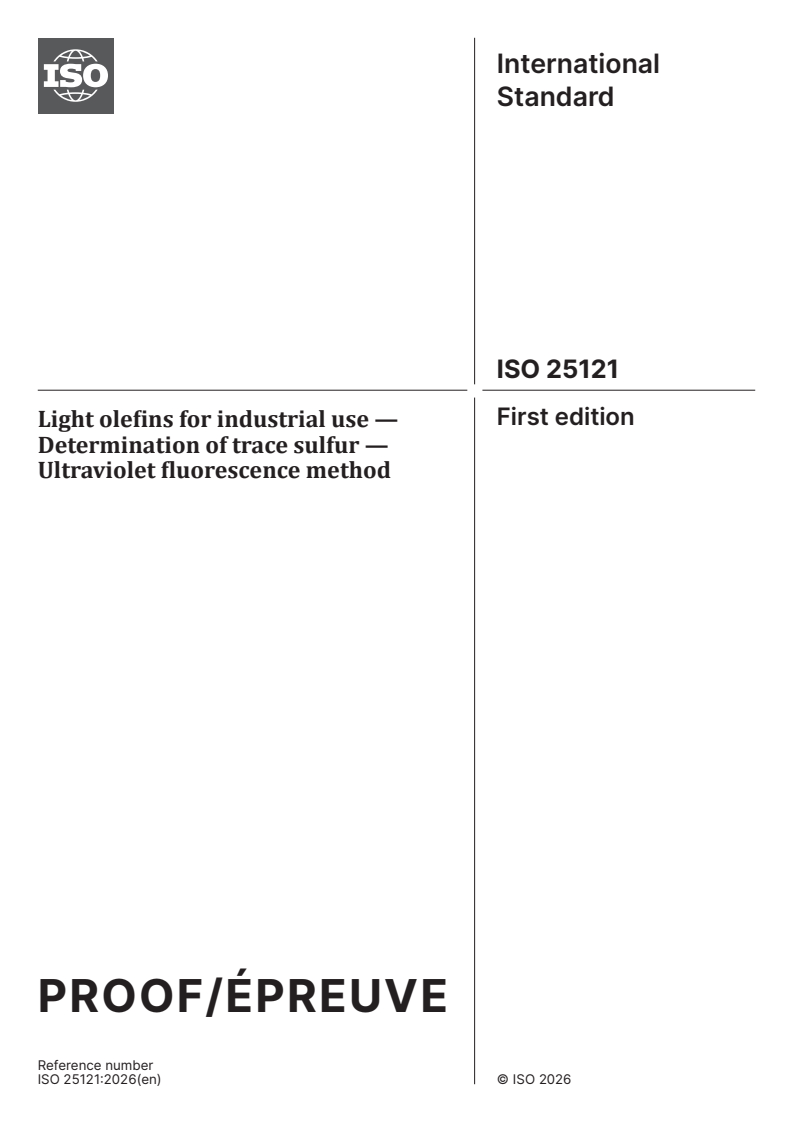

ISO/PRF 25121 - Light olefins for industrial use — Determination of trace sulfur — Ultraviolet fluorescence method
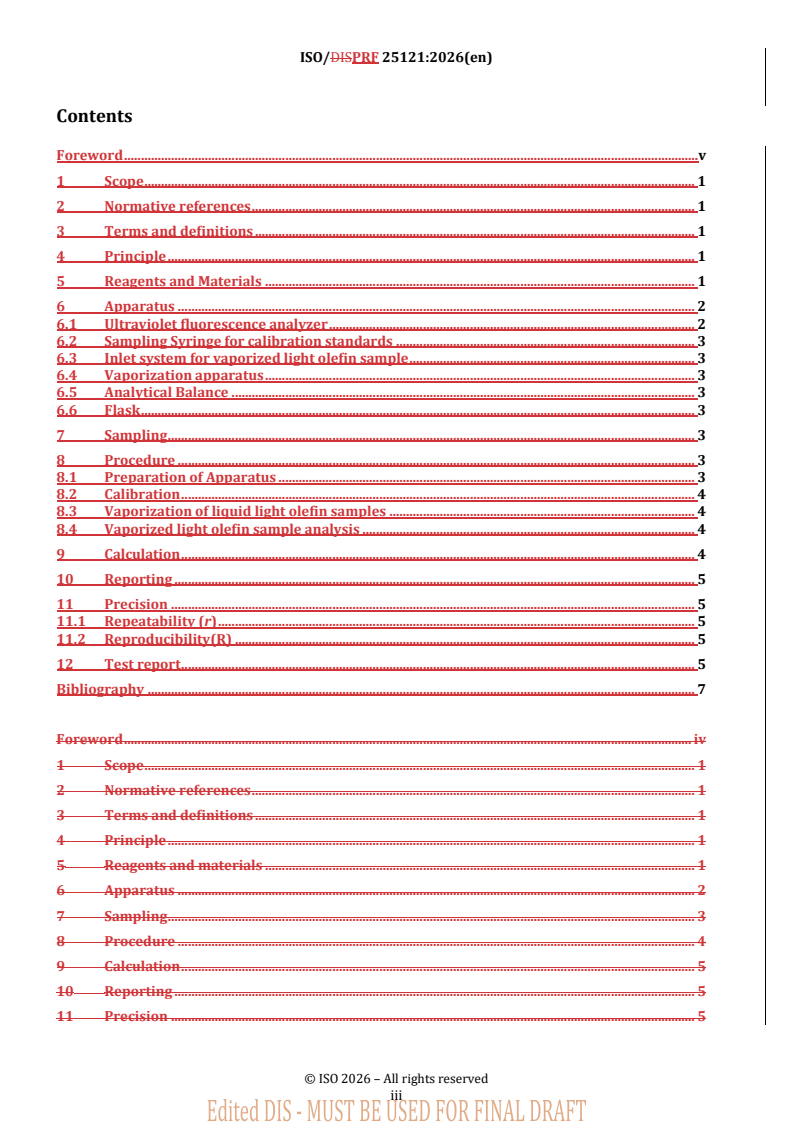
REDLINE ISO/PRF 25121 - Light olefins for industrial use — Determination of trace sulfur — Ultraviolet fluorescence method
ISO 25121 is an ISO standard for determining trace sulfur in light olefins by ultraviolet fluorescence. It applies to ethylene, propylene, butadiene and other C4 olefins, and it is intended for laboratories and industrial users who need sulfur results in the 0.2 mg/kg to 100 mg/kg range.
What does ISO 25121 specify?
ISO 25121 specifies a ultraviolet fluorescence method for measuring trace sulfur in light olefins. The method is written for industrial-use samples and focuses on sulfur in both liquid and vaporized light olefin samples.
The document is organized into clauses for scope, normative references, terms and definitions, principle, reagents and materials, apparatus, sampling, procedure, calculation, reporting, precision and test report. The body of the standard also includes a bibliography.
What are the key requirements of ISO 25121?
- Clause 4 - Principle: ISO 25121 uses high-temperature combustion in an oxygen-rich atmosphere to convert sulfur mainly to sulfur dioxide, removes combustion water, and measures the fluorescence emitted when sulfur dioxide is excited by ultraviolet light. In practice, the analyst needs complete combustion and stable detection, because the detector signal is the basis for the sulfur result.
- Clause 5 - Reagents and materials: ISO 25121 calls for high-purity sulfur compounds for standard stock solutions, very low-sulfur diluents, high-purity inert gas and oxygen, and standard stock solution preparation from known compounds. This matters because sulfur contamination from reagents or solvents can distort low-level results.
- Clause 6 - Apparatus: ISO 25121 requires an ultraviolet fluorescence analyzer with a pyrolysis furnace, quartz combustion tube, flow control, vapour drier and UV detector, plus suitable syringe, vaporization system, balance and flask. In practice, the instrument must handle vaporized light olefins and maintain repeatable gas flow into the oxidation zone.
- Clause 7 - Sampling: Sampling follows ISO 7382 and ISO 8563, and samples should be kept as cool as practical, uncovered only briefly, and analyzed quickly after removal from bulk supply. This reduces loss of volatile components and limits sulfur loss or contamination.
- Clause 8.2 - Calibration: ISO 25121 requires calibration standards prepared from the stock solutions, selection of the calibration curve according to expected sulfur level, three measurements of each standard, and daily verification of system performance. The document also sets a relative standard deviation limit for calibration standards and requires a linear calibration curve.
- Clauses 8.3 and 8.4 - Sample handling and analysis: Liquid light olefin samples are vaporized before analysis, mixed before vaporization, flushed through the inlet system, and injected after pressure equilibrium is reached. Each sample is measured twice, so the reported result is based on duplicate determinations rather than a single reading.
- Clauses 9 and 10 - Calculation and reporting: ISO 25121 calculates sulfur content in mg/kg from the measured sulfur mass and sample conditions, then reports the average of two measurements to the nearest 0.1 mg/kg. For users, this means the final result is standardized to sample amount, temperature and pressure.
- Clause 11 and Table 2 - Precision: ISO 25121 gives repeatability and reproducibility statements for two sulfur ranges. These figures tell laboratories how much difference to expect between duplicate results within one lab and between different laboratories.
- Clause 12 - Test report: The report must identify the sample, cite ISO 25121, state the result, note optional conditions and any deviations, and give the test date. This supports traceability in quality control and commercial testing.
What terms does ISO 25121 define?
- Light olefins - Olefinic materials covered by the method, including ethylene, propylene, butadiene and other C4 olefins.
- Ultraviolet fluorescence (UV) - The detection technique used to measure sulfur dioxide after excitation by ultraviolet light.
- Sulfur dioxide (SO2) - The main sulfur-containing combustion product measured by the detector signal.
- Sulfur trioxide (SO3) - A minor oxidation product formed during combustion in the oxygen-rich zone.
- Certified reference material (CRM) - A reference material produced in accordance with ISO 17034 and suitable for preparing standard stock solutions.
- Repeatability (r) - The closeness of results obtained under the same operating conditions in one laboratory.
- Reproducibility (R) - The closeness of results obtained in different laboratories under normal test conditions.
Who uses ISO 25121?
ISO 25121 is used by analytical laboratories, plant quality-control teams, technical service labs and purchasers who need to check sulfur in light olefins. It is relevant in the production, trading and receiving of ethylene, propylene and butadiene streams where trace sulfur can affect downstream use.
Which standards are used with ISO 25121?
ISO 25121 refers to ISO 7382, which specifies sampling of ethylene in the liquid and gaseous phases, and ISO 8563, which specifies sampling of propylene and butadiene in the liquid phase. It also cites ISO 17034 in a note as the basis for certified reference materials that can be used as alternatives when preparing standard stock solutions.
What does the ISO 25121 document contain?
ISO 25121 contains the test principle, reagent and material requirements, apparatus descriptions, sampling guidance, calibration and analysis procedures, calculation and reporting rules, and precision statements. It also includes Table 1 for typical calibration ranges and injection volumes, and Table 2 for repeatability and reproducibility expressions. The test report clause sets the minimum information needed for traceable sulfur testing.
Buy Documents
ISO/PRF 25121 - Light olefins for industrial use — Determination of trace sulfur — Ultraviolet fluorescence method
REDLINE ISO/PRF 25121 - Light olefins for industrial use — Determination of trace sulfur — Ultraviolet fluorescence method
Get Certified
Connect with accredited certification bodies for this standard

ECOCERT
Organic and sustainability certification.

Eurofins Food Testing Global
Global leader in food, environment, and pharmaceutical product testing.

Intertek Bangladesh
Intertek certification and testing services in Bangladesh.
Sponsored listings
Frequently Asked Questions
ISO 25121 is a draft published by the International Organization for Standardization (ISO). Its full title is "Light olefins for industrial use — Determination of trace sulfur — Ultraviolet fluorescence method". This standard covers: This document specifies a ultraviolet fluorescence method for the determination of trace sulfur in light olefins. This document is applicable to the determination of sulfur in ethylene, propylene, butadiene and other C4 olefins. The detection range for sulfur is from 0,2 mg/kg to 100 mg/kg.
This document specifies a ultraviolet fluorescence method for the determination of trace sulfur in light olefins. This document is applicable to the determination of sulfur in ethylene, propylene, butadiene and other C4 olefins. The detection range for sulfur is from 0,2 mg/kg to 100 mg/kg.
ISO 25121 is classified under the following ICS (International Classification for Standards) categories: 71.040.40 - Chemical analysis; 71.080.10 - Aliphatic hydrocarbons. The ICS classification helps identify the subject area and facilitates finding related standards.
ISO 25121 is available in PDF format for immediate download after purchase. The document can be added to your cart and obtained through the secure checkout process. Digital delivery ensures instant access to the complete standard document.
Standards Content (Sample)
International
Standard
First edition
Light olefins for industrial use —
Determination of trace sulfur —
Ultraviolet fluorescence method
PROOF/ÉPREUVE
Reference number
© ISO 2026
All rights reserved. Unless otherwise specified, or required in the context of its implementation, no part of this publication may
be reproduced or utilized otherwise in any form or by any means, electronic or mechanical, including photocopying, or posting on
the internet or an intranet, without prior written permission. Permission can be requested from either ISO at the address below
or ISO’s member body in the country of the requester.
ISO copyright office
CP 401 • Ch. de Blandonnet 8
CH-1214 Vernier, Geneva
Phone: +41 22 749 01 11
Email: copyright@iso.org
Website: www.iso.org
Published in Switzerland
PROOF/ÉPREUVE
ii
Contents Page
Foreword .iv
1 Scope . 1
2 Normative references . 1
3 Terms and definitions . 1
4 Principle . 1
5 Reagents and Materials . 1
6 Apparatus . 2
6.1 Ultraviolet fluorescence analyzer .2
6.1.1 Pyrolysis Furnace .2
6.1.2 Combustion tube .2
6.1.3 Flow controller .2
6.1.4 Vapour drier .2
6.1.5 Ultraviolet fluorescence (UV) detector.3
6.2 Sampling Syringe for calibration standards .3
6.3 Inlet system for vaporized light olefin sample .3
6.4 Vaporization apparatus .3
6.5 Analytical Balance . .3
6.6 Flask .3
7 Sampling . 3
8 Procedure . 3
8.1 Preparation of Apparatus .3
8.2 Calibration .4
8.3 Vaporization of liquid light olefin samples .4
8.4 Vaporized light olefin sample analysis .4
9 Calculation . 4
10 Reporting . 5
11 Precision . 5
11.1 Repeatability (r) .5
11.2 Reproducibility(R) .5
12 Test report . 5
Bibliography . 7
PROOF/ÉPREUVE
iii
Foreword
ISO (the International Organization for Standardization) is a worldwide federation of national standards
bodies (ISO member bodies). The work of preparing International Standards is normally carried out through
ISO technical committees. Each member body interested in a subject for which a technical committee
has been established has the right to be represented on that committee. International organizations,
governmental and non-governmental, in liaison with ISO, also take part in the work. ISO collaborates closely
with the International Electrotechnical Commission (IEC) on all matters of electrotechnical standardization.
The procedures used to develop this document and those intended for its further maintenance are described
in the ISO/IEC Directives, Part 1. In particular, the different approval criteria needed for the different types
of ISO document should be noted. This document was drafted in accordance with the editorial rules of the
ISO/IEC Directives, Part 2 (see www.iso.org/directives).
ISO draws attention to the possibility that the implementation of this document may involve the use of (a)
patent(s). ISO takes no position concerning the evidence, validity or applicability of any claimed patent
rights in respect thereof. As of the date of publication of this document, ISO had not received notice of (a)
patent(s) which may be required to implement this document. However, implementers are cautioned that
this may not represent the latest information, which may be obtained from the patent database available at
www.iso.org/patents. ISO shall not be held responsible for identifying any or all such patent rights.
Any trade name used in this document is information given for the convenience of users and does not
constitute an endorsement.
For an explanation of the voluntary nature of standards, the meaning of ISO specific terms and expressions
related to conformity assessment, as well as information about ISO's adherence to the World Trade
Organization (WTO) principles in the Technical Barriers to Trade (TBT), see www.iso.org/iso/foreword.html.
This document was prepared by Technical Committee ISO/TC 47, Chemistry.
Any feedback or questions on this document should be directed to the user’s national standards body. A
complete listing of these bodies can be found at www.iso.org/members.html.
PROOF/ÉPREUVE
iv
International Standard ISO 25121:2026(en)
Light olefins for industrial use — Determination of trace
sulfur — Ultraviolet fluorescence method
1 Scope
This document specifies a ultraviolet fluorescence method for the determination of trace sulfur in light
olefins.
This document is applicable to the determination of sulfur in ethylene, propylene, butadiene and other C4
olefins. The detection range for sulfur is from 0,2 mg/kg to 100 mg/kg.
2 Normative references
The following documents are referred to in the text in such a way that some or all of their content constitutes
requirements of this document. For dated references, only the edition cited applies. For undated references,
the latest edition of the referenced document (including any amendments) applies.
ISO 7382, Ethylene for industrial use — Sampling in the liquid and the gaseous phase
ISO 8563, Propylene and butadiene for industrial use — Sampling in the liquid phase
3 Terms and definitions
No terms and definitions are listed in this document.
ISO and IEC maintain terminology databases for use in standardization at the following ad
...
ISO/DISPRF 25121:2026(en)
ISO/TC 47
Secretariat: JISC
Date: 2026-06-1608-11
Light olefins for industrial use — Determination of trace sulfur —
Ultraviolet fluorescence method
PROOF
ISO/PRF 25121:2026(en)
All rights reserved. Unless otherwise specified, or required in the context of its implementation, no part of this publication
may be reproduced or utilized otherwise in any form or by any means, electronic or mechanical, including photocopying,
or posting on the internet or an intranet, without prior written permission. Permission can be requested from either ISO
at the address below or ISO’s member body in the country of the requester.
ISO copyright office
CP 401 • Ch. de Blandonnet 8
CH-1214 Vernier, Geneva
Phone: + 41 22 749 01 11
EmailE-mail: copyright@iso.org
Website: www.iso.orgwww.iso.org
Published in Switzerland
ii © ISO/CD 25121 2026 – All rights reserved
ii
ISO/DISPRF 25121:2026(en)
Contents
Foreword . v
1 Scope . 1
2 Normative references . 1
3 Terms and definitions . 1
4 Principle . 1
5 Reagents and Materials . 1
6 Apparatus . 2
6.1 Ultraviolet fluorescence analyzer . 2
6.2 Sampling Syringe for calibration standards . 3
6.3 Inlet system for vaporized light olefin sample . 3
6.4 Vaporization apparatus . 3
6.5 Analytical Balance . 3
6.6 Flask . 3
7 Sampling . 3
8 Procedure . 3
8.1 Preparation of Apparatus . 3
8.2 Calibration . 4
8.3 Vaporization of liquid light olefin samples . 4
8.4 Vaporized light olefin sample analysis . 4
9 Calculation . 4
10 Reporting . 5
11 Precision . 5
11.1 Repeatability (r) . 5
11.2 Reproducibility(R) . 5
12 Test report . 5
Bibliography . 7
Foreword . iv
1 Scope . 1
2 Normative references . 1
3 Terms and definitions . 1
4 Principle . 1
5 Reagents and materials . 1
6 Apparatus . 2
7 Sampling . 3
8 Procedure . 4
9 Calculation . 5
10 Reporting . 5
11 Precision . 5
iii
ISO/PRF 25121:2026(en)
12 Test report . 6
iv © ISO/CD 25121 2026 – All rights reserved
iv
ISO/DISPRF 25121:2026(en)
Foreword
ISO (the International Organization for Standardization) is a worldwide federation of national standards
bodies (ISO member bodies). The work of preparing International Standards is normally carried out through
ISO technical committees. Each member body interested in a subject for which a technical committee has been
established has the right to be represented on that committee. International organizations, governmental and
non-governmental, in liaison with ISO, also take part in the work. ISO collaborates closely with the
International Electrotechnical Commission (IEC) on all matters of electrotechnical standardization.
The procedures used to develop this document and those intended for its further maintenance are described
in the ISO/IEC Directives, Part 1. In particular, the different approval criteria needed for the different types of
ISO document should be noted. This document was drafted in accordance with the editorial rules of the
ISO/IEC Directives, Part 2 (see www.iso.org/directives).
ISO draws attention to the possibility that the implementation of this document may involve the use of (a)
patent(s). ISO takes no position concerning the evidence, validity or applicability of any claimed patent rights
in respect thereof. As of the date of publication of this document, ISO had not received notice of (a) patent(s)
which may be required to implement this document. However, implementers are cautioned that this may not
represent the latest information, which may be obtained from the patent database available at
www.iso.org/patents.www.iso.org/patents. ISO shall not be held responsible for identifying any or all such
patent rights.
Any trade name used in this document is information given for the convenience of users and does not
constitute an endorsement.
For an explanation of the voluntary nature of standards, the meaning of ISO specific terms and expressions
related to conformity assessment, as well as information about ISO's adherence to the World Trade
Organization (WTO) principles in the Technical Barriers to Trade (TBT), see
www.iso.org/iso/foreword.htmlwww.iso.org/iso/foreword.html.
This document was prepared by Technical Committee ISO/TC 47, Chemistry.
Any feedback or questions on this document should be directed to the user’s national standards body. A
complete listing of these bodies can be found at www.iso.org/members.htmlwww.iso.org/members.html.
v
DRAFT International Standard ISO/DIS 25121:2026(en)
Light olefins for industrial use — Determination of trace sulfur —
Ultraviolet fluorescence method
1 Scope
This document specifies a ultraviolet fluorescence method for the determination of trace sulfur in light olefins.
This document is applicable to the determination of sulfur in ethylene, propylene, butadiene and other C4
olefins. The detection range for sulfur is from 0,2 mg/kg to 100 mg/kg.
2 Normative references
The following documents are referred to in the text in such a way that some or all of their content constitutes
requirements of this document. For dated references, only the edition cited applies. For undated references,
the latest edition of the referenced document (including any amendments) applies.
ISO 7382, Ethylene for industrial use — Sampling in the liquid and the gaseous phase
ISO 8563, Propylene and butadiene for industrial use — Sampling in the liquid phase
3 Terms and definitions
No terms and definitions are listed in this document.
ISO and IEC maintain terminology databases for use in standardization at the following addresses:
— — ISO Online browsing platform: available at https://www.iso.org/obphttps://www.iso.org/obp
— — IEC Electropedia: available at https://www.electropedia.org/https://www.electropedia.org/
4 Principle
The gaseous sample is injected to high temper
...