

ISO/IEC 11179-1:2023
(Main)Information technology — Metadata registries (MDR) — Part 1: Framework
General Information
- Abstract
This document provides the means for understanding and associating the individual parts of ISO/IEC 11179 and is the foundation for a conceptual understanding of metadata and metadata registries. This document also describes the relationship of ISO/IEC 11179 to other JTC 1/SC 32 standards, technical specifications and technical reports on metadata. In all parts of ISO/IEC 11179, metadata refers to descriptions of data. It does not contain a general treatment of metadata.
- Status
- Published
- Publication Date
- 15-Jan-2023
- Technical Committee
- ISO/IEC JTC 1/SC 32 - Data management and interchange
- Drafting Committee
- ISO/IEC JTC 1/SC 32/WG 2 - MetaData
- Current Stage
- 6060 - International Standard published
- Start Date
- 16-Jan-2023
- Due Date
- 02-Apr-2023
- Completion Date
- 16-Jan-2023

Overview
ISO/IEC 11179-1:2023 - Information technology - Metadata registries (MDR) - Part 1: Framework is the fourth-edition foundation for understanding, designing and operating metadata registries. It defines the conceptual framework for metadata (descriptions of data), explains core terminology and topical scope across the ISO/IEC 11179 series, and describes how the series relates to other JTC 1/SC 32 metadata standards. The document focuses on the semantics of data, metadata management and the principles behind registration - it does not provide a general treatment of all kinds of metadata.
Key topics and technical requirements
- Conceptual framework and terminology: theory of terminology, modelling constructs, and standardized terms used in the 11179 metamodel.
- Metadata fundamentals: definitions of metadata, concepts for metadata management and the fundamental model of data elements.
- Metadata registries (MDRs): principles for registry structure and the fundamentals of registration, including the three registration goals - identification, provenance, and quality monitoring.
- Data element modelling: core concepts for describing and re-using data element components and value domains.
- Series overview and scope mapping: explanation of related parts (e.g., metamodels for registry facilities and data specification registration, naming principles, data definition formulation, registration procedures).
- Conformance and normative references: guidance on conformance and links to referenced standards.
These topics are intended to enable consistent semantic descriptions, re-use of metadata components and harmonized data interchange.
Applications and practical value
- Establishing a corporate or cross‑agency metadata registry to manage data element definitions, value domains and semantics.
- Supporting data governance, semantic interoperability, and data harmonization across systems and organizations.
- Guiding implementation of MDR software, APIs and mappings for metadata exchange.
- Enabling consistent data standardization for sectors such as government, healthcare, finance, and large enterprises that need robust metadata management for analytics, reporting and system integration.
Who should use this standard
- Data architects, metadata managers and data stewards implementing or operating MDRs.
- Software vendors building metadata registry solutions, APIs or integration tools.
- Standards bodies, interoperability working groups and organizations focused on semantic interoperability and data governance.
Related standards
ISO/IEC 11179-1 situates the 11179 series alongside other JTC 1/SC 32 standards such as ISO/IEC 11179 parts (metamodels, naming, registration) and related series including ISO/IEC 19763 (MFI / metamodels for interoperability), ISO/IEC 20943 / 20944 (MDR consistency and bindings), ISO/IEC 19583, and domain references like ISO/IEC 11404 and ISO/IEC 21838. These linked standards support registry metamodels, bindings, exchange formats and ontology mappings.
Keywords: ISO/IEC 11179, metadata registries, MDR, metadata management, data element, metamodel, data governance, semantic interoperability.
Relations
- Effective Date
- 04-Nov-2023
- Revises
ISO/IEC 11179-1:2015 - Information technology — Metadata registries (MDR) — Part 1: Framework - Effective Date
- 23-Apr-2020
Get Certified
Connect with accredited certification bodies for this standard

BSI Group
BSI (British Standards Institution) is the business standards company that helps organizations make excellence a habit.

NYCE
Mexican standards and certification body.
Sponsored listings
Frequently Asked Questions
ISO/IEC 11179-1:2023 is a standard published by the International Organization for Standardization (ISO). Its full title is "Information technology — Metadata registries (MDR) — Part 1: Framework". This standard covers: This document provides the means for understanding and associating the individual parts of ISO/IEC 11179 and is the foundation for a conceptual understanding of metadata and metadata registries. This document also describes the relationship of ISO/IEC 11179 to other JTC 1/SC 32 standards, technical specifications and technical reports on metadata. In all parts of ISO/IEC 11179, metadata refers to descriptions of data. It does not contain a general treatment of metadata.
This document provides the means for understanding and associating the individual parts of ISO/IEC 11179 and is the foundation for a conceptual understanding of metadata and metadata registries. This document also describes the relationship of ISO/IEC 11179 to other JTC 1/SC 32 standards, technical specifications and technical reports on metadata. In all parts of ISO/IEC 11179, metadata refers to descriptions of data. It does not contain a general treatment of metadata.
ISO/IEC 11179-1:2023 is classified under the following ICS (International Classification for Standards) categories: 35.040.50 - Automatic identification and data capture techniques. The ICS classification helps identify the subject area and facilitates finding related standards.
ISO/IEC 11179-1:2023 has the following relationships with other standards: It is inter standard links to ISO 11357-5:2025, ISO/IEC 11179-1:2015. Understanding these relationships helps ensure you are using the most current and applicable version of the standard.
ISO/IEC 11179-1:2023 is available in PDF format for immediate download after purchase. The document can be added to your cart and obtained through the secure checkout process. Digital delivery ensures instant access to the complete standard document.
Standards Content (Sample)
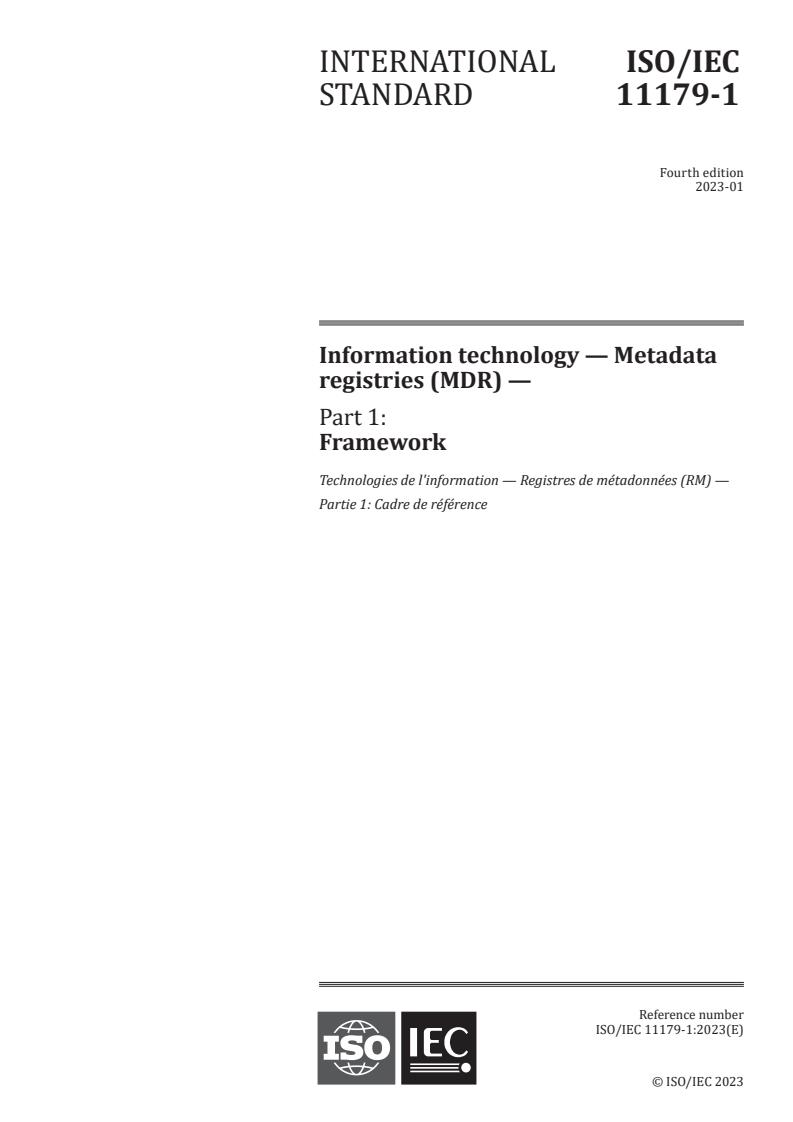
INTERNATIONAL ISO/IEC
STANDARD 11179-1
Fourth edition
2023-01
Information technology — Metadata
registries (MDR) —
Part 1:
Framework
Technologies de l'information — Registres de métadonnées (RM) —
Partie 1: Cadre de référence
Reference number
© ISO/IEC 2023
© ISO/IEC 2023
All rights reserved. Unless otherwise specified, or required in the context of its implementation, no part of this publication may
be reproduced or utilized otherwise in any form or by any means, electronic or mechanical, including photocopying, or posting on
the internet or an intranet, without prior written permission. Permission can be requested from either ISO at the address below
or ISO’s member body in the country of the requester.
ISO copyright office
CP 401 • Ch. de Blandonnet 8
CH-1214 Vernier, Geneva
Phone: +41 22 749 01 11
Email: copyright@iso.org
Website: www.iso.org
Published in Switzerland
ii
© ISO/IEC 2023 – All rights reserved
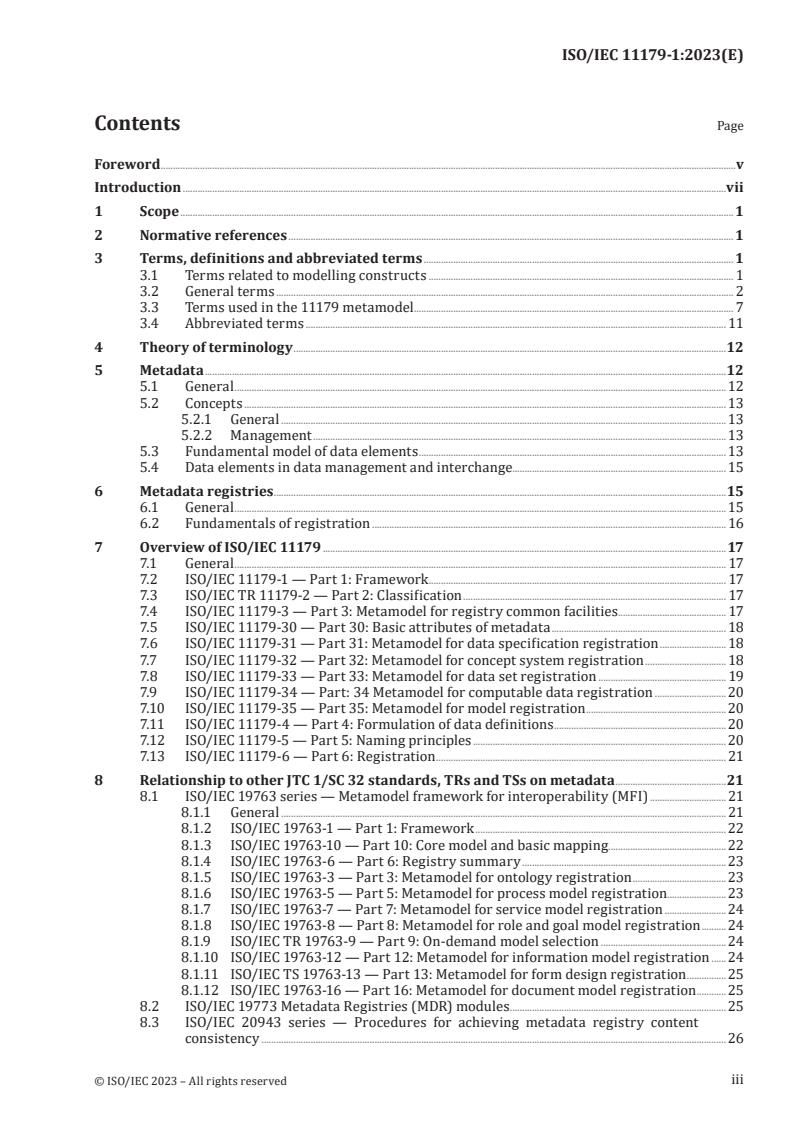
Contents Page
Foreword .v
Introduction .vii
1 Scope . 1
2 Normative references . 1
3 Terms, definitions and abbreviated terms . 1
3.1 Terms related to modelling constructs . 1
3.2 General terms . 2
3.3 Terms used in the 11179 metamodel . 7
3.4 Abbreviated terms . 11
4 Theory of terminology .12
5 Metadata .12
5.1 General .12
5.2 Concepts . 13
5.2.1 General .13
5.2.2 Management .13
5.3 Fundamental model of data elements . 13
5.4 Data elements in data management and interchange. 15
6 Metadata registries . .15
6.1 General . 15
6.2 Fundamentals of registration . 16
7 Overview of ISO/IEC 11179 .17
7.1 General . 17
7.2 ISO/IEC 11179-1 — Part 1: Framework . 17
7.3 ISO/IEC TR 11179-2 — Part 2: Classification . 17
7.4 ISO/IEC 11179-3 — Part 3: Metamodel for registry common facilities. 17
7.5 ISO/IEC 11179-30 — Part 30: Basic attributes of metadata . 18
7.6 ISO/IEC 11179-31 — Part 31: Metamodel for data specification registration . 18
7.7 ISO/IEC 11179-32 — Part 32: Metamodel for concept system registration . 18
7.8 ISO/IEC 11179-33 — Part 33: Metamodel for data set registration . 19
7.9 ISO/IEC 11179-34 — Part: 34 Metamodel for computable data registration .20
7.10 ISO/IEC 11179-35 — Part 35: Metamodel for model registration . 20
7.11 ISO/IEC 11179-4 — Part 4: Formulation of data definitions . 20
7.12 ISO/IEC 11179-5 — Part 5: Naming principles . 20
7.13 ISO/IEC 11179-6 — Part 6: Registration . 21
8 Relationship to other JTC 1/SC 32 standards, TRs and TSs on metadata .21
8.1 ISO/IEC 19763 series — Metamodel framework for interoperability (MFI) . 21
8.1.1 General . 21
8.1.2 ISO/IEC 19763-1 — Part 1: Framework . 22
8.1.3 ISO/IEC 19763-10 — Part 10: Core model and basic mapping.22
8.1.4 ISO/IEC 19763-6 — Part 6: Registry summary .23
8.1.5 ISO/IEC 19763-3 — Part 3: Metamodel for ontology registration .23
8.1.6 ISO/IEC 19763-5 — Part 5: Metamodel for process model registration .23
8.1.7 ISO/IEC 19763-7 — Part 7: Metamodel for service model registration . 24
8.1.8 ISO/IEC 19763-8 — Part 8: Metamodel for role and goal model registration . 24
8.1.9 ISO/IEC TR 19763-9 — Part 9: On-demand model selection . 24
8.1.10 ISO/IEC 19763-12 — Part 12: Metamodel for information model registration . 24
8.1.11 ISO/IEC TS 19763-13 — Part 13: Metamodel for form design registration .25
8.1.12 ISO/IEC 19763-16 — Part 16: Metamodel for document model registration .25
8.2 ISO/IEC 19773 Metadata Registries (MDR) modules . 25
8.3 ISO/IEC 20943 series — Procedures for achieving metadata registry content
consistency . 26
iii
© ISO/IEC 2023 – All rights reserved
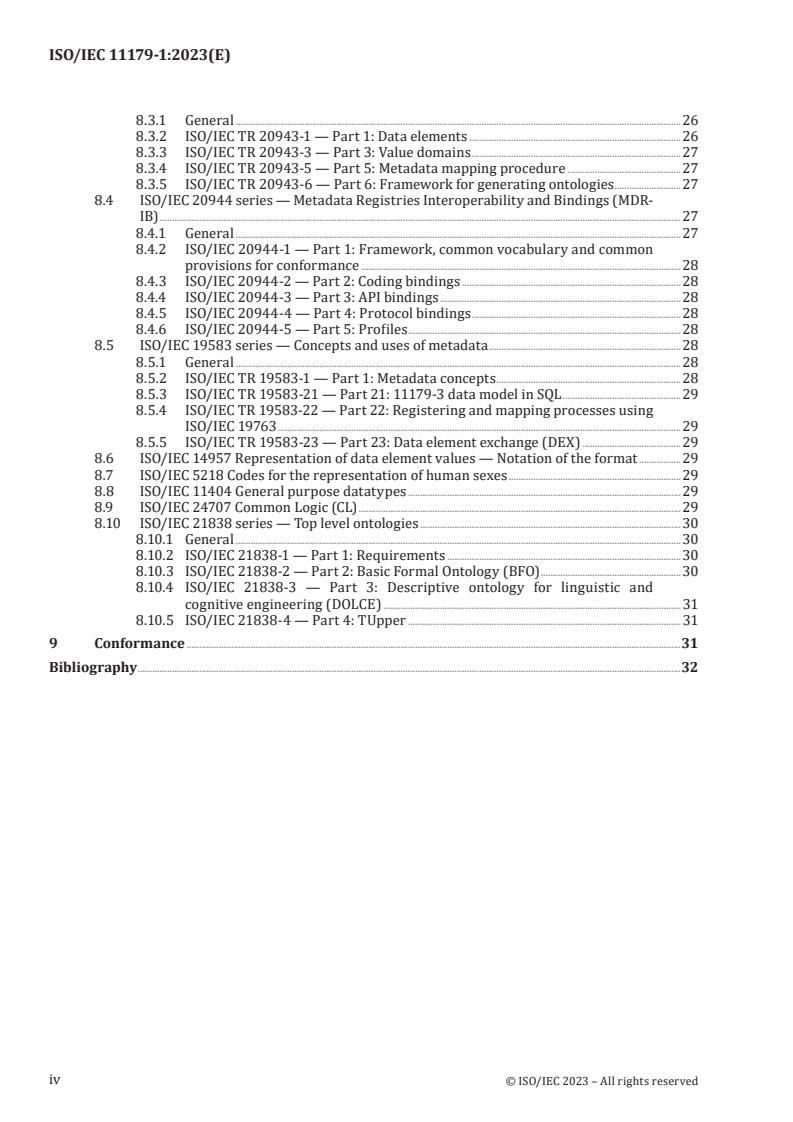
8.3.1 General . 26
8.3.2 ISO/IEC TR 20943-1 — Part 1: Data elements . 26
8.3.3 ISO/IEC TR 20943-3 — Part 3: Value domains . 27
8.3.4 ISO/IEC TR 20943-5 — Part 5: Metadata mapping procedure . 27
8.3.5 ISO/IEC TR 20943-6 — Part 6: Framework for generating ontologies . 27
8.4 ISO/IEC 20944 series — Metadata Registries Interoperability and Bindings (MDR-
IB) . 27
8.4.1 General . 27
8.4.2 ISO/IEC 20944-1 — Part 1: Framework, common vocabulary and common
provisions for conformance .28
8.4.3 ISO/IEC 20944-2 — Part 2: Coding bindings .28
8.4.4 ISO/IEC 20944-3 — Part 3: API bindings .28
8.4.5 ISO/IEC 20944-4 — Part 4: Protocol bindings .28
8.4.6 ISO/IEC 20944-5 — Part 5: Profiles .28
8.5 ISO/IEC 19583 series — Concepts and uses of metadata .28
8.5.1 General .28
8.5.2 ISO/IEC TR 19583-1 — Part 1: Metadata concepts .28
8.5.3 ISO/IEC TR 19583-21 — Part 21: 11179-3 data model in SQL .29
8.5.4 ISO/IEC TR 19583-22 — Part 22: Registering and mapping processes using
ISO/IEC 19763 .29
8.5.5 ISO/IEC TR 19583-23 — Part 23: Data element exchange (DEX) .29
8.6 ISO/IEC 14957 Representation of data element values — Notation of the format .29
8.7 ISO/IEC 5218 Codes for the representation of human sexes .29
8.8 ISO/IEC 11404 General purpose datatypes .29
8.9 ISO/IEC 24707 Common Logic (CL) .29
8.10 ISO/IEC 21838 series — Top level ontologies .30
8.10.1 General .30
8.10.2 ISO/IEC 21838-1 — Part 1: Requirements .30
8.10.3 ISO/IEC 21838-2 — Part 2: Basic Formal Ontology (BFO) .30
8.10.4 ISO/IEC 21838-3 — Part 3: Descriptive ontology for linguistic and
cognitive engineering (DOLCE) . 31
8.10.5 ISO/IEC 21838-4 — Part 4: TUpper . 31
9 Conformance .31
Bibliography .32
iv
© ISO/IEC 2023 – All rights reserved
Foreword
ISO (the International Organization for Standardization) and IEC (the International Electrotechnical
Commission) form the specialized system for worldwide standardization. National bodies that are
members of ISO or IEC participate in the development of International Standards through technical
committees established by the respective organization to deal with particular fields of technical
activity. ISO and IEC technical committees collaborate in fields of mutual interest. Other international
organizations, governmental and non-governmental, in liaison with ISO and IEC, also take part in the
work.
The procedures used to develop this document and those intended for its further maintenance
are described in the ISO/IEC Directives, Part 1. In particular, the different approval criteria
needed for the different types of document should be noted. This document was drafted in
accordance with the editorial rules of the ISO/IEC Directives, Part 2 (see www.iso.org/directives or
www.iec.ch/members_experts/refdocs).
Attention is drawn to the possibility that some of the elements of this document may be the subject
of patent rights. ISO and IEC shall not be held responsible for identifying any or all such patent
rights. Details of any patent rights identified during the development of the document will be in the
Introduction and/or on the ISO list of patent declarations received (see www.iso.org/patents) or the IEC
list of patent declarations received (see https://patents.iec.ch).
Any trade name used in this document is information given for the convenience of users and does not
constitute an endorsement.
For an explanation of the voluntary nature of standards, the meaning of ISO specific terms and
expressions related to conformity assessment, as well as information about ISO's adherence to
the World Trade Organization (WTO) principles in the Technical Barriers to Trade (TBT) see
www.iso.org/iso/foreword.html. In the IEC, see www.iec.ch/understanding-standards.
This document was prepared by Joint Technical Committee ISO/IEC/JTC 1, Information technology,
Subcommittee SC 32, Data management and interchange.
This fourth edition cancels and replaces the third edition (ISO/IEC 11179-1:2015), which has been
technically revised.
The main changes are as follows:
— some of the detailed descriptions from the Introduction and Clause 5 have been removed to avoid
duplication with other parts;
— Clause 7 has been updated to:
— revise the description for ISO/IEC 11179-3 to reflect its focus on the core metamodel of a
metadata registry, and the creation of separate parts to handle other aspects;
— add a description for ISO/IEC 11179-30;
— add a description for ISO/IEC 11179-31;
— add a description for ISO/IEC 11179-32;
— add a description for ISO/IEC 11179-33;
— add a description for ISO/IEC 11179-34;
— add a description for ISO/IEC 11179-35;
— Clause 8 has been added to describe the relationship of other ISO/IEC JTC 1/SC 32 standards on
metadata to the ISO/IEC 11179 series;
— references to other standards have been updated, especially ISO 1087, to the latest edition.
v
© ISO/IEC 2023 – All rights reserved
A list of all parts in the ISO/IEC 11179 series can be found on the ISO and IEC websites.
Any feedback or questions on this document should be directed to the user’s national standards
body. A complete listing of these bodies can be found at www.iso.org/members.html and
www.iec.ch/national-committees.
vi
© ISO/IEC 2023 – All rights reserved
Introduction
The ISO/IEC 11179 series addresses the semantics of data, the representation of data and the registration
of the descriptions of that data. It is through these descriptions that an accurate understanding of the
semantics and a useful depiction of the data are found.
The purposes of ISO/IEC 11179 are to promote the following:
— standard description of data;
— common understanding of data across organizational elements and between organizations;
— re-use and standardization of data over time, space, and applications;
— harmonization and standardization of data within an organization and across organizations;
— management of the components of descriptions of data;
— re-use of the components of descriptions of data.
Each part of ISO/IEC 11179 is devoted to addressing a different aspect of these needs, as described in
Clause 7.
Generally, descriptive data are known as metadata. Metadata can describe books, phone calls, data, etc.
ISO/IEC 11179 focuses upon metadata that describe data.
A metadata registry (MDR) is a system for maintaining a database of metadata. Registration is
one possible function of that system. Registration accomplishes three main goals: identification,
provenance, and monitoring quality. Identification is accomplished by assigning a unique identifier
(within the registry) to each object registered there. Provenance addresses the source of the metadata
and the object described. Monitoring quality ensures that the metadata does the job it is designed to do.
An MDR may contain the semantics of data. An understanding of data is fundamental to their design,
harmonization, standardization, use, re-use and interchange. The underlying model for an MDR is
designed to capture all the basic components of the semantics of data, independent of any application or
subject matter area.
MDRs, typically, are organized so that those designing applications can ascertain whether a suitable
object described in the MDR already exists. Where it is established that a new object is essential, its
derivation from an existing description with appropriate modifications is encouraged, thus avoiding
unnecessary variations in the way similar objects are described. Registration will also allow two or
more administered items describing identical objects to be identified, and more importantly, it will
help to identify situations where similar or identical names are in use for administered items that are
significantly different in one or more respects.
The names, definitions, datatype and related attributes that are associated with the description of an
object in an MDR give that object meaning. The depth of this meaning is limited, because names and
definitions convey limited information about the object. The relationships object descriptions have
with semantically related object descriptions in a registry provide additional information, but this
additional information is dependent on how many semantically related object descriptions there are.
A metadata registry that conforms to ISO/IEC 11179 can describe a wide variety of data. In fact, the
attributes described in ISO/IEC 11179 are data elements, and they can be registered in an ISO/IEC 11179
metadata registry. Moreover, any set of descriptors or metadata attributes may be interpreted as data
elements and registered in the metadata registry.
There are two main consequences to this:
— the metadata registry can describe itself;
— metadata layers or levels are not defined in ISO/IEC 11179.
vii
© ISO/IEC 2023 – All rights reserved
As a result, ISO/IEC 11179 is a general description framework for data of any kind, in any organization
and for any purpose. ISO/IEC 11179 does not address other data management needs, such as data
models, application specifications, programming code, program plans, business plans and business
policies. These need to be addressed elsewhere. ISO/IEC 19763 specifies facilities to extend a metadata
registry so that information about models can be registered. Such models include information (or data)
models, ontologies, process models, role and goal models, and form designs.
The increased use of data processing and electronic data interchange heavily relies on accurate, reliable,
controllable and verifiable data recorded in databases. One of the prerequisites for a correct and proper
use and interpretation of data is that both users and owners of data have a common understanding
of the meaning and descriptive characteristics (e.g. representation) of that data, guaranteed by the
definition of several basic attributes.
The basic attributes specified are applicable for the definition and specification of the contents of data
dictionaries and interchanging or referencing among various collections of administered items. The
“basic” in basic attributes means that the attributes are commonly needed in specifying administered
items completely enough to ensure that they will be applicable for a variety of functions, such as:
— design of information processing systems;
— retrieval of data from databases;
— design of messages for data interchange;
— maintenance of metadata registries;
— data management;
— dictionary design;
— dictionary control;
— use of information processing systems.
Basic also implies that they are independent of any:
— application environment;
— function of an object described by an administered item;
— level of abstraction;
— grouping of administered items;
— method for designing information processing systems or data interchange messages;
— MDR system.
Basic does not imply that all attributes specified in ISO/IEC 11179 are required in all cases. Distinction
is made between those attributes that are mandatory, conditional, or optional.
viii
© ISO/IEC 2023 – All rights reserved
INTERNATIONAL STANDARD ISO/IEC 11179-1:2023(E)
Information technology — Metadata registries (MDR) —
Part 1:
Framework
1 Scope
This document provides the means for understanding and associating the individual parts of
ISO/IEC 11179 and is the foundation for a conceptual understanding of metadata and metadata
registries. This document also describes the relationship of ISO/IEC 11179 to other JTC 1/SC 32
standards, technical specifications and technical reports on metadata.
In all parts of ISO/IEC 11179, metadata refers to descriptions of data. It does not contain a general
treatment of metadata.
2 Normative references
The following documents are referred to in the text in such a way that some or all of their content
constitutes requirements of this document. For dated references, only the edition cited applies. For
undated references, the latest edition of the referenced document (including any amendments) applies.
ISO 704, Terminology work — Principles and methods
ISO 1087, Terminology work and terminology science — Vocabulary
3 Terms, definitions and abbreviated terms
For the purposes of this document, the terms and definitions given in ISO 704, ISO 1087 and the
following apply.
ISO and IEC maintain terminological databases for use in standardization at the following addresses:
— ISO Online browsing platform: available at https:// www .iso .org/ obp
— IEC Electropedia: available at https:// www .electropedia .org/
3.1 Terms related to modelling constructs
3.1.1
attribute
characteristic (3.2.6) of an object (3.2.4) or set of objects
[SOURCE: ISO/IEC 11179-3:2023, 3.1.11]
3.1.2
class
description of a set of objects (3.2.4) that share the same attributes (3.1.1), operations, methods,
relationships (3.1.4) and semantics
Note 1 to entry: Adapted from ISO/IEC 19505-2:2012, 7.3.7.
© ISO/IEC 2023 – All rights reserved
3.1.3
identifier
sequence of characters, capable of uniquely identifying that with which it is
associated, within a specified context (3.3.3)
Note 1 to entry: Unlike a name (3.2.17), an identifier is linguistically neutral.
Note 2 to entry: It is possible to define an identifier from the point of view of terminology as defined in ISO 1087
and described in ISO 704, as follows: representation of an object by a sign which denotes it, and is intended for
dereferencing that object. Note the parallel with the definition of designation (3.2.16), except this applies to any
object rather than just for concepts.
[SOURCE: ISO/IEC 11179-3:2023, 3.1.16, modified — Note 2 to entry has been added.]
3.1.4
relationship
semantic connection among model elements
[SOURCE: ISO 19103:2015, 4.30]
3.2 General terms
3.2.1
subject
area of interest or expertise
[SOURCE: ISO 1087:2019, 3.1.5]
3.2.2
domain
subject field
field of special knowledge
Note 1 to entry: The borderlines and the granularity of a domain are determined from a purpose-related point of
view. If a domain is sub-divided, the result is again a domain.
[SOURCE: ISO 1087:2019, 3.1.4]
3.2.3
entity
any concrete or abstract thing that exists, did exist, or might exist, including associations among these
things
EXAMPLE A person, object, event, idea, process, etc.
Note 1 to entry: An entity exists whether data about it are available or not.
[SOURCE: ISO/IEC 2382:2015, 2121433, modified — some Notes to entry have been deleted.]
3.2.4
object
anything perceivable or conceivable
Note 1 to entry: Objects can be material (e.g. 'engine', 'sheet of paper', 'diamond'), immaterial (e.g. 'conversion
ratio', 'project plan') or imagined (e.g. 'unicorn', 'scientific hypothesis').
[SOURCE: ISO 1087:2019, 3.1.1]
3.2.5
property
feature of an object (3.2.4)
EXAMPLE 1 'Being made of wood' as a property of a given 'table'.
© ISO/IEC 2023 – All rights reserved
EXAMPLE 2 'Belonging to person A' as a property of a given 'pet'.
EXAMPLE 3 'Having been formulated by Einstein' as a property of the equation 'E = mc '.
EXAMPLE 4 'Being compassionate' as a property of a given 'person'.
EXAMPLE 5 'Having a given cable' as a property of a given 'computer mouse'.
Note 1 to entry: One or more objects can have the same property.
Note 2 to entry: See also 3.3.2.
[SOURCE: ISO 1087:2019, 3.1.3, modified — Note 2 to entry added.]
3.2.6
characteristic
abstraction of a property (3.2.5)
EXAMPLE 'Having a cable for connecting with a computer' as a characteristic of the concept 'cord mouse'.
Note 1 to entry: Characteristics are used for describing concepts (3.2.8).
[SOURCE: ISO 1087:2019, 3.2.1]
3.2.7
essential characteristic
characteristic (3.2.6) of a concept (3.2.8) which is indispensable to understanding that concept
[SOURCE: ISO 1087:2019, 3.2.3]
3.2.8
concept
unit of knowledge created by a unique combination of characteristics (3.2.6)
Note 1 to entry: Concepts are not necessarily bound to particular natural languages. They are, however,
influenced by the social or cultural background which often leads to different categorizations.
Note 2 to entry: A concept is independent of its representation.
[SOURCE: ISO 1087:2019, 3.2.7, modified — Note 2 to entry has been changed.]
3.2.9
general concept
concept (3.2.8) that corresponds to a potentially unlimited number of objects (3.2.4), which form a
group by reason of shared properties (3.2.5)
EXAMPLE 'planet', 'tower', 'Nobel Prize in Physics', 'moon'.
Note 1 to entry: For a general concept it is essential that a number of corresponding objects greater than 1 can
be perceived or conceived of. For example 'spaceship' has been a general concept before such a material object
existed, at the time when there existed only 1 such object, and later when there existed several such objects.
[SOURCE: ISO 1087:2019, 3.2.9]
3.2.10
individual concept
concept (3.2.8) which corresponds to only one object (3.2.4)
EXAMPLE ‘Saturn’, ‘Eiffel Tower’, 'Moon', 'serial number FRHR603928', '2016 Nobel Prize in Physics'.
Note 1 to entry: Individual concepts are represented by proper names (3.2.18).
[SOURCE: ISO 1087:2019, 3.2.8]
© ISO/IEC 2023 – All rights reserved
3.2.11
definition
representation of a concept (3.2.8) by an expression that describes it and differentiates it from related
concepts
[SOURCE: ISO 1087:2019, 3.3.1]
3.2.12
extension
set of all of the objects (3.2.4) to which a concept (3.2.8) corresponds
Note 1 to entry: This term has a different meaning in ISO/IEC 11179-3.
[SOURCE: ISO 1087:2019, 3.1.2, modified — Note 1 to entry added.]
3.2.13
intension
set of characteristics (3.2.6) that make up a concept (3.2.8)
[SOURCE: ISO 1087:2019, 3.2.6]
3.2.14
concept relation
relation between two concepts (3.2.8)
[SOURCE: ISO 1087:2019, 3.2.11]
3.2.15
concept system
set of concepts (3.2.8) structured in one or more related domains (3.2.2) according to the concept
relations (3.2.14) among its concepts
[SOURCE: ISO 1087:2019, 3.2.28]
3.2.16
designation
designator
representation of a concept (3.2.8) by a sign which denotes it in a domain (3.2.2) or subject (3.2.1)
Note 1 to entry: A designation can be linguistic or non-linguistic. It can consist of various types of characters,
but also punctuation marks such as hyphens or parentheses, governed by domain-, subject-, or language specific
conventions.
Note 2 to entry: A designation can be a term (3.2.19) including appellations (3.2.20), a proper name (3.2.18) or a
symbol (3.2.21).
[SOURCE: ISO 1087:2019, 3.4.1]
3.2.17
name
designation (3.2.16) of an object (3.2.4) by a linguistic expression
[SOURCE: ISO/IEC 15944-1:2011, 3.35]
3.2.18
proper name
designation (3.2.16) that represents an individual concept (3.2.10)
[SOURCE: ISO 1087:2019, 3.4.4]
© ISO/IEC 2023 – All rights reserved
3.2.19
term
designation (3.2.16) that represents a general concept (3.2.9) by linguistics means
EXAMPLE "laser printer", "planet", "pacemaker", "chemical compound", "¾ time", "Influenza A virus", "oil
painting".
Note 1 to entry: Terms may be partly or wholly verbal.
[SOURCE: ISO 1087:2019, 3.4.2, modified — EXAMPLE changed to EXAMPLES.]
3.2.20
appellation
term (3.2.19) that is applied to a group of objects (3.2.4) whose relevant properties (3.2.5) are identical
EXAMPLE "Nokia 7 Plus®" (mobile phone), “Adobe® Acrobat® X Pro” (software), “Road King®”
1)
(motorcycle)
[SOURCE: ISO 1087:2019, 3.4.3]
3.2.21
symbol
designation (3.2.16) that represents a concept (3.2.8) by non-linguistic means
Note 1 to entry: There are several types of symbols such as graphical symbols [see ISO 3864 (all parts)] and
[35]
letter symbols [see ISO 80000 (all parts)].
[SOURCE: ISO 1087:2019, 3.4.5]
3.2.22
terminological system
concept system (3.2.15) with designations (3.2.16) for each concept (3.2.8)
3.2.23
data
reinterpretable representation of information in a formalized manner suitable for communication,
interpretation or processing
Note 1 to entry: Data can be processed by humans or by automatic means.
Note 2 to entry: Data can also be described using the terminological notions defined in ISO 1087 and the
computational notions defined in ISO/IEC 11404. A datum is a designation of a concept with a notion of equality
defined for that concept.
[SOURCE: ISO/IEC 2382:2015, 2121272 — Notes to entry have been modified.]
3.2.24
data model
graphical, lexical or combined representation of data (3.2.23), specifying their properties (3.2.5),
structure, and interrelationships
3.2.25
conceptual model
conceptual data model
data model (3.2.24) that represents an abstract view of the real world
Note 1 to entry: A conceptual model represents the human understanding of a system, which can be anywhere
from a paper-based system to a complex database in an IT system.
1) Nokia 7 Plus® is a trademark of Nokia Corporation, Adobe® Acrobat® X Pro is a trademark of Adobe Systems,
Road King® is a trademark of Harley-Davidson. This information is given for the convenience of users of this
document and does not constitute an endorsement by ISO of the products named.
© ISO/IEC 2023 – All rights reserved
3.2.26
metadata
data (3.2.23) that define and describe other data
3.2.27
metamodel
data model (3.2.24) that specifies one or more other models, such as data models, process models,
ontologies, etc.
3.2.28
metadata object
object type defined by a metamodel (3.2.27)
Note 1 to entry: In all parts of ISO/IEC 11179, this term is applied only to metadata objects described by the
metamodels in those parts of ISO/IEC 11179 which specify potential registry content, including data elements
(3.3.4) in ISO/IEC 11179-31, concept systems (3.2.15) in ISO/IEC 11179-32, data sets in ISO/IEC 11179-33,
computable data in ISO/IEC 11179-34, and models in ISO/IEC 11179-35.
Note 2 to entry: The term also applies to metadata objects described by the metamodels in the various parts of
ISO/IEC 19763, which build upon the metamodel in ISO/IEC 11179-3.
[SOURCE: ISO/IEC 11179-3:2023, 3.2.31]
3.2.29
metadata item
instance of a metadata object (3.2.28) in a metadata registry (3.2.31)
Note 1 to entry: In all parts of ISO/IEC 11179, this term is applied only to instances of metadata objects described
by the metamodels in parts of ISO/IEC 11179 which specify potential registry content, including data elements
(3.3.4) in ISO/IEC 11179-31, concept systems (3.2.15) in ISO/IEC 11179-32, data sets in ISO/IEC 11179-33,
computable data in ISO/IEC 11179-34, and models in ISO/IEC 11179-35.
Note 2 to entry: The term also applies to instances of metadata objects described by the metamodels in the
various parts of ISO/IEC 19763, which build upon the metamodel in ISO/IEC 11179-3.
Note 3 to entry: A metadata item has associated attributes (3.1.1), as appropriate for the metadata object it
instantiates.
[SOURCE: ISO/IEC 11179-3:2023, 3.2.58]
3.2.30
basic attribute
attribute (3.1.1) of a metadata item (3.2.29) commonly needed in its specification
3.2.31
metadata registry
MDR
information system for registering metadata (3.2.26)
3.2.32
registry metamodel
metamodel (3.2.27) specifying a metadata registry (3.2.31)
3.2.33
registration
set of rules, operations, and procedures for inclusion of an item in a registry (3.2.34)
Note 1 to entry: A detailed description of registration as it applies in ISO/IEC 11179 is found in ISO/IEC 11179-6.
3.2.34
registry
information system for registration (3.2.32)
© ISO/IEC 2023 – All rights reserved
3.2.35
registry item
item recorded in a registry (3.2.34)
Note 1 to entry: A registry item is recorded in the registry, but is not necessarily identified, named, defined,
classified, registered or administered. Specific information needs to be provided for each of these categories
which might or might not be provided when the item is initially recorded. C.f. registered item (3.3.20).
[SOURCE: ISO/IEC 11179-3:2023, 3.2.54]
3.2.36
stewardship
responsibility for the maintenance of administrative information (3.3.22) applicable to one
or more administered items (3.3.21)
Note 1 to entry: The responsibility for the registration of metadata may be different from the responsibility for
stewardship of metadata.
[SOURCE: ISO/IEC 11179-3:2023, 3.2.102]
3.2.37
stewardship organization
organization (3.3.15) that maintains stewardship (3.2.36) of an administered item (3.3.21)
Note 1 to entry: In the second edition of ISO/IEC 11179-6, this was called responsible organization.
[SOURCE: ISO/IEC 11179-3:2023, 3.2.104]
3.2.38
submitting organization
submission organization
organization (3.3.15) that submits a registry item (3.2.35) for registration (3.2.32)
[SOURCE: ISO/IEC 11179-3:2023, 3.2.108]
3.2.39
data construct
object (3.2.4) that a metadata item (3.2.29) describes
Note 1 to entry: Individual data elements (3.3.4), value domains (3.3.9), data element concepts (3.3.5), conceptual
domains (3.3.11), object classes (3.3.1), and properties (3.3.2) are data constructs.
3.3 Terms used in the 11179 metamodel
3.3.1
object class
set of ideas, abstractions, or things in the real world that are identified with explicit boundaries and
meaning and whose properties and behaviour follow the same rules
[SOURCE: ISO/IEC 11179-31:2023, 3.1]
3.3.2
property
quality common to all members of an object class (3.3.1)
Note 1 to entry: See also 3.2.5.
[SOURCE: ISO/IEC 11179-31:2023, 3.2, modified — Domain and Note 1 to entry added.]
3.3.3
context
circumstance, purpose, and perspective under which an object (3.2.4) is defined or used
© ISO/IEC 2023 – All rights reserved
3.3.4
data element
unit of data (3.2.23) that is considered in context (3.3.3) to be indivisible
EXAMPLE The data element “age of a person” with values consisting of all combinations of 3 decimal digits.
Note 1 to entry: The definition states that a data element is “indivisible” in some context. This means it is possible
that a data element considered indivisible in one context (e.g. telephone number) can be divisible in another
context (e.g. country code, area code, local number).
[SOURCE: ISO/IEC 2382:2015, 2121599, modified — Notes to entry replaced.]
3.3.5
data element concept
DEC
concept (3.2.8) that can be represented in the form of a data element (3.3.4), described independently of
any particular representation
Note 1 to entry: A data element concept is implicitly associated with both the property (3.3.2) and the object class
(3.3.1) whose combination it expresses.
Note 2 to entry: A data element concept may also be associated with zero or more conceptual domains (3.3.11)
each of which expresses its value meanings (3.3.7).
Note 3 to entry: A data element concept may also be associated with zero or more data elements (3.3.4) each of
which provides representation for the data element concept via its associated value domain (3.3.9).
[SOURCE: ISO/IEC 11179-31:2023, 3.25]
3.3.6
value
sign, used to represent data (3.2.23)
Note 1 to entry: A value is a sign as used in ISO 1087:2019 and ISO 704:2022.
Note 2 to entry: A value may be a character string, bitmap, or some other symbol.
3.3.7
value meaning
semantic content of a value (3.3.6)
Note 1 to entry: The representation of value meanings in a registry (3.2.34) shall be independent of (and shall not
constrain) their representation in any corresponding value domain (3.3.9).
[SOURCE: ISO/IEC 11179-31:2023, 3.10]
3.3.8
datatype
named set of distinct values (3.3.6), characterized by properties of those values and by operations on
those values
[SOURCE: ISO/IEC 11404:2007, 3.12, modified — Inserted ‘named’ before ‘set’ in the definition.]
3.3.9
value domain
VD
set of permissible values (3.3.10)
Note 1 to entry: The value domain provides representation but has no implication as to what data element concept
(3.3.5) the values might be associated with nor what the values mean.
Note 2 to entry: The permissible values can either be enumerated, expressed via a description, or a combination
of the two.
© ISO/IEC 2023 – All rights reserved
[SOURCE: ISO/IEC 11179-31:2023, 3.13]
3.3.10
permissible value
designation (3.2.16) of a value meaning (3.3.7)
Note 1 to entry: Permissible values may be specified either as part of a value domain (3.3.9) or only associated
with a value meaning (3.3.7).
Note 2 to entry: Within a value domain, permissible values may either be enumerated or described.
Note 3 to entry: Explicit mapping of a single permissible value to a single value meaning is possible only when
both the value meaning and permissible value are enumerated, e.g. for code sets. For described permissible
values, the described meaning might be associated with a range of values, e.g. weight in kilograms.
Note 4 to entry: As a designation, the value is the sign and the value meaning is the concept (3.2.8).
[SOURCE: ISO/IEC 11179-31:2023, 3.19, modified — Note 4 to entry added.]
3.3.11
conceptual domain
CD
concept (3.2.8) whose meaning is expressed as an enumerated set, a description of subordinate concepts
or both, which are value meanings (3.3.7)
[SOURCE: ISO/IEC 11179-31:2023, 3.5]
3.3.12
classification scheme
descriptive information for an arrangement or division of objects (3.2.4) into groups based on criteria
such as characteristics (3.2.6), which the objects have in common
Note 1 to entry: A classification scheme is a concept system (3.2.15) used for classifying some objects.
EXAMPLE Origin, composition, structure, application, function, etc.
[SOURCE: ISO/IEC 11179-3:2023, 3.2.5.]
3.3.13
classification scheme item
CSI
item of content in a classification scheme (3.3.12)
Note 1 to entry: This may be a node in a taxonomy or ontology, a term in a thesaurus, etc.
[SOURCE: ISO/IEC 11179-3:2023, 3.2.6.]
3.3.14
representation class
classification of types of representations
3.3.15
organization
unique framework of authority within which a person or persons act, or are designated to act, towards
some purpose
[SOURCE: ISO/IEC 6523-1:1998, 3.1, modified — Edited to conform to ISO/IEC Directives, and NOTE
with examples deleted.]
© ISO/IEC 2023 – All rights reserved
3.3.16
registration authority
RA
organization (3.3.15) responsible for maintaining a register
[SOURCE: ISO/IEC 11179-3:2023, 3.2.92]
3.3.17
registration authority identifier
RA identifier
identifier (3.1.3) assigned to a registration authority (3.3.16)
[SOURCE: ISO/IEC 11179-3:2023, 3.2.93]
3.3.18
registrar
representative of a registration authority (3.3.16)
[SOURCE: ISO/IEC 11179-3:2023, 3.2.90]
3.3.19
identified item
registry item (3.2.35) identified in a registry (3.2.31)
[SOURCE: ISO/IEC 11179-3:2023, 3.2.61]
3.3.20
registered item
identified item (3.3.19) that is recorded and managed in a registry (3.2.34)
[SOURCE: ISO/IEC 11179-3:2023, 3.2.65, modified — Notes to entry deleted.]
3.3.21
administered item
registered item (3.2.20) for which administrative information (3.3.22) is recorded
[SOURCE: ISO/IEC 11179-3:2023, 3.2.66]
3.3.22
administrative information
information about the administration of an item in a registry (3.2.34)
EXAMPLE Creation date, last change date, origin, change description, explanatory comment.
[SOURCE: ISO/IEC 11179-3:2023, 3.2.67]
3.3.23
administrative status
designation (3.2.16) of the status in the administrative process of a registration authority (3.3.16)
...