

ISO 105-E13:1994
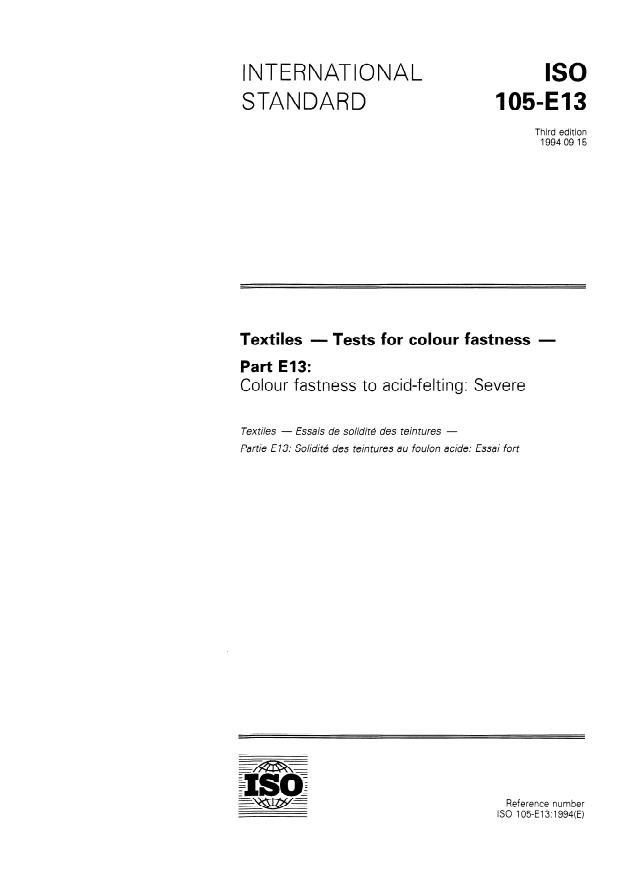
(Main)Textiles — Tests for colour fastness — Part E13: Colour fastness to acid-felting: Severe
General Information
- Abstract
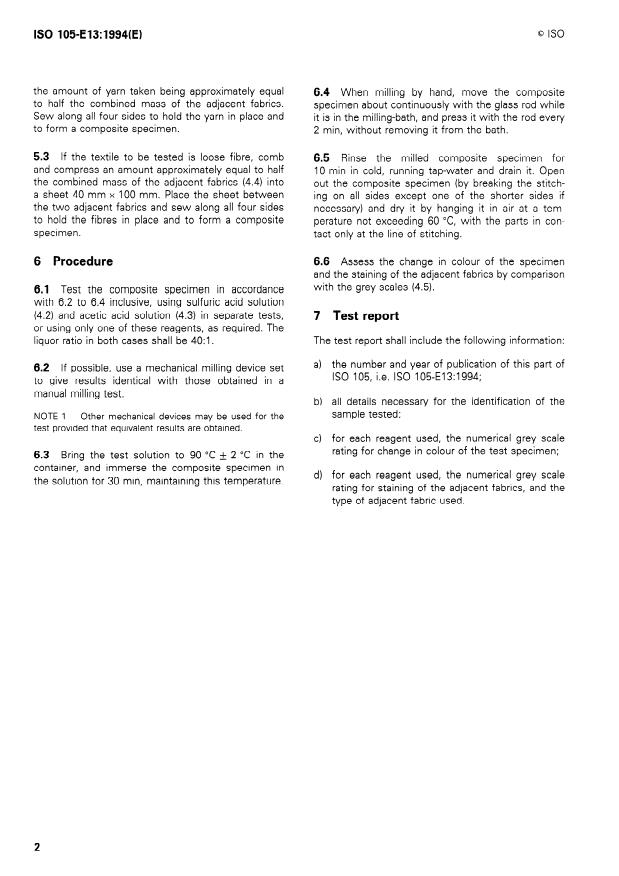
A specimen of the textile (textiles in all kinds and in all forms) in contact with adjacent fabrics is milled in solutions of acetic and/or sulfuric acid, rinsed and dried. The change in colour of the specimen and the staining of the adjacent fabrics are assessed with the grey scales.
- Status
- Published
- Publication Date
- 14-Sep-1994
- Technical Committee
- ISO/TC 38/SC 1 - Tests for coloured textiles and colorants
- Drafting Committee
- ISO/TC 38/SC 1 - Tests for coloured textiles and colorants
- Current Stage
- 9093 - International Standard confirmed
- Start Date
- 02-Apr-2026
- Completion Date
- 29-Aug-2026
Buy Documents
ISO 105-E13:1994 - Textiles — Tests for colour fastness — Part E13: Colour fastness to acid-felting: Severe Released:9/15/1994
ISO 105-E13:1994 - Textiles — Essais de solidité des teintures — Partie E13: Solidité des teintures au foulon acide: Essai fort Released:9/15/1994
ISO 105-E13:1994 - Textiles — Essais de solidité des teintures — Partie E13: Solidité des teintures au foulon acide: Essai fort Released:9/15/1994
Overview
ISO 105-E13:1994 is an international standard established by ISO (International Organization for Standardization) that defines the test method for evaluating the colour fastness of textiles to acid-felting under severe conditions. This test assesses how textile materials resist colour change and staining when exposed to acidic environments typical of the acid-felting process. The standard applies to textiles of all types and forms, ensuring consistent and reliable measurement of colour durability against acids such as acetic and sulfuric acid.
The test involves milling a composite specimen-consisting of the test textile and adjacent fabrics-within acidic solutions, followed by a thorough assessment of colour change and staining using standardized grey scales.
Key Topics
- Purpose: To determine the resistance of textile colours to acid-felting conditions, important for quality assurance in textile manufacturing.
- Scope: Applies to all textile kinds and forms, including fabrics, yarns, and loose fibres.
- Test Methodology:
- Preparation of composite specimens combining the test material and adjacent fabrics.
- Milling in acid solutions (acetic acid and sulfuric acid) at controlled temperatures (90 °C ± 2 °C).
- Rinsing, drying, and evaluating specimens using ISO grey scales for:
- Change in colour of the specimen.
- Staining of adjacent fabrics.
- Apparatus and Reagents:
- Open container and glass rod or mechanical milling device.
- Acid solutions with defined concentrations of acetic and sulfuric acid.
- Standard adjacent fabrics (wool or other fibers) for detecting staining.
- Grey scales complying with ISO 105-A02 and ISO 105-A03 for consistent visual assessment.
- Reporting: Includes detailed test conditions, reagent types, grey scale ratings, and fabric descriptions to ensure reproducibility and comparability of results.
Applications
ISO 105-E13:1994 plays a critical role in the textile industry where acid-felting processes are involved, such as:
- Quality Control: Ensuring textile products maintain their colour integrity during and after acid-felting treatments.
- Product Development: Assisting manufacturers in selecting suitable dyes and fabrics that resist acid damage and staining.
- Compliance and Certification: Facilitating compliance with international colour fastness standards, enhancing market acceptability.
- Textile Processing Optimization: Guiding improvement of acid treatment parameters to minimize colour degradation.
- Research: Providing a standardized framework for chemical fastness testing in academic and industrial research on textile dyes.
This standard is especially valuable for wool and blended textiles treated under harsh acidic conditions, where maintaining appearance and colour fidelity is essential.
Related Standards
ISO 105-E13:1994 is part of the ISO 105 series, which covers various colour fastness tests, including:
- ISO 105-A01: General principles of testing for colour fastness in textiles.
- ISO 105-A02: Grey scale for assessing change in colour.
- ISO 105-A03: Grey scale for assessing staining.
- ISO 105-F Series: Standards specifying adjacent fabric types for various colour fastness tests.
By aligning with these interrelated standards, ISO 105-E13 ensures harmonized testing procedures and assessment criteria, enabling consistent international evaluation of textile colour fastness.
Keywords: ISO 105-E13, colour fastness test, acid-felting, textiles, acid resistance, textile testing standards, colour durability, sulphuric acid, acetic acid, grey scale assessment, textile quality control.
Relations
- Effective Date
- 15-Apr-2008
Buy Documents
ISO 105-E13:1994 - Textiles — Tests for colour fastness — Part E13: Colour fastness to acid-felting: Severe Released:9/15/1994
ISO 105-E13:1994 - Textiles — Essais de solidité des teintures — Partie E13: Solidité des teintures au foulon acide: Essai fort Released:9/15/1994
ISO 105-E13:1994 - Textiles — Essais de solidité des teintures — Partie E13: Solidité des teintures au foulon acide: Essai fort Released:9/15/1994
Get Certified
Connect with accredited certification bodies for this standard

Control Union Certifications
Global certification for agriculture and sustainability.

Hohenstein Institut
Textile testing and certification.

Bureau Veritas Bangladesh
Bureau Veritas certification services in Bangladesh.
Sponsored listings
Frequently Asked Questions
ISO 105-E13:1994 is a standard published by the International Organization for Standardization (ISO). Its full title is "Textiles — Tests for colour fastness — Part E13: Colour fastness to acid-felting: Severe". This standard covers: A specimen of the textile (textiles in all kinds and in all forms) in contact with adjacent fabrics is milled in solutions of acetic and/or sulfuric acid, rinsed and dried. The change in colour of the specimen and the staining of the adjacent fabrics are assessed with the grey scales.
A specimen of the textile (textiles in all kinds and in all forms) in contact with adjacent fabrics is milled in solutions of acetic and/or sulfuric acid, rinsed and dried. The change in colour of the specimen and the staining of the adjacent fabrics are assessed with the grey scales.
ISO 105-E13:1994 is classified under the following ICS (International Classification for Standards) categories: 59.080.01 - Textiles in general. The ICS classification helps identify the subject area and facilitates finding related standards.
ISO 105-E13:1994 has the following relationships with other standards: It is inter standard links to ISO 105-E13:1987. Understanding these relationships helps ensure you are using the most current and applicable version of the standard.
ISO 105-E13:1994 is available in PDF format for immediate download after purchase. The document can be added to your cart and obtained through the secure checkout process. Digital delivery ensures instant access to the complete standard document.
Standards Content (Sample)
INTERNATIONAL ISO
STANDARD 105E13
Third edition
1994-09-15
Textiles - Tests for colour fastness -
Part E13:
Colour fastness to acid-felting: Severe
Textiles - Essais de soliditb des teintures -
Partie E 13: Soliditk des teintures au foulon acide: Essai fort
Reference number
ISO 105-El3:1994(E)
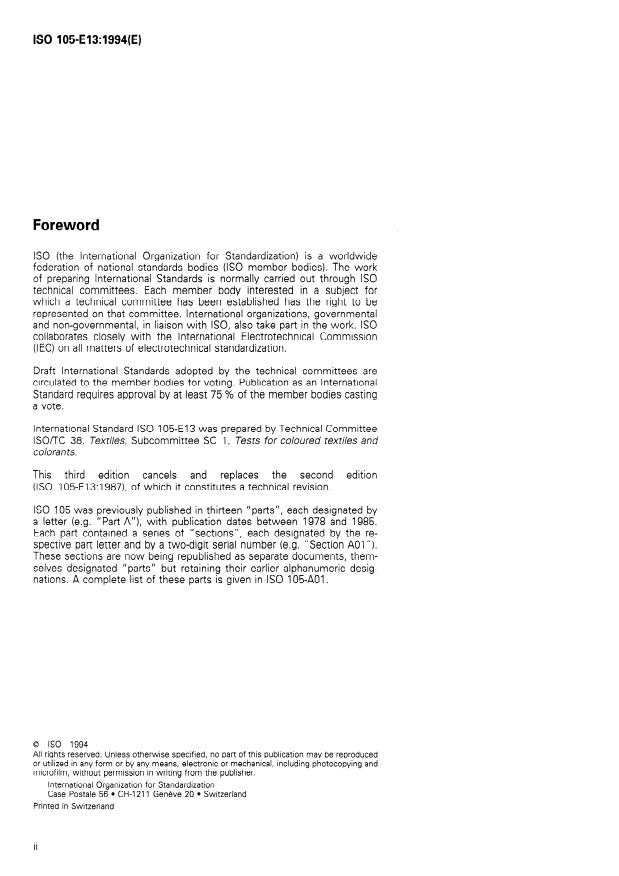
Foreword
ISO (the International Organization for Standardization) is a worldwide
federation of national Standards bodies (ISO member bodies). The work
of preparing International Standards is normally carried out through ISO
technical committees. Esch member body interested in a subject for
which a technical committee has been established has the right to be
represented on that committee. International organizations, governmental
and non-governmental, in liaison with ISO, also take part in the work. ISO
collaborates closely with the International Electrotechnical Commission
(1 EC) on all matters of electrotechnical standardization.
Draft International Standards adopted by the technical committees are
circulated to the member bodies for voting. Publication as an International
Standard requires approval by at least 75 % of the member bodies casting
a vote.
lnternational Standard ISO 105-El3 was prepared by Technical Committee
ISO/TC 38, Textiles, Subcommittee SC 1, Tests for coloured textjles and
coloran ts.
This third edition cancels and replaces the second edition
(ISO 105-El3:1987), of which it constitutes a technical revision.
ISO 105 was previously published in thirteen “Parts ”, each designated by
a letter (e.g. “Part A ”), with publication dates between 1978 and 1985.
Esch part contained a series of “sections ”, each designated by the re-
spective part letter and by a two-digit serial number (e.g. “Section AO1 “).
These sections are now being republished as separate documents, them-
selves designated “Parts” but retaining their earlier alphanumeric desig-
nations. A complete list of these Parts is given in ISO 105-AOI .
0 ISO 1994
All rights reserved. Unless otherwise specified, no part of this publication may be reproduced
or utilized in any form or by any means, electronie or mechanical, including photocopying and
microfilm, without permission in writing from the publisher.
International Organization for Standardization
Gase Postale 56 l CH-1 2111 Geneve 20 l Switzerland
Printed in Switzerland
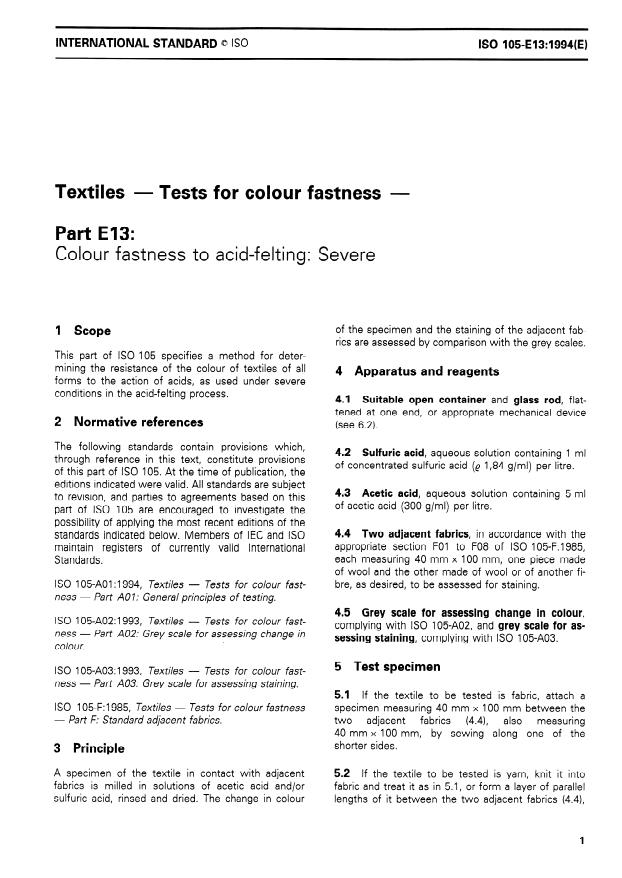
INTERNATIONAL STANDARD 0 ISO ISO 105-Ei3:1994(E)
Textiles - Tests for colour fastness -
Part El3:
Colour fastness to acid-felting: Severe
of the specimen and the staining of the adjacent fab-
1 Scope
ries are assessed by comparison with the grey scales.
This part of ISO 105 specifies a method for deter-
mining the resistance of the colour of textiles of all
4 Apparatus and reagents
forms to the action of acids, as used under severe
conditions in the acid-felting process.
4.1 Suitable open Container and glass rod, flat-
tened at one end, or appropriate mechanical device
2 Normative references
(see 6.2).
The following Standards contain provisions which,
4.2 Sulfuric acid, aqueous Solution containing 1 ml
through reference in this text, constitute provisions
of concentrated sulfuric acid (Q l,84 g/ml) per litre.
of this part of ISO 105. At the time of publication, the
editions indicated were valid. All Standards are subject
4.3 Acetic acid, aqueous Solution containing 5 ml
to revision, and Parties to agreements based on this
of acetic acid (300 g/ml) per litre.
part of ISO 105 are encouraged to investigate the
possibility of applying the most recent editions of the
4.4 Two adjacent fabrics, in accordance with the
Standards indicated below. Members of IEC and ISO
appropriate section FOl to F08 of ISO 105-F:1985,
maintain registers of currently valid International
each measuring 40 mm x 100 mm, one piece made
Standards.
of wool and the other made of wool or of another fi-
bre, as desired, to be assessed for staining.
ISO 105-AO1 :1994, Te
...
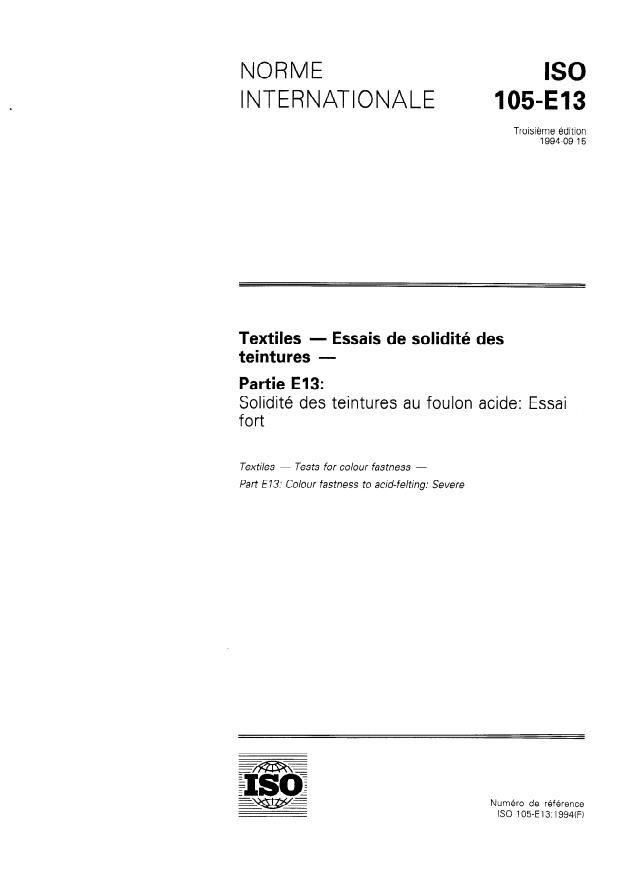
NORME ISO
INTERNATIONALE 105-El3
Troisième édition
1994-09-I 5
Textiles - Essais de solidité des
teintures -
Partie E13:
Solidité des teintures au foulon acide: Essai
fort
- Tests for colour fas tness -
Textiles
Part E 13: Colour fastness to acid-felting: Severe
Numéro de référence
ISO 1059E13:1994(F)
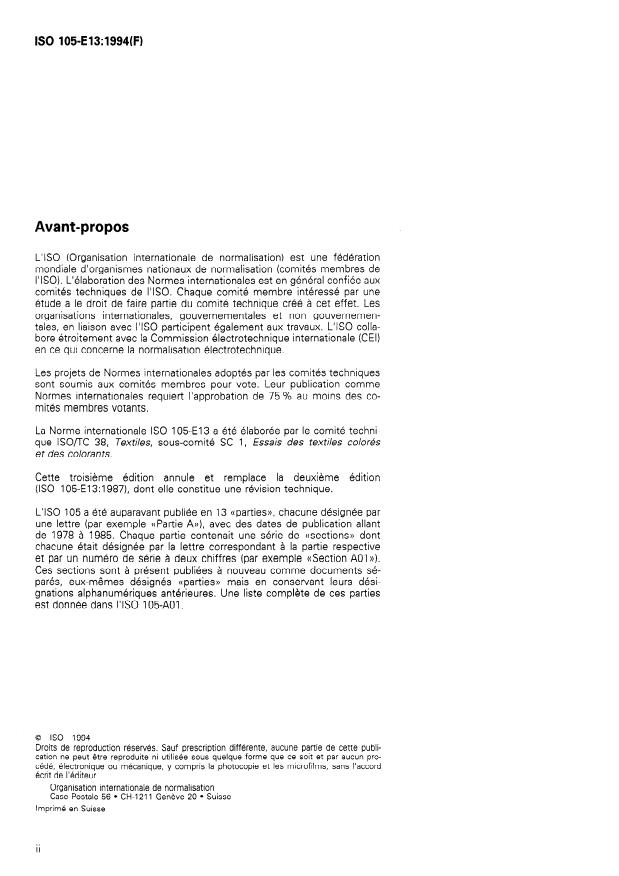
Avant-propos
L’ISO (Organisation internationale de normalisation) est une fédération
mondiale d’organismes nationaux de normalisation (comités membres de
I’ISO). L’élaboration des Normes internationales est en général confiée aux
comites techniques de I’ISO. Chaque comité membre intéressé par une
étude a le droit de faire partie du comité technique créé à cet effet. Les
organisations internationales, gouvernementales et non gouvernemen-
tales, en liaison avec I’ISO participent également aux travaux. L’ISO colla-
bore étroitement avec la Commission électrotechnique internationale (CEI)
en ce qui concerne la normalisation électrotechnique.
Les projets de Normes internationales adoptés par les comités techniques
sont soumis aux comités membres pour vote. Leur publication comme
Normes internationales requiert l’approbation de 75 % au moins des co-
mités membres votants.
La Norme internationale ISO 105-El3 a eté élaborée par le comité techni-
que lSO/TC 38, Textiles, sous-comité SC 1, Essais des textiles colorés
et des colorants.
Cette troisième édition annule et remplace la deuxième édition
(ISO 105-E13:1987), dont elle constitue une révision technique.
L’ISO 105 a été auparavant publiée en 13 ((parties), chacune désignée par
une lettre (par exemple ((Partie A»), avec des dates de publication allant
de 1978 à 1985. Chaque partie contenait une série de ((sections) dont
chacune était désignée par la lettre correspondant à la partie respective
et par un numéro de série a deux chiffres (par exemple (Section A01 1)).
Ces sections sont à présent publiées à nouveau comme documents sé-
parés, eux-mêmes désignés «parties» mais en conservant leurs dési-
gnations alphanumériques antérieures. Une liste complète de ces parties
est donnée dans I’ISO 105-AOI.
0 60 1994
Droits de reproduction réservés. Sauf prescription différente, aucune partie de cette publi-
cation ne peut être reproduite ni utilisée sous quelque forme que ce soit et par aucun pro-
cédé, électronique ou mhcanique, y compris la photocopie et les microfilms, sans l’accord
écrit de l’éditeur.
Organisation internationale de normalisation
Case Postale 56 l CH-l 211 Genève 20 l Suisse
Imprimé en Suisse
ii
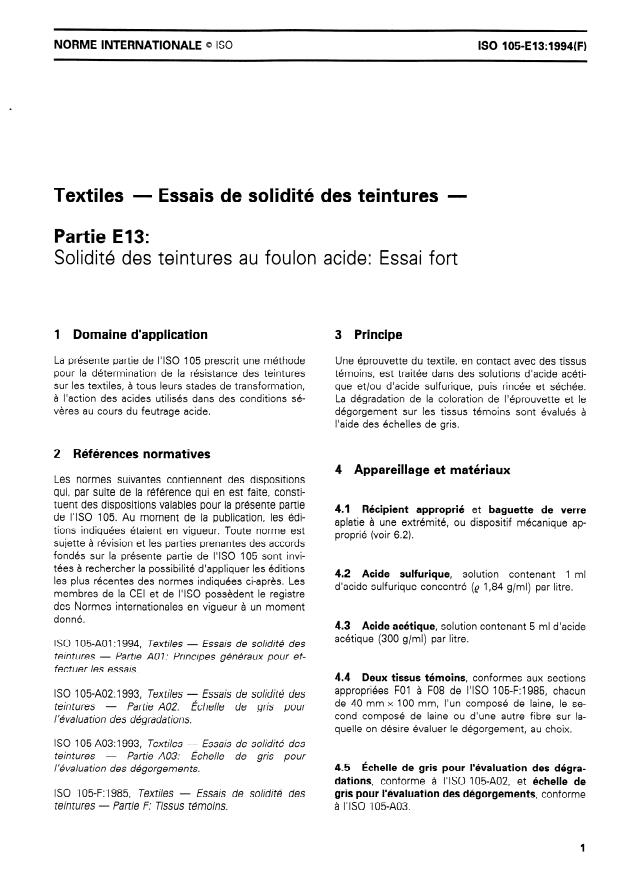
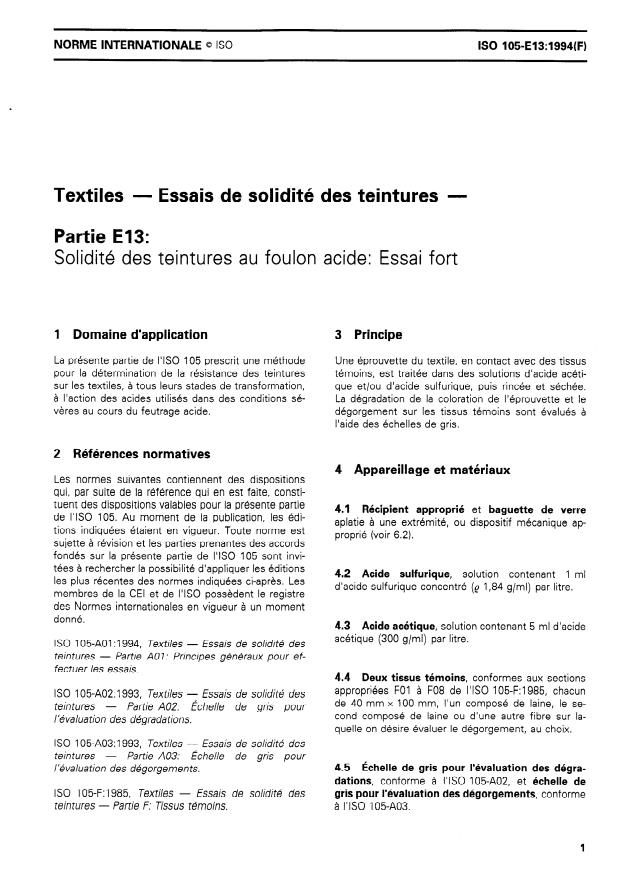
NORME INTERNATIONALE 0 60 ISO 105-E13:1994(F)
Textiles - Essais de solidité des teintures -
Partie E13:
Solidité des teintures au foulon acide: Essai fort
1 Domaine d’application 3 Principe
La présente partie de I’ISO 105 prescrit une méthode Une éprouvette du textile, en contact avec des tissus
pour la détermination de la résistance des teintures témoins, est traitée dans des solutions d’acide acéti-
que et/ou d’acide sulfurique, puis rincée et séchée.
sur les textiles, à tous leurs stades de transformation,
La dégradation de la coloration de l’éprouvette et le
à l’action des acides utilisés dans des conditions sé-
vères au cours du feutrage acide. dégorgement sur les tissus témoins sont évalués à
l’aide des échelles de gris.
2 Références normatives
4 Appareillage et matériaux
Les normes suivantes contiennent des dispositions
qui, par suite de la référence qui en est faite, consti-
tuent des dispositions valables pour la présente partie
4.1 Récipient approprié et baguette de verre
de I’ISO 105. Au moment de la publication, les édi-
aplatie a une extrémité, ou dispositif mécanique ap-
tions indiquées étaient en vigueur. Toute norme est
proprié (voir 6.2).
sujette a révision et les parties prenantes des accords
fondés sur la présente partie de I’ISO 105 sont invi-
tées à rechercher la possibilité d’appliquer les éditions
4.2 Acide sulfurique, solution contenant 1 ml
les plus récentes des normes indiquées ci-après. Les
d’acide sulfurique concentré (Q 1,84 g/ml) par litre.
membres de la CEI et de I’ISO possèdent le registre
des Normes internationales en vigueur à un moment
donné.
4.3 Acide acétique, solution contenant 5 ml d’acide
acétique (300 g/ml) par litre.
I SO 105-AOI : 1994, Textiles - Essais de solidité des
tein turcs - Partie AO?: Principes généraux pour ef-
fectuer les essais.
4.4 Deux
...
NORME ISO
INTERNATIONALE 105-El3
Troisième édition
1994-09-I 5
Textiles - Essais de solidité des
teintures -
Partie E13:
Solidité des teintures au foulon acide: Essai
fort
- Tests for colour fas tness -
Textiles
Part E 13: Colour fastness to acid-felting: Severe
Numéro de référence
ISO 1059E13:1994(F)
Avant-propos
L’ISO (Organisation internationale de normalisation) est une fédération
mondiale d’organismes nationaux de normalisation (comités membres de
I’ISO). L’élaboration des Normes internationales est en général confiée aux
comites techniques de I’ISO. Chaque comité membre intéressé par une
étude a le droit de faire partie du comité technique créé à cet effet. Les
organisations internationales, gouvernementales et non gouvernemen-
tales, en liaison avec I’ISO participent également aux travaux. L’ISO colla-
bore étroitement avec la Commission électrotechnique internationale (CEI)
en ce qui concerne la normalisation électrotechnique.
Les projets de Normes internationales adoptés par les comités techniques
sont soumis aux comités membres pour vote. Leur publication comme
Normes internationales requiert l’approbation de 75 % au moins des co-
mités membres votants.
La Norme internationale ISO 105-El3 a eté élaborée par le comité techni-
que lSO/TC 38, Textiles, sous-comité SC 1, Essais des textiles colorés
et des colorants.
Cette troisième édition annule et remplace la deuxième édition
(ISO 105-E13:1987), dont elle constitue une révision technique.
L’ISO 105 a été auparavant publiée en 13 ((parties), chacune désignée par
une lettre (par exemple ((Partie A»), avec des dates de publication allant
de 1978 à 1985. Chaque partie contenait une série de ((sections) dont
chacune était désignée par la lettre correspondant à la partie respective
et par un numéro de série a deux chiffres (par exemple (Section A01 1)).
Ces sections sont à présent publiées à nouveau comme documents sé-
parés, eux-mêmes désignés «parties» mais en conservant leurs dési-
gnations alphanumériques antérieures. Une liste complète de ces parties
est donnée dans I’ISO 105-AOI.
0 60 1994
Droits de reproduction réservés. Sauf prescription différente, aucune partie de cette publi-
cation ne peut être reproduite ni utilisée sous quelque forme que ce soit et par aucun pro-
cédé, électronique ou mhcanique, y compris la photocopie et les microfilms, sans l’accord
écrit de l’éditeur.
Organisation internationale de normalisation
Case Postale 56 l CH-l 211 Genève 20 l Suisse
Imprimé en Suisse
ii
NORME INTERNATIONALE 0 60 ISO 105-E13:1994(F)
Textiles - Essais de solidité des teintures -
Partie E13:
Solidité des teintures au foulon acide: Essai fort
1 Domaine d’application 3 Principe
La présente partie de I’ISO 105 prescrit une méthode Une éprouvette du textile, en contact avec des tissus
pour la détermination de la résistance des teintures témoins, est traitée dans des solutions d’acide acéti-
que et/ou d’acide sulfurique, puis rincée et séchée.
sur les textiles, à tous leurs stades de transformation,
La dégradation de la coloration de l’éprouvette et le
à l’action des acides utilisés dans des conditions sé-
vères au cours du feutrage acide. dégorgement sur les tissus témoins sont évalués à
l’aide des échelles de gris.
2 Références normatives
4 Appareillage et matériaux
Les normes suivantes contiennent des dispositions
qui, par suite de la référence qui en est faite, consti-
tuent des dispositions valables pour la présente partie
4.1 Récipient approprié et baguette de verre
de I’ISO 105. Au moment de la publication, les édi-
aplatie a une extrémité, ou dispositif mécanique ap-
tions indiquées étaient en vigueur. Toute norme est
proprié (voir 6.2).
sujette a révision et les parties prenantes des accords
fondés sur la présente partie de I’ISO 105 sont invi-
tées à rechercher la possibilité d’appliquer les éditions
4.2 Acide sulfurique, solution contenant 1 ml
les plus récentes des normes indiquées ci-après. Les
d’acide sulfurique concentré (Q 1,84 g/ml) par litre.
membres de la CEI et de I’ISO possèdent le registre
des Normes internationales en vigueur à un moment
donné.
4.3 Acide acétique, solution contenant 5 ml d’acide
acétique (300 g/ml) par litre.
I SO 105-AOI : 1994, Textiles - Essais de solidité des
tein turcs - Partie AO?: Principes généraux pour ef-
fectuer les essais.
4.4 Deux
...