

ISO 2231:1989
(Main)Rubber- or plastics-coated fabrics — Standard atmospheres for conditioning and testing
General Information
- Abstract
Specifies the requirements and definitions and determines pre-conditioning, characteristics of test atmospheres and methods of conditioning. Technical revision of the clauses 3 and 4 of the first edition (ISO 2231-1973).
- Status
- Published
- Publication Date
- 23-Jul-1989
- Technical Committee
- ISO/TC 45/SC 4 - Products (other than hoses)
- Drafting Committee
- ISO/TC 45/SC 4/WG 13 - Coated fabrics
- Current Stage
- 9093 - International Standard confirmed
- Start Date
- 28-Jun-2024
- Completion Date
- 29-Aug-2026
Buy Documents

ISO 2231:1989 - Rubber- or plastics-coated fabrics -- Standard atmospheres for conditioning and testing

ISO 2231:1989 - Rubber- or plastics-coated fabrics — Standard atmospheres for conditioning and testing/24/1989

ISO 2231:1989 - Supports textiles revetus de caoutchouc ou de plastique -- Atmospheres normales de conditionnement et d'essai

ISO 2231:1989 - Supports textiles revetus de caoutchouc ou de plastique -- Atmospheres normales de conditionnement et d'essai

ISO 2231:1989 - Supports textiles revêtus de caoutchouc ou de plastique — Atmosphères normales de conditionnement et d'essai/24/1989

ISO 2231:1989 - Supports textiles revêtus de caoutchouc ou de plastique — Atmosphères normales de conditionnement et d'essai/24/1989
Overview
ISO 2231:1989 is an international standard published by the International Organization for Standardization (ISO) that defines standard atmospheres for conditioning and testing rubber- or plastics-coated fabrics. This standard specifies the terminology, requirements, and technical procedures for pre-conditioning and maintaining the test atmospheres essential to obtaining reliable, repeatable results when testing coated textile supports. As a technical revision of the original 1973 edition, ISO 2231:1989 focuses on modernizing the conditioning clauses to reflect advances in testing methodologies.
Proper conditioning of these coated fabrics is critical because their properties-such as moisture content, mass, and mechanical strength-are significantly influenced by atmospheric humidity and temperature. By controlling test atmospheres under defined standard conditions, this ISO standard enables consistency and comparability of test results worldwide.
Key Topics
Scope and Applicability
The standard applies to rubber- or plastics-coated textile supports and specifies how to condition samples before testing to ensure consistent moisture equilibrium and temperature control.Definitions
Essential terminology related to atmospheres and conditioning is standardized, including:- Atmosphere of reference
- Normal conditioning atmosphere
- Conditioned state
- Hygrometric equilibrium
Standard Atmospheres
ISO 2231 defines several standard test atmospheres with specific temperature and relative humidity parameters:- Atmosphere A: 20 °C ± 2 °C, 65% ± 5% relative humidity
- Atmosphere B: 23 °C ± 2 °C, 50% ± 5% relative humidity
- Atmosphere C (Tropical): 27 °C ± 2 °C, 65% ± 5% relative humidity
- Atmosphere D: 23 °C ± 2 °C, temperature controlled only, no humidity control
- Atmosphere E: 27 °C ± 2 °C, temperature controlled only (tropical)
Preconditioning Methods
Procedures to achieve moisture equilibrium prior to testing include conditioning samples in controlled atmospheres for specified durations (minimum 16 hours for single-sided coated fabrics, 24 hours for double-sided). Preconditioning may involve exposure to dry atmospheres at elevated temperatures for hygroscopic materials requiring precise control.Conditioning Methods
Conditioning can be achieved through two main methods:- Method 1: Exposure to atmospheres A, B, or C until weight equilibrium is reached, verified by successive weighings every 2 hours.
- Method 2: Exposure to atmospheres D or E for a fixed time of 3 hours.
Applications
ISO 2231:1989 is widely used by manufacturers, testing laboratories, and quality control personnel engaged in the production and certification of rubber- or plastics-coated fabrics. Key practical applications include:
- Quality assurance of coated textiles to ensure batch-to-batch consistency.
- Material research and development, enabling accurate evaluation of physical properties under controlled conditions.
- Performance testing for durability, tensile strength, and dimensional stability influenced by moisture content.
- Standardizing testing procedures to meet international trade and regulatory requirements for coated fabrics in industries such as automotive, aerospace, protective clothing, and industrial liners.
Related Standards
ISO 2231:1989 references and complements other international standards relevant to conditioning and testing atmospheres for materials:
- ISO 554:1976 – Specifies normal atmospheres for conditioning and/or testing including temperature and humidity ranges, serving as a foundational reference for ISO 2231.
- Other ISO/TC 45 standards relating to elastomers and coated textile products that define specific test methods and performance requirements.
Together, these standards create a robust framework enabling manufacturers and testing agencies to reliably compare results and maintain high-quality control levels across global supply chains.
Keywords: ISO 2231, rubber-coated fabrics, plastics-coated fabrics, conditioning atmosphere, test atmosphere, moisture control, textile testing, standard atmosphere, preconditioning methods, coated textile supports, relative humidity, temperature control.
Relations
- Effective Date
- 25-Aug-2026
- Effective Date
- 25-Aug-2026
- Effective Date
- 25-Aug-2026
- Effective Date
- 25-Aug-2026
- Effective Date
- 25-Aug-2026
- Effective Date
- 25-Aug-2026
- Effective Date
- 25-Aug-2026
- Effective Date
- 25-Aug-2026
- Effective Date
- 25-Aug-2026
- Effective Date
- 25-Aug-2026
- Effective Date
- 25-Aug-2026
- Effective Date
- 25-Aug-2026
- Effective Date
- 25-Aug-2026
- Effective Date
- 25-Aug-2026
- Effective Date
- 25-Aug-2026
Buy Documents
ISO 2231:1989 - Rubber- or plastics-coated fabrics -- Standard atmospheres for conditioning and testing
ISO 2231:1989 - Rubber- or plastics-coated fabrics — Standard atmospheres for conditioning and testing/24/1989
ISO 2231:1989 - Supports textiles revetus de caoutchouc ou de plastique -- Atmospheres normales de conditionnement et d'essai
ISO 2231:1989 - Supports textiles revetus de caoutchouc ou de plastique -- Atmospheres normales de conditionnement et d'essai
ISO 2231:1989 - Supports textiles revêtus de caoutchouc ou de plastique — Atmosphères normales de conditionnement et d'essai/24/1989
ISO 2231:1989 - Supports textiles revêtus de caoutchouc ou de plastique — Atmosphères normales de conditionnement et d'essai/24/1989
Get Certified
Connect with accredited certification bodies for this standard

Control Union Certifications
Global certification for agriculture and sustainability.

Hohenstein Institut
Textile testing and certification.

Bureau Veritas Bangladesh
Bureau Veritas certification services in Bangladesh.
Sponsored listings
Frequently Asked Questions
ISO 2231:1989 is a standard published by the International Organization for Standardization (ISO). Its full title is "Rubber- or plastics-coated fabrics — Standard atmospheres for conditioning and testing". This standard covers: Specifies the requirements and definitions and determines pre-conditioning, characteristics of test atmospheres and methods of conditioning. Technical revision of the clauses 3 and 4 of the first edition (ISO 2231-1973).
Specifies the requirements and definitions and determines pre-conditioning, characteristics of test atmospheres and methods of conditioning. Technical revision of the clauses 3 and 4 of the first edition (ISO 2231-1973).
ISO 2231:1989 is classified under the following ICS (International Classification for Standards) categories: 59.080.40 - Coated fabrics. The ICS classification helps identify the subject area and facilitates finding related standards.
ISO 2231:1989 has the following relationships with other standards: It is inter standard links to EN ISO 6179:2017, EN ISO 2286-3:2016, EN ISO 5470-2:2021, EN ISO 32100:2010, EN ISO 4674-1:2016, EN ISO 5470-2:2003, EN ISO 2411:2024, EN ISO 2286-3:1998, EN ISO 3303-1:2020, EN ISO 4674-1:2003, EN ISO 6450:2021, EN ISO 2286-1:2016, EN ISO 2411:2017, EN ISO 6179:2010, EN ISO 1421:2016. Understanding these relationships helps ensure you are using the most current and applicable version of the standard.
ISO 2231:1989 is available in PDF format for immediate download after purchase. The document can be added to your cart and obtained through the secure checkout process. Digital delivery ensures instant access to the complete standard document.
Standards Content (Sample)
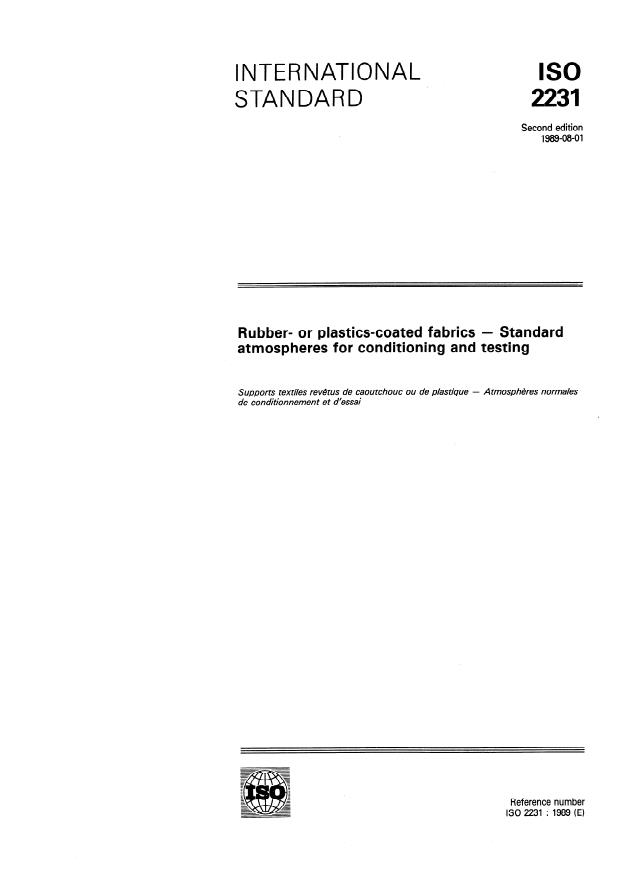
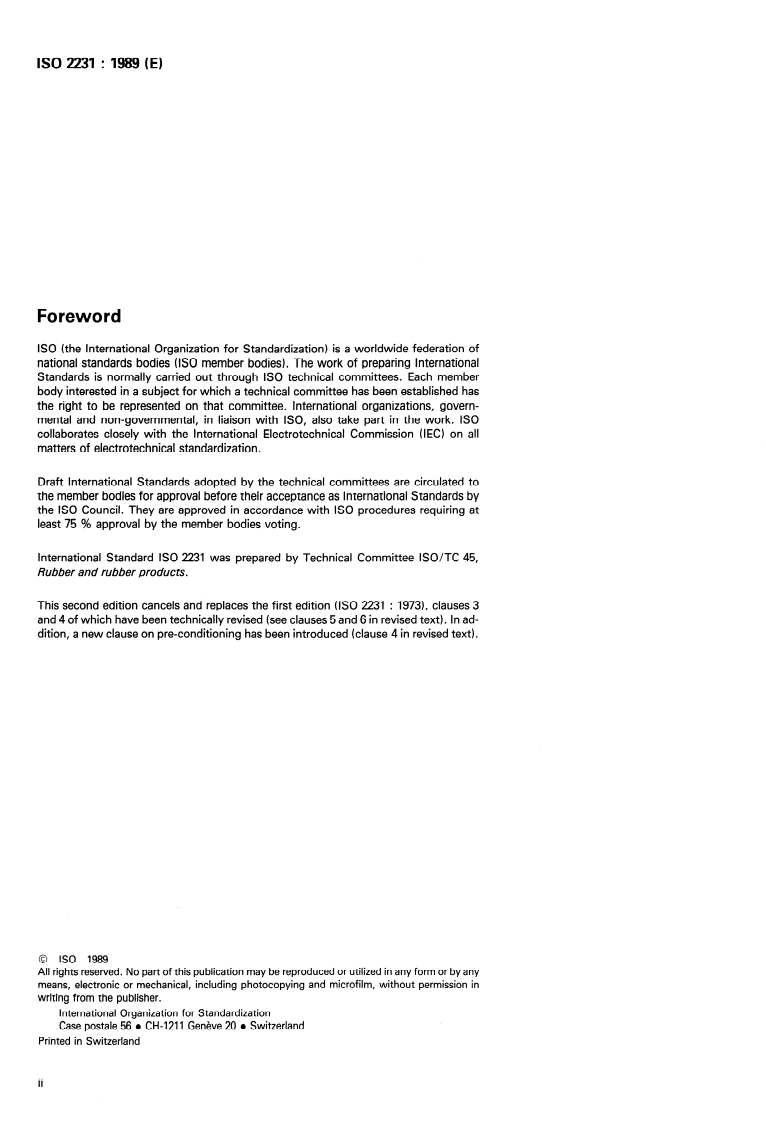
INTERNATIONAL ISO
STANDARD 2231
Second edition
1989-08-01
Rubber- or plastics-coated fabrics - Standard
atmospheres for conditioning and testing
Supports textiles revbs de caoutchouc ou de plastique - A tmospheres normales
de conditionnement et d’essai
Reference number
ISO 2231 : 1989 (EI
ISO 2231 : 1989 (EI
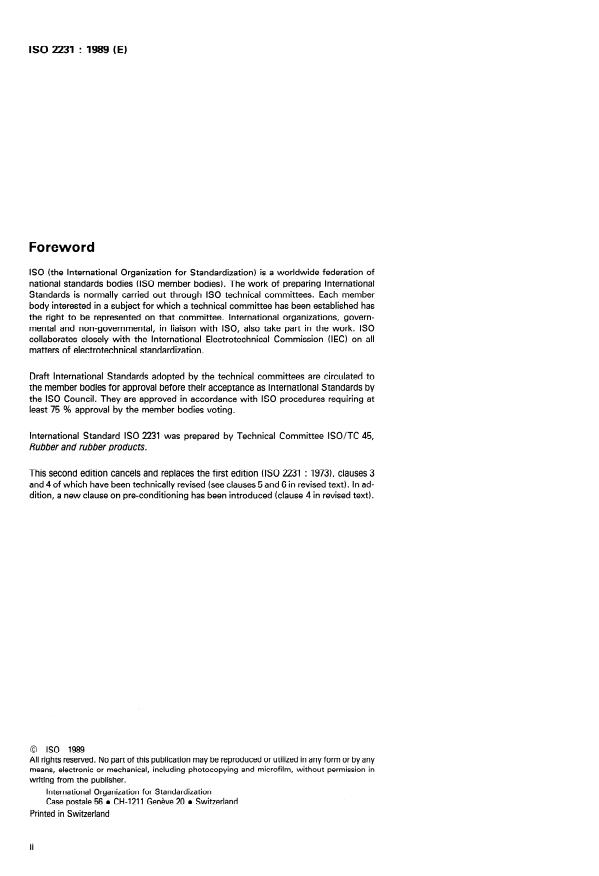
Foreword
ISO (the International Organization for Standardization) is a worldwide federation of
national Standards bodies (ISO member bodies). The work of preparing International
Standards is normally carried out through ISO technical committees. Esch member
body interested in a subject for which a technical committee has been established has
the right to be represented on that committee. International organizations, govern-
mental and non-governmental, in liaison with ISO, also take part in the work. ISO
collaborates closely with the International Electrotechnical Commission (IEC) on all
matters of electrotechnical standardization.
Draft International Standards adopted by the technical committees are circulated to
the member bodies for approval before their acceptance as International Standards by
the ISO Council. They are approved in accordance with ISO procedures requiring at
least 75 % approval by the member bodies voting.
International Standard ISO 2231 was prepared by Technical Committee ISO/TC 45,
Rubber and rubber products.
This second edition cancels and replaces the first edition (ISO 2231 : 19731, clauses 3
and 4 of which have been technically revised (see clauses 5 and 6 in revised text). In ad-
dition, a new clause on pre-conditioning has been introduced (clause 4 in revised text).
0 ISO 1989
All rights reserved. No patt of this publication may be reproduced or utilized in any form or by any
means, electronie or mechanical, including photocopying and microfilm, without Permission in
writing from the publisher.
International Organization for Standardization
Case postale 56 l CH-121 1 Geneve 20 l Switzerland
Printed in Switzerland
ii
ISO 2231 : 1989 (E)
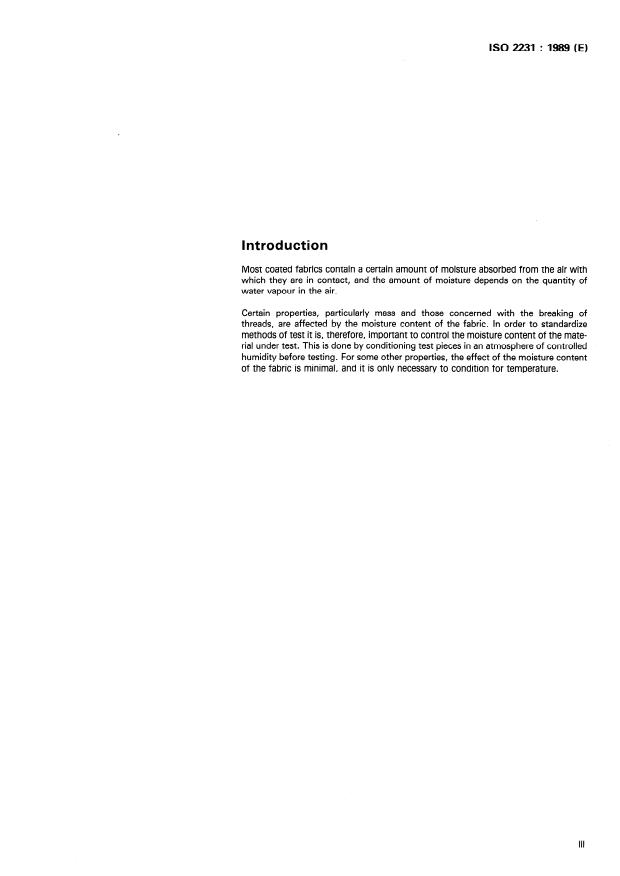
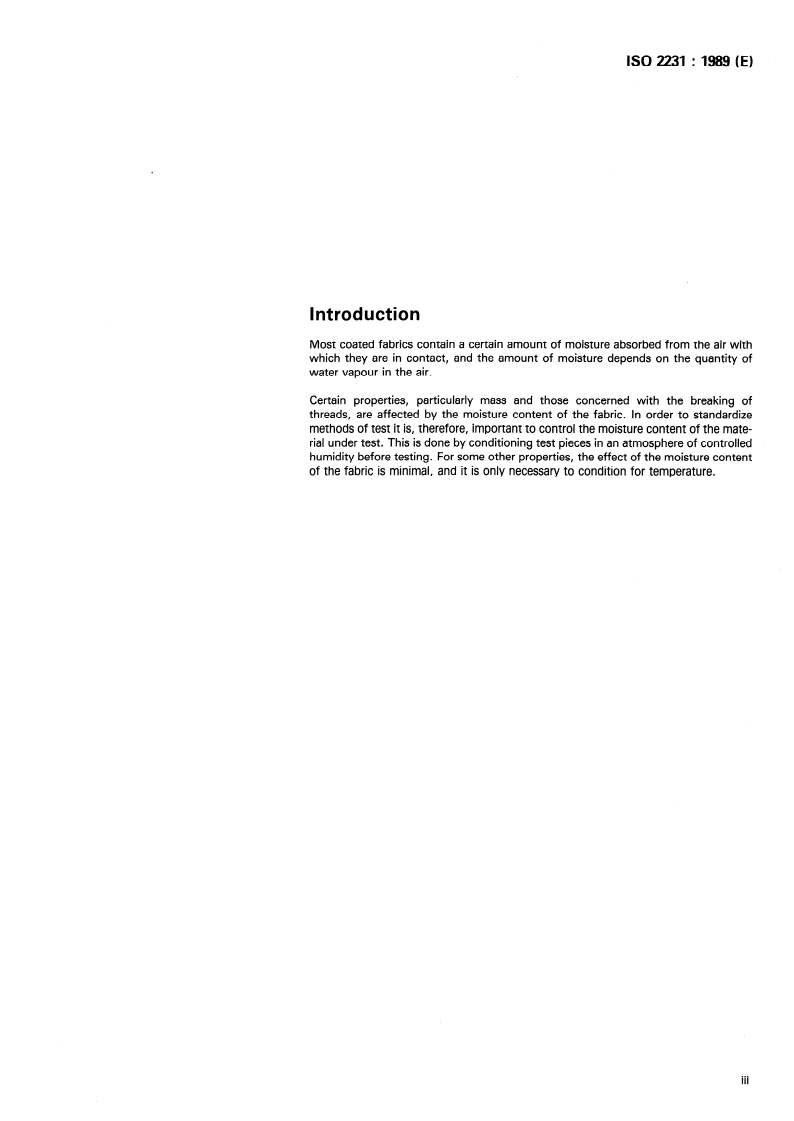
Introduction
Most coated fabrics contain a certain amount of moisture absorbed from the air with
which they are in contact, and the amount of moisture depends on the quantity of
water vapour in the air.
Certain properties, particularly mass and those concerned with the breaking of
threads, are affected by the moisture content of the fabric. In Order to standardize
methods of test it is, therefore, important to control the moisture content of the mate-
rial under test. This is done by conditioning test pieces in an atmosphere of controlled
humidity before testing. For some other properties, the effect of the moisture content
of the fabric is minimal, and it is only necessary to condition for temperature.
. . .
Ill
This page intentionally left blank
INTERNATIONAL STANDARD ISO2231 : 1989 (E)
Rubber- or plastics-coated fabrics - Standard
atmospheres for conditioning and testing
4 Pre-conditioning
1 Scope I
This International Standard specifies the requirements for con- When the textile Substrate is of a highly hygroscopic material or
where the method of test requires a high degree of accuracy,
ditioning and methods of conditioning employed for rubber- or
plastics-coated fabrics. equilibrium (sec 3.5) shall be approached from the dry side of
the hysteresis curve by pre-conditioning the test pieces in an
atmosphere having a relative humidity of not greater than 10 %
and a temperature of between 60 OC and 70 OC.
2 Normative reference
- Air at 65 % relative humidity and 20 OC will, when heated
NOTE
The following Standard contai
...
INTERNATIONAL ISO
STANDARD 2231
Second edition
1989-08-01
Rubber- or plastics-coated fabrics - Standard
atmospheres for conditioning and testing
Supports textiles revbs de caoutchouc ou de plastique - A tmospheres normales
de conditionnement et d’essai
Reference number
ISO 2231 : 1989 (EI
ISO 2231 : 1989 (EI
Foreword
ISO (the International Organization for Standardization) is a worldwide federation of
national Standards bodies (ISO member bodies). The work of preparing International
Standards is normally carried out through ISO technical committees. Esch member
body interested in a subject for which a technical committee has been established has
the right to be represented on that committee. International organizations, govern-
mental and non-governmental, in liaison with ISO, also take part in the work. ISO
collaborates closely with the International Electrotechnical Commission (IEC) on all
matters of electrotechnical standardization.
Draft International Standards adopted by the technical committees are circulated to
the member bodies for approval before their acceptance as International Standards by
the ISO Council. They are approved in accordance with ISO procedures requiring at
least 75 % approval by the member bodies voting.
International Standard ISO 2231 was prepared by Technical Committee ISO/TC 45,
Rubber and rubber products.
This second edition cancels and replaces the first edition (ISO 2231 : 19731, clauses 3
and 4 of which have been technically revised (see clauses 5 and 6 in revised text). In ad-
dition, a new clause on pre-conditioning has been introduced (clause 4 in revised text).
0 ISO 1989
All rights reserved. No patt of this publication may be reproduced or utilized in any form or by any
means, electronie or mechanical, including photocopying and microfilm, without Permission in
writing from the publisher.
International Organization for Standardization
Case postale 56 l CH-121 1 Geneve 20 l Switzerland
Printed in Switzerland
ii
ISO 2231 : 1989 (E)
Introduction
Most coated fabrics contain a certain amount of moisture absorbed from the air with
which they are in contact, and the amount of moisture depends on the quantity of
water vapour in the air.
Certain properties, particularly mass and those concerned with the breaking of
threads, are affected by the moisture content of the fabric. In Order to standardize
methods of test it is, therefore, important to control the moisture content of the mate-
rial under test. This is done by conditioning test pieces in an atmosphere of controlled
humidity before testing. For some other properties, the effect of the moisture content
of the fabric is minimal, and it is only necessary to condition for temperature.
. . .
Ill
This page intentionally left blank
INTERNATIONAL STANDARD ISO2231 : 1989 (E)
Rubber- or plastics-coated fabrics - Standard
atmospheres for conditioning and testing
4 Pre-conditioning
1 Scope I
This International Standard specifies the requirements for con- When the textile Substrate is of a highly hygroscopic material or
where the method of test requires a high degree of accuracy,
ditioning and methods of conditioning employed for rubber- or
plastics-coated fabrics. equilibrium (sec 3.5) shall be approached from the dry side of
the hysteresis curve by pre-conditioning the test pieces in an
atmosphere having a relative humidity of not greater than 10 %
and a temperature of between 60 OC and 70 OC.
2 Normative reference
- Air at 65 % relative humidity and 20 OC will, when heated
NOTE
The following Standard contai
...
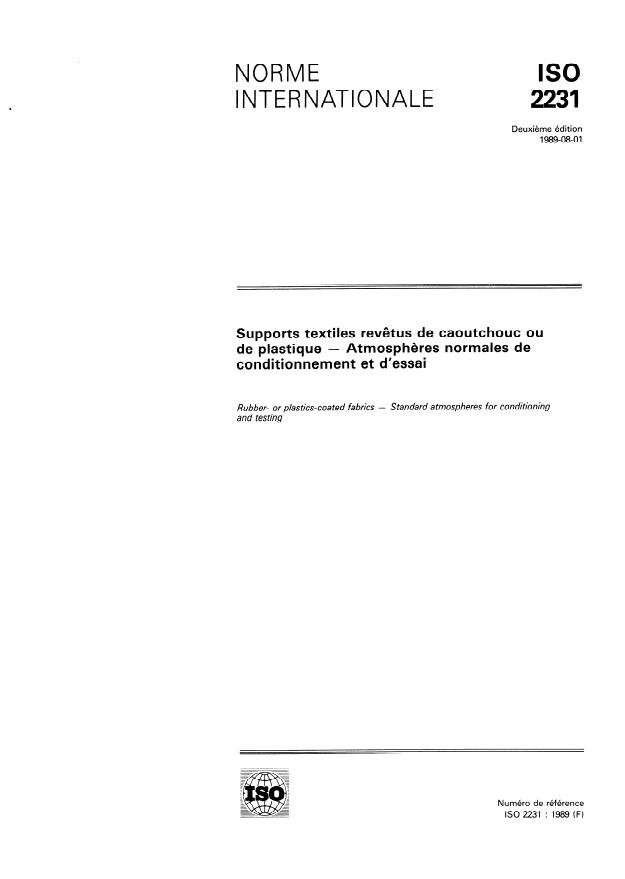
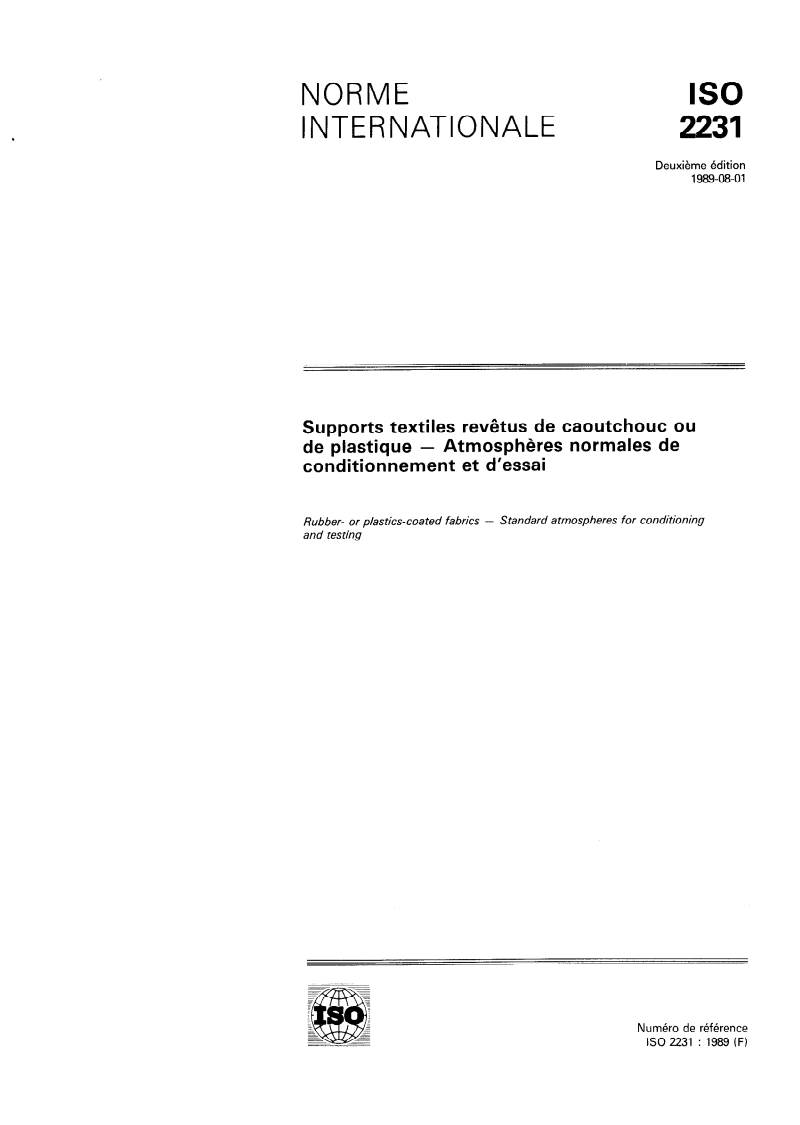
NORME
ISO
INTERNATIONALE
Deuxième édition
1989-08-01
Supports textiles revêtus de caoutchouc ou
Atmosphères normales de
de plastique -
conditionnement et d’essai
Rubber- or plastics-coa ted fabrics - Standard a tmospheres for conditioning
and tes ting
Numéro de référence
ISO 2231 : 1989 (FI
ISO 2231 : 1989 (F)
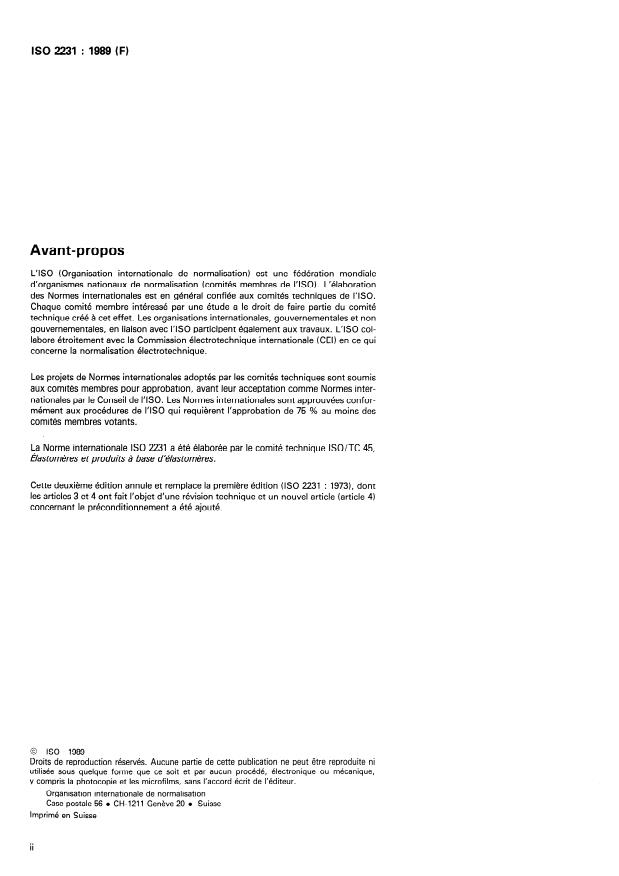
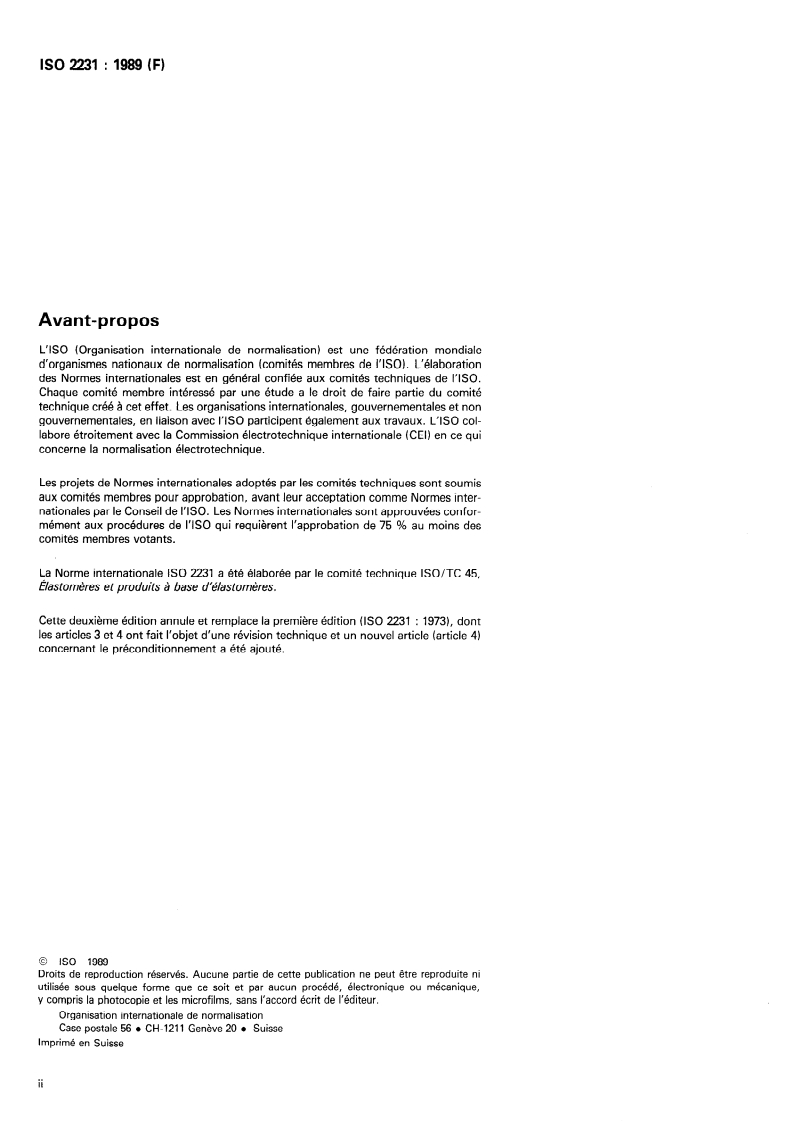
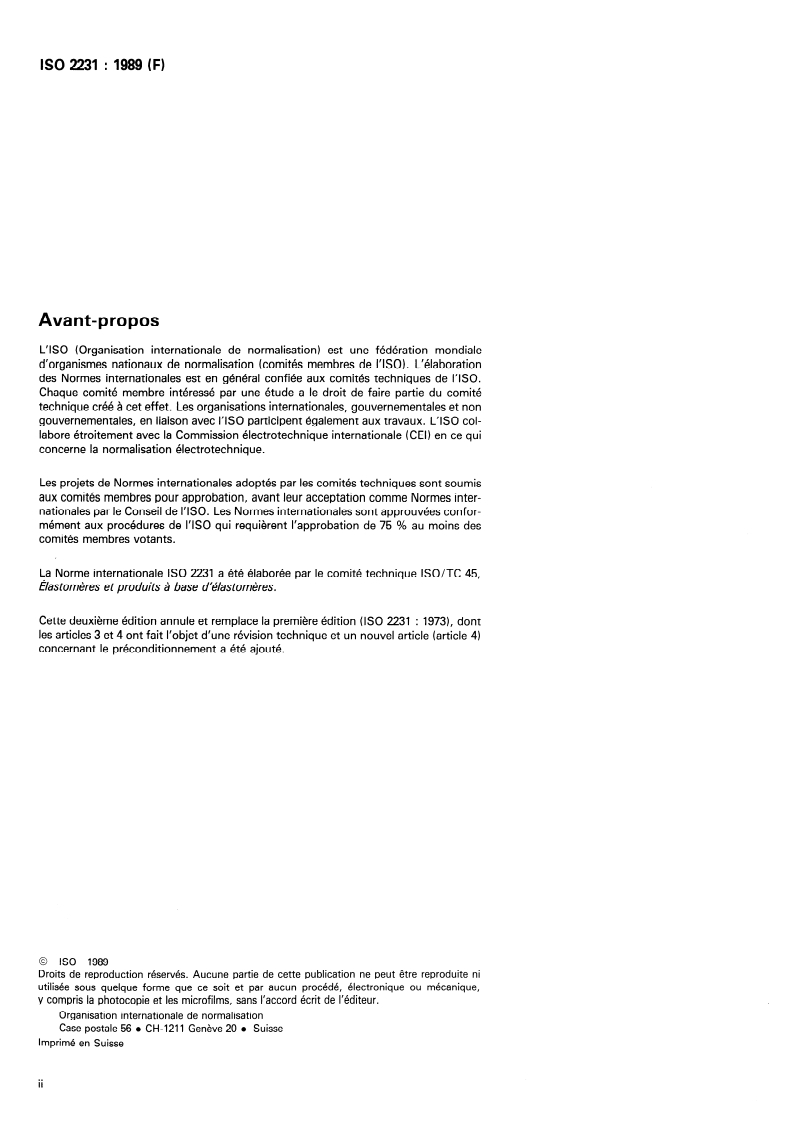
Avant-propos
L’ISO (Organisation internationale de normalisation) est une fédération mondiale
d’organismes nationaux de normalisation (comités membres de I’ISO). L’élaboration
des Normes internationales est en général confiée aux comités techniques de I’ISO.
Chaque comité membre intéressé par une étude a le droit de faire partie du comité
technique créé à cet effet. Les organisations internationales, gouvernementales et non
gouvernementales, en liaison avec I’ISO participent également aux travaux. L’ISO col-
labore étroitement avec la Commission électrotechnique internationale (CEI) en ce qui
concerne la normalisation électrotechnique.
Les projets de Normes internationales adoptés par les comités techniques sont soumis
aux comités membres pour approbation, avant leur acceptation comme Normes inter-
nationales par le Conseil de I’ISO. Les Normes internationales sont approuvées confor-
mément aux procédures de I’ISO qui requièrent l’approbation de 75 % au moins des
comités membres votants.
La Norme internationale ISO 2231 a été élaborée par le comité technique ISO/TC 45,
&astomères et produits à base d’élastomères.
Cette deuxième édition annule et remplace la première édition (ISO 2231 : 19731, dont
les articles 3 et 4 ont fait l’objet d’une révision technique et un nouvel article (article 4)
concernant le préconditionnement a été ajouté.
0 ISO 1989
Droits de reproduction réservés. Aucune partie de cette publication ne peut être reproduite ni
utilisée sous quelque forme que ce soit et par aucun procédé, électronique ou mécanique,
y compris la photocopie et les microfilms, sans l’accord écrit de l’éditeur.
Organisation internationale de normalisation
Case postale 56 l CH-1211 Genève 20 l Suisse
Imprimé en Suisse
ii
ISO 2231 : 1989 (F)
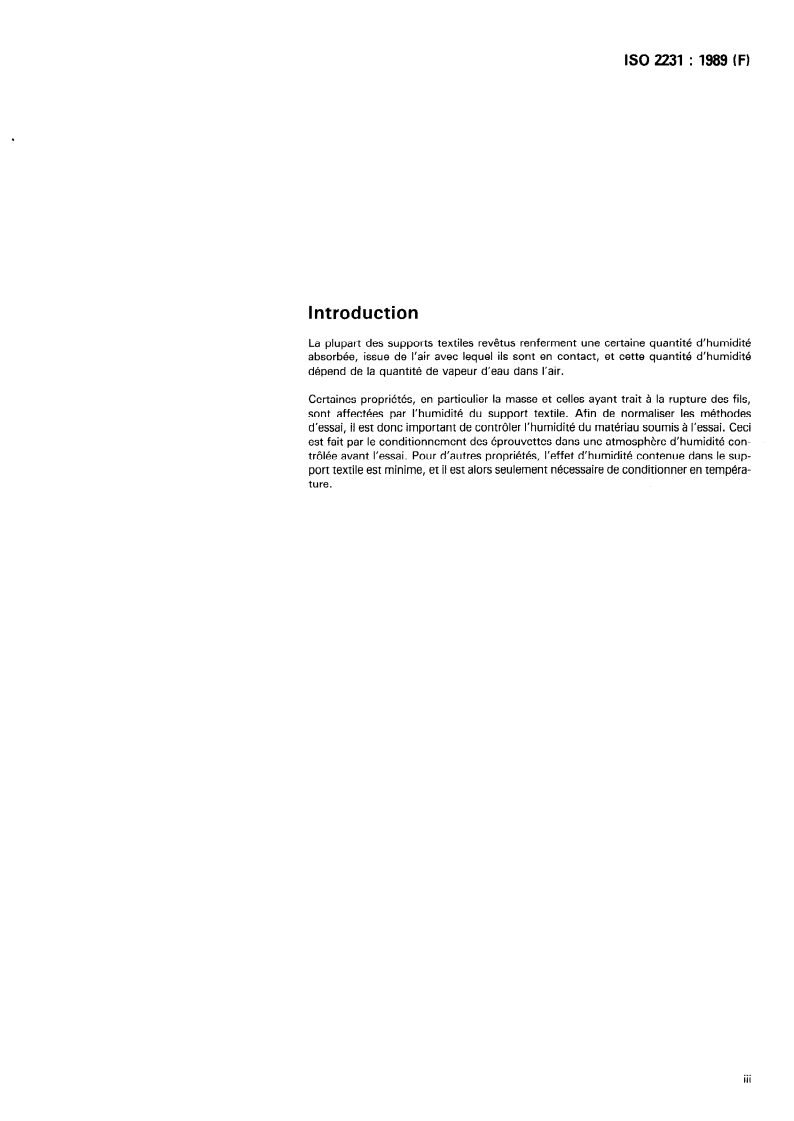
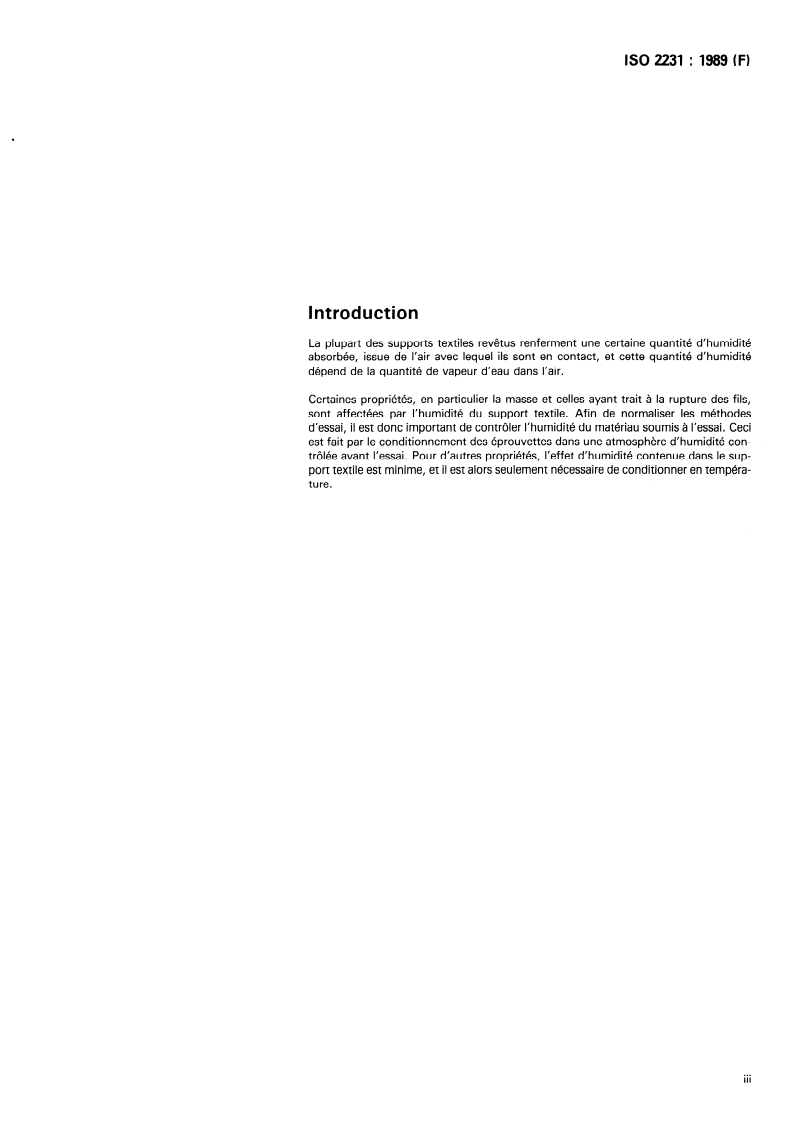
Introduction
La plupart des supports textiles revêtus renferment une certaine quantité d’humidité
absorbée, issue de l’air avec lequel ils sont en contact, et cette quantité d’humidité
dépend de la quantité de vapeur d’eau dans l’air.
Certaines propriétés, en particulier la masse et celles ayant trait à la rupture des fils,
sont affectées par l’humidité du support textile. Afin de normaliser les méthodes
d’essai, il est donc important de contrôler l’humidité du matériau soumis à l’essai. Ceci
est fait par le conditionnement des éprouvettes dans une atmosphère d’humidité con-
trôlée avant l’essai. Pour d’autres propriétés, l’effet d’humidité contenue dans le sup-
port textile est minime, et il est alors seulement nécessaire de conditionner en tempéra-
ture.
. . .
III
Page blanche
SO2231 : 1989 (F)
NORME INTERNATIONALE
Supports textiles revêtus de caoutchouc ou de plastique -
Atmosphères normales de conditionnement et d’essai
3.5 équilibre hygrométrique: État d’équilibre atteint par le
1 Domaine d’application
support textile revêtu lorsque, après exposition dans l’air en
La présente Norme internationale prescrit les caractéristiques mouvement, il n’y a plus de variation appréciable de sa masse.
pour le conditionnement et les méthodes de conditionnement
employées pour les supports textiles revêtus de caoutchouc ou
4 Préconditionnement
de plastique.
Lorsque le support textile revêtu comporte des composants
très hygroscopiques ou que l’on recherche une bonne préci-
2 Référence normative
sion, on s’approchera du point d’équilibre en suivant la branche
séche de la courbe d’hystérésis. Pour cela, on doit précondi-
La norme suivante contient des dispositions qui, par suite de la
tionner les éprouvettes dans une atmosphère ayant une humi-
référence qui
...
NORME
ISO
INTERNATIONALE
Deuxième édition
1989-08-01
Supports textiles revêtus de caoutchouc ou
Atmosphères normales de
de plastique -
conditionnement et d’essai
Rubber- or plastics-coa ted fabrics - Standard a tmospheres for conditioning
and tes ting
Numéro de référence
ISO 2231 : 1989 (FI
ISO 2231 : 1989 (F)
Avant-propos
L’ISO (Organisation internationale de normalisation) est une fédération mondiale
d’organismes nationaux de normalisation (comités membres de I’ISO). L’élaboration
des Normes internationales est en général confiée aux comités techniques de I’ISO.
Chaque comité membre intéressé par une étude a le droit de faire partie du comité
technique créé à cet effet. Les organisations internationales, gouvernementales et non
gouvernementales, en liaison avec I’ISO participent également aux travaux. L’ISO col-
labore étroitement avec la Commission électrotechnique internationale (CEI) en ce qui
concerne la normalisation électrotechnique.
Les projets de Normes internationales adoptés par les comités techniques sont soumis
aux comités membres pour approbation, avant leur acceptation comme Normes inter-
nationales par le Conseil de I’ISO. Les Normes internationales sont approuvées confor-
mément aux procédures de I’ISO qui requièrent l’approbation de 75 % au moins des
comités membres votants.
La Norme internationale ISO 2231 a été élaborée par le comité technique ISO/TC 45,
&astomères et produits à base d’élastomères.
Cette deuxième édition annule et remplace la première édition (ISO 2231 : 19731, dont
les articles 3 et 4 ont fait l’objet d’une révision technique et un nouvel article (article 4)
concernant le préconditionnement a été ajouté.
0 ISO 1989
Droits de reproduction réservés. Aucune partie de cette publication ne peut être reproduite ni
utilisée sous quelque forme que ce soit et par aucun procédé, électronique ou mécanique,
y compris la photocopie et les microfilms, sans l’accord écrit de l’éditeur.
Organisation internationale de normalisation
Case postale 56 l CH-1211 Genève 20 l Suisse
Imprimé en Suisse
ii
ISO 2231 : 1989 (F)
Introduction
La plupart des supports textiles revêtus renferment une certaine quantité d’humidité
absorbée, issue de l’air avec lequel ils sont en contact, et cette quantité d’humidité
dépend de la quantité de vapeur d’eau dans l’air.
Certaines propriétés, en particulier la masse et celles ayant trait à la rupture des fils,
sont affectées par l’humidité du support textile. Afin de normaliser les méthodes
d’essai, il est donc important de contrôler l’humidité du matériau soumis à l’essai. Ceci
est fait par le conditionnement des éprouvettes dans une atmosphère d’humidité con-
trôlée avant l’essai. Pour d’autres propriétés, l’effet d’humidité contenue dans le sup-
port textile est minime, et il est alors seulement nécessaire de conditionner en tempéra-
ture.
. . .
III
Page blanche
SO2231 : 1989 (F)
NORME INTERNATIONALE
Supports textiles revêtus de caoutchouc ou de plastique -
Atmosphères normales de conditionnement et d’essai
3.5 équilibre hygrométrique: État d’équilibre atteint par le
1 Domaine d’application
support textile revêtu lorsque, après exposition dans l’air en
La présente Norme internationale prescrit les caractéristiques mouvement, il n’y a plus de variation appréciable de sa masse.
pour le conditionnement et les méthodes de conditionnement
employées pour les supports textiles revêtus de caoutchouc ou
4 Préconditionnement
de plastique.
Lorsque le support textile revêtu comporte des composants
très hygroscopiques ou que l’on recherche une bonne préci-
2 Référence normative
sion, on s’approchera du point d’équilibre en suivant la branche
séche de la courbe d’hystérésis. Pour cela, on doit précondi-
La norme suivante contient des dispositions qui, par suite de la
tionner les éprouvettes dans une atmosphère ayant une humi-
référence qui
...
NORME
ISO
INTERNATIONALE
Deuxième édition
1989-08-01
Supports textiles revêtus de caoutchouc ou
Atmosphères normales de
de plastique -
conditionnement et d’essai
Rubber- or plastics-coa ted fabrics - Standard a tmospheres for conditioning
and tes ting
Numéro de référence
ISO 2231 : 1989 (FI
ISO 2231 : 1989 (F)
Avant-propos
L’ISO (Organisation internationale de normalisation) est une fédération mondiale
d’organismes nationaux de normalisation (comités membres de I’ISO). L’élaboration
des Normes internationales est en général confiée aux comités techniques de I’ISO.
Chaque comité membre intéressé par une étude a le droit de faire partie du comité
technique créé à cet effet. Les organisations internationales, gouvernementales et non
gouvernementales, en liaison avec I’ISO participent également aux travaux. L’ISO col-
labore étroitement avec la Commission électrotechnique internationale (CEI) en ce qui
concerne la normalisation électrotechnique.
Les projets de Normes internationales adoptés par les comités techniques sont soumis
aux comités membres pour approbation, avant leur acceptation comme Normes inter-
nationales par le Conseil de I’ISO. Les Normes internationales sont approuvées confor-
mément aux procédures de I’ISO qui requièrent l’approbation de 75 % au moins des
comités membres votants.
La Norme internationale ISO 2231 a été élaborée par le comité technique ISO/TC 45,
&astomères et produits à base d’élastomères.
Cette deuxième édition annule et remplace la première édition (ISO 2231 : 19731, dont
les articles 3 et 4 ont fait l’objet d’une révision technique et un nouvel article (article 4)
concernant le préconditionnement a été ajouté.
0 ISO 1989
Droits de reproduction réservés. Aucune partie de cette publication ne peut être reproduite ni
utilisée sous quelque forme que ce soit et par aucun procédé, électronique ou mécanique,
y compris la photocopie et les microfilms, sans l’accord écrit de l’éditeur.
Organisation internationale de normalisation
Case postale 56 l CH-1211 Genève 20 l Suisse
Imprimé en Suisse
ii
ISO 2231 : 1989 (F)
Introduction
La plupart des supports textiles revêtus renferment une certaine quantité d’humidité
absorbée, issue de l’air avec lequel ils sont en contact, et cette quantité d’humidité
dépend de la quantité de vapeur d’eau dans l’air.
Certaines propriétés, en particulier la masse et celles ayant trait à la rupture des fils,
sont affectées par l’humidité du support textile. Afin de normaliser les méthodes
d’essai, il est donc important de contrôler l’humidité du matériau soumis à l’essai. Ceci
est fait par le conditionnement des éprouvettes dans une atmosphère d’humidité con-
trôlée avant l’essai. Pour d’autres propriétés, l’effet d’humidité contenue dans le sup-
port textile est minime, et il est alors seulement nécessaire de conditionner en tempéra-
ture.
. . .
III
Page blanche
SO2231 : 1989 (F)
NORME INTERNATIONALE
Supports textiles revêtus de caoutchouc ou de plastique -
Atmosphères normales de conditionnement et d’essai
3.5 équilibre hygrométrique: État d’équilibre atteint par le
1 Domaine d’application
support textile revêtu lorsque, après exposition dans l’air en
La présente Norme internationale prescrit les caractéristiques mouvement, il n’y a plus de variation appréciable de sa masse.
pour le conditionnement et les méthodes de conditionnement
employées pour les supports textiles revêtus de caoutchouc ou
4 Préconditionnement
de plastique.
Lorsque le support textile revêtu comporte des composants
très hygroscopiques ou que l’on recherche une bonne préci-
2 Référence normative
sion, on s’approchera du point d’équilibre en suivant la branche
séche de la courbe d’hystérésis. Pour cela, on doit précondi-
La norme suivante contient des dispositions qui, par suite de la
tionner les éprouvettes dans une atmosphère ayant une humi-
référence qui
...
NORME
ISO
INTERNATIONALE
Deuxième édition
1989-08-01
Supports textiles revêtus de caoutchouc ou
Atmosphères normales de
de plastique -
conditionnement et d’essai
Rubber- or plastics-coa ted fabrics - Standard a tmospheres for conditioning
and tes ting
Numéro de référence
ISO 2231 : 1989 (FI
ISO 2231 : 1989 (F)
Avant-propos
L’ISO (Organisation internationale de normalisation) est une fédération mondiale
d’organismes nationaux de normalisation (comités membres de I’ISO). L’élaboration
des Normes internationales est en général confiée aux comités techniques de I’ISO.
Chaque comité membre intéressé par une étude a le droit de faire partie du comité
technique créé à cet effet. Les organisations internationales, gouvernementales et non
gouvernementales, en liaison avec I’ISO participent également aux travaux. L’ISO col-
labore étroitement avec la Commission électrotechnique internationale (CEI) en ce qui
concerne la normalisation électrotechnique.
Les projets de Normes internationales adoptés par les comités techniques sont soumis
aux comités membres pour approbation, avant leur acceptation comme Normes inter-
nationales par le Conseil de I’ISO. Les Normes internationales sont approuvées confor-
mément aux procédures de I’ISO qui requièrent l’approbation de 75 % au moins des
comités membres votants.
La Norme internationale ISO 2231 a été élaborée par le comité technique ISO/TC 45,
&astomères et produits à base d’élastomères.
Cette deuxième édition annule et remplace la première édition (ISO 2231 : 19731, dont
les articles 3 et 4 ont fait l’objet d’une révision technique et un nouvel article (article 4)
concernant le préconditionnement a été ajouté.
0 ISO 1989
Droits de reproduction réservés. Aucune partie de cette publication ne peut être reproduite ni
utilisée sous quelque forme que ce soit et par aucun procédé, électronique ou mécanique,
y compris la photocopie et les microfilms, sans l’accord écrit de l’éditeur.
Organisation internationale de normalisation
Case postale 56 l CH-1211 Genève 20 l Suisse
Imprimé en Suisse
ii
ISO 2231 : 1989 (F)
Introduction
La plupart des supports textiles revêtus renferment une certaine quantité d’humidité
absorbée, issue de l’air avec lequel ils sont en contact, et cette quantité d’humidité
dépend de la quantité de vapeur d’eau dans l’air.
Certaines propriétés, en particulier la masse et celles ayant trait à la rupture des fils,
sont affectées par l’humidité du support textile. Afin de normaliser les méthodes
d’essai, il est donc important de contrôler l’humidité du matériau soumis à l’essai. Ceci
est fait par le conditionnement des éprouvettes dans une atmosphère d’humidité con-
trôlée avant l’essai. Pour d’autres propriétés, l’effet d’humidité contenue dans le sup-
port textile est minime, et il est alors seulement nécessaire de conditionner en tempéra-
ture.
. . .
III
Page blanche
SO2231 : 1989 (F)
NORME INTERNATIONALE
Supports textiles revêtus de caoutchouc ou de plastique -
Atmosphères normales de conditionnement et d’essai
3.5 équilibre hygrométrique: État d’équilibre atteint par le
1 Domaine d’application
support textile revêtu lorsque, après exposition dans l’air en
La présente Norme internationale prescrit les caractéristiques mouvement, il n’y a plus de variation appréciable de sa masse.
pour le conditionnement et les méthodes de conditionnement
employées pour les supports textiles revêtus de caoutchouc ou
4 Préconditionnement
de plastique.
Lorsque le support textile revêtu comporte des composants
très hygroscopiques ou que l’on recherche une bonne préci-
2 Référence normative
sion, on s’approchera du point d’équilibre en suivant la branche
séche de la courbe d’hystérésis. Pour cela, on doit précondi-
La norme suivante contient des dispositions qui, par suite de la
tionner les éprouvettes dans une atmosphère ayant une humi-
référence qui
...