

ISO/DTS 24883
(Main)In vitro diagnostic medical devices — General guidance for manufacturers of lateral flow immunoassay (LFIA) for rapid diagnostic testing (RDT)
- Abstract
This document provides the general principles and guideline for the rapid diagnostic testing (RDT) of LFIA used for the In vitro diagnostics as follows: — Design and development of LFIA — General guideline for test performance of LFIA — Recommendations for the use of LFIA This document is specific to the RDT of LFIA, which employ the gold nanoparticle as the conjugate and read the signal either with naked eye or through reader devices. This document does not apply to other types of LFIA such as automatic devices and microfluidic chips. This document should be expected to be helpful to increase efficiency and reduce trials and errors when manufacturing LFIA RDT products to the industries and/or manufacturers.
- Status
- Not Published
- Drafting Committee
- ISO/TC 212/WG 3 - In vitro diagnostic products
- Current Stage
- 5020 - FDIS ballot initiated: 2 months. Proof sent to secretariat
- Start Date
- 30-Sep-2026
- Completion Date
- 30-Sep-2026
Buy Documents


ISO/DTS 24883 - In vitro diagnostic medical devices — General guidance for manufacturers of lateral flow immunoassay (LFIA) for rapid diagnostic testing (RDT)
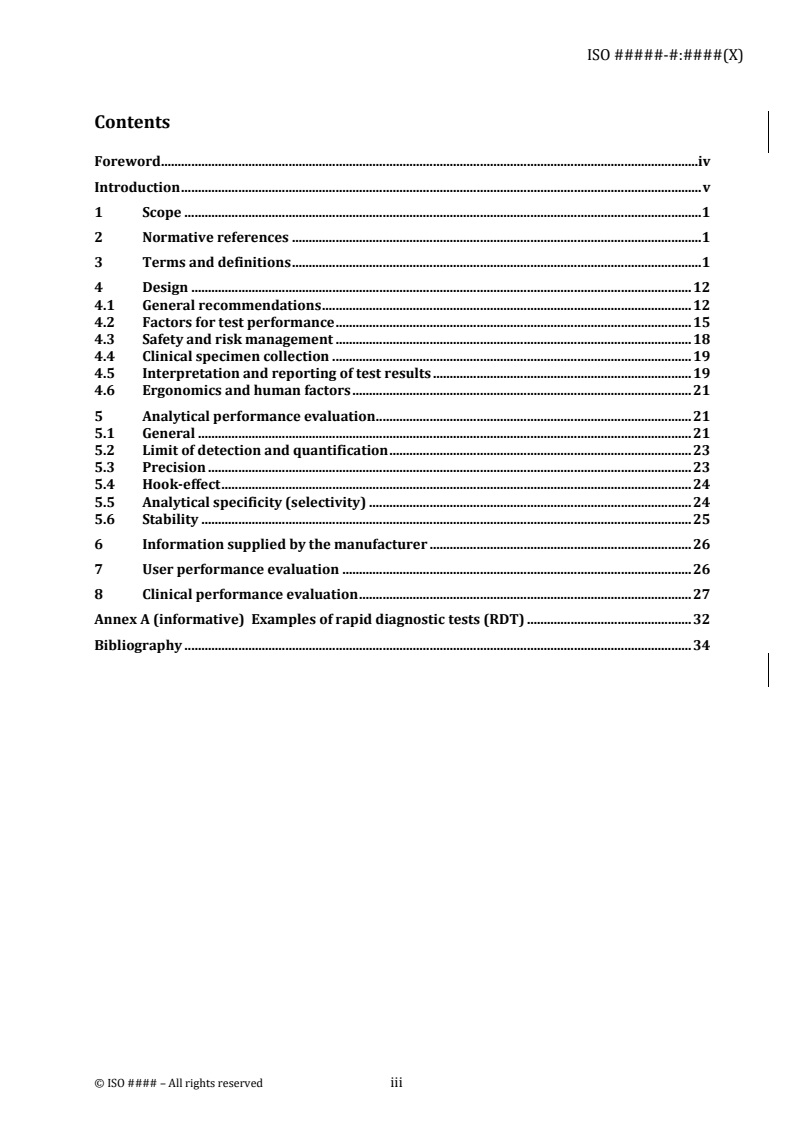
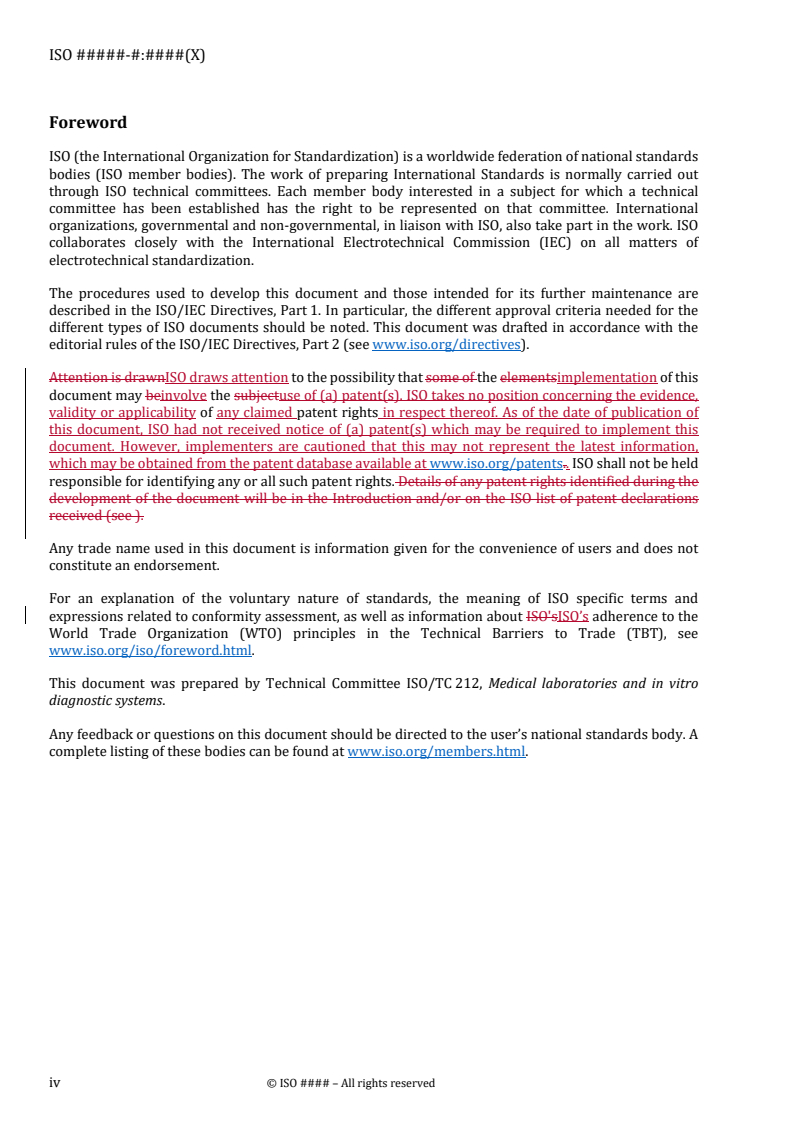
REDLINE ISO/DTS 24883 - In vitro diagnostic medical devices — General guidance for manufacturers of lateral flow immunoassay (LFIA) for rapid diagnostic testing (RDT)
ISO/DTS 24883 is an ISO document for manufacturers of lateral flow immunoassay (LFIA) rapid diagnostic testing (RDT) in in vitro diagnostic medical devices (IVDs). It gives guidance on how to design LFIA RDTs, evaluate their performance, and describe their use when the signal is read by the naked eye or with reader devices. The document is written for developers, manufacturers, and others who need a practical basis for building and validating these tests.
What does ISO/DTS 24883 specify?
ISO/DTS 24883 specifies general guidance for LFIA used in rapid diagnostic testing, with a focus on nanoparticle conjugates, especially gold, and visual or instrument-assisted reading. It is specific to LFIA RDT and does not apply to automatic devices or microfluidic chip formats.
The document is organized into these main parts:
- Clause 1 - Scope
- Clause 2 - Normative references
- Clause 3 - Terms and definitions
- Clause 4 - Design
- Clause 5 - Analytical performance evaluation
- Clause 6 - Information supplied by the manufacturer
- Clause 7 - User performance evaluation
- Clause 8 - Clinical performance evaluation
- Annex A - Informative examples of rapid diagnostic tests
That structure matters in practice because it moves from design choices, to analytical evidence, to user and clinical evidence, and then to what manufacturers must communicate in the product information.
What are the key requirements of ISO/DTS 24883?
ISO/DTS 24883 focuses on getting the strip chemistry, flow, interpretation, and evidence package right. The main message is that an LFIA RDT should be designed as a controlled system, not as a single reagent strip.
Design of the LFIA system
Clause 4 says the LFIA should be designed around the analyte, the antibody or antigen pair, the conjugate, the membrane, the pads, and the buffers. The document notes that monoclonal antibodies are generally preferred, and that recombinant antigens often give better purity and specificity. In practice, this affects lot-to-lot consistency and the risk of non-specific reactions.
Clause 4 also treats the conjugate as a critical performance element. The conjugate should be stable in sample, reproducible to manufacture, easy to scale, and should minimize non-specific binding. The document also expects the conjugation process and storage conditions to be validated, because poor conjugation or poor storage can weaken the visible signal.
Membrane, pad, and specimen choices
Clause 4 describes the importance of membrane pore size, capillary flow time, sample pad behavior, conjugate release, and absorbent pad capacity. It also notes that the flow rate influences interaction time and therefore sensitivity, while the absorbent pad helps prevent backflow. For a manufacturer, this means strip materials and geometry have to match the intended specimen type and read time.
Clause 4.4 addresses specimen collection and equivalency. The document points to different matrices such as whole blood, serum, plasma, swabs, urine, and other fluids, and it links this topic to CLSI EP14, CLSI EP35, and ISO/TS 20658. This matters when one assay is claimed for more than one specimen type.
Risk, interpretation, and human factors
Clause 4.3 requires a risk-based approach consistent with ISO 14971. The considerations include intended user, use environment, misuse, expired reagents, specimen volume, flow failure, improper preparation, temperature, humidity, and disposal. In practice, this is the basis for the hazard analysis and risk control file.
Clause 4.5 requires clear instructions for reading, interpreting, and reporting results. The manufacturer should define how to handle faint lines, invalid results, result timing, and any result that falls outside the valid measurement range. For visually read tests, scoring guides and pictorial examples help reduce interpretation errors.
Clause 4.6 links the document to ergonomics and human factors. The LFIA should be easy to use in the intended context, especially for point-of-care use and self-testing. That means the layout, sample application area, result window, and user instructions should support correct use without extra assistance.
Analytical performance evaluation
Clause 5 requires evaluation of the main analytical performance characteristics: limit of detection, precision, hook effect, analytical specificity, inclusivity, and stability. It also discusses matrix effects and the use of contrived, synthetic, or derived matrices when natural samples are limited. This is the evidence base behind the performance claims on the label and in the instructions.
Clause 5.5 treats precision for qualitative methods through repeatability and reproducibility, often using agreement measures such as kappa statistics. Clause 5.6 warns about the hook effect, where very high analyte concentrations can give falsely low or negative results. Clause 5.7 covers cross-reactivity, interference, and inclusivity, so the test is checked against likely false-positive and false-negative causes as well as target variants.
User and clinical performance
Clause 7 calls for user performance evaluation before commercial distribution. Representative users should perform the test using only the supplied instructions and training material, so the manufacturer can see whether the product is understandable in real use.
Clause 8 requires clinical performance evaluation in the intended target population. The document uses diagnostic accuracy studies and comparative diagnostic accuracy studies, with predefined result calling and analysis using measures such as clinical sensitivity, clinical specificity, positive predictive value, and negative predictive value. That is what shows whether the assay performs as claimed in the clinical setting.
What terms does ISO/DTS 24883 define?
- Lateral flow immunoassay (LFIA) - A membrane-based in vitro diagnostic that uses horizontal flow to detect analytes in liquid samples.
- In vitro diagnostic medical device (IVD medical device) - A product intended to provide information from specimens taken from the human body for a medical purpose.
- Clinical performance - The ability of an IVD to produce results correlated with a particular clinical condition or state.
- Analytical specificity - The ability of a measurement procedure to measure the intended measurand without dependence on other quantities in the system.
- Hook effect - A negative bias at high analyte concentrations that can make a very strong sample look weak or negative.
- Limit of detection (LOD) - The lowest measured quantity value for which absence of the component is not falsely claimed too often.
- Target condition (TC) - The disease, disease stage, health status, or other identifiable condition that the test is meant to detect or support.
- Specimen - A discrete portion of body fluid, tissue, or another human sample taken for examination.
Who uses ISO/DTS 24883?
ISO/DTS 24883 is used by LFIA developers and manufacturers, especially teams working on rapid diagnostic tests for point-of-care and self-testing applications. It is also relevant to quality, regulatory, and clinical evaluation teams that need to plan verification, validation, usability work, and clinical studies.
In practice, it helps people choose reagents, define strip materials, write instructions for use, plan analytical and clinical studies, and judge whether an LFIA RDT is suitable for a given specimen type or user group. Buyers and technical evaluators can also use it to compare whether a product’s performance claims are backed by the right types of evidence.
Which standards are used with ISO/DTS 24883?
| Standard | What it contributes |
|---|---|
| ISO 17511 | Requirements for metrological traceability of values assigned to calibrators, trueness control materials, and human samples. |
| ISO 18113-1 | Terms, definitions, and general requirements for manufacturer information and labelling. |
| ISO 14971 | The risk management framework used for identifying hazards and controlling risks. |
| ISO/TS 20658 | Requirements for collecting, transporting, receiving, and handling samples. |
| ISO 20916 | Good study practice for clinical performance studies using human specimens. |
| ISO 23640 | Stability evaluation of in vitro diagnostic reagents. |
| ISO 18113-2, ISO 18113-3, ISO 18113-4, ISO 18113-5 | Manufacturer information for professional use and self-testing. |
| IEC 62366-1 | Usability engineering for medical devices, relevant to ergonomic design and human factors. |
| ISO 24884 | Requirements for electronic instructions for use for IVD medical devices. |
What does the ISO/DTS 24883 document contain?
The document includes a figure showing a typical LFIA strip structure and several tables that support design and validation decisions. Table 1 links gold nanoparticle size to visible color, while Table 2 shows how positive, negative, and invalid results can be presented.
It also contains Table 3, which links intended purpose to study design and statistical measures, and Table 4, which gives the 2 x 2 contingency table used for diagnostic accuracy analysis. Clause 5 uses these ideas for analytical studies, while Clause 8 uses them for clinical performance evaluation.
Annex A gives informative examples of RDTs, including HIV, syphilis, malaria, cholera, hepatitis B, hepatitis C, SARS-CoV-2, tuberculosis/LAM, and influenza A/B, with references to the associated WHO technical specifications.
Buy Documents
ISO/DTS 24883 - In vitro diagnostic medical devices — General guidance for manufacturers of lateral flow immunoassay (LFIA) for rapid diagnostic testing (RDT)
REDLINE ISO/DTS 24883 - In vitro diagnostic medical devices — General guidance for manufacturers of lateral flow immunoassay (LFIA) for rapid diagnostic testing (RDT)
Get Certified
Connect with accredited certification bodies for this standard

BSI Group
BSI (British Standards Institution) is the business standards company that helps organizations make excellence a habit.

TÜV Rheinland
TÜV Rheinland is a leading international provider of technical services.

TÜV SÜD
TÜV SÜD is a trusted partner of choice for safety, security and sustainability solutions.
Sponsored listings
Frequently Asked Questions
ISO/DTS 24883 is a draft published by the International Organization for Standardization (ISO). Its full title is "In vitro diagnostic medical devices — General guidance for manufacturers of lateral flow immunoassay (LFIA) for rapid diagnostic testing (RDT)". This standard covers: This document provides the general principles and guideline for the rapid diagnostic testing (RDT) of LFIA used for the In vitro diagnostics as follows: — Design and development of LFIA — General guideline for test performance of LFIA — Recommendations for the use of LFIA This document is specific to the RDT of LFIA, which employ the gold nanoparticle as the conjugate and read the signal either with naked eye or through reader devices. This document does not apply to other types of LFIA such as automatic devices and microfluidic chips. This document should be expected to be helpful to increase efficiency and reduce trials and errors when manufacturing LFIA RDT products to the industries and/or manufacturers.
This document provides the general principles and guideline for the rapid diagnostic testing (RDT) of LFIA used for the In vitro diagnostics as follows: — Design and development of LFIA — General guideline for test performance of LFIA — Recommendations for the use of LFIA This document is specific to the RDT of LFIA, which employ the gold nanoparticle as the conjugate and read the signal either with naked eye or through reader devices. This document does not apply to other types of LFIA such as automatic devices and microfluidic chips. This document should be expected to be helpful to increase efficiency and reduce trials and errors when manufacturing LFIA RDT products to the industries and/or manufacturers.
ISO/DTS 24883 is classified under the following ICS (International Classification for Standards) categories: 11.100.10 - In vitro diagnostic test systems. The ICS classification helps identify the subject area and facilitates finding related standards.
ISO/DTS 24883 is available in PDF format for immediate download after purchase. The document can be added to your cart and obtained through the secure checkout process. Digital delivery ensures instant access to the complete standard document.
Standards Content (Sample)
FINAL DRAFT
Technical
Specification
ISO/TC 212
In vitro diagnostic medical
Secretariat: ANSI
devices — General guidance for
Voting begins on:
manufacturers of lateral flow
2026-09-30
immunoassay (LFIA) for rapid
Voting terminates on:
diagnostic testing (RDT)
2026-11-25
Dispositifs médicaux de diagnostic in vitro — Recommandations
générales pour les fabricants d'immunodosage à flux latéral
(LFIA) pour les essais de diagnostic rapide (TDR)
RECIPIENTS OF THIS DRAFT ARE INVITED TO SUBMIT,
WITH THEIR COMMENTS, NOTIFICATION OF ANY
RELEVANT PATENT RIGHTS OF WHICH THEY ARE AWARE
AND TO PROVIDE SUPPOR TING DOCUMENTATION.
IN ADDITION TO THEIR EVALUATION AS
BEING ACCEPTABLE FOR INDUSTRIAL, TECHNO
LOGICAL, COMMERCIAL AND USER PURPOSES, DRAFT
INTERNATIONAL STANDARDS MAY ON OCCASION HAVE
TO BE CONSIDERED IN THE LIGHT OF THEIR POTENTIAL
TO BECOME STAN DARDS TO WHICH REFERENCE MAY BE
MADE IN NATIONAL REGULATIONS.
Reference number
FINAL DRAFT
Technical
Specification
ISO/TC 212
In vitro diagnostic medical
Secretariat: ANSI
devices — General guidance for
Voting begins on:
manufacturers of lateral flow
immunoassay (LFIA) for rapid
Voting terminates on:
diagnostic testing (RDT)
Dispositifs médicaux de diagnostic in vitro — Recommandations
générales pour les fabricants d'immunodosage à flux latéral
(LFIA) pour les essais de diagnostic rapide (TDR)
RECIPIENTS OF THIS DRAFT ARE INVITED TO SUBMIT,
WITH THEIR COMMENTS, NOTIFICATION OF ANY
RELEVANT PATENT RIGHTS OF WHICH THEY ARE AWARE
AND TO PROVIDE SUPPOR TING DOCUMENTATION.
© ISO 2026
IN ADDITION TO THEIR EVALUATION AS
All rights reserved. Unless otherwise specified, or required in the context of its implementation, no part of this publication may
BEING ACCEPTABLE FOR INDUSTRIAL, TECHNO
LOGICAL, COMMERCIAL AND USER PURPOSES, DRAFT
be reproduced or utilized otherwise in any form or by any means, electronic or mechanical, including photocopying, or posting on
INTERNATIONAL STANDARDS MAY ON OCCASION HAVE
the internet or an intranet, without prior written permission. Permission can be requested from either ISO at the address below
TO BE CONSIDERED IN THE LIGHT OF THEIR POTENTIAL
or ISO’s member body in the country of the requester.
TO BECOME STAN DARDS TO WHICH REFERENCE MAY BE
MADE IN NATIONAL REGULATIONS.
ISO copyright office
CP 401 • Ch. de Blandonnet 8
CH-1214 Vernier, Geneva
Phone: +41 22 749 01 11
Email: copyright@iso.org
Website: www.iso.org
Published in Switzerland Reference number
ii
Contents Page
Foreword .iv
Introduction .v
1 Scope . 1
2 Normative references . 1
3 Terms and definitions . 1
4 Design .10
4.1 General recommendations .10
4.1.1 General .10
4.1.2 Primary components of LFIA .11
4.2 Factors for test performance . 12
4.2.1 Antibody and antigen . 12
4.2.2 Nanoparticle selection and conjugation . 13
4.2.3 Properties of membrane and pads .14
4.2.4 Fluidic property of membrane .14
4.3 Safety and risk management . 15
4.4 Clinical specimen collection .16
4.5 Interpretation and reporting of test results .16
4.6 Ergonomics and human factors .17
5 Analytical performance evaluation . .18
5.1 General .18
5.1.1 Overview .18
5.1.2 Matrix considerations in analytical performance evaluation .18
5.2 Limit of detection and quantification .19
5.3 Precision . . .19
5.3.1 General .19
5.3.2 Repeatability .19
5.3.3 Reproducibility . 20
5.4 Hook-effect . 20
5.5 Analytical specificity (selectivity) . 20
5.5.1 Cross-reactivity and interference . 20
5.5.2 Inclusivity .21
5.6 Stability .21
5.6.1 Specimen stability .21
5.6.2 Stability of reagents and materials .21
6 Information supplied by the manufacturer .21
7 User performance evaluation .22
8 Clinical performance evaluation .22
Annex A (informative) Examples of rapid diagnostic tests (RDT) .26
Bibliography .27
iii
Foreword
ISO (the International Organization for Standardization) is a worldwide federation of national standards
bodies (ISO member bodies). The work of preparing International Standards is normally carried out through
ISO technical committees. Each member body interested in a subject for which a technical committee
has been established has the right to be represented on that committee. International organizations,
governmental and non-governmental, in liaison with ISO, also take part in the work. ISO collaborates closely
with the International Electrotechnical Commission (IEC) on all matters of electrotechnical standardization.
The procedures used to develop this document and those intended for its further maintenance are described
in the ISO/IEC Directives, Part 1. In particular, the different approval criteria needed for the different types
of ISO documents should be noted. This document was drafted in accordance with the editorial rules of the
ISO/IEC Directives, Part 2 (see www.iso.org/directives).
ISO draws attention to the possibility that the implementation of this document may involve the use of (a)
patent(s). ISO takes no position concerning the evidence, validity or applicability of any claimed patent
rights in respect thereof. As of the date of publication of this document, ISO had not received notice of (a)
patent(s) which may be required to implement this document. However, implementers are cautioned that
this may not represent the latest information, which may be obtained from the patent database available at
www.iso.org/patents. ISO shall not be held responsible for identifying any or all such patent rights.
Any trade name used in this document is information given for the convenience of users and does not
constitute an endorsement.
For an explanation of the voluntary nature of standards, the meaning of ISO specific terms and expressions
related to conformity assessment, as well as information about ISO’s adherence to the World Trade
Organization (WTO) principles in the Technical Barriers to Trade (TBT), see www.iso.org/iso/foreword.html.
This document was prepared by Technical Committee ISO/TC 212, Medical laboratories and in vitro diagnostic
systems.
Any feedback or questions on this document should be directed to the user’s national standards body. A
complete listing of these bodies can be found at www.iso.org/members.html.
iv
Introduction
Lateral flow immunoassay (LFIA) is a well-established technology used widely in the development of in
vitro diagnostic medical devices (IVDs) (see Annex A for examples). It utilises immunochemical reactions
between antibodies and antigens, typically on a membrane, to detect analytes in a variety of clinical
specimens, including serum, plasma, whole blood, urine, sweat, saliva and others. The use of LFIA-based
IVDs has expanded rapidly due to their relative simplicity, low manufacturing cost, and rapid turnaround
time. They offer advantages in diagnostic testing across a range of medical conditions including infectious
diseases, cardio metabolic disease, thyroid disease, anaemia, allergies, pregnancy, cancer and substance
[40,41,43]
abuse .
One of the most significant applications of LFIAs is in rapid diagnostic tests (RDT). RDTs are typically
designed for use by healthcare professionals at the point-of-care (POC), or by lay individuals for self-testing.
They are well suited to such applications as they are easy to use and can provide rapid results, typically
within 15 to 30 minutes, enabling timely medical decisions in settings where laboratory-based testing
can be unfeasible. These characteristics make RDTs particularly valuable in remote or resource-limited
environments where the conditions, facilities and personnel needed can make more complex methods,
like nucleic acid amplification testing (NAAT), challenging. However, their use should be guided by careful
consideration of their performance in specific clinical contexts and the risks of false positives and false
negatives, as RDT performance (sensitivity and specificity) is often lower than more complex laboratory-
based methods or instrumented POC systems.
During infectious disease outbreaks, such as the COVID-19 pandemic, LFIA RDTs can play a crucial role in
surveillance, screening and triage of populations. Their use enables the timely detection and investigation
of outbreaks, as well as the rapid identification and isolation of infected individuals in communities,
institutions, and other high-risk settings. Their relative simplicity, low cost and scalability also make them
well suited to manufacture in low- and middle-income countries, facilitating timely access to affordable
diagnostics and reducing dependency on global supply chains.
This document provides manufacturers of LFIA-based IVDs with general guidance on the design and
performance evaluation of such technologies. Through the provision of this standardised guidance, it aims to
improve the safety, quality and availability of such devices for use in a wide variety of clinical and resource-
limited settings, especially during infectious disease outbreaks.
In this document, the following verbal forms are used
— “shall” indicates a requirement;
— “should” indicates a recommendation;
— “may “indicates a permission;
— “can” indicates a possibility or a capability.
v
FINAL DRAFT Technical Specification ISO/DTS 24883:2026(en)
In vitro diagnostic medical devices — General guidance for
manufacturers of lateral flow immunoassay (LFIA) for rapid
diagnostic testing (RDT)
1 Scope
The document specifies recommendations for the design and performance evaluation of lateral flow
immunoassay (LFIA). It applies to rapid diagnostic testing (RDT) of LFIA, which employ a nanoparticle (e.g.
gold) as the conjugate and read with the naked eye. This document does not apply to other types of LFIA
such as any instrument-based device with microfluidic chip or other reader device.
This document applies to developers and manufactures of LFIA RDT.
NOTE Other materials, such as dye, microsphere, quantum dot, magnetic bead, and others, can be used as
nanoparticles depending on the intended detection method.
2 Normative references
The following documents are referred to in the text in such a way that some or all of their content constitutes
requirements of this document. For dated references, only the edition cited applies. For undated references,
the latest edition of the referenced document (including any amendments) applies.
ISO 17511, In vitro diagnostic medical devices — Requirements for establishing metrological traceability of
values assigned to calibrators, trueness control materials and human samples
ISO 18113-1, In vitro diagnostic medical devices — Information supplied by the manufacturer (labelling) —
Part 1: Terms, definitions, and general requirements
3 Terms and definitions
For the purposes of this document, the terms and definitions given in given in ISO 17511, ISO 18113-1 and
the following apply.
ISO and IEC maintain terminology databases for use in standardization at the following addresses:
— ISO Online browsing platform: available at https:// www .iso .org/ obp
— IEC Electropedia: available at https:// www .electropedia .org/
3.1
absorbent pad
layer located at the end of strip that collects the treated liquid, allowing the specimen to flow along the strip
and preventing back flow
3.2
analytical specificity
relative specificity
capability of a measuring system, using a specified measurement procedure, to provide measurement
results for one or more measurands (3.25) which do not depend on each other nor on any other quantity in
the system undergoing measurement
Note 1 to entry: Lack of analytical specificity in immunochemistry measurement procedures can be due to cross-
reactivity (3.10).
Note 2 to entry: Specificity of a measurement procedure should not be confused with diagnostic specificity (3.10).
Note 3 to entry: ISO/IEC Guide 99:2007 uses the term selectivity for this concept instead of specificity.
Note 4 to entry: ISO/IEC Guide 99:2007 (VIM3, 4.13) defines selectivity as the independence of measured quantity
values from other measurands or quantities. While this definition is valid for general measurement science, it does not
fully address immunochemical cross-reactivity and interference phenomena, which are critical in IVD performance
evaluation. Therefore, the ISO/IVD definition, aligned with CLSI EP07, is retained for clarity and regulatory consistency.
[SOURCE: ISO 18113-1:2022, 3.2.5, modified — The example and notes 1 and 5 were deleted; Note 4 was
added.]
3.3
antibody
host proteins produced in response to the presence of foreign molecules, organisms or other agents in the
organism
[SOURCE: ISO 16577:2022, 3.2.1, modified — The notes to entry were removed.]
3.4
antigen
substance that simulates the production of antibodies (3.3) and reacts with them
[SOURCE: ISO 20166-4:2021, 3.4]
3.5
capture reagent
biorecognition molecules with specific affinity toward the analyte of interest to diagnosis
Note 1 to entry: In immunoassay, the capture reagent is the primary antibody (3.3) which is capable of binding with
analytes of interest.
EXAMPLE Primary antibodies, Fab fragments, nanobodies, single-chain variable fragments.
3.6
clinical specificity
ability of an in vitro diagnostics (IVD) examination procedure to have negative results associated with an
absence of particular disease or condition
Note 1 to entry: Also defined as percent negativity in samples where the target marker is known to be absent.
Note 2 to entry: Diagnostic specificity is expressed as a percentage (number fraction multiplied by 100), calculated as
100 × the number of true negative values (TN) divided by the sum of the number of true negative plus the number of
false positive (FP) values, or 100 × TN/(TN + FP). This calculation is based on a study design where only one sample is
taken from each subject.
Note 3 to entry: The target condition (3.37) is defined by criteria independent of the examination procedure under
consideration.
Note 4 to entry: Diagnostic specificity should not be confused with analytical specificity (3.2).
[SOURCE: ISO 18113-1:2022, 3.2.18, modified — Note 4 to entry was added.]
3.7
clinical performance
ability of an in vitro diagnostic (IVD) medical device (3.19) to yield results that are correlated with a particular
clinical condition or physiological or pathological process or state in accordance with the intended use
Note 1 to entry: In accordance with intended use, clinical performance can include expected values, diagnostic
sensitivity and diagnostic specificity based on the known clinical condition or physiological/pathological process/
state of the individual, and negative and positive predictive values based on the prevalence of the disease.
[SOURCE: ISO 18113-1:2022, 3.2.10, modified — Note 2 to entry was deleted.]
3.8
conjugate
material produced by attaching two or more substances together by covalent bond via chemical groups
Note 1 to entry: Conjugates of antibodies (3.3) with fluorochromes (e.g. chemical entity, such as a molecule or group,
that emits light in response to excitation by absorbed incident light), radiolabelled substances, gold or enzymes are
often used in immunoassays (3.18).
[SOURCE: ISO 21572:2019, 3.1]
3.9
conjugate pad
layer of the strip (3.35) where detector reagents (3.12) are dispensed
3.10
cross-reactivity
degree to which a substance other than the analyte binds to a reagent in a competitive binding
immunochemical measurement procedure
EXAMPLE Antibody (3.3) binding to metabolites of the analyte, structurally similar drugs or proteins of related
pathogens.
Note 1 to entry: Analytical specificity (3.2) is a related concept.
Note 2 to entry: Cross-reactivity of metabolites can be a desirable attribute of certain examination procedures, such
as for screening for the presence of illegal drugs.
Note 3 to entry: ISO/IEC Guide 99:2007 (VIM3, 2.52) defines “influence quantity” in broad metrological terms. In
IVD testing, however, “cross-reactivity” and “interference” must be operationally defined to design and interpret
interference studies. These sector-specific concepts, already standardized in ISO and CLSI documents, are preferred
in this document.
[SOURCE: ISO 18113-1:2022, 3.2.14, modified — the original Note 3 to entry was deleted and a new one was
added; in the example, “proteins of related pathogens” was added.]
3.11
cut-off value
relative cut-off value
quantity value used as a decision limit to identify samples that indicate the presence or the absence of a
specific disease, condition or measurand (3.25)
Note 1 to entry: Measurement results higher than the cut-off value are considered positive and those lower than the
cut-off are considered negative.
Note 2 to entry: Measurement results near the cut-off value (3.11) can be considered inconclusive.
Note 3 to entry: The selection of the cut-off value determines the diagnostic specificity and diagnostic sensitivity of
the examination.
Note 4 to entry: In case of qualitative examination (3.29), the relative cut-off can be determined using an accepted
reference value (3.30).
[SOURCE: ISO 18113-1:2022, 3.2.15, modified — “relative cut-off (value)” was added as an alternative
preferred term; Note 4 to entry was added.]
3.12
detector reagent
recognition molecules toward analytes or the capture reagents (3.5) with the conjugates (3.8) allowing
generation of the detection signal
Note 1 to entry: In lateral flow assay, the detection would be made by appearing the lines caused by binding of detector
reagents toward analytes and antibodies (3.3) immobilized on the control line.
3.13
diagnostic accuracy
extent of agreement between the information from the test under evaluation and applicable performance
attributes as measured by a reference method
Note 1 to entry: Diagnostic accuracy can be expressed in different ways, including sensitivity-specificity pairs,
likelihood ratio pairs, and the area under a receiver operating characteristic curve.
Note 2 to entry: Diagnostic accuracy shall be interpreted in context with the condition of interest and the combination
of specific criteria and methods used.
Note 3 to entry: Diagnostic accuracy is not the same as measurement accuracy, which is the closeness of a single result
of a measurement and a true value.
[SOURCE: ISO 5649:2024, 3.14]
3.14
epitope
antigenic determinant
antibody (3.3) binding site on a biomolecule that is an antigen (3.4)
[SOURCE: ISO 20166-4:2021, 3.14, modified — The admitted term “antigenic determinant” was added.]
3.15
false negative result
negative result by the tested method that is actually confirmed as a positive result
[SOURCE: ISO 16140-1:2016, 2.23]
3.16
false positive result
positive result by the tested method that is actually confirmed as a negative result
[SOURCE: ISO 16140-1:2016, 2.24]
3.17
hook effect
high dose hook effect
negative bias in some measurement procedures observed at high concentrations
EXAMPLE An immunochemical measurement procedure caused by impairment of antigen (3.4)-antibody (3.3)
cross-linking when the antigen concentration is in excess relative to the antibody concentration or when the antibody
concentration is in excess relative to the antigen concentration.
[SOURCE: ISO 18113-1:2022, 3.2.19, modified — Note 1 to entry was deleted.]
3.18
immunoassay
immunochemical detection procedure based on specific antibody (3.6)-antigen (3.7) binding theory often
using a tracer for the detection of a free or bound antibody
[SOURCE: ISO 23256:2023, 3.1.9, modified — Note 1 to entry was deleted.]
3.19
in vitro diagnostic medical device
IVD medical device
instrument, apparatus, implement, machine, appliance, implant, reagent for in vitro use, software, material
or other similar or related article, intended by the manufacturer to be used, alone or in combination, for
human beings for one or more of the specific purpose(s) of:
— diagnosis, prevention, monitoring, treatment or alleviation of disease;
— diagnosis, monitoring, treatment, alleviation of, or compensation for, an injury;
— investigation, replacement, modification or support of the anatomy or of a physiological or pathological
process or state;
— supporting or sustaining life;
— control of conception;
— disinfection of medical devices;
— providing information for medical purposes by means of in vitro examination of specimens derived from
the human body;
and does not achieve its primary intended action by pharmacological, immunological or metabolic means, in
or on the human body but which can be assisted in its intended function by such means
Note 1 to entry: Products which may be considered medical devices in some jurisdictions but not in others include:
— disinfection substances;
— aids for persons with disabilities;
— devices incorporating animal and/or human tissues;
— devices for in vitro fertilization or assisted reproduction technologies.
[SOURCE: ISO 18113-1:2022, 3.1.53 modified — The term “medical device” was changed to “in vitro
diagnostic medical device”; Notes 2 and 3 to entry were deleted.]
3.20
inclusivity
capacity of an assay to detect several strains or serovars of a species, several species of a genus, or a similar
grouping of closely related organisms, antibodies (3.3), or other analytes
Note 1 to entry: Adapted from ISO 5725-1:2023.
3.21
lateral flow immunoassay
LFIA
membrane (3.26)-based in vitro diagnostics employing horizontal flow intended to identify the presence or
absence of analytes of interest in liquid samples
Note 1 to entry: LFIAs are varied according to formats, biorecognition molecules, conjugates (3.8), detection systems,
and applications. They can be applied to the diagnosis of disease, determination of the presence of antibodies (3.3)
produced by infection or allergy, detection of toxins, microorganism, or hazardous chemicals.
Note 2 to entry: Vertical flow immunoassay (VFI) is a type of immunoassay (3.18) used for rapid diagnostic testing,
similar to lateral flow immunoassay. However, instead of capillary flow in a horizontal format, VFI relies on vertical
fluid flow through stacked membrane layers.
3.22
level
general average of the test results (3.38) or test results from all laboratories for one particular test item or
test item tested
Note 1 to entry: The accuracy of a measurement method is defined at each level and can be different.
Note 2 to entry: In the case of qualitative methods, different levels can be defined by quantitative reference values
(3.30).
[SOURCE: ISO 5725-1:2023, 3.3, modified — Note 2 to entry was added.]
3.23
limit of detection
LOD
measured quantity value, obtained by a given measurement procedure, for which the probability of falsely
claiming the absence of a component in a material is β, given a probability α of falsely claiming its presence
Note 1 to entry: The term analytical sensitivity is sometimes used to mean detection limit, but such usage is now
discouraged. See ISO 18113-1:2022, A.2.7 and A.2.8 for further information.
[SOURCE: ISO 18113-1:2022, 3.2.16, modified — Notes 1 and 3 to entry were deleted.]
3.24
matrix
system matrix
components of a material system, except the analyte
[SOURCE: ISO 17511:2020, 3.24, modified — Note 1 to entry was deleted.]
3.25
measurand
quantity intended to be measured
Note 1 to entry: The specification of a measurand in laboratory medicine requires knowledge of the kind of quantity
(e.g., mass concentration), a description of the matrix (3.24) carrying the quantity (e.g. blood plasma), and the chemical
entities involved, e.g. the analyte.
Note 2 to entry: The measurand can be a biological activity.
Note 3 to entry: In chemistry, “analyte”, or the name of a substance or compound, are terms sometimes used for
“measurand. This usage is erroneous because these terms do not refer to quantities.
Note 4 to entry: In qualitative examination (3.29), the measurand is the analyte in the sample (target marker in its
matrix).
Note 5 to entry: ISO/IEC Guide 99:2007 (VIM3, 2.3) defines measurand as the “quantity intended to be measured”.
While accurate within metrology, this abstraction is insufficient for clinical practice. ISO 15189 therefore introduces
the concept of “examination”, defined as the set of laboratory operations performed on a clinical specimen to produce
results. This operational perspective is essential for accreditation and regulatory conformity and is adopted here
accordingly.
[SOURCE: ISO 18113-1:2022, 3.1.45, modified — Note 3 to entry was removed; Notes 4 and 5 were added.]
3.26
membrane
thin, often pliable, sheet or layer
EXAMPLE Nitrocellulose, cellulose, glass fiber, polystyrene, and etc.
Note 1 to entry: In lateral flow immunoassay (LFIA) (3.21), antigen (3.4)–antibody (3.3) interaction occurs at the
membrane.
Note 2 to entry: Since pads of LFIA require various specifications depending on their roles, the different (various)
kinds of membranes can be employed for a strip (3.35).
3.27
performance characteristic
one of the parameters used to define the analytical and/or clinical performance (3.7) of an in vitro diagnostic
(IVD) medical device (3.19)
EXAMPLE Diagnostic sensitivity, diagnostic specificity, predictive values, measurement accuracy, reproducibility
(3.32), repeatability (3.31), stability, limits of detection (3.23) and measurement range, earliest clinical detection in
comparison with tests of reference.
Note 1 to entry: Information about more than one performance characteristic is usually required to evaluate the
suitability of an IVD medical device for its intended use.
Note 2 to entry: ISO/IEC Guide 99:2007 (VIM3) does not define “performance characteristic” in a form applicable to
IVDs. In contrast, ISO standards specific to IVDs define performance characteristics as parameters used to demonstrate
measurement and/or clinical performance. This definition aligns with regulatory performance evaluation reports
(e.g. IVDR Annex XIII) and is therefore adopted here.
[SOURCE: ISO 18113-1:2022, 3.1.57, modified — Example was rephrased; Note 2 to entry was added.]
3.28
performance evaluation
assessment and analysis of data to establish or verify the scientific validity, the analytical and, where
applicable, the clinical performance (3.7) of an in vitro diagnostic (IVD) medical device (3.19)
EXAMPLE It can include analytical performance and, where appropriate, clinical performance.
Note 1 to entry: ISO/IEC Guide 99:2007 (VIM3) defines measuring instruments and systems but does not address
the broader evaluation of IVD medical device performance, including scientific validity and clinical performance.
In contrast, ISO 18113-1 and related IVD standards define performance evaluation in a manner consistent with
regulatory submissions and laboratory practice; this approach is followed here.
[SOURCE: ISO 18113-1:2022, 3.1.59, modified — Note 1 to entry was added.]
3.29
qualitative examination
set of operations in which substances are identified or classified on the basis of their chemical or physical
properties
EXAMPLE Chemical reactivity, solubility, molecular weight, melting point, radiative properties (emission,
absorption), mass spectra, nuclear half-life
[SOURCE: ISO 18113-1:2022, 3.2.48, modified — Note 1 to entry was deleted.]
3.30
reference value
accepted reference value
quantity value used as a basis for comparison with values of quantities of the same kind
Note 1 to entry: A reference value can be a true quantity value of a measurand (3.25), in which case it is unknown, or a
conventional quantity value, in which case it is known
Note 2 to entry: A reference value with associated measurement uncertainty is usually provided with reference to a
a) material, e.g. a certified reference material;
b) device, e.g. a stabilized laser;
c) reference measurement procedure;
d) comparison of measurement standards.
Note 3 to entry: If the reference value allows a quantitative statement to be made, it can be used to determine (relative)
sensitivity and (relative) specificity.
[SOURCE: ISO 18113-1:2022, 3.2.55, modified — The term “reference quantity value” was changed to
“accepted reference value”; Note 3 to entry was added.]
3.31
repeatability
measurement precision under a set of conditions of measurement that includes the same measurement
procedure, same operators, same measuring system, same operating conditions and same location, and
replicate measurements on the same or similar objects over a short period of time
Note 1 to entry: In clinical chemistry, the term “within-run precision” or “intra-series precision” is sometimes used to
designate this concept.
Note 2 to entry: In evaluating an in vitro diagnostics (IVD) medical device (3.19), repeatability conditions are generally
selected to represent essentially unchanged conditions (called repeatability conditions) resulting in the minimum
variability of measurement results. Repeatability information can be useful for troubleshooting purposes.
Note 3 to entry: Repeatability can be expressed quantitatively in terms of the dispersion characteristics of the results,
such as repeatability standard deviation, repeatability variance and repeatability coefficient of variation. Relevant
statistical terms are given in ISO 5725-2.
Note 4 to entry: Since qualitative data are generally not numerical, intra-operator reliability using Cohen’s Kappa
coefficient or percentage agreement values are used.
[SOURCE: ISO 18113-1:2022, 3.2.33, modified — Note 4 to entry was changed.]
3.32
reproducibility
measurement precision under conditions of measurement that include different locations, operators,
measuring systems, and replicate measurements on the same or similar objects
Note 1 to entry: In clinical chemistry, the term “laboratory-to-laboratory” precision is sometimes used to designate
this concept.
Note 2 to entry: In evaluating an in vitro diagnostic (IVD) medical device (3.19), reproducibility conditions are generally
selected to represent maximally changed conditions (called reproducibility conditions) resulting in the variability
of measurement results that would be encountered when comparing results among independent laboratories, such
as would occur in inter-laboratory comparison programmes (e.g. proficiency testing, external quality assurance or
laboratory standardization trials).
Note 3 to entry: Reproducibility can be expressed quantitatively in terms of the dispersion characteristics of the
results, such as reproducibility standard deviation, reproducibility variance and reproducibility coefficient of
variation. Relevant statistical terms are given in ISO 5725-2.
Note 4 to entry: The different measuring systems can use different measurement procedures.
Note 5 to entry: A specification should give the conditions changed and unchanged, to the extent practical.
Note 6 to entry: Since qualitative data are generally not numerical, inter-operators-reproducibility using Cohen’s or
Fleiss Kappa coefficient or percentage agreement values are used.
[SOURCE: ISO 18113-1:2022, 3.2.34, modified — Note 6 to entry was changed.]
3.33
specimen
primary sample
discrete portion of a body fluid or tissue or tissue or other sample associated with the human body taken for
examination, study or analysis of one or more quantities or characteristics to determine the character of the
whole
Note 1 to entry: The International Medical Device Regulators Forum (IMDRF) uses the term “specimen” in its
harmonized guidance documents to mean a sample of biological origin intended for examination by a medical
laboratory.
[SOURCE: ISO 15189:2022, 3.25]
3.34
sample pad
layer of the strip (3.35) where specimen (3.33) liquid is applied to initiate the testing process
3.35
strip
test strip
device consisting of multiple layers with reactive membrane (3.26) or other materials used for testing
Note 1 to entry: It enables the controlled flow of the specimen (3.33) and reagents to facilitate analyte detection.
3.36
subjective evaluation
assessment (usually visual) of test results (3.38) based on the personal judgement of the operator rather
than on standardized, objective measurement methods
Note 1 to entry: In subjective evaluation, the personal assessments of the operator play a crucial role. This type of
evaluation can be influenced by factors such as experience, expertise, personal judgment, and external influences.
3.37
target condition
TC
particular disease, disease stage, health status or other identifiable condition, event or characteristic of a
patient, including staging a disease already known to be present, or a health condition that should prompt
the initiation, modification or termination of treatment or other clinical action
Note 1 to entry: A particular measurand (3.25) can serve as a target marker associated with the target condition. For
[49]
further discussion of these concepts, refer to the STARD statement .
[SOURCE: ISO 18113-1:2022, 3.2.60, modified — The term “condition of interest” was removed; Note 2 to
entry was deleted.]
3.38
test result
value of a characteristic obtained by carrying out a specified test method
Note 1 to entry: In the simple case, the test result is the observed value itself. In other cases, the test method should
specify that one or a number of individual observations be made, and their average or another appropriate function
(such as the median or the standard deviation) be reported as the test result. It can also require standard corrections
to be applied, such as correction of gas volumes to standard temperature and pressure. Thus, a test result can be a
result calculated from several observed values.
Note 2 to entry: When “measurement” is used (for methods or results) in this document it means test or measurement
(for methods or results).
Note 3 to entry: ISO/IEC Guide 99:2007 (VIM3, 2.9) defines a “measurement result” as a set of quantity values
attributed to a measurand with relevant information. For IVDs, ISO 5725-1 and ISO 15189 definitions are more
directly applicable, as they explicitly describe how numerical, textual, or categorical results are generated and
reported in clinical laboratories. This practical usage is adopted here to ensure consistency with regulatory reporting
and statistical analysis in validation studies.
[SOURCE: ISO 5725-1:2023, 3.1, modified — Note 1 to entry was rephrased; Note 3 to entry was added.]
3.39
validation
verification that the specified requirements are adequate for an intended use
Note 1 to entry: ISO 9000:2026, 3.11.14, defines “validation” as confirmation, through the provision of objective
evidence that the requirements for a specific intended use or application have been fulfilled.
Note 2 to entry: ISO/IEC Guide 99:2007 (VIM3, 2.44) defines “verification” as confirmation by objective evidence that
specified requirements have been fulfilled. While accurate, this definition does not distinguish between verification
and validation. ISO IVD-relevant standards make this distinction explicit: verification is confirmation of performance
claims, whereas validation demonstrates fitness for intended use. This distinction is critical for regulatory compliance
(IVDR, FDA QSR) and is therefore retained in this document.
[SOURCE: ISO 18113-1:2022, 3.1.91 modified — The example was removed; Note 2 to entry was added.]
4 Design
4.1 General recommendations
4.1.1 General
A lateral flow immunoassay (LFIA) is an immunochromatographic assay, a technique that combines
immunochemical reactions with chromatographic separation to detect analytes such as antigens and
antibodies. It is performed on a strip with overlapping layers, enabling the detection of target analytes
(Figure 1). A liquid specimen containing the analyte of interest migrates through the various pads of the
strip without external forces. The specimen migrates through a conjugate pad containing the conjugated
antibodies or antigens specific to the target analyte. The conjugates serve to visualize the presence of target
analyte. The specimen, containing conjugated antibodies or antigens bound to the target analytes, flows into
a test membrane where the resulting complexes are captured at the test line, which detects the presence
of analytes, and at the control line, which confirms proper flow and function of the device. Finally, signal-
readings, represented by lines of different intensities, can be evaluated by the naked eye or using a reader
instrument.
LFIAs are commonly used in a qualitative manner for detecting the presence or absence of a condition,
although strategies have been developed to produce quantitative methods. LFIAs can be converted to
produce quantitative methods by combining with a simple reader instrument or a colour chart (see
ISO 21572).
Key components of the LFIA should consider the following at a
...
ISO TS/DTS 24883:202#
ISO/TC 212/WG 3
Secretariat: ANSI
Date: YYYY-MM-DD2026-09-16
In vitro diagnostic medical devices — — General Guidanceguidance
for manufacturers of lateral flow immunoassay (LFIA) for rapid
diagnostic testing (RDT)
CD stage
Warning for WDs and CDs
This document is not an ISO International Standard. It is distributed for review and comment. It is subject to change
without notice and may not be referred to as an International Standard.
Recipients of this draft are invited to submit, with their comments, notification of any relevant patent rights of which
they are aware and to provide supporting documentation.
Dispositifs médicaux de diagnostic in vitro — Recommandations générales pour les fabricants d'immunodosage
à flux latéral (LFIA) pour les essais de diagnostic rapide (TDR)
© ISO #### – All rights reserved
ISO #####-#:####(X)
All rights reserved. Unless otherwise specified, or required in the context of its implementation, no part of this
publication may be reproduced or utilized otherwise in any form or by any means, electronic or mechanical,
including photocopying, or posting on the internet or an intranet, without prior written permission. Permission can
be requested from either ISO at the address below or ISO’s member body in the country of the requester.
ISO copyright office
CP 401 • Ch. de Blandonnet 8
CH-1214 Vernier, Geneva
Phone: + 41 22 749 01 11
EmailE-mail: copyright@iso.org
Website: www.iso.orgwww.iso.org
Published in Switzerland
ii © ISO #### – All rights reserved
ISO #####-#:####(X)
Contents
Foreword .iv
Introduction . v
1 Scope . 1
2 Normative references . 1
3 Terms and definitions . 1
4 Design . 12
4.1 General recommendations . 12
4.2 Factors for test performance . 15
4.3 Safety and risk management . 18
4.4 Clinical specimen collection . 19
4.5 Interpretation and reporting of test results . 19
4.6 Ergonomics and human factors . 21
5 Analytical performance evaluation . 21
5.1 General . 21
5.2 Limit of detection and quantification . 23
5.3 Precision . 23
5.4 Hook-effect . 24
5.5 Analytical specificity (selectivity) . 24
5.6 Stability . 25
6 Information supplied by the manufacturer . 26
7 User performance evaluation . 26
8 Clinical performance evaluation . 27
Annex A (informative) Examples of rapid diagnostic tests (RDT) . 32
Bibliography . 34
© ISO #### – All rights reserved iii
ISO #####-#:####(X)
Foreword
ISO (the International Organization for Standardization) is a worldwide federation of national standards
bodies (ISO member bodies). The work of preparing International Standards is normally carried out
through ISO technical committees. Each member body interested in a subject for which a technical
committee has been established has the right to be represented on that committee. International
organizations, governmental and non-governmental, in liaison with ISO, also take part in the work. ISO
collaborates closely with the International Electrotechnical Commission (IEC) on all matters of
electrotechnical standardization.
The procedures used to develop this document and those intended for its further maintenance are
described in the ISO/IEC Directives, Part 1. In particular, the different approval criteria needed for the
different types of ISO documents should be noted. This document was drafted in accordance with the
editorial rules of the ISO/IEC Directives, Part 2 (see www.iso.org/directives).
Attention is drawnISO draws attention to the possibility that some of the elementsimplementation of this
document may beinvolve the subjectuse of (a) patent(s). ISO takes no position concerning the evidence,
validity or applicability of any claimed patent rights in respect thereof. As of the date of publication of
this document, ISO had not received notice of (a) patent(s) which may be required to implement this
document. However, implementers are cautioned that this may not represent the latest information,
which may be obtained from the patent database available at www.iso.org/patents. ISO shall not be held
responsible for identifying any or all such patent rights. Details of any patent rights identified during the
development of the document will be in the Introduction and/or on the ISO list of patent declarations
received (see ).
Any trade name used in this document is information given for the convenience of users and does not
constitute an endorsement.
For an explanation of the voluntary nature of standards, the meaning of ISO specific terms and
expressions related to conformity assessment, as well as information about ISO'sISO’s adherence to the
World Trade Organization (WTO) principles in the Technical Barriers to Trade (TBT), see
www.iso.org/iso/foreword.html.
This document was prepared by Technical Committee ISO/TC 212, Medical laboratories and in vitro
diagnostic systems.
Any feedback or questions on this document should be directed to the user’s national standards body. A
complete listing of these bodies can be found at www.iso.org/members.html.
iv © ISO #### – All rights reserved
ISO #####-#:####(X)
Introduction
Lateral flow immunoassay (LFIA) is a well-established technology used widely in the development of in
vitro diagnostic medical devices (IVDs) (see Annex AAnnex A for examples). It utilises immunochemical
reactions between antibodies and antigens, typically on a membrane, to detect analytes in a variety of
clinical specimens, including serum, plasma, whole blood, urine, sweat, saliva and others. The use of LFIA-
based IVDs has expanded rapidly due to their relative simplicity, low manufacturing cost, and rapid
turnaround time. They offer advantages in diagnostic testing across a range of medical conditions
including infectious diseases, cardio metabolic disease, thyroid disease, anaemia, allergies, pregnancy,
[40], [41], [43]
cancer and substance abuse [40, 41, 43].
One of the most significant applications of LFIAs is in rapid diagnostic tests (RDT). RDTs are typically
designed for use by healthcare professionals at the point-of-care (POC), or by lay individuals for self-
testing. They are well suited to such applications as they are easy to use and can provide rapid results,
typically within 15 to 30 minutes, enabling timely medical decisions in settings where laboratory-based
testing can be unfeasible. These characteristics make RDTs particularly valuable in remote or resource-
limited environments where the conditions, facilities and personnel needed can make more complex
methods, like nucleic acid amplification testing (NAAT), challenging. However, their use should be guided
by careful consideration of their performance in specific clinical contexts and the risks of false positives
and false negatives, as RDT performance (sensitivity and specificity) is often lower than more complex
laboratory-based methods or instrumented POC systems.
During infectious disease outbreaks, such as the COVID-19 pandemic, LFIA RDTs can play a crucial role
in surveillance, screening and triage of populations. Their use enables the timely detection and
investigation of outbreaks, as well as the rapid identification and isolation of infected individuals in
communities, institutions, and other high-risk settings. Their relative simplicity, low cost and scalability
also make them well suited to manufacture in low- and middle-income countries, facilitating timely
access to affordable diagnostics and reducing dependency on global supply chains.
This document provides manufacturers of LFIA-based IVDs with general guidance on the design and
performance evaluation of such technologies. Through the provision of thesethis standardised
guidelinesguidance, it aims to improve the safety, quality and availability of such devices for use in a wide
variety of clinical and resource-limited settings, especially during infectious disease outbreaks.
In this document, the following verbal forms are used
— “shall” indicates a requirement;
— “should” indicates a recommendation;
— “may “indicates a permission;
— “can” indicates a possibility or a capability.
© ISO #### – All rights reserved v
ISO #####-#:####(X/DTS 24883:(en)
In Vitro Diagnostic Medical Devices: Lateral Flow Immunoassay for
Rapid Diagnostic Testing– General Guidance for Manufacturers
© ISO #### 2026 – All rights reserved
vi
In vitro diagnostic medical devices — General guidance for
manufacturers of lateral flow immunoassay (LFIA) for rapid
diagnostic testing (RDT)
1 Scope
The document specifies recommendations for the design and performance evaluation of lateral flow
immunoassay (LFIA). It applies to rapid diagnostic testing (RDT) of LFIA, which employ a nanoparticle (e.g.
gold) as the conjugate and read with the naked eye. This document does not apply to other types of LFIA such
as any instrument-based device with microfluidic chip or other reader device.
This document applies to developers and manufactures of LFIA RDT.
NOTE Other materials, such as dye, microsphere, quantum dot, magnetic bead, and others, can be used as
nanoparticles depending on the intended detection method.
2 Normative references
The following documents are referred to in the text in such a way that some or all of their content constitutes
requirements of this document. For dated references, only the edition cited applies. For undated references,
the latest edition of the referenced document (including any amendments) applies.
ISO 17511, In vitro diagnostic medical devices — Requirements for establishing metrological traceability of
values assigned to calibrators, trueness control materials and human samples
ISO 18113-1, In vitro diagnostic medical devices — Information supplied by the manufacturer (labelling) —
Part 1: Terms, definitions, and general requirements
3 Terms and definitions
For the purposes of this document, the terms and definitions given in given in ISO 17511:2020, ISO 18113-
1:2022 and the following terms and definitions apply.
ISO and IEC maintain terminology databases for use in standardization at the following addresses:
— ISO Online browsing platform: available at https://www.iso.org/obp
— IEC Electropedia: available at https://www.electropedia.org/
3.1
3.1
absorbent pad
layer located at the end of strip () that collects the treated liquid, allowing the specimen (3.43) to flow along
the strip and preventpreventing back flow
3.2
© ISO #### 2026 – All rights reserved
3.2
analytical specificity
(relative) specificity
capability of a measuring system, using a specified measurement procedure, to provide measurement results
for one or more measurands ((3.25) which do not depend on each other nor on any other quantity in the
system undergoing measurement
Note 1 to entry: Lack of analytical specificity in immunochemistry measurement procedures can be due to cross-reactivity
((3.10).
Note 2 to entry: Specificity of a measurement procedure should not be confused with diagnostic specificity ((3.10).
Note 3 to entry: ISO/IEC Guide 99:2007 uses the term selectivity for this concept instead of specificity.
Note 4 to entry: ISO/IEC Guide 99:2007 (VIM3 (, 4.13) defines selectivity as the independence of measured quantity
values from other measurands or quantities. While this definition is valid for general measurement science, it does not
fully address immunochemical cross-reactivity and interference phenomena, which are critical in IVD performance
evaluation. Therefore, the ISO/IVD definition, aligned with CLSI EP07, is retained for clarity and regulatory consistency.
[SOURCE: ISO 18113-1:2022, 3.2.5, modified – Example, Note 1,— The example and Note notes 1 and 5 were
deleted; Note 4 was added].]
3.3 3.3
antibody
host proteins produced in response to the presence of foreign molecules, organisms or other agents in the
organism
[SOURCE: ISO 16577:2022, 3.2.1], modified — The notes to entry were removed.]
3.4
3.4
antigen
substance that simulates the production of antibodies (3.3) and reacts with them
[SOURCE: ISO 20166-4:2021, 3.4]
3.5
3.5
capture reagent
biorecognition molecules with specific affinity toward the analyte (3.3) of interest to diagnosis
Note 1 to entry: In immunoassay, the capture reagent is the primary antibody (3.3) which is capable of binding with
analytes () of interest.
EXAMPLE Primary antibodies, Fab fragments, nanobodies, single-chain variable fragments, etc. .
3.6
3.6
clinical specificity
ability of an in vitro diagnostics (IVD) examination procedure to have negative results associated with an
absence of particular disease or condition
© ISO #### 2026 – All rights reserved
Note 1 to entry: Also defined as percent negativity in samples where the target marker is known to be absent. For
information regarding description of the diagnostic performance characteristics of an IVD medical device (3.23).
Note 2 to entry: Diagnostic specificity is expressed as a percentage (number fraction multiplied by 100), calculated as
100 × the number of true negative values (TN) divided by the sum of the number of true negative plus the number of
false positive (FP) values, or 100 × TN/(TN + FP). This calculation is based on a study design where only one sample is
taken from each subject.
Note 3 to entry: The target condition (3.37(3.49)) is defined by criteria independent of the examination procedure under
consideration.
Note 4 to entry: diagnostic Diagnostic specificity should not be confused with analytical specificity (3.2.).
[SOURCE: ISO18113ISO 18113-1:2022, 3.2.18, modified -— Note 4 to entry was added].]
3.7
3.7
clinical performance
ability of an in vitro diagnostic (IVD) medical device (3.19(3.23)) to yield results that are correlated with a
particular clinical condition or physiological or pathological process or state in accordance with the intended
use.
Note 1 to entry: In accordance with intended use, clinical performance can include expected values, diagnostic sensitivity
() and diagnostic specificity () based on the known clinical condition or physiological/pathological process/state of the
individual, and negative and positive predictive values based on the prevalence of the disease.
[SOURCE: ISO 18113-1:2022, 3.2.10, modified — Note 2 to entry was deleted].]
3.8 3.8
conjugate
material produced by attaching two or more substances together by covalent bond via chemical groups
Note 1 to entry: Conjugates of antibodies (3.(3.3) with fluorochromes (e.g. chemical entity, such as a molecule or group,
that emits light in response to excitation by absorbed incident light), radiolabelled substances, gold or enzymes are often
used in immunoassays (3.18(). ).
[SOURCE: ISO 21572:2019, 3.1]
3.9
3.9
conjugate pad
layer of the strip ((3.35) where detector reagents (3.12(3.16)) are dispensed
3.10
3.10
cross-reactivity
degree to which a substance other than the analyte () binds to a reagent in a competitive binding
immunochemical measurement procedure
EXAMPLE Antibody (3.3(3.6)) binding to metabolites of the analyte (),, structurally similar drugs or proteins of
related pathogens etc.
Note 1 to entry: Analytical specificity ((3.2) is a related concept.
© ISO #### 2026 – All rights reserved
Note 2 to entry: Cross-reactivity (3.14) of metabolites can be a desirable attribute of certain examination procedures,
such as for screening for the presence of illegal drugs.
Note 3 to entry: ISO/IEC Guide 99:2007 (VIM3 (, 2.52) defines 'influence quantity'“influence quantity” in broad
metrological terms. In IVD testing, however, 'cross-reactivity'“cross-reactivity” and 'interference'“interference” must be
operationally defined to design and interpret interference studies. These sector-specific concepts, already standardized
in ISO and CLSI documents, are preferred in this Technical Specificationdocument.
[SOURCE: ISO 18113-1:2022, 3.2.14, modified — the original Note 3 to entry was deleted; EXAMPLE and a
new one was added; in the example, “proteins of related pathogens” was added].]
3.11 3.11
cut-off value
relative cut-off value
quantity value used as a decision limit to identify samples that indicate the presence or the absence of a specific
disease, condition or measurand ((3.25)
Note 1 to entry: Measurement () results higher than the cut-off value are considered positive and those lower than the
cut-off are considered negative.
Note 2 to entry: Measurement () results near the cut-off value (3.11) can be considered inconclusive.
Note 3 to entry: The selection of the cut-off value (3.15) determines the diagnostic specificity () and diagnostic sensitivity
() of the examination.
Note 4 to entry: In case of qualitative examination ((3.29), the relative cut-off (3.15) can be determined using an accepted
reference value (3.30(). ).
[SOURCE: ISO 18113-1:2022, 3.2.15, modified — Note 4 to entry added, “relative cut-off (value)” was added
as an alternative preferred term; Note 4 to entry was added.]
3.12
3.12
detector reagent
recognition molecules toward analytes (3.3) or the capture reagents (3.5(3.8)) with the conjugates (3.8(3.12))
allowing generatinggeneration of the detection signal
Note 1 to entry: In lateral flow assay, the detection would be made by appearing the lines caused by binding of detector
reagents toward analytes (3.3) and antibodies (3.3(3.6)) immobilized on the control line.
3.13 3.13
diagnostic accuracy
extent of agreement between the information from the test under evaluation and applicable performance
attributes as measured by a reference method
Note 1 to entry: Diagnostic accuracy can be expressed in different ways, including sensitivity-specificity pairs, likelihood
ratio pairs, and the area under a receiver operating characteristic curve.
Note 2 to entry: Diagnostic accuracy shall be interpreted in context with the condition of interest and the combination of
specific criteria and methods used.
Note 3 to entry: Diagnostic accuracy is not the same as measurement accuracy, which is the closeness of a single result of
a measurement and a true value.
© ISO #### 2026 – All rights reserved
[SOURCE: ISO 5649:2024, 3.14]
3.14
3.14
epitope
antigenic determinant
antibody (3.3(3.6)) binding site on a biomolecule that is an antigen (3.4(3.7))
[SOURCE: ISO 20166-4:2021, 3.14], modified — The admitted term “antigenic determinant” was added.]
3.15 3.15
false negative result
negative result by the tested method that is actually confirmed as a positive result [SOURCE:ISO 16140-
1:2016, 2.23]
3.16 [SOURCE: ISO 16140-1:2016, 2.23]
3.16
false positive result
positive result by the tested method that is actually confirmed as a negative result [SOURCE: ISO 16140-
1:2016, 2.24
3.17
[SOURCE: ISO 16140-1:2016, 2.24]
3.17
hook effect
high dose hook effect
negative bias in some measurement () procedures observed at high concentrations
EXAMPLE anAn immunochemical measurement () procedure caused by impairment of antigen (3.4(3.7)-)-antibody
(3.3(3.6)) cross-linking when the antigen (3.7) concentration is in excess relative to the antibody (3.6) concentration or
when the antibody (3.6) concentration is in excess relative to the antigen (3.7) concentration.
[SOURCE: ISO 18113-1:2022, 3.2.19, modified — Note 1 to entry was deleted].]
3.173.18
3.18
immunoassay
immunochemical detection procedure based on specific antibody (3.6(3.6)-)-antigen (3.7(3.7)) binding theory
often using a tracer for the detection of a free or bound antibody
[SOURCE: ISO 23256:2023, 3.1.9], modified — Note 1 to entry was deleted.]
© ISO #### 2026 – All rights reserved
3.183.19
3.19
in vitro diagnostic medical device
IVD medical device
instrument, apparatus, implement, machine, appliance, implant, reagent for in vitro use, software, material or
other similar or related article, intended by the manufacturer (3.27) to be used, alone or in combination, for
human beings for one or more of the specific purpose(s) of:
— — diagnosis, prevention, monitoring, treatment or alleviation of disease;
— — diagnosis, monitoring, treatment, alleviation of, or compensation for, an injury;
— — investigation, replacement, modification or support of the anatomy or of a physiological or pathological
process or state;
— — supporting or sustaining life;
— — control of conception;
— — disinfection of medical devices;
— — providing information for medical purposes by means of in vitro examination of specimens derived
from the human body;
and does not achieve its primary intended action by pharmacological, immunological or metabolic means, in
or on the human body but which can be assisted in its intended function by such means
Note 1 to entry: Products which may be considered medical devices in some jurisdictions but not in others include:
— — disinfection substances;
— — aids for persons with disabilities;
— — devices incorporating animal and/or human tissues;
— — devices for in vitro fertilization or assisted reproduction technologies.
Note 2 to entry: [SOURCE: ISO 18113-1:2022, 3.1.53 modified — The term “medical device includes ” was changed to “in
vitro diagnostic medical devices (3.23).
[SOURCE: ISO 18113-1:2022, 3.55 modified — Notedevice”; Notes 2 and 3 to entry were deleted].]
3.193.20 3.20
inclusivity
capacity of an assay to detect several strains or serovars of a species, several species of a genus, or a similar
grouping of closely related organisms, antibodies (3.3(3.6),), or other analytes (3.3)
Note 1 to entry: Adapted from Reference [14].ISO 5725-1:2023.
© ISO #### 2026 – All rights reserved
3.203.21
3.21
lateral flow immunoassay
LFIA
membrane (3.26(3.32)-)-based IVDin vitro diagnostics employing horizontal flow intended to identify the
presence or absence of analytes () of interest in liquid samples
Note 1 to entry: LFIAs are varied according to formats, biorecognition molecules, conjugates ((3.8), detection systems,
and applications. They can be applied to the diagnosis of disease, determination of the presence of antibodies ((3.3)
produced by infection or allergy, detection of toxins, microorganism, or hazardous chemicals.
Note 2 to entry: Vertical flow immunoassay (VFI) is a type of immunoassay (3.18(3.22)) used for rapid diagnostic testing,
similar to lateral flow immunoassay. However, instead of capillary flow in a horizontal format, VFI relies on vertical fluid
flow through stacked membrane (3.32) layers.
3.213.22
3.22
level
) or test results (3.50) from all laboratories for one particular test item
general average of the test results ((3.38
or test item tested
Note 1 to entry: The accuracy (3.2) of a measurement (3.30) method is defined at each level and can be different.
Note 2 to entry: In the case of qualitative methods, different levels can be defined by quantitative reference values (3.30().
).
[SOURCE: ISO 5725-1:2023, 3.3, modified — Note 2 to entry was added].]
3.223.23
3.23
limit of detection
LOD
measured quantity value, obtained by a given measurement () procedure, for which the probability of falsely
claiming the absence of a component in a material is β, given a probability α of falsely claiming its presence.
Note 1 to entry: The term analytical sensitivity () is sometimes used to mean detection limit, but such usage is now
discouraged. See ISO 18113-1:2022, A.2.7 and A.2.8 for further information.
[SOURCE;: ISO 18113-1:2022, 3.2.16, modified — Note Notes 1 and 3 to entry were deleted and new Note 3 to
entry added,] .]
3.233.24
3.24
matrix
system matrix
components of a material system, except the analyte
[SOURCE: ISO 17511:2020, 3.24, modified — Note 1 to entry was deleted] .]
3.243.25
3.25
measurand
quantity intended to be measured
© ISO #### 2026 – All rights reserved
Note 1 to entry: The specification of a measurand in laboratory medicine requires knowledge of the kind of quantity (e.g.,
mass concentration), a description of the matrix ((3.24) carrying the quantity (e.g. blood plasma), and the chemical
entities involved, e.g. the analyte ().
Note 2 to entry: The measurand () can be a biological activity.
Note 3 to entry: See for other examples of IVD measurands.
Note 4 to entry: In chemistry, “analyte” (),”, or the name of a substance or compound, are terms sometimes used for
“measurand (3.30)”. This usage is erroneous because these terms do not refer to quantities.
Note 5 4 to entry: In qualitative examination (3.29(,), the measurand (3.30) is the analyte () in the sample (target marker
in its matrix ())).
Note 6 5 to entry: ISO/IED IEC Guide 99:2007 (VIM3, 2.3) defines measurand as the 'quantity“quantity intended to be
measured.'”. While accurate within metrology, this abstraction is insufficient for clinical practice. ISO 15189 therefore
introduces the concept of 'examination',“examination”, defined as the set of laboratory operations performed on a clinical
specimen to produce results. This operational perspective is essential for accreditation and regulatory conformity, and
is adopted here accordingly.
[SOURCE: ISO 18113-1:2022, 3.1.45, modified — Note 5 3 to entry was removed; Notes 4 and 6 5 were
added].]
3.253.26 3.26
membrane
thin, often pliable, sheet or layer
EXAMPLE Nitrocellulose, cellulose, glass fiber, polystyrene, and etc.
Note 1 to entry: In lateral flow immunoassay (LFIA () (3.21), antigen (3.4() – )–antibody ((3.3) interaction occurs at the
membrane.
Note 2 to entry: Since pads of LFIA () require various specifications depending on their roles, the different (various) kinds
of membranes (3.32) can be employed for a strip (3.35(). ).
3.263.27 3.27
performance characteristic
one of the parameters used to define the analytical and/or clinical performance (3.7(3.11)) of an in vitro
diagnostic (IVD) medical device ((3.19)
EXAMPLE diagnostic Diagnostic sensitivity (),, diagnostic specificity (),, predictive values, measurement
accuracy (),, reproducibility ((3.32), repeatability ((3.31), stability (),, limits of detection ((3.23) and measurement range,
earliest clinical detection in comparison with tests of reference (see trueness ()).
Note 1 to entry: Information about more than one performance characteristic (3.33) is usually required to evaluate the
suitability of an IVD medical device () for its intended use.
Note 2 to entry: ISO/IEC Guide 99:2007 (VIM3) does not define 'performance characteristic'“performance characteristic”
in a form applicable to IVDs. In contrast, ISO standards specific to IVDs define performance characteristics as parameters
used to demonstrate measurement and/or clinical performance. This definition aligns with regulatory performance
evaluation reports (e.g. IVDR Annex XIII) and is therefore adopted here.
© ISO #### 2026 – All rights reserved
[SOURCE: ISO 18113-1:2022, 3.1.57, modified — Example was rephrased; Note 2 to entry was added].]
3.273.28 3.28
performance evaluation
assessment and analysis of data to establish or verify the scientific validity, the analytical and, where
applicable, the clinical performance (3.7) of an in vitro diagnostic (IVD) medical device (3.(3.19)
EXAMPLE It can include analytical performance and, where appropriate, clinical performance.
Note 1 to entry: ISO/IEC Guide 99:2007 (VIM3) defines measuring instruments and systems but does not address the
broader evaluation of IVD medical device performance, including scientific validity and clinical performance. In contrast,
ISO 18113-1 and related IVD standards define performance evaluation in a manner consistent with regulatory
submissions and laboratory practice; this approach is retained followed here.
[SOURCE: ISO 18113-1:2022, 3.1.59, modified — Note 1 to entry was added.]
3.283.29 3.29
qualitative examination
set of operations in which substances are identified or classified on the basis of their chemical or physical
properties
EXAMPLE Chemical reactivity, solubility, molecular weight, melting point, radiative properties (emission,
absorption), mass spectra, nuclear half-life
[SOURCE: ISO 18113-1:2022, 3.2.48, modified — Note 1 to entry was deleted.]
3.293.30 3.30
reference value
accepted reference value
quantity value used as a basis for comparison with values of quantities of the same kind
Note 1 to entry: A reference quantity value can be a true quantity value of a measurand (3.25,), in which case it is
unknown, or a conventional quantity value, in which case it is known
Note 2 to entry: A reference quantity value with associated measurement uncertainty is usually provided with reference
to a
a) a) material, e.g. a certified reference material;
b) b) device, e.g. a stabilized laser;
c) c) reference measurement procedure;
d) d) comparison of measurement standards.
Note 3 to entry: If the reference value allows a quantitative statement to be made, it can be used to determine (relative)
sensitivity () and (relative) specificity ().
[SOURCE: ISO18113ISO 18113-1:2022, 3.2.55, modified — The term “reference quantity value” was changed
to “accepted reference value”; Note 3 to entry was added].]
© ISO #### 2026 – All rights reserved
3.303.31
3.31
repeatability
measurement precision under a set of conditions of measurement that includes the same measurement
procedure, same operators, same measuring system, same operating conditions and same location, and
replicate measurements on the same or similar objects over a short period of time
Note 1 to entry: In clinical chemistry, the term “within-run precision” or “intra-series precision” is sometimes used to
designate this concept.
Note 2 to entry: In evaluating an in vitro diagnostics (IVD) medical device (3.19(3.23),), repeatability conditions are
generally selected to represent essentially unchanged conditions (called repeatability conditions) resulting in the
minimum variability of measurement results. Repeatability information can be useful for troubleshooting purposes.
Note 3 to entry: Repeatability can be expressed quantitatively in terms of the dispersion characteristics of the results,
such as repeatability standard deviation, repeatability variance and repeatability coefficient of variation. Relevant
statistical terms are given in ISO 5725-2:2019.
Note 4 to entry: Since qualitative data are generally not numerical, Intra- intra-operator reliability using Cohen’s Kappa
coefficient or percentage agreement values are used.
[SOURCE: ISO 18113-1:2022, 3.2.33, modified — Note 4 to entry deleted and added]was changed.]
3.313.32
3.32
reproducibility
measurement precision (3.35) under conditions of measurement that include different locations, operators,
measuring systems, and replicate measurements on the same or similar objects
Note 1 to entry: In clinical chemistry, the term “laboratory-to-laboratory” precision is sometimes used to designate this
concept.
Note 2 to entry: In evaluating an in vitro diagnostic (IVD) medical device (3.19(3.23),), reproducibility conditions are
generally selected to represent maximally changed conditions (called reproducibility conditions) resulting in the
variability of measurement results that would be encountered when comparing results among independent laboratories,
such as would occur in inter-laboratory comparison programmes (e.g. proficiency testing, external quality assurance or
laboratory standardization trials).
Note 3 to entry: Reproducibility can be expressed quantitatively in terms of the dispersion characteristics of the results,
such as reproducibility standard deviation, reproducibility variance and reproducibility coefficient of variation. Relevant
statistical terms are given in ISO 5725-2:2019.
Note 4 to entry: The different measuring systems can use different measurement procedures.
Note 5 to entry: A specification should give the conditions changed and unchanged, to the extent practical.
Note 6 to entry: Since qualitative data are generally not numerical, Inter-Operators- Reproducibilityinter-operators-
reproducibility using Cohen’s or Fleiss Kappa coefficient or percentage agreement values are used.
[SOURCE: ISO 572518113-1:20232022, 3.182.34, modified — Note 6 to entry deleted and added]was
changed.]
© ISO #### 2026 – All rights reserved
3.323.33 3.33
specimen
primary sample
discrete portion of a body fluid or tissue or tissue or other sample associated with the human body taken for
examination, study or analysis of one or more quantities or characteristics to determine the character of the
whole
Note 1 to entry: The International Medical Device Regulators Forum (IMDRF) uses the term “specimen” in its harmonized
guidance documents to mean a sample of biological origin intended for examination by a medical laboratory .
[SOURCE: ISO 15189:2022, 3.25]
3.333.34
3.34
sample pad
layer of the strip (3.35(3.45)) where specimen ((3.33) liquid is applied to initiate the testing process
3.343.35
3.35
strip
test strip
device consisting of multiple layers with reactive membrane (3.26(3.32)) or other materials used for testing
Note 1 to entry: It enables the controlled flow of the specimen (3.33(3.43)) and reagents to facilitate analyte detection.
3.353.36
3.36
subjective evaluation
assessment (usually visual) of test results ((3.38) based on the personal judgement of the operator rather than
on standardized, objective measurement (3.31) methods
Note 1 to entry: In subjective evaluation, the personal assessments of the operator play a crucial role. This type of
evaluation can be influenced by factors such as experience, expertise, personal judgment, and external influences.
3.363.37
3.37
target condition
TC
particular disease, disease stage, health status or other identifiable condition, event or characteristic of a
patient, including staging a disease already known to be present, or a health condition that should prompt the
initiation, modification or termination of treatment or other clinical action
Note 1 to entry: A particular measurand (3.25) can serve as a target marker associated with the target condition. For
[49]
further discussion of these concepts, refer to the STARD statement . .
[SOURCE: ISO 18113-1:2022, 3.2.60, modified — The term “condition of interest” was removed; Note 2 to
entry was deleted].]
3.373.38
3.38
test result
value of a characteristic obtained by carrying out a specified test method
© ISO #### 2026 – All rights reserved
Note 1 to entry: In the simple case, the test result is the observed value itself. In other cases, the test method should
specify that one or a number of individual observations be made, and their average or another appropriate function (such
as the median or the standard deviation) be reported as the test result. It can also require standard corrections to be
applied, such as correction of gas volumes to standard temperature and pressure. Thus, a test result can be a result
calculated from several observed values.
Note 2 to entry: When “measurement (3.31)” is used (for methods or results) in this document it means test or
measurement (3.31) (for methods or results).
Note 3 to entry: ISO/IEC Guide 99:2007 (VIM3 (, 2.9) defines a “measurement result” as a set of quantity values attributed
to a measurand with relevant information. For IVDs, ISO 5725-1 and ISO 15189 definitions are more directly applicable,
as they explicitly describe how numerical, textual, or categorical results are generated and reported in clinical
laboratories. This practical usage is adopted here to ensure consistency with regulatory reporting and statistical analysis
in validation studies.
[SOURCE: ISO 5725-1:2023, 3.1, modified — Note 1 to entry was rephrased; Note 3 to entry was added].]
3.383.39
3.39
validation
verification () that the specified requirements are adequate for an intended use
Note 1 to entry: ISO 9000:2015, definition2026, 3.8.1311.14, defines “validation” as confirmation, through the provision
of objective evidence that the requirements for a specific intended use or application have been fulfilled.
Note 2 to entry: ISO/IEC Guide 99:2007 (VIM3 (, 2.44) defines “verification” as confirmation by objective evidence that
specified requirements have been fulfilled. While accurate, this definition does not distinguish between verification and
validation. ISO IVD-relevant standards make this distinction explicit: verification is confirmation of performance claims,
whereas validation demonstrates fitness for intended use. This distinction is critical for regulatory compliance (IVDR,
FDA QSR) and is therefore retained in this Technical Specificationdocument.
[SOURCE: ISO 18113-1:2022, 3.1.91 modified ─ Example deleted — The example was removed; Note 2 to
entry was added].]
4 Design
4.1 General recommendations
4.1.1 General
A lateral flow immunoassay (LFIA) is an immunochromatographic assay, a technique that combines
immunochemical reactions with chromatographic separation to detect analytes such as antigens and
antibodies. It is performed on a strip with overlapping layers, enabling the detection of target analytes
(Figure 1(Figure 1). ). A liquid specimen containing the analyte of interest migrates through the various pads
of the strip without external forces. The specimen migrates through a conjugate pad containing the conjugated
antibodies or antigens specific to the target analyte. The conjugates serve to visualize the presence of target
analyte. The specimen, containing conjugated antibodies or antigens bound to the target analytes, flows into
a test membrane where the resulting complexes are captured at the test line, which detects the presence of
analytes, and at the control line, which confirms proper flow and function of the device. Finally, signal-
readings, represented by lines of different intensities, can be evaluated by the naked eye or using a reader
instrument.
LFIAs are commonly used in a qualitative manner for detecting the presence or absence of a condition,
although strategies have been developed to produce quantitative methods. LFIAs can be converted to produce
quantitative methods by combining with a simple reader instrument or a colour chart [4]. (see ISO 21572).
Key components of the LFIA should consider the following at a minimum:
© ISO #### 2026 – All rights reserved
— Antibodyantibody and antigen (4.1.2.1(4.1.2.1));
— analytes (4.1.2.2);
• conjugate (detector reagent/label) (4.1.2.3Analytes (4.1.2.2)
• Conjugate (Detector regent/Label) (4.1.2.3)
— Test);
— test membranes and pads (4.1.2.4(4.1.2.4));
— Buffersbuffers and test kit reagents (4.1.2.5(4.1.2.5)).
NOTE 1 The conjugates are most commonly coloured particles such as colloidal gold and latex microspheres.
NOTE 2 LFIAs are designed as single-use devices.
Figure 1 – Example composition of LFIA
Key
1 sample pad
2 conjugate pad
3 test membrane
4 absorbent pad
5 test line
6 control line
a
flowFlow direction.
Figure 1 — Example composition of LFIA
© ISO #### 2026 – All rights reserved
4.1.2 Primary components of LFIA
4.1.2.1 Antibody and antigen
4.1.31.1.1 Antibody and antigen
Antibodies and antigens are among the most important factors for LFIA and should be carefully designed
and/or selected. In general, LFIA prefer monoclonal antibodies, because monoclonal antibodies, with their
high specificity, can be mass-produced. While polyclonal antibodies are successfully used in many RDTs due
to their ability to recognize multiple epitopes, they can lead to non-specific binding because of their diverse
sequence composition compared to the uniform sequences of monoclonal antibodies. Additionally, the
production of polyclonal antibodies involves ethical considerations, such as the need for ongoing boosts and
blood collection from animals, as well as potential lot-to-lot variability due to the biological nature of their
source.
When comparing natural antigens and recombinant antigens, recombinant antigens are generally considered
superior in terms of purity and specificity due to their controlled production processes. These attributes make
recombinant antigens particularly suitable for RDTs requiring high consistency and precision.
NOTE 1 In LFIA, different types of epitope-binding molecules, such as Fab fragments, nanobodies, single-chain
variable fragments, and others, can be used instead of antibodies.
NOTE 2 Control line can also be constructed using non-antibody-based capture reagents. Examples include peptides,
nanobodies, affibodies, molecularly imprinted polymers, and lectins.
4.1.3.14.1.2.2 Analytes
For diagnostic purposes, a biomark
...