

ISO 105-Z02:1993
(Main)Textiles — Tests for colour fastness — Part Z02: Colour fastness to metals in the dye-bath: Iron and copper
General Information
- Abstract
The principle of the method specified is assessing the difference in colour between dyeings made in the presence and in the absence of salts of the metal present (due to its use in the construction of dying machinery or resulting from water and steam used in dyeing) with the grey scale.
- Status
- Published
- Publication Date
- 29-Sep-1993
- Technical Committee
- ISO/TC 38/SC 1 - Tests for coloured textiles and colorants
- Drafting Committee
- ISO/TC 38/SC 1 - Tests for coloured textiles and colorants
- Current Stage
- 9093 - International Standard confirmed
- Start Date
- 16-Oct-2025
- Completion Date
- 29-Aug-2026
Buy Documents
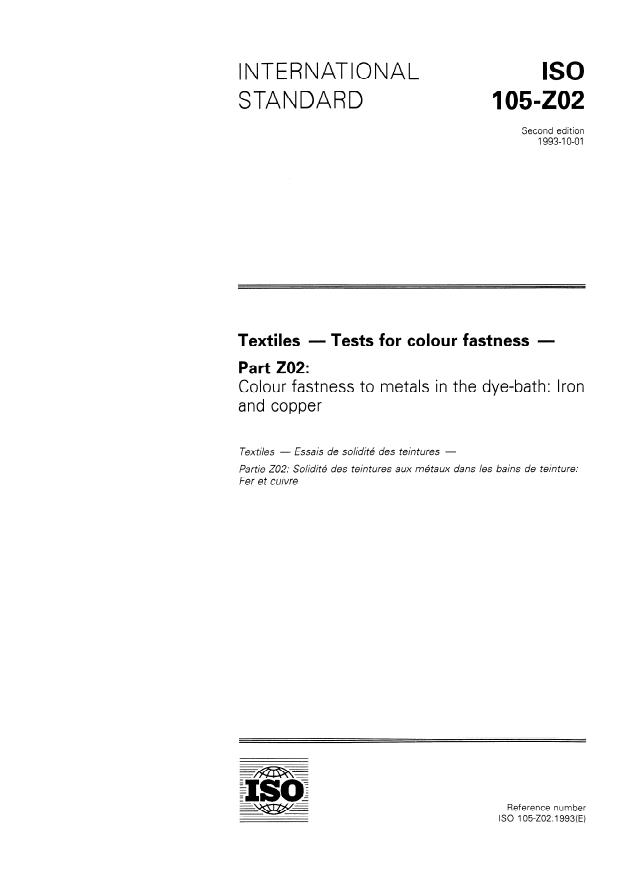
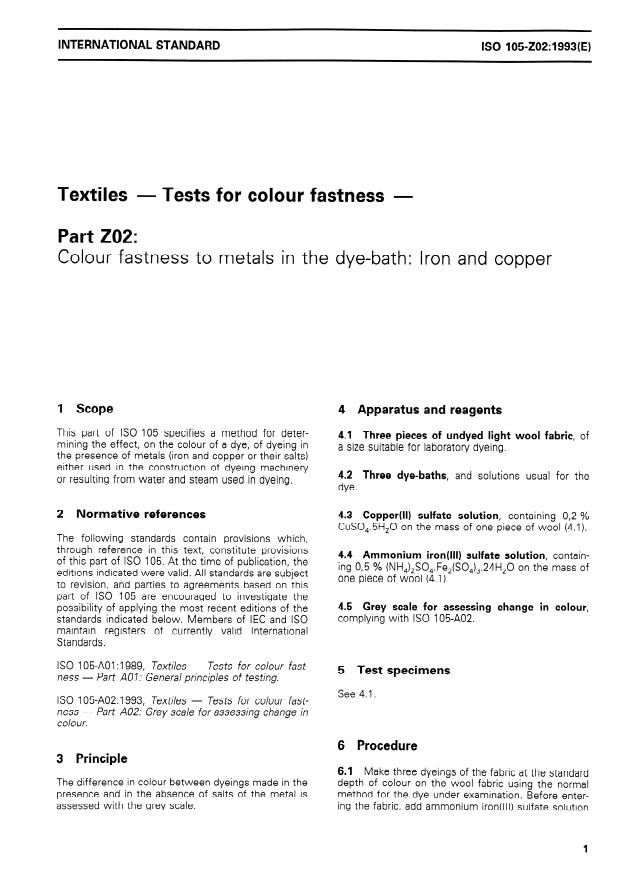
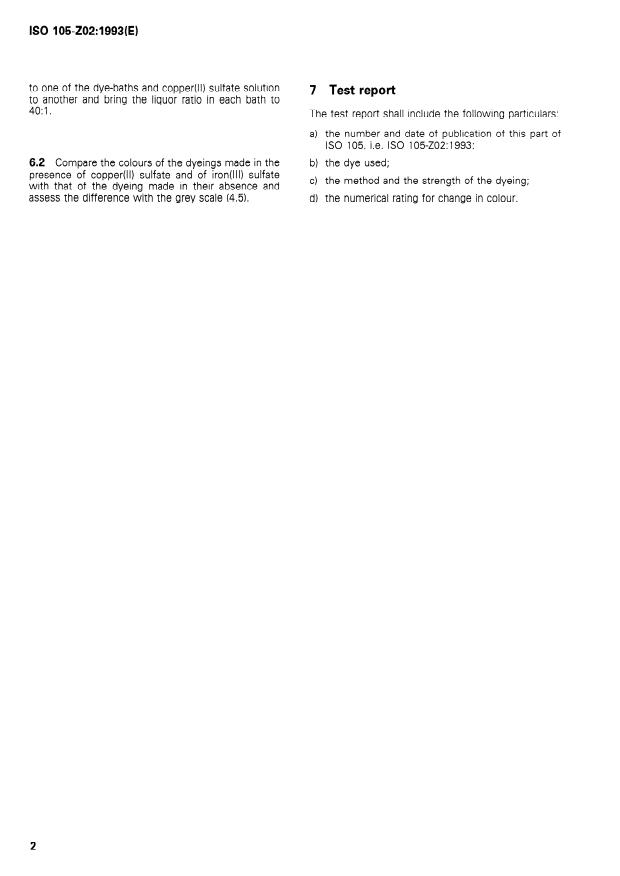
ISO 105-Z02:1993 - Textiles — Tests for colour fastness — Part Z02: Colour fastness to metals in the dye-bath: Iron and copper Released:9/30/1993
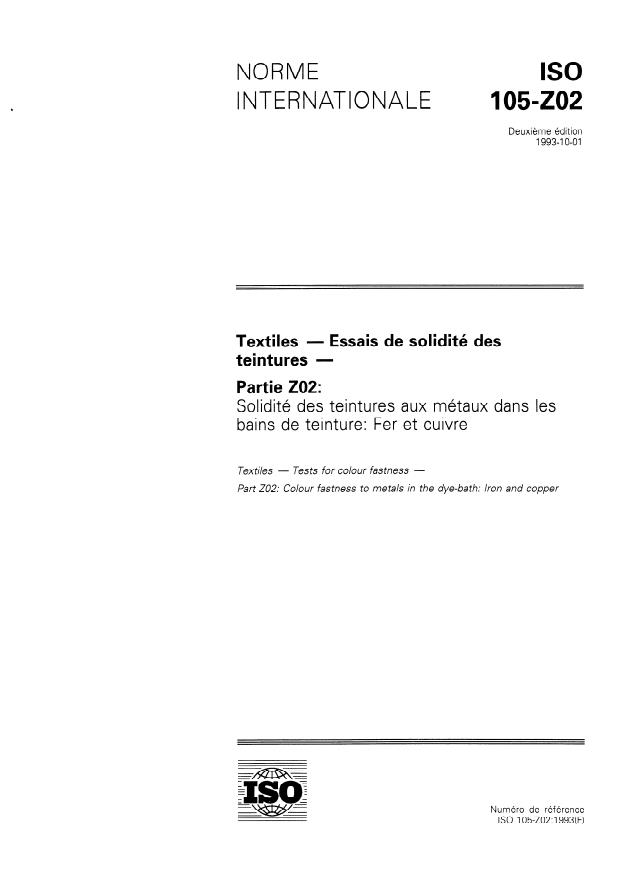
ISO 105-Z02:1993 - Textiles — Essais de solidité des teintures — Partie Z02: Solidité des teintures aux métaux dans les bains de teinture: Fer et cuivre Released:9/30/1993
ISO 105-Z02:1993 - Textiles — Essais de solidité des teintures — Partie Z02: Solidité des teintures aux métaux dans les bains de teinture: Fer et cuivre Released:9/30/1993
Overview
ISO 105-Z02:1993 is an international standard developed by the International Organization for Standardization (ISO) that specifies a method for testing the color fastness of textiles to metals present in the dye-bath, specifically iron and copper. These metals can influence the final color of dyed fabrics due to their presence in dyeing machinery or from water and steam used during the dyeing process. The standard outlines a practical procedure to assess the effect of these metallic salts on dyeing, ensuring consistent quality and color stability in textile products.
Key Topics
Scope and Purpose
The standard applies to textile materials dyed in the laboratory, primarily focusing on lightweight wool fabrics. It measures the difference in color shade when dyeing occurs with and without metal salts of iron and copper.Testing Principle
Dyeings are performed on identical fabric samples under three conditions:- Without any metal salts (control)
- With added copper sulfate (CuSO4·5H2O)
- With added ammonium iron(III) sulfate ((NH4)2SO4·Fe2(SO4)3·24H2O)
The resulting color differences are evaluated against a grey scale to quantify the impact of these metals on color fastness.
Methodology
The test involves- Preparing three dye baths with and without the metallic salts at a 40:1 liquor-to-goods ratio.
- Dyeing three unbleached wool fabric samples under standardized laboratory dyeing conditions.
- Assessing and comparing the color changes using a grey-scale for color fastness evaluation as per ISO 105-A02.
Instrumentation and Materials
Essential tools include standardized wool fabric swatches, dyeing baths, solutions of copper sulfate and ammonium iron(III) sulfate prepared at specified concentrations, and the grey scale for grading.Reporting Results
Test reports must detail the ISO standard version, specific dye used, dyeing method, concentrations, and the grey-scale ratings reflecting the color difference in the treated samples.
Applications
Textile Quality Control
Ensures that textile dyeing processes are not adversely affected by iron and copper contamination, enabling manufacturers to maintain consistent fabric color quality.Dyeing Process Optimization
Helps in identifying and mitigating unwanted color shifts caused by metal ions, improving overall dye selection and process parameters.Machinery and Water Monitoring
Guides manufacturers in evaluating the impact of metallic residues from dyeing equipment or water supply on color fastness, supporting maintenance and water treatment decisions.Product Development and Compliance
Assists textile producers and brands in certifying their products meet color fastness criteria related to metal ion exposure, enhancing customer satisfaction and reducing product returns.
Related Standards
ISO 105-A01:1989 – General principles for textile colorfastness testing, providing the foundational guidelines for performing various colorfastness assessments.
ISO 105-A02:1993 – Grey scale for evaluating color difference and staining, referenced for the assessment of color changes in ISO 105-Z02:1993.
ISO 105-Z – The broader series covering tests for color fastness in textiles, including other environmental and chemical factors affecting dye stability.
ISO/TC 38 – The technical committee responsible for textile standards, offering a suite of standardized tests for fabric performance and quality assurance.
Keywords: ISO 105-Z02:1993, color fastness testing, textile dyeing, iron and copper salts, dye-bath contamination, textile quality control, wool fabric testing, colorfastness grey scale, metal ion effect on dyeing, textile standards.
Buy Documents
ISO 105-Z02:1993 - Textiles — Tests for colour fastness — Part Z02: Colour fastness to metals in the dye-bath: Iron and copper Released:9/30/1993
ISO 105-Z02:1993 - Textiles — Essais de solidité des teintures — Partie Z02: Solidité des teintures aux métaux dans les bains de teinture: Fer et cuivre Released:9/30/1993
ISO 105-Z02:1993 - Textiles — Essais de solidité des teintures — Partie Z02: Solidité des teintures aux métaux dans les bains de teinture: Fer et cuivre Released:9/30/1993
Get Certified
Connect with accredited certification bodies for this standard

Control Union Certifications
Global certification for agriculture and sustainability.

Hohenstein Institut
Textile testing and certification.

Bureau Veritas Bangladesh
Bureau Veritas certification services in Bangladesh.
Sponsored listings
Frequently Asked Questions
ISO 105-Z02:1993 is a standard published by the International Organization for Standardization (ISO). Its full title is "Textiles — Tests for colour fastness — Part Z02: Colour fastness to metals in the dye-bath: Iron and copper". This standard covers: The principle of the method specified is assessing the difference in colour between dyeings made in the presence and in the absence of salts of the metal present (due to its use in the construction of dying machinery or resulting from water and steam used in dyeing) with the grey scale.
The principle of the method specified is assessing the difference in colour between dyeings made in the presence and in the absence of salts of the metal present (due to its use in the construction of dying machinery or resulting from water and steam used in dyeing) with the grey scale.
ISO 105-Z02:1993 is classified under the following ICS (International Classification for Standards) categories: 59.080.01 - Textiles in general. The ICS classification helps identify the subject area and facilitates finding related standards.
ISO 105-Z02:1993 is available in PDF format for immediate download after purchase. The document can be added to your cart and obtained through the secure checkout process. Digital delivery ensures instant access to the complete standard document.
Standards Content (Sample)
INTERNATIONAL
STANDARD
Second edition
1993-10-01
Textiles - Tests for colour fastness -
Part 202:
Colour fastness to metals in the dye-bath: Iron
and topper
Textiles - Essais de soliditk des teintures -
Partie 202: Solidite des teintures aux m&aux dans les bains de teinture:
Fer et cuivre
Reference number
ISO 105-ZO2:1993(E)
ISO 105~202:1993(E)
Foreword
ISO (the International Organization for Standardization) is a worldwide
federation of national Standards bodies (ISO member bodies). The work
of preparing International Standards is normally carried out through ISO
technical committees. Esch member body interested in a subject for
which a technical committee has been established has the right to be
represented on that committee. International organizations, governmental
and non-governmental, in liaison with ISO, also take part in the work. ISO
collaborates closely with the International Electrotechnical Commission
(IEC) on all matters of electrotechnical standardization.
Draft International Standards adopted by the technical committees are
circulated to the member bodies for voting. Publication as an International
Standard requires approval by at least 75 % of the member bodies casting
a vote.
International Standard ISO 105-202 was prepared by Technical Committee
lSO/rC 38, Textiles, Sub-Committee SC 1, Tests for coloured textiles and
coloran ts.
This second edition cancels and replaces the first edition (included in
ISO 105-Z:1978), of which it constitutes a minor revision.
ISO 105 was previously published in thirteen “Parts”, each designated by
a letter (e.g. “Part A”), with publication dates between 1978 and 1985.
Esch part contained a series of “sections”, each designated by the re-
spective part letter and by a two-digit serial number (e.g. “Section AO1 “).
These sections are now being republished as separate documents, them-
selves designated “Parts” but retaining their earlier alphanumeric desig-
nations. A complete list of these Parts is given in ISO 105-AOI .
0 ISO 1993
All rights reserved. No part of this publication may be reproduced or utilized in any form or
by any means, electronie or mechanical, including photocopying and microfilm, without per-
mission in writing from the publisher.
International Organization for Standardization
Case Postale 56 l CH-l 211 Geneve 20 l Switzerland
Printed in Switzerland
ii
~~
ISO i05-Z02:1993(E)
INTERNATIONAL STANDARD
Textiles - Tests for colour fastness -
Part 202:
Colour fastness to metals in the dye-bath: Iron and topper
4 Apparatus and reagents
1 Scope
This part of ISO 105 specifies a method for deter-
4.1 Three pieces of undyed light wo01 fabric, of
mining the effect, on the colour of a dye, of dyeing in
a size suitable for laboratory dyei
...
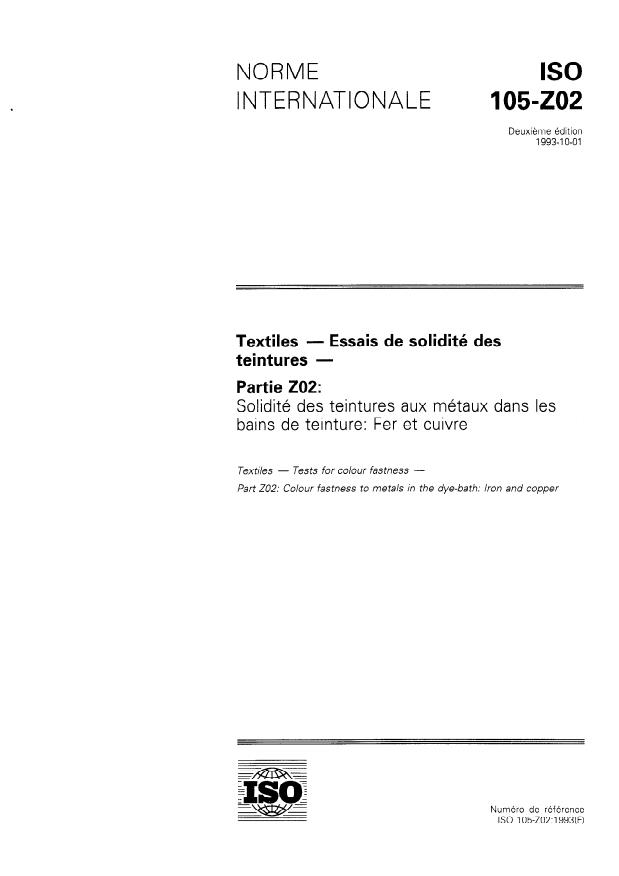
NORME
ISO
INTERNATIONALE
105-2102
Deuxième édition
1993-l O-OI
Textiles - Essais de solidité des
teintures -
Partie 202:
Solidité des teintures aux métaux dans les
bains de teinture: Fer et cuivre
Tex files - Tests for colour fastness -
Part 202: Colour fastness to metals in the dye-bath: Iran and copper
Numéro de référence
ISO 105-202: 1993(F)
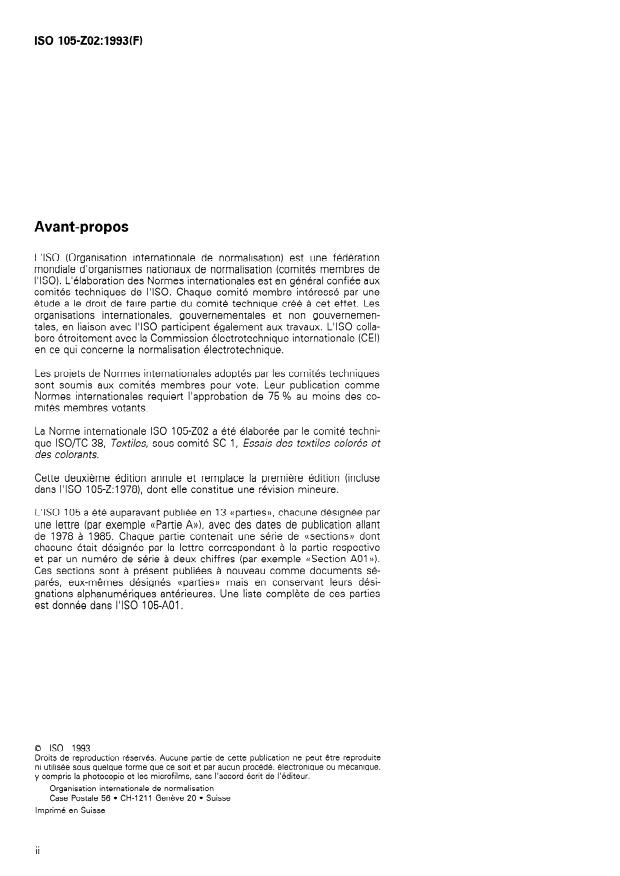
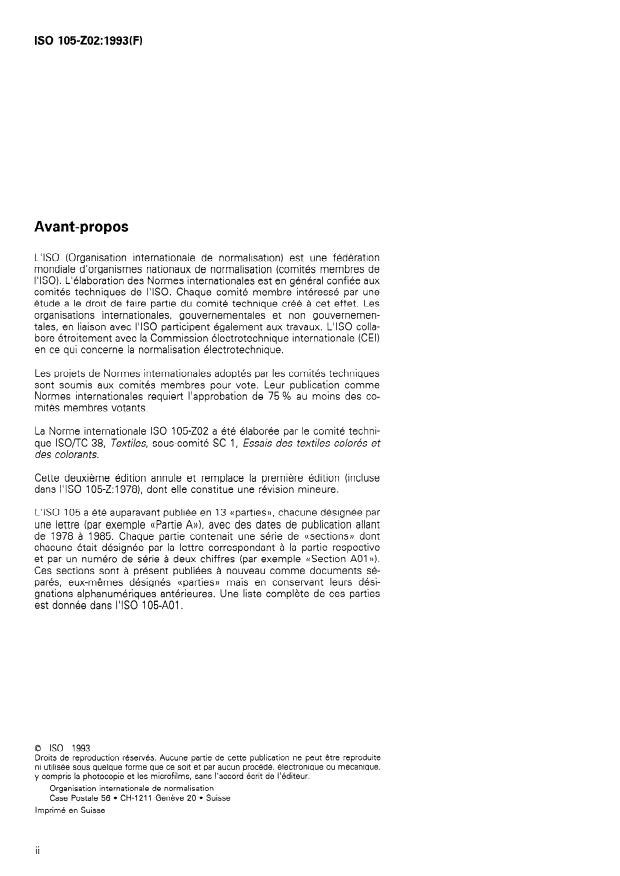
ISO 105-202:1993(F)
Avant-propos
L’ISO (Organisation internationale de normalisation) est une fédération
mondiale d’organismes nationaux de normalisation (comités membres de
I’ISO). L’élaboration des Normes internationales est en général confiée aux
comités techniques de I’ISO. Chaque comité membre intéressé par une
étude a le droit de faire partie du comité technique créé à cet effet. Les
organisations internationales, gouvernementales et non gouvernemen-
tales, en liaison avec I’ISO participent également aux travaux. L’ISO colla-
bore étroitement avec la Commission électrotechnique internationale (CEI)
en ce qui concerne la normalisation électrotechnique.
Les projets de Normes internationales adoptés par les comités techniques
sont soumis aux comités membres pour vote. Leur publication comme
Normes internationales requiert l’approbation de 75 % au moins des co-
mités membres votants.
La Norme internationale ISO 105-202 a été élaborée par le comité techni-
que lSO/TC 38, Textiles, sous-comité SC 1, Essais des textiles colorés et
des colorants.
Cette deuxième édition annule et remplace la première édition (incluse
dans I’ISO 105-Z:1978), dont elle constitue une révision mineure.
L’ISO 105 a été auparavant publiée en 13 ((parties), chacune désignée par
une lettre (par exemple ((Partie A»), avec des dates de publication allant
de 1978 à 1985. Chaque partie contenait une série de ((sections) dont
chacune était désignée par la lettre correspondant à la partie respective
et par un numéro de série à deux chiffres (par exemple (Section A01 1)).
Ces sections sont à présent publiées à nouveau comme documents sé-
parés, eux-mêmes désignés «parties» mais en conservant leurs dési-
gnations alphanumériques antérieures. Une liste complète de ces parties
est donnée dans I’ISO 105-AOl.
0 60 1993
Droits de reproduction réservés. Aucune partie de cette publication ne peut être reproduite
ni utilisée sous quelque forme que ce soit et par aucun procédé, électronique ou mécanique,
y compris la photocopie et les microfilms, sans l’accord écrit de l’éditeur.
Organisation internationale de normalisation
Case Postale 56 l CH-l 211 Genève 20 l Suisse
Imprimé en Suisse
ii
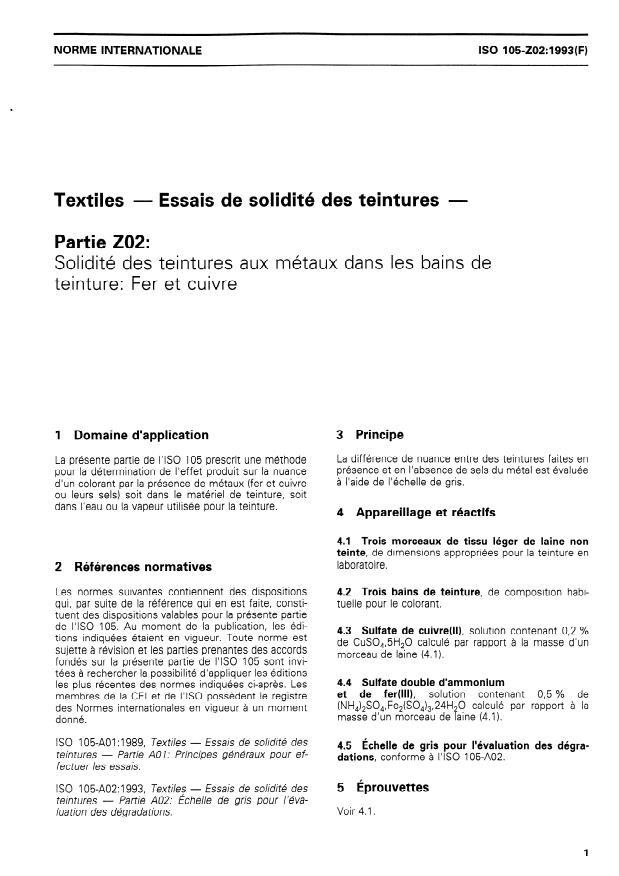
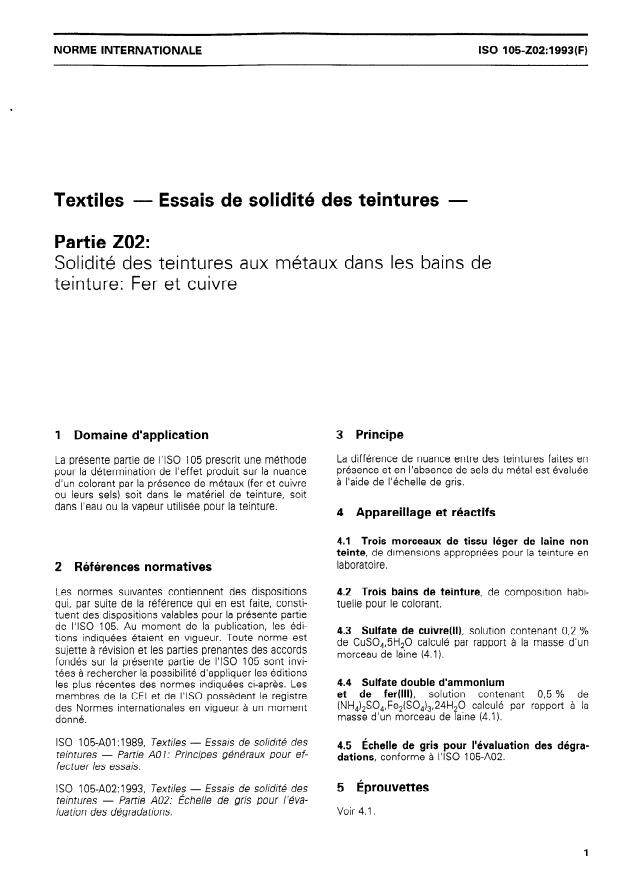
NORME INTERNATIONALE ISO 105-202:1993(F)
Textiles - Essais de solidité des teintures -
Partie 202:
Solidité des teintures aux métaux dans les bains de
teinture: Fer et cuivre
1 Domaine d’application 3 Principe
La différence de nuance entre des teintures faites en
La présente partie de I’ISO 105 prescrit une méthode
présence et en l’absence de sels du métal est évaluée
pour la détermination de l’effet produit sur la nuance
à l’aide de l’échelle de gris.
d’un colorant par la présence de métaux (fer et cuivre
ou leurs sels
...
NORME
ISO
INTERNATIONALE
105-2102
Deuxième édition
1993-l O-OI
Textiles - Essais de solidité des
teintures -
Partie 202:
Solidité des teintures aux métaux dans les
bains de teinture: Fer et cuivre
Tex files - Tests for colour fastness -
Part 202: Colour fastness to metals in the dye-bath: Iran and copper
Numéro de référence
ISO 105-202: 1993(F)
ISO 105-202:1993(F)
Avant-propos
L’ISO (Organisation internationale de normalisation) est une fédération
mondiale d’organismes nationaux de normalisation (comités membres de
I’ISO). L’élaboration des Normes internationales est en général confiée aux
comités techniques de I’ISO. Chaque comité membre intéressé par une
étude a le droit de faire partie du comité technique créé à cet effet. Les
organisations internationales, gouvernementales et non gouvernemen-
tales, en liaison avec I’ISO participent également aux travaux. L’ISO colla-
bore étroitement avec la Commission électrotechnique internationale (CEI)
en ce qui concerne la normalisation électrotechnique.
Les projets de Normes internationales adoptés par les comités techniques
sont soumis aux comités membres pour vote. Leur publication comme
Normes internationales requiert l’approbation de 75 % au moins des co-
mités membres votants.
La Norme internationale ISO 105-202 a été élaborée par le comité techni-
que lSO/TC 38, Textiles, sous-comité SC 1, Essais des textiles colorés et
des colorants.
Cette deuxième édition annule et remplace la première édition (incluse
dans I’ISO 105-Z:1978), dont elle constitue une révision mineure.
L’ISO 105 a été auparavant publiée en 13 ((parties), chacune désignée par
une lettre (par exemple ((Partie A»), avec des dates de publication allant
de 1978 à 1985. Chaque partie contenait une série de ((sections) dont
chacune était désignée par la lettre correspondant à la partie respective
et par un numéro de série à deux chiffres (par exemple (Section A01 1)).
Ces sections sont à présent publiées à nouveau comme documents sé-
parés, eux-mêmes désignés «parties» mais en conservant leurs dési-
gnations alphanumériques antérieures. Une liste complète de ces parties
est donnée dans I’ISO 105-AOl.
0 60 1993
Droits de reproduction réservés. Aucune partie de cette publication ne peut être reproduite
ni utilisée sous quelque forme que ce soit et par aucun procédé, électronique ou mécanique,
y compris la photocopie et les microfilms, sans l’accord écrit de l’éditeur.
Organisation internationale de normalisation
Case Postale 56 l CH-l 211 Genève 20 l Suisse
Imprimé en Suisse
ii
NORME INTERNATIONALE ISO 105-202:1993(F)
Textiles - Essais de solidité des teintures -
Partie 202:
Solidité des teintures aux métaux dans les bains de
teinture: Fer et cuivre
1 Domaine d’application 3 Principe
La différence de nuance entre des teintures faites en
La présente partie de I’ISO 105 prescrit une méthode
présence et en l’absence de sels du métal est évaluée
pour la détermination de l’effet produit sur la nuance
à l’aide de l’échelle de gris.
d’un colorant par la présence de métaux (fer et cuivre
ou leurs sels
...