


ISO 8968-3:2004
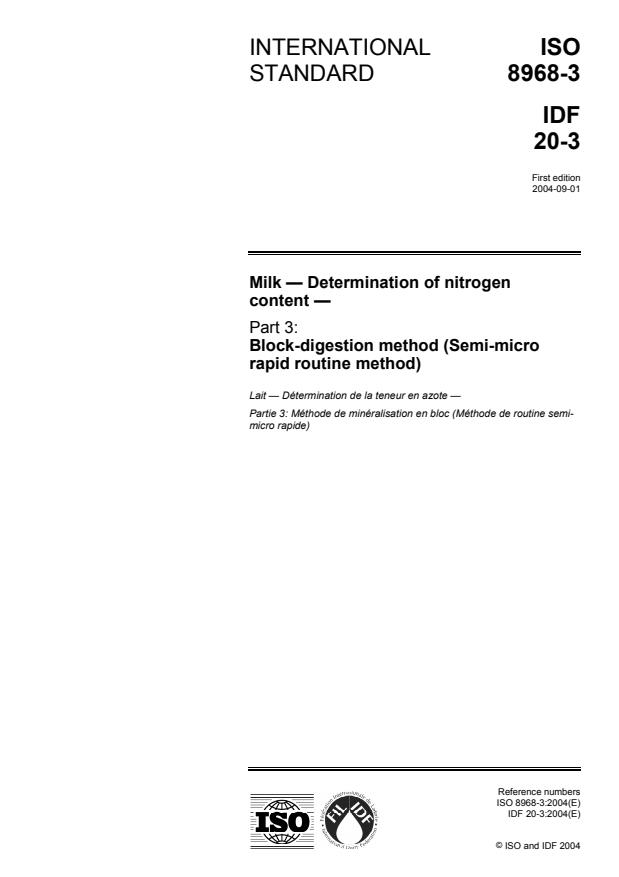
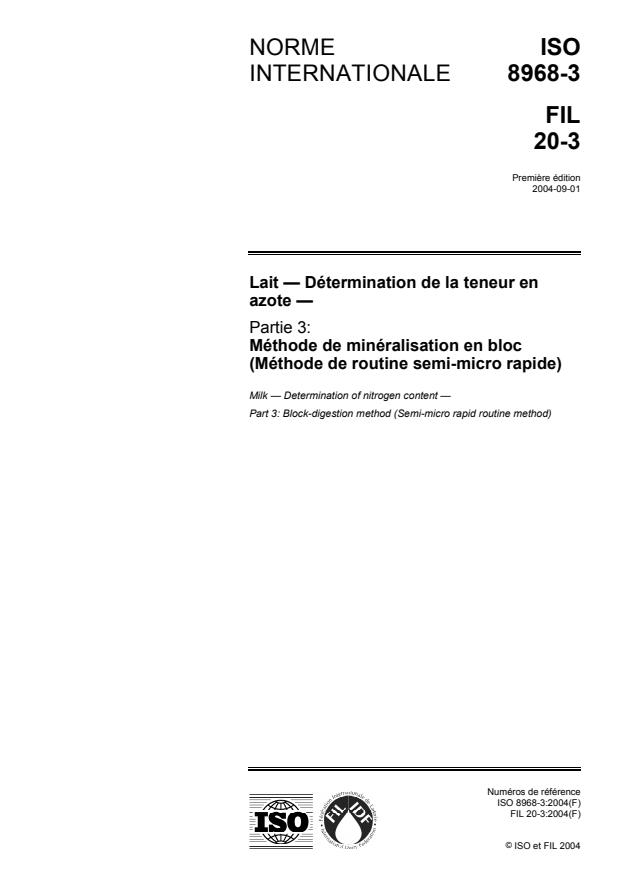
(Main)Milk — Determination of nitrogen content — Part 3: Block-digestion method (Semi-micro rapid routine method)
Milk — Determination of nitrogen content — Part 3: Block-digestion method (Semi-micro rapid routine method)
ISO 8968-3|IDF 20-3:2004 specifies a method for the determination of the nitrogen content of liquid, whole or skimmed milk. It concerns a semi-micro rapid routine method following the block-digestion principle.
Lait — Détermination de la teneur en azote — Partie 3: Méthode de minéralisation en bloc (Méthode de routine semi-micro rapide)
L'ISO 8968-3|FIL 20-3:2004 spécifie une méthode de détermination de la teneur en azote du lait liquide, entier ou écrémé. Elle concerne une méthode de routine semi-micro rapide, fondée sur le principe de la minéralisation en bloc.
General Information
- Status
- Published
- Publication Date
- 31-Aug-2004
- Technical Committee
- ISO/TC 34/SC 5 - Milk and milk products
- Drafting Committee
- ISO/TC 34/SC 5 - Milk and milk products
- Current Stage
- 9093 - International Standard confirmed
- Start Date
- 12-Mar-2024
- Completion Date
- 12-Feb-2026
Overview
ISO 8968-3:2004 - Milk - Determination of nitrogen content - Part 3: Block‑digestion method (Semi‑micro rapid routine method) specifies a laboratory procedure for measuring the nitrogen content of liquid milk (whole or skimmed). The method is a semi‑micro, rapid routine variant of Kjeldahl/block digestion that reduces digestion time by using smaller test portions and adding hydrogen peroxide together with concentrated sulfuric acid and a catalyst. Results are reported as mass fraction of nitrogen calculated from the ammonia liberated and distilled from the digest.
Key topics and technical requirements
- Scope: Applicable to liquid whole and skimmed milk; semi‑micro rapid routine block‑digestion approach.
- Principle: Organic nitrogen → ammonium sulfate via digestion with H2SO4 + H2O2 + catalyst; alkalize digest to liberate NH3; steam distil ammonia and quantify by titration.
- Typical test portion and reagents:
- Test portion: approximately 2 g of prepared milk sample.
- Kjeldahl catalyst tablets (example composition provided: 3.5 g K2SO4, 0.105 g CuSO4·5H2O, 0.105 g TiO2 per tablet).
- Sulfuric acid (95–98 %), hydrogen peroxide (~30 %), antifoaming agent, NaOH (≈40 g/100 ml).
- Boric acid titration solutions (e.g., 40.0 g/l and 10.0 g/l formulations) and HCl standard volumetric solutions (c(HCl) = 0.1 mol/l; 0.05 mol/l recommended for manual titration).
- Apparatus: Digestion block and tubes, exhaust manifold with scrubber, steam distillation unit (manual/semi‑automatic/automatic), burette or automatic titrator with pH/photometric endpoint detection, analytical balance, water bath.
- Procedure options: Manual or automated steam distillation and titration; photometric or pH endpoint detection when using automatic distillers/titrators.
- Quality/control: Blank tests, recovery checks (using ammonium sulfate, amino acids or sucrose), precision data and test reporting requirements are included.
- Safety: Standard warns of hazardous materials and operations (strong acids, oxidizers, heated digestion, ammonia) - users must apply appropriate laboratory safety and local regulations.
Practical applications
- Routine nitrogen/protein monitoring in dairy quality control and production labs.
- Regulatory compliance testing and labeling verification for milk composition.
- Research labs performing comparative analyses of milk nitrogen fractions when combined with other ISO 8968 parts.
- Rapid throughput environments where reduced digestion time and smaller sample sizes improve efficiency.
Who should use this standard
- Dairy industry QC/QA chemists and laboratory managers
- Contract analytical and food testing laboratories
- Regulatory agencies and standards bodies overseeing milk composition
- Researchers in dairy science and food chemistry
Related standards
- ISO 8968 series: Part 1 (Kjeldahl method), Part 2 (block‑digestion macro method), Part 4 (non‑protein‑nitrogen), Part 5 (protein‑nitrogen)
- ISO 707 (milk sampling recommendations)
- ISO 385 (laboratory burettes)
Keywords: ISO 8968-3:2004, milk nitrogen determination, block-digestion, semi-micro rapid routine method, Kjeldahl, steam distillation, boric acid titration, dairy laboratory.
Get Certified
Connect with accredited certification bodies for this standard

BSI Group
BSI (British Standards Institution) is the business standards company that helps organizations make excellence a habit.

Bureau Veritas
Bureau Veritas is a world leader in laboratory testing, inspection and certification services.

DNV
DNV is an independent assurance and risk management provider.
Sponsored listings
Frequently Asked Questions
ISO 8968-3:2004 is a standard published by the International Organization for Standardization (ISO). Its full title is "Milk — Determination of nitrogen content — Part 3: Block-digestion method (Semi-micro rapid routine method)". This standard covers: ISO 8968-3|IDF 20-3:2004 specifies a method for the determination of the nitrogen content of liquid, whole or skimmed milk. It concerns a semi-micro rapid routine method following the block-digestion principle.
ISO 8968-3|IDF 20-3:2004 specifies a method for the determination of the nitrogen content of liquid, whole or skimmed milk. It concerns a semi-micro rapid routine method following the block-digestion principle.
ISO 8968-3:2004 is classified under the following ICS (International Classification for Standards) categories: 67.100.10 - Milk and processed milk products. The ICS classification helps identify the subject area and facilitates finding related standards.
ISO 8968-3:2004 is available in PDF format for immediate download after purchase. The document can be added to your cart and obtained through the secure checkout process. Digital delivery ensures instant access to the complete standard document.
Standards Content (Sample)
INTERNATIONAL ISO
STANDARD 8968-3
IDF
20-3
First edition
2004-09-01
Milk — Determination of nitrogen
content —
Part 3:
Block-digestion method (Semi-micro
rapid routine method)
Lait — Détermination de la teneur en azote —
Partie 3: Méthode de minéralisation en bloc (Méthode de routine semi-
micro rapide)
Reference numbers
IDF 20-3:2004(E)
©
ISO and IDF 2004
IDF 20-3:2004(E)
PDF disclaimer
This PDF file may contain embedded typefaces. In accordance with Adobe's licensing policy, this file may be printed or viewed but
shall not be edited unless the typefaces which are embedded are licensed to and installed on the computer performing the editing. In
downloading this file, parties accept therein the responsibility of not infringing Adobe's licensing policy. Neither the ISO Central
Secretariat nor the IDF accepts any liability in this area.
Adobe is a trademark of Adobe Systems Incorporated.
Details of the software products used to create this PDF file can be found in the General Info relative to the file; the PDF-creation
parameters were optimized for printing. Every care has been taken to ensure that the file is suitable for use by ISO member bodies
and IDF national committees. In the unlikely event that a problem relating to it is found, please inform the ISO Central Secretariat at the
address given below.
© ISO and IDF 2004
All rights reserved. Unless otherwise specified, no part of this publication may be reproduced or utilized in any form or by any means,
electronic or mechanical, including photocopying and microfilm, without permission in writing from either ISO or IDF at the respective
address below.
ISO copyright office International Dairy Federation
Case postale 56 • CH-1211 Geneva 20 Diamant Building • Boulevard Auguste Reyers 80 • B-1030 Brussels
Tel. + 41 22 749 01 11 Tel. + 32 2 733 98 88
Fax + 41 22 749 09 47 Fax + 32 2 733 04 13
E-mail copyright@iso.org E-mail info@fil-idf.org
Web www.iso.org Web www.fil-idf.org
Published in Switzerland
ii © ISO and IDF 2004 – All rights reserved
IDF 20-3:2004(E)
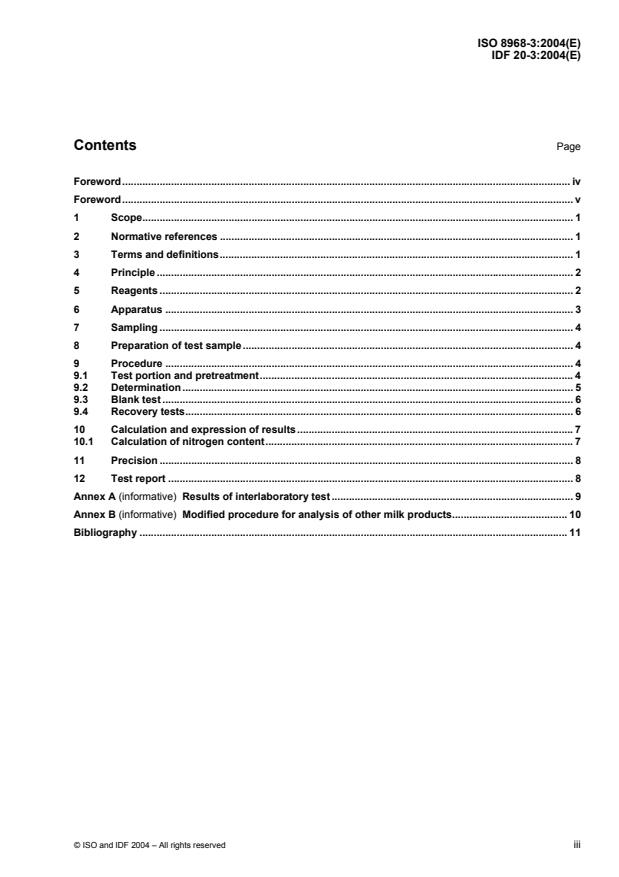
Contents Page
Foreword. iv
Foreword. v
1 Scope. 1
2 Normative references . 1
3 Terms and definitions. 1
4 Principle . 2
5 Reagents . 2
6 Apparatus . 3
7 Sampling . 4
8 Preparation of test sample. 4
9 Procedure . 4
9.1 Test portion and pretreatment. 4
9.2 Determination . 5
9.3 Blank test . 6
9.4 Recovery tests. 6
10 Calculation and expression of results. 7
10.1 Calculation of nitrogen content. 7
11 Precision . 8
12 Test report . 8
Annex A (informative) Results of interlaboratory test . 9
Annex B (informative) Modified procedure for analysis of other milk products. 10
Bibliography . 11
IDF 20-3:2004(E)
Foreword
ISO (the International Organization for Standardization) is a worldwide federation of national standards
bodies (ISO member bodies). The work of preparing International Standards is normally carried out through
ISO technical committees. Each member body interested in a subject for which a technical committee has
been established has the right to be represented on that committee. International organizations, governmental
and non-governmental, in liaison with ISO, also take part in the work. ISO collaborates closely with the
International Electrotechnical Commission (IEC) on all matters of electrotechnical standardization.
International Standards are drafted in accordance with the rules given in the ISO/IEC Directives, Part 2.
The main task of technical committees is to prepare International Standards. Draft International Standards
adopted by the technical committees are circulated to the member bodies for voting. Publication as an
International Standard requires approval by at least 75 % of the member bodies casting a vote.
Attention is drawn to the possibility that some of the elements of this document may be the subject of patent
rights. ISO shall not be held responsible for identifying any or all such patent rights.
ISO 8968-3IDF 20-3 was prepared by Technical Committee ISO/TC 34, Food products, Subcommittee SC 5,
Milk and milk products, and the International Dairy Federation (IDF), in collaboration with AOAC International.
It is being published jointly by ISO and IDF and separately by AOAC International.
ISO 8968IDF 20 consists of the following parts, under the general title Milk — Determination of nitrogen
content:
Part 1: Kjeldahl method
Part 2: Block-digestion method (Macro method)
Part 3: Block-digestion method (Semi-micro rapid routine method)
Part 4: Determination of non-protein-nitrogen content
Part 5: Determination of protein-nitrogen content
iv © ISO and IDF 2004 – All rights reserved
IDF 20-3:2004(E)
Foreword
IDF (the International Dairy Federation) is a worldwide federation of the dairy sector with a National
Committee in every member country. Every National Committee has the right to be represented on the IDF
Standing Committees carrying out the technical work. IDF collaborates with ISO and AOAC International in
the development of standard methods of analysis and sampling for milk and milk products.
Draft International Standards adopted by the Action Teams and Standing Committees are circulated to the
National Committees for voting. Publication as an International Standard requires approval by at least 50 % of
IDF National Committees casting a vote.
ISO 8968-3IDF 20-3 was prepared by Technical Committee ISO/TC 34, Food products, Subcommittee SC 5,
Milk and milk products, and the International Dairy Federation (IDF), in collaboration with AOAC International.
It is being published jointly by ISO and IDF and separately by AOAC International.
All work was carried out by the Joint ISO/IDF/AOAC Action Team, Nitrogen compounds, of the Standing
Committee on Main components of milk, under the aegis of its project leader Mrs S. Berman (IL).
This edition of ISO 8968-3IDF 20-3 cancels and replaces IDF 20-3:1993, which has been technically revised.
ISO 8968IDF 20 consists of the following parts, under the general title Milk — Determination of nitrogen
content:
Part 1: Kjeldahl method
Part 2: Block-digestion method (Macro method)
Part 3: Block-digestion method (Semi-micro rapid routine method)
Part 4: Determination of non-protein-nitrogen content
Part 5: Determination of protein-nitrogen content
INTERNATIONAL STANDARD
IDF 20-3:2004(E)
Milk — Determination of nitrogen content —
Part 3:
Block-digestion method (Semi-micro rapid routine method)
WARNING — The use of this part of ISO 8968IDF 20 may involve the use of hazardous materials,
operations and equipment. This standard does not purport to address all the safety risks associated
with its use. It is the responsibility of the user of this standard to establish appropriate safety and
health practices and determine the applicability of local regulatory limitations prior to use.
1 Scope
This part of ISO 8968IDF 20 specifies a method for the determination of the nitrogen content of liquid, whole
or skimmed milk.
It concerns a semi-micro rapid routine method following the block-digestion principle.
NOTE The method is a more rapid method than that described in ISO 8968-1IDF 20-1 and ISO 8968-2IDF 20-2
since the digestion time is reduced by taking a lower mass of test portion and using hydrogen peroxide together with
sulfuric acid and a catalyst in the digestion.
2 Normative references
The following referenced documents are indispensable for the application of this document. For dated
references, only the edition cited applies. For undated references, the latest edition of the referenced
document (including any amendments) applies.
1)
ISO 385:— , Laboratory glassware — Burettes
3 Terms and definitions
For the purposes of this document, the following terms and definitions apply.
3.1
nitrogen content
mass fraction of nitrogen determined by the procedure specified in this part of ISO 8968IDF 20.
NOTE The nitrogen content is expressed as a percentage by mass.
1) To be published. (Revision of ISO 385-1:1984, ISO 385-2:1984 and ISO 385-3:1984)
IDF 20-3:2004(E)
4 Principle
A test portion is digested by using a block-digestion apparatus with a mixture of concentrated sulfuric acid,
hydrogen peroxide and potassium sulfate, together with a catalyst to convert the organic nitrogen present to
ammonium sulfate. Excess sodium hydroxide is added to the cooled digest to liberate ammonia.
The liberated ammonia is distilled using a manual, semi-automatic or fully automatic steam distillation unit. In
the case of manual or semi-automatic steam distillation, the ammonia is distilled into excess boric acid
solution then titrated with hydrochloric acid solution. Where a fully automatic distillation unit is employed,
titration of the ammonia is carried out automatically with endpoint detection using a photometric or pH system.
The nitrogen content is calculated from the amount of ammonia produced.
5 Reagents
Use only reagents of recognized analytical grade, unless otherwise specified, and distilled or demineralized
water.
5.1 Kjeldahl catalyst tablets
These tablets may be purchased commercially. Tablets comprising 3,5 g of potassium sulfate, 0,105 g of
copper(II) sulfate pentahydrate and 0,105 g of titanium dioxide per tablet are suitable.
Other types of tablet may be used provided that
a) they contain a quantity of potassium sulfate such that 7 g of potassium sulfate can be dispensed using an
integer number of whole tablets, and
b) they contain no salts of toxic metals such as selenium or mercury.
5.2 Sulfuric acid (H SO), with mass fraction of at least 95 % to 98 %, nitrogen free
2 4
[ρ (H SO ) = 1,84 g/ml approximately].
20 2 4
5.3 Hydrogen peroxide solution (H O ), approximately 30 g of H O per 100 ml.
2 2 2 2
5.4 Antifoaming agent
A silicone preparation is recommended, for example with a mass fraction of 30 % aqueous emulsion.
5.5 Sodium hydroxide solution (NaOH), nitrogen free, containing approximately 40 g of NaOH per
100 ml.
5.6 Boric acid solutions
5.6.1 Boric acid solution, c(H BO ) = 40,0 g/l.
3 3
Dissolve 40,0 g of boric acid in 1 litre of hot water in a 1 000 ml one-mark volumetric flask. Allow the flask and
its contents to cool to 20 °C. Add 3 ml of indicator solution (5.7.1). Adjust to the mark with water and mix well.
Store the solution, which will be light orange in colour, in a borosilicate glass bottle. Protect the solution from
light and sources of ammonia fumes during storage.
5.6.2 Boric acid solution, c(H BO ) = 10,0 g/l, to be used in the photometric endpoint titration.
3 3
Dissolve 10,0 g of boric acid in 1 litre of hot water in a 1 000 ml one-mark volumetric flask. Allow the flask and
its contents to cool to 20 °C. Add 7 ml of methyl red solution (5.7.2) and 10 ml of bromocresol green solution
(5.7.2) and mix.
2 © ISO and IDF 2004 – All rights reserved
IDF 20-3:2004(E)
Dilute to the 1 000 ml mark with water and mix well. Neutralize the boric acid solution with 0,1 mol/l sodium
hydroxide until its colour changes to green.
NOTE The addition of 3 ml of 0,1 mol/l NaOH into 1 litre of 1 % boric acid usually gives good adjustments.
5.7 Indicator solutions
5.7.1 Indicator solution to be used in the pH endpoint titration
Dissolve 0,1 g of methyl red in 95 % (volume fraction) ethanol. Dilute to 50 ml with the ethanol. Dissolve 0,5 g
of bromocresol green in a small quantity of 95 % (volume fraction) ethanol. Dilute to 250 ml with the ethanol.
Mix amounts of one part of methyl red solution with five parts of bromocresol green solution, or combine and
mix both solutions.
5.7.2 Indicator solution to be used in the boric acid solution (5.6.2) for the photometric endpoint
titration
a) Dissolve 0,1 g of bromocresol green in 100 ml of 95 % (volume fraction) ethanol.
b) Dissolve 0,1 g of methyl red in 100 ml of 95 % (volume fraction) ethanol.
5.8 Hydrochloric acid standard volumetric solution, c(HCl) = (0,1 ± 0,0005) mol/l.
If the titration (9.2.3) is carried out manually, the use of a more diluted hydrochloric acid standard volumetric
solution, c(HCl) = (0,05 ± 0,0005) mol/l, is recommended.
5.9 Ammonium sulfate [(NH ) SO ], minimum assay 99,9 % (mass fraction) on dried material.
4 2 4
Immediately before use, dry the ammonium sulfate at 102 °C ± 2 °C for not less than 2 h. Cool to room
temperature in a desiccator.
5.10 Tryptophan (C H N O ) or lysine hydrochloride (C H CIN O ), minimum assay 99 % (mass
11 12 2 2 6 15 2 2
fraction).
Do not dry the reagents in an oven before use.
5.11 Sucrose, with a nitrogen content of not more than 0,002 % (mass fraction).
Do not dry the sucrose in an oven before use.
6 Apparatus
Usual laboratory apparatus and, in particular, the following.
6.1 Water bath, capable of being maintained at between 38 °C and 40 °C.
6.2 Analytical balance, capable of weighing to the nearest 1 mg, with readability to 0,1 mg.
6.3 Digestion block, aluminium alloy block or equivalent block, fitted with an adjustable temperature
control and device for measuring block temperature.
6.4 Digestion tubes, of capacity 250 ml, suitable for use with the digestion block (6.3).
6.5 Exhaust manifold, suitable for use with the digestion tubes (6.4).
IDF 20-3:2004(E)
6.6 Centrifugal scrubber apparatus, filter pump or aspirator, constructed of acid-resistant material, for use
with mains water supply.
6.7 Automatic pipettes (dispensers), of capacity 5 ml and 10 ml.
6.8 Graduated measuring cylinders, of capacity 50 ml.
6.9 Distillation unit, capable of steam distilling, manual or semi-automatic, suited to accept the digestion
tubes (6.4) and the conical flasks (6.10).
6.10 Conical flasks, of capacity 250 ml.
6.11 Burette, of capacity 25 ml, with a readability of at least 0,01 ml, complying with the requirements of
ISO 385:—, class A.
...
NORME ISO
INTERNATIONALE 8968-3
FIL
20-3
Première édition
2004-09-01
Lait — Détermination de la teneur en
azote —
Partie 3:
Méthode de minéralisation en bloc
(Méthode de routine semi-micro rapide)
Milk — Determination of nitrogen content —
Part 3: Block-digestion method (Semi-micro rapid routine method)
Numéros de référence
FIL 20-3:2004(F)
©
ISO et FIL 2004
FIL 20-3:2004(F)
PDF – Exonération de responsabilité
Le présent fichier PDF peut contenir des polices de caractères intégrées. Conformément aux conditions de licence d'Adobe, ce fichier
peut être imprimé ou visualisé, mais ne doit pas être modifié à moins que l'ordinateur employé à cet effet ne bénéficie d'une licence
autorisant l'utilisation de ces polices et que celles-ci y soient installées. Lors du téléchargement de ce fichier, les parties concernées
acceptent de fait la responsabilité de ne pas enfreindre les conditions de licence d'Adobe. Le Secrétariat central de l'ISO et la FIL
déclinent toute responsabilité en la matière.
Adobe est une marque déposée d'Adobe Systems Incorporated.
Les détails relatifs aux produits logiciels utilisés pour la création du présent fichier PDF sont disponibles dans la rubrique General Info
du fichier; les paramètres de création PDF ont été optimisés pour l'impression. Toutes les mesures ont été prises pour garantir
l'exploitation de ce fichier par les comités membres de l'ISO et les comités nationaux de la FIL. Dans le cas peu probable où
surviendrait un problème d'utilisation, veuillez en informer le Secrétariat central de l'ISO à l'adresse donnée ci-dessous.
© ISO et FIL 2004
Droits de reproduction réservés. Sauf prescription différente, aucune partie de cette publication ne peut être reproduite ni utilisée sous
quelque forme que ce soit et par aucun procédé, électronique ou mécanique, y compris la photocopie et les microfilms, sans l'accord écrit
soit de l'ISO soit de la FIL à l'adresse respective ci-après.
ISO copyright office Fédération Internationale de Laiterie
Case postale 56 • CH-1211 Geneva 20 Diamant Building • Boulevard Auguste Reyers 80 • B-1030 Bruxelles
Tel. + 41 22 749 01 11 Tel. + 32 2 733 98 88
Fax + 41 22 749 09 47 Fax + 32 2 733 04 13
E-mail copyright@iso.org E-mail info@fil-idf.org
Web www.iso.org Web www.fil-idf.org
Version française parue en 2005
Publié en Suisse
ii © ISO et FIL 2004 – Tous droits réservés
FIL 20-3:2004(F)
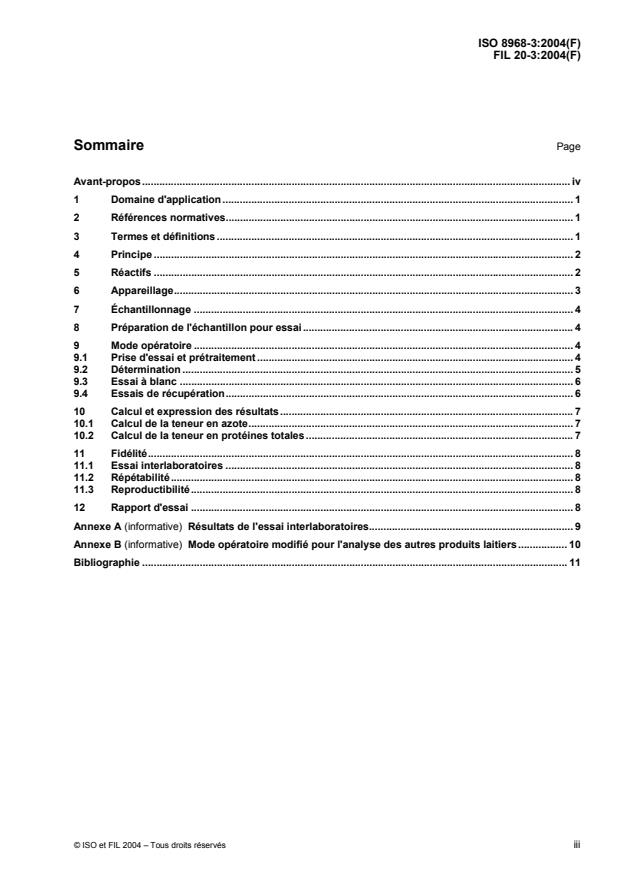
Sommaire Page
Avant-propos. iv
1 Domaine d'application. 1
2 Références normatives. 1
3 Termes et définitions . 1
4 Principe . 2
5 Réactifs . 2
6 Appareillage. 3
7 Échantillonnage . 4
8 Préparation de l'échantillon pour essai. 4
9 Mode opératoire . 4
9.1 Prise d'essai et prétraitement . 4
9.2 Détermination . 5
9.3 Essai à blanc . 6
9.4 Essais de récupération. 6
10 Calcul et expression des résultats. 7
10.1 Calcul de la teneur en azote. 7
10.2 Calcul de la teneur en protéines totales. 7
11 Fidélité. 8
11.1 Essai interlaboratoires . 8
11.2 Répétabilité. 8
11.3 Reproductibilité. 8
12 Rapport d'essai . 8
Annexe A (informative) Résultats de l'essai interlaboratoires. 9
Annexe B (informative) Mode opératoire modifié pour l'analyse des autres produits laitiers . 10
Bibliographie . 11
© ISO et FIL 2004 – Tous droits réservés iii
FIL 20-3:2004(F)
Avant-propos
L'ISO (Organisation internationale de normalisation) est une fédération mondiale d'organismes nationaux
de normalisation (comités membres de l'ISO). L'élaboration des Normes internationales est en général
confiée aux comités techniques de l'ISO. Chaque comité membre intéressé par une étude a le droit de faire
partie du comité technique créé à cet effet. Les organisations internationales, gouvernementales et non
gouvernementales, en liaison avec l'ISO participent également aux travaux. L'ISO collabore étroitement avec
la Commission électrotechnique internationale (CEI) en ce qui concerne la normalisation électrotechnique.
Les Normes internationales sont rédigées conformément aux règles données dans les Directives ISO/CEI,
Partie 2.
La tâche principale des comités techniques est d'élaborer les Normes internationales. Les projets de Normes
internationales adoptés par les comités techniques sont soumis aux comités membres pour vote. Leur
publication comme Normes internationales requiert l'approbation de 75 % au moins des comités membres
votants.
L'attention est appelée sur le fait que certains des éléments du présent document peuvent faire l'objet de
droits de propriété intellectuelle ou de droits analogues. L'ISO ne saurait être tenue pour responsable de ne
pas avoir identifié de tels droits de propriété et averti de leur existence.
L'ISO 8968-3FIL 20-3 a été élaborée par le comité technique ISO/TC 34, Produits alimentaires, sous-comité
SC 5, Lait et produits laitiers, et la Fédération internationale de laiterie (FIL), en collaboration avec l'AOAC
International. Elle est publiée conjointement par l'ISO et la FIL, et séparément par l'AOAC International.
L'ISO 8968FIL 20 comprend les parties suivantes, présentées sous le titre général Lait — Détermination de
la teneur en azote:
Partie 1: Méthode Kjeldahl
Partie 2: Méthode de minéralisation en bloc (Méthode macro)
Partie 3: Méthode de minéralisation en bloc (Méthode de routine semi-micro rapide)
Partie 4: Détermination de la teneur en azote non protéique
Partie 5: Détermination de la teneur en azote protéique
iv © ISO et FIL 2004 – Tous droits réservés
FIL 20-3:2004(F)
Avant-propos
La FIL (Fédération internationale de laiterie) est une fédération mondiale du secteur laitier avec un Comité
National dans chacun de ses pays membres. Chaque Comité National a le droit de faire partie des Comités
permanents de la FIL auxquels sont confiés les travaux techniques. La FIL collabore avec l'ISO et avec
l'AOAC International pour l'élaboration de méthodes normalisées d'analyse et d'échantillonnage pour le lait et
les produits laitiers.
Les projets de Normes internationales adoptés par les Équipes d'Action et les Comités permanents sont
soumis aux Comités Nationaux pour vote. Leur publication comme Normes internationales requiert
l'approbation de 50 % au moins des Comités Nationaux votants.
L'ISO 8968-3FIL 20-3 a été élaborée par le comité technique ISO/TC 34, Produits alimentaires, sous-comité
SC 5, Lait et produits laitiers, et la Fédération internationale de laiterie (FIL), en collaboration avec l'AOAC
International. Elle est publiée conjointement par l'ISO et la FIL, et séparément par l'AOAC International.
Tous les travaux ont été effectués par le groupe de travail ISO/FIL/AOAC, Composés azotés du Comité
permanent Principaux composants du lait sous l'égide de son chef de projet, Madame S. Berman (IL).
Cette édition de l'ISO 8968-3FIL 20-3 annule et remplace la FIL 20-3:1993, qui a fait l'objet d'une révision
technique.
L'ISO 8968FIL 20 comprend les parties suivantes, présentées sous le titre général Lait — Détermination de
la teneur en azote:
Partie 1: Méthode Kjeldahl
Partie 2: Méthode de minéralisation en bloc (Méthode macro)
Partie 3: Méthode de minéralisation en bloc (Méthode de routine semi-micro rapide)
Partie 4: Détermination de la teneur en azote non protéique
Partie 5: Détermination de la teneur en azote protéique
© ISO et FIL 2004 – Tous droits réservés v
NORME INTERNATIONALE
FIL 20-3:2004(F)
Lait — Détermination de la teneur en azote —
Partie 3:
Méthode de minéralisation en bloc (Méthode de routine
semi-micro rapide)
AVERTISSEMENT — L'utilisation de la présente partie de l'ISO 8968FIL 20 peut impliquer l'utilisation
de produits et la mise en œuvre de modes opératoires et d'appareillages à caractère dangereux. La
présente norme n'a pas pour but d'aborder tous les risques liés à son utilisation. Il incombe à
l'utilisateur de la présente norme d'établir, avant de l'utiliser, des pratiques appropriées d'hygiène et
de sécurité et de déterminer l'applicabilité des restrictions réglementaires locales.
1 Domaine d'application
La présente partie de l'ISO 8968FIL 20 spécifie une méthode de détermination de la teneur en azote du lait
liquide, entier ou écrémé.
Elle concerne une méthode de routine semi-micro rapide, fondée sur le principe de la minéralisation en bloc.
NOTE Cette méthode est plus rapide que celle décrite dans l'ISO 8968-1FIL 20-1 et l'ISO 8968-2FIL 20-2, car elle
réduit le temps de minéralisation en utilisant une prise d'essai de masse inférieure ainsi que du peroxyde d'hydrogène, de
l'acide sulfurique et un catalyseur pour la minéralisation.
2 Références normatives
Les documents de référence suivants sont indispensables pour l'application du présent document. Pour les
références datées, seule l'édition citée s'applique. Pour les références non datées, la dernière édition du
document de référence s'applique (y compris les éventuels amendements).
1)
ISO 385-1 , Verrerie de laboratoire — Burettes
3 Termes et définitions
Pour les besoins du présent document, les termes et définitions suivants s'appliquent.
3.1
teneur en azote
fraction massique d'azote déterminée suivant le mode opératoire décrit dans la présente partie de
l'ISO 8968FIL 20.
NOTE La teneur en azote est exprimée en pourcentage par masse.
1) À publier. (Révision de l'ISO 385-1:1984, de l'ISO 385-2:1984 et de l'ISO 385-3:1984)
© ISO et FIL 2004 – Tous droits réservés 1
FIL 20-3:2004(F)
4 Principe
Minéralisation d'une prise d'essai grâce à un appareil de minéralisation en bloc ou équivalent, avec un
mélange d'acide sulfurique concentré, de peroxyde d'hydrogène et de sulfate de potassium. Utilisation d'un
catalyseur pour convertir l'azote organique présent en sulfate d'ammonium. Addition d'hydroxyde de sodium
en excès au minéralisat refroidi pour libérer de l'ammoniac.
Distillation de l'ammoniac libéré à l'aide d'un appareil manuel, semi-automatique ou automatique de distillation
à la vapeur. Dans le cas d'un appareil manuel ou semi-automatique, distillation de l'ammoniac dans une
solution d'acide borique en excès, suivie d'un titrage à l'aide d'une solution d'acide chlorhydrique. Dans le cas
d'un appareil totalement automatique, titrage automatique de l'ammoniac avec une détection en point final à
l'aide d'un système photométrique ou d'un pH-mètre. Calcul de la teneur en azote de l'échantillon en fonction
de la quantité d'ammoniac produite.
5 Réactifs
Sauf spécification contraire, utiliser uniquement des réactifs de qualité analytique reconnue et de l'eau distillée
ou déminéralisée.
5.1 Tablettes de catalyseur Kjeldahl
Ces tablettes sont disponibles dans le commerce prêtes à l'emploi. Des tablettes contenant chacune 3,5 g de
sulfate de potassium, 0,105 g de sulfate de cuivre(II) pentahydraté et 0,105 g de dioxyde de titane
conviennent.
Il est possible d'utiliser d'autres types de tablettes, à condition que ces dernières
a) contiennent une quantité de sulfate de potassium telle qu'il soit possible d'avoir 7 g de sulfate de
potassium en utilisant un nombre entier de tablettes, et
b) ne contiennent pas de sels de métaux toxiques tels que le sélénium ou le mercure.
5.2 Acide sulfurique (H SO ), avec une fraction massique comprise entre 95 % et 98 %, sans azote
2 4
[ρ (H SO ) = environ 1,84 g/ml].
20 2 4
5.3 Solution de peroxyde d'hydrogène (H O ), d'environ 30 g de H O pour 100 ml.
2 2 2 2
5.4 Agent antimousse
Il est recommandé d'utiliser une préparation à base de silicone, avec une fraction massique de 30 % en
émulsion aqueuse.
5.5 Solution d'hydroxyde de sodium (NaOH), exempte d'azote, contenant environ 40 g de NaOH par
100 ml.
5.6 Solution d'acide borique
5.6.1 Solution d'acide borique c(H BO ) = 40,0 g/l.
3 3
Dissoudre 40,0 g d'acide borique dans 1 l d'eau chaude, dans une fiole jaugée à un trait de 1 000 ml. Laisser
refroidir la fiole et son contenu à 20 °C. Ajouter 3 ml de solution indicatrice (5.7.1). Compléter au trait de jauge
avec de l'eau et bien mélanger.
Conserver la solution, qui doit être de couleur orange clair, dans une bouteille en verre borosilicaté. Protéger
la solution de la lumière et des sources de vapeurs d'ammoniac lors du stockage.
5.6.2 Solution d'acide borique, c(H BO ) = 10,0 g/l, à utiliser lors d'un titrage en point final par
3 3
photométrie.
2 © ISO et FIL 2004 – Tous droits réservés
FIL 20-3:2004(F)
Dissoudre 10,0 g d'acide borique dans 1 l d'eau chaude, dans une fiole jaugée à un trait de 1 000 ml. Laisser
refroidir la fiole et son contenu à 20 °C. Ajouter 7 ml de rouge de méthyle (5.7.2) et 10 ml de solution de vert
de bromocrésol (5.7.2) et mélanger.
Compléter à 1 000 ml avec de l'eau et bien mélanger. Neutraliser la solution d'acide borique avec 0,1 mol/l de
NaOH jusqu'à virage au vert.
NOTE L'ajout de 3 ml de soude 0,1 mol/l dans 1 l d'acide borique à 1 % permet généralement d'obtenir un bon
ajustement.
5.7 Solutions indicatrices
5.7.1 Solution indicatrice, à utiliser pour le titrage pH en point final
Dissoudre 0,1 g de rouge de méthyle dans un volume d'éthanol à 95 % (fraction volumique). Ajuster à 50 ml
avec de l'éthanol. Dissoudre 0,5 g de vert de bromocrésol dans une petite quantité d'éthanol à 95 % (fraction
volumique). Ajuster à 250 ml avec de l'éthanol.
Mélanger un volume de la solution de rouge de méthyle à cinq volumes de vert de bromocrésol ou combiner
les deux solutions et bien les mélanger.
5.7.2 Solution indicatrice, à utiliser pour le titrage photométrique en point final avec la solution
d'acide borique (5.6.2)
a) Dissoudre 0,1 g de vert de bromocrésol dans 100 ml d'éthanol à 95 % (fraction volumique).
b) Dissoudre 0,1 g de rouge de méthyle dans 100 ml d'éthanol à 95 % (fraction volumique).
5.8 Solution titrée d'acide chlorhydrique, c(HCl) = (0,1 ± 0,000 5) mol/l.
Si le titrage (9.2.3) est effectué manuellement, il est recommandé d'utiliser une solution titrée d'acide
chlorhydrique plus diluée, c(HCl) = (0,05 ± 0,000 5) mol/l.
5.9 Sulfate d'ammonium [(NH ) SO ], essai ayant une pureté minimale de 99,9 % (fraction massique) sur
4 2 4
la matière sèche.
Immédiatement avant l'emploi, sécher le sulfate d'ammonium à (102 ± 2) °C pendant au moins 2 h. Laisser
refroidir à température ambiante dans un dessiccateur.
5.10 Tryptophane (C H N O ) ou hydrochlorure de lysine (C H CIN O ), essai ayant une pureté
11 12 2 2 6 15 2 2
minimale de 99 % (fraction massique).
Ne pas sécher ces réactifs dans une étuve avant l'emploi.
5.11 Saccharose, avec une teneur en azote ne dépassant pas 0,002 % (fraction massique).
Ne pas sécher les réactifs à l'étuve avant utilisation.
6 Appareillage
Utiliser le matériel courant de laboratoire et, en particulier, le matériel suivant.
6.1 Bain d'eau, permettant de maintenir une température comprise entre 38 °C et 40 °C.
6.2 Balance analytique, permettant de peser à 1 mg près, avec un affichage à 0,1 mg.
6.3 Bloc de minéralisation, bloc en alliage d'aluminium ou bloc équivalent, équipé d'un thermostat
réglable et d'un module de mesure de la température du bloc.
© ISO et FIL 2004 – Tous droits réservés 3
FIL 20-3:2004(F)
6.4 Tubes de minéralisation, d'une capacité de 250 ml, convenant pour une utilisation avec le bloc de
minéralisation (6.3).
6.5 Collecteur de sortie, d'un modèle approprié pour les tubes de minéralisation (6.4).
6.6 Épurateur centrifuge ou pompe filtrante ou aspirateur, constitué d'un matériau résistant à l'acide et
s'adaptant à une utilisation avec le réseau d'alimentation en eau.
6.7 Pipettes automatiques (distributeurs), d'une capacité de 5 ml et de 10 ml.
6.8 Éprouvettes graduées, d'une capacité de 50 ml.
6.9 Appareil de distillation, à la vapeur, manuel ou semi-automatique, pouvant recevoir les tubes de
minéralisation (6.4) et les fioles coniques (6.10).
6.10 Fioles coniques, d'une capacité de 250 ml.
6.11 Burette, d'une capacité de 25 ml, avec des graduations d'au moins 0,01 ml, conforme aux exigences
d
...
Questions, Comments and Discussion
Ask us and Technical Secretary will try to provide an answer. You can facilitate discussion about the standard in here.
Loading comments...