

ISO 3405:2019
(Main)Petroleum and related products from natural or synthetic sources — Determination of distillation characteristics at atmospheric pressure
General Information
- Abstract
This document specifies a laboratory method for the determination of the distillation characteristics of light and middle distillates derived from petroleum and related products of synthetic or biological origin with initial boiling points above 0 °C and end-points below approximately 400 °C, utilizing either manual or automated equipment. Light distillates are typically automotive engine petrol, automotive engine ethanol fuel blends with up to 85 % (V/V) ethanol, and aviation petrol. Middle distillates are typically aviation turbine fuel, kerosene, diesel, diesel with up to 30 % (V/V) FAME, burner fuel, and marine fuels that have no appreciable quantities of residua. NOTE For the purposes of this document, the term "% (V/V)" is used to represent the volume fraction of a material. The distillation (volatility) characteristics of hydrocarbons and related products of synthetic or biological origin have an important effect on their safety and performance, especially in the case of fuels and solvents. The boiling range gives important information on composition and behaviour during storage and use, and the rate of evaporation is an important factor in the application of many solvents. Limiting values to specified distillation characteristics are applied to most distillate petroleum product and liquid fuel specifications in order to control end-use performance and to regulate the formation of vapours which may form explosive mixtures with air, or otherwise escape into the atmosphere as emissions (VOC).
- Status
- Published
- Publication Date
- 21-Mar-2019
- Technical Committee
- ISO/TC 28 - Petroleum and related products, fuels and lubricants from natural or synthetic sources
- Drafting Committee
- ISO/TC 28/WG 26 - Physio-chemical and inspection tests
- Current Stage
- 9092 - International Standard to be revised
- Start Date
- 14-Mar-2025
- Completion Date
- 29-Aug-2026
Buy Documents

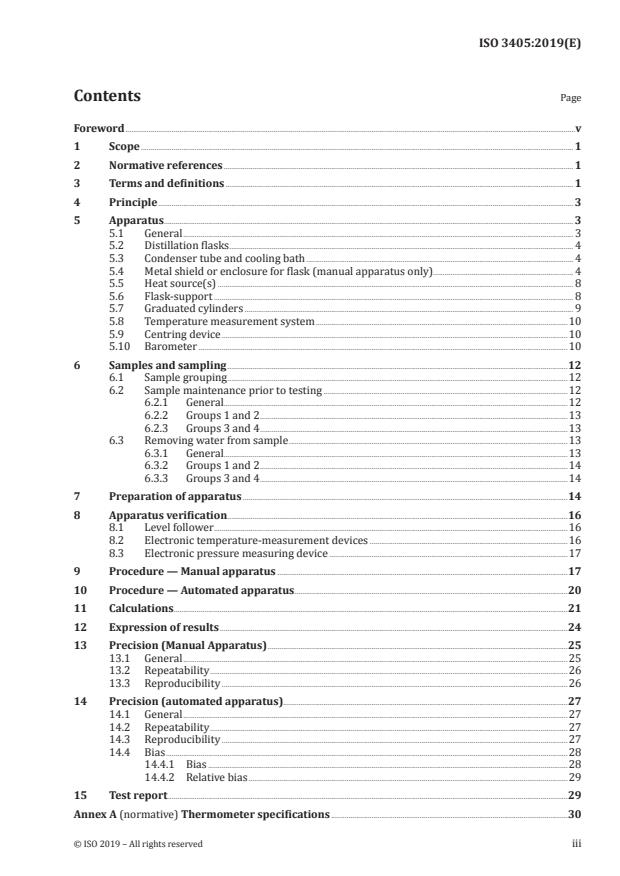

ISO 3405:2019 - Petroleum and related products from natural or synthetic sources -- Determination of distillation characteristics at atmospheric pressure

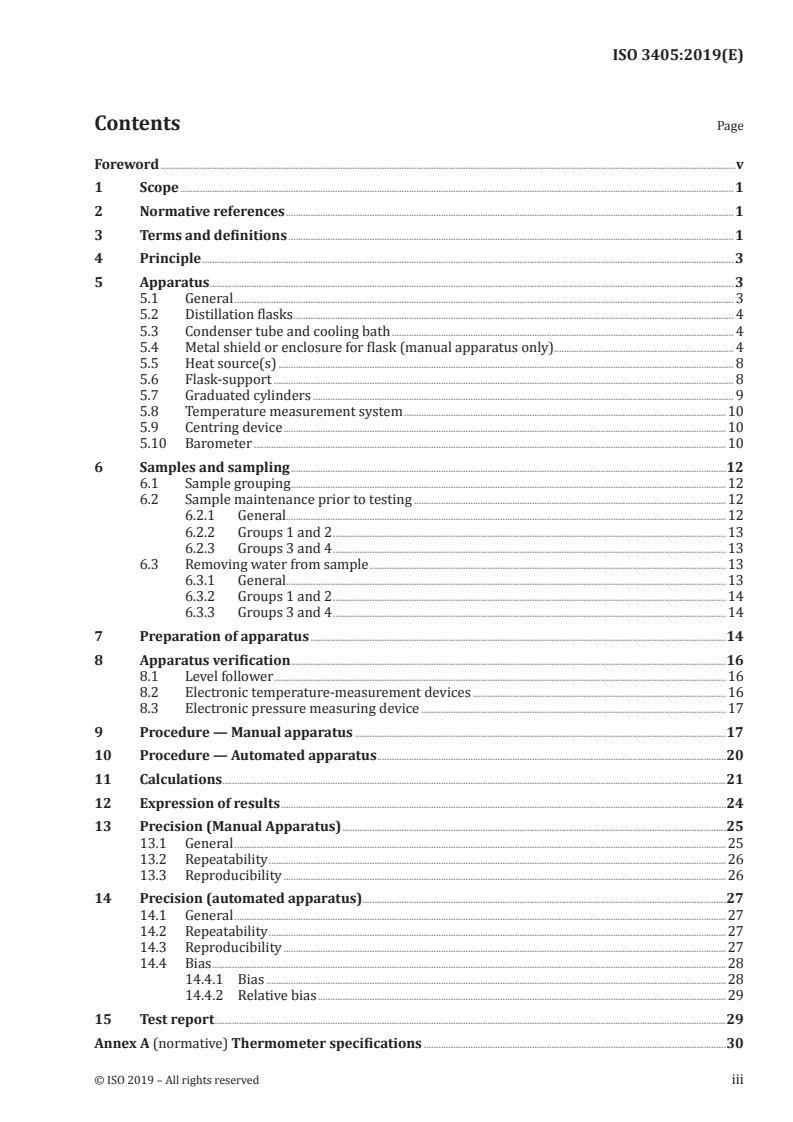

ISO 3405:2019 - Petroleum and related products from natural or synthetic sources — Determination of distillation characteristics at atmospheric pressure/22/2019



ISO 3405:2019 - Produits pétroliers et connexes d'origine naturelle ou synthétique -- Détermination des caractéristiques de distillation a pression atmosphérique

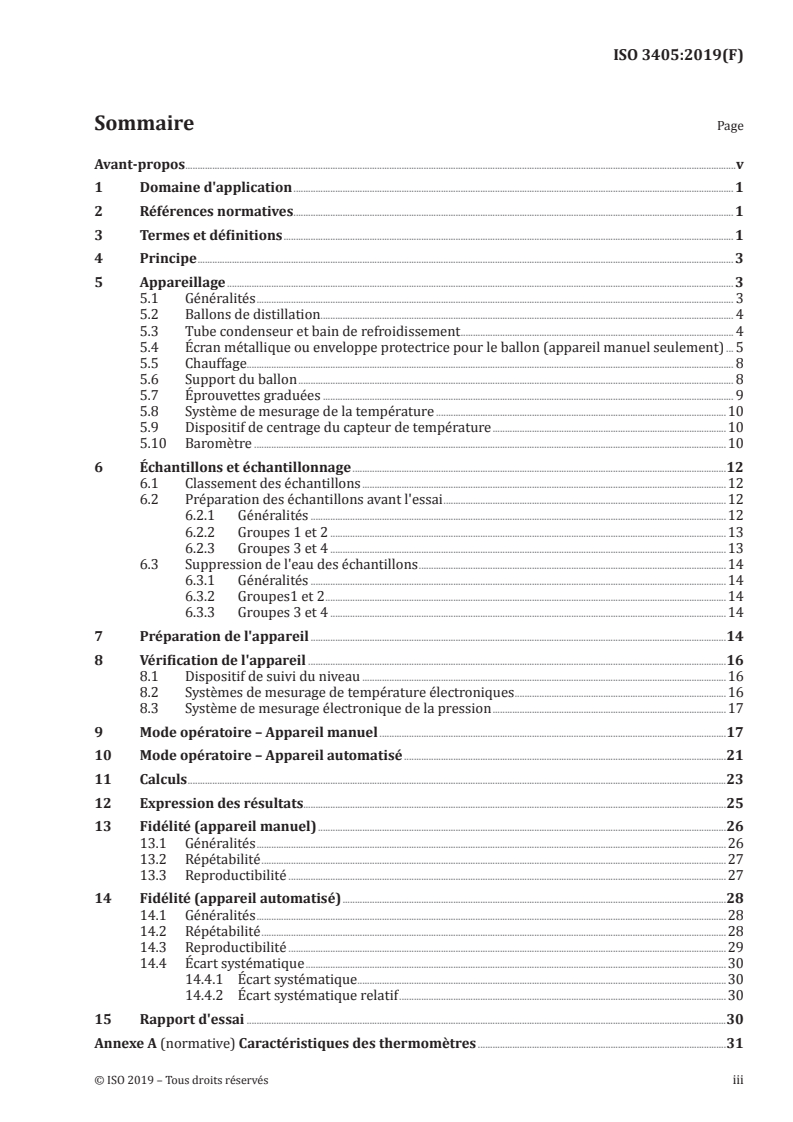

ISO 3405:2019 - Produits pétroliers et connexes d'origine naturelle ou synthétique — Détermination des caractéristiques de distillation à pression atmosphérique/14/2019
Overview
ISO 3405:2019 specifies a laboratory method for determining the distillation (volatility) characteristics of light and middle distillates from petroleum and related products of natural, synthetic or biological origin at atmospheric pressure. It covers samples with initial boiling points above 0 °C and end‑points below approximately 400 °C, using either manual or automated apparatus. Typical materials include automotive petrol and petrol–ethanol blends (up to 85 % V/V ethanol), aviation petrol, aviation turbine fuels, kerosene, diesel (including diesel with up to 30 % V/V FAME), burner and certain marine fuels.
Key topics and technical requirements
- Scope and sample types: Light and middle distillates, including synthetic and bio‑derived fuels; defined groups and handling requirements.
- Principle and apparatus: Specification of manual and automated distillation equipment, distillation flasks, condensers, heat sources, graduated cylinders and temperature/pressure measurement systems.
- Sample preparation and sampling: Grouping, storage, removal of water where applicable, and pre‑test maintenance.
- Procedure: Distillation runs for manual and automated systems, with guidelines for operation and safety.
- Apparatus verification and calibration: Level followers, temperature‑sensor lag, barometers and electronic device checks.
- Calculations and expression of results: Methods to compute initial boiling point, T10–T95 fractions, end‑point (final boiling point) and reporting formats.
- Precision and bias: Repeatability and reproducibility data (manual and automated); alignment with ASTM D86 precision data.
- Ancillary requirements: Thermometer specifications and examples of data calculations and test reports (normative and informative annexes).
- Safety note: The standard highlights hazards associated with flammable liquids and laboratory operations.
Practical applications and users
ISO 3405:2019 is used to:
- Verify fuel specification compliance (boiling range, volatility) for automotive, aviation, marine and heating fuels.
- Support quality control in refineries, fuel blending plants and laboratories.
- Provide volatility data for solvent formulation, storage and evaporation behavior analysis.
- Inform regulatory and environmental assessments related to VOC emissions and safety (flammability/vapor formation).
Typical users:
- Fuel testing and certification laboratories
- Refinery and blending quality assurance teams
- Petroleum product manufacturers and distributors
- Regulators, environmental agencies and standards bodies
Related standards
- ISO 918 (volatile organic liquids - distillation characteristics)
- ISO 3170 / ISO 3171 (manual and automatic sampling of petroleum liquids)
- ISO 4788 (graduated measuring cylinders)
- ASTM D86 (comparable distillation method; precision data referenced in ISO 3405:2019)
Keywords: ISO 3405:2019, distillation characteristics, petroleum distillation, volatility, fuel testing, ASTM D86, diesel FAME, petrol ethanol blends, laboratory method, VOC control.
Relations
- Effective Date
- 12-Feb-2026
- Effective Date
- 05-Nov-2015
Buy Documents
ISO 3405:2019 - Petroleum and related products from natural or synthetic sources -- Determination of distillation characteristics at atmospheric pressure
ISO 3405:2019 - Petroleum and related products from natural or synthetic sources — Determination of distillation characteristics at atmospheric pressure/22/2019
ISO 3405:2019 - Produits pétroliers et connexes d'origine naturelle ou synthétique -- Détermination des caractéristiques de distillation a pression atmosphérique
ISO 3405:2019 - Produits pétroliers et connexes d'origine naturelle ou synthétique — Détermination des caractéristiques de distillation à pression atmosphérique/14/2019
Get Certified
Connect with accredited certification bodies for this standard

Element Materials Technology
Materials testing and product certification.

ABS Group Brazil
ABS Group certification services in Brazil.

ABS Quality Evaluations Inc.
American Bureau of Shipping quality certification.
Sponsored listings
Frequently Asked Questions
ISO 3405:2019 is a standard published by the International Organization for Standardization (ISO). Its full title is "Petroleum and related products from natural or synthetic sources — Determination of distillation characteristics at atmospheric pressure". This standard covers: This document specifies a laboratory method for the determination of the distillation characteristics of light and middle distillates derived from petroleum and related products of synthetic or biological origin with initial boiling points above 0 °C and end-points below approximately 400 °C, utilizing either manual or automated equipment. Light distillates are typically automotive engine petrol, automotive engine ethanol fuel blends with up to 85 % (V/V) ethanol, and aviation petrol. Middle distillates are typically aviation turbine fuel, kerosene, diesel, diesel with up to 30 % (V/V) FAME, burner fuel, and marine fuels that have no appreciable quantities of residua. NOTE For the purposes of this document, the term "% (V/V)" is used to represent the volume fraction of a material. The distillation (volatility) characteristics of hydrocarbons and related products of synthetic or biological origin have an important effect on their safety and performance, especially in the case of fuels and solvents. The boiling range gives important information on composition and behaviour during storage and use, and the rate of evaporation is an important factor in the application of many solvents. Limiting values to specified distillation characteristics are applied to most distillate petroleum product and liquid fuel specifications in order to control end-use performance and to regulate the formation of vapours which may form explosive mixtures with air, or otherwise escape into the atmosphere as emissions (VOC).
This document specifies a laboratory method for the determination of the distillation characteristics of light and middle distillates derived from petroleum and related products of synthetic or biological origin with initial boiling points above 0 °C and end-points below approximately 400 °C, utilizing either manual or automated equipment. Light distillates are typically automotive engine petrol, automotive engine ethanol fuel blends with up to 85 % (V/V) ethanol, and aviation petrol. Middle distillates are typically aviation turbine fuel, kerosene, diesel, diesel with up to 30 % (V/V) FAME, burner fuel, and marine fuels that have no appreciable quantities of residua. NOTE For the purposes of this document, the term "% (V/V)" is used to represent the volume fraction of a material. The distillation (volatility) characteristics of hydrocarbons and related products of synthetic or biological origin have an important effect on their safety and performance, especially in the case of fuels and solvents. The boiling range gives important information on composition and behaviour during storage and use, and the rate of evaporation is an important factor in the application of many solvents. Limiting values to specified distillation characteristics are applied to most distillate petroleum product and liquid fuel specifications in order to control end-use performance and to regulate the formation of vapours which may form explosive mixtures with air, or otherwise escape into the atmosphere as emissions (VOC).
ISO 3405:2019 is classified under the following ICS (International Classification for Standards) categories: 75.080 - Petroleum products in general. The ICS classification helps identify the subject area and facilitates finding related standards.
ISO 3405:2019 has the following relationships with other standards: It is inter standard links to EN ISO 3405:2019, ISO 3405:2011. Understanding these relationships helps ensure you are using the most current and applicable version of the standard.
ISO 3405:2019 is available in PDF format for immediate download after purchase. The document can be added to your cart and obtained through the secure checkout process. Digital delivery ensures instant access to the complete standard document.
Standards Content (Sample)
INTERNATIONAL ISO
STANDARD 3405
Fifth edition
2019-03
Petroleum and related products
from natural or synthetic sources —
Determination of distillation
characteristics at atmospheric
pressure
Produits pétroliers et connexes d'origine naturelle ou synthétique —
Détermination des caractéristiques de distillation à pression
atmosphérique
Reference number
©
ISO 2019
© ISO 2019
All rights reserved. Unless otherwise specified, or required in the context of its implementation, no part of this publication may
be reproduced or utilized otherwise in any form or by any means, electronic or mechanical, including photocopying, or posting
on the internet or an intranet, without prior written permission. Permission can be requested from either ISO at the address
below or ISO’s member body in the country of the requester.
ISO copyright office
CP 401 • Ch. de Blandonnet 8
CH-1214 Vernier, Geneva
Phone: +41 22 749 01 11
Fax: +41 22 749 09 47
Email: copyright@iso.org
Website: www.iso.org
Published in Switzerland
ii © ISO 2019 – All rights reserved
Contents Page
Foreword .v
1 Scope . 1
2 Normative references . 1
3 Terms and definitions . 1
4 Principle . 3
5 Apparatus . 3
5.1 General . 3
5.2 Distillation flasks . 4
5.3 Condenser tube and cooling bath . 4
5.4 Metal shield or enclosure for flask (manual apparatus only) . 4
5.5 Heat source(s) . 8
5.6 Flask-support . 8
5.7 Graduated cylinders . 9
5.8 Temperature measurement system .10
5.9 Centring device .10
5.10 Barometer .10
6 Samples and sampling .12
6.1 Sample grouping .12
6.2 Sample maintenance prior to testing .12
6.2.1 General.12
6.2.2 Groups 1 and 2 .13
6.2.3 Groups 3 and 4 .13
6.3 Removing water from sample .13
6.3.1 General.13
6.3.2 Groups 1 and 2 .14
6.3.3 Groups 3 and 4 .14
7 Preparation of apparatus .14
8 Apparatus verification .16
8.1 Level follower .16
8.2 Electronic temperature-measurement devices .16
8.3 Electronic pressure measuring device .17
9 Procedure — Manual apparatus .17
10 Procedure — Automated apparatus .20
11 Calculations.21
12 Expression of results .24
13 Precision (Manual Apparatus) .25
13.1 General .25
13.2 Repeatability .26
13.3 Reproducibility .26
14 Precision (automated apparatus).27
14.1 General .27
14.2 Repeatability .27
14.3 Reproducibility .27
14.4 Bias .28
14.4.1 Bias .28
14.4.2 Relative bias .29
15 Test report .29
Annex A (normative) Thermometer specifications .30
Annex B (normative) Determination of temperature-sensor lag times .31
Annex C (normative) Determination of specified distillation data .32
Annex D (informative) Examples of data calculations .34
Annex E (informative) Emulation of emergent-stem errors .37
Annex F (informative) Examples of a test report .38
Bibliography .40
iv © ISO 2019 – All rights reserved
Foreword
ISO (the International Organization for Standardization) is a worldwide federation of national standards
bodies (ISO member bodies). The work of preparing International Standards is normally carried out
through ISO technical committees. Each member body interested in a subject for which a technical
committee has been established has the right to be represented on that committee. International
organizations, governmental and non-governmental, in liaison with ISO, also take part in the work.
ISO collaborates closely with the International Electrotechnical Commission (IEC) on all matters of
electrotechnical standardization.
The procedures used to develop this document and those intended for its further maintenance are
described in the ISO/IEC Directives, Part 1. In particular, the different approval criteria needed for the
different types of ISO documents should be noted. This document was drafted in accordance with the
editorial rules of the ISO/IEC Directives, Part 2 (see www .iso .org/directives).
Attention is drawn to the possibility that some of the elements of this document may be the subject of
patent rights. ISO shall not be held responsible for identifying any or all such patent rights. Details of
any patent rights identified during the development of the document will be in the Introduction and/or
on the ISO list of patent declarations received (see www .iso .org/patents).
Any trade name used in this document is information given for the convenience of users and does not
constitute an endorsement.
For an explanation of the voluntary nature of standards, the meaning of ISO specific terms and
expressions related to conformity assessment, as well as information about ISO's adherence to the
World Trade Organization (WTO) principles in the Technical Barriers to Trade (TBT) see www .iso
.org/iso/foreword .html.
This document was prepared by Technical Committee ISO/TC 28, Petroleum and related products, fuels
and lubricants from natural or synthetic sources.
This fifth edition cancels and replaces the fourth edition (ISO 3405:2011), which has been technically
revised. The main changes compared to the previous edition are as follows:
— extension of the scope to include synthetic and biological products in general and automotive petrol-
ethanol blends and to diesel with up to 30 % (V/V) FAME specifically;
[1]
— the procedure has been aligned with ASTM D86 and ASTM International has granted usage of its
precision data on 5 July 2017;
— update of the precision (for automated apparatus) for groups 1, 2, and 3, with the slope-based
[2]
precision obtained from a 2010 Interlaboratory Study ;
— for T95, group 4 now has a valid range of 260 °C to 360 °C and an updated precision, as a review of
a 2006 Interlaboratory Study revealed the absence of some group 4 samples having a final boiling
point near 360 °C, as well final boiling points above;
— the test report example in Annex F has been updated as group 0 is not addressed since the fourth
edition of this document;
— introduction of a solution for the replacement of mercury-in-glass thermometers.
Any feedback or questions on this document should be directed to the user’s national standards body. A
complete listing of these bodies can be found at www .iso .org/members .html.
INTERNATIONAL STANDARD ISO 3405:2019(E)
Petroleum and related products from natural or synthetic
sources — Determination of distillation characteristics at
atmospheric pressure
WARNING — The use of this document can involve hazardous materials, operations and
equipment. This document does not purport to address all the safety problems associated with
its use. It is the responsibility of users of this document to take appropriate measures to ensure
the safety and health of personnel prior to the application of the standard, and to determine the
applicability of any other restrictions for this purpose.
1 Scope
This document specifies a laboratory method for the determination of the distillation characteristics
of light and middle distillates derived from petroleum and related products of synthetic or biological
origin with initial boiling points above 0 °C and end-points below approximately 400 °C, utilizing either
manual or automated equipment. Light distillates are typically automotive engine petrol, automotive
engine ethanol fuel blends with up to 85 % (V/V) ethanol, and aviation petrol. Middle distillates are
typically aviation turbine fuel, kerosene, diesel, diesel with up to 30 % (V/V) FAME, burner fuel, and
marine fuels that have no appreciable quantities of residua.
NOTE For the purposes of this document, the term “% (V/V)” is used to represent the volume fraction of a
material.
The distillation (volatility) characteristics of hydrocarbons and related products of synthetic or
biological origin have an important effect on their safety and performance, especially in the case of
fuels and solvents. The boiling range gives important information on composition and behaviour during
storage and use, and the rate of evaporation is an important factor in the application of many solvents.
Limiting values to specified distillation characteristics are applied to most distillate petroleum product
and liquid fuel specifications in order to control end-use performance and to regulate the formation
of vapours which may form explosive mixtures with air, or otherwise escape into the atmosphere as
emissions (VOC).
2 Normative references
The following documents are referred to in the text in such a way that some or all of their content
constitutes requirements of this document. For dated references, only the edition cited applies. For
undated references, the latest edition of the referenced document (including any amendments) applies.
ISO 918, Volatile organic liquids for industrial use — Determination of distillation characteristics
ISO 3170, Petroleum liquids — Manual sampling
ISO 3171, Petroleum liquids — Automatic pipeline sampling
ISO 4788, Laboratory glassware — Graduated measuring cylinders
3 Terms and definitions
For the purposes of this document, the following terms and definitions apply.
ISO and IEC maintain terminological databases for use in standardization at the following addresses:
— ISO Online browsing platform: available at https: //www .iso .org/obp
— IEC Electropedia: available at https: //www .electropedia .org/
3.1
decomposition point
thermometer reading (corrected) which coincides with the first indications of thermal decomposition
of the liquid in the flask
Note 1 to entry: Characteristic indications of thermal decomposition are an evolution of fumes and erratic
thermometer readings which usually show a decided decrease after any attempt has been made to adjust the heat.
3.2
dry point
thermometer reading (corrected) that is observed at the instant the last drop of liquid evaporates from
the lowest point in the flask, any drops or film of liquid on the side of the flask or on the thermometer
being disregarded
Note 1 to entry: The end-point (final boiling point), rather than the dry point is intended for general use. The dry
point can be reported in connection with special purpose naphthas, such as those used in the paint industry.
Also, it is substituted for the end-point (final boiling point) whenever the sample is of such a nature that the
precision of the end-point cannot consistently meet the precision requirements given in Clauses 13 or 14.
3.3
final boiling point
end-point maximum thermometer reading (corrected) obtained during the test
Note 1 to entry: This usually occurs after evaporation of all liquid from the bottom of the flask.
3.4
initial boiling point
thermometer reading (corrected) that is observed at the instant that the first drop of condensate falls
from the lower end of the condenser tube
3.5
percent evaporated
sum of the percent recovered and the percent loss
3.6
percent loss
calculated amount of uncondensed material
Note 1 to entry: Sometimes called “front-end loss”; this is the amount of uncondensed material lost in the initial
stages of the distillation.
3.7
corrected loss
percent loss corrected for barometric pressure
3.8
percent recovered
volume of condensate observed in the receiving cylinder at any point in the distillation, expressed as a
percentage of the charge volume, in connection with a simultaneous temperature reading
3.9
percent recovery
maximum percent recovered, as observed in accordance with 9.10 or 10.10
3.10
percent residue
volume of residue measured in accordance with 9.11 or 10.11, and expressed as a percentage of the
charge volume
2 © ISO 2019 – All rights reserved
3.11
percent total recovery
combined percent recovery and residue in the flask, as determined in accordance with 11.1
3.12
thermometer reading
temperature recorded by the sensor of the saturated vapour measured in the neck of the flask below
the vapour tube, under the specified conditions of this test
3.13
temperature reading
thermometer or temperature-measurement device reading (3.12) which is corrected to 101,3 kPa
standard pressure
3.14
emergent stem effect
offset in temperature reading caused by the use of a total immersion mercury-in-glass thermometer in
the partial immersion mode
Note 1 to entry: The emergent part of the mercury column is at a lower temperature than the immersed portion,
resulting in a lower temperature reading than that obtained when the thermometer was completely immersed
for calibration.
3.15
temperature lag
offset in temperature reading between a mercury-in-glass thermometer and an electronic temperature-
measurement device, caused by the different response time of the systems involved
4 Principle
The sample is assigned into one of four groups based on its composition and expected volatility
characteristics, each group defining the apparatus arrangement, condenser temperature and
operational variables. A 100 ml test portion is distilled under the specified conditions appropriate
to the group into which the sample falls, and systematic observations of thermometer readings and
volumes of condensate recovered are made. The volume of the residue in the flask is measured, and the
loss on distillation recorded. The thermometer readings are corrected for barometric pressure, and
the data are then used for calculations appropriate to the nature of the sample and the specification
requirements.
5 Apparatus
5.1 General
Typical assemblies of the manual apparatus are shown in Figures 1 and 2. In addition to the basic
components described in Clause 5, automated apparatus are equipped with a system to measure and
automatically record the vapour temperature and the associated recovered volume in the receiving
cylinder.
Automated equipment manufactured from 1999 onwards shall be equipped with a device to
automatically shut down power to the unit and to spray an inert gas or vapour in the chamber where
the distillation flask is mounted in the event of fire.
NOTE Some causes of fires are breakage of the distillation flask, electrical shorts, and foaming and spilling
of liquid sample through the top opening of the flask.
5.2 Distillation flasks
The distillation flasks shall have a capacity of 125 ml and be constructed of heat-resistant glass,
according to the dimensions and tolerances shown in Figure 3.
For tests specifying the dry point, especially selected flasks with bottoms and walls of uniform
thickness are recommended.
5.3 Condenser tube and cooling bath
5.3.1 Typical types of condenser and cooling bath are illustrated in Figures 1 and 2.
Other types of apparatus may be used, provided that the test results obtained by their use are such as
to correlate with the results obtained with those illustrated, and to satisfy the precision criteria given
in Clauses 13 or 14.
5.3.2 The condenser shall be made of seamless non-corrosive metal tubing, 560 mm ± 5 mm in length,
with an outside diameter of 14 mm and a wall thickness of 0,8 mm to 0,9 mm.
NOTE Brass or stainless steel are suitable materials.
5.3.3 The condenser shall be set so that 393 mm ± 3 mm of the tube is in contact with the cooling
medium, with 50 mm ± 3 mm outside the cooling bath at the upper end, and 114 mm ± 3 mm outside
at the lower end. The portion of tube projecting at the upper end shall be set at an angle of 75° ± 3°
to the vertical. The portion of the tube inside the cooling bath shall be either straight or bent in any
suitable continuous smooth curve. The average gradient shall be 15° ± 1° with respect to the horizontal,
and no 100 mm section shall have a gradient outside a 15° ± 3° range. The projecting lower portion of
the condenser tube shall be curved downward for a length of 76 mm and the lower end cut off at an
acute angle. Provisions shall be made to enable the flow of distillate to run down the side of the receiving
cylinder. Figure 4 gives an illustration of the lower end of the condenser tube.
The flow of distillate down the side of the graduated cylinder can be accomplished either by using a
drip-deflector which is inserted in the receiver, or by having the downward length of the condenser
tube curve slightly backwards so as to ensure contact with the wall of the receiving cylinder at a point
25 mm to 32 mm below the top of the receiving cylinder when it is in position to receive distillate.
5.3.4 The volume and design of the cooling bath will depend on the cooling medium employed. The
cooling capacity of the bath shall be adequate to maintain the required temperature for the desired
condenser performance. A single cooling bath may be used for several condenser tubes.
5.4 Metal shield or enclosure for flask (manual apparatus only)
Shields shall be provided to protect the operator from damage from the unit during operation, and
to protect the distillation flask from draughts. They shall allow easy access to the distillation during
operation, and be provided with at least one window to observe the dry point at the end of the
distillation.
NOTE 1 A typical shield for a unit fitted with a gas burner would be 480 mm high, 280 mm long and 200 mm
wide, made of sheet metal approximately 0,8 mm in thickness (see Figure 1).
NOTE 2 A typical shield for a unit fitted with an electric heater would be 440 mm high, 200 mm long and
200 mm wide, made of sheet metal approximately 0,8 mm in thickness (see Figure 2).
4 © ISO 2019 – All rights reserved
Key
1 cooling bath 7 thermometer
2 air vents 8 bath cover
3 burner 9 blotting paper
4 shield 10 support
5 heat-resistant boards 11 graduated cylinder
6 distillation flask 12 gas line
Figure 1 — Apparatus assembly using a gas burner
Key
1 receiving cylinder 8 flask-adjusting knob
2 blotting paper 9 indicating dial
3 thermometer 10 switch
4 distillation flask 11 open bottom shield
5 flask-support board 12 cooling bath
6 electric heating element 13 condenser tube
6 © ISO 2019 – All rights reserved
7 flask-support platform 14 shield
Figure 2 — Apparatus assembly using an electric heater
Dimensions in millimetres
Key
1 19/22 neck or 19/26 neck
a
Reinforcing bead.
b
Fire polished.
Figure 3 — 125 ml flasks — Alternative neck designs
Dimensions in millimetres
Figure 4 — Lower end of condenser tube
5.5 Heat source(s)
5.5.1 Gas burner (see Figure 1), capable of bringing over the first drop from a cold start within the
time specified, and continuing the distillation at the specified rate. A sensitive regulating valve and gas
pressure governor to give complete control of heating shall be provided.
5.5.2 Electric heater (see Figure 2), of low heat retention and adjustable from 0 W to 1 000 W.
5.6 Flask-support
5.6.1 Type 1 for use with gas burner (see Figure 1). Either a ring support of the ordinary laboratory
type, 100 mm or larger in diameter, supported on a stand inside the shield, or a platform adjustable from
the outside of the shield shall be used.
The flask support board shall be constructed of ceramic or other heat-resistant material, 3 mm to 6 mm
in thickness and shall have a central opening conforming to the dimensions given in Table 2. The flask
support board shall be of sufficient dimension to ensure that thermal heat to the flask only comes from
the central opening and that extraneous heat to the flask other than through the central opening is
minimized. The flask-support board may be moved slightly in accordance with the directions for
positioning the distillation flask so that direct heat is applied to the flask only through the opening
in this board. The position of the flask is set by adjusting the length of the side-arm inserted into the
condenser.
5.6.2 Type 2 for use with an electric heater (see Figure 2). The flask-support is a platform on top of
the electric heater and adjustable from the outside of the shield. The flask support board described in
5.6.1 is mounted on this support. Provision shall be made for moving the upper (flask-support) board
slightly in the horizontal plane to ensure that direct heat is applied only through the specified opening
in this board. The flask-support assembly shall be able to move vertically to ensure contact of the flask-
support board with the bottom of the distillation flask during the distillation, and to allow for easy
mounting and removal of the distillation flask from the unit.
8 © ISO 2019 – All rights reserved
5.7 Graduated cylinders
5.7.1 Receiving cylinder, of 100 ml ± 1,0 ml capacity, nominally in accordance with ISO 4788. It shall
be graduated at intervals of 1 ml beginning at least at the 5 ml mark and have a graduation at the 100 ml
mark. The shape of the base shall be such that the receiver does not topple when placed empty on a
surface inclined at an angle of 13° to the horizontal. Construction details and tolerances for the graduated
cylinder are shown in Figure 5.
Dimensions in millimetres
Key
1 fire polished top end
Figure 5 — 100 ml receiving cylinder (tolerance ± 1,0 ml)
For automated apparatus, the cylinder shall conform to the physical specifications described in this
subclause, with the exception of all graduations but that at 100 ml. Receiving cylinders for use in
automated units may also have a metal base.
If required, the receiving cylinder shall be either immersed in a cooling bath containing cooling liquid,
such as a tall-form beaker of clear glass or transparent plastic, up to above the 100 ml graduation line,
or placed in a thermostatically controlled air-circulation chamber.
5.7.2 Residue cylinder, of 5 ml capacity, generally in accordance with ISO 4788.
5.8 Temperature measurement system
5.8.1 Thermometers, if used, shall be of the mercury-in-glass type, nitrogen filled, graduated on the
stem and enamel backed, and shall conform to the specifications given in Annex A.
CAUTION — Under certain test conditions, the bulb of the thermometer can be 28 °C above the
temperature indicated, and at an indicated temperature of 370 °C, the temperature of the bulb
is approaching a critical range in the glass. It is thus strongly recommended that distillation
temperature readings above 370 °C are avoided, but in those cases where thermometers have
been exposed to observed temperature readings above 370 °C, they shall not be re-used without
checking their ice point to verify calibration.
5.8.2 Electronic temperature-measurement devices, if used, shall exhibit the same temperature
lag, emergent stem effect and accuracy as the equivalent mercury-in-glass thermometer.
To simulate the temperature lag of a mercury-in-glass thermometer, the circuitry and/or the algorithms
used for the electronic system shall take this fact into account.
Alternatively, place the sensor in a casing with the tip covered, so that the assembly, because of its
adjusted thermal mass and conductivity, has a temperature lag time similar to that of mercury-in-glass
thermometers.
In case of dispute, unless otherwise agreed, the referee test shall be carried out using the specified
mercury-in-glass thermometers.
When it is required to determine the difference in lag time between an electronic measurement system
and mercury-in-glass thermometers Annex B shall be used.
NOTE The lag time difference determination is more applicable for equipment manufacturers.
5.9 Centring device
The temperature sensor shall be fitted through a snug-fitting device designed for mechanically centring
the sensor in the neck of the distillation flask without vapour leakage. The use of a cork or silicone
rubber stopper with a hole drilled through the centre is not acceptable for this purpose. Examples of
acceptable centring devices are shown in Figures 6 and 7.
When running tests by the manual method, products with a low initial boiling point can have one or
more temperature readings obscured by the centring device.
Centring devices not shown in Figures 6 and 7 are also acceptable provided they position and hold the
temperature sensor in the middle of the neck of the distillation flask.
5.10 Barometer
The barometer shall be capable of measuring atmospheric pressure with an accuracy of 0,1 kPa or
better, at the same elevation relative to sea level as the apparatus in the laboratory. Do not take readings
from aneroid barometers that are pre-corrected to give sea level pressures.
The barometer should ideally be located in the room in which the distillation is carried out.
10 © ISO 2019 – All rights reserved
Key
1 O-ring
a
Screwcap.
b
Knurled knob.
c
Cone male NS 19/26.
Figure 6 — PTFE centring device for ground-glass joint
Key
a
1 single O-ring Viton or perfluoro elastomer Cone-shaped for perfect centring in neck of
distillation flask.
2 compression nut (PTFE)
b
3 PTFE body Drilled out to fit Pt 100 probe.
c
4 double O-rings Viton or perfluoro elastomer Compression without O-ring.
d
5 compression O-ring Threads.
e
6 compression nut Internal diameter of flask to be precision bore.
7 thermometer or Pt 100 probe
8 neck of distilling flask
Figure 7 — Two illustrative centring device designs for straight-bore neck
6 Samples and sampling
6.1 Sample grouping
Determine the nature of the product to be sampled and place it in the appropriate group according to
Table 1, which also gives general guidance on sampling conditions.
6.2 Sample maintenance prior to testing
6.2.1 General
Unless otherwise specified, sampling shall be carried out by the procedures described in ISO 3170 or
ISO 3171, bearing in mind the special conditions described in Table 1. Maintain samples prior to testing
at the specified temperatures given in Table 1, away from sources of direct heat or sunlight.
12 © ISO 2019 – All rights reserved
6.2.2 Groups 1 and 2
Collect the sample in a container previously cooled to below 10 °C, when necessary. Condition the
container preferably by immersing it in the liquid, where possible, and discarding the first sample.
Where immersion is not possible, the sample shall be drawn off into the previously cooled container in
such a manner that agitation is kept at a minimum. Close the container immediately with a tight-fitting
stopper, and place the sample in an ice bath or refrigerator to maintain the sample below the specified
temperature. Maintain the sample below 10 °C prior to testing, and preferably store at or below this
temperature. Where maintenance and/or storage at below 10 °C is not possible or practicable, a
temperature up to 20 °C is acceptable provided that the sample is always conditioned to a temperature
below 10 °C before the container is opened.
6.2.3 Groups 3 and 4
Maintain the sample at ambient temperature. If the sample is not fluid at ambient temperature,
maintain it at a temperature of 9 °C to 21 °C above its pour point. Shake the sample vigorously prior
to subsampling to ensure homogeneity, and disregard the temperature range shown in Table 2 for the
receiving cylinder. Prior to analysis, heat the receiving cylinder to approximately the same temperature
as the sample, and pour the heated test portion precisely to the 100 ml mark. Transfer the test portion
as rapidly and completely as possible to the distillation flask.
CAUTION — A tightly-sealed, full, cold container of sample is likely to break if heated.
Table 1 — Sample groups and sampling conditions
Group number 1 2 3 4
Typical sample type Gasoline Gasoline Wide-cut Kerosene/
aviation fuel gas oil
Vapour pressure ≥65,5 <65,5 <65,5 <65,5
(DVPE), kPa
Initial boiling point — — ≤100 >100
(IBP), °C
Final boiling point ≤250 ≤250 >250 >250
(FBP), °C
Temperature of sample <10 — — —
bottle, °C
a a
Temperature of sample ≤10 ≤10 Ambient Ambient
at sampling, °C
b b
Temperature of stored <10 <10 Ambient Ambient
sample, °C
If sample is wet Resample or dry Resample or dry Dry Dry
(Reference) (6.3.2) (6.3.2) (6.3.3) (6.3.3)
a
Samples shall always be at 9 °C to 21 °C above their pour point if not fluid at ambient temperature.
b
When no facilities available for storage below 10 °C, the sample may be stored below 20 °C provided the container is
tightly sealed. See 6.2.2.
6.3 Removing water from sample
6.3.1 General
Samples of materials that are visibly hazy (suspended water) or are suspected of containing water are
not suitable for testing.
6.3.2 Groups 1 and 2
If the sample is not dry, obtain another sample for testing that is free from suspended water. If such
a sample cannot be obtained, add a sufficient amount of anhydrous sodium sulfate or other suitable
drying agent to the sample maintained at 0 °C to 10 °C, and physically remove the water by shaking.
Once the sample shows no visible signs of water, use a decanted portion of the sample, maintained at
0 °C to 10 °C, for the analysis. Record that the sample has been dried by desiccant.
Data from a round-robin exercise show that suspended water in hazy samples in group 1 and group 2
may be removed by the above procedure without statistically affecting the results of the test.
6.3.3 Groups 3 and 4
In cases where a water-free sample is not practical, remove the suspended water by shaking the sample
with anhydrous sodium sulphate or another suitable drying agent, and separate it from the drying
agent by decantation.
7 Preparation of apparatus
7.1 Refer to Table 2 and prepare the apparatus by choosing the appropriate distillation flask,
temperature-measurement system and flask-support board as directed for the indicated group. If gas
heating is used, use a Type 1 flask-support (5.6.1); if electric heating is used, use a Type 2 flask-support
(5.6.2). Bring the temperature of the receiving cylinder, the flask, the temperature sensor and the cooling
bath to the indicated temperature.
7.2 Make any necessary provisions so that the temperature of the cooling bath and receiving cylinder
will be maintained at their specified temperatures. The receiving cylinder shall be positioned in a bath
such that either the liquid level is at least as high as the 100 ml mark, or the entire receiving cylinder is
surrounded by an air-circulation chamber.
For groups 1, 2 and 3, use suitable media for low temperature baths such as chopped ice and water,
refrigerated brine and refrigerated ethylene glycol.
For group 4, use suitable media for ambient and higher bath temperatures such as cold water, hot water
and heated ethylene glycol.
7.3 Remove any residual liquid in the condenser tube by swabbing with a piece of soft, lint-free cloth
attached to a cord or wire.
7.4 For samples in groups 1, 2 and 3, fit a low-range temperature sensor, provided with a snug-fitting
cork or silicone rubber stopper, tightly into the neck of the sample container, and bring the temperature
of the sample to that specified in Table 2.
Table 2 — Preparation of apparatus
Group number 1 2 3 4
Temperature-measurement system (see 5.8) Low-range Low-range Low-range High-range
Diameter of hole in flask-support board, mm 38 38 50 50
Temperature at start of test, °C
— flask and thermometer 13 to 18 13 to 18 13 to 18 ≤ambient
— flask-support board and shield ≤ambient ≤ambient ≤ambient —
— receiving cylinder and sample 13 to 18 13 to 18 13 to 18 13 to ambient
14 © ISO 2019 – All rights reserved
7.5 When the temperature of the sample is confirmed, measure the test portion precisely to the 100 ml
mark of the receiving cylinder, and then transfer it as completely as practical to the distillation flask,
taking care that none of the liquid flows into the vapour tube.
NOTE 1 Any material which evaporates during the transfer will contribute to the loss; any material which
remains in the receiving cylinder will contribute to the observed recovery volume at the time of the initial
boiling point.
If irregular boiling (bumping) is expected, add a small volume of clean and dry boiling chips to the test
portion.
NOTE 2 Although theoretically the volume of deposit on the chips is part of the residue, this amount is
negligible and can be disregarded.
7.6 Fit the appropriate temperature sensor through a centring device (5.9). In the case of a mercury-
in-glass thermometer, the bulb is centred in the neck and the lower end of the capillary is level with
the highest point on the bottom of the inner wall of the vapour tube (see Figure 8). In the case of a
thermocouple/resistance thermometer, follow the manufacturer’s instructions as to placement so that
the sensing position will be just below the level of the side arm of the distillation flask.
Use a small quantity of vacuum grease on the mating surface of the polytetrafluoroethylene (PTFE)
centring device to facilitate dismantling after use.
Figure 8 — Position of thermometer in distillation flask neck
7.7 Fit the flask vapour tube, provided with a snug-fitting, well-rolled cork or silicone rubber stopper,
tightly into the condenser tube. Adjust the distillation flask in a vertical position so that the vapour tube
extends into the condenser tube for a distance of 25 mm to 50 mm. Raise and adjust the flask-support
board to fit snugly against the bottom of the flask.
7.8 Place the receiving cylinder that was used to measure the test portion, without drying, fitted with a
drip deflector if necessary, into the bath under the lower end of the condenser tube so that the end of the
condenser tube is centred in the receiving cylinder and extends therein for a distance of at least 25 mm,
but not below the 100 ml mark. For manual distillations, cover the receiving cylinder closely with a piece
of blotting paper or similar material that has been cut to fit the condenser tube snugly. For automated
distillations, cover the receiving cylinder, if necessary, with the device provided with the apparatus.
7.9 Record the room temperature and prevailing barometric pressure. Proceed at once with the
distillation, as described in Clauses 9 or 10.
8 Apparatus verification
8.1 Level follower
For automated apparatus, the level follower/recording mechanism of the apparatus shall have a
resolution of 0,1 ml with a maximum error of 0,3 ml between the 5 ml and 100 ml points. The calibration
of the assembly shall be verified according to the manufacturer’s instructions at intervals of not more
than three months.
NOTE The typical verification procedure involves verifying the output with the receiving cylinder containing
5 ml and 100 ml of material respectively.
8.2 Electronic temperature-measurement devices
8.2.1 Verification of the calibration of thes
...
INTERNATIONAL ISO
STANDARD 3405
Fifth edition
2019-03
Petroleum and related products
from natural or synthetic sources —
Determination of distillation
characteristics at atmospheric
pressure
Produits pétroliers et connexes d'origine naturelle ou synthétique —
Détermination des caractéristiques de distillation à pression
atmosphérique
Reference number
©
ISO 2019
© ISO 2019
All rights reserved. Unless otherwise specified, or required in the context of its implementation, no part of this publication may
be reproduced or utilized otherwise in any form or by any means, electronic or mechanical, including photocopying, or posting
on the internet or an intranet, without prior written permission. Permission can be requested from either ISO at the address
below or ISO’s member body in the country of the requester.
ISO copyright office
CP 401 • Ch. de Blandonnet 8
CH-1214 Vernier, Geneva
Phone: +41 22 749 01 11
Fax: +41 22 749 09 47
Email: copyright@iso.org
Website: www.iso.org
Published in Switzerland
ii © ISO 2019 – All rights reserved
Contents Page
Foreword .v
1 Scope . 1
2 Normative references . 1
3 Terms and definitions . 1
4 Principle . 3
5 Apparatus . 3
5.1 General . 3
5.2 Distillation flasks . 4
5.3 Condenser tube and cooling bath . 4
5.4 Metal shield or enclosure for flask (manual apparatus only) . 4
5.5 Heat source(s) . 8
5.6 Flask-support . 8
5.7 Graduated cylinders . 9
5.8 Temperature measurement system .10
5.9 Centring device .10
5.10 Barometer .10
6 Samples and sampling .12
6.1 Sample grouping .12
6.2 Sample maintenance prior to testing .12
6.2.1 General.12
6.2.2 Groups 1 and 2 .13
6.2.3 Groups 3 and 4 .13
6.3 Removing water from sample .13
6.3.1 General.13
6.3.2 Groups 1 and 2 .14
6.3.3 Groups 3 and 4 .14
7 Preparation of apparatus .14
8 Apparatus verification .16
8.1 Level follower .16
8.2 Electronic temperature-measurement devices .16
8.3 Electronic pressure measuring device .17
9 Procedure — Manual apparatus .17
10 Procedure — Automated apparatus .20
11 Calculations.21
12 Expression of results .24
13 Precision (Manual Apparatus) .25
13.1 General .25
13.2 Repeatability .26
13.3 Reproducibility .26
14 Precision (automated apparatus).27
14.1 General .27
14.2 Repeatability .27
14.3 Reproducibility .27
14.4 Bias .28
14.4.1 Bias .28
14.4.2 Relative bias .29
15 Test report .29
Annex A (normative) Thermometer specifications .30
Annex B (normative) Determination of temperature-sensor lag times .31
Annex C (normative) Determination of specified distillation data .32
Annex D (informative) Examples of data calculations .34
Annex E (informative) Emulation of emergent-stem errors .37
Annex F (informative) Examples of a test report .38
Bibliography .40
iv © ISO 2019 – All rights reserved
Foreword
ISO (the International Organization for Standardization) is a worldwide federation of national standards
bodies (ISO member bodies). The work of preparing International Standards is normally carried out
through ISO technical committees. Each member body interested in a subject for which a technical
committee has been established has the right to be represented on that committee. International
organizations, governmental and non-governmental, in liaison with ISO, also take part in the work.
ISO collaborates closely with the International Electrotechnical Commission (IEC) on all matters of
electrotechnical standardization.
The procedures used to develop this document and those intended for its further maintenance are
described in the ISO/IEC Directives, Part 1. In particular, the different approval criteria needed for the
different types of ISO documents should be noted. This document was drafted in accordance with the
editorial rules of the ISO/IEC Directives, Part 2 (see www .iso .org/directives).
Attention is drawn to the possibility that some of the elements of this document may be the subject of
patent rights. ISO shall not be held responsible for identifying any or all such patent rights. Details of
any patent rights identified during the development of the document will be in the Introduction and/or
on the ISO list of patent declarations received (see www .iso .org/patents).
Any trade name used in this document is information given for the convenience of users and does not
constitute an endorsement.
For an explanation of the voluntary nature of standards, the meaning of ISO specific terms and
expressions related to conformity assessment, as well as information about ISO's adherence to the
World Trade Organization (WTO) principles in the Technical Barriers to Trade (TBT) see www .iso
.org/iso/foreword .html.
This document was prepared by Technical Committee ISO/TC 28, Petroleum and related products, fuels
and lubricants from natural or synthetic sources.
This fifth edition cancels and replaces the fourth edition (ISO 3405:2011), which has been technically
revised. The main changes compared to the previous edition are as follows:
— extension of the scope to include synthetic and biological products in general and automotive petrol-
ethanol blends and to diesel with up to 30 % (V/V) FAME specifically;
[1]
— the procedure has been aligned with ASTM D86 and ASTM International has granted usage of its
precision data on 5 July 2017;
— update of the precision (for automated apparatus) for groups 1, 2, and 3, with the slope-based
[2]
precision obtained from a 2010 Interlaboratory Study ;
— for T95, group 4 now has a valid range of 260 °C to 360 °C and an updated precision, as a review of
a 2006 Interlaboratory Study revealed the absence of some group 4 samples having a final boiling
point near 360 °C, as well final boiling points above;
— the test report example in Annex F has been updated as group 0 is not addressed since the fourth
edition of this document;
— introduction of a solution for the replacement of mercury-in-glass thermometers.
Any feedback or questions on this document should be directed to the user’s national standards body. A
complete listing of these bodies can be found at www .iso .org/members .html.
INTERNATIONAL STANDARD ISO 3405:2019(E)
Petroleum and related products from natural or synthetic
sources — Determination of distillation characteristics at
atmospheric pressure
WARNING — The use of this document can involve hazardous materials, operations and
equipment. This document does not purport to address all the safety problems associated with
its use. It is the responsibility of users of this document to take appropriate measures to ensure
the safety and health of personnel prior to the application of the standard, and to determine the
applicability of any other restrictions for this purpose.
1 Scope
This document specifies a laboratory method for the determination of the distillation characteristics
of light and middle distillates derived from petroleum and related products of synthetic or biological
origin with initial boiling points above 0 °C and end-points below approximately 400 °C, utilizing either
manual or automated equipment. Light distillates are typically automotive engine petrol, automotive
engine ethanol fuel blends with up to 85 % (V/V) ethanol, and aviation petrol. Middle distillates are
typically aviation turbine fuel, kerosene, diesel, diesel with up to 30 % (V/V) FAME, burner fuel, and
marine fuels that have no appreciable quantities of residua.
NOTE For the purposes of this document, the term “% (V/V)” is used to represent the volume fraction of a
material.
The distillation (volatility) characteristics of hydrocarbons and related products of synthetic or
biological origin have an important effect on their safety and performance, especially in the case of
fuels and solvents. The boiling range gives important information on composition and behaviour during
storage and use, and the rate of evaporation is an important factor in the application of many solvents.
Limiting values to specified distillation characteristics are applied to most distillate petroleum product
and liquid fuel specifications in order to control end-use performance and to regulate the formation
of vapours which may form explosive mixtures with air, or otherwise escape into the atmosphere as
emissions (VOC).
2 Normative references
The following documents are referred to in the text in such a way that some or all of their content
constitutes requirements of this document. For dated references, only the edition cited applies. For
undated references, the latest edition of the referenced document (including any amendments) applies.
ISO 918, Volatile organic liquids for industrial use — Determination of distillation characteristics
ISO 3170, Petroleum liquids — Manual sampling
ISO 3171, Petroleum liquids — Automatic pipeline sampling
ISO 4788, Laboratory glassware — Graduated measuring cylinders
3 Terms and definitions
For the purposes of this document, the following terms and definitions apply.
ISO and IEC maintain terminological databases for use in standardization at the following addresses:
— ISO Online browsing platform: available at https: //www .iso .org/obp
— IEC Electropedia: available at https: //www .electropedia .org/
3.1
decomposition point
thermometer reading (corrected) which coincides with the first indications of thermal decomposition
of the liquid in the flask
Note 1 to entry: Characteristic indications of thermal decomposition are an evolution of fumes and erratic
thermometer readings which usually show a decided decrease after any attempt has been made to adjust the heat.
3.2
dry point
thermometer reading (corrected) that is observed at the instant the last drop of liquid evaporates from
the lowest point in the flask, any drops or film of liquid on the side of the flask or on the thermometer
being disregarded
Note 1 to entry: The end-point (final boiling point), rather than the dry point is intended for general use. The dry
point can be reported in connection with special purpose naphthas, such as those used in the paint industry.
Also, it is substituted for the end-point (final boiling point) whenever the sample is of such a nature that the
precision of the end-point cannot consistently meet the precision requirements given in Clauses 13 or 14.
3.3
final boiling point
end-point maximum thermometer reading (corrected) obtained during the test
Note 1 to entry: This usually occurs after evaporation of all liquid from the bottom of the flask.
3.4
initial boiling point
thermometer reading (corrected) that is observed at the instant that the first drop of condensate falls
from the lower end of the condenser tube
3.5
percent evaporated
sum of the percent recovered and the percent loss
3.6
percent loss
calculated amount of uncondensed material
Note 1 to entry: Sometimes called “front-end loss”; this is the amount of uncondensed material lost in the initial
stages of the distillation.
3.7
corrected loss
percent loss corrected for barometric pressure
3.8
percent recovered
volume of condensate observed in the receiving cylinder at any point in the distillation, expressed as a
percentage of the charge volume, in connection with a simultaneous temperature reading
3.9
percent recovery
maximum percent recovered, as observed in accordance with 9.10 or 10.10
3.10
percent residue
volume of residue measured in accordance with 9.11 or 10.11, and expressed as a percentage of the
charge volume
2 © ISO 2019 – All rights reserved
3.11
percent total recovery
combined percent recovery and residue in the flask, as determined in accordance with 11.1
3.12
thermometer reading
temperature recorded by the sensor of the saturated vapour measured in the neck of the flask below
the vapour tube, under the specified conditions of this test
3.13
temperature reading
thermometer or temperature-measurement device reading (3.12) which is corrected to 101,3 kPa
standard pressure
3.14
emergent stem effect
offset in temperature reading caused by the use of a total immersion mercury-in-glass thermometer in
the partial immersion mode
Note 1 to entry: The emergent part of the mercury column is at a lower temperature than the immersed portion,
resulting in a lower temperature reading than that obtained when the thermometer was completely immersed
for calibration.
3.15
temperature lag
offset in temperature reading between a mercury-in-glass thermometer and an electronic temperature-
measurement device, caused by the different response time of the systems involved
4 Principle
The sample is assigned into one of four groups based on its composition and expected volatility
characteristics, each group defining the apparatus arrangement, condenser temperature and
operational variables. A 100 ml test portion is distilled under the specified conditions appropriate
to the group into which the sample falls, and systematic observations of thermometer readings and
volumes of condensate recovered are made. The volume of the residue in the flask is measured, and the
loss on distillation recorded. The thermometer readings are corrected for barometric pressure, and
the data are then used for calculations appropriate to the nature of the sample and the specification
requirements.
5 Apparatus
5.1 General
Typical assemblies of the manual apparatus are shown in Figures 1 and 2. In addition to the basic
components described in Clause 5, automated apparatus are equipped with a system to measure and
automatically record the vapour temperature and the associated recovered volume in the receiving
cylinder.
Automated equipment manufactured from 1999 onwards shall be equipped with a device to
automatically shut down power to the unit and to spray an inert gas or vapour in the chamber where
the distillation flask is mounted in the event of fire.
NOTE Some causes of fires are breakage of the distillation flask, electrical shorts, and foaming and spilling
of liquid sample through the top opening of the flask.
5.2 Distillation flasks
The distillation flasks shall have a capacity of 125 ml and be constructed of heat-resistant glass,
according to the dimensions and tolerances shown in Figure 3.
For tests specifying the dry point, especially selected flasks with bottoms and walls of uniform
thickness are recommended.
5.3 Condenser tube and cooling bath
5.3.1 Typical types of condenser and cooling bath are illustrated in Figures 1 and 2.
Other types of apparatus may be used, provided that the test results obtained by their use are such as
to correlate with the results obtained with those illustrated, and to satisfy the precision criteria given
in Clauses 13 or 14.
5.3.2 The condenser shall be made of seamless non-corrosive metal tubing, 560 mm ± 5 mm in length,
with an outside diameter of 14 mm and a wall thickness of 0,8 mm to 0,9 mm.
NOTE Brass or stainless steel are suitable materials.
5.3.3 The condenser shall be set so that 393 mm ± 3 mm of the tube is in contact with the cooling
medium, with 50 mm ± 3 mm outside the cooling bath at the upper end, and 114 mm ± 3 mm outside
at the lower end. The portion of tube projecting at the upper end shall be set at an angle of 75° ± 3°
to the vertical. The portion of the tube inside the cooling bath shall be either straight or bent in any
suitable continuous smooth curve. The average gradient shall be 15° ± 1° with respect to the horizontal,
and no 100 mm section shall have a gradient outside a 15° ± 3° range. The projecting lower portion of
the condenser tube shall be curved downward for a length of 76 mm and the lower end cut off at an
acute angle. Provisions shall be made to enable the flow of distillate to run down the side of the receiving
cylinder. Figure 4 gives an illustration of the lower end of the condenser tube.
The flow of distillate down the side of the graduated cylinder can be accomplished either by using a
drip-deflector which is inserted in the receiver, or by having the downward length of the condenser
tube curve slightly backwards so as to ensure contact with the wall of the receiving cylinder at a point
25 mm to 32 mm below the top of the receiving cylinder when it is in position to receive distillate.
5.3.4 The volume and design of the cooling bath will depend on the cooling medium employed. The
cooling capacity of the bath shall be adequate to maintain the required temperature for the desired
condenser performance. A single cooling bath may be used for several condenser tubes.
5.4 Metal shield or enclosure for flask (manual apparatus only)
Shields shall be provided to protect the operator from damage from the unit during operation, and
to protect the distillation flask from draughts. They shall allow easy access to the distillation during
operation, and be provided with at least one window to observe the dry point at the end of the
distillation.
NOTE 1 A typical shield for a unit fitted with a gas burner would be 480 mm high, 280 mm long and 200 mm
wide, made of sheet metal approximately 0,8 mm in thickness (see Figure 1).
NOTE 2 A typical shield for a unit fitted with an electric heater would be 440 mm high, 200 mm long and
200 mm wide, made of sheet metal approximately 0,8 mm in thickness (see Figure 2).
4 © ISO 2019 – All rights reserved
Key
1 cooling bath 7 thermometer
2 air vents 8 bath cover
3 burner 9 blotting paper
4 shield 10 support
5 heat-resistant boards 11 graduated cylinder
6 distillation flask 12 gas line
Figure 1 — Apparatus assembly using a gas burner
Key
1 receiving cylinder 8 flask-adjusting knob
2 blotting paper 9 indicating dial
3 thermometer 10 switch
4 distillation flask 11 open bottom shield
5 flask-support board 12 cooling bath
6 electric heating element 13 condenser tube
6 © ISO 2019 – All rights reserved
7 flask-support platform 14 shield
Figure 2 — Apparatus assembly using an electric heater
Dimensions in millimetres
Key
1 19/22 neck or 19/26 neck
a
Reinforcing bead.
b
Fire polished.
Figure 3 — 125 ml flasks — Alternative neck designs
Dimensions in millimetres
Figure 4 — Lower end of condenser tube
5.5 Heat source(s)
5.5.1 Gas burner (see Figure 1), capable of bringing over the first drop from a cold start within the
time specified, and continuing the distillation at the specified rate. A sensitive regulating valve and gas
pressure governor to give complete control of heating shall be provided.
5.5.2 Electric heater (see Figure 2), of low heat retention and adjustable from 0 W to 1 000 W.
5.6 Flask-support
5.6.1 Type 1 for use with gas burner (see Figure 1). Either a ring support of the ordinary laboratory
type, 100 mm or larger in diameter, supported on a stand inside the shield, or a platform adjustable from
the outside of the shield shall be used.
The flask support board shall be constructed of ceramic or other heat-resistant material, 3 mm to 6 mm
in thickness and shall have a central opening conforming to the dimensions given in Table 2. The flask
support board shall be of sufficient dimension to ensure that thermal heat to the flask only comes from
the central opening and that extraneous heat to the flask other than through the central opening is
minimized. The flask-support board may be moved slightly in accordance with the directions for
positioning the distillation flask so that direct heat is applied to the flask only through the opening
in this board. The position of the flask is set by adjusting the length of the side-arm inserted into the
condenser.
5.6.2 Type 2 for use with an electric heater (see Figure 2). The flask-support is a platform on top of
the electric heater and adjustable from the outside of the shield. The flask support board described in
5.6.1 is mounted on this support. Provision shall be made for moving the upper (flask-support) board
slightly in the horizontal plane to ensure that direct heat is applied only through the specified opening
in this board. The flask-support assembly shall be able to move vertically to ensure contact of the flask-
support board with the bottom of the distillation flask during the distillation, and to allow for easy
mounting and removal of the distillation flask from the unit.
8 © ISO 2019 – All rights reserved
5.7 Graduated cylinders
5.7.1 Receiving cylinder, of 100 ml ± 1,0 ml capacity, nominally in accordance with ISO 4788. It shall
be graduated at intervals of 1 ml beginning at least at the 5 ml mark and have a graduation at the 100 ml
mark. The shape of the base shall be such that the receiver does not topple when placed empty on a
surface inclined at an angle of 13° to the horizontal. Construction details and tolerances for the graduated
cylinder are shown in Figure 5.
Dimensions in millimetres
Key
1 fire polished top end
Figure 5 — 100 ml receiving cylinder (tolerance ± 1,0 ml)
For automated apparatus, the cylinder shall conform to the physical specifications described in this
subclause, with the exception of all graduations but that at 100 ml. Receiving cylinders for use in
automated units may also have a metal base.
If required, the receiving cylinder shall be either immersed in a cooling bath containing cooling liquid,
such as a tall-form beaker of clear glass or transparent plastic, up to above the 100 ml graduation line,
or placed in a thermostatically controlled air-circulation chamber.
5.7.2 Residue cylinder, of 5 ml capacity, generally in accordance with ISO 4788.
5.8 Temperature measurement system
5.8.1 Thermometers, if used, shall be of the mercury-in-glass type, nitrogen filled, graduated on the
stem and enamel backed, and shall conform to the specifications given in Annex A.
CAUTION — Under certain test conditions, the bulb of the thermometer can be 28 °C above the
temperature indicated, and at an indicated temperature of 370 °C, the temperature of the bulb
is approaching a critical range in the glass. It is thus strongly recommended that distillation
temperature readings above 370 °C are avoided, but in those cases where thermometers have
been exposed to observed temperature readings above 370 °C, they shall not be re-used without
checking their ice point to verify calibration.
5.8.2 Electronic temperature-measurement devices, if used, shall exhibit the same temperature
lag, emergent stem effect and accuracy as the equivalent mercury-in-glass thermometer.
To simulate the temperature lag of a mercury-in-glass thermometer, the circuitry and/or the algorithms
used for the electronic system shall take this fact into account.
Alternatively, place the sensor in a casing with the tip covered, so that the assembly, because of its
adjusted thermal mass and conductivity, has a temperature lag time similar to that of mercury-in-glass
thermometers.
In case of dispute, unless otherwise agreed, the referee test shall be carried out using the specified
mercury-in-glass thermometers.
When it is required to determine the difference in lag time between an electronic measurement system
and mercury-in-glass thermometers Annex B shall be used.
NOTE The lag time difference determination is more applicable for equipment manufacturers.
5.9 Centring device
The temperature sensor shall be fitted through a snug-fitting device designed for mechanically centring
the sensor in the neck of the distillation flask without vapour leakage. The use of a cork or silicone
rubber stopper with a hole drilled through the centre is not acceptable for this purpose. Examples of
acceptable centring devices are shown in Figures 6 and 7.
When running tests by the manual method, products with a low initial boiling point can have one or
more temperature readings obscured by the centring device.
Centring devices not shown in Figures 6 and 7 are also acceptable provided they position and hold the
temperature sensor in the middle of the neck of the distillation flask.
5.10 Barometer
The barometer shall be capable of measuring atmospheric pressure with an accuracy of 0,1 kPa or
better, at the same elevation relative to sea level as the apparatus in the laboratory. Do not take readings
from aneroid barometers that are pre-corrected to give sea level pressures.
The barometer should ideally be located in the room in which the distillation is carried out.
10 © ISO 2019 – All rights reserved
Key
1 O-ring
a
Screwcap.
b
Knurled knob.
c
Cone male NS 19/26.
Figure 6 — PTFE centring device for ground-glass joint
Key
a
1 single O-ring Viton or perfluoro elastomer Cone-shaped for perfect centring in neck of
distillation flask.
2 compression nut (PTFE)
b
3 PTFE body Drilled out to fit Pt 100 probe.
c
4 double O-rings Viton or perfluoro elastomer Compression without O-ring.
d
5 compression O-ring Threads.
e
6 compression nut Internal diameter of flask to be precision bore.
7 thermometer or Pt 100 probe
8 neck of distilling flask
Figure 7 — Two illustrative centring device designs for straight-bore neck
6 Samples and sampling
6.1 Sample grouping
Determine the nature of the product to be sampled and place it in the appropriate group according to
Table 1, which also gives general guidance on sampling conditions.
6.2 Sample maintenance prior to testing
6.2.1 General
Unless otherwise specified, sampling shall be carried out by the procedures described in ISO 3170 or
ISO 3171, bearing in mind the special conditions described in Table 1. Maintain samples prior to testing
at the specified temperatures given in Table 1, away from sources of direct heat or sunlight.
12 © ISO 2019 – All rights reserved
6.2.2 Groups 1 and 2
Collect the sample in a container previously cooled to below 10 °C, when necessary. Condition the
container preferably by immersing it in the liquid, where possible, and discarding the first sample.
Where immersion is not possible, the sample shall be drawn off into the previously cooled container in
such a manner that agitation is kept at a minimum. Close the container immediately with a tight-fitting
stopper, and place the sample in an ice bath or refrigerator to maintain the sample below the specified
temperature. Maintain the sample below 10 °C prior to testing, and preferably store at or below this
temperature. Where maintenance and/or storage at below 10 °C is not possible or practicable, a
temperature up to 20 °C is acceptable provided that the sample is always conditioned to a temperature
below 10 °C before the container is opened.
6.2.3 Groups 3 and 4
Maintain the sample at ambient temperature. If the sample is not fluid at ambient temperature,
maintain it at a temperature of 9 °C to 21 °C above its pour point. Shake the sample vigorously prior
to subsampling to ensure homogeneity, and disregard the temperature range shown in Table 2 for the
receiving cylinder. Prior to analysis, heat the receiving cylinder to approximately the same temperature
as the sample, and pour the heated test portion precisely to the 100 ml mark. Transfer the test portion
as rapidly and completely as possible to the distillation flask.
CAUTION — A tightly-sealed, full, cold container of sample is likely to break if heated.
Table 1 — Sample groups and sampling conditions
Group number 1 2 3 4
Typical sample type Gasoline Gasoline Wide-cut Kerosene/
aviation fuel gas oil
Vapour pressure ≥65,5 <65,5 <65,5 <65,5
(DVPE), kPa
Initial boiling point — — ≤100 >100
(IBP), °C
Final boiling point ≤250 ≤250 >250 >250
(FBP), °C
Temperature of sample <10 — — —
bottle, °C
a a
Temperature of sample ≤10 ≤10 Ambient Ambient
at sampling, °C
b b
Temperature of stored <10 <10 Ambient Ambient
sample, °C
If sample is wet Resample or dry Resample or dry Dry Dry
(Reference) (6.3.2) (6.3.2) (6.3.3) (6.3.3)
a
Samples shall always be at 9 °C to 21 °C above their pour point if not fluid at ambient temperature.
b
When no facilities available for storage below 10 °C, the sample may be stored below 20 °C provided the container is
tightly sealed. See 6.2.2.
6.3 Removing water from sample
6.3.1 General
Samples of materials that are visibly hazy (suspended water) or are suspected of containing water are
not suitable for testing.
6.3.2 Groups 1 and 2
If the sample is not dry, obtain another sample for testing that is free from suspended water. If such
a sample cannot be obtained, add a sufficient amount of anhydrous sodium sulfate or other suitable
drying agent to the sample maintained at 0 °C to 10 °C, and physically remove the water by shaking.
Once the sample shows no visible signs of water, use a decanted portion of the sample, maintained at
0 °C to 10 °C, for the analysis. Record that the sample has been dried by desiccant.
Data from a round-robin exercise show that suspended water in hazy samples in group 1 and group 2
may be removed by the above procedure without statistically affecting the results of the test.
6.3.3 Groups 3 and 4
In cases where a water-free sample is not practical, remove the suspended water by shaking the sample
with anhydrous sodium sulphate or another suitable drying agent, and separate it from the drying
agent by decantation.
7 Preparation of apparatus
7.1 Refer to Table 2 and prepare the apparatus by choosing the appropriate distillation flask,
temperature-measurement system and flask-support board as directed for the indicated group. If gas
heating is used, use a Type 1 flask-support (5.6.1); if electric heating is used, use a Type 2 flask-support
(5.6.2). Bring the temperature of the receiving cylinder, the flask, the temperature sensor and the cooling
bath to the indicated temperature.
7.2 Make any necessary provisions so that the temperature of the cooling bath and receiving cylinder
will be maintained at their specified temperatures. The receiving cylinder shall be positioned in a bath
such that either the liquid level is at least as high as the 100 ml mark, or the entire receiving cylinder is
surrounded by an air-circulation chamber.
For groups 1, 2 and 3, use suitable media for low temperature baths such as chopped ice and water,
refrigerated brine and refrigerated ethylene glycol.
For group 4, use suitable media for ambient and higher bath temperatures such as cold water, hot water
and heated ethylene glycol.
7.3 Remove any residual liquid in the condenser tube by swabbing with a piece of soft, lint-free cloth
attached to a cord or wire.
7.4 For samples in groups 1, 2 and 3, fit a low-range temperature sensor, provided with a snug-fitting
cork or silicone rubber stopper, tightly into the neck of the sample container, and bring the temperature
of the sample to that specified in Table 2.
Table 2 — Preparation of apparatus
Group number 1 2 3 4
Temperature-measurement system (see 5.8) Low-range Low-range Low-range High-range
Diameter of hole in flask-support board, mm 38 38 50 50
Temperature at start of test, °C
— flask and thermometer 13 to 18 13 to 18 13 to 18 ≤ambient
— flask-support board and shield ≤ambient ≤ambient ≤ambient —
— receiving cylinder and sample 13 to 18 13 to 18 13 to 18 13 to ambient
14 © ISO 2019 – All rights reserved
7.5 When the temperature of the sample is confirmed, measure the test portion precisely to the 100 ml
mark of the receiving cylinder, and then transfer it as completely as practical to the distillation flask,
taking care that none of the liquid flows into the vapour tube.
NOTE 1 Any material which evaporates during the transfer will contribute to the loss; any material which
remains in the receiving cylinder will contribute to the observed recovery volume at the time of the initial
boiling point.
If irregular boiling (bumping) is expected, add a small volume of clean and dry boiling chips to the test
portion.
NOTE 2 Although theoretically the volume of deposit on the chips is part of the residue, this amount is
negligible and can be disregarded.
7.6 Fit the appropriate temperature sensor through a centring device (5.9). In the case of a mercury-
in-glass thermometer, the bulb is centred in the neck and the lower end of the capillary is level with
the highest point on the bottom of the inner wall of the vapour tube (see Figure 8). In the case of a
thermocouple/resistance thermometer, follow the manufacturer’s instructions as to placement so that
the sensing position will be just below the level of the side arm of the distillation flask.
Use a small quantity of vacuum grease on the mating surface of the polytetrafluoroethylene (PTFE)
centring device to facilitate dismantling after use.
Figure 8 — Position of thermometer in distillation flask neck
7.7 Fit the flask vapour tube, provided with a snug-fitting, well-rolled cork or silicone rubber stopper,
tightly into the condenser tube. Adjust the distillation flask in a vertical position so that the vapour tube
extends into the condenser tube for a distance of 25 mm to 50 mm. Raise and adjust the flask-support
board to fit snugly against the bottom of the flask.
7.8 Place the receiving cylinder that was used to measure the test portion, without drying, fitted with a
drip deflector if necessary, into the bath under the lower end of the condenser tube so that the end of the
condenser tube is centred in the receiving cylinder and extends therein for a distance of at least 25 mm,
but not below the 100 ml mark. For manual distillations, cover the receiving cylinder closely with a piece
of blotting paper or similar material that has been cut to fit the condenser tube snugly. For automated
distillations, cover the receiving cylinder, if necessary, with the device provided with the apparatus.
7.9 Record the room temperature and prevailing barometric pressure. Proceed at once with the
distillation, as described in Clauses 9 or 10.
8 Apparatus verification
8.1 Level follower
For automated apparatus, the level follower/recording mechanism of the apparatus shall have a
resolution of 0,1 ml with a maximum error of 0,3 ml between the 5 ml and 100 ml points. The calibration
of the assembly shall be verified according to the manufacturer’s instructions at intervals of not more
than three months.
NOTE The typical verification procedure involves verifying the output with the receiving cylinder containing
5 ml and 100 ml of material respectively.
8.2 Electronic temperature-measurement devices
8.2.1 Verification of the calibration of thes
...
NORME ISO
INTERNATIONALE 3405
Cinquième édition
2019-03
Produits pétroliers et connexes
d'origine naturelle ou synthétique —
Détermination des caractéristiques de
distillation à pression atmosphérique
Petroleum and related products from natural or synthetic sources —
Determination of distillation characteristics at atmospheric pressure
Numéro de référence
©
ISO 2019
DOCUMENT PROTÉGÉ PAR COPYRIGHT
© ISO 2019
Tous droits réservés. Sauf prescription différente ou nécessité dans le contexte de sa mise en œuvre, aucune partie de cette
publication ne peut être reproduite ni utilisée sous quelque forme que ce soit et par aucun procédé, électronique ou mécanique,
y compris la photocopie, ou la diffusion sur l’internet ou sur un intranet, sans autorisation écrite préalable. Une autorisation peut
être demandée à l’ISO à l’adresse ci-après ou au comité membre de l’ISO dans le pays du demandeur.
ISO copyright office
Case postale 401 • Ch. de Blandonnet 8
CH-1214 Vernier, Genève
Tél.: +41 22 749 01 11
Fax: +41 22 749 09 47
E-mail: copyright@iso.org
Web: www.iso.org
Publié en Suisse
ii © ISO 2019 – Tous droits réservés
Sommaire Page
Avant-propos .v
1 Domaine d'application . 1
2 Références normatives . 1
3 Termes et définitions . 1
4 Principe . 3
5 Appareillage . 3
5.1 Généralités . 3
5.2 Ballons de distillation. 4
5.3 Tube condenseur et bain de refroidissement . 4
5.4 Écran métallique ou enveloppe protectrice pour le ballon (appareil manuel seulement) . 5
5.5 Chauffage. 8
5.6 Support du ballon . 8
5.7 Éprouvettes graduées . 9
5.8 Système de mesurage de la température .10
5.9 Dispositif de centrage du capteur de température .10
5.10 Baromètre .10
6 Échantillons et échantillonnage .12
6.1 Classement des échantillons .12
6.2 Préparation des échantillons avant l'essai .12
6.2.1 Généralités .12
6.2.2 Groupes 1 et 2 .13
6.2.3 Groupes 3 et 4 .13
6.3 Suppression de l'eau des échantillons .14
6.3.1 Généralités .14
6.3.2 Groupes1 et 2 .14
6.3.3 Groupes 3 et 4 .14
7 Préparation de l'appareil .14
8 Vérification de l'appareil .16
8.1 Dispositif de suivi du niveau .16
8.2 Systèmes de mesurage de température électroniques .16
8.3 Système de mesurage électronique de la pression .17
9 Mode opératoire – Appareil manuel .17
10 Mode opératoire – Appareil automatisé .21
11 Calculs .23
12 Expression des résultats.25
13 Fidélité (appareil manuel) .26
13.1 Généralités .26
13.2 Répétabilité .27
13.3 Reproductibilité .27
14 Fidélité (appareil automatisé) .28
14.1 Généralités .28
14.2 Répétabilité .28
14.3 Reproductibilité .29
14.4 Écart systématique .30
14.4.1 Écart systématique . .30
14.4.2 Écart systématique relatif .30
15 Rapport d'essai .30
Annexe A (normative) Caractéristiques des thermomètres .31
Annexe B (normative) Détermination du temps de retard des capteurs de température .32
Annexe C (normative) Détermination des données de distillation spécifiées .33
Annexe D (informative) Exemples de calculs .35
Annexe E (informative) Simulation des erreurs de colonne émergente .38
Annexe F (informative) Exemples de rapport d'essai .39
Bibliographie .41
iv © ISO 2019 – Tous droits réservés
Avant-propos
L'ISO (Organisation internationale de normalisation) est une fédération mondiale d'organismes
nationaux de normalisation (comités membres de l'ISO). L'élaboration des Normes internationales est
en général confiée aux comités techniques de l'ISO. Chaque comité membre intéressé par une étude
a le droit de faire partie du comité technique créé à cet effet. Les organisations internationales,
gouvernementales et non gouvernementales, en liaison avec l'ISO participent également aux travaux.
L'ISO collabore étroitement avec la Commission électrotechnique internationale (IEC) en ce qui
concerne la normalisation électrotechnique.
Les procédures utilisées pour élaborer le présent document et celles destinées à sa mise à jour sont
décrites dans les Directives ISO/IEC, Partie 1. Il convient, en particulier, de prendre note des différents
critères d'approbation requis pour les différents types de documents ISO. Le présent document a été
rédigé conformément aux règles de rédaction données dans les Directives ISO/IEC, Partie 2 (voir www
.iso .org/directives).
L'attention est attirée sur le fait que certains des éléments du présent document peuvent faire l'objet de
droits de propriété intellectuelle ou de droits analogues. L'ISO ne saurait être tenue pour responsable
de ne pas avoir identifié de tels droits de propriété et averti de leur existence. Les détails concernant
les références aux droits de propriété intellectuelle ou autres droits analogues identifiés lors de
l'élaboration du document sont indiqués dans l'Introduction et/ou dans la liste des déclarations de
brevets reçues par l'ISO (voir www .iso .org/brevets).
Les appellations commerciales éventuellement mentionnées dans le présent document sont données
pour information, par souci de commodité, à l’intention des utilisateurs et ne sauraient constituer un
engagement.
Pour une explication de la nature volontaire des normes, la signification des termes et expressions
spécifiques de l'ISO liés à l'évaluation de la conformité, ou pour toute information au sujet de l'adhésion
de l'ISO aux principes de l’Organisation mondiale du commerce (OMC) concernant les obstacles
techniques au commerce (OTC), voir www .iso .org/avant -propos.
Le présent document a été élaboré par le comité technique ISO/TC 28, Produits pétroliers et produits
connexes, combustibles et lubrifiants d'origine synthétique ou biologique.
Cette cinquième édition annule et remplace la quatrième édition (ISO 3405:2011) qui a fait l’objet d’une
révision technique.
Les principales modifications par rapport à l'édition précédente sont les suivantes:
— une extension du domaine d'application aux produits d'origine biologique et synthétique en général
et en particulier aux mélanges éthanol-essence pour automobiles et aux gazolex pouvant contenir
des EMAG jusqu’à une teneur de 30 % (V/V);
[1]
— un alignement de la procédure avec l’ASTM D86, l’ASTM International ayant autorisé l’utilisation
de ses données de fidélité le 5 juillet 2017;
— une mise à jour de la fidélité (pour les appareils automatisés) pour les groupes 1, 2, et 3, obtenue à
[2]
partir de l’essai interlaboratoires de 2010 ;
— pour le T95, la plage valide du groupe 4 s’étend désormais de 260 °C à 360 °C et la fidélité mise à
jour, étant donné que l'examen d'une étude interlaboratoires de 2006 a révélé l'absence de certains
échantillons du groupe 4 dont le point final d'ébullition est proche de 360 °C; les points finaux
d'ébullition étant au-dessus;
— une mise à jour de l’exemple de rapport d’essai présenté en Annexe F du fait qu’il n’y a plus
ème
d’attribution pour le groupe 0 depuis la 4 édition de ce document;
— l’introduction d’une solution de remplacement des thermomètres à mercure.
Il convient que l’utilisateur adresse tout retour d’information ou toute question concernant le présent
document à l’organisme national de normalisation de son pays. Une liste exhaustive desdits organismes
se trouve à l’adresse www .iso .org/fr/members .html.
vi © ISO 2019 – Tous droits réservés
NORME INTERNATIONALE ISO 3405:2019(F)
Produits pétroliers et connexes d'origine naturelle ou
synthétique — Détermination des caractéristiques de
distillation à pression atmosphérique
AVERTISSEMENT — L'utilisation du présent document peut impliquer l'intervention de produits,
d'opérations et d'équipements à caractère dangereux. Le présent document n'est pas censé
aborder tous les problèmes de sécurité concernés par son usage. Il est de la responsabilité
des utilisateurs de ce document de prendre les mesures appropriées pour assurer la sécurité
et préserver la santé du personnel avant son application, et pour déterminer l’applicabilité de
toutes autres restrictions à cette fin.
1 Domaine d'application
Le présent document spécifie une méthode de laboratoire pour la détermination des caractéristiques
de distillation des distillats pétroliers légers et moyens, ainsi que des produits connexes d’origine
biologique ou synthétique, ayant un point initial de distillation supérieur à 0 °C et un point final inférieur
à environ 400 °C, utilisant un équipement manuel ou automatisé. Les distillats légers habituels sont
les essences pour moteur automobiles, les essences pour moteurs automobiles contenant jusqu'à 85 %
(V/V) d'éthanol et l’essence aviation. Les distillats moyens habituels sont le carburéacteur, le kérosène,
le gazole, le gazole contenant jusqu'à 30 % (V/V) d'EMAG, le combustible de chauffe et les combustibles
pour la marine qui n'ont pas une quantité de résidus appréciable.
NOTE Pour les besoins du présent document, l'expression “% (V/V)” est utilisée pour désigner la fraction
volumique des produits.
Les caractéristiques de distillation (volatilité) des hydrocarbures et des produits connexes d’origine
synthétique ou biologique sont importantes en matière de sécurité et de performances, en particulier
dans le cas des carburants et des solvants. L'intervalle de distillation donne des renseignements
importants sur la composition et le comportement pendant le stockage et l'utilisation, et la vitesse
d'évaporation est une caractéristique essentielle dans l'utilisation de nombreux solvants. La plupart
des spécifications applicables aux distillats pétroliers et aux carburants liquides fixent des valeurs
limites pour certaines caractéristiques de distillation, afin de mieux maîtriser les performances en
utilisation et pour contrôler la formation de vapeurs qui pourraient devenir explosives en présence
d'air ou s'échapper dans l'atmosphère (COV).
2 Références normatives
Les documents suivants sont cités dans le texte de sorte qu’ils constituent, pour tout ou partie de leur
contenu, des exigences du présent document. Pour les références datées, seule l’édition citée s’applique.
Pour les références non datées, la dernière édition du document de référence s'applique (y compris les
éventuels amendements).
ISO 918, Liquides organiques volatils à usage industriel — Détermination des caractéristiques de distillation
ISO 3170, Produits pétroliers liquides — Échantillonnage manuel
ISO 3171, Produits pétroliers liquides — Échantillonnage automatique en oléoduc
ISO 4788, Verrerie de laboratoire — Éprouvettes graduées cylindriques
3 Termes et définitions
Pour les besoins du présent document, les termes et définitions suivants s'appliquent.
L’ISO et l’IEC tiennent à jour des bases de données terminologiques destinées à être utilisées en
normalisation, consultables aux adresses suivantes:
— ISO Online browsing platform: disponible à l’adresse https: //www .iso .org/obp
— IEC Electropedia: disponible à l’adresse http: //www .electropedia .org/
3.1
point de décomposition
indication thermométrique (corrigée) notée lorsque se manifestent les premiers signes de décomposition
thermique du liquide contenu dans le ballon
Note 1 à l'article: Les signes caractéristiques d'une décomposition thermique sont l’apparition de fumées, les
indications erratiques du thermomètre et dans la majorité des cas un abaissement de cette température malgré
une augmentation du chauffage.
3.2
point sec
indication thermométrique (corrigée) relevée au moment de la vaporisation de la dernière goutte de
liquide au fond du ballon; les gouttes ou films de liquide se trouvant sur les parois latérales du ballon ou
sur le thermomètre n'étant pas tenus en compte
Note 1 à l'article: Le point final (point final de distillation) est une caractéristique plus généralement utilisée que
le point sec. Le point sec peut être utilisé pour les naphtas spéciaux, tels que ceux utilisés dans l'industrie des
peintures. Il peut aussi être retenu comme point final (point final de distillation) dès lors que l'échantillon est
d'une composition telle qu'il ne permet pas de déterminer le point final dans les conditions de fidélité exigées
dans les Articles 13 ou 14.
3.3
point final de distillation
indication thermométrique maximale (corrigée) du point final relevée au cours de l'essai
Note 1 à l'article: Cela a généralement lieu après évaporation de tout le liquide au fond du ballon.
3.4
point initial de distillation
indication thermométrique (corrigée) relevée au moment où la première goutte de condensat tombe de
l'extrémité inférieure du tube condenseur
3.5
pourcentage évaporé
somme du pourcentage récupéré et du pourcentage de pertes
3.6
pourcentage de pertes
quantité calculée de produit non condensé
Note 1 à l'article: Quelquefois appelé «pertes de tête»; il s'agit des produits légers incondensés, perdus en début
de distillation.
3.7
pertes corrigées
pourcentage de pertes corrigé de la pression atmosphérique
3.8
pourcentage récupéré
volume de condensat recueilli dans l'éprouvette de recette à tout point de la distillation, exprimé en
pourcentage du volume de la prise d'essai, correspondant à une indication de température
3.9
pourcentage de récupération
pourcentage maximal récupéré en fin d'essai, conformément aux indications de 9.10 ou 10.10
2 © ISO 2019 – Tous droits réservés
3.10
pourcentage de résidu
volume du résidu mesuré conformément à 9.11 ou 10.11, et exprimé en pourcentage du volume de la
prise d'essai
3.11
pourcentage de récupération totale
somme du pourcentage de récupération et du pourcentage de résidu dans le ballon, déterminé
conformément à 11.1
3.12
indication thermométrique
température de la vapeur saturée indiquée par le capteur, et mesurée dans le col du ballon au-dessous
du niveau du tube de dégagement de vapeurs, dans les conditions prescrites pour cet essai
3.13
indication de température
indication thermométrique (3.12) ou d'un dispositif de mesure de température, ramenée à la pression
standard de 101,3 kPa
3.14
effet de colonne émergente
écart d'indication de température résultant de l'utilisation d'un thermomètre à mercure en verre à
immersion totale en mode immersion partielle
Note 1 à l'article: La partie émergente de la colonne de mercure se trouve à une température inférieure à la
partie immergée, ce qui conduit à une indication de température inférieure à celle qui aurait été obtenue avec le
thermomètre totalement immergé.
3.15
retard de température
écart entre l'indication de température d'un thermomètre à mercure en verre et d'un système de mesurage
de température électronique, causé par la différence de temps de réponse des systèmes mis en jeu
4 Principe
L'échantillon est classé dans l'un des quatre groupes définis sur la base de son origine et de ses
caractéristiques de volatilité présumées. Pour chaque groupe de produits, il est stipulé des conditions
d'essai différentes en ce qui concerne la disposition de l'appareillage, la température du condenseur et
les variables opératoires. Une prise d'essai de 100 ml est distillée dans les conditions spécifiées pour le
groupe de produits auquel appartient l'échantillon, et des observations systématiques des indications
thermométriques et des volumes de condensat récupérés sont effectuées. Le volume de résidu restant
dans le ballon est mesuré, et les pertes de distillation sont notées. Les indications thermométriques sont
corrigées de la pression barométrique, et les résultats sont alors utilisés pour des calculs appropriés à
la nature de l'échantillon et aux exigences de la spécification.
5 Appareillage
5.1 Généralités
Les Figures 1 et 2 présentent des exemples d’ensembles d'appareils manuels. En plus des composants
de base décrits dans l'Article 5, les appareils automatisés sont équipés d'un système qui mesure et
enregistre automatiquement la température des vapeurs et le volume associé recueilli dans l’éprouvette
de recette.
Les appareils automatisés, construits depuis 1999, doivent être équipés d'un système qui éteint
automatiquement l'unité et qui disperse, en cas d'inflammation, des vapeurs ou un gaz inertes dans la
pièce où est monté le ballon de distillation.
NOTE Les inflammations peuvent être provoquées par le bris du ballon de distillation, les courts-circuits ou
par le moussage et l'éjection de l'échantillon liquide à travers l'ouverture supérieure du ballon.
5.2 Ballons de distillation
Les ballons doivent avoir une capacité de 125 ml et être fabriqués en verre résistant à la température,
selon les dimensions et tolérances indiquées à la Figure 3.
Pour les essais nécessitant la détermination du point sec, l'emploi de ballons spécialement choisis
comportant des fonds et des parois d'épaisseur uniforme est recommandé.
5.3 Tube condenseur et bain de refroidissement
5.3.1 Les Figures 1 et 2 montrent des types courants de tube condenseur et de bain de refroidissement.
L'utilisation d'autres types d'appareils est admise, à condition que les résultats d'essai obtenus avec
ces appareils se corrèlent avec les résultats obtenus avec les appareils présentés ici, et satisfassent aux
critères de fidélité de l'Article 13 ou 14.
5.3.2 Le condenseur doit être réalisé avec un tube métallique sans soudure, résistant à la corrosion,
de 560 mm ± 5 mm de longueur, de 14 mm de diamètre extérieur et d'épaisseur de paroi comprise entre
0,8 mm et 0,9 mm.
NOTE Des tubes en acier inoxydable ou en cuivre peuvent être utilisés.
5.3.3 Le condenseur doit être positionné de façon que 393 mm ± 3 mm de longueur de tube soient
en contact avec le milieu de refroidissement. Les extrémités du tube doivent dépasser à l'extérieur
du bain de refroidissement, de 50 mm ± 3 mm côté ballon de distillation et de 114 mm ± 3 mm côté
éprouvette graduée. La partie de tube dépassant côté ballon doit être inclinée avec un angle de 75° ± 3°
par rapport à la verticale. La partie du tube se trouvant à l'intérieur du bain de refroidissement doit
être droite ou cintrée selon une courbe douce et continue. La pente moyenne doit être de 15° ± 1° par
rapport à l'horizontale, et aucune partie de tube de 100 mm de longueur ne doit avoir une pente de
plus de 15° ± 3°. La partie inférieure du tube condenseur doit être courbée vers le bas sur une longueur
de 76 mm et l'extrémité inférieure coupée selon un angle aigu. Des moyens doivent être prévus pour
permettre au condensat de s'écouler le long des parois de l'éprouvette de recette. La Figure 4 présente
une illustration de la partie inférieure du tube condenseur.
On peut faire écouler le condensat le long des parois de l'éprouvette graduée, soit à l'aide d'un déflecteur
de gouttes inséré dans l'éprouvette graduée, soit en ayant la partie terminale du condenseur légèrement
courbée vers l'arrière de manière à toucher la paroi de l'éprouvette en un point situé entre 25 mm et
32 mm au-dessous du sommet de celle-ci lorsqu'elle est en place pour recevoir le condensat.
5.3.4 Le volume et la conception du bain de refroidissement dépendent du milieu réfrigérant utilisé. La
capacité de refroidissement du bain doit être appropriée pour maintenir la température requise pour le
condenseur. Il est permis d'utiliser le même bain de refroidissement pour plusieurs tubes condenseurs.
4 © ISO 2019 – Tous droits réservés
5.4 Écran métallique ou enveloppe protectrice pour le ballon (appareil manuel
seulement)
Des écrans doivent être prévus pour protéger l'opérateur durant l'opération et pour maintenir le ballon
de distillation à l'abri des courants d'air. Ils doivent permettre un accès facile durant la distillation et
doivent comporter au moins une fenêtre pour observer le point sec à la fin de la distillation.
NOTE 1 L’exemple courant d’enveloppe protectrice d'un appareil équipé d'un brûleur à gaz est réalisé en tôle
métallique d'environ 0,8 mm d'épaisseur et présente les dimensions suivantes: hauteur 480 mm, largeur 200 mm,
profondeur 280 mm (voir Figure 1).
NOTE 2 L'exemple courant d’écran d'un appareil équipé d'un chauffage électrique est réalisé en tôle métallique
d'environ 0,8 mm d'épaisseur et présente les dimensions suivantes: hauteur 440 mm, largeur 200 mm, profondeur
200 mm (voir Figure 2).
Légende
1 bain de refroidissement 7 thermomètre
2 évents 8 couvercle de bain
3 brûleur à gaz 9 papier-buvard
4 enveloppe protectrice 10 support
5 plaques résistantes au feu 11 éprouvette graduée
6 ballon de distillation 12 tuyau d'arrivée de gaz
Figure 1 — Ensemble de l'appareil de distillation avec chauffage au gaz
Légende
1 éprouvette de recette 8 bouton d'ajustement du ballon
2 papier buvard 9 cadran de réglage du chauffage
3 thermomètre 10 interrupteur
4 ballon de distillation 11 fond ouvert de l'enveloppe protectrice
6 © ISO 2019 – Tous droits réservés
5 plaque de support de ballon 12 bain de refroidissement
6 élément de chauffage électrique 13 tube condenseur
7 plateau support de ballon 14 enveloppe protectrice
Figure 2 — Ensemble de l'appareil de distillation avec chauffage électrique
Dimensions en millimètres
Légende
1 col 19/22 ou col 19/26
a
Bord renforcé.
b
Poli au feu.
Figure 3 — Ballons de distillation de 125 ml — Autres types de col
Dimensions en millimètres
Figure 4 — Extrémité inférieure du tube condenseur
5.5 Chauffage
5.5.1 Brûleur à gaz (voir Figure 1), capable de produire, à partir d'une mise en route à froid, la
première goutte de condensat dans le temps spécifié, et de poursuivre la distillation à la vitesse spécifiée.
On doit prévoir un régulateur de pression de gaz et un robinet de réglage sensible pour assurer une
bonne maîtrise du chauffage.
5.5.2 Dispositif de chauffage électrique (voir Figure 2), à faible inertie thermique et réglable de 0 W
à 1 000 W.
5.6 Support du ballon
5.6.1 Type 1 pour utilisation avec un brûleur à gaz (voir Figure 1). Utiliser, soit un support
annulaire du type courant de laboratoire, de diamètre égal ou supérieur à 100 mm, fixé sur un statif situé
à l'intérieur de l'enveloppe protectrice, soit un plateau ajustable à partir de l'extérieur de l'enveloppe.
La plaque de support du ballon doit être réalisée en céramique ou en un autre matériau résistant
au feu, d'épaisseur comprise entre 3 mm et 6 mm, et doit avoir une ouverture centrale conforme
aux dimensions données dans le Tableau 2. La plaque de support du ballon doit être de dimensions
suffisantes pour s'assurer que la chaleur pour le ballon ne provienne que de l'ouverture centrale et que
la chaleur extérieure au ballon ne passant pas par l'ouverture centrale est minimisée.
La plaque support du ballon peut être légèrement déplacée dans toutes les directions pour positionner
le ballon de distillation de manière qu'il ne reçoive de chaleur directe que par l'ouverture de la plaque.
La position du ballon est réglée en enfonçant plus ou moins le tube latéral du ballon dans le condenseur.
5.6.2 Type 2 pour utilisation avec un dispositif de chauffage électrique (voir Figure 2). Le
support du ballon est un plateau situé au-dessus du dispositif de chauffage électrique. La position de
ce plateau est réglable de l'extérieur de l'enveloppe protectrice. La plaque de support du ballon décrite
en 5.6.1 est montée sur ce support. Un moyen de déplacer légèrement la plaque supérieure (support du
ballon) dans le plan horizontal doit être prévu afin que la chaleur directe ne soit communiquée qu'au
travers de l'ouverture spécifiée de cette plaque. L'ensemble support du ballon doit pouvoir être déplacé
8 © ISO 2019 – Tous droits réservés
verticalement de manière à assurer un contact de la plaque support avec le fond du ballon au cours de la
distillation, et de permettre un montage et démontage facile de celui-ci.
5.7 Éprouvettes graduées
5.7.1 Éprouvette de recette, d'une capacité de (100 ± 1,0) ml, nominalement conforme à l'ISO 4788.
Elle doit être graduée tous les 1 ml à partir de la marque de 5 ml au moins et présenter une graduation à
100 ml. La forme du pied doit être telle que l'éprouvette ne culbute pas lorsqu'elle est placée vide sur une
surface inclinée de 13° par rapport à l'horizontale. La Figure 5 présente les détails de réalisation et les
tolérances pour cette éprouvette graduée.
Dimensions en millimètres
Légende
1 extrémité supérieure polie au feu
Figure 5 — Éprouvette de recette de 100 ml (tolérance ± 1,0 ml)
Les éprouvettes de recette utilisées dans les appareils automatisés ne comportent qu'une seule
graduation au niveau 100 ml et peuvent également avoir un pied métallique, les autres caractéristiques
spécifiées dans le présent paragraphe doivent être les mêmes.
Si nécessaire, l'éprouvette de recette doit être soit immergée dans un bain de refroidissement contenant
un liquide réfrigérant, tel qu'un bécher forme haute en verre ou en plastique transparent, jusqu'au-
dessus de la graduation 100 ml, ou placée dans une chambre à circulation d'air thermostatée.
5.7.2 Éprouvette pour le résidu, d'une capacité de 5 ml, généralement conforme à l’ISO 4788.
5.8 Système de mesurage de la température
5.8.1 Thermomètres, si utilisés, du type à mercure en verre, sous azote, à tige graduée et peinte sur la
partie arrière. Ces thermomètres doivent répondre aux spécifications données dans l'Annexe A.
AVERTISSEMENT — Dans certaines conditions d'essai, le réservoir du thermomètre peut se
trouver à une température supérieure de 28 °C à celle indiquée par le thermomètre, de sorte
que, pour une température indiquée de 370 °C, la température du réservoir s'approche de la
température de transition vitreuse du verre. Il est donc fortement recommandé d'éviter de
dépasser l'indication de température de distillation de 370 °C. Dans le cas où un thermomètre
se trouve porté à une indication de température supérieure à 370 °C, celui-ci ne doit pas être
réutilisé sans une vérification préalable du point 0 °C dans l'eau glacée.
5.8.2 Systèmes de mesure de température électroniques, si utilisés, présentant les mêmes
caractéristiques de retard de température, d'effets de colonne émergente et de fidélité que le thermomètre
à mercure en verre équivalent.
Les circuits électroniques et/ou les algorithmes d'un système de mesurage électronique doivent tenir
compte du phénomène de retard de température pour simuler le comportement des thermomètres à
mercure en verre.
À titre de solution de rechange, placer le capteur de température dans un boîtier avec la pointe
recouverte de façon que l'ensemble, grâce à une masse thermique et à une conductibilité choisies,
présente un temps de retard de température similaire à celui des thermomètres à mercure en verre.
En cas de litige, un essai de référence doit être effectué avec les thermomètres à mercure en verre
spécifiés, sauf en cas d'accord contraire.
Lorsqu’il est nécessaire de déterminer la différence de temps de retard entre un système de mesurage
électronique et un thermomètre à mercure en verre, l'Annexe B doit être utilisée.
NOTE La détermination de la différence de temps de retard s’applique davantage aux fabricants de matériel.
5.9 Dispositif de centrage du capteur de température
Le capteur de température doit être monté dans un dispositif serrant convenablement et conçu pour
maintenir le capteur dans l'axe du col du ballon de distillation sans fuite de vapeur. Les bouchons en
liège ou en caoutchouc silicone percés au centre ne conviennent pas pour cet usage. Les Figures 6 et 7
montrent des exemples de dispositifs de centrage appropriés.
Lorsqu'on effectue des essais par la méthode manuelle, les produits à bas point initial de distillation
peuvent avoir une ou plusieurs indications de température cachées par le dispositif de centrage.
Des dispositifs de centrage autres que ceux présentés sur les Figures 6 et 7, sont également acceptables,
dans la mesure où ils maintiennent et positionnent le capteur de température dans l'axe du col du ballon
de distillation.
5.10 Baromètre
Le baromètre doit être capable de mesurer la pression atmosphérique avec une justesse de 0,1 kPa ou
mieux, au même niveau par rapport à la mer que l'appareil d'essai dans le laboratoire. Ne pas utiliser de
baromètres anéroïdes, ceux-ci sont précorrigés pour donner la pression au niveau de la mer.
10 © ISO 2019 – Tous droits réservés
Le baromètre devrait normalement être situé dans la pièce où la distillation est effectuée.
Légende
1 Joint torique
a
Bouchon à vis.
b
Bouton moleté.
c
Cône mâle NS 19/26.
Figure 6 — Dispositif de centrage en PTFE pour ballons à col rodé
Légende
a
1 joint torique unique en Viton ou en élastomère En forme de cône pour un bon centrage dans le col du
perfluoré ballon de distillation.
b
2 écrou de compression (PTFE) Percé pour montage de la sonde Pt 100.
c
3 corps en PTFE Compression sans joint torique.
d
4 joints toriques en Viton ou en élastomère perfluoré Filetages.
e
5 joint torique de compression Col de ballon avec diamètre intérieur de précision.
6 écrou de compression
7 thermomètre ou sonde Pt 100
8 col du ballon de distillation
Figure 7 — Deux dispositifs de centrage pour ballons à col droit
6 Échantillons et échantillonnage
6.1 Classement des échantillons
Déterminer la nature du produit à échantillonner, et le classer dans le groupe approprié conformément
au Tableau 1. Celui-ci donne également quelques lignes directrices générales relatives aux conditions
d'échantillonnage.
6.2 Préparation des échantillons avant l'essai
6.2.1 Généralités
Sauf indication contraire, l'échantillonnage doit être réalisé selon les procédures décrites dans
l'ISO 3170 ou ISO 3171, en tenant compte des conditions spéciales indiquées dans le Tableau 1. Conserver
les échantillons avant essai, aux températures spécifiées dans le Tableau 1, à l'abri de la lumière du jour
et de toute source de chaleur directe.
12 © ISO 2019 – Tous droits réservés
6.2.2 Groupes 1 et 2
Prélever l'échantillon dans un récipient préalablement refroidi à une température inférieure à 10 °C
si nécessaire. Conditionner le récipient, de préférence par immersion dans le liquide lorsque cela est
possible, et rejeter le premier prélèvement. Lorsque l’immersion n'est pas possible, l'échantillon doit être
soutiré dans le récipient préalablement refroidi, en prenant soin d'éviter toute agitation inutile. Fermer
immédiatement le récipient avec un bouchon étanche, et placer l'échantillon dans un bain de glace ou
dans un réfrigérateur permettant de le conserver à une température inférieure à celle spécifiée.
Conserver l'échantillon à une température inférieure à 10 °C avant l'analyse, et le stocker de
préférence à cette température ou à une température inférieure. S'il n'est pas possible ou pas pratique
d’échantillonner et/ou de stocker l'échantillon à une température inférieure à 10 °C, une température
jusqu'à 20 °C est acceptable si l'échantillon est toujours conditionné à une température inférieure à
10 °C avant l'ouverture du récipient.
6.2.3 Groupes 3 et 4
Conserver l'échantillon à température ambiante. Dans le cas où l'échantillon n'est pas liquide à
la température ambiante, le conserver à une température de 9 °C à 21 °C au-dessus de son point
d'écoulement. Agiter vigoureusement l'échantillon pour l'homogénéiser avant le soutirage d'une prise
d'essai, et ne pas tenir compte de la plage de température spécifiée dans le Tableau 2 pour l'éprouvette
de recette. Avant analyse, chauffer l'éprouvette de recette à une température approximativement
identique à celle de l'échantillon, et y verser la prise d'essai réchauffée jusqu'à la graduation 100 ml.
Transvaser la prise d'essai aussi rapidement et complètement que possible dans le ballon de distillation.
ATTENTION — Un récipient froid, plein d'échantillon et hermétiquement bouché, est susceptible
de se rompre s'il est chauffé.
Tableau 1 — Groupes d'échantillons et conditions d'échantillonnage
Numéro de groupe 1 2 3 4
Exemple d'échantillon courant Essence Essence Carburant Kérosène/
aviation “coupe Gazole
large”
Pression de vapeur, kPa ≥ 65,5 < 65,5 < 65,5 < 65,5
Point initial de distillation (IBP), °C – – ≤ 100 > 100
Point final de distillation (FBP), °C ≤ 250 ≤ 250 > 250 > 250
Température du flacon à < 10 – – –
échantillon, °C
a a
Température de l'échantillon au ≤ 10 ≤ 10 Ambiante Ambiante
moment de l'échantillonnage, °C
b b
Température de stockage de < 10 < 10 Ambiante Ambiante
l'échantillon, °C
En cas de présence d'eau dans Échantillonner de Échantillonner de Sécher Sécher
l'échantillon nouveau ou sécher nouveau ou sécher
(Référence) (6.3.2) (6.3.2) (6.3.3) (6.3.3)
a
Les échantillons qui ne sont pas fluides à température ambiante doivent toujours être entre 9 °C et 21 °C au-dessus de
leur point d'écoulement.
b
S’il n’y a pas de possibilités pour stocker l’échantillon à moins de 10 °C, celui-ci peut être conservé à une température
inférieure à 20 °C à condition que le récipient soit hermétiquement fermé. Voir 6.2.2.
6.3 Suppression de l'eau des échantillons
6.3.1 Généralités
Les échantillons de produits qui sont visiblement trouble (eau en suspension) ou qui sont susceptibles
de contenir de l'eau ne conviennent pas pour l'essai.
6.3.2 Groupes1 et 2
Si l'échantillon contient de l'eau, se procurer un autre échantillon exempt d'eau en suspension pour
l'essai. Si cela n'est pas possible, ajouter à l'échantillon maintenu à une température comprise entre 0 °C
et 10 °C, une quantité suffisante de sulfate de sodium anhydre ou d'un autre agent déshydratant et
agiter pour absorber l'eau. Lorsque l'échantillon ne présente plus de traces visibles d'eau, prélever une
partie décantée de l'échantillon pour l'analyse et la conserver entre 0 °C et 10 °C. Noter que l'échantillon
a été séché à l'aide d'un agent déshydratant.
Des données obtenues avec des essais circulaires interlaboratoires montrent que l'eau en suspension
dans des échantillons troubles des groupes 1 et 2 peut être éliminée par la procédure ci-dessus sans
statistiquement affecter les résultats de l'essai.
6.3.3 Groupes 3 et 4
Dans le cas où il est impossible d'obtenir un échantillon exempt d'eau, éliminer l'eau en suspension par
agitation avec du sulfate de sodium anhydre ou un autre agent déshydratant, et séparer l'échantillon de
l'agent déshydratant par décantation.
7 Préparation de l'appareil
7.1 Se reporter au Tableau 2 et préparer l'appareil avec le ballon de distillation, le système de
mesurage de température et la plaque support de ballon appropriés au groupe de produit concerné. Le
support du ballon doit être du Type 1 (5.6.1) dans le cas d'un chauffage à gaz, et du Type 2 (5.6.2) pour
un chauffage électrique. Porter le ballon, l'éprouvette de recette, le capteur de température et le bain de
refroidissement aux températures indiquées.
7.2 Mettre en œuvre tous les moyens utiles pour maintenir le bain de refroidissement et l'éprouvette
de recette aux températures spécifiées tout au long de l'essai. L'éprouvette de recette doit être soit placée
dans un bain de liquide au moins jusqu'à la graduation 100 ml, soit entièrement enfermée dans une
chambre à circulation d'air.
7.2.1 Pour les groupes 1, 2 et 3, utiliser un produit approprié pour les bains à basse température
comme un mélange glace pilée et eau, de la saumure réfrigérée ou de l'éthylène glyc
...
NORME ISO
INTERNATIONALE 3405
Cinquième édition
2019-03
Produits pétroliers et connexes
d'origine naturelle ou synthétique —
Détermination des caractéristiques de
distillation à pression atmosphérique
Petroleum and related products from natural or synthetic sources —
Determination of distillation characteristics at atmospheric pressure
Numéro de référence
©
ISO 2019
DOCUMENT PROTÉGÉ PAR COPYRIGHT
© ISO 2019
Tous droits réservés. Sauf prescription différente ou nécessité dans le contexte de sa mise en œuvre, aucune partie de cette
publication ne peut être reproduite ni utilisée sous quelque forme que ce soit et par aucun procédé, électronique ou mécanique,
y compris la photocopie, ou la diffusion sur l’internet ou sur un intranet, sans autorisation écrite préalable. Une autorisation peut
être demandée à l’ISO à l’adresse ci-après ou au comité membre de l’ISO dans le pays du demandeur.
ISO copyright office
Case postale 401 • Ch. de Blandonnet 8
CH-1214 Vernier, Genève
Tél.: +41 22 749 01 11
Fax: +41 22 749 09 47
E-mail: copyright@iso.org
Web: www.iso.org
Publié en Suisse
ii © ISO 2019 – Tous droits réservés
Sommaire Page
Avant-propos .v
1 Domaine d'application . 1
2 Références normatives . 1
3 Termes et définitions . 1
4 Principe . 3
5 Appareillage . 3
5.1 Généralités . 3
5.2 Ballons de distillation. 4
5.3 Tube condenseur et bain de refroidissement . 4
5.4 Écran métallique ou enveloppe protectrice pour le ballon (appareil manuel seulement) . 5
5.5 Chauffage. 8
5.6 Support du ballon . 8
5.7 Éprouvettes graduées . 9
5.8 Système de mesurage de la température .10
5.9 Dispositif de centrage du capteur de température .10
5.10 Baromètre .10
6 Échantillons et échantillonnage .12
6.1 Classement des échantillons .12
6.2 Préparation des échantillons avant l'essai .12
6.2.1 Généralités .12
6.2.2 Groupes 1 et 2 .13
6.2.3 Groupes 3 et 4 .13
6.3 Suppression de l'eau des échantillons .14
6.3.1 Généralités .14
6.3.2 Groupes1 et 2 .14
6.3.3 Groupes 3 et 4 .14
7 Préparation de l'appareil .14
8 Vérification de l'appareil .16
8.1 Dispositif de suivi du niveau .16
8.2 Systèmes de mesurage de température électroniques .16
8.3 Système de mesurage électronique de la pression .17
9 Mode opératoire – Appareil manuel .17
10 Mode opératoire – Appareil automatisé .21
11 Calculs .23
12 Expression des résultats.25
13 Fidélité (appareil manuel) .26
13.1 Généralités .26
13.2 Répétabilité .27
13.3 Reproductibilité .27
14 Fidélité (appareil automatisé) .28
14.1 Généralités .28
14.2 Répétabilité .28
14.3 Reproductibilité .29
14.4 Écart systématique .30
14.4.1 Écart systématique . .30
14.4.2 Écart systématique relatif .30
15 Rapport d'essai .30
Annexe A (normative) Caractéristiques des thermomètres .31
Annexe B (normative) Détermination du temps de retard des capteurs de température .32
Annexe C (normative) Détermination des données de distillation spécifiées .33
Annexe D (informative) Exemples de calculs .35
Annexe E (informative) Simulation des erreurs de colonne émergente .38
Annexe F (informative) Exemples de rapport d'essai .39
Bibliographie .41
iv © ISO 2019 – Tous droits réservés
Avant-propos
L'ISO (Organisation internationale de normalisation) est une fédération mondiale d'organismes
nationaux de normalisation (comités membres de l'ISO). L'élaboration des Normes internationales est
en général confiée aux comités techniques de l'ISO. Chaque comité membre intéressé par une étude
a le droit de faire partie du comité technique créé à cet effet. Les organisations internationales,
gouvernementales et non gouvernementales, en liaison avec l'ISO participent également aux travaux.
L'ISO collabore étroitement avec la Commission électrotechnique internationale (IEC) en ce qui
concerne la normalisation électrotechnique.
Les procédures utilisées pour élaborer le présent document et celles destinées à sa mise à jour sont
décrites dans les Directives ISO/IEC, Partie 1. Il convient, en particulier, de prendre note des différents
critères d'approbation requis pour les différents types de documents ISO. Le présent document a été
rédigé conformément aux règles de rédaction données dans les Directives ISO/IEC, Partie 2 (voir www
.iso .org/directives).
L'attention est attirée sur le fait que certains des éléments du présent document peuvent faire l'objet de
droits de propriété intellectuelle ou de droits analogues. L'ISO ne saurait être tenue pour responsable
de ne pas avoir identifié de tels droits de propriété et averti de leur existence. Les détails concernant
les références aux droits de propriété intellectuelle ou autres droits analogues identifiés lors de
l'élaboration du document sont indiqués dans l'Introduction et/ou dans la liste des déclarations de
brevets reçues par l'ISO (voir www .iso .org/brevets).
Les appellations commerciales éventuellement mentionnées dans le présent document sont données
pour information, par souci de commodité, à l’intention des utilisateurs et ne sauraient constituer un
engagement.
Pour une explication de la nature volontaire des normes, la signification des termes et expressions
spécifiques de l'ISO liés à l'évaluation de la conformité, ou pour toute information au sujet de l'adhésion
de l'ISO aux principes de l’Organisation mondiale du commerce (OMC) concernant les obstacles
techniques au commerce (OTC), voir www .iso .org/avant -propos.
Le présent document a été élaboré par le comité technique ISO/TC 28, Produits pétroliers et produits
connexes, combustibles et lubrifiants d'origine synthétique ou biologique.
Cette cinquième édition annule et remplace la quatrième édition (ISO 3405:2011) qui a fait l’objet d’une
révision technique.
Les principales modifications par rapport à l'édition précédente sont les suivantes:
— une extension du domaine d'application aux produits d'origine biologique et synthétique en général
et en particulier aux mélanges éthanol-essence pour automobiles et aux gazolex pouvant contenir
des EMAG jusqu’à une teneur de 30 % (V/V);
[1]
— un alignement de la procédure avec l’ASTM D86, l’ASTM International ayant autorisé l’utilisation
de ses données de fidélité le 5 juillet 2017;
— une mise à jour de la fidélité (pour les appareils automatisés) pour les groupes 1, 2, et 3, obtenue à
[2]
partir de l’essai interlaboratoires de 2010 ;
— pour le T95, la plage valide du groupe 4 s’étend désormais de 260 °C à 360 °C et la fidélité mise à
jour, étant donné que l'examen d'une étude interlaboratoires de 2006 a révélé l'absence de certains
échantillons du groupe 4 dont le point final d'ébullition est proche de 360 °C; les points finaux
d'ébullition étant au-dessus;
— une mise à jour de l’exemple de rapport d’essai présenté en Annexe F du fait qu’il n’y a plus
ème
d’attribution pour le groupe 0 depuis la 4 édition de ce document;
— l’introduction d’une solution de remplacement des thermomètres à mercure.
Il convient que l’utilisateur adresse tout retour d’information ou toute question concernant le présent
document à l’organisme national de normalisation de son pays. Une liste exhaustive desdits organismes
se trouve à l’adresse www .iso .org/fr/members .html.
vi © ISO 2019 – Tous droits réservés
NORME INTERNATIONALE ISO 3405:2019(F)
Produits pétroliers et connexes d'origine naturelle ou
synthétique — Détermination des caractéristiques de
distillation à pression atmosphérique
AVERTISSEMENT — L'utilisation du présent document peut impliquer l'intervention de produits,
d'opérations et d'équipements à caractère dangereux. Le présent document n'est pas censé
aborder tous les problèmes de sécurité concernés par son usage. Il est de la responsabilité
des utilisateurs de ce document de prendre les mesures appropriées pour assurer la sécurité
et préserver la santé du personnel avant son application, et pour déterminer l’applicabilité de
toutes autres restrictions à cette fin.
1 Domaine d'application
Le présent document spécifie une méthode de laboratoire pour la détermination des caractéristiques
de distillation des distillats pétroliers légers et moyens, ainsi que des produits connexes d’origine
biologique ou synthétique, ayant un point initial de distillation supérieur à 0 °C et un point final inférieur
à environ 400 °C, utilisant un équipement manuel ou automatisé. Les distillats légers habituels sont
les essences pour moteur automobiles, les essences pour moteurs automobiles contenant jusqu'à 85 %
(V/V) d'éthanol et l’essence aviation. Les distillats moyens habituels sont le carburéacteur, le kérosène,
le gazole, le gazole contenant jusqu'à 30 % (V/V) d'EMAG, le combustible de chauffe et les combustibles
pour la marine qui n'ont pas une quantité de résidus appréciable.
NOTE Pour les besoins du présent document, l'expression “% (V/V)” est utilisée pour désigner la fraction
volumique des produits.
Les caractéristiques de distillation (volatilité) des hydrocarbures et des produits connexes d’origine
synthétique ou biologique sont importantes en matière de sécurité et de performances, en particulier
dans le cas des carburants et des solvants. L'intervalle de distillation donne des renseignements
importants sur la composition et le comportement pendant le stockage et l'utilisation, et la vitesse
d'évaporation est une caractéristique essentielle dans l'utilisation de nombreux solvants. La plupart
des spécifications applicables aux distillats pétroliers et aux carburants liquides fixent des valeurs
limites pour certaines caractéristiques de distillation, afin de mieux maîtriser les performances en
utilisation et pour contrôler la formation de vapeurs qui pourraient devenir explosives en présence
d'air ou s'échapper dans l'atmosphère (COV).
2 Références normatives
Les documents suivants sont cités dans le texte de sorte qu’ils constituent, pour tout ou partie de leur
contenu, des exigences du présent document. Pour les références datées, seule l’édition citée s’applique.
Pour les références non datées, la dernière édition du document de référence s'applique (y compris les
éventuels amendements).
ISO 918, Liquides organiques volatils à usage industriel — Détermination des caractéristiques de distillation
ISO 3170, Produits pétroliers liquides — Échantillonnage manuel
ISO 3171, Produits pétroliers liquides — Échantillonnage automatique en oléoduc
ISO 4788, Verrerie de laboratoire — Éprouvettes graduées cylindriques
3 Termes et définitions
Pour les besoins du présent document, les termes et définitions suivants s'appliquent.
L’ISO et l’IEC tiennent à jour des bases de données terminologiques destinées à être utilisées en
normalisation, consultables aux adresses suivantes:
— ISO Online browsing platform: disponible à l’adresse https: //www .iso .org/obp
— IEC Electropedia: disponible à l’adresse http: //www .electropedia .org/
3.1
point de décomposition
indication thermométrique (corrigée) notée lorsque se manifestent les premiers signes de décomposition
thermique du liquide contenu dans le ballon
Note 1 à l'article: Les signes caractéristiques d'une décomposition thermique sont l’apparition de fumées, les
indications erratiques du thermomètre et dans la majorité des cas un abaissement de cette température malgré
une augmentation du chauffage.
3.2
point sec
indication thermométrique (corrigée) relevée au moment de la vaporisation de la dernière goutte de
liquide au fond du ballon; les gouttes ou films de liquide se trouvant sur les parois latérales du ballon ou
sur le thermomètre n'étant pas tenus en compte
Note 1 à l'article: Le point final (point final de distillation) est une caractéristique plus généralement utilisée que
le point sec. Le point sec peut être utilisé pour les naphtas spéciaux, tels que ceux utilisés dans l'industrie des
peintures. Il peut aussi être retenu comme point final (point final de distillation) dès lors que l'échantillon est
d'une composition telle qu'il ne permet pas de déterminer le point final dans les conditions de fidélité exigées
dans les Articles 13 ou 14.
3.3
point final de distillation
indication thermométrique maximale (corrigée) du point final relevée au cours de l'essai
Note 1 à l'article: Cela a généralement lieu après évaporation de tout le liquide au fond du ballon.
3.4
point initial de distillation
indication thermométrique (corrigée) relevée au moment où la première goutte de condensat tombe de
l'extrémité inférieure du tube condenseur
3.5
pourcentage évaporé
somme du pourcentage récupéré et du pourcentage de pertes
3.6
pourcentage de pertes
quantité calculée de produit non condensé
Note 1 à l'article: Quelquefois appelé «pertes de tête»; il s'agit des produits légers incondensés, perdus en début
de distillation.
3.7
pertes corrigées
pourcentage de pertes corrigé de la pression atmosphérique
3.8
pourcentage récupéré
volume de condensat recueilli dans l'éprouvette de recette à tout point de la distillation, exprimé en
pourcentage du volume de la prise d'essai, correspondant à une indication de température
3.9
pourcentage de récupération
pourcentage maximal récupéré en fin d'essai, conformément aux indications de 9.10 ou 10.10
2 © ISO 2019 – Tous droits réservés
3.10
pourcentage de résidu
volume du résidu mesuré conformément à 9.11 ou 10.11, et exprimé en pourcentage du volume de la
prise d'essai
3.11
pourcentage de récupération totale
somme du pourcentage de récupération et du pourcentage de résidu dans le ballon, déterminé
conformément à 11.1
3.12
indication thermométrique
température de la vapeur saturée indiquée par le capteur, et mesurée dans le col du ballon au-dessous
du niveau du tube de dégagement de vapeurs, dans les conditions prescrites pour cet essai
3.13
indication de température
indication thermométrique (3.12) ou d'un dispositif de mesure de température, ramenée à la pression
standard de 101,3 kPa
3.14
effet de colonne émergente
écart d'indication de température résultant de l'utilisation d'un thermomètre à mercure en verre à
immersion totale en mode immersion partielle
Note 1 à l'article: La partie émergente de la colonne de mercure se trouve à une température inférieure à la
partie immergée, ce qui conduit à une indication de température inférieure à celle qui aurait été obtenue avec le
thermomètre totalement immergé.
3.15
retard de température
écart entre l'indication de température d'un thermomètre à mercure en verre et d'un système de mesurage
de température électronique, causé par la différence de temps de réponse des systèmes mis en jeu
4 Principe
L'échantillon est classé dans l'un des quatre groupes définis sur la base de son origine et de ses
caractéristiques de volatilité présumées. Pour chaque groupe de produits, il est stipulé des conditions
d'essai différentes en ce qui concerne la disposition de l'appareillage, la température du condenseur et
les variables opératoires. Une prise d'essai de 100 ml est distillée dans les conditions spécifiées pour le
groupe de produits auquel appartient l'échantillon, et des observations systématiques des indications
thermométriques et des volumes de condensat récupérés sont effectuées. Le volume de résidu restant
dans le ballon est mesuré, et les pertes de distillation sont notées. Les indications thermométriques sont
corrigées de la pression barométrique, et les résultats sont alors utilisés pour des calculs appropriés à
la nature de l'échantillon et aux exigences de la spécification.
5 Appareillage
5.1 Généralités
Les Figures 1 et 2 présentent des exemples d’ensembles d'appareils manuels. En plus des composants
de base décrits dans l'Article 5, les appareils automatisés sont équipés d'un système qui mesure et
enregistre automatiquement la température des vapeurs et le volume associé recueilli dans l’éprouvette
de recette.
Les appareils automatisés, construits depuis 1999, doivent être équipés d'un système qui éteint
automatiquement l'unité et qui disperse, en cas d'inflammation, des vapeurs ou un gaz inertes dans la
pièce où est monté le ballon de distillation.
NOTE Les inflammations peuvent être provoquées par le bris du ballon de distillation, les courts-circuits ou
par le moussage et l'éjection de l'échantillon liquide à travers l'ouverture supérieure du ballon.
5.2 Ballons de distillation
Les ballons doivent avoir une capacité de 125 ml et être fabriqués en verre résistant à la température,
selon les dimensions et tolérances indiquées à la Figure 3.
Pour les essais nécessitant la détermination du point sec, l'emploi de ballons spécialement choisis
comportant des fonds et des parois d'épaisseur uniforme est recommandé.
5.3 Tube condenseur et bain de refroidissement
5.3.1 Les Figures 1 et 2 montrent des types courants de tube condenseur et de bain de refroidissement.
L'utilisation d'autres types d'appareils est admise, à condition que les résultats d'essai obtenus avec
ces appareils se corrèlent avec les résultats obtenus avec les appareils présentés ici, et satisfassent aux
critères de fidélité de l'Article 13 ou 14.
5.3.2 Le condenseur doit être réalisé avec un tube métallique sans soudure, résistant à la corrosion,
de 560 mm ± 5 mm de longueur, de 14 mm de diamètre extérieur et d'épaisseur de paroi comprise entre
0,8 mm et 0,9 mm.
NOTE Des tubes en acier inoxydable ou en cuivre peuvent être utilisés.
5.3.3 Le condenseur doit être positionné de façon que 393 mm ± 3 mm de longueur de tube soient
en contact avec le milieu de refroidissement. Les extrémités du tube doivent dépasser à l'extérieur
du bain de refroidissement, de 50 mm ± 3 mm côté ballon de distillation et de 114 mm ± 3 mm côté
éprouvette graduée. La partie de tube dépassant côté ballon doit être inclinée avec un angle de 75° ± 3°
par rapport à la verticale. La partie du tube se trouvant à l'intérieur du bain de refroidissement doit
être droite ou cintrée selon une courbe douce et continue. La pente moyenne doit être de 15° ± 1° par
rapport à l'horizontale, et aucune partie de tube de 100 mm de longueur ne doit avoir une pente de
plus de 15° ± 3°. La partie inférieure du tube condenseur doit être courbée vers le bas sur une longueur
de 76 mm et l'extrémité inférieure coupée selon un angle aigu. Des moyens doivent être prévus pour
permettre au condensat de s'écouler le long des parois de l'éprouvette de recette. La Figure 4 présente
une illustration de la partie inférieure du tube condenseur.
On peut faire écouler le condensat le long des parois de l'éprouvette graduée, soit à l'aide d'un déflecteur
de gouttes inséré dans l'éprouvette graduée, soit en ayant la partie terminale du condenseur légèrement
courbée vers l'arrière de manière à toucher la paroi de l'éprouvette en un point situé entre 25 mm et
32 mm au-dessous du sommet de celle-ci lorsqu'elle est en place pour recevoir le condensat.
5.3.4 Le volume et la conception du bain de refroidissement dépendent du milieu réfrigérant utilisé. La
capacité de refroidissement du bain doit être appropriée pour maintenir la température requise pour le
condenseur. Il est permis d'utiliser le même bain de refroidissement pour plusieurs tubes condenseurs.
4 © ISO 2019 – Tous droits réservés
5.4 Écran métallique ou enveloppe protectrice pour le ballon (appareil manuel
seulement)
Des écrans doivent être prévus pour protéger l'opérateur durant l'opération et pour maintenir le ballon
de distillation à l'abri des courants d'air. Ils doivent permettre un accès facile durant la distillation et
doivent comporter au moins une fenêtre pour observer le point sec à la fin de la distillation.
NOTE 1 L’exemple courant d’enveloppe protectrice d'un appareil équipé d'un brûleur à gaz est réalisé en tôle
métallique d'environ 0,8 mm d'épaisseur et présente les dimensions suivantes: hauteur 480 mm, largeur 200 mm,
profondeur 280 mm (voir Figure 1).
NOTE 2 L'exemple courant d’écran d'un appareil équipé d'un chauffage électrique est réalisé en tôle métallique
d'environ 0,8 mm d'épaisseur et présente les dimensions suivantes: hauteur 440 mm, largeur 200 mm, profondeur
200 mm (voir Figure 2).
Légende
1 bain de refroidissement 7 thermomètre
2 évents 8 couvercle de bain
3 brûleur à gaz 9 papier-buvard
4 enveloppe protectrice 10 support
5 plaques résistantes au feu 11 éprouvette graduée
6 ballon de distillation 12 tuyau d'arrivée de gaz
Figure 1 — Ensemble de l'appareil de distillation avec chauffage au gaz
Légende
1 éprouvette de recette 8 bouton d'ajustement du ballon
2 papier buvard 9 cadran de réglage du chauffage
3 thermomètre 10 interrupteur
4 ballon de distillation 11 fond ouvert de l'enveloppe protectrice
6 © ISO 2019 – Tous droits réservés
5 plaque de support de ballon 12 bain de refroidissement
6 élément de chauffage électrique 13 tube condenseur
7 plateau support de ballon 14 enveloppe protectrice
Figure 2 — Ensemble de l'appareil de distillation avec chauffage électrique
Dimensions en millimètres
Légende
1 col 19/22 ou col 19/26
a
Bord renforcé.
b
Poli au feu.
Figure 3 — Ballons de distillation de 125 ml — Autres types de col
Dimensions en millimètres
Figure 4 — Extrémité inférieure du tube condenseur
5.5 Chauffage
5.5.1 Brûleur à gaz (voir Figure 1), capable de produire, à partir d'une mise en route à froid, la
première goutte de condensat dans le temps spécifié, et de poursuivre la distillation à la vitesse spécifiée.
On doit prévoir un régulateur de pression de gaz et un robinet de réglage sensible pour assurer une
bonne maîtrise du chauffage.
5.5.2 Dispositif de chauffage électrique (voir Figure 2), à faible inertie thermique et réglable de 0 W
à 1 000 W.
5.6 Support du ballon
5.6.1 Type 1 pour utilisation avec un brûleur à gaz (voir Figure 1). Utiliser, soit un support
annulaire du type courant de laboratoire, de diamètre égal ou supérieur à 100 mm, fixé sur un statif situé
à l'intérieur de l'enveloppe protectrice, soit un plateau ajustable à partir de l'extérieur de l'enveloppe.
La plaque de support du ballon doit être réalisée en céramique ou en un autre matériau résistant
au feu, d'épaisseur comprise entre 3 mm et 6 mm, et doit avoir une ouverture centrale conforme
aux dimensions données dans le Tableau 2. La plaque de support du ballon doit être de dimensions
suffisantes pour s'assurer que la chaleur pour le ballon ne provienne que de l'ouverture centrale et que
la chaleur extérieure au ballon ne passant pas par l'ouverture centrale est minimisée.
La plaque support du ballon peut être légèrement déplacée dans toutes les directions pour positionner
le ballon de distillation de manière qu'il ne reçoive de chaleur directe que par l'ouverture de la plaque.
La position du ballon est réglée en enfonçant plus ou moins le tube latéral du ballon dans le condenseur.
5.6.2 Type 2 pour utilisation avec un dispositif de chauffage électrique (voir Figure 2). Le
support du ballon est un plateau situé au-dessus du dispositif de chauffage électrique. La position de
ce plateau est réglable de l'extérieur de l'enveloppe protectrice. La plaque de support du ballon décrite
en 5.6.1 est montée sur ce support. Un moyen de déplacer légèrement la plaque supérieure (support du
ballon) dans le plan horizontal doit être prévu afin que la chaleur directe ne soit communiquée qu'au
travers de l'ouverture spécifiée de cette plaque. L'ensemble support du ballon doit pouvoir être déplacé
8 © ISO 2019 – Tous droits réservés
verticalement de manière à assurer un contact de la plaque support avec le fond du ballon au cours de la
distillation, et de permettre un montage et démontage facile de celui-ci.
5.7 Éprouvettes graduées
5.7.1 Éprouvette de recette, d'une capacité de (100 ± 1,0) ml, nominalement conforme à l'ISO 4788.
Elle doit être graduée tous les 1 ml à partir de la marque de 5 ml au moins et présenter une graduation à
100 ml. La forme du pied doit être telle que l'éprouvette ne culbute pas lorsqu'elle est placée vide sur une
surface inclinée de 13° par rapport à l'horizontale. La Figure 5 présente les détails de réalisation et les
tolérances pour cette éprouvette graduée.
Dimensions en millimètres
Légende
1 extrémité supérieure polie au feu
Figure 5 — Éprouvette de recette de 100 ml (tolérance ± 1,0 ml)
Les éprouvettes de recette utilisées dans les appareils automatisés ne comportent qu'une seule
graduation au niveau 100 ml et peuvent également avoir un pied métallique, les autres caractéristiques
spécifiées dans le présent paragraphe doivent être les mêmes.
Si nécessaire, l'éprouvette de recette doit être soit immergée dans un bain de refroidissement contenant
un liquide réfrigérant, tel qu'un bécher forme haute en verre ou en plastique transparent, jusqu'au-
dessus de la graduation 100 ml, ou placée dans une chambre à circulation d'air thermostatée.
5.7.2 Éprouvette pour le résidu, d'une capacité de 5 ml, généralement conforme à l’ISO 4788.
5.8 Système de mesurage de la température
5.8.1 Thermomètres, si utilisés, du type à mercure en verre, sous azote, à tige graduée et peinte sur la
partie arrière. Ces thermomètres doivent répondre aux spécifications données dans l'Annexe A.
AVERTISSEMENT — Dans certaines conditions d'essai, le réservoir du thermomètre peut se
trouver à une température supérieure de 28 °C à celle indiquée par le thermomètre, de sorte
que, pour une température indiquée de 370 °C, la température du réservoir s'approche de la
température de transition vitreuse du verre. Il est donc fortement recommandé d'éviter de
dépasser l'indication de température de distillation de 370 °C. Dans le cas où un thermomètre
se trouve porté à une indication de température supérieure à 370 °C, celui-ci ne doit pas être
réutilisé sans une vérification préalable du point 0 °C dans l'eau glacée.
5.8.2 Systèmes de mesure de température électroniques, si utilisés, présentant les mêmes
caractéristiques de retard de température, d'effets de colonne émergente et de fidélité que le thermomètre
à mercure en verre équivalent.
Les circuits électroniques et/ou les algorithmes d'un système de mesurage électronique doivent tenir
compte du phénomène de retard de température pour simuler le comportement des thermomètres à
mercure en verre.
À titre de solution de rechange, placer le capteur de température dans un boîtier avec la pointe
recouverte de façon que l'ensemble, grâce à une masse thermique et à une conductibilité choisies,
présente un temps de retard de température similaire à celui des thermomètres à mercure en verre.
En cas de litige, un essai de référence doit être effectué avec les thermomètres à mercure en verre
spécifiés, sauf en cas d'accord contraire.
Lorsqu’il est nécessaire de déterminer la différence de temps de retard entre un système de mesurage
électronique et un thermomètre à mercure en verre, l'Annexe B doit être utilisée.
NOTE La détermination de la différence de temps de retard s’applique davantage aux fabricants de matériel.
5.9 Dispositif de centrage du capteur de température
Le capteur de température doit être monté dans un dispositif serrant convenablement et conçu pour
maintenir le capteur dans l'axe du col du ballon de distillation sans fuite de vapeur. Les bouchons en
liège ou en caoutchouc silicone percés au centre ne conviennent pas pour cet usage. Les Figures 6 et 7
montrent des exemples de dispositifs de centrage appropriés.
Lorsqu'on effectue des essais par la méthode manuelle, les produits à bas point initial de distillation
peuvent avoir une ou plusieurs indications de température cachées par le dispositif de centrage.
Des dispositifs de centrage autres que ceux présentés sur les Figures 6 et 7, sont également acceptables,
dans la mesure où ils maintiennent et positionnent le capteur de température dans l'axe du col du ballon
de distillation.
5.10 Baromètre
Le baromètre doit être capable de mesurer la pression atmosphérique avec une justesse de 0,1 kPa ou
mieux, au même niveau par rapport à la mer que l'appareil d'essai dans le laboratoire. Ne pas utiliser de
baromètres anéroïdes, ceux-ci sont précorrigés pour donner la pression au niveau de la mer.
10 © ISO 2019 – Tous droits réservés
Le baromètre devrait normalement être situé dans la pièce où la distillation est effectuée.
Légende
1 Joint torique
a
Bouchon à vis.
b
Bouton moleté.
c
Cône mâle NS 19/26.
Figure 6 — Dispositif de centrage en PTFE pour ballons à col rodé
Légende
a
1 joint torique unique en Viton ou en élastomère En forme de cône pour un bon centrage dans le col du
perfluoré ballon de distillation.
b
2 écrou de compression (PTFE) Percé pour montage de la sonde Pt 100.
c
3 corps en PTFE Compression sans joint torique.
d
4 joints toriques en Viton ou en élastomère perfluoré Filetages.
e
5 joint torique de compression Col de ballon avec diamètre intérieur de précision.
6 écrou de compression
7 thermomètre ou sonde Pt 100
8 col du ballon de distillation
Figure 7 — Deux dispositifs de centrage pour ballons à col droit
6 Échantillons et échantillonnage
6.1 Classement des échantillons
Déterminer la nature du produit à échantillonner, et le classer dans le groupe approprié conformément
au Tableau 1. Celui-ci donne également quelques lignes directrices générales relatives aux conditions
d'échantillonnage.
6.2 Préparation des échantillons avant l'essai
6.2.1 Généralités
Sauf indication contraire, l'échantillonnage doit être réalisé selon les procédures décrites dans
l'ISO 3170 ou ISO 3171, en tenant compte des conditions spéciales indiquées dans le Tableau 1. Conserver
les échantillons avant essai, aux températures spécifiées dans le Tableau 1, à l'abri de la lumière du jour
et de toute source de chaleur directe.
12 © ISO 2019 – Tous droits réservés
6.2.2 Groupes 1 et 2
Prélever l'échantillon dans un récipient préalablement refroidi à une température inférieure à 10 °C
si nécessaire. Conditionner le récipient, de préférence par immersion dans le liquide lorsque cela est
possible, et rejeter le premier prélèvement. Lorsque l’immersion n'est pas possible, l'échantillon doit être
soutiré dans le récipient préalablement refroidi, en prenant soin d'éviter toute agitation inutile. Fermer
immédiatement le récipient avec un bouchon étanche, et placer l'échantillon dans un bain de glace ou
dans un réfrigérateur permettant de le conserver à une température inférieure à celle spécifiée.
Conserver l'échantillon à une température inférieure à 10 °C avant l'analyse, et le stocker de
préférence à cette température ou à une température inférieure. S'il n'est pas possible ou pas pratique
d’échantillonner et/ou de stocker l'échantillon à une température inférieure à 10 °C, une température
jusqu'à 20 °C est acceptable si l'échantillon est toujours conditionné à une température inférieure à
10 °C avant l'ouverture du récipient.
6.2.3 Groupes 3 et 4
Conserver l'échantillon à température ambiante. Dans le cas où l'échantillon n'est pas liquide à
la température ambiante, le conserver à une température de 9 °C à 21 °C au-dessus de son point
d'écoulement. Agiter vigoureusement l'échantillon pour l'homogénéiser avant le soutirage d'une prise
d'essai, et ne pas tenir compte de la plage de température spécifiée dans le Tableau 2 pour l'éprouvette
de recette. Avant analyse, chauffer l'éprouvette de recette à une température approximativement
identique à celle de l'échantillon, et y verser la prise d'essai réchauffée jusqu'à la graduation 100 ml.
Transvaser la prise d'essai aussi rapidement et complètement que possible dans le ballon de distillation.
ATTENTION — Un récipient froid, plein d'échantillon et hermétiquement bouché, est susceptible
de se rompre s'il est chauffé.
Tableau 1 — Groupes d'échantillons et conditions d'échantillonnage
Numéro de groupe 1 2 3 4
Exemple d'échantillon courant Essence Essence Carburant Kérosène/
aviation “coupe Gazole
large”
Pression de vapeur, kPa ≥ 65,5 < 65,5 < 65,5 < 65,5
Point initial de distillation (IBP), °C – – ≤ 100 > 100
Point final de distillation (FBP), °C ≤ 250 ≤ 250 > 250 > 250
Température du flacon à < 10 – – –
échantillon, °C
a a
Température de l'échantillon au ≤ 10 ≤ 10 Ambiante Ambiante
moment de l'échantillonnage, °C
b b
Température de stockage de < 10 < 10 Ambiante Ambiante
l'échantillon, °C
En cas de présence d'eau dans Échantillonner de Échantillonner de Sécher Sécher
l'échantillon nouveau ou sécher nouveau ou sécher
(Référence) (6.3.2) (6.3.2) (6.3.3) (6.3.3)
a
Les échantillons qui ne sont pas fluides à température ambiante doivent toujours être entre 9 °C et 21 °C au-dessus de
leur point d'écoulement.
b
S’il n’y a pas de possibilités pour stocker l’échantillon à moins de 10 °C, celui-ci peut être conservé à une température
inférieure à 20 °C à condition que le récipient soit hermétiquement fermé. Voir 6.2.2.
6.3 Suppression de l'eau des échantillons
6.3.1 Généralités
Les échantillons de produits qui sont visiblement trouble (eau en suspension) ou qui sont susceptibles
de contenir de l'eau ne conviennent pas pour l'essai.
6.3.2 Groupes1 et 2
Si l'échantillon contient de l'eau, se procurer un autre échantillon exempt d'eau en suspension pour
l'essai. Si cela n'est pas possible, ajouter à l'échantillon maintenu à une température comprise entre 0 °C
et 10 °C, une quantité suffisante de sulfate de sodium anhydre ou d'un autre agent déshydratant et
agiter pour absorber l'eau. Lorsque l'échantillon ne présente plus de traces visibles d'eau, prélever une
partie décantée de l'échantillon pour l'analyse et la conserver entre 0 °C et 10 °C. Noter que l'échantillon
a été séché à l'aide d'un agent déshydratant.
Des données obtenues avec des essais circulaires interlaboratoires montrent que l'eau en suspension
dans des échantillons troubles des groupes 1 et 2 peut être éliminée par la procédure ci-dessus sans
statistiquement affecter les résultats de l'essai.
6.3.3 Groupes 3 et 4
Dans le cas où il est impossible d'obtenir un échantillon exempt d'eau, éliminer l'eau en suspension par
agitation avec du sulfate de sodium anhydre ou un autre agent déshydratant, et séparer l'échantillon de
l'agent déshydratant par décantation.
7 Préparation de l'appareil
7.1 Se reporter au Tableau 2 et préparer l'appareil avec le ballon de distillation, le système de
mesurage de température et la plaque support de ballon appropriés au groupe de produit concerné. Le
support du ballon doit être du Type 1 (5.6.1) dans le cas d'un chauffage à gaz, et du Type 2 (5.6.2) pour
un chauffage électrique. Porter le ballon, l'éprouvette de recette, le capteur de température et le bain de
refroidissement aux températures indiquées.
7.2 Mettre en œuvre tous les moyens utiles pour maintenir le bain de refroidissement et l'éprouvette
de recette aux températures spécifiées tout au long de l'essai. L'éprouvette de recette doit être soit placée
dans un bain de liquide au moins jusqu'à la graduation 100 ml, soit entièrement enfermée dans une
chambre à circulation d'air.
7.2.1 Pour les groupes 1, 2 et 3, utiliser un produit approprié pour les bains à basse température
comme un mélange glace pilée et eau, de la saumure réfrigérée ou de l'éthylène glyc
...