


ISO/FDIS 10451
(Main)Dentistry — Contents of a technical file for dental implant systems
Dentistry — Contents of a technical file for dental implant systems
Médecine bucco-dentaire — Contenu du dossier technique pour les systèmes d'implants dentaires
General Information
Relations
Standards Content (Sample)
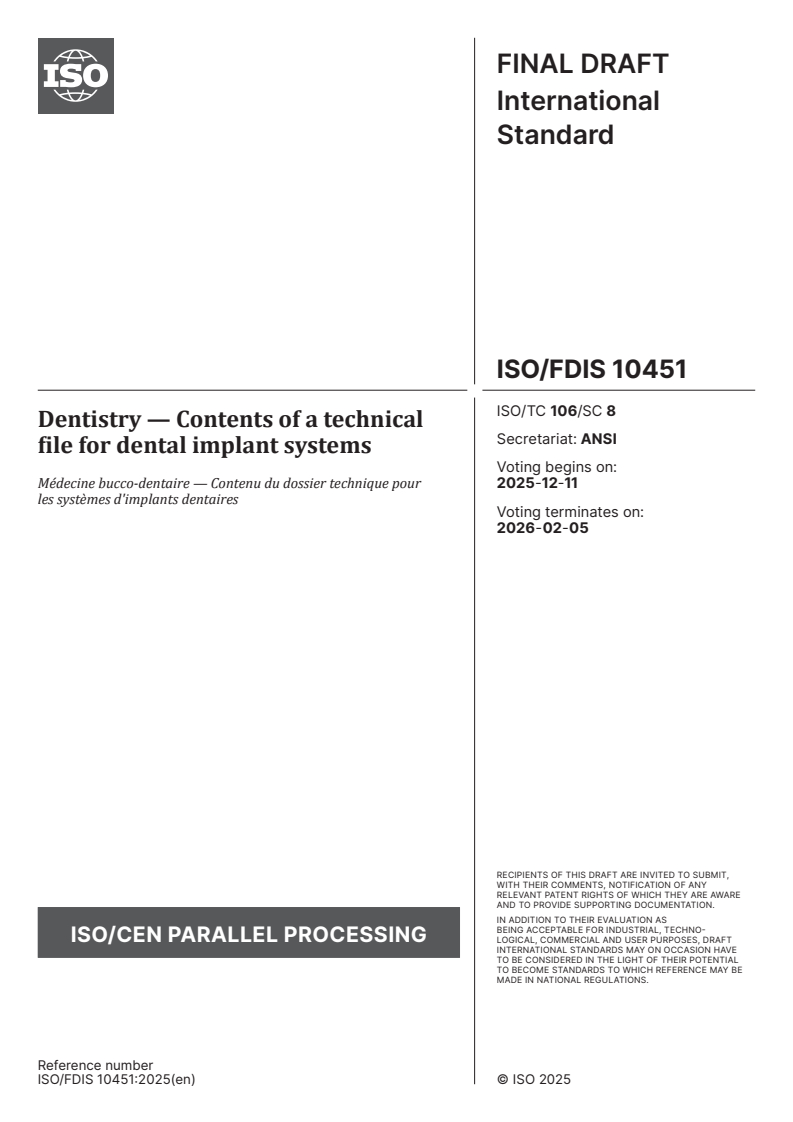
FINAL DRAFT
International
Standard
ISO/TC 106/SC 8
Dentistry — Contents of a technical
Secretariat: ANSI
file for dental implant systems
Voting begins on:
Médecine bucco-dentaire — Contenu du dossier technique pour 2025-12-11
les systèmes d'implants dentaires
Voting terminates on:
2026-02-05
RECIPIENTS OF THIS DRAFT ARE INVITED TO SUBMIT,
WITH THEIR COMMENTS, NOTIFICATION OF ANY
RELEVANT PATENT RIGHTS OF WHICH THEY ARE AWARE
AND TO PROVIDE SUPPOR TING DOCUMENTATION.
IN ADDITION TO THEIR EVALUATION AS
BEING ACCEPTABLE FOR INDUSTRIAL, TECHNO
ISO/CEN PARALLEL PROCESSING LOGICAL, COMMERCIAL AND USER PURPOSES, DRAFT
INTERNATIONAL STANDARDS MAY ON OCCASION HAVE
TO BE CONSIDERED IN THE LIGHT OF THEIR POTENTIAL
TO BECOME STAN DARDS TO WHICH REFERENCE MAY BE
MADE IN NATIONAL REGULATIONS.
Reference number
FINAL DRAFT
International
Standard
ISO/TC 106/SC 8
Dentistry — Contents of a technical
Secretariat: ANSI
file for dental implant systems
Voting begins on:
Médecine bucco-dentaire — Contenu du dossier technique pour
les systèmes d'implants dentaires
Voting terminates on:
RECIPIENTS OF THIS DRAFT ARE INVITED TO SUBMIT,
WITH THEIR COMMENTS, NOTIFICATION OF ANY
RELEVANT PATENT RIGHTS OF WHICH THEY ARE AWARE
AND TO PROVIDE SUPPOR TING DOCUMENTATION.
© ISO 2025
IN ADDITION TO THEIR EVALUATION AS
All rights reserved. Unless otherwise specified, or required in the context of its implementation, no part of this publication may
BEING ACCEPTABLE FOR INDUSTRIAL, TECHNO
ISO/CEN PARALLEL PROCESSING
LOGICAL, COMMERCIAL AND USER PURPOSES, DRAFT
be reproduced or utilized otherwise in any form or by any means, electronic or mechanical, including photocopying, or posting on
INTERNATIONAL STANDARDS MAY ON OCCASION HAVE
the internet or an intranet, without prior written permission. Permission can be requested from either ISO at the address below
TO BE CONSIDERED IN THE LIGHT OF THEIR POTENTIAL
or ISO’s member body in the country of the requester.
TO BECOME STAN DARDS TO WHICH REFERENCE MAY BE
MADE IN NATIONAL REGULATIONS.
ISO copyright office
CP 401 • Ch. de Blandonnet 8
CH-1214 Vernier, Geneva
Phone: +41 22 749 01 11
Email: copyright@iso.org
Website: www.iso.org
Published in Switzerland Reference number
ii
Contents Page
Foreword .iv
Introduction .v
1 Scope . 1
2 Normative references . 1
3 Terms and definitions . 2
4 Technical file content and requirements. 3
4.1 General .3
4.2 Device description and specification.4
4.3 Risk analysis .5
4.4 Infection and microbial contamination .5
4.5 Manufacturing information .5
4.6 Verification and validation activities .6
4.7 Clinical evaluation and clinical investigation .7
4.8 Information supplied by the manufacturer .8
4.9 Post market surveillance .9
Annex A (informative) List of identified hazards for dental implants .10
Bibliography .12
iii
Foreword
ISO (the International Organization for Standardization) is a worldwide federation of national standards
bodies (ISO member bodies). The work of preparing International Standards is normally carried out through
ISO technical committees. Each member body interested in a subject for which a technical committee
has been established has the right to be represented on that committee. International organizations,
governmental and non-governmental, in liaison with ISO, also take part in the work. ISO collaborates closely
with the International Electrotechnical Commission (IEC) on all matters of electrotechnical standardization.
The procedures used to develop this document and those intended for its further maintenance are described
in the ISO/IEC Directives, Part 1. In particular, the different approval criteria needed for the different types
of ISO document should be noted. This document was drafted in accordance with the editorial rules of the
ISO/IEC Directives, Part 2 (see www.iso.org/directives).
ISO draws attention to the possibility that the implementation of this document may involve the use of (a)
patent(s). ISO takes no position concerning the evidence, validity or applicability of any claimed patent
rights in respect thereof. As of the date of publication of this document, ISO had not received notice of (a)
patent(s) which may be required to implement this document. However, implementers are cautioned that
this may not represent the latest information, which may be obtained from the patent database available at
www.iso.org/patents. ISO shall not be held responsible for identifying any or all such patent rights.
Any trade name used in this document is information given for the convenience of users and does not
constitute an endorsement.
For an explanation of the voluntary nature of standards, the meaning of ISO specific terms and expressions
related to conformity assessment, as well as information about ISO's adherence to the World Trade
Organization (WTO) principles in the Technical Barriers to Trade (TBT), see www.iso.org/iso/foreword.html.
This document was prepared by Technical Committee ISO/TC 106, Dentistry, Subcommittee SC 8, Dental
implants, in collaboration with the European Committee for Standardization (CEN) Technical Committee
CEN/TC 55, Dentistry, in accordance with the Agreement on technical cooperation between ISO and CEN
(Vienna Agreement).
This third edition cancels and replaces the second edition (ISO 10451:2010), which has been technically
revised.
The main changes compared to the previous edition are as follows:
[1]
— technical file has been reworked to take into account the new European Medical Device Regulation ;
— Annex A has been added.
Any feedback or questions on this document should be directed to the user’s national standards body. A
complete listing of these bodies can be found at www.iso.org/members.html.
iv
Introduction
Legal and regulatory requirements on the documentation of the design, manufacture and performance of
dental implants are developing in different ways around the world. As the dental implant industry is already
active on a global basis, and is becoming more so, concern is growing as to the need for international and
mutually recognized standards for the documentation of the design and performance of such devices.
v
FINAL DRAFT International Standard ISO/FDIS 10451:2025(en)
Dentistry — Contents of a technical file for dental implant
systems
1 Scope
This document specifies requirements for the contents of a technical file to demonstrate the fulfilment of
regulatory requirements for an endosseous dental implant that can include:
— implant body;
— implant abutment;
— abutment screw;
— implant connecting part;
— implant connecting part screw;
— prosthetic screw;
— implant cover screw;
— transmucosal healing component.
This document also specifies requirements for intended use and performance, design attributes, components,
biocompatibility, manufacturing, packaging, sterilization, shelf life, marking, labelling and information
supplied by the manufacturer.
This document does not apply to the following devices:
— dental implants incorporating animal or human components or bioactive characteristics;
— custom-made devices that have no pre-fabricated connection;
— implantable materials for bone filling and augmentation in oral and maxillofacial surgery;
— membrane materials for guided tissue regeneration in oral and maxillofacial surgery;
— specific instruments indicated to be used as part of a dental implant system.
NOTE 1 ISO 22794 specifies the necessary content of technical files for implantable materials for bone filling
and augmentation in oral and maxillofacial surgery. ISO 22803 specifies the necessary content of technical files for
membrane materials for guided tissue regeneration in oral and maxillofacial surgery. These materials require a
separate technical file.
NOTE 2 ISO 13504 gives the general requirements for specific instruments indicated to be used as part of a dental
implant system. These instruments require a separate technical file.
[5]
NOTE 3 Custom-made devices are defined in IMDRF/PMD WG/N49 .
2 Normative references
The following documents are referred to in the text in such a way that some or all of their content constitutes
requirements of this document. For dated references, only the edition cited applies. For undated references,
the latest edition of the referenced document (including any amendments) applies.
ISO 1942, Dentistry — Vocabulary
ISO 3950, Dentistry — Designation system for teeth and areas of the oral cavity
ISO 7405, Dentistry — Evaluation of biocompatibility of medical devices used in dentistry
ISO 10271, Dentistry — Corrosion test methods for metallic materials
ISO 10993-1, Biological evaluation of medical devices — Part 1: Evaluation and testing within a risk management
process
ISO 10993-17, Biological evaluation of medical devices — Part 17: Toxicological risk assessment of medical
device constituents
ISO 11135, Sterilization of health-care products — Ethylene oxide — Requirements for the development,
validation and routine control of a sterilization process for medical devices
ISO 11137-1, Sterilization of health care products — Radiation — Part 1: Requirements for the development,
validation and routine control of a sterilization process for medical devices
ISO 11137-2, Sterilization of health care products — Radiation — Part 2: Establishing the sterilization dose
ISO 11607-1, Packaging for terminally sterilized medical devices — Part 1: Requirements for materials, sterile
barrier systems and packaging systems
ISO 11607-2, Packaging for terminally sterilized medical devices — Part 2: Validation requirements for forming,
sealing and assembly processes
ISO 13485, Medical devices — Quality management systems — Requirements for regulatory purposes
ISO 14155, Clinical investigation of medical devices for human subjects — Good clinical practice
ISO 14644-1, Cleanrooms and associated controlled environments — Part 1: Classification of air cleanliness by
particle concentration
ISO 14801, Dentistry — Implants — Dynamic loading test for endosseous dental implants
ISO 14971, Medical devices — Application of risk management to medical devices
ISO 15223-1, Medical devices — Symbols to be used with information to be supplied by the manufacturer — Part
1: General requirements
ISO 15223-2, Medical devices — Symbols to be used with medical device labels, labelling, and information to be
supplied — Part 2: Symbol development, selection and validation
ISO 16443, Dentistry — Vocabulary for dental implants systems and related procedure
ISO 17664-1, Processing of health care products — Information to be provided by the medical device
manufacturer for the processing of medical devices — Part 1: Critical and semi-critical medical devices
ISO 17665, Sterilization of health care products — Moist heat — Requirements for the development, validation
and routine control of a sterilization process for medical devices
ISO 20417, Medical devices — Information to be supplied by the manufacturer
ISO 22683, Dentistry — Rotational adaptability test between implant body and implant abutment in dental
implant systems
IEC 62366-1, Medical devices — Part 1: Application of usability engineering to medical devices
3 Terms and definitions
For the purposes of this document, the terms and definitions given in ISO 1942, ISO 3950, ISO 16443,
ISO 13485 and the following apply.
ISO and IEC maintain terminological databases for use in standardization at the following addresses:
— ISO Online browsing platform: available at https:// www .iso .org/ obp
— IEC Electropedia: available at https:// www .electropedia .org/
3.1
clinical evaluation
assessment and analysis of clinical data pertaining to a medical device to verify the clinical safety and
performance of the device when used as intended by the manufacturer
[SOURCE: ISO 13485:2016, 3.3]
3.2
dental implant assembly
assembly of dental implant components as recommended by the manufacturer to serve the purposes of a
dental implant
[SOURCE: ISO 16443:2014, 3.2.3]
3.3
implant component coating
layer of material, different from the constitutive material of the implant component, used to cover or
partially cover a defined surface of an implant body or an implant component
[SOURCE: ISO 1942:2020, 3.7.2.7]
3.4
technical documentation
manufacturer's set of data showing conformity of a device to a list of requirements of this document and
which is intended to be used as part of the technical documentation required for conformity assessment
procedures performed by conformity assessment bodies (3.2)
Note 1 to entry: See Reference [6] for an explanation of the term “conformity assessment body”.
Note 2 to entry: In Europe, notified bodies are considered as being conformity assessment bodies and every member
state has a national regulatory authority (e.g. Zentralstelle der Länder für Gesundheitsschutz for Germany, Agence
Nationale de Sécurité du Médicament et des Produits de Santé for France). In the United States, the Food and Drug
Agency is both a regulatory authority and a conformity assessment body.
3.5
subtractive surface treatment
process that modifies a component’s surface by subtraction of material
EXAMPLE Sandblasting and acid etching are considered subtractive surface treatments.
4 Technical file content and requirements
4.1 General
The technical file should be kept up-to-date and kept for a defined period after the last device has been
placed on the market.
The technical file shall contain, or reference the location of, at least the information required in 4.2 to 4.9.
NOTE Subclauses 4.2 to 4.9 are not supposed to be strictly followed as chapter headers for the technical
documentation.
4.2 Device description and specification
The technical file shall include the following information:
a) device name;
b) representative images;
c) variations in the family;
d) patient population;
e) intended use;
f) indications for use and contra-indications (especially if the implant component is suitable for either
single or multi-unit restorations or both, delayed or immediate loading);
g) specifications including:
1) design and dimensions;
EXAMPLE 1 Height, length, diameter, connection platform types including size, taper, conical feature, internal or
external hexagon when relevant and description of surface modification(s).
NOTE Surface modifications can include, but are not limited to, various processes like coating (ceramic, metallic,
hydroxyapatite, etc.), sandblasting, acid-etching.
2) implant abutment and prosthetic fixation design;
EXAMPLE 2 Screw-retained, cement-retained, friction-fit or combination.
3) composition of the raw material in accordance with relevant standard(s);
4) chemical properties of the raw materials in accordance with relevant standard(s);
5) physical properties of the raw material in accordance with relevant standard(s).
h) explanation of novel features;
i) description of accessories to be used in combination with the device;
j) description of unique device identification number;
k) if appropriate, justification of the classification criteria and rationale used to select the conformity
assessment route;
l) market history;
m) ref
...
ISO/TC 106/SC 8
Secretariat: ANSI
Date: 2025-09-3011-27
Dentistry - — Contents of a technical file for dental implantsimplant
systems
Médecine bucco-dentaire - — Contenu du dossier technique pour implantsles systèmes d'implants dentaires
FDIS stage
TThhiiss d drraft iaft iss su subbmmiitted tted to to a pa parallearallel vl vote ote iinn IS ISOO, CE, CENN.
ISO /FDIS 10451:####(X:2025(en)
All rights reserved. Unless otherwise specified, or required in the context of its implementation, no part of this publication
may be reproduced or utilized otherwise in any form or by any means, electronic or mechanical, including photocopying,
or posting on the internet or an intranet, without prior written permission. Permission can be requested from either ISO
at the address below or ISO’s member body in the country of the requester.
ISO copyright office
CP 401 • Ch. de Blandonnet 8
CH-1214 Vernier, Geneva
Phone: + 41 22 749 01 11
EmailE-mail: copyright@iso.org
Website: www.iso.orgwww.iso.org
Published in Switzerland
ii © ISO #### 2025 – All rights reserved
ii
Contents
Foreword . iv
Introduction . v
1 Scope . 1
2 Normative references . 2
3 Terms and definitions . 3
4 Technical file content and requirements . 4
4.1 General. 4
4.2 Device description and specification . 4
4.3 Risk analysis . 5
4.4 Infection and microbial contamination . 5
4.5 Manufacturing information . 6
4.6 Verification and validation activities . 7
4.7 Clinical evaluation and clinical investigation . 8
4.8 Information supplied by the manufacturer . 9
4.9 Post market surveillance . 10
Annex A (informative) List of identified hazards for dental implants . 11
Bibliography . 13
Foreword . iv
Introduction . v
1 Scope . 1
2 Normative references . 2
3 Terms and definitions . 3
4 Technical file content and requirements . 4
4.1 General . 4
4.2 Device description and specification . 4
4.3 Risk analysis . 5
4.4 Infection and microbial contamination . 5
4.5 Manufacturing information . 6
4.6 Verification and validation activities . 7
4.7 Clinical evaluation and Clinical investigation . 8
4.8 Information supplied by the manufacturer . 9
4.9 Post Market Surveillance . 10
Annex A (informative) List of identified hazards for dental implants . 11
Bibliography . 13
iii
ISO /FDIS 10451:####(X:2025(en)
Foreword
ISO (the International Organization for Standardization) is a worldwide federation of national standards
bodies (ISO member bodies). The work of preparing International Standards is normally carried out through
ISO technical committees. Each member body interested in a subject for which a technical committee has been
established has the right to be represented on that committee. International organizations, governmental and
non-governmental, in liaison with ISO, also take part in the work. ISO collaborates closely with the
International Electrotechnical Commission (IEC) on all matters of electrotechnical standardization.
The procedures used to develop this document and those intended for its further maintenance are described
in the ISO/IEC Directives, Part 1. In particular, the different approval criteria needed for the different types of
ISO document should be noted. This document was drafted in accordance with the editorial rules of the
ISO/IEC Directives, Part 2 (see www.iso.org/directives).
ISO draws attention to the possibility that the implementation of this document may involve the use of (a)
patent(s). ISO takes no position concerning the evidence, validity or applicability of any claimed patent rights
in respect thereof. As of the date of publication of this document, ISO had not received notice of (a) patent(s)
which may be required to implement this document. However, implementers are cautioned that this may not
represent the latest information, which may be obtained from the patent database available at
www.iso.org/patents. ISO shall not be held responsible for identifying any or all such patent rights.
Any trade name used in this document is information given for the convenience of users and does not
constitute an endorsement.
For an explanation of the voluntary nature of standards, the meaning of ISO specific terms and expressions
related to conformity assessment, as well as information about ISO's adherence to the World Trade
Organization (WTO) principles in the Technical Barriers to Trade (TBT), see www.iso.org/iso/foreword.html.
This document was prepared by Technical Committee ISO/TC 106, Dentistry, Subcommittee SC 8, Dental
implants, in collaboration with the European Committee for Standardization (CEN) Technical Committee
CEN/TC 55, Dentistry, in accordance with the Agreement on technical cooperation between ISO and CEN
(Vienna Agreement).
This third edition cancels and replaces the second edition (ISO 10451:2010), which has been technically
revised.
The main changes compared to the previous edition are as follows:
[1]
— technical file has been reworked to take into account the new European Medical Device Regulation ;
— Annex A has been added.
Any feedback or questions on this document should be directed to the user’s national standards body. A
complete listing of these bodies can be found at www.iso.org/members.html.
iv © ISO #### 2025 – All rights reserved
iv
Introduction
Legal and regulatory requirements on the documentation of the design, manufacture and performance of
dental implants are developing in different ways around the world. As the dental implant industry is already
active on a global basis, and is becoming more so, concern is growing as to the need for international and
mutually recognized standards for the documentation of the design and performance of such devices.
v
DRAFT International Standard ISO/FDIS 10451:2025(en)
Dentistry - — Contents of a technical file for dental implantsimplant
systems
1 Scope
This document specifies requirements for the contents of a technical file to demonstrate the fulfilment of
regulatory requirements for an endosseous dental implant that can include:
— implant body;
— implant abutment;
— abutment screw;
— implant connecting part;
— implant connecting part screw;
— prosthetic screw;
— implant cover screw;
— transmucosal healing component.
This document also specifies requirements for intended use and performance, design attributes, components,
biocompatibility, manufacturing, packaging, sterilization, shelf life, marking, labelling and information
supplied by the manufacturer.
This document does not apply to the following devices:
— dental implants incorporating animal or human components or bioactive characteristics;
— custom-made devices that have no pre-fabricated connection;
— implantable materials for bone filling and augmentation in oral and maxillofacial surgery;
— membrane materials for guided tissue regeneration in oral and maxillofacial surgery;
— specific instruments indicated to be used as part of a dental implant system.
[2]
NOTE 1 ISO 22794 specifies the necessary content of technical files for implantable materials for bone filling and
[3]
augmentation in oral and maxillofacial surgery. ISO 22803 specifies the necessary content of technical files for
membrane materials for guided tissue regeneration in oral and maxillofacial surgery. These materials require a separate
technical file.
[4]
NOTE 2 ISO 13504 gives the general requirements for specific instruments indicated to be used as part of a dental
implant system. These instruments require a separate technical file.
[5] [Error! Reference source not found.]
NOTE 3 Custom-made devices are defined in IMDRF/PMD WG/N49 . .
ISO /FDIS 10451:####(X:2025(en)
2 Normative references
The following documents are referred to in the text in such a way that some or all of their content constitutes
requirements of this document. For dated references, only the edition cited applies. For undated references,
the latest edition of the referenced document (including any amendments) applies.
ISO 1942, Dentistry — Vocabulary
ISO 3950, Dentistry — Designation system for teeth and areas of the oral cavity
ISO 7405, Dentistry — Evaluation of biocompatibility of medical devices used in dentistry
ISO 10271, Dentistry — Corrosion test methods for metallic materials
ISO 10993-1, Biological evaluation of medical devices — Part 1: Evaluation and testing within a risk
management process
ISO 10993--17, Biological evaluation of medical devices — Part 17: Toxicological risk assessment of medical
device constituents
ISO 11135, Sterilization of health-care products — Ethylene oxide — Requirements for the development,
validation and routine control of a sterilization process for medical devices
ISO 11137--1, Sterilization of health care products — Radiation — Part 1: Requirements for the development,
validation and routine control of a sterilization process for medical devices
ISO 11137--2, Sterilization of health care products — Radiation — Part 2: Establishing the sterilization dose
ISO 11607--1, Packaging for terminally sterilized medical devices — Part 1: Requirements for materials, sterile
barrier systems and packaging systems
ISO 11607--2, Packaging for terminally sterilized medical devices — Part 2: Validation requirements for forming,
sealing and assembly processes
ISO 13485, Medical devices — Quality management systems — Requirements for regulatory purposes
ISO 14155, Clinical investigation of medical devices for human subjects — Good clinical practice
ISO 14644 (all parts),-1, Cleanrooms and associated controlled environments — Part 1: Classification of air
cleanliness by particle concentration
ISO 14801, Dentistry — Implants — Dynamic loading test for endosseous dental implants
ISO 14971, Medical devices — Application of risk management to medical devices
ISO 15223--1, Medical devices — Symbols to be used with information to be supplied by the manufacturer —
Part 1: General requirements
ISO 15223--2, Medical devices — Symbols to be used with medical device labels, labelling, and information to be
supplied by the manufacturer — Part 2: Symbol development, selection and validation
ISO 16443, Dentistry — Vocabulary for dental implants systems and related procedure
ISO 17664--1, Processing of health care products — Information to be provided by the medical device
manufacturer for the processing of medical devices — Part 1: Critical and semi-critical medical devices
2 © ISO #### 2025 – All rights reserved
ISO 17665, Sterilization of health care products — Moist heat — Requirements for the development, validation
and routine control of a sterilization process for medical devices
ISO 20417, Medical devices — Information to be supplied by the manufacturer
ISO 22683, Dentistry — Rotational adaptability test between implant body and implant abutment in dental
implant systems
IEC 62366--1, Medical devices — Part 1: Application of usability engineering to medical devices
3 Terms and definitions
For the purposes of this document, the terms and definitions given in ISO 1942, ISO 3950, ISO 16443, ISO
13485 and the following apply.
ISO and IEC maintain terminological databases for use in standardization at the following addresses:
— ISO Online browsing platform: available at https://www.iso.org/obp
— IEC Electropedia: available at https://www.electropedia.org/
3.1 3.1
clinical evaluation
assessment and analysis of clinical data pertaining to a medical device to verify the clinical safety and
performance of the device when used as intended by the manufacturer
[SOURCE: ISO 13485:2016, 3.3]
3.2
conformity assessment body
a body other than a regulatory authority engaged in determining whether the relevant requirements in
technical regulations or standards are fulfilled
EXAMPLE In Europe, notified bodies are considered as being conformity assessment body and every member state has a
national regulatory authority (e.g. Zentralstelle der Länder für Gesundheitsschutz for Germany, Agence Nationale de
Sécurité du Médicament et des Produits de Santé for France). In the United States, the Food and Drug Agency is both a
regulatory authority and a conformity assessment body.
[6]
[SOURCE IMDRF/GRRP WG/N040:2024 , modified, example added]
3.2 3.3
dental implant assembly
assembly of dental implant components as recommended by the manufacturer to serve the purposes of a
dental implant
[SOURCE: ISO 16443:2014, 3.2.3]
3.3 3.4
implant component coating
layer of material, different from the constitutive material of the implant component, used to cover or partially
cover a defined surface of an implant body or an implant component
[SOURCE: ISO 1942:2020, 3.7.2.7]
ISO /FDIS 10451:####(X:2025(en)
3.4 3.5
technical documentation
manufacturer's set of data showing conformity of a device to a list of requirements of this document and which
is intended to be used as part of the technical documentation required for conformity assessment procedures
performed by conformity assessment bodies (3.2)(Error! Reference source not found.)
3.6Note 1 to entry: See Reference [Error! Reference source not found.] for an explanation of the term “conformity
assessment body”.
Note 2 to entry: In Europe, notified bodies are considered as being conformity assessment bodies and every member
state has a national regulatory authority (e.g. Zentralstelle der Länder für Gesundheitsschutz for Germany, Agence
Nationale de Sécurité du Médicament et des Produits de Santé for France). In the United States, the Food and Drug Agency
is both a regulatory authority and a conformity assessment body.
3.5
subtractive surface treatment
process that modifies a component’s surface by subtraction of material
EXAMPLE Sandblasting and acid etching are considered subtractive surface treatments.
4 Technical file content and requirements
4.1 General
The technical file should be kept up-to-date and kept for a defined period after the last device has been placed
on the market.
The technical file shall contain, or reference the location of, at least the information required in 4.2 to 4.9.4.2
to 4.9.
NOTE Subclauses 4.2 to 4.9NOTE 4.2 to 4.9 are not supposed to be strictly followed as chapter headers
for the technical documentation.
4.2 Device description and specification
The technical file shall include the following information:
a) device name;
b) representative images;
c) variations in the family;
d) patient population;
e) intended use;
f) indications for use and contra-indications (especially if the implant component is suitable for either single
or multi-unit restorations or both, delayed or immediate loading);
g) specifications including:
1) design and dimensions;
EXAMPLE 1 Height, length, diameter, connection platform types including size, taper, conical feature, internal or
external hexagon when relevant and description of surface modification(s).
4 © ISO #### 2025 – All rights reserved
NOTE Surface modifications can include, but are not limited to, various processes like coating (ceramic, metallic,
hydroxyapatite…),, etc.), sandblasting, acid-etching.
2) implant abutment and prosthetic fixation design;
EXAMPLE 2 Screw-retained, cement-retained, friction-fit or combination.
3) composition of the raw material in accordance with relevant standard(s);
4) chemical propert
...
Questions, Comments and Discussion
Ask us and Technical Secretary will try to provide an answer. You can facilitate discussion about the standard in here.