

ISO 3974:1977
(Main)Definitions of living animals for slaughter — Ovines
General Information
- Abstract
Gives definitions of terms, such as lamb, young ovine, adult ovine in English and French. An annex shows two sketsches of dentition of ovines.
- Status
- Published
- Publication Date
- 31-Jan-1977
- Technical Committee
- ISO/TC 34/SC 6 - Meat, poultry, fish, eggs and their products
- Drafting Committee
- ISO/TC 34/SC 6 - Meat, poultry, fish, eggs and their products
- Current Stage
- 9093 - International Standard confirmed
- Start Date
- 10-Feb-2023
- Completion Date
- 29-Aug-2026
Overview
ISO 3974:1977 is an International Standard developed by the International Organization for Standardization (ISO) that defines key terms related to living ovine animals intended for slaughter. This standard provides clear definitions in both English and French for classifications such as lamb, young ovine, and adult ovine. An essential component of the document is an annex containing sketches illustrating the dentition stages of ovines, which serve as practical guides for identifying animal categories based on tooth eruption.
The standard was created by ISO Technical Committee ISO/TC 34, which focuses on agricultural food products, ensuring accurate terminology for ovine livestock in meat production and trade.
Key Topics
Definitions of Ovines for Slaughter
ISO 3974 provides precise terminology to classify ovines according to their age and physiological characteristics, aiding in uniform descriptions worldwide.Terminology Breakdown:
- Lamb: An ovine animal with no erupted permanent incisor teeth, including:
- Sucking lamb: Not weaned and weighing ≤ 15 kg.
- Slaughter lamb: Weighing > 15 kg, which may be milk-fed or grass-fed (fattened post-weaning).
- Young Ovine: Male (castrated or entire) or female ovines with up to two pairs of permanent incisor teeth, or females that have not lambed.
- Adult Ovine: Male or female ovines with at least one erupted tooth from the third pair of permanent incisors or females that have lambed. Includes subcategories such as rams, ewes, maidens, and wethers.
- Lamb: An ovine animal with no erupted permanent incisor teeth, including:
Dentition-Based Classification
The annex features detailed dentition sketches enabling users to visually determine the classification of ovines by observing the eruption status of permanent incisors.
Applications
Livestock Management:
Farmers, breeders, and abattoirs use these standard terms to categorize their ovine animals accurately before slaughter, ensuring proper management and handling.Meat Industry:
Meat processors, distributors, and retailers rely on ISO 3974 to classify ovine meat products based on the age and type of animal, improving labeling accuracy and market transparency.International Trade:
Uniform terminology facilitates clear communication and reduces disputes in ovine livestock and meat trade across countries by providing a common understanding of animal categories.Regulatory Compliance:
Authorities can adopt ISO 3974 definitions for inspection, certification, and enforcement processes related to animal welfare, food safety, and quality standards.
Related Standards
ISO/TC 34 Series:
These standards pertain to agricultural food products, including meat and livestock terminology and handling procedures.ISO 22000:
Food safety management systems which may incorporate classification standards like ISO 3974 for ensuring meat safety and traceability.Codex Alimentarius Standards:
Guidelines and standards for meat hygiene and classification, which coordinate with ISO standards to promote quality and safety in food supply chains.
Keywords: ISO 3974, ovines, lamb definitions, slaughter animals, sheep classification, dentition sketches, livestock standards, agricultural standards, meat industry terminology, animal age classification, international ovine trade, meat labeling, ISO livestock standards.
Get Certified
Connect with accredited certification bodies for this standard

Control Union Certifications
Global certification for agriculture and sustainability.

ECOCERT
Organic and sustainability certification.

FSC International
Forest Stewardship Council certification.
Sponsored listings
Frequently Asked Questions
ISO 3974:1977 is a standard published by the International Organization for Standardization (ISO). Its full title is "Definitions of living animals for slaughter — Ovines". This standard covers: Gives definitions of terms, such as lamb, young ovine, adult ovine in English and French. An annex shows two sketsches of dentition of ovines.
Gives definitions of terms, such as lamb, young ovine, adult ovine in English and French. An annex shows two sketsches of dentition of ovines.
ISO 3974:1977 is classified under the following ICS (International Classification for Standards) categories: 65.020.30 - Animal husbandry and breeding. The ICS classification helps identify the subject area and facilitates finding related standards.
ISO 3974:1977 is available in PDF format for immediate download after purchase. The document can be added to your cart and obtained through the secure checkout process. Digital delivery ensures instant access to the complete standard document.
Standards Content (Sample)
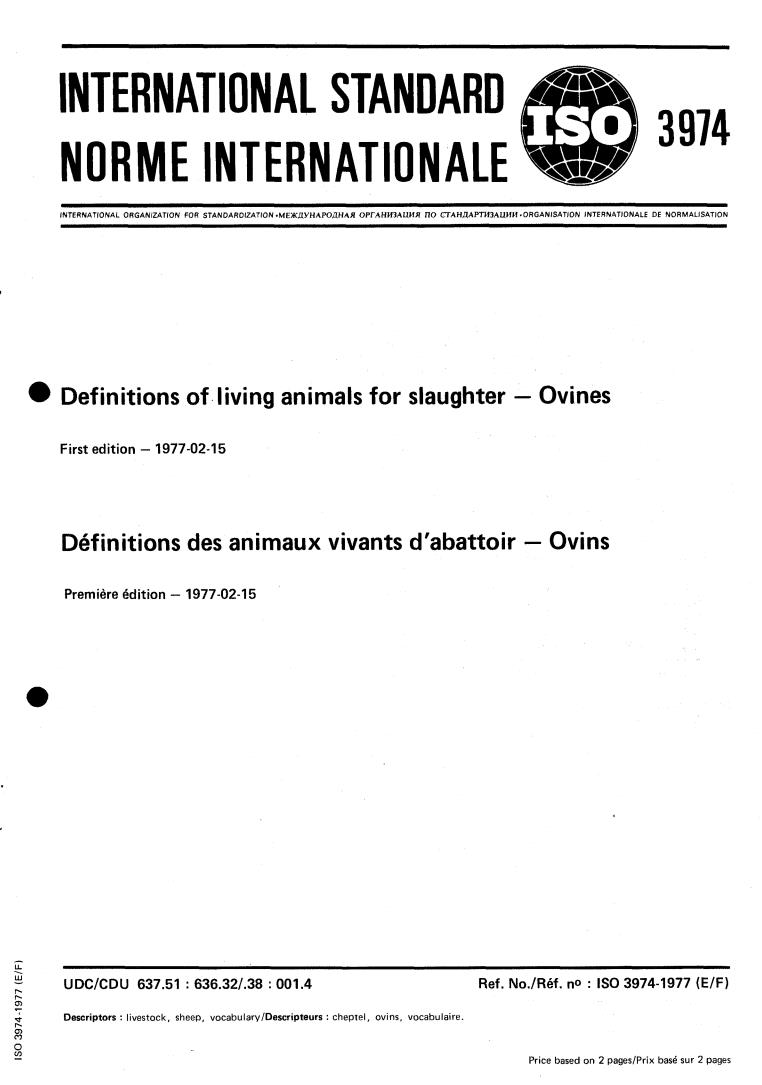
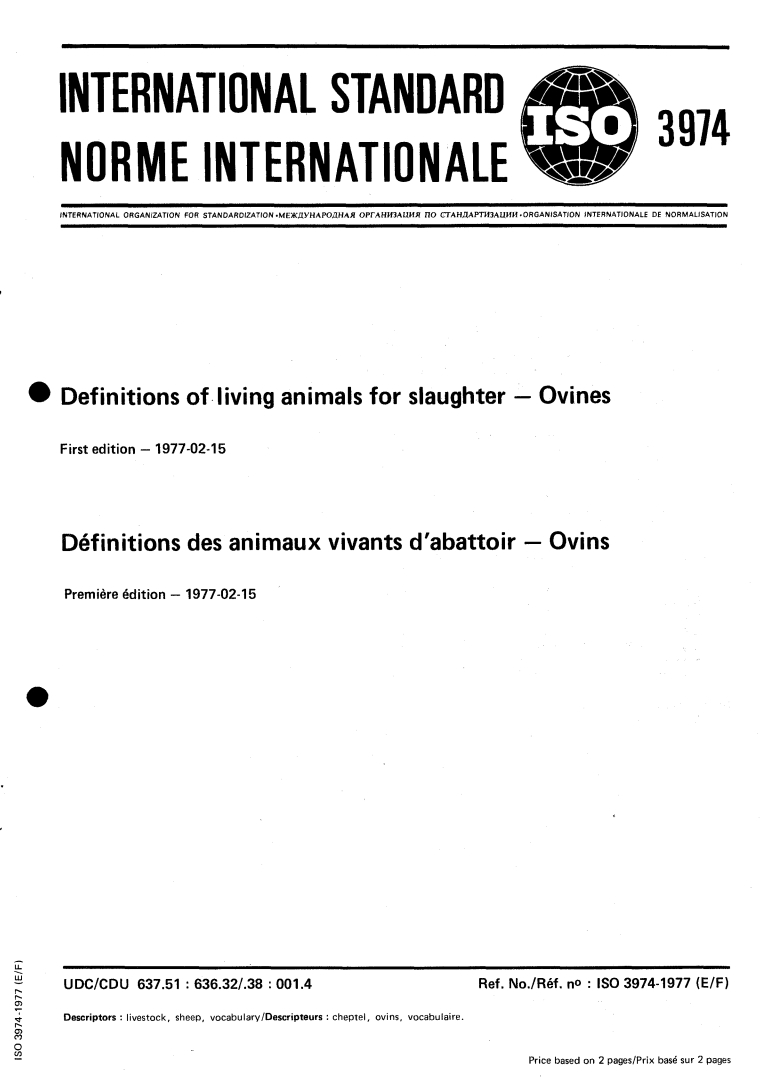
INTERNATIONAL STANDARD
NORME INTERNATIONALE
INTERNATIONAL ORGANIZATION FOR STANDARDIZATION .MEW(flYHAPOflHAR OPTAHW3AUHJl il0 CTAHnAPTI13AIlHH .ORGANISATION INTERNATIONALE DE NORMALISATION
0 Definitions of living animals for slaughter - Ovines
First edition - 1977-02-15
Définitions des animaux vivants d'abattoir - Ovins
Première édition - 1977-02-15
-
U
.
w
-
Ref. No./Réf. no : IS0 3974-1977 (E/F)
UDC/CDU 637.51 : 636.32/.38 : 001.4
pi
IC
q
Descriptors : livestock, sheep, vocabulary/Descripteurs : cheptel, ovins, vocabulaire.
h
Price based on 2 pages/Prix basé sur 2 pages
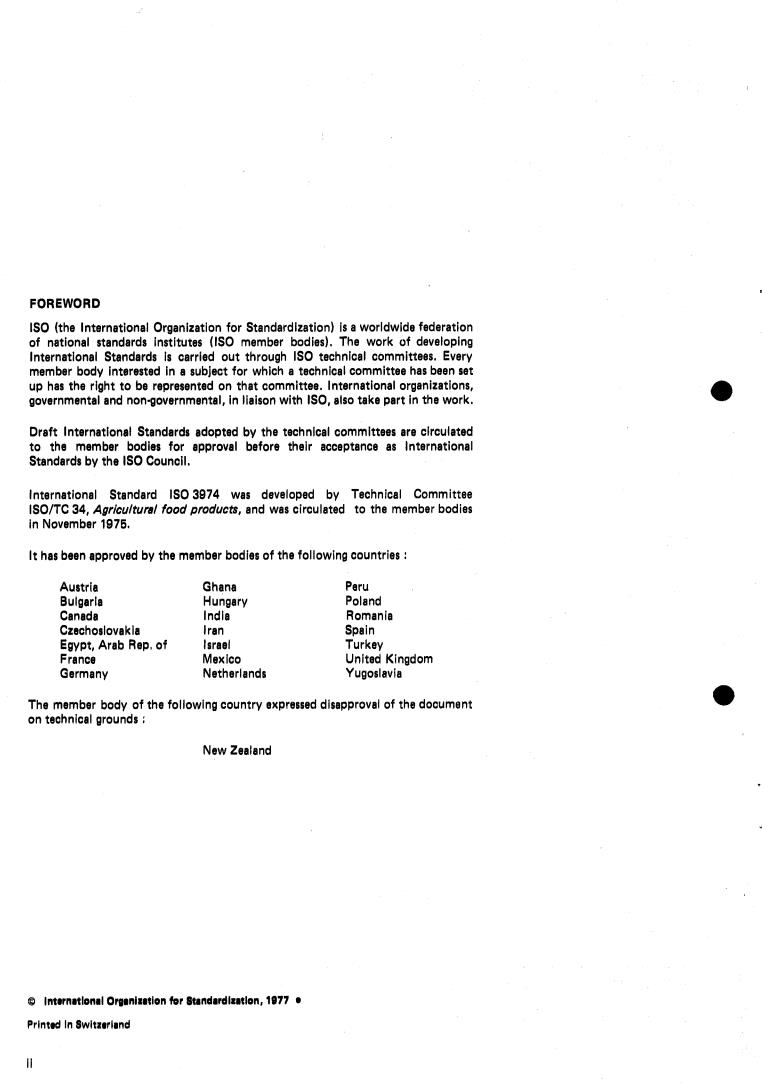
FOREWORD
IS0 (the International Organization for Standardization) is a worldwide federation
(IS0 member bodies). The work of developing
of national standards institutes
International Standards is carried out through IS0 technical committees. Every
member body interested in a subject for which a technical committee has been set
up has the right to be represented on that committee. International organizations,
e
governmental and non-governmentel, in liaison with ISO, also take part in the work.
Draft International Standards adopted by the technical committees are circulated
to the member bodies for approval before their acceptance as International
Standards by the IS0 Council.
International Standard IS0 3974 was developed by Technical Committee
ISO/TC 34, Agricultural food products, and was circulated to the member bodies
in November 1975.
It has been approved by the member bodies of the following countries :
Austria Ghana Peru
Bulgaria Hungary Poland
Canada India Romania
Spain
Czechoslovakia I ran
Israel Turkey
Egypt, Arab Rep, of
France Mexico United Kingdom
Germany Netherlands Yugoslavia
a
The member body of the following country expressed disepprovel of the document
on technical grounds ;
New Zealand
Q Intrrnitlonil Orginizrtion for Stindirdizitlon, lB77 O
Prlntd In Swlttrrlind
ii
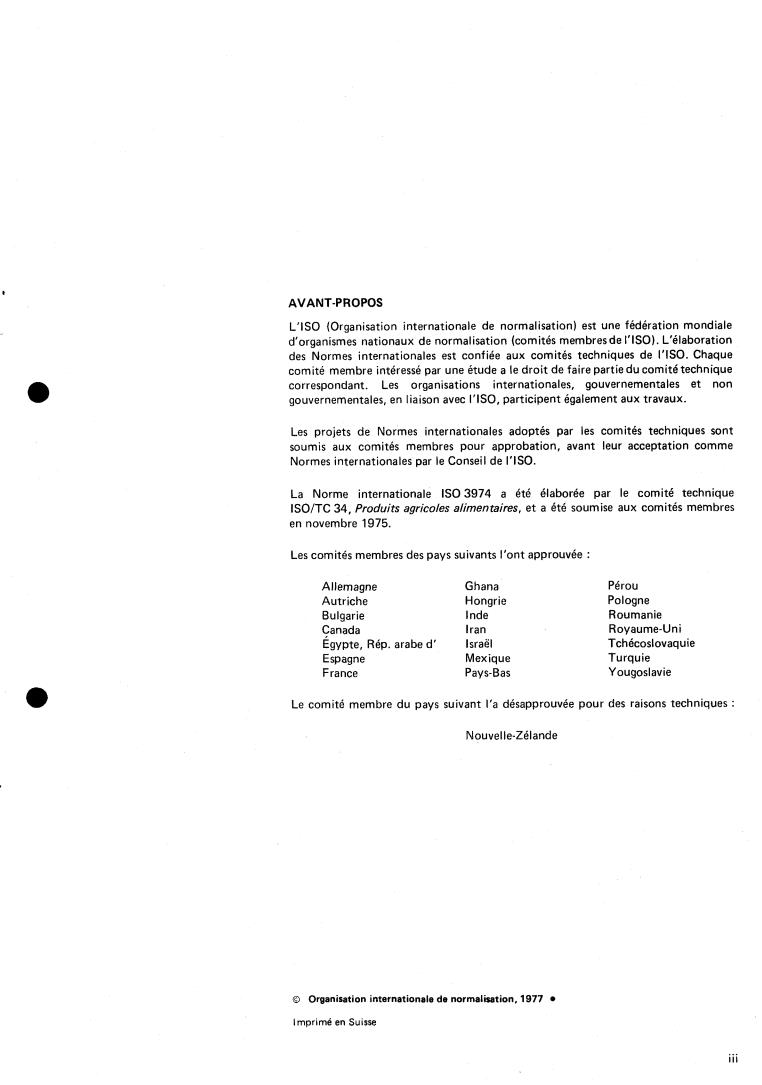
AVANT-PROPOS
L'ISO (Organisation internationale de normalisation) est une fédération mondiale
d'organismes nationaux de normalisation (comités membresde I'ISO). L'élaboration
des Normes internationales est confiée aux comités techniques de I'ISO. Chaque
comité membre intéressé par une étude a le droit de faire partiedu comité technique
correspondant. Les organisations internationales, gouvernementales et non
gouvernementales, en liaison avec I'ISO, participent également aux travaux.
Les projets de Normes internationales adoptés par les comités techniques sont
soumis aux comités membres pour approbation, avant leur acceptation comme
Normes internationales par le Conseil de I'ISO.
La Norme internationale IS0 3974 a été élaborée par le comité technique
ISO/TC 34, Produits agricoles alimentaires, et a été soumise aux comités membres
en novembre 1975.
Les comités membres des pays suivants l'ont approuvée :
Allemagne Ghana Pérou
Autriche Hongrie Pologne
Bulgarie Inde Roumanie
Iran Royaume-Uni
Canada
Egypte, Rép. arabe d' Israel Tchécoslovaquie
Espagne Mexique Turquie
France Pays-Bas Yougoslavie
Le comité membre du pays suivant l'a désapprouvée pour des raisons techniques :
Nouvelle-Zélande
O Organisation internationale de normalisation, 1977 0
Imorimé en Suisse
iii
INTERNATIONAL STANDARD
IS0 3974-1977 (E/F)
NORME INTERNATIONALE
Définitions des animaux vivants
Definitions of living animals for-
d'abattoir - Ovins
slaughter - Ovines
OBJET ET DOMAINE D'APPLICATION
SCOPE AND FIELD OF APPLICATION
La présente Norme internationale donne les définitions des
Thi
...
INTERNATIONAL STANDARD
NORME INTERNATIONALE
INTERNATIONAL ORGANIZATION FOR STANDARDIZATION .MEW(flYHAPOflHAR OPTAHW3AUHJl il0 CTAHnAPTI13AIlHH .ORGANISATION INTERNATIONALE DE NORMALISATION
0 Definitions of living animals for slaughter - Ovines
First edition - 1977-02-15
Définitions des animaux vivants d'abattoir - Ovins
Première édition - 1977-02-15
-
U
.
w
-
Ref. No./Réf. no : IS0 3974-1977 (E/F)
UDC/CDU 637.51 : 636.32/.38 : 001.4
pi
IC
q
Descriptors : livestock, sheep, vocabulary/Descripteurs : cheptel, ovins, vocabulaire.
h
Price based on 2 pages/Prix basé sur 2 pages
FOREWORD
IS0 (the International Organization for Standardization) is a worldwide federation
(IS0 member bodies). The work of developing
of national standards institutes
International Standards is carried out through IS0 technical committees. Every
member body interested in a subject for which a technical committee has been set
up has the right to be represented on that committee. International organizations,
e
governmental and non-governmentel, in liaison with ISO, also take part in the work.
Draft International Standards adopted by the technical committees are circulated
to the member bodies for approval before their acceptance as International
Standards by the IS0 Council.
International Standard IS0 3974 was developed by Technical Committee
ISO/TC 34, Agricultural food products, and was circulated to the member bodies
in November 1975.
It has been approved by the member bodies of the following countries :
Austria Ghana Peru
Bulgaria Hungary Poland
Canada India Romania
Spain
Czechoslovakia I ran
Israel Turkey
Egypt, Arab Rep, of
France Mexico United Kingdom
Germany Netherlands Yugoslavia
a
The member body of the following country expressed disepprovel of the document
on technical grounds ;
New Zealand
Q Intrrnitlonil Orginizrtion for Stindirdizitlon, lB77 O
Prlntd In Swlttrrlind
ii
AVANT-PROPOS
L'ISO (Organisation internationale de normalisation) est une fédération mondiale
d'organismes nationaux de normalisation (comités membresde I'ISO). L'élaboration
des Normes internationales est confiée aux comités techniques de I'ISO. Chaque
comité membre intéressé par une étude a le droit de faire partiedu comité technique
correspondant. Les organisations internationales, gouvernementales et non
gouvernementales, en liaison avec I'ISO, participent également aux travaux.
Les projets de Normes internationales adoptés par les comités techniques sont
soumis aux comités membres pour approbation, avant leur acceptation comme
Normes internationales par le Conseil de I'ISO.
La Norme internationale IS0 3974 a été élaborée par le comité technique
ISO/TC 34, Produits agricoles alimentaires, et a été soumise aux comités membres
en novembre 1975.
Les comités membres des pays suivants l'ont approuvée :
Allemagne Ghana Pérou
Autriche Hongrie Pologne
Bulgarie Inde Roumanie
Iran Royaume-Uni
Canada
Egypte, Rép. arabe d' Israel Tchécoslovaquie
Espagne Mexique Turquie
France Pays-Bas Yougoslavie
Le comité membre du pays suivant l'a désapprouvée pour des raisons techniques :
Nouvelle-Zélande
O Organisation internationale de normalisation, 1977 0
Imorimé en Suisse
iii
INTERNATIONAL STANDARD
IS0 3974-1977 (E/F)
NORME INTERNATIONALE
Définitions des animaux vivants
Definitions of living animals for-
d'abattoir - Ovins
slaughter - Ovines
OBJET ET DOMAINE D'APPLICATION
SCOPE AND FIELD OF APPLICATION
La présente Norme internationale donne les définitions des
Thi
...