


ISO 8858-1:2019
(Main)Hard coal - Froth flotation testing - Part 1: Laboratory procedure
Hard coal - Froth flotation testing - Part 1: Laboratory procedure
This document sets out a laboratory procedure for the froth flotation testing of fine coal, e.g. coal of particle size less than 0,5 mm. The procedure provides a means of evaluating the general flotation characteristics of a coal under a set of specified standard conditions, and will not necessarily indicate the full flotation potential of that coal. The flotation characteristics of coals are sensitive to changes in flotation conditions. These conditions can be changed by varying basic parameters such as flotation time, reagent and dosage rate. Separate flotation tests are used to assess the effect of varying these parameters to determine the best flotation conditions for a particular coal. A method of evaluating flotation response will be given in a separate standard.
Houille — Essais de flottation — Partie 1: Méthode de laboratoire
General Information
Relations
Overview
ISO 8858-1:2019 - Hard coal - Froth flotation testing - Part 1: Laboratory procedure - specifies a standardized laboratory method for assessing the froth flotation behaviour of fine hard coal (typically particle size < 0.5 mm). The standard defines the test purpose, required apparatus and reagents, sampling and sample preparation rules, controlled flotation conditions, and how to report results. It gives a repeatable baseline procedure for preliminary comparison of flotation characteristics under specified conditions (it does not claim to show the coal’s full flotation potential). A separate standard covers methods for evaluating flotation response.
Key topics and technical requirements
- Scope and purpose: Laboratory procedure for fine coal froth flotation testing to evaluate general flotation characteristics.
- Sample preparation and sampling: Follow ISO sampling procedures; dewater slurry by settling/decantation without chemicals or heat; retain sub-samples for particle size (ISO 1953) and ash/moisture testing (ISO 1171, ISO 11722).
- Apparatus: Mechanical impeller flotation cell (~3.5 L effective volume), stainless-steel cell and impeller (impeller periphery speed up to 1 500 rpm), deflector block and scraper for consistent concentrate removal, constant level control, syringes/pipettes and timing device.
- Reagents: Analytical-grade reagents only; collector n‑Dodecane (1 ml/kg dry solids); frother MIBC (4‑methylpentan‑2‑ol) used as 0.14% V/V solution, dosed at 0.1 ml MIBC solution per kg dry solids.
- Controlled test conditions: Operating temperature 25 °C ± 10 °C; solids content 100 g dry solids per litre of pulp; pulp level 20 mm ± 2 mm below overflow lip (with impeller running at 1 500 rpm); air flow 4 L/min ± 0.4 L/min.
- Procedure and reporting: Conditioning, aeration and froth collection steps; separate recovery of concentrate and tailings; determination of yields and ash content; recommended test report layout (Annex A).
Practical applications and users
- Who uses it: Coal technologists, mineral processing laboratories, exploration teams, coal preparation plants, equipment manufacturers, and consultants evaluating fine-coal floatability.
- Why it’s useful:
- Provides a reproducible baseline method for comparing coals and screening samples.
- Supports optimization studies by serving as a reference procedure before varying parameters (time, reagent type/dosage, aeration).
- Useful in exploration, product development, and quality assessment where fine-coal cleaning is needed.
Related standards
- ISO 1171 (ash), ISO 11722 (moisture), ISO 1953 (particle size analysis)
- ISO 565 (test sieves), ISO 648 (pipettes)
- ISO 1213-1 (vocabulary), ISO 13909-1…4 and ISO 18283 (sampling and sample preparation)
- Note: A separate ISO standard addresses methods for evaluating flotation response.
Keywords: ISO 8858-1:2019, hard coal, froth flotation testing, laboratory procedure, fine coal, flotation cell, MIBC, n‑dodecane, solids content, particle size, coal preparation.
Standards Content (Sample)
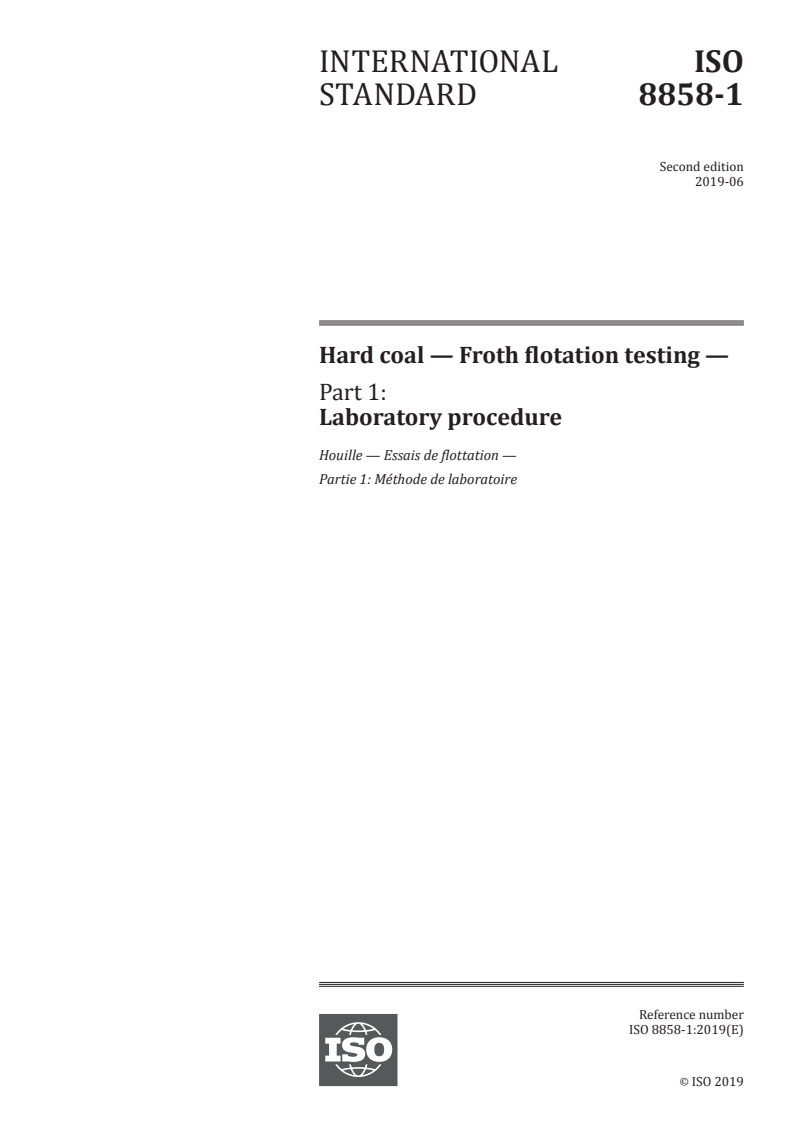
INTERNATIONAL ISO
STANDARD 8858-1
Second edition
2019-06
Hard coal — Froth flotation testing —
Part 1:
Laboratory procedure
Houille — Essais de flottation —
Partie 1: Méthode de laboratoire
Reference number
©
ISO 2019
© ISO 2019
All rights reserved. Unless otherwise specified, or required in the context of its implementation, no part of this publication may
be reproduced or utilized otherwise in any form or by any means, electronic or mechanical, including photocopying, or posting
on the internet or an intranet, without prior written permission. Permission can be requested from either ISO at the address
below or ISO’s member body in the country of the requester.
ISO copyright office
CP 401 • Ch. de Blandonnet 8
CH-1214 Vernier, Geneva
Phone: +41 22 749 01 11
Fax: +41 22 749 09 47
Email: copyright@iso.org
Website: www.iso.org
Published in Switzerland
ii © ISO 2019 – All rights reserved
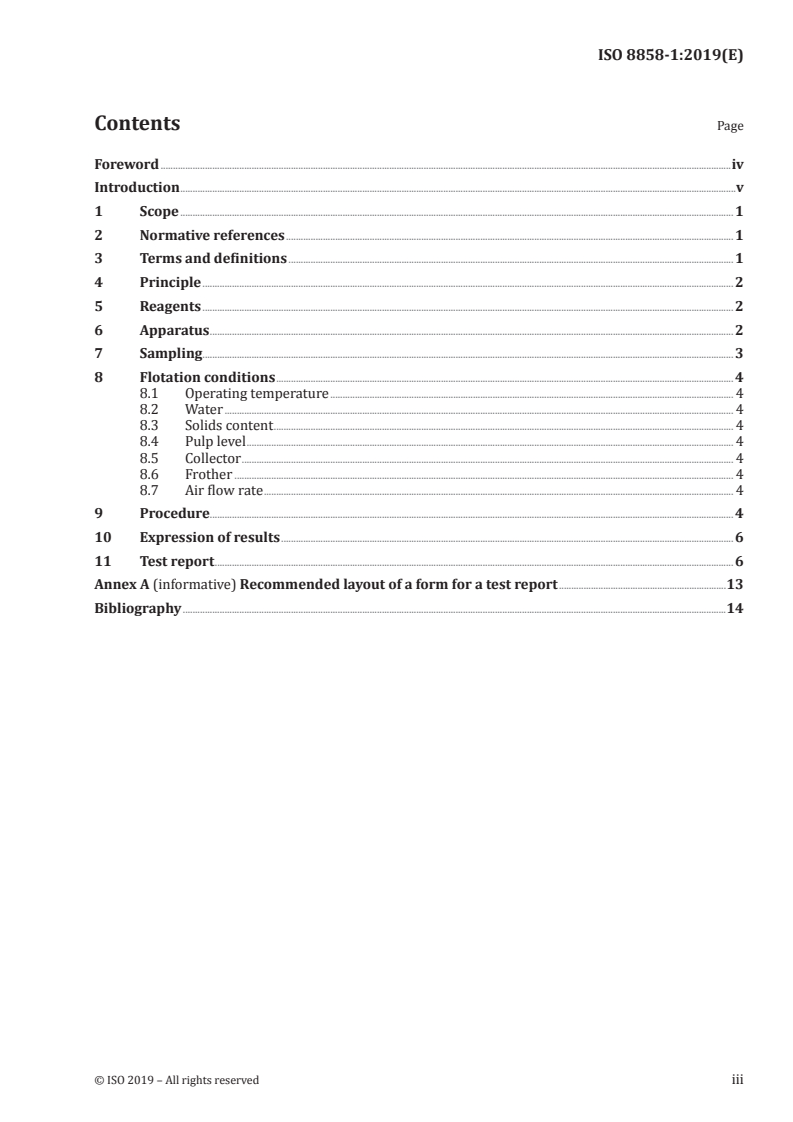
Contents Page
Foreword .iv
Introduction .v
1 Scope . 1
2 Normative references . 1
3 Terms and definitions . 1
4 Principle . 2
5 Reagents . 2
6 Apparatus . 2
7 Sampling . 3
8 Flotation conditions . 4
8.1 Operating temperature . 4
8.2 Water . 4
8.3 Solids content . 4
8.4 Pulp level . 4
8.5 Collector . 4
8.6 Frother . 4
8.7 Air flow rate . 4
9 Procedure. 4
10 Expression of results . 6
11 Test report . 6
Annex A (informative) Recommended layout of a form for a test report .13
Bibliography .14
Foreword
ISO (the International Organization for Standardization) is a worldwide federation of national standards
bodies (ISO member bodies). The work of preparing International Standards is normally carried out
through ISO technical committees. Each member body interested in a subject for which a technical
committee has been established has the right to be represented on that committee. International
organizations, governmental and non-governmental, in liaison with ISO, also take part in the work.
ISO collaborates closely with the International Electrotechnical Commission (IEC) on all matters of
electrotechnical standardization.
The procedures used to develop this document and those intended for its further maintenance are
described in the ISO/IEC Directives, Part 1. In particular, the different approval criteria needed for the
different types of ISO documents should be noted. This document was drafted in accordance with the
editorial rules of the ISO/IEC Directives, Part 2 (see www .iso .org/directives).
Attention is drawn to the possibility that some of the elements of this document may be the subject of
patent rights. ISO shall not be held responsible for identifying any or all such patent rights. Details of
any patent rights identified during the development of the document will be in the Introduction and/or
on the ISO list of patent declarations received (see www .iso .org/patents).
Any trade name used in this document is information given for the convenience of users and does not
constitute an endorsement.
For an explanation of the voluntary nature of standards, the meaning of ISO specific terms and
expressions related to conformity assessment, as well as information about ISO's adherence to the
World Trade Organization (WTO) principles in the Technical Barriers to Trade (TBT) see www .iso
.org/iso/foreword .html.
This document was prepared by Technical Committee ISO/TC 27, Solid mineral fuels, Subcommittee
SC 1, Coal preparation: Terminology and performance.
This second edition cancels and replaces the first edition (ISO 8858-1:1990), of which it constitutes a
minor revision. It also incorporates the Technical Corrigendum ISO 8858-1:1990/Cor.1:2001.
A list of all parts in the ISO 8858 series can be found on the ISO website.
Any feedback or questions on this document should be directed to the user’s national standards body. A
complete listing of these bodies can be found at www .iso .org/members .html.
iv © ISO 2019 – All rights reserved
Introduction
The froth flotation of coal has widespread application for the concentration and separation of fine coal
particles from mineral matter. The response of coal to the froth flotation process is initially measured
by a laboratory scale test. Although the principles used for the laboratory tests are generally similar,
the precise type of equipment and techniques used vary considerably.
The procedure for the laboratory froth flotation test sets out, in detail, the type of equipment to be
used and the methods to be adopted. The purpose of this procedure is to provide a standard method of
test by which a preliminary evaluation of the froth flotation characteristics of a coal can be compared.
This need is particularly important for exploration programmes. This document also serves as an
introduction for operators who are not familiar with the techniques (and problems) associated with the
laboratory froth flotation of coals.
Annex A of this document is for information only.
INTERNATIONAL STANDARD ISO 8858-1:2019(E)
Hard coal — Froth flotation testing —
Part 1:
Laboratory procedure
1 Scope
This document sets out a laboratory procedure for the froth flotation testing of fine coal, e.g. coal of
particle size less than 0,5 mm. The procedure provides a means of evaluating the general flotation
characteristics of a coal under a set of specified standard conditions, and will not necessarily indicate
the full flotation potential of that coal.
The flotation characteristics of coals are sensitive to changes in flotation conditions. These conditions
can be changed by varying basic parameters such as flotation time, reagent and dosage rate. Separate
flotation tests are used to assess the effect of varying these parameters to determine the best flotation
conditions for a particular coal. A method of evaluating flotation response will be given in a separate
standard.
2 Normative references
The following documents are referred to in the text in such a way that some or all of their content
constitutes requirements of this document. For dated references, only the edition cited applies. For
undated references, the latest edition of the referenced document (including any amendments) applies.
ISO 565, Test sieves — Metal wire cloth, perforated metal plate and electroformed sheet — Nominal sizes
of openings
ISO 648, Laboratory glassware — Single-volume pipettes
ISO 1171, Solid mineral fuels — Determination of ash
ISO 11722, Solid mineral fuels — Hard coal — Determination of moisture in the general analysis test
sample by drying in nitrogen
ISO 1213-1, Solid mineral fuels — Vocabulary — Part 1: Terms relating to coal preparation
ISO 13909-1, Hard coal and coke — Mechanical sampling — Part 1: General introduction
ISO 13909-2, Hard coal and coke — Mechanical sampling — Part 2: Coal — Sampling from moving streams
ISO 13909-3, Hard coal and coke — Mechanical sampling — Part 3: Coal — Sampling from stationary lots
ISO 13909-4, Hard coal and coke — Mechanical sampling — Part 4: Coal — Preparation of test samples
ISO 18283, Hard coal and coke — Manual sampling
3 Terms and definitions
For the purposes of this document, the terms and definitions given in ISO 1213-1 apply.
ISO and IEC maintain terminological databases for use in standardization at the following addresses:
— ISO Online browsing platform: available at https: //www .iso .org/obp
— IEC Electropedia: available at http: //www .electropedia .org/
3.1
collector
collecting agent
reagent added to a pulp to bring about adhesion between solid particles and air bubbles
3.2
flotation concentrate
clean product recovered in froth flotation
3.3
conditioning
preparatory stage in the flotation process in which the reagents are brought into intimate contact with
the solids of the pulp
3.4
frother
frothing agent
reagent used to control the size and stability of the air bubbles in the flotation process
3.5
froth flotation
process for cleaning fine coal in which the coal, with the aid of a reagent or reagents, becomes attached
to air bubbles in a liquid medium and floats as a froth
3.6
pulp
mixture of solid particles and water
3.7
flotation tailings
reject from froth flotation cells
4 Principle
Mixing of a coal sample with water to form a suspension in the flotation cell. Addition of collector and
frother and introduction of air. Separate recovery of the concentrate and tailings and determination of
the yield and ash of each.
NOTE 1 The use of chemical additives or heat can affect the flotation characteristics of the coal.
5 Reagents
During the analysis, use only reagents of recognized analytical grade and only distilled water or water
of equivalent purity.
5.1 Collector, n-Dodecane.
5.2 Frother, Methyl iso-butyl carbinol (MIBC), (4-Methylpentan-2-ol), 0,14 % (V/V) aqueous solution.
6 Apparatus
The apparatus shall be a mechanical impeller type flotation machine (see Figure 1) with the following
speci
...
Frequently Asked Questions
ISO 8858-1:2019 is a standard published by the International Organization for Standardization (ISO). Its full title is "Hard coal - Froth flotation testing - Part 1: Laboratory procedure". This standard covers: This document sets out a laboratory procedure for the froth flotation testing of fine coal, e.g. coal of particle size less than 0,5 mm. The procedure provides a means of evaluating the general flotation characteristics of a coal under a set of specified standard conditions, and will not necessarily indicate the full flotation potential of that coal. The flotation characteristics of coals are sensitive to changes in flotation conditions. These conditions can be changed by varying basic parameters such as flotation time, reagent and dosage rate. Separate flotation tests are used to assess the effect of varying these parameters to determine the best flotation conditions for a particular coal. A method of evaluating flotation response will be given in a separate standard.
This document sets out a laboratory procedure for the froth flotation testing of fine coal, e.g. coal of particle size less than 0,5 mm. The procedure provides a means of evaluating the general flotation characteristics of a coal under a set of specified standard conditions, and will not necessarily indicate the full flotation potential of that coal. The flotation characteristics of coals are sensitive to changes in flotation conditions. These conditions can be changed by varying basic parameters such as flotation time, reagent and dosage rate. Separate flotation tests are used to assess the effect of varying these parameters to determine the best flotation conditions for a particular coal. A method of evaluating flotation response will be given in a separate standard.
ISO 8858-1:2019 is classified under the following ICS (International Classification for Standards) categories: 73.040 - Coals. The ICS classification helps identify the subject area and facilitates finding related standards.
ISO 8858-1:2019 has the following relationships with other standards: It is inter standard links to ISO/FDIS 10993-7, ISO 8858-1:1990, ISO 8858-1:1990/Cor 1:2001. Understanding these relationships helps ensure you are using the most current and applicable version of the standard.
You can purchase ISO 8858-1:2019 directly from iTeh Standards. The document is available in PDF format and is delivered instantly after payment. Add the standard to your cart and complete the secure checkout process. iTeh Standards is an authorized distributor of ISO standards.
Questions, Comments and Discussion
Ask us and Technical Secretary will try to provide an answer. You can facilitate discussion about the standard in here.
Loading comments...