


ISO 26262-5:2018
(Main)Road vehicles — Functional safety — Part 5: Product development at the hardware level
Road vehicles — Functional safety — Part 5: Product development at the hardware level
This document is intended to be applied to safety-related systems that include one or more electrical and/or electronic (E/E) systems and that are installed in series production road vehicles, excluding mopeds. This document does not address unique E/E systems in special vehicles such as E/E systems designed for drivers with disabilities. NOTE Other dedicated application-specific safety standards exist and can complement the ISO 26262 series of standards or vice versa. Systems and their components released for production, or systems and their components already under development prior to the publication date of this document, are exempted from the scope of this edition. This document addresses alterations to existing systems and their components released for production prior to the publication of this document by tailoring the safety lifecycle depending on the alteration. This document addresses integration of existing systems not developed according to this document and systems developed according to this document by tailoring the safety lifecycle. This document addresses possible hazards caused by malfunctioning behaviour of safety-related E/E systems, including interaction of these systems. It does not address hazards related to electric shock, fire, smoke, heat, radiation, toxicity, flammability, reactivity, corrosion, release of energy and similar hazards, unless directly caused by malfunctioning behaviour of safety-related E/E systems. This document describes a framework for functional safety to assist the development of safety-related E/E systems. This framework is intended to be used to integrate functional safety activities into a company-specific development framework. Some requirements have a clear technical focus to implement functional safety into a product; others address the development process and can therefore be seen as process requirements in order to demonstrate the capability of an organization with respect to functional safety. This document does not address the nominal performance of E/E systems. This document specifies the requirements for product development at the hardware level for automotive applications, including the following: — general topics for the product development at the hardware level; — specification of hardware safety requirements; — hardware design; — evaluation of the hardware architectural metrics; — evaluation of safety goal violations due to random hardware failures; and — hardware integration and verification. The requirements of this document for hardware elements are applicable to both non-programmable and programmable elements, such as ASIC, FPGA and PLD. Further guidelines can be found in ISO 26262-10:2018 and ISO 26262-11:2018. Annex A provides an overview on objectives, prerequisites and work products of this document.
Véhicules routiers — Sécurité fonctionnelle — Partie 5: Développement du produit au niveau du matériel
General Information
Relations
Standards Content (Sample)
INTERNATIONAL ISO
STANDARD 26262-5
Second edition
2018-12
Road vehicles — Functional safety —
Part 5:
Product development at the
hardware level
Véhicules routiers — Sécurité fonctionnelle —
Partie 5: Développement du produit au niveau du matériel
Reference number
©
ISO 2018
© ISO 2018
All rights reserved. Unless otherwise specified, or required in the context of its implementation, no part of this publication may
be reproduced or utilized otherwise in any form or by any means, electronic or mechanical, including photocopying, or posting
on the internet or an intranet, without prior written permission. Permission can be requested from either ISO at the address
below or ISO’s member body in the country of the requester.
ISO copyright office
CP 401 • Ch. de Blandonnet 8
CH-1214 Vernier, Geneva
Phone: +41 22 749 01 11
Fax: +41 22 749 09 47
Email: copyright@iso.org
Website: www.iso.org
Published in Switzerland
ii © ISO 2018 – All rights reserved
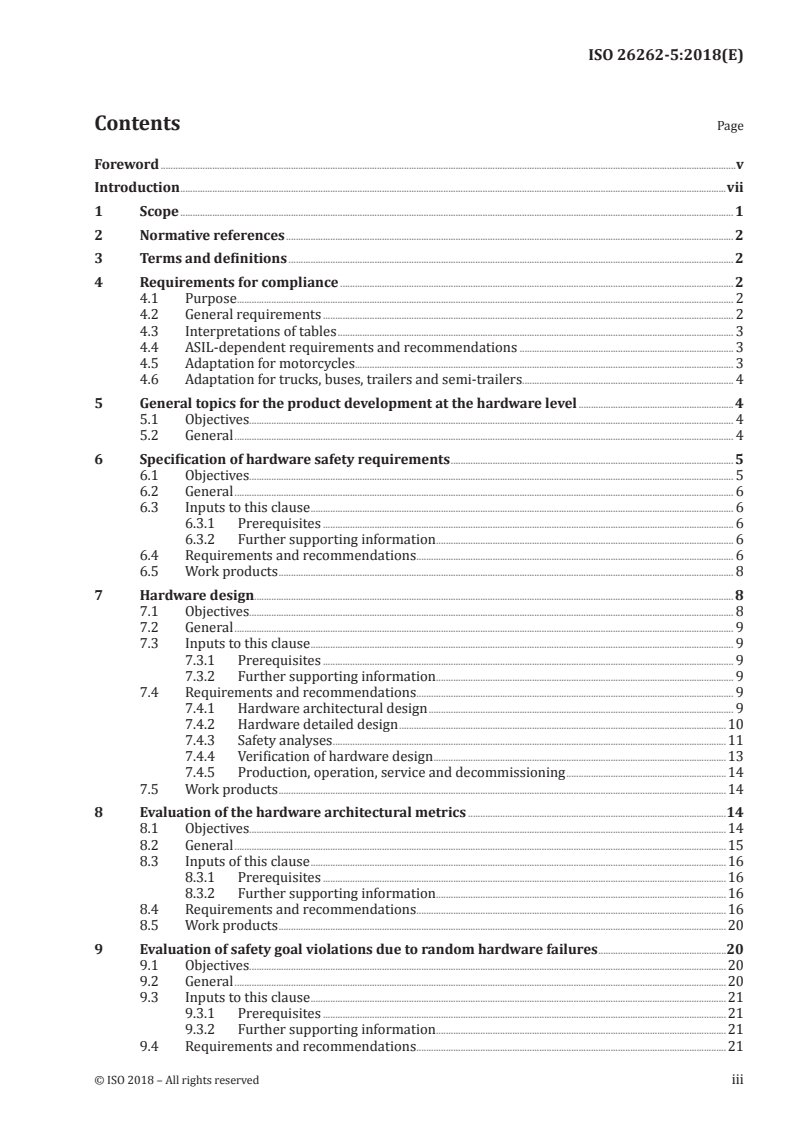
Contents Page
Foreword .v
Introduction .vii
1 Scope . 1
2 Normative references . 2
3 Terms and definitions . 2
4 Requirements for compliance . 2
4.1 Purpose . 2
4.2 General requirements . 2
4.3 Interpretations of tables . 3
4.4 ASIL-dependent requirements and recommendations . 3
4.5 Adaptation for motorcycles . 3
4.6 Adaptation for trucks, buses, trailers and semi-trailers. 4
5 General topics for the product development at the hardware level .4
5.1 Objectives. 4
5.2 General . 4
6 Specification of hardware safety requirements . 5
6.1 Objectives. 5
6.2 General . 6
6.3 Inputs to this clause . 6
6.3.1 Prerequisites . 6
6.3.2 Further supporting information . 6
6.4 Requirements and recommendations . 6
6.5 Work products . 8
7 Hardware design. 8
7.1 Objectives. 8
7.2 General . 9
7.3 Inputs to this clause . 9
7.3.1 Prerequisites . 9
7.3.2 Further supporting information . 9
7.4 Requirements and recommendations . 9
7.4.1 Hardware architectural design . 9
7.4.2 Hardware detailed design .10
7.4.3 Safety analyses .11
7.4.4 Verification of hardware design .13
7.4.5 Production, operation, service and decommissioning .14
7.5 Work products .14
8 Evaluation of the hardware architectural metrics .14
8.1 Objectives.14
8.2 General .15
8.3 Inputs of this clause .16
8.3.1 Prerequisites .16
8.3.2 Further supporting information .16
8.4 Requirements and recommendations .16
8.5 Work products .20
9 Evaluation of safety goal violations due to random hardware failures .20
9.1 Objectives.20
9.2 General .20
9.3 Inputs to this clause .21
9.3.1 Prerequisites .21
9.3.2 Further supporting information .21
9.4 Requirements and recommendations .21
9.4.1 General.21
9.4.2 Evaluation of Probabilistic Metric for random Hardware Failures (PMHF) .22
9.4.3 Evaluation of Each Cause of safety goal violation (EEC) .25
9.4.4 Verification review .29
9.5 Work products .30
10 Hardware integration and verification .30
10.1 Objectives.30
10.2 General .30
10.3 Inputs of this clause .30
10.3.1 Prerequisites .30
10.3.2 Further supporting information .30
10.4 Requirements and recommendations .30
10.5 Work products .32
Annex A (informative) Overview of and workflow of product development at the hardware level 33
Annex B (informative) Failure mode classification of a hardware element .36
Annex C (normative) Hardware architectural metrics .38
Annex D (informative) Evaluation of the diagnostic coverage .44
Annex E (informative) Example calculation of hardware architectural metrics:“single-point
fault metric” and “latent-fault metric” .66
Annex F (informative) Example for rationale that objectives of Clause 9 in accordance with
4.2 are met .75
Annex G (informative) Example of a PMHF budget assignment for an item consisting of two
systems .82
Annex H (informative) Example of latent fault handling .86
Bibliography .89
iv © ISO 2018 – All rights reserved
Foreword
ISO (the International Organization for Standardization) is a worldwide federation of national standards
bodies (ISO member bodies). The work of preparing International Standards is normally carried out
through ISO technical committees. Each member body interested in a subject for which a technical
committee has been established has the right to be represented on that committee. International
organizations, governmental and non-governmental, in liaison with ISO, also take part in the work.
ISO collaborates closely with the International Electrotechnical Commission (IEC) on all matters of
electrotechnical standardization.
The procedures used to develop this document and those intended for its further maintenance are
described in the ISO/IEC Directives, Part 1. In particular the different approval criteria needed for the
different types of ISO documents should be noted. This document was drafted in accordance with the
editorial rules of the ISO/IEC Directives, Part 2 (see www .iso .org/directives).
Attention is drawn to the possibility that some of the elements of this document may be the subject of
patent rights. ISO shall not be held responsible for identifying any or all such patent rights. Details of
any patent rights identified during the development of the document will be in the Introduction and/or
on the ISO list of patent declarations received (see www .iso .org/patents).
Any trade name used in this document is information given for the convenience of users and does not
constitute an endorsement.
For an explanation on the voluntary nature of standards, the meaning of ISO specific terms and
expressions related to conformity assessment, as well as information about ISO's adherence to the
World Trade Organization (WTO) principles in the Technical Barriers to Trade (TBT) see the following
URL: www .iso .org/iso/foreword .html.
This document was prepared by Technical Committee ISO/TC 22, Road vehicles, Subcommittee SC 32,
Electrical and electronic components and general system aspects.
This edition of ISO 26262 series of standards cancels and replaces the edition ISO 26262:2011 series of
standards, which has been technically revised and includes the following main changes:
— requirements for trucks, buses, trailers and semi-trailers;
— extension of the vocabulary;
— more detailed objectives;
— objective oriented confirmation measures;
— management of safety anomalies;
— references to cyber security;
— updated target values for hardware architecture metrics;
— guidance on model based development and software safety analysis;
— evaluation of hardware elements;
— additional guidance on dependent failure analysis;
— guidance on fault tolerance, safety related special characteristics and software tools;
— guidance for semiconductors;
— requirements for motorcycles; and
— general restructuring of all parts for improved clarity.
Any feedback or questions on this document should be directed to the user’s national standards body. A
complete listing of these bodies can be found at www .iso .org/members .html.
A list of all parts in the ISO 26262 series can be found on the ISO website.
vi © ISO 2018 – All rights reserved
Introduction
The ISO 26262 series of standards is the adaptation of IEC 61508 series of standards to address the
sector specific needs of electrical and/or electronic (E/E) systems within road vehicles.
This adaptation applies to all activities during the safety lifecycle of safety-related systems comprised
of electrical, electronic and software components.
Safety is one of the key issues in the development of road vehicles. Development and integration of
automotive functionalities strengthen the need for functional safety and the need to provide evidence
that functional safety objectives are satisfied.
With the trend of increasing technological complexity, software content and mechatronic
implementation, there are increasing risks from systematic failures and random hardware failures,
these being considered within the scope of functional safety. ISO 26262 series of standards includes
guidance to mitigate these risks by providing appropriate requirements and processes.
To achieve functional safety, the ISO 26262 series of standards:
a) provides a reference for the automotive safety lifecycle and supports the tailoring of the activities
to be performed during the lifecycle phases, i.e., development, production, operation, service and
decommissioning;
b) provides an automotive-specific risk-based approach to determine integrity levels [Automotive
Safety Integrity Levels (ASILs)];
c) uses ASILs to specify which of the requirements of ISO 26262 are applicable to avoid unreasonable
residual risk;
d) provides requirements for functional safety management, design, implementation, verification,
validation and confirmation measures; and
e) provides requirements for relations between customers and suppliers.
The ISO 26262 series of standards is concerned with functional safety of E/E systems that is achieved
through safety measures including safety mechanisms. It also provides a framework within which
safety-related systems based on other technologies (e.g. mechanical, hydraulic and pneumatic) can be
considered.
The achievement of functional safety is influenced by the development process (including such
activities as requirements specification, design, implementation, integration, verification, validation
and configuration), the production and service processes and the management processes.
Safety is intertwined with common function-oriented and quality-oriented activities and work
products. The ISO 26262 series of standards addresses the safety-related aspects of these activities and
work products.
Figure 1 shows the overall structure of the ISO 26262 series of standards. The ISO 26262 series of
standards is based upon a V-model as a reference process model for the different phases of product
development. Within the figure:
— the shaded “V”s represent the interconnection among ISO 26262-3, ISO 26262-4, ISO 26262-5,
ISO 26262-6 and ISO 26262-7;
— for motorcycles:
— ISO 26262-12:2018, Clause 8 supports ISO 26262-3;
— ISO 26262-12:2018, Clauses 9 and 10 support ISO 26262-4;
— the specific clauses are indicated in the following manner: “m-n”, where “m” represents the number
of the particular part and “n” indicates the number of the clause within that part.
EXAMPLE “2-6” represents ISO 26262-2:2018, Clause 6.
Figure 1 — Overview of the ISO 26262 series of standards
viii © ISO 2018 – All rights reserved
INTERNATIONAL STANDARD ISO 26262-5:2018(E)
Road vehicles — Functional safety —
Part 5:
Product development at the hardware level
1 Scope
This document is intended to be applied to safety-related systems that include one or more electrical
and/or electronic (E/E) systems and that are installed in series production road vehicles, excluding
mopeds. This document does not address unique E/E systems in special vehicles such as E/E systems
designed for drivers with disabilities.
NOTE Other dedicated application-specific safety standards exist and can complement the ISO 26262 series
of standards or vice versa.
Systems and their components released for production, or systems and their components already under
development prior to the publication date of this document, are exempted from the scope of this edition.
This document addresses alterations to existing systems and their components released for production
prior to the publication of this document by tailoring the safety lifecycle depending on the alteration.
This document addresses integration of existing systems not developed according to this document and
systems developed according to this document by tailoring the safety lifecycle.
This document addresses possible hazards caused by malfunctioning behaviour of safety-related E/E
systems, including interaction of these systems. It does not address hazards related to electric shock,
fire, smoke, heat, radiation, toxicity, flammability, reactivity, corrosion, release of energy and similar
hazards, unless directly caused by malfunctioning behaviour of safety-related E/E systems.
This document describes a framework for functional safety to assist the development of safety-
related E/E systems. This framework is intended to be used to integrate functional safety activities
into a company-specific development framework. Some requirements have a clear technical focus to
implement functional safety into a product; others address the development process and can therefore
be seen as process requirements in order to demonstrate the capability of an organization with respect
to functional safety.
This document does not address the nominal performance of E/E systems.
This document specifies the requirements for product development at the hardware level for automotive
applications, including the following:
— general topics for the product development at the hardware level;
— specification of hardware safety requirements;
— hardware design;
— evaluation of the hardware architectural metrics;
— evaluation of safety goal violations due to random hardware failures; and
— hardware integration and verification.
The requirements of this document for hardware elements are applicable to both non-programmable
and programmable elements, such as ASIC, FPGA and PLD. Further guidelines can be found in
ISO 26262-10:2018 and ISO 26262-11:2018.
Annex A provides an overview on objectives, prerequisites and work products of this document.
2 Normative references
The following documents are referred to in the text in such a way that some or all of their content
constitutes requirements of this document. For dated references, only the edition cited applies. For
undated references, the latest edition of the referenced document (including any amendments) applies.
ISO 26262-1, Road vehicles — Functional safety — Part 1: Vocabulary
ISO 26262-2:2018, Road vehicles — Functional safety — Part 2: Management of functional safety
ISO 26262-4:2018, Road vehicles — Functional safety — Part 4: Product development at the system level
ISO 26262-6:2018, Road vehicles — Functional safety — Part 6: Product development at the software level
ISO 26262-7:2018, Road vehicles — Functional safety — Part 7: Production and operation
ISO 26262-8:2018, Road vehicles — Functional safety — Part 8: Supporting processes
ISO 26262-9:2018, Road vehicles — Functional safety — Part 9: Automotive Safety Integrity Level (ASIL)-
oriented and safety-oriented analyses
3 Terms and definitions
For the purposes of this document, the terms, definitions and abbreviated terms given in
ISO 26262-1:2018 apply.
ISO and IEC maintain terminological databases for use in standardization at the following addresses:
— IEC Electropedia: available at http: //www .electropedia .org/
— ISO Online browsing platform: available at https: //www .iso .org/obp
4 Requirements for compliance
4.1 Purpose
This clause describes how:
a) to achieve compliance with the ISO 26262 series of standards;
b) to interpret the tables used in the ISO 26262 series of standards; and
c) to interpret the applicability of each clause, depending on the relevant ASIL(s).
4.2 General requirements
When claiming compliance with the ISO 26262 series of standards, each requirement shall be met,
unless one of the following applies:
a) tailoring of the safety activities in accordance with ISO 26262-2 has been performed that shows
that the requirement does not apply; or
b) a rationale is available that the non-compliance is acceptable and the rationale has been evaluated
in accordance with ISO 26262-2.
Informative content, including notes and examples, is only for guidance in understanding, or for
clarification of the associated requirement, and shall not be interpreted as a requirement itself or as
complete or exhaustive.
2 © ISO 2018 – All rights reserved
The results of safety activities are given as work products. “Prerequisites” are information which shall
be available as work products of a previous phase. Given that certain requirements of a clause are
ASIL-dependent or may be tailored, certain work products may not be needed as prerequisites.
“Further supporting information” is information that can be considered, but which in some cases is not
required by the ISO 26262 series of standards as a work product of a previous phase and which may be
made available by external sources that are different from the persons or organizations responsible for
the functional safety activities.
4.3 Interpretations of tables
Tables are normative or informative depending on their context. The different methods listed in a table
contribute to the level of confidence in achieving compliance with the corresponding requirement. Each
method in a table is either:
a) a consecutive entry (marked by a sequence number in the leftmost column, e.g. 1, 2, 3), or
b) an alternative entry (marked by a number followed by a letter in the leftmost column, e.g. 2a, 2b, 2c).
For consecutive entries, all listed highly recommended and recommended methods in accordance with
the ASIL apply. It is allowed to substitute a highly recommended or recommended method by others
not listed in the table, in this case, a rationale shall be given describing why these comply with the
corresponding requirement. If a rationale can be given to comply with the corresponding requirement
without choosing all entries, a further rationale for omitted methods is not necessary.
For alternative entries, an appropriate combination of methods shall be applied in accordance with the
ASIL indicated, independent of whether they are listed in the table or not. If methods are listed with
different degrees of recommendation for an ASIL, the methods with the higher recommendation should
be preferred. A rationale shall be given that the selected combination of methods or even a selected
single method complies with the corresponding requirement.
NOTE A rationale based on the methods listed in the table is sufficient. However, this does not imply a bias
for or against methods not listed in the table.
For each method, the degree of recommendation to use the corresponding method depends on the ASIL
and is categorized as follows:
— “++” indicates that the method is highly recommended for the identified ASIL;
— “+” indicates that the method is recommended for the identified ASIL; and
— “o” indicates that the method has no recommendation for or against its usage for the identified ASIL.
4.4 ASIL-dependent requirements and recommendations
The requirements or recommendations of each sub-clause shall be met for ASIL A, B, C and D, if not
stated otherwise. These requirements and recommendations refer to the ASIL of the safety goal.
If ASIL decomposition has been performed at an earlier stage of development, in accordance with
ISO 26262-9:2018, Clause 5, the ASIL resulting from the decomposition shall be met.
If an ASIL is given in parentheses in the ISO 26262 series of standards, the corresponding sub-clause
shall be considered as a recommendation rather than a requirement for this ASIL. This has no link with
the parenthesis notation related to ASIL decomposition.
4.5 Adaptation for motorcycles
For items or elements of motorcycles for which requirements of ISO 26262-12 are applicable,
the requirements of ISO 26262-12 supersede the corresponding requirements in this document.
Requirements of ISO 26262-2 that are superseded by ISO 26262-12 are defined in Part 12.
4.6 Adaptation for trucks, buses, trailers and semi-trailers
Content that is intended to be unique for trucks, buses, trailers and semi-trailers (T&B) is indicated
as such.
5 General topics for the product development at the hardware level
5.1 Objectives
The objective of this clause is to describe the functional safety activities during the individual sub-
phases of hardware development.
5.2 General
The necessary activities and processes needed to develop hardware that meets the safety requirements
are planned according to ISO 26262-2:2018, 6.4.6.
Figure 2 illustrates the hardware level product development process steps in order to comply with the
requirements of this document, and the integration of these steps within the ISO 26262 framework.
The necessary activities and processes for the product development at the hardware level include:
— the hardware implementation of the technical safety concept;
— the analysis of potential hardware faults and their effects; and
— the coordination with software development.
In contrast to the software development sub-phases, this document contains two clauses describing
quantitative evaluations of the overall hardware architecture of the item.
Clause 8 describes two metrics to evaluate the effectiveness of the hardware architecture of the item
and the implemented safety mechanisms to cope with random hardware failures.
As a complement to Clause 8, Clause 9 describes two alternative methods to evaluate whether the
residual risk of safety goal violations is sufficiently low, either by using a global probabilistic approach
(see 9.4.2, PMHF method) or by using a cut-set analysis (see 9.4.3, EEC method) to study the impact of
each identified fault of a hardware element upon the violation of the safety goals.
4 © ISO 2018 – All rights reserved
NOTE Within the figure, the specific clauses of each part of ISO 26262 are indicated in the following
manner: “m-n”, where “m” represents the number of the part and “n” indicates the number of the clause, e.g. “4-7”
represents ISO 26262-4:2018, Clause 7.
Figure 2 — Reference phase model for the product development at the hardware level
6 Specification of hardware safety requirements
6.1 Objectives
The objectives of this clause are:
a) to specify the hardware safety requirements. They are derived from the technical safety concept
and the system architectural design specification;
b) to refine the hardware-software interface (HSI) specification initiated in ISO 26262-4:2018,
6.4.7; and
c) to verify that the hardware safety requirements and the hardware-software interface (HSI)
specification are consistent with the technical safety concept and the system architectural design
specification.
6.2 General
The technical safety requirements are allocated to hardware and software. The requirements that are
allocated to both are further partitioned to yield hardware-only safety requirements. The hardware
safety requirements are further detailed considering design constraints and the impact of these design
constraints on the hardware.
6.3 Inputs to this clause
6.3.1 Prerequisites
The following information shall be available:
— technical safety concept in accordance with ISO 26262-4:2018, 6.5.2;
— system architectural design specification in accordance with ISO 26262-4:2018, 6.5.3; and
— hardware-software interface (HSI) specification in accordance with ISO 26262-4:2018, 6.5.4.
6.3.2 Further supporting information
The following information can be considered:
— software safety requirements specification (see ISO 26262-6:2018, 6.5.1); and
— hardware specifications (from an external source).
6.4 Requirements and recommendations
6.4.1 A hardware safety requirements specification for the hardware elements of the item
shall be derived from the technical safety requirements allocated to hardware (resulting from
ISO 26262-4:2018, 6.5.2).
6.4.2 The hardware safety requirements specification shall include each hardware requirement that
relates to functional safety, including the following:
a) the hardware safety requirements and relevant properties of safety mechanisms to control
internal failures of the hardware of the element. These include internal safety mechanisms to cover
transient faults when shown to be relevant due to, for instance, the technology used;
EXAMPLE 1 Properties can include the timing and detection abilities of a watchdog.
b) the hardware safety requirements and relevant properties of safety mechanisms to control or
tolerate failures external to the element;
EXAMPLE 2 The functional behaviour required for an ECU in the event of an external failure, such as an
open-circuit on an input of the ECU.
c) the hardware safety requirements and relevant properties of safety mechanisms to comply with
the safety requirements of other elements;
EXAMPLE 3 Diagnosis of sensors or actuators.
d) the hardware safety requirements and relevant properties of safety mechanisms to detect and
signal internal or external failures; and
6 © ISO 2018 – All rights reserved
NOTE 1 The hardware safety requirements described in d) include safety mechanisms to prevent faults
from being latent.
EXAMPLE 4 The specified fault reaction time interval for the hardware part of a safety mechanism, so as
to be consistent with the fault tolerant time interval.
e) the hardware safety requirements not specifying safety mechanisms.
EXAMPLE 5 Examples are:
— requirements on the hardware elements to meet the target values for random hardware failures as
described in 6.4.3 and 6.4.4;
— requirements for the avoidance of a specific behaviour (for instance, “a particular sensor shall not
produce an unstable output signal”);
— requirements allocated to hardware elements implementing the intended functionality; and
— requirements specifying design measures on harnesses or connectors.
NOTE 2 Safety mechanisms can be implemented in hardware, in software, or as a combination of both.
6.4.3 This requirement applies to ASIL (B), C, and D of the safety goal. The target values specified to
comply with ISO 26262-4:2018, 6.4.5, for the metrics of Clause 8 of this document shall be considered
when deriving values for the hardware elements of the item.
6.4.4 This requirement applies to ASIL (B), C, and D of the safety goal. The target values specified to
comply with ISO 26262-4:2018, 6.4.5, for the procedures of Clause 9 of this document shall be considered
when deriving values for the hardware elements of the item.
NOTE This activity can include an apportionment of PMHF target values in the case of a distributed
development as given in ISO 26262-8:2018, Clause 5, unless the use of EEC of 9.4.3 is agreed.
6.4.5 The hardware safety requirements shall be specified in accordance with ISO 26262-8:2018,
Clause 6.
6.4.6 The criteria for design verification of the hardware elements of the item shall be specified,
including environmental conditions (temperature, vibration, EMI, etc.), specific operational environment
(supply voltage, mission profile, etc.) and component specific requirements:
a) for verification by evaluation of hardware elements, the criteria shall meet the needs of
ISO 26262-8:2018, Clause 13; and
b) for verification by testing, the criteria shall meet the needs of Clause 10 of this document.
6.4.7 The hardware safety requirements shall comply with the fault tolerant time interval, or with the
maximum fault handling time interval, for safety mechanisms as specified in ISO 26262-4:2018, 6.4.2.
NOTE A mechanism able to control a fault, but not able to comply with the fault tolerant time interval or
with the maximum fault handling time interval, can be specified in the HW design. In such a case, it cannot be
considered within the metrics of Clause 8 and Clause 9 of this document and it cannot be considered in an ASIL
decomposition scheme.
6.4.8 The hardware safety requirements shall comply with the multiple-point fault detection interval
as specified in ISO 26262-4:2018, 6.4.2.
NOTE 1 In the case of ASIL C and D safety goals, and if the corresponding safety concept does not prescribe
specific values, the multiple-point fault detection intervals can be specified to be equal to or lower than the item's
“power-up to power-down” cycle.
NOTE 2 Appropriate multiple-point fault detection intervals can also be justified by the quantitative analysis
of the occurrence of random hardware failures (see Clause 9).
6.4.9 The hardware safety requirements shall be verified in accordance with ISO 26262-8:2018,
Clause 9, in order to provide evidence of their:
a) consistency with the technical safety concept, the system design specification and the hardware
specifications;
b) completeness with respect to the technical safety requirements allocated to the hardware element;
c) consistency with the relevant software safety requirements; and
d) correctness and accuracy.
6.4.10 The HSI specification initiated in ISO 26262-4:2018, 6.4.7, shall be refined sufficiently to allow
for the correct control and usage of the hardware by the software and shall describe each safety-related
dependency between hardware and software.
6.4.11 The persons responsible for hardware and software development shall be jointly responsible for
the verification of the adequacy of the refined HSI specification.
6.5 Work products
6.5.1 Hardware safety requirements specification (including test and evaluation criteria)
resulting from requirements 6.4.1 to 6.4.8.
6.5.2 Hardware-software interface specification (HSI) (refined) resulting from requirement 6.4.10.
NOTE This work product refers to the same work product as given in ISO 26262-6:2018, 6.5.2.
6.5.3 Hardware safety requirements verification report resulting from requirements 6.4.9 and 6.4.11.
7 Hardware design
7.1 Objectives
The objectives of this clause are:
a) to create a hardware design that:
— supports the safety-oriented analyses;
— considers the results of the safety-oriented analyses;
— fulfils the hardware safety requirements;
— fulfils the hardware-software interface (HSI) specification;
— is consistent with system architectural design specification; and
— satisfies the required hardware design properties; and
b) to specify requirements and to provide information regarding functional safety of the hardware
during production, operation, service and decommissioning; and
8 © ISO 2018 – All rights reserved
c) to verify:
— that the hardware design can fulfil the hardware safety requirements and the hardware-
software interface (HSI) specification;
— the validity of the assumptions used to develop each SEooC integrated in the developed
hardware; and
— the suitability of the safety-related special characteristics to achieve functional safety during
production and service.
7.2 General
Hardware design includes hardware architectural design and hardware detailed design. Hardware
architectural design represents all hardware components and their interactions with one another.
Hardware detailed design is at the level of electrical/electronic schematics representing the
interconnections between hardware parts composing the hardware components.
In order to develop a single hardware design, both hardware safety requirements as well as all non-
safety requirements are complied with. Hence, in this sub-phase, safety and non-safety requirements
are handled within one development process.
7.3 Inputs to this clause
7.3.1 Prerequisites
The following information shall be available:
— hardware safety requirements specification in accordance with 6.5.1;
— hardware-software interface specification (HSI) (refined) in accordance with 6.5.2; and
— system architectural design specification in accordance with ISO 26262-4:2018, 6.5.3.
7.3.2 Further supporting information
The following information can be considered:
— software safety requirements specification (see ISO 26262-6:2018, 6.5.1); and
— specification of non-safety-related requirements of the hardware (from an external source).
7.4 Requirements and recommendations
7.4.1 Hardware architectural design
7.4.1.1 The hardware architecture shall implement the hardware safety requirements defined in
Clause 6.
7.4.1.2 The hardware safety requirements shall be allocated to the hardware elements. As a result, each
hardware element shall be developed in compliance with the highest ASIL of any of the requirements
allocated to it.
NOTE Each characteristic of the hardware element will inherit the highest ASIL of the hardware safety
requirements that it implements.
7.4.1.3 If ASIL decomposition is applied to the hardware safety requirements during hardware
architectural design, it shall be applied in accordance with ISO 26262-9:2018, Clause 5.
7.4.1.4 If a hardware element is made of sub-elements that have an ASIL lower than the ASIL of the
element or no ASIL assigned, then each of these shall be treated in accordance with the highest ASIL,
unless the criteria for coex
...
Questions, Comments and Discussion
Ask us and Technical Secretary will try to provide an answer. You can facilitate discussion about the standard in here.