


ISO/IEC 10040:1992
(Main)Information technology — Open Systems Interconnection — Systems management overview
Information technology — Open Systems Interconnection — Systems management overview
Technologies de l'information — Interconnexion de systèmes ouverts (OSI) — Aperçu général de la gestion-systèmes
General Information
- Status
- Withdrawn
- Publication Date
- 28-Oct-1992
- Withdrawal Date
- 28-Oct-1992
- Technical Committee
- ISO/IEC JTC 1 - Information technology
- Drafting Committee
- ISO/IEC JTC 1 - Information technology
- Current Stage
- 9599 - Withdrawal of International Standard
- Start Date
- 15-Oct-1998
- Completion Date
- 12-Feb-2026
Relations
- Effective Date
- 06-Jun-2022
- Effective Date
- 06-Jun-2022
- Effective Date
- 06-Jun-2022
- Effective Date
- 15-Apr-2008
- Effective Date
- 15-Apr-2008
- Effective Date
- 15-Apr-2008
- Effective Date
- 15-Apr-2008

ISO/IEC 10040:1992 - Information technology -- Open Systems Interconnection -- Systems management overview
ISO/IEC 10040:1992 - Technologies de l'information -- Interconnexion de systemes ouverts (OSI) -- Aperçu général de la gestion-systemes
Get Certified
Connect with accredited certification bodies for this standard

BSI Group
BSI (British Standards Institution) is the business standards company that helps organizations make excellence a habit.

NYCE
Mexican standards and certification body.
Sponsored listings
Frequently Asked Questions
ISO/IEC 10040:1992 is a standard published by the International Organization for Standardization (ISO). Its full title is "Information technology — Open Systems Interconnection — Systems management overview". This standard covers: Information technology — Open Systems Interconnection — Systems management overview
Information technology — Open Systems Interconnection — Systems management overview
ISO/IEC 10040:1992 is classified under the following ICS (International Classification for Standards) categories: 35.100.70 - Application layer. The ICS classification helps identify the subject area and facilitates finding related standards.
ISO/IEC 10040:1992 has the following relationships with other standards: It is inter standard links to ISO/IEC 10040:1992/Amd 1:1995, ISO/IEC 10040:1992/Cor 2:1996, ISO/IEC 10040:1992/Cor 1:1994, ISO/IEC 10040:1998; is excused to ISO/IEC 10040:1992/Cor 2:1996, ISO/IEC 10040:1992/Amd 1:1995, ISO/IEC 10040:1992/Cor 1:1994. Understanding these relationships helps ensure you are using the most current and applicable version of the standard.
ISO/IEC 10040:1992 is available in PDF format for immediate download after purchase. The document can be added to your cart and obtained through the secure checkout process. Digital delivery ensures instant access to the complete standard document.
Standards Content (Sample)
I N TERN AT I O NA L ISO/IEC
STANDARD 10040
First edition
1992-1 1-01
Information technology - Open Systems
- Systems management
Interconnection
overview
Technologies de l'information - Interconnexion de systèmes ouverts
(OS11 - Aperçu général de la gestion-système
Reference number
ISOAEC 10040:1992(E)
ISODEC 10040:1992 (E)
Contents . Page
I Scope . I
2 Normative rcfcrences . 1
2.1 Identical CCIïT Recommendations I International Standards . 2
2.2 Paired Rccoininendations I International Standards equivalcnt in
2.3 Additional rcfcrences . . 3
3 Definitions .
3.1 Basic rcfcrcncc model dcfinitions
3.2 Managenient framcwo
3.3 CMISE dcfinitions .
3.4 Manageineiit inforinat
3.5 OS1 conforinancc tcsii
3.6 Systcins inanagemcnt
4 Abbreviations .
5 Systems management . .
6 Systcins manageinent inodel . 7
6.1 Introduction .
6.2 Information aspects .
6.3 Functional aspects .
6.4 OS1 coininunications aspccts .
6.5 Organizational aspects . 14
7.2 Cominunication of in
7.3 Structure of inanagei
7.4 Systciiis iiianagcment functions . 16
8 Coiiforiiiancc and coinpliance . 18
... 18
8.1 Coiiipliancc to this Recominendation I International Standard .
8.2 Coiiïoriiiancc to this Recomiiicndation I International Standard . 20
Aiincx A Applicaiion contcxt tor systems managcinciit . 21
Anncx B Scopc staicmcnt for systeiiis inanageinent functions . 24
O ISO/IEC 1992
All rights rçservcd. No part of this publication may bç reproduced or utilized in any foriii or by
my iiieaiis, çlectronic or inechaiiicol, including photocopying or iiiicrofiliii, without pcriiiissioii
iii writing ïroiii thç publisher.
ISO/IEC Copyright Ofiïcç Case postalç 56 CH-121 I Geiihç Switzerland
Printed in Switmhd
Il
ISODEC 100401992 (E)
Foreword
IS0 (the International Organization for Standardization) and IEC (the
International Electrotechnical Commission) form the specialized system for
worldwide standardization. National bodies that are members of IS0 or IEC
participate in the development of International Standards through technical
committees established by the respective organization to deal with particular
fields of technical activity. IS0 and IEC technical committees collaborate in
fields of mutual interest. Other international organizations, governmental and
non-governmental, in liaison with IS0 and IEC, also participate in the work.
In the field of information technology, IS0 and IEC have established a joint
technical committee, ISO/IEC JTC 1. Draft International Standards adopted by
the joint technical committee are circulated to national bodies for voting.
Publication as an International Standard requires approval by at least 75% of the
national bodies casting a vote.
International Standard ISO/IEC 10040 was prepared by the Joint Technical
Committee ISO/IEC JTC1, Infoniintioii technology, in collaboration with
CCITT. The identical text is published as CCITT Recommendation X.701.
Annex A foriiis an integral part of ISO/IEC 10040.
Annex B is for information only.
iii
ISOAEC 10040 : 1992 (E)
INTERNATIONAL STANDARD
CCITT RECOMM3ENDATION
INFORMATION TECHNOLOGY - OPEN SYSTEMS INTERCONNECTION -
SYSTEMS MANAGEMENT OVERVEW
1 Scope
This Recommendation I International Standard
-
provides an overview to the family of systems management standards;
-
establishes the basis for partitioning the systems management standards into separate groups, specifying
the scope of each group and identifying the principal components within each group;
-
gives guidance on the development of systems management standards and identifies the way they relate
to each other;
-
defines terms for use by other systems management standards.
-
is applicable to the definition of ail systems management standards and to all aspects of systems
management of whatever scale;
-
is applicable to situations in which the responsibility for systems management is centralised and those
where it is decentralised;
-
establishes a model for systems management, identifies several aspects of systems management
a
(i.e., information, functional, communications, and organizational), and further refines the model to
clarify these aspects;
-
identifies the principles governing conformance requirements and conformance claims to systems
management standards.
There are no conformance requirements on the main body of this Recommendation I International Standard, however it
does specify requirements on standards claiming compliance to systems management.
Annex A of this Recommendation I Intemational Standard defines an application context for systems management and
specifies the rules for negotiating systems management functional units. There are conformance requirements
associated with these rules.
2 Normative references
The following CCITT Recommendations and International Standards contain provisions which, through reference in
this text, constitute provisions of this Recommendation I International Standard. At the time of publication, the editions
indicated were valid. All Recommendations and Standards are subject to revision, and parties to agreement based on
this Recommendation I International Standard are encouraged to investigate the possibility of applying the most recent
editions of the Recommendations and Standards listed below. Members of EC and IS0 maintain registers of currently
valid Internatiotial Standards. The CCITT Secretariat maintains a list of the currently valid CCITT Recommendations.
Rec. X.701 (1992 E) 1
CCITT
I
ISO/IEC 10040 : 1992 (E)
2.1 Identical CCITT Recommendations I International Standards
-
CCITT Recommendation X.720 (1992) I ISOBLEC 10165-1:1992, Information technology - Open
Systems Interconnection - Structure of management information: Management information model.
-
CCITT Recommendation X.721 (1992) I ISOBLEC 10165-2:1992, Information technology - Open
Systems Interconnection - Structure of management information: Definition of management
information.
-
CCITT Recommendation X.722 (1992) I ISO/IEC 10165-4:1992, Information technology - Open
Systems Interconnection - Structure of management information: Guidelines for the definition of
managed objects,
-
CCITT Recommendation X.730 (1992) I ISOBLEC 10164-1:1992, Information technology - Open
Systems Interconnection - Systems Management: Object management function.
-
CCITT Recommendation X.731 (1992) I ISOBLEC 10164-2:1992, Information technology - Open
Systems Interconnection - Systems Management: State management function.
-
CCITT Recommendation X.732 (1992) I ISOBLEC 10164-3:1992, Information technology - Open
Systems Interconnection - Systems Management: Attributes for representing relationships.
-
CCITT Recommendation X.733 (1992) I ISOBLEC 10164-4:1992, Information technology - Open
Systems Interconnection - Systems Management: Alarm reporting function.
-
CCITT Recommendation X.734l) (1992) I ISOBLEC 10164-5: 1992, Information technology - Open
Systems Interconnection - Systems Management: Event report managementfunction.
-
CCITT Recommendation X.7351) (1992) I ISOBLEC 10164-6:1992, Information technology - Open
Systems Interconnection - Systems Management: Log control function.
-
CCITT Recommendation X.736 (1992) I ISOBLEC 10164-7:1992, Information technology - Open
Systems Interconnection - Systems Management: Security alarm reporting function.
Paired Recommendations I International Standards equivalent in technical content
2.2
CCITT Recommendation X.200 (1988)) Reference Model of Open Systems Interconnection for CCIZT
Applications.
IS0 7498: 1984, Information processing systems - Open Systems Interconnection - Basic Reference
Model.
CCITT Recommendation X.7001) Management Framework Definition for Open Systems
Interconnection (OSI) for CCITT Applications.
ISOBLEC 7498-4: 1989, Information processing systems - Open Systems Interconnection - Basic
Reference Model - Part 4: Management framework.
CCITT Recommendation X.209 (1988)) Specification of basic encoding rules for abstract syntax
notation one (ASN.1).
ISO/LEC 8825: 1990, Information technology - Open Systems Interconnection - Specification of Basic
Encoding Rules for Abstract Syntax Notation One (ASN.1).
CCITT Recommendation X.217 (1988), Association control service definition for Open Systems
Interconnection for CCITT Applications.
IS0 8649: 1988, Information processing systems - Open Systems Interconnection - Service definition of
the Association Control Service Element.
CCIïT Recommendation X.227 (1988)) Association Control Protocol Specification for Open Systems
Interconnection for CCITT Applications.
IS0 8650: 1988, Information processing systems - Open Systems Interconnection - Protocol
specification for the Association Control Service Element.
CCITT Recommendation X.219 (1988), Remote Operations: model, notation and service definition.
ISOBLEC 9072-1:1989, Information processing - Text communication - Remote Operations - Part I:
Model, notation and service definition.
l) Presently at state of draft Recommendation.
2 CCï" Rec. X.701(1992 E)
ISOIIEC 10040 : 1992 (E)
-
CCITT Recommendation X.229 (1988), Remote Operations: Protocol specGCation.
ISOAEC 9072-2 1989 Information processing systems - Text communication - Remote Operations -
Part 2: Protocol specification.
-
CCITT Recommendation X.290 (1992), OSI Conformance testing Methodology and Framework for
Protocol Recommendations for CCIïT Applications - General Concepts.
ISOAEC 9646-1: 1991, Information technology - Open Systems Interconnection - Conformance testing
methodology andframework - Part 1: General concepts.
-
CCITT Recommendation X.710 (1991), Common management information service definition for CCIïT
applications.
ISO/TEC 9595: 1991, Information technology - Open Systems Interconnection - Common management
information service definition.
-
CCITT Recommendation X.711 (1991), Common management information protocol specification for
CCIïT applications.
ISOAEC 9596-1: 1991, Information technology - Open Systems Interconnection - Common management
- Part I: Specification.
information protocol
2.3 Additional references
-
ISOAEC 8571: 1989, Information processing systems - Open Systems Interconnection - File Transfer,
Access and Management.
-
ISOAEC 9545: 1989, Information technology - Open Systems Interconnection - Application Layer
strudture.
-
ISO/IEC 10026: .2), Information technology - Open Systems Interconnection - Distributed Transaction
Processing.
3 Definitions
Basic reference model definitions
3.1
This Recommendation I International Standard is based on the concepts in the Basic Reference Model for Open
Systems Interconnection and makes use of the following terms defined in CCI'IT Rec. X.200 I IS0 7498:
a) application service element;
b) systems management.
3.2 Management framework definitions
This Recommendation I International Standard makes use of the following terms defined in CCITT Rec. X.700 I
ISO/IEC 7498-4:
a) managed object;
b) management information base;
c) systems management application entity.
3.3 CMISE definitions
This Recommendation I International Standard makes use of the following terms defined in CCITT Rec. X.710 I
ISOAEC 9595:
(of managed object);
a) attribute
common management information service element;
b)
c) common management information services.
2, To be published.
CCïïT Rec. X.701(1992 E) 3
ISOAEC 10040 : 1992 (E)
3.4 Management information model definitions
This Recommendation I International Standard makes use of the following terms defined in CCITT Rec. X.720 I
ISODEC 10165-1:
a) attribute type;
b) naming tree;
c) managed object boundary.
3.5 OS1 conformance testing methodology and framework definitions
This Recommendation I International Standard makes use of the following terms defined in CCITT Rec. X.290 I
ISODEC 9646- 1:
protocol implementation conformance statement (PICS);
a)
b) PICS proforma;
c) system conformance statement.
3.6 Systems management overview definitions
For the purposes of this Recommendation I International Standard, the following definitions apply:.
3.6.1 agent: An MIS-User, which for a particular systems management interaction, bas taken an agent role.
3.6.2 agent role: A role taken by an MIS-User in which it is capable of performing management operations on
managed objects and of emitting notifications on behalf of managed objects.
3.6.3 dependent conformance: Conformance to the elements of protocol associated with a set of services, as
specified by a system conformance statement.
3.6.4 general conformance: Conformance to the elements of protocol associated with the kernel set of services,
and any additional functional units, as required by the Recommendation I International Standard.
3.6.5 generic definitions: Definitions of managed object classes, attribute types, notification types or management
operation types, made available for general use.
3.6.6 (management) interaction: A single management operation or a single notification or an identified set of
logically related management operations and notifications during which the manager and agent role do not change.
3.6.7 managed object class: A named set of managed objects sharing the same (named) sets of attributes,
notifications, management operations (packages), and which share the same conditions for presence of those packages.
NOTE 1 - The following two definitions are aligned with the corresponding definitions in OS1 Conformance Testing
Methodology and Framework CCITT Rec. X.290 I ISO/IEC 9646-1 for PICS and PICS proforma.
3.6.8 managed object conformance statement (MOCS): A statement made by a supplier of a managed object
implementation, stating the capabilities and options which bave been implemented, and any features which have been
omitted.
3.6.9 MOCS proforma: A document, in the form of a questionnaire, designed by the managed object definer or
conformance test suite specifier, which when completed for a managed object implementation becomes the MOCS.
3.6.10 managed (open) system: A real open system containing an MIS-User which can take the agent role.
3.6.11 management domain: A set of managed objects, to which a common systems management policy applies.
3.6.12 management information: The information within an open system which may be transferred by OS1
management protocols.
3.6.13 management support object: A systems managed object defined specifically to support a systems
management function (e.g. log, discriminator).
3.6.14 manager: An MIS-User, which for a particular systems management interaction, has taken a manager role.
3.6.15 manager role: A role taken by an MIS-User in which it is capable of issuing management operations and of
receiving notifications.
4 CCITT Rec. X.701(1992 E)
ISO/IEC 10040 : 1992 (E)
3.6.16 managing (open) system: A real open system containing an MIS-User which can take the manager role.
MIS-User: An application making use of systems management services.
3.6.17
3.6.18 notification: Information emitted by a managed object relating to an event that has occurred within the
managed object.
3.6.19 notification type: A named data-type defining a specific kind of notification.
(N)-layer managed object: A managed object specific to the (N)-layer.
3.6.20
3.6.21 (N)-layer management protocol: A (N)-layer protocol for the exchange of (N)-layer management
information supported solely by protocols of the layers (N-1) and below.
NOTE2- This Recommendation I International Standard neither specifies nor requires the use of (N)-layer
management protocols. The definition is included here for the sake of completeness.
(systems management) operation: An operation on a managed object to effect systems management.
3.6.22
3.6.23 systems managed object: A managed object relevant to more than one layer, to the system as a whole, or to
specific management functions.
3.6.24 systems management application process: An application process participating in systems management.
3.6.25 systems management application service element: An application service element providing systems
management services.
3.6.26 systems management function: A part of systems management activities which satisfy a set of logically
related user requirements.
3.6.27 systems management functional area: A category of systems management user requirements.
3.6.28 systems management functional unit: A named non-empty set of systems management services defined for
the purpose of identifying specific sets of functionality where there is a requirement to establish or negotiate the use of
such functionality between end systems or for reference purposes in other standards.
3.6.29 systems management functional unit package: A named non-empty set of systems management functional
units, defined for the purposes of negotiation of functional units on an association.
3.6.30 systems management (application) protocol: An application layer protocol supporting systems
management services.
3.6.31 systems management service: A named set of service primitives that provide a service for use in systems
management.
4 Abbreviations
ASN. 1 Abstract Syntax Notation One
association control service element
ACSE
ASE application service element
B-ISDN broadband integrated services digitai network
CMIP common management information protocol
CMIPDU common management information protocol data unit
CMIS common management information service
CMISE common management information service element
CSPDN circuit switched public data network
FrAM file transfer, access and management
Id identifier
ISDN integrated services digital network
LAN local area network
management application protocol data unit
MAPDU
CCITT Rec. X.701(1992 E) 5
ISOmEC 10040 : 1992 (E)
MHS message handling system
MOTIS message oriented text interchange system
MIB management information base
MIS management information service
MOCS managed object conformance statement
os1 open systems interconnection
PICS protocol implementation conformance statement
data network
PSPDN packet switched public
ROSE remote operations service element
single association control function
SACF
SMAE systems management application entity
SMAPM systems management application protocol machine
SMASE systems management application service element
Sh4FA systems management functional area
SMFU systems management functional unit
SMI structure of management information
TMN telecommunication management network
TP transaction processing
virtual terminal
VT
WAN wide area network
5 Systems management
Systems management provides mechanisms for the monitoring, control and coordination of resources within the OS1
environment and OS1 protocol standards for communicating information pertinent to those resources. In order to
describe management operations on resources in the OS1 environment, the resources are viewed as managed objects
with defined properties. Information required for systems management purposes in any open system may be provided
through local input, may result from input from other open systems through systems management (application layer)
communication or may be a result of lower layer protocol exchanges.
In particular, systems management applies to but is not limited to, (e.g. use of CCITT Rec. M.30 TMN is also
considered a valid application of systems management)
-
OS1 Layer 1 (Dedicated lineSAeased lines, satellite connections);
-
OS1 Layer 2 GAN, WAN, etc.);
-
OS1 Layer 3 (CSPDN, PSPDN, ISDN, B-ISDN, CCIïT Rec. X.300 subnetwork, etc.);
-
OS1 Layer 4 (Transport Layer Entities);
-
OS1 Layer 5 (Session Layer Entities);
-
OS1 Layer 6 (Presentation layer Entities);
-
OS1 Layer 7 (MHS I MOTIS, FïAM, VT, TP, Directory).
NOTE- While the principal impetus for the development of these standards has been the need to managed OS1
resources, they also have broader applicability. Furthermore, it is possible that in the future, standards development may be
undertaken to specifically address additional areas.
Systems management is applicable to a wide range of distributed processing and communications environments. These
environments range from local area networks interconnecting small systems, to interconnected corporate and national
networks on a global scale. Small scale environments may be managed by appropriate small scale management
systems, consisting of a single manager capable of controlling and coordinating the open communication environment
through a number of agents. The standards and concepts are also applicable to large scale environments supporting
multiple managers.
6 CClTï Rec. X.701(1992 E)
ISOmEC 10040 : 1992 (E)
There are three main groupings within the set of systems management standards. They are
a set of standards specifying systems management functions;
a)
a set of standards relating to the specification of managed objects;
b)
a set of application layer service and protocol standards for communicating information relating to
c)
management functions,
The requirements to be satisfied by systems management activities can conveniently be grouped into five areas, each
of which gives rise to one or more standards covering one or more functions. These areas as defined by the OS1
Management Framework (CCITï Rec. X.700 I ISO/IEC 7498-4) are
- fault management;
- configuration management;
- accounting management;
- performance management;
- security management.
However, many items of information, their associated management operations and the communication protocols are
known to be common to more than one area. And, in performing management activities, sets of management functions
may be combined to effect a particular management policy.
For these reasons, systems management standards form a closely interrelated set of standards.
6 Systems management model
6.1 Introduction
This clause identifies a number of concepts of systems management and provides a model to clarify these concepts and
their relationships.
The following subclauses describe the various aspects of the systems management model:
- information aspects;
- functional aspects;
- OS1 communications aspects;
- organizational aspects.
Management of a communications environment is an information processing application. Because the environment
being managed is distributed, the individual components of the management activities are themselves distributed.
Management applications perform the management activities in a distributed manner, by establishing associations
between systems management application entities.
As shown in Figure 1 the interactions which take place between systems managernent application entities are
abstracted in terms of management operations and notifications issued by one entity to the other; these are
communicated using systems management services and protocols.
Management activities are effected through the manipulation of managed objects. For the purposes of systems
management, management applications are categorised as MIS-Users. Each interaction takes place between two MIS-
Users, one taking the manager role, the other the agent role.
An MIS-User taking the role of an agent is that part of a distributed application that manages the managed objects
within its local system environment. An agent performs management operations on managed objects as a consequence
of management operations communicated from a manager. An agent may also forward notifications emitted by
managed objects to a manager.
An MIS-User taking the role of a manager is that part of a distributed application which has responsibility for one or
more management activities, by issuing management operations and receiving notifications.
The concept of a manager is not limited to applications participating solely in systems management; other applications
needing access to management information may use management information services.
CCJTT Rec. X.701(1992 E) 7
ISOmEC 10040 : 1992 (E)
Managed open system
Performing
management
Communicating
/I
r\
operations *
O
/ Management operations
11 MIS-user 1
M IS-user
b\
Notifications (agent role)
(manager role)
O
Notifications
/
emitted
O
Managed
objects
TIS00010-92
Figure 1 - Systems management interactions
Roles are not permanently assigned to MIS-Users. Some MIS-Users can be restricted to only taking an agent role,
some to only taking a manager role while other MIS-Users are aliowed to take an agent role in one interaction and to
take a manager role in a separate interaction.
NOTE 1 - When a management interaction between open systems pertains to more than one managed object, the
specification of how the agent distributes the management operation amongst its managed objects is not subject to standardization.
NOTE 2 - A managed object can itself represent a resource outside of the managed system. The relationship between
the managed system and the outside resource may also be one of managedagent. If the communication between these systems
follows OS1 Management standards, then management operations on a managed object in the original managed system might
result in further managedagent exchanges, operating on a "remote" managed object. No limits are imposed upon the number of
such cascaded management operations that are permitted.
It is important to recognise that this Recommendation I International Standard only establishes a conceptual model that
describes the structure and contents of the information actually communicated by the use of standardized management
information services. Whenever management information is communicated, it is done in terms of this model.
Whether, where and how systems represent and store the real data from which the management information is derived
is a local matter, and therefore not subject to standardization.
NOTE 3 - Figure 2 represents a particular way of viewing certain aspects of the system management model and is given
for information only. The figure has been of value during the development of this specification. In particular it differentiates the
mapping to standardized communication (following the rules introduced in 6.2) from local mapping, which illustrates that a
method of viewing the real management information in terms of the model must exist within the systems management application
process. Furthermore, the method exists in the local environment and is therefore an implementation matter not subject to
standardization.
Figure 2 does not show the complete model, nor does it show all the details in full. In particular it does not imply that
there is necessarily only one subtree of the naming tree related to a specific layer, nor does it imply that the term "systems
management information model space" is a defined term.
6.2 Information aspects
This subclause introduces the information aspects of the systems management model. The definitive specification of
the information model is given in CCITT Rec. X.720 I ISO/IEC 10165-1. It refines the concept of Managed Objects
defined in CCITT Rec. X.700 I ISO/IEC 7498-4. It deals with their attributes, the management operations that may be
performed upon them, and the notifications that they may emit. The set of managed objects in a system, together with
their attributes, constitutes that system's Management Information Base (MIB).
8 CCITT Rec. X.701(1992 E)
1-1
ISO/IEC 10040 : 1992 (E)
Standardised managed objects are expected to be specified by the standardization organisations responsible for
standardizing the resources represented by the managed objects (e.g., the group responsible for standardising an
(N)-layer protocol entity is also responsible for standardising the managed object that represents the management view
of that protocol entity). Guidelines and tools to support the definition of managed objects are provided, as are a
collection of definitions of management information to support the definitions of managed objects and the definition of
systems management functions.
6.2.1 Managed objects
A managed object is the OS1 Management view of a resource that is subject to management, such as a layer entity, a
connection or an item of physical communications equipment. Thus, a managed object is the abstraction of such a
resource that represents its properties as seen by (and for the purpose of) management. An essential part of the
definition of a managed object is the relationship between these properties and the operational behaviour of the
resource. This relationship is not modelled in a general way.
Managed objects can be specific to an individual layer, in which case they are known as (N)-layer managed objects.
Those managed objects that are relevant to more than one layer, to a specific systems management function
to the system as a whole are known as systems managed objects.
(management support object) or
I Systems manaqement application process
I[ Mappinq to standardised communication 1
t----- Systems managed objects
t (N)-layer managed objects
1 OS1 environment r,- L Local environment J
TIS00020-92
Managed object
fi Containment hierarchy of managed objects
1[71 Systems management information model space
Use standardised OS1 management communication
Figure 2 - Relationship between information and communication aspects
of the systems management model
6.2.2 Attributes
Attributes are properties of managed objects. An attribute has an associated value, which may have a simple or a
complex structure.
CCITT Rec. X.701(1992 E) 9
ISO/iEC 10040 : 1992 (E)
6.2.3 Management operations and notifications
Part of the definition of a managed object is the specification of the set of management operations that can be
performed upon it and the effect that these management operations have upon the managed object and its attributes.
The definition may also specify the effect, if any, on related managed objects. The execution of a management
operation may also be conditional upon the state of the managed object or its attributes. An essential part of the
definition of a management operation is the set of possible ways in which it can fail.
Managed objects may also emit notifications, which contain information concerning the occurrence of an event
associated with the managed object.
Whereas the mechanisms for communicating management operations and notifications are subject to OS1 management
standardization, the mechanisms for performing management operations and notifications are not. No corresponding
internal systems interface is subject to standardization. The relationship between management operations at the
managed object boundary and what is communicated in protocol between open systems is described in 6.4.
6.3 Functional aspects
This subclause descibes functional aspects of the systems management model.
A systems management function may satisfy more than one requirement and to satisfy some requirements, more than
one function may be applicable. Therefore, a many-to-many relationship between functions and requirements exists.
The specification of a systems management function defines the management activities and information that are
necessary to meet the requirements.
Management functions may be combined to accomplish a specific management activity.
Since not all services are always required on a given association, a systems management function's services may be
subgrouped into one or more functional units, which are basic units of negotiation between MIS-Users. In addition,
functional units spanning services from more than one function may be defined.
Functional units that cross function boundaries are provided to support the following sets of Capabilities:
a) notifications only;
b) management operations only;
c) notifications and management operations.
NOTE - Other functional units are defined that allow negotiation of subsets of these capabilities (e.g. monitor, control).
The agent cannot in general determine the purpose of the management operations it receives or the notifications it
emits. For example, an open system cannot in general determine whether its responses to read error counters requests
will be used for the purpose of fault management or performance management. The agent responds to requests from a
manager individually, without needing any wider context within which to cany out the request.
6.4 OS1 communications aspects
The interactions between MIS-Users acting in the role of manager and agent respectively are realised through the
exchange of management information. This communication is accomplished using OS1 protocols.
The general OS1 communication service for systems management is CMIS. Subclause 6.4.1 describes how CMIS is
used to support communications concerning the management operations and notifications applicable to managed
objects in a managed system. Subclauses 6.4.2 through 6.4.5 explain how communications support fits into the
application layer structure.
MIS-Users may make use of other OS1 services (such as TP or RAM) which may or may not support the
managedagent role distinction, however the MIS-Users shali still support the managedagent role distinction.
NOTE - MIS-Users may make use of other services.
10 CCI?T Rec. X.701(1992 E)
ISO/IEC 10040 : 1992 (E)
6.4.1 Support for management operations and notifications
There are two aspects to communications support for management operations and notifications:
support for the transfer of requests for management operations and notifications between Mis-Users;
a)
support for the control of access to managed objects and the external dissemination of notification
b)
information.
The major components are shown in Figure 3.
The systems management services have primitives for the communication of requests for the various types of
management operations defined in CCITT Rec. X.720 I ISOmEC 10165-1, and primitives for the transfer of
notification information. In this way, the systems management services mirror the exchange defined at the managed
object boundary. The systems managemeiit services provide additional support for the selection of appropriate
managed objects by scoping and filtering.
CCITT Rec. X.730 I ISO/IEC 10164-1 defines how the systems management services are mapped onto CMIS services.
lanaged open system
Performing
Communicating
management
11 operations ' 0 A
Management operations
-
MIS-user
(manager role) c Notifications
Notifications 0
emitted
MIS-user
Managed
objects
TIS00030-92
Figure 3 - Communication support for notifications and managements operations
There is a strict correspondence between the types of exchange defined (in the information model) at the managed
object boundary and communications support in systems management services; however, in individual exchanges (or
potential exchanges) of information, these mechanisms may intervene to control information flow.
Access control mechanisms may deny management operation requests from specified managers on selected managed
objects.
For the external communication of a management notification emitted by a managed object, a mechanism is defined to
identify destinations for external communications and matching criteria that the notification information shall satisfy.
Independently of this, another mechanism is defined that can cause the information to be logged for subsequent
retrieval.
6.4.2 Systems management application entity
The Systems Management Application Entity (SMAE) consists of the Systems Management Application Service
Element (SMASE) and the Association Control Service Element (ACSE, CCITT Rec. X.217 I IS0 8649). Other OS1
application service elements required within the SMAE are described below.
Figure 4 shows how systems management components fit into the application layer structure.
The SMASE defines the semantics and abstract syntaxes of the information transferred as relevant to OS1 management
in Management Application Protocol Data Units (MAPDUs). The MAPDU is the OS1 protocol realisation of the
abstract notion of management operations and notifications exchanged between systems management application
entities (see 6.1). For each MAPDU defined, the mapping to supporting services is also specified.
CCITT Rec. X.701(1992 E) 11
":r:
l-kl
ISO/IEC 10040 : 1992 (E)
The services provided by the SMASE may be grouped for the purpose of negotiation using functional units. The
SMASE specifies management information to be exchanged between the systems management application entities,
The communications service used by the SMASE may be provided by the Common Management Information Service
Element (CMISE) ASE or other ASEs such as File Transfer, Access and Management (FïAM, IS0 8571) or
Transaction Processing (TP, ISO/TEC 10026). The use of CMISE also implies the presence of the Remote Operation
Service Element (ROSE, CCITT Rec. X.219 I ISO/iEC 9072). CMISE specifies the service and procedures for transfer
of Common Management Information Protocol Data Units (CMIPDUs). CMISE provides a means for the exchange of
information in management operations and notifications for management purposes in a common manner. Other ASEs
can be used to communicate management information.
6.4.3 Application context
Two systems management application entities establish an association by agreeing on an application context, which
identifies the initial shared management knowledge for that association, including the various application service
elements used.
For the purpose of systems management, a name has been allocated to a systems management application context in
Annex A of this Recommendation I International Standard. This application context is for use in cases where only
systems management is used. Other names may be allocated in the future, implying the use of a different set of ASEs.
Application process
Real system
environment
SMAE
SACF
os I
environment
TIS00040-92
Figure 4 - Management and the application layer
6.4.4 Shared management knowledge
NOTE - This subclause describes aspects of the model which are of an informative nature.
In order to perform systems management, shared management knowledge must exist between the manager and the
agent.
Management knowledge for systems management communication includes (but is not limited to)
-
protocol knowledge (e.g. application context);
-
function knowledge (e.g. functions and functional units);
-
managed object knowledge (e.g. classes and instances and identification of managed objects and their
attributes);
-
constraints on functions supported and relationships between those functions and managed objects. In
particular the relevant managed objects in an open system shall be present in order for specific functions
to be supported.
CCITT Rec. X.701 (1992 E)
ISOmEC 10040 : 1992 (E)
Shared management knowledge manifests itself in terms of distributed management applications, and hence the
if managed objects contained within the associated open systems
respective views of each end system may be different
5). The shared management knowledge refers to the common knowledge between the two
are dissimilar (see Figure
systems, i.e., the shared management schema.
As specified in 6.1 there is a need to be able to establish and modify the shared management knowledge that exists
between two systems engaging in management information exchange.
Management howledge can be established at any time, specifically
-
prior to any communication taking place (e.g. established at system design or build time, or
"remembered" from a previous association);
-
during the association establishment phase;
-
subsequentiy, during the lifetime of the association.
A priori knowledge to enable management communication is an example of the establishment of management
knowledge.
Open system B
Open system A
______--
r--------
A-to-B
Agent
shared
Objects
management
knowledge
O0
\
\
O
\
r---------- \ \
\ \
\ \
\ \-
Agent
\
\
\
Objects
\- __-------
B-to-A
I
Il0 I O
I
shared
Manager I
management
'I I 0
I
knowledge
-__-----
Figure 5 -Views of shared management knowledge
At association establishment time it should be possible to either establish or modify the management knowledge.
Having set up an association for the purposes of systems management, a mechanism may be used to modify the
management knowledge. For example a knowledge discovery mechanism may be supported by systems supporting the
agent role, to enable the capabilities of a system to be examined. (The use of such a mechanism by managers should be
left op tionai.)
Any modifications to the shared management knowledge after association time might be made by means of a
knowledge update mechanism.
CCI" Rec. X.701(1992 E) 13
ISOmEC 10040 : 1992 (E)
6.4.5 Use of supporting services
Different functions require different communication services, for example, certain functions may require file-oriented
management operations, while others may only require a simple requestheply protocol.
6.5 Organizational aspects
The organizational aspects of the model describe the distributed nature of OS1 management. Many of the concepts
pertinent to systems management organizational aspects (e.g. manager, agent) have been introduced earlier (see 6.1).
This subclause identifies further organizational aspects,
6.5.1 Management domains
NOTE -This subclause describes aspects of the model which are of an informative nature.
The organizational requirements for managing a collection of managed objects include the following:
-
to partition the OS1 management environment for a number of functional purposes (or "policies"), such
as for security, accounting, fault management, etc., or to partition the OS1 management environment for
other management purposes, such as according to geographical, technological, or organizational
structure;
-
to temporarily assign and possibly modify the roles of manager and agent for each of the purposes
within each collection of managed objects;
-
to exercise forms of control (e.g, a security policy) in a consistent manner.
When managed objects are organised into sets to meet the above requirements, these sets are called management
domains. These concepts are illustrated in Figure 6.
_e-----
------- .
/. --. \
--. /-.
/ 1
/ \/
/ x \
/
/\ \
/ / \ \
\ \
Real open system
MDn Management domain n
4--b
lntradomain interaction between management systems
lnterdomain interactions between management systems
Figure 6 -Concept of management domains
14 CCITT Rec. X.701(1992 E)
IsO/IEC 10040 : 1992 (E)
Management domains, when used for system management purposes, may be represented by managed objects. A
management domain possesses at least the following properties:
-
a name which uniquely identifies that management domain;
-
identification
...
NORME ISO/CEI
INTERNATIONALE 10040
Première édition
1992-1 1-01
Technologies de l’information -
Interconnexion de systèmes ouverts
(OSI) - Apergu général de la
gestion-systèmes
Information technology - Open Systems Interconnection - Systems
management overview
Numéro de référence
ISO/CEI 10040:1992(F)
ISOKEI 10040:1992(F)
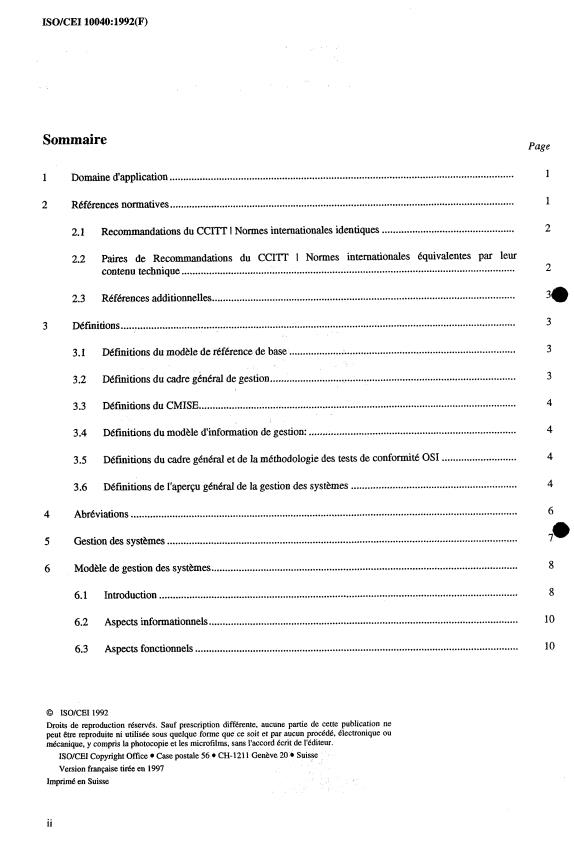
Sommaire
Page
Domaine d'application .
R&rences normatives .
Recommandations du CCITT I Normes internationales identiques .
2.1
Paires de Recommandations du CCITT I Normes internationales équivalentes par leur
2.2
contenu technique .
2.3 Références additionnelles .
Définitions .
3.1 Définitions du modèle de rbférence de base .
Définitions du cadre général de gestion .
3.2
3.3 Définitions du CMISE .
Définitions du modèle d'information de gestion: .
3.4
Définitions du cadre générai et de la méthodologie des tests de conformité OS1 .
3.5
3.6 Définitions de l'aperçu général de la gestion des systèmes .
Abréviations .
5 Gestion des systèmes .
Modèle de gestion des systèmes .
6.1 Introduction .
6.2 Aspects informationne ls .
6.3 Aspects fonctionnels .
0 ISO/CEI 1992
Droits de reproduction réservés . Sauf prescription différente. aucune partie de cette publication ne
peut être reproduite ni utilisée sous quelque forme que ce soit et par aucun procédé. électronique ou
mécanique. y compris la photocopie et les microfilms. sans l'accord écrit de i'éditeur .
ISOKEI Copyright Office Case postale 56 CH-121 1 Genève 20 Suisse
tirée en 1997
Version française
Imprimé en Suisse
ISO/CEI 10040:1992(F)
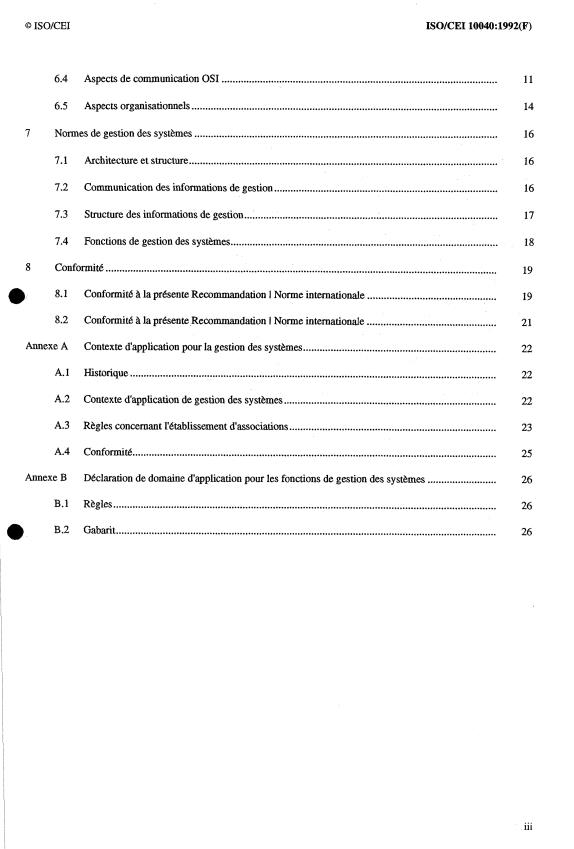
0 ISO/CEI
Aspects de communication OS1 . 11
6.4
6.5 Aspects organisationnels .
7 16
Normes de gestion des systèmes .
7.1 Architecture et structure . 16
7.2 Communication des informations de gestion .
7.3 17
Structure des informations de gestion .
7.4 Fonctions de gestion des systèmes . 18
8 Conformité . 19
II) 8.1
Conformité à la présente Recommandation I Norme internationale . 19
8.2
Conformité à la présente Recommandation I Norme internationale .
Annexe A
Contexte d'application pour la gestion des systèmes . 22
A . 1 Historique .
A.2
Contexte d'application de gestion des systèmes .
A.3 Règles concernant l'établissement d'associations . 23
A.4 Conformité . 25
Annexe B 26
Déclaration de domaine d'application pour les fonctions de gestion des systèmes .
B.l Règles . 26
B . 2 Gabarit . 26
...
0 ISO/CEI
ISO/CEI 10040:1992(F)
Avant-propos
LIS0 (Organisation internationale de normalisation) et la CE1 (Commission
électrotechnique internationale) forment ensemble un système consacré à la
normalisation internationale considérée comme un tout. Les organismes nationaux
membres de l'IS0 ou de la CE1 participent au développement de Normes inter-
nationales par l'intermédiaire des comités techniques créés par l'organisation
concernée afin de s'occuper des différents domaines particuliers de l'activité
technique. Les comités techniques de I'ISO et de la CE1 collaborent dans des
domaines d'intérêt commun. D'autres organisations internationales, gouverne-
mentales ou non gouvernementales, en liaison avec VISO et la CE1 participent
également aux travaux.
Dans le domaine des technologies de l'information, I'ISO et la CE1 ont créé un
comité technique mixte, l'ISO/CEI JTC 1. Les projets de Normes internationales
adoptés par le comité technique mixte sont soumis aux organismes nationaux pour
approbation, avant leur acceptation comme Normes internationales. Les Normes
internationales sont approuvées conformément aux procédures qui requièrent
l'approbation de 75 % au moins des organismes nationaux votants.
La Norme internationale ISO/CEI 10040 a été élaborée par le comité technique
mixte ISO/CEI JTC 1, Technologies de l'information, en collaboration avec le
CCITT. Le texte identique est publié en tant que Recommandation X.701 du
CCITT.
L'annexe A fait partie intégrante de la présente partie de l'ISO/CEI 10040.
L'annexe B est donnée uniquement à titre d'information.
a
ISOKEI 10040: 1992(F)
NORME INTERNATIONALE
RECOMMANDATION DU CCITI:
TECHNOLOGIES DE L'INFORMATION -
INTERCONNEXION DE SYSTÈMES OUVERTS (OSI) -
APERÇU GÉNÉRAL DE LA GESTION-SYSTÈMES
Domaine d'application
al -
La présente Recommandation I Norme internationale
-
offre un aperçu général de la famille des normes de gestion des systèmes;
-
établit les bases permettant de subdiviser les normes de gestion des systèmes en groupes distincts,
précise le domaine d'application de chaque groupe et définit les principales composantes à l'intérieur de
chaque groupe;
-
fournit des directives pour l'élaboration de normes de gestion des systèmes et identifie les liens entre ces
normes;
-
définit les termes utilisés dans d'autres normes de gestion des systèmes;
-
S'applique à la définition de toutes les normes de gestion des systèmes et à tous les aspects de la gestion
des systèmes, quelle que soit leur importance;
-
où la responsabilité de la gestion des systèmes est centralisée ou distribuée;
s'applique aux cas
-
définit un modèle de gestion de systèmes, précise plusieurs aspects (informationnel, fonctionnel, de
communication et d'organisation) de la gestion des systèmes et affine ledit modèle pour préciser ces
différents aspects;
-
e recense les principes régissant les impératifs de conformité et les déclarations de conformité par rapport
aux normes de gestion des systèmes.
I1 n'existe aucun impératif de conformité aux dispositions du corps principal de la présente Recommandation I Norme
internationale; cette dernière précise toutefois les exigences auxquelles doivent répondre les normes qui se veulent
conformes à la gestion des systèmes.
L'annexe A de la présente Recommandation I Norme internationale définit un contexte d'application pour la gestion
des systèmes et spécifie les règles de négociation des unités fonctionnelles de gestion des systèmes. Des exigences de
conformité sont associées à ces règles.
2 Références normatives
Les Recommandations du CCITT I Normes internationales suivantes contiennent des dispositions qui, par suite de la
I Norme
référence qui y est faite, constituent des dispositions valables pour la présente Recommandation
internationaie. Au moment de la publication, les éditions indiquées étaient en vigueur. Toute Recommandation I
Norme internationale est sujette à révision et les parties prenantes aux accords fondés sur la présente Recomman-
dation 1 Norme internationale sont invitées à rechercher la possibilité d'appliquer les éditions les plus récentes des
Recommandations I Normes internationales indiquées ci-après. Les membres de la CEE et de 1'ISO possèdent le registre
des Normes intemationales en vigueur. Le Secrétariat du CCITï tient à jour une liste des Recommandations du CCITT
actuellement en vigueur.
Rec. X.701 du CCITT (1992 F) 1
ISO/CEI 10040:1992(F)
2.1 Recommandations du CCITT I Normes internationales identiques
-
Recommandation X.720 du CCITT (1992) I ISO/CEI 10165-1: 1992, Technologies de l'information -
Interconnexion de systèmes ouverts - Structure des informations de gestion - Modèle d'information
de gestion.
-
Recommandation X.721 du CCIïT (1992) I ISOKEI 10165-2 1992, Technologies de l'information -
Interconnexion de systèmes ouverts - Structure des informations de gestion - Définition des
infonnations de gestion.
-
Recommandation X.722 du CCITT (1992) I ISO/CEI 101654 1992, Technologies de l'information -
Interconnexion de systèmes ouverts - Structure des informutions de gestion - Directives pour la
définition des objets gérés.
-
Recommandation X.730 du CCIïT (1992) I ISO/CEI 10164-1: (1992), Technologies de l'information -
Interconnexion de systèmes ouverts - Gestion des systèmes - Fonction de gestion des objets.
-
Recommandation X.731 du CCITT (1992) I ISO/CEI 10164-2: 1992, Technologies de l'information -
Interconnexion de systèmes ouverts - Gestion des systèmes - Fonction de gestion d'états.
-
Recommandation X.732 du CCITT (1992) I ISO/CEI 10164-3: 1992, Technologies de l'information -
Interconnexion de systèmes ouverts - Gestion des systèmes -Attributs pour représenter les relations.
-
Recommandatiori X.733 du CCITT (1992) I ISO/CEI 101644 1992, Technologies de l'information -
Interconnexion de systèmes ouverts - Gestion des systèmes - Fonction de signalisation des alarmes.
a
-
Recommandation X.734I) du CCïïï I ISO/CEI 10164-5: 1992, Technologies de l'information -
Interconnexion de systèmes ouverts - Gestion des systèmes - Fonction de gestion des rapports
d'événements.
- Recommandation X.7351) du CCITT I ISO/cEI 10164-6: 1992, Technologies de l'information -
Interconnexion de systèmes ouverts - Gestion des systèmes - Fonction de gestion des registres
de consignation.
-
Recommandation X.736 du CCITT(1992) I ISO/CEI 10164-7: 1992, Technologies de l'information -
Interconnexion de systèmes ouverts - Gestion des systèmes - Fonction des signalisation des alarmes
de sécurité.
2.2 Paires de Recommandations du WITT I Normes internationales équivalentes par leur
contenu technique
- Recommandation X.200 du CCITT (1988), Modèle de référence pour l'interconnexion des systèmes
ouverts pour les applications du CCm.
e
IS0 7498: 1984, Systèmes de traitement de l'information - Interconnexion de systèmes ouverts - Modèle
de référence de base.
-
Recommandation X.209 du C ITT (1988), Spéc@cation des règles de codage pour la notation de
syntaxe abstraite numéro un (A N.l).
ISO/CEI 8825: 1990, Techn logies de l'information - Interconnexion de systèmes ouverts -
Spécijtcation de règles de base our coder la notation de syntaxe abstraite numéro un (ASN.1).
-
Recommandation X.217 du CITT (1988), Définition du service de contrôle d'association pour
l'interconnexion des systèmes O i verts pour les applications du CCIïT.
IS0 8649 1988, Systèmes de traitement de l'information - Interconnexion de systèmes ouverts -
Définition du service de l'élément du service de contrôle d'association.
-
Recommandation X.219 du CCITT (1988), Opérations distantes: modèle, notation et définition
du service.
ISO/CEI 9072-1: 1989, Systèmes des traitement de l'information - Communication de texte - Opérations
à distance -Partie 1: modèle, notation et définition du service.
I) Actuellement à I'état de projet de Recommandation.
Rec. X.701 du CClTl' (1992 F)
ISO/CEI 10040: 1992(F)
Recommandation X.227 du CCIïT (19881, Spécification du service de contrôle d'association de 1'0SI
(Interconnexion de systèmes ouverts) pour les applications du CCIïT.
IS0 8650 1988, Systèmes de traitement de l'information - Interconnexion de systèmes ouverts -
Spécijïcation du protocole pour l'élément de service de contrôle d'association.
Recommandation X.229 du CCITT (1988), Opérations distantes: spéc@cation du protocole.
ISO/CEI 9072-2: 1989, Systèmes de traitement de l'information - Communication de texte - Opérations
à distance -Partie 2: Spécijïcation du protocole.
Recommandation X.290 du CCITT (1992), Cadre général et méthodologie des tests de conformité OSI
pour les Recommandations sur les protocoles pour les applications du CCIIT- Concepts généraux.
ISO/CEI 9646-1: 1991, Technologies de l'information - Interconnexion de systèmes ouverts - Cadre
général et méthodologie des tests de conformité -Partie I: Concepts généraux.
Recommandation X.700') du CCITT, Définition du cadre général de gestion pour l'interconnexion de
systèmes ouverts (OSI) pour les applications du CCm.
ISO/CEI 7498-4: 1989, Systèmes de traitement de l'information - Interconnexion de systèmes ouverts -
Modèle de référence de base -Partie 4: Cadre général de gestion.
Recommandation X.710 du CCITT (1991), Définition du service commun de transfert d'informations de
gestion pour les applications du CCIIT.
ISO/cEI 9595: 1991, Technologies de Z'information - Interconnexion de systèmes ouverts - Définition
du service commun d'informations de gestion.
Recommandation X.711 du CCITT (1991), Spécification du protocole commun de transfert
d'informations de gestion pour les applications du CCIV.
ISO/CEI 9596-1: 1991, Technologies de l'information - Interconnexion de systèmes ouverts - Protocole
commun d'information de gestion - Partie 1: Spéc fication.
2.3 Références addi tion nelles
-
IS0 8571: 1988, Systèmes de traitement de l'information - Interconnexion de systèmes ouverts -
Transfert, accès et gestion de fichiers.
-
ISO/CEI 9545: 1989, Technologies de l'information - Interconnexion de systèmes ouverts - Structure de
la Couche Application.
-
ISO/CEI 100262), Technologies de l'information - Interconnexion de systèmes ouverts - Traitement des
transactions distribuées.
Définitions
3.1 Définitions du modèle de référence de base
La présente Recommandation I Nonne internationale est basée sur les concepts définis dans le modèle de la référence
de base pour l'interconnexion de systèmes ouverts et utilise les termes suivants définis dans la Rec. X.200 du CCITT I
IS0 7498:
a) élément de service d'application;
b) gestion des systèmes.
3.2
Définitions du cadre générai de gestion
La présente Recommandation I Norme internationale utilise les termes suivants, définis dans la Rec. X.700 du
CCITT I ISO/CEI 7498-4:
a) objet géré;
b) base d'information de gestion;
c) entité d'application de gestion des systèmes.
Actuellement à l'état de projet de Recommandation.
2) paraître.
Rec. X.701 du CCITT (1992 F) 3
ISO/CEI 10040:1992(F)
3.3 Définitions du CMISE
La présente Recommandation I Norme internationale utilise les termes suivants définis dans la Rec. X.710 du
CCI7-r I ISO/CEI 9595:
a) atiribut (d'un objet géré);
élément du service commun d'information de gestion;
b)
services communs d'information de gestion.
c)
Définitions du modèle d'information de gestion:
3.4
La présente Recommandation I Norme internationale utilise les termes suivants, définis dans la Rec. X.720 du
CCI'IT I ISO/CEI 10165-1:
a) type d'attribut;
b) arbre de dénomination;
c) limite d'un objet géré.
Définitions du cadre général et de la méthodologie des tests de conformité OS1
3.5
La présente Recommandation I Norme internationale utilise les termes suivants, définis dans la Rec. X.290 du
CCIlT I ISO/cEI 9646- 1 :
déciaration de conformité d'une instance de protocole (PICS);
a)
b) formulaire PICS;
déclaration de conformité du système.
c)
3.6 Définitions de l'aperçu général de la gestion des systèmes
Pour les besoins de la présente Recommandation I Norme internationale, les définitions suivantes s'appliquent:
3.6.1 agent: utilisateur-MIS qui, pour une interaction donnée de gestion des systèmes, a pris un rôle d'agent.
3.6.2 rôle d'agent: rôle pris par un utilisateur-MIS et dans lequel il est capable d'effectuer des opérations de
gestion sur des objets gérés et d'émettre des notifications pour le compte d'objets gérés.
3.6.3 conformité dépendante: conformité aux éléments de protocole associés à un ensemble de services, comme
cela est spécifié par une déclaration de conformité du système. e
3.6.4 conformité générale: conformité aux éléments de protocole associés à l'ensemble fondamental de services,
et à toute autre unité fonctionnelle additionnelle, comme cela est prescrit dans la RecommandationINome
in ternationale.
3.6.5 définitions génériques: définitions de classes d'objet géré, de types d'attribut, de types de notification ou de
types d'opération de gestion destinées à une utilisation générale.
3.6.6 interaction (de gestion): opération de gestion unique ou notification unique ou ensemble identifié
d'opérations de gestion et de notifications logiquement liées pendant laquelleflequel le rôle de gestionnaire et celui
d'agent ne changent pas.
3.6.7 classe d'objet géré ensemble nommé d'objets gérés partageant les mêmes ensembles (nommés) d'attributs,
de notifications, d'opérations de gestion (lots) et répondant aux mêmes conditions en ce qui concerne la présence de
ces lots.
REMARQUE 1 - Les deux définitions suivantes sont alignées sur les définitions correspondantes figurant dans le cadre
général et la méthodologie des tests de conformité OSI, Rec. X.290 du CCITT I ISO/CEI 9646-1 pour le PICS et le
formulaire PICS.
3.6.8 déclaration de conformité d'objet géré (MOCS): déclaration faite par le
fournisseur d'une application
d'objet géré, précisant les capacités et les options qui ont été réalisées et toute caractéristique qui a été omise.
4 Rec. X.701 du CCI" (1992 F)
ISOKEI 10040:1992(F)
3.6.9 formulaire MOCS: document, sous forme de questionnaire, établi par le définisseur de l'objet géré ou par le
concepteur de la suite de tests de conformité qui, lorsqu'il est rempli pour l'instance d'un objet géré, devient le MOCS.
3.6.10 système (ouvert) géré: système ouvert réel contenant un utilisateur-MIS qui peut prendre le rôle d'agent.
3.6.11 domaine de gestion: ensemble d'objets gérés, auxquels s'applique une politique commune de gestion
des systèmes.
3.6.12 information de gestion: information à l'intérieur d'un système ouvert qui peut être transférée moyennant
l'utilisation des protocoles de gestion OSI.
3.6.13 objet support de gestion: objet géré des systèmes, défini spécifiquement pour assurer une fonction de
gestion des systèmes (par exemple consignation, discriminateur).
3.6.14 gestionnaire: utilisateur-MIS, qui, pour une interaction donnée de gestion des systèmes, a pris un rôle
de gestionnaire.
rôle de gestionnaire: rôle joué par un utilisateur-MIS en vertu duquel il est capable de déclencher des
3.6.15
opérations de gestion et de recevoir des notifications.
3.6.16 système (ouvert) de gestion: système ouvert réel contenant un utilisateur-MIS qui peut jouer le rôle
de gestionnaire.
0 3.6.17 utilisateur-MIS: application utilisant les services de gestion des systèmes.
notification: information envoyée par un objet géré concernant un événement survenu à l'intérieur de
3.6.18
l'objet géré.
3.6.19 type de notification: type de données nommé définissant une sorte particulière de notification.
3.6.20 objet géré de couche (N): objet géré propre à la couche (N).
3.6.21 protocole de gestion de couche 0: protocole de couche (N) utilisé pour l'échange d'informations de
gestion de couche (N) acceptées uniquement par les protocoles des couches (N-1) et inférieures.
REMARQUE 2 - La présente Recommandation I Nome internationale ne spécifie ni n'exige l'utilisation de protocoles
de gestion de couche (N). La définition est incluse ici dans un souci d'exhaustivité.
3.6.22 opération (de gestion de systèmes): opération effectuée sur un objet géré pour réaliser la gestion
des systèmes.
3.6.23 objet géré des systèmes: objet géré significatif pour plus dune couche, pour le système dans son ensemble
ou pour des fonctions précises de gestion.
3.6.24 processus d'application de gestion des systèmes: processus d'application participant à la gestion
8 des systèmes.
3.6.25 élément de service d'application de gestion des systèmes: élément de service d'application assurant des
services de gestion des systèmes.
3.6.26 fonction de gestion des systèmes: partie des activités de gestion des systèmes qui répondent à un ensemble
de besoins d'utilisateurs liés logiquement.
3.6.27 zone fonctionnelle de gestion des systèmes: catégorie de besoins d'utilisateur relevant de la gestion
des systèmes.
3.6.28 unité fonctionnelle de gestion des systèmes: ensemble nommé non vide de services de gestion des systèmes
défini pour identifier des ensembles spécifiques de fonctionnalités lorsqu'il est nécessaire de définir ou de négocier
l'utilisation desdites fonctionnalités entre des systèmes d'extrémité ou pour servir de référence à d'autres
Recommandations I Normes internationales.
3.6.29 lot d'unités fonctionnelles de gestion des systèmes: ensemble nommé non vide d'unités fonctionnelles de
gestion des systèmes, défini pour les besoins de la négociation des unités fonctionnelles sur une association.
3.6.30 protocole d'application de gestion des systèmes: protocole de la couche Application admettant des services
de gestion des systèmes.
3.6.31 service de gestion des systèmes: ensemble nommé de primitives de service qui fournissent un service
à être utilisé dans la gestion des systèmes.
destiné
Rec. X.701 du CCI" (1992 F) 5
ISO/CEI 10040: 1992(F)
4 Abréviations
ACSE Elément de service de contrôle d'association (association control service element)
ASE Elément de service d'application (application service element)
ASN. 1 Notation de syntaxe abstraite numéro un (abstract syntax notation one)
Ch4IP Protocole commun d'information de gestion (common management information protocol)
CMIPDU Unité de données du protocole commun d'information de gestion (common management
information protocol data unit)
CMIS Service commun d'information de gestion (common management information service)
CMISE Elément du service commun d'information de gestion (common management information
service element)
FrAM Transfert, accès et gestion de fichiers @le transfer, access and management)
ICs Déclaration de conformité d'instance (implementation conformance statement)
Id Identificateur (identifier)
LAN Réseau local d'entreprise (local area network)
MAPDU Unité de données du protocole d'application de gestion (management application protocol@
data unit)
MD Domaine de gestion (management domain)
MHS Système de messagerie (message handling system)
m Base d'information de gestion (management information base)
MIS Service d'information de gestion (management information service)
MOCS Déclaration de conformité d'objet géré (managed object conformance statement)
MOTIS
Système d'échanges de textes orientés messages (message oriented text interchange system)
os1 Interconnexion de systèmes ouverts (open systems interconnection)
PICS Déclaration de conformité d'une instance de protocole (protocol implementation conformance
statement)
RNIS Réseau numérique avec intégration des services
RNIS-LB Réseau numérique avec intégration des services large bande
ROSE
Elément de service d'opérations distantes (remote operations service element)
a
RPDCC Réseau public de données à commutation de circuits
RPDCP Réseau public de données à commutation par paquets
SACF Fonction de conîrôle d'association unique (single association controljùnction)
SMAF!
Entité d'application de gestion des systèmes (systems management application entiîy)
SWM Machine protocole d'application de gestion des systèmes (systems management application
protocol machine)
SMASE Elément de service d'application de gestion des systèmes (systems management application
service element)
SMFA Zone fonctionnelle de gestion des systèmes (systems management functional area)
SMFU Unité fonctionnelle de gestion des systèmes (systems management functional unit)
SMI Structure de I'mfonnation de gestion (structure of management information)
TMN
Réseau de gestion des télécommunications (telecommunication management network)
TP
Traitement transactionnel (transaction processing)
VT Terminai virtuel (virtual terminal)
WAN Réseau étendu (wide area network)
6 Rec. X.701 du CCITT (1992 F)
ISO/CEI 10040:1992(F)
5 Gestion des systèmes
La gestion des systèmes fournit des mécanismes permettant de surveiller, de contrôler et de coordonner les ressources
dans l'environnement OS1 ainsi que les normes de protocole OS1 permettant de communiquer des informations
concernant ces ressources. Pour décrire les opérations de gestion effectuées sur les ressources dans l'environnement
OSI, les ressources sont considérées comme des objets gérés ayant des propriétés définies. Les informations
nécessaires pour les besoins de la gestion des systèmes dans tout système ouvert peuvent être fournies par entrée
locale, peuvent résulter de données provenant d'autres systèmes ouverts par le biais d'une communication (couche
Application) de gestion des systèmes ou d'échanges entre protocoles des couches inférieures.
En particulier, la gestion des systèmes s'applique notamment mais pas exclusivement aux couches suivantes (par
exemple, l'utilisation de la Rec. M.30 du CCITT relative au réseau de gestion des télécommunications (TMN) est
égaiement considérée comme étant une application valable de la gestion des systèmes):
-
couche 1 de l'OS1 (lignes spécialiséesAignes louées, liaisons par satellite);
-
couche 2 de l'OS1 (LAN, WAN);
-
couche 3 de l'OS1 (RPDCC, RPDCP, RNIS, RNIS-LB, sous-réseau conforme aux spécifications de la
Rec. X.300 du CCITr);
-
couche 4 de l'OS1 (entités de la couche Transport);
a
-
couche 5 de l'OS1 (entités de la couche Session);
-
la couche 6 de l'OS1 (entités de la couche Présentation);
-
couche 7 de l'OS1 (MHS I MOTIS, RAM, VT, TP, annuaire).
REMARQUE - Si ces normes ont été élaborées essentiellement eu égard à la nécessité de gérer les ressources OSI, elles
ont aussi une applicabilité plus large. De plus, il est possible qu'à i'avenir, l'élaboration des nonnes porte sur des domaines
supplémentaires bien spécifiques.
La gestion des systèmes s'applique à une large gamme d'environnements de traitement et de communication distribués.
Ces environnements vont des réseaux locaux d'entreprise reliant de petits systèmes à des réseaux privés ou nationaux
interconnectés à l'échelle mondiale. Dans le cas des environnements peu «étendus» la gestion peut être assurée par les
systèmes de gestion appropriés correspondants, composés d'un seul gestionnaire capable de contrôler et de coordonner
l'environnement ouvert de communications grâce à un certain nombre d'agents. Les normes et les concepts s'appliquent
aussi à des environnements plus étendus qui admettent plusieurs gestionnaires.
L'ensemble des normes de gestion des systèmes se subdivise en trois groupes principaux:
un ensemble de normes spécifiant les fonctions de gestion des systèmes;
a)
un ensemble de normes relatives à la spécification des objets gérés;
b)
un ensemble de normes de protocoles et de services de la couche Application permettant de
c)
communiquer les informations concernant les fonctions de gestion.
Les exigences auxquelles doivent se conformer les activités de gestion des systèmes peuvent, par commodité, être
classées en cinq domaines dont chacun donne lieu à une ou plusieurs normes couvrant une ou plusieurs fonctions. Ces
dans le cadre général de gestion OS1 (Rec. X.700 du CCITT I ISO/CEI 7498-4) sont les suivants:
domaines, définis
- gestion des fautes;
- gestion des configurations;
- gestion de la comptabilité;
- gestion des performances;
- gestion de la sécurité.
Toutefois, de nombreux éléments d'information, les opérations de gestion et les protocoles de communication qui leur
sont associés sont communs à plusieurs domaines. Lorsqu'on exécute les activités de gestion, il est possible de
combiner des ensembles de fonctions de gestion pour réaliser une politique de gestion particulière.
Pour ces raisons, les normes de gestion des systèmes forment un ensemble de normes étroitement liées.
Rec. X.701 du CCUT (1992 F)
ISO/CEI 10040: 1992(F)
Modèle de gestion des systèmes
6.1 Introduction
Le présent article définit un ceriain nombre de concepts propres à la gestion des systèmes et fournit un modèle
permettant de préciser ces concepts ainsi que leurs relations.
Les paragraphes ci-après décrivent les divers aspects du modèle de gestion des systèmes:
- aspects informationnels;
- aspects fonctionnels;
- aspects de communication OSI;
- aspects organisationnels.
La gestion d'un environnement de communication est une application de traitement de l'information. L'environnement
géré étant distribué, les différentes composantes des activités de gestion sont elles-mêmes distribuées. Les applications
de gestion exécutent les activités de gestion de façon distribuée, moyennant l'établissement d'associations entre les
entités d'application de gestion des systèmes.
Comme le montre la figure 1, les interactions intervenant entre les différentes entités d'application de gestion de
systèmes sont résumées sous forme d'opérations de gestion et de notifications envoyées par une entité à une autre; elles 0
sont transmises à l'aide de services et de protocoles de gestion des systèmes.
Système géré ouvert
i
Exécution
Communication
opérations
degest+ 0
Utilisateur-MIS
Utilisateur-M IS
[rôle de gestionnaire
(rôle d'agent)
Notifications
O
Notifications
envoyées 0
Objets
gérés
~~
TIS00010-9:
Figure 1 -Interactions de gestion des systèmes
Les activités de gestion se réalisent par manipulation d'objets gérés. Pour les besoins de la gestion des systèmes, les
applications de gestion sont assimilées à des catégories d'utilisateurs-MIS. Chaque interaction fait intervenir deux
utilisateurs-MIS, l'un jouant le rôle de gestionnaire et l'autre le rôle d'agent.
Un utilisateur-MIS qui joue le rôle d'agent est la partie d'une application distribuée qui gère les objets gérés dans
l'environnement de son système local. Un agent effectue des opérations de gestion sur des objets gérés à la suite
d'opérations de gestion émanant d'un gestionnaire. Un agent peut aussi retransmettre des notifications envoyées par des
objets gérés à un gestionnaire.
Un utilisateur-MIS qui joue le rôle de gestionnaire est la partie d'une application distribuée qui est responsable d'une
ou de plusieurs activités de gestion et qui, pour ce faire, initialise des opérations de gestion et reçoit des notifications.
Le concept de gestionnaire n'est pas limité aux applications intervenant uniquement dans la gestion des systèmes;
d'autres applications qui doivent avoir accès aux informations de gestion peuvent utiliser les services d'information
de gestion.
8 Rec. X.701 du CCI" (1992 F)
ISO/CEI 10040:1992(F)
Les rôles ne sont pas affectés de façon définitive aux utilisateurs-MIS. Certains utilisateurs-MIS peuvent être limit& à
un rôle d'agent, d'autres à un rôle de gestionnaire alors que d'autres utiiisateurs-MIS sont autorisés à jouer le rôle
d'agent dans une interaction et celui de gestionnaire dans une autre interaction.
REMARQUE 1 - Lorsqu'une interaction de gestion entre systèmes ouverts concerne plus d'un objet géré, la spécifi-
cation de la façon dont l'agent répartit l'opération de gestion entre ses objets gérés ne fait pas l'objet d'une normalisation.
REMARQUE 2 - Un objet géré peut lui-même représenter une ressource extérieure au système géré. La relation entre le
système géré et la ressource extérieure peut aussi être une relation du type gestionnaire/agent. Si la communication entre ces
systèmes respecte les normes de gestion OSI, les opérations de gestion sur un objet géré appartenant au système géré d'origine
risquent d'aboutir à de nouveaux échanges gestionnairelagent, agissant sur un objet géré «distant». Le nombre d'opérations de
gestion en cascade de ce type qui sont autorisées n'est pas limité.
I1 importe de reconnaître que la présente Recommandation I Norme internationale ne fait que définir un modèle
conceptuel qui décrit la structure et le contenu des informations qui sont effectivement communiquées par le biais des
services normalisés d'information de gestion. Chaque fois qu'une information de gestion est communiquée, elle l'est
conformément à ce modèle.
Quant à la question de savoir si, où et comment les systèmes représentent et mettent en mémoire les données réelles à
partir desquelles l'information de gestion est obtenue, elle doit être résolue au niveau local et ne fait donc pas l'objet
d'une normalisation.
REMARQUE 3 - La figure 2 représente une façon particulière de visualiser certains aspects du modele de gestion des
0 systèmes et est donnée à titre d'information seulement. Cette figure présentait de l'intérêt lors de l'élaboration de la norme. Elle
établit notamment une distinction entre la mise en correspondance avec les communications normalisées (conformément aux règles
énoncées en 6.2 et la mise en correspondance locale, ce qui tend à prouver qu'une méthode permettant de visualiser une
information de gestion réelle du point de vue du modèle doit exister dans le processus d'application de gestion des systèmes. De
plus, la méthode existe au niveau local et sa mise en œuvre ne fait donc pas l'objet d'une normalisation.
La figure 2 ne représente pas le modèle dans sa totalité et n'indique pas tous les détails pertinents. I1 n'y est pas dit en
particulier qu'un seul sous-arbre de l'arbre de dénomination correspond nécessairement à une couche particulière ou que le terme
«espace du modèle d'information de gestion de systèmes» est défini.
Processus d'application de gestion de systèmes
Mise en correspondance avec 18s communications normalis6es
. . . . . . , . . . . , . . . . , , . . . . . . . . . . . . . . . . . . . , . . . .
.<
Application gkl fi 1
I Présentation 11 fi I
t
I
1 PhysiqueAm' A
L.-.- Objets gérés des systèmes
Objets gérés de la couche-(N)
~ Environnement local
Environnement OS1 ~
fi Hiérarchie de structuration des objets gérés
frig Espace du modèle d'information de gestion des systèmes
Utilisation de communications de gestion OS1 normalisées
Figure 2 -Relations entre les aspects informationnels et de communication
du modèle de gestion des systèmes
Rec. X.701 du CCITT (1992 F) 9
ISOKEI 10040: 1992(F)
6.2 Aspects informationneis
Le présent article expose les aspects informationnels du modèle de gestion des systèmes. La spécification complète du
modèle informationnel est donnée dans la Rec. X.720 du CCITT I ISO/CEI 10165-1. Le présent article affine le
concept d'objets gérés défini dans la Rec. X.700 du CCITT I ISO/CEI 7498-4. I1 traite des attributs de ces objets, des
opérations de gestion qui peuvent être effectuées sur ces objets et des notifications qu'ils peuvent envoyer. L'ensemble
des objets gérés d'un système, ainsi que leurs attributs, constituent la base d'informations de gestion (MIB)
dudit système.
Des objets gérés normalisés devraient être spécifiés par les organisations responsables de la normalisation des
ressources représentées par les objets gérés (par exemple, le groupe responsable de la normalisation d'une entité de
protocole de couche (N) est aussi responsable de la normalisation de l'objet géré qui représente la vue de gestion de
ladite entité de protocole). Des directives et des outils sont fournis pour assurer la défïnition des objets gérés mais aussi
un ensemble de définitions des informations de gestion qui servent à étayer les définitions des objets gérés et la
définition des fonctions de gestion des systèmes.
6.2.1 Objets gérés
Un objet géré est la vue de gestion OS1 d'une ressource susceptible d'être gérée, par exemple une entité de couche, une
connexion, ou un élément d'un équipement de communication physique. Un objet géré est donc l'abstraction d'une
ressource qui représente ses propriétés teiles qu'elles sont vues par la gestion et aux fins de celle-ci. Une partie
essentielle de la définition d'un objet géré est la relation entre ces propriéth et le comportement opérationnel de ladite
ressource. Cette relation n'est en général pas modélisée.
Les objets gérés peuvent être spécifiques à une couche donnée, auquel cas on parle d'objets gérés de la couche (N). Les
objets gérés qui concernent plus d'une couche, une fonction spécifique de gestion des systèmes (objet support de
gestion) ou le système dans son intégralité sont dits objets gérés de système.
6.2.2 Attributs
Les aaributs sont les propriétés des objets gérés. Un attribut a une valeur associée qui peut avoir une structure simple
ou complexe.
6.2.3 Opérations de gestion et notifications
Une partie de la définition d'un objet géré est la spécification de l'ensemble des opérations de gestion qui peuvent être
effectuées sur ledit objet ainsi que les conséquences que ces opérations de gestion peuvent avoir sur l'objet géré et ses
attributs. La définition peut aussi spécifier les conséquences, si elles existent, sur des objets gérés connexes.
L'exécution d'une opération de gestion peut aussi dépendre de l'état de l'objet géré ou de ses attributs. Une partie 0
essentielle de la définition d'une opération de gestion est l'ensemble des façons possibles dont elle peut échouer.
Les objets gérés peuvent aussi envoyer des notifications qui contiennent des informations concernant l'occurrence d'un
à l'objet géré.
événement associé
Alors que les mécanismes de communication des opérations de gestion et des notifications font l'objet de normes de
gestion OSI, tel n'est pas le cas pour les mécanismes d'exécution des opérations de gestion et des notifications. Aucune
interface de systèmes interne correspondante n'est normalisée. La relation entre les opérations de gestion à la limite de
l'objet géré et ce qui est communiqué dans le protocole entre systèmes ouverts est décrite en 6.4.
6.3 Aspects fonctionnels
Le présent paragraphe décrit les aspects fonctionnels du modèle de gestion des systèmes.
à plus d'un besoin et pour répondre à certains besoins plus d'une
Une fonction de gestion des systèmes peut répondre
fonction peut être applicable. I1 existe donc une relation n-n entre les fonctions et les besoins.
La spécification d'une fonction de gestion des systèmes définit les activités de gestion et les informations nécessaires
pour répondre aux besoins.
10 Rec. X.701 du CCITT (1992 F)
ISOKEI 10040: 1992(F)
Les fonctions de gestion peuvent être combinées pour accomplir une activité de gestion donnée.
Etant donné que tous les services ne sont pas toujours demandés pour une association donnée, les services relevant
d'une fonction de gestion des systèmes peuvent être regroupés en une ou plusieurs unités fonctionnelles qui sont les
unités de négociation de base entre les utilisateurs-MIS. De plus, il est possible de définir des unités fonctionnelles
couvrant plusieurs services relevant de plus d'une fonction.
Des unités fonctionnelles dépassant les limites des fonctions permettent de prendre en charge les ensembles de
capacités suivants:
a) notifications uniquement;
b) opérations de gestion uniquement;
notifications et opérations de gestion.
c)
REMARQUE - D'autres unités fonctionnelles sont définies pour autoriser la négociation de sous-ensembles de ces
capacités (par exemple surveillance, contrôle).
L'agent ne peut, en règle générale, déterminer le but des opérations de gestion qu'il reçoit ou des notifications qu'il
envoie. Par exemple, un système ouvert ne peut pas, en générai déterminer si ses réponses aux demandes de lecture des
compteurs d'erreurs seront utilisées pour les besoins de la gestion des fautes ou des performances. L'agent répond aux
demandes d'un gestionnaire individuellement, sans avoir besoin d'un contexte plus large pour donner suite à
la demande.
6.4 Aspects de communication OS1
Les interactions entre des utilisateurs-MIS jouant, respectivement, le rôle de gestionnaire et d'agent se réalisent par
l'échange d'informations de gestion. Cette communication s'effectue à l'aide des protocoles OSI.
Le service générai de communications OS1 pour la gestion des systkmes est le CMIS. Le 8 6.4.1 décrit la façon dont le
CMIS est utilisé pour assurer le support des communications relatives aux opérations de gestion et aux notifications
applicables aux objets gérés d'un système géré. Les 0 6.4.2 à 6.4.5 expliquent comment le support des communications
s'intègre dans la structure de la couche Application.
Les utilisateurs-MIS peuvent utiliser d'autres services OS1 (par exemple, le TP ou le FTAM) qui assurent ou non la
distinction entre le rôle de gestionnaire et celui d'agent; toutefois, les utilisateurs-MIS continueront d'accepter la
distinction entre le rôle de gestionnaire et celui d'agent.
REMARQUE -Les utilisateurs MIS peuvent utiliser d'autres services.
6.4.1 Support pour les opérations de gestion et les notifications
Le support de communications pour les opérations de gestion et les notifications comporte deux aspects:
a) support pour le transfert des demandes d'opérations de gestion et les notifications entre les
utilisateurs-MIS;
b) support pour le contrôle d'accès aux objets gérés et la diffusion extérieure des informations relatives
aux notifications.
Les principales composantes sont représentées à la figure 3.
Les services de gestion des systèmes ont des primitives pour communiquer les demandes correspondant aux différents
types d'opération de gestion définis dans la Rec. X.7
...
Questions, Comments and Discussion
Ask us and Technical Secretary will try to provide an answer. You can facilitate discussion about the standard in here.
Loading comments...