


ISO/FDIS 10303-239
(Main)Industrial automation systems and integration — Product data representation and exchange — Part 239: Application protocol: Product life cycle support
Industrial automation systems and integration — Product data representation and exchange — Part 239: Application protocol: Product life cycle support
This document specifies the application protocol for Product life cycle support. The following are within the scope of this document: information for defining a complex product and its support solution; information required to maintain a complex product; information required for through life configuration change management of a product and its support solution; the representation of product structures, assemblies and breakdowns including: the identification and representation of parts, their versions, definitions, and documentation and management information, such as dates and approvals assigned to parts; the representation of multiple product structure views; the representation of functional, physical, system and zonal breakdown of the product structure, from system via subsystems or components to end items; the representation of the shape of an assembly as the composition of the shape representation of its components; the identification of positions within an assembly of parts to which component parts may be attached; the association of valued properties to a part or to an assembly; the representation of interfaces between products; the classification of parts, documents and assemblies. the representation of a product through life including: the representation of product requirements and their fulfilment; the representation of existing or potential future products; the identification of the configuration of a product for a given role; the specification of effectivity constraints applied to configuration of a product; the representation of predicted and observed states of products. the specification and planning of activities for a product including: the specification of tasks to be performed on a product; the representation of conditions for performing the tasks, including the resources required and the location of the resources and product; the representation of the type of person and skills required for performing a task; the representation of planning and scheduling of the tasks and the management and authorization of the subsequent work. the representation of the activity history of a product including: the recording of the usage of a product and the resource usage; the recording of the activities performed on a product and the resource usage. the representation of the product history including: a historical record of the states of a product; a historical record of the configuration status of the product; the location of product data; the observation of product data.
Systèmes d'automatisation industrielle et intégration — Représentation et échange de données de produits — Partie 239: Protocole d'application: Soutien du cycle de vie du produit
General Information
Relations
Buy Standard

Standards Content (Sample)
INTERNATIONAL STANDARD ISO 10303-104:2000
TECHNICAL CORRIGENDUM 1
Published 2009-11-15
INTERNATIONAL ORGANIZATION FOR STANDARDIZATION • МЕЖДУНАРОДНАЯ ОРГАНИЗАЦИЯ ПО СТАНДАРТИЗАЦИИ • ORGANISATION INTERNATIONALE DE NORMALISATION
Industrial automation systems and integration — Product data
representation and exchange —
Part 104:
Integrated application resource: Finite element analysis
TECHNICAL CORRIGENDUM 1
Systèmes d'automatisation industrielle et intégration — Représentation et échange de données de produits —
Partie 104: Ressources d'application intégrées: Analyse par éléments finis
RECTIFICATIF TECHNIQUE 1
Technical Corrigendum 1 to ISO 10303-104:2000 was prepared by Technical Committee ISO/TC 184,
Automation systems and integration, Subcommittee SC 4, Industrial data.
Introduction
This Technical Corrigendum corrects ISO 10303-104:2000.
The purpose of the modifications to the text of ISO 10303-104:2000 is to correct the use of the definition
attribute in four entities that are SUBTYPEs of the representation entity, which had a description attribute
added after the publication of ISO 10303-104:2000.
ICS 25.040.40 Ref. No. ISO 10303-104:2000/Cor.1:2009(E)
© ISO 2009 – All rights reserved
Published in Switzerland
ISO 10303-104:2000/Cor.1:2009(E)
Modifications to the text of ISO 10303-104:2000
Page 40, 5.4.1 fea_model
Delete the .definition attribute in the fea_model entity, which is a SUBTYPE of the
representation entity, which had a .description attribute added after the publication of
ISO 10303-104:2000 causing a conflict. Remove the current EXPRESS definition and
replace with:
EXPRESS specification:
*)
ENTITY fea_model
SUPERTYPE OF (ONEOF(fea_model_2d,
fea_model_3d))
SUBTYPE OF (representation);
creating_software : text;
intended_analysis_code : SET [1:?] OF text;
analysis_type : text;
UNIQUE
UR1: SELF\representation.name;
END_ENTITY;
(*
Page 90, 5.7.27 point_element_representation
Delete the .definition attribute in the point_element_representation entity, which is a
SUBTYPE of the representation entity, which had a .description attribute added after
the publication of ISO 10303-104:2000 causing a conflict. Remove the current EXPRESS
definition and replace with:
EXPRESS specification:
*)
ENTITY point_element_representation
SUBTYPE OF (el
...
INTERNATIONAL STANDARD ISO 10303-104:2000
TECHNICAL CORRIGENDUM 2
Published 2014-7-01
INTERNATIONAL ORGANIZATION FOR STANDARDIZATION • МЕЖДУНАРОДНАЯ ОРГАНИЗАЦИЯ ПО СТАНДАРТИЗАЦИИ • ORGANISATION INTERNATIONALE DE NORMALISATION
Industrial automation systems and integration —
Product data representation and exchange —
Part 104:
Integrated generic resource:
Finite element analysis
TECHNICAL CORRIGENDUM 2
Systèmes d’ automatisation industrielle et intégration – Représentation et échange de données de produits
- Partie 104 Ressources génériques intégrées: Analyse par elements finis
RECTIFICATIF TECHNIQUE 2
Technical Corrigendum 2 to International Standard ISO 10303-104:2000 was prepared by Technical Committee ISO/TC
184, Automation systems and integration, Subcommittee SC 4, Industrial data.
The purpose of the modifications to the text of ISO 10303-104:2000 is to correct a scoping issue in the FUNCTION required jd_nodes
and the FUNCTION required_3d_nodes. In addition, the FUNCTION variable_value_type is corrected to return the correct value for a
surface _tensor2 _ 2d _variable.
ICS 25.040.40 Ref. No. ISO 10303-104:2000/Cor.2:2014(E)
© ISO 2014 – All rights reserved
Published in Switzerland
Modifications to the text of ISO 10303-104:2000
Page 208, 5.15.3 required_2d_nodes
Fully qualify the references to “triangle” and “quadrilateral” in IF statements to avoid
namespace clashes. Remove the current EXPRESS definition and replace with:
EXPRESS specification:
*)
FUNCTION required_2d_nodes
(node_list: LIST [1:?] OF node_representation; element_shape:
element_2d_shape; order: element_order) : BOOLEAN;
LOCAL
vertex_nodes : INTEGER;
edge_nodes : INTEGER;
edge_face_body_nodes : INTEGER;
END_LOCAL;
IF (element_shape = element_2d_shape.triangle) THEN
vertex_nodes := 3;
IF (order = linear_order) THEN
edge_nodes := 0;
edge_face_body_nodes := 0;
END_IF;
IF (order = quadratic_order) THEN
edge_nodes := 3;
edge_face_body_nodes := 3;
END_IF;
IF (order = cubic_order) THEN
edge_nodes := 6;
edge_face_body_nodes := 7;
END_IF;
END_IF;
IF (element_shape = element_2d_shape.quadrilateral) THEN
vertex_nodes := 4;
IF (order = linear_order) THEN
edge_nodes := 0;
edge_face_body_nodes := 0;
END_IF;
IF (order = quadratic_order) THEN
edge_nodes := 4;
edge_face_body_nodes := 5;
END_IF;
IF (order = cubic_order) THEN
edge_nodes := 8;
edge_face_body_nodes := 12;
END_IF;
END_IF;
RETURN ((SIZEOF (node_list) = vertex_nodes + edge_nodes) OR
(SIZEOF (node_list) = vertex_nodes + edge_face_body_nodes));
END_FUNCTION;
(*
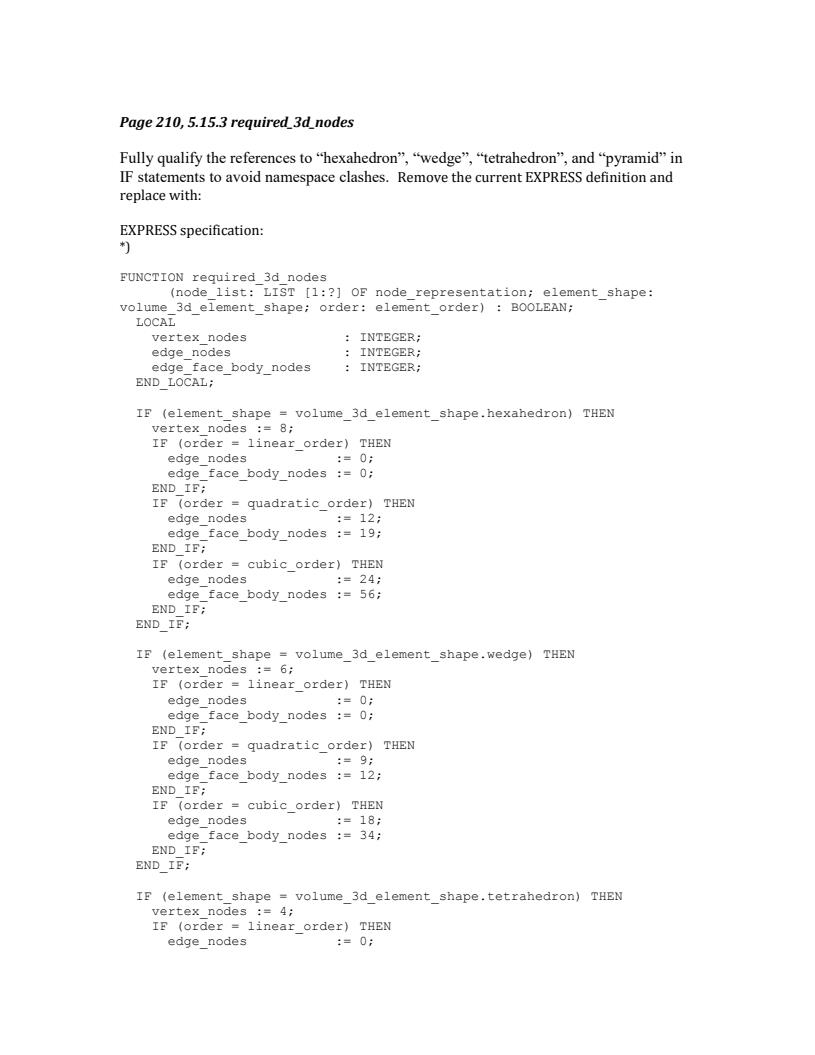
Page 210, 5.15.3 required_3d_nodes
Fully qualify the references to “hexahedron”, “wedge”, “tetrahedron”, and “pyramid” in
IF statements to avoid namespace clashes. Remove the current EXPRESS definition and
replace with:
EXPRESS specification:
*)
FUNCTION required_3d_nodes
(node_list: LIST [1:?] OF node_representation; element_shape:
volume_3d_element_shape; order: element_order) : BOOLEAN;
LOCAL
vertex_nodes : INTEGER;
edge_nodes : INTEGER;
edge_face_body_nodes : INTEGER;
END_LOCAL;
IF (element_shape = volume_3d_element_shape.hexahedron) THEN
vertex_nodes := 8;
IF (order = linear_order) THEN
edge_nodes := 0;
edge_face_body_nodes := 0;
END_IF;
IF (order = quadratic_order) THEN
edge_nodes := 12;
edge_face_body_nodes := 19;
END_IF;
IF (order = cubic_order) THEN
edge_nodes := 24;
edge_face_body_nodes := 56;
END_IF;
END_IF;
IF (element_shape = volume_3d_element_shape.wedge) THEN
vertex_nodes := 6;
IF (order = linear_order) THEN
edge_nodes := 0;
edge_face_body_nodes := 0;
END_IF;
IF (order = quadratic_order) THEN
edge_nodes := 9;
edge_face_body_nodes := 12;
END_IF;
IF (order = cubic_order) THEN
edge_nodes := 18;
edge_face_body_nodes := 34;
END_IF;
END_IF;
IF (element_shape = volume_3d_element_shape.tetrahedron) THEN
vertex_nodes := 4;
IF (order = linear_order) THEN
edge_nodes := 0;
edge_face_body_nodes := 0;
END_IF;
IF (order = quadratic_order) THEN
edge_nodes := 6;
edge_face_body_nodes := 6;
END_IF;
IF (order = cubic_order) THEN
edge_nodes := 12;
edge_face_body_nodes := 16;
END_IF;
END_IF;
IF (element_shape = volume_3d_element_shape.pyramid) THEN
vertex_nodes := 5;
IF (order = linear_order) THEN
edge_nodes := 0;
edge_face_body_nodes := 0;
END_IF;
IF (order = quadratic_order) THEN
edge_nodes := 8;
edge_face_body_nodes := 9;
END_IF;
IF (order = cubic_order) THEN
edge_nodes := 16;
edge_face_body_nodes := 25;
END_IF;
END_IF;
RETURN ((SIZEOF (node_list) = vertex_nodes + edge_nodes) OR
(SIZEOF (node_list) = vertex
...
INTERNATIONAL ISO
STANDARD 10303-104
First edition
2000-12-15
Industrial automation systems and
integration — Product data representation
and exchange —
Part 104:
Integrated application resource: Finite
element analysis
Systèmes d'automatisation industrielle et intégration — Représentation
et échange de données de produits —
Partie 104: Ressources d'application intégrées: Analyse par éléments
finis
Reference number
ISO 10303-104:2000(E)
©
ISO 2000
ISO 10303-104:2000(E)
PDF disclaimer
This PDF file may contain embedded typefaces. In accordance with Adobe's licensing policy, this file may be printed or viewed but shall not
be edited unless the typefaces which are embedded are licensed to and installed on the computer performing the editing. In downloading this
file, parties accept therein the responsibility of not infringing Adobe's licensing policy. The ISO Central Secretariat accepts no liability in this
area.
Adobe is a trademark of Adobe Systems Incorporated.
Details of the software products used to create this PDF file can be found in the General Info relative to the file; the PDF-creation parameters
were optimized for printing. Every care has been taken to ensure that the file is suitable for use by ISO member bodies. In the unlikely event
that a problem relating to it is found, please inform the Central Secretariat at the address given below.
All rights reserved. Unless otherwise specified, no part of this publication may be reproduced or utilized in any form or by any means, electronic
or mechanical, including photocopying and microfilm, without permission in writing from either ISO at the address below or ISO's member body
in the country of the requester.
ISO copyright office
Case postale 56 � CH-1211 Geneva 20
Tel. + 41 22 749 01 11
Fax + 41 22 749 09 47
E-mail copyright@iso.ch
Web www.iso.ch
Printed in Switzerland
ii © ISO 2000 – All rights reserved
ISO 10303-104:2000(E)
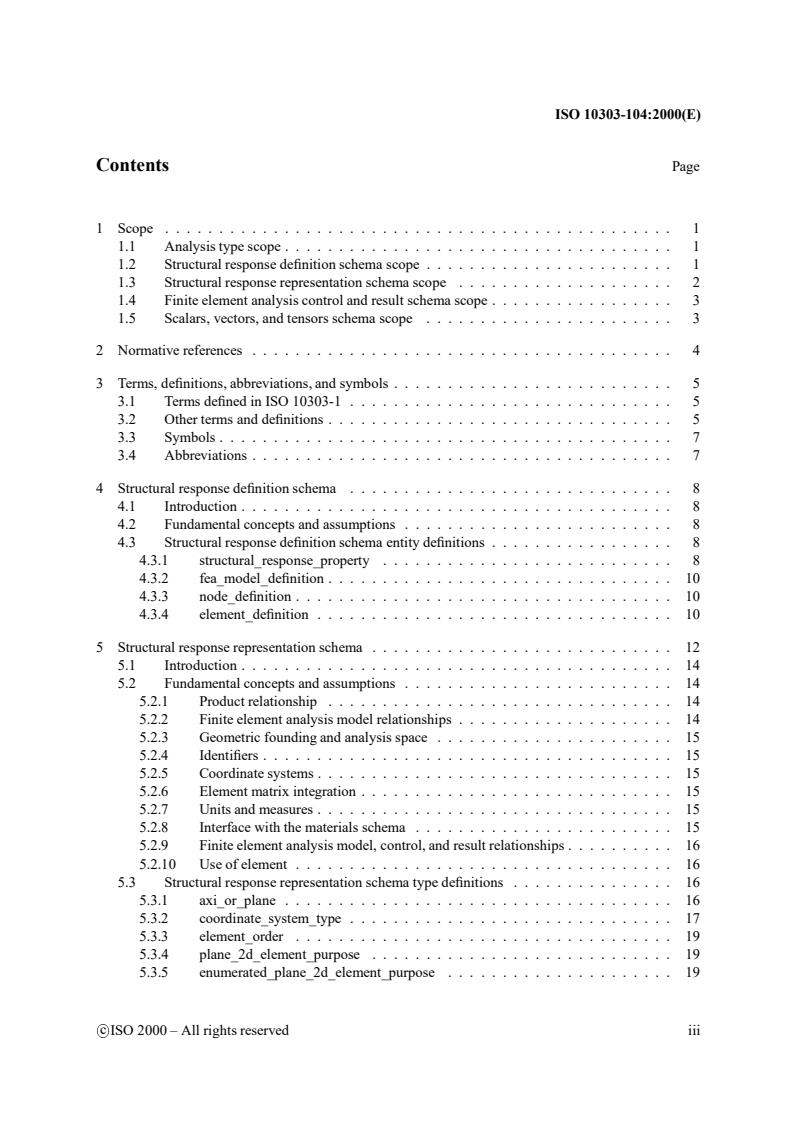
Contents Page
1 Scope . . . . . 1
1.1 Analysistypescope. . . . 1
1.2 Structural response definition schema scope . . . 1
1.3 Structural response representation schema scope . . . . 2
1.4 Finiteelementanalysiscontrolandresultschemascope. . 3
1.5 Scalars,vectors,andtensorsschemascope . . . 3
2 Normativereferences . . . . 4
3 Terms,definitions,abbreviations,andsymbols . . . 5
3.1 Terms defined in ISO 10303-1 . . . . 5
3.2 Othertermsanddefinitions. . . . 5
3.3 Symbols. . . . . . 7
3.4 Abbreviations. . . . 7
4 Structural response definition schema . . . . 8
4.1 Introduction. . . . 8
4.2 Fundamental concepts and assumptions . . . 8
4.3 Structural response definition schema entity definitions . . 8
4.3.1 structural_response_property . . . 8
4.3.2 fea_model_definition . . . . . . 10
4.3.3 node_definition. . . . 10
4.3.4 element_definition . . . . 10
5 Structural response representation schema . . . 12
5.1 Introduction. . . . 14
5.2 Fundamental concepts and assumptions . . . 14
5.2.1 Product relationship . . . . . . 14
5.2.2 Finiteelementanalysismodelrelationships . . . 14
5.2.3 Geometric founding and analysis space . . . 15
5.2.4 Identifiers. . . . 15
5.2.5 Coordinatesystems. . . . 15
5.2.6 Elementmatrixintegration. . . 15
5.2.7 Unitsandmeasures. . . . 15
5.2.8 Interfacewiththematerialsschema . . . 15
5.2.9 Finiteelementanalysismodel,control,andresultrelationships. . 16
5.2.10 Useofelement . . . . 16
5.3 Structural response representation schema type definitions . . 16
5.3.1 axi_or_plane . . . . 16
5.3.2 coordinate_system_type . . . . 17
5.3.3 element_order . . . . 19
5.3.4 plane_2d_element_purpose . . . 19
5.3.5 enumerated_plane_2d_element_purpose . . . . . 19
�c ISO 2000 – All rights reserved iii
ISO 10303-104:2000(E)
5.3.6 application_defined_element_purpose. . . 20
5.3.7 volume_element_purpose . . . 20
5.3.8 enumerated_volume_element_purpose . . . 21
5.3.9 surface_element_purpose . . . 21
5.3.10 enumerated_surface_element_purpose. . . 21
5.3.11 curve_element_purpose . . . . 22
5.3.12 enumerated_curve_element_purpose . . . 23
5.3.13 volume_3d_element_shape . . . 24
5.3.14 element_2d_shape . . . . 24
5.3.15 matrix_property_type . . . . . 25
5.3.16 enumerated_matrix_property_type. . . 25
5.3.17 application_defined_matrix_property_type . . . . 25
5.3.18 surface_matrix_property_type . . . 26
5.3.19 enumerated_surface_matrix_property_type . . . . 26
5.3.20 curve_matrix_property_type . . . 27
5.3.21 enumerated_curve_matrix_property_type . . . . . 28
5.3.22 matrix_symmetry. . . . 29
5.3.23 degree_of_freedom. . . . 30
5.3.24 enumerated_degree_of_freedom . . . 30
5.3.25 application_defined_degree_of_freedom . . . . . 31
5.3.26 curve_element_freedom . . . . 31
5.3.27 enumerated_curve_element_freedom . . . 32
5.3.28 integration_rule. . . . 32
5.3.29 shape_function . . . . 33
5.3.30 volume_2d_element_representation . . . 33
5.3.31 surface_2d_element_representation . . . 34
5.3.32 curve_2d_element_representation . . . 34
5.3.33 volume_2d_element_descriptor . . . 34
5.3.34 surface_2d_element_descriptor . . . 35
5.3.35 curve_2d_element_descriptor . . . 35
5.3.36 volume_3d_element_coordinate_system. . . 35
5.3.37 volume_2d_element_coordinate_system. . . 36
5.3.38 surface_3d_element_coordinate_system. . . 36
5.3.39 surface_2d_element_coordinate_system. . . 36
5.3.40 curve_3d_element_coordinate_system. . . 37
5.3.41 curve_element_end_coordinate_system . . . 37
5.3.42 directionally_explicit_element_coordinate_system . . 37
5.3.43 element_aspect . . . . 38
5.3.44 element_volume . . . . 38
5.3.45 curve_edge . . . . 39
5.3.46 node_or_node_group . . . . . . 39
5.3.47 element_or_element_group . . . 39
5.4 Structural response representation schema entity definitions: Finite element analysis
model . . . . . 40
5.4.1 fea_model . . . . 40
5.4.2 fea_model_3d . . . . 41
iv �c ISO 2000 – All rights reserved
ISO 10303-104:2000(E)
5.4.3 fea_model_2d . . . . 41
5.4.4 structural_response_property_definition_representation . . 42
5.4.5 fea_representation_item . . . . 43
5.5 Structural response representation schema entity definitions: Node and element geom-
etry,geometriccoordinatesystems,andgeometricassociativity. . 44
5.5.1 direction_node . . . . 45
5.5.2 fea_axis2_placement_2d . . . . 47
5.5.3 fea_axis2_placement_3d . . . . 48
5.5.4 node_set . . . . 49
5.5.5 analysis_item_within_representation . . . 49
5.5.6 node_geometric_relationship . . . 50
5.5.7 element_geometric_relationship . . . 51
5.6 Structural response representation schema entity definitions: Node representation . . . 52
5.6.1 node_representation . . . . . . 52
5.6.2 node . . . . 53
5.6.3 node_with_vector . . . . 53
5.6.4 node_with_solution_coordinate_system . . . 54
5.6.5 dummy_node. . . . 55
5.6.6 geometric_node . . . . 55
5.6.7 substructure_node_relationship . . . 56
5.7 Structural response representation schema entity definitions: Element representations . 56
5.7.1 element_representation. . . . . 61
5.7.2 volume_3d_element_representation . . . 62
5.7.3 axisymmetric_volume_2d_element_representation . . 64
5.7.4 plane_volume_2d_element_representation . . . . 66
5.7.5 surface_3d_element_representation . . . 68
5.7.6 axisymmetric_surface_2d_element_representation . . 70
5.7.7 plane_surface_2d_element_representation . . . . . 72
5.7.8 curve_3d_element_representation . . . 75
5.7.9 axisymmetric_curve_2d_element_representation . . 77
5.7.10 plane_curve_2d_element_representation . . . . . 79
5.7.11 element_descriptor . . . . 80
5.7.12 volume_3d_element_descriptor . . . 81
5.7.13 axisymmetric_volume_2d_element_descriptor . . 82
5.7.14 plane_volume_2d_element_descriptor. . . 82
5.7.15 volume_3d_element_basis . . . 83
5.7.16 volume_2d_element_basis . . . 84
5.7.17 surface_3d_element_descriptor . . . 84
5.7.18 axisymmetric_surface_2d_element_descriptor . . 85
5.7.19 plane_surface_2d_element_descriptor. . . 85
5.7.20 surface_3d_element_basis . . . 86
5.7.21 surface_2d_element_basis . . . 87
5.7.22 curve_3d_element_descriptor . . . 87
5.7.23 axisymmetric_curve_2d_element_descriptor . . . 88
5.7.24 plane_curve_2d_element_descriptor. . . 88
5.7.25 curve_3d_element_basis . . . . 89
�c ISO 2000 – All rights reserved v
ISO 10303-104:2000(E)
5.7.26 curve_2d_element_basis . . . . 90
5.7.27 point_element_representation . . . 90
5.7.28 point_element_matrix . . . . . 91
5.7.29 stationary_mass . . . . 92
5.7.30 grounded_spring . . . . 93
5.7.31 grounded_damper . . . . 93
5.7.32 directionally_explicit_element_representation. . . 94
5.7.33 system_and_freedom. . . . 96
5.7.34 directionally_explicit_element_coefficient . . . 96
5.7.35 explicit_element_representation . . . 97
5.7.36 explicit_element_matrix . . . . 98
5.7.37 substructure_element_representation . . . 99
5.8 Structural response representation schema definitions: Element topologies. 99
5.9 Structural response representation schema entity definitions: Element coordinate systems115
5.9.1 aligned_axis_tolerance. . . . . 116
5.9.2 arbitrary_volume_3d_element_coordinate_system . . 117
5.9.3 parametric_volume_3d_element_coordinate_system . . 117
5.9.4 arbitrary_volume_2d_element_coordinate_system . . 119
5.9.5 parametric_volume_2d_element_coordinate_system . . 121
5.9.6 aligned_surface_3d_element_coordinate_system . . 122
5.9.7 parametric_surface_3d_element_coordinate_system . . 124
5.9.8 constant_surface_3d_element_coordinate_system. . 126
5.9.9 aligned_surface_2d_element_coordinate_system . . 127
5.9.10 parametric_surface_2d_element_coordinate_system . . 128
5.9.11 aligned_curve_3d_element_coordinate_system . . 129
5.9.12 parametric_curve_3d_element_coordinate_system . . 130
5.9.13 parametric_curve_3d_element_coordinate_direction . . 132
5.9.14 curve_2d_element_coordinate_system. . . 132
5.9.15 directionally_explicit_element_coordinate_system_arbitrary . . 133
5.9.16 directionally_explicit_element_coordinate_system_aligned. . 134
5.9.17 euler_angles . . . . 134
5.10 Structural response representation schema entity definitions: Element matrix integration 135
5.10.1 Volume3DElement . . . . 139
5.10.2 Volume2DElement . . . . 139
5.10.3 Curve2DElement . . . . 140
5.10.4 Surface3DorCurveElement . . . 140
5.10.5 Surface2DElement . . . . 141
5.10.6 volume_3d_element_integrated_matrix . . . 142
5.10.7 volume_3d_element_integrated_matrix_with_definition . . 142
5.10.8 volume_3d_element_field_integration. . . 143
5.10.9 element_integration_algebraic . . . 143
5.10.10 volume_3d_element_field_integration_rule . . . . 143
5.10.11 volume_3d_element_field_integration_explicit . . 144
5.10.12 volume_position_weight . . . . 144
5.10.13 volume_2d_element_integrated_matrix . . . 145
5.10.14 volume_2d_element_integrated_matrix_with_definition . . 145
vi �c ISO 2000 – All rights reserved
ISO 10303-104:2000(E)
5.10.15 volume_2d_element_field_integration. . . 146
5.10.16 volume_2d_element_field_integration_rule . . .
...
INTERNATIONAL ISO
STANDARD 10303-108
First edition
2005-02-01
Industrial automation systems and
integration — Product data
representation and exchange —
Part 108:
Integrated application resource:
Parameterization and constraints for
explicit geometric product models
Systèmes d'automatisation industrielle et intégration — Représentation
et échange de données de produits —
Partie 108: Ressources d'application intégrées: Paramétrage et
contraintes pour les modèles de produits géométriques explicites
Reference number
ISO 10303-108:2005(E)
©
ISO 2005
ISO 10303-108:2005(E)
PDF disclaimer
This PDF file may contain embedded typefaces. In accordance with Adobe's licensing policy, this file may be printed or viewed but
shall not be edited unless the typefaces which are embedded are licensed to and installed on the computer performing the editing. In
downloading this file, parties accept therein the responsibility of not infringing Adobe's licensing policy. The ISO Central Secretariat
accepts no liability in this area.
Adobe is a trademark of Adobe Systems Incorporated.
Details of the software products used to create this PDF file can be found in the General Info relative to the file; the PDF-creation
parameters were optimized for printing. Every care has been taken to ensure that the file is suitable for use by ISO member bodies. In
the unlikely event that a problem relating to it is found, please inform the Central Secretariat at the address given below.
© ISO 2005
All rights reserved. Unless otherwise specified, no part of this publication may be reproduced or utilized in any form or by any means,
electronic or mechanical, including photocopying and microfilm, without permission in writing from either ISO at the address below or
ISO's member body in the country of the requester.
ISO copyright office
Case postale 56 • CH-1211 Geneva 20
Tel. + 41 22 749 01 11
Fax + 41 22 749 09 47
E-mail copyright@iso.org
Web www.iso.org
Published in Switzerland
ii © ISO 2005 – All rights reserved
ISO 10303-108:2005(E)
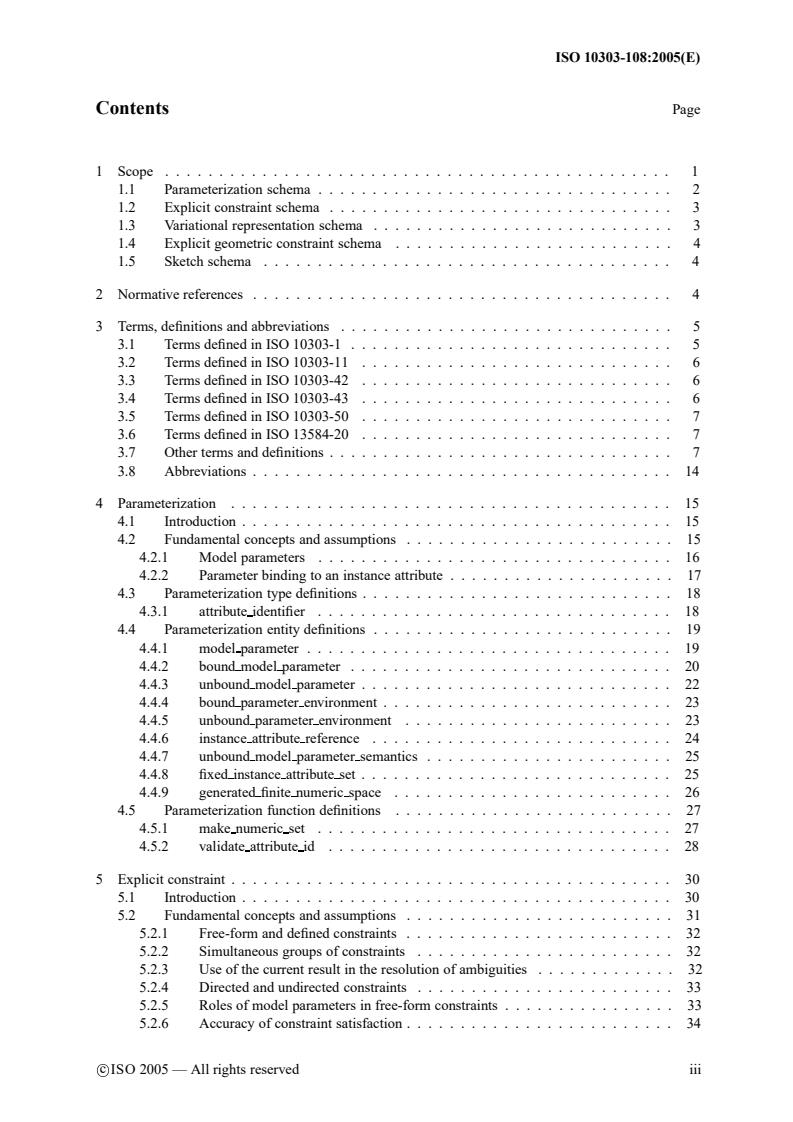
Contents Page
1 Scope . . . . . . . . . 1
1.1 Parameterizationschema . . . . . . . 2
1.2 Explicitconstraintschema . . . . . . 3
1.3 Variational representation schema . . . . . . . . . . . . . . . . . . . . . . . . . . . . 3
1.4 Explicit geometric constraint schema . . . . . . . . . . . . . . . . . . . . . . . . . . 4
1.5 Sketchschema . . . . . . . . 4
2 Normativereferences . . . . . . . . 4
3 Terms, definitions and abbreviations . . . . . . . . . . . . . . . . . . . . . . . . . . . . . . . 5
3.1 TermsdefinedinISO10303-1 . . . . . . 5
3.2 TermsdefinedinISO10303-11 . . . . . . 6
3.3 TermsdefinedinISO10303-42 . . . . . . 6
3.4 TermsdefinedinISO10303-43 . . . . . . 6
3.5 TermsdefinedinISO10303-50 . . . . . . 7
3.6 TermsdefinedinISO13584-20 . . . . . . 7
3.7 Othertermsanddefinitions . . . . . . 7
3.8 Abbreviations . . . . . . . . 14
4 Parameterization . . . . . . . . 15
4.1 Introduction . . . . . . . . 15
4.2 Fundamental concepts and assumptions . . . . . . . . . . . . . . . . . . . . . . . . . 15
4.2.1 Modelparameters . . . . . . . 16
4.2.2 Parameter binding to an instance attribute . . . . . . . . . . . . . . . . . . . . . 17
4.3 Parameterization type definitions . . . . . . . . . . . . . . . . . . . . . . . . . . . . . 18
4.3.1 attributeidentifier . . . . . . . 18
4.4 Parameterization entity definitions . . . . . . . . . . . . . . . . . . . . . . . . . . . . 19
4.4.1 modelparameter . . . . . . . 19
4.4.2 bound modelparameter . . . . . . 20
4.4.3 unbound modelparameter . . . . . . 22
4.4.4 bound parameterenvironment . . . . . . 23
4.4.5 unbound parameterenvironment . . . . . 23
4.4.6 instance attributereference . . . . . . 24
4.4.7 unbound model parametersemantics . . . . . 25
4.4.8 fixed instance attributeset . . . . . . 25
4.4.9 generated finite numericspace . . . . . 26
4.5 Parameterization function definitions . . . . . . . . . . . . . . . . . . . . . . . . . . 27
4.5.1 make numericset . . . . . . . 27
4.5.2 validate attributeid . . . . . . 28
5 Explicitconstraint . . . . . . . . 30
5.1 Introduction . . . . . . . . 30
5.2 Fundamental concepts and assumptions . . . . . . . . . . . . . . . . . . . . . . . . . 31
5.2.1 Free-form and defined constraints . . . . . . . . . . . . . . . . . . . . . . . . . 32
5.2.2 Simultaneous groups of constraints . . . . . . . . . . . . . . . . . . . . . . . . 32
5.2.3 Use of the current result in the resolution of ambiguities . . . . . . . . . . . . . 32
5.2.4 Directed and undirected constraints . . . . . . . . . . . . . . . . . . . . . . . . 33
5.2.5 Roles of model parameters in free-form constraints . . . . . . . . . . . . . . . . 33
5.2.6 Accuracy of constraint satisfaction . . . . . . . . . . . . . . . . . . . . . . . . . 34
�c ISO 2005 — All rights reserved iii
ISO 10303-108:2005(E)
5.3 Explicit constraint type definitions . . . . . . . . . . . . . . . . . . . . . . . . . . . . 34
5.3.1 constraint group member . . . . . . 34
5.4 Explicit constraint entity definitions . . . . . . . . . . . . . . . . . . . . . . . . . . . 34
5.4.1 explicit constraint . . . . . . . 34
5.4.2 definedconstraint . . . . . . . 35
5.4.3 equal parameterconstraint. . . . . . 36
5.4.4 free formconstraint . . . . . . 37
5.4.5 free formassignment . . . . . . 38
5.4.6 free formrelation . . . . . . . 39
5.4.7 simultaneous constraintgroup . . . . . . 40
6 Variationalrepresentation . . . . . . . 43
6.1 Introduction . . . . . . . . 43
6.2 Fundamental concepts and assumptions . . . . . . . . . . . . . . . . . . . . . . . . . 43
6.3 Variational representation entity definitions . . . . . . . . . . . . . . . . . . . . . . . 45
6.3.1 variational representationitem . . . . . 45
6.3.2 auxiliary geometric representationitem. . . . . 46
6.3.3 variationalrepresentation . . . . . . 46
6.3.4 variational current representationrelationship . . . . 48
6.4 Variational representation function definitions . . . . . . . . . . . . . . . . . . . . . . 49
6.4.1 invalidate vrepitem . . . . . . 49
7 Explicitgeometricconstraint . . . . . . . 52
7.1 Introduction . . . . . . . . 52
7.2 Fundamental concepts and assumptions . . . . . . . . . . . . . . . . . . . . . . . . . 52
7.2.1 Dimensional constraints . . . . . . . . . . . . . . . . . . . . . . . . . . . . . . 54
7.2.2 Semantics of dimensional constraints . . . . . . . . . . . . . . . . . . . . . . . 55
7.2.3 Constraints on procedurally defined model elements . . . . . . . . . . . . . . . 56
7.3 Explicit geometric constraint type definitions . . . . . . . . . . . . . . . . . . . . . . 56
7.3.1 geometric constraintelement . . . . . . 56
7.3.2 point curve or surface constraintelement. . . . 57
7.3.3 curve or surface constraintelement . . . . . 57
7.3.4 linear geometry constraintelement . . . . . 57
7.3.5 radial geometry constraintelement . . . . . 57
7.3.6 axial geometry constraintelement . . . . . 58
7.3.7 swept surface orsolid . . . . . . 59
7.3.8 tangent contacttype . . . . . . 59
7.3.9 parallel offsettype . . . . . . . 59
7.3.10 non negative lengthmeasure . . . . . . 60
7.4 Explicit geometric constraint entity definitions . . . . . . . . . . . . . . . . . . . . . 60
7.4.1 explicit geometricconstraint. . . . . . 60
7.4.2 fixed element geometricconstraint . . . . . 61
7.4.3 parallel geometricconstraint . . . . . . 62
7.4.4 pgc withdimension . . . . . . 63
7.4.5 point distance geometricconstraint . . . . . 64
7.4.6 pdgc withdimension. . . . . . 65
7.4.7 skew line distance geometricconstraint . . . . 65
7.4.8 near pointrelationship . . . . . . 66
7.4.9 curve distance geometricconstraint . . . . . 67
7.4.10 cdgc withdimension . . . . . . 69
7.4.11 surface distance geometricconstraint . . . . . 69
7.4.12 sdgc withdimension . . . . . . 71
iv �c ISO 2005 — All rights reserved
ISO 10303-108:2005(E)
7.4.13 radius geometricconstraint . . . . . . 72
7.4.14 rgc with dimension . . . . . . 72
7.4.15 curve length geometricconstraint . . . . . 73
7.4.16 clgc with dimension . . . . . . 74
7.4.17 parallel offset geometricconstraint . . . . . 74
7.4.18 pogc withdimension. . . . . . 76
7.4.19 angle geometricconstraint. . . . . . 77
7.4.20 agc withdimension . . . . . . 78
7.4.21 perpendicular geometricconstraint . . . . . 79
7.4.22 incidence geometricconstraint . . . . . 80
7.4.23 coaxial geometricconstraint . . . . . . 82
7.4.24 tangent geometricconstraint. . . . . . 82
7.4.25 symmetry geometricconstraint . . . . . 84
7.4.26 swept point curve geometricconstraint . . . . . 86
7.4.27 swept curve surface geometricconstraint . . . . 87
7.4.28 curve segmentset . . . . . . . 88
7.4.29 curve smoothness geometricconstraint . . . . . 89
7.4.30 surface patchset . . . . . . . 90
7.4.31 surface smoothness geometricconstraint . . . . 90
8 Sketch . . . . . . . . . 92
8.1 Introduction . . . . . . . . 92
8.2 Fundamental concepts and assumptions . . . . . . . . . . . . . . . . . . . . . . . . . 92
8.3 Sketchtypedefinitions . . . . . . . 93
8.3.1 surface or solidmodel . . . . . . 93
8.3.2 planar curveselect . . . . . . . 94
8.3.3 sketch elementselect . . . . . . 95
8.3.4 sketch basisselect . . . . . . . 95
8.3.5 sketch typeselect . . . . . . . 95
8.3.6 curves orarea . . . . . . . 96
8.4 Sketchentitydefinitions . . . . . . . 96
8.4.1 implicit point onplane . . . . . . 96
8.4.2 implicit planar intersectionpoint . . . . . 98
8.4.3 implicit planar projectionpoint . . . . . 98
8.4.4 implicit planarcurve . . . . . . 99
8.4.5 implicit intersectioncurve . . . . . . 100
8.4.6 implicit projectedcurve . . . . . . 100
8.4.7 implicit model intersectioncurve . . . . . 101
8.4.8 implicit silhouettecurve. . . . . . 101
8.4.9 neutral sketchrepresentation . . . . . . 102
8.4.10 positionedsketch. . . . . . . 103
8.4.11 repositioned neutralsketch . . . . . . 105
8.4.12 implicit explicit positioned sketchrelationship . . . . 106
8.4.13 subsketch . . . . . . . . 107
8.4.14 rigidsubsketch . . . . . . . 108
8.5 Sketchfunctiondefinitions . . . . . . 108
8.5.1 get relative direction2points . . . . . . 108
8.5.2 check curveplanarity . . . . . . 109
8.5.3 get plane of implicitgeometry . . . . . 110
Annex A (normative) Short names of entities . . . . . . . . . . . . . . . . . . . . . . . . . . 113
�c ISO 2005 — All rights reserved v
ISO 10303-108:2005(E)
Annex B (normative) Information object registration . . . . . . . . . . . . . . . . . . . . . 115
B.1 Documentidentification . . . . . . . 115
B.2 Schemaidentification . . . . . . . 115
B.2.1 parameterization schemaidentification . . . . . 115
B.2.2 explicit constraint schema identification . . . . . . . . . . . . . . . . . . . . . 115
B.2.3 variational representation schema identification . . . . . . . . . . . . . . . . . 115
B.2.4 explicit geometric constraint schema identification . . . . . . . . . . . . . . . . 116
B.2.5 sketchschemaidentification . . . . . . 116
Annex C (informative) Computer interpretable listings . . . . . . . . . . . . . . . . . . . . . 117
Annex D (informative) EXPRESS-G diagrams . . . . . . . . . . . . . . . . . . . . . . . . . 118
Annex E (informative) Technical discussions . . . . . . . . . . . . . . . . . . . . . . . . . . 137
E.1 Role of parameterization and constraints in procedural and hybrid representations . . . 137
E.2 Justification of representational choices made in this part of ISO 10303 . . . . . . . . 139
E.2.1 Non-binary constraints . . . . . . . . . . . . . . . . . . . . . . . . . . . . . . . 139
E.2.2 The modelling of variational representations . . . . . . . . . . . . . . . . . . . 140
E.3 Application-related sketches with specific geometric forms . . . . . . . . . . . . . . . 141
AnnexF(informative) Examples. . . . . . . 142
F.1 Examples of the intended usage of the ISO 10303-108 mechanism for linking param-
eters with attributes of entity instances . . . . . . . . . . . . . . . . . . . . . . . . . . 142
F.1.1 Exa
...
INTERNATIONAL STANDARD ISO 10303-108:2005
TECHNICAL CORRIGENDUM 1
Published 2008-12-15
INTERNATIONAL ORGANIZATION FOR STANDARDIZATION • МЕЖДУНАРОДНАЯ ОРГАНИЗАЦИЯ ПО СТАНДАРТИЗАЦИИ • ORGANISATION INTERNATIONALE DE NORMALISATION
Industrial automation systems and integration — Product data
representation and exchange —
Part 108:
Integrated application resource: Parameterization and
constraints for explicit geometric product models
TECHNICAL CORRIGENDUM 1
Systèmes d'automatisation industrielle et intégration — Représentation et échange de données de produits —
Partie 108: Ressources d'application intégrées: Paramétrage et contraintes pour les modèles de produits
géométriques explicites
RECTIFICATIF TECHNIQUE 1
Technical Corrigendum 1 to ISO 10303-108:2005 was prepared by Technical Committee ISO/TC 184,
Automation systems and integration, Subcommittee SC 4, Industrial data.
Introduction
The modifications made to ISO 10303-108:2005 have three purposes:
a) to remove an entity name clash with ISO 10303-210:2001 (published earlier than ISO 10303-108:2005 and
therefore having prior claim on the name) concerning model_parameter. This Technical Corrigendum provides for
its replacement throughout ISO 10303-108 with variational_parameter;
b) to remove the definition of non_negative_length_measure, which has been moved to ISO 10303-41, and to replace
it by a reference to that resource;
c) to correct minor errors in EXPRESS code.
The opportunity has also been taken to update the normative reference to ISO 10303-55 (now published) and to correct a
few minor editorial errors mainly concerning the numbering of notes and examples.
ICS 25.040.40 Ref. No. ISO 10303-108:2005/Cor.1:2008(E)
© ISO 2008 – All rights reserved
Published in Switzerland
ISO 10303-108:2005/Cor.1:2008(E)
Modifications to the text of ISO 10303-108:2005
Table of Contents, p. iii ff.
The term model_parameter is being systematically replaced by variational_parameter. The necessary
entity name change requires replacement of the titles of several subclauses.
Make the following replacements:
Subclause: Previous title: New title:
4.2.1 Model parameters Variational parameters
4.4.1 model_parameter variational_parameter
4.4.2 bound_model_parameter bound_variational_parameter
4.4.3 unbound_model_parameter unbound_variational_parameter
4.4.7 unbound_model_parameter_semantics unbound_variational_parameter_semantics
5.2.5 Roles of model parameters. . . Roles of variational parameters. . .
Delete the entry 7.3.10 non_negative_length_measure from the Table of Contents
Clause 1, p. 1
Replace model parameters by variational parameters in line 1 of the first paragraph, and lines 1 and 3 of
the second paragraph.
Clause 1.1, p. 3
Replace model parameters by variational parameters in the third bulleted item of this subclause.
Clause 2, p. 5
ISO 10303-55 has now been published. After ISO 10303-55 delete :—, and also delete the footnote.
Clause 3.7.24, p. 11
Replace model parameter by variational parameter, and reposition this definition in the list to follow
the definition of variational (previously clause 3.7.34). The wording of the definition is unchanged, but
the text of the notes and the example needs to be changed.
Replace NOTE 1, EXAMPLE and NOTE 2 as follows:
NOTE 1 Assignment of different values to variational parameters generates different members of a family of
models. Variational parameters therefore express design freedom in a model, according to the parameterization
scheme imposed by its creator. Limitations may be defined on the allowable ranges of variational parameters.
EXAMPLE The dimensions of a generic block may be represented by variational parameters L (length), W
(width) andH (height). Individual members of the family of blocks are specified by assigning numerical values to
the three parameters independently. Alternatively, relationships may be defined between the variational parameters,
such as L = 2W;H = 0:5W , to restrict the size of the family and define it in terms of the single independent
variational parameterW .
NOTE 2 Distinction must be made between the use of the word parameter in this part of ISO 10303, in ISO
10303-11, in ISO 10303-42 and in ISO 10303-50. In ISO 10303-11 a parameter is used for the formal represen-
tation of an input to, or output from, a function or procedure defined in an EXPRESS schema. In ISO 10303-42
a parameter is a variable used to identify the position of a point on a curve or a surface, so that the parameter
may be thought of as an input to a function whose output is a coordinate value. In ISO 10303-50 a parameter is
defined as ‘a free variable in an expression’. In this part of ISO 10303 the term variational parameter is used
for a variable that controls dimensions or other gross characteristics of a model, for example the overall shape of a
product model. A variational parameter may be thought of as an input to a procedure, in this case a procedure that
2 °c ISO 2008 — All rights reserved
ISO 10303-108:2005/Cor.1:2008(E)
computes one instance of a family of shape models. It is unfortunate that the word ‘parameter’ is in widespread
current use for such a variety of purposes. Although at a broad conceptual level the usages within ISO 10303 are
similar, there are significant differences in such matters as the way the functions or procedures are defined and in
the scope of parameters in a model.
Clause 3.7 more generally
The terms defined in this clause need to be reordered into alphabetical order, and other references to the
superseded entity name need to be changed as follows: (a) Renumber clause 3.7.24, as modified above,
to 3.7.34; (b) Renumber the current clauses 3.7.25 – 3.7.34 as 3.7.24 – 3.7.33, keeping their sequence
the same; (c) In the clause newly numbered 3.7.25, defining the term parameter, replace the existing
definition by variational parameter (in the context of this part of ISO 10303) — see the definition of
variational parameter given in clause 3.7.34.
Clause 4, p. 15
Clause 4.2 and most of clause 4.4 need to be replaced. Subclauses 4.1 and 4.3 may remain as they are
(subject to the correction noted below), and so may subclause 4.5. Clause 4.4.9 needs only one name
replacement.
Clause 4.1, p. 15
In NOTE 2, replace Figure by Figures.
Clause 4.2, p. 15
Replace subclause 4.2 by the following:
4.2 Fundamental concepts and assumptions
This schema provides representation methods for the following:
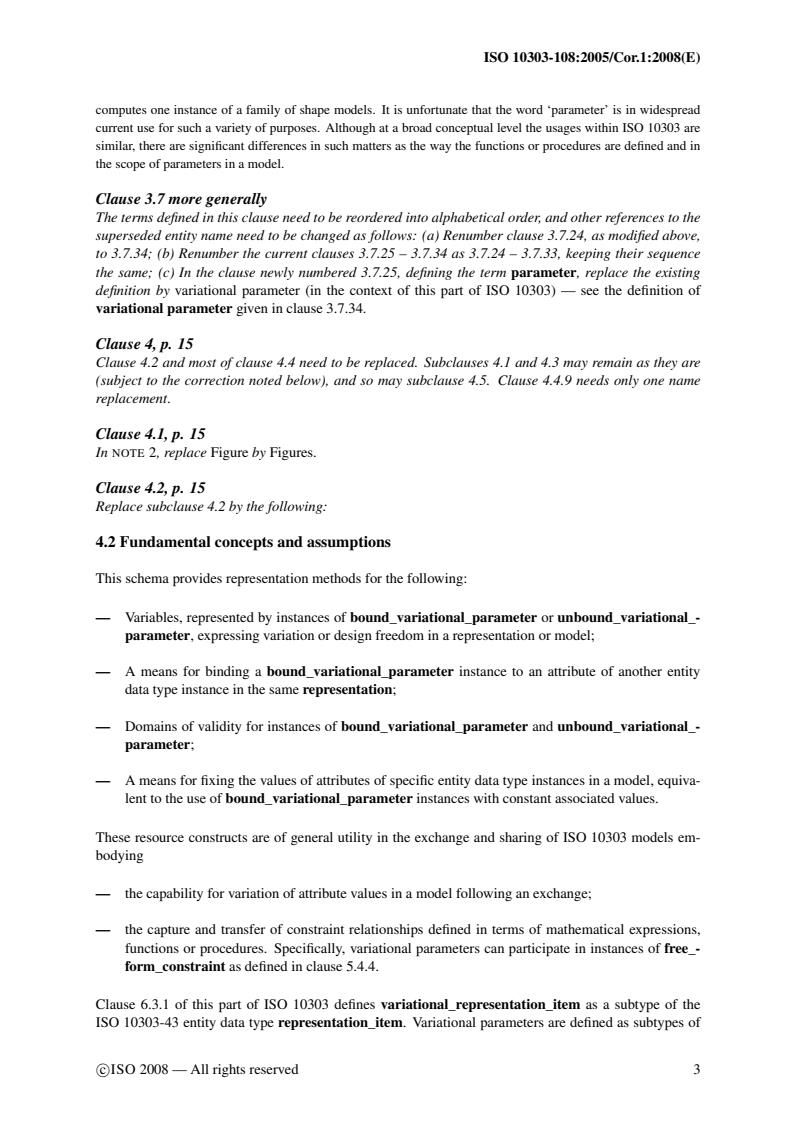
— Variables, represented by instances of bound_variational_parameter or unbound_variational_-
parameter, expressing variation or design freedom in a representation or model;
— A means for binding a bound_variational_parameter instance to an attribute of another entity
data type instance in the same representation;
— Domains of validity for instances of bound_variational_parameter and unbound_variational_-
parameter;
— A means for fixing the values of attributes of specific entity data type instances in a model, equiva-
lent to the use of bound_variational_parameter instances with constant associated values.
These resource constructs are of general utility in the exchange and sharing of ISO 10303 models em-
bodying
— the capability for variation of attribute values in a model following an exchange;
— the capture and transfer of constraint relationships defined in terms of mathematical expressions,
functions or procedures. Specifically, variational parameters can participate in instances of free_-
form_constraint as defined in clause 5.4.4.
Clause 6.3.1 of this part of ISO 10303 defines variational_representation_item as a subtype of the
ISO 10303-43 entity data type representation_item. Variational parameters are defined as subtypes of
°c ISO 2008 — All rights reserved 3
ISO 10303-108:2005/Cor.1:2008(E)
variational_representation_item, which is the supertype of all entity data types used to express the
variational aspects of models with explicit parameterization and constraints. The type of representation
in which they participate is a variational_representation, as defined in clause 6.3.3.
4.2.1 Variational parameters
An abstract entity data type variational_parameter is provided, with two instantiable subtypes, bound_-
variational_parameter and unbound_variational_parameter. These allow for the capture and trans-
mission of permitted aspects of model variation that can be exploited in a receiving system. A bound_-
variational_parameter is bound to an attribute of an entity data type instance in an ISO 10303 model, in
which case it provides a syntactic representation of the value of that attribute, for example a dimensional
value. By contrast, an unbound_variational_parameter is not directly associated with any model at-
tribute. Either kind of variational_parameter may be used in mathematical relationships defined in
free-form constraints. The current value of a variational_parameter is specified by one of its attributes;
in the bound case the value of this attribute is required by an informal proposition to be the same as the
value of the attribute to which it is bound.
The entity data type variational_parameter is defined as a subtype of variational_representation_-
item, and the scope of its instantiable subtypes is therefore defined by those instances of variational_-
representation in which they participate. It is also a subtype of the ISO 10303-50 entity data type
maths_variable, from which it inherits an attribute values_space, of ISO 10303-50 type maths_space.
This attribute specifies the domain of validity for values of the variational_parameter. These may
include domains corresponding to those of the EXPRESS data types REAL, INTEGER, BOOLEAN and
STRING, together with various bounded subsets of the REAL and INTEGER domains. This part of ISO
10303 does not directly provide the use of parameters having values belonging to aggregate types, but
applications may define such extensions if they are required.
EXAMPLE 1 Consider a rectangle, with length x units and width y units. Here x and y are variables or
parameters. An explicit constraint relationship x = y + 2 relates these dimensions. Valid parameter ranges
10:0 · x · 30:0 and 2:0 · y · 5:0 are defined. In this case the two variables correspond to instances of
bound_variational_parameter, both bound to physical quantities in the model, i.e., dimensional attributes of the
rectangle. The parameterization and constraint information may be transmitted together with a ‘current result’
— an explicit model of a rectangle with length 18.0 units and width 4.0 units. These parameter values satisfy
the constraint and fall within the required parameter ranges. When model transfer is complete, if one of the
parameters is edited the other should adjust accordingly to maintain satisfaction of the constraint, provided the
parameters remain within their valid ranges. It is assumed that the necessary functionality for parameter variation
and constraint maintenance will be provided by the receiving system.
The following example illustrates the use of an unbound_variational_parameter.
EXAMPLE 2 Suppose an instance of right_circular_cylinder (as defined in ISO 10303-42), has associated
instances of bound_variational_parameter associated with its radius and height attributes, here denoted by r
andh respectively. A third parameter, denoted byt, may be used to control the values of bothr andh according
to the relationshipsr = 3t¡2,h = t +1. In the case whent is not bound to an attribute of any entity data type
instance, it will appropriately be modelled in terms of an unbound_variational_parameter.
4.2.2 Parameter binding to an instance attribute
A bound_variational_parameter is associated with an attribute of an entity data type instance in a
populated schema, whose value represents the value of the parameter. This association is defined through
the use of an entity data type instance_attribute_reference that simply specifies the name of an attribute
4 °c ISO 2008 — All rights reserved
ISO 10303-108:2005/Cor.1:2008(E)
and the instance to which it belongs (see clause 4.4.6). A simple example is given below to illustrate the
principle, and the intended usage of the mechanism is more fully documented in clause F.1 of annex F.
Once the parameter binding has been established, the parameter may participate in a relationship that
governs its value if the model is subsequently edited in a receiving system.
EXAMPLE For the purpose of the example, entity data types defined in the ISO 10303 integrated generic re-
sources are treated as though they are instantiable elements in an application protocol.
It is desired to parameterize one dimension of a block solid, as defined in ISO 10303-42. This has three attributes,
x,y andz, that prescribe its three principal dimensions. In any instantiation of the block these will have specific
real numerical values. Consider now the following fragment of an ISO 10303-21 transfer file:
#290 = AXIS2_PLACEMENT_3D(.);
#300 = BLOCK(’BLOCK1’, #290, 4.0, 6.0, 8.0);
#310 = INSTANCE_ATTRIBUTE_REFERENCE
(’GEOMETRIC_MODEL_SCHEMA.BLOCK.X’, #300);
#320 = FINITE_REAL_INTERVAL(2.0, .CLOSED., 10.0, .CLOSED.);
#330 = BOUND_VARIATIONAL_PARAMETER
(’XPARAM’, #320, ’XPARAM’, ’BLOCK X-DIMENSION’, );
*
#340 = BOUND_PARAMETER_ENVIRONMENT(#310, #330);
The instances represented above are explained as follows:
#290: defines an ISO 10303-42 axis placement (details omitted) for the next instance;
#300: the block instance. As a subtype of ISO 10303-43 representation_item, this inherits a name at-
tribute of type label, whose value in this instance is’block1’. The block is defined with respect to the axis
placement#290 and has dimensions 4.0, 6.0 and 8.0 units;
#310: an instance of instance_attribute_reference;’geometric_model_schema.block.x’ is the
specified attribute name and the referenced block instance is#300. Note that the attribute name appears fully
qualified with the name of the owning entity data type and its defining schema. This entry in the file identifies
the particular instance whose specified attribute is to be associated with the bound_variational_parameter
instance;
#320: defines the domain of that parameter, a real interval closed at both ends, bounded below by 2.0 and
above by 10.0. The entity data type finite_real_interval is defined in ISO 10303-50;
#330: specifies the bound_variational_parameter itself, as defined in clause 4.4.2 of this schema. Its
attribute value list contains these entries:
— a label,’xparam’, corresponding to the name attribute of its representation_item supertype;
— a domain#320, corresponding to the values_space attribute of its maths_variable supertype;
— a label, ’xparam’, corresponding to the name attribute of its maths_variable supertype — the two
inherited name attributes are required by a
...
INTERNATIONAL STANDARD ISO 10303-108:2005
TECHNICAL CORRIGENDUM 2
Published 2014-07-01
INTERNATIONAL ORGANIZATION FOR STANDARDIZATION • МЕЖДУНАРОДНАЯ ОРГАНИЗАЦИЯ ПО СТАНДАРТИЗАЦИИ • ORGANISATION INTERNATIONALE DE NORMALISATION
Industrial automation systems and integration —
Product data representation and exchange —
Part 108:
Integrated generic resource:
Parameterization and constraints for explicit geometric
product models
TECHNICAL CORRIGENDUM 2
Systèmes d' automatisation industrielle et intégration – Représentation et échange de données de produits -
Partie 108 Ressources génériques intégrées: Paramétrage et contraintes pour les modèles de produits
géométriques explicites
RECTIFICATIF TECHNIQUE 2
Technical Corrigendum 2 to International Standard ISO 10303-108:2005 was prepared by Technical Committee ISO/
TC 184, Automation systems and integration, Subcommittee SC 4, Industrial data.
This Technical Corrigendum is intended to be used in conjunction with ISO 10303-108:2005/Cor.1: order of their publication. The
purpose of the modifications to the text of ISO 10303-108:2005 is to, corrections and improvements to its EXPRESS code. The changes
are mainly in the more s, qualification of attributes in the WHERE rules of entity specifications and in the coding of some functions
ICS 25.040.40 Ref. No. ISO 10303-108:2005/Cor.2:2014(E)
© ISO 2014 – All rights reserved
Published in Switzerland
ISO 10303-108: 2004/Cor.2:2014(E)
Modifications to the text of ISO 10303-108:2004
Clause 4.1, Introduction, p. 15
ReplaceISO13584_generic_expressions_schemawithiso13584_generic_expressions_-
schemainthefifthREFERENCE FROM statement,andmakethecorrespondingchangeinNote1.
Clause 5.1, Introduction, p. 30
ReplaceISO13584_generic_expressions_schemawithiso13584_generic_expressions_-
schemainthesixthREFERENCE FROMstatement,andreplaceISO13584_expressions_schema
with iso13584_expressions_schema in the seventh REFERENCE FROM statement. Make the
correspondingchangesinNote1.
Clause 5.4.7, simultaneous_constraint_group, pp. 40 - 42
ReplacetheEXPRESScodeonp. 41withthefollowing,inwhichWR1hashasbeenmodified:
EXPRESS specification:
)
*
ENTITY simultaneous_constraint_group
SUBTYPE OF (variational_representation_item);
constraint_group : SET[2:?] OF constraint_group_member;
WHERE
WR1: SIZEOF(QUERY(q < using_representations(SELF) |
*
SIZEOF(QUERY(r < q.items |
*
(’EXPLICIT_CONSTRAINT_SCHEMA.SIMULTANEOUS_CONSTRAINT_GROUP’
IN TYPEOF(r)) AND (SIZEOF(QUERY(s < constraint_group |
*
(s IN r\simultaneous_constraint_group.constraint_group)
AND NOT (r :=: SELF))) > 0))) > 0)) = 0;
WR2: SIZEOF(QUERY(q < using_representations(constraint_group[1]) |
*
(SIZEOF(QUERY(r < constraint_group |
*
item_in_context(r,q.context_of_items)))
= SIZEOF(constraint_group)))) > 0;
WR3: SIZEOF(QUERY(q < constraint_group |
*
((’EXPLICIT_CONSTRAINT_SCHEMA.EXPLICIT_CONSTRAINT’ IN TYPEOF(q))
AND (SIZEOF(QUERY(r < q.constrained_elements |
*
SIZEOF(QUERY(s < constraint_group |
*
r IN s.reference_elements)) > 0)) > 0)))) = 0;
END_ENTITY;
(
*
NOTE1 Somechangesweremadetoclause5.4.7byTechnicalCorrigendum1forISO10303-108:2004,butthe
originalEXPRESScodeofthisentitywasnotaffectedbythosechanges.
Clause 6.1, Introduction, p. 43
Replace the sixth REFERENCE FROM statement on p. 43 with the following, which references two
additionalentitiesfromtheISO13584generic_expressions_schemawhicharerequiredbythefunction
invalidate_vrep_itemdefinedonpp. 49-51:
REFERENCE FROM iso13584_generic_expressions_schema -- ISO 13584-20
(environment,
generic_variable,
variable_semantics);
2 ⃝c ISO 2014—Allrightsreserved
ISO 10303-108: 2004/Cor.2:2014(E)
Also, replace ISO13584_generic_expressions_schema with iso13584_generic_expressions_schema in
Note1.
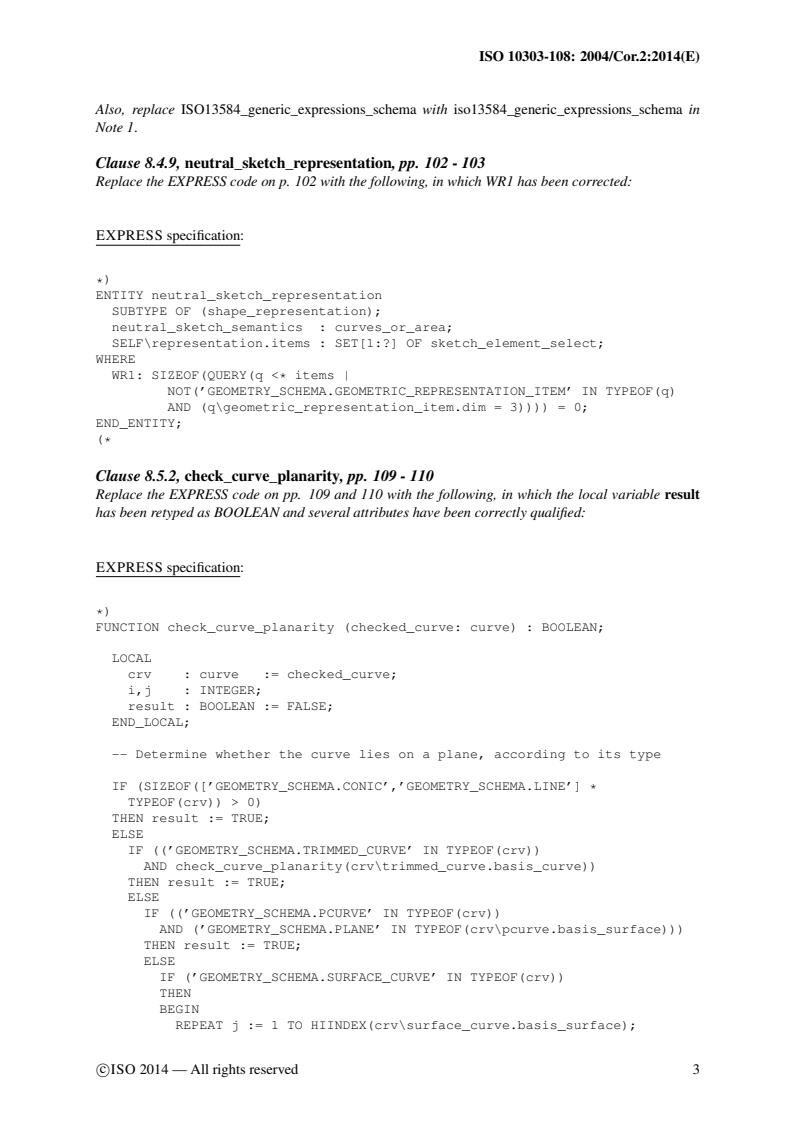
Clause 8.4.9, neutral_sketch_representation, pp. 102 - 103
ReplacetheEXPRESScodeonp. 102withthefollowing,inwhichWR1hasbeencorrected:
EXPRESS specification:
)
*
ENTITY neutral_sketch_representation
SUBTYPE OF (shape_representation);
neutral_sketch_semantics : curves_or_area;
SELF\representation.items : SET[1:?] OF sketch_element_select;
WHERE
WR1: SIZEOF(QUERY(q < items |
*
NOT(’GEOMETRY_SCHEMA.GEOMETRIC_REPRESENTATION_ITEM’ IN TYPEOF(q)
AND (q\geometric_representation_item.dim = 3)))) = 0;
END_ENTITY;
(
*
Clause 8.5.2, check_curve_planarity, pp. 109 - 110
Replace the EXPRESS code on pp. 109 and 110 with the following, in which the local variable result
hasbeenretypedasBOOLEANandseveralattributeshavebeencorrectlyqualified:
EXPRESS specification:
)
*
FUNCTION check_curve_planarity (checked_curve: curve) : BOOLEAN;
LOCAL
crv : curve := checked_curve;
i,j : INTEGER;
result : BOOLEAN := FALSE;
END_LOCAL;
-- Determine whether the curve lies on a plane, according to its type
IF (SIZEOF([’GEOMETRY_SCHEMA.CONIC’,’GEOMETRY_SCHEMA.LINE’]
*
TYPEOF(crv)) > 0)
THEN result := TRUE;
ELSE
IF ((’GEOMETRY_SCHEMA.TRIMMED_CURVE’ IN TYPEOF(crv))
AND check_curve_planarity(crv\trimmed_curve.basis_curve))
THEN result := TRUE;
ELSE
IF ((’GEOMETRY_SCHEMA.PCURVE’ IN TYPEOF(crv))
AND (’GEOMETRY_SCHEMA.PLANE’ IN TYPEOF(crv\pcurve.basis_surface)))
THEN result := TRUE;
ELSE
IF (’GEOMETRY_SCHEMA.SURFACE_CURVE’ IN TYPEOF(crv))
THEN
BEGIN
REPEAT j := 1 TO HIINDEX(crv\surface_curve.basis_surfa
...
INTERNATIONAL STANDARD ISO 10303-109:2004
TECHNICAL CORRIGENDUM 1
Published 2010-12-01
INTERNATIONAL ORGANIZATION FOR STANDARDIZATION • МЕЖДУНАРОДНАЯ ОРГАНИЗАЦИЯ ПО СТАНДАРТИЗАЦИИ • ORGANISATION INTERNATIONALE DE NORMALISATION
Industrial automation systems and integration — Product data
representation and exchange —
Part 109:
Integrated application resource: Kinematic and geometric
constraints for assembly models
TECHNICAL CORRIGENDUM 1
Systèmes d'automatisation industrielle et intégration — Représentation et échange de données de produits —
Partie 109: Ressources d'application intégrées: Contraintes cinématiques et géométriques pour les modèles
d'assemblage
RECTIFICATIF TECHNIQUE 1
Technical Corrigendum 1 to ISO 10303-109:2004 was prepared by Technical Committee ISO/TC 184,
Automation systems and integration, Subcommittee SC 4, Industrial data.
The purpose of the modifications to the text of ISO 10303-109:2004 is to correct the integration issues
between ISO 10303-109 and ISO 10303-59.
ISO 10303-59 redefines the following function, which exists in ISO 10303-109, because it is inappropriate
that 50 series parts refer to functions from 100 series parts:
FUNCTION using_product_definition_of_shape_representation
In order to avoid multiple definitions of the same function, the definition of the function has been removed
from ISO 10303-109 and changed so that reference is made to the function defined in ISO 10303-59.
ICS 25.040.40 Ref. No. ISO 10303-109:2004/Cor.1:2010(E)
© ISO 2010 – All rights reserved
Published in Switzerland
ISO 10303-109:2004/Cor.1:2010(E)
Modifications to the text of ISO 10303-109:2004
Page 2, Clause 2, Normative references
Add the following to the list of normative references:
ISO 10303-59, Industrial automation systems and integration — Product data represen
...
INTERNATIONAL STANDARD ISO 10303-109:2004
TECHNICAL CORRIGENDUM 2
Published 2014-07-01
INTERNATIONAL ORGANIZATION FOR STANDARDIZATION • МЕЖДУНАРОДНАЯ ОРГАНИЗАЦИЯ ПО СТАНДАРТИЗАЦИИ • ORGANISATION INTERNATIONALE DE NORMALISATION
Industrial automation systems and integration —
Product data representation and exchange —
Part 109:
Integrated generic resource:
Kinematic and geometric constraints for assembly
models
TECHNICAL CORRIGENDUM 2
Systèmes d’ automatisation industrielle et intégration – Représentation et échange de données de produits -
Partie 109: Ressources génériques intégrées: Contraintes cinématiques et géométriques pour les modèles
d'assemblage RECTIFICATIF TECHNIQUE 2
Technical Corrigendum 2 to International Standard ISO 10303-109:2004 was prepared by Technical Committee ISO/TC
184, Automation systems and integration, Subcommittee SC 4, Industrial data.
The purpose of the modification is to the text of ISO 10303-109:2004 is to correct editorial issues.
ICS 25.040.40 Ref. No. ISO 10303-109:2004/Cor.2:2014(E)
© ISO 2014 – All rights reserved
Published in Switzerland
ISO 10303-109:2004/Cor.1:2010(E) (Only Reference)
Modifications to the text of ISO 10303-109:2004
Page 2, Clause 2, Normative references
Add the following to the list of normative references:
ISO 10303-59, Industrial automation systems and integration — Product data representation and
exchange — Part 59: Integrated generic resource — Quality of product shape data
Page 5, 4.1
Remove the existing EXPRESS specification and NOTE 1 and replace them with the following new EXPRESS
specification and NOTE 1:
EXPRESS specification:
*)
SCHEMA assembly_feature_relationship_schema;
REFERENCE FROM assembly_constraint_schema; -- 10303-109
REFERENCE FROM geometry_schema; -- 10303-42
REFERENCE FROM kinematic_motion_representation_schema; -- 10303-105
REFERENCE FROM kinematic_structure_schema; -- 10303-105
REFERENCE FROM product_definition_schema; -- 10303-41
REFERENCE FROM product_property_definition_schema; -- 10303-41
REFERENCE FROM product_property_representation_schema; -- 10303-41
REFERENCE FROM product_structure_schema; -- 10303-44
REFERENCE FROM representation_schema; -- 10303-43
REFERENCE FROM support_resource_schema; -- 10303-41
REFERENCE FROM shape_data_quality_inspection_result_schema
(using_product_definition_of_shape_representation); -- 10303-59
(*
NOTE 1 The schemas referenced above can be found in the following parts of ISO 10303:
assembly_constraint_schema ISO 10303-109 geometry_schema
ISO 10303-42 kinematic_motion_representation_schema ISO
10303-105 kinematic_structure_schema ISO 10303-105
product_definition_schema ISO 10303-41
product_property_definition_schema ISO 10303-41
product_property_representation_schema ISO 10303-41
product_structure_schema ISO 10303-44 representation_schema
ISO 10303-43 support_resource_schema ISO 10303-41
shape_data_quality_inspection_result_schema ISO 10303-59
Pages 22 to 24, 4.5.10, 4.5.11 and 4.5.12
Delete the whole of subclause 4.5.10 and renumber subclauses 4.5.11 and 4.5.12 as 4.5.10 and 4.5.11.
Page 46, Index
Remove the line “Using product definition of shape representation”.
Modifications to the text of ISO 10303-109:2004
Page iii, Contents
Removal of the line regarding Using product definition of shape representation
Page vii, Introduction
Addition of the following two lines at the end of the page
shape_data_quality_inspection_result_schema ISO 10303-59
support_resource_schema ISO 10303-41
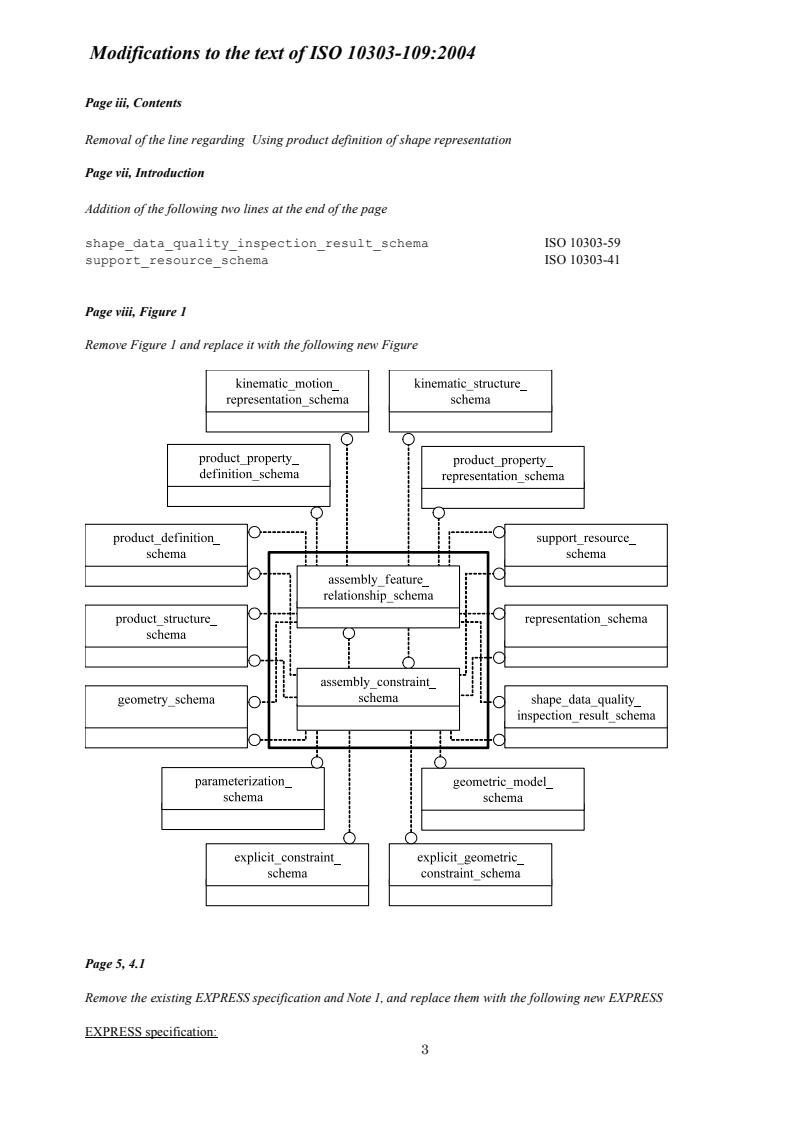
Page viii, Figure 1
Remove Figure 1 and replace it with the following new Figure
Page 5, 4.1
Remove the existing EXPRESS specification and Note 1, and replace them with the following new EXPRESS
EXPRESS specification:
*)
SCHEMA assembly_feature_relationship_schema;
REFERENCE FROM assembly_constraint_schema; --10303-109
REFERENCE FROM geometry_schema; -- 10303-41
REFERENCE FROM kinematic_motion_representation_schema; -- 10303-105
REFERENCE FROM kinematic_structure_schema; -- 10303-105
REFERENCE FROM product_definition_schema; -- 10303-41
REFERENCE FROM product_property_definition_schema; -- 10303-41
REFERENCE FROM product_property_representation_schema; -- 10303-41
REFERENCE FROM product_structure_schema; -- 10303-44
REFERENCE FROM representation_schema; -- 10303-43
REFERENCE FROM shape_data_quality_inspection_result_schema; -- ISO 10303-59
REFERENCE FROM support_resource_schema; -- 10303-41
(*
NOTE 1 The schemas referenced above can be found in the following parts of ISO 10303:
assembly_constraint_schema ISO 10303-109
geometry_schema ISO 10303-42
kinematic_motion_representation_schema ISO 10303-105
kinematic_structure_schema ISO 10303-105
product_definition_schema ISO 10303-41
product_property_definition_schema ISO 10303-41
product_property_representation_schema ISO 10303-41
product_structure_schema ISO 10303-44
representation_schema ISO 10303-43
shape_data_quality_inspection_result_schema ISO 10303-59
support_resource_schema ISO 10303-41
Page 7, 4.4.1
Remove the existing EXPRESS specification, and replace it with the following new EXPRESS
EXPRESS specification:
*)
ENTITY shape_aspect_relationship_representation_association;
represented_shape_aspect_relationship: shape_aspect_relationship;
representing_representation_relationship : representation_relationship;
WHERE
WR1: ('ASSEMBLY_FEATURE_RELATIONSHIP_SCHEMA.REPRESENTATIVE_SHAPE_REPRESENTATION'
IN TYPEOF(representing_representation_relationship¥representation_relationship.
rep_1)) AND
('ASSEMBLY_FEATURE_RELATIONSHIP_SCHEMA.REPRESENTATIVE_SHAPE_REPRESENTATION'
IN
TYPEOF(representing_representation_relationship¥representation_relationship.
rep_2));
WR2: (represented_shape_aspect_relationship.relating_shape_aspect IN
using_shape_aspect_of_shape_representation
(representing_representation_relationship.rep_1)) AND
(represented_shape_aspect_relationship.related_shape_aspect IN
using_shape_aspect_of_shape_representation
(representing_representation_relationship.rep_2));
WR3: ((find_representative_shape_representation_of_product_definition
(using_product_definition_of_shape_aspect
(represented_shape_aspect_relationship.relating_shape_aspect)).
context_of_items) :=:
(find_representative_shape_representation_of_shape_aspect
(represented_shape_aspect_relationship.relating_shape_aspect).
context_of_items)) AND
((find_representative_shape_representation_of_product_definition
(using_product_definition_of_shape_aspect
(represented_shape_aspect_relationship.related_shape_aspect)).
context_of_items) :=:
(find_representative_shape_representation_of_shape_aspect
(represented_shape_aspect_relationship.related_shape_aspect).
context_of_items));
WR4: using_product_definition_of_shape_aspect
(represented_shape_aspect_relationship.relating_shape_aspect) :<>:
using_product_definition_of_shape_aspect
(represented_shape_aspect_relationship.related_shape_aspect);
WR5: find_assembly_root ([using_product_definition_of_shape_aspect
(represented_shape_aspect_relationship.relating_shape_aspect)]) :=:
find_assembly_root ([using_product_definition_of_shape_aspect
(represented_shape_aspect_relationship.related_shape_aspect)]);
END_ENTITY; -- shape_aspect_relationship_representation_association
(*
Page 10, 4.4.3
Remove the existing EXPRESS specification, and replace it with the following new EXPRESS
EXPRESS specification:
*)
ENTITY free_kinematic_motion_representation
SUBTYPE OF (representation_relationship_with_transformation);
SELF¥representation_relationship.rep_1:
representative_shape_representation;
SELF¥representation_relationship.rep_2:
representative_shape_representation;
motion : kinematic_path;
WHERE
WR1: 'REPRESENTATION_SCHEMA.ITEM_DEFINED_TRANSFORMATION' IN TYPEOF
(SELF¥representation_relationship_with_transformation.
transformation_operator);
WR2: ('GEOMETRY_SCHEMA.GEOMETRIC_REPRESENTATION_ITEM' IN TYPEOF
(SELF¥representation_relationship_with_transformation.
transformation_operator¥item_defined_transformation.transform_item_1)) AND
('GEOMETRY_SCHEMA.GEOMETRIC_REPRESENTATION_ITEM' IN TYPEOF
(SELF¥representation_relationship_with_transformation.
transformation_operator¥item_defined_transformation.
transform_item_2));
WR3: ((dimension_of
(SELF¥representation_relationship_with_transformation.
transformation_operator¥item_defined_transformation.
transform_item_1) = 3 ) AND
(dimension_of
(SELF¥representation_relationship_with_transformation.
transformation_operator¥item_defined_transformation.
transform_item_2) = 3 ));
WR4:(SELF¥representation_relationship.rep_1 IN
(using_representations
(SELF¥representation_relationship_with_transformation.
transformation_operator¥item_defined_transformation.transform_item_1) +
using_representation_with_mapping
(SELF¥representation_relationship_with_transformation.
transformation_operator¥item_defined_transformation.transform_item_1)))
AND
(SELF¥representation_relationship.rep_2 IN
(using_representations
(SELF¥representation_relationship_with_transformation.
transformation_operator¥item_defined_transformation.transform_item_2) +
using_representation_with_mapping
(SELF¥representation_relationship_with_transformation.
transformation_operator¥item_defined_transformation.transform_item_2)));
END_ENTITY; -- free_kinematic_motion_representation
(*
Page 12, 4.4.4
Remove the existing EXPRESS specification, and replace it with the following new EXPRESS
EXPRESS specification:
*)
ENTITY constrained_kinematic_motion_representation
SUBTYPE OF (representation_relationship_with_transformation);
SELF¥representation_relationship.rep_1:
representative_shape_representation;
SELF¥representation_relationship.rep_2:
representative_shape_representation;
WHERE
WR1: ('GEOMETRY_SCHEMA.AXIS2_PLACEMENT_3D' IN TYPEOF
(SELF¥representation_relationship_with_transformation.
transformation_operator¥item_defined_transformation.transform_item_1)) AND
('GEOMETRY_SCHEMA.AXIS2_PLACEMENT_3D' IN TYPEOF
(SELF¥representation_relationship_with_transformation.
transformation_operator¥item_defined_transformation.transform_item_2));
WR2: ((dimension_of
(SELF¥representation_relationship_with_transformation.
transformation_operator¥item_defined_transformation.
transform_item_1) = 3 ) AND
(dimension_of
(SELF¥representation_relationship_with_transformation.
transformation_operator¥item_defined_transformation.
transform_item_2) = 3 ));
WR3:(SELF¥representation_relationship.rep_1 IN
(using_representations
(SELF¥representation_relationship_with_transformation.
transformation_operator¥item_defined_transformation.transform_item_1) +
using_representation_with_mapping
(SELF¥representation_relationship_with_transformation.
transformation_operator¥item_defined_transformation.transform_item_1))) AND
(SELF¥representation_relationship.rep_2 IN
(using_representations
(SELF¥representation_relationship_with_transformation.
transformation_operator¥item_defined_transformation.transform_item_2) +
using_representation_with_mapping
(SELF¥representation_relationship_with_transformation.
transformation_operator¥item_defined_transformation.transform_item_2)));
WR4: 'KINEMATIC_STRUCTURE_SCHEMA.KINEMATIC_PAIR' IN TYPEOF
(SELF¥representation_relationship_with_transformation.
transformation_operator);
END_ENTITY; -- constrained_kinematic_motion_representation
(*
Page 13, 4.5.1
Remove the existing EXPRESS specification, and replace it with the following new EXPRESS
EXPRESS specification:
*)
FUNCTION assembly_root
(item: product_definition) : BOOLEAN;
-- extraction of related assembly_component_relationships --
IF (SIZEOF(QUERY(pdr <* USEDIN (item,
'PRODUCT_DEFINITION_SCHEMA.PRODUCT_DEFINITION_RELATIONSHIP.' +
'RELATED_PRODUCT_DEFINITION') |
'PRODUCT_STRUCTURE_SCHEMA.ASSEMBLY_COMPONENT_USAGE' IN
TYPEOF(pdr)))
= 0) THEN RETURN(TRUE);
ELSE RETURN (FALSE);
END_IF;
END_FUNCTION;
(*
Page 14, 4.5.2
Remove the existing EXPRESS specification, and replace it with the following new EXPRESS
EXPRESS specification:
*)
FUNCTION find_assembly_root
(constituent: SET OF product_definition) : SET OF product_definition;
LOCAL
local_relation: SET OF assembly_component_usage := [];
local_relation2: BAG OF assembly_component_usage := [];
local_parent: SET OF product_definition := [];
root : SET OF product_definition;
i : INTEGER := 0;
j : INTEGER := 0;
END_LOCAL;
-- Is constituent root ? --
IF ((SIZEOF (constituent) = 1) AND assembly_root (constituent[1]))
THEN RETURN ([constituent [1]]);
-- ERROR constituent is vacant --
ELSE IF (SIZEOF (constituent) = 0 ) THEN RETURN ([]);
-- extraction of related assembly_component_relationships --
ELSE
REPEAT j:= 1 TO HIINDEX(constituent);
local_relation2 := local_relation2 + QUERY(pdr <* USEDIN (constituent[j],
'PRODUCT_DEFINITION_SCHEMA.PRODUCT_DEFINITION_RELATIONSHIP.' +
'RELATED_PRODUCT_DEFINITION') |
'PRODUCT_STRUCTURE_SCHEMA.ASSEMBLY_COMPONENT_USAGE' IN
TYPEOF(pdr));
END_REPEAT;
local_relation := bag_to_set (local_relation2);
IF (SIZEOF(local_relation) = 0) THEN
IF (SIZEOF(constituent) = 1) THEN RETURN ([constituent[1]]);
ELSE RETURN ([]);
END_IF;
ELSE
-- extraction of a set of parents --
REPEAT i :=1 TO HIINDEX(local_relation);
REPEAT j := 1 TO HIINDEX(constituent);
IF (local_relation[i].relating_product_definition <>
constituent[j]) THEN
local_parent := local_parent +
local_relation[i].relating_product_definition;
END_IF;
END_REPEAT;
END_REPEAT;
IF ((SIZEOF (local_parent) = 1 ) AND
assembly_root (local_parent[1]))
THEN RETURN ([local_parent[1]]);
ELSE IF (SIZEOF (local_parent) = 0) THEN RETURN ([]);
-- try again --
ELSE
root := find_assembly_root(local_parent);
IF (SIZEOF (root)
...
INTERNATIONAL ISO
STANDARD 10303-109
First edition
2004-12-01
Industrial automation systems and
integration — Product data
representation and exchange —
Part 109:
Integrated application resource:
Kinematic and geometric constraints for
assembly models
Systèmes d'automatisation industrielle et intégration — Représentation
et échange de données de produits —
Partie 109: Ressources d'application intégrées: Contraintes
cinématiques et géométriques pour les modèles d'assemblage
Reference number
ISO 10303-109:2004(E)
©
ISO 2004
ISO 10303-109:2004(E)
PDF disclaimer
This PDF file may contain embedded typefaces. In accordance with Adobe's licensing policy, this file may be printed or viewed but
shall not be edited unless the typefaces which are embedded are licensed to and installed on the computer performing the editing. In
downloading this file, parties accept therein the responsibility of not infringing Adobe's licensing policy. The ISO Central Secretariat
accepts no liability in this area.
Adobe is a trademark of Adobe Systems Incorporated.
Details of the software products used to create this PDF file can be found in the General Info relative to the file; the PDF-creation
parameters were optimized for printing. Every care has been taken to ensure that the file is suitable for use by ISO member bodies. In
the unlikely event that a problem relating to it is found, please inform the Central Secretariat at the address given below.
© ISO 2004
All rights reserved. Unless otherwise specified, no part of this publication may be reproduced or utilized in any form or by any means,
electronic or mechanical, including photocopying and microfilm, without permission in writing from either ISO at the address below or
ISO's member body in the country of the requester.
ISO copyright office
Case postale 56 • CH-1211 Geneva 20
Tel. + 41 22 749 01 11
Fax + 41 22 749 09 47
E-mail copyright@iso.org
Web www.iso.org
Published in Switzerland
ii © ISO 2004 – All rights reserved
ISO 10303-109:2004(E)
Contents Page
1 Scope.1
2 Normative references .2
3 Terms, definitions, and abbreviations .3
3.1 Terms defined in ISO 10303-1 .3
3.2 Terms defined in ISO 10303-11 .3
3.3 Terms defined in ISO 10303-41 .3
3.4 Terms defined in ISO 10303-42 .3
3.5 Terms defined in ISO 10303-43 .3
3.6 Terms defined in ISO 10303-44 .4
3.7 Terms defined in ISO 10303-108 .4
3.8 Abbreviations…………………………………………………….……………………….4
4 Assembly feature relationship.5
4.1 Introduction .5
4.2 Fundamental concepts and assumptions.6
4.3 Assembly feature relationship type definitions .7
4.3.1 Representing relationship .7
4.4 Assembly feature relationship entity definitions .7
4.4.1 Shape aspect relationship representation association .7
4.4.2 Representative shape representation.9
4.4.3 Free kinematic motion representation.10
4.4.4 Constrained kinematic motion representation .12
4.5 Assembly feature relationship function definitions.13
4.5.1 Assembly root.13
4.5.2 Find assembly root.14
4.5.3 Find shape representation of product definition .16
4.5.4 Find shape representation of shape aspect.17
4.5.5 Find representative shape representation of product definition……….…………….18
4.5.6 Find representative shape representation of shape aspect…………….…………….18
4.5.7 Unique in product definition.19
4.5.8 Unique in shape aspect .20
4.5.9 Using product definition of shape aspect.21
4.5.10 Using product definition of shape representation.22
4.5.11 Using shape aspect of shape representation.23
4.5.12 Using representations with mapping.24
5 Assembly constraint.26
5.1 Introduction.26
5.2 Fundamental concepts and assumptions.27
©ISO 2004-All rights reserved iii
ISO 10303-109:2004(E)
5.3 Assembly constraint entity definitions .29
5.3.1 Assembly geometric constraint.29
5.3.2 Binary assembly constraint ………………………………………………………….29
5.3.3 Fixed constituent assembly constraint.31
5.3.4 Parallel assembly constraint .32
5.3.5 Parallel assembly constraint with dimension.33
5.3.6 Surface distance assembly constraint with dimension.33
5.3.7 Angle assembly constraint with dimension .34
5.3.8 Perpendicular assembly constraint .34
5.3.9 Incidence assembly constraint .35
5.3.10 Coaxial assembly constraint .35
5.3.11 Tangent assembly constraint.36
5.4 Assembly constraint function definitions .36
5.4.1 Assembly leaf .36
Annex A (normative) Short names of entities.38
Annex B (normative) Information object registration.39
B.1 Document identification .39
B.2 Schema identification .39
B.2.1 Identification of the schema assembly_feature_relationship…………………….….39
B.2.2 Identification of the schema assembly_constraint…………………………….…….39
Annex C (informative) Computer-interpretable listings .40
Annex D (informative) EXPRESS-G diagrams .41
Annex E (informative) Informative figures…………………………………………………….44
Index.46
Figures
Figure 1 Schema level diagram of relationships between ISO 10303-109 schemas (inside the
box) and other resource schemas……………………………………….………viii
Figure D.1 EXPRESS-G diagram of the assembly_feature_relationship_schema (1 of 1)….….42
Figure D.2 EXPRESS-G diagram of the assembly_constraint_schema (1 of 1)………………….43
Figure E.1 Relationships of schemas in this part of ISO 10303 and related modules with existing
resource entities (overall structure)…………………………….……………………45
Tables
Table A.1 Short names of entities…………………………………………………………………38
iv
©ISO 2004-All rights reserved
ISO 10303-109:2004(E)
Foreword
ISO (the International Organization for Standardization) is a worldwide federation of national standards
bodies (ISO member bodies). The work of preparing International Standards is normally carried out
through ISO technical committees. Each member body interested in a subject for which a technical
committee has been established has the right to be represented on that committee. International
organizations, governmental and non-governmental, in liaison with ISO, also take part in the work. ISO
collaborates closely with the International Electrotechnical Commission (IEC) on all matters of
electrotechnical standardization.
International Standards are drafted in accordance with the rules given in the ISO/IEC Directives, Part 2.
The main task of technical committees is to prepare International Standards. Draft International
Standards adopted by the technical committees are circulated to the member bodies for voting.
Publication as an International Standard requires approval by at least 75% of the member bodies casting
a vote.
Attention is drawn to the possibility that some of the elements of this part of ISO 10303 may be the
subject of patent rights. ISO shall not be held responsible for identifying any or all such patent rights.
ISO 10303-109 was prepared by Technical Committee ISO/TC184, Industrial automation systems and
integration, Subcommittee SC4, Industrial data.
ISO 10303 is organized as a series of parts, each published separately. The structure of ISO 10303 is
described in ISO 10303-1.
Each part of ISO 10303 is a member of one of the following series: description methods,
implementation methods, conformance testing methodology and framework, integrated generic
resources, integrated application resources, application protocols, abstract test suites, application
interpreted constructs, and application modules. This part is a member the of integrated application
resources series. The integrated generic resources and the integrated application resources specify a
single conceptual product data model.
A complete list of parts of ISO 10303 is available from the Internet:
©ISO 2004-All rights reserved v
ISO 10303-109:2004(E)
Introduction
ISO 10303 is an International Standard for the computer-interpretable representation of product
information and for the exchange of product data. The objective is to provide a neutral mechanism
capable of describing products throughout their life cycle. This mechanism is suitable not only for
neutral file exchange, but also as a basis for implementing and sharing product databases, and as a basis
for archiving.
This part of ISO 10303 is a member of the integrated application resources series. Major subdivisions of
this part of ISO 10303 are:
— Assembly feature relationship schema;
— Assembly constraint schema.
This part of ISO 10303 provides general representations for geometric relationships between
component parts within an assembly model. The distinction of assembly, subassembly and component
part is context dependent. An assembly in some engineering context could be a component part in
another engineering context. In order to cope with this variety, this part of ISO 10303 uses the term
‘constituent’ to represent a generic concept that implies assembly or subassembly or component part in
case these distinctions are not necessary.
EXAMPLE 1 For some applications, an electric motor is regarded as a single component part of a washing
machine rather than as an assembly in its own right.
Detailed geometric relationships between constituents of an assembly are required in applications such
as parametric representation of geometric constraints between constituents, motion animation of an
assembly product, assembly/disassembly process planning, kinematics analysis and tolerance analysis.
Existing STEP resource parts support limited assembly model representations. They capture
hierarchical relationship, alternative constituent and mutual position and orientation between two
constituents. This part of ISO 10303 is intended to fill in missing information to enable the above
mentioned applications.
An important conc
...
INTERNATIONAL ISO
STANDARD 10303-110
First edition
2011-10-15
Industrial automation systems and
integration — Product data representation
and exchange —
Part 110:
Integrated application resource:
Mesh-based computational fluid dynamics
Systèmes d'automatisation industrielle et intégration — Représentation
et échange de données de produits —
Partie 110: Ressources d'application intégrées: Dynamique des fluides
computationnelle fondée sur la maille
Reference number
ISO 10303-110:2011(E)
©
ISO 2011
ISO 10303-110:2011(E)
© ISO 2011
All rights reserved. Unless otherwise specified, no part of this publication may be reproduced or utilized in any form or by any means,
electronic or mechanical, including photocopying and microfilm, without permission in writing from either ISO at the address below or
ISO's member body in the country of the requester.
ISO copyright office
Case postale 56 CH-1211 Geneva 20
Tel. + 41 22 749 01 11
Fax + 41 22 749 09 47
E-mail copyright@iso.org
Web www.iso.org
Published in Switzerland
ii © ISO 2011 – All rights reserved
ISO 10303-110:2011(E)
Contents Page
Foreword . . . . . . . . . . . . . . . . . . . . . . . . . . . . . . . . . . . . . . . . . . . . . . viii
Introduction . . . . . . . . . . . . . . . . . . . . . . . . . . . . . . . . . . . . . . . . . . . . . ix
1 Scope . . . . . . . . . . . . . . . . . . . . . . . . . . . . . . . . . . . . . . . . . . . . . . . 1
2 Normative references . . . . . . . . . . . . . . . . . . . . . . . . . . . . . . . . . . . . . . . 3
3 Terms, definitions, abbreviated terms, and symbols . . . . . . . . . . . . . . . . . . . . . . . 3
3.1 Terms defined in ISO 10303-1 . . . . . . . . . . . . . . . . . . . . . . . . . . . . . . 3
3.2 Other terms and definitions . . . . . . . . . . . . . . . . . . . . . . . . . . . . . . . . 3
3.3 Abbreviated terms . . . . . . . . . . . . . . . . . . . . . . . . . . . . . . . . . . . . 4
3.4 Symbols . . . . . . . . . . . . . . . . . . . . . . . . . . . . . . . . . . . . . . . . . . 4
4 Basis . . . . . . . . . . . . . . . . . . . . . . . . . . . . . . . . . . . . . . . . . . . . . . . . 7
4.1 General . . . . . . . . . . . . . . . . . . . . . . . . . . . . . . . . . . . . . . . . . . 8
4.2 Fundamental concepts and assumptions . . . . . . . . . . . . . . . . . . . . . . . . . 8
4.3 basis_schema type definitions . . . . . . . . . . . . . . . . . . . . . . . . . . . . . . 16
4.3.1 choose_general_property_identifier . . . . . . . . . . . . . . . . . . . . . . . . 16
4.3.2 choose_geometry_location . . . . . . . . . . . . . . . . . . . . . . . . . . . . . 16
4.3.3 choose_representation_context_identifier . . . . . . . . . . . . . . . . . . . . . 17
4.3.4 defined_data_class . . . . . . . . . . . . . . . . . . . . . . . . . . . . . . . . . 17
4.3.5 defined_data_name . . . . . . . . . . . . . . . . . . . . . . . . . . . . . . . . . 18
4.3.6 fd_defined_data_name . . . . . . . . . . . . . . . . . . . . . . . . . . . . . . . 18
4.3.7 fd_nondimensional_parameter_name . . . . . . . . . . . . . . . . . . . . . . . 19
4.3.8 mbna_property_distribution_select . . . . . . . . . . . . . . . . . . . . . . . . 20
4.3.9 mbna_value_context_select . . . . . . . . . . . . . . . . . . . . . . . . . . . . 21
4.4 basis_schema entity definitions . . . . . . . . . . . . . . . . . . . . . . . . . . . . . . 21
4.4.1 geometry_reference . . . . . . . . . . . . . . . . . . . . . . . . . . . . . . . . 21
4.4.2 specified_general_property . . . . . . . . . . . . . . . . . . . . . . . . . . . . . 22
4.4.3 specified_representation_context . . . . . . . . . . . . . . . . . . . . . . . . . . 22
5 Hierarchy . . . . . . . . . . . . . . . . . . . . . . . . . . . . . . . . . . . . . . . . . . . . . 23
5.1 General . . . . . . . . . . . . . . . . . . . . . . . . . . . . . . . . . . . . . . . . . . 24
5.2 Fundamental concepts and assumptions . . . . . . . . . . . . . . . . . . . . . . . . . 25
5.3 hierarchy_schema entity definitions . . . . . . . . . . . . . . . . . . . . . . . . . . . 26
5.3.1 fd_step . . . . . . . . . . . . . . . . . . . . . . . . . . . . . . . . . . . . . . . 26
5.3.2 fd_zone . . . . . . . . . . . . . . . . . . . . . . . . . . . . . . . . . . . . . . . 26
5.3.3 mbna_model . . . . . . . . . . . . . . . . . . . . . . . . . . . . . . . . . . . . 27
5.3.4 mbna_state . . . . . . . . . . . . . . . . . . . . . . . . . . . . . . . . . . . . . 27
5.3.5 mbna_step . . . . . . . . . . . . . . . . . . . . . . . . . . . . . . . . . . . . . 28
5.3.6 mbna_zone . . . . . . . . . . . . . . . . . . . . . . . . . . . . . . . . . . . . . 28
6 Domain . . . . . . . . . . . . . . . . . . . . . . . . . . . . . . . . . . . . . . . . . . . . . . 30
°c ISO 2011 — All rights reserved iii
ISO 10303-110:2011(E)
6.1 General . . . . . . . . . . . . . . . . . . . . . . . . . . . . . . . . . . . . . . . . . . 30
6.2 domain_schema type definitions . . . . . . . . . . . . . . . . . . . . . . . . . . . . . 30
6.2.1 coordinate_data_name . . . . . . . . . . . . . . . . . . . . . . . . . . . . . . . 30
6.3 domain_schema entity definitions . . . . . . . . . . . . . . . . . . . . . . . . . . . . 32
6.3.1 grid_coordinates . . . . . . . . . . . . . . . . . . . . . . . . . . . . . . . . . . 32
6.3.2 grid_coordinates_with_rind . . . . . . . . . . . . . . . . . . . . . . . . . . . . 33
6.4 domain_schema function definitions . . . . . . . . . . . . . . . . . . . . . . . . . . . 33
6.4.1 is_coordinate_property . . . . . . . . . . . . . . . . . . . . . . . . . . . . . . . 33
7 Conditions . . . . . . . . . . . . . . . . . . . . . . . . . . . . . . . . . . . . . . . . . . . . . 34
7.1 General . . . . . . . . . . . . . . . . . . . . . . . . . . . . . . . . . . . . . . . . . . 35
7.2 Fundamental concepts and assumptions . . . . . . . . . . . . . . . . . . . . . . . . . 35
7.3 conditions_schema type definitions . . . . . . . . . . . . . . . . . . . . . . . . . . . 37
7.3.1 fd_bc_type_compound . . . . . . . . . . . . . . . . . . . . . . . . . . . . . . . 37
7.3.2 fd_bc_type_simple . . . . . . . . . . . . . . . . . . . . . . . . . . . . . . . . . 37
7.3.3 ijk_minmax . . . . . . . . . . . . . . . . . . . . . . . . . . . . . . . . . . . . . 40
7.3.4 mbna_bc_type . . . . . . . . . . . . . . . . . . . . . . . . . . . . . . . . . . . 40
7.3.5 mbna_bc_type_compound . . . . . . . . . . . . . . . . . . . . . . . . . . . . . 41
7.3.6 mbna_bc_type_simple . . . . . . . . . . . . . . . . . . . . . . . . . . . . . . . 41
7.3.7 Riemann_1D_data_name . . . . . . . . . . . . . . . . . . . . . . . . . . . . . 42
7.4 conditions_schema entity definitions . . . . . . . . . . . . . . . . . . . . . . . . . . . 43
7.4.1 elements_bc . . . . . . . . . . . . . . . . . . . . . . . . . . . . . . . . . . . . 43
7.4.2 fd_bc . . . . . . . . . . . . . . . . . . . . . . . . . . . . . . . . . . . . . . . . 44
7.4.3 fd_bc_dataset . . . . . . . . . . . . . . . . . . . . . . . . . . . . . . . . . . . . 44
7.4.4 fd_zone_bc . . . . . . . . . . . . . . . . . . . . . . . . . . . . . . . . . . . . . 46
7.4.5 indexed_elements_bc . . . . . . . . . . . . . . . . . . . . . . . . . . . . . . . . 46
7.4.6 indexed_points_bc . . . . . . . . . . . . . . . . . . . . . . . . . . . . . . . . . 47
7.4.7 mbna_bc . . . . . . . . . . . . . . . . . . . . . . . . . . . . . . . . . . . . . . 47
7.4.8 mbna_bc_data . . . . . . . . . . . . . . . . . . . . . . . . . . . . . . . . . . . 49
7.4.9 mbna_bc_data_global . . . . . . . . . . . . . . . . . . . . . . . . . . . . . . . 49
7.4.10 mbna_bc_data_local . . . . . . . . . . . . . . . . . . . . . . . . . . . . . . . . 50
7.4.11 mbna_bc_dataset . . . . . . . . . . . . . . . . . . . . . . . . . . . . . . . . . . 50
7.4.12 mbna_condition . . . . . . . . . . . . . . . . . . . . . . . . . . . . . . . . . . 52
7.4.13 mbna_Dirichlet_bc_dataset . . . . . . . . . . . . . . . . . . . . . . . . . . . . 53
7.4.14 mbna_Neumann_bc_dataset . . . . . . . . . . . . . . . . . . . . . . . . . . . . 53
7.4.15 mbna_reference_state . . . . . . . . . . . . . . . . . . . . . . . . . . . . . . . 54
7.4.16 mbna_zone_bc . . . . . . . . . . . . . . . . . . . . . . . . . . . . . . . . . . . 55
8 Equations . . . . . . . . . . . . . . . . . . . . . . . . . . . . . . . . . . . . . . . . . . . . . 55
8.1 General . . . . . . . . . . . . . . . . . . . . . . . . . . . . . . . . . . . . . . . . . . 56
8.2 Fundamental concepts and assumptions . . . . . . . . . . . . . . . . . . . . . . . . . 56
8.3 equations_schema type definitions . . . . . . . . . . . . . . . . . . . . . . . . . . . . 57
8.3.1 fd_behaviour_models . . . . . . . . . . . . . . . . . . . . . . . . . . . . . . . 57
8.3.2 fd_governing_equation_type . . . . . . . . . . . . . . . . . . . . . . . . . . . . 57
8.3.3 force_moment_data_name . . . . . . . . . . . . . . . . . . . . . . . . . . . . . 58
8.3.4 gas_model_data_name . . . . . . . . . . . . . . . . . . . . . . . . . . . . . . . 61
iv °c ISO 2011 — All rights reserved
ISO 10303-110:2011(E)
8.3.5 gas_model_type . . . . . . . . . . . . . . . . . . . . . . . . . . . . . . . . . . 61
8.3.6 mbna_behaviour_models . . . . . . . . . . . . . . . . . . . . . . . . . . . . . . 62
8.3.7 mbna_governing_equation_type . . . . . . . . . . . . . . . . . . . . . . . . . . 62
8.3.8 thermal_conductivity_model_data_name . . . . . . . . . . . . . . . . . . . . . 63
8.3.9 thermal_conductivity_model_type . . . . . . . . . . . . . . . . . . . . . . . . . 64
8.3.10 turbulence_closure_data_name . . . . . . . . . . . . . . . . . . . . . . . . . . 65
8.3.11 turbulence_closure_type . . . . . . . . . . . . . . . . . . . . . . . . . . . . . . 65
8.3.12 turbulence_model_data_name . . . . . . . . . . . . . . . . . . . . . . . . . . . 66
8.3.13 turbulence_model_type . . . . . . . . . . . . . . . . . . . . . . . . . . . . . . 67
8.3.14 viscosity_model_data_name . . . . . . . . . . . . . . . . . . . . . . . . . . . . 68
8.3.15 viscosity_model_type . . . . . . . . . . . . . . . . . . . . . . . . . . . . . . . 69
8.4 equations_schema entity definitions . . . . . . . . . . . . . . . . . . . . . . . . . . . 70
8.4.1 fd_diffusion_equation . . . . . . . . . . . . . . . . . . . . . . . . . . . . . . . 70
8.4.2 fd_diffusion_model . . . . . . . . . . . . . . . . . . . . . . . . . . . . . . . . 71
8.4.3 fd_governing_equation . . . . . . . . . . . . . . . . . . . . . . . . . . . . . . . 72
8.4.4 flow_equation_set . . . . . . . . . . . . . . . . . . . . . . . . . . . . . . . . . 72
8.4.5 gas_model . . . . . . . . . . . . . . . . . . . . . . . . . . . . . . . . . . . . . 73
8.4.6 mbna_behaviour_model . . . . . . . . . . . . . . . . . . . . . . . . . . . . . . 73
8.4.7 mbna_equation . . . . . . . . . . . . . . . . . . . . . . . . . . . . . . . . . . . 74
8.4.8 mbna_equation_set . . . . . . . . . . . . . . . . . . . . . . . . . . . . . . . . . 74
8.4.9 mbna_governing_equation . . . . . . . . . . . . . . . . . . . . . . . . . . . . . 75
8.4.10 thermal_conductivity_model . . . . . . . . . . . . . . . . . . . . . . . . . . . . 75
8.4.11 turbulence_closure . . . . . . . . . . . . . . . . . . . . . . . . . . . . . . . . . 76
8.4.12 turbulence_model . . . . . . . . . . . . . . . . . . . . . . . . . . . . . . . . . 76
8.4.13 viscosity_model . . . . . . . . . . . . . . . . . . . . . . . . . . . . . . . . . . 77
9 Results . . . . . . . . . . . . . . . . . . . . . . . . . . . . . . . . . . . . . . . . . . . . . . . 77
9.1 General . . . . . . . . . . . . . . . . . . . . . . . . . . . . . . . . . . . . . . . . . . 78
9.2 Fundamental concepts and assumptions . . . . . . . . . . . . . . . . . . . . . . . . . 78
9.3 results_schema type definitions . . . . . . . . . . . . . . . . . . . . . . . . . . . . . 78
9.3.1 flow_solution_data_name . . . . . . . . . . . . . . . . . . . . . . . . . . . . . 78
9.4 results_schema entity definitions . . . . . . . . . . . . . . . . . . . . . . . . . . . . . 83
9.4.1 mbna_discrete_data . . . . . . . . . . . . . . . . . . . . . . . . . . . . . . . . 83
9.4.2 mbna_discrete_data_with_rind . . . . . . . . . . . . . . . . . . . . . . . . . . . 83
9.4.3 mbna_history . . . . . . . . . . . . . . . . . . . . . . . . . . . . . . . . . . . . 84
9.4.4 mbna_result . . . . . . . . . . . . . . . . . . . . . . . . . . . . . . . . . . . . 84
9.4.5 mbna_solution . . . . . . . . . . . . . . . . . . . . . . . . . . . . . . . . . . . 85
9.4.6 mbna_solution_with_rind . . . . . . . . . . . . . . . . . . . . . . . . . . . . . 85
Annex A (normative) Short names of entities . . . . . . . . . . . . . . . . . . . . . . . . . . 87
Annex B (normative) Information object registration . . . . . . . . . . . . . . . . . . . . . 90
B.1 Document identification . . . . . . . . . . . . . . . . . . . . . . . . . . . . . . . . . 90
B.2 Schema identification . . . . . . . . . . . . . . . . . . . . . . . . . . . . . . . . . . . 90
Annex C (informative) Computer-interpretable listings . . . . . . . . . . . . . . . . . . . . . 92
°c ISO 2011 — All rights reserved v
ISO 10303-110:2011(E)
Annex D (informative) EXPRESS-G diagrams . . . . . . . . . . . . . . . . . . . . . . . . . 93
Annex E (informative) Description by maths functions and founding . . . . . . . . . . . . . . 115
Annex F (informative) Additional information . . . . . . . . . . . . . . . . . . . . . . . . . 117
Bibliography . . . . . . . . . . . . . . . . . . . . . . . . . . . . . . . . . . . . . . . . . . . . . 119
Index . . . . . . . . . . . . . . . . . . . . . . . . . . . . . . . . . . . . . . . . . . . . . . . . . 120
Figures
1 Schema relationships . . . . . . . . . . . . . . . . . . . . . . . . . . . . . . . . . ix
2 EXPRESS-G partial model sketching a skeleton for an analysis information model 9
3 EXPRESS-G partial model sketching the realisation of the conceptual data_array . 14
4 EXPRESS-G partial model sketching the skeleton of the analysis information model 15
5 Topologically based analysis hierarchy . . . . . . . . . . . . . . . . . . . . . . . . 25
6 Hierarchy for boundary-condition structures . . . . . . . . . . . . . . . . . . . . . 36
D.1 Entity level diagram of basis schema (page 1 of 5) . . . . . . . . . . . . . . . . . . 93
D.2 Entity level diagram of basis schema (page 2 of 5) . . . . . . . . . . . . . . . . . . 94
D.3 Entity level diagram of basis schema (page 3 of 5) . . . . . . . . . . . . . . . . . . 95
D.4 Entity level diagram of basis schema (page 4 of 5) . . . . . . . . . . . . . . . . . . 95
D.5 Entity level diagram of basis schema (page 5 of 5) . . . . . . . . . . . . . . . . . . 96
D.6 Entity level diagram of hierarchy schema (page 1 of 2) . . . . . . . . . . . . . . . 97
D.7 Entity level diagram of hierarchy schema (page 2 of 2) . . . . . . . . . . . . . . . 98
D.8 Entity level diagram of domain schema (
...
INTERNATIONAL ISO
STANDARD 10303-111
First edition
2007-05-15
Industrial automation systems and
integration — Product data
representation and exchange —
Part 111:
Integrated application resource: Elements
for the procedural modelling of solid
shapes
Systèmes d'automatisation industrielle et intégration — Représentation
et échange de données de produits —
Partie 111: Ressources d'application intégrée: Éléments pour la
modélisation procédurale des formes solides
Reference number
ISO 10303-111:2007(E)
©
ISO 2007
ISO 10303-111:2007(E)
PDF disclaimer
This PDF file may contain embedded typefaces. In accordance with Adobe's licensing policy, this file may be printed or viewed but
shall not be edited unless the typefaces which are embedded are licensed to and installed on the computer performing the editing. In
downloading this file, parties accept therein the responsibility of not infringing Adobe's licensing policy. The ISO Central Secretariat
accepts no liability in this area.
Adobe is a trademark of Adobe Systems Incorporated.
Details of the software products used to create this PDF file can be found in the General Info relative to the file; the PDF-creation
parameters were optimized for printing. Every care has been taken to ensure that the file is suitable for use by ISO member bodies. In
the unlikely event that a problem relating to it is found, please inform the Central Secretariat at the address given below.
© ISO 2007
All rights reserved. Unless otherwise specified, no part of this publication may be reproduced or utilized in any form or by any means,
electronic or mechanical, including photocopying and microfilm, without permission in writing from either ISO at the address below or
ISO's member body in the country of the requester.
ISO copyright office
Case postale 56 • CH-1211 Geneva 20
Tel. + 41 22 749 01 11
Fax + 41 22 749 09 47
E-mail copyright@iso.org
Web www.iso.org
Published in Switzerland
ii © ISO 2007 – All rights reserved
ISO 10303-111:2007(E)
Contents Page
1 Scope . . . . . . . . . . . . . . . . . . . . . . . . . . . . . . . . . . . . . . . . . . . . . . . 1
2 Normative references . . . . . . . . . . . . . . . . . . . . . . . . . . . . . . . . . . . . . . . 2
3 Terms, definitions and abbreviations . . . . . . . . . . . . . . . . . . . . . . . . . . . . . . . 2
3.1 Terms defined in ISO 10303-1 . . . . . . . . . . . . . . . . . . . . . . . . . . . . . . 2
3.2 Terms defined in ISO 10303-11 . . . . . . . . . . . . . . . . . . . . . . . . . . . . . 3
3.3 Terms defined in ISO 10303-42 . . . . . . . . . . . . . . . . . . . . . . . . . . . . . 3
3.4 Terms defined in ISO 10303-43 . . . . . . . . . . . . . . . . . . . . . . . . . . . . . 3
3.5 Terms defined in ISO 10303-55 . . . . . . . . . . . . . . . . . . . . . . . . . . . . . 4
3.6 Terms defined in ISO 10303-108 . . . . . . . . . . . . . . . . . . . . . . . . . . . . . 4
3.7 Other terms and definitions . . . . . . . . . . . . . . . . . . . . . . . . . . . . . . . . 4
3.8 Abbreviations . . . . . . . . . . . . . . . . . . . . . . . . . . . . . . . . . . . . . . . 4
4 Solid shape element . . . . . . . . . . . . . . . . . . . . . . . . . . . . . . . . . . . . . . . . 5
4.1 Introduction . . . . . . . . . . . . . . . . . . . . . . . . . . . . . . . . . . . . . . . . 5
4.2 Fundamental concepts and assumptions . . . . . . . . . . . . . . . . . . . . . . . . . 6
4.3 Solid shape element type definitions . . . . . . . . . . . . . . . . . . . . . . . . . . . 7
4.3.1 base solid select . . . . . . . . . . . . . . . . . . . . . . . . . . . . . . . . . . 7
4.3.2 blend end condition select . . . . . . . . . . . . . . . . . . . . . . . . . . . . . 8
4.3.3 generalized surface select . . . . . . . . . . . . . . . . . . . . . . . . . . . . . 8
4.3.4 trim condition select . . . . . . . . . . . . . . . . . . . . . . . . . . . . . . . . 9
4.3.5 blend radius variation type . . . . . . . . . . . . . . . . . . . . . . . . . . . . 9
4.3.6 trim intent . . . . . . . . . . . . . . . . . . . . . . . . . . . . . . . . . . . . . 9
4.4 Solid shape element entity definitions . . . . . . . . . . . . . . . . . . . . . . . . . . 10
4.4.1 modified solid . . . . . . . . . . . . . . . . . . . . . . . . . . . . . . . . . . . 10
4.4.2 edge blended solid . . . . . . . . . . . . . . . . . . . . . . . . . . . . . . . . . 11
4.4.3 track blended solid . . . . . . . . . . . . . . . . . . . . . . . . . . . . . . . . . 12
4.4.4 track blended solid with end conditions . . . . . . . . . . . . . . . . . . . . . 13
4.4.5 solid with constant radius edge blend . . . . . . . . . . . . . . . . . . . . . . 15
4.4.6 solid with variable radius edge blend . . . . . . . . . . . . . . . . . . . . . . . 17
4.4.7 solid with chamfered edges . . . . . . . . . . . . . . . . . . . . . . . . . . . . 20
4.4.8 solid with single offset chamfer . . . . . . . . . . . . . . . . . . . . . . . . . . 21
4.4.9 solid with double offset chamfer . . . . . . . . . . . . . . . . . . . . . . . . . 21
4.4.10 solid with angle based chamfer . . . . . . . . . . . . . . . . . . . . . . . . . . 22
4.4.11 surfaced open shell . . . . . . . . . . . . . . . . . . . . . . . . . . . . . . . . 24
4.4.12 sculptured solid . . . . . . . . . . . . . . . . . . . . . . . . . . . . . . . . . . 25
4.4.13 sculptured solid with selection . . . . . . . . . . . . . . . . . . . . . . . . . . 26
4.4.14 offset face solid . . . . . . . . . . . . . . . . . . . . . . . . . . . . . . . . . . 27
4.4.15 shelled solid . . . . . . . . . . . . . . . . . . . . . . . . . . . . . . . . . . . . 28
4.4.16 double offset shelled solid . . . . . . . . . . . . . . . . . . . . . . . . . . . . . 30
4.4.17 complex shelled solid . . . . . . . . . . . . . . . . . . . . . . . . . . . . . . . 31
4.4.18 modified solid with placed configuration . . . . . . . . . . . . . . . . . . . . . 31
4.4.19 solid with depression . . . . . . . . . . . . . . . . . . . . . . . . . . . . . . . 32
4.4.20 solid with through depression . . . . . . . . . . . . . . . . . . . . . . . . . . . 33
4.4.21 solid with hole . . . . . . . . . . . . . . . . . . . . . . . . . . . . . . . . . . . 34
4.4.22 solid with stepped round hole . . . . . . . . . . . . . . . . . . . . . . . . . . . 34
4.4.23 conical stepped hole transition . . . . . . . . . . . . . . . . . . . . . . . . . . 35
4.4.24 solid with stepped round hole and conical transitions . . . . . . . . . . . . . . 37
ISO 10303-111:2007(E)
4.4.25 solid with flat bottom round hole . . . . . . . . . . . . . . . . . . . . . . . . . 38
4.4.26 solid with spherical bottom round hole . . . . . . . . . . . . . . . . . . . . . . 39
4.4.27 solid with conical bottom round hole . . . . . . . . . . . . . . . . . . . . . . . 40
4.4.28 solid with pocket . . . . . . . . . . . . . . . . . . . . . . . . . . . . . . . . . . 41
4.4.29 solid with rectangular pocket . . . . . . . . . . . . . . . . . . . . . . . . . . . 42
4.4.30 solid with circular pocket . . . . . . . . . . . . . . . . . . . . . . . . . . . . . 44
4.4.31 solid with general pocket . . . . . . . . . . . . . . . . . . . . . . . . . . . . . 45
4.4.32 solid with slot . . . . . . . . . . . . . . . . . . . . . . . . . . . . . . . . . . . 46
4.4.33 solid with straight slot . . . . . . . . . . . . . . . . . . . . . . . . . . . . . . . 47
4.4.34 solid with curved slot . . . . . . . . . . . . . . . . . . . . . . . . . . . . . . . 49
4.4.35 solid with trapezoidal section slot . . . . . . . . . . . . . . . . . . . . . . . . . 49
4.4.36 solid with tee section slot . . . . . . . . . . . . . . . . . . . . . . . . . . . . . 50
4.4.37 solid with groove . . . . . . . . . . . . . . . . . . . . . . . . . . . . . . . . . 52
4.4.38 solid with protrusion . . . . . . . . . . . . . . . . . . . . . . . . . . . . . . . . 54
4.4.39 solid with circular protrusion . . . . . . . . . . . . . . . . . . . . . . . . . . . 54
4.4.40 solid with rectangular protrusion . . . . . . . . . . . . . . . . . . . . . . . . . 55
4.4.41 solid with general protrusion . . . . . . . . . . . . . . . . . . . . . . . . . . . 56
4.4.42 solid with shape element pattern . . . . . . . . . . . . . . . . . . . . . . . . . 56
4.4.43 solid with circular pattern . . . . . . . . . . . . . . . . . . . . . . . . . . . . . 57
4.4.44 solid with rectangular pattern . . . . . . . . . . . . . . . . . . . . . . . . . . . 59
4.4.45 solid with incomplete circular pattern . . . . . . . . . . . . . . . . . . . . . . 60
4.4.46 solid with incomplete rectangular pattern . . . . . . . . . . . . . . . . . . . . . 61
4.4.47 thickened face solid . . . . . . . . . . . . . . . . . . . . . . . . . . . . . . . . 62
4.4.48 extruded face solid with trim conditions . . . . . . . . . . . . . . . . . . . . . 64
4.4.49 extruded face solid with draft angle . . . . . . . . . . . . . . . . . . . . . . . 67
4.4.50 extruded face solid with multiple draft angles . . . . . . . . . . . . . . . . . . 67
4.4.51 revolved face solid with trim conditions . . . . . . . . . . . . . . . . . . . . . 68
4.4.52 auxiliary geometric instance aggregator . . . . . . . . . . . . . . . . . . . . . 70
4.5 Solid shape element function definitions . . . . . . . . . . . . . . . . . . . . . . . . . 71
4.5.1 check continuous edges . . . . . . . . . . . . . . . . . . . . . . . . . . . . . . 71
4.5.2 compute total depth . . . . . . . . . . . . . . . . . . . . . . . . . . . . . . . . 72
4.5.3 validate countersink radii . . . . . . . . . . . . . . . . . . . . . . . . . . . . . 73
Annex A (normative) Short names of entities . . . . . . . . . . . . . . . . . . . . . . . . . . 75
Annex B (normative) Information object registration . . . . . . . . . . . . . . . . . . . . . 77
B.1 Document identification . . . . . . . . . . . . . . . . . . . . . . . . . . . . . . . . . 77
B.2 Schema identification . . . . . . . . . . . . . . . . . . . . . . . . . . . . . . . . . . . 77
Annex C (informative) Computer interpretable listings . . . . . . . . . . . . . . . . . . . . . 78
Annex D (informative) EXPRESS-G diagrams . . . . . . . . . . . . . . . . . . . . . . . . . 79
Annex E (informative) Justification of the modelling approaches taken in this part of ISO 10303 91
E.1 Representation of constructional operations . . . . . . . . . . . . . . . . . . . . . . . 91
E.2 Representation of local shape configurations . . . . . . . . . . . . . . . . . . . . . . . 92
Bibliography . . . . . . . . . . . . . . . . . . . . . . . . . . . . . . . . . . . . . . . . . . . . . 93
Index . . . . . . . . . . . . . . . . . . . . . . . . . . . . . . . . . . . . . . . . . . . . . . . . . 94
iv © ISO 2007 – All rights reserved
ISO 10303-111:2007(E)
Figures
Figure 1 Schema level diagram of relationships between the solid - shape element schema
of this part of ISO 10303 and other resource schemas . . . . . . . . . . . . . . . . . . . . viii
Figure 2 L-section block . . . . . . . . . . . . . . . . . . . . . . . . . . . . . . . . . . . . 16
Figure 3 L-section block of Figure 2 with constant radius edge blend . . . . . . . . . . . . . 16
Figure 4 A track blended solid with a constant radius edge blend . . . . . . . . . . . . . . . 17
Figure 5 L-section block of Figure 2 with variable radius edge blend . . . . . . . . . . . . . 19
Figure 6 A track blended solid with end conditions for which the blend radius is variable . . 19
Figure 7 Solid with double offset chamfer . . . . . . . . . . . . . . . . . . . . . . . . . . . 22
Figure 8 Solid with angle based chamfer . . . . . . . . . . . . . . . . . . . . . . . . . . . . 24
Figure 9 Solid and generalized surface defining a sculptured solid . . . . . . . . . . . . . . . 26
Figure 10 The sculptured solid after the partitioning operation . . . . . . . . . . . . . . . . . 26
Figure 11 Offset face solid . . . . . . . . . . . . . . . . . . . . . . . . . . . . . . . . . . . . 28
Figure 12 Shelled solid . . . . . . . . . . . . . . . . . . . . . . . . . . . . . . . . . . . . . . 30
Figure 13 Cross-section of solid with stepped round hole . . . . . . . . . . . . . . . . . . . . 36
Figure 14 Cross-section of solid with stepped round hole and conical transitions . . . . . . . . 38
Figure 15 Bottom conditions for blind round holes . . . . . . . . . . . . . . . . . . . . . . . 41
Figure 16 Solid with rectangular pocket . . . . . . . . . . . . . . . . . . . . . . . . . . . . . 44
Figure 17 Solid with straight slot, having two closed ends . . . . . . . . . . . . . . . . . . . 48
Figure 18 Straight slot with multiple entries and exits from part material . . . . . . . . . . . . 48
Figure 19 Trapezoidal and T slot sections . . . . . . . . . . . . . . . . . . . . . . . . . . . . 51
Figure 20 Solid with groove . . . . . . . . . . . . . . . . . . . . . . . . . . . . . . . . . . . 53
Figure 21 The effect of radial alignment in solid with circular pattern . . . . . . . . . . . . . 58
Figure 22 Solid with rectangular pattern . . . . . . . . . . . . . . . . . . . . . . . . . . . . . 60
Figure 23 Solid with incomplete circular pattern . . . . . . . . . . . . . . . . . . . . . . . . 61
Figure 24 Solid with incomplete rectangular pattern . . . . . . . . . . . . . . . . . . . . . . . 62
Figure 25 Thickened face solid . . . . . . . . . . . . . . . . . . . . . . . . . . . . . . . . . . 63
Figure 26 Extruded face solid with draft angle . . . . . . . . . . . . . . . . . . . . . . . . . . 66
Figure D.1 solid shape element schema – EXPRESS-G diagram 1 of 11 . . . . . . . . . . . . 80
Figure D.2 solid shape element schema – EXPRESS-G diagram 2 of 11 . . . . . . . . . . . . 81
Figure D.3 solid shape element schema – EXPRESS-G diagram 3 of 11 . . . . . . . . . . . . 82
Figure D.4 solid shape element schema – EXPRESS-G diagram 4 of 11 . . . . . . . . . . . . 83
Figure D.5 solid shape element schema – EXPRESS-G diagram 5 of 11 . . . . . . . . . . . . 84
Figure D.6 solid shape element schema – EXPRESS-G diagram 6 of 11 . . . . . . . . . . . . 85
Figure D.7 solid shape element schema – EXPRESS-G diagram 7 of 11 . . . . . . . . . . . . 86
Figure D.8 solid shape element schema – EXPRESS-G diagram 8 of 11 . . . . . . . . . . . . 87
Figure D.9 solid shape element schema – EXPRESS-G diagram 9 of 11 . . . . . . . . . . . . 88
Figure D.10 solid shape element schema – EXPRESS-G diagram 10 of 11 . . . . . . . . . . . 89
Figure D.11 solid shape element schema – EXPRESS-G diagram 11 of 11 . . . . . . . . . . . 90
Tables
A.1 Short names of entities . . . . . . . . . . . . . . . . . . . . . . . . . . . . . . . . . . . 75
ISO 10303-111:2007(E)
Foreword
ISO (the International Organization for Standardization) is a worldwide federation of national standards
bodies (ISO member
...
INTERNATIONAL STANDARD ISO 10303-111:2007
TECHNICAL CORRIGENDUM 1
Published 2008-12-15
INTERNATIONAL ORGANIZATION FOR STANDARDIZATION • МЕЖДУНАРОДНАЯ ОРГАНИЗАЦИЯ ПО СТАНДАРТИЗАЦИИ • ORGANISATION INTERNATIONALE DE NORMALISATION
Industrial automation systems and integration — Product data
representation and exchange —
Part 111:
Integrated application resource: Elements for the procedural
modelling of solid shapes
TECHNICAL CORRIGENDUM 1
Systèmes d'automatisation industrielle et intégration — Représentation et échange de données de produits —
Partie 111: Ressources d'application intégrée: Éléments pour la modélisation procédurale des formes solides
RECTIFICATIF TECHNIQUE 1
Technical Corrigendum 1 to ISO 10303-111:2007 was prepared by Technical Committee ISO/TC 184,
Automation systems and integration, Subcommittee SC 4, Industrial data.
Introduction
The modifications made to ISO 10303-111:2007 have four main objectives:
a) to correct the reference to the type non_negative_length_measure, which was originally defined in ISO 10303-108
but has now been moved to ISO 10303-41;
b) to disambiguate references to enumerated values in WHERE rules of the entity
extruded_face_solid_with_trim_conditions;
c) to correct an invalid initialization assignment to a local variable in the function compute_total_depth;
d) to rename the enumerated values of the type blend_radius_variation_type to avoid a name space clash with
Edition 2 of AP209.
The opportunity has also been taken to correct an error in the logic of the function validate_countersink_radii.
ICS 25.040.40 Ref. No. ISO 10303-111:2007/Cor.1:2008(E)
© ISO 2008 – All rights reserved
Published in Switzerland
ISO 10303-111: 2007/Cor.1:2008(E)
Modifications to the text and figures of ISO 10303-111:2007
Introduction, pp. vii, viii
Replace Figure 1 on p. viii with the following:
Figure 1 – Schema level diagram of relationships between the solid_-
shape_element_schema of this part of ISO 10303 and other resource
schemas
2 °c ISO 2008 — All rights reserved
ISO 10303-111: 2007/Cor.1:2008(E)
Clause 4.1, Introduction, pp. 5,6
Replace the formal reference to the measure_schema on p. 5 with the following:
REFERENCE FROM measure_schema -- ISO 10303-41
(length_measure,
non_negative_length_measure,
plane_angle_measure,
positive_length_measure,
positive_plane_angle_measure);
Further, delete the formal reference to the explicit_geometric_constraint_schema on p. 6, and also
delete the line specifying that schema from NOTE 1 on the same page.
Clause 4.3.5, blend_radius_variation_type, p. 9
Replace the EXPRESS code and the enumeration list on p. 9 with the following:
EXPRESS specification:
)
*
TYPE blend_radius_variation_type = ENUMERATION OF
(linear_blend,
cubic_blend,
unspecified_blend);
END_TYPE;
(
*
Enumerated item definitions:
linear_blend: the blend radius varies linearly between radius definition points.
cubic_blend: the blend radius varies as a cubic between radius definition points.
unspecified_blend: the blend radius variation is not specified.
Clause 4.4.6, solid_with_variable_radius_edge_blend, pp. 17 - 19
Replace the descriptive text on p. 18 between Notes 3 and 4 with the following:
In any interval whose radius-defining function is cubic_blend, the actual function is determined us-
ing Hermite interpolation, in terms of the radii at each end point of the interval and values of the first
derivatives of the radius variation function at those end points.
Replace the text of Note 5 on p. 18 with the following:
In any interval for which the value of the radius-defining function is unspecified_blend it is recom-
mended that linear interpolation is used initially in the receiving system, but that the user is warned that
some other native blending capability of that system may be more appropriate.
Clause 4.4.48, extruded_face_solid_with_trim_conditions, pp. 64-66
Replace the EXPRESS code on p. 65 with the following, in which WHERE rules WR2, WR3, and WR4
have been modified:
°c ISO 2008 — All rights reserved 3
ISO 10303-111: 2007/Cor.1:2008(E)
EXPRESS specification:
)
*
ENTITY extruded_face_solid_with_trim_conditions
SUPERTYPE OF (ONEOF
(extruded_face_solid_with_draft_angle,
extruded_face_solid_with_multiple_draft_angles))
SUBTYPE OF (extruded_face_solid);
first_trim_condition : trim_condition_select;
second_trim_condition : trim_condition_select;
first_trim_intent : trim_intent;
second_trim_intent : trim_intent;
first_offset : non_negative_length_measure;
second_offset : non_negative_length_measure;
WHERE
WR1: NOT((’MEASURE_SCHEMA.PLANE_ANGLE_MEASURE’
IN TYPEOF(first_trim_condition)) OR
(’MEASURE_SCHEMA.PLANE_ANGLE_MEASURE’
IN TYPEOF(second_trim_condition)));
WR2: NOT (((’MEASURE_SCHEMA.LENGTH_MEASURE’
IN TYPEOF(first_trim_condition)) AND
((first_trim_intent = trim_intent.offset)
OR (first_trim_intent = trim_intent.up_to_next))
...
INTERNATIONAL STANDARD ISO 10303-111:2007
TECHNICAL CORRIGENDUM 2
Published 2014-07-01
INTERNATIONAL ORGANIZATION FOR STANDARDIZATION • МЕЖДУНАРОДНАЯ ОРГАНИЗАЦИЯ ПО СТАНДАРТИЗАЦИИ • ORGANISATION INTERNATIONALE DE NORMALISATION
Industrial automation systems and integration —
Product data representation and exchange —
Part 111:
Integrated generic resource:
Elements for the procedural modelling of solid
shapes
TECHNICAL CORRIGENDUM 2
Systèmes d’ automatisation industrielle et intégration – Représentation et échange de données de produits
- Partie 111 Ressources génériques intégrées: Éléments pour la modélisation procédurale des forms
solides RECTIFICATIF TECHNIQUE 2
Technical Corrigendum 2 to International Standard ISO 10303-111:2007 was prepared by Technical Committee ISO/TC
184, Automation systems and integration, Subcommittee SC 4, Industrial data.
This Technical Corrigendum is intended to be used in conjunction with ISO 10303-111:2007/Cor.1:2008. The purpose of the
modifications to the text of ISO 10303-111:2007 is to make minor changes in the information model to avoid an implementation
problem
ICS 25.040.40 Ref. No. ISO 10303-111:2007/Cor.2:2014(E)
© ISO 2014 – All rights reserved
Published in Switzerland
ISO10303-111: 2007/Cor.2:2014(E)
ModificationstothetextofISO10303-111:2007
Clause4.4.2,edge_blended_solid,pp. 11-12
Replace the EXPRESS code on p. 12 with the following, in which solid_with_variable_radius_edge_-
blend has been removed from the SUPERTYPE OF list:
EXPRESS specification:
)
*
ENTITY edge_blended_solid
ABSTRACT SUPERTYPE OF (track_blended_solid ANDOR (ONEOF
(solid_with_constant_radius_edge_blend,
solid_with_chamfered_edges)))
SUBTYPE OF (modified_solid);
blended_edges : LIST [1:?] OF UNIQUE edge_curve;
END_ENTITY;
(
*
Clause4.4.3,track_blended_solid,pp. 12-13
Replacetheentireentitydefinitionbythefollowing,inwhichtheEXPRESScodeandthedescriptivetext
have been amended:
A track_blended_solid is a type of edge_blended_solid in which the edges to be blended form a con-
tinuousopenorclosedtrack. A WHERE ruleisimposedtoensurethiscondition.
NOTE1 A track is related to a path as defined in ISO 10303-42 in that it consists of a list of distinct edges
connectedendtoendsothatitispossibletotraversealltheedgesinthelistcontinuouslyfromaninitialvertexto
a final vertex. The initial and final vertices may be the same in the case of a closed track. The difference is that a
path consists of instances of oriented_edge, so that there is a sense associated with the path as a whole. A track,
bycontrast,ismadeupofunorientededges.
NOTE2 Whereappropriate,this ABSTRACT entitymaybeinstantiatedasacomplexinstancewithsolid_with_-
constant_radius_edge_blendorsolid_with_chamfered_edges.
NOTE3 Figure 4 in clause 4.4.5 shows an example of a track_blended_solid, in which the blended track is
a sequence of five edges of the volume created by extruding a rectangle with two rounded corners. Since the
blend is a constant radius blend, this solid can be represented by a complex instance of track_blended_solid and
solid_with_constant_radius_edge_blend.
EXPRESS specification:
)
*
ENTITY track_blended_solid
ABSTRACT SUPERTYPE
SUBTYPE OF (edge_blended_solid);
WHERE
WR1: check_continuous_edges(SELF\edge_blended_solid.blended_edges);
END_ENTITY;
(
*
2 ⃝c ISO 2014—Allrightsreserved
ISO10303-111: 2007/Cor.2:2014(E)
Formalpropositions:
WR1: One vertex of each member of the list of edge_curve instances (except the last instance, in the
caseofanopentrack)shallbeidenticalwithonevertexofthefollowingmember.
Clause4.4.6,solid_with_variable_radius_edge_blend,pp. 17-19
Replace the descriptive text and the EXPRESS code of this clause by the following, in which edge_-
blended_solidhasbeenremovedfromtheSUPERTYPEOFlistintheEXPRESScodeandthedescriptive
text has been amended accordingly:
Asolid_with_variable_radius_edge_blendisatypeoftrack_blended_solidinwhichdifferentradius
values are specified at selected points of each of the edges concerned, and a specified interpolation
methodisusedtocomputeblendradiusvaluesatintermediatepoints.
As stated in clause 4.4.5, the geometry of the transferred blend is assumed to be of the rolling ball type,
thoughinthiscasetheradiusoftheballvariesduringitsmotion.
NOTE 1 The note in clause 4.4.5 concerning differences in the geometric interpretation of rolling ball edge
blendsappliesforthisentityalso.
Sinc
...
INTERNATIONAL ISO
STANDARD 10303-112
First edition
2006-12-15
Industrial automation systems and
integration — Product data
representation and exchange —
Part 112:
Integrated application resource:
Modelling commands for the exchange of
procedurally represented 2D CAD models
Systèmes d'automatisation industrielle et intégration — Représentation
et échange de données de produits —
Partie 112: Ressources d'application intégrée: Commandes de
modélisation pour l'échange de modèles 2D CAD représentés en
modes opératoires
Reference number
ISO 10303-112:2006(E)
©
ISO 2006
ISO 10303-112:2006(E)
PDF disclaimer
This PDF file may contain embedded typefaces. In accordance with Adobe's licensing policy, this file may be printed or viewed but
shall not be edited unless the typefaces which are embedded are licensed to and installed on the computer performing the editing. In
downloading this file, parties accept therein the responsibility of not infringing Adobe's licensing policy. The ISO Central Secretariat
accepts no liability in this area.
Adobe is a trademark of Adobe Systems Incorporated.
Details of the software products used to create this PDF file can be found in the General Info relative to the file; the PDF-creation
parameters were optimized for printing. Every care has been taken to ensure that the file is suitable for use by ISO member bodies. In
the unlikely event that a problem relating to it is found, please inform the Central Secretariat at the address given below.
© ISO 2006
All rights reserved. Unless otherwise specified, no part of this publication may be reproduced or utilized in any form or by any means,
electronic or mechanical, including photocopying and microfilm, without permission in writing from either ISO at the address below or
ISO's member body in the country of the requester.
ISO copyright office
Case postale 56 • CH-1211 Geneva 20
Tel. + 41 22 749 01 11
Fax + 41 22 749 09 47
E-mail copyright@iso.org
Web www.iso.org
Published in Switzerland
ii © ISO 2006 – All rights reserved
ISO 10303-112:2006(E)
Contents Page
1 Scope. 1
2 Normative references. 1
3 Terms, definitions, and abbreviations. 2
3.1 Terms defined in ISO 10303-1 . 2
3.2 Terms defined in ISO 10303-11 . 2
3.3 Terms defined in ISO 10303-55 . 2
3.4 Terms defined in ISO 10303-108 . 2
3.5 Other terms and definitions . 3
3.6 Abbreviations . 3
4 Procedural sketch. 3
4.1 Introduction . 3
4.2 Fundamental concepts and assumptions. 4
4.2.1 Identification of selected entities. 4
4.2.2 Representation of construction history. 4
4.2.3 Representation of explicit constraints in a 2D sketch. 5
4.3 Procedural sketch type definitions. 5
4.3.1 polygon_circle_type . 5
4.3.2 circle_or_circular_arc. 5
4.3.3 line_or_trimmed_line . 6
4.3.4 rotation_direction . 6
4.3.5 ps_sketch_element_select. 6
4.4 procedural_sketch entity definitions. 7
4.4.1 sketch_command . 7
4.4.2 sketch_create_curve_element. 7
4.4.3 create_line_segment . 7
4.4.4 create_line_segment_2_points. 8
4.4.5 create_line_segment_point_tangent . 8
4.4.6 create_line_segment_2_tangents . 9
4.4.7 create_centreline. 10
4.4.8 create_polyline . 11
4.4.9 create_rectangle. 11
4.4.10 create_polygon . 12
4.4.11 create_circular_arc. 13
4.4.12 create_circular_arc_concentric. 13
4.4.13 create_circular_arc_3_tangents . 14
4.4.14 create_circular_arc_centre_ends. 16
4.4.15 create_circular_arc_start_centre_angle . 17
4.4.16 create_circular_arc_start_centre_length. 18
4.4.17 create_circular_arc_start_end_angle . 19
4.4.18 create_circular_arc_start_end_direction. 19
4.4.19 create_circular_arc_start_end_radius . 20
4.4.20 create_circular_arc_3_points. 20
4.4.21 create_circular_arc_angles . 21
4.4.22 create_circle. 22
4.4.23 create_circle_centre_point. 23
4.4.24 create_circle_concentric . 23
4.4.25 create_circle_3_tangents . 24
4.4.26 create_circle_2_points. 25
ISO 10303-112:2006(E)
4.4.27 create_circle_3_points. 26
4.4.28 create_ellipse . 27
4.4.29 create_ellipse_3_points . 27
4.4.30 create_ellipse_centre_point . 28
4.4.31 create_spline. 29
4.4.32 create_parabolic_arc. 30
4.4.33 create_fillet . 31
4.4.34 create_chamfer. 32
4.4.35 create_divided_curve. 34
4.4.36 sketch_operate_transform. 35
4.4.37 sketch_transform_translate. 36
4.4.38 sketch_transform_rotate . 36
4.4.39 sketch_transform_mirror . 37
4.4.40 sketch_transform_scale . 38
4.4.41 sketch_create_pattern_element. 39
4.4.42 create_pattern_rectangular. 39
4.4.43 create_pattern_circular . 40
4.5 procedural_sketch function definitions . 42
4.5.1 distance_between_cartesian_points. 42
4.5.2 non_collinear_2d_points . 42
4.5.3 midpoint. 43
4.5.4 distinct_points. 43
4.5.5 circular_type. 44
4.5.6 linear_type . 44
4.5.7 centre_of_circle_or_circular_arc. 45
4.5.8 have_pattern_elements_in_geometric_curve_set . 45
4.5.9 three_distinct_points. 45
Annex A (normative) Short names of entities. 47
Annex B (normative) Information object registration. 49
B.1 Document identification . 49
B.2 Schema identification . 49
Annex C (informative) Computer interpretable listings. 50
Annex D (informative) EXPRESS-G diagrams . 51
Annex E (informative) Example of intended usage of this part of ISO 10303 . 68
E.1 Example. 68
Index. 70
Figures
Figure 1 — Schema level diagram of relationships between the ISO 10303-112 schemas and other
resource schemas . vii
Figure 2 — create_line_segment_2_points. 8
Figure 3 — create_centreline . 10
Figure 4 — create_polyline. 11
Figure 5 — create_rectangle . 12
Figure 6 — create_circular_arc_concentric . 14
Figure 7 — create_circular_arc_3_tangents. 16
Figure 8 — create_circular_arc_centre_ends. 17
Figure 9 — create_circular_arc_start_centre_angle. 18
iv © ISO 2006 – All rights reserved
ISO 10303-112:2006(E)
Figure 10 — create_circular_arc_3_points . 21
Figure 11 — create_circular_arc_angles. 22
Figure 12 — create_circle_centre_point .
...
INTERNATIONAL
IS0
STANDARD 10303-49
First edition
1998-06- 15
Industrial automation systems and
integration -
Product data representation
and exchange -
Part 49:
Integrated generic resources: Process
structure and properties
Systemes d ’automatisation industrielle et inthgration - Repr&entation et
kchange de don&es de produits -
Parfie 49: Ressources g&Griques intkgrkes: Structure et propriMs du
pro&d6
Reference number
IS0 10303-49: 1998(E)
IS0 10303-49: 1998(E)
Page
Contents
1 Scope . . . . . . . . . . . . . . . . . . . . . . . . . . . . . . . . . . . . . . . . . . . . . . . . . . . . . . . . . . . . . . . . . . . . . . . . . . . . . . . . . . . . . . . . . . . . . . . . . . . . . . . . . . . . . . . . . . . . . . . . .
. . . . . . . . . . . . . . . . . . . . . . . . . . . . . . . . . . . . . . . . . . . . . . . . . . . . . . . . . . . . . . . . . . . . . . . . . . . . . . . . . . . . . . . . . . . . . . . . . . . . . . . . . . . . . . . . . . . . . . . .
2 Normative references
. . . . . . . . . . . . . . . . . . . . . . . . . . . . . . . . . . . . . . . . . . . . . . . . . . . . . . . . . . . . . . . .*.
3 Definitions and Abbreviations
. . . . . . . . . . . . . . . . . . . . . . . . . . . . . . . . . . . . .*.
3.1 Terms defined in IS0 10303- 1
. . . . . . . . . . . . . . . . . . . . . . . . . . . . . . . . . . . . . . . . . . . . . . . . . . . . . . . . . . . . . . . . . . . . . . . . . . . . . . . . . . . . . . . . . . . . . . . .
3.2 Terms defined in IS0 10303-45
3.3 Other definitions . . . . . . . . . . . . . . . . . . . . . . . . . . . . . . . . . . . . . . . . . . . . . . . . . . . . . . . . . . . . . . . . . . . . . . . . . . . . . . . . . . . . . . . . . . . . . . . . . . . . . . . . . . . . . . . . . . . . . . . .
. . . . . . . . . . . . . . . . . . . . . . . . . . . . . . . . . . . . . . . . . . . . . . . . . . . . . . . . . .*.
3.3.1 process
3.3.2 process plan . . . . . . . . . . . . . . . . . . . . . . . . . . . . . . . . . . . . . . . . . . . . . . . . . . . . . . . . . . . . . . . . . . . . . . . . . . . . . . . . . . . . . . . . . . . . . . . . . . . . . . . . . . . . . . . . . . . . . . .
. . . . . . . . . . . . . . . . . . . . . . . . . . . . . . . . . . . . . . . . . . . . . . . . . . . . . . . . . . . . . . . . . . . . . . . . . . . . . . . . . . . . . . . . . . . . . . . . . . . . . . . . . . . . . . . . . . . . . . . . .
3.3.3 resource
3.4 Abbreviations . . . . . . . . . . . . . . . . . . . . . . . . . . . . . . . . . . . . . . . . . . . . . . . . . . . . . . . . . . . . . . . . . . . . . . . . . . . . . . . . . . . . . . . . . . . . . . . . . . . . . . . . . . . . . . . . . . . . . . . . .
4 Method definition .
...............................................................................................................................
4.1 Introduction
....................................................................................
4.2 Fundamental concepts and assumptions
4.3 method definition schema type definitions .
..............................................................................................
4.3.1 reGionship with condition
4.3.2 process or process relationship .
...........................................................................
4.4 method definition schema entity definitions
....................................................................
4.4.1 action method with associated documents
4.4.2 action-method-with-associated-documents constrained .
-
.........................................................................................
4.4.3 action-method-to select from -
4.4.4 process or process relationship effectivity .
-
4.4.5 serial action method .
4.4.6 sequential method .
...............................................................................................
4.4.7 concurrent action method
4.4.8 context dependent action method relationship .
...........................................................................
4.4.9 context-dependent-action-relationship
4.4.10 relationship condition . - .
-
5 Process property . . . . . . . . . . . . . . . . . . . . . . . . . . . . . . . . . . . . . . . . . . . . . . . . . . . . . . . . . . . . . . . . . . . . . . . . . . . . . . . . . . . . . . . . . . . . . . . . . . . . . . . . . . . . . . . . . . . . . . . . .
5.1 Introduction . . . . . . . . . . . . . . . . . . . . . . . . . . . . . . . . . . . . . . . . . . . . . . . . . . . . . . . . . . . . . . . . . . . . . . . . . . . . . . . . . . . . . . . . . . . . . . . . . . . . . . . . . . . . . . . . . . . . . . . . .
5.2 Fundamental concepts and assumptions . . . . . . . . . . . . . . . . . . . . . . . . . . . . . . . . . . . . . . . . . . . . . . . . . . . . . . . . . . . . . . . . . . . . . . . . . . . . . . . . . . .
. . . . . . . . . . . . . . . . . . . . . . . . . . . . . . . . . . . . . . . . . . . . . . . . . . . . . . . . . . . . . . . . . . . . . . . . . . . . . .
5.3 processproperty schema type definitions
5.3.1 characterized action definition . . . . . . . . . . . . . . . . . . . . . . . . . . . . . . . . . . . . . . . . . . . . . . . . . . . . . . . . . . . . . . . . . . . . . . . . . . . . . . . . . . . . . . .
5.3.2 characterized-resource definition . . . . . . . . . . . . . . . . . . . . . . . . . . . . . . . . . . . . . . . . . . . . . . . . . . . . . . . . . . . . . . . . . . . . . . . . . . . . . . . . . . .
5.3.3 property or shape sel&t . . . . . . . . . . . . . . . . . . . . . . . . .*.
- - -
0 IS0 1998
All rights reserved. Unless otherwise specified, no part of this publication may be reproduced or utilized in any form or by
any means, electronic or mechanical, including photocopying and microfilm, without permission in writing from the
publisher.
International Organization for Standardization
Case postale 56 l CH-121 1 Geneve 20 l Switzerland
Internet central@iso.ch
x.400 c=ch; a=400net; p=iso; o=isocs; s=central
Printed in Switzerland
ii
OISO
IS0 10303-49: 1998(E)
5.4 process property schema entity definitions . . .
. . . 19
5.4.1 action property . . . . . . . . . . . . . . . . . . .
. . . 19
5.4.2 product definition process . . . . . . . . . . .
. . .
5.4.3 process-product a&ociation . . . . . . . . . .
. . . 21
5.4.4 proper& process . . . . . . . . . a . . . . . . . .
. . . 21
5.4.5 process property association . . . . . . . . .
. . . 22
5.4.6 replacement relationship . . . . . . . . . . . .
. . . 23
5.4.7 resource property . . . . . . . . . . . . . . . . . . .
........................ 23
5 -4.8 action r&source requirement . . . . . . . . . . . . .
5.4.9 action-property-relationship . . . . . . . . . . . . .
5.4.10 requirement f&i- action resource . . . . . . . .
........................ 26
5.4.11 resource property relationship . . .
5.4.12 action r&source requirement relatidrkhip’
. . .
5.4.13 resource requirement type Y. . . . . . . . . . . . 28
5.4.14 resource-requirement-type relationship . 28
........................
- - -
6 Process property representation . . . . . . . . . . . . . . . . . . . . .
. . . . . . . . 29
6.1 Introduction . . . . . . . . . m . . . . . . . . . e . . . . . . . . . . .
. . . . . . . . 30
6.2 Fundamental concepts and assumptions . . . . . . . . . . . .
. . . . . . . . 30
6.3 process property representation schema entity definitions
. . . . . . . . 30
6.3.1 action property representation . . . . . . . . .
. . . . . . 30
6.3.2 resource property representation : : : : : : : . . . . . . . . .
. . . . . . 31
- -
Annexes
A Short names of entities . . . . . . . . . . . . . . . . . . . . . . . . . . . . . . . . . . . . . . . . . . . . . . . .
B Information object registration . . . . . . . . . . . . . . . . . . . . . . . . .
. . . . . . . . . . 35
B.1 Document identification . . . . . . . . . . . . . . . . . . . . . . . . . .
. . . . . . . . . . 35
B.2 Schema identification . . . . . . . . . . . . . . . . . . . . . . . . . . . .
. . . . . . . . . . . . 35
B.2.1 method definition schema identification . . . . . . . . . . .
. . . . . . . . . . . . 35
B.2.2 process-property schema identification .
. . . . . . . . . . . . 35
B.2.3 process-property-representation schema ’ihkntifk&n l :
. . . . . . . . . . . . 35
- -
-
C Computer-interpretable listings . . . . . . . . . . . . . . . . . . . . . . . . . . . . . . . . . . . . . . . . . . .
D EXPRESS-G figures . . . . . . . . . . . . . . . . . . . . . . . . . . . . . . . . . . . . . . . . . . . . . . . . . .
EExamples . . . . . . . . . . . . . . . . . . . . . . . . . . . . . . . . . . . . . . . . . . . . . . . . . . . . . . . . .
Index . . . . . . . . . . . . . . . . . . . . . . . . . . . . . . . . . . . . . . . . . . . . . . . . . . . . . . . . . . . . . .
. . .
IS0 10303-49: 1998(E) OISO
Figures
Figure D. 1 - method definition schema - EXPRESS-G diagram 1 of 1 . 38
Figure D.2 - process-property schema - EXPRESS-G diagram 1 of 1 . 39
Figure D.3 - process-property representation schema - EXPRESS-G diagram ; of 1 . 40
Figure E.l - Drilling operation-
............................................
Tables
Table A.1 - Short names of entities . 33
Table E. 1 - Automobile gear setting as an action method . 41
Table E.2 - Automobile gear operation as a serial action method . 42
Table E.3 - Serial action method definition for gear ope%ions . 42
...............................
Table E.4 - Drilling oper%ion population - 1 of 2 43
Table E.5 - Drilling operation population - 2 of 2 .
Table E.6 - Action methods in the life of a person . 44
Table E.7 - Life restrictions as a serial action method . 44
Table E.8 - Concurrent action method-for avvike . 45
Table E.9 - Desired caractions 45
............................................
Table E.10 - Actions for the car 46
...........................................
Table E.ll - Action relationships for the car . 46
Table E.12 - Relationship conditions for the car .
Table E. 13 - The order ofexecution defined by action relationship .
.......... 47
Table E. 14 - The context dependent action relationship for order of execution
Table E.15 - Action method for sequential -method .
Table E.16 - Sequential method for specified order .
Table E.17 - Builder concrete mix methods .
Table E. 18 - Builder concrete mix methods with restriction . 49
Table E.19 - Builder collection of action method relationships .
-
-
iv
OISO IS0 10303-49: 1998(E)
Foreword
IS0 (the International Organization for Standardization) is a worldwide federation of national standards
bodies (IS0 member bodies). The work of preparing International Standards is normally carried out
through IS0 technical committees. Each member body interested in a subject for which a technical
committee has been established has the right to be represented on that committee. International
organizations, governmental and non-governmental, in liaison with ISO, also take part in the work. IS0
collaborates closely with the International Electrotechnical Commission (IEC) on all matters of
electrotechnical standardization.
Draft International Standards adopted by technical committees are circulated to the member bodies for
voting. Publication as an International Standard requires approval by at least 75% of the member bodies
casting a vote.
International Standard IS0 10303-49 was prepared by Technical Committee ISO/TC 184, Industrial
automation systems and integration, Subcommittee SC 4, Industrial data.
IS0 10303 consists of the following parts under the general title Industrial automation systems and
integration - Product data representation and exchange:
- Part 1, Overview and fundamental principles;
- Part I 1, Description methods: The EXPRESS language reference manual;
- Part 12, Description method: The EXPRESS-I language reference manual;
- Part 2 1, Implementation methods: Clear text encoding of the exchange structure;
- Part 22, Implementation method: Standard data access interface specification;
- Part 23, Implementation method: C++ language binding to the standard data access
interface;
- Part 24, Implementation method: C language binding to the standard data access
interface;
- Part 26, Implementation method: Interface definition language binding to the
standard data access;
- Part 3 1, Conformance testing methodology and framework: General concepts;
- Part 32, Conformance testing methodology and framework: Requirements on testing
laboratories and clients;
- Part 34, Conformance testing methodology and framework: Abstract test methods;
- Part 35, Conformance testing methodology and framework: Abstract test methods
V
OISO
IS0 10303=49:1998(E)
- Part 41, Inte
...
INTERNATIONAL ISO
STANDARD 10303-501
First edition
2000-03-01
Industrial automation systems and
integration — Product data representation
and exchange —
Part 501:
Application interpreted construct:
Edge-based wireframe
Systèmes d'automatisation industrielle et intégration — Représentation
et échange de données de produits —
Partie 501: Construction interprétée d'application: Cadre en fil
métallique basé sur un côté
Reference number
ISO 10303-501:2000(E)
©
ISO 2000
ISO 10303-501:2000(E)
PDF disclaimer
This PDF file may contain embedded typefaces. In accordance with Adobe's licensing policy, this file may be printed or viewed but shall not
be edited unless the typefaces which are embedded are licensed to and installed on the computer performing the editing. In downloading this
file, parties accept therein the responsibility of not infringing Adobe's licensing policy. The ISO Central Secretariat accepts no liability in this
area.
Adobe is a trademark of Adobe Systems Incorporated.
Details of the software products used to create this PDF file can be found in the General Info relative to the file; the PDF-creation parameters
were optimized for printing. Every care has been taken to ensure that the file is suitable for use by ISO member bodies. In the unlikely event
that a problem relating to it is found, please inform the Central Secretariat at the address given below.
All rights reserved. Unless otherwise specified, no part of this publication may be reproduced or utilized in any form or by any means, electronic
or mechanical, including photocopying and microfilm, without permission in writing from either ISO at the address below or ISO's member body
in the country of the requester.
ISO copyright office
Case postale 56 � CH-1211 Geneva 20
Tel. + 41 22 749 01 11
Fax + 41 22 734 10 79
E-mail copyright@iso.ch
Web www.iso.ch
Printed in Switzerland
ii © ISO 2000 – All rights reserved
©ISO ISO 10303-501:2000(E)
Contents Page
1 Scope . 1
2 Normativereferences . 1
3 Terms,definitions,andabbreviations . 2
4 EXPRESSshort listing . 3
4.1 Introduction . 4
4.2 Fundamental concepts and assumptions . 4
4.3 aic_edge_based_wireframe entity definition: edge_based_wireframe_shape_representation . . . 4
4.4 aic_edge_based_wireframe function definitions . 6
4.4.1 valid_wireframe_edge_curve . 6
4.4.2 valid_wireframe_vertex_point . 7
Annex A (normative) Short names of entities . 9
AnnexB(normative) Informationobject registration . 10
B.1 Document identification . 10
B.2 Schemaidentification . 10
AnnexC(informative) EXPRESS-Gdiagrams . 11
AnnexD(informative) Computer interpretablelistings . 18
Index . 19
Figures
Figure C.1- aic_edge_based_wireframe - EXPRESS-Gdiagram 1of 6. 12
Figure C.2- aic_edge_based_wireframe - EXPRESS-Gdiagram 2of 6. 13
Figure C.3- aic_edge_based_wireframe - EXPRESS-Gdiagram 3of 6. 14
Figure C.4- aic_edge_based_wireframe - EXPRESS-Gdiagram 4of 6. 15
Figure C.5- aic_edge_based_wireframe - EXPRESS-Gdiagram 5of 6. 16
Figure C.6- aic_edge_based_wireframe - EXPRESS-Gdiagram 6of 6. 17
Tables
Table A.1 - Short names of entities . 9
iii
ISO 10303-501:2000(E) ©ISO
Foreword
ISO (the International Organization for Standardization) is a worldwide federation of national standards
bodies (ISO member bodies). The work of preparing International Standards is normally carried out through
ISO technical committees. Each member body interested in a subject for which a technical committee has
been established has the right to be represented on that committee. International organizations, governmental
and non-governmental, in liaison with ISO, also take part in the work. ISO collaborates closely with the
International Electrotechnical Commission (IEC) on all matters of electrotechnical standardization.
Draft International Standards adopted by the technical committees are circulated to the member bodies for
voting. Publication as an International Standard requires approval by at least 75% of the member bodies
casting a vote.
International Standard ISO 10303-501 was prepared by Technical Committee ISO/TC 184, Industrial
automation systems and integration, Subcommittee SC4, Industrial data.
ISO 10303 consists of the following parts under the general title Industrial automation systems and
integration - Product data representation and exchange:
— Part 1, Overview and fundamental principles;
— Part 11, Description methods: The EXPRESS language reference manual;
— Part 12, Description method: The EXPRESS-I language reference manual;
— Part 21, Implementation methods: Clear text encoding of the exchange structure;
— Part 22, Implementation method: Standard data access interface specification;
— Part 23, Implementation method: C++ language binding to the standard data access interface;
— Part 24, Implementation method: C language binding to the standard data access interface;
— Part 26, Implementation method: Interface definition language binding to the standard data access;
— Part 31, Conformance testing methodology and framework: General concepts;
— Part 32, Conformance testing methodology and framework: Requirements on testing laboratories and
clients;
— Part 34, Conformance testing methodology and framework: Abstract test methods;
— Part 35, Conformance testing methodology and framework: Abstract test methods for SDAI
implementations;
— Part 41, Integrated generic resources: Fundamentals of product description and support;
— Part 42, Integrated generic resources: Geometric and topological representation;
— Part 43, Integrated generic resources: Representation structures;
iv
©ISO ISO 10303-501:2000(E)
— Part 44, Integrated generic resources: Product structure configuration;
— Part 45, Integrated generic resource: Materials;
— Part 46, Integrated generic resources: Visual presentation;
— Part 47, Integrated generic resource: Shape variation tolerances;
— Part 49, Integrated generic resource: Process structure and properties;
— Part 101, Integrated application resource: Draughting;
— Part 104, Integrated application resource: Finite element analysis;
— Part 105, Integrated application resource: Kinematics;
— Part 106, Integrated application resource: Building construction core model;
— Part 107, Engineering Analysis Core Application reference model (EA C-ARM);
— Part 108, Integrated application resource: Parameterization and constraints for explicit geometric product
models
— Part 201, Application protocol: Explicit draughting;
— Part 202, Application protocol: Associative draughting;
— Part 203, Application protocol: Configuration controlled design;
— Part 204, Application protocol: Mechanical design using boundary representation;
— Part 205, Application protocol: Mechanical design using surface representation;
— Part 207, Application protocol: Sheet metal die planning and design;
— Part 208, Application protocol: Life cycle management - Change process;
— Part 209, Application protocol: Composite and metallic structural analysis and related design;
— Part 210, Application protocol: Electronic assembly, interconnet, and packaging design;
— Part 212, Application protocol: Electrotechnical design and installation
— Part 213, Application protocol: Numerical control process plans for machined parts;
— Part 214, Application protocol: Core data for automotive mechanical design processes;
— Part 215, Application protocol: Ship arrangement;
— Part 216, Application protocol: Ship moulded forms;
v
ISO 10303-501:2000(E) ©ISO
— Part 217, Application protocol: Ship piping;
— Part 218, Application protocol: Ship structures;
— Part 220, Application protocol: Process planning, manufacture, and assembly of layered electronic
products
— Part 221, Application protocol: Functional data and their schematic representation for process plant;
— Part 222, Application protocol: Exchange of product data for composite structures;
— Part 223, Application protocol: Exchange of design and manufacturing product information for casting
parts;
— Part 224, Application protocol: Mechanical product definition for process plans using machining features;
— Part 225, Application protocol: Building elements using explicit shape representation;
— Part 226, Application protocol: Ship mechanical systems;
— Part 227, Application protocol: Plant spatial configuration;
— Part 229, Application protocol: Exchange of design and manufacturing product information for forged
parts;
— Part 230, Application protocol: Building structural frame: Steelwork;
— Part 231, Application protocol: Process engineering data: Process design and process specification of
major equipment;
— Part 232, Application protocol: Technical data packaging core information and exchange;
— Part 233, Application Protocol: Systems engineering data representation
— Part 234, Application protocol: Ship Operational logs, records, and messages
— Part 235, Application Protocol: Materials information for the design and verification of products
— Part 301, Abstract test suite: Explicit draughting;
— Part 302, Abstract test suite: Associative draughting;
— Part 303, Abstract test suite: Configuration controlled design;
— Part 304, Abstract test suite: Mechanical design using boundary representation;
— Part 305, Abstract test suite: Mechanical design using surface representation;
— Part 307, Abstract test suite: Sheet metal die planning and design;
vi
©ISO ISO 10303-501:2000(E)
— Part 308, Abstract test suite: Life cycle management - Change process;
— Part 309, Abstract test suite: Composite and metallic structural analysis and related design;
— Part 310, Abstract test suite: Electronic assembly, interconnect, and packaging design;
— Part 312, Abstract test suite: Electrotechnical design and installation;
— Part 313, Abstract test suite: Numerical control process plans for machined parts;
— Part 314, Abstract test suite: Core data for automotive mechanical design processes;
— Part 315, Abstract test suite: Ship arrangement;
— Part 316, Abstract test suite: Ship moulded for
— Part 317, Abstract test suite: Ship piping;
— Part 318, Abstract test suite: Ship structures;
— Part 321, Abstract test suite: Functional data and their schematic representation for process plant;
— Part 322, Abstract test suite: Exchange of product data for composite structures;
— Part 323, Abstract test suite: Exchange of design and manufacturing product information for casting parts;
— Part 324, Abstract test suite: Mechanical product definition for process plans using machining features;
— Part 325, Abstract test suite: Building elements using explicit shape representation;
— Part 326, Abstract test suite: Ship mechanical systems;
— Part 327, Abstract test suite: Plant spatial configuration;
— Part 329, Abstract test suite: Exchange of design and manufacturing product information for forged parts;
— Part 330, Abstract test suite: Building structural frame: Steelwork;
— Part 331, Abstract test suite: Process engineering data: Process design and process specification of major
equipment;
— Part 332, Abstract test suite: Technical data packaging core information and exchange;
— Part 334, Abstract test suitel: Ship Operational logs, records, and messages
— Part 335, Abstract test suite: Materials information for the design and verification of products
— Part 501, Application interpreted construct: Edge-based wireframe;
— Part 502, Application interpreted construct: Shell-based wireframe;
vii
ISO 10303-501:2000(E) ©ISO
— Part 503, Application interpreted construct: Geometrically bounded 2D wireframe;
— Part 504, Application interpreted construct: Draughting annotation;
— Part 505, Application interpreted construct: Drawing structure and administration;
— Part 506, Application interpreted construct: Draughting elements;
— Part 507, Application interpreted construct: Geometrically bounded surface;
— Part 508, Application interpreted construct: Non-manifold surface;
— Part 509, Application interpreted construct: Manifold surface;
— Part 510, Application interpreted construct: Geometrically bounded wireframe;
— Part 511, Application interpreted construct: Topologically bounded surface;
— Part 512, Application interpreted construct: Faceted boundary representation;
— Part 513, Application interpreted construct: Elementary boundary representation;
— Part 514, Application interpreted construct: Advanced boundary representation;
— Part 515, Application interpreted construct: Constructive solid geometry;
— Part 517, Application interpreted construct: Mechanical design geometric presentation;
— Part 518, Application interpreted construct: Mechanical design shaded presentation;
— Part 519, Application interpreted construct: Geometric tolerances;
— Part 520, Application interpreted construct: Associative draughting.
The structure of this International Standard is described in ISO 10303-1. The numbering of the parts of the
International Standard reflects its structure:
— Parts 11 to 12 specify the description methods,
— Parts 21 to 26 specify the implementation methods,
— Parts 31 to 35 specify the conformance testing methodology and framework,
— Parts 41 to 49 specify the integrated generic resources,
— Parts 101 to 108 specify the integrated application resources,
— Parts 201 to 235 specify the application protocols,
— Parts 301 to 335 specify the abstract test suites, and
viii
©ISO ISO 10303-501:2000(E)
— Parts 501 to 520 specify the application interpreted constructs.
Should further parts be published, they will follow the same numbering pattern.
Annexes A and B form an integral part of this part o
...
INTERNATIONAL STANDARD ISO 10303-50:2002
TECHNICAL CORRIGENDUM 1
Published 2010-10-15
INTERNATIONAL ORGANIZATION FOR STANDARDIZATION • МЕЖДУНАРОДНАЯ ОРГАНИЗАЦИЯ ПО СТАНДАРТИЗАЦИИ • ORGANISATION INTERNATIONALE DE NORMALISATION
Industrial automation systems and integration — Product data
representation and exchange —
Part 50:
Integrated generic resource: Mathematical constructs
TECHNICAL CORRIGENDUM 1
Systèmes d'automatisation industrielle et intégration — Représentation et échange de données de produits —
Partie 50: Ressources génériques intégrées: Constructions mathématiques
RECTIFICATIF TECHNIQUE 1
Technical Corrigendum 1 to ISO 10303-50:2002 was prepared by Technical Committee ISO/TC 184,
Automation systems and integration, Subcommittee SC 4, Industrial data.
The purpose of the modifications to the text of ISO 10303-50:2002 is to correct errors relating to incorrect
data types in EXPRESS entity and function definitions, and to update the normative references.
ICS 25.040.40 Ref. No. ISO 10303-50:2002/Cor.1:2010(E)
© ISO 2010 – All rights reserved
Published in Switzerland
ISO 10303-50:2002/Cor.1:2010(E)
Modifications to the text of ISO 10303-50:2001
Pages 1 and 2, Clause 2, Normative references
Replace the first, fourth, fifth and sixth normative references with the following:
ISO/IEC 8824-1, Information technology — Abstract Syntax Notation One (ASN.1): — Part 1: Specification
of basic notation
ISO 10303-41, Industrial automation systems and integration — Product data representation and
exchange — Part 41: Integrated generic resource: Fundamentals of product description and support
ISO 10303-42, Industrial automation systems and integration — Product data representation and
exchange — Part 42: Integrated generic resource: Geometric and topological representation
ISO 13584-20, Industrial automation systems and integration — Parts library — Part 20: Logical resource:
Logical model of expressions
Page 18, 4.4.6, maths_simple_atom
This SELECT type contains a repetition of maths_number where the intent was to include maths_integer.
Delete the current EXPRESS definition of the SELECT type maths_simple_atom and replace with:
EXPRESS specification:
*)
TYPE maths_simple_atom = SELECT
(maths_number,
maths_real,
maths_integer,
maths_logical,
maths_boolean,
maths_string,
maths_binary);
END_TYPE;
(*
Page 71, 4.5.49, listed_complex_number_data
Due to the behaviour of the
...
INTERNATIONAL STANDARD ISO 10303-50:2001
TECHNICAL CORRIGENDUM 2
Published 2014-07-01
INTERNATIONAL ORGANIZATION FOR STANDARDIZATION • МЕЖДУНАРОДНАЯ ОРГАНИЗАЦИЯ ПО СТАНДАРТИЗАЦИИ • ORGANISATION INTERNATIONALE DE NORMALISATION
Industrial automation systems and integration —
Product data representation and exchange —
Part 50:
Integrated generic resource:
Mathematical constructs
TECHNICAL CORRIGENDUM 2
Systèmes d’ automatisation industrielle et intégration – Représentation et échange de données de produits
- Partie 50: Ressources génériques intégrées: Constructions mathematiques
RECTIFICATIF TECHNIQUE 2
Technical Corrigendum 2 to International Standard ISO 10303-50:2001 was prepared by Technical Committee ISO/TC 184,
Automation systems and integration, Subcommittee SC 4, Industrial data.
This Technical Corrigendum is intended to be used in conjunction with ISO 10303-50:2001/Cor.1:2010. Included SEDS reports: SEDS
1299. Included Bugzilla reports: Bug 979, Bug 1109, Bug 2574, Bug 4114, Bug 5046, Bug 5053, Bug 5059
ICS 25.040.40 Ref. No. ISO 10303-50:2004/Cor.2:2014(E)
© ISO 2014 – All rights reserved
Published in Switzerland
ISO 10303-50:2001/Cor.2:2014(E)
Introduction
This Technical Corrigendum applies to ISO 10303-50:2001 as modified by TC1.
The purpose of the modifications to the text of ISO 10303-50:2001 is to correct EXPRESS errors relating
to incorrect data types in EXPRESS type, entity and function definitions, and to update the document
identifiers in annex B.
ii °c ISO 2014 — All rights reserved
ISO 10303-50:2001/Cor.2:2014(E)
Modifications to the text of ISO 10303-50:2001
Delete the current list of normative references and replace with the following undated references and
move the reference to ISO//IEC 8824-1 to the bibligraphy:
ISO 10303-1, Industrial automation systems and integration - Product data representation and exchange
- Part 1 : Overview and fundamental principles.
ISO 10303-11, Industrial automation systems and integration - Product data representation and ex-
change - Part 11 : Description methods: The EXPRESS language reference manual.
ISO 10303-41, Industrial automation systems and integration — Product data representation and ex-
change — Part 41: Integrated generic resource: Fundamentals of product description and support.
ISO 10303-42, Industrial automation systems and integration — Product data representation and ex-
change — Part 42: Integrated generic resource: Geometric and topological representation.
ISO 13584-20, Industrial automation systems and integration — Parts Library — Part 20: Logical re-
source: Logical model of expressions.
Page 6, 4 Mathematical functions, EXPRESS specification
In the EXPRESS references to the schemas from ISO 13584-20 the wrong case is used in the schema
names. Delete the line:
REFERENCE FROM ISO13584_generic_expressions_schema – ISO 13584-20
And replace with:
REFERENCE FROM iso13584_generic_expressions_schema -- ISO 13584-20
Delete the line:
REFERENCE FROM ISO13584_expressions_schema – ISO 13584-20
And replace with:
REFERENCE FROM iso13584_expressions_schema -- ISO 13584-20
In NOTE 1 change the schema names from ISO13584_generic_expressions_schema and ISO13584_-
expressions_schema to:
iso13584_generic_expressions_schema and
iso13584_expressions_schema.
Page 34, 4.4.27, tuple_space
This type requires extensions in other parts of ISO 10303. Delete the current EXPRESS definition of the
type tuple_space and replace with:
°c ISO 2014 — All rights reserved 1
ISO 10303-50:2001/Cor.2:2014(E)
EXPRESS specification:
)
*
TYPE tuple_space = EXTENSIBLE GENERIC_ENTITY SELECT
(product_space,
extended_tuple_space);
END_TYPE;
(
*
Page 38, 4.5.5, complex_number_literal
The definition of complex_number_literal lacks a subtype to enable the definition of complex numbers
by giving the values of modulus and argument. Immediately after clause 4.5.5 insert the following new
definition as clause 4.5.6 and re-number the existing clauses 4.5.6 to 4.5.77 as 4.5.7 to 4.5.78.
4.5.6 complex_number_literal_polar
A complex_number_literal_polar is a type of complex_number_literal defined by the values of its
modulus and argument.
EXPRESS specification:
)
*
ENTITY complex_number_literal_polar
SUBTYPE OF (complex_number_literal);
modulus : REAL;
argument : REAL;
DERIVE
SELF\complex_number_literal.real_part : REAL := modulus cos(argument);
*
SELF\complex_number_literal.imag_part : REAL := modulus sin(argument);
*
WHERE
WR1: modulus >= 0;
WR2: {0 <= argument <= 2 PI};
*
END_ENTITY;
(
*
Attribute definitions:
modulus: The value of the modulus of the complex number. This is equal to the distance from the point
representing the complex number to the origin of the complex plane.
argument: The value of the argument of the complex number. This is equal to the angle between the
line joining the point representiong the complex number to the origin and the real axis.
2 °c ISO 2014 — All rights reserved
ISO 10303-50:2001/Cor.2:2014(E)
Formal propositions:
WR1: The modulus shall not be negative.
WR2: The argument shall be between 0 and 2¼.
Page 54, 4.5.32, extended_tuple_space
This entity contains an incorrect data type for the first attribute. Delete the current EXPRESS definition
of the entity type extended_tuple_space and replace with:
EXPRESS specification:
)
*
ENTITY extended_tuple_space
SUBTYPE OF (maths_space, generic_literal);
base : tuple_space;
extender : maths_space;
WHERE
WR1: expression_is_constant(base) AND expression_is_constant(extender);
WR2: no_cyclic_space_reference(SELF, []);
WR3: extender <> the_empty_space;
END_ENTITY;
(
*
Remove the description given for the first attribute base and replace with:
The tuple_space describing the common initial component spaces of all the ordered tuples belonging to
this tuple space. When there are no ocommon initial components, the value of base will be the zero-tuple
space.
Page 73, 4.5.52, linearized_table_function
This entity contains an incomplete reference path in WR2. Delete the current EXPRESS definition of the
entity type linearized_table_function and replace with:
°c ISO 2014 — All rights reserved 3
ISO 10303-50:2001/Cor.2:2014(E)
EXPRESS specification:
)
*
ENTITY linearized_table_function
SUPERTYPE OF (ONEOF (standard_table_function,
regular_table_function,
triangular_matrix,
symmetric_matrix,
banded_matrix))
SUBTYPE OF (explicit_table_function, unary_generic_expression);
SELF\unary_generic_expression.operand : maths_function;
first : integer;
DERIVE
source : maths_function := SELF\unary_generic_expression.operand;
WHERE
WR1: function_is_1d_array(source);
WR2: member_of(first, source\maths_function.domain);
END_ENTITY;
(
*
Page 79, 4.5.57, symmetric_matrix
The entity symmetric_matrix contains incorrect data types in WR3 and WR4. Delete the current EX-
PRESS definition of the entity symmetric_matrix and replace with:
EXPRESS specification:
)
*
ENTITY symmetric_matrix
SUBTYPE OF (linearized_table_function);
symmetry : symmetry_type;
triangle : lower_upper;
order : ordering_type;
WHERE
WR1: SIZEOF (SELF\explicit_table_function.shape) = 2;
WR2: SELF\explicit_table_function.shape[1] =
SELF\explicit_table_function.shape[2];
WR3: NOT (symmetry = symmetry_type.skew) OR (
(space_dimension(SELF\linearized_table_function.source.range) = 1) AND
subspace_of_es(factor1(SELF\linearized_table_function.source.range),
es_numbers));
WR4: NOT ((symmetry = symmetry_type.hermitian) OR
(symmetry = symmetry_type.skew_hermitian)) OR (
(space_dimension(SELF\linearized_table_function.source.range) = 1) AND
subspace_of_es(factor1(SELF\linearized_table_function.source.range),
es_complex_numbers));
END_ENTITY;
(
*
4 °c ISO 2014 — All rights reserved
ISO 10303-50:2001/Cor.2:2014(E)
Page 141, 4.6.31 derive_function_range
The function derive_function_range contains EXPRESS errors of incompatible types for the assignment
statements with function calls to the make_uniform_product_space funtion. A new local variable is
introduced to correct this problem. Remove completely the existing EXPRESS definition and replace
with:
EXPRESS specification:
)
*
FUNCTION derive_function_range(func : maths_function) : tuple_space;
LOCAL
typenames : SET OF STRING := stripped_typeof(func);
tspace : tuple_space := make_listed_product_space ([]);
m, n : nonnegative_integer := 0;
temp : INTEGER := 0;
END_LOCAL;
IF ’FINITE_FUNCTION’ IN typenames THEN
RETURN (derive_finite_function_range (func\finite_function.pairs));
END_IF;
IF ’CONSTANT_FUNCTION’ IN typenames THEN
RETURN (one_tuples_of (make_finite_space ([func\constant_function.sole_output])));
END_IF;
IF ’SELECTOR_FUNCTION’ IN typenames THEN
tspace := func.domain;
IF (space_dimension(tspace) = 1) AND ((schema_prefix + ’TUPLE_SPACE’) IN
TYPEOF (tspace)) THEN
tspace := factor1 (tspace);
END_IF;
RETURN (one_tuples_of (factor_space (tspace, func\selector_function.selector)));
END_IF;
IF ’ELEMENTARY_FUNCTION’ IN typenames THEN
RETURN (derive_elementary_function_range (func\elementary_function.func_id));
END_IF;
IF ’RESTRICTION_FUNCTION’ IN typenames THEN
RETURN (one_tuples_of (func\restriction_function.operand));
END_IF;
IF ’REPACKAGING_FUNCTION’ IN typenames THEN
tspace := func\repackaging_function.operand.range;
IF func\repackaging_function.output_repack = ro_wrap_as_tuple THEN
tspace := one_tuples_of (tspace);
END_IF;
IF func\repackaging_function.output_repack = ro_unwrap_tuple THEN
tspace := factor1 (tspace);
END_IF;
IF func\repackaging_function.selected_output > 0 THEN
tspace := one_tuples_of (factor_space (tspace,
func\repackaging_function.selected_output));
END_IF;
RETURN (tspace);
°c ISO 2014 — All rights reserved 5
ISO 10303-50:2001/Cor.2:2014(E)
END_IF;
IF ’REINDEXED_ARRAY_FUNCTION’ IN typenames THEN
RETURN (func\unary_generic_expression.operand\maths_function.range);
END_IF;
IF ’SERIES_COMPOSED_FUNCTION’ IN typenames THEN
RETURN (func\series_composed_function.operands[SIZEOF
(func\series_composed_function.operands)].range);
END_IF;
IF ’PARALLEL_COMPOSED_FUNCTION’ IN typenames THEN
RETURN (func\parallel_composed_function.final_function.range);
END_IF;
IF ’EXPLICIT_TA
...
INTERNATIONAL ISO
STANDARD 10303-50
First edition
2002-05-01
Industrial automation systems and
integration — Product data representation
and exchange —
Part 50:
Integrated generic resource: Mathematical
constructs
Systèmes d'automatisation industrielle et intégration — Représentation
et échange de données de produits —
Partie 50: Ressources génériques intégrées: Constructions mathématiques
Reference number
ISO 10303-50:2002(E)
©
ISO 2002
ISO 10303-50:2002(E)
PDF disclaimer
This PDF file may contain embedded typefaces. In accordance with Adobe's licensing policy, this file may be printed or viewed but shall not
be edited unless the typefaces which are embedded are licensed to and installed on the computer performing the editing. In downloading this
file, parties accept therein the responsibility of not infringing Adobe's licensing policy. The ISO Central Secretariat accepts no liability in this
area.
Adobe is a trademark of Adobe Systems Incorporated.
Details of the software products used to create this PDF file can be found in the General Info relative to the file; the PDF-creation parameters
were optimized for printing. Every care has been taken to ensure that the file is suitable for use by ISO member bodies. In the unlikely event
that a problem relating to it is found, please inform the Central Secretariat at the address given below.
© ISO 2002
All rights reserved. Unless otherwise specified, no part of this publication may be reproduced or utilized in any form or by any means, electronic
or mechanical, including photocopying and microfilm, without permission in writing from either ISO at the address below or ISO's member body
in the country of the requester.
ISO copyright office
Case postale 56 • CH-1211 Geneva 20
Tel. + 41 22 749 01 11
Fax + 41 22 749 09 47
E-mail copyright@iso.ch
Web www.iso.ch
Printed in Switzerland
ii © ISO 2002 – All rights reserved
ISO 10303-50:2002(E)
Contents Page
1 Scope . . . . . . . . . . . . . . . . . . . . . . . . . . . . . . . . . . . . . . . . . . . . 1
2 Normative references . . . . . . . . . . . . . . . . . . . . . . . . . . . . . . . . . . . . 1
3 Terms, definitions, and symbols . . . . . . . . . . . . . . . . . . . . . . . . . . . . . . 2
3.1 Terms defined in ISO 10303-1 . . . . . . . . . . . . . . . . . . . . . . . . . . . . 2
3.2 Other terms and definitions . . . . . . . . . . . . . . . . . . . . . . . . . . . . . 2
3.3 Symbols . . . . . . . . . . . . . . . . . . . . . . . . . . . . . . . . . . . . . . . . 5
4 Mathematical functions . . . . . . . . . . . . . . . . . . . . . . . . . . . . . . . . . . 6
4.1 Introduction .8
4.2 Fundamental concepts and assumptions .8
4.2.1 Mathematical function . . . . . . . . . . . . . . . . . . . . . . . . . . . . . 8
4.2.2 Mathematical object or value . . . . . . . . . . . . . . . . . . . . . . . . . 9
4.2.3 Mathematical expression . . . . . . . . . . . . . . . . . . . . . . . . . . . 10
4.2.4 Mathematical space . . . . . . . . . . . . . . . . . . . . . . . . . . . . . . 10
4.2.5 Mathematical tuple . . . . . . . . . . . . . . . . . . . . . . . . . . . . . . 11
4.2.6 Function domains and ranges . . . . . . . . . . . . . . . . . . . . . . . . . 11
4.2.7 Spaces of one-tuples . . . . . . . . . . . . . . . . . . . . . . . . . . . . . . 12
4.2.8 Array function . . . . . . . . . . . . . . . . . . . . . . . . . . . . . . . . . 12
4.2.9 Table function . . . . . . . . . . . . . . . . . . . . . . . . . . . . . . . . . 12
4.2.10 Matrix. . . . . . . . . . . . . . . . . . . . . . . . . . . . . . . . . . . . . . 12
4.2.11 Inputs and Parameters . . . . . . . . . . . . . . . . . . . . . . . . . . . . 13
4.2.12 Function evaluation . . . . . . . . . . . . . . . . . . . . . . . . . . . . . . 14
4.2.13 Function application . . . . . . . . . . . . . . . . . . . . . . . . . . . . . . 14
4.3 Mathematical functions schema constant definitions . . . . . . . . . . . . . . . 14
4.3.1 schema prefix . . . . . . . . . . . . . . . . . . . . . . . . . . . . . . . . . . 15
4.3.2 the elementary spaces . . . . . . . . . . . . . . . . . . . . . . . . . . . . . 15
4.3.3 the empty space . . . . . . . . . . . . . . . . . . . . . . . . . . . . . . . . 15
4.3.4 real intervals . . . . . . . . . . . . . . . . . . . . . . . . . . . . . . . . . . 15
4.3.5 tuple spaces . . . . . . . . . . . . . . . . . . . . . . . . . . . . . . . . . . . 16
4.3.6 empty values . . . . . . . . . . . . . . . . . . . . . . . . . . . . . . . . . . 16
4.4 Mathematical functions schema type definitions . . . . . . . . . . . . . . . . . . 17
4.4.1 nonnegative integer . . . . . . . . . . . . . . . . . . . . . . . . . . . . . . 17
4.4.2 positive integer . . . . . . . . . . . . . . . . . . . . . . . . . . . . . . . . . 17
4.4.3 zero or one . . . . . . . . . . . . . . . . . . . . . . . . . . . . . . . . . . . 17
4.4.4 one or two . . . . . . . . . . . . . . . . . . . . . . . . . . . . . . . . . . . 18
4.4.5 local names for simple types . . . . . . . . . . . . . . . . . . . . . . . . . 18
4.4.6 maths simple atom . . . . . . . . . . . . . . . . . . . . . . . . . . . . . . . 18
4.4.7 maths atom . . . . . . . . . . . . . . . . . . . . . . . . . . . . . . . . . . . 19
4.4.8 atom based tuple . . . . . . . . . . . . . . . . . . . . . . . . . . . . . . . . 19
4.4.9 atom based value. . . . . . . . . . . . . . . . . . . . . . . . . . . . . . . . 19
4.4.10 maths tuple . . . . . . . . . . . . . . . . . . . . . . . . . . . . . . . . . . . 20
4.4.11 maths value . . . . . . . . . . . . . . . . . . . . . . . . . . . . . . . . . . . 20
4.4.12 maths expression . . . . . . . . . . . . . . . . . . . . . . . . . . . . . . . . 20
4.4.13 maths function select . . . . . . . . . . . . . . . . . . . . . . . . . . . . . 21
4.4.14 input selector . . . . . . . . . . . . . . . . . . . . . . . . . . . . . . . . . . 21
4.4.15 elementary space enumerators . . . . . . . . . . . . . . . . . . . . . . . . 22
4.4.16 ordering type . . . . . . . . . . . . . . . . . . . . . . . . . . . . . . . . . . 23
4.4.17 lower upper . . . . . . . . . . . . . . . . . . . . . . . . . . . . . . . . . . . 24
4.4.18 symmetry type . . . . . . . . . . . . . . . . . . . . . . . . . . . . . . . . . 24
ISO 10303-50:2002(E)
4.4.19 elementary function enumerators . . . . . . . . . . . . . . . . . . . . . . . 25
4.4.20 open closed . . . . . . . . . . . . . . . . . . . . . . . . . . . . . . . . . . . 31
4.4.21 space constraint type . . . . . . . . . . . . . . . . . . . . . . . . . . . . . 31
4.4.22 repackage options . . . . . . . . . . . . . . . . . . . . . . . . . . . . . . . 32
4.4.23 extension options . . . . . . . . . . . . . . . . . . . . . . . . . . . . . . . . 32
4.4.24 maths enum atom . . . . . . . . . . . . . . . . . . . . . . . . . . . . . . . 33
4.4.25 dotted express identifier . . . . . . . . . . . . . . . . . . . . . . . . . . . . 34
4.4.26 express identifier . . . . . . . . . . . . . . . . . . . . . . . . . . . . . . . . 34
4.4.27 product space. . . . . . . . . . . . . . . . . . . . . . . . . . . . . . . . . . 34
4.4.28 tuple space . . . . . . . . . . . . . . . . . . . . . . . . . . . . . . . . . . . 35
4.4.29 maths space or function . . . . . . . . . . . . . . . . . . . . . . . . . . . . 35
4.4.30 real interval . . . . . . . . . . . . . . . . . . . . . . . . . . . . . . . . . . . 35
4.5 Mathematical functions schema entity definitions . . . . . . . . . . . . . . . . . 36
4.5.1 quantifier expression . . . . . . . . . . . . . . . . . . . . . . . . . . . . . . 36
4.5.2 dependent variable definition . . . . . . . . . . . . . . . . . . . . . . . . . 37
4.5.3 bound variable semantics . . . . . . . . . . . . . . . . . . . . . . . . . . . 37
4.5.4 free variable semantics . . . . . . . . . . . . . . . . . . . . . . . . . . . . . 38
4.5.5 complex number literal . . . . . . . . . . . . . . . . . . . . . . . . . . . . 38
4.5.6 logical literal . . . . . . . . . . . . . . . . . . . . . . . . . . . . . . . . . . 39
4.5.7 binary literal . . . . . . . . . . . . . . . . . . . . . . . . . . . . . . . . . . 39
4.5.8 maths enum literal . . . . . . . . . . . . . . . . . . . . . . . . . . . . . . . 39
4.5.9 real tuple literal . . . . . . . . . . . . . . . . . . . . . . . . . . . . . . . . 40
4.5.10 integer tuple literal . . . . . . . . . . . . . . . . . . . . . . . . . . . . . . 40
4.5.11 atom based literal . . . . . . . . . . . . . . . . . . . . . . . . . . . . . . . 40
4.5.12 maths tuple literal . . . . . . . . . . . . . . . . . . . . . . . . . . . . . . . 41
4.5.13 maths variable . . . . . . . . . . . . . . . . . . . . . . . . . . . . . . . . . 41
4.5.14 maths real variable. . . . . . . . . . . . . . . . . . . . . . . . . . . . . . . 42
4.5.15 maths integer variable . . . . . . . . . . . . . . . . . . . . . . . . . . . . . 42
4.5.16 maths boolean variable . . . . . . . . . . . . . . . . . . . . . . . . . . . . 43
4.5.17 maths string variable . . . . . . . . . . . . . . . . . . . . . . . . . . . . . 43
4.5.18 function application . . . . . . . . . . . . . . . . . . . . . . . . . . . . . . 44
4.5.19 maths space . . . . . . . . . . . . . . . . . . . . . . . . . . . . . . . . . . 45
4.5.20 elementary space . . . . . . . . . . . . . . . . . . . . . . . . . . . . . . . . 46
4.5.21 finite integer interval. . . . . . . . . . . . . . . . . . . . . . . . . . . . . . 46
4.5.22 integer interval from min . . . . . . . . . . . . . . . . . . . . . . . . . . . 47
interval to max . . . . . . . . . . . . . . . . . . . . . . . . . . . . 47
4.5.23 integer
4.5.24 finite real interval . . . . . . . . . . . . . . . . . . . . . . . . . . . . . . . 47
4.5.25 real interval from min . . . . . . . . . . . . . . . . . . . . . . . . . . . . . 48
4.5.26 real interval to max . . . . . . . . . . . . . . . . . . . . . . . . . . . . . . 49
4.5.27 cartesian complex number region . . . . . . . . . . . . . . . . . . . . . . . 49
4.5.28 polar complex number region . . . . . . . . . . . . . . . . . . . . . . . . . 50
4.5.29 finite space . . . . . . . . . . . . . . . . . . . . . . . . . . . . . . . . . . . 51
4.5.30 uniform product space . . . . . . . . . . . . . . . . . . . . . . . . . . . . . 52
4.5.31 listed product space . . . . . . . . . . . . . . . . . . . . . . . . . . . . . . 53
4.5.32 extended tuple space. . . . . . . . . . . . . . . . . . . . . . . . . . . . . . 54
4.5.33 function space . . . . . . . . . . . . . . . . . . . . . . . . . . . . . . . . . 55
4.5.34 maths function . . . . . . . . . . . . . . . . . . . . . . . . . . . . . . . . . 56
4.5.35 finite function . . . . . . . . . . . . . . . . . . . . . . . . . . . . . . . . . 57
4.5.36 constant function. . . . . . . . . . . . . . . . . . . . . . . . . . . . . . . . 58
4.5.37 selector function . . . . . . . . . . . . . . . . . . . . . . . . . . . . . . . . 59
4.5.38 elementary function . . . . . . . . . . . . . . . . . . . . . . . . . . . . . . 60
4.5.39 restriction function . . . . . . . . . . . . . . . . . . . . . . . . . . . . . . . 60
iv © ISO 2002 — All rights reserved
ISO 10303-50:2002(E)
4.5.40 repackaging function . . . . . . . . . . . . . . . . . . . . . . . . . . . . . . 61
4.5.41 reindexed array function. . . . . . . . . . . . . . . . . . . . . . . . . . . . 63
4.5.42 series composed function . . . . . . . . . . . . . . . . . . . . . . . . . . . 64
4.5.43 parallel composed function . . . . . . . . . . . . . . . . . . . . . . . . . . 64
4.5.44 explicit table function . . . . . . . . . . . . . . . . . . . . . . . . . . . . . 67
4.5.45 listed real data . . . . . . . . . . . . . . . . . . . . . . . . . . . . . . . . . 68
4.5.46 listed integer data . . . . . . . . . . . . . . . . . . . . . . . . . . . . . . . 69
4.5.47 listed logical data . . . . . . . . . . . . . . . . . . . . . . . . . . . . . . . 69
4.5.48 listed string data . . . . . . . . . . . . . . . . . . . . . . . . . . . . . . . . 70
4.5.49 listed complex number data . . . . . . . . . . . . . . . . . . . . . . . . . . 71
4.5.50 listed data . . . . . . . . . . . . . . . . . . . . . . . . . . . . . . . . . . . 72
4.5.51 externally listed data . . . . . . . . . . . . . . . . . . . . . . . . . . . . . 72
4.5.52 linearized table function . . . . . . . . . . . . . . . . . . . . . . . . . . . . 73
4.5.53 standard table function . . . . . . . . . . . . . . . . . . . . . . . . . . . . 75
4.5.54 regular table function . . . . . . . . . . . . . . . . . . . . . . . . . . . . . 76
4.5.55 triangular matrix . . . . . . . . . . . . . . . . . . . . . . . . . . . . . . . . 78
4.5.56 strict triangular matrix . . . . . . . . . . . . . . . . . . . . . . . . . . . . 78
4.5.57 symmetric matrix . . . . . . . . . . . . . . . . . . . . . . . . . . . . . . . 79
4.5.58 symmetric banded matrix . . . . . . . . . . . . . . . . . . . . . . . . . . . 80
4.5.59 banded matrix . . . . . . . . . . . . . . . . . . . . . . . . . . . . . . . . . 81
4.5.60 basic sparse matrix . . . . . . . . . . . . . . . . . . . . . . . . . . . . . . 83
4.5.61 homogeneous linear function . . . . . . . . . . . . . . . . . . . . . . . . . 85
4.5.62 general linear function . . . . . . . . . . . . . . . . . . . . . . . . . . . . . 86
4.5.63 b spline basis . . . . . . . . . . . . . . . . . . . . . . . . . . . . . . . . . . 87
4.5.64 b spline function . . . . . . . . . . . . . . . . . . . . . . . . . . . . . . . . 88
4.5.65 rationalize function . . . . . . . . . . . . . . . . . . . . . . . . . . . . . . 89
4.5.66 partial derivative function . . . . . . . . . . . . . . . . . . . . . . . . . . . 91
4.5.67 partial derivative expression . . . . . . . . . . . . . . . . . . . . . . . . . 92
4.5.68 definite integral function . . . . . . . . . . . . . . . . . . . . . . . . . . . 94
4.5.69 definite integral expression . . . . . . . . . . . . . . . . . . . . . . . . . . 95
4.5.70 abstracted expression function . . . . . . . . . . . . . . . . . . . . . . . . 97
4.5.71 expression denoted function . . . . . . . . . . . . . . . . . . . . . . . . . . 98
4.5.72 imported point function . . . . . . . . . . . . . . . . . . . . . . . . . . . . 99
4.5.73 imported curve function . . . . . . . . . . . . . . . . . . . . . . . . . . . . 100
4.5.74 imported surface function . . . . . . . . . . . . . . . . . . . . . . . . . . . 100
volume function . . . . . . . . . . . . . . . . . . . . . . . . . . . 101
4.5.75 imported
4.5.76 application defined function . . . . . . . . . . . . . . . . . . . . . . . . . . 102
4.5.77 mathematical description . . . . . . . . . . . . . . . . . . . . . . . . . . . 103
4.6 Mathematical functions schema function definitions . . . . . . . . . . . . . . . 104
4.6.1 all members of es. . . . . . . . . . . . . . . . . . . . . . . . . . . . . . . . 104
4.6.2 any space satisfies . . . . . . . . . . . . .
...
INTERNATIONAL ISO
STANDARD 10303-502
First edition
2000-03-01
Industrial automation systems and
integration — Product data representation
and exchange —
Part 502:
Application interpreted construct:
Shell-based wireframe
Systèmes d'automatisation industrielle et intégration — Représentation
et échange de données de produits —
Partie 502: Construction interprétée d'application: Cadre en fil
métallique basé sur une coquille
Reference number
ISO 10303-502:2000(E)
©
ISO 2000
ISO 10303-502:2000(E)
PDF disclaimer
This PDF file may contain embedded typefaces. In accordance with Adobe's licensing policy, this file may be printed or viewed but shall not
be edited unless the typefaces which are embedded are licensed to and installed on the computer performing the editing. In downloading this
file, parties accept therein the responsibility of not infringing Adobe's licensing policy. The ISO Central Secretariat accepts no liability in this
area.
Adobe is a trademark of Adobe Systems Incorporated.
Details of the software products used to create this PDF file can be found in the General Info relative to the file; the PDF-creation parameters
were optimized for printing. Every care has been taken to ensure that the file is suitable for use by ISO member bodies. In the unlikely event
that a problem relating to it is found, please inform the Central Secretariat at the address given below.
All rights reserved. Unless otherwise specified, no part of this publication may be reproduced or utilized in any form or by any means, electronic
or mechanical, including photocopying and microfilm, without permission in writing from either ISO at the address below or ISO's member body
in the country of the requester.
ISO copyright office
Case postale 56 � CH-1211 Geneva 20
Tel. + 41 22 749 01 11
Fax + 41 22 734 10 79
E-mail copyright@iso.ch
Web www.iso.ch
Printed in Switzerland
ii © ISO 2000 – All rights reserved
©ISO ISO 10303-502:2000(E)
Contents Page
1 Scope . 1
2 Normativereferences . 1
3 Terms,definitions,andabbreviations . 2
4 EXPRESSshort listing . 3
4.1 Introduction . 4
4.2 Fundamental concepts and assumptions . 4
4.3 aic_shell_based_wireframe entity definition: shell_based_wireframe_shape_representation . . . 4
4.4 aic_shell_based_wireframe function definitions . 8
4.4.1 valid_wireframe_edge_curve . 8
4.4.2 valid_wireframe_vertex_point . 9
Annex A (normative) Short names of entities . 10
AnnexB(normative) Informationobject registration . 11
B.1 Document identification . 11
B.2 Schemaidentification . 11
AnnexC(informative) EXPRESS-Gdiagrams . 12
AnnexD(informative) Computer interpretablelistings . 19
Index . 20
Figures
Figure C.1-aic_shell_based_wireframe -EXPRESS-Gdiagram1of6 . 13
Figure C.2-aic_shell_based_wireframe -EXPRESS-Gdiagram2of6 . 14
Figure C.3-aic_shell_based_wireframe -EXPRESS-Gdiagram3of6 . 15
Figure C.4-aic_shell_based_wireframe -EXPRESS-Gdiagram4of6 . 16
Figure C.5-aic_shell_based_wireframe -EXPRESS-Gdiagram5of6 . 17
Figure C.6-aic_shell_based_wireframe -EXPRESS-Gdiagram6of6 . 18
Tables
Table A.1 - Short names of entities . 10
iii
ISO 10303-502:2000(E) ©ISO
Foreword
ISO (the International Organization for Standardization) is a worldwide federation of national standards
bodies (ISO member bodies). The work of preparing International Standards is normally carried out through
ISO technical committees. Each member body interested in a subject for which a technical committee has
been established has the right to be represented on that committee. International organizations, governmental
and non-governmental, in liaison with ISO, also take part in the work. ISO collaborates closely with the
International Electrotechnical Commission (IEC) on all matters of electrotechnical standardization.
Draft International Standards adopted by the technical committees are circulated to the member bodies for
voting. Publication as an International Standard requires approval by at least 75% of the member bodies
casting a vote.
International Standard ISO 10303-501 was prepared by Technical Committee ISO/TC 184, Industrial
automation systems and integration, Subcommittee SC4, Industrial data.
ISO 10303 consists of the following parts under the general title Industrial automation systems and
integration - Product data representation and exchange:
— Part 1, Overview and fundamental principles;
— Part 11, Description methods: The EXPRESS language reference manual;
— Part 12, Description method: The EXPRESS-I language reference manual;
— Part 21, Implementation methods: Clear text encoding of the exchange structure;
— Part 22, Implementation method: Standard data access interface specification;
— Part 23, Implementation method: C++ language binding to the standard data access interface;
— Part 24, Implementation method: C language binding to the standard data access interface;
— Part 26, Implementation method: Interface definition language binding to the standard data access;
— Part 31, Conformance testing methodology and framework: General concepts;
— Part 32, Conformance testing methodology and framework: Requirements on testing laboratories and
clients;
— Part 34, Conformance testing methodology and framework: Abstract test methods;
— Part 35, Conformance testing methodology and framework: Abstract test methods for SDAI
implementations;
— Part 41, Integrated generic resources: Fundamentals of product description and support;
— Part 42, Integrated generic resources: Geometric and topological representation;
— Part 43, Integrated generic resources: Representation structures;
iv
©ISO ISO 10303-502:2000(E)
— Part 44, Integrated generic resources: Product structure configuration;
— Part 45, Integrated generic resource: Materials;
— Part 46, Integrated generic resources: Visual presentation;
— Part 47, Integrated generic resource: Shape variation tolerances;
— Part 49, Integrated generic resource: Process structure and properties;
— Part 101, Integrated application resource: Draughting;
— Part 104, Integrated application resource: Finite element analysis;
— Part 105, Integrated application resource: Kinematics;
— Part 106, Integrated application resource: Building construction core model;
— Part 107, Engineering Analysis Core Application reference model (EA C-ARM);
— Part 108, Integrated application resource: Parameterization and constraints for explicit geometric product
models
— Part 201, Application protocol: Explicit draughting;
— Part 202, Application protocol: Associative draughting;
— Part 203, Application protocol: Configuration controlled design;
— Part 204, Application protocol: Mechanical design using boundary representation;
— Part 205, Application protocol: Mechanical design using surface representation;
— Part 207, Application protocol: Sheet metal die planning and design;
— Part 208, Application protocol: Life cycle management - Change process;
— Part 209, Application protocol: Composite and metallic structural analysis and related design;
— Part 210, Application protocol: Electronic assembly, interconnet, and packaging design;
— Part 212, Application protocol: Electrotechnical design and installation
— Part 213, Application protocol: Numerical control process plans for machined parts;
— Part 214, Application protocol: Core data for automotive mechanical design processes;
— Part 215, Application protocol: Ship arrangement;
— Part 216, Application protocol: Ship moulded forms;
v
ISO 10303-502:2000(E) ©ISO
— Part 217, Application protocol: Ship piping;
— Part 218, Application protocol: Ship structures;
— Part 220, Application protocol: Process planning, manufacture, and assembly of layered electronic
products
— Part 221, Application protocol: Functional data and their schematic representation for process plant;
— Part 222, Application protocol: Exchange of product data for composite structures;
— Part 223, Application protocol: Exchange of design and manufacturing product information for casting
parts;
— Part 224, Application protocol: Mechanical product definition for process plans using machining features;
— Part 225, Application protocol: Building elements using explicit shape representation;
— Part 226, Application protocol: Ship mechanical systems;
— Part 227, Application protocol: Plant spatial configuration;
— Part 229, Application protocol: Exchange of design and manufacturing product information for forged
parts;
— Part 230, Application protocol: Building structural frame: Steelwork;
— Part 231, Application protocol: Process engineering data: Process design and process specification of
major equipment;
— Part 232, Application protocol: Technical data packaging core information and exchange;
— Part 233, Application Protocol: Systems engineering data representation
— Part 234, Application protocol: Ship Operational logs, records, and messages
— Part 235, Application Protocol: Materials information for the design and verification of products
— Part 301, Abstract test suite: Explicit draughting;
— Part 302, Abstract test suite: Associative draughting;
— Part 303, Abstract test suite: Configuration controlled design;
— Part 304, Abstract test suite: Mechanical design using boundary representation;
— Part 305, Abstract test suite: Mechanical design using surface representation;
— Part 307, Abstract test suite: Sheet metal die planning and design;
— Part 308, Abstract test suite: Life cycle management - Change process;
vi
©ISO ISO 10303-502:2000(E)
— Part 309, Abstract test suite: Composite and metallic structural analysis and related design;
— Part 310, Abstract test suite: Electronic assembly, interconnect, and packaging design;
— Part 312, Abstract test suite: Electrotechnical design and installation;
— Part 313, Abstract test suite: Numerical control process plans for machined parts;
— Part 314, Abstract test suite: Core data for automotive mechanical design processes;
— Part 315, Abstract test suite: Ship arrangement;
— Part 316, Abstract test suite: Ship moulded for
— Part 317, Abstract test suite: Ship piping;
— Part 318, Abstract test suite: Ship structures;
— Part 321, Abstract test suite: Functional data and their schematic representation for process plant;
— Part 322, Abstract test suite: Exchange of product data for composite structures;
— Part 323, Abstract test suite: Exchange of design and manufacturing product information for casting parts;
— Part 324, Abstract test suite: Mechanical product definition for process plans using machining features;
— Part 325, Abstract test suite: Building elements using explicit shape representation;
— Part 326, Abstract test suite: Ship mechanical systems;
— Part 327, Abstract test suite: Plant spatial configuration;
— Part 329, Abstract test suite: Exchange of design and manufacturing product information for forged parts;
— Part 330, Abstract test suite: Building structural frame: Steelwork;
— Part 331, Abstract test suite: Process engineering data: Process design and process specification of major
equipment;
— Part 332, Abstract test suite: Technical data packaging core information and exchange;
— Part 334, Abstract test suitel: Ship Operational logs, records, and messages
— Part 335, Abstract test suite: Materials information for the design and verification of products
— Part 501, Application interpreted construct: Edge-based wireframe;
— Part 502, Application interpreted construct: Shell-based wireframe;
— Part 503, Application interpreted construct: Geometrically bounded 2D wireframe;
vii
ISO 10303-502:2000(E) ©ISO
— Part 504, Application interpreted construct: Draughting annotation;
— Part 505, Application interpreted construct: Drawing structure and administration;
— Part 506, Application interpreted construct: Draughting elements;
— Part 507, Application interpreted construct: Geometrically bounded surface;
— Part 508, Application interpreted construct: Non-manifold surface;
— Part 509, Application interpreted construct: Manifold surface;
— Part 510, Application interpreted construct: Geometrically bounded wireframe;
— Part 511, Application interpreted construct: Topologically bounded surface;
— Part 512, Application interpreted construct: Faceted boundary representation;
— Part 513, Application interpreted construct: Elementary boundary representation;
— Part 514, Application interpreted construct: Advanced boundary representation;
— Part 515, Application interpreted construct: Constructive solid geometry;
— Part 517, Application interpreted construct: Mechanical design geometric presentation;
— Part 518, Application interpreted construct: Mechanical design shaded presentation;
— Part 519, Application interpreted construct: Geometric tolerances;
— Part 520, Application interpreted construct: Associative draughting.
The structure of this International Standard is described in ISO 10303-1. The numbering of the parts of the
International Standard reflects its structure:
— Parts 11 to 12 specify the description methods,
— Parts 21 to 26 specify the implementation methods,
— Parts 31 to 35 specify the conformance testing methodology and framework,
— Parts 41 to 49 specify the integrated generic resources,
— Parts 101 to 108 specify the integrated application resources,
— Parts 201 to 235 specify the application protocols,
— Parts 301 to 335 specify the abstract test suites, and
— Parts 501 to 520 specify the application interpreted constructs.
viii
©ISO ISO 10303-502:2000(E)
Should further parts be published, they will follow the same numbering pattern.
Annexes A and B form an integral part of this part of ISO
...
INTERNATIONAL ISO
STANDARD 10303-505
First edition
2000-06-15
Industrial automation systems and
integration — Product data representation
and exchange —
Part 505:
Application interpreted construct: Drawing
structure and administration
Systèmes d'automatisation industrielle et intégration — Représentation et
échange de données de produits —
Partie 505: Construction interprétée d'application: Structure et
administration des dessins
Reference number
ISO 10303-505:2000(E)
©
ISO 2000
ISO 10303-505:2000(E)
PDF disclaimer
This PDF file may contain embedded typefaces. In accordance with Adobe's licensing policy, this file may be printed or viewed but shall not
be edited unless the typefaces which are embedded are licensed to and installed on the computer performing the editing. In downloading this
file, parties accept therein the responsibility of not infringing Adobe's licensing policy. The ISO Central Secretariat accepts no liability in this
area.
Adobe is a trademark of Adobe Systems Incorporated.
Details of the software products used to create this PDF file can be found in the General Info relative to the file; the PDF-creation parameters
were optimized for printing. Every care has been taken to ensure that the file is suitable for use by ISO member bodies. In the unlikely event
that a problem relating to it is found, please inform the Central Secretariat at the address given below.
All rights reserved. Unless otherwise specified, no part of this publication may be reproduced or utilized in any form or by any means, electronic
or mechanical, including photocopying and microfilm, without permission in writing from either ISO at the address below or ISO's member body
in the country of the requester.
ISO copyright office
Case postale 56 � CH-1211 Geneva 20
Tel. + 41 22 749 01 11
Fax + 41 22 734 10 79
E-mail copyright@iso.ch
Web www.iso.ch
Printed in Switzerland
ii © ISO 2000–All rights reserved
ISO 10303-505:2000(E)
Contents Page
1 Scope.1
2 Normative references.2
3 Terms, definitions and abbreviations .3
3.1 Terms defined in ISO 10209-1 .3
3.2 Terms defined in ISO 10303-1 .3
3.3 Terms defined in ISO 10303-46 .3
3.4 Terms defined in ISO 10303-101 .3
3.5 Terms defined in ISO 10303-202 .4
3.6 Abbreviations .4
4 EXPRESS short listing .5
4.1 Fundamental concepts and assumptions .6
4.2 aic_drawing_structure_and_administration type definitions .6
4.3 aic_drawing_structure_and_administration entity definitions .8
Annex A (normative) Short names of entities.17
Annex B (normative) Information object registration.18
B.1 Document identification .18
B.2 Schema identification .18
Annex C (informative) EXPRESS-G diagrams .19
Annex D (informative) Computer interpretable listings .34
Index.35
ISO 10303-505:2000(E)
Figures
Figure C.1 - EXPRESS-G diagram 1 of 14 .20
Figure C.2 - EXPRESS-G diagram 2 of 14 .21
Figure C.3 - EXPRESS-G diagram 3 of 14 .22
Figure C.4 - EXPRESS-G diagram 4 of 14 .23
Figure C.5 - EXPRESS-G diagram 5 of 14 .24
Figure C.6 - EXPRESS-G diagram 6 of 14 .25
Figure C.7 - EXPRESS-G diagram 7 of 14 .26
Figure C.8 - EXPRESS-G diagram 8 of 14 .27
Figure C.9 - EXPRESS-G diagram 9 of 14 .28
Figure C.10 - EXPRESS-G diagram 10 of 14 .29
Figure C.11 - EXPRESS-G diagram 11 of 14 .30
Figure C.12 - EXPRESS-G diagram 12 of 14 .31
Figure C.13 - EXPRESS-G diagram 13 of 14 .32
Figure C.14 - EXPRESS-G diagram 14 of 14 .33
Tables
Table A.1 - Short names of entities .17
iv © ISO 2000 – All rights reserved
ISO 10303-505:2000(E)
Foreword
ISO (the International Organization for Standardization) is a worldwide federation of national standards bodies (ISO
member bodies). The work of preparing International Standards is normally carried out through ISO technical
committees. Each member body interested in a subject for which a technical committee has been established has
the right to be represented on that committee. International organizations, governmental and non-governmental, in
liaison with ISO, also take part in the work. ISO collaborates closely with the International Electrotechnical
Commission (IEC) on all matters of electrotechnical standardization.
International Standards are drafted in accordance with the rules given in the ISO/IEC Directives, Part 3.
Draft International Standards adopted by the technical committees are circulated to the member bodies for voting.
Publication as an International Standard requires approval by at least 75 % of the member bodies casting a vote.
Attention is drawn to the possibility that some of the elements of this part of ISO 10303 may be the subject of
patent rights. ISO shall not be held responsible for identifying any or all such patent rights.
International Standard ISO 10303-505 was prepared by Technical Committee ISO/TC 184, Industrial automation
systems and integration, Subcommittee SC 4, Industrial data.
This International Standard is organized as a series of parts, each published separately. The parts of ISO 10303
fall into one of the following series: description methods, integrated resources, application protocols, abstract test
suites, implementation methods, and conformance testing. The series are described in ISO 10303-1.
A complete list of parts of ISO 10303 is available from the internet:
http://www.nist.gov/sc4/editing/step/titles/
Annexes A and B form a normative part of this part of ISO 10303. Annexes C and D are for information only.
ISO 10303-505:2000(E)
Introduction
ISO 10303 is an International Standard for the computer-interpretable representation and exchange of
product data. The objective is to provide a neutral mechanism capable of describing product data
throughout the life cycle of a product, independent from any particular system. The nature of this
description makes it suitable not only for neutral file exchange, but also as a basis for implementing and
sharing product databases and archiving.
This International Standard is organized as a series of parts, each published separately. The parts of ISO
10303 fall into one of the following series: description methods, integrated resources, application
interpreted constructs, application protocols, abstract test suites, implementation methods, and
conformance testing. The series are described in ISO 10303-1. This part of ISO 10303 is a member of the
application interpreted constructs series.
An application interpreted construct (AIC) provides a logical grouping of interpreted constructs that
supports a specific functionality for the usage of product data across multiple application contexts. An
interpreted construct is a common interpretation of the integrated resources that supports shared
information requirements among application protocols.
This document specifies the application interpreted construct for the description of the hierarchical
organization of drawings, drawing sheets, and drawing views, together with the administrative information
necessary to manage drawings and drawing sheets, and the information necessary to relate a product to a
drawing.
vi © ISO 2000 – All rights reserved
INTERNATIONAL STANDARD ©ISO ISO 10303-505:2000(E)
Industrial automation systems and integration —
Product data representation and exchange —
Part 505:
Application interpreted construct:
Drawing structure and administration
1Scope
This part of ISO 10303 specifies the interpretation of the integrated resources to satisfy requirements for
the definition of the hierarchical structure of drawings and the administration information to manage
drawings and relate a product to the drawing.
The following are within the scope of this part of ISO 10303:
— the structures for representing a drawing that depicts any phase of design;
— the structures for representing individual drawing revisions;
— the hierarchical structure of drawings, drawing sheets, and views of the draughting shape model;
— the administrative data used for the purpose of drawing management;
— the administrative data identifying the product versions being documented by the drawing.
The following are outside the scope of this part of ISO 10303:
— the structures for representing drawings that are not related to a product;
— the exchange of drawing history;
NOTE - Drawing history refers to prior drawing revisions.
— the exchange of data used exclusively for the creation of paper or hard copy versions of the drawing;
EXAMPLE - Printer or plotter data can be pen designations, plot scale, or plot color specifications.
ISO 10303-505:2000(E) ©ISO
2 Normative references
The following normative documents contain provisions which, through reference in this text, constitute
provisions of this International Standard. For dated references, subsequent amendments to, or revision of,
any of these publications do not apply. However, parties to agreements based on this part of ISO 10303
are encouraged to investigate the possibility of applying the most recent editions of the normative
documents indicated below. For undated references, the latest edition of the normative document referred
to applies. Members of the ISO and IEC maintain registers of currently valid International Standards.
ISO/IEC 8824-1:1998, Information technology —Ð Abstract Syntax Notation One (ASN.1): —
Specification of basic notation.
ISO 10209-1:1992, Technical product documentation — Vocabulary — Part 1: Terms relating to
technical drawings: general and types of drawings.
ISO 10303-1:1994, Industrial automation systems and integration — Product data representation and
exchange — Part 1: Overview and fundamental principles.
ISO 10303-11:1994, Industrial automation systems and integration — Product data representation and
exchange — Part 11: Description methods: The EXPRESS language reference manual.
ISO 10303-41:1994, Industrial automation systems and integration — Product data representation and
exchange — Part 41: Integrated generic resources: Fundamentals of product description and support.
ISO 10303-42:1994, Industrial automation systems and integration — Product data representation and
exchange — Part 42: Integrated generic resources: Geometric and topological representation.
ISO 10303-43:1994, Industrial automation systems and integration — Product data representation and
exchange — Part 43: Integrated generic resources: Representation structures.
ISO 10303-46:1994, Industrial automation systems and integration — Product data representation and
exchange — Part 46: Integrated generic resources: Visual presentation.
ISO 10303-101:1994, Industrial automation systems and integration — Product data representation and
exchange — Part 101: Integrated application resources: Draughting.
ISO 10303-202:1996, Industrial automation systems and integration — Product data representation and
exchange — Part 202: Application protocol: Associative draughting.
©ISO ISO 10303-505:2000(E)
3 Terms, definitions and abbreviations
3.1 Terms defined in ISO 10209-1
For the purposes of this part of ISO 10303, the following terms defined in ISO 10209-1 apply:
— drawing.
3.2 Terms defined in ISO 10303-1
For the purposes of this part of ISO 10303, the following terms defined in ISO 10303-1 apply:
— application;
— application context;
— application protocol (AP);
— implementation method;
...
INTERNATIONAL ISO
STANDARD 10303-507
First edition
2001-02-01
Industrial automation systems and
integration — Product data representation
and exchange —
Part 507:
Application interpreted construct:
Geometrically bounded surface
Systèmes d'automation industrielle et intégration — Représentation
et échange de données de produits —
Partie 507: Établissement interprété d'application: Surface limitée
géométriquement
Reference number
ISO 10303-507:2001(E)
©
ISO 2001
ISO 10303-507:2001(E)
PDF disclaimer
This PDF file may contain embedded typefaces. In accordance with Adobe's licensing policy, this file may be printed or viewed but shall not
be edited unless the typefaces which are embedded are licensed to and installed on the computer performing the editing. In downloading this
file, parties accept therein the responsibility of not infringing Adobe's licensing policy. The ISO Central Secretariat accepts no liability in this
area.
Adobe is a trademark of Adobe Systems Incorporated.
Details of the software products used to create this PDF file can be found in the General Info relative to the file; the PDF-creation parameters
were optimized for printing. Every care has been taken to ensure that the file is suitable for use by ISO member bodies. In the unlikely event
that a problem relating to it is found, please inform the Central Secretariat at the address given below.
All rights reserved. Unless otherwise specified, no part of this publication may be reproduced or utilized in any form or by any means, electronic
or mechanical, including photocopying and microfilm, without permission in writing from either ISO at the address below or ISO's member body
in the country of the requester.
ISO copyright office
Case postale 56 � CH-1211 Geneva 20
Tel. + 41 22 749 01 11
Fax + 41 22 749 09 47
E-mail copyright@iso.ch
Web www.iso.ch
Printed in Switzerland
ii © ISO 2001 – All rights reserved
ISO 10303-507:2001(E)
Contents Page
1 Scope . . . . . . . . . 1
2 Normativereferences . . . . . . . . 2
3 Terms,definitions,andabbreviations . . . . . . 3
3.1 Terms defined in ISO 10303–1 . . . . . . 3
3.2 Terms defined in ISO 10303–42 . . . . . . . . 3
3.3 Terms defined in ISO 10303–202 . . . . . . . 4
3.4 Othertermsanddefinitions . . . . . . 4
3.5 Abbreviations . . . . . . . . 4
4 EXPRESSshortlisting . . . . . . . . 4
4.1 Fundamental concepts and assumptions . . . . . 7
4.2 aic_geometrically_bounded_surface schema entity definition: geometrically_bounded_-
surface_shape_representation . . . . . . 7
4.3 aic_geometrically_bounded_surfacefunctiondefinitions . . . . 10
4.3.1 gbsf_check_point . . . . . . . . 10
4.3.2 gbsf_check_curve . . . . . . . 12
4.3.3 gbsf_check_surface . . . . . . 18
Annex A (normative) Short names of entities. . . . . 23
AnnexB(normative) Informationobjectregistration . . . . 24
B.1 Documentidentification . . . . . . . 24
B.2 Schemaidentification . . . . . . . 24
Annex C (informative) EXPRESS-G diagrams . . . . . 25
AnnexD(informative) Computerinterpretablelistings . . . . 44
Index . . . . . . . . . . 45
Figures
Figure C.1 EXPRESS-G diagram 1 of 18 . . . . . . . . 26
Figure C.2 EXPRESS-G diagram 2 of 18 . . . . . . . . 27
Figure C.3 EXPRESS-G diagram 3 of 18 . . . . . . . . 28
Figure C.4 EXPRESS-G diagram 4 of 18 . . . . . . . . 29
Figure C.5 EXPRESS-G diagram 5 of 18 . . . . . . . . 30
Figure C.6 EXPRESS-G diagram 6 of 18 . . . . . . . . 31
Figure C.7 EXPRESS-G diagram 7 of 18 . . . . . . . . 32
Figure C.8 EXPRESS-G diagram 8 of 18 . . . . . . . . 33
Figure C.9 EXPRESS-G diagram 9 of 18 . . . . . . . . 34
Figure C.10 EXPRESS-G diagram 10 of 18 . . . . . . . 35
ISO 10303-507:2001(E)
Figure C.11 EXPRESS-G diagram 11 of 18 . . . . . . . 36
Figure C.12 EXPRESS-G diagram 12 of 18 . . . . . . . 37
Figure C.13 EXPRESS-G diagram 13 of 18 . . . . . . . 38
Figure C.14 EXPRESS-G diagram 14 of 18 . . . . . . . 39
Figure C.15 EXPRESS-G diagram 15 of 18 . . . . . . . 40
Figure C.16 EXPRESS-G diagram 16 of 18 . . . . . . . 41
Figure C.17 EXPRESS-G diagram 17 of 18 . . . . . . . 42
Figure C.18 EXPRESS-G diagram 18 of 18 . . . . . . . 43
Tables
Table A.1 Short names of entities . . . . . . 23
iv © ISO 2001 – All rights reserved
ISO 10303-507:2001(E)
Foreword
ISO (the International Organization for Standardization) is a worldwide federation of national standards bodies (ISO
member bodies). The work of preparing International Standards is normally carried out through ISO technical
committees. Each member body interested in a subject for which a technical committee has been established has
the right to be represented on that committee. International organizations, governmental and non-governmental, in
liaison with ISO, also take part in the work. ISO collaborates closely with the International Electrotechnical
Commission (IEC) on all matters of electrotechnical standardization.
International Standards are drafted in accordance with the rules given in the ISO/IEC Directives, Part 3.
Draft International Standards adopted by the technical committees are circulated to the member bodies for voting.
Publication as an International Standard requires approval by at least 75 % of the member bodies casting a vote.
Attention is drawn to the possibility that some of the elements of this International Standard may be the subject of
patent rights. ISO shall not be held responsible for identifying any or all such patent rights.
International Standard ISO 10303-507 was prepared by Technical Committee ISO/TC 184 Industrial automation
systems and integration, Subcommittee SC 4, Industrial data.
This International Standard is organized as a series of parts, each published separately. The structure of this
International Standard is described in ISO 10303-1.
Each part of this International Standard is a member of one of the following series: description methods,
implementation methods, conformance testing methodology and framework, integrated generic resources,
integrated application resources, application protocols, abstract test suites, application interpreted constructs, and
application modules. This part is a member of the application interpreted construct series.
A complete list of parts of ISO 10303 is available from the Internet:
Annexes A and B form a normative part of this part of ISO 10303. Annexes C and D are for information only.
ISO 10303-507:2001(E)
Introduction
ISO 10303 is an International Standard for the computer-interpretable representation and exchange of
product data. The objective is to provide a neutral mechanism capable of describing product data
throughout the life cycle of a product independent from any particular system. The nature of this de-
scription makes it suitable not only for neutral file exchange, but also as a basis for implementing and
sharing product databases and archiving.
This International Standard is organized as a series of parts, each published separately. The parts of
ISO 10303 fall into one of the following series: description methods, integrated resources, application
interpreted constructs, application protocols, abstract test suites, implementation methods, and confor-
mance testing. The series are described in ISO 10303–1. This part of ISO 10303 is a member of the
application interpreted constructs series.
An application interpreted construct (AIC) provides a logical grouping of interpreted constructs that
supports a specific functionality for the usage of product data across multiple application contexts. An
interpreted construct is a common interpretation of the integrated resources that supports shared infor-
mation requirements among application protocols.
This document specifies the application interpreted construct for the description of geometric shapes by
means of geometrically bounded surface models. It includes the geometric resources to define purely
geometrically bounded models that consist of elementary and sculptured curves and surfaces.
vi © ISO 2001 – All rights reserved
INTERNATIONAL STANDARD ISO 10303-507:2001(E)
Industrial automation systems and integration —
Product data representation and exchange —
Part 507:
Application interpreted construct:
Geometrically bounded surface
1Scope
This part of ISO 10303 specifies the interpretation of the integrated resources in order to satisfy require-
ments for the representation of geometric shapes by means of geometrically bounded surface models.
The following are within the scope of this part of ISO 10303:
— 3D points;
— points defined in the parameter space of curves or surfaces;
— 3D curves;
— curves defined in the parameter space of surfaces;
NOTE - Such curves are also known as pcurves or cons, which are acronyms for parametrised curve
and curve on surface.
— the elementary curves line, circle, ellipse, parabola, and hyperbola;
— intersection curves;
— polylines that consist of at least three points;
— surfaces;
— the elementary surfaces plane, cylinder, cone, torus, and sphere;
— swept surfaces created by rotation or linear extrusion of a curve;
— sculptured curves and surfaces;
— trimming of curves and surfaces;
— composition of curves and surfaces;
— replication of curves, surfaces, and surface models;
�c ISO 2001 – All rights reserved 1
ISO 10303-507:2001(E)
— 3D offsets of curves and surfaces.
The following are outside the scope of this part of ISO 10303:
— unbounded geometry;
— self-intersecting geometry;
— geometry in a 2D cartesian coordinate space;
— replication of points;
— topological entities.
2 Normative references
The following normative documents contain provisions which, through reference in this text, constitute
provisions of this part of ISO 10303. For dated references, subsequent amendments to, or revisions of,
any of these publications do not apply. However, parties to agreements based on this part of ISO 10303
are encouraged to investigate the possibility of applying the most recent editions of the normative docu-
ments indicated below. For undated references, the latest edition of the normative document referred to
applies. Members of ISO and IEC maintain registers of currently valid International Standards.
ISO/IEC 8824–1:1998, Information technology– Abstract Syntax Notation One (ASN.1): Specification
of basic notation.
ISO 10303–1:1994, Industrial automation systems and integration – Product data representation and
exchange – Part 1 : Overview and fundamental principles.
ISO 10303–11:1994, Industrial automation systems and integration – Product data representation and
exchange – Part 11 : Description methods: The EXPRESS language reference manual.
ISO 10303–41:1994, Industrial automation systems and integration – Product data representation and
exchange – Part 41 : Integrated generic resources: Fundamentals of product description and support.
ISO 10303–42:1994, Industrial automation systems and integration – Product data representation and
exchange – Part 42 : Integrated generic resources: Geometric and topological representation.
ISO 10303–43:1994, Industrial automation systems and integration – Product data representation and
exchange – Part 43 : Integrated generic resources: Representation structures.
ISO 10303–202:1996, Industrial automation systems and integration – Product data representation and
exchange: – Part 202: Application protocol: Associative draughting.
NOTE - ISO 10303-202 is referenced normatively solely for the definition of the term AIC.
2 �c ISO 2001 – All rights reserved
ISO 10303-507:2001(E)
3 Terms, definitions, and abbreviations
3.1 Terms defined in ISO 10303–1
For the purposes of this part of ISO 10303, the following terms defined in ISO 10303-1 apply:
— abstract test suite (ATS);
— application;
— application context;
— application protocol (AP);
— data;
— data exchange;
— generic resource;
— implementation method;
— information;
— integrated resource;
— interpretation;
— model;
— product;
— product data;
— structure.
3.2 Terms defined in ISO 10303–42
For the purposes of this part of ISO 10303, the following terms defined in ISO 10303-42 apply:
— boundary;
— coordinate space;
— curve;
�c ISO 2001 – All rights reserved 3
ISO 10303-507:2001(E)
— dimensionality;
— domain;
— parameter space;
— self-intersect;
— surface.
3.3 Terms defined in ISO 10303–202
For the purposes of this part of ISO 10303, the following terms defined in ISO 10303-202 apply:
3.3.1
application interpreted construct (AIC)
a logical grouping of interpreted constructs that supports a specific function for the usage of product data
across multiple application contexts.
3.4 Other terms and definitions
For the purposes of this part of ISO 10303, the following terms and definitions apply:
3.4.1
geometrically bounded
a description for a geometric shape that uses only values in coordinate space to define its boundaries and
connectivity, and no topological constructs.
3.5 Abbreviations
For the purposes of this part of ISO 10303, the following abbreviations apply:
AIC application interpreted construct
AP application protocol
ATS abstract test suite
4 EXPRESS short listing
This clause specifies the EXPRESS schema that uses elements from the integrated resources and con-
tains the types, entity specializations, and functions that are specific to this part of ISO 10303.
NOTE 1 - There may be subtypes and items of select lists that appear in the integrated resources that are
not imported into the AIC. Constructs are eliminated from the subtype tree or select list through the use of
4 �c ISO 2001 – A
...
INTERNATIONAL ISO
STANDARD 10303-508
First edition
2001-04-15
Industrial automation systems and
integration — Product data representation
and exchange —
Part 508:
Application interpreted construct:
Non-manifold surface
Systèmes d'automation industrielle et intégration — Représentation
et échange de données de produits —
Partie 508: Établissement interprété d'application: Surface non manifold
Reference number
ISO 10303-508:2001(E)
©
ISO 2001
ISO 10303-508:2001(E)
PDF disclaimer
This PDF file may contain embedded typefaces. In accordance with Adobe's licensing policy, this file may be printed or viewed but shall not
be edited unless the typefaces which are embedded are licensed to and installed on the computer performing the editing. In downloading this
file, parties accept therein the responsibility of not infringing Adobe's licensing policy. The ISO Central Secretariat accepts no liability in this
area.
Adobe is a trademark of Adobe Systems Incorporated.
Details of the software products used to create this PDF file can be found in the General Info relative to the file; the PDF-creation parameters
were optimized for printing. Every care has been taken to ensure that the file is suitable for use by ISO member bodies. In the unlikely event
that a problem relating to it is found, please inform the Central Secretariat at the address given below.
All rights reserved. Unless otherwise specified, no part of this publication may be reproduced or utilized in any form or by any means, electronic
or mechanical, including photocopying and microfilm, without permission in writing from either ISO at the address below or ISO's member body
in the country of the requester.
ISO copyright office
Case postale 56 � CH-1211 Geneva 20
Tel. + 41 22 749 01 11
Fax + 41 22 749 09 47
E-mail copyright@iso.ch
Web www.iso.ch
Printed in Switzerland
ii © ISO 2001 – All rights reserved
ISO 10303-508:2001(E)
Contents Page
1 Scope . . . . . . . . . 1
2 Normativereferences . . . . . . . . 2
3 Terms,definitions,andabbreviations . . . . . . 3
3.1 Terms defined in ISO 10303–1 . . . . . . 3
3.2 Terms defined in ISO 10303–42 . . . . . . . . 4
3.3 Terms defined in ISO 10303–202 . . . . . . . 4
3.4 Terms defined in ISO 10303–511 . . . . . . . 4
3.5 Othertermsanddefinitions . . . . . . 5
3.6 Abbreviations . . . . . . . . 5
4 EXPRESSshortlisting . . . . . . . . 5
4.1 Fundamental concepts and assumptions . . . . . 7
4.2 aic_non_manifold_surface schema entity definition: non_manifold_surface_shape_re-
presentation . . . . . . . . . . 7
4.3 aic_non_manifold_surface function definitions . . . . 14
4.3.1 nmsf_curve_check . . . . . . . 14
4.3.2 nmsf_surface_check . . . . . . 19
Annex A (normative) Short names of entities. . . . . 23
AnnexB(normative) Informationobjectregistration . . . . 24
B.1 Documentidentification . . . . . . . 24
B.2 Schemaidentification . . . . . . . 24
Annex C (informative) EXPRESS-G diagrams . . . . . 25
AnnexD(informative) Computerinterpretablelistings . . . . 49
Index . . . . . . . . . . 50
Figures
Figure C.1 EXPRESS-G diagram 1 of 22 . . . . . . . . 27
Figure C.2 EXPRESS-G diagram 2 of 22 . . . . . . . . 28
Figure C.3 EXPRESS-G diagram 3 of 22 . . . . . . . . 29
Figure C.4 EXPRESS-G diagram 4 of 22 . . . . . . . . 30
Figure C.5 EXPRESS-G diagram 5 of 22 . . . . . . . . 31
Figure C.6 EXPRESS-G diagram 6 of 22 . . . . . . . . 32
Figure C.7 EXPRESS-G diagram 7 of 22 . . . . . . . . 33
Figure C.8 EXPRESS-G diagram 8 of 22 . . . . . . . . 34
Figure C.9 EXPRESS-G diagram 9 of 22 . . . . . . . . 35
Figure C.10 EXPRESS-G diagram 10 of 22 . . . . . . . 36
ISO 10303-508:2001(E)
Figure C.11 EXPRESS-G diagram 11 of 22 . . . . . . . 37
Figure C.12 EXPRESS-G diagram 12 of 22 . . . . . . . 38
Figure C.13 EXPRESS-G diagram 13 of 22 . . . . . . . 39
Figure C.14 EXPRESS-G diagram 14 of 22 . . . . . . . 40
Figure C.15 EXPRESS-G diagram 15 of 22 . . . . . . . 41
Figure C.16 EXPRESS-G diagram 16 of 22 . . . . . . . 42
Figure C.17 EXPRESS-G diagram 17 of 22 . . . . . . . 43
Figure C.18 EXPRESS-G diagram 18 of 22 . . . . . . . 44
Figure C.19 EXPRESS-G diagram 19 of 22 . . . . . . . 45
Figure C.20 EXPRESS-G diagram 20 of 22 . . . . . . . 46
Figure C.21 EXPRESS-G diagram 21 of 22 . . . . . . . 47
Figure C.22 EXPRESS-G diagram 22 of 22 . . . . . . . 48
Tables
Table A.1 Short names of entities . . . . . . 23
iv © ISO 2001 – All rights reserved
ISO 10303-508:2001(E)
Foreword
ISO (the International Organization for Standardization) is a worldwide federation of national standards bodies (ISO
member bodies). The work of preparing International Standards is normally carried out through ISO technical
committees. Each member body interested in a subject for which a technical committee has been established has
the right to be represented on that committee. International organizations, governmental and non-governmental, in
liaison with ISO, also take part in the work. ISO collaborates closely with the International Electrotechnical
Commission (IEC) on all matters of electrotechnical standardization.
International Standards are drafted in accordance with the rules given in the ISO/IEC Directives, Part 3.
Draft International Standards adopted by the technical committees are circulated to the member bodies for voting.
Publication as an International Standard requires approval by at least 75 % of the member bodies casting a vote.
Attention is drawn to the possibility that some of the elements of this International Standard may be the subject of
patent rights. ISO shall not be held responsible for identifying any or all such patent rights.
International Standard ISO 10303-508 was prepared by Technical Committee ISO/TC 184 Industrial automation
systems and integration, Subcommittee SC 4, Industrial data.
This International Standard is organized as a series of parts, each published separately. The structure of this
International Standard is described in ISO 10303-1.
Each part of this International Standard is a member of one of the following series: description methods,
implementation methods, conformance testing methodology and framework, integrated generic resources,
integrated application resources, application protocols, abstract test suites, application interpreted constructs, and
application modules. This part is a member of the application interpreted construct series.
A complete list of parts of ISO 10303 is available from the Internet:
Annexes A and B form a normative part of this part of ISO 10303. Annexes C and D are for information only.
ISO 10303-508:2001(E)
Introduction
ISO 10303 is an International Standard for the computer-interpretable representation and exchange of
product data. The objective is to provide a neutral mechanism capable of describing product data
throughout the life cycle of a product independent from any particular system. The nature of this de-
scription makes it suitable not only for neutral file exchange, but also as a basis for implementing and
sharing product databases and archiving.
This International Standard is organized as a series of parts, each published separately. The parts of
ISO 10303 fall into one of the following series: description methods, integrated resources, application
interpreted constructs, application protocols, abstract test suites, implementation methods, and confor-
mance testing. The series are described in ISO 10303–1. This part of ISO 10303 is a member of the
application interpreted constructs series.
An application interpreted construct (AIC) provides a logical grouping of interpreted constructs that
supports a specific functionality for the usage of product data across multiple application contexts. An
interpreted construct is a common interpretation of the integrated resources that supports shared infor-
mation requirements among application protocols.
This document specifies the application interpreted construct for the description of geometric shapes by
means of non-manifold surface models. It includes the geometric and topological resources to define
non-manifolds that may consist of elementary and sculptured curves and surfaces.
vi © ISO 2001 – All rights reserved
INTERNATIONAL STANDARD ISO 10303-508:2001(E)
Industrial automation systems and integration —
Product data representation and exchange —
Part 508:
Application interpreted construct:
Non-manifold surface
1Scope
This part of ISO 10303 specifies the interpretation of the integrated resources to satisfy requirements for
the description of geometric shapes by means of non-manifold surface models.
The following are within the scope of this part of ISO 10303:
— 3D points;
— points defined in the parameter space of curves or surfaces;
— 3D curves;
— curves defined in the parameter space of surfaces;
NOTE - Such curves are also known as pcurves or cons, which are acronyms for parametrised curve
and curve on surface.
— the elementary curve types line, circle, ellipse, parabola, and hyperbola;
— intersection curves;
— polylines that consist of at least three points;
— the elementary surface types plane, cylinder, cone, torus, and sphere;
— swept surfaces created by rotation or linear extrusion of a curve;
— sculptured curves and surfaces;
— trimming of curves and surfaces using topological entities;
— composition of curves and surfaces using topological entities;
— replication of curves, surfaces, and surface models;
— 3D offsets of curves and surfaces;
c
� ISO 2001 – All rights reserved 1
ISO 10303-508:2001(E)
— non-manifolds.
The following are outside the scope of this part of ISO 10303:
— unbounded geometry;
— self-intersecting geometry;
— geometry in a 2D cartesian coordinate space;
— replication of points;
— topology without an association to a corresponding geometric domain.
2 Normative references
The following normative documents contain provisions which, through reference in this text, constitute
provisions of this part of ISO 10303. For dated references, subsequent amendments to, or revisions of,
any of these publications do not apply. However, parties to agreements based on this part of ISO 10303
are encouraged to investigate the possibility of applying the most recent editions of the normative docu-
ments indicated below. For undated references, the latest edition of the normative document referred to
applies. Members of ISO and IEC maintain registers of currently valid International Standards.
ISO/IEC 8824–1:1998, Information technology – Abstract Syntax Notation Onw (ASN.1): Specification
of basic notation.
ISO 10303–1:1994, Industrial automation systems and integration – Product data representation and
exchange – Part 1 : Overview and fundamental principles.
ISO 10303–11:1994, Industrial automation systems and integration – Product data representation and
exchange – Part 11 : Description methods: The EXPRESS language reference manual.
ISO 10303–41:1994, Industrial automation systems and integration – Product data representation and
exchange – Part 41 : Integrated generic resources: Fundamentals of product description and support.
ISO 10303–42:1994, Industrial automation systems and integration – Product data representation and
exchange – Part 42 : Integrated generic resources: Geometric and topological representation.
ISO 10303–43:1994, Industrial automation systems and integration – Product data representation and
exchange – Part 43 : Integrated generic resources: Representation structures.
ISO 10303–202:1996, Industrial automation systems and integration – Product data representation and
exchange: – Part 202: Application protocol: Associative draughting.
NOTE - ISO 10303-202 is referenced normatively solely for the definition of the term AIC.
ISO 10303–511:2001, Industrial automation systems and integration – Product data representation and
exchange – Part 511 : Application interpreted construct: Topologically bounded surface.
2 �c ISO 2001 – All rights reserved
ISO 10303-508:2001(E)
3 Terms, definitions, and abbreviations
3.1 Terms defined in ISO 10303–1
For the purposes of this part of ISO 10303, the following terms defined in ISO 10303-1 apply:
— abstract test suite (ATS);
— application;
— application context;
— application protocol (AP);
— data;
— data exchange;
— generic resource;
— implementation method;
— information;
— integrated resource;
— interpretation;
— model;
— product;
— product data;
— structure.
�c ISO 2001 – All rights reserved 3
ISO 10303-508:2001(E)
3.2 Terms defined in ISO 10303–42
For the purposes of this part of ISO 10303, the following terms defined in ISO 10303-42 apply:
— boundary;
— boundary representation solid model;
— connected;
— coordinate space;
— curve;
— dimensionality;
— domain;
— parameter space;
— self-intersect;
— surface.
3.3 Terms defined in ISO 10303–202
For the purposes of this part of ISO 10303, the following terms defined in ISO 10303-202 apply:
3.3.1
application interpreted construct (AIC)
a logical grouping of interpreted constructs that supports a specific function for the usage of product data
across multiple application contexts.
3.4 Terms defined in ISO 10303–511
For the purposes of this part of ISO 10303, the following terms defined in ISO 10303-511 apply:
— advanced face;
— sculptured surface;
— swept surface.
4 �c ISO 2001 – All rights reserved
ISO 10303-508:2001(E)
3.5 Other terms and definitions
...
INTERNATIONAL ISO
STANDARD 10303-509
First edition
2001-04-15
Industrial automation systems and
integration — Product data representation
and exchange —
Part 509:
Application interpreted construct:
Manifold surface
Systèmes d'automation industrielle et intégration — Représentation
et échange de données de produits —
Partie 509: Établissement interprété d'application: Surface manifold
Reference number
ISO 10303-509:2001(E)
©
ISO 2001
ISO 10303-509:2001(E)
PDF disclaimer
This PDF file may contain embedded typefaces. In accordance with Adobe's licensing policy, this file may be printed or viewed but shall not
be edited unless the typefaces which are embedded are licensed to and installed on the computer performing the editing. In downloading this
file, parties accept therein the responsibility of not infringing Adobe's licensing policy. The ISO Central Secretariat accepts no liability in this
area.
Adobe is a trademark of Adobe Systems Incorporated.
Details of the software products used to create this PDF file can be found in the General Info relative to the file; the PDF-creation parameters
were optimized for printing. Every care has been taken to ensure that the file is suitable for use by ISO member bodies. In the unlikely event
that a problem relating to it is found, please inform the Central Secretariat at the address given below.
All rights reserved. Unless otherwise specified, no part of this publication may be reproduced or utilized in any form or by any means, electronic
or mechanical, including photocopying and microfilm, without permission in writing from either ISO at the address below or ISO's member body
in the country of the requester.
ISO copyright office
Case postale 56 � CH-1211 Geneva 20
Tel. + 41 22 749 01 11
Fax + 41 22 749 09 47
E-mail copyright@iso.ch
Web www.iso.ch
Printed in Switzerland
ii © ISO 2001 – All rights reserved
ISO 10303-509:2001(E)
Contents Page
1 Scope . . . . . . . . . 1
2 Normativereferences . . . . . . . . 2
3 Terms,definitions,andabbreviations . . . . . . 3
3.1 Terms defined in ISO 10303–1 . . . . . . 3
3.2 Terms defined in ISO 10303–42 . . . . . . . . 4
3.3 Terms defined in ISO 10303–202 . . . . . . . 4
3.4 Terms defined in ISO 10303–511 . . . . . . . 4
3.5 Othertermsanddefinitions . . . . . . 5
3.6 Abbreviations . . . . . . . . 5
4 EXPRESSshortlisting . . . . . . . . 5
4.1 Fundamental concepts and assumptions . . . . . 7
4.2 aic_manifold_surface schema entity definition: manifold_surface_shape_representation 7
4.3 aic_manifold_surfacefunctiondefinitions . . . . . 14
4.3.1 msf_curve_check . . . . . . . 14
4.3.2 msf_surface_check . . . . . . . 18
Annex A (normative) Short names of entities. . . . . 22
AnnexB(normative) Informationobjectregistration . . . . 23
B.1 Documentidentification . . . . . . . 23
B.2 Schemaidentification . . . . . . . 23
Annex C (informative) EXPRESS-G diagrams . . . . . 24
AnnexD(informative) Computerinterpretablelistings . . . . 47
Index . . . . . . . . . . 48
Figures
Figure C.1 EXPRESS-G diagram 1 of 22 . . . . . . . . 25
Figure C.2 EXPRESS-G diagram 2 of 22 . . . . . . . . 26
Figure C.3 EXPRESS-G diagram 3 of 22 . . . . . . . . 27
Figure C.4 EXPRESS-G diagram 4 of 22 . . . . . . . . 28
Figure C.5 EXPRESS-G diagram 5 of 22 . . . . . . . . 29
Figure C.6 EXPRESS-G diagram 6 of 22 . . . . . . . . 30
Figure C.7 EXPRESS-G diagram 7 of 22 . . . . . . . . 31
Figure C.8 EXPRESS-G diagram 8 of 22 . . . . . . . . 32
Figure C.9 EXPRESS-G diagram 9 of 22 . . . . . . . . 33
Figure C.10 EXPRESS-G diagram 10 of 22 . . . . . . . 34
Figure C.11 EXPRESS-G diagram 11 of 22 . . . . . . . 35
ISO 10303-509:2001(E)
Figure C.12 EXPRESS-G diagram 12 of 22 . . . . . . . 36
Figure C.13 EXPRESS-G diagram 13 of 22 . . . . . . . 37
Figure C.14 EXPRESS-G diagram 14 of 22 . . . . . . . 38
Figure C.15 EXPRESS-G diagram 15 of 22 . . . . . . . 39
Figure C.16 EXPRESS-G diagram 16 of 22 . . . . . . . 40
Figure C.17 EXPRESS-G diagram 17 of 22 . . . . . . . 41
Figure C.18 EXPRESS-G diagram 18 of 22 . . . . . . . 42
Figure C.19 EXPRESS-G diagram 19 of 22 . . . . . . . 43
Figure C.20 EXPRESS-G diagram 20 of 22 . . . . . . . 44
Figure C.21 EXPRESS-G diagram 21 of 22 . . . . . . . 45
Figure C.22 EXPRESS-G diagram 22 of 22 . . . . . . . 46
Tables
Table A.1 Short names of entities . . . . . . 22
iv © ISO 2001 – All rights reserved
ISO 10303-509:2001(E)
Foreword
ISO (the International Organization for Standardization) is a worldwide federation of national standards bodies (ISO
member bodies). The work of preparing International Standards is normally carried out through ISO technical
committees. Each member body interested in a subject for which a technical committee has been established has
the right to be represented on that committee. International organizations, governmental and non-governmental, in
liaison with ISO, also take part in the work. ISO collaborates closely with the International Electrotechnical
Commission (IEC) on all matters of electrotechnical standardization.
International Standards are drafted in accordance with the rules given in the ISO/IEC Directives, Part 3.
Draft International Standards adopted by the technical committees are circulated to the member bodies for voting.
Publication as an International Standard requires approval by at least 75 % of the member bodies casting a vote.
Attention is drawn to the possibility that some of the elements of this International Standard may be the subject of
patent rights. ISO shall not be held responsible for identifying any or all such patent rights.
International Standard ISO 10303-509 was prepared by Technical Committee ISO/TC 184 Industrial automation
systems and integration, Subcommittee SC 4, Industrial data.
This International Standard is organized as a series of parts, each published separately. The structure of this
International Standard is described in ISO 10303-1.
Each part of this International Standard is a member of one of the following series: description methods,
implementation methods, conformance testing methodology and framework, integrated generic resources,
integrated application resources, application protocols, abstract test suites, application interpreted constructs, and
application modules. This part is a member of the application interpreted construct series.
A complete list of parts of ISO 10303 is available from the Internet:
Annexes A and B form a normative part of this part of ISO 10303. Annexes C and D are for information only.
ISO 10303-509:2001(E)
Introduction
ISO 10303 is an International Standard for the computer-interpretable representation and exchange of
product data. The objective is to provide a neutral mechanism capable of describing product data
throughout the life cycle of a product independent from any particular system. The nature of this de-
scription makes it suitable not only for neutral file exchange, but also as a basis for implementing and
sharing product databases and archiving.
This International Standard is organized as a series of parts, each published separately. The parts of
ISO 10303 fall into one of the following series: description methods, integrated resources, application
interpreted constructs, application protocols, abstract test suites, implementation methods, and confor-
mance testing. The series are described in ISO 10303–1. This part of ISO 10303 is a member of the
application interpreted construct series.
An application interpreted construct (AIC) provides a logical grouping of interpreted constructs that
supports a specific functionality for the usage of product data across multiple application contexts. An
interpreted construct is a common interpretation of the integrated resources that supports shared infor-
mation requirements among application protocols.
This document specifies the application interpreted construct for the description of geometric shapes
by means of manifold surface models. It includes the geometric and topological resources to define
2-manifolds that may consist of elementary and sculptured curves and surfaces.
vi © ISO 2001 – All rights reserved
INTERNATIONAL STANDARD ISO 10303-509:2001(E)
Industrial automation systems and integration —
Product data representation and exchange —
Part 509:
Application interpreted construct:
Manifold surface
1Scope
This part of ISO 10303 specifies the interpretation of the integrated resources to satisfy requirements for
the description of geometric shapes by means of manifold surface models.
The following are within the scope of this part of ISO 10303:
— 3D points;
— points defined in the parameter space of curves or surfaces;
— 3D curves;
— curves defined in the parameter space of surfaces;
NOTE - Such curves are also known as pcurves or cons, which are acronyms for parametrised curve
and curve on surface.
— the elementary curves line, circle, ellipse, parabola, and hyperbola;
— intersection curves;
— polylines that consist of at least three points;
— the elementary surfaces plane, cylinder, cone, torus, and sphere;
— swept surfaces created by rotation or linear extrusion of a curve;
— sculptured curves and surfaces;
— trimming of curves and surfaces using topological entities;
— composition of curves and surfaces using topological entities;
— replication of curves, surfaces, and surface models;
— 3D offsets of curves and surfaces;
�c ISO 2001 – All rights reserved 1
ISO 10303-509:2001(E)
— 2-manifolds.
The following are outside the scope of this part of ISO 10303:
— unbounded geometry;
— self-intersecting geometry;
— geometry in a 2D cartesian coordinate space;
— replication of points;
— topology without an association to a corresponding geometric domain;
— non-manifolds.
2 Normative references
The following normative documents contain provisions which, through reference in this text, constitute
provisions of this part of ISO 10303. For dated references, subsequent amendments to, or revisions of,
any of these publications do not apply. However, parties to agreements based on this part of ISO 10303
are encouraged to investigate the possibility of applying the most recent editions of the normative docu-
ments indicated below. For undated references, the latest edition of the normative document referred to
applies. Members of ISO and IEC maintain registers of currently valid International Standards.
ISO/IEC 8824–1:1998, Information technology – Abstract Syntax Notation One (ASN.1): Specification
of basic notation.
ISO 10303–1:1994, Industrial automation systems and integration – Product data representation and
exchange – Part 1 : Overview and fundamental principles.
ISO 10303–11:1994, Industrial automation systems and integration – Product data representation and
exchange – Part 11 : Description methods: The EXPRESS language reference manual.
ISO 10303–41:1994, Industrial automation systems and integration – Product data representation and
exchange – Part 41 : Integrated generic resources: Fundamentals of product description and support.
ISO 10303–42:1994, Industrial automation systems and integration – Product data representation and
exchange – Part 42 : Integrated generic resources: Geometric and topological representation.
ISO 10303–43:1994, Industrial automation systems and integration – Product data representation and
exchange – Part 43 : Integrated generic resources: Representation structures.
ISO 10303–202:1996, Industrial automation systems and integration – Product data representation and
exchange: – Part 202: Application protocol: Associative draughting.
NOTE - ISO 10303-202 is referenced normatively solely for the definition of the term AIC.
2 �c ISO 2001 – All rights reserved
ISO 10303-509:2001(E)
ISO 10303–511:2001, Industrial automation systems and integration – Product data representation and
exchange – Part 511 : Application interpreted construct: Topologically bounded surface.
3 Terms, definitions, and abbreviations
3.1 Terms defined in ISO 10303–1
For the purposes of this part of ISO 10303, the following terms defined in ISO 10303-1 apply:
— abstract test suite (ATS);
— application;
— application context;
— application protocol (AP);
— data;
— data exchange;
— generic resource;
— implementation method;
— information;
— integrated resource;
— interpretation;
— model;
— product;
— product data;
— structure.
�c ISO 2001 – All rights reserved 3
ISO 10303-509:2001(E)
3.2 Terms defined in ISO 10303–42
For the purposes of this part of ISO 10303, the following terms defined in ISO 10303-42 apply:
— boundary;
— boundary representation solid model;
— connected;
— coordinate space;
— curve;
— dimensionality;
— domain;
— parameter space;
— self-intersect;
— surface.
3.3 Terms defined in ISO 10303–202
For the purposes of this part of ISO 10303, the following terms defined in ISO 10303-202 apply:
3.3.1
application interpreted construct (AIC)
a logical grouping of interpreted constructs that supports a specific function for the usage of product data
across multiple application contexts.
3.4 Terms defined in ISO 10303–511
For the purposes of this part of ISO 10303, the following terms defined in ISO 10303-511 apply:
— advanced face;
— sculptured surface;
— swept surface.
4 �c ISO 2001 – All rights reserved
ISO 10303-509:2001(E)
3.5 Other terms and definitions
For the purposes of this part of ISO 10303, the following terms and definitions
...
INTERNATIONAL ISO
STANDARD 10303-510
First edition
2000-03-01
Industrial automation systems and
integration — Product data representation
and exchange —
Part 510:
Application interpreted construct:
Geometrically bounded wireframe
Systèmes d'automatisation industrielle et intégration — Représentation
et échange de données de produits —
Partie 510: Construction interprétée d'application: Cadre en fil
métallique délimité géométriquement
Reference number
ISO 10303-510:2000(E)
©
ISO 2000
ISO 10303-510:2000(E)
PDF disclaimer
This PDF file may contain embedded typefaces. In accordance with Adobe's licensing policy, this file may be printed or viewed but shall not
be edited unless the typefaces which are embedded are licensed to and installed on the computer performing the editing. In downloading this
file, parties accept therein the responsibility of not infringing Adobe's licensing policy. The ISO Central Secretariat accepts no liability in this
area.
Adobe is a trademark of Adobe Systems Incorporated.
Details of the software products used to create this PDF file can be found in the General Info relative to the file; the PDF-creation parameters
were optimized for printing. Every care has been taken to ensure that the file is suitable for use by ISO member bodies. In the unlikely event
that a problem relating to it is found, please inform the Central Secretariat at the address given below.
All rights reserved. Unless otherwise specified, no part of this publication may be reproduced or utilized in any form or by any means, electronic
or mechanical, including photocopying and microfilm, without permission in writing from either ISO at the address below or ISO's member body
in the country of the requester.
ISO copyright office
Case postale 56 � CH-1211 Geneva 20
Tel. + 41 22 749 01 11
Fax + 41 22 734 10 79
E-mail copyright@iso.ch
Web www.iso.ch
Printed in Switzerland
ii © ISO 2000 – All rights reserved
©ISO ISO 10303-510:2000(E)
Contents Page
1 Scope . 1
2 Normativereferences . 1
3 Definitions andabbreviations . 2
3.1 Terms defined in ISO 10303-1 . 2
3.2 Terms defined in ISO 10303-202 . 3
3.3 Abbreviations . 3
4 EXPRESSshort listing . 3
4.1 Introduction . 4
4.2 Fundamental concepts and assumptions . 4
4.3 aic_geometrically_bounded_wireframe entity definition:
geometrically_bounded_wireframe_shape_representation . 5
4.4 aic_geometrically_bounded_wireframe function definitions . 7
4.4.1 valid_geometrically_bounded_wf_curve . 7
4.4.2 valid_geometrically_bounded_wf_point . 8
Annex A (normative) Short names of entities . 10
AnnexB(normative) Informationobject registration . 11
B.1 Document identification . 11
B.2 Schemaidentification . 11
AnnexC(informative) EXPRESS-Gdiagrams . 12
AnnexD(informative) Computer interpretablelistings . 19
Index . 20
iii
ISO 10303-510:2000(E) ©ISO
Figures
Figure C.1 - aic_geometrically_bounded_wireframe - EXPRESS-G diagram 1 of 6 . 13
Figure C.2 - aic_geometrically_bounded_wireframe - EXPRESS-G diagram 2 of 6 . 14
Figure C.3 - aic_geometrically_bounded_wireframe - EXPRESS-G diagram 3 of 6 . 15
Figure C.4 - aic_geometrically_bounded_wireframe - EXPRESS-G diagram 4 of 6 . 16
Figure C.5 - aic_geometrically_bounded_wireframe - EXPRESS-G diagram 5 of 6 . 17
Figure C.6 - aic_geometrically_bounded_wireframe - EXPRESS-G diagram 6 of 6 . 18
Tables
Table A.1 - Short names of entities . 10
iv
©ISO ISO 10303-510:2000(E)
Foreword
ISO (the International Organization for Standardization) is a worldwide federation of national standards
bodies (ISO member bodies). The work of preparing International Standards is normally carried out through
ISO technical committees. Each member body interested in a subject for which a technical committee has
been established has the right to be represented on that committee. International organizations, governmental
and non-governmental, in liaison with ISO, also take part in the work. ISO collaborates closely with the
International Electrotechnical Commission (IEC) on all matters of electrotechnical standardization.
Draft International Standards adopted by the technical committees are circulated to the member bodies for
voting. Publication as an International Standard requires approval by at least 75% of the member bodies
casting a vote.
International Standard ISO 10303-501 was prepared by Technical Committee ISO/TC 184, Industrial
automation systems and integration, Subcommittee SC4, Industrial data.
ISO 10303 consists of the following parts under the general title Industrial automation systems and
integration - Product data representation and exchange:
— Part 1, Overview and fundamental principles;
— Part 11, Description methods: The EXPRESS language reference manual;
— Part 12, Description method: The EXPRESS-I language reference manual;
— Part 21, Implementation methods: Clear text encoding of the exchange structure;
— Part 22, Implementation method: Standard data access interface specification;
— Part 23, Implementation method: C++ language binding to the standard data access interface;
— Part 24, Implementation method: C language binding to the standard data access interface;
— Part 26, Implementation method: Interface definition language binding to the standard data access;
— Part 31, Conformance testing methodology and framework: General concepts;
— Part 32, Conformance testing methodology and framework: Requirements on testing laboratories and
clients;
— Part 34, Conformance testing methodology and framework: Abstract test methods;
— Part 35, Conformance testing methodology and framework: Abstract test methods for SDAI
implementations;
v
ISO 10303-510:2000(E) ©ISO
— Part 41, Integrated generic resources: Fundamentals of product description and support;
— Part 42, Integrated generic resources: Geometric and topological representation;
— Part 43, Integrated generic resources: Representation structures;
— Part 44, Integrated generic resources: Product structure configuration;
— Part 45, Integrated generic resource: Materials;
— Part 46, Integrated generic resources: Visual presentation;
— Part 47, Integrated generic resource: Shape variation tolerances;
— Part 49, Integrated generic resource: Process structure and properties;
— Part 101, Integrated application resource: Draughting;
— Part 104, Integrated application resource: Finite element analysis;
— Part 105, Integrated application resource: Kinematics;
— Part 106, Integrated application resource: Building construction core model;
— Part 107, Engineering Analysis Core Application reference model (EA C-ARM);
— Part 108, Integrated application resource: Parameterization and constraints for explicit geometric product
models
— Part 201, Application protocol: Explicit draughting;
— Part 202, Application protocol: Associative draughting;
— Part 203, Application protocol: Configuration controlled design;
— Part 204, Application protocol: Mechanical design using boundary representation;
— Part 205, Application protocol: Mechanical design using surface representation;
— Part 207, Application protocol: Sheet metal die planning and design;
— Part 208, Application protocol: Life cycle management - Change process;
— Part 209, Application protocol: Composite and metallic structural analysis and related design;
— Part 210, Application protocol: Electronic assembly, interconnet, and packaging design;
vi
©ISO ISO 10303-510:2000(E)
— Part 212, Application protocol: Electrotechnical design and installation
— Part 213, Application protocol: Numerical control process plans for machined parts;
— Part 214, Application protocol: Core data for automotive mechanical design processes;
— Part 215, Application protocol: Ship arrangement;
— Part 216, Application protocol: Ship moulded forms;
— Part 217, Application protocol: Ship piping;
— Part 218, Application protocol: Ship structures;
— Part 220, Application protocol: Process planning, manufacture, and assembly of layered electronic
products
— Part 221, Application protocol: Functional data and their schematic representation for process plant;
— Part 222, Application protocol: Exchange of product data for composite structures;
— Part 223, Application protocol: Exchange of design and manufacturing product information for casting
parts;
— Part 224, Application protocol: Mechanical product definition for process plans using machining features;
— Part 225, Application protocol: Building elements using explicit shape representation;
— Part 226, Application protocol: Ship mechanical systems;
— Part 227, Application protocol: Plant spatial configuration;
— Part 229, Application protocol: Exchange of design and manufacturing product information for forged
parts;
— Part 230, Application protocol: Building structural frame: Steelwork;
— Part 231, Application protocol: Process engineering data: Process design and process specification of
major equipment;
— Part 232, Application protocol: Technical data packaging core information and exchange;
— Part 233, Application Protocol: Systems engineering data representation
— Part 234, Application protocol: Ship Operational logs, records, and messages
vii
ISO 10303-510:2000(E) ©ISO
— Part 235, Application Protocol: Materials information for the design and verification of products
— Part 301, Abstract test suite: Explicit draughting;
— Part 302, Abstract test suite: Associative draughting;
— Part 303, Abstract test suite: Configuration controlled design;
— Part 304, Abstract test suite: Mechanical design using boundary representation;
— Part 305, Abstract test suite: Mechanical design using surface representation;
— Part 307, Abstract test suite: Sheet metal die planning and design;
— Part 308, Abstract test suite: Life cycle management - Change process;
— Part 309, Abstract test suite: Composite and metallic structural analysis and related design;
— Part 310, Abstract test suite: Electronic assembly, interconnect, and packaging design;
— Part 312, Abstract test suite: Electrotechnical design and installation;
— Part 313, Abstract test suite: Numerical control process plans for machined parts;
— Part 314, Abstract test suite: Core data for automotive mechanical design processes;
— Part 315, Abstract test suite: Ship arrangement;
— Part 316, Abstract test suite: Ship moulded for
— Part 317, Abstract test suite: Ship piping;
— Part 318, Abstract test suite: Ship structures;
— Part 321, Abstract test suite: Functional data and their schematic representation for process plant;
— Part 322, Abstract test suite: Exchange of product data for composite structures;
— Part 323, Abstract test suite: Exchange of design and manufacturing product information for casting parts;
— Part 324, Abstract test suite: Mechanical product definition for process plans using machining features;
— Part 325, Abstract test suite: Building elements using explicit shape representation;
— Part 326, Abstract test suite: Ship mechanical systems;
viii
©ISO ISO 10303-510:2000(E)
— Part 327, Abstract test suite: Plant spatial configuration;
— Part 329, Abstract test suite: Exchange of design and manufacturing product information for forged parts;
— Part 330, Abstract test suite: Building structural frame: Steelwork;
— Part 331, Abstract test suite: Process engineering data: Process design and process specification of major
equipment;
— Part 332, Abstract test suite: Technical data packaging core information and exchange;
— Part 334, Abstract test suitel: Ship Operational logs, records, and messages
— Part 335, Abstract test suite: Materials information for the design and verification of products
— Part 501, Application interpreted construct: Edge-based wireframe;
— Part 502, Application interpreted construct: Shell-based wireframe;
— Part 503, Application interpreted construct: Geometrically bounded 2D wireframe;
— Part 504, Application interpreted construct: Draughting annotation;
— Part 505, Application interpreted construct: Drawing structure and administration;
— Part 506, Application interpreted construct: Draughting elements;
— Part 507, Application interpreted construct: Geometrically bounded surface;
— Part 508, Application interpreted construct: Non-manifold surface;
— Part 509, Application interpreted construct: Manifold surface;
— Part 510, Application interpreted construct: Geometrically bounded wireframe;
— Part 511, Application interpreted construct: Topologically bounded surface;
— Part 512, Application interpreted construct: Faceted boundary representation;
— Part 513, Application interpreted construct: Elementary boundary representation;
— Part 514, Application interpreted construct: Advanced boundary representation;
— Part 515, Application interpreted construct: Constructive solid geometry;
— Part 517, Application interpreted construct: Mechanical design geometric presentation;
ix
ISO 10303-510:2000(E) ©ISO
— Part 518, Application interpreted construct: Mechanical design shaded presentation;
— Part 519, Application interpreted construct: Geometric tolerances;
— Part 520, Application interpreted construct: Associative draughting.
The structure of this International Standard is described in ISO 10303-1. The numbering of the parts of the
International Standard reflects its structure:
— Parts 11 to 12 specify the description methods,
— Parts 21 to 26 specify the implementation methods,
— Parts 31 to 35 specify the conformance testing methodolog
...
INTERNATIONAL ISO
STANDARD 10303-511
First edition
2001-04-15
Industrial automation systems and
integration — Product data representation
and exchange —
Part 511:
Application interpreted construct:
Topologically bounded surface
Systèmes d'automatisation industrielle et intégration — Représentation et
échange de données de produits —
Partie 511: Construction interprétée: Surface délimitée topologiquement
Reference number
ISO 10303-511:2001(E)
©
ISO 2001
ISO 10303-511:2001(E)
PDF disclaimer
This PDF file may contain embedded typefaces. In accordance with Adobe's licensing policy, this file may be printed or viewed but shall not
be edited unless the typefaces which are embedded are licensed to and installed on the computer performing the editing. In downloading this
file, parties accept therein the responsibility of not infringing Adobe's licensing policy. The ISO Central Secretariat accepts no liability in this
area.
Adobe is a trademark of Adobe Systems Incorporated.
Details of the software products used to create this PDF file can be found in the General Info relative to the file; the PDF-creation parameters
were optimized for printing. Every care has been taken to ensure that the file is suitable for use by ISO member bodies. In the unlikely event
that a problem relating to it is found, please inform the Central Secretariat at the address given below.
All rights reserved. Unless otherwise specified, no part of this publication may be reproduced or utilized in any form or by any means, electronic
or mechanical, including photocopying and microfilm, without permission in writing from either ISO at the address below or ISO's member body
in the country of the requester.
ISO copyright office
Case postale 56 � CH-1211 Geneva 20
Tel. + 41 22 749 01 11
Fax + 41 22 749 09 47
E-mail copyright@iso.ch
Web www.iso.ch
Printed in Switzerland
ii © ISO 2001 – All rights reserved
ISO 10303-511:2001(E)
Contents Page
1 Scope . . . . . 1
2 Normativereferences . . . . 2
3 Terms,definitionsandabbreviations . . . . 2
3.1 Terms defined in ISO 10303-1 . . . . 2
3.2 Terms defined in ISO 10303-42 . . . 3
3.3 Terms defined in ISO 10303-202 . . . 3
3.4 Otherdefinitions . . . . 3
3.5 Abbreviations. . . . 4
4 EXPRESSshortlisting . . . . 4
4.1 Fundamental concepts and assumptions . . . 6
4.2 aic topologically bounded surface schema entity definition: advancedface . 8
Annex A (normative) Short names of entities. . . 12
AnnexB(normative) Informationobjectregistration . . . 13
B.1 Documentidentification . . . . 13
B.2 Schemaidentification. . . . 13
AnnexC(informative) Computer-interpretablelistings . . . 14
AnnexD(informative) EXPRESS-Gdiagrams . . . 15
Index . . . . . 24
Figures
Figure D.1 aic topologically boundedsurfaceEXPRESS-Gdiagrampage1of8. . 16
Figure D.2 aic topologically boundedsurfaceEXPRESS-Gdiagrampage2of8. . 17
Figure D.3 aic topologically boundedsurfaceEXPRESS-Gdiagrampage3of8. . 18
Figure D.4 aic topologically boundedsurfaceEXPRESS-Gdiagrampage4of8. . 19
Figure D.5 aic topologically boundedsurfaceEXPRESS-Gdiagrampage5of8. . 20
Figure D.6 aic topologically boundedsurfaceEXPRESS-Gdiagrampage6of8. . 21
Figure D.7 aic topologically boundedsurfaceEXPRESS-Gdiagrampage7of8. . 22
Figure D.8 aic topologically boundedsurfaceEXPRESS-Gdiagrampage8of8. . 23
Tables
Table A.1 Short names of entities . . . . . . 12
ISO 10303-511:2001(E)
Foreword
ISO (the International Organization for Standardization) is a worldwide federation of national standards bodies (ISO
member bodies). The work of preparing International Standards is normally carried out through ISO technical
committees. Each member body interested in a subject for which a technical committee has been established has
the right to be represented on that committee. International organizations, governmental and non-governmental, in
liaison with ISO, also take part in the work. ISO collaborates closely with the International Electrotechnical
Commission (IEC) on all matters of electrotechnical standardization.
International Standards are drafted in accordance with the rules given in the ISO/IEC Directives, Part 3.
Draft International Standards adopted by the technical committees are circulated to the member bodies for voting.
Publication as an International Standard requires approval by at least 75 % of the member bodies casting a vote.
Attention is drawn to the possibility that some of the elements of this part of ISO 10303 may be the subject of
patent rights. ISO shall not be held responsible for identifying any or all such patent rights.
This International Standard is organized as a series of parts, each published separately. The structure of this
International Standard is described in ISO 10303-1.
Each part of this International Standard is a member of one of the following series: description methods,
implementation methods, conformance testing methodology and framework, integrated generic resources,
integrated application resources, application protocols, abstract test suites, application interpreted constructs, and
application modules. This part is a member of the application interpreted construct series.
A complete list of parts of ISO 10303 is available from the Internet:
Annexes A and B form a normative part of of this part of ISO 10303. Annexes C and D are for information only.
iv © ISO 2001 – All rights reserved
ISO 10303-511:2001(E)
Introduction
ISO 10303 is an International Standard for the computer-interpretable representation and exchange of
product data. The objective is to provide a neutral mechanism capable of describing product data
throughout the life cycle of a product independent from any particular system. The nature of this de-
scription makes it suitable not only for neutral file exchange, but also as a basis for implementing and
sharing product databases and archiving.
This International Standard is organized as a series of parts, each published separately. The parts of
ISO 10303 fall into one of the following series: description methods, integrated resources, application
interpreted constructs, application protocols, abstract test suites, implementation methods, and confor-
mance testing. The series are described in ISO 10303–1. This part of ISO 10303 is a member of the
application interpreted construct series.
An application interpreted construct (AIC) provides a logical grouping of interpreted constructs that
supports a specific functionality for the usage of product data across multiple application contexts. An
interpreted construct is a common interpretation of the integrated resources that supports shared infor-
mation requirements among application protocols.
This document specifies the application interpreted construct for topologically bounded surface. This is
the final draft of a 500 series part edition of the AIC for the definition of a face with explicit topology and
fully defined geometry. The face and edge geometry includes both elementary and free-form geometry.
INTERNATIONAL STANDARD ISO 10303-511:2001(E)
Industrial automation systems and integration —
Product data representation and exchange —
Part 511:
Application interpreted construct: Topologically bounded
surface
1Scope
This part of ISO 10303 specifies the interpretation of the itegrated resources to satisfy the requirement
for the definition of a face with explicit topological bounds and fully defined geometry.
The following are within the scope of this part of ISO 10303:
— 3D geometry;
— B-spline curves and surfaces;
— conics;
— elementary curves;
— elementary surfaces;
— polylines;
— pcurves;
— sculptured surfaces;
— surface curves referencing pcurves;
— swept surfaces;
— twisted curves;
— unbounded geometry;
— geometric transformations;
— use of topology to bound geometric entities.
The following are outside the scope of this part of ISO 10303:
— 2D geometry other than for the definition of a pcurve in the parameter space of a surface;
�c ISO 2001 — All rights reserved 1
ISO 10303-511:2001(E)
— bounded curves other than polylines and B-spline curves;
— bounded surfaces other than B-spline surfaces;
— offset curves and surfaces.
2 Normative references
The following normative documents contain provisions which, through reference in this text, constitute
provisions of this part of ISO 10303. For dated references, subsequent amendments to, or revisions of,
any of these publications do not apply. However, parties to agreements based on this part of ISO 10303
are encouraged to investigate the possibility of applying the most recent editions of the normative docu-
ments indicated below. For undated references, the latest edition of the normative document referred to
applies. Members of ISO and IEC maintain registers of currently valid International Standards.
ISO/IEC 8824-1: 1998, Information technology- Abstract Syntax Notation One (ASN.1): Specification
of basic notation.
ISO 10303-1: 1994, Industrial automation systems and integration - Product data representation and
exchange - Part 1 : Overview and fundamental principles.
ISO 10303-11: 1994, Industrial automation systems and integration - Product data representation and
exchange - Part 11 : Description methods: The EXPRESS language reference manual.
ISO 10303-41: 1994, Industrial automation systems and integration - Product data representation and
exchange - Part 41 : Integrated generic resources: Fundamentals of product description and support.
ISO 10303-42: 1994, Industrial automation systems and integration - Product data representation and
exchange - Part 42 : Integrated generic resources: Geometric and topological representation.
ISO 10303-43: 1994, Industrial automation systems and integration - Product data representation and
exchange - Part 43 : Integrated generic resources: Representation structures.
ISO 10303-202: 1996, Industrial automation systems and integration- Product data representation and
exchange - Part 202: Application protocol: Associative draughting
3 Terms, definitions and abbreviations
3.1 Terms defined in ISO 10303-1
For the purposes of this part of ISO 10303, the following terms defined in ISO 10303-1 apply.
— application;
2 �c ISO 2001 — All rights reserved
ISO 10303-511:2001(E)
— application context;
— application protocol;
— implementation method;
— integrated resource;
— interpretation;
— product data;
3.2 Terms defined in ISO 10303-42
For the purposes of this part of ISO 10303, the following terms defined in ISO 10303-42 apply.
— axi-symmetric;
— boundary;
— bounds;
— coordinate space;
— curve;
— open curve;
— orientable;
— surface;
— topological sense.
3.3 Terms defined in ISO 10303-202
For the purposes of this part of ISO 10303, the following term defined in ISO 10303-202 applies.
3.3.1
application interpreted construct (AIC)
a logical grouping of interpreted constructs that supports a specific functionality for the usage of product
data across multiple application contexts.
3.4 Other definitions
3.4.1
�c ISO 2001 — All rights reserved 3
ISO 10303-511:2001(E)
advanced face
A face defined on a surface. This face is a finite portion of the surface that has its boundaries fully defined
using topological entities with associated geometric curves. The surface geometry is required to be either
an elementary surface, or a swept surface, or a B-spline surface.
3.4.2
sculptured surface
A bi-parametric free-form surface. In this part of ISO 10303 a sculptured surface is represented by a
B-spline surface.
3.4.3
swept surface
A surface obtained by translating or revolving a curve.
3.4.4
twisted curve
A parametric curve in three-dimensional space. In this part of ISO 10303 a twisted curve is represented
by a B-spline curve.
3.5 Abbreviations
For the purposes of this part of ISO 10303, the following abbreviations apply.
AIC Application Interpreted Construct
AP Application Protocol
4 EXPRESS short listing
This clause specifies the EXPRESS schema that uses elements from the integrated resources and con-
tains the types, entity specializations, and functions that are specific to this part of ISO 10303.
NOTE 1 There may be subtypes and items of select lists that appear in the integrated resources that are not
imported into the AIC. Constructs are eliminated from the subtype tree or select list through the use of the implicit
interface rules of ISO 10303-11. References to eliminated constructs are outside the scope of the AIC. In some
cases, all items of the select list are eliminated. Because AICs are intended to be implemented in the context of an
application protocol, the items of the select list will be defined by the scope of the application protocol.
This application interpreted construct provides a consistent set of geometric and topological entities
for the definition of a face with fully defined geometry and explicit topology defining the boundaries.
The permissible types of face geometry include elementary surfaces and B-spline surfaces. Edges are
required to have their geometry defined by curves, that may include pcurves.
The highest level entity in this AIC is advanced face which is a specialised type of face surface (see
ISO 10303-42). The rules on this entity ensure that the topology and geometry are fully defined.
4 �c ISO 2001 — All rights reserved
ISO 10303-511:2001(E)
EXPRESS specification:
*)
SCHEMA aic_topologically_bounded_surface;
USE FROM geometry_schema
(axis2_placement_2d,
axis2_placement_3d,
bezier_curve,
bezier_surface,
b_spline_curve_with_knots,
b_spline_surface_with_knots,
cartesian_point,
circle,
composite_curve_on_surface,
conical_surface,
cylindrical_surface,
degenerate_toroidal_surface,
direction,
ellipse,
geometric_representation_context,
hyperbola,
line,
parabola,
pcurve,
plane,
polyline,
quasi_uniform_curve,
quasi_uniform_surface,
rational_b_spline_curve,
rational_b_spline_surface,
spherical_surface,
surface_curve,
surface_of_linear_e
...
INTERNATIONAL ISO
STANDARD 10303-512
First edition
1999-12-15
Industrial automation systems and
integration — Product data representation
and exchange —
Part 512:
Application interpreted construct: Faceted
boundary representation
Systèmes d'automatisation industrielle et intégration — Représentation
et échange de données de produits —
Partie 512: Construction interprétée d'application: Représentation
délimitée des faces
Reference number
ISO 10303-512:1999(E)
©
ISO 1999
ISO 10303-512:1999(E)
PDF disclaimer
This PDF file may contain embedded typefaces. In accordance with Adobe's licensing policy, this file may be printed or viewed but shall not
be edited unless the typefaces which are embedded are licensed to and installed on the computer performing the editing. In downloading this
file, parties accept therein the responsibility of not infringing Adobe's licensing policy. The ISO Central Secretariat accepts no liability in this
area.
Adobe is a trademark of Adobe Systems Incorporated.
Details of the software products used to create this PDF file can be found in the General Info relative to the file; the PDF-creation parameters
were optimized for printing. Every care has been taken to ensure that the file is suitable for use by ISO member bodies. In the unlikely event
that a problem relating to it is found, please inform the Central Secretariat at the address given below.
© ISO 1999
All rights reserved. Unless otherwise specified, no part of this publication may be reproduced or utilized in any form or by any means, electronic
or mechanical, including photocopying and microfilm, without permission in writing from either ISO at the address below or ISO's member body
in the country of the requester.
ISO copyright office
Case postale 56 � CH-1211 Geneva 20
Tel. + 41 22 749 01 11
Fax + 41 22 734 10 79
E-mail copyright@iso.ch
Web www.iso.ch
Printed in Switzerland
ii © ISO 1999 – All rights reserved
c
�ISO ISO 10303-512:1999(E)
Contents Page
1 Scope . 1
2 Normative references . . . . . . . . . . . . . . . . . . . . . . . . . . . . . . . . . . . . . 2
3 Terms, de�nitions and abbreviations . . . . . . . . . . . . . . . . . . . . . . . . . . . . 2
3.1 Terms de�ned in ISO 10303-1 . . . . . . . . . . . . . . . . . . . . . . . . . . . . 2
3.2 Terms de�ned in ISO 10303-42 . . . . . . . . . . . . . . . . . . . . . . . . . . . 3
3.3 Terms de�ned in ISO 10303-202 . 3
3.4 Other de�nitions . . . . . . . . . . . . . . . . . . . . . . . . . . . . . . . . . . . 4
3.5 Abbreviations . . . . . . . . . . . . . . . . . . . . . . . . . . . . . . . . . . . . . 4
4 EXPRESS short listing . 4
4.1 Fundamental concepts and assumptions . 6
4.2 aic faceted brep schema entity de�nition: faceted brep shape representation . . 7
Annex A (normative) Short names of entities . 9
Annex B (normative) Information object registration . . . . . . . . . . . . . . . . . . . 10
B.1 Document identi�cation . . . . . . . . . . . . . . . . . . . . . . . . . . . . . . . 10
B.2 Schema identi�cation . 10
Annex C (informative) Computer-interpretable listings . . . . . . . . . . . . . . . . . . . 11
Annex D (informative) EXPRESS-G diagrams . 12
Annex E (informative) AIC conformance requirements and test purposes . . . . . . . . . 15
E.1 AIC conformance requirements: faceted B-rep . . . . . . . . . . . . . . . . . . . 15
E.2 Test purposes for faceted B-rep AIC . . . . . . . . . . . . . . . . . . . . . . . . 16
E.3 Test cases for faceted B-rep AIC . 18
E.3.1 Test case fb1 . . . . . . . . . . . . . . . . . . . . . . . . . . . . . . . . . . 18
E.3.2 Test case fb2 . . . . . . . . . . . . . . . . . . . . . . . . . . . . . . . . . . 20
E.3.3 Test case fb3 . . . . . . . . . . . . . . . . . . . . . . . . . . . . . . . . . . 23
E.3.4 Test case fb4 . . . . . . . . . . . . . . . . . . . . . . . . . . . . . . . . . . 28
E.3.5 Test case fb5 . . . . . . . . . . . . . . . . . . . . . . . . . . . . . . . . . . 30
iii
c
ISO 10303-512:1999(E) �ISO
E.4 Contexts de�ned for test cases of faceted B-rep . . . . . . . . . . . . . . . . . . 33
Index . 35
Figures
Figure D.1 aic faceted brep, EXPRESS-G diagram 1 of 2 . . . . . . . . . . . . . . . . . 13
Figure D.2 aic faceted brep, EXPRESS-G diagram 2 of 2 . . . . . . . . . . . . . . . . . 14
Tables
Table A.1 Short names of entities . . . . . . . . . . . . . . . . . . . . . . . . . . . . . . 9
iv
c
�ISO ISO 10303-512:1999(E)
Foreword
ISO (the International Organization for Standardization) is a worldwide federation of national
standards bodies (ISO member bodies). The work of preparing International Standards is nor-
mally carried outthrough ISO technical committees. Each memberbody interested in a subject
for which a technical committee has been established has the right to be represented on that
committee. International organizations, governmental and non-governmental, in liaison with
ISO, also takepart in the work. ISO collaborates closely with the International Electrotechnical
Commission (IEC) on all matters of electrotechnical standardization.
DraftInternationalStandardsadoptedbythetechnical committeesarecirculated tothemember
bodies for voting. Publication as an International Standard requires approval by at least 75%
of the member bodies casting a vote.
A complete list of parts of ISO 10303 is available from Internet:
This part of ISO 10303 is a member of the application interpreted constructs series.
Annexes A and B form an integral part of this part of ISO 10303. Annexes C, D and E are for
information only.
v
c
ISO 10303-512:1999(E) �ISO
Introduction
ISO 10303 is an International Standard for the computer-interpretable representation and ex-
change of product data. The objectiveistoprovide a neutral mechanism capable of describing
product data throughout the life cycle of a product independent from any particular system.
The nature of this description makes it suitable not only for neutral �le exchange, but also as a
basis for implementing and sharing product databases and archiving.
This International Standard is organized as a series of parts, each published separately. The
parts of ISO 10303 fall into one of the following series: description methods, generic resources,
application interpreted constructs, application protocols, abstract test suites, implementation
methods, and conformance testing. The series are described in ISO 10303{1. This part of
ISO 10303 is a member of the application interpreted construct series.
An application interpreted construct(AIC) provides alogical grouping ofinterpreted constructs
that supports a speci�c functionality for the usage of product data across multiple application
contexts. An interpreted construct is a common interpretation of the integrated resources that
supports shared information requirements among application protocols.
This document speci�es the application interpreted construct for the de�nition of a boundary
representationsolid withplanar facesandimplicit topology. Thisis the�nal draftofa500series
part edition of this AIC.
vi
INTERNATIONAL STANDARD �cISO ISO 10303-512:1999(E)
Industrial automation systems and integration |
Product data representation and exchange |
Part 512 :
Application interpreted construct:
Faceted boundary representation
1 Scope
This part of ISO 10303 speci�es the interpretation of the generic resources in order to satisfy
the following requirements:
| for the description of a three dimensional shape by means of a boundary representation
model with planar faces and implicit straight line edges;
| forthecompositionofoneormoresuchshapesasafaceted brep shape representation.
The following are within the scope of this part of ISO 10303:
| 3D geometry;
| B-reps;
| B-rep models;
| faceted B-reps;
| polyloops;
| unbounded geometry;
| use of topology to bound geometric entities;
| geometric transformations.
The following are outside the scope of this part of ISO 10303:
| 2D geometry;
| curves;
| explicit edge de�nitions;
| surfaces other than planes;
c
ISO 10303-512:1999(E) �ISO
| o�set curves and surfaces.
2 Normative references
The following normative documents contain provisions which, through reference in this text,
constitute provisions of this part of ISO 10303. For dated references, subsequent amendments
to, or revisions of, any of these publications do not apply. However, parties to agreements
based on this part of ISO 10303 are encouraged to investigate the possibility of applying the
most recent editions of the normative documents indicated below. For undated references, the
latest edition ofthe normativedocument referred toapplies. Membersof ISO and IEC maintain
registers of currently valid International Standards.
ISO/IEC 8824-1: 1995, Information technology- Opensystemsinterconnection-Abstractsyntax
notation one (ASN.1) Part 1 : Speci�cation of basic notation.
ISO 10303-1: 1994, Industrial automation systemsandintegration- Product data representation
and exchange - Part 1 : Overview and fundamental principles.
ISO 10303-11: 1994, Industrial automation systems and integration - Product data representa-
tion and exchange - Part 11 : Description methods: The EXPRESS language reference manual.
ISO TR 10303-12: 1997, Industrial automation systems and integration - Product data repre-
sentation and exchange - Part 12 : Description methods: TheEXPRESS-I language reference
manual.
ISO 10303-41: 1994, Industrial automation systems and integration - Product data representa-
tion and exchange - Part 41 : Integratedgeneric resources: Fundamentals of product description
and support.
ISO 10303-42: 1994, Industrial automation systems and integration - Product data representa-
tion and exchange - Part 42 : Integrated generic resources: Geometric and topological represen-
tation.
ISO 10303-43: 1994, Industrial automation systems and integration - Product data representa-
tion and exchange - Part 43 : Integrated generic resources: Representation structures.
ISO 10303-202: 1995, Industrial automation systems and integration - Product data representa-
tion and exchange - Part 202: Application protocol: Associative draughting
3 Terms, de�nitions and abbreviations
3.1 Terms de�ned in ISO 10303-1
For the purposes of this part of ISO 10303, the following terms de�ned in ISO 10303-1 apply.
c
�ISO ISO 10303-512:1999(E)
| application;
| application context;
| application protocol;
| implementation method;
| integrated resource;
| interpretation;
| product data;
3.2 Terms de�ned in ISO 10303-42
For the purposes of this part of ISO 10303, the following terms de�ned in ISO 10303-42 apply.
| arcwise connected;
| boundary;
| boundary representation solid model (B-rep);
| bounds;
| coordinate space;
| curve;
| orientable;
| surface;
| topological sense.
3.3 Terms de�ned in ISO 10303-202
For the purposes of this part of ISO 10303, the following term de�ned in ISO 10303-202 ap-
plies.
3.3.1
application interpreted construct (AIC)
a logical grouping of interpreted constructs that supports a speci�c functionality for the usage
of product data across multiple application contexts.
c
ISO 10303-512:1999(E) �ISO
3.4 Other de�nitions
3.4.1
faceted B-rep shape representation
a shape representation made up ofone or more manifold faceted B-reps. Each constituent B-rep
is required to have planar faces and implicitly de�ned edges.
3.4.2
manifold faceted B-rep
an arcwise connected faceted solid such that, for a very small sphere, centred at any pointon
the boundary of the solid, the interior of the sphere is divided into precisely two regions. One
of these regions is inside the solid, the other is outside.
3.4.3
polyloop
a loop on a planar face consisting of linear segments. The edge geometry and topology is
implicitly de�ned by a list of cartesian points.
3.5 Abbreviations
For the purposes of this part of ISO 10303, the following abbreviations apply.
AIC Application Interpreted Construct
AP Application Protocol
B-rep Boundary representation solid model
4 EXPRESS short listing
This clause speci�es the EXPRESS schema that uses elements from the integrated resources
and contains the types, entity specializations, and functions that are speci�c to this part of
ISO 10303.
NOTE There may be subtypes and items of select lists that appear in the integrated resources
that are not imported into the AIC. Constructs are eliminated from the subtype tree or select list
through the use of the implicitinterface rules of ISO 10303-11. References to eliminated constructs
are outside the scope of the AIC. In some cases, all items of the select list are eliminated. Because
AICs are intended to be implemented in the context of an application protocol, the items of the
select list will be de�ned by the scope of the application protocol.
This application interpreted construct provides a consistent set of geometric and topological
entities for the de�nition of manifold solid models with planar faces and implicitly de�ned edges
andvertices. ThefacesoftheB-repmodels arebounded bypoly loops andeachfaceisrequired
to have an explicit outer bound.
c
�ISO ISO 10303-512:1999(E)
The highest level entity in this AIC is thefaceted brep shape representation. Afaceted -
brep shape representation is a shape representation (see: ISO 10303-41) consisting of
faceted breps and mapped items de�ned as transformed copies of faceted breps.
EXPRESS speci�cation:
*)
SCHEMA aic_faceted_brep;
USE FROM geometry_schema
(axis2_placement_3d,
cartesian_point,
cartesian_transformation_operator_3d,
elementary_surface,
plane);
USE FROM geometric_model_schema
(brep_with_voids,
faceted_brep,
manifold_solid_brep);
REFERENCE FROM geometric_model_schema(msb_shells);
USE FROM topology_schema
(closed_shell,
connected_face_set,
face_bound,
face_outer_bound,
face_surface,
oriented_closed_shell,
poly_loop);
USE FROM representation_schema(mapped_item);
USE FROM product_property_representation_schema(shape_representation);
(*
NOTE 1 The connected face set entity is explicitlyinterfaced (i.e. included in the USE FROM
lists) to allow rules in the faceted brep shape representationentity to access attributes of this
entity.For the use of this AIC this entity shall only be instantiated as one
...
INTERNATIONAL ISO
STANDARD 10303-513
First edition
2000-09-01
Industrial automation systems and
integration — Product data representation
and exchange —
Part 513:
Application interpreted construct:
Elementary boundary representation
Systèmes d'automatisation industrielle et intégration — Représentation et
échange de données de produits —
Partie 513: Construction interprétée d'application: Représentation des
limites élémentaires
Reference number
ISO 10303-513:2000(E)
©
ISO 2000
ISO 10303-513:2000(E)
PDF disclaimer
This PDF file may contain embedded typefaces. In accordance with Adobe's licensing policy, this file may be printed or viewed but shall not
be edited unless the typefaces which are embedded are licensed to and installed on the computer performing the editing. In downloading this
file, parties accept therein the responsibility of not infringing Adobe's licensing policy. The ISO Central Secretariat accepts no liability in this
area.
Adobe is a trademark of Adobe Systems Incorporated.
Details of the software products used to create this PDF file can be found in the General Info relative to the file; the PDF-creation parameters
were optimized for printing. Every care has been taken to ensure that the file is suitable for use by ISO member bodies. In the unlikely event
that a problem relating to it is found, please inform the Central Secretariat at the address given below.
All rights reserved. Unless otherwise specified, no part of this publication may be reproduced or utilized in any form or by any means, electronic
or mechanical, including photocopying and microfilm, without permission in writing from either ISO at the address below or ISO's member body
in the country of the requester.
ISO copyright office
Case postale 56 � CH-1211 Geneva 20
Tel. + 41 22 749 01 11
Fax + 41 22 749 09 47
E-mail copyright@iso.ch
Web www.iso.ch
Printed in Switzerland
ii © ISO 2000 – All rights reserved
ISO 10303-513:2000(E)
Contents Page
1 Scope . . . . . 1
2 Normativereferences . . . . 2
3 Terms,definitions,andabbreviations . . . . 2
3.1 Terms defined in ISO 10303-1 . . . . 3
3.2 Terms defined in ISO 10303-42 . . . 3
3.3 Terms defined in ISO 10303-202 . . . 3
3.4 Terms defined in ISO 10303-514 . . . 4
3.5 Otherdefinitions . . . . 4
3.6 Abbreviations. . . . 4
4 EXPRESSshortlisting . . . . 4
4.1 Fundamental concepts and assumptions . . . 6
4.2 aic_elementary_brep schema entity definition: elementary_brep_shape_representation 7
Annex A (normative) Short names of entities. . . 12
AnnexB(normative) Informationobjectregistration . . . 13
B.1 Documentidentification . . . . 13
B.2 Schemaidentification. . . . 13
AnnexC(informative) Computer-interpretablelistings . . . 14
AnnexD(informative) EXPRESS-Gdiagrams . . . 15
AnnexE(informative) AICconformancerequirementsandtestpurposes . . 20
E.1 AICconformancerequirements:elementaryB-rep . . . 20
E.2 TestpurposesforelementaryB-repAIC . . . 21
E.3 AbstracttestcasesforelementaryB-rep . . . 25
E.4 ContextsdefinedfortestcasesofelementaryB-rep . . . 41
Index . . . . . 56
Figures
Figure D.1 aic_elementary_boundary_representation EXPRESS-G diagram, page 1 of 4 . 16
Figure D.2 aic_elementary_boundary_representation EXPRESS-G diagram, page 2 of 4 . 17
Figure D.3 aic_elementary_boundary_representation EXPRESS-G diagram, page 3 of 4 . 18
Figure D.4 aic_elementary_boundary_representation EXPRESS-G diagram, page 4 of 4 . 19
Tables
Table A.1 Short names of entities . . . . . . 12
�c ISO 2000 — All rights reserved iii
ISO 10303-513:2000(E)
Foreword
ISO (the International Organization for Standardization) is a worldwide federation of national standards
bodies (ISO member bodies). The work of preparing International Standards is normally carried out
through ISO technical committees. Each member body interested in a subject for which a technical
committee has been established has the right to be represented on that committee. International
organizations, governmental and non-governmental, in liaison with ISO, also take part in the work. ISO
collaborates closely with the International Electrotechnical Commission (IEC) on all matters of
electrotechnical standardization.
International Standards are drafted in accordance with the rules given in the ISO/IEC Directives, Part 3.
Draft International Standards adopted by the technical committees are circulated to the member bodies for
voting. Publication as an International Standard requires approval by at least 75 % of the member bodies
casting a vote.
Attention is drawn to the possibility that some of the elements of this part of ISO 10303 may be the subject
of patent rights. ISO shall not be held responsible for identifying any or all such patent rights.
International Standard ISO 10303-513 was prepared by Technical Committee ISO/TC 184, Industrial
automation systems and integration, Subcommittee SC 4, Industrial da.ta.
A complete list of parts of ISO 10303 is available from the Internet:
This part of ISO 10303 is a member of the application interpreted constructs series.
Annexes A and B form a normative part of this part of ISO 10303. Annexes C, D and E are for
information only.
iv �c ISO 2000 — All rights reserved
ISO 10303-513:2000(E)
Introduction
ISO 10303 is an International Standard for the computer-interpretable representation and exchange of
product data. The objective is to provide a neutral mechanism capable of describing product data
throughout the life cycle of a product independent from any particular system. The nature of this de-
scription makes it suitable not only for neutral file exchange, but also as a basis for implementing and
sharing product databases and archiving.
This International Standard is organized as a series of parts, each published separately. The parts of
ISO 10303 fall into one of the following series: description methods, integrated resources, application
interpreted constructs, application protocols, abstract test suites, implementation methods, and confor-
mance testing. The series are described in ISO 10303-1. This part of ISO 10303 is a member of the
application interpreted construct series.
An application interpreted construct (AIC) provides a logical grouping of interpreted constructs that
supportsa specific functionality for the usage of product data across multiple application contexts. An
interpreted construct is a common interpretation of the integrated resources that supports shared infor-
mation requirements among application protocols.
This document specifies the application interpreted construct for the definition ofa boundary representa-
tion solid with elementary geometry and explicit topology.
�c ISO 2000— All rights reserved v
INTERNATIONAL STANDARD ISO 10303-513:2000(E)
Industrial automation systems and integration —
Product data representation and exchange —
Part 513 :
Application interpreted construct:
Elementary boundary representation
1Scope
This part of ISO 10303 specifies the interpretation of the generic resources for the definition of an ele-
mentary boundary representation model.
The following are within the scope of this part of ISO 10303:
— the definition of an elementary_brep_shape_representation, this is a representation composed
of one or more manifold_solid_breps each of which is defined with elementary geometry and
complete explicit topology;
— the definition of the unbounded geometry of curves and surfaces used in the definition of the faces
of such a B-rep model;
— the definition of the topological structure of a B-rep model;
— 3D geometry;
— B-reps;
— elementary curves, these are linesor conics;
— elementary_surfaces;
— geometric transformations;
— polylines;
— unbounded geometry;
— use of topology to bound geometric entities.
The following are outside the scope of this part of ISO 10303:
— 2D geometry;
— bounded curves other than polylines;
— bounded surfaces;
�c ISO 2000 — All rights reserved 1
ISO 10303-513:2000(E)
— offset curves and surfaces.
This AIC is independent of any industrial application domain.
2 Normative references
The following normative documents contain provisions which, through reference in this text, constitute
provisions of this part of ISO 10303. For dated references, subsequent amendments to, or revisions of,
any of these publications do not apply. However, parties to agreements based on this part of ISO 10303
are encouraged to investigate the possibility of applying the most recent editions of the normative docu-
ments indicated below. For undated references, the latest edition of the normative document referred to
applies. Members of ISO and IEC maintain registers of currently valid International Standards.
ISO/IEC 8824-1: 1995, Information technology - Abstract Syntax Notation One (ASN.1): Specification
of basic notation.
ISO 10303-1: 1994, Industrial automation systems and integration - Product data representation and
exchange - Part 1 : Overview and fundamental principles.
ISO 10303-11: 1994, Industrial automation systems and integration - Product data representation and
exchange - Part 11 : Description methods: The EXPRESS language reference manual.
ISO/TR 10303-12: 1997, Industrial automation systems and integration - Product data representation
and exchange - Part 12 : Description methods: The EXPRESS-I language reference manual.
ISO 10303-41: 1994, Industrial automation systems and integration - Product data representation and
exchange - Part 41 : Integrated generic resources: Fundamentals of product description and support.
ISO 10303-42: 1994, Industrial automation systems and integration - Product data representation and
exchange - Part 42 : Integrated generic resources: Geometric and topological representation.
ISO 10303-43: 1994, Industrial automation systems and integration - Product data representation and
exchange - Part 43 : Integrated generic resources: Representation structures.
ISO 10303-202: 1996, Industrial automation systems and integration - Product data representation and
exchange - Part 202: Application protocol: Associative draughting.
ISO 10303-514: 1999, Industrial automation systems and integration - Product data representation and
exchange - Part 514: Application interpreted construct: Advanced boundary representation.
2 �c ISO 2000 — All rights reserved
ISO 10303-513:2000(E)
3 Terms, definitions, and abbreviations
3.1 Terms defined in ISO 10303-1
For the purposes of this part of ISO 10303, the following terms defined in ISO 10303-1 apply.
— application;
— application context;
— application protocol;
— implementation method;
— integrated resource;
— interpretation;
— product data.
3.2 Terms defined in ISO 10303-42
For the purposes of this part of ISO 10303, the following terms defined in ISO 10303-42 apply.
— arcwise connected;
— boundary;
— bounds;
— coordinate space;
— curve;
— open curve;
— orientable;
— surface;
— topological sense.
3.3 Terms defined in ISO 10303-202
For the purposes of this part of ISO 10303, the following terms defined in ISO 10303-202 apply.
�c ISO 2000 — All rights reserved 3
ISO 10303-513:2000(E)
— AIC.
3.4 Terms defined in ISO 10303-514
For the purposes of this part of ISO 10303, the following terms defined in ISO 10303-514 apply.
— manifold solid.
3.5 Other definitions
For the purposes of this part of ISO 10303 the following definitions apply:
3.5.1
elementary B-rep shape representation
a shape representation made up of one or more manifold solid B-reps. Each constituent B-rep is required
to have its faces and edges defined by elementary geometry.
3.5.2
elementary geometry
geometry composed of lines, polylines, conicsand elementary_surfaces.
3.6 Abbreviations
For the purposes of this part of ISO 10303, the following abbreviations apply:
AIC application interpreted construct
AP application protocol
B-rep boundary representation solid model
4 EXPRESS short listing
This clause specifies the EXPRESS schema that uses elements from the integrated resources and con-
tains the types, entity specializations, and functions that are specific to this part of ISO 10303.
NOTE 1 There may be subtypes and items of select lists that appear in the integrated resources that are not
imported into the AIC. Constructs are eliminated from the subtype tree or select list through the use of the implicit
interface rules of ISO 10303-11. References to eliminated constructs are outside the scope of the AIC. In some
cases, all items of the select list are eliminated. Because AICs are intended to be implemented in the context of an
application protocol, the items of the select list will be defined by the scope of the application protocol.
This application interpreted construct provides a consistent set of geometric and topological entities for
the definition of manifold solid models with faces having elementary geometry and explicitly defined
edges and vertices. The faces of the B-rep models are bounded by polylines, lines or conics.
4 �c ISO 2000 — All rights reserved
ISO 10303-513:2000(E)
The highest level entity in this AIC is the elementary_brep_shape_representation. This is a shape_-
representation (see: ISO 10303-41) consisting of manifold_solid_brepsand mapped_itemsdefined
as translated or transformed copies of manifold_solid_breps having elementary geometry.
EXPRESS specification:
*)
SCHEMA aic_elementary_brep;
USE FROM geometry_schema(axis2_placement_3d,
cartesian_point,
cartesian_transformation_operator_3d,
circle,
conical_surface,
cylindrical_surface,
degenerate_toroidal_surface,
direction,
ellipse,
hyperbola,
line,
parabola,
plane,
polyline,
spherical_surface,
toroidal_surface,
vector);
USE FROM geometric_model_schema(manifold_solid_brep,
brep_with_voids);
REFERENCE FROM geometric_model_schema(msb_shells);
USE FROM topology_schema(closed_shell,
connected_face_set,
edge_curve,
edge_loop,
face_bound,
face_outer_bound,
face_surface,
oriented_closed_shell,
vertex_loop,
vert
...
INTERNATIONAL ISO
STANDARD 10303-514
First edition
1999-12-15
Industrial automation systems and
integration — Product data representation
and exchange —
Part 514:
Application interpreted construct:
Advanced boundary representation
Systèmes d'automatisation industrielle et intégration — Représentation
et échange de données de produits —
Partie 514: Construction interprétée d'application: Représentation
délimitée avancée
Reference number
ISO 10303-514:1999(E)
©
ISO 1999
ISO 10303-514:1999(E)
PDF disclaimer
This PDF file may contain embedded typefaces. In accordance with Adobe's licensing policy, this file may be printed or viewed but shall not
be edited unless the typefaces which are embedded are licensed to and installed on the computer performing the editing. In downloading this
file, parties accept therein the responsibility of not infringing Adobe's licensing policy. The ISO Central Secretariat accepts no liability in this
area.
Adobe is a trademark of Adobe Systems Incorporated.
Details of the software products used to create this PDF file can be found in the General Info relative to the file; the PDF-creation parameters
were optimized for printing. Every care has been taken to ensure that the file is suitable for use by ISO member bodies. In the unlikely event
that a problem relating to it is found, please inform the Central Secretariat at the address given below.
© ISO 1999
All rights reserved. Unless otherwise specified, no part of this publication may be reproduced or utilized in any form or by any means, electronic
or mechanical, including photocopying and microfilm, without permission in writing from either ISO at the address below or ISO's member body
in the country of the requester.
ISO copyright office
Case postale 56 � CH-1211 Geneva 20
Tel. + 41 22 749 01 11
Fax + 41 22 734 10 79
E-mail copyright@iso.ch
Web www.iso.ch
Printed in Switzerland
ii © ISO 1999 – All rights reserved
c
�ISO ISO 10303-514:1999(E)
Contents Page
1 Scope . 1
2 Normative references . . . . . . . . . . . . . . . . . . . . . . . . . . . . . . . . . . . . . 2
3 Terms, de�nitions and abbreviations . . . . . . . . . . . . . . . . . . . . . . . . . . . . 3
3.1 Terms de�ned in ISO 10303-1 . . . . . . . . . . . . . . . . . . . . . . . . . . . . 3
3.2 Terms de�ned in ISO 10303-42 . . . . . . . . . . . . . . . . . . . . . . . . . . . 3
3.3 Terms de�ned in ISO 10303-202 . 4
3.4 Terms de�ned in ISO 10303-511 . 4
3.5 Other de�nitions . . . . . . . . . . . . . . . . . . . . . . . . . . . . . . . . . . . 4
3.6 Abbreviations . . . . . . . . . . . . . . . . . . . . . . . . . . . . . . . . . . . . . 5
4 EXPRESS short listing . 5
4.1 Fundamental concepts and assumptions . 6
4.2 aic advanced brep schema entity de�nition: advanced brep shape representation 8
Annex A (normative) Short names of entities . 11
Annex B (normative) Information object registration . . . . . . . . . . . . . . . . . . . 12
B.1 Document identi�cation . . . . . . . . . . . . . . . . . . . . . . . . . . . . . . . 12
B.2 Schema identi�cation . 12
Annex C (informative) Computer-interpretable listings . . . . . . . . . . . . . . . . . . . 13
Annex D (informative) EXPRESS-G diagrams . 14
Annex E (informative) AIC conformance requirements and test purposes . . . . . . . . . 23
Index . 24
Figures
Figure D.1 aic advanced brep EXPRESS-G diagram, page 1 of8. 15
Figure D.2 aic advanced brep EXPRESS-G diagram, page 2 of8. 16
iii
c
ISO 10303-514:1999(E) �ISO
Figure D.3 aic advanced brep EXPRESS-G diagram, page 3 of8. 17
Figure D.4 aic advanced brep EXPRESS-G diagram, page 4 of8. 18
Figure D.5 aic advanced brep EXPRESS-G diagram, page 5 of8. 19
Figure D.6 aic advanced brep EXPRESS-G diagram, page 6 of8. 20
Figure D.7 aic advanced brep EXPRESS-G diagram, page 7 of8. 21
Figure D.8 aic advanced brep EXPRESS-G diagram, page 8 of8. 22
Tables
Table A.1 Short names of aic advanced brep entities . 11
iv
c
�ISO ISO 10303-514:1999(E)
Foreword
ISO (the International Organization for Standardization) is a worldwide federation of national
standards bodies (ISO member bodies). The work of preparing International Standards is nor-
mally carried outthrough ISO technical committees. Each memberbody interested in a subject
for which a technical committee has been established has the right to be represented on that
committee. International organizations, governmental and non-governmental, in liaison with
ISO, also takepart in the work. ISO collaborates closely with the International Electrotechnical
Commission (IEC) on all matters of electrotechnical standardization.
DraftInternationalStandardsadoptedbythetechnical committeesarecirculated tothemember
bodies for voting. Publication as an International Standard requires approval by at least 75%
of the member bodies casting a vote.
A complete list of parts of ISO 10303 is available from Internet:
This part of ISO 10303 is a member of the application interpreted constructs series.
Annexes A and B form an integral part of this part of ISO 10303. Annexes C, D and E are for
information only.
v
c
ISO 10303-514:1999(E) �ISO
Introduction
ISO 10303 is an International Standard for the computer-interpretable representation and ex-
change of product data. The objectiveistoprovide a neutral mechanism capable of describing
product data throughout the life cycle of a product independent from any particular system.
The nature of this description makes it suitable not only for neutral �le exchange, but also as a
basis for implementing and sharing product databases and archiving.
This International Standard is organized as a series of parts, each published separately. The
parts of ISO 10303 fall into one of the following series: description methods, generic resources,
application interpreted constructs, application protocols, abstract test suites, implementation
methods, and conformance testing. The series are described in ISO 10303{1. This part of
ISO 10303 is a member of the application interpreted construct series.
An application interpreted construct(AIC) provides alogical grouping ofinterpreted constructs
that supports a speci�c functionality for the usage of product data across multiple application
contexts. An interpreted construct is a common interpretation of the integrated resources that
supports shared information requirements among application protocols.
This paqrt of ISO 10303 speci�es the application interpreted construct for the de�nition of a
boundary representation solid with explicit topology and elementary or free-form geometry.It
specialises thegenericconstructsfromISO 10303-42forthede�nition ofmanifoldsolidboundary
representation models to ensure that such models are completely and unambiguously de�ned.
The faces of the B-rep models de�ned in this AIC use the advanced face de�nition from ISO
10303-511.
vi
INTERNATIONAL STANDARD �cISO ISO 10303-514:1999(E)
Industrial automation systems and integration |
Product data representation and exchange |
Part 514 :
Application interpreted construct:
Advanced boundary representation
1 Scope
The application interpreted construct de�ned in this part speci�es the interpretation of the
generic resources in order to satisfy the following requirements:
| For the de�nition of an advanced boundary representation model. An advanced B-rep
model is a representation composed of one or more manifold solid breps each of which
is de�ned with elementary geometry or sculptured geometry.
| For the de�nition of the unbounded geometry of curves and surfaces used in the de�nition
of the faces of such a B-rep model.
| Forthede�nition ofthetopologicalstructureofaB-repmodel. Inparticular allsurfacesare
bounded by de�ning an associatedadvanced face and all curves arebounded by reference
from a topological edge curve.
This AIC is independentofany industrial application domain.
The following are within the scope of this part of ISO 10303:
| 3D geometry;
| B-reps;
| B-rep models;
| B-spline curves and surfaces;
| conics;
| elementary curves;
| elementary surfaces;
| geometric transformations;
| polylines;
c
ISO 10303-514:1999(E) �ISO
| pcurves;
| sculptured surfaces;
| surface curves;
| swept surfaces;
| twisted curves;
| unbounded geometry;
| use of topology to bound geometric entities.
The following are outside the scope of this part of ISO 10303:
| 2D geometry other than for the de�nition of a pcurve in the parameter space of a surface;
| bounded curves other than polylines and B-spline curves;
| bounded surfaces other than B-spline surfaces;
| o�set curves and surfaces.
2 Normative references
The following normative documents contain provisions which, through reference in this text,
constitute provisions of this part of ISO 10303. For dated references, subsequent amendments
to, or revisions of, any of these publications do not apply. However, parties to agreements
based on this part of ISO 10303 are encouraged to investigate the possibility of applying the
most recent editions of the normative documents indicated below. For undated references, the
latest edition ofthe normativedocument referred toapplies. Membersof ISO and IEC maintain
registers of currently valid International Standards.
ISO/IEC 8824-1: 1995, Information technology - Open systems interconnection-Abstract syntax
notation one (ASN.1) Part 1 : Speci�cation of basic notation.
ISO 10303-1: 1994, Industrial automation systems and integration - Product data representation
and exchange - Part 1 : Overview and fundamental principles.
ISO 10303-11: 1994, Industrial automation systems and integration - Product data representa-
tion and exchange - Part 11 : Description methods: The EXPRESS language reference manual.
ISO 10303-41: 1994, Industrial automation systems and integration - Product data representa-
tion and exchange - Part 41 : Integrated generic resources: Fundamentals of product description
and support.
c
�ISO ISO 10303-514:1999(E)
ISO 10303-42: 1994, Industrial automation systems and integration - Product data representa-
tion and exchange - Part 42 : Integrated generic resources: Geometric and topological represen-
tation.
ISO 10303-43: 1994, Industrial automation systems and integration - Product data representa-
tion and exchange - Part 43 : Integrated generic resources: Representation structures.
ISO 10303-202: 1995, Industrial automation systems and integration - Product data representa-
tion and exchange - Part 202: Application protocol: Associative draughting
ISO 10303-511: 1999, Industrial automation systems and integration - Product data representa-
tion and exchange - Part 511: Application interpretedconstruct: topologically bounded surface
3 Terms, de�nitions and abbreviations
3.1 Terms de�ned in ISO 10303-1
For the purposes of this part of ISO 10303, the following terms de�ned in ISO 10303-1 apply.
| application;
| application context;
| application protocol;
| implementation method;
| integrated resource;
| interpretation;
| product data;
3.2 Terms de�ned in ISO 10303-42
For the purposes of this part of ISO 10303, the following terms de�ned in ISO 10303-42 apply.
| arcwise connected;
| axi-symmetric;
| boundary;
| boundary representation solid model (B-rep);
c
ISO 10303-514:1999(E) �ISO
| bounds;
| coordinate space;
| curve;
| open curve;
| orientable;
| surface;
| topological sense.
3.3 Terms de�ned in ISO 10303-202
For the purposes of this part of ISO 10303, the following term de�ned in ISO 10303-202 ap-
plies.
3.3.1
application interpreted construct (AIC)
a logical grouping of interpreted constructs that supports a speci�c functionality for the usage
of product data across multiple application contexts.
3.4 Terms de�ned in ISO 10303-511
For the purposes of this part of ISO 10303, the following terms de�ned in ISO 10303-511apply.
| advanced face
| sculptured surface
| swept surface
| twisted curve
3.5 Other de�nitions
3.5.1
advanced B-rep shape representation
a shape representation made up of one or more manifold solid B-reps. Each constituent B-rep
is required to have its faces and edges explicitly de�ned by elementary or free-form geometry.
c
�ISO ISO 10303-514:1999(E)
3.5.2
manifold solid B-rep
an arcwise connected solid, represented by its boundary, such that, for a very small sphere,
centred at any point on the boundary of the solid, the interior of the sphere is divided into
precisely two regions. One of these regions is inside the solid, the other is outside.
3.6 Abbreviations
For the purposes of this part of ISO 10303, the following abbreviations apply.
AIC Application Interpreted Construct
AP Application Protocol
B-rep Boundary representation solid model
4 EXPRESS short listing
This clause speci�es the EXPRESS schema that uses elements from the integrated resources
and contains the types, entity specializations, and functions that are speci�c to this part of
ISO 10303.
NOTE 1 There may be subtypes and items of select lists that appear in the integrated resources
that are not imported into the AIC. Constructs are eliminated from the subtype tree or select list
through the use of the implicitinterface rules of ISO 10303-11. References to eliminated constructs
are outside the scope of the AIC. In some cases, all items of the select list are eliminated. Because
AICs are intended to be implemented in the context of an application protocol, the items of the
select list will be de�ned by the scope of the application protocol.
NOTE 2 This AIC uses all the entities and types from the topology bounded surface AIC (aic -
topologically bounded surface). ISO 10303-511 should be referred to in order to obtain the
complete data set.
EXPRESS speci�cation:
*)
SCHEMA aic_advanced_brep;
USE FROM aic_topologically_bounded_surface;
USE FROM geometry_schema(cartesian_transformation_operator_3d);
USE FROM geometric_model_schema
(manifold_solid_brep,
brep_with_voids);
REFERENCE FROM geometric_model_schema(msb_shells);
USE FROM topology_schema
c
ISO 10303-514:1999(E) �ISO
(closed_shell,
connected_face_set,
orien
...
INTERNATIONAL STANDARD ISO 10303-519:2000
TECHNICAL CORRIGENDUM 1
Published 2000-10-15
INTERNATIONAL ORGANIZATION FOR STANDARDIZATION � МЕЖДУНАРОДНАЯОРГАНИЗАЦИЯПОСТАНДАРТИЗАЦИИ � ORGANISATION INTERNATIONALE DE NORMALISATION
Industrial automation systems and integration — Product data
representation and exchange —
Part 519:
Application interpreted construct: Geometric tolerances
TECHNICAL CORRIGENDUM 1
Systèmes d’automatisation industrielle et intégration — Représentation et échange de données de produits —
Partie 519: Construction interprétée d’application: Tolérances géométriques
RECTIFICATIF TECHNIQUE 1
Technical Corrigendum 1 to International Standard ISO 10303-519:2000 was prepared by Technical Committee
ISO/TC 184, Industrial automation systems and integration, Subcommittee SC 4, Industrial data.
Introduction
This document corrects ISO 10303-519:2000, Product data representation and exchange — Part 519:
Application interpreted construct: Geometric tolerances. The corrected document supersedes ISO
10303-519:2000.
The purpose of the modifications to the text of ISO 10303-519:2000 is to correct errors in the
EXPRESS definitions likely to cause a compilation problem, to correct errors in Informal propositions
and Formal propositions, to replace informative figures that are affected by changes in EXPRESS
definitions, and to replace the object identifier for the document and the schemas.
ICS 25.040.40 Ref. No. ISO 10303-519:2000/Cor.1:2000(E)
Printed in Switzerland
ISO 10303-519:2000/Cor.1:2000(E)
Modifications to the text of ISO 10303-519:2000
Clause 4, p. 5
The EXPRESS specification for the aic_geometric_tolerances schema did not include a reference to a
required data type. The required data type is an entity data type, the shape_aspect_relationship for
the Formal proposition 2 in line_profile_tolerance. Add the following to the EXPRESS specification
above 'USE FROM shape_aspect_definition_schema':
USE FROM product_property_definition_schema --ISO 10303-41
(shape_aspect_relationship);
With the addition of the shape_aspect_relationship taken from the product_property_definition_-
schema, NOTE 2 changed. Delete NOTE 2 and replace with the following:
NOTE 2 The schemas referenced above can be found in the following parts of ISO 10303:
measure_schema ISO 10303-41
product_property_definition_schema ISO 10303-41
shape_aspect_definition_schema ISO 10303-47
shape_tolerance_schema ISO 10303-47
Clause 4.2.11, p. 16
The EXPRESS specification of position_tolerance is revised to make it a subtype of
geometric_tolerance in order to provide the capability to specify such a tolerance without a datum
reference. Remove the EXPRESS specification and replace with the following:
EXPRESS specification:
*)
ENTITY position_tolerance
SUBTYPE OF (geometric_tolerance);
WHERE
WR1: ( NOT ('AIC_GEOMETRIC_TOLERANCES.' +
'GEOMETRIC_TOLERANCE_WITH_DATUM_REFERENCE' IN TYPEOF (SELF)))
OR
(SIZEOF (SELF\geometric_tolerance_with_datum_reference.
datum_system) <= 3);
END_ENTITY;
(*
The text of the formal proposition does not change.
Annex B.1, p. 21
With the changes identified in this Technical Corrigendum, the object identifier for this part of ISO
10303 has changed
...
INTERNATIONAL ISO
STANDARD 10303-519
First edition
2000-03-01
Industrial automation systems and
integration — Product data representation
and exchange —
Part 519:
Application interpreted construct:
Geometric tolerances
Systèmes d'automatisation industrielle et intégration — Représentation et
échange de données de produits —
Partie 519: Construction interprétée d'application: Tolérances
géométriques
Reference number
ISO 10303-519:2000(E)
©
ISO 2000
ISO 10303-519:2000(E)
PDF disclaimer
This PDF file may contain embedded typefaces. In accordance with Adobe's licensing policy, this file may be printed or viewed but shall not
be edited unless the typefaces which are embedded are licensed to and installed on the computer performing the editing. In downloading this
file, parties accept therein the responsibility of not infringing Adobe's licensing policy. The ISO Central Secretariat accepts no liability in this
area.
Adobe is a trademark of Adobe Systems Incorporated.
Details of the software products used to create this PDF file can be found in the General Info relative to the file; the PDF-creation parameters
were optimized for printing. Every care has been taken to ensure that the file is suitable for use by ISO member bodies. In the unlikely event
that a problem relating to it is found, please inform the Central Secretariat at the address given below.
All rights reserved. Unless otherwise specified, no part of this publication may be reproduced or utilized in any form or by any means, electronic
or mechanical, including photocopying and microfilm, without permission in writing from either ISO at the address below or ISO's member body
in the country of the requester.
ISO copyright office
Case postale 56 � CH-1211 Geneva 20
Tel. + 41 22 749 01 11
Fax + 41 22 734 10 79
E-mail copyright@iso.ch
Web www.iso.ch
Printed in Switzerland
ii © ISO 2000 – All rights reserved
ISO 10303-519:2000(E)
Contents Page
1 Scope . . . . . . . . . . . . . . . . . . . . . . . . . . . . . . . . . . . . . . . . . . . . . 1
2 Normative references . . . . . . . . . . . . . . . . . . . . . . . . . . . . . . . . . . . . . 2
3 Terms, de�nitions, and abbreviations . . . . . . . . . . . . . . . . . . . . . . . . . . . . 3
3.1 Terms de�ned in ISO 10303{1 . . . . . . . . . . . . . . . . . . . . . . . . . . . . 3
3.2 Terms de�ned in ISO 10303{202 . . . . . . . . . . . . . . . . . . . . . . . . . . 3
3.3 Terms de�ned in ISO 5459 . . . . . . . . . . . . . . . . . . . . . . . . . . . . . 4
3.4 Terms de�ned in ISO/TS 17450 . . . . . . . . . . . . . . . . . . . . . . . . . . . 4
3.5 Other de�nitions . . . . . . . . . . . . . . . . . . . . . . . . . . . . . . . . . . . 4
3.6 Abbreviations . . . . . . . . . . . . . . . . . . . . . . . . . . . . . . . . . . . . . 5
4 EXPRESS short listing . . . . . . . . . . . . . . . . . . . . . . . . . . . . . . . . . . . 5
4.1 Fundamental concepts and assumptions . . . . . . . . . . . . . . . . . . . . . . 6
4.2 aic geometric tolerances entity de�nitions . . . . . . . . . . . . . . . . . . . . . 8
4.2.1 angularity tolerance . . . . . . . . . . . . . . . . . . . . . . . . . . . . . . 8
4.2.2 circular runout tolerance . . . . . . . . . . . . . . . . . . . . . . . . . . . 9
4.2.3 coaxiality tolerance . . . . . . . . . . . . . . . . . . . . . . . . . . . . . . 9
4.2.4 common datum. . . . . . . . . . . . . . . . . . . . . . . . . . . . . . . . . 10
4.2.5 concentricity tolerance . . . . . . . . . . . . . . . . . . . . . . . . . . . . . 11
4.2.6 cylindricity tolerance. . . . . . . . . . . . . . . . . . . . . . . . . . . . . . 11
4.2.7 �atness tolerance . . . . . . . . . . . . . . . . . . . . . . . . . . . . . . . . 12
4.2.8 line pro�le tolerance . . . . . . . . . . . . . . . . . . . . . . . . . . . . . . 13
4.2.9 parallelism tolerance . . . . . . . . . . . . . . . . . . . . . . . . . . . . . . 14
4.2.10 perpendicularity tolerance . . . . . . . . . . . . . . . . . . . . . . . . . . . 15
4.2.11 position tolerance . . . . . . . . . . . . . . . . . . . . . . . . . . . . . . . 15
4.2.12 roundness tolerance . . . . . . . . . . . . . . . . . . . . . . . . . . . . . . 16
4.2.13 straightness tolerance . . . . . . . . . . . . . . . . . . . . . . . . . . . . . 17
4.2.14 surface pro�le tolerance . . . . . . . . . . . . . . . . . . . . . . . . . . . . 18
4.2.15 symmetry tolerance . . . . . . . . . . . . . . . . . . . . . . . . . . . . . . 18
4.2.16 total runout tolerance . . . . . . . . . . . . . . . . . . . . . . . . . . . . . 19
Annex A (normative) Short names of entities . . . . . . . . . . . . . . . . . . . . . . . 20
Annex B (normative) Information object registration . . . . . . . . . . . . . . . . . . . 21
B.1 Document identi�cation . . . . . . . . . . . . . . . . . . . . . . . . . . . . . . . 21
ISO 10303-519:2000(E)
B.2 Schema identi�cation . . . . . . . . . . . . . . . . . . . . . . . . . . . . . . . . 21
Annex C (informative) EXPRESS-G diagrams . . . . . . . . . . . . . . . . . . . . . . . 22
Annex D (informative) Computer interpretable listings . . . . . . . . . . . . . . . . . . . 28
Index . . . . . . . . . . . . . . . . . . . . . . . . . . . . . . . . . . . . . . . . . . . . . . . 29
Figures
Figure C.1 AIC expanded listing diagram in EXPRESS{G: 1 of 5 . . . . . . . . . . . . 23
Figure C.2 AIC expanded listing diagram in EXPRESS{G: 2 of 5 . . . . . . . . . . . . 24
Figure C.3 AIC expanded listing diagram in EXPRESS{G: 3 of 5 . . . . . . . . . . . . 25
Figure C.4 AIC expanded listing diagram in EXPRESS{G: 4 of 5 . . . . . . . . . . . . 26
Figure C.5 AIC expanded listing diagram in EXPRESS{G: 5 of 5 . . . . . . . . . . . . 27
Tables
Table A.1 Short names of entities . . . . . . . . . . . . . . . . . . . . . . . . . . . . . . 20
iv © ISO 2000 – All rights reserved
ISO 10303-519:2000(E)
Foreword
ISO (the International Organization for Standardization) is a worldwide federation of national
standards bodies (ISO member bodies). The work of preparing International Standards is nor-
mallycarriedout through ISOtechnical committees. Each memberbodyinterested ina subject
for which a technical committee has been established has the right to be represented on that
committee. International organizations, governmental and non-governmental, in liaison with
ISO, also take part inthe work. ISOcollaborates closely withthe InternationalElectrotechnical
Commission (IEC) on all matters of electrotechnical standardization.
DraftInternationalStandardsadoptedbythetechnicalcommitteesarecirculatedtothemember
bodies for voting. Publication as an International Standard requires approval by at least 75%
of the member bodies casting a vote.
International Standard ISO 10303{519 was prepared by Technical Committee ISO/TC 184,
Industrial automation systems and integration, Subcommittee SC4, Industrial data.
This International Standard is organized as a series of parts, each published separately. The
partsofISO10303fallintooneofthefollowingseries: descriptionmethods,integratedresources,
application protocols, abstract test suites, implementation methods, and conformance testing.
The series are described in ISO 10303{1.
A complete list of parts of ISO 10303 is available from the internet:
http://www.nist.gov/sc4/editing/step/titles/
Annexes A and B form an integral part of this part of ISO 10303. Annexes C and D are for
information only.
ISO 10303-519:2000(E)
Introduction
ISO 10303 is an International Standard for the computer-interpretable representation and ex-
change of product data. The objective is to provide a neutral mechanism capable of describing
product data throughout the life cycle of a product independent from any particular system.
The nature of this description makes it suitable not only for neutral �le exchange, but also as a
basis for implementing and sharing product databases and archiving.
This International Standard is organized as a series of parts, each published separately. The
partsofISO10303fallintooneofthefollowingseries: descriptionmethods,integratedresources,
application interpreted constructs, application protocols, abstract test suites, implementation
methods, and conformance testing. The series are described in ISO 10303{1. This part of
ISO 10303 is a member of the application interpreted constructs series.
An applicationinterpretedconstruct (AIC) providesa logicalgroupingof interpretedconstructs
that supports a speci�c functionality for the usage of product data across multiple application
contexts. An interpreted construct is a common interpretation of the integrated resources that
supports shared information requirements among application protocols.
This document speci�es the application interpreted construct for the description of allowable
deviation of physical characteristics of a product’s shape according to ISO 1101:1999.
vi © ISO 2000 – All rights reserved
INTERNATIONAL STANDARD ISO 10303-519:2000(E)
Industrial automation systems and integration |
Product data representation and exchange |
Part 519:
Application interpreted construct:
Geometric tolerances
1 Scope
This part of ISO 10303 speci�es the interpretation of the integrated resources to satisfy require-
ments for the representation of the allowable deviation of physical characteristics of a product’s
shape according to ISO 1101.
The following are within the scope of this part of ISO 10303:
| tolerances as constraints on shape aspects of a product;
| the speci�cation of tolerances of the shape of a product;
| the representation of geometrical tolerances;
| the representation of tolerance values;
| the speci�cation of datums and datum references;
| the identi�cation of derived shape elements suchascentre lines and intersections.
The following are outside the scope of this part of ISO 10303:
| the representation of plus-minus tolerances and limits and �ts;
| the de�nition of the fundamental principles, concepts, and terminology of tolerancing and
dimensioning;
| the mathematical de�nition of tolerances and datums;
| the description of dimensioning or tolerancing practices;
| the speci�cation of dimensional inspection methods;
| the synthesis and analysis of tolerances;
| the tolerancing of product characteristics other than shape;
ISO 10303-519:2000(E)
| the presentation of tolerances on engineering drawings;
| the representation of the product’s shape;
| the representation of dimensions.
NOTE - This part of ISO 10303providesthe interpretation of the integratedresourcesin the area
of product data indicated above, whereas the application of industrial requirements is a task to be
ful�lled byapplicationprotocols(APs). PartsofISO10303thatmakeuseoftheelementsde�nedin
thispartarestronglyadvisedtochecktheISOstandardsthatdealwiththeapplicationoftolerances
available at the time of the development.
2 Normative references
The following normative documents contain provisions which, through reference in this text,
constitute provisions of this part of ISO 10303. For dated references, subsequent amendments
to, or revisions of, any of these publications do not apply. However, parties to agreements
based on this part of ISO 10303 are encouraged to investigate the possibility of applying the
most recent editions of the normative documents indicated below. For undated references, the
latest editionof thenormative documentreferredto applies. MembersofISOandIECmaintain
registers of currently valid International Standards.
1)
ISO 1101 , Geometrical Product Specifications (GPS) — Geometrical tolerancing — Tolerances of form,
orientation, location and run-out (Revision of ISO 1101:1983).
ISO 5459:1981, Technical drawings{Geometrical tolerancing { Datums and datum-systems for
geometrical tolerances.
ISO 8824{1:1995, Information Technology { Open Systems Interconnection { Abstract Syntax
Notation one (ASN.1) { Part 1: Speci�cation of Basic Notation.
ISO 10303{1:1994, Industrial automation systems and integration { Product data representation
and exchange { Part 1: Overview and fundamental principles.
ISO 10303{11:1994, Industrial automation systems and integration { Product data representa-
tion and exchange { Part 11: Description methods: TheEXPRESS language reference manual.
ISO 10303{41:1994, Industrial automation systems and integration { Product data representa-
tion and exchange { Part 41: Integrated generic resources: Fundamentals of product description
and support.
ISO 10303{47:1997, Industrial automation systems and integration { Product data representa-
tion and exchange { Part 47: Integrated generic resources: Shape variation tolerances.
1)
To be published.
2 © ISO 2000 – All rights reserved
ISO 10303-519:2000(E)
ISO 10303{202:1996, Industrial automation systems and integration{Product data representa-
tion and exchange { Part 202: Application protocol: Associative draughting.
1)
ISO/TS 17450 , Geometrical product speci�cation (GPS) { Model for geometric speci�cation
and veri�cation.
3 Terms, de�nitions, and abbreviations
3.1 Terms de�ned in ISO 10303{1
For the purpose of this part of ISO 10303, the following terms de�ned in ISO 10303{1 apply:
| abstract test suite (ATS);
| application;
| application context;
| application protocol (AP);
| implementation method;
| information;
| integrated resource;
| interpretation;
| model;
| product;
| product data.
3.2 Terms de�ned in ISO 10303{202
For the purpose of this part of ISO 10303, the following terms de�ned in ISO 10303{202 ap-
ply:
3.2.1
application interpreted construct
a logical grouping of interpreted constructs that supports a speci�c function for the usage of
product data across multiple application contexts
[ISO 10303{202:1996, de�nition 3.7.1]
ISO 10303-519:2000(E)
3.3 Terms de�ned in ISO 5459
For the purpose of this part of ISO 10303, the following terms de�ned in ISO 5459 apply:
| datum system
3.4 Terms de�ned in ISO/TS 17450
For the purpose of this part of ISO 10303, the following terms de�ned in ISO/TS 17450 ap-
ply:
3.4.1
ideal feature
perfect shape feature de�ned byatype and characterisitcs
[ISO/TS 17450, de�nition 3.11]
3.4.2
invariance class
a group of ideal features de�ned by the same invariance degree
[ISO/TS 17450, de�nition 3.13]
3.4.3
invariance degree of an ideal feature
displacement(s) of the ideal feature for which the feature is kept identical in the space
[ISO/TS 17450, de�nition 3.14]
3.4.4
skin model
model of the physical interface of the workpiece
...
INTERNATIONAL ISO
STANDARD 10303-52
First edition
2011-03-01
Industrial automation systems and
integration — Product data
representation and exchange —
Part 52:
Integrated generic resource: Mesh-based
topology
Systèmes d'automatisation industrielle et intégration — Représentation
et échange de données de produits —
Partie 52: Ressources génériques intégrées: Topologie fondée sur la
maille
Reference number
ISO 10303-52:2011(E)
©
ISO 2011
ISO 10303-52:2011(E)
PDF disclaimer
This PDF file may contain embedded typefaces. In accordance with Adobe's licensing policy, this file may be printed or viewed but
shall not be edited unless the typefaces which are embedded are licensed to and installed on the computer performing the editing. In
downloading this file, parties accept therein the responsibility of not infringing Adobe's licensing policy. The ISO Central Secretariat
accepts no liability in this area.
Adobe is a trademark of Adobe Systems Incorporated.
Details of the software products used to create this PDF file can be found in the General Info relative to the file; the PDF-creation
parameters were optimized for printing. Every care has been taken to ensure that the file is suitable for use by ISO member bodies. In
the unlikely event that a problem relating to it is found, please inform the Central Secretariat at the address given below.
© ISO 2011
All rights reserved. Unless otherwise specified, no part of this publication may be reproduced or utilized in any form or by any means,
electronic or mechanical, including photocopying and microfilm, without permission in writing from either ISO at the address below or
ISO's member body in the country of the requester.
ISO copyright office
Case postale 56 • CH-1211 Geneva 20
Tel. + 41 22 749 01 11
Fax + 41 22 749 09 47
E-mail copyright@iso.org
Web www.iso.org
Published in Switzerland
ii © ISO 2011 – All rights reserved
ISO 10303-52:2011(E)
Contents Page
Foreword . . . . . . . . . . . . . . . . . . . . . . . . . . . . . . . . . . . . . . . . . . . . . . vii
Introduction. . . . . . . . . . . . . . . . . . . . . . . . . . . . . . . . . . . . . . . . . . . . . viii
1 Scope . . . . . . . . . . . . . . . . . . . . . . . . . . . . . . . . . . . . . . . . . . . . . . . 1
2 Normative references . . . . . . . . . . . . . . . . . . . . . . . . . . . . . . . . . . . . . . . 1
3 Terms, definitions and abbreviated terms . . . . . . . . . . . . . . . . . . . . . . . . . . . . . 2
3.1 Terms defined in ISO 10303-1 . . . . . . . . . . . . . . . . . . . . . . . . . . . . . . 2
3.2 Terms defined in ISO 10303-110 . . . . . . . . . . . . . . . . . . . . . . . . . . . . . 2
3.3 Other terms and definitions . . . . . . . . . . . . . . . . . . . . . . . . . . . . . . . . 3
3.4 Abbreviated terms . . . . . . . . . . . . . . . . . . . . . . . . . . . . . . . . . . . . 3
4 Mesh topology . . . . . . . . . . . . . . . . . . . . . . . . . . . . . . . . . . . . . . . . . . 4
4.1 Fundamental concepts and assumptions . . . . . . . . . . . . . . . . . . . . . . . . . 4
4.1.1 Structured mesh . . . . . . . . . . . . . . . . . . . . . . . . . . . . . . . . . . 4
4.1.2 Unstructured mesh . . . . . . . . . . . . . . . . . . . . . . . . . . . . . . . . . 6
4.2 mesh_topology_schema type definitions . . . . . . . . . . . . . . . . . . . . . . . . . 6
4.2.1 cell_shape . . . . . . . . . . . . . . . . . . . . . . . . . . . . . . . . . . . . . 6
4.2.2 cell_shape_0D . . . . . . . . . . . . . . . . . . . . . . . . . . . . . . . . . . . 6
4.2.3 cell_shape_1D . . . . . . . . . . . . . . . . . . . . . . . . . . . . . . . . . . . 7
4.2.4 cell_shape_2D . . . . . . . . . . . . . . . . . . . . . . . . . . . . . . . . . . . 7
4.2.5 cell_shape_3D . . . . . . . . . . . . . . . . . . . . . . . . . . . . . . . . . . . 8
4.2.6 indices_group . . . . . . . . . . . . . . . . . . . . . . . . . . . . . . . . . . . 8
4.2.7 mesh_location . . . . . . . . . . . . . . . . . . . . . . . . . . . . . . . . . . . 9
4.2.8 mesh_maths_space_type . . . . . . . . . . . . . . . . . . . . . . . . . . . . . . 10
4.2.9 structured_mesh_type . . . . . . . . . . . . . . . . . . . . . . . . . . . . . . . 10
4.3 mesh_topology_schema entity definitions . . . . . . . . . . . . . . . . . . . . . . . . 13
4.3.1 array_based_unstructured_mesh . . . . . . . . . . . . . . . . . . . . . . . . . . 13
4.3.2 array_based_unstructured_mesh_and_vertices . . . . . . . . . . . . . . . . . . 14
4.3.3 cell . . . . . . . . . . . . . . . . . . . . . . . . . . . . . . . . . . . . . . . . . 15
4.3.4 cell_with_explicit_boundary . . . . . . . . . . . . . . . . . . . . . . . . . . . . 15
4.3.5 cell_of_structured_mesh . . . . . . . . . . . . . . . . . . . . . . . . . . . . . . 16
4.3.6 explicit_unstructured_mesh . . . . . . . . . . . . . . . . . . . . . . . . . . . . 16
4.3.7 extraction_of_structured_submesh . . . . . . . . . . . . . . . . . . . . . . . . . 17
4.3.8 extraction_of_submesh . . . . . . . . . . . . . . . . . . . . . . . . . . . . . . . 18
4.3.9 extraction_of_submesh_by_cells . . . . . . . . . . . . . . . . . . . . . . . . . 18
4.3.10 extraction_of_submesh_by_vertices . . . . . . . . . . . . . . . . . . . . . . . . 19
4.3.11 indices_list . . . . . . . . . . . . . . . . . . . . . . . . . . . . . . . . . . . . . 19
4.3.12 indices_range . . . . . . . . . . . . . . . . . . . . . . . . . . . . . . . . . . . . 20
4.3.13 mesh . . . . . . . . . . . . . . . . . . . . . . . . . . . . . . . . . . . . . . . . 20
4.3.14 mesh_derived_maths_space . . . . . . . . . . . . . . . . . . . . . . . . . . . . 21
4.3.15 product_of_mesh . . . . . . . . . . . . . . . . . . . . . . . . . . . . . . . . . . 22
°c ISO 2011 — All rights reserved iii
ISO 10303-52:2011(E)
4.3.16 rind . . . . . . . . . . . . . . . . . . . . . . . . . . . . . . . . . . . . . . . . . 23
4.3.17 structured_mesh . . . . . . . . . . . . . . . . . . . . . . . . . . . . . . . . . . 23
4.3.18 structured_mesh_with_rind . . . . . . . . . . . . . . . . . . . . . . . . . . . . 25
4.3.19 submesh . . . . . . . . . . . . . . . . . . . . . . . . . . . . . . . . . . . . . . 26
4.3.20 unstructured_mesh . . . . . . . . . . . . . . . . . . . . . . . . . . . . . . . . . 26
4.3.21 vertex_defined_cell . . . . . . . . . . . . . . . . . . . . . . . . . . . . . . . . . 34
4.4 mesh_topology_schema function definitions . . . . . . . . . . . . . . . . . . . . . . . 35
4.4.1 all_mesh_vertices . . . . . . . . . . . . . . . . . . . . . . . . . . . . . . . . . 35
4.4.2 cell_counts . . . . . . . . . . . . . . . . . . . . . . . . . . . . . . . . . . . . . 36
4.4.3 shorten_array . . . . . . . . . . . . . . . . . . . . . . . . . . . . . . . . . . . . 38
4.4.4 this_schema . . . . . . . . . . . . . . . . . . . . . . . . . . . . . . . . . . . . 39
5 Mesh connectivity . . . . . . . . . . . . . . . . . . . . . . . . . . . . . . . . . . . . . . . . . 39
5.1 General . . . . . . . . . . . . . . . . . . . . . . . . . . . . . . . . . . . . . . . . . . 40
5.2 Fundamental concepts and assumptions . . . . . . . . . . . . . . . . . . . . . . . . . 40
5.3 mesh_connectivity_schema type definitions . . . . . . . . . . . . . . . . . . . . . . . 42
5.3.1 mismatched_region_type . . . . . . . . . . . . . . . . . . . . . . . . . . . . . . 42
5.4 mesh_connectivity_schema entity definitions . . . . . . . . . . . . . . . . . . . . . . 42
5.4.1 matched_mesh_connection . . . . . . . . . . . . . . . . . . . . . . . . . . . . . 42
5.4.2 mesh_connectivity . . . . . . . . . . . . . . . . . . . . . . . . . . . . . . . . . 44
5.4.3 mesh_overset_hole . . . . . . . . . . . . . . . . . . . . . . . . . . . . . . . . . 45
5.4.4 mismatched_donor_mesh . . . . . . . . . . . . . . . . . . . . . . . . . . . . . 45
5.4.5 mismatched_mesh_connection . . . . . . . . . . . . . . . . . . . . . . . . . . . 46
5.4.6 mismatched_mesh_region . . . . . . . . . . . . . . . . . . . . . . . . . . . . . 47
5.4.7 multiple_mesh_block . . . . . . . . . . . . . . . . . . . . . . . . . . . . . . . 47
5.4.8 structured_donor_mesh . . . . . . . . . . . . . . . . . . . . . . . . . . . . . . 48
5.4.9 unstructured_donor_mesh . . . . . . . . . . . . . . . . . . . . . . . . . . . . . 49
6 Mesh function . . . . . . . . . . . . . . . . . . . . . . . . . . . . . . . . . . . . . . . . . . . 50
6.1 General . . . . . . . . . . . . . . . . . . . . . . . . . . . . . . . . . . . . . . . . . . 50
6.2 Fundamental concepts and assumptions . . . . . . . . . . . . . . . . . . . . . . . . . 50
6.3 mesh_function_schema entity definitions . . . . . . . . . . . . . . . . . . . . . . . . 50
6.3.1 mesh_function . . . . . . . . . . . . . . . . . . . . . . . . . . . . . . . . . . . 50
6.3.2 mesh_function_basis . . . . . . . . . . . . . . . . . . . . . . . . . . . . . . . . 53
6.4 mesh_function_schema subtype constraint definitions . . . . . . . . . . . . . . . . . . 55
6.4.1 sc1_application_defined_function . . . . . . . . . . . . . . . . . . . . . . . . . 55
6.4.2 sc1_unary_generic_expression . . . . . . . . . . . . . . . . . . . . . . . . . . . 55
Annex A (normative) Short names of entities . . . . . . . . . . . . . . . . . . . . . . . . . . 56
Annex B (normative) Information object registration . . . . . . . . . . . . . . . . . . . . . 58
B.1 Document identification . . . . . . . . . . . . . . . . . . . . . . . . . . . . . . . . . 58
B.2 Schema identification . . . . . . . . . . . . . . . . . . . . . . . . . . . . . . . . . . . 58
Annex C (informative) Computer-interpretable listings . . . . . . . . . . . . . . . . . . . . . 59
Annex D (informative) EXPRESS-G diagrams . . . . . . . . . . . . . . . . . . . . . . . . . 60
iv °c ISO 2011 — All rights reserved
ISO 10303-52:2011(E)
Annex E (informative) Additional information . . . . . . . . . . . . . . . . . . . . . . . . . 73
Bibliography . . . . . . . . . . . . . . . . . . . . . . . . . . . . . . . . . . . . . . . . . . . . . 74
Index . . . . . . . . . . . . . . . . . . . . . . . . . . . . . . . . . . . . . . . . . . . . . . . . . 75
Figures
Figure 1 Schema relationships . . . . . . . . . . . . . . . . . . . . . . . . . . . . . . . . . ix
Figure 2 Example convention for a 2-D cell centre . . . . . . . . . . . . . . . . . . . . . . . 5
Figure 3 Example mesh with rind vertices . . . . . . . . . . . . . . . . . . . . . . . . . . . 5
Figure 4 A 1-D rectangular_mesh or pentahedral_mesh or pyramidal_mesh or tetrahedral_-
mesh (withi=5) . . . . . . . . . . . . . . . . . . . . . . . . . . . . . . . . . . . 11
Figure 5 A 2-D rectangular_mesh (withi=5,j =4) . . . . . . . . . . . . . . . . . . . . . 11
Figure 6 A 3-D rectangular_mesh (withi=5,j =4,k =3) . . . . . . . . . . . . . . . . . 11
Figure 7 A 2-D pentahedral_mesh or pyramidal_mesh or tetrahedral_mesh (withi=5,j =4) 12
Figure 8 A 3-D pentahedral_mesh (withi=5,j =4,k =3) . . . . . . . . . . . . . . . . . 12
Figure 9 A 3-D pyramidal_mesh (withi=5,j =4,k =3) . . . . . . . . . . . . . . . . . . 13
Figure 10 A 3-D tetrahedral_mesh (withi=5,j =4,k =3) . . . . . . . . . . . . . . . . . 13
Figure 11 Parametric coordinate system for a 1-D structured mesh . . . . . . . . . . . . . . . 24
Figure 12 Parametric coordinate system for a 2-D structured mesh . . . . . . . . . . . . . . . 24
Figure 13 Parametric coordinate system for a 3-D structured mesh . . . . . . . . . . . . . . . 24
Figure 14 Linear, quadratic and cubic line cells . . . . . . . . . . . . . . . . . . . . . . . . . 27
Figure 15 Linear, quadratic and cubic triangle cells . . . . . . . . . . . . . . . . . . . . . . . 28
Figure 16 Linear, quadratic and cubic quadrilateral cells . . . . . . . . . . . . . . . . . . . . 29
Figure 17 Linear, quadratic and cubic hexahedron cells . . . . . . . . . . . . . . . . . . . . . 30
Figure 18 Linear, quadratic and cubic wedge cells . . . . . . . . . . . . . . . . . . . . . . . 31
Figure 19 Linear, quadratic and cubic tetrahedron cells . . . . . . . . . . . . . . . . . . . . . 32
Figure 20 Linear, quadratic and cubic pyramid cells . . . . . . . . . . . . . . . . . . . . . . 33
Figure 21 A 1-to-1 abutting interface . . . . . . . . . . . . . . . . . . . . . . . . . . . . . . 40
Figure 22 A mismatched abutting interface . . . . . . . . . . . . . . . . . . . . . . . . . . . 41
Figure 23 An overset interface . . . . . . . . . . . . . . . . . . . . . . . . . . . . . . . . . . 41
Figure D.1 Entity level diagram of mesh_topology_schema schema (page 1 of 10) . . . . . . 60
Figure D.2 Entity level diagram of mesh_topology_schema schema (page 2 of 10) . . . . . . 61
Figure D.3 Entity level diagram of mesh_topology_schema schema (page 3 of 10) . . . . . . 62
Figure D.4 Entity level diagram of mesh_topology_schema schema (page 4 of 10) . . . . . . 63
Figure D.5 Entity level diagram of mesh_topology_schema schema (page 5 of 10) . . . . . . 64
Figure D.6 Entity level diagram of mesh_topology_schema schema (page 6 of 10) . . . . . . 65
Figure D.7 Entity level diagram of mesh_topology_schema schema (page 7 of 10) . . . . . . 65
Figure D.8 Entity level diagram of mesh_topology_schema schema (page 8 of 10) . . . . . . 66
Figure D.9 Entity level diagram of mesh_topology_schema schema (page 9 of 10) . . . . . . 67
Figure D.10 Entity level diagram of mesh_topology_schema schema (page 10 of 10) . . . . . . 68
Figure D.11 Entity level diagram of mesh_connectivity_schema schema (page 1 of 3) . . . . . 69
Figure D.12 Entity level diagram of mesh_connectivity_schema schema (page 2 of 3) . . . . . 70
Figure D.13 Entity level diagram of mesh_connectivity_schema schema (page 3 of 3) . . . . . 71
Figure D.14 Entity level diagram of mesh_function_schema schema (page 1 of 1) . . . . . . . 72
°c ISO 2011 — All rights reserved v
ISO 10303-52:2011(E)
Tables
Table 1 Number of vertices in a structured_mesh . . . . . . . . . . . . . . . . . . . . . . . 25
Table 2 Edges of triangle, quadrilateral and polygon cells . . . . . . . . . . . . . . . . . . 27
Table 3 Edges of hexahedron, wedge, tetrahedron and pyramid cells . . . . . . . . . . . . . 27
Table 4 Faces of hexahedron, wedge, tetrahedron and pyramid cells . . . . . . . . . . . . . 32
Table 5 Domain of the control values table for a mesh_function . . . . . . . . . . . . . . . 52
Table A.1 Short names of entities . . . . . . . . . . . . . . . . . . . . . . . . . . . . . . . . 57
Table E.1 Elements of mesh_topology_schema used by other schemas . . . . . . . . . . . . 73
vi °c ISO 2011 — All rights reserved
ISO 10303-52:2011(E)
Foreword
ISO (the International Organization for Standardization) is a worldwide federation of national standards
bodies (ISO member bodies). The work of preparing International Standards is normally carried out
through ISO
...
INTERNATIONAL STANDARD ISO 10303-52:2011
TECHNICAL CORRIGENDUM 1
Published 2014-07-01
INTERNATIONAL ORGANIZATION FOR STANDARDIZATION • МЕЖДУНАРОДНАЯ ОРГАНИЗАЦИЯ ПО СТАНДАРТИЗАЦИИ • ORGANISATION INTERNATIONALE DE NORMALISATION
Industrial automation systems and integration —
Product data representation and exchange —
Part 52:
Integrated generic resource:
Mesh based topology
TECHNICAL CORRIGENDUM 1
Systèmes d’ automatisation industrielle et intégration – Représentation et échange de données de
produits - Partie 52 Ressources génériques intégrées: Topologie du réseau
RECTIFICATIF TECHNIQUE 1
Technical Corrigendum 1 to International Standard ISO 10303-52:2011 was prepared by Technical Committee ISO/TC 184,
Automation systems and integration, Subcommittee SC 4, Industrial data.
Included Bugzilla reports: Bug 3439, Bug 4617, 4813
ICS 25.040.40 Ref. No. ISO 10303-52:2011/Cor.1:2014(E)
© ISO 2014 – All rights reserved
Published in Switzerland
ISO 10303-52:2011/Cor.1:2014(E)
Introduction
This Technical Corrigendum applies to ISO 10303-52:2011.
The purpose of the modifications to the text of ISO 10303-52:2001 is to correct errors relating to incorrect
inclusion of a polygon cell shape. Corrections are made to the text, a table, to correct the EXPRESS in 3
entity definitions and to one EXPRESS function, and to update the document identifiers in annex B.
ii °c ISO 2014 — All rights reserved
ISO 10303-52:2011/Cor.1:2014(E)
Modifications to the text of ISO 10303-52:2011
Page vi, tables
Delete the entry for table 2 and replace with:
Table 2 Edges of triangle and quadrilateral cells . . . . . . . . . . . . . . . . . . . . . . . . 27
Page 14, 4.3.1 array_based_unstructured_mesh
Some attributes referenced in the EXPRESS are not properly defined, Remove the EXPRESS definition of
this entity and replce with:
EXPRESS specification:
)
*
ENTITY array_based_unstructured_mesh
SUBTYPE OF (unstructured_mesh);
cells : ARRAY [1 : SELF\unstructured_mesh.cell_count] OF vertex_defined_cell;
WHERE
wr1: SELF\mesh.index_count = 1;
END_ENTITY;
(
*
Page 26, 4.3.1 explicit_unstructured_mesh
An attribute referenced in the EXPRESS is not properly defined, Remove the EXPRESS definition of this
entity and replace with:
EXPRESS specification:
)
*
ENTITY explicit_unstructured_mesh
SUBTYPE OF (unstructured_mesh);
explicit_model : fea_model;
cells : ARRAY [1 : SELF\unstructured_mesh.cell_count] OF UNIQUE element_representation;
END_ENTITY;
(
*
Page 27, table 2
This table contains information on polygon cells which are not included in ISO 10303-52. Remove table
2 completely and replace with:
Page 34, 4.3.21 vertex_defined_cell The description of the vertices attribute contains an inappropri-
ate reference to plygon. Remove the current description and replace with:
°c ISO 2014 — All rights reserved 1
ISO 10303-52:2011/Cor.1:2014(E)
Table 2 – Edges of triangle and quadrilateral cells
triangle quadrilateral
edge vertices edge vertices
1 1, 2 1 1, 2
2 2, 3 2 2, 3
3 3, 1 3 3, 4
4 4, 1
vertices: the vertices at the ends of cell edges, and within cell edges, cell faces and the interior of the
cell. The position of a vertex or an edge node in the array depends on the shape of the cell as established
graphically in Figures 10 through 39 in ISO 10303-104.
Page 36, 4.4.2 cell_counts This function contains a case of polygon which does not exist. Further
qualification has been added to other cases to avoid interaction with definitions in other schemas. Re-
move the EXPRESS definition of this function and replace with:
EXPRESS specification:
)
*
FUNCTION cell_counts(arg : vertex_defined_cell) : ARRAY[1:3] OF INTEGER;
LOCAL
om1 : INTEGER := 0; -- (order - 1)
om1sq : INTEGER := om1 2; -- (order - 1) squared
**
vts : INTEGER; -- number of bounding vertices
eds : INTEGER; -- number of edges
qf : INTEGER := 0; -- number of quadrilateral faces
tf : INTEGER := 0; -- number of triangular faces
result : ARRAY [1:3] OF INTEGER := [0,0,0];
END_LOCAL;
CASE arg.order OF
linear : om1 := 0;
quadratic : om1 := 1;
cubic : om1 := 2;
OTHERWISE : RETURN(result);
END_CASE;
om1sq := om1 2;
**
CASE arg.shape OF
cell_shape_0D.single :
BEGIN
vts :
...
INTERNATIONAL STANDARD ISO 10303-55:2005
TECHNICAL CORRIGENDUM 1
Published 2005-05-15
INTERNATIONAL ORGANIZATION FOR STANDARDIZATION • МЕЖДУНАРОДНАЯ ОРГАНИЗАЦИЯ ПО СТАНДАРТИЗАЦИИ • ORGANISATION INTERNATIONALE DE NORMALISATION
Industrial automation systems and integration — Product data
representation and exchange —
Part 55:
Integrated generic resource: Procedural and hybrid
representation
TECHNICAL CORRIGENDUM 1
Systèmes d'automatisation industrielle et intégration — Représentation et échange de données de produits —
Partie 55: Ressources
...
INTERNATIONAL ISO
STANDARD 10303-55
First edition
2005-02-01
Industrial automation systems — Product
data representation and exchange —
Part 55:
Integrated generic resource: Procedural
and hybrid representation
Systèmes d'automatisation industrielle — Représentation et échange
de données de produits —
Partie 55: Ressources génériques intégrées — Représentation
procédurale et hybride
Reference number
ISO 10303-55:2005(E)
©
ISO 2005
ISO 10303-55:2005(E)
PDF disclaimer
This PDF file may contain embedded typefaces. In accordance with Adobe's licensing policy, this file may be printed or viewed but
shall not be edited unless the typefaces which are embedded are licensed to and installed on the computer performing the editing. In
downloading this file, parties accept therein the responsibility of not infringing Adobe's licensing policy. The ISO Central Secretariat
accepts no liability in this area.
Adobe is a trademark of Adobe Systems Incorporated.
Details of the software products used to create this PDF file can be found in the General Info relative to the file; the PDF-creation
parameters were optimized for printing. Every care has been taken to ensure that the file is suitable for use by ISO member bodies. In
the unlikely event that a problem relating to it is found, please inform the Central Secretariat at the address given below.
© ISO 2005
All rights reserved. Unless otherwise specified, no part of this publication may be reproduced or utilized in any form or by any means,
electronic or mechanical, including photocopying and microfilm, without permission in writing from either ISO at the address below or
ISO's member body in the country of the requester.
ISO copyright office
Case postale 56 • CH-1211 Geneva 20
Tel. + 41 22 749 01 11
Fax + 41 22 749 09 47
E-mail copyright@iso.org
Web www.iso.org
Published in Switzerland
ii © ISO 2005 – All rights reserved
ISO 10303-55:2005(E)
Contents Page
1 Scope . . . . . . . . . 1
2 Normative references . . . . . . . . . 2
3 Terms, definitions and abbreviations . . . . . . 2
3.1 Terms defined in ISO 10303-1 . . . . . . 2
3.2 Terms defined in ISO 10303-11 . . . . . . . . 3
3.3 Terms defined in ISO 10303-42 . . . . . . . . 3
3.4 Terms defined in ISO 10303-43 . . . . . . . . 3
3.5 Terms defined in ISO 10303-108 . . . . . . . . 4
3.6 Other terms and definitions . . . . . . 5
3.7 Abbreviations . . . . . . . . . 5
4 Procedural model . . . . . . . . 6
4.1 Introduction . . . . . . . . . . 6
4.2 Fundamental concepts and assumptions . . . . . 6
4.2.1 Procedural models . . . . . . . 7
4.2.2 Hybrid models . . . . . . . . . 8
4.2.3 Explicit selected elements . . . . . . . . 8
4.2.4 Dual models . . . . . . . 9
4.2.5 Representation of constructional operations in procedural models . . 10
4.2.6 Implicit and explicit constraints . . . . . 11
4.2.7 Suppression of constructional operations . . . . 12
4.2.8 Exchange of procedural and hybrid models . . . . 12
4.2.9 Variational cases of procedural and hybrid models . . . . 12
4.3 Procedural model entity definitions . . . . . . 13
4.3.1 explicit procedural representation relationship . . . . . . 13
4.3.2 explicit procedural representation item relationship . . . 14
4.3.3 procedural representation . . . . . . . . 15
4.3.4 procedural representation sequence . . . . . . . 16
4.3.5 user selected elements . . . . . . 17
4.3.6 indirectly selected elements . . . . . . . 18
5 Procedural shape model . . . . . . . . 20
5.1 Introduction . . . . . . . . . . 20
5.2 Fundamental concepts and assumptions . . . . . 20
5.2.1 Procedural shape models . . . . . . 21
5.2.2 Hybrid shape models . . . . . . 22
5.2.3 Explicit selected elements in a shape model . . . . 22
5.2.4 Dual shape representations . . . . . . . . 22
5.2.5 Design rationale for shape models . . . . . 22
5.3 Procedural shape model type definitions . . . . . 23
5.3.1 shape representation item . . . . . . . . 23
5.4 Procedural shape model entity definitions . . . . . . . 23
5.4.1 explicit procedural shape representation relationship. . . 23
5.4.2 explicit procedural geometric representation item relationship . . 24
5.4.3 procedural shape representation . . . . . 25
5.4.4 procedural shape representation sequence . . . . 25
5.4.5 procedural solid representation sequence . . . . 26
c
�ISO 2005 — All rights reserved iii
ISO 10303-55:2005(E)
5.4.6 procedural surface representation sequence . . . . 27
5.4.7 procedural wireframe representation sequence . . . . . . 28
5.4.8 user selected shape elements . . . . . . 28
5.4.9 indirectly selected shape elements . . . . . . . 29
Annex A (normative) Short names of entities. . . . . 31
Annex B (normative) Information object registration . . . . 32
B.1 Document identification . . . . . . . 32
B.2 Schema identification . . . . . . . . . 32
B.2.1 procedural model schema identification . . . . . 32
B.2.2 procedural shape model schema identification . . . . . . 32
Annex C (informative) Computer interpretable listings . . . . 33
Annex D (informative) EXPRESS-G diagrams . . . . . 34
Annex E (informative) Examples of the use of this part of ISO 10303 . . . 38
E.1 Example of non-geometric application of procedural modelling . . . . . 38
E.2 Example of intended usage of the procedural shape model schema . . 38
E.3 Example of the use of variational (parameterization and constraint) information with a
procedural model . . . . . . . 40
E.4 Example of the embedding of operation sequences and the recording of design rationale 45
Bibliography . . . . . . . . . . 47
Index . . . . . . . . . . 48
Figures
Figure 1 Schema level diagram of relationships among ISO 10303-55 schemas (inside the
box) and other resource schemas . . . . . . viii
Figure D.1 procedural model schema – EXPRESS-G diagram 1 of 1 . . . 35
Figure D.2 procedural shape model schema – EXPRESS-G diagram 1 of 2 . . . . 36
Figure D.3 procedural shape model schema – EXPRESS-G diagram 2 of 2 . . . . 37
Figure E.1 Relationships between instances of procedural, variational and explicit models for
the cases of (a) no variational model, (b) no procedural model, and (c) all three models. . . 42
Table
A.1 Short names of entities . . . . . . . . . 31
c
iv �ISO 2005 — All rights reserved
ISO 10303-55:2005(E)
Foreword
ISO (the International Organization for Standardization) is a worldwide federation of national standards
bodies (ISO member bodies). The work of preparing International Standards is normally carried out
through ISO technical committees. Each member body interested in a subject for which a technical com-
mittee has been established has the right to be represented on that committee. International organizations,
governmental and non-governmental, in liaison with ISO, also take part in the work. ISO collaborates
closely with the International Electrotechnical Commission (IEC) on all matters of electrotechnical stan-
dardization.
International Standards are drafted in accordance with the rules given in the ISO/IEC Directives, Part 2.
The main task of technical committees is to prepare International Standards. Draft International Stan-
dards adopted by the technical committees are circulated to the member bodies for voting. Publication
as an International Standard requires approval by at least 75% of the member bodies casting a vote.
Attention is drawn to the possibility that some of the elements of this part of ISO 10303 may be the
subject of patent rights. ISO shall not be held responsible for identifying any or all such patent rights.
ISO 10303-55 was prepared by Technical Committee ISO/TC 184/SC 4, Industrial automation systems
and integration, Subcommittee SC 4, Industrial data.
ISO 10303 consists of a series of parts, under the general title Industrial automation systems and
integration — Product data representation and exchange. The structure of ISO 10303 is described in
ISO 10303-1.
Each part of ISO 10303 is a member of one of the following series: description methods, implementation
methods, conformance testing methodology and framework, integrated generic
resources, integrated application resources, application protocols, abstract test suites, application
interpreted constructs, and application modules. This part is a member of the integrated generic
resources series. The integrated generic resources and the integrated application resources specify a
single conceptual product data model.
A complete list of parts of ISO 10303 is available from the Internet:
Should further parts of ISO 10303 be published, they will follow the same numbering pattern.
c
�ISO 2005 — All rights reserved v
ISO 10303-55:2005(E)
Introduction
ISO 10303 is an International Standard for the computer-interpretable representation of product infor-
mation and for the exchange of product data. The objective is to provide a neutral mechanism capable of
describing products throughout their life cycle. This mechanism is suitable not only for neutral file ex-
change, but also as a basis for implementing and sharing product databases, and as a basis for archiving.
This part of ISO 10303 is a member of the integrated resources series. Major subdivisions of this part of
ISO 10303 are:
— Procedural model schema;
— Procedural shape model schema.
This part of ISO 10303 provides general mechanisms for the representation of models defined in terms
of the operations used to construct them. The constructional operations themselves are represented by
entity data types defined in other parts of ISO 10303, interpreted as constructors. Procedural models
have the advantage of being easy to edit, simply by changing values of parameters used as arguments of
their constructional operations. Such models are said to embody design intent information, in the sense
that modifications to them conform to the scheme of parameterization imposed by their original creator,
and also comply with any constraints implied by the particular constructional operations used. Thus the
transfer of a procedural model into a receiving system carries with it information as to how the model
will behave when edited following the transfer.
However, procedural models also have the disadvantage of containing (in their purest form) little or no
explicit information about the result of actually performing the sequence of operations. This fact makes
them unsuitable as a basis for the automation of many engineering processes that depend on the use of
explicit geometric information, for example numerically controlled machining or inspection.
Systems for engineering purposes commonly achieve the advantages of both modelling approaches
through the use of a dual representation, comprising a primary representation of the procedural or con-
struction history type together with a secondary explicit representation. Other ISO 10303 resources pro-
vide the elements needed for explicit representions. This part of the standard not only specifies resources
for procedural representations but also provides a dual model capability by enabling the association of
such a model with its corresponding explicit counterpart.
The initial focus of this part of ISO 10303 was to allow the capture and exchange of CAD shape rep-
resentations of the procedural and hybrid types (a hybrid representation is basically procedural but also
contains some explicit elements). However, the capabilities provided also have general applicability
for the transfer of any type of procedurally represented or hybrid model, whether geometric or non-
geometric. In the case of shape models, ISO 10303-42 is the primary resource for the corresponding
explicit representations.
Because procedural representations are inherently parametric, they can be edited by changing the values
of input arguments of constructional procedures. However, this requires that the system operator has
an appropriate level of understanding of the rationale underlying the original constructional method. At
the time of writing, no method is known for capturing design rationale information automatically during
model construction, and provision is therefore made in this part of ISO 10303 for its representation as
descriptive text, assumed to be supplied by the original designer.
It is useful to emphasize the distinction between design intent and design rationale. Design intent is cap-
tured in the schemes of parameterization and constraints imposed upon models during their construction.
c
vi �ISO 2005 — All rights reserved
ISO 10303-55:2005(E)
It therefore governs the ways in which a model may be edited. Design rationale, on the other hand, is
concerned with the reasons why a particular configuration or constructional process was adopted, and
therefore with the logic underlying the design intent.
The industry motivation for the exchange of procedural, hybrid and dual representations arises from the
difficulties that have been encountered in the editing of ISO 10303 explicit models in a receiving system,
following a model transfer. If only an explicit model is transferred, as in the past, the design intent
embodied in the procedural component of the dual model in the sending system is lost in the transfer.
The consequences are that received model is incomplete in vital respects, and that editing it is diffic
...
INTERNATIONAL STANDARD ISO 13584-20:1998
TECHNICAL CORRIGENDUM 1
Published 2014-07-01
INTERNATIONAL ORGANIZATION FOR STANDARDIZATION • МЕЖДУНАРОДНАЯ ОРГАНИЗАЦИЯ ПО СТАНДАРТИЗАЦИИ • ORGANISATION INTERNATIONALE DE NORMALISATION
Industrial automation systems and integration — Parts
library —
Part 20:
Logical resource: Logical model of expressions
TECHNICAL CORRIGENDUM 1
Systèmes d'automatisation industrielle et intégration — Bibliothèque de composants —
Partie 20: Ressource logique: Modèle logique d'expressions
RECTIFICATIF TECHNIQUE 1
Technical corrigendum 1 to International Standard ISO 13584-20:1998 was prepared by Technical
Committee ISO/TC 184,Automation systems and integration, Subcommittee SC
4, Industrial data.
The purpose of the modifications to the text of ISO 13584-20:1998 is to integrate the various SEDS reports
that have been collected since its publication.
ICS 25.040.40 Ref. No. ISO 13584-20:1998/Cor.1:2014(E)
© ISO 2014 – All rights reserved
Published in Switzerland
ISO 13584-20:1998/Cor.1:2014(E)
Modifications to the text of ISO 13584-20:1998
Clause 6 Schema name, p8
The schema name shall be written using lowercase letters. Update the EXPRESS schema name as
follows:
SCHEMA iso13584_generic_expressions_schema;
Additionally, all the references to the schema name (both in the text and in the EXPRESS code) is also
updated.
Clause 6.3.1 Is_acyclic function, p13
A RETURN statement is not included between the final END_IF statement and the end of the function,
resulting in possible invalid results. Consequently, the 'result' variable shall be initialized. Update the
EXPRESS specification with the following:
FUNCTION acyclic (arg1: generic_expression;
arg2: SET OF generic_expression): BOOLEAN;
LOCAL
result: BOOLEAN := TRUE;
END_LOCAL;
…
REPEAT i := 1 TO
SIZEOF
(arg1\multiple_arity_generic_expression.operands);
result := result AND
acyclic(arg1\multiple_arity_generic_expression.operands[i],
arg2+[arg1]);
END_REPEAT;
RETURN (result);
END_IF;
RETURN (result);
END_FUNCTION; -- acyclic
Clause 7 Schema name, p15
The schema name shall be written using lower case letters. Update the EXPRESS schema name as
follows:
SCHEMA iso13584_expressions_schema;
Additionally, all the references to the schema name (both in the text and in the EXPRESS code) is also
updated.
Clause 7.4.6 Odd_Function, WR1, p35
The EXPRESS declaration for WR1 is not in compliance with the English description. Replace the
WR1 specification with the following:
2 © ISO 2014 – All rights reserved
ISO 13584-20:1998/Cor.1:2014(E)
WR1: is_int_expr(operand);
Clause 7.4.13,Comparison_expression, WR1, p38
There is an error in the express for rule WR1 of entity comparison_expression. Replace the rule with
the following:
WR1: (('ISO13584_EXPRESSIONS_SCHEMA.NUMERIC_EXPRESSION'
IN TYPEOF(SELF\binary_generic_expression.operands[1]))
AND
('ISO13584_EXPRESSIONS_SCHEMA.NUMERIC_EXPRESSION'
IN TYPEOF(SELF\binary_generic_expression.operands[2])))
OR
(('ISO13584_EXPRESSIONS_SCHEMA.BOOLEAN_EXPRESSION'
IN TYPEOF(SELF\binary_generic_expression.operands[1]))
AND
('ISO13584_EXPRESSIONS_SCHEMA.BOOLEAN_EXPRESSION'
IN TYPEOF(SELF\binary_generic_expression.operands[2])))
OR
(('ISO13584_EXPRESSIONS_SCHEMA.STRING_EXPRESSION'
IN TYPEOF(SELF\binary_generic_expression.operands[1]))
AND
('ISO13584_EXPRESSIONS_SCHEMA.STRING_EXPRESSION'
IN TYPEOF(SELF\binary_generic_expression.operands[2])))
;
Clause 7.4.21 Interval_expression, WR2, p41
The types of the expressions to be compared in the interval_expression shall evaluate to comparable
expressions. But, when an interval_expression is specified based on numeric expressions, WR2
restricts the type of the interval_low attribute to be a string expression, what is erroneous. Change the
WR2 specification with the following:
WR2:(('ISO13584_EXPRESSIONS_SCHEMA.STRING_EXPRESSION'
IN TYPEOF (SELF.interval_low))
AND ('ISO13584_EXPRESSIONS_SCHEMA.STRING_EXPRESSION'
IN TYPEOF (SELF.interval_high))
AND ('ISO13584_EXPRESSIONS_SCHEMA.STRING_EXPRESSION'
IN TYPEOF (SELF.interval_item)))
OR
(('ISO13584_EXPRESSIONS_SCHEMA.NUMERIC_EXPRESSION'
IN TYPEOF(SELF.interval_low))
AND ('ISO13584_EXPRESSIONS_SCHEMA.NUMERIC_EXPRESSION'
IN TYPEOF(SELF.interval_item))
AND ('ISO13584_EXPRESSIONS_SCHEMA.NUMERIC_EXPRESSION'
IN TYPEOF(SELF.interval_high)));
Clause 7.6.1 Is_int_expr, p48
The local variable i is declared, but never used. It shall be removed from the EXPRESS specification.
Clause 7.6.2 Is_SQL_mappable, p50
ISO 13584-20:1998/Cor.1:2014(E)
The local variable i is declared, but never used. It shall be removed from the EXPRESS specification.
Clause 7.6.3, used_functions function, p53
When the type of the arg formal parameter is an
'ISO13584_EXPRESSIONS_SCHEMA.LIKE_EXPRESSION', the function is recursively called twice
with some bad partial entity instance references. Replace with the following:
FUNCTION used_functions (arg : expression) : SET OF defined_function;
...
IF 'ISO13584_EXPRESSIONS_SCHEMA.LIKE_EXPRESSION' IN TYPEOF (arg)
THEN
RETURN (used_functions (arg\comparison_expression.operands[1])
+ used_functions (arg\comparison_expression.operands[2]));
END_IF;
Annex A, Table A.1, p56
In Table A.1, some short names are missing for the entities whose first letter is between 'i' and 'r'.
Replace Table A.1 by the following:
Table A.1 — Short names of entities
Long name Short name
ABS_FUNCTION ABSFNC
ACOS_FUNCTION ACSFNC
AND_EXPRESSION ANDEXP
ASIN_FUNCTION ASNFNC
ATAN_FUNCTION ATNFNC
BINARY_BOOLEAN_EXPRESSION BNBLEX
BINARY_FUNCTION_CALL BNFNCL
BINARY_GENERIC_EXPRESSION BNGNEX
BINARY_NUMERIC_EXPRESSION BNNMEX
BOOLEAN_DEFINED_FUNCTION BLDFFN
BOOLEAN_EXPRESSION BLNEXP
BOOLEAN_LITERAL BLNLTR
BOOLEAN_VARIABLE BLNVRB
COMPARISON_EQUAL CMPEQL
COMPARISON_EXPRESSION CMPEXP
COMPARISON_GREATER CMPGRT
COMPARISON_GREATER_EQUAL CMGREQ
COMPARISON_LESS CMPLSS
COMPARISON_LESS_EQUAL CMLSEQ
COMPARISON_NOT_EQUAL
...
INTERNATIONAL ISO
STANDARD 13584-20
First edition
1998-07-01
Industrial automation systems and
integration — Parts library —
Part 20:
Logical resource: Logical model of expressions
Systèmes d'automatisation industrielle et intégration — Bibliothèque de
composants —
Partie 20: Ressource logique: Modèle logique d'expressions
A
Reference number
ISO 13584-20:1998(E)
ISO 13584-20:1998(E)
Page
Contents
Foreword .vi
Introduction . viii
1 Scope . 1
2 Normative references. 1
3 Terms and definitions. 2
3.1 Terms and definitions from ISO 10303-11 . 2
3.2 Terms and definitions from ISO 10303-44 . 2
3.3 Other terms and definitions. 3
4 Abbreviated terms . 5
5 Fundamental concepts and assumptions. 6
5.1 Static and dynamic data. 6
5.2 Syntax of expressions. 6
5.3 Semantics of expressions . 6
5.3.1 Semantic of expressions. 6
5.3.2 Exchange time and evaluation time . 6
5.4 Levels of abstraction in expression modelling . 7
5.4.1 Specialisation of the ISO13584_generic_expressions_schema. 7
5.4.2 Specialisation of the ISO13584_expressions_schema. 7
5.5 Modelling a variable . 7
5.5.1 Syntactic representation . 7
5.5.2 Domain of values for a variable .8
5.5.3 Semantics of a variable. 8
5.6 Mappability to the SQL language. 8
6 ISO13584_generic_expressions_schema .8
6.1 Introduction . 8
6.2 ISO13584_generic_expressions_schema entity definitions . 9
6.2.1 Generic_expression. 9
6.2.2 Simple_generic_expression. 10
6.2.3 Generic_literal. 10
6.2.4 Generic_variable. 10
6.2.5 Variable_semantics. 11
6.2.6 Environment. 11
6.2.7 Unary_generic_expression . 11
6.2.8 Binary_generic_expression. 12
6.2.9 Multiple_arity_generic_expression. 12
6.3 ISO13584_generic_expressions_schema function definitions . 12
6.3.1 Is_acyclic function. 13
6.3.2 Used_variables function. 14
© ISO 1998
All rights reserved. Unless otherwise specified, no part of this publication may be reproduced or utilized in any form or by any
means, electronic or mechanical, including photocopying and microfilm, without permission in writing from the publisher.
International Organization for Standardization
Case postale 56 • CH-1211 Genève 20 • Switzerland
Internet iso@iso.ch
Printed in Switzerland
ii
©ISO
ISO 13584-20:1998(E)
7 ISO13584_expressions_schema . 15
7.1 Introduction . 15
7.2 ISO13584_expressions_schema overall entity definitions. 16
7.2.1 Expression . 16
7.2.1.1 Variable. 16
7.2.1.2 Defined_function.17
7.2.1.3 SQL_mappable_defined_function . 17
7.3 ISO13584_expressions_schema : entity definitions for numeric expressions. 17
7.3.1 Numeric_expression . 17
7.3.2 Simple_numeric_expression. 18
7.3.3 Literal_number . 18
7.3.4 Int_literal . 19
7.3.5 Real_literal . 19
7.3.6 Numeric_variable. 19
7.3.7 Int_numeric_variable. 20
7.3.8 Real_numeric_variable . 20
7.3.9 Unary_numeric_expression . 20
7.3.10 Binary_numeric_expression. 21
7.3.11 Multiple_arity_numeric_expression. 21
7.3.12 Length_function . 21
7.3.13 Value_function . 22
7.3.14 Int_value_function. 22
7.3.15 Numeric_defined_function . 23
7.3.16 Plus_expression. 23
7.3.17 Minus_expression. 23
7.3.18 Mult_expression. 24
7.3.19 Div_expression . 24
7.3.20 Mod_expression. 24
7.3.21 Slash_expression. 25
7.3.22 Power_expression . 25
7.3.23 Unary_function_call . 25
7.3.24 binary_function_call . 26
7.3.25 Multiple_arity_function_call. 26
7.3.26 Abs_function . 26
7.3.27 Minus_function. 27
7.3.28 Sin_function . 27
7.3.29 Cos_function. 28
7.3.30 Tan_function . 28
7.3.31 Asin_function . 28
7.3.32 Acos_function . 29
7.3.33 Exp_function . 29
7.3.34 Log_function . 29
7.3.35 Log2_function . 30
7.3.36 Log10_function . 30
7.3.37 Square_root_function. 31
7.3.38 Atan_function . 31
7.3.39 Maximum_function. 31
7.3.40 Minimum_function. 32
7.3.41 Integer_defined_function .32
7.3.42 Real_defined_function . 32
7.4 Boolean_expression. 33
7.4.1 Simple_boolean_expression. 33
7.4.2 Boolean_literal . 34
7.4.3 Boolean_variable . 34
7.4.4 Unary_boolean_expression . 34
7.4.5 Not_expression. 34
7.4.6 Odd_function. 35
iii
©ISO
ISO 13584-20:1998(E)
7.4.7 Binary_boolean_expression. 35
7.4.8 Multiple_arity_boolean_expression. 36
7.4.9 Xor_expression. 36
7.4.10 Equals_expression. 37
7.4.11 And_expression . 37
7.4.12 Or_expression. 37
7.4.13 Comparison_expression . 38
7.4.14 Comparison_equal.
...
INTERNATIONAL ISO
STANDARD 13584-42
Second edition
2010-12-15
Industrial automation systems and
integration — Parts library —
Part 42:
Description methodology: Methodology
for structuring parts families
Systèmes d'automatisation industrielle et intégration — Bibliothèque
de composants —
Partie 42: Méthodologie descriptive: Méthodologie appliquée à
la structuration des familles de pièces
Reference number
ISO 13584-42:2010(E)
©
ISO 2010
ISO 13584-42:2010(E)
PDF disclaimer
This PDF file may contain embedded typefaces. In accordance with Adobe's licensing policy, this file may be printed or viewed but
shall not be edited unless the typefaces which are embedded are licensed to and installed on the computer performing the editing. In
downloading this file, parties accept therein the responsibility of not infringing Adobe's licensing policy. The ISO Central Secretariat
accepts no liability in this area.
Adobe is a trademark of Adobe Systems Incorporated.
Details of the software products used to create this PDF file can be found in the General Info relative to the file; the PDF-creation
parameters were optimized for printing. Every care has been taken to ensure that the file is suitable for use by ISO member bodies. In
the unlikely event that a problem relating to it is found, please inform the Central Secretariat at the address given below.
© ISO 2010
All rights reserved. Unless otherwise specified, no part of this publication may be reproduced or utilized in any form or by any means,
electronic or mechanical, including photocopying and microfilm, without permission in writing from either ISO at the address below or
ISO's member body in the country of the requester.
ISO copyright office
Case postale 56 • CH-1211 Geneva 20
Tel. + 41 22 749 01 11
Fax + 41 22 749 09 47
E-mail copyright@iso.org
Web www.iso.org
Published in Switzerland
ii © ISO 2010 – All rights reserved
ISO 13584-42:2010(E)
Contents Page
Foreword . x
Introduction. xii
1 Scope .1
2 Normative references.2
3 Terms and definitions.3
4 Abbreviated terms .12
5 Description of a hierarchy of characterization classes of products.12
5.1 Relationships between product categorization and product ontologies .12
5.2 Relationships between classes.12
5.2.1 Class inclusion relationship .12
5.2.2 Aggregation and composition.13
5.3 Simultaneous description of characterization classes of products and products properties.14
5.4 Applicable and visible properties .14
5.5 Purpose of a standardized characterization hierarchy .15
5.6 Use of the standardized characterization hierarchy .16
5.7 Class valued property .16
5.8 Compatibility between ISO 13584 and IEC 61360 standard series .16
6 Rules for creating hierarchies of characterization classes of products .17
6.1 Choice of characterization class hierarchy.17
6.1.1 Field of application.17
6.1.2 Upper section of the class hierarchy .17
6.1.3 Lower section of the class hierarchy .17
6.1.4 Multiple perspectives on the class hierarchy.18
6.2 Association of properties .18
6.2.1 Properties to be considered .18
6.2.2 Semantic identification of properties .18
6.2.3 Factoring rule.19
7 Dictionary elements that describe properties of products.20
7.1 Mapping of properties onto the common ISO13584/IEC61360 dictionary model .20
7.2 Attributes.20
7.2.1 Code .21
7.2.2 Definition Class.21
7.2.3 Data Type .22
7.2.4 Preferred Name .22
7.2.5 Short Name .22
7.2.6 Preferred Letter Symbol .23
7.2.7 Synonymous Letter Symbol.23
7.2.8 Synonymous Name .23
7.2.9 Property Type Classification.24
7.2.10 Definition.24
7.2.11 Source Document of Definition.24
7.2.12 Note .25
7.2.13 Remark .25
7.2.14 Unit .25
7.2.15 Condition.26
ISO 13584-42:2010(E)
7.2.16 Formula. 26
7.2.17 Value Format . 26
7.2.18 Date of Original Definition. 27
7.2.19 Date of Current Version . 27
7.2.20 Date of Current Revision . 28
7.2.21 Version Number. 28
7.2.22 Revision Number . 28
7.2.23 Is Deprecated. 29
7.2.24 Is Deprecated Interpretation . 29
7.2.25 Administrative data . 29
8 Dictionary elements that describe classes of products .30
8.1 Mapping of classes onto the common ISO13584/IEC61360 dictionary model. 30
8.2 Attributes . 30
8.2.1 Code. 32
8.2.2 Superclass . 32
8.2.3 Preferred Name . 32
8.2.4 Short Name. 33
8.2.5 Synonymous Names. 33
8.2.6 Visible Types. 33
8.2.7 Applicable Types. 34
8.2.8 Class Valued Properties . 34
8.2.9 Visible Properties. 34
8.2.10 Applicable Properties. 35
8.2.11 Class Constant Values . 35
8.2.12 Definition . 35
8.2.13 Source Document of Definition. 36
8.2.14 Note. 36
8.2.15 Remark .36
8.2.16 Simplified Drawing . 36
8.2.17 Date of Original Definition. 37
8.2.18 Date of Current Version . 37
8.2.19 Date of Current Revision . 37
8.2.20 Version Number. 38
8.2.21 Revision Number . 38
8.2.22 Constraints.38
8.2.23 Instance Sharable. 39
8.2.24 Categorization Class Superclasses. 39
8.2.25 Is Deprecated. 39
8.2.26 Is Deprecated Interpretation . 40
8.2.27 Administrative Data. 40
9 Dictionary Change Management Rules . 40
9.1 Principle of ontological continuity. 40
9.2 Revisions and Versions. 41
9.3 Correction of errors . 43
9.4 Rules for change management.45
9.4.1 Criteria for classifying a change. 45
9.4.2 Dependency and the propagation of changes. 47
9.4.3 Management of categorization classes . 48
9.3.4 Management of dictionary version and revision . 49
9.5 Dictionary Changes and Attribut
...
Questions, Comments and Discussion
Ask us and Technical Secretary will try to provide an answer. You can facilitate discussion about the standard in here.