

ISO 15538:2001
(Main)Protective clothing for firefighters — Laboratory test methods and performance requirements for protective clothing with a reflective outer surface
General Information
- Abstract
This International Standard specifies test methods and minimum performance requirements for protective clothing that relies upon the ability of the outer material to reflect intense radiant heat. The clothing covered by this International Standard is intended to provide protection against flame lick and intense radiant heat and it should be worn for short periods only. Subject to a risk assessment, this type of clothing may also be used for certain industrial and other applications. Subject to a risk assessment, other types of protective clothing, for example clothing complying with the requirements of ISO 11613, may be used for the types of firefighting and industrial applications envisaged by this International Standard in conjunction with appropriate protection for the head, face, hands and feet as well as suitable respiratory protection. This International Standard does not consider requirements for the protection of the head (including the face), hands and feet other than those specified in 4.2 and 4.3. Any other requirements specific to the protection of head (including the face), hands and feet required by the user should be determined by a risk assessment and specified.
- Status
- Published
- Publication Date
- 03-Oct-2001
- Technical Committee
- ISO/TC 94/SC 14 - Firefighters' personal equipment
- Drafting Committee
- ISO/TC 94/SC 14 - Firefighters' personal equipment
- Current Stage
- 9093 - International Standard confirmed
- Start Date
- 28-May-2024
- Completion Date
- 29-Aug-2026
Buy Documents
ISO 15538:2001 - Protective clothing for firefighters — Laboratory test methods and performance requirements for protective clothing with a reflective outer surface Released:10/4/2001
ISO 15538:2001 - Vetements de protection pour sapeurs-pompiers — Méthodes d'essai en laboratoire et exigences de performance relatives aux vetements de protection ayant une surface extérieure réfléchissante Released:10/4/2001
Overview
ISO 15538:2001 - "Protective clothing for firefighters - Laboratory test methods and performance requirements for protective clothing with a reflective outer surface" defines minimum laboratory test methods and performance requirements for firefighter garments that rely on a reflective outer surface to reduce exposure to intense radiant heat. The standard is intended for garments worn for short periods (e.g., rescue, approach to high-radiant-heat sources) and may be applied to certain industrial uses after a formal risk assessment.
Key topics and technical requirements
- Scope and limitations
- Applies to garments and ensembles whose outer material reflects intense radiant heat.
- Not a full head/face/hands/feet standard - additional protection should be determined by risk assessment (clauses 4.2, 4.3).
- Thermal performance
- Radiant heat testing referenced to ISO 6942 with a specified heat flux (40 kW/m²).
- Convective heat performance assessed using ISO 9151 (heat transfer index).
- Contact heat evaluated using ISO 12127 (test at 300 °C).
- Limited flame spread requirements using ISO 15025.
- Mechanical and durability requirements
- Tensile strength, tear strength, seam strength and dimensional change tests (various ISO textile and coating test methods referenced).
- Other functional requirements
- Water-penetration resistance (ISO 811) and surface wetting (ISO 4920).
- Design rules: reflective surface must not be covered; pockets constructed from outer material with external drainage.
- Sampling and pretreatment
- Metallized/reflective materials: cleaned and pretreated per Annex A and manufacturer instructions (generally five cleaning cycles).
- Textile wash cycles follow ISO 6330 (Procedure 2A, 60 °C) or ISO 3175 for dry-clean-only items.
- Documentation and marking
- Requirements for labelling, combination garments, and manufacturers’ information.
Applications and who uses it
- Fire departments and emergency response teams specifying PPE for high-radiant-heat tasks.
- PPE manufacturers designing and certifying reflective firefighting clothing and component assemblies.
- Test laboratories performing standardized thermal and mechanical tests.
- Safety managers and procurement officers selecting garments for short-duration interventions or industrial operations with radiant-heat hazards (subject to risk assessment).
Related standards
ISO 15538 cross-references many ISO standards for test methods and supporting requirements, for example:
- ISO 6942 (radiant heat), ISO 9151 (convective heat), ISO 12127 (contact heat)
- ISO 15025 (limited flame spread), ISO 6330 (washing), ISO 13688 (general protective clothing)
- ISO 15383 (firefighter gloves), ISO 8782 (protective footwear)
Practical note: ISO 15538 sets minimum laboratory criteria for reflective outer-surface garments - always combine with appropriate head, breathing, hand and foot protection based on a documented risk assessment.
Relations
- Referred By
EN 15090:2012 - Footwear for firefighters - Effective Date
- 25-Aug-2026
Buy Documents
ISO 15538:2001 - Protective clothing for firefighters — Laboratory test methods and performance requirements for protective clothing with a reflective outer surface Released:10/4/2001
ISO 15538:2001 - Vetements de protection pour sapeurs-pompiers — Méthodes d'essai en laboratoire et exigences de performance relatives aux vetements de protection ayant une surface extérieure réfléchissante Released:10/4/2001
Get Certified
Connect with accredited certification bodies for this standard

CIS Institut d.o.o.
Personal Protective Equipment (PPE) certification body. Notified Body NB-2890 for EU Regulation 2016/425 PPE.

Kiwa BDA Testing
Building and construction product certification.
Kmetijski inštitut Slovenije
Agricultural Institute of Slovenia. Soil testing, plant health, agricultural product analysis.
Sponsored listings
Frequently Asked Questions
ISO 15538:2001 is a standard published by the International Organization for Standardization (ISO). Its full title is "Protective clothing for firefighters — Laboratory test methods and performance requirements for protective clothing with a reflective outer surface". This standard covers: This International Standard specifies test methods and minimum performance requirements for protective clothing that relies upon the ability of the outer material to reflect intense radiant heat. The clothing covered by this International Standard is intended to provide protection against flame lick and intense radiant heat and it should be worn for short periods only. Subject to a risk assessment, this type of clothing may also be used for certain industrial and other applications. Subject to a risk assessment, other types of protective clothing, for example clothing complying with the requirements of ISO 11613, may be used for the types of firefighting and industrial applications envisaged by this International Standard in conjunction with appropriate protection for the head, face, hands and feet as well as suitable respiratory protection. This International Standard does not consider requirements for the protection of the head (including the face), hands and feet other than those specified in 4.2 and 4.3. Any other requirements specific to the protection of head (including the face), hands and feet required by the user should be determined by a risk assessment and specified.
This International Standard specifies test methods and minimum performance requirements for protective clothing that relies upon the ability of the outer material to reflect intense radiant heat. The clothing covered by this International Standard is intended to provide protection against flame lick and intense radiant heat and it should be worn for short periods only. Subject to a risk assessment, this type of clothing may also be used for certain industrial and other applications. Subject to a risk assessment, other types of protective clothing, for example clothing complying with the requirements of ISO 11613, may be used for the types of firefighting and industrial applications envisaged by this International Standard in conjunction with appropriate protection for the head, face, hands and feet as well as suitable respiratory protection. This International Standard does not consider requirements for the protection of the head (including the face), hands and feet other than those specified in 4.2 and 4.3. Any other requirements specific to the protection of head (including the face), hands and feet required by the user should be determined by a risk assessment and specified.
ISO 15538:2001 is classified under the following ICS (International Classification for Standards) categories: 13.340.10 - Protective clothing. The ICS classification helps identify the subject area and facilitates finding related standards.
ISO 15538:2001 has the following relationships with other standards: It is inter standard links to EN 15090:2012. Understanding these relationships helps ensure you are using the most current and applicable version of the standard.
ISO 15538:2001 is available in PDF format for immediate download after purchase. The document can be added to your cart and obtained through the secure checkout process. Digital delivery ensures instant access to the complete standard document.
Standards Content (Sample)
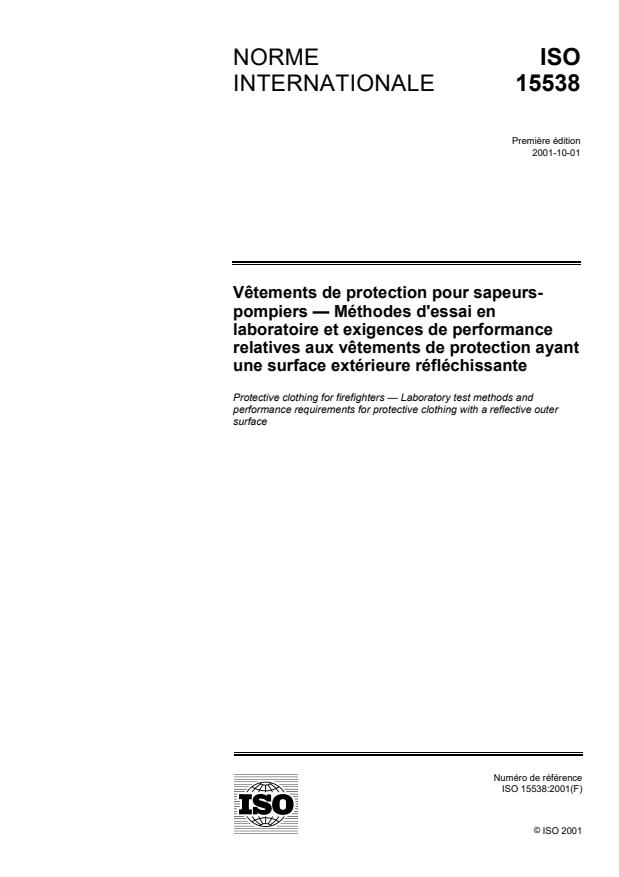
INTERNATIONAL ISO
STANDARD 15538
First edition
2001-10-01
Protective clothing for firefighters —
Laboratory test methods and performance
requirements for protective clothing with a
reflective outer surface
Vêtements de protection pour sapeurs-pompiers — Méthodes d'essai en
laboratoire et exigences de performance relatives aux vêtements de
protection ayant une surface extérieure réfléchissante
Reference number
©
ISO 2001
PDF disclaimer
This PDF file may contain embedded typefaces. In accordance with Adobe's licensing policy, this file may be printed or viewed but shall not
be edited unless the typefaces which are embedded are licensed to and installed on the computer performing the editing. In downloading this
file, parties accept therein the responsibility of not infringing Adobe's licensing policy. The ISO Central Secretariat accepts no liability in this
area.
Adobe is a trademark of Adobe Systems Incorporated.
Details of the software products used to create this PDF file can be found in the General Info relative to the file; the PDF-creation parameters
were optimized for printing. Every care has been taken to ensure that the file is suitable for use by ISO member bodies. In the unlikely event
that a problem relating to it is found, please inform the Central Secretariat at the address given below.
All rights reserved. Unless otherwise specified, no part of this publication may be reproduced or utilized in any form or by any means, electronic
or mechanical, including photocopying and microfilm, without permission in writing from either ISO at the address below or ISO's member body
in the country of the requester.
ISO copyright office
Case postale 56 � CH-1211 Geneva 20
Tel. + 41 22 749 01 11
Fax + 41 22 749 09 47
E-mail copyright@iso.ch
Web www.iso.ch
Printed in Switzerland
ii © ISO 2001 – All rights reserved
Contents Page
Foreword.iv
Introduction.v
1 Scope .1
2 Normative references .1
3 Terms and definitions .2
4 General clothing design.3
4.1 Garments .3
4.2 Hand protection .4
4.3 Foot protection.4
5 Sampling and pretreatment .4
5.1 Sampling.4
5.2 Pretreatment.4
6 Thermal requirements .4
6.1 Limited flame spread.4
6.2 Heat transfer (radiant heat).4
6.3 Heat transfer (convective heat) .5
6.4 Contact heat .5
6.5 Heat resistance .5
7 Mechanical requirements.5
7.1 Dimensional change.5
7.2 Tensile strength .6
7.3 Tear strength.6
7.4 Seam strength.6
8 Other requirements.6
8.1 Water-penetration resistance .6
8.2 Surface wetting .6
9 Marking .7
10 Manufacturers' information .7
Annex A (normative) Mechanical pretreatment for metallized materials .8
Annex B (informative) Warning for flame engulfment.10
Annex C (informative) Guidelines for clothing design .11
Bibliography.12
Foreword
ISO (the International Organization for Standardization) is a worldwide federation of national standards bodies (ISO
member bodies). The work of preparing International Standards is normally carried out through ISO technical
committees. Each member body interested in a subject for which a technical committee has been established has
the right to be represented on that committee. International organizations, governmental and non-governmental, in
liaison with ISO, also take part in the work. ISO collaborates closely with the International Electrotechnical
Commission (IEC) on all matters of electrotechnical standardization.
International Standards are drafted in accordance with the rules given in the ISO/IEC Directives, Part 3.
Draft International Standards adopted by the technical committees are circulated to the member bodies for voting.
Publication as an International Standard requires approval by at least 75 % of the member bodies casting a vote.
Attention is drawn to the possibility that some of the elements of this International Standard may be the subject of
patent rights. ISO shall not be held responsible for identifying any or all such patent rights.
International Standard ISO 15538 was prepared by Technical Committee ISO/TC 94, Personal safety — Protective
clothing and equipment, Subcommittee SC 13, Protective clothing.
Annex A forms an integral part of this International Standard. Annexes B and C are for information only.
iv © ISO 2001 – All rights reserved
Introduction
The purpose of this International Standard is to provide minimum performance requirements for protective clothing
designed for use in certain techniques of firefighting.
The protective clothing should be loose-fitting and as light as possible commensurate with the risks to which the
user might be exposed.
A risk assessment should be made to determine whether the clothing covered by this International Standard is
suitable for the intended use for the expected exposure. The risk assessment should include consideration of any
respiratory protection that may also be required.
Firefighters should be trained in the use, care and maintenance of the protective clothing covered by this
International Standard, including an understanding of its limitations and of the necessity to remove personal
protective equipment (PPE) as soon as possible after an incident.
Subject to risk assessment, the clothing covered by this International Standard may be suitable for use in activities
other than those considered by this International Standard. Nothing in this International Standard is intended to
restrict any jurisdiction, purchaser or manufacturer from exceeding these minimum requirements.
A list of International Standards related to this International Standard is given in the Bibliography.
INTERNATIONAL STANDARD ISO 15538:2001(E)
Protective clothing for firefighters — Laboratory test methods and
performance requirements for protective clothing with a reflective
outer surface
1 Scope
This International Standard specifies test methods and minimum performance requirements for protective clothing
that relies upon the ability of the outer material to reflect intense radiant heat.
The clothing covered by this International Standard is intended to provide protection against flame lick and intense
radiant heat and it should be worn for short periods only.
Subject to a risk assessment, this type of clothing may also be used for certain industrial and other applications.
Subject to a risk assessment, other types of protective clothing, for example clothing complying with the
requirements of ISO 11613, may be used for the types of firefighting and industrial applications envisaged by this
International Standard in conjunction with appropriate protection for the head, face, hands and feet as well as
suitable respiratory protection.
This International Standard does not consider requirements for the protection of the head (including the face),
hands and feet other than those specified in 4.2 and 4.3. Any other requirements specific to the protection of head
(including the face), hands and feet required by the user should be determined by a risk assessment and specified.
2 Normative references
The following normative documents contain provisions which, through reference in this text, constitute provisions of
this International Standard. For dated references, subsequent amendments to, or revisions of, any of these
publications do not apply. However, parties to agreements based on this International Standard are encouraged to
investigate the possibility of applying the most recent editions of the normative documents indicated below. For
undated references, the latest edition of the normative document referred to applies. Members of ISO and IEC
maintain registers of currently valid International Standards.
ISO 811, Textile fabrics — Determination of resistance to water penetration — Hydrostatic pressure test
ISO 1421, Rubber- or plastics-coated fabrics — Determination of tensile strength and elongation at break
ISO 3175-1, Textiles — Dry cleaning and finishing — Part 1: Method for assessing the cleanability of textiles and
garments
ISO 4674:1977, Fabrics coated with rubber or plastics — Determination of tear resistance
ISO 4920, Textiles — Determination of resistance to surface wetting (spray test) of fabrics
ISO 5077, Textiles — Determination of dimensional change in washing and drying
ISO 6330:2000, Textiles — Domestic washing and drying procedures for textile testing
1)
ISO 6942:— , Protective clothing — Protection against heat and fire — Method of test: Evaluation of materials and
material assemblies when exposed to a source of radiant heat
ISO 8782-1, Safety, protective and occupational footwear for professional use — Part 1: Requirements and test
methods
ISO 8782-5, Safety, protective and occupational footwear for professional use — Part 5: Additional requirements
and test methods
ISO 9151, Protective clothing against heat and flame — Determination of heat transmission on exposure to flame
ISO 12127, Clothing for protection against heat and flame — Determination of contact heat transmission through
protective clothing or constituent materials
ISO 13688, Protective clothing — General requirements
ISO 13934-1, Textiles — Tensile properties of fabrics — Part 1: Determination of maximum force and elongation at
maximum force using the strip method
ISO 13935-2, Textiles — Seam tensile properties of fabrics and made-up textile articles — Part 2: Determination of
maximum force to seam rupture using the grab method
ISO 13938-2, Textiles — Bursting properties of fabrics — Part 2: Pneumatic method for determination of bursting
strength and bursting distension
ISO 15025:2000, Protective clothing — Protection against heat and flame — Method of test for limited flame spread
ISO 15383, Protective gloves for firefighters — Laboratory test methods and performance requirements
ISO 17493, Clothing and equipment for protection against heat — Test method for convective heat resistance using
a hot air circulating oven
3 Terms and definitions
For the purposes of this International Standard, the following terms and definitions apply.
3.1
garment
single item of clothing which may consist of single or multiple layers
3.2
clothing ensemble
combination of two or more garments that collectively provide protection of the body
3.3
clothing assembly
series of outer and under garments to be worn together
3.4
component assembly
combination of all materials of a multi-layer garment presented exactly as the finished garment construction
1) To be published. (Revision of ISO 6942:1993)
2 © ISO 2001 – All rights reserved
3.5
closure system
method of fastening openings in the garment including combinations of more than one method for achieving a
secure closure, e.g. a slide fastener covered by an overflap fastened down with a touch-and-close fastener
NOTE This term does not cover seams.
3.6
seam
any method of permanent fastening between two or more pieces of material
3.7
main seam
seam that is necessary for the integrity of the garment
3.8
hardware
non-fabric items
...
NORME ISO
INTERNATIONALE 15538
Première édition
2001-10-01
Vêtements de protection pour sapeurs-
pompiers — Méthodes d'essai en
laboratoire et exigences de performance
relatives aux vêtements de protection ayant
une surface extérieure réfléchissante
Protective clothing for firefighters — Laboratory test methods and
performance requirements for protective clothing with a reflective outer
surface
Numéro de référence
©
ISO 2001
PDF – Exonération de responsabilité
Le présent fichier PDF peut contenir des polices de caractères intégrées. Conformément aux conditions de licence d'Adobe, ce fichier peut
être imprimé ou visualisé, mais ne doit pas être modifiéà moins que l'ordinateur employéà cet effet ne bénéficie d'une licence autorisant
l'utilisation de ces polices et que celles-ci y soient installées. Lors du téléchargement de ce fichier, les parties concernées acceptent de fait la
responsabilité de ne pas enfreindre les conditions de licence d'Adobe. Le Secrétariat central de l'ISO décline toute responsabilité en la
matière.
Adobe est une marque déposée d'Adobe Systems Incorporated.
Les détails relatifs aux produits logiciels utilisés pour la créationduprésent fichier PDF sont disponibles dans la rubrique General Info du
fichier; les paramètres de création PDF ont été optimisés pour l'impression. Toutes les mesures ont été prises pour garantir l'exploitation de
ce fichier par les comités membres de l'ISO. Dans le cas peu probable où surviendrait un problème d'utilisation, veuillez en informer le
Secrétariat central à l'adresse donnée ci-dessous.
Droits de reproduction réservés. Sauf prescription différente, aucune partie de cette publication ne peut être reproduite ni utilisée sous quelque
forme que ce soit et par aucun procédé, électronique ou mécanique, y compris la photocopie et les microfilms, sans l'accord écrit de l’ISO à
l’adresse ci-aprèsouducomité membre de l’ISO dans le pays du demandeur.
ISO copyright office
Case postale 56 � CH-1211 Geneva 20
Tel. + 41 22 749 01 11
Fax. + 41 22 749 09 47
E-mail copyright@iso.ch
Web www.iso.ch
Imprimé en Suisse
ii © ISO 2001 – Tous droits réservés
Sommaire Page
Avant-propos.iv
Introduction.v
1 Domaine d'application.1
2Références normatives .1
3Termesetdéfinitions.2
4 Conception générale du vêtement.3
4.1 Articles d’habillement .3
4.2 Protection des mains .4
4.3 Protection des pieds .4
5 Échantillonnage et prétraitement.4
5.1 Échantillonnage .4
5.2 Prétraitement.4
6 Exigences de performance thermique .4
6.1 Propagation de flamme limitée.4
6.2 Transfert de chaleur (chaleur radiante).5
6.3 Transfert de chaleur (chaleur convective) .5
6.4 Chaleur de contact.5
6.5 Résistance à la chaleur .6
7 Exigences mécaniques .6
7.1 Variation dimensionnelle .6
7.2 Résistance à la traction.6
7.3 Résistance au déchirement .6
7.4 Résistance des coutures .6
8 Autres exigences .7
8.1 Résistance à la pénétration d’eau.7
8.2 Mouillage superficiel .7
9 Marquage.7
10 Informations du fabricant .7
Annexe A (normative) Prétraitement mécanique des matériaux métallisés.8
Annexe B (informative) Avertissement concernant la pénétration dans les flammes.10
Annexe C (informative) Lignes directrices pour la conception des vêtements.11
Bibliographie .12
Avant-propos
L'ISO (Organisation internationale de normalisation) est une fédération mondiale d'organismes nationaux de
normalisation (comités membres de l'ISO). L'élaboration des Normes internationales est en général confiéeaux
comités techniques de l'ISO. Chaque comité membre intéressé par une étude aledroit de faire partie ducomité
technique créé à cet effet. Les organisations internationales, gouvernementales et non gouvernementales, en
liaison avec l'ISO participent également aux travaux. L'ISO collabore étroitement avec la Commission
électrotechnique internationale (CEI) en ce qui concerne la normalisation électrotechnique.
Les Normes internationales sont rédigées conformément aux règles données dans les Directives ISO/CEI,
Partie 3.
Les projets de Normes internationales adoptés par les comités techniques sont soumis aux comités membres pour
vote. Leur publication comme Normes internationales requiert l'approbation de 75 % au moins des comités
membres votants.
L’attention est appelée sur le fait que certains des éléments de la présente Norme internationale peuvent faire
l’objet de droits de propriété intellectuelle ou de droits analogues. L’ISO ne saurait être tenue pour responsable de
ne pas avoir identifié de tels droits de propriété et averti de leur existence.
La Norme internationale ISO 15538 a étéélaboréepar le comité technique ISO/TC 94, Sécurité individuelle —
Vêtements et équipements de protection, sous-comité SC 13, Vêtements de protection.
L’annexe A, constitue un élément normatif de la présente Norme internationale. Les annexes B et C sont données
uniquement à titre d’information.
iv © ISO 2001 – Tous droits réservés
Introduction
L’objet delaprésente Norme internationale est de spécifier les exigences minimales de performance pour les
vêtements de protection destinés àêtre utilisés dans certaines techniques de lutte contre l’incendie.
Il convient que les vêtements de protection ne serrent pas et qu’ils soient les plus légers possible en fonction des
risques auxquels l’utilisateur est susceptible d’être exposé.
Il convient de réaliser une évaluation des risques pour déterminer si les vêtements couverts par la présente Norme
internationale sont appropriés à l’usage prévu pour l’exposition escomptée. Il convient que l’estimation du risque
prenne en compte les aspects relatifs à la protection respiratoire qui peut également être exigée.
Il convient que les sapeurs-pompiers soient formés à l’utilisation, au soin et à l’entretien des vêtements de
protection traités dans la présente Norme internationale et qu’ils en connaissent les limites ainsi que la nécessité
de les enlever le plus rapidement possible aprèsunincident.
Sous réserve d’une évaluation des risques, les vêtements de protection traités dans la présente Norme
internationale peuvent convenir à un usage dans des activités autres que celles qui sont traitées dans la présente
Norme internationale. Aucun élément de la présente Norme internationale n’est destinéà empêcher une autorité,
un client ou un fabricant de faire mieux que les exigences minimales spécifiées.
Une liste des Normes internationales en rapport avec la présente Norme internationale est donnée dans la
bibliographie.
NORME INTERNATIONALE ISO 15538:2001(F)
Vêtements de protection pour sapeurs-pompiers — Méthodes
d'essai en laboratoire et exigences de performance relatives aux
vêtements de protection ayant une surface extérieure
réfléchissante
1 Domaine d'application
La présente Norme internationale prescrit les méthodes d’essai et les exigences minimales de performance pour
les vêtements de protection qui se définissent par l’aptitude du matériau extérieur à réfléchir la chaleur radiante
intense.
Les vêtements couverts par la présente Norme internationale sont destinés à assurer une protection contre la
flamme et la chaleur radiante intense et il convient qu’ils soient portés uniquement pendant des périodes courtes.
Sous réserve d’une évaluation des risques, ce type de vêtement peut également être utilisé lors de certaines
applications industrielles ou d’une autre nature.
Sous réserve d’uneestimationdurisque, d’autres types de vêtements de protection, par exemple des vêtements
de protection qui respectent les exigences de l’ISO 11613, peuvent être utilisés pour les opérations de lutte contre
l’incendie et pour les applications industrielles évoquées dans la présente Norme internationale conjointement avec
les équipements de protection appropriés delatête, du visage, des mains et des pieds ainsi qu’avec les
équipements de protection respiratoire adaptés.
La présente Norme internationale ne traite pas des exigences relatives à la protection de la tête (y compris le
visage), des mains et des pieds sauf celles qui sont spécifiées en 4.2 et 4.3. Il convient que toute autre exigence
spécifique à la protection de la tête (y compris le visage), des mains et des pieds requise par l’utilisateur fasse
l’objet d’uneestimationdurisqueet d’une spécification.
2Références normatives
Les documents normatifs suivants contiennent des dispositions qui, par suite de la référence qui y est faite,
constituent des dispositions valables pour la présente Norme internationale. Pour les références datées, les
amendements ultérieurs ou les révisions de ces publications ne s’appliquent pas. Toutefois, les parties prenantes
aux accords fondés sur la présente Norme internationale sont invitées à rechercher la possibilité d'appliquer les
éditions les plus récentes des documents normatifs indiqués ci-après. Pour les références non datées, la dernière
édition du document normatif en référence s’applique. Les membres de l'ISO et de la CEI possèdent le registre des
Normes internationales en vigueur.
ISO 811, Étoffes — Déterminationdelarésistance à la pénétrationdel'eau — Essai sous pression hydrostatique
ISO 1421, Supports textiles revêtus de caoutchouc ou de plastique — Détermination de la force de rupture et de
l’allongement à la rupture
ISO 3175-1, Textiles — Nettoyage à sec et finition — Partie 1: Méthode d’évaluationdel’aptitude au nettoyage des
textiles et vêtements
ISO 4674:1977, Supports textiles revêtus de caoutchouc ou de plastique — Détermination de la résistance au
déchirement
ISO 4920, Étoffes — Déterminationdelarésistance au mouillage superficiel (essai d’arrosage)
ISO 5077, Textiles — Détermination des variations dimensionnelles au lavage et au séchage domestiques
ISO 6330:2000, Textiles — Méthodes de lavage et de séchage domestiques en vue des essais des textiles
1)
ISO 6942:— , Vêtements de protection — Protection contre la chaleur et le feu — Méthode d'essai: Évaluation
des matériaux et assemblages de matériaux exposés à une source de chaleur radiante
ISO 8782-1, Chaussures de sécurité,de protectionetde travail à usage professionnel — Partie 1: Exigences et
méthodes d’essai
ISO 8782-5, Chaussures de sécurité,de protectionet detravail à usage professionnel — Partie 5: Exigences
additionnelles et méthodes d'essai
ISO 9151, Vêtements de protection contre la chaleur et les flammes — Déterminationdelatransmission de
chaleur à l’exposition d’une flamme
ISO 12127, Vêtements de protection contre la chaleur et la flamme — Détermination de la transmission thermique
par contact à travers les vêtements de protection ou leurs matériaux constitutifs
ISO 13688, Vêtements de protection — Exigences générales
ISO 13934-1, Textiles — Propriétés des étoffes en traction — Partie 1: Détermination de la force maximale et de
l'allongement à la force maximale par la méthode sur bande
ISO 13935-2, Textiles — Propriétésde résistance à la traction des coutures d'étoffes et d'articles textiles
confectionnés — Partie 2: Détermination de la force maximale avant rupture des coutures par la méthode
d'arrachement (Grab test)
ISO 13938-2, Textiles — Propriétésde résistance à l'éclatement des étoffes — Partie 2: Méthode pneumatique
pour la déterminationdelarésistance et de la déformation à l'éclatement
ISO 15025:2000, Vêtements de protection — Protection contre la chaleur et les flammes — Méthode d'essai pour
la propagation de flamme limitée
ISO 15383, Gants de protection pour sapeurs-pompiers — Méthodes d'essai en laboratoire et exigences de
performance
ISO 17493, Vêtements et équipement de protection contre la chaleur — Méthode d'essai delarésistance à la
chaleur de convection au moyen d'un four à circulation d'air chaud
3 Termes et définitions
Pour les besoins de la présente Norme internationale, les termes et définitions suivants s'appliquent.
3.1
article d’habillement
élément individuel d’un vêtement qui peut être composé d’une ou plusieurs couches
3.2
ensemble de vêtements
combinaison d’au moins deux articles d’habillement qui assurent ensemble la protection du corps
1) À publier. (Révision de l'ISO 6942:1993)
2 © ISO 2001 – Tous droits réservés
3.3
assemblage de vêtements
ensemble d’articles d’habillement de dessus et de dessous destinés àêtre portés conjointement
3.4
assemblage de composants
combinaison de tous les matériaux d’un article d’habillement multicouche disposésdansl’ordre de fabrication de
l’article d’habillement fini
3.5
système de fermeture
méthode d’attache des ouvertures de l’article d’habillement pouvant comprendre des combinaisons de plusieurs
méthodes pour une fermeture sûre, par exemple une fermeture à glissière sous rabat fermé par un système
auto-agrippant
NOTE Ce terme ne couvre pas les coutures.
3.6
couture
toute méthode de liaison permanente entre deux pièces de matériau ou plus
3.7
couture principale
couture nécessaire à l’intégrité de l’article d’habillement
3.8
accessoire rigide
article autre que l’étoffe, utilisé dans un vêtement de protection et comprenant des articles en métal ou en matière
plastique, comme par exemple les attaches, les insignes de grade, les boutons
4 Conception générale du vêtement
4.1 Articles d’habillement
4.1.1 Généralités
Les vêtements de protection pour sapeurs-pompiers couverts par la présente Norme internationale peuvent
garantir une protection du corps entier du pompier, y compris la tête, les mains et les pieds en fonction de
l’estimation du risque. Le vêtement doit être composé
a) d’un article d’habillement d’uneseulepièce, ou
b) d’un ensemble de vêtements, ou
c) d’un assemblage de vêtements.
Lorsque des assemblages de vêtements sont utilisés pour atteindre les niveaux de performance spécifiés dans la
présente Norme internationale, les différents articles d’habillement doivent être pourvus d’une étiquette indiquant
clairement qu’ils doivent toujours être portés ensemble (voir article 9).
La surface réfléchissante de chacu
...