

ISO/IEC 29110-5-1-3
(Main)Systems and software engineering — Life cycle profiles for very small entities (VSEs) — Part 5-1-3: Software engineering guidelines for the generic Intermediate profile
- Abstract
ISO/IEC TR 29110-5-1-3:2017 provides management and engineering guide to the intermediate profile described in terms of business management, project management, software implementation and acquisition processes. ISO/IEC TR 29110-5-1-3:2017 is applicable to Very Small Entities (VSEs). VSEs are enterprises, organizations, departments or projects having up to 25 people. The life cycle processes described in the ISO/IEC 29110 series are not intended to preclude or discourage their use by organizations bigger than VSEs. ISO/IEC 29110?4-1 identifies the requirements applicable to the tasks and work products described in this document. ISO/IEC TR 29110-5-1-3:2017 has been developed using the management and engineering guide of the Basic profile and by modifying and adding elements (e.g. process, task, work product, role) for VSEs involved in the development of more than one project in parallel with more than one work team. ISO/IEC TR 29110-5-1-3:2017 applies for VSEs developing non-critical software. Using this document, VSEs can obtain the following benefits: - the management and monitoring of more than one project in parallel with more than one work team; - reuse existing software components (e.g. code and document) in new projects; - continuously measure projects and improve processes. Once the software, developed by a VSE, has been accepted by their customers, the VSE that wants to provide after delivery services can refer to ISO/IEC TR 29110-5-3.[1] ISO/IEC TR 29110-5-1-3:2017 is targeted to VSEs which are familiar with ISO/IEC TR 29110‑5-1-2 for their software development projects and are involved in the development of more than one project in parallel with more than one work team. ISO/IEC TR 29110-5-1-3:2017 is intended to be used with any lifecycles, processes, techniques and methods that enhance the VSEs customer satisfaction and productivity. [1] To be published.
- Status
- Not Published
- Technical Committee
- ISO/IEC JTC 1/SC 7 - Software and systems engineering
- Drafting Committee
- ISO/IEC JTC 1/SC 7 - Software and systems engineering
- Current Stage
- 6000 - International Standard under publication
- Start Date
- 04-Sep-2026
- Completion Date
- 10-Oct-2026
Buy Documents
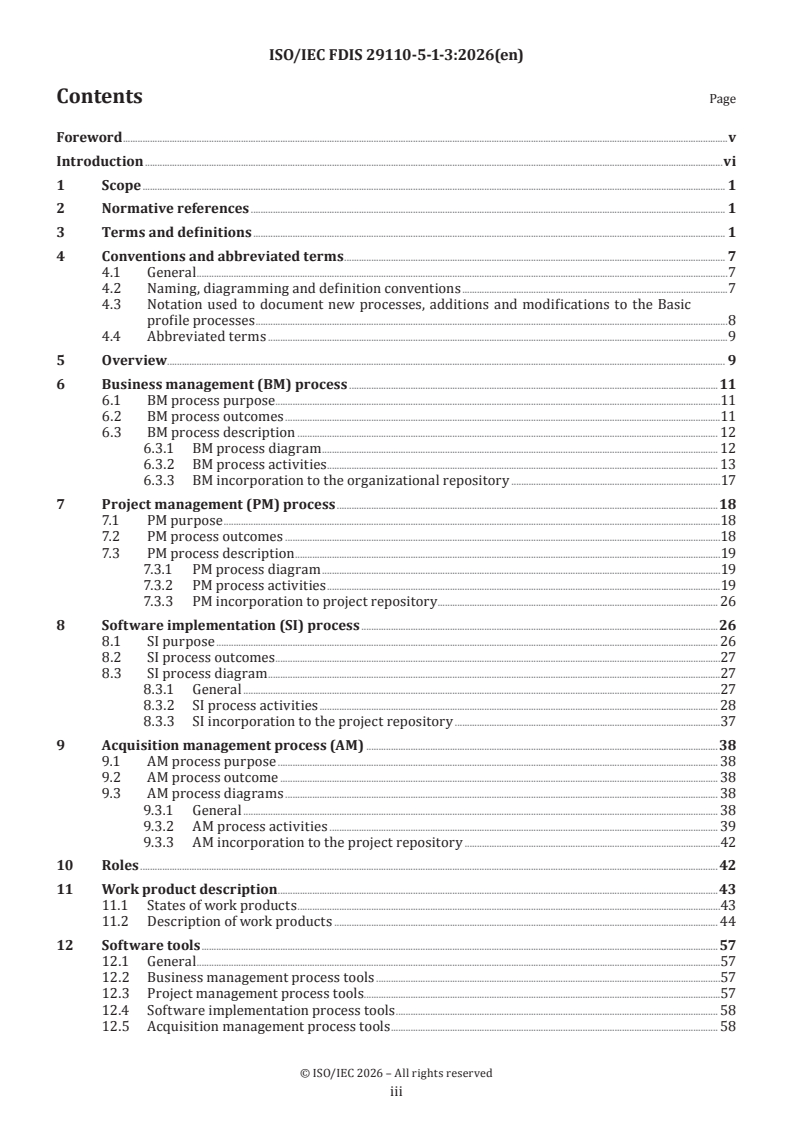
ISO/IEC FDIS 29110-5-1-3 - Systems and software engineering — Life cycle profiles for very small entities (VSEs) — Part 5-1-3: Software engineering guidelines for the generic Intermediate profile
REDLINE ISO/IEC FDIS 29110-5-1-3 - Systems and software engineering — Life cycle profiles for very small entities (VSEs) — Part 5-1-3: Software engineering guidelines for the generic Intermediate profile
ISO/IEC 29110-5-1-3 is an ISO/IEC technical report for very small entities (VSEs) that develop non-critical software. It gives management and engineering guidelines for the generic Intermediate profile, covering business management, project management, software implementation, and a conditional acquisition management process.
What does ISO/IEC 29110-5-1-3 specify?
ISO/IEC 29110-5-1-3 specifies how a VSE can organize software work for the Intermediate profile described in ISO/IEC 29110-4-1. It is written for VSEs that use the Basic profile and need guidance for handling more than one project in parallel with more than one work team.
The document is organized into:
- Clause 1 Scope
- Clause 2 Normative references
- Clause 3 Terms and definitions
- Clause 4 Conventions and abbreviated terms
- Clause 5 Overview
- Clauses 6 to 9 for the BM, PM, SI, and AM processes
- Clause 10 Roles
- Clause 11 Work product description
- Clause 12 Software tools
- Annex A on software engineering deployment packages
| Annex | What it covers |
|---|---|
| Annex A | Software engineering deployment packages that support implementation of the profile |
The overview says the Intermediate profile builds on the Basic profile by adding new processes, tasks, roles, and work products. The document is intended for use with any lifecycle and any development approach or method that helps customer satisfaction and productivity.
What are the key requirements of ISO/IEC 29110-5-1-3?
ISO/IEC 29110-5-1-3 is mainly a set of process guidelines, not a prescriptive method. The key requirement in practice is to run the work through defined BM, PM, SI, and, when needed, AM processes, and to keep the related work products under control.
Business management (BM)
Clause 6 says the BM process is used to identify opportunities, evaluate agreements and customer requests, obtain resources, monitor projects, run lessons learned, and protect intellectual property and the security of assets and information items. Its outcomes cover project initiation, customer delivery, staffing, infrastructure, measurement, protection, and the organizational repository.
In practice, this means the VSE needs a business view of its software work, not only project-level control. It must decide which opportunities to pursue, provide resources, keep project-level and organizational information, and reuse results from finished work.
Project management (PM)
Clause 7 says the PM process establishes and carries out the tasks needed to meet project quality, time, and cost objectives. The process includes planning, execution, assessment and control, and project closure.
The practical focus is clear project planning and control:
- define the agreement, delivery instructions, tasks, resources, schedule, effort, cost, and risks
- set a configuration management strategy and repository approach
- monitor progress and record deviations
- manage change requests
- hold reviews with the work team and customer
- close the project with customer acceptance and disposal as agreed
This matters because the document expects the project manager to show what will be done, track what is happening, and keep evidence of status, issues, and acceptance.
Software implementation (SI)
Clause 8 says the SI process covers analysis, design, construction, integration, and test for new or modified software work products according to the specified requirements. Its outcomes require requirements to be defined and approved, design to be baselined, software components to be produced and unit tested, integration and test to be performed, and the software configuration to be delivered with user, operation, and maintenance documentation when required.
In practice, the SI process is traceability-driven:
- requirements are analyzed for correctness and testability
- design is linked to requirements
- test cases and test procedures are created from requirements and design
- software is integrated and tested, with defects corrected
- the traceability record is updated across requirements, design, components, and tests
- product operation guide, software user documentation, and maintenance documentation are verified and baselined when applicable
Acquisition management (AM)
Clause 9 makes AM a conditional process. The AM process is used only when the VSE needs products and/or services from an external supplier. It covers purchase orders, supplier agreements, delivery instructions, acceptance, open items, and repository storage.
In practice, this means supplier work is not handled informally. If a VSE buys something or outsources work, it needs documented approval, agreed delivery instructions, acceptance evidence, and tracked supplier documents.
Work products and status control
Clause 11 gives the work product model and the states used across the profile, such as initiated, reviewed, approved, verified, validated, baselined, published, delivered, accepted, and updated. This matters because the status tells the team whether a work product is ready for the next step, ready for delivery, or stable enough to use as a baseline.
Clause 4 also explains the notation used in the process descriptions. Tasks are written as actions, and the tables show inputs, outputs, roles, and repository incorporation. That helps a VSE map the guide to its own methods without being forced into a single lifecycle model.
What terms does ISO/IEC 29110-5-1-3 define?
- Very small entity (VSE) - an enterprise, organization, department, or project with up to 25 people.
- Intermediate profile - the profile targeted at VSEs involved in more than one project in parallel with more than one work team.
- Profile - a subset of standards processes, outcomes, activities, and tasks combined to accomplish a particular function.
- Work product (WP) - an artefact produced by a process, such as a plan, specification, design document, source code, or test report.
- Baseline - a formally approved version of a configuration item that is fixed at a specific time.
- Traceability - the association between related entities such as requirements, design, verification, and tasks.
- Verification - confirmation that specified requirements have been fulfilled.
- Validation - confirmation that requirements for the intended use have been fulfilled.
Who uses ISO/IEC 29110-5-1-3?
ISO/IEC 29110-5-1-3 is used by VSEs that develop non-critical software and need a practical way to organize work across several projects and work teams. It is also relevant to organizations that already use the Basic profile and want the next level of guidance.
The roles named in Clause 10 show the intended users:
- business manager
- project manager
- technical leader
- analyst
- designer
- programmer
- customer
- supplier
- work team
In practice, the document supports project planning, requirements work, software design, coding, unit and integration testing, delivery, acquisition activities, reviews, measurement, repository management, and lessons learned. It can also be used in audits or assessments when the acquisition management process is in scope.
What changed in ISO/IEC 29110-5-1-3 from the previous edition?
The foreword says this edition adds terms to Clause 3 so the document is self-contained. It also says some terms were modified to align with updated editions of standards such as ISO/IEC/IEEE 12207 and ISO/IEC/IEEE 15289, and that extra text was added to task statements to make the guide easier to understand and use.
Which standards are used with ISO/IEC 29110-5-1-3?
Clause 2 states that there are no normative references in this document. The guide is nevertheless built around related standards and companion parts named throughout the scope, definitions, and bibliography.
- ISO/IEC 29110-4-1 - defines the profile requirements that this guide supports.
- ISO/IEC 29110-1-2 - provides the vocabulary for profiles, VSEs, and related terms.
- ISO/IEC 29110-2-1 - provides the framework and taxonomy used for profile notation and structure.
- ISO/IEC 29110-5-1-1 and ISO/IEC 29110-5-1-2 - the Entry and Basic profile parts that this Intermediate guide builds on.
- ISO/IEC/IEEE 12207 - source for life cycle process concepts, activities, tasks, agreements, requirements, and traceability-related terminology.
- ISO/IEC/IEEE 15289 - source for life cycle information items used in the work product descriptions.
- ISO/IEC/IEEE 20246 - supports work product review concepts used in planning and task descriptions.
- ISO/IEC/IEEE 24774 - supplies process description terms such as purpose and outcome.
- ISO/IEC/IEEE 29119-1 - supplies testing terms such as test item, expected result, and test result.
- ISO 9000 and ISO 31073 - supply vocabulary used for validation and risk.
- ISO/IEC/IEEE 26511 and IEEE 1044 - support version control and defect terminology.
- ISO/IEC/IEEE 24765 - supports the integration testing definition.
What does the ISO/IEC 29110-5-1-3 document contain?
The document contains four main process descriptions plus the supporting material needed to use them. Clauses 6 to 9 break down BM, PM, SI, and AM into purposes, outcomes, diagrams, and task lists, with tables that show inputs, outputs, roles, and repository incorporation.
Clause 11 is especially practical: Tables 22 to 44 describe the work products, their sources, their states, and what each item contains, including the agreement, project plan, project repository, requirements specification, software design, software, software user documentation, test cases and test procedures, test report, traceability record, validation record, and verification record. Clause 12 then lists software tool types that can support each process.
Annex A gives an informative overview of software engineering deployment packages. It explains that these packages help a VSE implement the profile step by step, and it lists packages for business management, requirements analysis, architecture and detailed design, construction and unit testing, integration and test, verification and validation, version control management, project management, product delivery, acquisition management, and self-assessment.
Relations
- Effective Date
- 24-Dec-2022
Buy Documents
ISO/IEC FDIS 29110-5-1-3 - Systems and software engineering — Life cycle profiles for very small entities (VSEs) — Part 5-1-3: Software engineering guidelines for the generic Intermediate profile
REDLINE ISO/IEC FDIS 29110-5-1-3 - Systems and software engineering — Life cycle profiles for very small entities (VSEs) — Part 5-1-3: Software engineering guidelines for the generic Intermediate profile
Get Certified
Connect with accredited certification bodies for this standard

BSI Group
BSI (British Standards Institution) is the business standards company that helps organizations make excellence a habit.

BSCIC Certifications Pvt. Ltd.
Established 2006, accredited by NABCB, JAS-ANZ, EIAC, IAS. CDSCO Notified Body.

Intertek India Pvt. Ltd.
Delivers Assurance, Testing, Inspection & Certification since 1993 with 26 labs and 32 offices.
Sponsored listings
Frequently Asked Questions
ISO/IEC 29110-5-1-3 is a draft published by the International Organization for Standardization (ISO). Its full title is "Systems and software engineering — Life cycle profiles for very small entities (VSEs) — Part 5-1-3: Software engineering guidelines for the generic Intermediate profile". This standard covers: ISO/IEC TR 29110-5-1-3:2017 provides management and engineering guide to the intermediate profile described in terms of business management, project management, software implementation and acquisition processes. ISO/IEC TR 29110-5-1-3:2017 is applicable to Very Small Entities (VSEs). VSEs are enterprises, organizations, departments or projects having up to 25 people. The life cycle processes described in the ISO/IEC 29110 series are not intended to preclude or discourage their use by organizations bigger than VSEs. ISO/IEC 29110?4-1 identifies the requirements applicable to the tasks and work products described in this document. ISO/IEC TR 29110-5-1-3:2017 has been developed using the management and engineering guide of the Basic profile and by modifying and adding elements (e.g. process, task, work product, role) for VSEs involved in the development of more than one project in parallel with more than one work team. ISO/IEC TR 29110-5-1-3:2017 applies for VSEs developing non-critical software. Using this document, VSEs can obtain the following benefits: - the management and monitoring of more than one project in parallel with more than one work team; - reuse existing software components (e.g. code and document) in new projects; - continuously measure projects and improve processes. Once the software, developed by a VSE, has been accepted by their customers, the VSE that wants to provide after delivery services can refer to ISO/IEC TR 29110-5-3.[1] ISO/IEC TR 29110-5-1-3:2017 is targeted to VSEs which are familiar with ISO/IEC TR 29110‑5-1-2 for their software development projects and are involved in the development of more than one project in parallel with more than one work team. ISO/IEC TR 29110-5-1-3:2017 is intended to be used with any lifecycles, processes, techniques and methods that enhance the VSEs customer satisfaction and productivity. [1] To be published.
ISO/IEC TR 29110-5-1-3:2017 provides management and engineering guide to the intermediate profile described in terms of business management, project management, software implementation and acquisition processes. ISO/IEC TR 29110-5-1-3:2017 is applicable to Very Small Entities (VSEs). VSEs are enterprises, organizations, departments or projects having up to 25 people. The life cycle processes described in the ISO/IEC 29110 series are not intended to preclude or discourage their use by organizations bigger than VSEs. ISO/IEC 29110?4-1 identifies the requirements applicable to the tasks and work products described in this document. ISO/IEC TR 29110-5-1-3:2017 has been developed using the management and engineering guide of the Basic profile and by modifying and adding elements (e.g. process, task, work product, role) for VSEs involved in the development of more than one project in parallel with more than one work team. ISO/IEC TR 29110-5-1-3:2017 applies for VSEs developing non-critical software. Using this document, VSEs can obtain the following benefits: - the management and monitoring of more than one project in parallel with more than one work team; - reuse existing software components (e.g. code and document) in new projects; - continuously measure projects and improve processes. Once the software, developed by a VSE, has been accepted by their customers, the VSE that wants to provide after delivery services can refer to ISO/IEC TR 29110-5-3.[1] ISO/IEC TR 29110-5-1-3:2017 is targeted to VSEs which are familiar with ISO/IEC TR 29110‑5-1-2 for their software development projects and are involved in the development of more than one project in parallel with more than one work team. ISO/IEC TR 29110-5-1-3:2017 is intended to be used with any lifecycles, processes, techniques and methods that enhance the VSEs customer satisfaction and productivity. [1] To be published.
ISO/IEC 29110-5-1-3 is classified under the following ICS (International Classification for Standards) categories: 35.080 - Software. The ICS classification helps identify the subject area and facilitates finding related standards.
ISO/IEC 29110-5-1-3 has the following relationships with other standards: It is inter standard links to ISO/IEC TR 29110-5-1-3:2017. Understanding these relationships helps ensure you are using the most current and applicable version of the standard.
ISO/IEC 29110-5-1-3 is available in PDF format for immediate download after purchase. The document can be added to your cart and obtained through the secure checkout process. Digital delivery ensures instant access to the complete standard document.
Standards Content (Sample)
FINAL DRAFT
International
Standard
ISO/IEC
FDIS
29110-5-1-3
ISO/IEC JTC 1/SC 7
Systems and software
Secretariat: BIS
engineering — Life cycle profiles for
Voting begins on:
very small entities (VSEs) —
2026-07-09
Part 5-1-3:
Voting terminates on:
2026-09-03
Software engineering guidelines for
the generic Intermediate profile
RECIPIENTS OF THIS DRAFT ARE INVITED TO SUBMIT,
WITH THEIR COMMENTS, NOTIFICATION OF ANY
RELEVANT PATENT RIGHTS OF WHICH THEY ARE AWARE
AND TO PROVIDE SUPPOR TING DOCUMENTATION.
IN ADDITION TO THEIR EVALUATION AS
BEING ACCEPTABLE FOR INDUSTRIAL, TECHNO
LOGICAL, COMMERCIAL AND USER PURPOSES, DRAFT
INTERNATIONAL STANDARDS MAY ON OCCASION HAVE
TO BE CONSIDERED IN THE LIGHT OF THEIR POTENTIAL
TO BECOME STAN DARDS TO WHICH REFERENCE MAY BE
MADE IN NATIONAL REGULATIONS.
Reference number
ISO/IEC FDIS 29110513:2026(en) © ISO/IEC 2026
FINAL DRAFT
ISO/IEC FDIS 29110-5-1-3:2026(en)
International
Standard
ISO/IEC
FDIS
29110-5-1-3
ISO/IEC JTC 1/SC 7
Systems and software
Secretariat: BIS
engineering — Life cycle profiles for
Voting begins on:
very small entities (VSEs) —
Part 5-1-3:
Voting terminates on:
Software engineering guidelines for
the generic Intermediate profile
RECIPIENTS OF THIS DRAFT ARE INVITED TO SUBMIT,
WITH THEIR COMMENTS, NOTIFICATION OF ANY
RELEVANT PATENT RIGHTS OF WHICH THEY ARE AWARE
AND TO PROVIDE SUPPOR TING DOCUMENTATION.
© ISO/IEC 2026
IN ADDITION TO THEIR EVALUATION AS
All rights reserved. Unless otherwise specified, or required in the context of its implementation, no part of this publication may
BEING ACCEPTABLE FOR INDUSTRIAL, TECHNO
LOGICAL, COMMERCIAL AND USER PURPOSES, DRAFT
be reproduced or utilized otherwise in any form or by any means, electronic or mechanical, including photocopying, or posting on
INTERNATIONAL STANDARDS MAY ON OCCASION HAVE
the internet or an intranet, without prior written permission. Permission can be requested from either ISO at the address below
TO BE CONSIDERED IN THE LIGHT OF THEIR POTENTIAL
or ISO’s member body in the country of the requester.
TO BECOME STAN DARDS TO WHICH REFERENCE MAY BE
MADE IN NATIONAL REGULATIONS.
ISO copyright office
CP 401 • Ch. de Blandonnet 8
CH-1214 Vernier, Geneva
Phone: +41 22 749 01 11
Email: copyright@iso.org
Website: www.iso.org
Published in Switzerland Reference number
ISO/IEC FDIS 29110513:2026(en) © ISO/IEC 2026
© ISO/IEC 2026 – All rights reserved
ii
ISO/IEC FDIS 29110-5-1-3:2026(en)
Contents Page
Foreword .v
Introduction .vi
1 Scope . 1
2 Normative references . 1
3 Terms and definitions . 1
4 Conventions and abbreviated terms . 7
4.1 General .7
4.2 Naming, diagramming and definition conventions .7
4.3 Notation used to document new processes, additions and modifications to the Basic
profile processes .8
4.4 Abbreviated terms .9
5 Overview . 9
6 Business management (BM) process .11
6.1 BM process purpose . . .11
6.2 BM process outcomes .11
6.3 BM process description . 12
6.3.1 BM process diagram . 12
6.3.2 BM process activities . . 13
6.3.3 BM incorporation to the organizational repository .17
7 Project management (PM) process .18
7.1 PM purpose .18
7.2 PM process outcomes .18
7.3 PM process description .19
7.3.1 PM process diagram .19
7.3.2 PM process activities .19
7.3.3 PM incorporation to project repository . 26
8 Software implementation (SI) process .26
8.1 SI purpose . 26
8.2 SI process outcomes .27
8.3 SI process diagram .27
8.3.1 General .27
8.3.2 SI process activities . 28
8.3.3 SI incorporation to the project repository .37
9 Acquisition management process (AM) .38
9.1 AM process purpose . 38
9.2 AM process outcome . 38
9.3 AM process diagrams . 38
9.3.1 General . 38
9.3.2 AM process activities . 39
9.3.3 AM incorporation to the project repository .42
10 Roles .42
11 Work product description .43
11.1 States of work products .43
11.2 Description of work products . 44
12 Software tools .57
12.1 General .57
12.2 Business management process tools .57
12.3 Project management process tools.57
12.4 Software implementation process tools . 58
12.5 Acquisition management process tools . 58
© ISO/IEC 2026 – All rights reserved
iii
ISO/IEC FDIS 29110-5-1-3:2026(en)
Annex A (informative) Software engineering deployment packages .59
Bibliography . 61
© ISO/IEC 2026 – All rights reserved
iv
ISO/IEC FDIS 29110-5-1-3:2026(en)
Foreword
ISO (the International Organization for Standardization) and IEC (the International Electrotechnical
Commission) form the specialized system for worldwide standardization. National bodies that are
members of ISO or IEC participate in the development of International Standards through technical
committees established by the respective organization to deal with particular fields of technical activity.
ISO and IEC technical committees collaborate in fields of mutual interest. Other international organizations,
governmental and non-governmental, in liaison with ISO and IEC, also take part in the work.
The procedures used to develop this document and those intended for its further maintenance are described
in the ISO/IEC Directives, Part 1. In particular, the different approval criteria needed for the different types
of document should be noted. This document was drafted in accordance with the editorial rules of the ISO/
IEC Directives, Part 2 (see www.iso.org/directives or www.iec.ch/members_experts/refdocs).
ISO and IEC draw attention to the possibility that the implementation of this document may involve the
use of (a) patent(s). ISO and IEC take no position concerning the evidence, validity or applicability of any
claimed patent rights in respect thereof. As of the date of publication of this document, ISO and IEC had not
received notice of (a) patent(s) which may be required to implement this document. However, implementers
are cautioned that this may not represent the latest information, which may be obtained from the patent
database available at www.iso.org/patents and https://patents.iec.ch. ISO and IEC shall not be held
responsible for identifying any or all such patent rights.
Any trade name used in this document is information given for the convenience of users and does not
constitute an endorsement.
For an explanation of the voluntary nature of standards, the meaning of ISO specific terms and expressions
related to conformity assessment, as well as information about ISO's adherence to the World Trade
Organization (WTO) principles in the Technical Barriers to Trade (TBT) see www.iso.org/iso/foreword.html.
In the IEC, see www.iec.ch/understanding-standards.
This document was prepared by Joint Technical Committee ISO/IEC JTC 1, Information technology,
Subcommittee SC 7, Software and systems engineering.
This first edition cancels and replaces ISO/IEC TR 29110-5-1-3:2017, which has been technically revised.
The main changes are as follows:
— many task statements have been reworded to facilitate their understanding;
— conditional tasks have been added to develop optional work products (e.g. operation guide) that have
been requested by a customer; this notation replaces the ‘Optional’ notation [e.g. *(optional)] used in the
TR that caused ambiguities;
— terms have been added to Clause 3 such that this document is self-contained;
— a few terms have been modified to align this document with the updated version of standards such as
ISO/IEC/IEEE 12207 and ISO/IEC/IEEE 15289;
— texts have been added to task statements to provide additional information to facilitate the understanding
or use of this document.
A list of all parts in the ISO/IEC 29110 series can be found on the ISO and IEC websites.
Any feedback or questions on this document should be directed to the user’s national standards
body. A complete listing of these bodies can be found at www.iso.org/members.html and
www.iec.ch/national-committees.
© ISO/IEC 2026 – All rights reserved
v
ISO/IEC FDIS 29110-5-1-3:2026(en)
Introduction
0.1 Introduction to theISO/IEC29110series
For the ISO/IEC 29110 series, a very small entity (VSE) is an enterprise, an organization (e.g. government
agency, non-profit organization), a department or a project having up to 25 people. Many VSEs either develop
systems or maintain systems and the software components used in those systems, either as independent
products or incorporated into the larger system. Due to this, a recognition of VSEs as suppliers of high-
quality products is required.
VSEs around the world are creating valuable products and services. According to the World Bank, small and
medium enterprises (SMEs) account for about 90 % of enterprises worldwide. According to the Organisation
for Economic Co-operation and Development (OECD), SMEs represent 99 % of all businesses and generate
about 60 % of employment. Almost one person out of three is employed in a micro firm with less than 10
employees. The European Union reports that micro firms, with fewer than 10 persons, account for 93,5 % of
all enterprises and small firms, with 10 to 49 employees, account for 5,5 % of all enterprises. The challenge
facing governments and economies is to provide a business environment that supports the competitiveness
of this large heterogeneous business population and that promotes a vibrant entrepreneurial culture.
From studies and surveys conducted, the majority of international standards do not address the needs of
VSEs. Implementation of and conformity with these standards is difficult, if not impossible.
Consequently, VSEs have no, or very limited, ways to be recognized as entities that produce quality systems/
system elements, including software in their domain. Therefore, VSEs are excluded from some economic
activities.
It has been found that VSEs find it difficult to relate international standards to their business needs and to
justify the effort required to apply standards to their business practices. Most VSEs can neither afford the
resources, in terms of number of employees, expertise, budget and time, nor do they see a net benefit in
establishing over-complex systems or software life cycle processes. To address some of these difficulties,
a set of guidelines has been developed based on a set of VSE characteristics. The guidelines are based on
subsets of appropriate standards processes, activities, tasks, and outcomes, referred to as profiles. The
purpose of a profile is to define a subset of international standards relevant to the VSEs' context, for example,
processes, activities, tasks, and outcomes of ISO/IEC/IEEE 12207 for software; processes, activities,
tasks, and outcomes of ISO/IEC/IEEE 15288 for systems; and information products (documentation) of
ISO/IEC/IEEE 15289 for software and systems.
VSEs can achieve recognition through implementing a profile and by being audited against ISO/IEC 29110
specifications.
The ISO/IEC 29110 series can be applied at any phase of system or software development within a life cycle.
The ISO/IEC 29110 series is intended to be used by VSEs that do not have experience or expertise in adapting
or tailoring ISO/IEC/IEEE 12207 or ISO/IEC/IEEE 15288 to the needs of a specific project. VSEs that have
expertise in adapting or tailoring ISO/IEC/IEEE 12207 or ISO/IEC/IEEE 15288 are encouraged to use those
standards instead of the ISO/IEC 29110 series.
The ISO/IEC 29110 series is intended to be used with any lifecycle such as waterfall, iterative, incremental,
evolutionary or agile.
Systems, in the context of the ISO/IEC 29110 series, are typically composed of hardware and software
components.
The ISO/IEC 29110 series, targeted by audience, has been developed to improve system or software and/
or service quality, and process performance. Figure 1 describes the ISO/IEC 29110 series and positions the
parts within the framework of reference.
© ISO/IEC 2026 – All rights reserved
vi
ISO/IEC FDIS 29110-5-1-3:2026(en)
Figure 1 — The ISO/IEC 29110 series
ISO/IEC 29110-1-1 introduces processes, lifecycle and standardization concepts, the taxonomy (catalogue) of
ISO/IEC 29110 profiles and the ISO/IEC 29110 series. ISO/IEC 29110-1-1 also introduces the characteristics
and needs of a VSE, and clarifies the rationale for specific profiles, documents, standards and guidelines.
ISO/IEC 29110-1-2 defines the terms common to the ISO/IEC 29110 series. ISO/IEC 29110-1-1 and
ISO/IEC 29110-1-2 are targeted at VSEs and their customers, assessors, standards producers, tool vendors
and methodology vendors.
ISO/IEC 29110-2 introduces the concepts for systems and software engineering profiles for VSEs. It
establishes the logic behind the definition and application of profiles. For standardized profiles, it specifies
the elements common to all profiles (structure, requirements, conformance, assessment). For domain-
specific profiles (profiles that are not standardised and developed outside of the ISO process), it provides
general guidance adapted from the definition of standardised profiles. ISO/IEC 29110-2 is targeted at profile
producers, tool vendors and methodology vendors.
ISO/IEC 29110-3 defines certification schemes, assessment guidelines and compliance requirements for
process capability assessment, conformity assessments, and self-assessments for process improvements.
ISO/IEC 29110-3 also contains information that can be useful to developers of certification and assessment
methods and developers of certification and assessment tools. ISO/IEC 29110-3 is addressed to people who
have direct involvement with the assessment process, e.g., the auditor, certification and accreditation bodies
and the sponsor of the audit, who need guidance on ensuring that the requirements for performing an audit
have been met. ISO/IEC 29110-3 is targeted at VSEs and their customers, assessors, accreditation bodies.
© ISO/IEC 2026 – All rights reserved
vii
ISO/IEC FDIS 29110-5-1-3:2026(en)
ISO/IEC 29110-4 provides the specifications for all generic profiles of the generic profile group that are based
on subsets of appropriate standards elements. ISO/IEC 29110-4 is targeted at VSEs, customers, standards
producers, tool vendors and methodology vendors.
ISO/IEC 29110-5 provides a management, engineering and service delivery guidelines for profiles of the
generic profile group. ISO/IEC 29110-5 is targeted at VSEs and their customers.
ISO/IEC 29110-6 provides the specifications for specific profiles that are based on subsets of appropriate
standards elements. ISO/IEC 29110-6 is targeted at VSEs, customers, standards producers, tool vendors and
methodology vendors.
ISO/IEC 29110-7 provides a guideline for each profile of the specific profile group. ISO/IEC 29110-7 is
targeted at VSEs and their customers.
If a new profile is needed, ISO/IEC 29110-4 or ISO/IEC 29110-6 can be developed with minimal impact to
existing documents.
0.2 Introduction to this document
This document is the second software profile of a four-profile software engineering roadmap (i.e. Entry,
Basic, Intermediate and Advanced).
This document is intended to be used by VSEs to support the software product which they developed.
This document is intended to be used by VSEs to add accessibility tasks to the software implementation
process.
This document is intended to be used with any processes, techniques and methods that enhance the VSE's
customer satisfaction and productivity.
The life cycle processes described in the ISO/IEC 29110 series are not intended to preclude or discourage
their use by organizations larger than VSEs.
To use this document, a VSE should fulfil the following conditions:
— project agreement is documented, approved by the management of the VSE and baselined before the
start of the project;
— a project feasibility study is performed before the project start;
— the project team, including project manager, is assigned and trained;
— development cycle(s) should be documented (e.g. waterfall, iterative, incremental, evolutionary, agile);
— goods, services and infrastructure to start the project are available.
Using this document, a VSE can obtain the following benefits:
— an agreed set of project requirements and expected work products is delivered to the customer;
— a disciplined management process that provides project visibility and corrective actions of project
problems and deviations is performed;
— a systematic software implementation process that satisfies customer needs and ensures quality work
products is followed.
VSEs that develop systems that have software components are invited to use the systems engineering
Intermediate profile guidelines of the ISO/IEC 29110 series (i.e. ISO/IEC 29110-5-6-3).
Annex A provides a set of deployment packages to facilitate incremental adoption of best practices, allowing
VSEs to enhance their capabilities in a manageable and adaptable way.
Requirements for implementations of this document can be found in ISO/IEC 29110-4-1.
© ISO/IEC 2026 – All rights reserved
viii
FINAL DRAFT International Standard ISO/IEC FDIS 29110-5-1-3:2026(en)
Systems and software engineering — Life cycle profiles for
very small entities (VSEs) —
Part 5-1-3:
Software engineering guidelines for the generic Intermediate
profile
1 Scope
This document provides management and engineering guidelines to the software Intermediate profile
specified in ISO/IEC 29110-4-1 through project management and software implementation processes.
This document applies to VSEs that do not develop safety critical software.
This document applies for software development projects, which can fulfil an external or internal agreement.
This document is applicable to VSEs developing a single product by a single work team.
2 Normative references
There are no normative references in this document.
3 Terms and definitions
For the purposes of this document, the following terms and definitions apply.
ISO and IEC maintain terminology databases for use in standardization at the following addresses:
— ISO Online browsing platform: available at https:// www .iso .org/ obp
— IEC Electropedia: available at https:// www .electropedia .org/
3.1
accessibility
extent to which products, systems, services, environments and facilities can be used by people from a
population with the widest range of characteristics and capabilities to achieve a specified goal in a specified
context of use
3.2
activity
set of cohesive tasks (3.30) of a process (3.17)
[SOURCE: ISO/IEC/IEEE 12207:—, 3.1.3]
3.3
Advanced profile
profile (3.20) targeted at VSEs (3.38) which want to sustain and grow as an independent competitive system
and/or software development business
[SOURCE: ISO/IEC 29110-1-2:2024, 3.3, modified — The word "independent" has been added; "organization"
has been replaced by "business".]
© ISO/IEC 2026 – All rights reserved
ISO/IEC FDIS 29110-5-1-3:2026(en)
3.4
agreement
mutual acknowledgement of terms and conditions under which a working relationship is conducted
EXAMPLE Contract, memorandum of agreement.
[SOURCE: ISO/IEC/IEEE 12207:—, 3.1.5]
3.5
baseline
formally approved version of a configuration item, regardless of media, formally designated and fixed at a
specific time during the configuration item’s life cycle
[SOURCE: ISO/IEC/IEEE 12207:—, 3.1.12]
3.6
Basic profile
profile (3.20) targeted at VSEs (3.38) developing a single product by a single work team
[SOURCE: ISO/IEC 29110-1-2:2024, 3.18]
3.7
conditional process
process (3.17) that can be mandatory under some specified conditions, can be optional under other specified
conditions, and can be out of scope or not applicable under other specified conditions
Note 1 to entry: These shall be observed if the specified conditions apply.
3.8
conditional task
task (3.30) that can be mandatory under some specified condition(s), can be optional under other specified
conditions, and can be out of scope or not applicable under other specified conditions
Note 1 to entry: These shall be observed if the specified condition(s) apply.
[SOURCE: ISO/IEC 29110-1-2:2024, 3.28]
3.9
customer
person or organization that could or does receive a product or a service that is intended for or required by
this person or organization
EXAMPLE Consumer, client, end-user, retailer, receiver of product or service from an internal process (3.17),
beneficiary and purchaser.
Note 1 to entry: A customer can be internal or external to the organization.
[SOURCE: ISO 9000:—, 3.2.11]
3.10
defect
imperfection or deficiency in a work product (3.39) where that work product does not meet its requirements
(3.25) or specifications and needs to be either repaired or replaced
[SOURCE: IEEE 1044:2009, IEEE dictionary]
3.11
deployment package
DP
set of artefacts developed to facilitate the implementation of a set of practices, of the selected framework, in
a very small entity (3.38)
[SOURCE: ISO/IEC 29110-1-2:2024, 3.35]
© ISO/IEC 2026 – All rights reserved
ISO/IEC FDIS 29110-5-1-3:2026(en)
3.12
Entry profile
profile (3.20) targeted at start-up VSEs (3.38) (i.e. VSEs who started their operation fewer than three years
ago) and/or at VSEs working on a single small project (3.21) (e.g. project size of less than 6 person-months)
[SOURCE: ISO/IEC 29110-1-2:2024, 3.40]
3.13
expected result
observable predicted behaviour of the test item (3.31) under specified conditions based on its specification
or another source
[SOURCE: ISO/IEC/IEEE 29119-1:2022, 3.35]
3.14
generic profile group
profile (3.20) group applicable to VSEs (very small entities) (3.38) that do not develop business critical
systems or software products (3.28)
[SOURCE: ISO/IEC 29110-1-2:2024, 3.43]
3.15
Intermediate profile
profile (3.20) targeted at VSEs (3.38) involved in the development of more than one project (3.21) in parallel
with more than one work team
[SOURCE: ISO/IEC 29110-1-2:2024, 3.48]
3.16
integration testing
testing (3.33) in which software components, hardware components, or both are combined and tested to
evaluate the interaction among them
[SOURCE: ISO/IEC/IEEE 24765:2017, 3.2034, modified — Note 1 to entry has been removed.]
3.17
process
set of interrelated or interacting activities (3.2) that transform inputs into outputs
[SOURCE: ISO/IEC/IEEE 12207:—, 3.1.45]
3.18
process purpose
high-level objective of performing the process (3.17) and the likely outcomes of effective implementation of
the process
[SOURCE: ISO/IEC/IEEE 24774:2021, 3.12]
3.19
process outcome
observable result of the successful achievement of the process purpose (3.18)
[SOURCE: ISO/IEC/IEEE 24774:2021, 3.11]
3.20
profile
subset of appropriate standards’ processes (3.17) and their outcomes, activities (3.2) and tasks (3.30)
combined to accomplish a particular function
Note 1 to entry: The base standards used to develop profiles for VSEs (3.38) are ISO/IEC/IEEE 12207,
ISO/IEC/IEEE 15288 and ISO/IEC/IEEE 15289.
[SOURCE: ISO/IEC 29110-1-2:2024, 3.70]
© ISO/IEC 2026 – All rights reserved
ISO/IEC FDIS 29110-5-1-3:2026(en)
3.21
project
endeavour with defined start and finish criteria undertaken to create a product or service in accordance
with specified resources and requirements (3.25)
Note 1 to entry: A project is sometimes viewed as a unique process (3.17) comprising coordinated and controlled
technical management and technical activities (3.2).
Note 2 to entry: Continuous development approaches such as agile and DevOps can create products and services
without the defined start and finish criteria of projects.
[SOURCE: ISO/IEC/IEEE 12207:—, 3.1.50]
3.22
report
information item that describes the results of activities (3.2) such as investigations, observations,
assessments, or tests
[SOURCE: ISO/IEC/IEEE 15289:2019, 3.1.22]
3.23
review
process (3.17) or meeting during which a work product (3.39), or set of work products, is presented to project
(3.21) personnel, managers, users, customers (3.9), or other stakeholders or comment or approval
[SOURCE: ISO/IEC 29110-1-2:2024, 3.79]
3.24
risk
effect of uncertainty on objectives
Note 1 to entry: An effect is a deviation from the expected. It can be positive, negative or both.
Note 2 to entry: Objectives can have different aspects (such as financial, health and safety, and environmental goals)
and can be applied at different levels [such as strategic, organization-wide, project (3.21), product and process (3.17)].
Note 3 to entry: Risk is often characterized by reference to potential events and consequences, or a combination of
these.
Note 4 to entry: Risk is often expressed in terms of a combination of the consequences of an event (including changes
in circumstances) and the associated likelihood of occurrence.
Note 5 to entry: Uncertainty is the state, even partial, of deficiency of information related to, understanding or
knowledge of, an event, its consequence, or likelihood.
[SOURCE: ISO 31073:2022, 3.1.1, modified — The original notes to entry have been replaced by new ones.]
3.25
requirement
statement that translates or expresses a need and its associated constraints and conditions
[SOURCE: ISO/IEC/IEEE 12207:—, 3.1.59]
3.26
safety-critical system
product whose failure or malfunction can result in one (or more) of the following outcomes: death or serious
injury to people, loss or severe damage to equipment or property, or environmental harm
3.27
security
protection against intentional subversion or forced failure
Note 1 to entry: Security includes authenticity, accountability, confidentiality, integrity, availability, non-repudiation,
and reliability, all of which have the related issue of their assurance.
© ISO/IEC 2026 – All rights reserved
ISO/IEC FDIS 29110-5-1-3:2026(en)
[SOURCE: ISO/IEC/IEEE 12207:—, 3.1.64]
3.28
small and medium enterprise
SME
enterprise with less than 250 persons employed
[SOURCE: ISO/IEC 29110-1-2:2024, 3.92]
3.29
software product
set of computer programs, procedures, and possibly associated documentation and data
Note 1 to entry: A software product is a software system viewed as the output product resulting from a process (3.17).
[SOURCE: ISO/IEC/IEEE 12207:—, 3.1.71]
3.30
stakeholder
individual or organization having a right, share, claim, or interest in a system or in its possession of
characteristics that meet their needs and expectations
EXAMPLE Users, end user organizations, supporters, developers, customers (3.9), producers, trainers,
maintainers, disposers, acquirers, suppliers, regulatory bodies, and people influenced positively or negatively by a
system.
Note 1 to entry: Some stakeholders can have interests that oppose each other or oppose the system.
Note 2 to entry: Stakeholders include those who are affected or impacted by a system.
[SOURCE: ISO/IEC/IEEE 12207:—, 3.1.76]
3.31
task
required, recommended, or permissible action, intended to contribute to the achievement of one or more
outcomes of a process (3.17)
[SOURCE: ISO/IEC/IEEE 12207:—, 3.1.83]
3.32
test item
work product (3.39) to be tested
[SOURCE: ISO/IEC/IEEE 29119-1:2022, 3.107]
3.33
test result
indication of whether or not a specific test case has passed or failed, i.e. if the actual result observed as test
item (3.31) output corresponds to the expected result (3.13) or if deviations were observed
[SOURCE: ISO/IEC/IEEE 29119-1:2022, 3.122, modified — The words "observed as test item output" have
been added.]
3.34
testing
set of activities (3.2) conducted to facilitate discovery and evaluation of properties of one or more test items
(3.31)
[SOURCE: ISO/IEC/IEEE 29119-1:2022, 3.131, modified — The words "one or more" have been added.]
© ISO/IEC 2026 – All rights reserved
ISO/IEC FDIS 29110-5-1-3:2026(en)
3.35
traceability
association established between two or more logical entities, especially entities having a predecessor-
successor or primary-secondary relationship to one another, such as requirements (3.25), system elements,
verifications (3.36), or tasks (3.30)
EXAMPLE Software features and test cases are typically traceable to software requirements.
[SOURCE: ISO/IEC/IEEE 12207:—, 3.1.86]
3.36
validation
confirmation, through the provision of objective evidence, that the requirements (3.25) for a specific intended
use or application have been fulfilled
Note 1 to entry: In a life cycle context, validation involves the set of activities (3.2) for gaining confidence that a system
is able to accomplish its intended use, goals, and objectives in an environment like the operational environment. The
right system was built.
[SOURCE: ISO 9000:—, 3.12.13, modified — Notes 1 to 3 to entry have been replaced by a new note 1 to
entry.]
3.37
verification
confirmation, through the provision of objective evidence, that specified requirements (3.25) have been
fulfilled
Note 1 to entry: Verification is a set of activities (3.2) that compares a system or system element against the required
characteristics. This includes, but is not limited to specified requirements, design, descriptions, and the system itself.
The system was built right.
[SOURCE: ISO 9000:—, 3.12.11, modified — Notes 1 to 3 to entry have been replaced by a new note 1 to
entry.]
3.38
version control
establishment and maintenance of baselines (3.5) and the identification and control of changes to baselines
that make it possible to return to the previous baseline
[SOURCE: ISO/IEC/IEEE 26511:2018, 3.1.40]
3.39
very small entity
VSE
enterprise, organization (e.g. government agency, non-profit organization), department or project (3.21)
having up to 25 people
[SOURCE: ISO/IEC 29110-1-2:2024, 3.12, modified — "(e.g. government agency, non-profit organization)" has
been added.]
3.40
work product
WP
artefact produced by a process (3.17)
EXAMPLE Project (3.21) plan, requirements (3.25) specification, design documentation, source code, test meeting
minutes, schedules, budgets.
Note 1 to entry: A subset of the work products can be baselined to be used as the basis of further work and some form
the set of project deliverables.
[SOURCE: ISO/IEC 20246:2017, 3.20, modified — The abbreviated term "WP" has been added; the words
"and incident reports" have been removed from the EXAMPLE.]
© ISO/IEC 2026 – All rights reserved
ISO/IEC FDIS 29110-5-1-3:2026(en)
4 Conventions and abbreviated terms
4.1 General
Conventions for naming, diagramming, describing and defining profiles are defined in ISO/IEC 29110-2-1.
4.2 Naming, diagramming and definition conventions
The following process structure description and notation are used to describe the processes.
Process name – process identifier, followed by its abbreviation in parenthesis “( )”.
Process purpose – high-level objective of performing the process and the likely outcomes of effective
implementation of the process.
Process outcomes – observable result of the successful achievement of the process purpose. Outcomes are
identified by the abbreviation of the process name, followed by the letter “O” and a consecutive number, for
example PM.O1, SI.O2.
Input work products – work products (WP) which can be used to perform the process and its corresponding
source, which can be another process or an external entity to the project, such as the customer. Identified by
the abbreviation of the process name.
Output work products – work products generated by the process and its corresponding destination, which
can be another process or an external entity to the project, such as customer. Identified by the abbreviation
of the process name.
Internal work products – work products generated (i.e. output work product) and consumed (i.e. input work
product) by the process. An internal work product is not reviewed or approved by the customer.
All work products’ names initiate with capital letters. Some work products should have one or more statuses
attached to the work product name surrounded by square brackets “[ ]” and separated by ”,”. The work
product state may change during the process execution. See Clause 11 for the alphabetical list of the work
products, its descriptions, possible states and the source of the work product. The source can be another
process or an external entity to the project, such as the customer.
Roles involved – names and abbreviation of the functions to be performed by project team members. Several
roles may be played by a single person and one role may be assumed by several persons. Roles are assigned
to project participants based on the characteristics of the project. See Clause 10 for the alphabetical list of
the roles and recommended competencies description.
Diagram – graphical representation of the processes. The large round-edged rectangles indicate process
or activities, and the smaller square-edged rectangles indicate the work products. The directional or
bidirectional thick arrows indicate the major flow of information between processes or activities. The thin
directional or bidirectional arrows indicate the input or output work products. The notation used in the
diagrams does not imply the use of any specific process life cycle.
Activity – a set of cohesive tasks of a process. The task statements in this guideline are not imperative. A
process activity is the first level of process workflow decomposition, and the second one is a task. Activities
are identified by a process name abbreviation followed by consecutive number and the activity name.
Activity description – each activity description is identified by the activity name and the list of related
process outcomes surrounded by parenthesis “( )”. For example, PM.01 project planning (contributes to
PM.O1, PM.O5, PM.O6, PM.O7) means that the activity PM.01 project planning contributes to the achievement
of the listed objectives: PM.O1, PM.O5, PM.O6 and PM.O7.
Task description – Each task description begins with an active verb (e.g. assign, test) and is followed by
an object (e.g. review the project plan). To facilitate their implementation, a few tasks are broken down in
elementary tasks. The task description doesn’t impose any technique or method to perform it. The selection
of the techniques or methods is left to the VSE or project team.
© ISO/IEC 2026 – All rights reserved
ISO/IEC FDIS 29110-5-1-3:2026(en)
Tasks description table contains four columns corresponding to:
— Role: the abbreviation of role(s) involved in the task execution.
— Task: description of the task to be performed. Each task is identified by activity ID and consecutive
number, for example PM.01.01, PM.01.02, and so on. A few numbered items are added to provide additional
information intended to assist the understanding or use of tasks.
— Input work products: work products needed to execute the task.
— Output work products: work products created or modified by the execution of the task.
NOTE 1 A conditional task is executed if its associated work product (e.g. software user documentation) is required
by the customer and listed in the delivery instructions. The conditional task statement is preceded with this text: "x)
Conditional task:".
Incorporation to project repository – list of work products to be saved in the project repository; the
configuration management strategy should be applied to some of them. A few work products (e.g.
requirements) are baselined, a change to a baselined work product can be done through an approved change
request.
NOTE 2 Tables used in process description are for presentation purposes only.
NOTE 3 The term ‘Basic’ is using a capital ‘B’ to indicate an ISO/IEC
...
Style Definition
...
Style Definition
...
Style Definition
...
Style Definition
...
Style Definition
...
ISO/IEC FDIS 29110-5-1-3:2026(en)
Style Definition
...
Date: 2026-02-23
Style Definition
...
Style Definition
...
ISO /IEC JTC 1/SC 7 N 10091
Style Definition
...
Secretariat: BIS
Style Definition
...
Style Definition
Date: 2026-06-24 .
Style Definition
...
Style Definition
...
Style Definition
...
Style Definition
...
Style Definition
...
Systems and software engineering — Life cycle profiles for very
Style Definition
...
small entities (VSEs) —
Style Definition
...
Style Definition
...
Style Definition
...
Style Definition
...
Style Definition
...
Style Definition
...
Part 5-1-3:
Style Definition
...
Software engineering guidelines for the generic Intermediate
Style Definition
...
profile
Style Definition
...
Ingénierie des systèmes et du logiciel — Profils de cycle de vie pour très petits organismes (TPO) — Style Definition
...
Partie 5-1-3: Lignes directrices d’ingénierie du logiciel pour le profil générique intermédiaire
Style Definition
...
Style Definition
...
Style Definition
...
Style Definition
...
Style Definition
...
Style Definition
...
Style Definition
...
Style Definition
...
Style Definition
...
Style Definition
...
Style Definition
...
Style Definition
...
Style Definition
...
Style Definition
...
Style Definition
...
Style Definition
...
Style Definition
...
Style Definition
...
Style Definition
...
Style Definition
...
Style Definition
...
Style Definition
...
Style Definition
...
Style Definition
...
Style Definition
...
Style Definition
...
Style Definition
...
Style Definition
...
Style Definition
...
Style Definition
...
Style Definition
FDIS stage
ISO/IEC FDIS 29110-5-1-3:2026(en)
Formatted: Font: Bold, English (United Kingdom)
Formatted: Font: Bold
Formatted: HeaderCentered
© ISO/IEC/IEEE 2025 2026
Formatted: Default Paragraph Font
All rights reserved. Unless otherwise specified, or required in the context of its implementation, no part of this publication Formatted: Adjust space between Latin and Asian text,
may be reproduced or utilized otherwise in any form or by any means, electronic or mechanical, including photocopying, Adjust space between Asian text and numbers
or posting on the internet or an intranet, without prior written permission. Permission can be requested from either ISO
Formatted: Left: 1.5 cm, Right: 1.5 cm, Gutter: 0 cm,
or IEEE at the respective address below or ISO’s member body in the country of the requester.
Header distance from edge: 1.27 cm
ISO copyright office Institute of Electrical and Electronics Engineers, Inc
Formatted: zzCopyright address, Adjust space between
CP 401 • Ch. de Blandonnet 8 3 Park Avenue
Latin and Asian text, Adjust space between Asian text
CH-1214 Vernier, Geneva New York, NY 10016-5997, USA
and numbers, Tab stops: Not at 7.78 cm
Phone: + 41 22 749 01 11
Formatted: English (United Kingdom)
Fax: +41 22 749 09 47
Formatted: English (United Kingdom)
Formatted: French (France)
Email: copyright@iso.org
Formatted: French (France)
E-mail: copyright@iso.org
Website: www.iso.orgwww.iso.org
Formatted: zzCopyright address, Adjust space between
Latin and Asian text, Adjust space between Asian text
Published in Switzerland
and numbers, Tab stops: Not at 7.78 cm
Formatted: Font: 10 pt
Formatted: Font: 10 pt
Formatted: Font: 10 pt
Formatted: FooterCentered, Left, Space Before: 0 pt,
Tab stops: Not at 17.2 cm
Formatted: Font: 11 pt
Formatted: FooterPageRomanNumber, Left, Space
After: 0 pt, Tab stops: Not at 17.2 cm
© ISO/IEC 2026 – All rights reserved
iii
ISO/IEC DIS FDIS 29110-5-1-3:20252026(en)
Formatted: Font: Bold
Formatted: Font: Bold
Formatted: Font: Bold
Contents
Formatted: HeaderCentered
Formatted: Adjust space between Latin and Asian text,
Foreword . viii
Adjust space between Asian text and numbers
Introduction . x
1 Scope . 1
2 Normative references . 1
3 Terms and definitions . 1
4 Conventions and abbreviated terms . 8
4.1 General . 8
4.2 Naming, diagramming and definition conventions . 8
4.3 Notation used to document new processes, additions and modifications to the Basic
profile processes . 9
4.4 Abbreviated terms . 10
5 Overview . 10
6 Business management (BM) process . 12
6.1 BM process purpose . 12
6.2 BM process outcomes . 13
6.3 BM process description . 13
7 Project management (PM) process . 22
7.1 PM purpose . 22
7.2 PM process outcomes . 23
7.3 PM process description . 23
8 Software implementation (SI) process . 33
8.1 SI purpose . 33
8.2 SI process outcomes . 34
8.3 SI process diagram . 34
9 Acquisition management process (AM) . 48
9.1 AM process purpose . 48
9.2 AM process outcome . 48
9.3 AM process diagrams . 48
10 Roles . 53
11 Work product description . 54
11.1 States of work products . 54
11.2 Description of work products. 55
12 Software tools . 69
12.1 General . 69
12.2 Business management process tools . 69
12.3 Project management process tools . 69
12.4 Software implementation process tools . 69
12.5 Acquisition management process tools . 70
Annex A (informative) Software engineering deployment packages . 71
Bibliography . 73
Formatted: FooterCentered, Indent: First line: 0 ch
Foreword . VI
Formatted: English (United Kingdom)
Introduction . VII
Formatted: FooterPageRomanNumber
© ISO/IEC 20242026 – All rights reserved
iv
ISO/IEC FDIS 29110-5-1-3:2026(en)
Formatted: Font: Bold, English (United Kingdom)
Formatted: Font: Bold
Formatted: HeaderCentered
1 Scope . 1
2 Normative references . 1
3 Terms and definitions . 1
4 Conventions and abbreviated terms . 7
4.1 General . 7
4.2 Naming, diagramming and definition conventions . 7
4.3 Notation used to document new processes, additions and modifications to the Basic
profile processes . 9
4.4 Abbreviated terms . 9
5 Overview . 10
6 Business management (BM) process . 11
6.1 BM process purpose . 12
6.2 BM process outcomes . 12
6.3 BM process description . 12
6.3.1 BM process diagram . 12
6.3.2 BM activities . 13
6.3.3 BM incorporation to the organizational repository . 19
7 Project management (PM) process . 20
7.1 PM purpose . 20
7.2 PM process outcomes . 20
7.3 PM process description . 20
7.3.1 PM process diagram . 20
7.3.2 PM activities . 21
7.3.3 PM incorporation to project repository . 28
8 Software implementation (SI) process . 29
8.1 SI purpose . 29
8.2 SI process outcomes . 29
8.3 SI process diagram . 30
8.3.1 General . 30
8.3.2 SI activities . 30
8.3.3 SI incorporation to the project repository. 41
9 Acquisition management process (AM) . 42
9.1 AM process purpose . 42
9.2 AM process outcome . 42
9.3 AM process diagrams . 42
9.3.1 General . 42
9.3.2 AM activities. 42
9.3.3 AM incorporation to the project repository . 45
10 Roles . 45
11 Work product description . 46
11.1 States of work products . 46
Formatted: Font: 10 pt
11.2 Description of work products. 47
Formatted: Font: 10 pt
12 Software tools’ requirements . 62
Formatted: Font: 10 pt
12.1 General . 62
12.2 Business management process . 62
Formatted: FooterCentered, Left, Space Before: 0 pt,
12.3 Project management process . 62
Tab stops: Not at 17.2 cm
12.4 Software implementation process . 62
Formatted: Font: 11 pt
12.5 Acquisition management process . 63
Formatted: FooterPageRomanNumber, Left, Space
Annex A (informative) Software engineering deployment packages . 64
After: 0 pt, Tab stops: Not at 17.2 cm
© ISO/IEC 2026 – All rights reserved
v
ISO/IEC DIS FDIS 29110-5-1-3:20252026(en)
Formatted: Font: Bold
Formatted: Font: Bold
Formatted: Font: Bold
Bibliography . 66
Formatted: HeaderCentered
Table of figures
Figure 1— ISO/IEC 29110 series . IX
Figure 2 — Processes of the Intermediate profile . 11
Figure 3 — Business management process diagram . 13
Figure 4 — Project management process diagram . 21
Figure 5 — Software implementation process diagram . 30
Figure 6 — Acquisition management process . 42
Table of tables
Table 1 — Software engineering 4-stage roadmap . 10
Table 2 — BM.01 task list . 14
Table 3— BM.02 task list . 14
Table 4 — BM.03 task list . 15
Table 5— BM.04 task list . 16
Table 6— BM.05 task list . 17
Table 7— BM.06 task list . 18
Table 8 — PM.01 task list . 22
Table 9— PM.02 task list . 25
Table 10 — PM.03 task list . 27
Table 11 — PM.04 task list . 28
Table 12 — SI.01 task list . 31
Table 13— SI.02 task list . 31
Table 14 — SI.03 task list . 34
Table 15 — SI.04 task list . 36
Table 16 — SI.05 task list . 38
Table 17 — SI.06 task list . 40
Table 18 — AM.01 task list . 43
Table 19 — AM.02 task list . 44
Table 20— Roles . 45
Table 21—Definition of states of work products . 46
Table 22 — Acceptance record . 48
Table 23 — Agreement . 48
Table 24 — Change request . 49
Table 25 — Correction register. 49
Table 26 — Implementation environment . 50
Formatted: FooterCentered, Indent: First line: 0 ch
Table 27 — Maintenance documentation . 50
Formatted: English (United Kingdom)
Table 28— Meeting record . 50
Formatted: FooterPageRomanNumber
© ISO/IEC 20242026 – All rights reserved
vi
ISO/IEC FDIS 29110-5-1-3:2026(en)
Formatted: Font: Bold, English (United Kingdom)
Formatted: Font: Bold
Formatted: HeaderCentered
Table 29 — Product operation guideline . 51
Table 30 — Progress status record . 52
Table 31— Project plan . 52
Table 32 — Project repository . 54
Table 33 — Project repository backup. 55
Table 34 — Requirements specification . 55
Table 35 — Software . 56
Table 36 — Software components . 56
Table 37 — Software design . 56
Table 38 — Software product . 57
Table 39 — Software user documentation . 58
Table 40 — Test cases and test procedures . 59
Table 41 — Test report . 59
Table 42 — Traceability record . 60
Table 43 — Validation record . 60
Table 44 — Verification record . 61
Table 45 — Business management tools . 62
Table 46 — Project management tools . 62
Table 47 — Software implementation tools . 62
Table 48 — Acquisition management tools . 63
Formatted: Font: 10 pt
Formatted: Font: 10 pt
Formatted: Font: 10 pt
Formatted: FooterCentered, Left, Space Before: 0 pt,
Tab stops: Not at 17.2 cm
Formatted: Font: 11 pt
Formatted: FooterPageRomanNumber, Left, Space
After: 0 pt, Tab stops: Not at 17.2 cm
© ISO/IEC 2026 – All rights reserved
vii
ISO/IEC DIS FDIS 29110-5-1-3:20252026(en)
Formatted: Font: Bold
Formatted: Font: Bold
Formatted: Font: Bold
Foreword
Formatted: HeaderCentered
ISO (the International Organization for Standardization) and IEC (the International Electrotechnical
Formatted: Adjust space between Latin and Asian text,
Commission) form the specialized system for worldwide standardization. National bodies that are members Adjust space between Asian text and numbers
of ISO or IEC participate in the development of International Standards through technical committees
established by the respective organization to deal with particular fields of technical activity. ISO and IEC
technical committees collaborate in fields of mutual interest. Other international organizations, governmental
and non-governmental, in liaison with ISO and IEC, also take part in the work.
The procedures used to develop this document and those intended for its further maintenance are described
in the ISO/IEC Directives, Part 1. In particular, the different approval criteria needed for the different types of
document should be noted. This document was drafted in accordance with the editorial rules of the ISO/IEC
Directives, Part 2 (see www.iso.org/directiveswww.iso.org/directives or
www.iec.ch/members_experts/refdocswww.iec.ch/members_experts/refdocs).
ISO and IEC draw attention to the possibility that the implementation of this document may involve the use of
(a) patent(s). ISO and IEC take no position concerning the evidence, validity or applicability of any claimed
patent rights in respect thereof. As of the date of publication of this document, ISO and IEC had not received
notice of (a) patent(s) which may be required to implement this document. However, implementers are
cautioned that this may not represent the latest information, which may be obtained from the patent database
available at www.iso.org/patents and https://patents.iec.ch.www.iso.org/patents and https://patents.iec.ch.
ISO and IEC shall not be held responsible for identifying any or all such patent rights.
Any trade name used in this document is information given for the convenience of users and does not
constitute an endorsement.
For an explanation of the voluntary nature of standards, the meaning of ISO specific terms and expressions
related to conformity assessment, as well as information about ISO's adherence to the World Trade
Organization (WTO) principles in the Technical Barriers to Trade (TBT) see
www.iso.org/iso/foreword.html.www.iso.org/iso/foreword.html. In the IEC, see www.iec.ch/understanding-
standardswww.iec.ch/understanding-standards.
Formatted: Foreword Text, Adjust space between Latin
and Asian text, Adjust space between Asian text and
This document was prepared by Joint Technical Committee ISO/IEC JTC 1, Information technology,
numbers, Tab stops: Not at 0.7 cm + 1.4 cm + 2.1 cm
Subcommittee SC 7, Software and systems engineering.
+ 2.8 cm + 3.5 cm + 4.2 cm + 4.9 cm + 5.6 cm + 6.3
cm + 7 cm
This first edition cancels and replaces ISO/IEC TR 29110-5-1-3:2017, which has been technically revised.
Formatted: English (United Kingdom)
The main changes are as follows:
Formatted: Adjust space between Latin and Asian text,
Adjust space between Asian text and numbers
— — many task statements have been reworded to facilitate their understanding;
Formatted: Adjust space between Latin and Asian text,
Adjust space between Asian text and numbers, Tab
— — conditional tasks have been added to develop optional work products (e.g. operation guide) that have
stops: Not at 0.7 cm + 1.4 cm + 2.1 cm + 2.8 cm +
been requested by a customer; this notation replaces the ‘Optional’ notation [e.g. *(optional)] used in the
3.5 cm + 4.2 cm + 4.9 cm + 5.6 cm + 6.3 cm + 7 cm
TR that caused ambiguities;
Formatted: Default Paragraph Font
— — terms have been added to Clause 3Clause 3 such that this document is self-contained;
Formatted: Default Paragraph Font
Formatted: Default Paragraph Font
— — a few terms have been modified to align this document with the updated version of standards such as
ISO/IEC/IEEE 12207 and ISO/IEC/IEEE 15289;
Formatted: Default Paragraph Font
Formatted: Adjust space between Latin and Asian text,
— — texts have been added to task statements to provide additional information to facilitate the
Adjust space between Asian text and numbers
understanding or use of this document.
Formatted: FooterCentered, Indent: First line: 0 ch
A list of all parts in the ISO/IEC 29110 series can be found on the ISO and IEC websites.
Formatted: English (United Kingdom)
Formatted: FooterPageRomanNumber
© ISO/IEC 20242026 – All rights reserved
viii
ISO/IEC FDIS 29110-5-1-3:2026(en)
Formatted: Font: Bold, English (United Kingdom)
Formatted: Font: Bold
Formatted: HeaderCentered
Any feedback or questions on this document should be directed to the user’s national standards body. A
complete listing of these bodies can be found at www.iso.org/members.htmlwww.iso.org/members.html and
www.iec.ch/national-committeeswww.iec.ch/national-committees.
Formatted: Font: 10 pt
Formatted: Font: 10 pt
Formatted: Font: 10 pt
Formatted: FooterCentered, Left, Space Before: 0 pt,
Tab stops: Not at 17.2 cm
Formatted: Font: 11 pt
Formatted: FooterPageRomanNumber, Left, Space
After: 0 pt, Tab stops: Not at 17.2 cm
© ISO/IEC 2026 – All rights reserved
ix
ISO/IEC DIS FDIS 29110-5-1-3:20252026(en)
Formatted
...
Formatted
...
Formatted
...
Introduction
Formatted
...
0.1 0.1 Introduction to the ISO/IEC 29110 seriestheISO/IEC29110series
For the ISO/IEC 29110 series, a very small entity (VSE) is an enterprise, an organization (e.g. government
Formatted
...
agency, non-profit organization), a department or a project having up to 25 people. Many VSEs either develop
Formatted
...
and/systems or maintain systems and the software components used in those systems, either as independent
Formatted
products or incorporated into the larger system. Due to this, a recognition of VSEs as suppliers of high-quality .
products is required.
Formatted
...
VSEs around the world are creating valuable products and services. According to the World Bank, small and
Formatted
...
medium enterprises (SMEs) account for about 90 % of enterprises worldwide. According to the Organisation
Formatted
...
for Economic Co-operation and Development (OECD), SMEs represent 99 % of all businesses and generate
about 60 % of employment. Almost one person out of three is employed in a micro firm with less than 10
Formatted
...
employees. The European Union reports that micro firms, with fewer than 10 persons, account for 93,5 % of
Formatted
...
all enterprises and small firms, with 10 to 49 employees, account for 5,5 % of all enterprises. The challenge
Formatted
facing governments and economies is to provide a business environment that supports the competitiveness .
of this large heterogeneous business population and that promotes a vibrant entrepreneurial culture.
Formatted
...
Formatted
...
From studies and surveys conducted, the majority of International Standardsinternational standards do not
Formatted
address the needs of VSEs. Implementation of and conformity with these standards is difficult, if not
...
impossible.
Formatted
...
Formatted
...
Consequently, VSEs have no, or very limited, ways to be recognized as entities that produce quality
systems/system elements, including software in their domain. Therefore, VSEs are excluded from some Formatted
...
economic activities.
Formatted
...
Formatted
...
It has been found that VSEs find it difficult to relate International Standardsinternational standards to their
business needs and to justify the effort required to apply standards to their business practices. Most VSEs can
Formatted
...
neither afford the resources, in terms of number of employees, expertise, budget and time, nor do they see a
Formatted
...
net benefit in establishing over-complex systems or software life cycle processes. To address some of these
Formatted
difficulties, a set of guidelines has been developed based on a set of VSE characteristics. The guidelines are .
based on subsets of appropriate standards processes, activities, tasks, and outcomes, referred to as profiles.
Formatted
...
The purpose of a profile is to define a subset of International Standardsinternational standards relevant to the
Formatted
...
VSEs' context, for example, processes, activities, tasks, and outcomes of ISO/IEC/IEEE 12207 for software;
Formatted
processes, activities, tasks, and outcomes of ISO/IEC/IEEE 15288 for systems; and information products .
(documentation) of ISO/IEC/IEEE 15289 for software and systems.
Formatted
...
Formatted
...
VSEs can achieve recognition through implementing a profile and by being audited against ISO/IEC 29110
specifications. Formatted
...
Formatted
...
The ISO/IEC 29110 series can be applied at any phase of system or software development within a life cycle.
Formatted
...
The ISO/IEC 29110 series is intended to be used by VSEs that do not have experience or expertise in adapting
or tailoring ISO/IEC/IEEE 12207 or ISO/IEC/IEEE 15288 to the needs of a specific project. VSEs that have
Formatted
...
expertise in adapting or tailoring ISO/IEC/IEEE 12207 or ISO/IEC/IEEE 15288 are encouraged to use those
Formatted
...
standards instead of the ISO/IEC 29110 series.
Formatted
...
The ISO/IEC 29110 series is intended to be used with any lifecycle such as waterfall, iterative, incremental,
Formatted
...
evolutionary or agile.
Formatted
...
Systems, in the context of the ISO/IEC 29110 series, are typically composed of hardware and software Formatted
...
components.
Formatted
...
Formatted
...
Formatted
...
© ISO/IEC 20242026 – All rights reserved
x
ISO/IEC FDIS 29110-5-1-3:2026(en)
Formatted: Font: Bold, English (United Kingdom)
Formatted: Font: Bold
Formatted: HeaderCentered
The ISO/IEC 29110 series, targeted by audience, has been developed to improve system or software and/or
Formatted: Default Paragraph Font
service quality, and process performance. Figure 1 describes the ISO/IEC 29110 series and positions the parts
within the framework of reference.
Formatted: Default Paragraph Font
Formatted: Default Paragraph Font
Formatted: Default Paragraph Font
Formatted: Default Paragraph Font
Formatted: Default Paragraph Font
Formatted: Default Paragraph Font
Formatted: Font: 10 pt
Formatted: Font: 10 pt
Formatted: Font: 10 pt
Formatted: FooterCentered, Left, Space Before: 0 pt,
Tab stops: Not at 17.2 cm
Formatted: Font: 11 pt
Formatted: FooterPageRomanNumber, Left, Space
After: 0 pt, Tab stops: Not at 17.2 cm
© ISO/IEC 2026 – All rights reserved
xi
ISO/IEC DIS FDIS 29110-5-1-3:20252026(en)
Formatted: Font: Bold
Formatted: Font: Bold
Formatted: Font: Bold
Formatted: HeaderCentered
Formatted: FooterCentered, Indent: First line: 0 ch
Formatted: English (United Kingdom)
Formatted: FooterPageRomanNumber
© ISO/IEC 20242026 – All rights reserved
xii
ISO/IEC FDIS 29110-5-1-3:2026(en)
Formatted: Font: Bold, English (United Kingdom)
Formatted: HeaderCentered
Figure 1 — The ISO/IEC 29110 series
Formatted: Default Paragraph Font
Formatted: None, Adjust space between Latin and
ISO/IEC 29110-1-1 introduces processes, lifecycle and standardization concepts, the taxonomy (catalogue) of Asian text, Adjust space between Asian text and
ISO/IEC 29110 profiles and the ISO/IEC 29110 series. ISO/IEC 29110-1-1 also introduces the characteristics numbers
and needs of a VSE, and clarifies the rationale for specific profiles, documents, standards and guidelines.
Formatted: Default Paragraph Font
ISO/IEC 29110-1-2 defines the terms common to the ISO/IEC 29110 series. ISO/IEC 29110-1-1 and ISO/IEC
Formatted: Default Paragraph Font
29110-1-2 are targeted at VSEs and their customers, assessors, standards producers, tool vendors and
Formatted: Adjust space between Latin and Asian text,
methodology vendors.
Adjust space between Asian text and numbers
ISO/IEC 29110-2 introduces the concepts for systems and software engineering profiles for VSEs. It
Formatted: Default Paragraph Font
establishes the logic behind the definition and application of profiles. For standardized profiles, it specifies the
elements common to all profiles (structure, requirements, conformance, assessment). For domain-specific
profiles (profiles that are not standardised and developed outside of the ISO process), it provides general
Formatted: Default Paragraph Font
guidance adapted from the definition of standardised profiles. ISO/IEC 29110-2 is targeted at profile
producers, tool vendors and methodology vendors. Formatted: Font: 10 pt
Formatted: Font: 10 pt
ISO/IEC 29110-3 defines certification schemes, assessment guidelines and compliance requirements for
Formatted: FooterCentered, Left, Space Before: 0 pt,
process capability assessment, conformity assessments, and self-assessments for process improvements.
Tab stops: Not at 17.2 cm
ISO/IEC 29110-3 also contains information that can be useful to developers of certification and assessment
methods and developers of certification and assessment tools. ISO/IEC 29110-3 is addressed to people who Formatted: Font: 11 pt
have direct involvement with the assessment process, e.g., the auditor, certification and accreditation bodies
Formatted: FooterPageRomanNumber, Left, Space
After: 0 pt, Tab stops: Not at 17.2 cm
© ISO/IEC 2026 – All rights reserved
xiii
Formatted
...
Formatted
...
ISO/IEC DIS FDIS 29110-5-1-3:20252026(en)
Formatted
...
Formatted
...
Formatted
...
and the sponsor of the audit, who need guidance on ensuring that the requirements for performing an audit
have been met. ISO/IEC 29110-3 is targeted at VSEs and their customers, assessors, accreditation bodies. Formatted
...
Formatted
...
ISO/IEC 29110-4 provides the specifications for all generic profiles of the generic profile group that are based
Formatted
on subsets of appropriate standards elements. ISO/IEC 29110-4 is targeted at VSEs, customers, standards .
producers, tool vendors and methodology vendors.
Formatted
...
Formatted
...
ISO/IEC 29110-5 provides a management, engineering and service delivery guidelines for profiles of the
Formatted
generic profile group. ISO/IEC 29110-5 is targeted at VSEs and their customers.
...
Formatted
...
ISO/IEC 29110-6 provides the specifications for specific profiles that are based on subsets of appropriate
Formatted
...
standards elements. ISO/IEC 29110-6 is targeted at VSEs, customers, standards producers, tool vendors and
methodology vendors. Formatted
...
Formatted
...
ISO/IEC 29110-7 provides a guideline for each profile of the specific profile group. ISO/IEC 29110-7 is
Formatted
...
targeted at VSEs and their customers.
Formatted
...
If a new profile is needed, ISO/IEC 29110-4 or ISO/IEC 29110-6 can be developed with minimal impact to
Formatted
...
existing documents.
Formatted
...
0.2 0.2 Introduction to this document
Formatted
...
Formatted
...
This document is the second software profile of a four-profile software engineering roadmap (i.e. Entry, Basic,
Intermediate and Advanced).
Formatted
...
Formatted
...
This document is intended to be used by VSEs to support the software product which they developed.
Formatted
...
This document is intended to be used by VSEs to add accessibility tasks to the software implementation
Formatted
...
process.
Formatted
...
This document is intended to be used with any processes, techniques and methods that enhance the VSE's Formatted
...
customer satisfaction and productivity.
Formatted
...
Formatted
The life cycle processes described in the ISO/IEC 29110 series are not intended to preclude or discourage their .
use by organizations larger than VSEs.
Formatted
...
Formatted
...
To use this document, a VSE should fulfil the following
...