

ISO/IEC 9837:2026
(Main)Systems and software engineering — Systems resilience concepts
General Information
- Abstract
This document establishes concepts for understanding and improving systems resilience. Systems resilience addresses the capabilities of systems under adversity. This document is applicable to human-created systems that can be either physical or conceptual, or a combination of both. It applies to systems as defined in ISO/IEC/IEEE 15288, including services and products. It is not intended to apply to naturally occurring systems.
- Status
- Published
- Publication Date
- 24-Jun-2026
- Technical Committee
- ISO/IEC JTC 1/SC 7 - Software and systems engineering
- Drafting Committee
- ISO/IEC JTC 1/SC 7 - Software and systems engineering
- Current Stage
- 6060 - International Standard published
- Start Date
- 25-Jun-2026
- Due Date
- 16-Sep-2025
- Completion Date
- 25-Jun-2026
Overview
ISO/IEC 9837:2026 - Systems and Software Engineering: Systems Resilience Concepts provides a unified set of concepts supporting the understanding and improvement of systems resilience. This standard addresses the ability of human-created systems-whether physical, conceptual, or hybrid-to maintain required capabilities when encountering adversity. Designed for systems as defined in ISO/IEC/IEEE 15288, including products and services, ISO/IEC 9837:2026 underpins efforts in systems engineering, architecture, and lifecycle processes to ensure robust, adaptable, and recoverable system performance.
Systems resilience is an essential quality characteristic for contemporary engineering, supporting organizations worldwide as they look to prevent, withstand, and recover from disruptions. This standard lays the foundation for resilience frameworks and techniques, enhancing stakeholders’ ability to respond to a diverse array of challenges in both digital and physical systems.
Key Topics
ISO/IEC 9837:2026 introduces and defines critical systems resilience concepts, focusing on the following areas:
- Resilience Fundamentals: Core definitions such as resilience (the ability to provide required capability under adversity), capability, adversity, stress, error recovery, and fault.
- Fundamental Objectives: Three principal goals for resilience-avoiding adversity, withstanding adversity, and recovering from adversity.
- Means Objectives: Intermediate objectives contributing to resilience, including agility, anticipation, integrity, damage control, robustness, prevention, and more.
- Resilience Techniques: Practical methods to achieve resilience, like adaptive response, anomaly detection, boundary enforcement, defense-in-depth, redundancy, modularity, self-modelling, and virtualization.
- Relationship to Other System Qualities: How resilience connects to availability, dependability, recoverability, security, maintainability, flexibility, and safety.
- Resilience Framework: A structured approach comprising fundamental objectives, means objectives, and corresponding techniques.
- Systems Engineering Integration: Application of resilience concepts throughout the systems engineering lifecycle, emphasizing early incorporation during requirements, architecture, design, and operations.
Applications
ISO/IEC 9837:2026 is valuable across multiple domains where systems resilience is key to sustained operation and service delivery:
- Systems Engineering and Architecture: Embedding resilience into requirements, architectural design, and product lifecycle management.
- Product and Service Development: Ensuring digital services, embedded systems, and critical infrastructure can maintain essential functions under stress or attack.
- Information Technology and Software Engineering: Supporting robust, fault-tolerant software systems and IT services.
- Operational Risk Management: Informing strategies for incident response, disaster recovery, and business continuity.
- Safety- and Security-Critical Systems: Guiding practices in sectors such as transportation, energy, healthcare, and telecommunications.
- Organizational Resilience Planning: Establishing enterprise-wide standards and guidelines for handling adverse conditions affecting mission-critical systems.
Adopting ISO/IEC 9837:2026 empowers organizations to proactively manage and mitigate risks posed by both expected and unforeseen adverse events, leading to systems that can adapt, recover, and continue functioning under duress.
Related Standards
For a comprehensive approach to systems resilience, ISO/IEC 9837:2026 references and aligns with several key standards, including:
- ISO/IEC/IEEE 15288: Systems and software engineering - System life cycle processes.
- ISO/IEC 25010: Systems and software quality models, focusing on attributes such as reliability, security, and maintainability.
- ISO/IEC 25023: Quality measures for systems and software to assess recoverability and fault-tolerance.
- IEC 60300-1:2024: Guidance on dependability management and resilience.
- IEC 62853: Concepts of resilience in open systems dependability.
These related standards provide guidance and metrics that support the implementation and assessment of resilience within systems engineering projects.
By following ISO/IEC 9837:2026, organizations and engineering teams can systematically incorporate resilience concepts into the design and management of systems, ensuring dependable performance and robust recovery under adversity.
Get Certified
Connect with accredited certification bodies for this standard

BSI Group
BSI (British Standards Institution) is the business standards company that helps organizations make excellence a habit.

BSCIC Certifications Pvt. Ltd.
Established 2006, accredited by NABCB, JAS-ANZ, EIAC, IAS. CDSCO Notified Body.

Intertek India Pvt. Ltd.
Delivers Assurance, Testing, Inspection & Certification since 1993 with 26 labs and 32 offices.
Sponsored listings
Frequently Asked Questions
ISO/IEC 9837:2026 is a standard published by the International Organization for Standardization (ISO). Its full title is "Systems and software engineering — Systems resilience concepts". This standard covers: This document establishes concepts for understanding and improving systems resilience. Systems resilience addresses the capabilities of systems under adversity. This document is applicable to human-created systems that can be either physical or conceptual, or a combination of both. It applies to systems as defined in ISO/IEC/IEEE 15288, including services and products. It is not intended to apply to naturally occurring systems.
This document establishes concepts for understanding and improving systems resilience. Systems resilience addresses the capabilities of systems under adversity. This document is applicable to human-created systems that can be either physical or conceptual, or a combination of both. It applies to systems as defined in ISO/IEC/IEEE 15288, including services and products. It is not intended to apply to naturally occurring systems.
ISO/IEC 9837:2026 is classified under the following ICS (International Classification for Standards) categories: 01.040.35 - Information technology (Vocabularies); 35.080 - Software. The ICS classification helps identify the subject area and facilitates finding related standards.
ISO/IEC 9837:2026 is available in PDF format for immediate download after purchase. The document can be added to your cart and obtained through the secure checkout process. Digital delivery ensures instant access to the complete standard document.
Standards Content (Sample)
International
Standard
ISO/IEC 9837
First edition
Systems and software
2026-06
engineering — Systems resilience
concepts
Ingénierie des systèmes et du logiciel — Concepts de résilience
des systèmes
Reference number
© ISO/IEC 2026
All rights reserved. Unless otherwise specified, or required in the context of its implementation, no part of this publication may
be reproduced or utilized otherwise in any form or by any means, electronic or mechanical, including photocopying, or posting on
the internet or an intranet, without prior written permission. Permission can be requested from either ISO at the address below
or ISO’s member body in the country of the requester.
ISO copyright office
CP 401 • Ch. de Blandonnet 8
CH-1214 Vernier, Geneva
Phone: +41 22 749 01 11
Email: copyright@iso.org
Website: www.iso.org
Published in Switzerland
© ISO/IEC 2026 – All rights reserved
ii
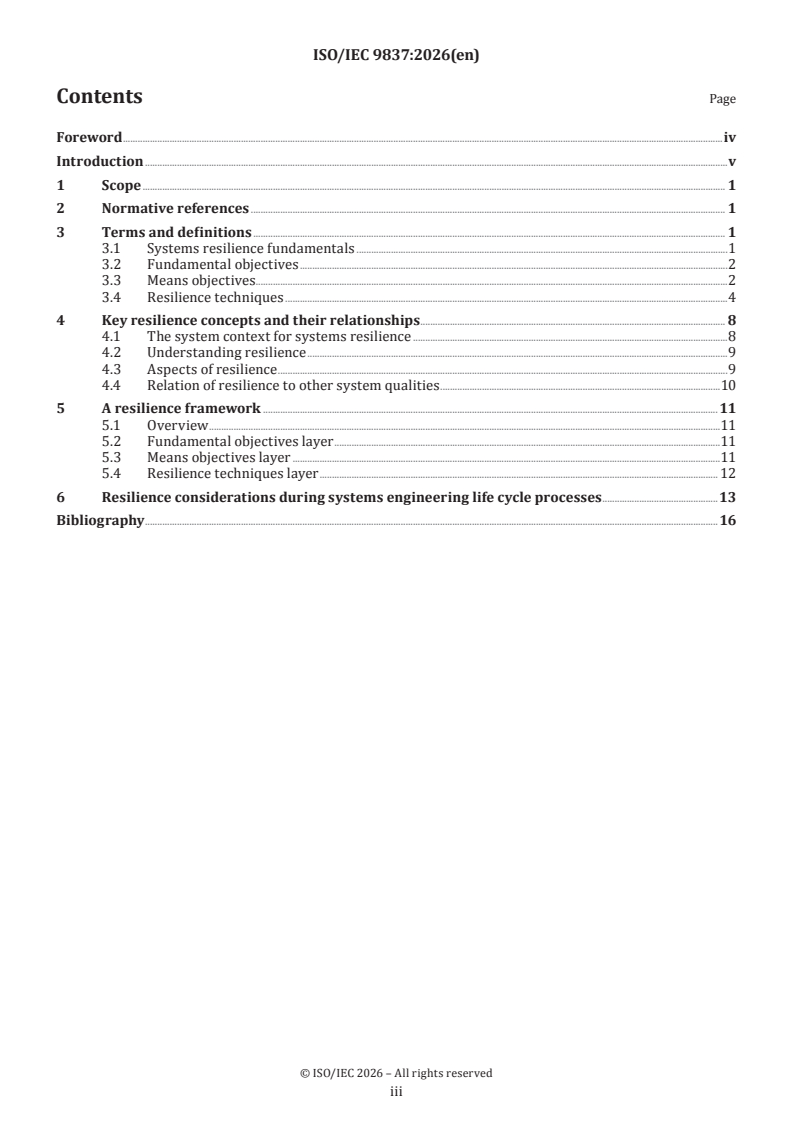
Contents Page
Foreword .iv
Introduction .v
1 Scope . 1
2 Normative references . 1
3 Terms and definitions . 1
3.1 Systems resilience fundamentals .1
3.2 Fundamental objectives .2
3.3 Means objectives .2
3.4 Resilience techniques .4
4 Key resilience concepts and their relationships . 8
4.1 The system context for systems resilience .8
4.2 Understanding resilience .9
4.3 Aspects of resilience .9
4.4 Relation of resilience to other system qualities .10
5 A resilience framework .11
5.1 Overview .11
5.2 Fundamental objectives layer .11
5.3 Means objectives layer .11
5.4 Resilience techniques layer . 12
6 Resilience considerations during systems engineering life cycle processes .13
Bibliography .16
© ISO/IEC 2026 – All rights reserved
iii
Foreword
ISO (the International Organization for Standardization) and IEC (the International Electrotechnical
Commission) form the specialized system for worldwide standardization. National bodies that are
members of ISO or IEC participate in the development of International Standards through technical
committees established by the respective organization to deal with particular fields of technical activity.
ISO and IEC technical committees collaborate in fields of mutual interest. Other international organizations,
governmental and non-governmental, in liaison with ISO and IEC, also take part in the work.
The procedures used to develop this document and those intended for its further maintenance are described
in the ISO/IEC Directives, Part 1. In particular, the different approval criteria needed for the different types
of document should be noted. This document was drafted in accordance with the editorial rules of the ISO/
IEC Directives, Part 2 (see www.iso.org/directives or www.iec.ch/members_experts/refdocs).
ISO and IEC draw attention to the possibility that the implementation of this document may involve the
use of (a) patent(s). ISO and IEC take no position concerning the evidence, validity or applicability of any
claimed patent rights in respect thereof. As of the date of publication of this document, ISO and IEC had not
received notice of (a) patent(s) which may be required to implement this document. However, implementers
are cautioned that this may not represent the latest information, which may be obtained from the patent
database available at www.iso.org/patents and https://patents.iec.ch. ISO and IEC shall not be held
responsible for identifying any or all such patent rights.
Any trade name used in this document is information given for the convenience of users and does not
constitute an endorsement.
For an explanation of the voluntary nature of standards, the meaning of ISO specific terms and expressions
related to conformity assessment, as well as information about ISO's adherence to the World Trade
Organization (WTO) principles in the Technical Barriers to Trade (TBT) see www.iso.org/iso/foreword.html.
In the IEC, see www.iec.ch/understanding-standards.
This document was prepared by Joint Technical Committee ISO/IEC JTC 1, Information technology,
Subcommittee SC 7, Software and systems engineering.
Any feedback or questions on this document should be directed to the user’s national standards
body. A complete listing of these bodies can be found at www.iso.org/members.html and
www.iec.ch/national-committees.
© ISO/IEC 2026 – All rights reserved
iv
Introduction
As the complexity of systems continues to increase and the list of capabilities required of those systems
continues to grow, systems are expected to deliver those capabilities under various conditions, including
adverse ones. Resilience is the quality characteristic that enables systems to achieve this. Broadly speaking,
systems resilience involves the capabilities of systems to avoid, withstand, and recover from adversity.
Resilience goals are realized through application of techniques during processes related to requirements,
architecture, design or operations of a system.
This document focuses on establishing systems resilience concepts that form the basis for understanding,
building and enhancing the resilience of systems. It also provides a resilience framework that includes
fundamental objectives, means objectives and techniques for achieving systems resilience. It is compatible
with a system engineering approach and with system life cycle processes.
This document serves as a foundation for other documents related to various aspects of systems resilience.
© ISO/IEC 2026 – All rights reserved
v
International Standard ISO/IEC 9837:2026(en)
Systems and software engineering — Systems resilience
concepts
1 Scope
This document establishes concepts for understanding and improving systems resilience. Systems resilience
addresses the capabilities of systems under adversity.
This document is applicable to human-created systems that can be either physical or conceptual, or a
combination of both. It applies to systems as defined in ISO/IEC/IEEE 15288, including services and
products. It is not intended to apply to naturally occurring systems.
2 Normative references
There are no normative references in this document.
3 Terms and definitions
For the purposes of this document, the following terms and definitions apply.
ISO and IEC maintain terminology databases for use in standardization at the following addresses:
— ISO Online browsing platform: available at https:// www .iso .org/ obp
— IEC Electropedia: available at https:// www .electropedia .org/
3.1 Systems resilience fundamentals
3.1.1
resilience
ability to provide required capability (3.1.2) in the face of adversity (3.1.3)
Note 1 to entry: Under adversity, what is required of a system can be distinct from the capability required during
normal operation.
Note 2 to entry: Resilience includes the ability to anticipate and adapt to, resist or quickly recover from a potentially
disruptive event.
[23]
[SOURCE: MITRE Technical Report MTR-190495, 2019, modified — Notes to entry have been added.]
3.1.2
capability
ability to do something useful under a particular set of conditions
[SOURCE: ISO/IEC/IEEE 24641:2023, 3.1.3, modified — Note 1 to entry has been removed.]
3.1.3
adversity
anything that can degrade the required capability (3.1.2) of the system, directly or indirectly
Note 1 to entry: In contrast to risk, which is the effect of uncertainty on objectives (as defined in
ISO/IEC/IEEE 15288:2023, 3.39), adversity can be anything actual or possible.
© ISO/IEC 2026 – All rights reserved
3.1.4
stress
force, demand or influence on a system due to adversity (3.1.3) that directly affects the system
3.1.5
error recovery
detection, control, and correction of an internal discrepancy
3.1.6
fault
defect in a system or a representation of a system that if executed/activated can potentially result in an
error
1)
[SOURCE: ISO/IEC/IEEE 15026-1:2019, 3.4.6, modified — Note 1 to entry has been removed.]
3.2 Fundamental objectives
3.2.1
fundamental objective
end goal for achieving resilience (3.1.1)
Note 1 to entry: In this document, there are three fundamental objectives of resilience: avoiding (3.2.2), withstanding
(3.2.4) and recovering (3.2.3) from adversity (3.1.3).
3.2.2
avoiding
eliminating or reducing exposure to adversity (3.1.3)
3.2.3
recovering
replenishing lost capability (3.1.2) after degradation
Note 1 to entry: The degree of recovery can be less than, the same as, or greater than the degree of degradation.
3.2.4
withstanding
resisting degradation of capability (3.1.2) when stressed
3.3 Means objectives
3.3.1
means objective
objective which enables the achievement of other objectives
Note 1 to entry: Means objectives are used to achieve fundamental objectives (3.2.1) or other means objectives.
Note 2 to entry: A means objective can be implemented through one or more resilience techniques (3.4.1).
Note 3 to entry: Means objectives are named by noun phrases in this document. Some names are based on the
approach that is provided, such as preparation (3.3.9), prevention (3.3.10), rearchitecting (3.3.11) and redeployment
(3.3.12). Some names are based on the outcome achieved, such as agility (3.3.3), integrity (3.3.8), robustness (3.3.13)
and situational awareness (3.3.15).
EXAMPLE Anticipation (3.3.4) is a means objective used to achieve the fundamental objectives (3.2.1) of avoiding
(3.2.2), withstanding (3.2.4) and recovering (3.2.3) from adversity (3.1.3).
1) Cancelled and replaced by ISO/IEC/IEEE 15026-1:2025.
© ISO/IEC 2026 – All rights reserved
3.3.2
adversity management
acting to reduce the effectiveness of adversities (3.1.3)
[25]
[SOURCE: SEBoK, v. 2.11, Taxonomy for Achieving Resilience, modified — removed “number and”.]
3.3.3
agility
ability of a system to adapt to deliver required capability (3.1.2) in unpredictably evolving conditions
3.3.4
anticipation
establishing awareness of the nature of potential adversities (3.1.3), their likely consequences and
appropriate responses, prior to the adversity stressing the system
[25]
[SOURCE: SEBoK, v. 2.11, Taxonomy for Achieving Resilience, modified — added “establishing”.]
3.3.5
damage control
limiting the propagation of malfunction within a system
3.3.6
evolution
modifying a system to address changes over time due to adversity (3.1.3) or emergent needs
3.3.7
graceful degradation
ability of a system to transition to acceptable states after damage
Note 1 to entry: See also fail soft (3.4.17).
3.3.8
integrity
means by which a system remains complete and unaltered under adversity (3.1.3)
3.3.9
preparation
developing and maintaining courses of action that address predicted adversity (3.1.3)
3.3.10
prevention
precluding the realization of adversity (3.1.3)
3.3.11
rearchitecting
modifying an architecture
3.3.12
redeployment
putting system capabilities (3.1.2) into operation following stress (3.1.4)
3.3.13
robustness
means to enable a system to function correctly in the presence of invalid inputs or stressful environmental
conditions
3.3.14
service continuity
means to deliver required capability (3.1.2) under stress (3.1.4)
© ISO/IEC 2026 – All rights reserved
3.3.15
situational awareness
perception of elements in the environment, and a comprehension of their meaning, and could include a
projection of the future status of perceived elements and the risk associated with that status
Note 1 to entry: Situational awareness of the environment is complemented by resilience modelling (3.4.36) of the
internal elements of the system.
[SOURCE: ISO 17757:2019, 3.1.23, modified — Note 1 to entry has been added.]
3.4 Resilience techniques
3.4.1
resilience technique
method to realize a means objective (3.3.1)
Note 1 to entry: A resilience technique can contribute to the realization of one or more means objectives.
Note 2 to entry: Resilience techniques are named by noun phrases in this document. Some names are derived from
the ability provided by the technique, such as absorption (3.4.2), dynamic repositioning (3.4.16), forward recovery
(3.4.19), and replacement (3.4.35). Other names are derived from the outcome achieved by application of the resilience
technique, such as fail soft (3.4.17), human-in-the-loop (3.4.20), safe state (3.4.38), and self-modelling (3.4.40).
3.4.2
absorption
withstanding (3.2.4) stress (3.1.4) without unacceptable degradation in the system’s capability (3.1.2)
3.4.3
adaptive response
dynamic reaction to limit or avoid consequences of an adverse situation
Note 1 to entry: An adaptive response can occur before or after adversity (3.1.3) stresses the system.
3.4.4
anomaly detection
discovering salient irregularities or abnormalities in the system or in its environment to enable effective
response action
[25]
[SOURCE: SEBoK, v. 2.11, Taxonomy for Achieving Resilience, modified — removed “in a timely manner”
and replaced “that enables” with “to enable”.]
3.4.5
boundary enforcement
implementing process, temporal and spatial limits intended to protect the system
[25]
[SOURCE: SEBoK, v. 2.11, Taxonomy for Achieving Resilience ]
3.4.6
buffering
reducing degradation due to stress (3.1.4) by means of excess capacity
3.4.7
coordinated defence
using multiple, synergistic mechanisms to protect required capability (3.1.2)
3.4.8
deception
confusing and thus impeding an adversary
[25]
[SOURCE: SEBoK, v. 2.11, Taxonomy for Achieving Resilience ]
© ISO/IEC 2026 – All rights reserved
3.4.9
defence-in-depth
hierarchical deployment of different levels of diverse equipment and procedures (known as barriers) to
prevent the escalation of faults (3.1.6) to a hazardous condition
[SOURCE: ISO 1709:2018, 3.12]
3.4.10
detection avoidance
reducing an adversary’s awareness of the system
[25]
[SOURCE: SEBoK, v. 2.11, Taxonomy for Achieving Resilience ]
3.4.11
disaggregation
dispersing missions, functions, subsystems or components across multiple systems or subsystems
3.4.12
distributed privilege
requiring multiple authorized entities to act in a coordinated manner before a system function is allowed to
proceed
[25]
[SOURCE: SEBoK, v. 2.11, Taxonomy for Achieving Resilience ]
3.4.13
diversification
using a heterogeneous set of resources to minimize common vulnerabilities and common mode failures
Note 1 to entry: Resources include technologies, data sources, processing locations, equipment locations, supply
chains and communications paths.
3.4.14
domain separation
physically or logically isolating system elements with distinctly different protection needs
[25]
[SOURCE: SEBoK, v. 2.11, Taxonomy for Achieving Resilience, modified — “items” has been replaced with
“system elements”.]
3.4.15
drift correction
preventive action to keep system operation within the boundaries of acceptable performance
3.4.16
dynamic repositioning
relocation of system functionality or components
3.4.17
fail soft
technique to enable prioritized, gradual termination of affected functions, in the case of a fault (3.1.6), or
when failure is imminent
[SOURCE: IEC 60050:2015:192-10-07, modified — “capable of” has been replaced with “technique to enable”.]
3.4.18
fault tolerance
technique to continue functioning with certain faults (3.1.6) present
[SOURCE: IEC 60050:2015:192-10-09, modified — “ability” has been replaced with “technique”.]
© ISO/IEC 2026 – All rights reserved
3.4.19
forward recovery
error recovery (3.1.5) in which a system, program, database, or other system resource is restored to a new,
not previously occupied state in which it can perform required functions
[SOURCE: IEC 60050:2015:192-10-18]
3.4.20
human-in-the-loop
including persons as part of a system for adaptive capability (3.1.2)
3.4.21
least functionality
technique by which each element of the system has the ability to accomplish its required functions, but no
more
[25]
[SOURCE: SEBoK, v. 2.11, Taxonomy for Achieving Resilience, modified — replaced “when” with
“technique by which”.]
3.4.22
least persistence
technique by which system elements are available, accessible and able to fulfil their design intent only for
the time they are needed
[25]
[SOURCE: SEBoK, v. 2.11, Taxonomy for Achieving Resilience, modified — replaced “when” with
“technique by which”.]
3.4.23
least privilege
technique by which system elements are allocated authorizations that are necessary to accomplish their
specified functions, but not more
[25]
[SOURCE: SEBoK, v. 2.11, Taxonomy for Achieving Resilience, modified — replaced “when” with
“technique by which”.]
3.4.24
least sharing
technique by which system resources are accessible by multiple system elements only when necessary, and
among as few system elements as possible
[25]
[SOURCE: SEBoK, v. 2.11, Taxonomy for Achieving Resilience, modified — replaced “when” with
“technique by which”.]
3.4.25
loose coupling
technique by which dependencies between elements of a system are intentionally reduced to limit the
potential for propagation of damage
3.4.26
maintainability
technique by which a system has the ability to be retained in, or restored to, a state to perform as required
3.4.27
mediated access
controlling the ability to use system elements
[25]
[SOURCE: SEBoK, v. 2.11, Taxonomy for Achieving Resilience, modified — removed “access and”.]
3.4.28
modularity
technique by which a system is composed of discrete elements such that a change to one element has minimal
impact on other components
© ISO/IEC 2026 – All rights reserved
3.4.29
neutral state
technique by which a system assumes a condition in which it is acceptable to make no changes while awaiting
stakeholder evaluation of possible changes
3.4.30
non-persistence
retaining information, services, and connectivity or functions for a limited time, thereby reducing an
adversary’s opportunity to exploit vulnerabilities and establish a persistent foothold
[25]
[SOURCE: SEBoK, v. 2.11, Taxonomy for Achieving Resilience ]
3.4.31
privilege restriction
restricting authorization assigned to entities by an authority
[25]
[SOURCE: SEBoK, v. 2.11, Taxonomy for Achieving Resilience ]
3.4.32
protective default
technique by which a predetermined configuration of a system safeguards its effectiveness
3.4.33
protective recovery
ensuring that recovery of a system element does not result in, nor lead to, unacceptable loss
[25]
[SOURCE: SEBoK, v. 2.11, Taxonomy for Achieving Resilience ]
3.4.34
redundancy
technique by which a system has more than one means at a given time for providing required capability
(3.1.2)
3.4.35
replacement
changing parts of an existing item to regain its functionality
[SOURCE: ISO 20887:2020, 3.32, modified — replaced “change of” with “changing”.]
3.4.36
resilience modelling
developing and maintaining useful representations of required system capabilities (3.1.2), how those
capabilities are generated, the system environment, and the potential for degradation due to adversity (3.1.3)
3.4.37
resilience monitoring
gathering, fusing and analysing data to identify vulnerabilities, adverse conditions and system degradation
and evaluating the efficacy of system countermeasures
3.4.38
safe state
technique to achieve a state without critical or catastrophic consequences
3.4.39
segmentation
technique by which system elements are separated, logically or physically, to limit the spread of damage
3.4.40
self-modelling
providing a system with a model of itself to enable it to achieve resilience (3.1.1)
Note 1 to entry: A system provided with a model of itself can use that model to adapt to adversities (3.1.3).
© ISO/IEC 2026 – All rights reserved
3.4.41
substantiated integrity
providing the ability to ensure that system components have not been corrupted
[25]
[SOURCE: SEBoK, v. 2.11, Taxonomy for Achieving Resilience ]
3.4.42
substitution
use of system elements from an alternate source or with differences in form or function to provide or restore
capability (3.1.2)
3.4.43
system reconfiguration
technique to change the location or functionality of system elements, in the event of failure or external
disturbance, to enable the system to continue operation
[SOURCE: IEC 60050:2015, 192-10-15, modified — “process” has been replaced with “technique”.]
3.4.44
tolerance
technique to provide capability (3.1.2) despite the effects of stress (3.1.4) on the system
3.4.45
virtualization
use of digital entities to represent a system, a
...