

ISO/IEC 26565:2026
(Main)Software and systems engineering — Methods and tools for product line maturity framework
- Abstract
This document, within the context of methods and tools that support adoption, construction, operation, and management of product line maturity framework, specifies: processes for managing, operationalizing, and supporting product line maturity framework adoption (those processes are described in terms of purpose, inputs, tasks, and outcomes); method capabilities to support the defined tasks of each process; tool capabilities that automate or semi-automate tasks and methods. This document does not concern the processes and capabilities of methods and tools for a single system but rather deals with those for a family of products.
- Status
- Published
- Publication Date
- 28-May-2026
- Technical Committee
- ISO/IEC JTC 1/SC 7 - Software and systems engineering
- Drafting Committee
- ISO/IEC JTC 1/SC 7 - Software and systems engineering
- Current Stage
- 6060 - International Standard published
- Start Date
- 29-May-2026
- Due Date
- 12-Oct-2026
- Completion Date
- 29-May-2026
ISO/IEC 26565:2026 is an International Standard from ISO for software and systems engineering. It specifies methods and tools for a product line maturity framework, including how to manage, operationalize, and support its adoption for a family of products rather than a single system. It is aimed at organizations using software and systems product line (SSPL) approaches, along with the people and suppliers who assess, build, operate, and improve those capabilities.
What does ISO/IEC 26565:2026 specify?
ISO/IEC 26565:2026 specifies the processes, method capabilities, and tool capabilities needed to adopt and run a product line maturity framework. The document is organized around three main areas - management, operationalization, and support - and it treats product line maturity as something to plan, implement, evaluate, and improve across a product family.
Clause 5 sets out the reference model and the key aspects that matter in product line work, such as domain engineering, application engineering, collaboration, business, organization, variability, traceability, and measurement. Annex A gives an informative example of a product line maturity framework.
What are the key requirements of ISO/IEC 26565:2026?
ISO/IEC 26565:2026 defines a practical framework for planning, operating, appraising, and improving product line maturity work. The most important parts are the management processes in Clause 6, the operationalization processes in Clause 7, and the support processes in Clause 8.
1. Management starts with a plan
Clause 6.2 requires a product line maturity framework operationalization plan that includes an adoption strategy, roles and responsibilities, success measures, and required resources. Its inputs include product line business objectives, a product line transition plan from ISO/IEC 26562, and defined organizational standard product line processes. In practice, this means an organization needs to decide why it is adopting the framework, who will do the work, how success will be judged, and what budget, people, facilities, and tools are needed.
2. Enabling means setting up people and measurement
Clause 6.3 requires facilitators and a measurement environment for product line maturity framework operationalization. The facilitators include qualified assessors, trained participants, and access to product line assets and decision information. In practice, this means the organization must prepare the people, access, logistics, and measurement setup before appraisals and improvements can work reliably.
3. Management includes monitoring and corrective action
Clause 6.4 requires review of operationalization status against success measures, control of issues, and corrective actions. The process uses collected data to compare actual status with the plan, identify root causes, and record lessons learned. In practice, this gives managers a way to track whether maturity work is on course and to act when plans and reality diverge.
4. Operationalization begins by selecting or constructing the framework
Clause 7.2 covers preparation for adoption. It requires the organization to identify participants, mobilize resources, identify organization-specific requirements, and adopt the best-fit product line maturity framework. Clause 7.3 then covers construction if the selected framework needs to be tailored or built further. In practice, this means the framework is not treated as one-size-fits-all; it must be matched to the organization’s context, goals, and existing process maturity approach.
5. Training, operation, appraisal, and improvement are separate but linked
Clause 7.4 requires training modules, tailored training, delivery, and verification of training effectiveness. Clause 7.5 covers operation, including deciding the operational components, synchronizing them with improvement needs, executing them, measuring effectiveness, and documenting results. Clause 7.6 covers appraisal of domain engineering, application engineering, technical management, organizational management, and core asset management. Clause 7.7 then requires collating results, analysing them against product line objectives, defining improvements, and reporting results. In practice, this separates preparation, use, assessment, and improvement so each can be managed deliberately.
6. Support focuses on quality, decisions, and data
Clause 8 requires quality assurance for the framework, decision support, and information and data management. Quality assurance evaluates whether operations and work products meet the required quality standard; decision support helps select among alternatives and capture the rationale; information and data management collects, structures, validates, retrieves, and disseminates evidence. In practice, this is the evidence backbone of the framework - it is what supports traceable judgments, not just opinions.
7. The framework is built around product line-specific concerns
Clause 5 explains that the framework is designed for SSPL concerns such as commonality, variability, binding, traceability, reusability, reference architecture, collaboration, and measurement. It explicitly distinguishes domain engineering and application engineering and adds business and organization dimensions. In practice, this keeps the maturity model focused on family-of-products issues that do not appear in single-system work.
8. Annex A gives an example framework
Annex A presents the Family Evaluation Framework (FEF) as an informative example. It uses the BAPO dimensions - business, architecture, process, and organization - and five maturity levels. In practice, Annex A shows how an organization can use a staged maturity model to assess readiness, current capability, and improvement needs.
What terms does ISO/IEC 26565:2026 define?
- Software and systems product line (SSPL) - A family of related products built from shared assets and managed as a product line.
- Product line maturity framework - A model for appraising product line capabilities in different dimensions and at progressively defined levels.
- Product line maturity - An organization’s stable and repeatable capability in SSPL domain engineering, application engineering, and management.
- Domain engineering - The life cycle processes used to specify and manage commonality and variability for a product line.
- Application engineering - The life cycle processes used to build and manage member products by reusing domain assets and binding variability.
- Variability - The set of functional and non-functional characteristics that may differ among members of the product line.
- BAPO - The four dimensions used in Annex A: business, architecture, process, and organization.
- FEF - Family evaluation framework, the informative example of a product line maturity framework in Annex A.
Who uses ISO/IEC 26565:2026?
ISO/IEC 26565:2026 is used by organizations that want to adopt SSPL approaches for their products. It is also used by product line organizations that need to evaluate and select methods and tools for adoption, construction, operation, appraisal, and improvement of a product line maturity framework.
In practice, the standard is relevant to product line managers, assessors, appraisers, change agents, domain engineers, application engineers, technical managers, organizational managers, and providers of methods or tools. It supports work in software and systems engineering settings where a family of products is developed, reused, measured, and improved over time.
Which standards are used with ISO/IEC 26565:2026?
ISO/IEC 26565:2026 is used alongside the ISO/IEC 26550 family named in the introduction and bibliography, especially ISO/IEC 26550, ISO/IEC 26551, ISO/IEC 26552, ISO/IEC 26553, ISO/IEC 26554, ISO/IEC 26555, ISO/IEC 26556, ISO/IEC 26557, ISO/IEC 26558, ISO/IEC 26559, ISO/IEC 26560, ISO/IEC 26561, ISO/IEC 26562, ISO/IEC 26563, ISO/IEC 26564, and ISO/IEC 26566.
These related standards provide the surrounding product line engineering and management practices, such as requirements engineering, architecture design, realization, testing, technical management, organizational management, variability mechanisms, variability modelling, traceability, product management, technical probe, transition management, configuration management, measurement, and texture.
What does the ISO/IEC 26565:2026 document contain?
The document contains a reference model in Clause 5, including a figure and a table of key aspects used to identify product line maturity framework tasks. It then gives structured subprocess descriptions in Clauses 6 to 8, each with purpose, inputs, outcomes, and tasks.
Those clauses also describe method capabilities and tool capabilities for planning, enabling, managing, constructing, training, operating, appraising, improving, quality assurance, decision support, and data management. Annex A adds an informative example of how an organization can apply a maturity framework in practice, using FEF and the BAPO dimensions.
Get Certified
Connect with accredited certification bodies for this standard

BSI Group
BSI (British Standards Institution) is the business standards company that helps organizations make excellence a habit.
BSCIC Certifications Pvt. Ltd.
Established 2006, accredited by NABCB, JAS-ANZ, EIAC, IAS. CDSCO Notified Body.

Intertek India Pvt. Ltd.
Delivers Assurance, Testing, Inspection & Certification since 1993 with 26 labs and 32 offices.
Sponsored listings
Frequently Asked Questions
ISO/IEC 26565:2026 is a standard published by the International Organization for Standardization (ISO). Its full title is "Software and systems engineering — Methods and tools for product line maturity framework". This standard covers: This document, within the context of methods and tools that support adoption, construction, operation, and management of product line maturity framework, specifies: processes for managing, operationalizing, and supporting product line maturity framework adoption (those processes are described in terms of purpose, inputs, tasks, and outcomes); method capabilities to support the defined tasks of each process; tool capabilities that automate or semi-automate tasks and methods. This document does not concern the processes and capabilities of methods and tools for a single system but rather deals with those for a family of products.
This document, within the context of methods and tools that support adoption, construction, operation, and management of product line maturity framework, specifies: processes for managing, operationalizing, and supporting product line maturity framework adoption (those processes are described in terms of purpose, inputs, tasks, and outcomes); method capabilities to support the defined tasks of each process; tool capabilities that automate or semi-automate tasks and methods. This document does not concern the processes and capabilities of methods and tools for a single system but rather deals with those for a family of products.
ISO/IEC 26565:2026 is classified under the following ICS (International Classification for Standards) categories: 01.110 - Technical product documentation; 35.080 - Software. The ICS classification helps identify the subject area and facilitates finding related standards.
ISO/IEC 26565:2026 is available in PDF format for immediate download after purchase. The document can be added to your cart and obtained through the secure checkout process. Digital delivery ensures instant access to the complete standard document.
Standards Content (Sample)
International
Standard
ISO/IEC 26565
First edition
Software and systems
2026-05
engineering — Methods and
tools for product line maturity
framework
Ingénierie logiciel et système – Outils et méthodes pour un cadre
de maturité d’une ligne de produits
Reference number
© ISO/IEC 2026
All rights reserved. Unless otherwise specified, or required in the context of its implementation, no part of this publication may
be reproduced or utilized otherwise in any form or by any means, electronic or mechanical, including photocopying, or posting on
the internet or an intranet, without prior written permission. Permission can be requested from either ISO at the address below
or ISO’s member body in the country of the requester.
ISO copyright office
CP 401 • Ch. de Blandonnet 8
CH-1214 Vernier, Geneva
Phone: +41 22 749 01 11
Email: copyright@iso.org
Website: www.iso.org
Published in Switzerland
© ISO/IEC 2026 – All rights reserved
ii
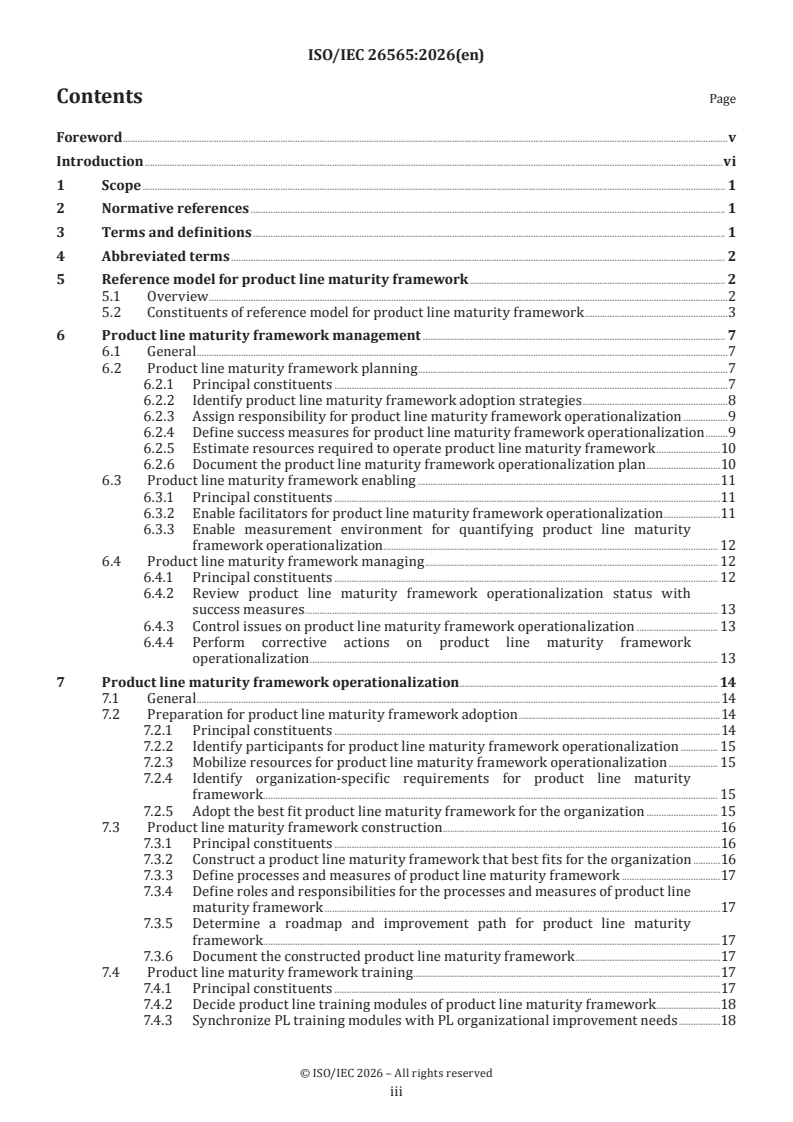
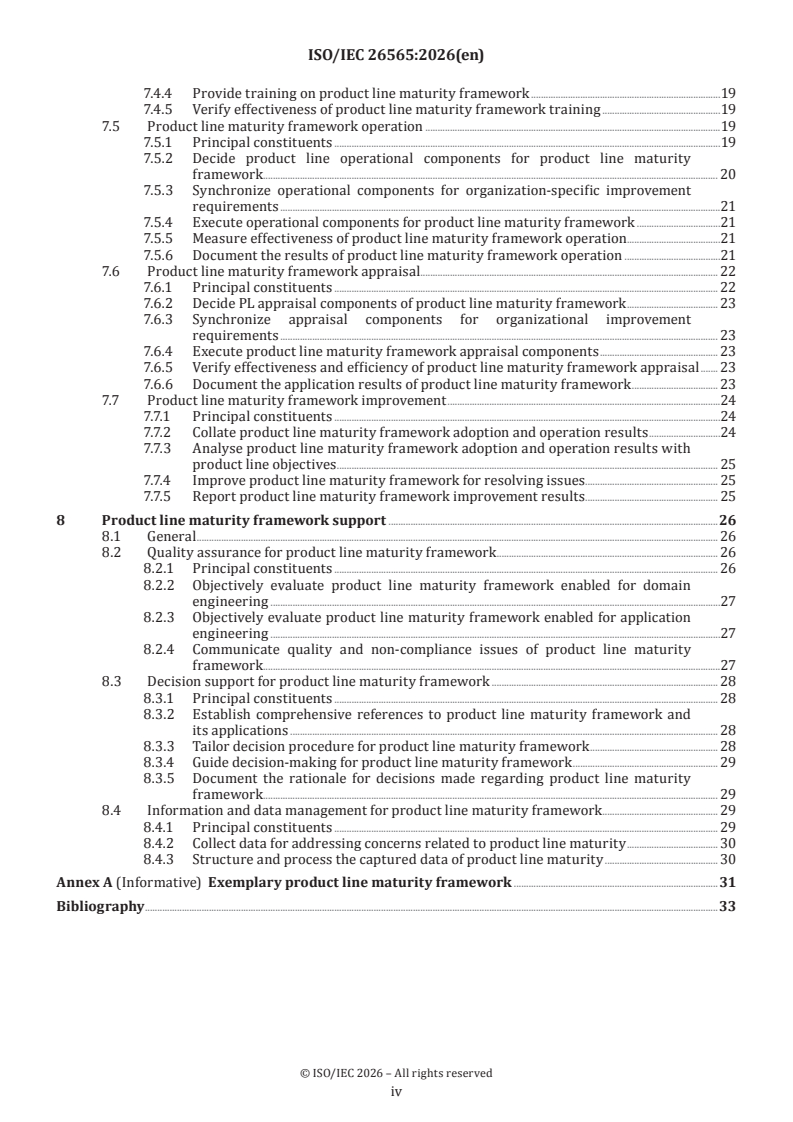
Contents Page
Foreword .v
Introduction .vi
1 Scope . 1
2 Normative references . 1
3 Terms and definitions . 1
4 Abbreviated terms . 2
5 Reference model for product line maturity framework . 2
5.1 Overview .2
5.2 Constituents of reference model for product line maturity framework .3
6 Product line maturity framework management . 7
6.1 General .7
6.2 Product line maturity framework planning .7
6.2.1 Principal constituents .7
6.2.2 Identify product line maturity framework adoption strategies .8
6.2.3 Assign responsibility for product line maturity framework operationalization .9
6.2.4 Define success measures for product line maturity framework operationalization .9
6.2.5 Estimate resources required to operate product line maturity framework .10
6.2.6 Document the product line maturity framework operationalization plan .10
6.3 Product line maturity framework enabling .11
6.3.1 Principal constituents .11
6.3.2 Enable facilitators for product line maturity framework operationalization .11
6.3.3 Enable measurement environment for quantifying product line maturity
framework operationalization . 12
6.4 Product line maturity framework managing . 12
6.4.1 Principal constituents . 12
6.4.2 Review product line maturity framework operationalization status with
success measures . 13
6.4.3 Control issues on product line maturity framework operationalization . 13
6.4.4 Perform corrective actions on product line maturity framework
operationalization . 13
7 Product line maturity framework operationalization . 14
7.1 General .14
7.2 Preparation for product line maturity framework adoption .14
7.2.1 Principal constituents .14
7.2.2 Identify participants for product line maturity framework operationalization . 15
7.2.3 Mobilize resources for product line maturity framework operationalization . 15
7.2.4 Identify organization-specific requirements for product line maturity
framework . 15
7.2.5 Adopt the best fit product line maturity framework for the organization . 15
7.3 Product line maturity framework construction.16
7.3.1 Principal constituents .16
7.3.2 Construct a product line maturity framework that best fits for the organization .16
7.3.3 Define processes and measures of product line maturity framework .17
7.3.4 Define roles and responsibilities for the processes and measures of product line
maturity framework .17
7.3.5 Determine a roadmap and improvement path for product line maturity
framework .17
7.3.6 Document the constructed product line maturity framework .17
7.4 Product line maturity framework training .17
7.4.1 Principal constituents .17
7.4.2 Decide product line training modules of product line maturity framework .18
7.4.3 Synchronize PL training modules with PL organizational improvement needs .18
© ISO/IEC 2026 – All rights reserved
iii
7.4.4 Provide training on product line maturity framework .19
7.4.5 Verify effectiveness of product line maturity framework training .19
7.5 Product line maturity framework operation .19
7.5.1 Principal constituents .19
7.5.2 Decide product line operational components for product line maturity
framework . 20
7.5.3 Synchronize operational components for organization-specific improvement
requirements .21
7.5.4 Execute operational components for product line maturity framework .21
7.5.5 Measure effectiveness of product line maturity framework operation .21
7.5.6 Document the results of product line maturity framework operation .21
7.6 Product line maturity framework appraisal. 22
7.6.1 Principal constituents . 22
7.6.2 Decide PL appraisal components of product line maturity framework . 23
7.6.3 Synchronize appraisal components for organizational improvement
requirements . 23
7.6.4 Execute product line maturity framework appraisal components . 23
7.6.5 Verify effectiveness and efficiency of product line maturity framework appraisal . 23
7.6.6 Document the application results of product line maturity framework . 23
7.7 Product line maturity framework improvement .24
7.7.1 Principal constituents .24
7.7.2 Collate product line maturity framework adoption and operation results .24
7.7.3 Analyse product line maturity framework adoption and operation results with
product line objectives . 25
7.7.4 Improve product line maturity framework for resolving issues . . 25
7.7.5 Report product line maturity framework improvement results . . 25
8 Product line maturity framework support .26
8.1 General . 26
8.2 Quality assurance for product line maturity framework . 26
8.2.1 Principal constituents . 26
8.2.2 Objectively evaluate product line maturity framework enabled for domain
engineering .27
8.2.3 Objectively evaluate product line maturity framework enabled for application
engineering .27
8.2.4 Communicate quality and non-compliance issues of product line maturity
framework .27
8.3 Decision support for product line maturity framework . 28
8.3.1 Principal constituents . 28
8.3.2 Establish comprehensive references to product line maturity framework and
its applications . 28
8.3.3 Tailor decision procedure for product line maturity framework . 28
8.3.4 Guide decision-making for product line maturity framework . 29
8.3.5 Document the rationale for decisions made regarding product line maturity
framework . 29
8.4 Information and data management for product line maturity framework . 29
8.4.1 Principal constituents . 29
8.4.2 Collect data for addressing concerns related to product line maturity . 30
8.4.3 Structure and process the captured data of product line maturity . 30
Annex A (Informative) Exemplary product line maturity framework .31
Bibliography .33
© ISO/IEC 2026 – All rights reserved
iv
Foreword
ISO (the International Organization for Standardization) and IEC (the International Electrotechnical
Commission) form the specialized system for worldwide standardization. National bodies that are
members of ISO or IEC participate in the development of International Standards through technical
committees established by the respective organization to deal with particular fields of technical activity.
ISO and IEC technical committees collaborate in fields of mutual interest. Other international organizations,
governmental and non-governmental, in liaison with ISO and IEC, also take part in the work.
The procedures used to develop this document and those intended for its further maintenance are described
in the ISO/IEC Directives, Part 1. In particular, the different approval criteria needed for the different types
of document should be noted. This document was drafted in accordance with the editorial rules of the ISO/
IEC Directives, Part 2 (see www.iso.org/directives or www.iec.ch/members_experts/refdocs).
ISO and IEC draw attention to the possibility that the implementation of this document may involve the
use of (a) patent(s). ISO and IEC take no position concerning the evidence, validity or applicability of any
claimed patent rights in respect thereof. As of the date of publication of this document, ISO and IEC had not
received notice of (a) patent(s) which may be required to implement this document. However, implementers
are cautioned that this may not represent the latest information, which may be obtained from the patent
database available at www.iso.org/patents and https://patents.iec.ch. ISO and IEC shall not be held
responsible for identifying any or all such patent rights.
Any trade name used in this document is information given for the convenience of users and does not
constitute an endorsement.
For an explanation of the voluntary nature of standards, the meaning of ISO specific terms and expressions
related to conformity assessment, as well as information about ISO's adherence to the World Trade
Organization (WTO) principles in the Technical Barriers to Trade (TBT) see www.iso.org/iso/foreword.html.
In the IEC, see www.iec.ch/understanding-standards.
This document was prepared by Joint Technical Committee ISO/IEC JTC 1, Information technology,
Subcommittee SC 7, Software and systems engineering.
Any feedback or questions on this document should be directed to the user’s national standards
body. A complete listing of these bodies can be found at www.iso.org/members.html and
www.iec.ch/national-committees.
© ISO/IEC 2026 – All rights reserved
v
Introduction
Software and systems product line (SSPL) engineering and management creates, exploits, and manages a
common platform to develop a family of products (e.g. software products, systems architectures) at a lower
cost, with reduced time to market and better quality. As a result, it has gained increasing global attention
since the 1990s.
To achieve the objectives of SSPL adoption, the performance of SSPL engineering and management should
be evaluated and improved based on the results. The product line maturity framework guides to adopt
and construct required constituents of product line process assessment and improvement, and it operates,
appraises, and improves product line processes to align with the product line objectives. The product line
maturity framework deals with a product family, so its focuses are on SSPL specific aspects such as domain
and application engineering, variability management, business involvement, and collaboration among these
aspects. Processes, activities, and tasks are necessary to utilize the product line maturity framework, and
methods and tools to support them are required for enhancing the efficiency, collaboration, and application
quality of the maturity framework.
This document can be used in the following modes:
— by organizations that want to adopt SSPL for producing their products – to provide guidance on how to
adopt, construct, operate, appraise, and improve product line maturity framework;
— by a product line organization – to provide guidance on the evaluation and selection of methods and
tools for adopting, constructing, operating, appraising, and improving product line maturity framework;
— by providers of either methods or tools, or both – to provide guidance on implementing or developing
either methods or tools, or both, by specifying a comprehensive set of methods and tools capabilities for
adopting, constructing, operating, appraising, and improving product line maturity framework.
Documents on product line engineering and management developed by ISO/IEC JTC 1 address both
engineering and management processes and capabilities of methods and tools, in terms of the critical
characteristics of product line development. This document provides processes and capabilities of methods
and tools for adopting, constructing, operating, appraising, and improving product line maturity framework.
Standards in the ISO/IEC 26550 family include ISO/IEC 26550, ISO/IEC 26551, ISO/IEC 26552, ISO/IEC 26553,
ISO/IEC 26554, ISO/IEC 26555, ISO/IEC 26556, ISO/IEC 26557, ISO/IEC 26558, ISO/IEC 26559, ISO/IEC 26560,
ISO/IEC 26561, ISO/IEC 26562, ISO/IEC 26563, ISO/IEC 26564, and ISO/IEC 26566.
— Processes and capabilities of methods and tools for domain requirements engineering and application
requirements engineering are provided in ISO/IEC 26551;
— Processes and capabilities of methods and tools for domain design and application design are provided
in ISO/IEC 26552;
— Processes and capabilities of methods and tools for domain realization and application realization are
provided in ISO/IEC 26553;
— Processes and capabilities of methods and tools for domain testing and application testing are provided
in ISO/IEC 26554;
— Processes and capabilities of methods and tools for technical management are provided in ISO/IEC 26555;
— Processes and capabilities of methods and tools for organizational management are provided in
ISO/IEC 26556;
— Processes and capabilities of methods and tools for variability mechanisms are provided in ISO/IEC 26557;
— Processes and capabilities of methods and tools for variability modelling are provided in ISO/IEC 26558;
— Processes and capabilities of methods and tools for variability traceability are provided in ISO/IEC 26559;
— Processes and capabilities of methods and tools for product line product management are provided in
ISO/IEC 26560;
© ISO/IEC 2026 – All rights reserved
vi
— Processes and capabilities of methods and tools for product line technical probe are provided in
ISO/IEC 26561;
— Processes and capabilities of methods and tools for product line transition management are provided in
ISO/IEC 26562;
— Processes and capabilities of methods and tools for product line configuration management are provided
in ISO/IEC 26563;
— Processes and capabilities of methods and tools for product line measurement are provided in
ISO/IEC 26564;
— Processes and capabilities of methods and tools for product line texture are provided in ISO/IEC 26566
(International Standard under development);
— Others (ISO/IEC 26567 to ISO/IEC 26599): To be developed.
© ISO/IEC 2026 – All rights reserved
vii
International Standard ISO/IEC 26565:2026(en)
Software and systems engineering — Methods and tools for
product line maturity framework
1 Scope
This document, within the context of methods and tools that support adoption, construction, operation, and
management of product line maturity framework, specifies:
— processes for managing, operationalizing, and supporting product line maturity framework adoption
(those processes are described in terms of purpose, inputs, tasks, and outcomes);
— method capabilities to support the defined tasks of each process;
— tool capabilities that automate or semi-automate tasks and methods.
This document does not concern the processes and capabilities of methods and tools for a single system but
rather deals with those for a family of products.
2 Normative references
There are no normative references in this document.
3 Terms and definitions
For the purposes of this document, the following terms and definitions apply.
ISO and IEC maintain terminology databases for use in standardization at the following addresses:
— ISO Online browsing platform: available at https:// www .iso .org/ obp
— IEC Electropedia: available at https:// www .electropedia .org/
3.1
application engineering
life cycle consisting of a set of processes in which the application assets and member products of the product
line are implemented and managed by reusing domain assets in conformance to the domain architecture
and by binding the variability (3.10) of the platform
[SOURCE: ISO/IEC 26550:2015, 3.4, modified — Note 1 to entry has been removed.]
3.2
binding
task to make a decision on relevant variants, which can be application assets, from domain assets using the
domain variability (3.10) model and from application assets using the application variability model
[SOURCE: ISO/IEC 26550:2015, 3.8, modified — "will be" has been replaced by "can be"; note 1 to entry has
been removed.]
3.3
commonality
set of functional and non-functional characteristics that is shared by all applications belonging to the
product line
[SOURCE: ISO/IEC 26550:2015, 3.9]
© ISO/IEC 2026 – All rights reserved
3.4
domain engineering
life cycle consisting of a set of processes for specifying and managing the commonality (3.3) and variability
(3.10) of a product line
[SOURCE: ISO/IEC 26550:2015, 3.12, modified — Notes to entry have been removed.]
3.5
process capability
characterization of the ability of a process to meet current or projected business goals
[SOURCE: ISO/IEC 33020:2019, 3.4]
3.6
product line appraisal component
personnel or organizational unit of domain engineering (3.4), application engineering (3.1), core asset
management, technical management, or organizational management, which is the subject of a product line
maturity framework (3.8) appraisal
3.7
product line maturity
organization’s possession of software and systems product line (SSPL) stable and repeatable capabilities in
domain engineering (3.4), application engineering (3.1), and organizational and technical management
3.8
product line maturity framework
model for appraising product line capabilities in various dimensions and progressively defined levels
3.9
product line operational component
sponsors of appraisal, change agents, the appraisal team, and personnel involved in product line transition
or product line institutionalization
3.10
variability
set of functional and non-functional characteristics that may differ among members of the product line
[SOURCE: ISO/IEC 26550:2015]
4 Abbreviated terms
BAPO business, architecture, process, and organization
FEF family evaluation framework
PL product line
SSPL software and systems product line
5 Reference model for product line maturity framework
5.1 Overview
SSPL engineering develops domain assets including common platforms that allow variabilities for member
products of a product line in domain engineering processes and derive individual products based on the
domain assets and by resolving the values of variabilities in application engineering processes. Because
of these unique engineering processes, product line maturity framework subdivides processes into the
following three subprocesses: domain engineering processes, application engineering processes, and
collaboration processes between the two processes. SSPL also requires an SSPL organization to change its
© ISO/IEC 2026 – All rights reserved
business strategies. Therefore, product line maturity framework has additional dimensions: business and
organization dimension.
Product line maturity framework deals with a consistent process capability that enables the development
of high-quality domain assets that continually evolve with changes in technologies and customer needs as
well as a process capability that configures member products by reusing the domain assets. The framework
serves as a basis of assessing the SSPL engineering capabilities of departments, business units, divisions,
and the organization. Product line maturity framework is used to assess the organization's readiness before
product line adoption, assess the current competencies and deficiencies of an organization, and derive the
organization's SSPL competency level and improvement items for successful SSPL settlement and continuous
evolution.
A product line can be adopted incrementally, either starting from the specific business units and gradually
expanding organization-wide, or it can be initially structured as a whole. Consequently, product line
maturity framework can be customized or extended to meet the requirements of different business domains
or integrated with specific disciplines as needed. The evaluations take place following the adaptation or
extension of product line maturity framework to address these specific situations. The evaluation can
involve integrating it with other maturity frameworks.
Within the product line (PL) maturity framework, the organization may adapt, extend, or combine activities
being evaluated to improve efficiency, collaboration, and overall quality. Therefore, the organization shall
incorporate suitable processes, activities, tasks, and supporting methods and tools to improve and guarantee
the efficiency, collaboration, and overall quality of adopting the product line maturity framework.
NOTE Annex A provides an exemplary product line maturity framework that an organization can utilize.
5.2 Constituents of reference model for product line maturity framework
The reference model is divided into three processes: management, operationalization, and support for
product line maturity framework, each with a set of subprocesses. The management process deals with
planning, enabling, and managing the operationalization of product line maturity framework to evaluate
capability or performance in SSPL engineering. The operationalization process supports an SSPL organization
in adopting, constructing, operating, and improving product line maturity framework as needed by its
users. The support process resolves technical or operationalization issues and responds to requests for
information needs encountered during the operationalization of product line maturity framework.
In the rest of this document, tasks, methods, and tools are described for processes and subprocesses defined
in the reference model.
Each process is divided into subprocesses, and each subprocess is described in terms of the following
attributes:
— the title of the subprocess;
— the purpose of the subprocess;
— the inputs to produce the outcomes;
— the tasks to achieve the outcomes;
— the outcomes of the subprocess.
© ISO/IEC 2026 – All rights reserved
Figure 1 — Reference model for product line maturity framework
The product line maturity framework management process supports the planning of product line maturity
framework operationalization (e.g. strategy, participant identity and responsibilities, criteria for conformity
verification). It also enables the allocation of necessary resources, tools, and infrastructures for plan
implementation, and conducts an analysis of the plan versus the actual status of product line maturity
framework operationalization. The product line maturity framework management includes the following:
— product line maturity framework planning establishes plans for operationalizing product line maturity
framework and supporting its operationalization; product line maturity framework operationalization
plan includes product line maturity framework adoption strategy, identity and responsibilities of
participants, criteria for verifying conformance to the requirements of product line maturity framework,
schedule, and required resources.
— product line maturity framework enabling maintains and helps ensure the availability of resources,
including participants, guidance, and measurement environment necessary for product line maturity
framework operationalization; the guidance provided by product line maturity framework supports its
use in product line maturity framework adoption, appraisal, and process improvement; the measurement
environments support the collection, transformation, dissemination of information from product line
maturity framework operationalization.
— product line maturity framework managing provides integrated management for product line maturity
framework operationalization; this subprocess reviews the actual status of operationalization against
plans, controls issues, and takes corrective actions if necessary.
The product line maturity framework operationalization process deals with subprocesses, ranging from the
adaptation of product line maturity framework to the improvements of its operationalization in accordance
with SSPL adoption situations within an SSPL organization. The adapted product line maturity framework is
well-suited to evaluation needs of the organization. The product line maturity framework operationalization
includes the following:
— preparation for product line maturity framework adoption involves selecting and composing suitable
product line maturity framework. This subprocess identifies and mobilizes participants for product line
maturity framework operationalization; It also analyses the reasons for conducting product line maturity
© ISO/IEC 2026 – All rights reserved
framework appraisal; The analysis results guide selection or composition of maturity frameworks that
satisfy the requirements; Maturity frameworks for single system engineering can be used in conjunction
with product line maturity framework.
— product line maturity framework construction involves adapting the selected or composed maturity
frameworks as an integral part of product line maturity framework. The adaptation should be performed
in accordance with the guidance on product line maturity framework adaption.
— product line maturity framework training checks training needs participants necessary to perform
product line maturity framework operation, appraisal, and improvement. Training is given to appraisees,
operators, and assessors. Training strategy is developed to satisfy the needs. It includes training criteria
and training resources, and the success of training should be assessed after training.
— product line maturity framework operation proceeds product line maturity framework appraisal
and improvement. Operators perform assigned tasks in accordance with required performance and
operational procedures, guided by a product line maturity framework plan.
— product line maturity framework appraisal performs assessments and derives product line maturity
improvements. This subprocess evaluates the current product line capabilities based on the adapted
product line maturity framework.
— product line maturity framework improvement defines product line maturity improvement activities by
analysing product line organization’s strengths, weaknesses, and risks of product line processes.
The product line maturity framework operationalization comprises sequential decision-making situations.
For the decision-making, designated information and data should be available. In addition, quality
requirements of product line maturity framework management and operationalization process should be
assured. The product line maturity framework support includes the following:
— quality assurance for product line maturity framework objectively evaluates the operations, appraisals,
and improvements of product line maturity framework. The results of this subprocess are fed into
product line maturity framework management process to find improvement items product line maturity
framework operationalization.
— decision support for product line maturity framework guides decision makers to consider issues belong
to decision-making related to product line maturity framework. The major items to be made decision are
maturity level of a product line organization and action items for product line process improvements.
This subprocess includes a decision-making strategy, decisions for main or alternative flows of activities
to be analysed and selected to produce optimized outcomes, and decision rationales captured.
— information and data management for product line maturity framework identifies and manages
information and data during product line maturity framework operationalization. Designated
information and data of product line maturity framework include evidence of PL process implementation,
interview results, reports, and other evidence that supports decision-making of product line maturity.
This subprocess deals with the lifecycle of information and data collected during product line maturity
framework operationalization.
Identifying and analysing the key differentiators between single-system engineering and management
and product line engineering and management can help the organizations understand the product line and
formulate a strategy for the successful implementation of product line engineering and management. The
key aspects are defined in ISO/IEC 26550; and Table 1 shows the category of the key aspects.
© ISO/IEC 2026 – All rights reserved
Table 1 — Key aspects for identifying product line maturity framework tasks
Category Aspects
application engineering, domain assets, domain engineering, product management, plat-
Reuse management
form, reusability
Variability manage-
binding, variability
ment
Complexity manage- collaboration, configuration, enabling technology support, reference architecture, texture,
ment traceability
Quality management measurement and tracking, cross-functional verification and validation
The following is the description for each aspect concerning product line maturity framework. Processes
and tasks of product line maturity framework processes shall be identified based on these aspects. Product
line maturity framework’s concerns are to enable the organization to understand processes, subprocesses,
tasks, and methods' and tools' capabilities related to product line maturity framework.
— Application engineering: Unlike single-system engineering, application engineering processes of a
product line include new processes such as variability binding, dealing with deltas, which represent
differences between domain artefacts and application artefacts. Additionally, they involve the integration
of application specific artefacts into common platforms. Application engineering processes within PL
maturity framework that guide product development should be identified and their maturity should be
effectively managed.
— Binding: Binding mechanisms, binding times, and the resolution of binding play a critical role in achieving
product line quality requirements, such as flexibility, evolvability, and maintainability. Processes that
guide binding should be identified and assessed in both domain engineering and application engineering.
— Collaboration: Since domain engineering and application engineering are performed in parallel, distinct
collaboration processes should be identified for all product line engineering process areas, with
collaboration activities incrementally achieved at different level.
— Configuration: PL engineering comprises two distinct engineering processes, one for producing and
reusing reusable assets, and another for producing assets specific to application requirements. These
two separated engineering processes from the basis for identifying and managing configuration items.
Processes should facilitate synchronized configuration management between domain and application
engineering.
— Domain asset: Processes that guide the development of reusable domain assets and support their
intended use should be taken into account in product line maturity framework.
— Domain engineering: Since domain engineering has specific roles and responsibilities in producing
domain assets for reuse in application engineering, distinct processes that reflect that align with these
responsibilities should be identified to guide domain engineering efforts. Furthermore, the maturity
level of their execution should be assessed and incrementally improved.
— Enabling technology support: To launch and institutionalize a product line, enabling elements such
as technologies, product line processes for platform development and reuse, and training should be
identified and managed within product line maturity framework.
— Measurement and tracking: Within a product line, measurements encompass aspects related to business
involvement, product line processes divided into domain, application, and collaboration processes,
organizational effectiveness within organizational structures, and their assigned responsibilities.
Tracking of status is essential for making improvements.
— Platform: Commonality of a product line is realized through a common platform, which is a collection
of common assets. The quality of the common platform determines its reusability; thus, product line
maturity framework should deal with the capabilities required for developing and managing the common
platform.
— Product management: Business involvement is crucial for the success of a product line. Product
management leads the evolution of a product line to enhance the business achievement. The improvement
© ISO/IEC 2026 – All rights reserved
of product management within product line maturity framework should be guided by measurement
results.
— Reference architecture: A reference architecture is utilized for all member products, and the quality of
the reference architecture directly impacts the quality of member products. Achieving the capability
to define a reference architecture that supports automated configuration to derive specific member
products occur in stages.
— Reusability: The level of reuse of domain assets is managed in stages in alignment with the maturity
level of product line processes, reference architecture, and common platforms. A product line aims for
systematic and manged reuse; therefore, reuse capability should be addressed at lower levels of product
line maturity framework.
— Texture: Rules and constraints guide the development of domain assets and their use and extension
in application engineering. Through engineering management of product line texture, the product line
evolves within a coherent approach to its product architecture and design. Examples of textures include
styles and patterns offered by a reference architecture. Processes that address the definition, application,
and conformance to textures should be included, thus product line maturity framework should deal with
these aspects. Processes of domain and application engineering utilize texture processes to properly
implement their processes.
— Traceability: Product line maintains bi-directional traceability between domain and application
engineering. Traceability process helps ensure consistencies between them. Processes of domain and
application engineering utilize traceability processes to properly implement their processes. Product
line framework incorporates features to assess these aspects.
— Cross-functional validation and verification: Verification and validation are essential for collaboration
and coordination between domain and applicatio
...