

ISO/IEC 26566:2026
(Main)Software and systems engineering — Methods and tools for product line texture
- Abstract
This document, within the context of methods’ and tools’ capability for supporting product line texture, defines: processes for product line texture management, operationalization, and support; those processes are described in terms of purpose, inputs, tasks, and outcomes; method capabilities to support the defined tasks of each process; tool capabilities that automate or semi-automate tasks and methods. This document does not concern the processes and capabilities of tools and methods for a single system but rather deals with those for a family of products.
- Status
- Published
- Publication Date
- 27-May-2026
- Technical Committee
- ISO/IEC JTC 1/SC 7 - Software and systems engineering
- Drafting Committee
- ISO/IEC JTC 1/SC 7 - Software and systems engineering
- Current Stage
- 6060 - International Standard published
- Start Date
- 28-May-2026
- Due Date
- 12-Oct-2026
- Completion Date
- 28-May-2026
ISO/IEC 26566:2026 is an International Standard from ISO and IEC on methods and tools for product line texture. It specifies how organizations can manage, define, apply, check, change, and trace product line textures across software and systems product line (SSPL) engineering. It is aimed at organizations using SSPL, and at the teams and tool providers that need shared guidance for a family of products rather than a single system.
What does ISO/IEC 26566:2026 specify?
ISO/IEC 26566:2026 specifies processes for product line texture management, product line texture operationalization, and product line texture support. It also specifies method capabilities and tool capabilities that support those processes, with the focus on product line families rather than one-off systems.
The document is organized into:
- Clause 1 - Scope
- Clause 2 - Normative references
- Clause 3 - Terms and definitions
- Clause 4 - Reference model for product line texture
- Clause 5 - Product line texture management
- Clause 6 - Product line texture operationalization
- Clause 7 - Product line texture support
- Annex A - Informative exemplary product line textures
Clause 4 sets out the reference model and splits product line texture work into three processes: management, operationalization, and support. Annex A gives examples of textures in requirements, architecture design, realization, and testing.
What are the key requirements of ISO/IEC 26566:2026?
ISO/IEC 26566:2026 is built around a reference model and then turns that model into practical work for planning, defining, checking, and maintaining product line textures. The standard matters in practice because it ties guidance to the full product line lifecycle - from requirements to configuration - so teams can apply the same variability rules consistently.
1. Product line texture management must be planned, enabled, and controlled
Clause 5 defines three management subprocesses: planning, enabling, and managing. Planning covers strategies, roles and responsibilities, success measures, resources, and documentation for product line texture operationalization and support.
In practice, this means an organization needs to decide who owns product line texture work, how success will be measured, and what tools and skills are needed. The enabling work then provides facilitators, guidance, and a measurement environment, while managing reviews status, handles issues, and drives corrective action.
2. Planning must link texture work to business goals and resources
Clause 5.2 requires the plan to cover product line texture strategies, responsibility allocation, success measures, resource estimation, and documented plans. The planning tasks explicitly include identifying strategies, assigning responsibilities, defining success measures, estimating resources, and documenting the plan.
This matters because product line texture work is not just technical writing. Teams have to connect texture definitions to objectives, people, and tools, or the rules will be hard to apply and even harder to sustain.
3. Operationalization covers six lifecycle areas
Clause 6 applies product line texture to requirements, design, realization, testing, after-compile-time, and configuration. For each area, the document follows the same pattern: analyse common rules and constraints, define textures, formulate textures in artefacts, and verify them.
That structure gives teams a repeatable way to handle variability. In practice, it means the texture work is not limited to architecture documents - it also reaches tests, implementation, and configuration of member products.
4. Each lifecycle area uses the same logic, but different content
Clause 6 tailors the texture work to each phase. For requirements, it deals with variability modelling, expressing variability, and binding or adapting requirements. For design, it covers architecture styles, patterns, tactics, and constraints. For realization, it addresses variability realization mechanisms, detailed design decisions, and implementation guidance. For testing, it addresses test adequacy, reusable test artefacts, and variability in testing. For after-compile-time and configuration, it focuses on adaptation after compilation and correct configuration of member products.
This is important because the standard is not a generic process model. It tells different roles what kind of texture content belongs in each phase, so requirements engineers, architects, developers, testers, and configurators can work from the same product line rules.
5. Support covers conformance, change management, and traceability
Clause 7 supports adherence to product line textures through three subprocesses: conformance, change management, and traceability. Conformance checking applies to both domain engineering and application engineering. Change management handles change requests, impact analysis, and disposition reporting. Traceability establishes links between textures and related artefacts.
In practice, this is where quality control happens. Teams need evidence that activities and artefacts follow the defined textures, they need controlled handling of texture changes, and they need trace links so impacts can be followed across requirements, design, realization, testing, and configuration.
6. Tool support is expected to include automation and semi-automation
Across clauses 5 to 7, the document repeatedly points to tool support such as templates, automatic formatting and grammar checks, consistency checks across artefacts, dashboards, notifications, repositories, version control, traceability matrices, and linked artefacts.
That means the standard is not only about process descriptions. It also gives a clear target for tool vendors and internal platform teams: tools should help authors define textures, help reviewers check them, and help teams track compliance, change status, and trace links.
7. Annex A gives practical examples by lifecycle phase
Annex A illustrates what product line textures can look like in requirements, architecture design, realization, and testing. The examples show the kinds of rules and constraints that may be captured for variability modelling, binding, commonality and variability, coding conventions, test coverage, and test artefact reuse.
For readers, this is useful as a sanity check. It shows the level of specificity the standard is aiming for, without turning the document into a single prescribed method.
What terms does ISO/IEC 26566:2026 define?
- Product line platform - a product line architecture, a configuration management plan, and domain assets that enable application engineering to reuse them and produce derivative products.
- Product line architecture - the core architecture of a software and systems product line, including the structure and the texture that constrains member products.
- Product line texture - the guidelines, rules, and restrictions used throughout product line engineering to keep domain engineering and application engineering consistent.
- Trace link - an association between two trace artefacts, or between a variability model element and a development artefact.
Who uses ISO/IEC 26566:2026?
ISO/IEC 26566:2026 is used by organizations adopting SSPL, by product line organizations evaluating methods and tools, and by providers developing those methods and tools. It is also relevant to domain engineers, application engineers, architects, developers, test engineers, configurators, product managers, facilitators, and quality or compliance staff.
In practice, those users apply it to define product line textures, document them, verify conformance, manage changes, and keep traceability across the product line lifecycle. It is especially useful where multiple teams need to apply the same rules to shared assets and to product-specific adaptations.
Which standards are used with ISO/IEC 26566:2026?
ISO/IEC 26566:2026 states that there are no normative references. It sits in the ISO/IEC 26550 family, and the introduction names related parts that provide the surrounding product line framework:
- ISO/IEC 26550 - reference model for product line engineering and management
- ISO/IEC 26551 - product line requirements engineering
- ISO/IEC 26552 - product line architecture design
- ISO/IEC 26553 - product line realization
- ISO/IEC 26554 - product line testing
- ISO/IEC 26555 - product line technical management
- ISO/IEC 26556 - product line organizational management
- ISO/IEC 26557 - variability mechanisms
- ISO/IEC 26558 - variability modelling
- ISO/IEC 26559 - variability traceability
- ISO/IEC 26560 - product line product management
- ISO/IEC 26561 - product line technical probe
- ISO/IEC 26562 - product line transition management
- ISO/IEC 26563 - product line configuration management
- ISO/IEC 26564 - product line measurement
- ISO/IEC 26565 - product line maturity framework, identified as under development
What does the ISO/IEC 26566:2026 document contain?
ISO/IEC 26566:2026 contains a reference model in Clause 4, including Figure 1 and Table 1. Figure 1 shows the three-process structure for product line texture, and Table 1 groups key aspects such as reuse management, variability management, complexity management, and quality management.
The body of the document then gives subprocess purposes, inputs, tasks, and outcomes for management, operationalization, and support. It also describes the kinds of methods and tool capabilities needed, such as templates, repositories, automatic checking, reporting, alerts, version control, and traceability links.
Annex A provides informative examples of textures for requirements, architecture design, realization, and testing. The bibliography points readers to related product line standards and background books on software product line engineering.
Get Certified
Connect with accredited certification bodies for this standard

BSI Group
BSI (British Standards Institution) is the business standards company that helps organizations make excellence a habit.

BSCIC Certifications Pvt. Ltd.
Established 2006, accredited by NABCB, JAS-ANZ, EIAC, IAS. CDSCO Notified Body.

Intertek India Pvt. Ltd.
Delivers Assurance, Testing, Inspection & Certification since 1993 with 26 labs and 32 offices.
Sponsored listings
Frequently Asked Questions
ISO/IEC 26566:2026 is a standard published by the International Organization for Standardization (ISO). Its full title is "Software and systems engineering — Methods and tools for product line texture". This standard covers: This document, within the context of methods’ and tools’ capability for supporting product line texture, defines: processes for product line texture management, operationalization, and support; those processes are described in terms of purpose, inputs, tasks, and outcomes; method capabilities to support the defined tasks of each process; tool capabilities that automate or semi-automate tasks and methods. This document does not concern the processes and capabilities of tools and methods for a single system but rather deals with those for a family of products.
This document, within the context of methods’ and tools’ capability for supporting product line texture, defines: processes for product line texture management, operationalization, and support; those processes are described in terms of purpose, inputs, tasks, and outcomes; method capabilities to support the defined tasks of each process; tool capabilities that automate or semi-automate tasks and methods. This document does not concern the processes and capabilities of tools and methods for a single system but rather deals with those for a family of products.
ISO/IEC 26566:2026 is classified under the following ICS (International Classification for Standards) categories: 01.110 - Technical product documentation; 35.080 - Software. The ICS classification helps identify the subject area and facilitates finding related standards.
ISO/IEC 26566:2026 is available in PDF format for immediate download after purchase. The document can be added to your cart and obtained through the secure checkout process. Digital delivery ensures instant access to the complete standard document.
Standards Content (Sample)
International
Standard
ISO/IEC 26566
First edition
Software and systems
2026-05
engineering — Methods and tools
for product line texture
Ingénierie logiciel et système — Méthodes et outils pour la
texture d’une ligne de produits
Reference number
© ISO/IEC 2026
All rights reserved. Unless otherwise specified, or required in the context of its implementation, no part of this publication may
be reproduced or utilized otherwise in any form or by any means, electronic or mechanical, including photocopying, or posting on
the internet or an intranet, without prior written permission. Permission can be requested from either ISO at the address below
or ISO’s member body in the country of the requester.
ISO copyright office
CP 401 • Ch. de Blandonnet 8
CH-1214 Vernier, Geneva
Phone: +41 22 749 01 11
Email: copyright@iso.org
Website: www.iso.org
Published in Switzerland
© ISO/IEC 2026 – All rights reserved
ii
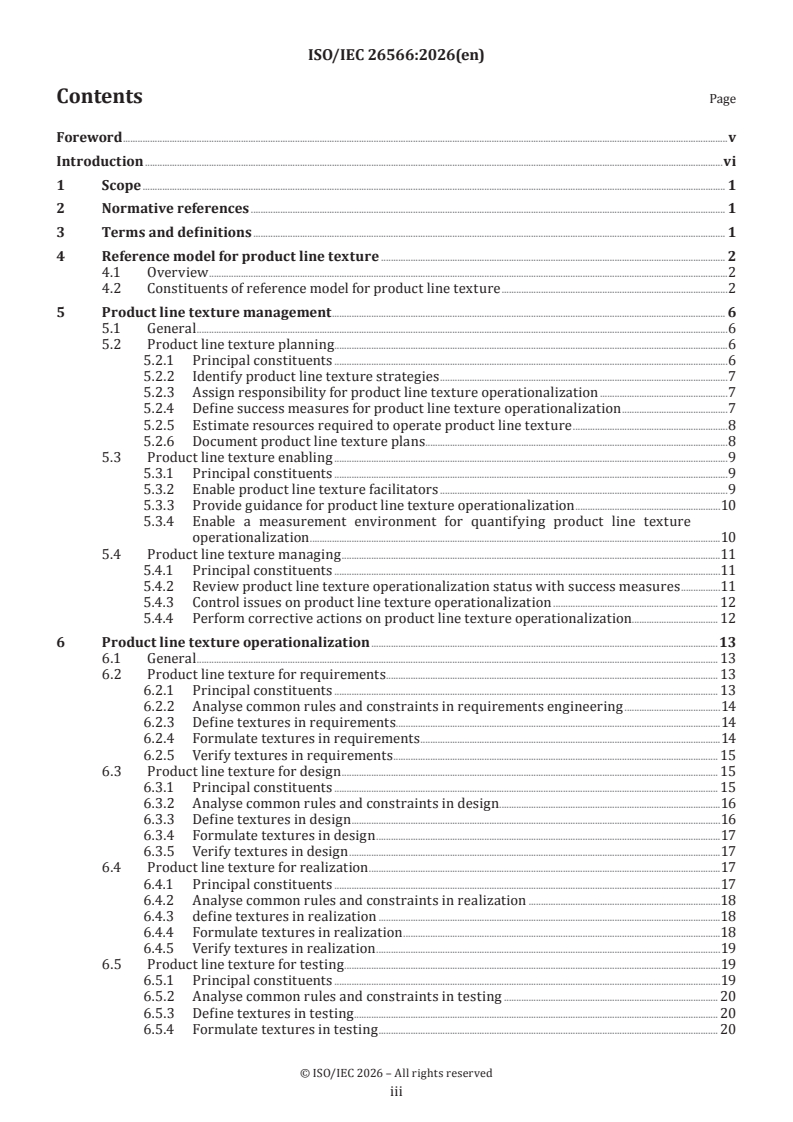
Contents Page
Foreword .v
Introduction .vi
1 Scope . 1
2 Normative references . 1
3 Terms and definitions . 1
4 Reference model for product line texture . 2
4.1 Overview .2
4.2 Constituents of reference model for product line texture .2
5 Product line texture management . 6
5.1 General .6
5.2 Product line texture planning .6
5.2.1 Principal constituents .6
5.2.2 Identify product line texture strategies .7
5.2.3 Assign responsibility for product line texture operationalization .7
5.2.4 Define success measures for product line texture operationalization .7
5.2.5 Estimate resources required to operate product line texture .8
5.2.6 Document product line texture plans . .8
5.3 Product line texture enabling .9
5.3.1 Principal constituents .9
5.3.2 Enable product line texture facilitators .9
5.3.3 Provide guidance for product line texture operationalization .10
5.3.4 Enable a measurement environment for quantifying product line texture
operationalization .10
5.4 Product line texture managing .11
5.4.1 Principal constituents .11
5.4.2 Review product line texture operationalization status with success measures .11
5.4.3 Control issues on product line texture operationalization . 12
5.4.4 Perform corrective actions on product line texture operationalization . 12
6 Product line texture operationalization .13
6.1 General . 13
6.2 Product line texture for requirements . . 13
6.2.1 Principal constituents . 13
6.2.2 Analyse common rules and constraints in requirements engineering .14
6.2.3 Define textures in requirements.14
6.2.4 Formulate textures in requirements .14
6.2.5 Verify textures in requirements . 15
6.3 Product line texture for design . 15
6.3.1 Principal constituents . 15
6.3.2 Analyse common rules and constraints in design.16
6.3.3 Define textures in design .16
6.3.4 Formulate textures in design .17
6.3.5 Verify textures in design .17
6.4 Product line texture for realization .17
6.4.1 Principal constituents .17
6.4.2 Analyse common rules and constraints in realization .18
6.4.3 define textures in realization .18
6.4.4 Formulate textures in realization .18
6.4.5 Verify textures in realization .19
6.5 Product line texture for testing .19
6.5.1 Principal constituents .19
6.5.2 Analyse common rules and constraints in testing . 20
6.5.3 Define textures in testing . 20
6.5.4 Formulate textures in testing . 20
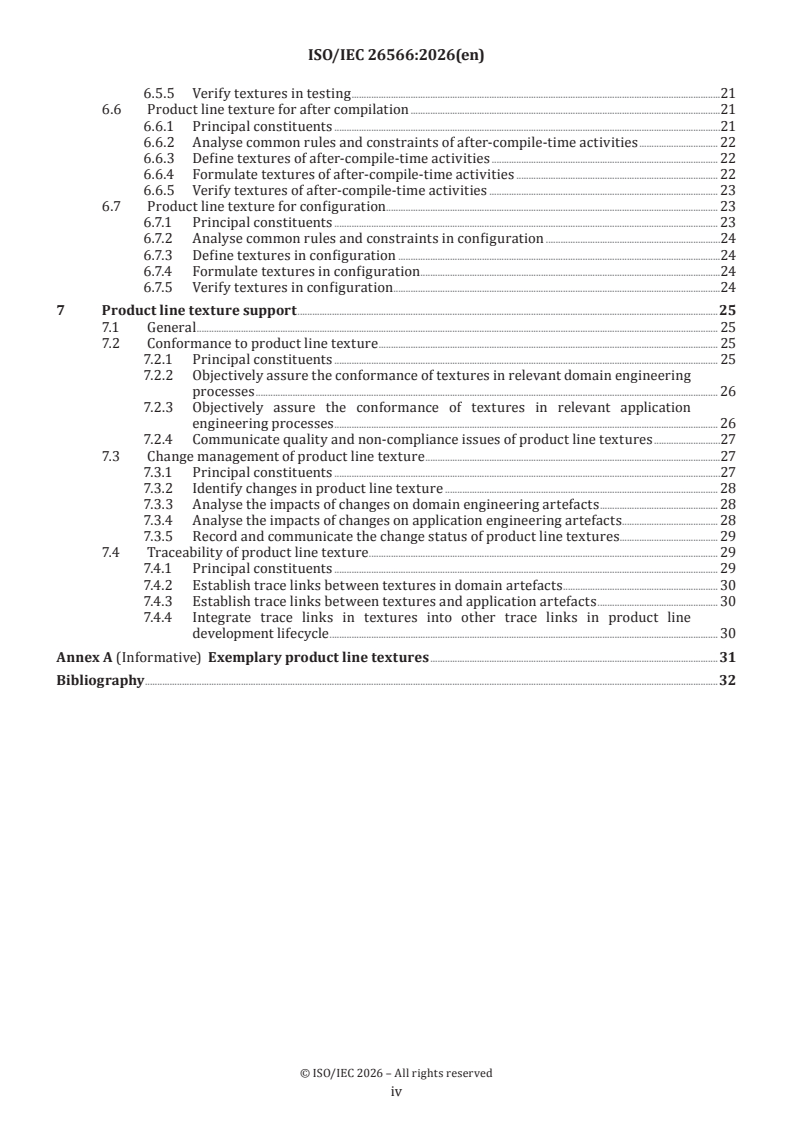
© ISO/IEC 2026 – All rights reserved
iii
6.5.5 Verify textures in testing .21
6.6 Product line texture for after compilation .21
6.6.1 Principal constituents .21
6.6.2 Analyse common rules and constraints of after-compile-time activities . 22
6.6.3 Define textures of after-compile-time activities . 22
6.6.4 Formulate textures of after-compile-time activities . 22
6.6.5 Verify textures of after-compile-time activities . 23
6.7 Product line texture for configuration. 23
6.7.1 Principal constituents . 23
6.7.2 Analyse common rules and constraints in configuration .24
6.7.3 Define textures in configuration .24
6.7.4 Formulate textures in configuration .24
6.7.5 Verify textures in configuration .24
7 Product line texture support .25
7.1 General . 25
7.2 Conformance to product line texture . 25
7.2.1 Principal constituents . 25
7.2.2 Objectively assure the conformance of textures in relevant domain engineering
processes . 26
7.2.3 Objectively assure the conformance of textures in relevant application
engineering processes . 26
7.2.4 Communicate quality and non-compliance issues of product line textures .27
7.3 Change management of product line texture .27
7.3.1 Principal constituents .27
7.3.2 Identify changes in product line texture . 28
7.3.3 Analyse the impacts of changes on domain engineering artefacts . 28
7.3.4 Analyse the impacts of changes on application engineering artefacts . 28
7.3.5 Record and communicate the change status of product line textures. 29
7.4 Traceability of product line texture . 29
7.4.1 Principal constituents . 29
7.4.2 Establish trace links between textures in domain artefacts . 30
7.4.3 Establish trace links between textures and application artefacts . 30
7.4.4 Integrate trace links in textures into other trace links in product line
development lifecycle . 30
Annex A (Informative) Exemplary product line textures .31
Bibliography .32
© ISO/IEC 2026 – All rights reserved
iv
Foreword
ISO (the International Organization for Standardization) and IEC (the International Electrotechnical
Commission) form the specialized system for worldwide standardization. National bodies that are
members of ISO or IEC participate in the development of International Standards through technical
committees established by the respective organization to deal with particular fields of technical activity.
ISO and IEC technical committees collaborate in fields of mutual interest. Other international organizations,
governmental and non-governmental, in liaison with ISO and IEC, also take part in the work.
The procedures used to develop this document and those intended for its further maintenance are described
in the ISO/IEC Directives, Part 1. In particular, the different approval criteria needed for the different types
of document should be noted. This document was drafted in accordance with the editorial rules of the ISO/
IEC Directives, Part 2 (see www.iso.org/directives or www.iec.ch/members_experts/refdocs).
ISO and IEC draw attention to the possibility that the implementation of this document may involve the
use of (a) patent(s). ISO and IEC take no position concerning the evidence, validity or applicability of any
claimed patent rights in respect thereof. As of the date of publication of this document, ISO and IEC had not
received notice of (a) patent(s) which may be required to implement this document. However, implementers
are cautioned that this may not represent the latest information, which may be obtained from the patent
database available at www.iso.org/patents and https://patents.iec.ch. ISO and IEC shall not be held
responsible for identifying any or all such patent rights.
Any trade name used in this document is information given for the convenience of users and does not
constitute an endorsement.
For an explanation of the voluntary nature of standards, the meaning of ISO specific terms and expressions
related to conformity assessment, as well as information about ISO's adherence to the World Trade
Organization (WTO) principles in the Technical Barriers to Trade (TBT) see www.iso.org/iso/foreword.html.
In the IEC, see www.iec.ch/understanding-standards.
This document was prepared by Joint Technical Committee ISO/IEC JTC 1, Information technology,
Subcommittee SC 7, Software and systems engineering.
Any feedback or questions on this document should be directed to the user’s national standards
body. A complete listing of these bodies can be found at www.iso.org/members.html and
www.iec.ch/national-committees.
© ISO/IEC 2026 – All rights reserved
v
Introduction
Software and systems product line (SSPL) engineering and management creates, exploits, and manages a
common platform to develop a family of products (e.g. software products, systems architectures) at a lower
cost, with reduced time to market and better quality. As a result, it has gained increasing global attention
since the 1990s.
SSPL engineering uses platforms to facilitate mass customization. To facilitate this, SSPL engineering
establishes two distinct engineering processes: domain engineering and application engineering. Domain
engineering process is responsible for producing a reusable platform, while application engineering process
reuses the platform to derive planned member products. When application engineering derives a member
product from the platform, it exploits the defined variability and adds application-specific variability
not defined in domain engineering. For correct binding of variability and integrating application-specific
variability, domain engineering provides detailed guidelines, rules, and restrictions, and application
engineering should follow them to help ensure that the right member products will be derived. Product
line textures indicates the guidelines, rules, and restrictions. They may be defined at any product line
engineering processes. A texture defined at a specific domain engineering process takes effect on the
subsequent processes as well as its related application engineering process. This document deals with
methods and tools for product line textures that are aware of these aspects.
This document can be used in the following modes:
— by organizations that want to adopt SSPL for producing their products – to provide guidance on how to
define and validate textures, and how to check conformance to textures;
— by a product line organization – to provide guidance on the evaluation and selection for methods and
tools for product line textures;
— by providers of either methods or tools, or both – to provide guidance on implementing or developing
either methods or tools, or both, by specifying a comprehensive set of methods and tools capabilities for
supporting product line textures.
Documents on product line engineering and management developed by ISO/IEC JTC 1 address both
engineering and management processes and capabilities of methods and tools in terms of the critical
characteristics of product line development. This document provides processes and capabilities of
methods and tools for product line textures. Standards in the ISO/IEC 26550 family include ISO/IEC 26550,
ISO/IEC 26551, ISO/IEC 26552, ISO/IEC 26553, ISO/IEC 26554, ISO/IEC 26555, ISO/IEC 26556, ISO/IEC 26557,
ISO/IEC 26558, ISO/IEC 26559, ISO/IEC 26560, ISO/IEC 26561, ISO/IEC 26562, ISO/IEC 26563, ISO/IEC 26564,
and ISO/IEC 26565.
— Processes and capabilities of methods and tools for domain requirements engineering and application
requirements engineering are provided in ISO/IEC 26551;
— Processes and capabilities of methods and tools for domain design and application design are provided
in ISO/IEC 26552;
— Processes and capabilities of methods and tools for domain realization and application realization are
provided in ISO/IEC 26553;
— Processes and capabilities of methods and tools for domain testing and application testing are provided
in ISO/IEC 26554;
— Processes and capabilities of methods and tools for technical management are provided in ISO/IEC 26555;
— Processes and capabilities of methods and tools for organizational management are provided in
ISO/IEC 26556;
— Processes and capabilities of methods and tools for variability mechanisms are provided in ISO/IEC 26557;
— Processes and capabilities of methods and tools for variability modelling are provided in ISO/IEC 26558;
© ISO/IEC 2026 – All rights reserved
vi
— Processes and capabilities of methods and tools for variability traceability are provided in ISO/IEC 26559;
— Processes and capabilities of methods and tools for product line product management are provided in
ISO/IEC 26560;
— Processes and capabilities of methods and tools for product line technical probe are provided in
ISO/IEC 26561;
— Processes and capabilities of methods and tools for product line transition management are provided in
ISO/IEC 26562;
— Processes and capabilities of methods and tools for product line configuration management are provided
in ISO/IEC 26563;
— Processes and capabilities of methods and tools for product line measurement are provided in
ISO/IEC 26564;
— Processes and capabilities of methods and tools for product line maturity framework are provided in
ISO/IEC 26565 (International Standard under development);
— Others (ISO/IEC 26567 to ISO/IEC 26599): To be developed.
© ISO/IEC 2026 – All rights reserved
vii
International Standard ISO/IEC 26566:2026(en)
Software and systems engineering — Methods and tools for
product line texture
1 Scope
This document, within the context of methods’ and tools’ capability for supporting product line texture,
defines:
— processes for product line texture management, operationalization, and support; those processes are
described in terms of purpose, inputs, tasks, and outcomes;
— method capabilities to support the defined tasks of each process;
— tool capabilities that automate or semi-automate tasks and methods.
This document does not concern the processes and capabilities of tools and methods for a single system but
rather deals with those for a family of products.
2 Normative references
There are no normative references in this document.
3 Terms and definitions
For the purposes of this document, the following terms and definitions apply.
ISO and IEC maintain terminology databases for use in standardization at the following addresses:
— ISO Online browsing platform: available at https:// www .iso .org/ obp
— IEC Electropedia: available at https:// www .electropedia .org/
3.1
product line platform
platform
product line architecture (3.2), a configuration management plan, and domain assets enabling application
engineering to effectively reuse and produce a set of derivative products
[SOURCE: ISO/IEC 26550:2015, 3.18, modified — The preferred term "platform" has been added; note 1 to
entry has been removed.]
3.2
product line architecture
core architecture that captures the high-level design of a software and systems product line including
the architectural structure and texture (e.g. common rules and constraints) that constrains all member
products within a software and systems product line
[SOURCE: ISO/IEC 26550:2015, 3.10, modified — The preferred terms "domain architecture" and "reference
architecture" have been removed; note 1 to entry has been removed.]
3.3
product line texture
guidelines, rules, and restrictions, which are used throughout product line engineering, ensuring consistent
approach of interpreting and applying domain engineering and application engineering
© ISO/IEC 2026 – All rights reserved
3.4
trace link
association between two trace artefacts or between an element of variability model and a development
artefact
[SOURCE: ISO/IEC 26559:2017, 3.6]
4 Reference model for product line texture
4.1 Overview
SSPL develops a set of similar products from a common platform that define and implement commonalities
and variabilities of a product line. The quality of the platform determines the quality of products developed
within a product line. For quickly developing high-quality products based on the platform, the platform
should enable the correct reuse and adaptation of its constituent elements. Product line textures provide
commonalities that the platform defines as well as guidance, rules, and constraints related to variabilities
that allow for platform extension, adaptation, substitution, and exclusion.
SSPL consists of two different lifecycle processes: domain engineering and application engineering. Domain
engineering develops a common platform that will be reused in application engineering for developing
each member product of a product line. Textures may be defined in application engineering to restrict
the subsequent phase, but in SSPL most important textures are defined in domain engineering with the
development of a common platform.
Product line textures tell relevant roles and responsibilities how to work out the elements of the platform
in detail, how to reuse, adapt, extend, or evolve the elements of the platform. Product line texture is used
throughout product line engineering, ensuring consistent approach of interpreting and applying the
platform. To enable the platform’s predictable performance, product line textures should be clearly defined,
focusing solely on elements to help ensure compatibility, reusability, ease of member product development,
as well as the robustness and flexibility of a platform. Product line texture helps ensure the platform remains
cohesive throughout all product line lifecycle phases.
Product line texture also defines common approaches to deal with product line variability in domain
and application engineering. Product line texture should guide how to model variabilities, how to refine
variabilities from feature level to internal variabilities, how to combine correct variabilities to the right
places. Variability mechanisms used for expressing or implementing variabilities in analysis models, design
models, and realization are product line textures that relevant roles and responsibilities should adhere
to deal with variabilities at the relevant phases. As an example, architecture texture tells how product
line architecture works out and solve given domain problems, guides domain realization and member
product development by providing common approaches used to perform their tasks and solve problems.
Architectural texture includes architectural style, patterns, tactics, coding conventions, and algorithms. The
architectural texture also helps ensure a coherent evolution of product line architecture over time.
4.2 Constituents of reference model for product line texture
The reference model specifies the structure of supporting processes and subprocesses for a product line
texture. Figure 1 shows that a product line texture is structured into three processes: product line texture
management, product line texture operationalization, and product line texture support. In the rest of this
document, tasks, methods, and tools are described for processes and subprocesses defined in the reference
model.
Each process is divided into subprocesses, and each subprocess is described in terms of the following
attributes:
— the title of the subprocess;
— the purpose of the subprocess;
— the inputs to produce the outcomes;
© ISO/IEC 2026 – All rights reserved
— the tasks to achieve the outcomes;
— the outcomes of the subprocess.
Figure 1 — Reference model for product line texture
The product line texture management process serves three essential subprocesses: planning of product
line texture, encompassing aspects like strategy, resource estimation, responsibility allocation, and
defining measures and validation criteria; facilitating the provision of necessary resources, tools, and
infrastructures required to deploy the product line texture plan effectively; analysing and comparing the
actual status of product line texture with the plan. The product line texture management includes the
following subprocesses:
— product line texture planning involves establishing plans for defining, operationalizing and maintaining
product line texture; The product line texture plans include validation for the conformance of a platform
and application engineering processes with the relevant product line texture; adequacy to business goals,
strategies, responsibilities and authorities, criteria for defining and validating product line texture,
applicable policies, effectiveness measures of product line texture, and required tools and resources.
— product line texture enabling helps ensure the availability of environments and resources necessary
for defining, operationalizing and maintaining product line texture; Environments for product line
texture should support the unambiguous definition and conveyance of product line texture in domain
engineering and application engineering processes, enabling providers and users of product line texture
to fulfill their roles and responsibilities coherently; Guidance on defining the suitable extent of product
line texture in the suitable placement helps prevent it excessive use.
— product line texture managing provides integrated management for the operationalization of product line
texture; this subprocess involves reviewing the current status of product line texture operationalization
against the established plans, addressing any issues, and taking corrective actions as needed.
The product line texture operationalization process encompasses subprocesses for defining, formulating,
and maintaining of product line texture throughout the product line lifecycle phases. This process involves
© ISO/IEC 2026 – All rights reserved
identifying common rules and constraints, performing analysis, formulating, and verifying product line
textures for each phase. The product line texture operationalization includes the following subprocesses:
— product line texture for requirements defines common guides for requirements engineering and its
associated processes, as well as for addressing challenges encountered during these processes. The
texture within the subprocess includes principles and guidelines for defining, expressing, and binding
variabilities in requirements.
— product line texture for design defines common guides for architecture design and its associated
processes, as well as for resolving challenges encountered during architecture design and its associated
processes. The texture of this subprocess contains coding conventions, design patterns, architectural
tactics/strategies, architecture styles, and relations defined in product line architecture. Addressing
commonalities and variabilities in product line architecture constitutes a fundamental aspect of
architectural guidelines at the subsequent subprocesses.
— product line texture for realization defines common guides for standard practices in product line
realization and its associated processes, as well as for resolving challenges encountered during realization
and its relevant processes. The texture in this subprocess contains detailed design decisions aimed at
achieving specific quality attribute requirements, such as design patterns and tactics. Additionally, it
defines variability implementation mechanisms.
— product line texture for testing defines product line texture for guiding common ways to perform testing
and its relevant processes or for solving problems faced with during testing and its relevant processes.
product line texture at this subprocess includes test adequacy criteria commonly applied to domain and
application testing, rules and constraints for test artefact reuse, and guidelines for testing variabilities.
— product line texture for after compilation defines product line texture for guiding common ways to
perform after compilation processes and its relevant processes or for solving problems faced with after
compilation processes and its relevant processes.
— product line texture for configuration defines product line texture for guiding common ways to perform
configuration and its relevant processes or for solving problems faced with during configuring a member
product and its relevant processes. Member products are derived based on the common platform of
a product line, and thereafter participants of member product development perform adaptations for
satisfying member product-specific features. Rules, constraints, and guidance for deriving the correct
configurations of member products should be provided as parts of product line textures.
The product line texture support process provides supports required for assuring the adherence of product
line texture in relevant product line lifecycle phases. The process manages changes and traceability for
product line textures. To achieve these, the product line texture support includes the following:
— conformance to product line texture objectively evaluates the activities and artefacts of product line
engineering processes for conformance to the guidance, rules, and constraints. Product line texture
conformance analysis detects the flaws due to the inconsistencies between the product line texture and
its relevant work products.
— change management for product line texture evaluates and manages change requests of product line
texture in accordance with product line evolution.
— traceability for product line texture establishes and manages trace links between product line textures
and their corresponding and conforming tasks and artefacts.
Identifying and analysing the key differentiators between single-system engineering and management
and product line engineering and management can help the organizations understand the product line and
formulate a strategy for the successful implementation of product line engineering and management. The
key aspects are defined in ISO/IEC 26550; and Table 1 shows the category of the key aspects.
© ISO/IEC 2026 – All rights reserved
Table 1 — Key aspects for identifying product line texture tasks
Category Aspects
application engineering, domain assets, domain engineering, product management, platform,
Reuse management
reusability
Variability management binding, variability
collaboration, configuration, enabling technology support, reference architecture, texture,
Complexity management
traceability
Quality management measurement and tracking, cross-functional verification and validation
The following is the description for each aspect concerning product line texture. The product line texture
processes and tasks shall be identified based on these aspects. The product line texture's concerns are to
enable the organization to understand texture processes, subprocesses, tasks, and methods' and tools'
capabilities.
— Application engineering: Application engineering adheres to product line textures delivered from
domain engineering.
— Binding: One of the product line textures that application engineering should adhere to is the binding
times of variabilities, ensuring correct configurations of member products.
— Collaboration: Product line textures inform domain and application engineering participants about what
is and what is not permissible. Product line textures serve to facilitate collaboration by conveying rules,
constraints, and guideline to collaborators.
— Configuration: Product line textures constrain the structures, relations, variation points, and potential
extensions of a configuration. Configurations of member products within a product line should follow
the product line textures, which, in turn, guarantee the configurability of a member product.
— Domain asset: Product line textures are parts of domain assets. They encompass rules, constraints, and
guidelines for the proper reuse, extension, and evolution of domain assets.
— Domain engineering: Primary product line textures are defined during domain engineering processes and
subsequently delivered to both application engineering processes and subsequent domain engineering
processes, creating reusable product line platforms and supporting for successful application engineering.
— Enabling technology support: Enablers to help ensure the effective definition and utilization of product
line textures should be identified and integrated to product line texture processes. These enablers such
as technological solutions and resources should be identified and provided, and their supports should be
monitored and appropriately improved.
— Measurement and tracking: The effectiveness of product line textures should be measured and tracked
to help ensure how well these textures align with the established product line objectives. This aspect
involves defining metrics to measure how well these textures are performing in terms of their intended
objectives.
— Platform: A common platform incorporates product line textures for reusing, extending, and evolving it
without compromising its core concepts.
— Product management: Product line textures guide the evolution of a product line, so product management
utilizes product line textures to help ensure overall consistency in the evolution of a product line.
— Reference architecture: Reference architecture includes multiple product line textures that guide domain
designers, domain developers, and application architects.
— Reusability: Product line textures guide domain and application engineering participant in developing
and reusing domain assets correctly, ensuring that they perform their tasks correctly.
— Texture: Product line textures are defined in all product line engineering processes, from product line
scoping to product line testing.
© ISO/IEC 2026 – All rights reserved
— Traceability: Product line textures should guide the abstraction levels when establishing and maintaining
traceabilities among domain assets, application assets, and products.
— Cross-functional validation and verification: The conformance of product line textures should be
validated and verified in all relevant product line engineering processes, from product line scoping to
product line testing.
— Variability: Product line textures guide common ways to deal with variabilities.
5 Product line texture management
5.1 General
The product line texture management supports the following:
a) product line texture planning;
b) product line texture enabling;
c) product line texture managing.
5.2 Product line texture planning
5.2.1 Principal constituents
5.2.1.1 Purpose
The purpose of this subprocess is to produce and maintain a plan for product line texture operationalization
and support.
5.2.1.2 Input
To perform the process, plans established in domain and application engineering processes should be
available.
5.2.1.3 Outcome
As a result of the successful implementation of the process, a plan, comprising strategies, goals,
responsibilities and authorities, success measures, and necessary resources for defining, operationalizing,
and maintaining product line textures, shall be established. This plan also includes a mobilization plan for
the required resources.
5.2.1.4 Tasks
The organization shall implement the following tasks with respect to the process:
a) Identify product line texture strategies: Establish strategies for defining and expressing product line
textures in domain engineering, including a method for verifying artefacts’ conformance to their
respective textures.
b) Assign responsibility for product line texture operationalization: Define roles and responsibilities
related to the operationalization of product line textures. Roles and responsibilities concerning product
line textures should be distinct for domain and application engineering.
c) Define success measures for product line texture operationalization: Specify measures for assessing the
success of product line texture operations.
d) Estimate resources required for operating product line textures: Identify the resources necessary for
operating product line textures in both domain and application engineering. Critical resources in this
© ISO/IEC 2026 – All rights reserved
context include tools that enable engineers to express product line textures in artefacts and verify
artefact compliance to their respective textures.
e) Document product line texture plans: Incorporate strategies, roles and responsibilities, success
measures, and resource requirements into the product line texture operation plan.
5.2.2 Identify product line texture strategies
a) The method should support the task with the following capabilities:
1) defining key perspectives of product line texture;
2) understanding the product line context, product line objectives and the defined organizational
standard product line processes from the defined product line texture perspectives;
3) establishing strategies for definition, management and compliance checks of product line textures.
b) A tool should support the task by allowing the user to:
1) access product line context, product line objectives and defined organizational standard product
line processes;
2) communicate alternative strategies with participants for selecting crucial components of a product
line texture strategy;
3) edit a product line texture strategy and integrate it with the product line texture plan.
5.2.3 Assign responsibility for product line texture operationalization
a) The method should support the task with the following capabilities:
1) analysing critical roles, responsibilities and general principles for the operationalization of product
line textures;
2) collating the required roles, responsibilities and general principles for the operational
...