

ISO 17423:2018
(Main)Intelligent transport systems — Cooperative systems — Application requirements and objectives
General Information
- Abstract
This document — specifies communication service parameters presented by ITS station (ITS-S) application processes to the ITS-S management in support of automatic selection of ITS-S communication profiles in an ITS station unit (ITS-SU), — specifies related procedures for the static and dynamic ITS-S communication profile selection processes at a high functional level, — provides an illustration of objectives used to estimate an optimum ITS-S communication profile.
- Status
- Withdrawn
- Publication Date
- 02-May-2018
- Technical Committee
- ISO/TC 204 - Intelligent transport systems
- Drafting Committee
- ISO/TC 204/WG 18 - Cooperative systems
- Current Stage
- 9599 - Withdrawal of International Standard
- Start Date
- 10-Apr-2025
- Completion Date
- 29-Aug-2026
Buy Documents

ISO 17423:2018 - Intelligent transport systems — Cooperative systems — Application requirements and objectives/3/2018


ISO 17423:2018 - Intelligent transport systems -- Cooperative systems -- Application requirements and objectives

ISO 17423:2018 - Systèmes de transport intelligents — Systèmes Coopératifs — Exigences et objectifs de l'application/4/2019

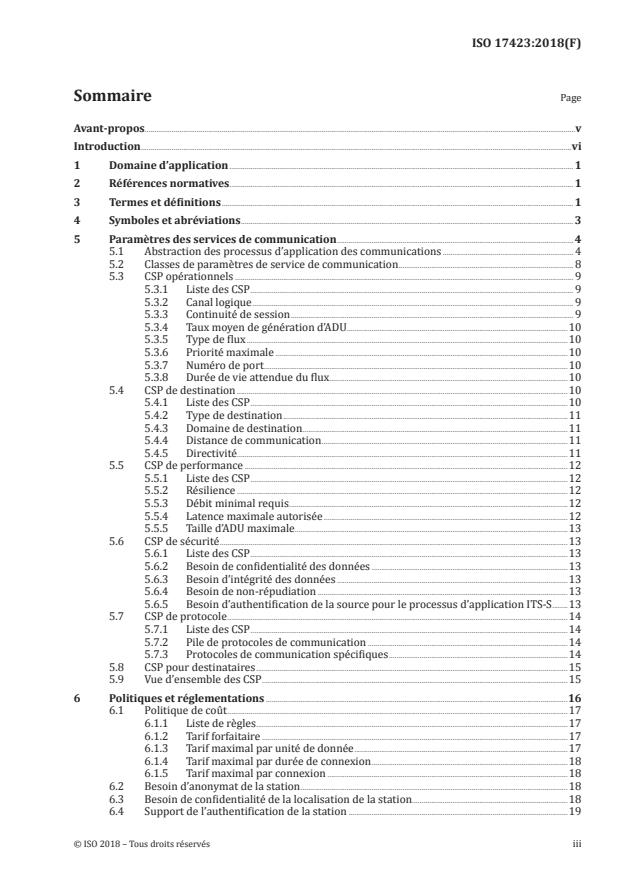
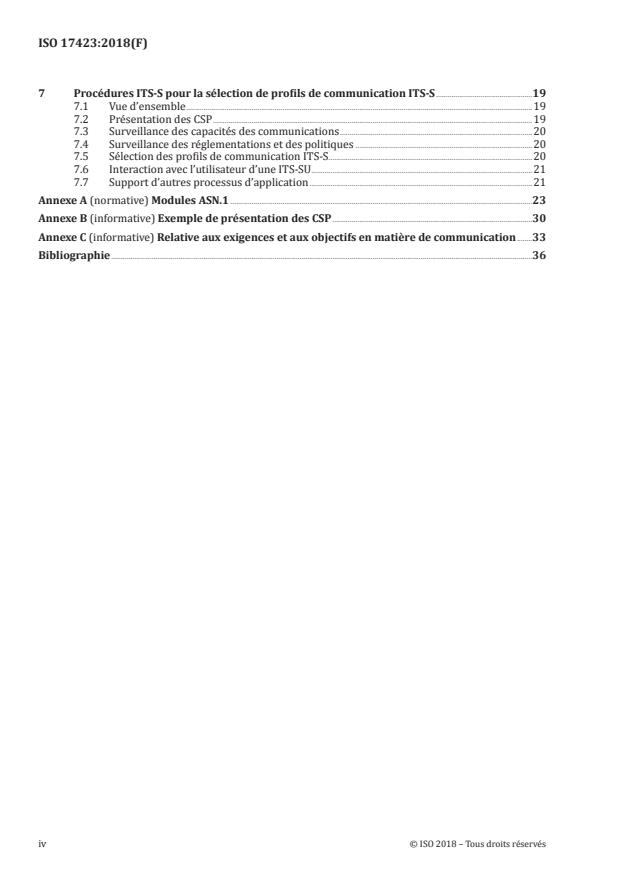
ISO 17423:2018 - Systemes de transport intelligents -- Systemes Coopératifs -- Exigences et objectifs de l'application
Overview
ISO 17423:2018 - "Intelligent transport systems - Cooperative systems - Application requirements and objectives" defines how ITS station application processes present communication needs to ITS station management so that the station can automatically select appropriate communication profiles. The standard describes the communication service parameters (CSPs) provided by applications, high‑level procedures for static and dynamic ITS‑S communication profile selection, and illustrative objectives for estimating an optimal ITS‑S communication profile.
Key keywords: ISO 17423:2018, Intelligent Transport Systems, Cooperative ITS (C‑ITS), ITS‑S communication profiles, communication service parameters (CSPs), ITS station management.
Key topics and technical requirements
ISO 17423 structures the selection of ITS‑S communication profiles around clearly defined CSPs and decision procedures:
- Communication service parameter classes - abstraction of application processes from communications; CSP categories that describe operational, destination, performance, security and protocol requirements.
- Operational CSPs - examples include logical channel, session continuity, average ADU generation rate, flow type, maximum priority, port number, expected flow lifetime.
- Destination CSPs - destination type and domain, communication distance and directivity.
- Performance CSPs - resilience, minimum throughput, maximum latency, maximum ADU size.
- Security CSPs - needs for confidentiality, integrity, non‑repudiation and source authentication.
- Protocol CSPs - requested protocol stack or specific communication protocols.
- Policies and regulations - cost policies, anonymity and location‑privacy requirements, and support for station authentication.
- ITS‑S procedures - presentation of CSPs to management, monitoring of communication capabilities and policies, static and dynamic selection processes, user interaction and support of other application processes.
- Supporting material - normative ASN.1 modules and informative annexes with CSP presentation examples and objective illustrations.
Practical applications and intended users
ISO 17423 is aimed at implementers and designers of ITS and C‑ITS systems who need standardized ways to map application requirements to communication configurations:
- Automotive OEMs and telematics suppliers designing in‑vehicle ITS station units (ITS‑SU)
- Roadside unit and infrastructure vendors enabling cooperative services
- ITS system architects and software developers implementing ITS‑S management and flow/path selection
- Network operators and integrators enforcing policies (cost, privacy, authentication)
- Standards bodies and certification teams aligning ITS applications with CALM architecture
Adopting ISO 17423 helps ensure consistent, interoperable automatic selection of communication profiles (e.g., for V2X/C‑ITS flows), optimized for performance, security and policy constraints.
Related standards
- ISO 21217 (CALM architecture)
- ISO 24102‑6 (flow and path management)
- ISO 17419 (identifiers)
- ISO 22418 and relevant ASN.1/ISO references cited in the standard
Using ISO 17423:2018 supports robust ITS station management, efficient resource use, and predictable behavior across cooperative transport systems.
Relations
- Effective Date
- 25-Aug-2026
- Effective Date
- 25-Aug-2026
- Effective Date
- 12-Feb-2026
- Effective Date
- 06-Jun-2022
- Effective Date
- 04-Nov-2023
- Effective Date
- 05-Nov-2015
Buy Documents
ISO 17423:2018 - Intelligent transport systems — Cooperative systems — Application requirements and objectives/3/2018
ISO 17423:2018 - Intelligent transport systems -- Cooperative systems -- Application requirements and objectives
ISO 17423:2018 - Systèmes de transport intelligents — Systèmes Coopératifs — Exigences et objectifs de l'application/4/2019
ISO 17423:2018 - Systemes de transport intelligents -- Systemes Coopératifs -- Exigences et objectifs de l'application
Get Certified
Connect with accredited certification bodies for this standard

BSI Group
BSI (British Standards Institution) is the business standards company that helps organizations make excellence a habit.

Great Wall Tianjin Quality Assurance Center
Established 1993, first batch to receive national accreditation with IAF recognition.
Hong Kong Quality Assurance Agency (HKQAA)
Hong Kong's leading certification body.
Sponsored listings
Frequently Asked Questions
ISO 17423:2018 is a standard published by the International Organization for Standardization (ISO). Its full title is "Intelligent transport systems — Cooperative systems — Application requirements and objectives". This standard covers: This document — specifies communication service parameters presented by ITS station (ITS-S) application processes to the ITS-S management in support of automatic selection of ITS-S communication profiles in an ITS station unit (ITS-SU), — specifies related procedures for the static and dynamic ITS-S communication profile selection processes at a high functional level, — provides an illustration of objectives used to estimate an optimum ITS-S communication profile.
This document — specifies communication service parameters presented by ITS station (ITS-S) application processes to the ITS-S management in support of automatic selection of ITS-S communication profiles in an ITS station unit (ITS-SU), — specifies related procedures for the static and dynamic ITS-S communication profile selection processes at a high functional level, — provides an illustration of objectives used to estimate an optimum ITS-S communication profile.
ISO 17423:2018 is classified under the following ICS (International Classification for Standards) categories: 03.220.20 - Road transport; 35.240.60 - IT applications in transport. The ICS classification helps identify the subject area and facilitates finding related standards.
ISO 17423:2018 has the following relationships with other standards: It is inter standard links to EN ISO 22418:2020, CEN ISO/TS 21176:2020, EN ISO 17423:2018, ISO/IEC 15693-3:2009/Amd 2:2015, ISO 17423:2025, ISO/TS 17423:2014. Understanding these relationships helps ensure you are using the most current and applicable version of the standard.
ISO 17423:2018 is available in PDF format for immediate download after purchase. The document can be added to your cart and obtained through the secure checkout process. Digital delivery ensures instant access to the complete standard document.
Standards Content (Sample)
INTERNATIONAL ISO
STANDARD 17423
First edition
2018-05
Intelligent transport systems —
Cooperative systems — Application
requirements and objectives
Systèmes de transport intelligents — Systèmes coopératifs —
Exigences d'application et objectifs
Reference number
©
ISO 2018
© ISO 2018
All rights reserved. Unless otherwise specified, or required in the context of its implementation, no part of this publication may
be reproduced or utilized otherwise in any form or by any means, electronic or mechanical, including photocopying, or posting
on the internet or an intranet, without prior written permission. Permission can be requested from either ISO at the address
below or ISO’s member body in the country of the requester.
ISO copyright office
CP 401 • Ch. de Blandonnet 8
CH-1214 Vernier, Geneva
Phone: +41 22 749 01 11
Fax: +41 22 749 09 47
Email: copyright@iso.org
Website: www.iso.org
Published in Switzerland
ii © ISO 2018 – All rights reserved
Contents Page
Foreword .v
Introduction .vi
1 Scope . 1
2 Normative references . 1
3 Terms and definitions . 1
4 Symbols and abbreviated terms . 3
5 Communication service parameters . 4
5.1 Abstraction of application processes from communications . . 4
5.2 Communication service parameter classes . 7
5.3 Operational CSPs . 8
5.3.1 List of CSPs . 8
5.3.2 Logical channel . 8
5.3.3 Session continuity . 8
5.3.4 Average ADU generation rate . 9
5.3.5 Flow type . 9
5.3.6 Maximum priority . 9
5.3.7 Port number . 9
5.3.8 Expected flow lifetime . . 9
5.4 Destination CSPs . 9
5.4.1 List of CSPs . 9
5.4.2 Destination type .10
5.4.3 Destination domain .10
5.4.4 Communication distance .10
5.4.5 Directivity .10
5.5 Performance CSPs .11
5.5.1 List of CSPs .11
5.5.2 Resilience .11
5.5.3 Minimum required throughput .11
5.5.4 Maximum allowed latency .11
5.5.5 Maximum ADU size .12
5.6 Security CSPs .12
5.6.1 List of CSPs .12
5.6.2 Need for data confidentiality .12
5.6.3 Need for data integrity . .12
5.6.4 Need for non-repudiation .12
5.6.5 Need for source ITS-S application process authentication.12
5.7 Protocol CSP .13
5.7.1 List of CSPs .13
5.7.2 Communication protocol stack.13
5.7.3 Specific communications protocols .13
5.8 CSPs for sinks .13
5.9 CSPs overview .14
6 Policies and regulations .15
6.1 Cost policy .15
6.1.1 List of rules .15
6.1.2 Flat rate .15
6.1.3 Maximum rate per data unit .16
6.1.4 Maximum rate per connection time .16
6.1.5 Maximum rate per connection .16
6.2 Need for station anonymity .17
6.3 Need for station location privacy .17
6.4 Support of station authentication.17
7 ITS-S procedures for ITS-S communication profile selection .17
7.1 Overview .17
7.2 Presentation of CSPs .18
7.3 Monitoring of capabilities of communications .18
7.4 Monitoring of regulations and policies .19
7.5 Selection of ITS-S communication profiles .19
7.6 Interaction with user of ITS-SU .19
7.7 Support of other application processes .20
Annex A (normative) ASN.1 modules .21
Annex B (informative) Example of presentation of CSPs .28
Annex C (informative) On communication requirements and objectives .31
Bibliography .34
iv © ISO 2018 – All rights reserved
Foreword
ISO (the International Organization for Standardization) is a worldwide federation of national standards
bodies (ISO member bodies). The work of preparing International Standards is normally carried out
through ISO technical committees. Each member body interested in a subject for which a technical
committee has been established has the right to be represented on that committee. International
organizations, governmental and non-governmental, in liaison with ISO, also take part in the work.
ISO collaborates closely with the International Electrotechnical Commission (IEC) on all matters of
electrotechnical standardization.
The procedures used to develop this document and those intended for its further maintenance are
described in the ISO/IEC Directives, Part 1. In particular the different approval criteria needed for the
different types of ISO documents should be noted. This document was drafted in accordance with the
editorial rules of the ISO/IEC Directives, Part 2 (see www .iso .org/directives).
Attention is drawn to the possibility that some of the elements of this document may be the subject of
patent rights. ISO shall not be held responsible for identifying any or all such patent rights. Details of
any patent rights identified during the development of the document will be in the Introduction and/or
on the ISO list of patent declarations received (see www .iso .org/patents).
Any trade name used in this document is information given for the convenience of users and does not
constitute an endorsement.
For an explanation on the voluntary nature of standards, the meaning of ISO specific terms and
expressions related to conformity assessment, as well as information about ISO's adherence to the
World Trade Organization (WTO) principles in the Technical Barriers to Trade (TBT) see the following
URL: www .iso .org/iso/foreword .html.
This document was prepared by ISO/TC 204, Intelligent transport systems.
This first edition cancels and replaces ISO/TS 17423:2014, which has been technically revised.
Introduction
Abstracting applications from communications is a useful basic architectural principle of Intelligent
1)
Transport Systems (ITS) embodied in the ITS station and communication architecture presented in
ISO 21217:2014.
Applications and communications are linked together using the concepts of flows and paths and
communication profiles described in ISO 21217:2014 with related flow and path management
2)
[11]
procedures specified in ISO 24102-6 . The ITS station management uses communication
requirements and objectives of applications together with the capabilities of the ITS station (status of
available communication protocol stacks) and sets of decision rules (regulations and policies) to select
suitable parameterized ITS-S communication protocol stacks, also referred to as "ITS-S Communication
Profiles" (ITS-SCP), for each source of a potential flow as illustrated in Figure 1. A set of communication
[11]
requirements is referred to as a Flow Type in ISO 24102-6 . There may be well-known registered
Flow Types as specified in ISO 17419.
Figure 1 — ITS-S communication profile selection process
An ITS-S communication profile is independent of any destination address. However an instantiation
of a communication profile includes the address of the next hop recipient, and a path includes address
[11]
information of the next hop recipient, the anchor and the destination as specified in ISO 24102-6 .
A user of an ITS station unit may be able to influence the selection of ITS-S communication profiles by
providing his own policies.
Information from a Local Dynamic Map (LDM) on neighbouring stations offering certain communication
capabilities may also be useful for the ITS-S communication profile selection process, although not
indispensable.
1) The term “Cooperative ITS” (C-ITS) indicates specific features of ITS [4]. For the purpose of this document, no
distinction between ITS and C-ITS is needed.
2) To be published.
vi © ISO 2018 – All rights reserved
INTERNATIONAL STANDARD ISO 17423:2018(E)
Intelligent transport systems — Cooperative systems —
Application requirements and objectives
1 Scope
This document
— specifies communication service parameters presented by ITS station (ITS-S) application processes
to the ITS-S management in support of automatic selection of ITS-S communication profiles in an
ITS station unit (ITS-SU),
— specifies related procedures for the static and dynamic ITS-S communication profile selection
processes at a high functional level,
— provides an illustration of objectives used to estimate an optimum ITS-S communication profile.
2 Normative references
The following documents are referred to in the text in such a way that some or all of their content
constitutes requirements of this document. For dated references, only the edition cited applies. For
undated references, the latest edition of the referenced document (including any amendments) applies.
ISO 4217:2015, Codes for the representation of currencies
ISO/IEC 8824-1:2015, Information technology — Abstract Syntax Notation One (ASN.1): Specification of
basic notation
ISO 17419, Intelligent transport systems — Identifiers — Globally unique identification
ISO 21217:2014, Intelligent transport systems — Communications access for land mobiles (CALM) —
Architecture
3 Terms and definitions
For the purposes of this document, the following terms and definitions apply.
ISO and IEC maintain terminological databases for use in standardization at the following addresses:
— IEC Electropedia: available at https: //www .electropedia .org/
— ISO Online browsing platform: available at https: //www .iso .org/obp
3.1
authorization
prescription that a particular behaviour shall not be prevented
Note 1 to entry: Unlike a permission (3.10), an authorization is an empowerment.
[14]
Note 2 to entry: From ITU-T X.911 .
3.2
ITS-S application process
element in an ITS station that performs information processing for a particular application and uses
ITS-S services to transmit and receive information
Note 1 to entry: Examples of ITS-S application processes are ITS-S applications, ITS-S facility applications (e.g. for
[10]
CAM), and ITS-S management applications (e.g. FSAP specified in ISO 22418 ).
[SOURCE: ISO 21217:2014, 3.19, modified — Note 1 to entry has been added.]
3.3
ITS application
instantiation of an ITS service that involves an association of two or more complementary ITS-S
application processes
[SOURCE: ISO 21217:2014, 3.9 — modified: Note 1 to entry was deleted.]
3.4
ITS service
functionality provided to users of intelligent transport systems designed e.g. to increase safety,
sustainability, efficiency, or comfort
[SOURCE: ISO 21217:2014, 3.11]
3.5
ITS-S application
ITS-S application process residing in the ITS-S application entity
[SOURCE: ISO 21217:2014, 3.18]
3.6
ITS-S application process provisioner
functionality in an ITS-SU offering ITS-S application processes for download to other ITS-SUs
[SOURCE: ISO 17419:2018, 3.14]
3.7
ITS-S communication profile
parameterized ITS-S communication protocol stack
3.8
ITS-S communication protocol stack
consistent set of ITS-S communication protocols enabling communications between an ITS-SCU and
other nodes which may be identified by a registered globally unique reference number
3.9
ITS-S application process RX/TX interface
sink or source of an ITS-S application process
3.10
permission
rule that a particular behaviour is allowed to occur
[14]
Note 1 to entry: From ITU-T X.911 .
2 © ISO 2018 – All rights reserved
4 Symbols and abbreviated terms
BSME Bounded Secured Managed Entity, see ISO 21217
CPSP Communication Profile Selection Process
CRO Communication Requirements and Objectives
CSP Communication Service Parameter
CSP_AvgADUrate Communication service parameter “Average ADU generation rate”
CSP_CommDistance Communication service parameter “Communication distance”
CSP_DataConfidentiality Communication service parameter “Need for data confidentiality”
CSP_DataIntegrity Communication service parameter “Need for data integrity”
CSP_DestinationDomain Communication service parameter “Destination domain”
CSP_DestinationType Communication service parameter “Destination type”
CSP_Directivity Communication service parameter “Directivity”
CSP_ExpFlowLifetime Communication service parameter “Expected flow lifetime”
CSP_FlowType Communication service parameter “Flow type”
CSP_LogicalChannelType Communication service parameter “Logical channel”
CSP_MaxADU Communication service parameter “Maximum ADU size”
CSP_MaxLat Communication service parameter “Maximum allowed latency”
CSP_MaxPrio Communication service parameter “Maximum priority”
CSP_MinThP Communication service parameter “Minimum throughput”
CSP_NonRepudiation Communication service parameter “Need for non-repudiation”
CSP_PortNo Communication service parameter “Port Number”
CSP_Protocol Communication service parameter “Protocol requirements”
CSP_Resilience Communication service parameter “Resilience”
CSP_SessionCont Communication service parameter “Session continuity”
CSP_SourceAuthentication Communication service parameter “Source authentication”
CSP_SpecificCommsProts Communication service parameter “Specific communications protocols”
[11]
ITS-S-FlowID Flow Identifier, see ISO 24102-6
IICP ITS station-internal management communications protocol, see
[9]
ISO 24102-4
ITS-S ITS station, see ISO 21217:2014
ITS-SCP ITS station communication profile
ITS-SCPS ITS station communication protocol stack
ITS-SCU ITS station communication unit, see ISO 21217:2014
ITS-SU ITS station unit, see ISO 21217:2014
R_ConnectRate “Maximum rate per connection” rule
R_ConnectTimeRate “Maximum rate per connection time” rule
R_DataUnitRate “Maximum rate per data unit” rule
R_FlatRate “Flat Rate” rule
R_StationAnonymity “Need for station anonymity” rule
R_StationAuthentication “Support of station authentication” rule
R_StationLocationPrivacy “Need for station location privacy” rule
ITS-S-FlowTypeID ITS-S flow type identifier (from ISO 24102-6)
5 Communication service parameters
5.1 Abstraction of application processes from communications
The ITS station (ITS-S) reference architecture presented in Figure 2 and specified in ISO 21217:2014
distinguishes two main blocks, i.e. "Applications" and "Communications". ITS-S application processes in
"Applications" access communication services in "Communications" through an API. Portability of ITS-S
application processes, which leads to the creation of ITS application process repositories as described
in ISO 17419, is enabled by
— abstraction of ITS-S application processes (e.g. in "Applications") from communication protocols
(in "Facilities", "Networking & Transport", "Access") and supporting management and security
functionality (in "Management", "Security") introduced as an essential basics of an ITS station in
ISO 21217:2014,
— procedures by which instances of ITS-S application processes running in an ITS station unit (ITS-SU)
specified in ISO 21217:2014 can present requirements for communication services in an abstract
and standardized way to the ITS station management as specified in this document,
— procedures for automatic selection of optimum communication profiles by the ITS station
management for each set of required communication services.
Communication service requirements are presented by means of "Communication Service Parameters"
(CSP) as identified in this document. These parameters are used to identify sets of possible choices
of ITS-S communication profiles as well as selecting the "optimal" ITS-S communication profile out of
each set. The selection of the "optimal" ITS-S communication profile is implementation dependent and
generally involves the formulation of a cost function based on objectives. The cost function needs to be
extremized (maximized or minimized) as discussed in Annex C.
4 © ISO 2018 – All rights reserved
Figure 2 — ITS station architecture [ISO 21217:2014]
The same approach to present communication requirements and objectives also applies to
— ITS-S application processes located in the ITS-S facilities layer (e.g. CAM source, specified in ETSI
[15]
EN 302 637-2 ),
— ITS-S application processes located in the ITS-S management entity (e.g. SAM and SRM sources
[1] [10]
specified in ISO/TS 16460 and ISO 22418 ),
— ITS-S application processes located in the ITS-S security entity,
— ITS-S application processes located somewhere else in an ITS station.
There are also other application processes that can get access to the communication services of an
ITS-SU. Such other application processes are not certified to be installed in an ITS-SU implemented
as a BSME as described in ISO 21217:2014 and ISO 17419, but may use selected functionality from it,
especially communication functionality.
Figure 3 illustrates a simplified version of Figure 2 to be applied to the process illustrated in Figure 1
considering ITS-S application processes in general.
Figure 3 — Simplified architecture
Application processes are classified in ISO 17419 as:
— ITS-S application processes certified for a BSME and identified by an ITS-AID (ITS-S facilities
applications, ITS-S management applications, ITS-S security applications and ITS-S applications):
— authorized ITS-S applications;
— permitted ITS-S applications;
— application processes not certified for a BSME and without ITS-AID.
[14]
The definitions of "authorized" and "permitted" are given in ITU-T X.911 .
CSPs for ITS-S application process sources are specified in 5.3, 5.4, 5.5, 5.6 and 5.7. An overview is
presented in 5.9. An ITS-S application process shall present the mandatory CSPs, and may present
those optional CSPs which are relevant for it. Mandatory CSPs shall be treated as optional in case CSP_
FlowType is presented.
Users of ITS-SUs may present rules, see Figure 1, by means of user policies, e.g. for cases where the ITS-S
application process did not specify a specific value (example: financial requirements). Requirements
may also be given by authorities in terms of regulations and policies, or by other entities in terms of
policies, see Figure 1.
NOTE 1 Regulations are enforceable rules. Policies are rules or guidelines which cannot be enforced.
3)
An ITS-S application process may have more than one communication source (/ sink) (ITS-S application
process RX/TX interface), and these communication sources may have different communication
requirements. Each communication source (and sink) of an ITS-S application process is identified by a
reference number of ASN.1 type ITSappProcSinkSourceNo specified in ISO 17419 which is unique
in the scope of that ITS-S application process. For each communication source an ITS-S application
process presents a set of communication requirements to the ITS-S management as specified in this
document. Such a set of communication requirements is linked to an ITS flow type identifier (ITS-S-
FlowTypeID). ITS-S-FlowTypeIDs may be well-known registered identifiers pointing to pre-defined
well-known sets of requirements or may be dynamically assigned in an ITS-SU.
Information contained in a registry for ITS flow types is given by the ASN.1 type ITSflowTypeRegistry
specified in Annex A. This registry shall contain entries for ITS flow types given by the ASN.1 type
ITSflowType specified in Annex A and listed in Table 1. A registration authority may add further
information elements to properly identify and support management of ITS flow types. A registration
authority shall clearly distinguish the range of well-known registered ITS-FlowTypeIDs and dynamically
assigned ITS-FlowTypeIDs.
NOTE 2 A general introduction on registries for unique identifiers in ITS is provided in ISO 17419.
Table 1 — Registry components of ITSflowType
Component of Semantics
ITSflowType
id FlowTypeID
req
List of applicable communication service parameters ITSSappCPReqReg. The communi-
cation service parameter CSP_FlowType presenting a value of ITS-FlowTypeID is prohibited
in req. The CostObjective used in some communication service parameters is not part
of a registered ITS flow type. Thus the value presented in the registry is not relevant. The
convention shall be to use the value 255 (maximum relevance) in the registry, and to replace
it by an applicable value upon usage.
CSPs presented by ITS-S application processes for each communication source are used by the ITS
station management to select the best suited ITS-S communication profile per communication source.
3) An ITS-S application process might need to maintain flows for different communication sources, e.g. audio,
video and messages.
6 © ISO 2018 – All rights reserved
It might be that an ITS-S management is not able to provide a communication protocol stack which fully
complies with the requirements, i.e. fails to identify and select an appropriate ITS-S communication
profile. In this failure situation either a best effort approach to enable communications or a refusal to
support this particular communication source applies. In any case the ITS-S management reports the
status of the ITS-S communication profile selection procedure to the ITS-S application process.
[11]
Once a ITS-S-FlowID has been assigned to an ITS-S application process, see ISO 24102-6 , the ITS-S
application process can
— present ADUs for transmission,
— publish data objects, and
— subscribe to reception of data objects,
[3]
e.g. using the procedures specified in ISO/TS 17429:2017, Clause 8 .
[11]
Once a ITS-S-FlowID has been assigned to an ITS-S application process, see ISO 24102-6 , the ITS-S
application process cannot update CSPs associated with the flow.
An ITS-S application process may also present requirements on communication sinks (ITS-S application
process RX/TX interface), e.g. to request opening a receive port identified by an ITS port number (ITS-
PN). Similarly to the communication sources of an ITS-S application process these communication sinks
are uniquely identified by a reference number of ASN.1 type ITSappProcSinkSourceNo specified in
ISO 17419. CSPs for ITS-S application process sinks are specified in 5.8.
The interface between "Applications" and "Communications" illustrated in Figure 1 is an "Application
Programming Interface" (API). An API provides the functionality described in the service access points
[8]
MA-SAP, SA-SAP and FA-SAP specified in ISO 24102-3 . Details of APIs depend on the operating system
used to implement them.
ITS-S application processes may reside in the ITS-S application entity, the ITS-S facilities layer, in the
ITS-S security entity, and in the ITS-S management entity. The interaction between ITS-S application
processes and the ITS-S management entity is specified in terms of functions in the service primitives
of the MA-SAP, the MF-SAP, and the MS-SAP illustrated in Figure 2.
The specification of APIs for ITS is outside the scope of this document.
Management procedures and service primitives related to these CSPs are specified in Clause 7.
The normative Annex A provides an ASN.1 module with specifications of types and values used to
present the communication requirements and objectives.
5.2 Communication service parameter classes
CSPs are grouped into classes. The following communication service parameter classes are identified in
this document:
— The class of operational CSPs is specified in 5.3.
— The class of destination CSPs is specified in 5.4.
— The class of performance CSPs is specified in 5.5.
— The class of security CSPs is specified in 5.6.
— The class of protocol CSPs is specified in 5.7.
— CSPs relevant for ITS-S application process sinks, specified in 5.8
— An overview of all CSPs identified in this document is presented in 5.9.
Some CSPs are mandatory, i.e. shall be presented by all ITS-S application processes as specified in 7.2.
ASN.1 specifications of the CSPs are provided in Annex A.
5.3 Operational CSPs
5.3.1 List of CSPs
Operational CSPs specified in this document are:
— "Logical channel" communication service parameter CSP_LogicalChannelType (mandatory) as
specified in 5.3.2;
— "Session continuity" communication service parameter CSP_SessionCont (optional) as specified
in 5.3.3;
— "Average ADU generation rate" communication service parameter CSP_AvgADUrate (optional) as
specified in 5.3.4;
— "FlowType" communication service parameter CSP_FlowType (optional) as specified in 5.3.5;
— "Maximum Priority" communication service parameter CSP_MaxPrio (optional) as specified in 5.3.6;
— "Port Number" communication service parameter CSP_PortNo (mandatory) as specified in 5.3.7;
— "Expected flow lifetime" communication service parameter CSP_ExpFlowLifetime (optional) as
specified in 5.3.8.
5.3.2 Logical channel
CSP_LogicalChannelType indicates the logical channel to be used for communications. It shall
always be presented by an ITS-S application process. CSP_LogicalChannelType shall be of ASN.1 type
LogicalChannelType specified in ISO 17419.
Logical channels are subject to registration as specified in ISO 17419. Some examples of logical channels
are presented in Table 2.
Table 2 — Examples of logical channels
Acronym Name Description
CCH Control channel For dissemination and exchange of basic channel control informa-
tion, communication information, and application management
information.
SaCH Service advertisement channel For advertising of applications and services e.g. using FSAP spec-
[10]
ified in ISO 22418 .
SfCH Safety of life and property channel For dissemination and exchange of safety of life and property
critical information.
SCH Service channel For exchange of peer to peer ITS-S application process data, and
for general message dissemination.
5.3.3 Session continuity
CSP_SessionCont indicates that the flow is related to a session. CSP_SessionCont shall be of ASN.1 type
SessionCont specified in Annex A.
SessionCont is a binary flag indicating whether a session may be interrupted or not. In case the
binary flag is set to one, an active session should not be interrupted by the station management.
8 © ISO 2018 – All rights reserved
5.3.4 Average ADU generation rate
CSP_AvgADUrate indicates the repetition period (time) at which ADUs will be presented for
transmission. It is applicable only for information dissemination. CSP_AvgADUrate shall be of ASN.1
type AvgADUrate specified in Annex A.
The value zero indicates an unknown average rate.
In case CSP_AvgADUrate is not presented, then the value of zero shall apply.
5.3.5 Flow type
CSP_FlowType presents a well-known registered flow type identifier FlowTypeID specified in ISO 17419
which uniquely points to a set of pre-defined CSPs. CSP_FlowType shall be of ASN.1 type FlowTypeID
specified in Annex A.
When CSP_FlowType is presented, no other CSPs need to be presented including those indicated to be
mandatory. CSP_FlowType shall overrule other CSPs that conflict with the implicit CSPs identified by
CSP_FlowType.
5.3.6 Maximum priority
CSP_MaxPrio presents the maximum allowed priority for flows. In case CSP_MaxPrio is not present,
lowest priority 0 is assumed. CSP_MaxPrio shall be of ASN.1 type ITSapObPriority specified in
Annex A.
5.3.7 Port number
CSP_PortNo is a mandatory CSP that consists of two parts, a direction indicator of ASN.1 type PortRxTx
and the port number mappings of ASN.1 type PortNumberMappings. CSP_PortNo is presented
for communication sources and communication sinks to indicate a well-known port number to be
associated with the interface. CSP_PortNo shall be of ASN.1 type PortNoInfo specified in Annex A.
In case the given interface is not associated with a well-known port, the port number PORT_UNK
specified in ISO 17419 shall be presented.
5.3.8 Expected flow lifetime
CSP_ExpFlowLifetime indicates the expected lifetime of a flow. CSP_ExpFlowLifetime shall be of ASN.1
type ExpFlowLifeTime specified in Annex A.
ExpFlowLifeTime consists of a time information of ASN.1 type TimeDurationValue.
TimeDurationValue indicates the expected time for a flow. A time value of zero indicates "time
unknown".
In case CSP_ExpFlowLifetime is not presented, then the value of zero shall apply.
5.4 Destination CSPs
5.4.1 List of CSPs
Destination CSPs specified in this document are:
— "Destination type" communication service parameter CSP_DestinationType (mandatory) as
specified in 5.4.2.
— "Destination domain" communication service parameter CSP_DestinationDomain (mandatory) as
specified in 5.4.3.
— "Communication distance" communication service parameter CSP_CommDistance (optional) as
specified in 5.4.4.
— "Directivity" communication service parameter CSP_Directivity (optional) as specified in 5.4.5.
NOTE Destination address information is provided by the ITS-S application process at time of ITS-S-FlowID
[11]
allocation, see ISO 24102-6 .
5.4.2 Destination type
CSP_DestinationType indicates the type of transmission. It shall always be presented by an ITS-S
application process. CSP_DestinationType is of ASN.1 type DestinationType specified in Annex A.
DestinationType indicates the following different casting types:
— 1: broadcast transmission;
— 2: multicast transmission to a defined multicast group;
— 4: unicast transmission to a specific station;
— 8: anycast transmission to exactly one undefined station;
— 16: geocast transmission to an area given by geo-coordinates.
5.4.3 Destination domain
CSP_DestinationDomain indicates the domain of communications. It shall always be presented by an
ITS-S application process. CSP_DestinationDomain is of ASN.1 type DestDomain specified in Annex A.
DestDomain supports selection of the following communication domains:
— 1: ITS station-internal domain;
— 2: local domain (including single-hop communications, e.g. performed with FNTP specified in ISO/
[1] [13]
TS 16460 and ISO 29281-1 );
— 4: site local domain;
— 8: ITS network local domain without Internet access;
— 16: global domain (=Internet).
5.4.4 Communication distance
CSP_CommDistance indicates the required minimum communication distance in metres to reach the
next neighbour node (next node outside the ITS-SU), if applicable. CSP_CommDistance is of ASN.1 type
CommDistance specified in Annex A. The value zero shall indicate a distance larger than the maximum
possible value of 65 535 m.
5.4.5 Directivity
[5]
CSP_Directivity provides information on the required antenna aperture as specified in ISO 21218
[12]
and ISO 21214 . CSP_Directivity is of ASN.1 type Directivity specified in Annex A. This CSP is only
[12]
applicable for some access technologies, e.g. CALM IR specified in ISO 21214 .
10 © ISO 2018 – All rights reserved
5.5 Performance CSPs
5.5.1 List of CSPs
Performance CSPs specified in this document are:
— "Resilience" communication service parameter CSP_Resilience (optional) as specified in 5.5.2;
— "Minimum required throughput" communication service parameter CSP_MinThP (optional) as
specified in 5.5.3;
— "Maximum allowed latency" communication service parameter CSP_MaxLat (optional) as specified
in 5.5.4;
— "Maximum APDU size" communication service parameter CSP_MaxADU (mandatory) as specified
in 5.5.5.
5.5.2 Resilience
CSP_Resilience requests provision of appropriate means to increase the likelihood of proper delivery of
messages. CSP_Resilience is of ASN.1 type Resilience specified in Annex A.
Appropriate means to increase the likelihood of proper delivery of messages include:
— Acknowledgement of messages: Acknowledgements can be at the ITS-S access layer, at the ITS-S
networking & transport layer, or at the ITS-S facilities layer. Acknowledgements can be from the
destination node or from any interim node. Acknowledgment of messages should be selected only
in case of unicast transmission.
— Repeated transmission of the same message: This should only be selected in case of information
dissemination.
5.5.3 Minimum required throughput
CSP_MinThP indicates the required average data rate in integer multiples of 100 bit/s. CSP_MinThP is of
ASN.1 type MinThP specified in Annex A.
The range is from zero to 429 496 729 500 bit/s in steps of 100 bit/s. The value zero should not be used,
as it only indicates that no requirement for throughput is presented. This CSP is especially meaningful
for flows of audio and video streams. It is less meaningful for transmission of single messages, e.g. DENM.
5.5.4 Maximum allowed latency
CSP_MaxLat indicates the maximum acceptable latency. CSP_MinThP is of ASN.1 type MaxLat specified
in Annex A.
Possible value ranges that can be indicated by MaxLat are
— response within less than 10 ms,
— response within less than 100 ms,
— response within less than 1 s,
— response within less than 10 s,
— response within less than 1 min,
— response within less than 10 min, and
— response within less than 1 h.
This CSP may be meaningful for transmission of single messages, e.g. SPaT, CAM, DENM.
5.5.5 Maximum ADU size
CSP_MaxADU indicates the maximum size of protocol data units from an ITS-S application process flow.
CSP_MaxADU shall be of ASN.1 type MaxADU specified in Annex A.
The maximum ADU size can be presented in steps of 100 bytes in the range from zero to 6 553 400
bytes. The value zero indicates an unknown APDU size. The value MaxADU = 65 535 indicates an ADU
size in excess of 6 553 400 bytes.
This CSP is necessary in case of "large ADUs" where fragmentation is potentially needed due to frame
size restrictions in the ITS-S access technologies. It shall always be presented by an ITS-S application
process.
5.6 Security CSPs
5.6.1 List of CSPs
Security CSPs specified in this document are:
— "Need for data confidentiality" communication service parameter CSP_DataConfidentiality
(optional) as specified in 5.6.2;
— "Need for data integrity" communication service parameter CSP_DataIntegrity (optional) as
specified in 5.6.3;
— "Need for non-repudiation" communication service parameter CSP_NonRepudiation (optional) as
specified in 5.6.4;
— "Need for data source authentication" communication service parameter CSP_SourceAuthentication
(optional) specified in 5.6.5.
5.6.2 Need for data confidentiality
CSP_DataConfidentiality indicates that authentication is needed. CSP_DataConfidentiality is of ASN.1
type DataConfidentiality specified in Annex A. DataConfidentiality allows presentation of
the cost factor, i.e. the relevance of this CSP.
5.6.3 Need for data integrity
CSP_DataIntegrity indicates that encryption of the ADUs of the ITS-S ap
...
INTERNATIONAL ISO
STANDARD 17423
First edition
2018-05
Intelligent transport systems —
Cooperative systems — Application
requirements and objectives
Systèmes de transport intelligents — Systèmes coopératifs —
Exigences d'application et objectifs
Reference number
©
ISO 2018
© ISO 2018
All rights reserved. Unless otherwise specified, or required in the context of its implementation, no part of this publication may
be reproduced or utilized otherwise in any form or by any means, electronic or mechanical, including photocopying, or posting
on the internet or an intranet, without prior written permission. Permission can be requested from either ISO at the address
below or ISO’s member body in the country of the requester.
ISO copyright office
CP 401 • Ch. de Blandonnet 8
CH-1214 Vernier, Geneva
Phone: +41 22 749 01 11
Fax: +41 22 749 09 47
Email: copyright@iso.org
Website: www.iso.org
Published in Switzerland
ii © ISO 2018 – All rights reserved
Contents Page
Foreword .v
Introduction .vi
1 Scope . 1
2 Normative references . 1
3 Terms and definitions . 1
4 Symbols and abbreviated terms . 3
5 Communication service parameters . 4
5.1 Abstraction of application processes from communications . . 4
5.2 Communication service parameter classes . 7
5.3 Operational CSPs . 8
5.3.1 List of CSPs . 8
5.3.2 Logical channel . 8
5.3.3 Session continuity . 8
5.3.4 Average ADU generation rate . 9
5.3.5 Flow type . 9
5.3.6 Maximum priority . 9
5.3.7 Port number . 9
5.3.8 Expected flow lifetime . . 9
5.4 Destination CSPs . 9
5.4.1 List of CSPs . 9
5.4.2 Destination type .10
5.4.3 Destination domain .10
5.4.4 Communication distance .10
5.4.5 Directivity .10
5.5 Performance CSPs .11
5.5.1 List of CSPs .11
5.5.2 Resilience .11
5.5.3 Minimum required throughput .11
5.5.4 Maximum allowed latency .11
5.5.5 Maximum ADU size .12
5.6 Security CSPs .12
5.6.1 List of CSPs .12
5.6.2 Need for data confidentiality .12
5.6.3 Need for data integrity . .12
5.6.4 Need for non-repudiation .12
5.6.5 Need for source ITS-S application process authentication.12
5.7 Protocol CSP .13
5.7.1 List of CSPs .13
5.7.2 Communication protocol stack.13
5.7.3 Specific communications protocols .13
5.8 CSPs for sinks .13
5.9 CSPs overview .14
6 Policies and regulations .15
6.1 Cost policy .15
6.1.1 List of rules .15
6.1.2 Flat rate .15
6.1.3 Maximum rate per data unit .16
6.1.4 Maximum rate per connection time .16
6.1.5 Maximum rate per connection .16
6.2 Need for station anonymity .17
6.3 Need for station location privacy .17
6.4 Support of station authentication.17
7 ITS-S procedures for ITS-S communication profile selection .17
7.1 Overview .17
7.2 Presentation of CSPs .18
7.3 Monitoring of capabilities of communications .18
7.4 Monitoring of regulations and policies .19
7.5 Selection of ITS-S communication profiles .19
7.6 Interaction with user of ITS-SU .19
7.7 Support of other application processes .20
Annex A (normative) ASN.1 modules .21
Annex B (informative) Example of presentation of CSPs .28
Annex C (informative) On communication requirements and objectives .31
Bibliography .34
iv © ISO 2018 – All rights reserved
Foreword
ISO (the International Organization for Standardization) is a worldwide federation of national standards
bodies (ISO member bodies). The work of preparing International Standards is normally carried out
through ISO technical committees. Each member body interested in a subject for which a technical
committee has been established has the right to be represented on that committee. International
organizations, governmental and non-governmental, in liaison with ISO, also take part in the work.
ISO collaborates closely with the International Electrotechnical Commission (IEC) on all matters of
electrotechnical standardization.
The procedures used to develop this document and those intended for its further maintenance are
described in the ISO/IEC Directives, Part 1. In particular the different approval criteria needed for the
different types of ISO documents should be noted. This document was drafted in accordance with the
editorial rules of the ISO/IEC Directives, Part 2 (see www .iso .org/directives).
Attention is drawn to the possibility that some of the elements of this document may be the subject of
patent rights. ISO shall not be held responsible for identifying any or all such patent rights. Details of
any patent rights identified during the development of the document will be in the Introduction and/or
on the ISO list of patent declarations received (see www .iso .org/patents).
Any trade name used in this document is information given for the convenience of users and does not
constitute an endorsement.
For an explanation on the voluntary nature of standards, the meaning of ISO specific terms and
expressions related to conformity assessment, as well as information about ISO's adherence to the
World Trade Organization (WTO) principles in the Technical Barriers to Trade (TBT) see the following
URL: www .iso .org/iso/foreword .html.
This document was prepared by ISO/TC 204, Intelligent transport systems.
This first edition cancels and replaces ISO/TS 17423:2014, which has been technically revised.
Introduction
Abstracting applications from communications is a useful basic architectural principle of Intelligent
1)
Transport Systems (ITS) embodied in the ITS station and communication architecture presented in
ISO 21217:2014.
Applications and communications are linked together using the concepts of flows and paths and
communication profiles described in ISO 21217:2014 with related flow and path management
2)
[11]
procedures specified in ISO 24102-6 . The ITS station management uses communication
requirements and objectives of applications together with the capabilities of the ITS station (status of
available communication protocol stacks) and sets of decision rules (regulations and policies) to select
suitable parameterized ITS-S communication protocol stacks, also referred to as "ITS-S Communication
Profiles" (ITS-SCP), for each source of a potential flow as illustrated in Figure 1. A set of communication
[11]
requirements is referred to as a Flow Type in ISO 24102-6 . There may be well-known registered
Flow Types as specified in ISO 17419.
Figure 1 — ITS-S communication profile selection process
An ITS-S communication profile is independent of any destination address. However an instantiation
of a communication profile includes the address of the next hop recipient, and a path includes address
[11]
information of the next hop recipient, the anchor and the destination as specified in ISO 24102-6 .
A user of an ITS station unit may be able to influence the selection of ITS-S communication profiles by
providing his own policies.
Information from a Local Dynamic Map (LDM) on neighbouring stations offering certain communication
capabilities may also be useful for the ITS-S communication profile selection process, although not
indispensable.
1) The term “Cooperative ITS” (C-ITS) indicates specific features of ITS [4]. For the purpose of this document, no
distinction between ITS and C-ITS is needed.
2) To be published.
vi © ISO 2018 – All rights reserved
INTERNATIONAL STANDARD ISO 17423:2018(E)
Intelligent transport systems — Cooperative systems —
Application requirements and objectives
1 Scope
This document
— specifies communication service parameters presented by ITS station (ITS-S) application processes
to the ITS-S management in support of automatic selection of ITS-S communication profiles in an
ITS station unit (ITS-SU),
— specifies related procedures for the static and dynamic ITS-S communication profile selection
processes at a high functional level,
— provides an illustration of objectives used to estimate an optimum ITS-S communication profile.
2 Normative references
The following documents are referred to in the text in such a way that some or all of their content
constitutes requirements of this document. For dated references, only the edition cited applies. For
undated references, the latest edition of the referenced document (including any amendments) applies.
ISO 4217:2015, Codes for the representation of currencies
ISO/IEC 8824-1:2015, Information technology — Abstract Syntax Notation One (ASN.1): Specification of
basic notation
ISO 17419, Intelligent transport systems — Identifiers — Globally unique identification
ISO 21217:2014, Intelligent transport systems — Communications access for land mobiles (CALM) —
Architecture
3 Terms and definitions
For the purposes of this document, the following terms and definitions apply.
ISO and IEC maintain terminological databases for use in standardization at the following addresses:
— IEC Electropedia: available at https: //www .electropedia .org/
— ISO Online browsing platform: available at https: //www .iso .org/obp
3.1
authorization
prescription that a particular behaviour shall not be prevented
Note 1 to entry: Unlike a permission (3.10), an authorization is an empowerment.
[14]
Note 2 to entry: From ITU-T X.911 .
3.2
ITS-S application process
element in an ITS station that performs information processing for a particular application and uses
ITS-S services to transmit and receive information
Note 1 to entry: Examples of ITS-S application processes are ITS-S applications, ITS-S facility applications (e.g. for
[10]
CAM), and ITS-S management applications (e.g. FSAP specified in ISO 22418 ).
[SOURCE: ISO 21217:2014, 3.19, modified — Note 1 to entry has been added.]
3.3
ITS application
instantiation of an ITS service that involves an association of two or more complementary ITS-S
application processes
[SOURCE: ISO 21217:2014, 3.9 — modified: Note 1 to entry was deleted.]
3.4
ITS service
functionality provided to users of intelligent transport systems designed e.g. to increase safety,
sustainability, efficiency, or comfort
[SOURCE: ISO 21217:2014, 3.11]
3.5
ITS-S application
ITS-S application process residing in the ITS-S application entity
[SOURCE: ISO 21217:2014, 3.18]
3.6
ITS-S application process provisioner
functionality in an ITS-SU offering ITS-S application processes for download to other ITS-SUs
[SOURCE: ISO 17419:2018, 3.14]
3.7
ITS-S communication profile
parameterized ITS-S communication protocol stack
3.8
ITS-S communication protocol stack
consistent set of ITS-S communication protocols enabling communications between an ITS-SCU and
other nodes which may be identified by a registered globally unique reference number
3.9
ITS-S application process RX/TX interface
sink or source of an ITS-S application process
3.10
permission
rule that a particular behaviour is allowed to occur
[14]
Note 1 to entry: From ITU-T X.911 .
2 © ISO 2018 – All rights reserved
4 Symbols and abbreviated terms
BSME Bounded Secured Managed Entity, see ISO 21217
CPSP Communication Profile Selection Process
CRO Communication Requirements and Objectives
CSP Communication Service Parameter
CSP_AvgADUrate Communication service parameter “Average ADU generation rate”
CSP_CommDistance Communication service parameter “Communication distance”
CSP_DataConfidentiality Communication service parameter “Need for data confidentiality”
CSP_DataIntegrity Communication service parameter “Need for data integrity”
CSP_DestinationDomain Communication service parameter “Destination domain”
CSP_DestinationType Communication service parameter “Destination type”
CSP_Directivity Communication service parameter “Directivity”
CSP_ExpFlowLifetime Communication service parameter “Expected flow lifetime”
CSP_FlowType Communication service parameter “Flow type”
CSP_LogicalChannelType Communication service parameter “Logical channel”
CSP_MaxADU Communication service parameter “Maximum ADU size”
CSP_MaxLat Communication service parameter “Maximum allowed latency”
CSP_MaxPrio Communication service parameter “Maximum priority”
CSP_MinThP Communication service parameter “Minimum throughput”
CSP_NonRepudiation Communication service parameter “Need for non-repudiation”
CSP_PortNo Communication service parameter “Port Number”
CSP_Protocol Communication service parameter “Protocol requirements”
CSP_Resilience Communication service parameter “Resilience”
CSP_SessionCont Communication service parameter “Session continuity”
CSP_SourceAuthentication Communication service parameter “Source authentication”
CSP_SpecificCommsProts Communication service parameter “Specific communications protocols”
[11]
ITS-S-FlowID Flow Identifier, see ISO 24102-6
IICP ITS station-internal management communications protocol, see
[9]
ISO 24102-4
ITS-S ITS station, see ISO 21217:2014
ITS-SCP ITS station communication profile
ITS-SCPS ITS station communication protocol stack
ITS-SCU ITS station communication unit, see ISO 21217:2014
ITS-SU ITS station unit, see ISO 21217:2014
R_ConnectRate “Maximum rate per connection” rule
R_ConnectTimeRate “Maximum rate per connection time” rule
R_DataUnitRate “Maximum rate per data unit” rule
R_FlatRate “Flat Rate” rule
R_StationAnonymity “Need for station anonymity” rule
R_StationAuthentication “Support of station authentication” rule
R_StationLocationPrivacy “Need for station location privacy” rule
ITS-S-FlowTypeID ITS-S flow type identifier (from ISO 24102-6)
5 Communication service parameters
5.1 Abstraction of application processes from communications
The ITS station (ITS-S) reference architecture presented in Figure 2 and specified in ISO 21217:2014
distinguishes two main blocks, i.e. "Applications" and "Communications". ITS-S application processes in
"Applications" access communication services in "Communications" through an API. Portability of ITS-S
application processes, which leads to the creation of ITS application process repositories as described
in ISO 17419, is enabled by
— abstraction of ITS-S application processes (e.g. in "Applications") from communication protocols
(in "Facilities", "Networking & Transport", "Access") and supporting management and security
functionality (in "Management", "Security") introduced as an essential basics of an ITS station in
ISO 21217:2014,
— procedures by which instances of ITS-S application processes running in an ITS station unit (ITS-SU)
specified in ISO 21217:2014 can present requirements for communication services in an abstract
and standardized way to the ITS station management as specified in this document,
— procedures for automatic selection of optimum communication profiles by the ITS station
management for each set of required communication services.
Communication service requirements are presented by means of "Communication Service Parameters"
(CSP) as identified in this document. These parameters are used to identify sets of possible choices
of ITS-S communication profiles as well as selecting the "optimal" ITS-S communication profile out of
each set. The selection of the "optimal" ITS-S communication profile is implementation dependent and
generally involves the formulation of a cost function based on objectives. The cost function needs to be
extremized (maximized or minimized) as discussed in Annex C.
4 © ISO 2018 – All rights reserved
Figure 2 — ITS station architecture [ISO 21217:2014]
The same approach to present communication requirements and objectives also applies to
— ITS-S application processes located in the ITS-S facilities layer (e.g. CAM source, specified in ETSI
[15]
EN 302 637-2 ),
— ITS-S application processes located in the ITS-S management entity (e.g. SAM and SRM sources
[1] [10]
specified in ISO/TS 16460 and ISO 22418 ),
— ITS-S application processes located in the ITS-S security entity,
— ITS-S application processes located somewhere else in an ITS station.
There are also other application processes that can get access to the communication services of an
ITS-SU. Such other application processes are not certified to be installed in an ITS-SU implemented
as a BSME as described in ISO 21217:2014 and ISO 17419, but may use selected functionality from it,
especially communication functionality.
Figure 3 illustrates a simplified version of Figure 2 to be applied to the process illustrated in Figure 1
considering ITS-S application processes in general.
Figure 3 — Simplified architecture
Application processes are classified in ISO 17419 as:
— ITS-S application processes certified for a BSME and identified by an ITS-AID (ITS-S facilities
applications, ITS-S management applications, ITS-S security applications and ITS-S applications):
— authorized ITS-S applications;
— permitted ITS-S applications;
— application processes not certified for a BSME and without ITS-AID.
[14]
The definitions of "authorized" and "permitted" are given in ITU-T X.911 .
CSPs for ITS-S application process sources are specified in 5.3, 5.4, 5.5, 5.6 and 5.7. An overview is
presented in 5.9. An ITS-S application process shall present the mandatory CSPs, and may present
those optional CSPs which are relevant for it. Mandatory CSPs shall be treated as optional in case CSP_
FlowType is presented.
Users of ITS-SUs may present rules, see Figure 1, by means of user policies, e.g. for cases where the ITS-S
application process did not specify a specific value (example: financial requirements). Requirements
may also be given by authorities in terms of regulations and policies, or by other entities in terms of
policies, see Figure 1.
NOTE 1 Regulations are enforceable rules. Policies are rules or guidelines which cannot be enforced.
3)
An ITS-S application process may have more than one communication source (/ sink) (ITS-S application
process RX/TX interface), and these communication sources may have different communication
requirements. Each communication source (and sink) of an ITS-S application process is identified by a
reference number of ASN.1 type ITSappProcSinkSourceNo specified in ISO 17419 which is unique
in the scope of that ITS-S application process. For each communication source an ITS-S application
process presents a set of communication requirements to the ITS-S management as specified in this
document. Such a set of communication requirements is linked to an ITS flow type identifier (ITS-S-
FlowTypeID). ITS-S-FlowTypeIDs may be well-known registered identifiers pointing to pre-defined
well-known sets of requirements or may be dynamically assigned in an ITS-SU.
Information contained in a registry for ITS flow types is given by the ASN.1 type ITSflowTypeRegistry
specified in Annex A. This registry shall contain entries for ITS flow types given by the ASN.1 type
ITSflowType specified in Annex A and listed in Table 1. A registration authority may add further
information elements to properly identify and support management of ITS flow types. A registration
authority shall clearly distinguish the range of well-known registered ITS-FlowTypeIDs and dynamically
assigned ITS-FlowTypeIDs.
NOTE 2 A general introduction on registries for unique identifiers in ITS is provided in ISO 17419.
Table 1 — Registry components of ITSflowType
Component of Semantics
ITSflowType
id FlowTypeID
req
List of applicable communication service parameters ITSSappCPReqReg. The communi-
cation service parameter CSP_FlowType presenting a value of ITS-FlowTypeID is prohibited
in req. The CostObjective used in some communication service parameters is not part
of a registered ITS flow type. Thus the value presented in the registry is not relevant. The
convention shall be to use the value 255 (maximum relevance) in the registry, and to replace
it by an applicable value upon usage.
CSPs presented by ITS-S application processes for each communication source are used by the ITS
station management to select the best suited ITS-S communication profile per communication source.
3) An ITS-S application process might need to maintain flows for different communication sources, e.g. audio,
video and messages.
6 © ISO 2018 – All rights reserved
It might be that an ITS-S management is not able to provide a communication protocol stack which fully
complies with the requirements, i.e. fails to identify and select an appropriate ITS-S communication
profile. In this failure situation either a best effort approach to enable communications or a refusal to
support this particular communication source applies. In any case the ITS-S management reports the
status of the ITS-S communication profile selection procedure to the ITS-S application process.
[11]
Once a ITS-S-FlowID has been assigned to an ITS-S application process, see ISO 24102-6 , the ITS-S
application process can
— present ADUs for transmission,
— publish data objects, and
— subscribe to reception of data objects,
[3]
e.g. using the procedures specified in ISO/TS 17429:2017, Clause 8 .
[11]
Once a ITS-S-FlowID has been assigned to an ITS-S application process, see ISO 24102-6 , the ITS-S
application process cannot update CSPs associated with the flow.
An ITS-S application process may also present requirements on communication sinks (ITS-S application
process RX/TX interface), e.g. to request opening a receive port identified by an ITS port number (ITS-
PN). Similarly to the communication sources of an ITS-S application process these communication sinks
are uniquely identified by a reference number of ASN.1 type ITSappProcSinkSourceNo specified in
ISO 17419. CSPs for ITS-S application process sinks are specified in 5.8.
The interface between "Applications" and "Communications" illustrated in Figure 1 is an "Application
Programming Interface" (API). An API provides the functionality described in the service access points
[8]
MA-SAP, SA-SAP and FA-SAP specified in ISO 24102-3 . Details of APIs depend on the operating system
used to implement them.
ITS-S application processes may reside in the ITS-S application entity, the ITS-S facilities layer, in the
ITS-S security entity, and in the ITS-S management entity. The interaction between ITS-S application
processes and the ITS-S management entity is specified in terms of functions in the service primitives
of the MA-SAP, the MF-SAP, and the MS-SAP illustrated in Figure 2.
The specification of APIs for ITS is outside the scope of this document.
Management procedures and service primitives related to these CSPs are specified in Clause 7.
The normative Annex A provides an ASN.1 module with specifications of types and values used to
present the communication requirements and objectives.
5.2 Communication service parameter classes
CSPs are grouped into classes. The following communication service parameter classes are identified in
this document:
— The class of operational CSPs is specified in 5.3.
— The class of destination CSPs is specified in 5.4.
— The class of performance CSPs is specified in 5.5.
— The class of security CSPs is specified in 5.6.
— The class of protocol CSPs is specified in 5.7.
— CSPs relevant for ITS-S application process sinks, specified in 5.8
— An overview of all CSPs identified in this document is presented in 5.9.
Some CSPs are mandatory, i.e. shall be presented by all ITS-S application processes as specified in 7.2.
ASN.1 specifications of the CSPs are provided in Annex A.
5.3 Operational CSPs
5.3.1 List of CSPs
Operational CSPs specified in this document are:
— "Logical channel" communication service parameter CSP_LogicalChannelType (mandatory) as
specified in 5.3.2;
— "Session continuity" communication service parameter CSP_SessionCont (optional) as specified
in 5.3.3;
— "Average ADU generation rate" communication service parameter CSP_AvgADUrate (optional) as
specified in 5.3.4;
— "FlowType" communication service parameter CSP_FlowType (optional) as specified in 5.3.5;
— "Maximum Priority" communication service parameter CSP_MaxPrio (optional) as specified in 5.3.6;
— "Port Number" communication service parameter CSP_PortNo (mandatory) as specified in 5.3.7;
— "Expected flow lifetime" communication service parameter CSP_ExpFlowLifetime (optional) as
specified in 5.3.8.
5.3.2 Logical channel
CSP_LogicalChannelType indicates the logical channel to be used for communications. It shall
always be presented by an ITS-S application process. CSP_LogicalChannelType shall be of ASN.1 type
LogicalChannelType specified in ISO 17419.
Logical channels are subject to registration as specified in ISO 17419. Some examples of logical channels
are presented in Table 2.
Table 2 — Examples of logical channels
Acronym Name Description
CCH Control channel For dissemination and exchange of basic channel control informa-
tion, communication information, and application management
information.
SaCH Service advertisement channel For advertising of applications and services e.g. using FSAP spec-
[10]
ified in ISO 22418 .
SfCH Safety of life and property channel For dissemination and exchange of safety of life and property
critical information.
SCH Service channel For exchange of peer to peer ITS-S application process data, and
for general message dissemination.
5.3.3 Session continuity
CSP_SessionCont indicates that the flow is related to a session. CSP_SessionCont shall be of ASN.1 type
SessionCont specified in Annex A.
SessionCont is a binary flag indicating whether a session may be interrupted or not. In case the
binary flag is set to one, an active session should not be interrupted by the station management.
8 © ISO 2018 – All rights reserved
5.3.4 Average ADU generation rate
CSP_AvgADUrate indicates the repetition period (time) at which ADUs will be presented for
transmission. It is applicable only for information dissemination. CSP_AvgADUrate shall be of ASN.1
type AvgADUrate specified in Annex A.
The value zero indicates an unknown average rate.
In case CSP_AvgADUrate is not presented, then the value of zero shall apply.
5.3.5 Flow type
CSP_FlowType presents a well-known registered flow type identifier FlowTypeID specified in ISO 17419
which uniquely points to a set of pre-defined CSPs. CSP_FlowType shall be of ASN.1 type FlowTypeID
specified in Annex A.
When CSP_FlowType is presented, no other CSPs need to be presented including those indicated to be
mandatory. CSP_FlowType shall overrule other CSPs that conflict with the implicit CSPs identified by
CSP_FlowType.
5.3.6 Maximum priority
CSP_MaxPrio presents the maximum allowed priority for flows. In case CSP_MaxPrio is not present,
lowest priority 0 is assumed. CSP_MaxPrio shall be of ASN.1 type ITSapObPriority specified in
Annex A.
5.3.7 Port number
CSP_PortNo is a mandatory CSP that consists of two parts, a direction indicator of ASN.1 type PortRxTx
and the port number mappings of ASN.1 type PortNumberMappings. CSP_PortNo is presented
for communication sources and communication sinks to indicate a well-known port number to be
associated with the interface. CSP_PortNo shall be of ASN.1 type PortNoInfo specified in Annex A.
In case the given interface is not associated with a well-known port, the port number PORT_UNK
specified in ISO 17419 shall be presented.
5.3.8 Expected flow lifetime
CSP_ExpFlowLifetime indicates the expected lifetime of a flow. CSP_ExpFlowLifetime shall be of ASN.1
type ExpFlowLifeTime specified in Annex A.
ExpFlowLifeTime consists of a time information of ASN.1 type TimeDurationValue.
TimeDurationValue indicates the expected time for a flow. A time value of zero indicates "time
unknown".
In case CSP_ExpFlowLifetime is not presented, then the value of zero shall apply.
5.4 Destination CSPs
5.4.1 List of CSPs
Destination CSPs specified in this document are:
— "Destination type" communication service parameter CSP_DestinationType (mandatory) as
specified in 5.4.2.
— "Destination domain" communication service parameter CSP_DestinationDomain (mandatory) as
specified in 5.4.3.
— "Communication distance" communication service parameter CSP_CommDistance (optional) as
specified in 5.4.4.
— "Directivity" communication service parameter CSP_Directivity (optional) as specified in 5.4.5.
NOTE Destination address information is provided by the ITS-S application process at time of ITS-S-FlowID
[11]
allocation, see ISO 24102-6 .
5.4.2 Destination type
CSP_DestinationType indicates the type of transmission. It shall always be presented by an ITS-S
application process. CSP_DestinationType is of ASN.1 type DestinationType specified in Annex A.
DestinationType indicates the following different casting types:
— 1: broadcast transmission;
— 2: multicast transmission to a defined multicast group;
— 4: unicast transmission to a specific station;
— 8: anycast transmission to exactly one undefined station;
— 16: geocast transmission to an area given by geo-coordinates.
5.4.3 Destination domain
CSP_DestinationDomain indicates the domain of communications. It shall always be presented by an
ITS-S application process. CSP_DestinationDomain is of ASN.1 type DestDomain specified in Annex A.
DestDomain supports selection of the following communication domains:
— 1: ITS station-internal domain;
— 2: local domain (including single-hop communications, e.g. performed with FNTP specified in ISO/
[1] [13]
TS 16460 and ISO 29281-1 );
— 4: site local domain;
— 8: ITS network local domain without Internet access;
— 16: global domain (=Internet).
5.4.4 Communication distance
CSP_CommDistance indicates the required minimum communication distance in metres to reach the
next neighbour node (next node outside the ITS-SU), if applicable. CSP_CommDistance is of ASN.1 type
CommDistance specified in Annex A. The value zero shall indicate a distance larger than the maximum
possible value of 65 535 m.
5.4.5 Directivity
[5]
CSP_Directivity provides information on the required antenna aperture as specified in ISO 21218
[12]
and ISO 21214 . CSP_Directivity is of ASN.1 type Directivity specified in Annex A. This CSP is only
[12]
applicable for some access technologies, e.g. CALM IR specified in ISO 21214 .
10 © ISO 2018 – All rights reserved
5.5 Performance CSPs
5.5.1 List of CSPs
Performance CSPs specified in this document are:
— "Resilience" communication service parameter CSP_Resilience (optional) as specified in 5.5.2;
— "Minimum required throughput" communication service parameter CSP_MinThP (optional) as
specified in 5.5.3;
— "Maximum allowed latency" communication service parameter CSP_MaxLat (optional) as specified
in 5.5.4;
— "Maximum APDU size" communication service parameter CSP_MaxADU (mandatory) as specified
in 5.5.5.
5.5.2 Resilience
CSP_Resilience requests provision of appropriate means to increase the likelihood of proper delivery of
messages. CSP_Resilience is of ASN.1 type Resilience specified in Annex A.
Appropriate means to increase the likelihood of proper delivery of messages include:
— Acknowledgement of messages: Acknowledgements can be at the ITS-S access layer, at the ITS-S
networking & transport layer, or at the ITS-S facilities layer. Acknowledgements can be from the
destination node or from any interim node. Acknowledgment of messages should be selected only
in case of unicast transmission.
— Repeated transmission of the same message: This should only be selected in case of information
dissemination.
5.5.3 Minimum required throughput
CSP_MinThP indicates the required average data rate in integer multiples of 100 bit/s. CSP_MinThP is of
ASN.1 type MinThP specified in Annex A.
The range is from zero to 429 496 729 500 bit/s in steps of 100 bit/s. The value zero should not be used,
as it only indicates that no requirement for throughput is presented. This CSP is especially meaningful
for flows of audio and video streams. It is less meaningful for transmission of single messages, e.g. DENM.
5.5.4 Maximum allowed latency
CSP_MaxLat indicates the maximum acceptable latency. CSP_MinThP is of ASN.1 type MaxLat specified
in Annex A.
Possible value ranges that can be indicated by MaxLat are
— response within less than 10 ms,
— response within less than 100 ms,
— response within less than 1 s,
— response within less than 10 s,
— response within less than 1 min,
— response within less than 10 min, and
— response within less than 1 h.
This CSP may be meaningful for transmission of single messages, e.g. SPaT, CAM, DENM.
5.5.5 Maximum ADU size
CSP_MaxADU indicates the maximum size of protocol data units from an ITS-S application process flow.
CSP_MaxADU shall be of ASN.1 type MaxADU specified in Annex A.
The maximum ADU size can be presented in steps of 100 bytes in the range from zero to 6 553 400
bytes. The value zero indicates an unknown APDU size. The value MaxADU = 65 535 indicates an ADU
size in excess of 6 553 400 bytes.
This CSP is necessary in case of "large ADUs" where fragmentation is potentially needed due to frame
size restrictions in the ITS-S access technologies. It shall always be presented by an ITS-S application
process.
5.6 Security CSPs
5.6.1 List of CSPs
Security CSPs specified in this document are:
— "Need for data confidentiality" communication service parameter CSP_DataConfidentiality
(optional) as specified in 5.6.2;
— "Need for data integrity" communication service parameter CSP_DataIntegrity (optional) as
specified in 5.6.3;
— "Need for non-repudiation" communication service parameter CSP_NonRepudiation (optional) as
specified in 5.6.4;
— "Need for data source authentication" communication service parameter CSP_SourceAuthentication
(optional) specified in 5.6.5.
5.6.2 Need for data confidentiality
CSP_DataConfidentiality indicates that authentication is needed. CSP_DataConfidentiality is of ASN.1
type DataConfidentiality specified in Annex A. DataConfidentiality allows presentation of
the cost factor, i.e. the relevance of this CSP.
5.6.3 Need for data integrity
CSP_DataIntegrity indicates that encryption of the ADUs of the ITS-S ap
...
NORME ISO
INTERNATIONALE 17423
Première édition
2018-05
Systèmes de transport intelligents —
Systèmes Coopératifs — Exigences et
objectifs de l'application
Intelligent transport systems — Cooperative systems — Application
requirements and objectives
Numéro de référence
©
ISO 2018
DOCUMENT PROTÉGÉ PAR COPYRIGHT
© ISO 2018
Tous droits réservés. Sauf prescription différente ou nécessité dans le contexte de sa mise en œuvre, aucune partie de cette
publication ne peut être reproduite ni utilisée sous quelque forme que ce soit et par aucun procédé, électronique ou mécanique,
y compris la photocopie, ou la diffusion sur l’internet ou sur un intranet, sans autorisation écrite préalable. Une autorisation peut
être demandée à l’ISO à l’adresse ci-après ou au comité membre de l’ISO dans le pays du demandeur.
ISO copyright office
Case postale 401 • Ch. de Blandonnet 8
CH-1214 Vernier, Genève
Tél.: +41 22 749 01 11
Fax: +41 22 749 09 47
E-mail: copyright@iso.org
Web: www.iso.org
Publié en Suisse
ii © ISO 2018 – Tous droits réservés
Sommaire Page
Avant-propos .v
Introduction .vi
1 Domaine d’application . 1
2 Références normatives . 1
3 Termes et définitions . 1
4 Symboles et abréviations . 3
5 Paramètres des services de communication . 4
5.1 Abstraction des processus d’application des communications . 4
5.2 Classes de paramètres de service de communication . 8
5.3 CSP opérationnels . 9
5.3.1 Liste des CSP . 9
5.3.2 Canal logique . 9
5.3.3 Continuité de session . 9
5.3.4 Taux moyen de génération d’ADU . .10
5.3.5 Type de flux .10
5.3.6 Priorité maximale .10
5.3.7 Numéro de port .10
5.3.8 Durée de vie attendue du flux .10
5.4 CSP de destination .10
5.4.1 Liste des CSP .10
5.4.2 Type de destination .11
5.4.3 Domaine de destination .11
5.4.4 Distance de communication .11
5.4.5 Directivité .11
5.5 CSP de performance .12
5.5.1 Liste des CSP .12
5.5.2 Résilience .12
5.5.3 Débit minimal requis .12
5.5.4 Latence maximale autorisée .12
5.5.5 Taille d’ADU maximale . .13
5.6 CSP de sécurité .13
5.6.1 Liste des CSP .13
5.6.2 Besoin de confidentialité des données .13
5.6.3 Besoin d’intégrité des données .13
5.6.4 Besoin de non-répudiation .13
5.6.5 Besoin d’authentification de la source pour le processus d’application ITS-S .13
5.7 CSP de protocole .14
5.7.1 Liste des CSP .14
5.7.2 Pile de protocoles de communication .14
5.7.3 Protocoles de communication spécifiques .14
5.8 CSP pour destinataires .15
5.9 Vue d’ensemble des CSP .15
6 Politiques et réglementations .16
6.1 Politique de coût .17
6.1.1 Liste de règles .17
6.1.2 Tarif forfaitaire .17
6.1.3 Tarif maximal par unité de donnée .17
6.1.4 Tarif maximal par durée de connexion .18
6.1.5 Tarif maximal par connexion .18
6.2 Besoin d’anonymat de la station .18
6.3 Besoin de confidentialité de la localisation de la station.18
6.4 Support de l’authentification de la station .19
7 Procédures ITS-S pour la sélection de profils de communication ITS-S .19
7.1 Vue d’ensemble .19
7.2 Présentation des CSP .19
7.3 Surveillance des capacités des communications .20
7.4 Surveillance des réglementations et des politiques .20
7.5 Sélection des profils de communication ITS-S .20
7.6 Interaction avec l’utilisateur d’une ITS-SU .21
7.7 Support d’autres processus d’application .21
Annexe A (normative) Modules ASN.1 .23
Annexe B (informative) Exemple de présentation des CSP .30
Annexe C (informative) Relative aux exigences et aux objectifs en matière de communication .33
Bibliographie .36
iv © ISO 2018 – Tous droits réservés
Avant-propos
L’ISO (Organisation internationale de normalisation) est une fédération mondiale d’organismes
nationaux de normalisation (comités membres de l’ISO). L’élaboration des Normes internationales est
en général confiée aux comités techniques de l’ISO. Chaque comité membre intéressé par une étude
a le droit de faire partie du comité technique créé à cet effet. Les organisations internationales,
gouvernementales et non gouvernementales, en liaison avec l’ISO, participent également aux travaux.
L’ISO collabore étroitement avec la Commission électrotechnique internationale (IEC) en ce qui
concerne la normalisation électrotechnique.
Les procédures utilisées pour élaborer le présent document et celles destinées à sa mise à jour sont
décrites dans les Directives ISO/IEC, Partie 1. Il convient en particulier de prendre note des différents
critères d’approbation requis pour les différents types de documents ISO. Le présent document a été
rédigé conformément aux règles de rédaction définies dans les Directives ISO/IEC, Partie 2 (voir www
.iso .org/directives).
L’attention est attirée sur le fait que certains des éléments du présent document peuvent faire l’objet de
droits de propriété intellectuelle ou de droits analogues. L’ISO ne saurait être tenue pour responsable
de ne pas avoir identifié de tels droits de propriété et averti de leur existence. Les détails concernant
les références aux droits de propriété intellectuelle ou autres droits analogues identifiés lors de
l’élaboration du document sont indiqués dans l’Introduction et/ou dans la liste des déclarations de
brevets reçues par l’ISO (voir www .iso .org/patents).
Les appellations commerciales éventuellement mentionnées dans le présent document sont données
pour information, par souci de commodité, à l’intention des utilisateurs et ne sauraient constituer un
engagement.
Pour une explication de la signification des termes et expressions spécifiques de l’ISO liés à l’évaluation
de la conformité, ou pour toute information au sujet de l’adhésion de l’ISO aux principes de l’organisation
mondiale du commerce (OMC) concernant les obstacles techniques au commerce (OTC), voir le lien
suivant: www .iso .org/iso/foreword .html.
Le présent document a été élaboré par le comité technique ISO/TC 204, Systèmes de transport intelligent.
Cette première édition annule et remplace ISO/TS 17423:2014 qui a fait l’objet d’une révision technique.
Introduction
L’abstraction d’applications des communications constitue un principe architectural de base utile
1)
des systèmes intelligents de transport (ITS) incarné par l’architecture de la station ITS et de
communication présentée par l’ISO 21217:2014.
Les applications et les communications sont liées par les concepts de flux et de chemins mais également
par les concepts des profils de communication décrits par l’ISO 21217:2014 avec les procédures de
2)
[11]
gestion des flux et des chemins spécifiés par l’ISO 24102-6 . La gestion de la station ITS s’appuie
sur les exigences et les objectifs en matière de communication des applications, mais également sur
les capacités de la station ITS (statut des piles de protocoles de communication disponibles) et les
ensembles de règles décisionnelles (réglementations et politiques) pour sélectionner les piles de
protocoles de communication ITS-S paramétrées appropriées, également désignées « Profils de
communication ITS-S » (ITS-SCP), pour chaque source de flux potentiel comme le montre la Figure 1. Un
[11]
ensemble d’exigences en matière de communication est désigné Type de flux dans l’ISO 24102-6 . Il
peut y avoir des types de flux bien connus et enregistrés conformément à l'ISO 17419.
Figure 1 — Processus de sélection des profils de communication ITS-S
Un profil de communication ITS-S est indépendant de toute adresse de destination. Toutefois,
l’instanciation d’un profil de communication comprend l’adresse du destinataire du saut suivant, et un
chemin comprend l’adresse du destinataire du saut suivant, l’ancre et la destination conformément à
[11]
l’ISO 24102-6 .
L’utilisateur d’une unité de station ITS peut influer sur la sélection des profils de communication ITS-S
en fournissant ses propres politiques.
1) Le terme « ITS coopératifs » (C-ITS) désigne des fonctionnalités spécifiques des systèmes intelligents de
[5]
transport . Pour les besoins du présent document, aucune distinction n’est nécessaire entre ITS et C-ITS.
2) À paraître.
vi © ISO 2018 – Tous droits réservés
Les informations issues d’une carte dynamique locale (LDM) sur les stations voisines offrant certaines
capacités de communication peuvent également être utiles pour le processus de sélection des profils de
communication ITS-S sans toutefois être indispensables.
NORME INTERNATIONALE ISO 17423:2018(F)
Systèmes de transport intelligents — Systèmes Coopératifs
— Exigences et objectifs de l'application
1 Domaine d’application
Le présent document
— spécifie les paramètres de service de communication présentés par les processus d’application
de la station ITS (ITS-S) à la gestion ITS-S afin de faciliter la sélection automatique des profils de
communication ITS-S au sein d’une unité de station ITS (ITS-SU),
— spécifie les procédures liées aux processus de sélection des profils de communication ITS-S statiques
et dynamiques à un niveau fonctionnel élevé,
— fournit une illustration des objectifs permettant d’estimer un profil de communication ITS-S
optimal.
2 Références normatives
Les documents suivants sont cités dans le texte de sorte qu’ils constituent, pour tout ou partie de leur
contenu, des exigences du présent document. Pour les références datées, seule l’édition citée s’applique.
Pour les références non datées, la dernière édition du document de référence s'applique (y compris les
éventuels amendements).
ISO 4217:2015, Codes pour la représentation des monnaies
ISO/IEC 8824-1:2015, Technologies de l’information — Notation de syntaxe abstraite numéro un (ASN.1):
Spécification de la notation de base
ISO 17419, Systèmes intelligents de transport — Systèmes coopératifs — Classification et gestion des
applications de systèmes intelligents de transport dans un contexte global
ISO 21217:2014, Systèmes intelligents de transport — Accès aux communications des services mobiles
terrestres (CALM) — Architecture
3 Termes et définitions
Pour les besoins du présent document, les termes et définitions suivants s’appliquent.
L’ISO et l’IEC tiennent à jour des bases de données terminologiques destinées à être utilisées en
normalisation, consultables aux adresses suivantes:
— ISO Online browsing platform: disponible à l’adresse https: //www .iso .org/obp
— IEC Electropedia: disponible à l’adresse http: //www .electropedia .org/
3.1
autorisation
prescription selon laquelle un comportement particulier ne doit pas être empêché
Note 1 à l'article: Contrairement à une permission (3.10) une autorisation revêt un caractère d’habilitation.
[14]
Note 2 à l'article: Extrait de l’ITU-T X.911 .
3.2
processus d’application ITS-S
élément d’une station ITS assurant le traitement des informations pour une application particulière et
utilisant les services ITS-S pour échanger des informations
Note 1 à l'article: Exemples de processus d’application ITS-S: applications ITS-S, applications d’installation ITS-S
[10]
(par ex. pour CAM), et applications de gestion ITS-S (par ex. FSAP spécifié par l’ISO 24102 ).
[SOURCE: ISO 21217:2014, 3.19, modifié — Note 1 à l'article a été ajouté.]
3.3
application ITS
instanciation d’un service ITS qui implique une association de deux ou plusieurs processus d’application
ITS-S complémentaires
[SOURCE: ISO 21217:2014, 3.9, modifié — Note 1 à l'article a été supprimé.]
3.4
service ITS
fonctionnalité fournie aux utilisateurs de systèmes intelligents de transport et conçue, par exemple,
pour améliorer la sécurité, la durabilité, l’efficacité ou le confort
[SOURCE: ISO 21217:2014, 3.11]
3.5
application ITS-S
processus d’application ITS-S résidant dans l’entité d’application ITS-S
[SOURCE: ISO 21217:2014, 3.18]
3.6
fournisseur de processus d’application ITS-S
fonctionnalité d’une ITS-SU proposant des processus d’applications ITS-S au téléchargement à
d’autres ITS-SU
[SOURCE: ISO 21217:2014, 3.14]
3.7
profil de communication ITS-S
pile de protocoles de communication ITS-S paramétrée
3.8
pile de protocoles de communication ITS-S
ensemble cohérent de protocoles de communication ITS-S permettant la réalisation de communications
entre une ITS-SCU et d’autres nœuds pouvant être identifiés par un numéro de référence enregistré
unique au niveau global
3.9
interface de réception/transmission de processus d’application ITS-S
destinataire ou source d’un processus d’application ITS-S
3.10
permission
règle rendant possible l’adoption d’un comportement particulier
[14]
Note 1 à l'article: Extrait de l’ITU-T X.911 .
2 © ISO 2018 – Tous droits réservés
4 Symboles et abréviations
BSME Entité délimitée gérée de manière sécurisée, voir l’ISO 21217
CPSP Processus de sélection du profil de communication
CRO Exigences et objectifs en matière de communication
CSP Paramètre de service de communication
CSP_AvgADUrate Paramètre de service de communication « taux moyen de génération
d’ADU »
CSP_CommDistance Paramètre de service de communication « distance de communication »
CSP_DataConfidentiality Paramètre de service de communication « besoin de confidentialité des
données »
CSP_DataIntegrity Paramètre de service de communication « besoin d’intégrité des données »
CSP_DestinationDomain Paramètre de service de communication « domaine de destination »
CSP_DestinationType Paramètre de service de communication « type de destination »
CSP_Directivity Paramètre de service de communication « directivité »
CSP_ExpFlowLifetime Paramètre de service de communication « durée de vie attendue du flux »
CSP_FlowType Paramètre de service de communication « type de flux »
CSP_LogicalChannelType Paramètre de service de communication « canal logique »
CSP_MaxADU Paramètre de service de communication « taille d’ADU maximale »
CSP_MaxLat Paramètre de service de communication « latence maximale autorisée »
CSP_MaxPrio Paramètre de service de communication « priorité maximale »
CSP_MinThP Paramètre de service de communication « débit minimal requis »
CSP_NonRepudiation Paramètre de service de communication « besoin de non-répudiation »
CSP_PortNo Paramètre de service de communication « numéro de port »
CSP_Protocol Paramètre de service de communication « exigences en matière de pro-
tocole »
CSP_Resilience Paramètre de service de communication « résilience »
CSP_SessionCont Paramètre de service de communication « continuité de session »
CSP_SourceAuthentication Paramètre de service de communication « authentification de la source »
CSP_SpecificCommsProts Paramètre de service de communication « protocoles de communication
spécifiques »
[11]
ITS-S-FlowID ITS-S Flow Identifier (identificateur de flux ITS-S) voir l’ISO 24102-6
IICP ITS station-internal management communications protocol (proto-
cole de communications de la gestion interne à la station ITS), voir
[9]
l’ISO 24102-4
ITS-S ITS station (station ITS), voir l’ ISO 21217:2014
ITS-SCP Profil de communication de station ITS
ITS-SCPS Pile de protocoles de communication de station ITS
ITS-SCU Unité de communication de station, voir l’ ISO 21217:2014
ITS-SU Unité de station ITS, voir l’ ISO 21217:2014
R_ConnectRate Règle du « tarif maximal par connexion »
R_ConnectTimeRate Règle du « tarif maximal par durée de connexion »
R_DataUnitRate Règle du « tarif maximal par unité de donnée »
R_FlatRate Règle du « tarif forfaitaire »
R_StationAnonymity Règle du « besoin d’anonymat de la station »
R_StationAuthentication Règle du « support de l’authentification de la station »
R_StationLocationPrivacy Règle du « besoin de confidentialité de la localisation de la station »
ITS-S-FlowTypeID Identificateur du type de flux ITS-S (issu de l’ISO 24102-6)
5 Paramètres des services de communication
5.1 Abstraction des processus d’application des communications
L’architecture de référence de la station ITS (ITS-S) présentée dans la Figure 2 et spécifiée par
l’ISO 21217:2014 distingue deux blocs principaux: les « Applications » et les « Communications ». Les
processus d’application ITS-S du bloc « Applications » accèdent aux services de communication du bloc
« Communications » par le biais d’une API. La portabilité des processus d’application ITS-S, qui conduit
à la création de référentiels de processus d’application ITS conformément à la norme ISO 17419, est
rendue possible par
— l’abstraction des processus d’application ITS-S (par ex. dans « Applications ») des protocoles de
communication (dans « Installations », « Réseau et transport », « Accès ») ainsi que des fonctionnalités
annexes de gestion et de sécurité (dans « Gestion », « Sécurité ») mis en place, constituant la base
d’une station ITS selon l’ISO 21217:2014, et
— les procédures par lesquelles des instances de processus d’application ITS-S, exécutées dans une
unité de station ITS (ITS-SU) spécifiées dans l’ISO 21217:2014 peuvent présenter des exigences en
matière de services de communication de manière abstraite et normalisée à la gestion de la station
ITS, conformément au présent document, et
— les procédures de sélection automatique des profils de communication optimaux par la gestion de la
station ITS pour chaque ensemble de services de communication requis.
Les exigences en matière de services de communication sont présentées au moyen des « Paramètres
de service de communication » (CSP) identifiés dans le présent document. Ces paramètres permettent
d’identifier des ensembles de choix possibles pour les profils de communication ITS-S et de sélectionner
le profil de communication ITS-S « optimal » dans chaque ensemble. La sélection du profil de
communication ITS-S « optimal » dépend de la mise en œuvre, et implique généralement la formulation
d’une fonction de coûts basée sur les objectifs. La fonction de coûts doit être extrémisée (maximisée ou
minimisée) conformément à l’Annexe C.
4 © ISO 2018 – Tous droits réservés
Figure 2 — Architecture d’une station ITS [ISO 21217:2014]
Cette même approche de présentation des exigences et des objectifs en matière de communication
s’applique également
— aux processus d’application ITS-S situés dans la couche d’installation ITS-S (par ex. la source CAM,
[15]
spécifiée par la norme ETSI EN 302 637-2 ),
— aux processus d’application ITS-S situés dans l’entité de gestion ITS-S (par ex. les sources SAM et
[1] [10]
SRM spécifiées par l’ISO 16460 et l’ISO 24102-5 ),
— aux processus d’application ITS-S situés dans l’entité de sécurité ITS-S, et
— aux processus d’application situés en tout autre point d’une station ITS.
En outre, d’autres processus d’application peuvent obtenir un accès aux services de communication
d’une ITS-SU. Ces autres processus d’application ne sont pas certifiés en vue d’une installation dans
une ITS-SU mise en œuvre en tant que BSME, conformément à l’ISO 21217:2014 et à l’ISO 17419, mais
peuvent utiliser des fonctionnalités sélectionnées de cette ITS-SU, en particulier la fonctionnalité de
communication.
La Figure 3 présente une version simplifiée de la Figure 2 à appliquer au processus présenté par la
Figure 1 couvrant les processus d’application ITS-S en général.
Figure 3 — Architecture simplifiée
Les processus d’application sont classés par l’ISO 17419 en tant que:
— processus d’application ITS-S certifiés pour une BSME et identifiés par un ITS-AID (applications des
installations ITS-S, applications de gestion ITS-S, applications de sécurité ITS-S et applications ITS-S):
— applications ITS-S autorisées
— applications ITS-S permises
— processus d’application non certifiés pour une BSME et sans ITS-AID.
[14]
Les termes « autorisé » et « permis » sont définis par l’ITU-T X.911 .
Les CSP destinés aux sources des processus d’application ITS-S sont spécifiés aux paragraphes 5.3,
5.4, 5.5, 5.6 et 5.7. Le paragraphe 5.9 fournit une vue d’ensemble. Un processus d’application ITS-S doit
présenter les CSP obligatoires, et peut présenter les CSP facultatifs pertinents. Les CSP obligatoires
doivent être traités comme facultatifs si CSP_FlowType est présenté.
Les utilisateurs d’ITS-SU peuvent présenter des règles, voir la Figure 1, au moyen de politiques
utilisateur, par exemple lorsque les processus d’application ITS-S n’ont pas spécifié de valeur précise
(par exemple: exigences financières). Les exigences peuvent également être fournies par les autorités
en termes de réglementations et de politiques, ou par d’autres entités en termes de politiques, voir la
Figure 1.
NOTE 1 Les réglementations sont des règles pouvant être mises en application. Les politiques sont des règles
ou des directives n’ayant pas caractère exécutoire.
6 © ISO 2018 – Tous droits réservés
3)
Un processus d’application ITS-S peut avoir plusieurs sources (ou destinataires) de communication
(interface de réception/transmission de processus d’application ITS-S), et ces sources de communication
peuvent avoir différentes exigences en matière de communication. Chaque source (et destinataire)
de communication d’un processus d’application ITS-S est identifié(e) par un numéro de référence de
type ASN.1 ITSappProcSinkSourceNo spécifié par l’ISO 17419, ce numéro étant unique dans le
périmètre de ce processus d’application ITS-S. Pour chaque source de communication, un processus
d’application ITS-S présente un ensemble d’exigences en matière de communication à la gestion ITS-S
conformément au présent document. Cet ensemble d’exigences en matière de communication est lié
à un identificateur de type de flux ITS (ITS-S-FlowTypeID). Les ITS-S-FlowTypeID peuvent être des
identificateurs enregistrés bien connus pointant vers des ensembles prédéfinis bien connus d’exigences
ou peuvent être attribués de manière dynamique dans une ITS-SU.
Les informations contenues dans un registre applicable aux types de flux ITS sont fournies par le type
ASN.1 ITSflowTypeRegistry spécifié à l’Annexe A. Ce registre doit contenir les entrées applicables
aux types de flux ITS fournies par le type ASN.1 ITSflowType spécifié à l’Annexe A et décliné dans le
Tableau 1. Une autorité d’enregistrement peut ajouter d’autres éléments d’information pour identifier
et supporter la gestion des types de flux ITS de manière appropriée. Une autorité d’enregistrement
doit clairement distinguer la plage des ITS-FlowTypeID enregistrés bien connus et la plage des ITS-
FlowTypeID attribués de manière dynamique.
NOTE 2 La norme ISO 17419 présente une introduction générale sur les registres pour les identificateurs
uniques dans les ITS.
Tableau 1 — Composants de registre de ITSflowType
Composant de Sémantique
ITSflowType
id FlowTypeID
req
Liste des paramètres de service de communication applicables
ITSSappCPReqReg. Le paramètre de service de communication CSP_FlowType
présentant une valeur d’ITS-FlowTypeID est interdit dans req. CostObjective,
utilisé dans certains paramètres de service de communication, ne fait pas partie
d’un type de flux ITS enregistré. Ainsi, la valeur présentée dans le registre n’est pas
pertinente. Par convention, la valeur 255 (pertinence maximale) doit être utilisée
dans le registre, et cette valeur doit être remplacée par une valeur applicable à
l’usage.
Les CSP présentés par les processus d’application ITS-S pour chaque source de communication sont
utilisés par la gestion de la station ITS afin de sélectionner, pour chaque source de communication,
le profil de communication ITS-S le plus adapté. Il peut arriver que la gestion ITS-S ne soit pas en
mesure de fournir une pile de protocoles de communication pleinement conforme aux exigences, c’est-
à-dire qu’elle ne soit pas en mesure d’identifier et de sélectionner un profil de communication ITS-S
approprié. Un tel cas implique soit l’adoption d’une démarche basée sur les meilleurs efforts pour que
la communication ait lieu, soit un refus de supporter cette source de communication particulière. Dans
tous les cas, la gestion ITS-S signale le statut de la procédure de sélection du profil de communication
ITS-S au processus d’application ITS-S.
[11]
Une fois qu’un ITS-S-FlowID a été attribué à un processus d’application ITS-S selon l’ISO 24102-6 , le
processus d’application ITS-S peut
— présenter des ADU en vue d’une transmission,
— publier des objets de données,
— s’abonner à la réception d’objets de données,
3) Un processus d’application ITS-S peut avoir besoin de maintenir des flux pour différentes sources de
communication, par exemple des sources audio, des sources vidéo et des messages.
[3]
par ex. en utilisant les procédures spécifiées par l’ISO 17429:2017, Article 8 .
[11]
Une fois qu’un ITS-S-FlowID a été attribué à un processus d’application ITS-S selon l’ISO 24102-6 , le
processus d’application ITS-S ne peut plus mettre à jour les CSP associés au flux.
Un processus d’application ITS-S peut également présenter des exigences concernant les destinataires
des communications (interface de réception/transmission de processus d’application ITS-S), par
ex. demander l’ouverture d’un port de réception identifié par un numéro de port ITS (ITS-PN). De
manière similaire aux sources de communication d’un processus d’application ITS-S, ces destinataires
des communications sont identifiés de manière unique par un numéro de référence du type ASN.1
ITSappProcSinkSourceNo spécifié par l’ISO 17419. Les CSP applicables aux destinataires des
processus d’application ITS-S sont spécifiés au paragraphe 5.8.
L’interface entre les « Applications » et les « Communications » présentée par la Figure 1 est une
« Interface de programmation » (API). Une API apporte les fonctionnalités décrites dans les points
[8]
d’accès au service MA-SAP, SA-SAP et FA-SAP spécifiés par l’ISO 24102-3 . Les caractéristiques
détaillées des API dépendent du système d’exploitation utilisé pour leur mise en œuvre.
Les processus d’application ITS-S peuvent résider dans l’entité d’application ITS-S, dans la couche
d’installation ITS-S, dans l’entité de sécurité ITS-S et dans l’entité de gestion ITS-S. Les interactions
entre les processus d’application ITS-S et l’entité de gestion ITS-S sont spécifiées en termes de fonctions
dans les services primaires du MA-SAP, du MF-SAP, et du MS-SAP présentés par la Figure 2.
La spécification des API pour les ITS n’entre pas dans le domaine d’application du présent document.
Les procédures de gestion et les services primaires liés à ces CSP sont spécifiés à l’Article 7.
L’Annexe A normative fournit un module ASN.1 avec la spécification des valeurs et des types utilisés
pour présenter les exigences et les objectifs en matière de communication.
5.2 Classes de paramètres de service de communication
Les CSP sont regroupés en classes. Le présent document identifie les classes de paramètres de service
de communication suivantes:
— La classe des CSP opérationnels est spécifiée par le paragraphe 5.3.
— La classe des CSP de destination est spécifiée par le paragraphe 5.4.
— La classe des CSP de performance est spécifiée par le paragraphe 5.5.
— La classe des CSP de sécurité est spécifiée par le paragraphe 5.6.
— La classe des CSP de protocole est spécifiée par le paragraphe 5.7.
— Les CSP applicables aux destinataires des processus d’application ITS-S sont spécifiés au
paragraphe 5.8
— Une vue d’ensemble de tous les CSP identifiés dans ce document est présentée au paragraphe 5.9.
Certains CSP sont obligatoires, c’est-à-dire qu’ils doivent être présentés par tous les processus
d’application ITS-S conformément au paragraphe 7.2.
Les spécifications ASN.1 des CSP sont présentées par l’Annexe A.
8 © ISO 2018 – Tous droits réservés
5.3 CSP opérationnels
5.3.1 Liste des CSP
Les CSP opérationnels spécifiés dans le présent document sont les suivants:
— Paramètre de service de communication « canal logique » CSP_LogicalChannelType (obligatoire)
spécifié par le paragraphe 5.3.2.
— Paramètre de service de communication « continuité de session » CSP_SessionCont (facultatif)
spécifié par le paragraphe 5.3.3.
— Paramètre de service de communication « taux moyen de génération d’ADU » CSP_AvgADUrate
(facultatif) spécifié par le paragraphe 5.3.4.
— Paramètre de service de communication « type de flux » CSP_FlowType (facultatif) spécifié par le
paragraphe 5.3.5.
— Paramètre de service de communication « priorité maximale » CSP_MaxPrio (facultatif) spécifié par
le paragraphe 5.3.6.
— Paramètre de service de communication « numéro de port » CSP_PortNo (obligatoire) spécifié par
le paragraphe 5.3.7.
— Paramètre de service de communication « durée de vie attendue du flux » CSP_ExpFlowLifetime
(facultatif) spécifié par le paragraphe 5.3.8.
5.3.2 Canal logique
CSP_LogicalChannelType indique le canal logique à utiliser pour les communications. Il doit toujours
être présenté par un processus d’application ITS-S. CSP_LogicalChannelType Il doit être du type ASN.1
LogicalChannelType spécifié par l’ISO 17419.
Les canaux logiques doivent être enregistrés conformément à l’ISO 17419. Le Tableau 2 présente
plusieurs exemples de canaux logiques.
Tableau 2 — Exemples de canaux logiques
Acronyme Nom Description
CCH Canal de contrôle Pour diffuser et échanger des informations de base relatives au
contrôle du canal, des informations relatives à la communica-
tion et des informations sur la gestion des applications.
SaCH Canal d’avertissement de service Permet un avertissement des applications et des services,
par exemple en utilisant le protocole FSAP spécifié par
[10]
l’ISO 22418 .
SfCH Canal de sécurité des personnes Permet de diffuser et d’échanger des informations cruciales sur
et des biens la sécurité des personnes et des biens.
SCH Canal de service Permet d’échanger des données de processus d’application
ITS-S de pair à pair. Il est également utilisé pour la diffusion
générale de messages.
5.3.3 Continuité de session
CSP_SessionCont indique que le flux est lié à une session. CSP_SessionCont Il doit être du type ASN.1
SessionCont spécifié par l’Annexe A.
SessionCont est un marqueur binaire indiquant si une session peut être interrompue ou non. Si le
marqueur binaire est défini à la valeur un, il convient que la gestion de la station n’interrompe pas une
session active.
5.3.4 Taux moyen de génération d’ADU
CSP_AvgADUrate indique la durée de répétition (temps) pendant laquelle les ADU seront présentées en
vue d’une transmission. Il s’applique uniquement à la diffusion des informations. CSP_AvgADUrate Il
doit être du type ASN.1 AvgADUrate spécifié par l’Annexe A.
La valeur zéro indique un taux moyen inconnu.
Si CSP_AvgADUrate n’est pas présenté, la valeur zéro doit être appliquée.
5.3.5 Type de flux
CSP_FlowType présente un identificateur de type de flux FlowTypeID enregistré et bien connu, spécifié
par l’ISO 17419, pointant de manière unique vers un ensemble de CSP prédéfinis. CSP_FlowType Il doit
être du type ASN.1 FlowTypeID spécifié par l’Annexe A.
Lors de la présentation de CSP_FlowType, aucun autre CSP ne doit nécessairement être présenté, y
compris ceux qui sont déclarés obligatoires. CSP_FlowType doit avoir priorité sur les autres CSP entrant
en conflit avec les CSP implicites identifiés par CSP_FlowType.
5.3.6 Priorité maximale
CSP_MaxPrio présente la priorité maximale autorisée pour les flux. Si le paramètre CSP_MaxPrio
n’est pas présent, la priorité la plus basse 0 est supposée. CSP_MaxPrio Il doit être du type ASN.1
ITSapObPriority spécifié par l’Annexe A.
5.3.7 Numéro de port
CSP_PortNo est un CSP obligatoire comprenant deux parties, un indicateur de sens de type ASN.1
PortRxTx et le numéro de port de type ASN.1 PortNumber. CSP_PortNo est présenté pour les sources
de communications et les destinataires de communications pour indiquer un numéro de port bien connu
à associer à l’interface. CSP_PortNo Il doit être du type ASN.1 PortNoInfo spécifié par l’Annexe A.
Si l’interface donnée n’est pas associée à un port bien connu, le numéro de port PORT_UNK spécifié par
l’ISO 17419 doit être présenté.
5.3.8 Durée de vie attendue du flux
CSP_ExpFlowLifetime indique la durée de vie attendue d’un flux. CSP_ExpFlowLifetime Il doit être du
type ASN.1 ExpFlowLifeTime spécifié par l’Annexe A.
ExpFlowLifeTime comprend une information temporelle de type ASN.1 TimeDurationValue.
TimeDurationValue indique la durée attendue d’un flux. Une valeur temporelle de zéro signifie
« durée inconnue ».
Si CSP_ExpFlowLifetime n’est pas présenté, la valeur zéro doit être appliquée.
5.4 CSP de destination
5.4.1 Liste des CSP
Les CSP de destination spécifiés dans le présent document sont les suivants:
— Paramètre de service de communication « type de destination » CSP_DestinationType (obligatoire)
spécifié par le paragraphe 5.4.2.
10 © ISO 2018 – Tous droits réservés
— Paramètre de service de communication « domaine de destination » CSP_DestinationDomain
(obligatoire) spécifié par le paragraphe 5.4.3.
— Paramètre de service de communication « distance de communication » CSP_CommDistance
(facultatif) spécifié par le paragraphe 5.4.4.
— Paramètre de service de communication « directivité » CSP_Directivity (facultatif) spécifié par le
paragraphe 5.4.5.
NOTE Les informations relatives à l’adresse de destination sont fournies par le processus d’application ITS-S
[11]
lors de l’attribution de l’ITS-S-FlowID, voir l’ISO 24102-6 .
5.4.2 Type de destination
CSP_DestinationType indique le type de transmission. Il doit toujours être présenté par un processus
d’application ITS-S. CSP_DestinationType est du type ASN.1 DestinationType spécifié à l’Annexe A.
DestinationType indique les différents types de diffusion suivants:
— 1: transmission broadcast
— 2: transmission multicast à un groupe multicast défini
— 4: transmission unicast à une station spécifique
— 8: transmission anycast à exactement une station non définie
— 16: transmission geocast à une zone définie par coordonnées géographiques.
5.4.3 Domaine de destination
CSP_DestinationDomain indique le domaine des communications. Il doit toujours être présenté par
un processus d’application ITS-S. CSP_DestinationDomain est du type ASN.1 DestDomain spécifié à
l’Annexe A.
DestDomain supporte la sélection des domaines de communication suivants:
— 1: domaine interne à la station ITS
— 2: domaine local (y compris les communications sur un seul saut, par ex. réalisées via le protocole
[1] [13]
FNTP spécifié par l’ISO 16460 et l’ISO 29281-1 )
— 4: domaine local du site
— 8: domaine local du réseau ITS sans accès Internet
— 16: domaine global (= Internet)
5.4.4 Distance de communication
CSP_CommDistance indique la distance de communication minimale requise en mètres pour atteindre
le nœud voisin (nœud suivant extérieur à l’ITS-SU), le cas échéant. CSP
...
NORME ISO
INTERNATIONALE 17423
Première édition
2018-05
Systèmes de transport intelligents —
Systèmes Coopératifs — Exigences et
objectifs de l'application
Intelligent transport systems — Cooperative systems — Application
requirements and objectives
Numéro de référence
©
ISO 2018
DOCUMENT PROTÉGÉ PAR COPYRIGHT
© ISO 2018
Tous droits réservés. Sauf prescription différente ou nécessité dans le contexte de sa mise en œuvre, aucune partie de cette
publication ne peut être reproduite ni utilisée sous quelque forme que ce soit et par aucun procédé, électronique ou mécanique,
y compris la photocopie, ou la diffusion sur l’internet ou sur un intranet, sans autorisation écrite préalable. Une autorisation peut
être demandée à l’ISO à l’adresse ci-après ou au comité membre de l’ISO dans le pays du demandeur.
ISO copyright office
Case postale 401 • Ch. de Blandonnet 8
CH-1214 Vernier, Genève
Tél.: +41 22 749 01 11
Fax: +41 22 749 09 47
E-mail: copyright@iso.org
Web: www.iso.org
Publié en Suisse
ii © ISO 2018 – Tous droits réservés
Sommaire Page
Avant-propos .v
Introduction .vi
1 Domaine d’application . 1
2 Références normatives . 1
3 Termes et définitions . 1
4 Symboles et abréviations . 3
5 Paramètres des services de communication . 4
5.1 Abstraction des processus d’application des communications . 4
5.2 Classes de paramètres de service de communication . 8
5.3 CSP opérationnels . 9
5.3.1 Liste des CSP . 9
5.3.2 Canal logique . 9
5.3.3 Continuité de session . 9
5.3.4 Taux moyen de génération d’ADU . .10
5.3.5 Type de flux .10
5.3.6 Priorité maximale .10
5.3.7 Numéro de port .10
5.3.8 Durée de vie attendue du flux .10
5.4 CSP de destination .10
5.4.1 Liste des CSP .10
5.4.2 Type de destination .11
5.4.3 Domaine de destination .11
5.4.4 Distance de communication .11
5.4.5 Directivité .11
5.5 CSP de performance .12
5.5.1 Liste des CSP .12
5.5.2 Résilience .12
5.5.3 Débit minimal requis .12
5.5.4 Latence maximale autorisée .12
5.5.5 Taille d’ADU maximale . .13
5.6 CSP de sécurité .13
5.6.1 Liste des CSP .13
5.6.2 Besoin de confidentialité des données .13
5.6.3 Besoin d’intégrité des données .13
5.6.4 Besoin de non-répudiation .13
5.6.5 Besoin d’authentification de la source pour le processus d’application ITS-S .13
5.7 CSP de protocole .14
5.7.1 Liste des CSP .14
5.7.2 Pile de protocoles de communication .14
5.7.3 Protocoles de communication spécifiques .14
5.8 CSP pour destinataires .15
5.9 Vue d’ensemble des CSP .15
6 Politiques et réglementations .16
6.1 Politique de coût .17
6.1.1 Liste de règles .17
6.1.2 Tarif forfaitaire .17
6.1.3 Tarif maximal par unité de donnée .17
6.1.4 Tarif maximal par durée de connexion .18
6.1.5 Tarif maximal par connexion .18
6.2 Besoin d’anonymat de la station .18
6.3 Besoin de confidentialité de la localisation de la station.18
6.4 Support de l’authentification de la station .19
7 Procédures ITS-S pour la sélection de profils de communication ITS-S .19
7.1 Vue d’ensemble .19
7.2 Présentation des CSP .19
7.3 Surveillance des capacités des communications .20
7.4 Surveillance des réglementations et des politiques .20
7.5 Sélection des profils de communication ITS-S .20
7.6 Interaction avec l’utilisateur d’une ITS-SU .21
7.7 Support d’autres processus d’application .21
Annexe A (normative) Modules ASN.1 .23
Annexe B (informative) Exemple de présentation des CSP .30
Annexe C (informative) Relative aux exigences et aux objectifs en matière de communication .33
Bibliographie .36
iv © ISO 2018 – Tous droits réservés
Avant-propos
L’ISO (Organisation internationale de normalisation) est une fédération mondiale d’organismes
nationaux de normalisation (comités membres de l’ISO). L’élaboration des Normes internationales est
en général confiée aux comités techniques de l’ISO. Chaque comité membre intéressé par une étude
a le droit de faire partie du comité technique créé à cet effet. Les organisations internationales,
gouvernementales et non gouvernementales, en liaison avec l’ISO, participent également aux travaux.
L’ISO collabore étroitement avec la Commission électrotechnique internationale (IEC) en ce qui
concerne la normalisation électrotechnique.
Les procédures utilisées pour élaborer le présent document et celles destinées à sa mise à jour sont
décrites dans les Directives ISO/IEC, Partie 1. Il convient en particulier de prendre note des différents
critères d’approbation requis pour les différents types de documents ISO. Le présent document a été
rédigé conformément aux règles de rédaction définies dans les Directives ISO/IEC, Partie 2 (voir www
.iso .org/directives).
L’attention est attirée sur le fait que certains des éléments du présent document peuvent faire l’objet de
droits de propriété intellectuelle ou de droits analogues. L’ISO ne saurait être tenue pour responsable
de ne pas avoir identifié de tels droits de propriété et averti de leur existence. Les détails concernant
les références aux droits de propriété intellectuelle ou autres droits analogues identifiés lors de
l’élaboration du document sont indiqués dans l’Introduction et/ou dans la liste des déclarations de
brevets reçues par l’ISO (voir www .iso .org/patents).
Les appellations commerciales éventuellement mentionnées dans le présent document sont données
pour information, par souci de commodité, à l’intention des utilisateurs et ne sauraient constituer un
engagement.
Pour une explication de la signification des termes et expressions spécifiques de l’ISO liés à l’évaluation
de la conformité, ou pour toute information au sujet de l’adhésion de l’ISO aux principes de l’organisation
mondiale du commerce (OMC) concernant les obstacles techniques au commerce (OTC), voir le lien
suivant: www .iso .org/iso/foreword .html.
Le présent document a été élaboré par le comité technique ISO/TC 204, Systèmes de transport intelligent.
Cette première édition annule et remplace ISO/TS 17423:2014 qui a fait l’objet d’une révision technique.
Introduction
L’abstraction d’applications des communications constitue un principe architectural de base utile
1)
des systèmes intelligents de transport (ITS) incarné par l’architecture de la station ITS et de
communication présentée par l’ISO 21217:2014.
Les applications et les communications sont liées par les concepts de flux et de chemins mais également
par les concepts des profils de communication décrits par l’ISO 21217:2014 avec les procédures de
2)
[11]
gestion des flux et des chemins spécifiés par l’ISO 24102-6 . La gestion de la station ITS s’appuie
sur les exigences et les objectifs en matière de communication des applications, mais également sur
les capacités de la station ITS (statut des piles de protocoles de communication disponibles) et les
ensembles de règles décisionnelles (réglementations et politiques) pour sélectionner les piles de
protocoles de communication ITS-S paramétrées appropriées, également désignées « Profils de
communication ITS-S » (ITS-SCP), pour chaque source de flux potentiel comme le montre la Figure 1. Un
[11]
ensemble d’exigences en matière de communication est désigné Type de flux dans l’ISO 24102-6 . Il
peut y avoir des types de flux bien connus et enregistrés conformément à l'ISO 17419.
Figure 1 — Processus de sélection des profils de communication ITS-S
Un profil de communication ITS-S est indépendant de toute adresse de destination. Toutefois,
l’instanciation d’un profil de communication comprend l’adresse du destinataire du saut suivant, et un
chemin comprend l’adresse du destinataire du saut suivant, l’ancre et la destination conformément à
[11]
l’ISO 24102-6 .
L’utilisateur d’une unité de station ITS peut influer sur la sélection des profils de communication ITS-S
en fournissant ses propres politiques.
1) Le terme « ITS coopératifs » (C-ITS) désigne des fonctionnalités spécifiques des systèmes intelligents de
[5]
transport . Pour les besoins du présent document, aucune distinction n’est nécessaire entre ITS et C-ITS.
2) À paraître.
vi © ISO 2018 – Tous droits réservés
Les informations issues d’une carte dynamique locale (LDM) sur les stations voisines offrant certaines
capacités de communication peuvent également être utiles pour le processus de sélection des profils de
communication ITS-S sans toutefois être indispensables.
NORME INTERNATIONALE ISO 17423:2018(F)
Systèmes de transport intelligents — Systèmes Coopératifs
— Exigences et objectifs de l'application
1 Domaine d’application
Le présent document
— spécifie les paramètres de service de communication présentés par les processus d’application
de la station ITS (ITS-S) à la gestion ITS-S afin de faciliter la sélection automatique des profils de
communication ITS-S au sein d’une unité de station ITS (ITS-SU),
— spécifie les procédures liées aux processus de sélection des profils de communication ITS-S statiques
et dynamiques à un niveau fonctionnel élevé,
— fournit une illustration des objectifs permettant d’estimer un profil de communication ITS-S
optimal.
2 Références normatives
Les documents suivants sont cités dans le texte de sorte qu’ils constituent, pour tout ou partie de leur
contenu, des exigences du présent document. Pour les références datées, seule l’édition citée s’applique.
Pour les références non datées, la dernière édition du document de référence s'applique (y compris les
éventuels amendements).
ISO 4217:2015, Codes pour la représentation des monnaies
ISO/IEC 8824-1:2015, Technologies de l’information — Notation de syntaxe abstraite numéro un (ASN.1):
Spécification de la notation de base
ISO 17419, Systèmes intelligents de transport — Systèmes coopératifs — Classification et gestion des
applications de systèmes intelligents de transport dans un contexte global
ISO 21217:2014, Systèmes intelligents de transport — Accès aux communications des services mobiles
terrestres (CALM) — Architecture
3 Termes et définitions
Pour les besoins du présent document, les termes et définitions suivants s’appliquent.
L’ISO et l’IEC tiennent à jour des bases de données terminologiques destinées à être utilisées en
normalisation, consultables aux adresses suivantes:
— ISO Online browsing platform: disponible à l’adresse https: //www .iso .org/obp
— IEC Electropedia: disponible à l’adresse http: //www .electropedia .org/
3.1
autorisation
prescription selon laquelle un comportement particulier ne doit pas être empêché
Note 1 à l'article: Contrairement à une permission (3.10) une autorisation revêt un caractère d’habilitation.
[14]
Note 2 à l'article: Extrait de l’ITU-T X.911 .
3.2
processus d’application ITS-S
élément d’une station ITS assurant le traitement des informations pour une application particulière et
utilisant les services ITS-S pour échanger des informations
Note 1 à l'article: Exemples de processus d’application ITS-S: applications ITS-S, applications d’installation ITS-S
[10]
(par ex. pour CAM), et applications de gestion ITS-S (par ex. FSAP spécifié par l’ISO 24102 ).
[SOURCE: ISO 21217:2014, 3.19, modifié — Note 1 à l'article a été ajouté.]
3.3
application ITS
instanciation d’un service ITS qui implique une association de deux ou plusieurs processus d’application
ITS-S complémentaires
[SOURCE: ISO 21217:2014, 3.9, modifié — Note 1 à l'article a été supprimé.]
3.4
service ITS
fonctionnalité fournie aux utilisateurs de systèmes intelligents de transport et conçue, par exemple,
pour améliorer la sécurité, la durabilité, l’efficacité ou le confort
[SOURCE: ISO 21217:2014, 3.11]
3.5
application ITS-S
processus d’application ITS-S résidant dans l’entité d’application ITS-S
[SOURCE: ISO 21217:2014, 3.18]
3.6
fournisseur de processus d’application ITS-S
fonctionnalité d’une ITS-SU proposant des processus d’applications ITS-S au téléchargement à
d’autres ITS-SU
[SOURCE: ISO 21217:2014, 3.14]
3.7
profil de communication ITS-S
pile de protocoles de communication ITS-S paramétrée
3.8
pile de protocoles de communication ITS-S
ensemble cohérent de protocoles de communication ITS-S permettant la réalisation de communications
entre une ITS-SCU et d’autres nœuds pouvant être identifiés par un numéro de référence enregistré
unique au niveau global
3.9
interface de réception/transmission de processus d’application ITS-S
destinataire ou source d’un processus d’application ITS-S
3.10
permission
règle rendant possible l’adoption d’un comportement particulier
[14]
Note 1 à l'article: Extrait de l’ITU-T X.911 .
2 © ISO 2018 – Tous droits réservés
4 Symboles et abréviations
BSME Entité délimitée gérée de manière sécurisée, voir l’ISO 21217
CPSP Processus de sélection du profil de communication
CRO Exigences et objectifs en matière de communication
CSP Paramètre de service de communication
CSP_AvgADUrate Paramètre de service de communication « taux moyen de génération
d’ADU »
CSP_CommDistance Paramètre de service de communication « distance de communication »
CSP_DataConfidentiality Paramètre de service de communication « besoin de confidentialité des
données »
CSP_DataIntegrity Paramètre de service de communication « besoin d’intégrité des données »
CSP_DestinationDomain Paramètre de service de communication « domaine de destination »
CSP_DestinationType Paramètre de service de communication « type de destination »
CSP_Directivity Paramètre de service de communication « directivité »
CSP_ExpFlowLifetime Paramètre de service de communication « durée de vie attendue du flux »
CSP_FlowType Paramètre de service de communication « type de flux »
CSP_LogicalChannelType Paramètre de service de communication « canal logique »
CSP_MaxADU Paramètre de service de communication « taille d’ADU maximale »
CSP_MaxLat Paramètre de service de communication « latence maximale autorisée »
CSP_MaxPrio Paramètre de service de communication « priorité maximale »
CSP_MinThP Paramètre de service de communication « débit minimal requis »
CSP_NonRepudiation Paramètre de service de communication « besoin de non-répudiation »
CSP_PortNo Paramètre de service de communication « numéro de port »
CSP_Protocol Paramètre de service de communication « exigences en matière de pro-
tocole »
CSP_Resilience Paramètre de service de communication « résilience »
CSP_SessionCont Paramètre de service de communication « continuité de session »
CSP_SourceAuthentication Paramètre de service de communication « authentification de la source »
CSP_SpecificCommsProts Paramètre de service de communication « protocoles de communication
spécifiques »
[11]
ITS-S-FlowID ITS-S Flow Identifier (identificateur de flux ITS-S) voir l’ISO 24102-6
IICP ITS station-internal management communications protocol (proto-
cole de communications de la gestion interne à la station ITS), voir
[9]
l’ISO 24102-4
ITS-S ITS station (station ITS), voir l’ ISO 21217:2014
ITS-SCP Profil de communication de station ITS
ITS-SCPS Pile de protocoles de communication de station ITS
ITS-SCU Unité de communication de station, voir l’ ISO 21217:2014
ITS-SU Unité de station ITS, voir l’ ISO 21217:2014
R_ConnectRate Règle du « tarif maximal par connexion »
R_ConnectTimeRate Règle du « tarif maximal par durée de connexion »
R_DataUnitRate Règle du « tarif maximal par unité de donnée »
R_FlatRate Règle du « tarif forfaitaire »
R_StationAnonymity Règle du « besoin d’anonymat de la station »
R_StationAuthentication Règle du « support de l’authentification de la station »
R_StationLocationPrivacy Règle du « besoin de confidentialité de la localisation de la station »
ITS-S-FlowTypeID Identificateur du type de flux ITS-S (issu de l’ISO 24102-6)
5 Paramètres des services de communication
5.1 Abstraction des processus d’application des communications
L’architecture de référence de la station ITS (ITS-S) présentée dans la Figure 2 et spécifiée par
l’ISO 21217:2014 distingue deux blocs principaux: les « Applications » et les « Communications ». Les
processus d’application ITS-S du bloc « Applications » accèdent aux services de communication du bloc
« Communications » par le biais d’une API. La portabilité des processus d’application ITS-S, qui conduit
à la création de référentiels de processus d’application ITS conformément à la norme ISO 17419, est
rendue possible par
— l’abstraction des processus d’application ITS-S (par ex. dans « Applications ») des protocoles de
communication (dans « Installations », « Réseau et transport », « Accès ») ainsi que des fonctionnalités
annexes de gestion et de sécurité (dans « Gestion », « Sécurité ») mis en place, constituant la base
d’une station ITS selon l’ISO 21217:2014, et
— les procédures par lesquelles des instances de processus d’application ITS-S, exécutées dans une
unité de station ITS (ITS-SU) spécifiées dans l’ISO 21217:2014 peuvent présenter des exigences en
matière de services de communication de manière abstraite et normalisée à la gestion de la station
ITS, conformément au présent document, et
— les procédures de sélection automatique des profils de communication optimaux par la gestion de la
station ITS pour chaque ensemble de services de communication requis.
Les exigences en matière de services de communication sont présentées au moyen des « Paramètres
de service de communication » (CSP) identifiés dans le présent document. Ces paramètres permettent
d’identifier des ensembles de choix possibles pour les profils de communication ITS-S et de sélectionner
le profil de communication ITS-S « optimal » dans chaque ensemble. La sélection du profil de
communication ITS-S « optimal » dépend de la mise en œuvre, et implique généralement la formulation
d’une fonction de coûts basée sur les objectifs. La fonction de coûts doit être extrémisée (maximisée ou
minimisée) conformément à l’Annexe C.
4 © ISO 2018 – Tous droits réservés
Figure 2 — Architecture d’une station ITS [ISO 21217:2014]
Cette même approche de présentation des exigences et des objectifs en matière de communication
s’applique également
— aux processus d’application ITS-S situés dans la couche d’installation ITS-S (par ex. la source CAM,
[15]
spécifiée par la norme ETSI EN 302 637-2 ),
— aux processus d’application ITS-S situés dans l’entité de gestion ITS-S (par ex. les sources SAM et
[1] [10]
SRM spécifiées par l’ISO 16460 et l’ISO 24102-5 ),
— aux processus d’application ITS-S situés dans l’entité de sécurité ITS-S, et
— aux processus d’application situés en tout autre point d’une station ITS.
En outre, d’autres processus d’application peuvent obtenir un accès aux services de communication
d’une ITS-SU. Ces autres processus d’application ne sont pas certifiés en vue d’une installation dans
une ITS-SU mise en œuvre en tant que BSME, conformément à l’ISO 21217:2014 et à l’ISO 17419, mais
peuvent utiliser des fonctionnalités sélectionnées de cette ITS-SU, en particulier la fonctionnalité de
communication.
La Figure 3 présente une version simplifiée de la Figure 2 à appliquer au processus présenté par la
Figure 1 couvrant les processus d’application ITS-S en général.
Figure 3 — Architecture simplifiée
Les processus d’application sont classés par l’ISO 17419 en tant que:
— processus d’application ITS-S certifiés pour une BSME et identifiés par un ITS-AID (applications des
installations ITS-S, applications de gestion ITS-S, applications de sécurité ITS-S et applications ITS-S):
— applications ITS-S autorisées
— applications ITS-S permises
— processus d’application non certifiés pour une BSME et sans ITS-AID.
[14]
Les termes « autorisé » et « permis » sont définis par l’ITU-T X.911 .
Les CSP destinés aux sources des processus d’application ITS-S sont spécifiés aux paragraphes 5.3,
5.4, 5.5, 5.6 et 5.7. Le paragraphe 5.9 fournit une vue d’ensemble. Un processus d’application ITS-S doit
présenter les CSP obligatoires, et peut présenter les CSP facultatifs pertinents. Les CSP obligatoires
doivent être traités comme facultatifs si CSP_FlowType est présenté.
Les utilisateurs d’ITS-SU peuvent présenter des règles, voir la Figure 1, au moyen de politiques
utilisateur, par exemple lorsque les processus d’application ITS-S n’ont pas spécifié de valeur précise
(par exemple: exigences financières). Les exigences peuvent également être fournies par les autorités
en termes de réglementations et de politiques, ou par d’autres entités en termes de politiques, voir la
Figure 1.
NOTE 1 Les réglementations sont des règles pouvant être mises en application. Les politiques sont des règles
ou des directives n’ayant pas caractère exécutoire.
6 © ISO 2018 – Tous droits réservés
3)
Un processus d’application ITS-S peut avoir plusieurs sources (ou destinataires) de communication
(interface de réception/transmission de processus d’application ITS-S), et ces sources de communication
peuvent avoir différentes exigences en matière de communication. Chaque source (et destinataire)
de communication d’un processus d’application ITS-S est identifié(e) par un numéro de référence de
type ASN.1 ITSappProcSinkSourceNo spécifié par l’ISO 17419, ce numéro étant unique dans le
périmètre de ce processus d’application ITS-S. Pour chaque source de communication, un processus
d’application ITS-S présente un ensemble d’exigences en matière de communication à la gestion ITS-S
conformément au présent document. Cet ensemble d’exigences en matière de communication est lié
à un identificateur de type de flux ITS (ITS-S-FlowTypeID). Les ITS-S-FlowTypeID peuvent être des
identificateurs enregistrés bien connus pointant vers des ensembles prédéfinis bien connus d’exigences
ou peuvent être attribués de manière dynamique dans une ITS-SU.
Les informations contenues dans un registre applicable aux types de flux ITS sont fournies par le type
ASN.1 ITSflowTypeRegistry spécifié à l’Annexe A. Ce registre doit contenir les entrées applicables
aux types de flux ITS fournies par le type ASN.1 ITSflowType spécifié à l’Annexe A et décliné dans le
Tableau 1. Une autorité d’enregistrement peut ajouter d’autres éléments d’information pour identifier
et supporter la gestion des types de flux ITS de manière appropriée. Une autorité d’enregistrement
doit clairement distinguer la plage des ITS-FlowTypeID enregistrés bien connus et la plage des ITS-
FlowTypeID attribués de manière dynamique.
NOTE 2 La norme ISO 17419 présente une introduction générale sur les registres pour les identificateurs
uniques dans les ITS.
Tableau 1 — Composants de registre de ITSflowType
Composant de Sémantique
ITSflowType
id FlowTypeID
req
Liste des paramètres de service de communication applicables
ITSSappCPReqReg. Le paramètre de service de communication CSP_FlowType
présentant une valeur d’ITS-FlowTypeID est interdit dans req. CostObjective,
utilisé dans certains paramètres de service de communication, ne fait pas partie
d’un type de flux ITS enregistré. Ainsi, la valeur présentée dans le registre n’est pas
pertinente. Par convention, la valeur 255 (pertinence maximale) doit être utilisée
dans le registre, et cette valeur doit être remplacée par une valeur applicable à
l’usage.
Les CSP présentés par les processus d’application ITS-S pour chaque source de communication sont
utilisés par la gestion de la station ITS afin de sélectionner, pour chaque source de communication,
le profil de communication ITS-S le plus adapté. Il peut arriver que la gestion ITS-S ne soit pas en
mesure de fournir une pile de protocoles de communication pleinement conforme aux exigences, c’est-
à-dire qu’elle ne soit pas en mesure d’identifier et de sélectionner un profil de communication ITS-S
approprié. Un tel cas implique soit l’adoption d’une démarche basée sur les meilleurs efforts pour que
la communication ait lieu, soit un refus de supporter cette source de communication particulière. Dans
tous les cas, la gestion ITS-S signale le statut de la procédure de sélection du profil de communication
ITS-S au processus d’application ITS-S.
[11]
Une fois qu’un ITS-S-FlowID a été attribué à un processus d’application ITS-S selon l’ISO 24102-6 , le
processus d’application ITS-S peut
— présenter des ADU en vue d’une transmission,
— publier des objets de données,
— s’abonner à la réception d’objets de données,
3) Un processus d’application ITS-S peut avoir besoin de maintenir des flux pour différentes sources de
communication, par exemple des sources audio, des sources vidéo et des messages.
[3]
par ex. en utilisant les procédures spécifiées par l’ISO 17429:2017, Article 8 .
[11]
Une fois qu’un ITS-S-FlowID a été attribué à un processus d’application ITS-S selon l’ISO 24102-6 , le
processus d’application ITS-S ne peut plus mettre à jour les CSP associés au flux.
Un processus d’application ITS-S peut également présenter des exigences concernant les destinataires
des communications (interface de réception/transmission de processus d’application ITS-S), par
ex. demander l’ouverture d’un port de réception identifié par un numéro de port ITS (ITS-PN). De
manière similaire aux sources de communication d’un processus d’application ITS-S, ces destinataires
des communications sont identifiés de manière unique par un numéro de référence du type ASN.1
ITSappProcSinkSourceNo spécifié par l’ISO 17419. Les CSP applicables aux destinataires des
processus d’application ITS-S sont spécifiés au paragraphe 5.8.
L’interface entre les « Applications » et les « Communications » présentée par la Figure 1 est une
« Interface de programmation » (API). Une API apporte les fonctionnalités décrites dans les points
[8]
d’accès au service MA-SAP, SA-SAP et FA-SAP spécifiés par l’ISO 24102-3 . Les caractéristiques
détaillées des API dépendent du système d’exploitation utilisé pour leur mise en œuvre.
Les processus d’application ITS-S peuvent résider dans l’entité d’application ITS-S, dans la couche
d’installation ITS-S, dans l’entité de sécurité ITS-S et dans l’entité de gestion ITS-S. Les interactions
entre les processus d’application ITS-S et l’entité de gestion ITS-S sont spécifiées en termes de fonctions
dans les services primaires du MA-SAP, du MF-SAP, et du MS-SAP présentés par la Figure 2.
La spécification des API pour les ITS n’entre pas dans le domaine d’application du présent document.
Les procédures de gestion et les services primaires liés à ces CSP sont spécifiés à l’Article 7.
L’Annexe A normative fournit un module ASN.1 avec la spécification des valeurs et des types utilisés
pour présenter les exigences et les objectifs en matière de communication.
5.2 Classes de paramètres de service de communication
Les CSP sont regroupés en classes. Le présent document identifie les classes de paramètres de service
de communication suivantes:
— La classe des CSP opérationnels est spécifiée par le paragraphe 5.3.
— La classe des CSP de destination est spécifiée par le paragraphe 5.4.
— La classe des CSP de performance est spécifiée par le paragraphe 5.5.
— La classe des CSP de sécurité est spécifiée par le paragraphe 5.6.
— La classe des CSP de protocole est spécifiée par le paragraphe 5.7.
— Les CSP applicables aux destinataires des processus d’application ITS-S sont spécifiés au
paragraphe 5.8
— Une vue d’ensemble de tous les CSP identifiés dans ce document est présentée au paragraphe 5.9.
Certains CSP sont obligatoires, c’est-à-dire qu’ils doivent être présentés par tous les processus
d’application ITS-S conformément au paragraphe 7.2.
Les spécifications ASN.1 des CSP sont présentées par l’Annexe A.
8 © ISO 2018 – Tous droits réservés
5.3 CSP opérationnels
5.3.1 Liste des CSP
Les CSP opérationnels spécifiés dans le présent document sont les suivants:
— Paramètre de service de communication « canal logique » CSP_LogicalChannelType (obligatoire)
spécifié par le paragraphe 5.3.2.
— Paramètre de service de communication « continuité de session » CSP_SessionCont (facultatif)
spécifié par le paragraphe 5.3.3.
— Paramètre de service de communication « taux moyen de génération d’ADU » CSP_AvgADUrate
(facultatif) spécifié par le paragraphe 5.3.4.
— Paramètre de service de communication « type de flux » CSP_FlowType (facultatif) spécifié par le
paragraphe 5.3.5.
— Paramètre de service de communication « priorité maximale » CSP_MaxPrio (facultatif) spécifié par
le paragraphe 5.3.6.
— Paramètre de service de communication « numéro de port » CSP_PortNo (obligatoire) spécifié par
le paragraphe 5.3.7.
— Paramètre de service de communication « durée de vie attendue du flux » CSP_ExpFlowLifetime
(facultatif) spécifié par le paragraphe 5.3.8.
5.3.2 Canal logique
CSP_LogicalChannelType indique le canal logique à utiliser pour les communications. Il doit toujours
être présenté par un processus d’application ITS-S. CSP_LogicalChannelType Il doit être du type ASN.1
LogicalChannelType spécifié par l’ISO 17419.
Les canaux logiques doivent être enregistrés conformément à l’ISO 17419. Le Tableau 2 présente
plusieurs exemples de canaux logiques.
Tableau 2 — Exemples de canaux logiques
Acronyme Nom Description
CCH Canal de contrôle Pour diffuser et échanger des informations de base relatives au
contrôle du canal, des informations relatives à la communica-
tion et des informations sur la gestion des applications.
SaCH Canal d’avertissement de service Permet un avertissement des applications et des services,
par exemple en utilisant le protocole FSAP spécifié par
[10]
l’ISO 22418 .
SfCH Canal de sécurité des personnes Permet de diffuser et d’échanger des informations cruciales sur
et des biens la sécurité des personnes et des biens.
SCH Canal de service Permet d’échanger des données de processus d’application
ITS-S de pair à pair. Il est également utilisé pour la diffusion
générale de messages.
5.3.3 Continuité de session
CSP_SessionCont indique que le flux est lié à une session. CSP_SessionCont Il doit être du type ASN.1
SessionCont spécifié par l’Annexe A.
SessionCont est un marqueur binaire indiquant si une session peut être interrompue ou non. Si le
marqueur binaire est défini à la valeur un, il convient que la gestion de la station n’interrompe pas une
session active.
5.3.4 Taux moyen de génération d’ADU
CSP_AvgADUrate indique la durée de répétition (temps) pendant laquelle les ADU seront présentées en
vue d’une transmission. Il s’applique uniquement à la diffusion des informations. CSP_AvgADUrate Il
doit être du type ASN.1 AvgADUrate spécifié par l’Annexe A.
La valeur zéro indique un taux moyen inconnu.
Si CSP_AvgADUrate n’est pas présenté, la valeur zéro doit être appliquée.
5.3.5 Type de flux
CSP_FlowType présente un identificateur de type de flux FlowTypeID enregistré et bien connu, spécifié
par l’ISO 17419, pointant de manière unique vers un ensemble de CSP prédéfinis. CSP_FlowType Il doit
être du type ASN.1 FlowTypeID spécifié par l’Annexe A.
Lors de la présentation de CSP_FlowType, aucun autre CSP ne doit nécessairement être présenté, y
compris ceux qui sont déclarés obligatoires. CSP_FlowType doit avoir priorité sur les autres CSP entrant
en conflit avec les CSP implicites identifiés par CSP_FlowType.
5.3.6 Priorité maximale
CSP_MaxPrio présente la priorité maximale autorisée pour les flux. Si le paramètre CSP_MaxPrio
n’est pas présent, la priorité la plus basse 0 est supposée. CSP_MaxPrio Il doit être du type ASN.1
ITSapObPriority spécifié par l’Annexe A.
5.3.7 Numéro de port
CSP_PortNo est un CSP obligatoire comprenant deux parties, un indicateur de sens de type ASN.1
PortRxTx et le numéro de port de type ASN.1 PortNumber. CSP_PortNo est présenté pour les sources
de communications et les destinataires de communications pour indiquer un numéro de port bien connu
à associer à l’interface. CSP_PortNo Il doit être du type ASN.1 PortNoInfo spécifié par l’Annexe A.
Si l’interface donnée n’est pas associée à un port bien connu, le numéro de port PORT_UNK spécifié par
l’ISO 17419 doit être présenté.
5.3.8 Durée de vie attendue du flux
CSP_ExpFlowLifetime indique la durée de vie attendue d’un flux. CSP_ExpFlowLifetime Il doit être du
type ASN.1 ExpFlowLifeTime spécifié par l’Annexe A.
ExpFlowLifeTime comprend une information temporelle de type ASN.1 TimeDurationValue.
TimeDurationValue indique la durée attendue d’un flux. Une valeur temporelle de zéro signifie
« durée inconnue ».
Si CSP_ExpFlowLifetime n’est pas présenté, la valeur zéro doit être appliquée.
5.4 CSP de destination
5.4.1 Liste des CSP
Les CSP de destination spécifiés dans le présent document sont les suivants:
— Paramètre de service de communication « type de destination » CSP_DestinationType (obligatoire)
spécifié par le paragraphe 5.4.2.
10 © ISO 2018 – Tous droits réservés
— Paramètre de service de communication « domaine de destination » CSP_DestinationDomain
(obligatoire) spécifié par le paragraphe 5.4.3.
— Paramètre de service de communication « distance de communication » CSP_CommDistance
(facultatif) spécifié par le paragraphe 5.4.4.
— Paramètre de service de communication « directivité » CSP_Directivity (facultatif) spécifié par le
paragraphe 5.4.5.
NOTE Les informations relatives à l’adresse de destination sont fournies par le processus d’application ITS-S
[11]
lors de l’attribution de l’ITS-S-FlowID, voir l’ISO 24102-6 .
5.4.2 Type de destination
CSP_DestinationType indique le type de transmission. Il doit toujours être présenté par un processus
d’application ITS-S. CSP_DestinationType est du type ASN.1 DestinationType spécifié à l’Annexe A.
DestinationType indique les différents types de diffusion suivants:
— 1: transmission broadcast
— 2: transmission multicast à un groupe multicast défini
— 4: transmission unicast à une station spécifique
— 8: transmission anycast à exactement une station non définie
— 16: transmission geocast à une zone définie par coordonnées géographiques.
5.4.3 Domaine de destination
CSP_DestinationDomain indique le domaine des communications. Il doit toujours être présenté par
un processus d’application ITS-S. CSP_DestinationDomain est du type ASN.1 DestDomain spécifié à
l’Annexe A.
DestDomain supporte la sélection des domaines de communication suivants:
— 1: domaine interne à la station ITS
— 2: domaine local (y compris les communications sur un seul saut, par ex. réalisées via le protocole
[1] [13]
FNTP spécifié par l’ISO 16460 et l’ISO 29281-1 )
— 4: domaine local du site
— 8: domaine local du réseau ITS sans accès Internet
— 16: domaine global (= Internet)
5.4.4 Distance de communication
CSP_CommDistance indique la distance de communication minimale requise en mètres pour atteindre
le nœud voisin (nœud suivant extérieur à l’ITS-SU), le cas échéant. CSP
...