

ISO 11855-8:2023
(Main)Building environment design — Design, dimensioning, installation and control of embedded radiant heating and cooling systems — Part 8: Electrical heating systems
General Information
- Abstract
This document specifies procedures and conditions to enable the heat flux in electrical surface heating systems to be determined relative to the medium differential temperature for systems. The determination of thermal performance electrical surface heating systems and their conformity to this document is carried out by calculation in accordance with design documents and a model. This enables a uniform assessment and calculation surface heating systems. The surface temperature and the temperature uniformity of the heated surface, nominal heat flux density between electrical heated layer and space are given as the result. The ISO 11855 series is applicable to water based embedded surface heating and cooling systems in residential, commercial and industrial buildings[1]. The methods apply to systems integrated into the wall, floor or ceiling construction without any open-air gaps. It does not apply to ceiling mounted panel systems with open air gaps which are not integrated into the building structure. The ISO 11855 series also applies, as appropriate, to the use of fluids other than water as a heating or cooling medium. The ISO 11855 series is not applicable for testing of systems. The methods do not apply to heated or chilled ceiling panels or beams. [1] ISO 11855-7 can also be used for electrical heated embedded systems.
- Status
- Published
- Publication Date
- 07-Dec-2023
- Technical Committee
- ISO/TC 205 - Building environment design
- Drafting Committee
- ISO/TC 205 - Building environment design
- Current Stage
- 6060 - International Standard published
- Start Date
- 08-Dec-2023
- Due Date
- 08-Apr-2025
- Completion Date
- 08-Dec-2023
Buy Documents

ISO 11855-8:2023 - Building environment design — Design, dimensioning, installation and control of embedded radiant heating and cooling systems — Part 8: Electrical heating systems Released:8. 12. 2023

ISO 11855-8:2023 - Conception de l'environnement des bâtiments — Conception, dimensionnement, installation et contrôle des systemes intégrés de chauffage et de refroidissement par rayonnement — Partie 8: Systemes de chauffage électrique Released:8. 12. 2023
Overview
ISO 11855-8:2023 - part of the ISO 11855 series on building environment design - provides standardized calculation procedures for the thermal performance of embedded electrical surface heating systems. The standard specifies how to determine heat flux relative to the medium differential temperature using design documents and a model, producing results such as mean surface temperature, temperature uniformity, and nominal heat flux density. It applies to systems integrated into walls, floors or ceilings (no open air gaps) in residential, commercial and industrial buildings. Note: ISO 11855-8 covers calculation methods (not physical testing).
Key topics and technical requirements
- Scope and applicability
- Embedded electrical heating systems integrated into building structure (no open gaps).
- Applicable alongside water-based and other fluid systems where appropriate; not for ceiling panels/beams with open gaps.
- Calculation procedure
- Stepwise method to compute thermal resistances of covering and internal layers.
- Determination of part-heat coefficients (κ), mean surface and lamella temperatures, and heat fluxes into adjacent spaces.
- Use of a lamella (heat-conducting strip) sub-model and handling of air gaps, filling layers and heat-conduction strips.
- Iterative calculations for surface excess temperatures and heat transfer coefficients.
- Guidance for non‑circular heating element cross-sections (equivalent diameter conversion).
- Outputs and conformity
- Surface temperature, temperature uniformity, and heat flux density between the electrical heated layer and space.
- Uniform assessment method to compare product/system designs to the standard’s calculation model.
Practical applications
- Design and dimensioning of embedded electrical radiant heating systems for new builds and renovations.
- Thermal performance assessment during design reviews to ensure compliance with comfort and energy criteria.
- Specification and product development for manufacturers of embedded electrical heating elements and lamella solutions.
- Energy modelling and building performance assessments where precise surface heat flux inputs are required.
Who should use this standard
- HVAC and building services engineers
- Building designers and architects specifying embedded heating
- Product manufacturers and R&D teams for electrical surface heating
- Energy assessors, consultants and code reviewers
- Specifiers preparing technical design and compliance documentation
Related standards
- ISO 11855 series (Parts 1–7) - definitions, comfort criteria, dimensioning, installation and control methods for embedded radiant systems
- ISO 52000-1 - energy performance of buildings (overarching EPB framework)
- ISO 52031 - system energy requirement calculations (space emission systems)
Keywords: ISO 11855-8:2023, electrical heating systems, embedded radiant heating, heat flux calculation, surface temperature, thermal performance, building environment design, dimensioning, installation, control.
Relations
- Effective Date
- 12-Feb-2026
- Consolidates
ISO 5840-1:2021 - Cardiovascular implants — Cardiac valve prostheses — Part 1: General requirements - Effective Date
- 26-Nov-2022
Buy Documents
ISO 11855-8:2023 - Building environment design — Design, dimensioning, installation and control of embedded radiant heating and cooling systems — Part 8: Electrical heating systems Released:8. 12. 2023
ISO 11855-8:2023 - Conception de l'environnement des bâtiments — Conception, dimensionnement, installation et contrôle des systemes intégrés de chauffage et de refroidissement par rayonnement — Partie 8: Systemes de chauffage électrique Released:8. 12. 2023
Get Certified
Connect with accredited certification bodies for this standard

DIBt (Deutsches Institut für Bautechnik)
German Institute for Building Technology.
DIN CERTCO
DIN Group product certification.

Aboma Certification B.V.
Specialized in construction, metal, and transport sectors.
Sponsored listings
Frequently Asked Questions
ISO 11855-8:2023 is a standard published by the International Organization for Standardization (ISO). Its full title is "Building environment design — Design, dimensioning, installation and control of embedded radiant heating and cooling systems — Part 8: Electrical heating systems". This standard covers: This document specifies procedures and conditions to enable the heat flux in electrical surface heating systems to be determined relative to the medium differential temperature for systems. The determination of thermal performance electrical surface heating systems and their conformity to this document is carried out by calculation in accordance with design documents and a model. This enables a uniform assessment and calculation surface heating systems. The surface temperature and the temperature uniformity of the heated surface, nominal heat flux density between electrical heated layer and space are given as the result. The ISO 11855 series is applicable to water based embedded surface heating and cooling systems in residential, commercial and industrial buildings[1]. The methods apply to systems integrated into the wall, floor or ceiling construction without any open-air gaps. It does not apply to ceiling mounted panel systems with open air gaps which are not integrated into the building structure. The ISO 11855 series also applies, as appropriate, to the use of fluids other than water as a heating or cooling medium. The ISO 11855 series is not applicable for testing of systems. The methods do not apply to heated or chilled ceiling panels or beams. [1] ISO 11855-7 can also be used for electrical heated embedded systems.
This document specifies procedures and conditions to enable the heat flux in electrical surface heating systems to be determined relative to the medium differential temperature for systems. The determination of thermal performance electrical surface heating systems and their conformity to this document is carried out by calculation in accordance with design documents and a model. This enables a uniform assessment and calculation surface heating systems. The surface temperature and the temperature uniformity of the heated surface, nominal heat flux density between electrical heated layer and space are given as the result. The ISO 11855 series is applicable to water based embedded surface heating and cooling systems in residential, commercial and industrial buildings[1]. The methods apply to systems integrated into the wall, floor or ceiling construction without any open-air gaps. It does not apply to ceiling mounted panel systems with open air gaps which are not integrated into the building structure. The ISO 11855 series also applies, as appropriate, to the use of fluids other than water as a heating or cooling medium. The ISO 11855 series is not applicable for testing of systems. The methods do not apply to heated or chilled ceiling panels or beams. [1] ISO 11855-7 can also be used for electrical heated embedded systems.
ISO 11855-8:2023 is classified under the following ICS (International Classification for Standards) categories: 91.040.01 - Buildings in general. The ICS classification helps identify the subject area and facilitates finding related standards.
ISO 11855-8:2023 has the following relationships with other standards: It is inter standard links to EN ISO 11855-8:2023, ISO 5840-1:2021. Understanding these relationships helps ensure you are using the most current and applicable version of the standard.
ISO 11855-8:2023 is available in PDF format for immediate download after purchase. The document can be added to your cart and obtained through the secure checkout process. Digital delivery ensures instant access to the complete standard document.
Standards Content (Sample)
INTERNATIONAL ISO
STANDARD 11855-8
First edition
2023-12
Building environment design —
Design, dimensioning, installation and
control of embedded radiant heating
and cooling systems —
Part 8:
Electrical heating systems
Conception de l'environnement des bâtiments — Conception,
dimensionnement, installation et contrôle des systèmes intégrés de
chauffage et de refroidissement par rayonnement —
Partie 8: Systèmes de chauffage électrique
Reference number
© ISO 2023
All rights reserved. Unless otherwise specified, or required in the context of its implementation, no part of this publication may
be reproduced or utilized otherwise in any form or by any means, electronic or mechanical, including photocopying, or posting on
the internet or an intranet, without prior written permission. Permission can be requested from either ISO at the address below
or ISO’s member body in the country of the requester.
ISO copyright office
CP 401 • Ch. de Blandonnet 8
CH-1214 Vernier, Geneva
Phone: +41 22 749 01 11
Email: copyright@iso.org
Website: www.iso.org
Published in Switzerland
ii
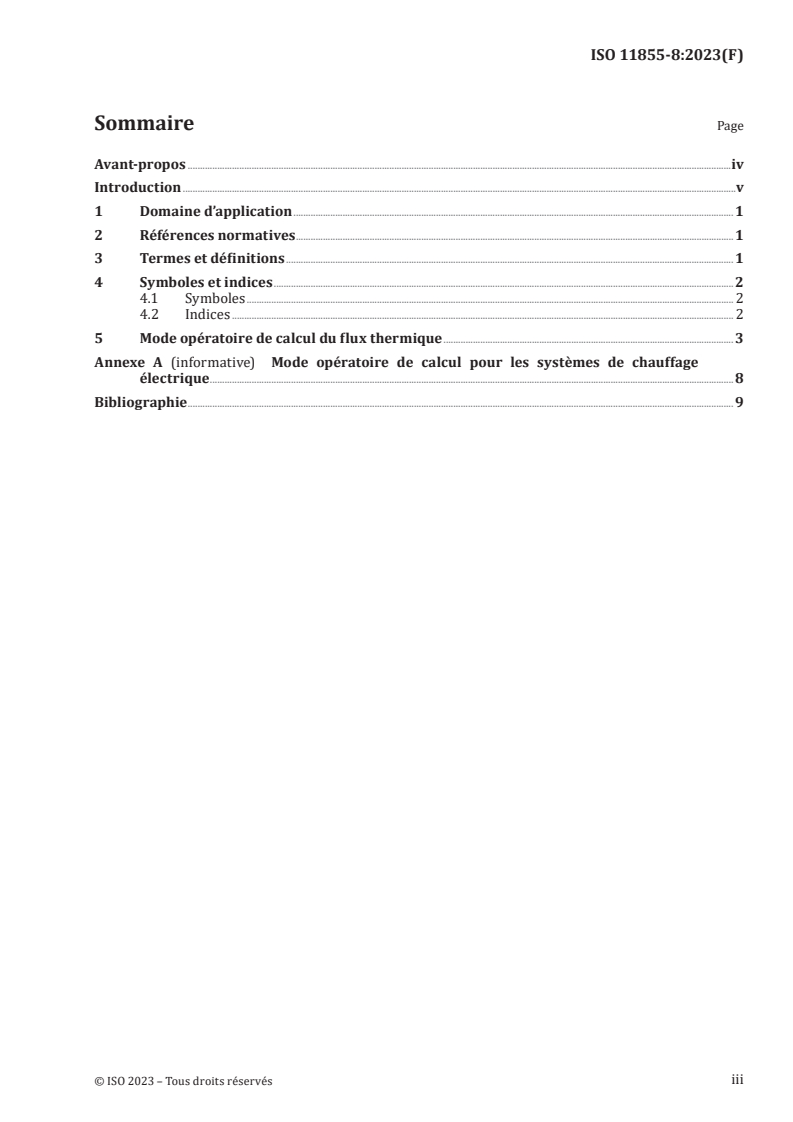
Contents Page
Foreword .iv
Introduction .v
1 Scope . 1
2 Normative references . 1
3 Terms and definitions . 1
4 Symbols and subscripts . 2
4.1 Symbols . 2
4.2 Subscripts . . 2
5 Calculation procedure of the heat flux . 3
Annex A (informative) Calculation procedure for electrical heating systems .8
Bibliography . 9
iii
Foreword
ISO (the International Organization for Standardization) is a worldwide federation of national standards
bodies (ISO member bodies). The work of preparing International Standards is normally carried out
through ISO technical committees. Each member body interested in a subject for which a technical
committee has been established has the right to be represented on that committee. International
organizations, governmental and non-governmental, in liaison with ISO, also take part in the work.
ISO collaborates closely with the International Electrotechnical Commission (IEC) on all matters of
electrotechnical standardization.
The procedures used to develop this document and those intended for its further maintenance are
described in the ISO/IEC Directives, Part 1. In particular, the different approval criteria needed for the
different types of ISO document should be noted. This document was drafted in accordance with the
editorial rules of the ISO/IEC Directives, Part 2 (see www.iso.org/directives).
ISO draws attention to the possibility that the implementation of this document may involve the use
of (a) patent(s). ISO takes no position concerning the evidence, validity or applicability of any claimed
patent rights in respect thereof. As of the date of publication of this document, ISO had not received
notice of (a) patent(s) which may be required to implement this document. However, implementers are
cautioned that this may not represent the latest information, which may be obtained from the patent
database available at www.iso.org/patents. ISO shall not be held responsible for identifying any or all
such patent rights.
Any trade name used in this document is information given for the convenience of users and does not
constitute an endorsement.
For an explanation of the voluntary nature of standards, the meaning of ISO specific terms and
expressions related to conformity assessment, as well as information about ISO's adherence to
the World Trade Organization (WTO) principles in the Technical Barriers to Trade (TBT), see
www.iso.org/iso/foreword.html.
This document was prepared by Technical Committee ISO/TC 205, Building environment design, in
collaboration with the European Committee for Standardization (CEN) Technical Committee CEN/TC
228, Heating systems and water based cooling systems in buildings, in accordance with the Agreement on
technical cooperation between ISO and CEN (Vienna Agreement).
Any feedback or questions on this document should be directed to the user’s national standards body. A
complete listing of these bodies can be found at www.iso.org/members.html.
.
iv
Introduction
The radiant heating and cooling system consists of heat emitting/absorbing, heat supply, distribution,
and control systems. The ISO 11855 series deals with the embedded surface heating and cooling system
that directly controls heat exchange within the space. It does not include the system equipment itself,
such as heat source, distribution system and controller.
The ISO 11855 series addresses an embedded system that is integrated with the building structure.
Therefore, the panel system with open air gap, which is not integrated with the building structure, is
not covered by this series.
The ISO 11855 series can be applied to systems that use not only water but also other liquids or
electricity as a heating or cooling medium.
The object of the ISO 11855 series is to provide criteria to effectively design embedded systems. To do
this, it presents comfort criteria for the space served by embedded systems, heat output calculation,
dimensioning, dynamic analysis, installation, operation, and control method of embedded systems.
The following is a summary of the ISO 11855 parts:
— ISO 11855-1 specifies the comfort criteria which should be considered in designing embedded
radiant heating and cooling systems, since the main objective of the radiant heating and cooling
system is to satisfy thermal comfort of the occupants.
— ISO 11855-2 provides steady-state calculation methods for determination of the heating and cooling
capacity.
— ISO 11855-3 specifies design and dimensioning methods of radiant heating and cooling systems to
ensure the heating and cooling capacity.
— ISO 11855-4 provides a dimensioning and calculation method to design Thermo Active Building
Systems (TABS) for energy-saving purposes, since radiant heating and cooling systems can reduce
energy consumption and heat source size by using renewable energy.
— ISO 11855-5 addresses the installation process for the system to operate as intended.
— ISO 11855-6 shows a proper control method of the radiant heating and cooling systems to ensure
the maximum performance which was intended in the design stage when the system is actually
being operated in a building.
— ISO 11855-7 presents a calculation method for the product specific input parameters for ISO 52031.
— ISO 11855-8 (this document) presents a calculation method for electrical heating systems.
v
INTERNATIONAL STANDARD ISO 11855-8:2023(E)
Building environment design — Design, dimensioning,
installation and control of embedded radiant heating and
cooling systems —
Part 8:
Electrical heating systems
1 Scope
This document specifies procedures and conditions to enable the heat flux in electrical surface
heating systems to be determined relative to the medium differential temperature for systems. The
determination of thermal performance electrical surface heating systems and their conformity to this
document is carried out by calculation in accordance with design documents and a model. This enables
a uniform assessment and calculation surface heating systems.
The surface temperature and the temperature uniformity of the heated surface, nominal heat flux
density between electrical heated layer and space are given as the result.
The ISO 11855 series is applicable to water based embedded surface heating and cooling systems in
1)
residential, commercial and industrial buildings . The methods apply to systems integrated into the
wall, floor or ceiling
...
NORME ISO
INTERNATIONALE 11855-8
Première édition
2023-12
Conception de l'environnement
des bâtiments — Conception,
dimensionnement, installation et
contrôle des systèmes intégrés de
chauffage et de refroidissement par
rayonnement —
Partie 8:
Systèmes de chauffage électrique
Building environment design — Design, dimensioning, installation
and control of embedded radiant heating and cooling systems —
Part 8: Electrical heating systems
Numéro de référence
DOCUMENT PROTÉGÉ PAR COPYRIGHT
© ISO 2023
Tous droits réservés. Sauf prescription différente ou nécessité dans le contexte de sa mise en œuvre, aucune partie de cette
publication ne peut être reproduite ni utilisée sous quelque forme que ce soit et par aucun procédé, électronique ou mécanique,
y compris la photocopie, ou la diffusion sur l’internet ou sur un intranet, sans autorisation écrite préalable. Une autorisation peut
être demandée à l’ISO à l’adresse ci-après ou au comité membre de l’ISO dans le pays du demandeur.
ISO copyright office
Case postale 401 • Ch. de Blandonnet 8
CH-1214 Vernier, Genève
Tél.: +41 22 749 01 11
E-mail: copyright@iso.org
Web: www.iso.org
Publié en Suisse
ii
Sommaire Page
Avant-propos .iv
Introduction .v
1 Domaine d’application . 1
2 Références normatives .1
3 Termes et définitions . 1
4 Symboles et indices .2
4.1 Symboles . 2
4.2 Indices . 2
5 Mode opératoire de calcul du flux thermique . 3
Annexe A (informative) Mode opératoire de calcul pour les systèmes de chauffage
électrique . 8
Bibliographie . 9
iii
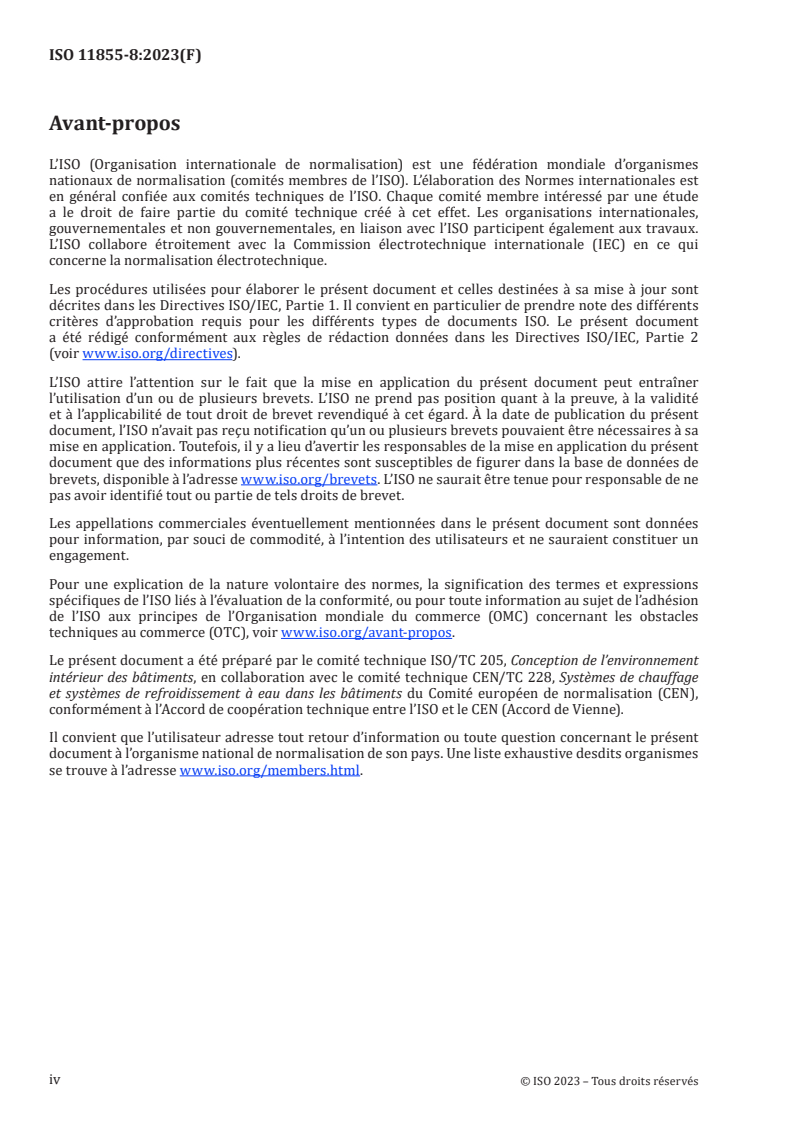
Avant-propos
L’ISO (Organisation internationale de normalisation) est une fédération mondiale d’organismes
nationaux de normalisation (comités membres de l’ISO). L’élaboration des Normes internationales est
en général confiée aux comités techniques de l’ISO. Chaque comité membre intéressé par une étude
a le droit de faire partie du comité technique créé à cet effet. Les organisations internationales,
gouvernementales et non gouvernementales, en liaison avec l’ISO participent également aux travaux.
L’ISO collabore étroitement avec la Commission électrotechnique internationale (IEC) en ce qui
concerne la normalisation électrotechnique.
Les procédures utilisées pour élaborer le présent document et celles destinées à sa mise à jour sont
décrites dans les Directives ISO/IEC, Partie 1. Il convient en particulier de prendre note des différents
critères d’approbation requis pour les différents types de documents ISO. Le présent document
a été rédigé conformément aux règles de rédaction données dans les Directives ISO/IEC, Partie 2
(voir www.iso.org/directives).
L’ISO attire l’attention sur le fait que la mise en application du présent document peut entraîner
l’utilisation d’un ou de plusieurs brevets. L’ISO ne prend pas position quant à la preuve, à la validité
et à l’applicabilité de tout droit de brevet revendiqué à cet égard. À la date de publication du présent
document, l’ISO n’avait pas reçu notification qu’un ou plusieurs brevets pouvaient être nécessaires à sa
mise en application. Toutefois, il y a lieu d’avertir les responsables de la mise en application du présent
document que des informations plus récentes sont susceptibles de figurer dans la base de données de
brevets, disponible à l’adresse www.iso.org/brevets. L’ISO ne saurait être tenue pour responsable de ne
pas avoir identifié tout ou partie de tels droits de brevet.
Les appellations commerciales éventuellement mentionnées dans le présent document sont données
pour information, par souci de commodité, à l’intention des utilisateurs et ne sauraient constituer un
engagement.
Pour une explication de la nature volontaire des normes, la signification des termes et expressions
spécifiques de l’ISO liés à l’évaluation de la conformité, ou pour toute information au sujet de l’adhésion
de l’ISO aux principes de l’Organisation mondiale du commerce (OMC) concernant les obstacles
techniques au commerce (OTC), voir www.iso.org/avant-propos.
Le présent document a été préparé par le comité technique ISO/TC 205, Conception de l’environnement
intérieur des bâtiments, en collaboration avec le comité technique CEN/TC 228, Systèmes de chauffage
et systèmes de refroidissement à eau dans les bâtiments du Comité européen de normalisation (CEN),
conformément à l’Accord de coopération technique entre l’ISO et le CEN (Accord de Vienne).
Il convient que l’utilisateur adresse tout retour d’information ou toute question concernant le présent
document à l’organisme national de normalisation de son pays. Une liste exhaustive desdits organismes
se trouve à l’adresse www.iso.org/members.html.
iv
Introduction
Les systèmes de chauffage et de refroidissement par rayonnement sont constitués de systèmes
d’émission/d’absorption de chaleur, de fourniture de chaleur, de distribution et de contrôle. La série
ISO 11855 concerne les systèmes intégrés de chauffage et de refroidissement de surface qui contrôlent
directement l’échange de chaleur dans les locaux. Elle n’inclut pas l’équipement composant le système
lui-même, tel que la source de chaleur, le système de distribution et le contrôleur.
La série ISO 11855 examine un système intégré dans une structure de bâtiment. Le système de
panneaux avec ouverture à l’air libre, qui n’est pas intégré dans une structure de bâtiment, n’est donc
pas traité par cette série de normes.
La série ISO 11855 est applicable aux systèmes utilisant non seulement de l’eau mais également d’autres
liquides ou de l’électricité en tant que medium de chauffage ou de refroidissement.
L’objectif de la série ISO 11855 est de fournir des critères permettant une conception efficace des
systèmes intégrés. À cet effet, elle présente des critères de confort des locaux desservis par les systèmes
intégrés, et traite du calcul de la puissance calorifique, du dimensionnement, de l’analyse dynamique,
de l’installation, du fonctionnement et de la méthode de contrôle des systèmes intégrés.
Un résumé des différentes parties de l’ISO 11855 est fourni ci-dessous:
— L’ISO 11855-1 spécifie les critères de confort dont il convient de tenir compte lors de la conception
des systèmes intégrés de chauffage et de refroidissement par rayonnement, le principal objectif
d’un système de chauffage et de refroidissement par rayonnement étant de satisfaire au confort
thermique des occupants.
— L’ISO 11855-2 fournit des méthodes de calcul en régime stabilisé pour la détermination de la
puissance calorifique et frigorifique.
— L’ISO 11855-3 spécifie les méthodes de conception et de dimensionnement des systèmes de
chauffage et de refroidissement par rayonnement permettant de garantir la puissance calorifique
et frigorifique.
— L’ISO 11855-4 fournit une méthode de dimensionnement et de calcul pour la conception des systèmes
thermoactifs (TABS) en vue de réaliser des économies d’énergie, les systèmes de chauffage et de
refroidissement par rayonnement permettant de réduire la consommation d’énergie et la taille de la
source de chaleur en utilisant de l’énergie renouvelable.
— L’ISO 11855-5 examine le processus d’installation permettant au système de fonctionner comme
prévu.
— L’ISO 11855-6 présente une méthode de contrôle appropriée des systèmes de chauffage et de
refroidissement par rayonnement, permettant de garantir les performances maximales prévues au
stade de la conception lorsque le système est effectivement exploité dans un bâtiment.
— L’ISO 11855-7 présente une méthode de calcul pour les paramètres d’entrée spécifiques aux produits
pour l’ISO 52031.
— L’ISO 11855-8 (le présent document) fournit une méthode de calcul pour les systèmes de chauffage
électrique.
v
NORME INTERNATIONALE ISO 11855-8:2023(F)
Conception de l'environnement des bâtiments —
Conception, dimensionnement, installation et contrôle des
systèmes intégrés de chauffage et de refroidissement par
rayonnement —
Partie 8:
Systèmes de chauffage électrique
1 Domaine d’application
Le présent document spécifie des modes opératoires et des conditions permettant de déterminer le
flux thermique au sein de systèmes de chauffage électrique de surface par rapport à la température
nominale du medium des systèmes. La détermination des performances thermiques des systèmes de
chauffage électrique de surface et leur conformité au présent document sont déterminées grâce à des
calculs réalisés conformément aux documents de conception et à un modèle. Cela permet une évaluation
et des calculs uniformes concernant les systèmes de chauffage de surface.
Il en résulte la température des surfaces et l’uniformité de la température de la surface chauffée ainsi
que la densité nominale de flux thermique entre la couche chauffée électriquement et les locaux.
La série ISO 11855 s’applique aux systèmes intégrés de chauffage et de refroidissement de surface à
1)
eau dans les bâtiments résidentiels, commerciaux et
...