

ISO/IEC 11179-3:2023
(Main)Information technology — Metadata registries (MDR) — Part 3: Metamodel for registry common facilities
General Information
- Abstract
This document specifies the information to be recorded in a metadata registry in the form of a conceptual data model: — Clause 5 specifies the approach used to model a metadata registry; — Clause 6 specifies the Core Model of the registry, including basic types and classes to be reused in extending the model. The core model defines a generic “registry item”, from which any type of item that needs to registered can be sub-classed; — Clause 7 specifies the metamodel for Identification of registry items; — Clause 8 specifies the metamodel for Designation and Definition of registry items; — Clause 9 specifies the metamodel for Registration of registry items; — Clause 10 specifies the metamodel for Classification of registry items; — Clause 11 specifies the metamodel for Mapping among registry items.
- Status
- Published
- Publication Date
- 15-Jan-2023
- Technical Committee
- ISO/IEC JTC 1/SC 32 - Data management and interchange
- Drafting Committee
- ISO/IEC JTC 1/SC 32/WG 2 - MetaData
- Current Stage
- 6060 - International Standard published
- Start Date
- 16-Jan-2023
- Due Date
- 02-Apr-2023
- Completion Date
- 16-Jan-2023

Overview
ISO/IEC 11179-3:2023 - "Information technology - Metadata registries (MDR) - Part 3: Metamodel for registry common facilities" defines a conceptual metamodel for metadata registries. It specifies the information that must be recorded in an MDR using a conceptual data model and provides a reusable Core Model that defines a generic registry item. The fourth edition (2023) documents modelling conventions, conformance rules and modular packages used to structure registry implementations.
Key Topics and Technical Requirements
The standard is organized into clear clauses that set modelling, conformance and structural requirements:
- Modelling approach (Clause 5): Guidance on applying a metamodel, use of UML packages, class diagrams and extensibility patterns.
- Core Model (Clause 6): Basic and core classes, predefined datatypes (Boolean, Date, Datetime, Integer, String, Text, Phone_Number, Postal_Address, etc.) and reusable constructs for registry item definitions.
- Identification (Clause 7): Metamodel for uniquely identifying registry items (scoped identifiers, namespaces).
- Designation and Definition (Clause 8): Metamodel for names, labels, definitions, naming conventions and language/context-aware designations.
- Registration (Clause 9): Rules and metadata about how items are registered, lifecycle and provenance.
- Classification (Clause 10): Structures for categorizing items, taxonomies and association classes.
- Mapping (Clause 11): Metamodel constructs to express mappings and relationships among registry items.
- Conformance (Clause 4): Levels and profiles for conforming implementations, implementation conformance statements and roles for registration authorities.
The document emphasizes extensibility, clear terminology, and formal specification practices to support interoperable metadata registries.
Practical Applications
ISO/IEC 11179-3:2023 is intended for practical metadata management and semantic interoperability use cases:
- Building and operating metadata registries / data dictionaries for government, finance, health or enterprise environments.
- Designing metadata management solutions that require consistent identification, naming, classification and mapping of data elements.
- Implementing data governance programs that need standard metadata models for provenance, registration and conformance.
- Enabling system integration, API metadata catalogues and semantic mapping tools to exchange metadata reliably.
Who Should Use This Standard
- Metadata architects and data modelers
- Data governance leads and information managers
- Software vendors of metadata registry, catalog and data governance tools
- Standards bodies and registry administrators
Related Standards
- Other parts of the ISO/IEC 11179 series (metadata registry standards) and complementary standards for data quality, vocabularies and semantic interoperability. Use ISO/IEC 11179-3:2023 as the authoritative metamodel when implementing MDR-compliant registries.
Keywords: ISO/IEC 11179-3:2023, metadata registry, MDR metamodel, metadata management, data governance, registry item, identification, designation, classification, mapping.
Relations
- Effective Date
- 04-Nov-2023
- Effective Date
- 29-Jun-2024
- Effective Date
- 23-Apr-2020
- Effective Date
- 23-Apr-2020
Get Certified
Connect with accredited certification bodies for this standard

BSI Group
BSI (British Standards Institution) is the business standards company that helps organizations make excellence a habit.

NYCE
Mexican standards and certification body.
Sponsored listings
Frequently Asked Questions
ISO/IEC 11179-3:2023 is a standard published by the International Organization for Standardization (ISO). Its full title is "Information technology — Metadata registries (MDR) — Part 3: Metamodel for registry common facilities". This standard covers: This document specifies the information to be recorded in a metadata registry in the form of a conceptual data model: — Clause 5 specifies the approach used to model a metadata registry; — Clause 6 specifies the Core Model of the registry, including basic types and classes to be reused in extending the model. The core model defines a generic “registry item”, from which any type of item that needs to registered can be sub-classed; — Clause 7 specifies the metamodel for Identification of registry items; — Clause 8 specifies the metamodel for Designation and Definition of registry items; — Clause 9 specifies the metamodel for Registration of registry items; — Clause 10 specifies the metamodel for Classification of registry items; — Clause 11 specifies the metamodel for Mapping among registry items.
This document specifies the information to be recorded in a metadata registry in the form of a conceptual data model: — Clause 5 specifies the approach used to model a metadata registry; — Clause 6 specifies the Core Model of the registry, including basic types and classes to be reused in extending the model. The core model defines a generic “registry item”, from which any type of item that needs to registered can be sub-classed; — Clause 7 specifies the metamodel for Identification of registry items; — Clause 8 specifies the metamodel for Designation and Definition of registry items; — Clause 9 specifies the metamodel for Registration of registry items; — Clause 10 specifies the metamodel for Classification of registry items; — Clause 11 specifies the metamodel for Mapping among registry items.
ISO/IEC 11179-3:2023 is classified under the following ICS (International Classification for Standards) categories: 35.040.50 - Automatic identification and data capture techniques. The ICS classification helps identify the subject area and facilitates finding related standards.
ISO/IEC 11179-3:2023 has the following relationships with other standards: It is inter standard links to ISO 11357-6:2025, ISO/IEC 11179-3:2023/Amd 1:2026, ISO/IEC 11179-3:2013, ISO/IEC 11179-3:2013/Amd 1:2020. Understanding these relationships helps ensure you are using the most current and applicable version of the standard.
ISO/IEC 11179-3:2023 is available in PDF format for immediate download after purchase. The document can be added to your cart and obtained through the secure checkout process. Digital delivery ensures instant access to the complete standard document.
Standards Content (Sample)
INTERNATIONAL ISO/IEC
STANDARD 11179-3
Fourth edition
2023-01
Information technology — Metadata
registries (MDR) —
Part 3:
Metamodel for registry common
facilities
Reference number
© ISO/IEC 2023
© ISO/IEC 2023
All rights reserved. Unless otherwise specified, or required in the context of its implementation, no part of this publication may
be reproduced or utilized otherwise in any form or by any means, electronic or mechanical, including photocopying, or posting on
the internet or an intranet, without prior written permission. Permission can be requested from either ISO at the address below
or ISO’s member body in the country of the requester.
ISO copyright office
CP 401 • Ch. de Blandonnet 8
CH-1214 Vernier, Geneva
Phone: +41 22 749 01 11
Email: copyright@iso.org
Website: www.iso.org
Published in Switzerland
ii
© ISO/IEC 2023 – All rights reserved
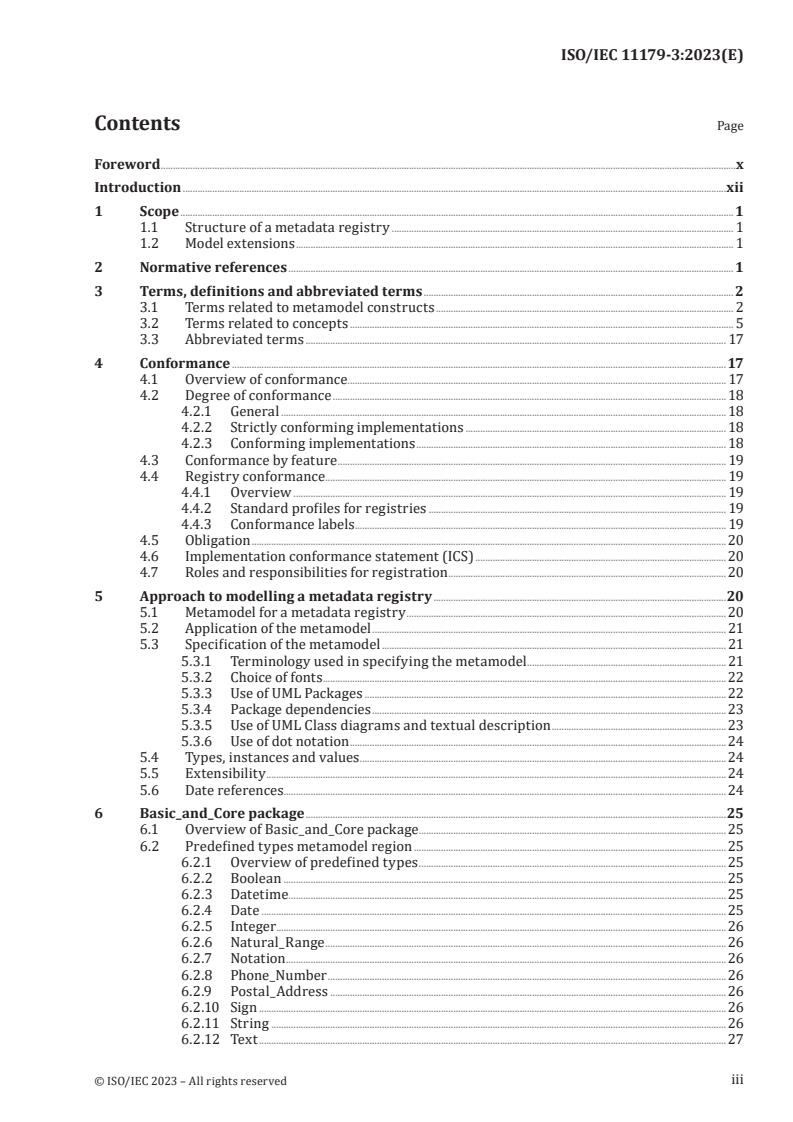
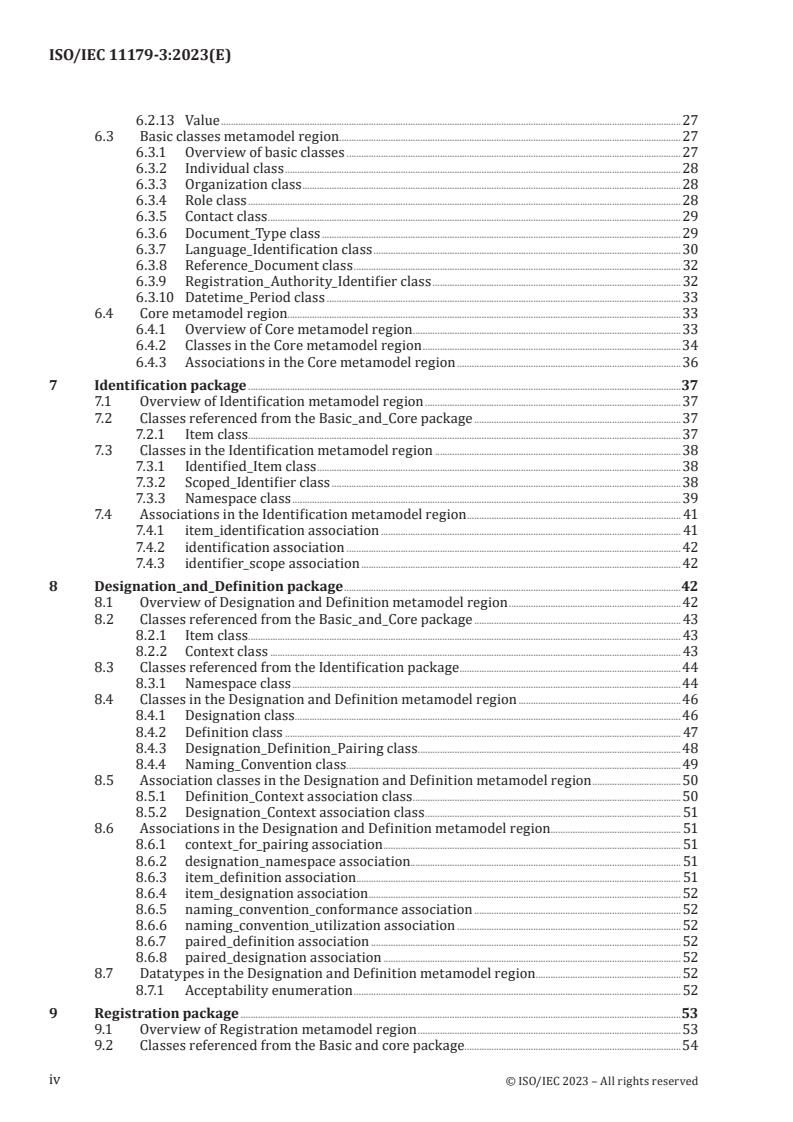
Contents Page
Foreword .x
Introduction .xii
1 Scope . 1
1.1 Structure of a metadata registry . 1
1.2 Model extensions . 1
2 Normative references . 1
3 Terms, definitions and abbreviated terms . 2
3.1 Terms related to metamodel constructs . 2
3.2 Terms related to concepts . 5
3.3 Abbreviated terms . 17
4 Conformance .17
4.1 Overview of conformance . . 17
4.2 Degree of conformance . 18
4.2.1 General . 18
4.2.2 Strictly conforming implementations . 18
4.2.3 Conforming implementations . 18
4.3 Conformance by feature . 19
4.4 Registry conformance . . 19
4.4.1 Overview . 19
4.4.2 Standard profiles for registries . 19
4.4.3 Conformance labels . . 19
4.5 Obligation . 20
4.6 Implementation conformance statement (ICS) . 20
4.7 Roles and responsibilities for registration . 20
5 Approach to modelling a metadata registry .20
5.1 Metamodel for a metadata registry . 20
5.2 Application of the metamodel . 21
5.3 Specification of the metamodel . 21
5.3.1 Terminology used in specifying the metamodel . 21
5.3.2 Choice of fonts .22
5.3.3 Use of UML Packages .22
5.3.4 Package dependencies .23
5.3.5 Use of UML Class diagrams and textual description .23
5.3.6 Use of dot notation . 24
5.4 Types, instances and values . 24
5.5 Extensibility . 24
5.6 Date references. 24
6 Basic_and_Core package .25
6.1 Overview of Basic_and_Core package . 25
6.2 Predefined types metamodel region . 25
6.2.1 Overview of predefined types . 25
6.2.2 Boolean . 25
6.2.3 Datetime . 25
6.2.4 Date . 25
6.2.5 Integer . 26
6.2.6 Natural_Range .26
6.2.7 Notation . 26
6.2.8 Phone_Number .26
6.2.9 Postal_Address . 26
6.2.10 Sign . 26
6.2.11 String . 26
6.2.12 Text . 27
iii
© ISO/IEC 2023 – All rights reserved
6.2.13 Value . 27
6.3 Basic classes metamodel region. 27
6.3.1 Overview of basic classes . 27
6.3.2 Individual class .28
6.3.3 Organization class .28
6.3.4 Role class .28
6.3.5 Contact class . 29
6.3.6 Document_Type class .29
6.3.7 Language_Identification class .30
6.3.8 Reference_Document class . 32
6.3.9 Registration_Authority_Identifier class . 32
6.3.10 Datetime_Period class . 33
6.4 Core metamodel region.33
6.4.1 Overview of Core metamodel region . 33
6.4.2 Classes in the Core metamodel region .34
6.4.3 Associations in the Core metamodel region .36
7 Identification package .37
7.1 Overview of Identification metamodel region . 37
7.2 Classes referenced from the Basic_and_Core package . 37
7.2.1 Item class . 37
7.3 Classes in the Identification metamodel region .38
7.3.1 Identified_Item class .38
7.3.2 Scoped_Identifier class .38
7.3.3 Namespace class . 39
7.4 Associations in the Identification metamodel region . 41
7.4.1 item_identification association . 41
7.4.2 identification association . 42
7.4.3 identifier_scope association . 42
8 Designation_and_Definition package .42
8.1 Overview of Designation and Definition metamodel region . 42
8.2 Classes referenced from the Basic_and_Core package . 43
8.2.1 Item class . 43
8.2.2 Context class . 43
8.3 Classes referenced from the Identification package .44
8.3.1 Namespace class .44
8.4 Classes in the Designation and Definition metamodel region .46
8.4.1 Designation class .46
8.4.2 Definition class . 47
8.4.3 Designation_Definition_Pairing class .48
8.4.4 Naming_Convention class .49
8.5 Association classes in the Designation and Definition metamodel region .50
8.5.1 Definition_Context association class .50
8.5.2 Designation_Context association class . 51
8.6 Associations in the Designation and Definition metamodel region. 51
8.6.1 context_for_pairing association . 51
8.6.2 designation_namespace association. 51
8.6.3 item_definition association . . 51
8.6.4 item_designation association . 52
8.6.5 naming_convention_conformance association . 52
8.6.6 naming_convention_utilization association . 52
8.6.7 paired_definition association . 52
8.6.8 paired_designation association . 52
8.7 Datatypes in the Designation and Definition metamodel region . 52
8.7.1 Acceptability enumeration . 52
9 Registration package .53
9.1 Overview of Registration metamodel region . 53
9.2 Classes referenced from the Basic and core package.54
iv
© ISO/IEC 2023 – All rights reserved
9.2.1 Contact class .54
9.2.2 Organization class .54
9.2.3 Reference_Document class . 55
9.3 Classes referenced from the Identification package . 55
9.3.1 Identified_Item .55
9.3.2 Namespace class . 55
9.4 Classes in the Registration region . 55
9.4.1 Registered_Item class . 55
9.4.2 Administered_Item class.56
9.4.3 Attached_Item class . 57
9.4.4 Registration_State class . .58
9.4.5 Constraint_Set class . 59
9.4.6 Registration_Authority class .60
9.4.7 Registrar class . 61
9.4.8 Stewardship_Record class . 61
9.4.9 Submission_Record class . 62
9.4.10 Registry_Specification class .63
9.5 Associations in the Registration region .66
9.5.1 attachment association.66
9.5.2 reference association.66
9.5.3 registered_item_constraint_set association .66
9.5.4 registration association .66
9.5.5 registration_authority_namespace association . 67
9.5.6 registration_authority_registrar association . 67
9.5.7 stewardship association . 67
9.5.8 submission association . 67
9.6 Datatypes in the Registration metamodel region . 67
9.6.1 Degree_of_Conformance enumeration . 67
9.6.2 Registration_Status enumeration .68
10 Classification package . .69
10.1 Overview of Classification metamodel region . 69
10.2 Classes referenced from the Basic and core package. 70
10.2.1 Item class . 70
10.3 Classes in the Classification metamodel region . 70
10.3.1 Classification_Scheme class . 70
10.3.2 Classification_Scheme_Item class . 71
10.3.3 Classification_Scheme_Item_Relationship class .72
10.3.4 Classification_Scheme_Item_Relationship_Type class . .72
10.4 Associations in the Classification metamodel region .73
10.4.1 item_classification association .73
10.4.2 classification_scheme_membership association .73
10.4.3 subject_classification_scheme_item association .73
10.4.4 object_classification_scheme_item association .73
10.4.5 classification_scheme_item_relationship_categorization association .73
11 Item_Mapping package .74
11.1 Overview of the Item_Mapping metamodel region .74
11.2 Classes referenced from the Basic and core package .74
11.2.1 Item class .74
11.3 Classes in the Mapping metamodel region . 75
11.3.1 Item_Mapping class . 75
11.4 Association Classes in the Mapping metamodel region . 76
11.4.1 Subject_Mapping association class . 76
11.4.2 Object_Mapping association class . 76
11.5 Associations in the Item Mapping metamodel region .77
11.5.1 mapping_hierarchy association .77
11.6 Datatypes in the Mapping metamodel region .77
11.6.1 Item_Mapping_Degree enumeration .77
v
© ISO/IEC 2023 – All rights reserved
Annex A (informative) Consolidated class hierarchy .79
Annex B (informative) Illustrations of Item_Mapping .80
Annex C (informative) Example of Registering a simple Conceptual Domain .91
Bibliography .96
vi
© ISO/IEC 2023 – All rights reserved
List of Figures
Figure 1 — Package dependencies .23
Figure 2 — Predefined types metamodel region .25
Figure 3 — Basic classes metamodel region .27
Figure 4 — Core metamodel region .34
Figure 5 — Identification metamodel region .37
Figure 6 — Designation and Definition metamodel region .42
Figure 7 — Registration metamodel region .54
Figure 8 — Classification metamodel region.69
Figure 9 — Item mapping .74
Figure A.1 — Consolidated class hierarchy .79
Figure B.1 — Object Diagram for the ‘same as’ mapping example .81
Figure B.2 — Object Diagram for the ‘derived from’ mapping example .82
Figure B.3 — Example UML Class Diagram for the Product Supplier concept (as used by
System A) .84
Figure B.4 — Example IDEF1X Model for the Product Supplier concept (as used by System
B) .84
Figure B.5 — Object Diagram for the ‘semantically equivalent’ mapping example .85
Figure B.6 — Object Diagram for the ‘semantically similar’ mapping example .89
Figure C.1 — Example object model of Conceptual Domain registration .92
vii
© ISO/IEC 2023 – All rights reserved
List of Tables
Table 1 — Attributes of Individual class .28
Table 2 — Attributes of Organization class .28
Table 3 — Attributes of Role class .29
Table 4 — Attributes of Contact class .29
Table 5 — Attributes of Document_Type class .30
Table 6 — Attributes of Language_Identification class .30
Table 7 — Attributes of Reference_Document class .32
Table 8 — Attributes of Registration_Authority_Identifier class.33
Table 9 — Attributes of Datetime_Period class .33
Table 10 — Attributes of Concept class .35
Table 11 — Attributes of Slot class .36
Table 12 — Attributes of Scoped_Identifier class .38
Table 13 — Attributes of Namespace class .40
Table 14 — Attributes of Designation class .46
Table 15 — Attributes of Definition class .48
Table 16 — Attributes of Designation_Definition_Pairing class .49
Table 17 — Attributes of Naming_Convention class .49
Table 18 — Attributes of Definition_Context association class.51
Table 19 — Attributes of Designation_Context association class.51
Table 20 — Enumeration of Acceptability ratings .53
Table 21 — Attributes of Administered_Item class .56
Table 22 — Attributes of Registration_State class .58
Table 23 — Attributes of Constraint_Set class .60
Table 24 — Attributes of Registration_Authority class .61
Table 25 — Attributes of Registrar class .61
Table 26 — Attributes of Stewardship_Record class .62
Table 27 — Attributes of Submission_Record class .63
Table 28 — Attributes of Registry_Specification class .63
Table 29 — Enumeration of Degree_of_Conformance .68
Table 30 — Enumeration of Registration Statuses .68
Table 31 — Attributes of Classification_Scheme_Item class .71
Table 32 — Attributes of Item_Mapping class.75
Table 33 — Attributes of Subject_Mapping association class .76
Table 34 — Attributes of Object_Mapping association class .77
Table 35 — Enumeration of Item_Mapping_Degree values .77
Table B.1 — Examples of Mapping Degree usage .80
Table B.2 — Table of Items used in ‘same as’ example .81
Table B.3 — Item_Mapping for 'Birth Date_Mapping' .81
viii
© ISO/IEC 2023 – All rights reserved
Table B.4 — Table of Items used in ‘derived_from’ example .81
Table B.5 — Item_Mapping class 'isodate_mapping1'.82
Table B.6 — Table of Subject_Mappings for isodate_mapping1 .83
Table B.7 — Table of Object_Mappings for isodate_mapping1 .83
Table B.8 — Item_Mapping class 'isodate_mapping2' .83
Table B.9 — Table of Subject_Mappings for isodate_mapping2 .83
Table B.10 — Table of Object_Mappings for isodate_mapping2 .83
Table B.11 — Table of Items used in this example .84
Table B.12 — Table of Item_Mappings for this example .86
Table B.13 — Table of Mapping_Hierarchy associations .86
Table B.14 — Table of Items used in this example .87
Table B.15 — Table of Item_Mappings for this example.90
Table B.16 — Table of Mapping_Hierarchy association .90
ix
© ISO/IEC 2023 – All rights reserved
Foreword
ISO (the International Organization for Standardization) and IEC (the International Electrotechnical
Commission) form the specialized system for worldwide standardization. National bodies that are
members of ISO or IEC participate in the development of International Standards through technical
committees established by the respective organization to deal with particular fields of technical
activity. ISO and IEC technical committees collaborate in fields of mutual interest. Other international
organizations, governmental and non-governmental, in liaison with ISO and IEC, also take part in the
work.
The procedures used to develop this document and those intended for its further maintenance
are described in the ISO/IEC Directives, Part 1. In particular, the different approval criteria
needed for the different types of document should be noted. This document was drafted in
accordance with the editorial rules of the ISO/IEC Directives, Part 2 (see www.iso.org/directives or
www.iec.ch/members_experts/refdocs).
Attention is drawn to the possibility that some of the elements of this document may be the subject
of patent rights. ISO and IEC shall not be held responsible for identifying any or all such patent
rights. Details of any patent rights identified during the development of the document will be in the
Introduction and/or on the ISO list of patent declarations received (see www.iso.org/patents) or the IEC
list of patent declarations received (see https://patents.iec.ch).
Any trade name used in this document is information given for the convenience of users and does not
constitute an endorsement.
For an explanation of the voluntary nature of standards, the meaning of ISO specific terms and
expressions related to conformity assessment, as well as information about ISO's adherence to
the World Trade Organization (WTO) principles in the Technical Barriers to Trade (TBT) see
www.iso.org/iso/foreword.html. In the IEC, see www.iec.ch/underst
...