

ISO 21876:2020
(Main)Machinery for forestry — Saw chain shot protective windows — Test method and performance criteria
General Information
- Abstract
This document specifies a test method and corresponding performance requirements for saw chain shot protective windows on forestry machines equipped with a chain saw for cutting, harvesting or processing as defined in ISO 6814. It also applies to machines that have been modified to perform cutting, harvesting or processing (such as excavator) with a chain saw cutting attachment.
- Status
- Published
- Publication Date
- 24-Sep-2020
- Technical Committee
- ISO/TC 23/SC 15 - Machinery for forestry
- Drafting Committee
- ISO/TC 23/SC 15 - Machinery for forestry
- Current Stage
- 9093 - International Standard confirmed
- Start Date
- 26-Feb-2026
- Completion Date
- 29-Aug-2026
Buy Documents


ISO 21876:2020 - Machinery for forestry -- Saw chain shot protective windows -- Test method and performance criteria
ISO 21876:2020 - Machinery for forestry — Saw chain shot protective windows — Test method and performance criteria/25/2020
Overview
ISO 21876:2020 - Machinery for forestry: Saw chain shot protective windows - specifies a test method and performance criteria for protective windows fitted to forestry machines that use a chain saw (including modified machines with chain saw attachments). The standard defines how to simulate a saw chain break and measure whether a protective window prevents high‑speed saw chain shots from passing through to protect operators and bystanders.
Key topics and requirements
- Test apparatus and setup: Uses a rig (per ISO 11837 or equivalent) to generate saw chain shots with the saw casing removed; includes a drive unit capable of maintaining saw chain speed and a protective enclosure for safety.
- Cutting attachment parameters: Defines guide bar selection (longest recommended bar), saw chain pitch, number of drive links and a test saw chain speed equal to 1.2× the maximum no‑load speed recommended by the cutting attachment manufacturer.
- Measurement and instrumentation:
- Two shot measurement panels (200 mm ± 2 mm apart) to calculate shot speed and vector.
- Shot indication panel positioned 75 mm ± 2 mm behind the window sample.
- Angle and speed measurement tolerances (shot angle measured to ±1°, speed control ±2 m/s, drive shaft speed uncertainty ±1%).
- Test samples and conditioning:
- Window test sample dimensions: 360 mm ± 20 mm by 1 000 mm ± 20 mm, flat and mounted to limit deflection.
- Test temperature: 20 °C ± 2 °C measured at mid‑thickness; samples preconditioned to homogenous temperature.
- Procedure controls: Pre‑calibration (10 runs without sample), saw chain stopping device positioning, repeatability criteria (shot occurrence and angle consistency) and a specified number of test runs.
- Ancillary requirements: Labelling, test reporting and use of a saw chain stopping device (Annex A). Protective enclosure and safety warnings are mandated.
Applications and practical value
ISO 21876:2020 is used to:
- Validate and certify protective windows for harvester heads, grip saws, carriers and retrofitted machines (e.g., excavators with chain saw attachments).
- Support product development and design verification for manufacturers of forestry machinery glass, polymer windows and guarding systems.
- Provide testing protocols for independent laboratories and compliance bodies to assess operator safety against saw chain shots.
- Inform risk assessments and procurement specifications for forestry operators, fleet managers and safety engineers.
Who should use this standard
- Forestry machine and cutting‑attachment manufacturers
- Component suppliers (transparent protective materials and glazing)
- Test laboratories and certification bodies
- Safety engineers, technical compliance teams and procurement specialists in forestry operations
Related standards
- ISO 11837 - Saw chain shot guarding systems (test method)
- ISO 6814 - Definitions for chain saw‑equipped forestry machines
- ISO 536 - Paper grammage (referenced for indication panels)
- EN 13984 - Plastic/rubber vapour control layers (materials reference)
Keywords: ISO 21876:2020, saw chain shot protective windows, forestry machinery safety, test method, performance criteria, saw chain shot, guide bar, cutting attachment, protective window testing.
Buy Documents
ISO 21876:2020 - Machinery for forestry -- Saw chain shot protective windows -- Test method and performance criteria
ISO 21876:2020 - Machinery for forestry — Saw chain shot protective windows — Test method and performance criteria/25/2020
Get Certified
Connect with accredited certification bodies for this standard

Control Union Certifications
Global certification for agriculture and sustainability.

ECOCERT
Organic and sustainability certification.

FSC International
Forest Stewardship Council certification.
Sponsored listings
Frequently Asked Questions
ISO 21876:2020 is a standard published by the International Organization for Standardization (ISO). Its full title is "Machinery for forestry — Saw chain shot protective windows — Test method and performance criteria". This standard covers: This document specifies a test method and corresponding performance requirements for saw chain shot protective windows on forestry machines equipped with a chain saw for cutting, harvesting or processing as defined in ISO 6814. It also applies to machines that have been modified to perform cutting, harvesting or processing (such as excavator) with a chain saw cutting attachment.
This document specifies a test method and corresponding performance requirements for saw chain shot protective windows on forestry machines equipped with a chain saw for cutting, harvesting or processing as defined in ISO 6814. It also applies to machines that have been modified to perform cutting, harvesting or processing (such as excavator) with a chain saw cutting attachment.
ISO 21876:2020 is classified under the following ICS (International Classification for Standards) categories: 65.060.80 - Forestry equipment. The ICS classification helps identify the subject area and facilitates finding related standards.
ISO 21876:2020 is available in PDF format for immediate download after purchase. The document can be added to your cart and obtained through the secure checkout process. Digital delivery ensures instant access to the complete standard document.
Standards Content (Sample)
INTERNATIONAL ISO
STANDARD 21876
First edition
2020-09
Machinery for forestry — Saw chain
shot protective windows — Test
method and performance criteria
Machines forestières — Ecran de protection contre la projection
d’éléments de scies à chaîne — Méthodes d'essai et critères de
performance
Reference number
©
ISO 2020
© ISO 2020
All rights reserved. Unless otherwise specified, or required in the context of its implementation, no part of this publication may
be reproduced or utilized otherwise in any form or by any means, electronic or mechanical, including photocopying, or posting
on the internet or an intranet, without prior written permission. Permission can be requested from either ISO at the address
below or ISO’s member body in the country of the requester.
ISO copyright office
CP 401 • Ch. de Blandonnet 8
CH-1214 Vernier, Geneva
Phone: +41 22 749 01 11
Email: copyright@iso.org
Website: www.iso.org
Published in Switzerland
ii © ISO 2020 – All rights reserved
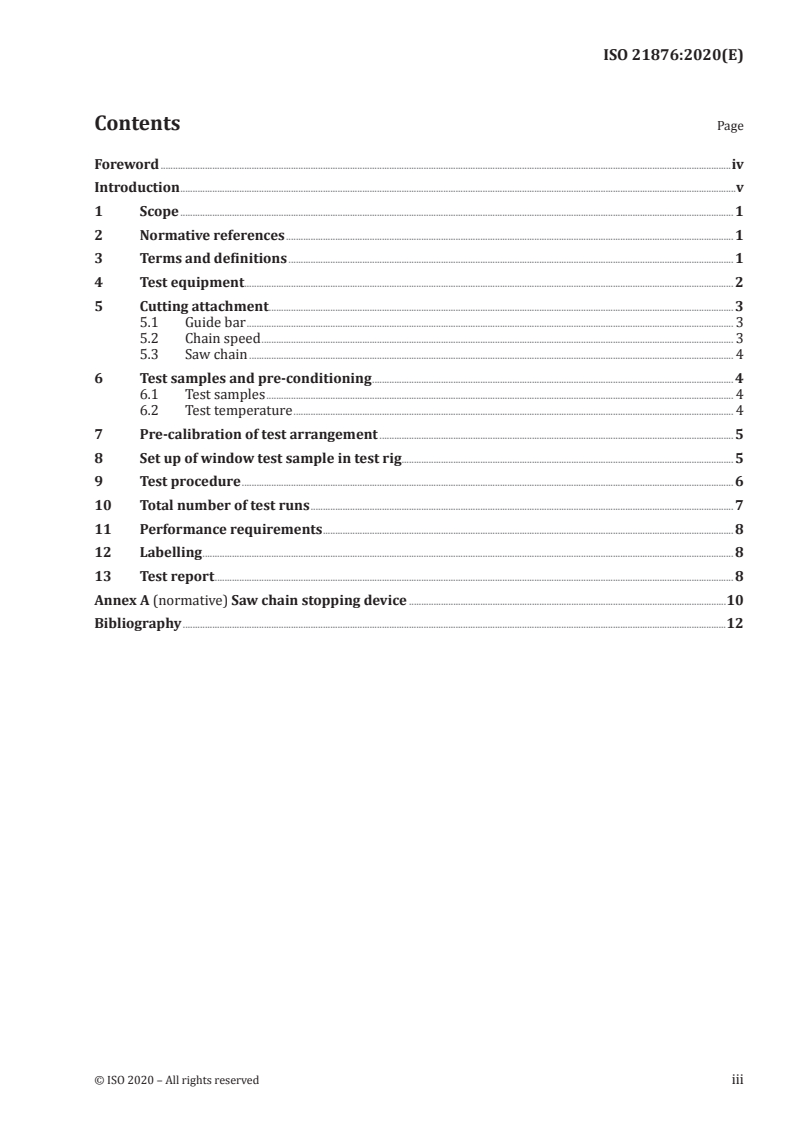
Contents Page
Foreword .iv
Introduction .v
1 Scope . 1
2 Normative references . 1
3 Terms and definitions . 1
4 Test equipment. 2
5 Cutting attachment . 3
5.1 Guide bar . 3
5.2 Chain speed . 3
5.3 Saw chain . 4
6 Test samples and pre-conditioning . 4
6.1 Test samples . 4
6.2 Test temperature . 4
7 Pre-calibration of test arrangement . 5
8 Set up of window test sample in test rig . 5
9 Test procedure . 6
10 Total number of test runs . 7
11 Performance requirements . 8
12 Labelling . 8
13 Test report . 8
Annex A (normative) Saw chain stopping device .10
Bibliography .12
Foreword
ISO (the International Organization for Standardization) is a worldwide federation of national standards
bodies (ISO member bodies). The work of preparing International Standards is normally carried out
through ISO technical committees. Each member body interested in a subject for which a technical
committee has been established has the right to be represented on that committee. International
organizations, governmental and non-governmental, in liaison with ISO, also take part in the work.
ISO collaborates closely with the International Electrotechnical Commission (IEC) on all matters of
electrotechnical standardization.
The procedures used to develop this document and those intended for its further maintenance are
described in the ISO/IEC Directives, Part 1. In particular, the different approval criteria needed for the
different types of ISO documents should be noted. This document was drafted in accordance with the
editorial rules of the ISO/IEC Directives, Part 2 (see www .iso .org/ directives).
Attention is drawn to the possibility that some of the elements of this document may be the subject of
patent rights. ISO shall not be held responsible for identifying any or all such patent rights. Details of
any patent rights identified during the development of the document will be in the Introduction and/or
on the ISO list of patent declarations received (see www .iso .org/ patents).
Any trade name used in this document is information given for the convenience of users and does not
constitute an endorsement.
For an explanation of the voluntary nature of standards, the meaning of ISO specific terms and
expressions related to conformity assessment, as well as information about ISO's adherence to
the World Trade Organization (WTO) principles in the Technical Barriers to Trade (TBT), see
www .iso .org/ iso/ foreword .html.
This document was prepared by Technical Committee ISO/TC 23, Tractors and machinery for agriculture
and forestry, Subcommittee SC 15, Machinery for forestry.
Any feedback or questions on this document should be directed to the user’s national standards body. A
complete listing of these bodies can be found at www .iso .org/ members .html.
iv © ISO 2020 – All rights reserved
Introduction
On the basis of a risk analysis, the types of saw chain breakage can be determined and a saw chain shot
protective window selected that provides protection against these risks.
Saw chain shots can be generated if the saw chain is broken on the upper or lower side of the guide bar
as well as when broken at the nose sprocket. ISO 11837 provides requirements for a saw chain guarding
system that provides protection against saw chain breakage on the cutting (lower) side of the bar.
When a saw chain is broken on the upper side or at the nose sprocket, the guarding system according to
ISO 11837 does not protect from saw chain shots generated in the direction of the guide bar seen from
position of the drive sprocket.
This document establishes a test method and performance criteria for windows intended to provide
protection against saw chain shot.
The test apparatus specified in this document is designed to simulate the situation in which the saw
chain is broken. The end of the saw chain passes the drive sprocket in the guide bar plane. At different
saw chain speeds and combinations of distance to the saw chain breakage, the break force, guide bar
geometry and saw chain preload will throw the saw chain in a curve, producing a whiplash that can
create a saw chain shot.
INTERNATIONAL STANDARD ISO 21876:2020(E)
Machinery for forestry — Saw chain shot protective
windows — Test method and performance criteria
CAUTION — The test method specified in this document involves the use of processes which can
lead to a hazardous situation. The test creates saw chain shots. Under no circumstances shall
the test be performed without the protective enclosure for the test apparatus in place. The
protective enclosure is only to be removed when rotating parts are standing still.
1 Scope
This document specifies a test method and corresponding performance requirements for saw chain
shot protective windows on forestry machines equipped with a chain saw for cutting, harvesting or
processing as defined in ISO 6814. It also applies to machines that have been modified to perform
cutting, harvesting or processing (such as excavator) with a chain saw cutting attachment.
2 Normative references
The following documents are referred to in the text in such a way that some or all of their content
constitutes requirements of this document. For dated references, only the edition cited applies. For
undated references, the latest edition of the referenced document (including any amendments) applies.
ISO 536, Paper and board — Determination of grammage
ISO 11837, Machinery for forestry — Saw chain shot guarding systems — Test method and performance
criteria
EN 13984, Flexible sheets for waterproofing — Plastic and rubber vapour control layers — Definitions and
characteristics
3 Terms and definitions
For the purposes of this document, the following terms and definitions apply.
ISO and IEC maintain terminological databases for use in standardization at the following addresses:
— ISO Online browsing platform: available at https:// www .iso .org/ obp
— IEC Electropedia: available at http:// www .electropedia .org/
3.1
saw chain shot
object flying with high speed and consisting of one or more parts (drive links, side links, cutters) of a
broken saw chain
3.2
relevant saw chain shot
saw chain shot (3.1)
— consisting of an assembly of one or more pieces of saw chain joined by up to two rivets;
— consisting of no more than one assembly (excluding additional loose parts of saw chain generated
during the breakage event);
— that does not hit the test sample clearly sideways; and
— with shot angle (3.9) of 0° ± 12°.
3.3
maximum saw chain speed
C
highest saw chain speed under no load, recommended for a given combination of cutting attachment
(3.4) and machine
3.4
cutting attachment
combination of saw chain, guide bar and drive sprocket mounted on the harvester head or grip saw
3.5
saw chain shot protective window
window that provides protection to the operator of the forestry machine from saw chain shots (3.1)
generated from a broken saw chain
3.6
shot measurement panels
two planes used for detecting and measuring the saw chain shot (3.1) direction and shot speed
3.7
shot indication panel
plane used for indicating a saw chain shot (3.1) passed through the window test sample
3.8
shot through
saw chain shot (3.1) completely passing through the saw chain shot protective window (3.5) and the shot
indication panel (3.7)
3.9
shot angle
angle between the saw chain shot (3.1) direction and a perpendicular line to the window test sample
Note 1 to entry: See item G in Figure 3.
4 Test equipment
4.1 Test apparatus, as described in ISO 11837 or equivalent, shall be used for generating the saw
chain shots against the window test sample. The saw chain guarding system including saw casing shall
not be attached. A device for mounting the window test sample shall be attached to the test rig.
4.2 Drive unit, shall be capable of maintaining a constant saw chain speed of ±2 m/s during breakage,
taking into account the increased force involved in the breakage of the saw chain.
NOTE One way to accommodate this is using an electric motor (15 kW and 50 r/s) with a belt transmission
gearing up the speed four times and with a flywheel mass of 15 kg mounted on the drive shaft (360 mm in
diameter and 19 mm in thickness).
4.3 Saw chain speed control, shall be possible to run and adjust the saw chain speed with a maximum
tolerance of ±2 m/s.
4.4 Drive shaft speed measurement, used to verify the saw chain speed with a maximum uncertainty
of ±1,0 % of the reading.
4.5 Saw chain lubrication system, shall lubricate the saw chain.
4.6 Saw chain stopping device, as specified in Annex A or an equivalent means.
2 © ISO 2020 – All rights reserved
4.7 Protective window test sample fixture, shot indicat
...
INTERNATIONAL ISO
STANDARD 21876
First edition
2020-09
Machinery for forestry — Saw chain
shot protective windows — Test
method and performance criteria
Machines forestières — Ecran de protection contre la projection
d’éléments de scies à chaîne — Méthodes d'essai et critères de
performance
Reference number
©
ISO 2020
© ISO 2020
All rights reserved. Unless otherwise specified, or required in the context of its implementation, no part of this publication may
be reproduced or utilized otherwise in any form or by any means, electronic or mechanical, including photocopying, or posting
on the internet or an intranet, without prior written permission. Permission can be requested from either ISO at the address
below or ISO’s member body in the country of the requester.
ISO copyright office
CP 401 • Ch. de Blandonnet 8
CH-1214 Vernier, Geneva
Phone: +41 22 749 01 11
Email: copyright@iso.org
Website: www.iso.org
Published in Switzerland
ii © ISO 2020 – All rights reserved
Contents Page
Foreword .iv
Introduction .v
1 Scope . 1
2 Normative references . 1
3 Terms and definitions . 1
4 Test equipment. 2
5 Cutting attachment . 3
5.1 Guide bar . 3
5.2 Chain speed . 3
5.3 Saw chain . 4
6 Test samples and pre-conditioning . 4
6.1 Test samples . 4
6.2 Test temperature . 4
7 Pre-calibration of test arrangement . 5
8 Set up of window test sample in test rig . 5
9 Test procedure . 6
10 Total number of test runs . 7
11 Performance requirements . 8
12 Labelling . 8
13 Test report . 8
Annex A (normative) Saw chain stopping device .10
Bibliography .12
Foreword
ISO (the International Organization for Standardization) is a worldwide federation of national standards
bodies (ISO member bodies). The work of preparing International Standards is normally carried out
through ISO technical committees. Each member body interested in a subject for which a technical
committee has been established has the right to be represented on that committee. International
organizations, governmental and non-governmental, in liaison with ISO, also take part in the work.
ISO collaborates closely with the International Electrotechnical Commission (IEC) on all matters of
electrotechnical standardization.
The procedures used to develop this document and those intended for its further maintenance are
described in the ISO/IEC Directives, Part 1. In particular, the different approval criteria needed for the
different types of ISO documents should be noted. This document was drafted in accordance with the
editorial rules of the ISO/IEC Directives, Part 2 (see www .iso .org/ directives).
Attention is drawn to the possibility that some of the elements of this document may be the subject of
patent rights. ISO shall not be held responsible for identifying any or all such patent rights. Details of
any patent rights identified during the development of the document will be in the Introduction and/or
on the ISO list of patent declarations received (see www .iso .org/ patents).
Any trade name used in this document is information given for the convenience of users and does not
constitute an endorsement.
For an explanation of the voluntary nature of standards, the meaning of ISO specific terms and
expressions related to conformity assessment, as well as information about ISO's adherence to
the World Trade Organization (WTO) principles in the Technical Barriers to Trade (TBT), see
www .iso .org/ iso/ foreword .html.
This document was prepared by Technical Committee ISO/TC 23, Tractors and machinery for agriculture
and forestry, Subcommittee SC 15, Machinery for forestry.
Any feedback or questions on this document should be directed to the user’s national standards body. A
complete listing of these bodies can be found at www .iso .org/ members .html.
iv © ISO 2020 – All rights reserved
Introduction
On the basis of a risk analysis, the types of saw chain breakage can be determined and a saw chain shot
protective window selected that provides protection against these risks.
Saw chain shots can be generated if the saw chain is broken on the upper or lower side of the guide bar
as well as when broken at the nose sprocket. ISO 11837 provides requirements for a saw chain guarding
system that provides protection against saw chain breakage on the cutting (lower) side of the bar.
When a saw chain is broken on the upper side or at the nose sprocket, the guarding system according to
ISO 11837 does not protect from saw chain shots generated in the direction of the guide bar seen from
position of the drive sprocket.
This document establishes a test method and performance criteria for windows intended to provide
protection against saw chain shot.
The test apparatus specified in this document is designed to simulate the situation in which the saw
chain is broken. The end of the saw chain passes the drive sprocket in the guide bar plane. At different
saw chain speeds and combinations of distance to the saw chain breakage, the break force, guide bar
geometry and saw chain preload will throw the saw chain in a curve, producing a whiplash that can
create a saw chain shot.
INTERNATIONAL STANDARD ISO 21876:2020(E)
Machinery for forestry — Saw chain shot protective
windows — Test method and performance criteria
CAUTION — The test method specified in this document involves the use of processes which can
lead to a hazardous situation. The test creates saw chain shots. Under no circumstances shall
the test be performed without the protective enclosure for the test apparatus in place. The
protective enclosure is only to be removed when rotating parts are standing still.
1 Scope
This document specifies a test method and corresponding performance requirements for saw chain
shot protective windows on forestry machines equipped with a chain saw for cutting, harvesting or
processing as defined in ISO 6814. It also applies to machines that have been modified to perform
cutting, harvesting or processing (such as excavator) with a chain saw cutting attachment.
2 Normative references
The following documents are referred to in the text in such a way that some or all of their content
constitutes requirements of this document. For dated references, only the edition cited applies. For
undated references, the latest edition of the referenced document (including any amendments) applies.
ISO 536, Paper and board — Determination of grammage
ISO 11837, Machinery for forestry — Saw chain shot guarding systems — Test method and performance
criteria
EN 13984, Flexible sheets for waterproofing — Plastic and rubber vapour control layers — Definitions and
characteristics
3 Terms and definitions
For the purposes of this document, the following terms and definitions apply.
ISO and IEC maintain terminological databases for use in standardization at the following addresses:
— ISO Online browsing platform: available at https:// www .iso .org/ obp
— IEC Electropedia: available at http:// www .electropedia .org/
3.1
saw chain shot
object flying with high speed and consisting of one or more parts (drive links, side links, cutters) of a
broken saw chain
3.2
relevant saw chain shot
saw chain shot (3.1)
— consisting of an assembly of one or more pieces of saw chain joined by up to two rivets;
— consisting of no more than one assembly (excluding additional loose parts of saw chain generated
during the breakage event);
— that does not hit the test sample clearly sideways; and
— with shot angle (3.9) of 0° ± 12°.
3.3
maximum saw chain speed
C
highest saw chain speed under no load, recommended for a given combination of cutting attachment
(3.4) and machine
3.4
cutting attachment
combination of saw chain, guide bar and drive sprocket mounted on the harvester head or grip saw
3.5
saw chain shot protective window
window that provides protection to the operator of the forestry machine from saw chain shots (3.1)
generated from a broken saw chain
3.6
shot measurement panels
two planes used for detecting and measuring the saw chain shot (3.1) direction and shot speed
3.7
shot indication panel
plane used for indicating a saw chain shot (3.1) passed through the window test sample
3.8
shot through
saw chain shot (3.1) completely passing through the saw chain shot protective window (3.5) and the shot
indication panel (3.7)
3.9
shot angle
angle between the saw chain shot (3.1) direction and a perpendicular line to the window test sample
Note 1 to entry: See item G in Figure 3.
4 Test equipment
4.1 Test apparatus, as described in ISO 11837 or equivalent, shall be used for generating the saw
chain shots against the window test sample. The saw chain guarding system including saw casing shall
not be attached. A device for mounting the window test sample shall be attached to the test rig.
4.2 Drive unit, shall be capable of maintaining a constant saw chain speed of ±2 m/s during breakage,
taking into account the increased force involved in the breakage of the saw chain.
NOTE One way to accommodate this is using an electric motor (15 kW and 50 r/s) with a belt transmission
gearing up the speed four times and with a flywheel mass of 15 kg mounted on the drive shaft (360 mm in
diameter and 19 mm in thickness).
4.3 Saw chain speed control, shall be possible to run and adjust the saw chain speed with a maximum
tolerance of ±2 m/s.
4.4 Drive shaft speed measurement, used to verify the saw chain speed with a maximum uncertainty
of ±1,0 % of the reading.
4.5 Saw chain lubrication system, shall lubricate the saw chain.
4.6 Saw chain stopping device, as specified in Annex A or an equivalent means.
2 © ISO 2020 – All rights reserved
4.7 Protective window test sample fixture, shot indicat
...