

ISO 16:1975
(Main)Acoustics — Standard tuning frequency (Standard musical pitch)
General Information
- Abstract
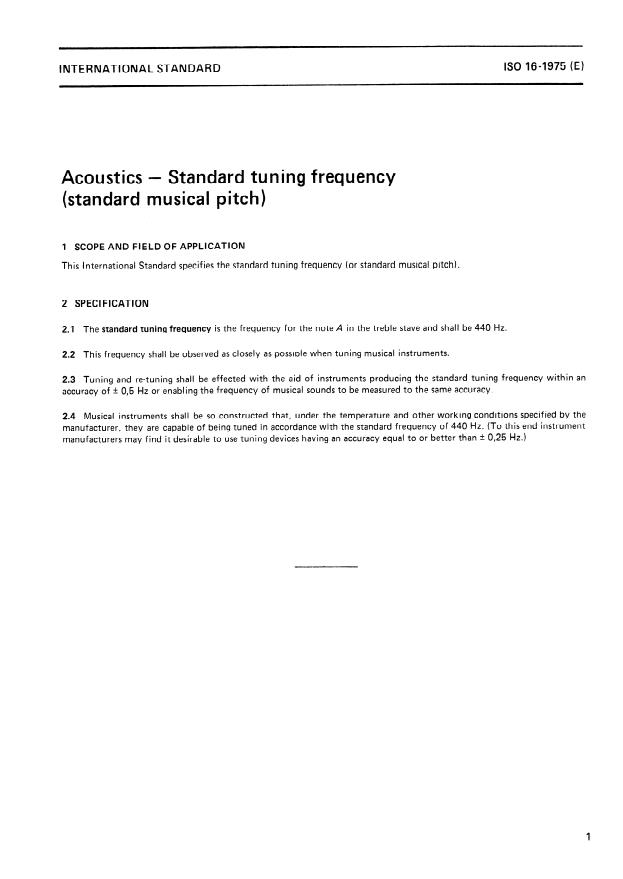
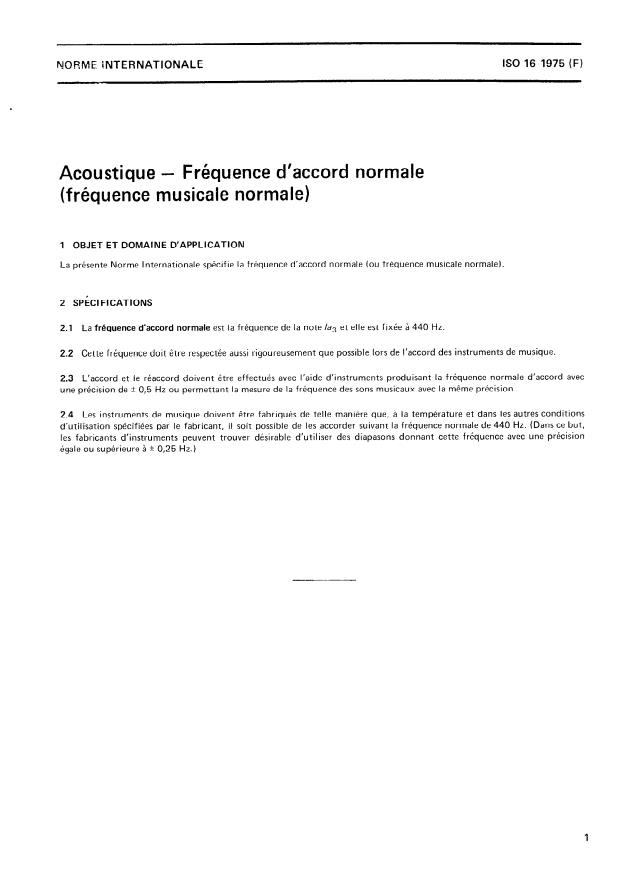
Specifies the frequency for the note A in the treble stave and shall be 440 Hz. Tuning and retuning shall be effected by instruments producing it within an accuracy of 0,5 Hz.
- Status
- Published
- Publication Date
- 31-Dec-1974
- Technical Committee
- ISO/TC 43 - Acoustics
- Drafting Committee
- ISO/TC 43 - Acoustics
- Current Stage
- 9093 - International Standard confirmed
- Start Date
- 30-Sep-2022
- Completion Date
- 29-Aug-2026
Buy Documents

ISO 16:1975 - Acoustics — Standard tuning frequency (Standard musical pitch) Released:1/1/1975

ISO 16:1975 - Acoustique — Fréquence d'accord normale (Fréquence musicale normale) Released:1/1/1975
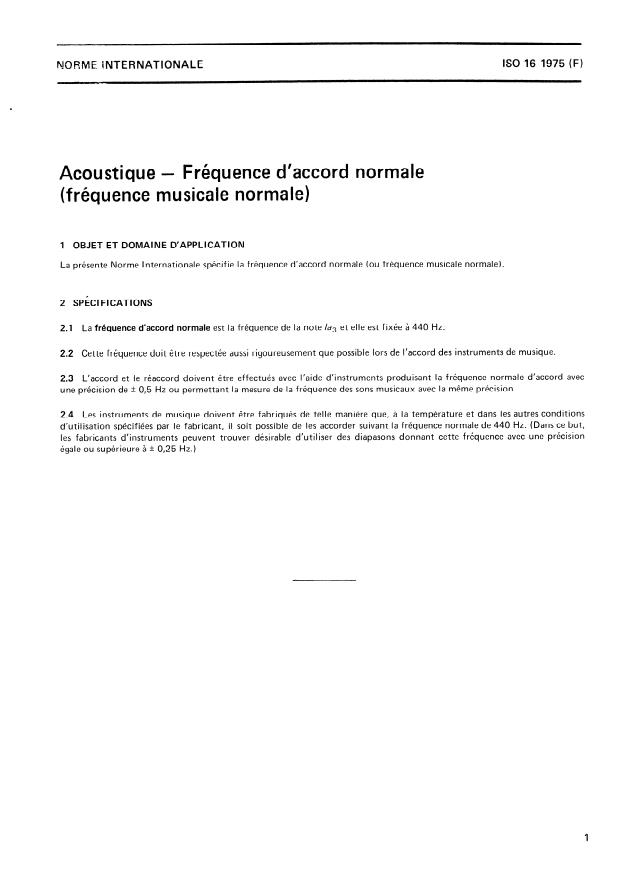

ISO 16:1975 - Acoustique — Fréquence d'accord normale (Fréquence musicale normale) Released:1/1/1975
Overview
ISO 16:1975 is the international standard that specifies the standard tuning frequency for musical instruments. It establishes the recognized reference pitch for the note "A" above middle C, setting it precisely at 440 Hz. This frequency is commonly referred to as the standard musical pitch or concert pitch, and it serves as a foundational benchmark for tuning a wide range of musical instruments worldwide.
Adopted by the International Organization for Standardization (ISO) in 1975, ISO 16 ensures consistency and accuracy in musical tuning across different manufacturers, performers, and audio contexts. The standard facilitates uniformity in musical performances, recordings, and instrument manufacturing by defining a strict tolerance for tuning accuracy.
Key Topics
- Standard Tuning Frequency: Defines the note "A" at 440 Hz on the treble stave.
- Tuning Accuracy: Requires instruments for tuning or retuning to produce or measure frequencies with an accuracy of ±0.5 Hz.
- Instrument Construction: Instruments should be designed to be tunable to 440 Hz under normal conditions, accommodating environmental factors such as temperature.
- Measurement Instruments: Recommends using tuning devices capable of measuring frequencies with even greater precision (±0.25 Hz) for optimal accuracy.
- Scope: Applies to all musical instruments and settings where standard pitch tuning is essential.
- Historical Context: ISO 16 replaced the earlier ISO Recommendation R 16-1955 with technically identical specifications, reflecting international consensus on tuning standards.
Applications
ISO 16:1975 is critical for various practical applications related to music and acoustics:
- Musical Instrument Manufacturing: Ensures that instruments are built to accommodate tuning at 440 Hz, promoting compatibility and standardization globally.
- Music Performance: Enables consistent tuning among ensembles, orchestras, and solo performers, preventing dissonance caused by pitch variation.
- Recording Studios and Audio Engineering: Provides a reliable pitch reference during recording, mixing, and production processes.
- Music Education: Serves as a baseline standard for teaching pitch and tuning techniques.
- Tuning Device Design: Guides manufacturers of electronic and mechanical tuning devices to meet required accuracy levels, improving both professional and amateur musicians' tuning processes.
- Acoustic Research: Offers a defined standard frequency for experiments and studies involving musical pitch and sound frequency.
Related Standards
ISO 16:1975 aligns with and complements other standards and recommendations in the field of acoustics and music technology:
- ISO/IEC Guide 99 (International Vocabulary of Metrology): Provides accuracy and measurement terms relevant for tuning device precision.
- IEC 60065 (Audio and Video Equipment Safety): While focused on safety, it intersects with design elements of electronic tuning devices.
- ITU-R BS.1116 (Performance Standards for Audio Systems): Addresses standards related to audio fidelity which rely on consistent pitch standards.
- ASTM E33 (Standard Terminology Relating to Acoustic Microscopes): Though specialized, it serves along with ISO 16 within the broader context of acoustic measurement.
- National standards on musical pitch and tuning often reference ISO 16 to ensure compatibility and international coherence.
By defining a precise and internationally recognized pitch standard, ISO 16:1975 plays an essential role in maintaining musical harmony, enhancing instrument design, and supporting audio technology advancements. Musicians, instrument makers, tuning device manufacturers, and audio engineers rely on this standard to achieve consistent and accurate tuning worldwide.
Relations
- Effective Date
- 25-Aug-2026
- Effective Date
- 06-Jun-2022
Buy Documents
ISO 16:1975 - Acoustics — Standard tuning frequency (Standard musical pitch) Released:1/1/1975
ISO 16:1975 - Acoustique — Fréquence d'accord normale (Fréquence musicale normale) Released:1/1/1975
ISO 16:1975 - Acoustique — Fréquence d'accord normale (Fréquence musicale normale) Released:1/1/1975
Get Certified
Connect with accredited certification bodies for this standard

BSMI (Bureau of Standards, Metrology and Inspection)
Taiwan's standards and inspection authority.
Sponsored listings
Frequently Asked Questions
ISO 16:1975 is a standard published by the International Organization for Standardization (ISO). Its full title is "Acoustics — Standard tuning frequency (Standard musical pitch)". This standard covers: Specifies the frequency for the note A in the treble stave and shall be 440 Hz. Tuning and retuning shall be effected by instruments producing it within an accuracy of 0,5 Hz.
Specifies the frequency for the note A in the treble stave and shall be 440 Hz. Tuning and retuning shall be effected by instruments producing it within an accuracy of 0,5 Hz.
ISO 16:1975 is classified under the following ICS (International Classification for Standards) categories: 17.140.01 - Acoustic measurements and noise abatement in general. The ICS classification helps identify the subject area and facilitates finding related standards.
ISO 16:1975 has the following relationships with other standards: It is inter standard links to EN ISO 80000-8:2007, ISO 7933:2004. Understanding these relationships helps ensure you are using the most current and applicable version of the standard.
ISO 16:1975 is available in PDF format for immediate download after purchase. The document can be added to your cart and obtained through the secure checkout process. Digital delivery ensures instant access to the complete standard document.
Standards Content (Sample)
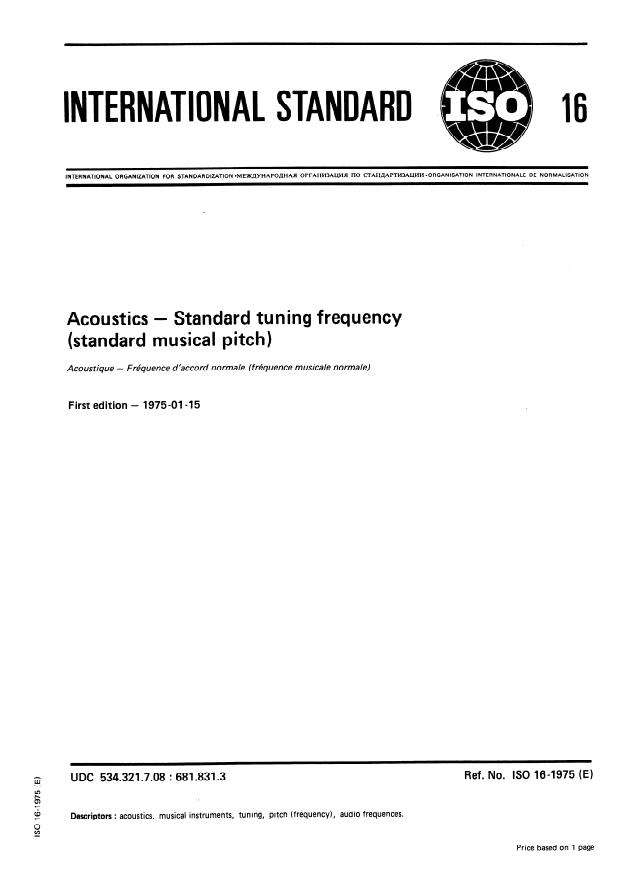
INTERNATIONAL STANDARD .
INTERNATIONAL ORGANIZATION FOR STANDARDIZATION l EXAYHAPOAHAII OP~AHM3AWM I-IO ~AHAAPTM3ALW.I .ORGANISATION INTERNATIONALE DE NORMALISATION
Standard tuning frequency
Acoustics -
(Standard musical pitch)
Acoustique - Frhquence d ‘accord normale (frhquence musicale normale)
First edition - 1975-01-15
Ref. No. ISO 16-1975 (E)
UDC 534.321.7.08 : 681.831.3
Co
musical instruments, tuning, pitch (frequency), audio frequences.
Descriptors : acoustics,
i
Price based on 1 page
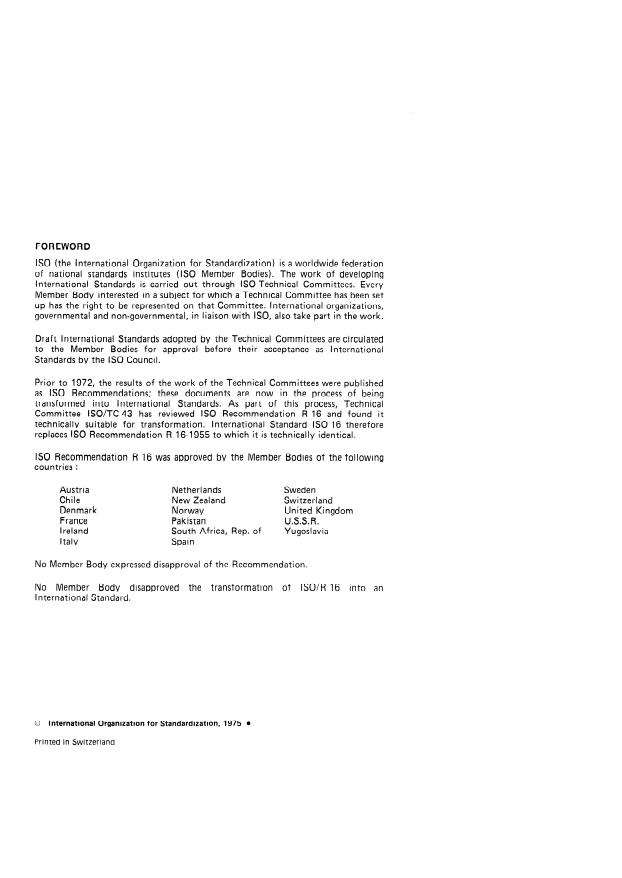
FOREWORD
ISO (the International Organization for Standardization) is a worldwide federation
of national Standards institutes (ISO Member Bodies). The work of developing
International Standards is carried out through ISO Technical Committees. Every
Member Body interested in a subject for which a Technical Committee has been set
up has the right to be represented on that Committee. International organizations,
governmental and non-governmental, in liaison with ISO, also take part in the work.
Draft International Standards adopted by the Technical Committees are circulated
to the Member Bodies for approval before their acceptance as International
Standards by the ISO Council.
Prior to 1972, the results of the work of the Technical Committees were published
as ISO Recommendations; these documents are now in the process of being
transformed into International Standards. As part of this process, Technical
Committee ISO/TC 43 has reviewed ISO Recommendation R 16 and found it
International Standard ISO 16 therefore
technically suitable for transformation.
replaces ISO Recommendation R 16-1955 to which it is technically identical.
ISO Recommendat
...
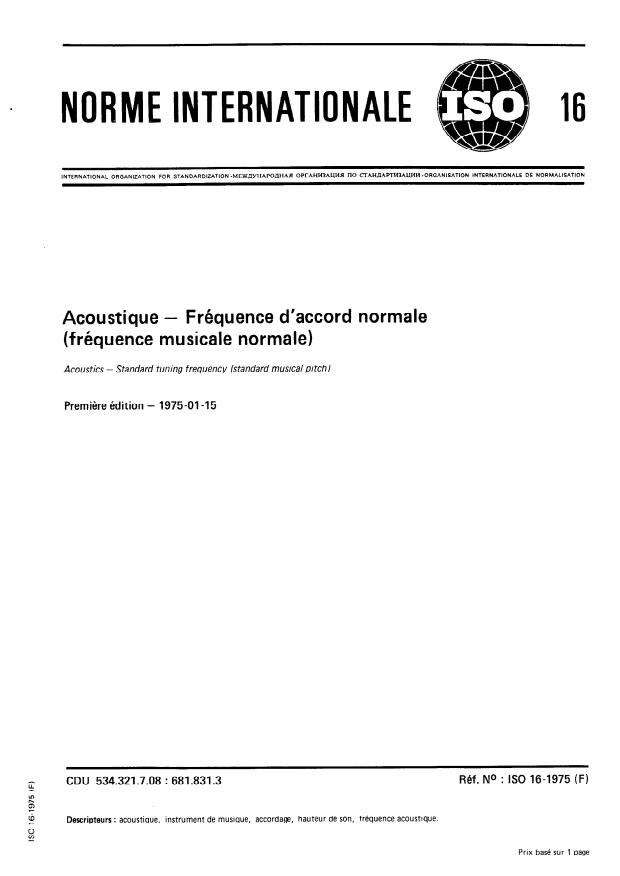
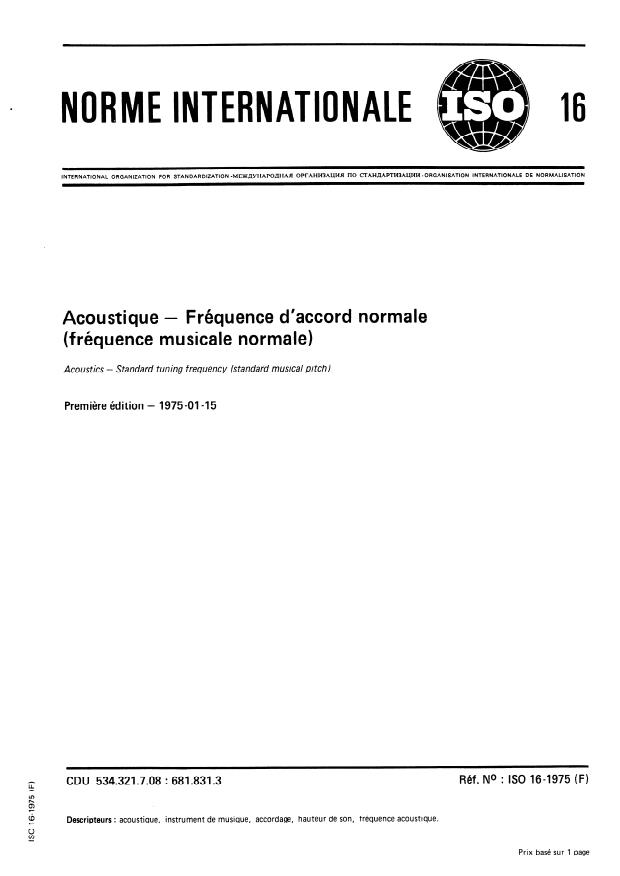
NORME INTERNATIONALE
INTERNATIONAL ORGANIZATION FOR STANDARDIZATION .MEXCAYHAPOAHAII OPrAHW3ALU.W II0 CTAHAAPTW3AWM.ORGANISATION INTERNATIONALE DE NORMALISATION
Acoustique - Fréquence d’accord normale
(fréquence musicale normale)
Acoustics - Standard tuning frequenc y (standard musical pitch)
Première édition - 1975-01-15
Réf. No : ISO 16-1975 (F)
CDU 534.321.7.08 : 681.831.3
îî
instrument de musique, accordage, hauteur de son, fréquence acoustique.
Descripteurs : acoustique,
Prix basé sur 1 page
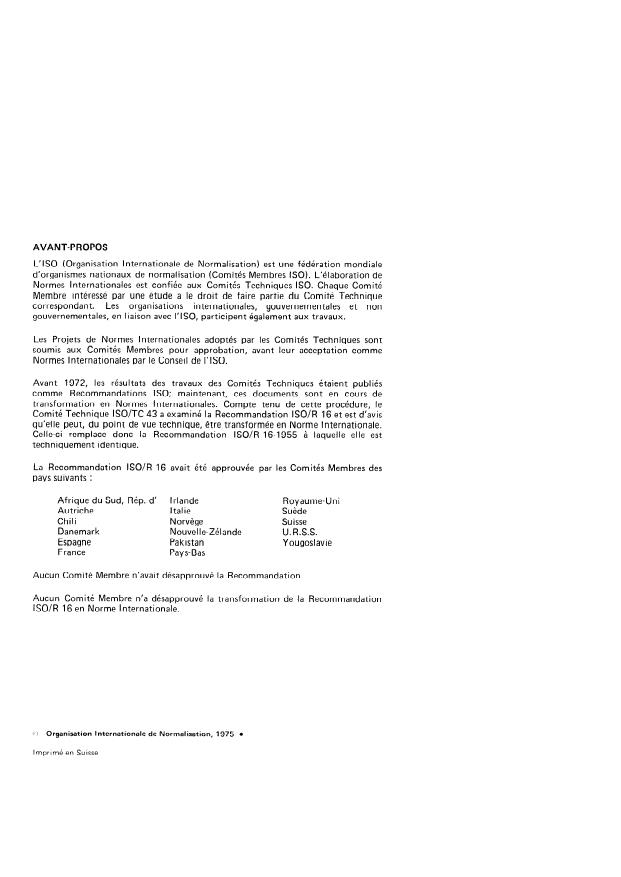
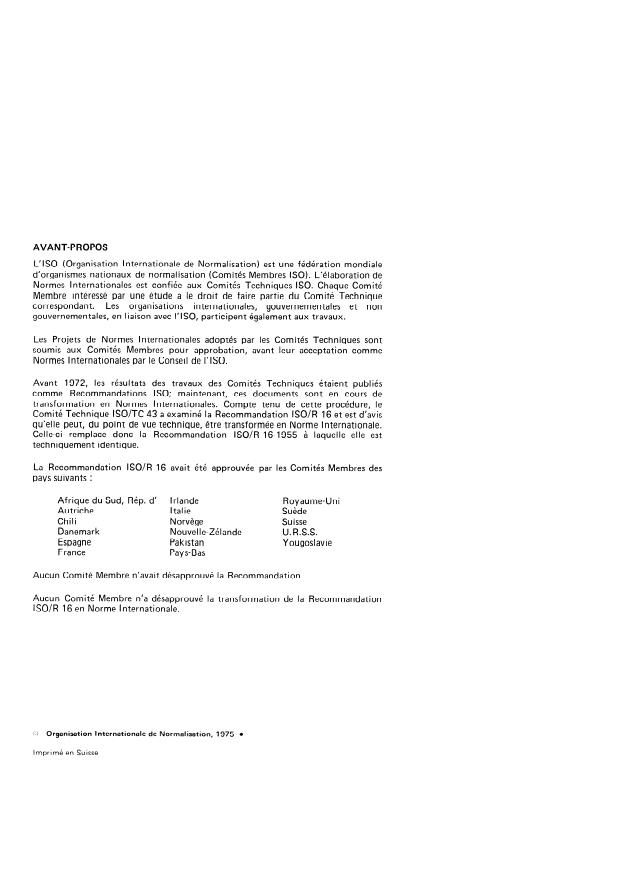
AVANT-PROPOS
L’ISO (Organisation Internationale de Normalisation) est une fédération mondiale
d’organismes nationaux de normalisation (Comités Membres KO). L’élaboration de
Normes Internationales est confiée aux Comités Techniques ISO. Chaque Comité
Membre intéressé par une étude a le droit de faire partie du Comité Technique
correspondant. Les organisations internationales, gouvernementales et non
gouvernementales, en liaison avec I’ISO, participent également aux travaux.
Les Projets de Normes Internationales adoptés par les Comités Techniques sont
soumis aux Comités Membres pour approbation, avant leur acceptation comme
Normes Internationales par le Conseil de I’ISO.
Avant 1972, les résultats des travaux des Comités Techniques étaient publiés
comme Recommandations ISO; maintenant, ces documents sont en cours de
transformation en Normes Internationales. Compte tenu de cette procédure, le
Comité Technique ISO/TC 43 a examiné la Recommandation lSO/R 16 et est d’avis
qu’elle peut, du point de vue technique, être transformée en Norme Internationale.
Celle-ci remplace donc la Recommandation lSO/R 16-1955 à laquelle elle est
techniquement identique.
La Recommandation lSO/R 16 avait été ap
...
NORME INTERNATIONALE
INTERNATIONAL ORGANIZATION FOR STANDARDIZATION .MEXCAYHAPOAHAII OPrAHW3ALU.W II0 CTAHAAPTW3AWM.ORGANISATION INTERNATIONALE DE NORMALISATION
Acoustique - Fréquence d’accord normale
(fréquence musicale normale)
Acoustics - Standard tuning frequenc y (standard musical pitch)
Première édition - 1975-01-15
Réf. No : ISO 16-1975 (F)
CDU 534.321.7.08 : 681.831.3
îî
instrument de musique, accordage, hauteur de son, fréquence acoustique.
Descripteurs : acoustique,
Prix basé sur 1 page
AVANT-PROPOS
L’ISO (Organisation Internationale de Normalisation) est une fédération mondiale
d’organismes nationaux de normalisation (Comités Membres KO). L’élaboration de
Normes Internationales est confiée aux Comités Techniques ISO. Chaque Comité
Membre intéressé par une étude a le droit de faire partie du Comité Technique
correspondant. Les organisations internationales, gouvernementales et non
gouvernementales, en liaison avec I’ISO, participent également aux travaux.
Les Projets de Normes Internationales adoptés par les Comités Techniques sont
soumis aux Comités Membres pour approbation, avant leur acceptation comme
Normes Internationales par le Conseil de I’ISO.
Avant 1972, les résultats des travaux des Comités Techniques étaient publiés
comme Recommandations ISO; maintenant, ces documents sont en cours de
transformation en Normes Internationales. Compte tenu de cette procédure, le
Comité Technique ISO/TC 43 a examiné la Recommandation lSO/R 16 et est d’avis
qu’elle peut, du point de vue technique, être transformée en Norme Internationale.
Celle-ci remplace donc la Recommandation lSO/R 16-1955 à laquelle elle est
techniquement identique.
La Recommandation lSO/R 16 avait été ap
...