


ISO 19107:2003
(Main)Geographic information — Spatial schema
Geographic information — Spatial schema
ISO 19107:2003 specifies conceptual schemas for describing the spatial characteristics of geographic features, and a set of spatial operations consistent with these schemas. It treats vector geometry and topology up to three dimensions. It defines standard spatial operations for use in access, query, management, processing, and data exchange of geographic information for spatial (geometric and topological) objects of up to three topological dimensions embedded in coordinate spaces of up to three axes.
Information géographique — Schéma spatial
Geografske informacije - Prostorska shema
General Information
- Status
- Withdrawn
- Publication Date
- 07-May-2003
- Withdrawal Date
- 07-May-2003
- Technical Committee
- ISO/TC 211 - Geographic information/Geomatics
- Drafting Committee
- ISO/TC 211 - Geographic information/Geomatics
- Current Stage
- 9599 - Withdrawal of International Standard
- Start Date
- 28-Oct-2019
- Completion Date
- 14-Feb-2026
Relations
- Effective Date
- 01-Mar-2014

Get Certified
Connect with accredited certification bodies for this standard

BSI Group
BSI (British Standards Institution) is the business standards company that helps organizations make excellence a habit.

NYCE
Mexican standards and certification body.
Sponsored listings
Frequently Asked Questions
ISO 19107:2003 is a standard published by the International Organization for Standardization (ISO). Its full title is "Geographic information — Spatial schema". This standard covers: ISO 19107:2003 specifies conceptual schemas for describing the spatial characteristics of geographic features, and a set of spatial operations consistent with these schemas. It treats vector geometry and topology up to three dimensions. It defines standard spatial operations for use in access, query, management, processing, and data exchange of geographic information for spatial (geometric and topological) objects of up to three topological dimensions embedded in coordinate spaces of up to three axes.
ISO 19107:2003 specifies conceptual schemas for describing the spatial characteristics of geographic features, and a set of spatial operations consistent with these schemas. It treats vector geometry and topology up to three dimensions. It defines standard spatial operations for use in access, query, management, processing, and data exchange of geographic information for spatial (geometric and topological) objects of up to three topological dimensions embedded in coordinate spaces of up to three axes.
ISO 19107:2003 is classified under the following ICS (International Classification for Standards) categories: 35.240.70 - IT applications in science. The ICS classification helps identify the subject area and facilitates finding related standards.
ISO 19107:2003 has the following relationships with other standards: It is inter standard links to ISO 19107:2019. Understanding these relationships helps ensure you are using the most current and applicable version of the standard.
ISO 19107:2003 is available in PDF format for immediate download after purchase. The document can be added to your cart and obtained through the secure checkout process. Digital delivery ensures instant access to the complete standard document.
Standards Content (Sample)
INTERNATIONAL ISO
STANDARD 19107
First edition
2003-05-01
Geographic information — Spatial
schema
Information géographique — Schéma spatial
Reference number
©
ISO 2003
PDF disclaimer
This PDF file may contain embedded typefaces. In accordance with Adobe's licensing policy, this file may be printed or viewed but
shall not be edited unless the typefaces which are embedded are licensed to and installed on the computer performing the editing. In
downloading this file, parties accept therein the responsibility of not infringing Adobe's licensing policy. The ISO Central Secretariat
accepts no liability in this area.
Adobe is a trademark of Adobe Systems Incorporated.
Details of the software products used to create this PDF file can be found in the General Info relative to the file; the PDF-creation
parameters were optimized for printing. Every care has been taken to ensure that the file is suitable for use by ISO member bodies. In
the unlikely event that a problem relating to it is found, please inform the Central Secretariat at the address given below.
© ISO 2003
All rights reserved. Unless otherwise specified, no part of this publication may be reproduced or utilized in any form or by any means,
electronic or mechanical, including photocopying and microfilm, without permission in writing from either ISO at the address below or
ISO's member body in the country of the requester.
ISO copyright office
Case postale 56 • CH-1211 Geneva 20
Tel. + 41 22 749 01 11
Fax + 41 22 749 09 47
E-mail copyright@iso.org
Web www.iso.org
Published in Switzerland
ii © ISO 2003 — All rights reserved
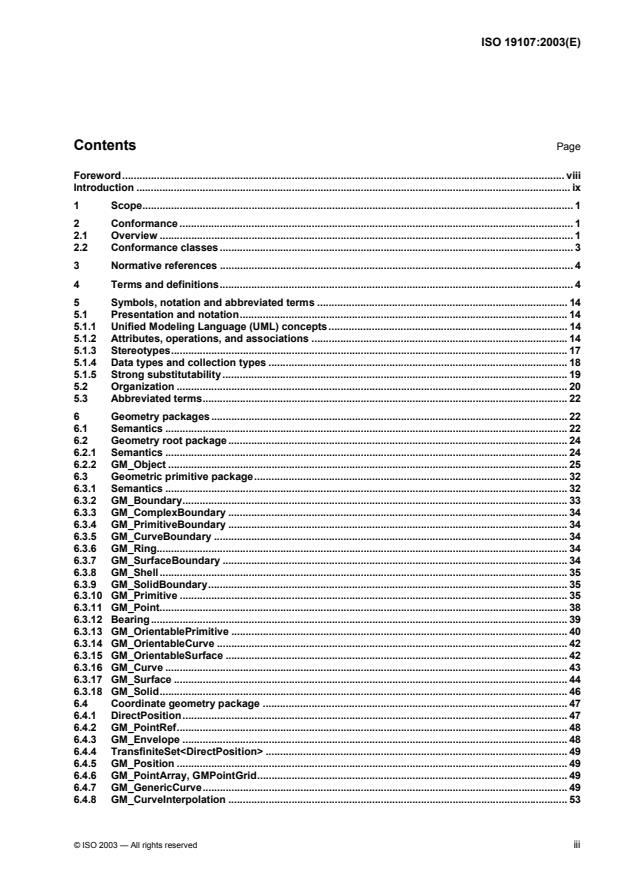
Contents Page
Foreword. viii
Introduction . ix
1 Scope. 1
2 Conformance . 1
2.1 Overview . 1
2.2 Conformance classes. 3
3 Normative references . 4
4 Terms and definitions. 4
5 Symbols, notation and abbreviated terms . 14
5.1 Presentation and notation. 14
5.1.1 Unified Modeling Language (UML) concepts. 14
5.1.2 Attributes, operations, and associations . 14
5.1.3 Stereotypes. 17
5.1.4 Data types and collection types . 18
5.1.5 Strong substitutability. 19
5.2 Organization . 20
5.3 Abbreviated terms. 22
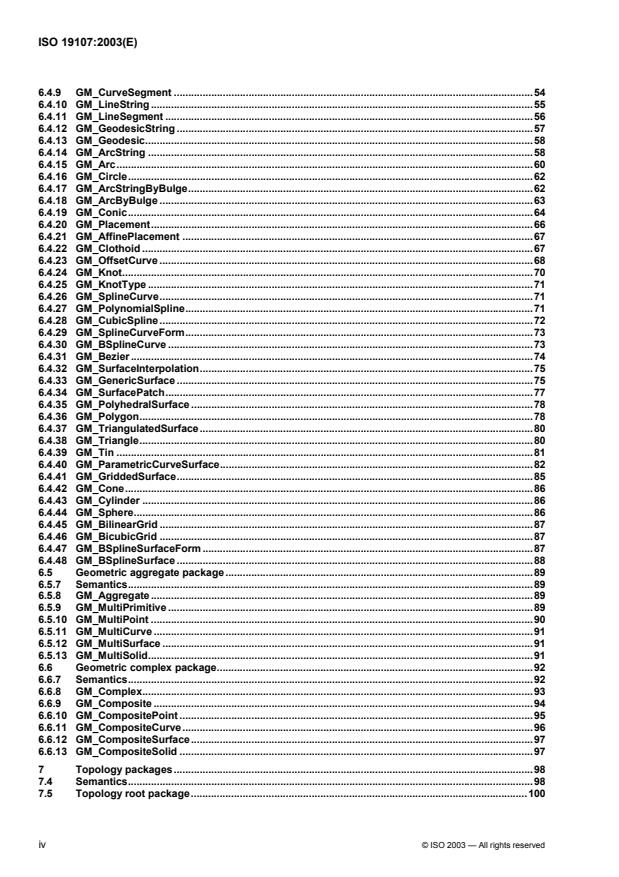
6 Geometry packages . 22
6.1 Semantics . 22
6.2 Geometry root package. 24
6.2.1 Semantics . 24
6.2.2 GM_Object . 25
6.3 Geometric primitive package. 32
6.3.1 Semantics . 32
6.3.2 GM_Boundary. 33
6.3.3 GM_ComplexBoundary . 34
6.3.4 GM_PrimitiveBoundary . 34
6.3.5 GM_CurveBoundary . 34
6.3.6 GM_Ring. 34
6.3.7 GM_SurfaceBoundary . 34
6.3.8 GM_Shell. 35
6.3.9 GM_SolidBoundary. 35
6.3.10 GM_Primitive . 35
6.3.11 GM_Point. 38
6.3.12 Bearing. 39
6.3.13 GM_OrientablePrimitive . 40
6.3.14 GM_OrientableCurve . 42
6.3.15 GM_OrientableSurface . 42
6.3.16 GM_Curve . 43
6.3.17 GM_Surface . 44
6.3.18 GM_Solid. 46
6.4 Coordinate geometry package . 47
6.4.1 DirectPosition. 47
6.4.2 GM_PointRef. 48
6.4.3 GM_Envelope . 48
6.4.4 TransfiniteSet . 49
6.4.5 GM_Position . 49
6.4.6 GM_PointArray, GMPointGrid. 49
6.4.7 GM_GenericCurve. 49
6.4.8 GM_CurveInterpolation . 53
6.4.9 GM_CurveSegment .54
6.4.10 GM_LineString.55
6.4.11 GM_LineSegment .56
6.4.12 GM_GeodesicString .57
6.4.13 GM_Geodesic.58
6.4.14 GM_ArcString .58
6.4.15 GM_Arc.60
6.4.16 GM_Circle.62
6.4.17 GM_ArcStringByBulge.62
6.4.18 GM_ArcByBulge .63
6.4.19 GM_Conic.64
6.4.20 GM_Placement.66
6.4.21 GM_AffinePlacement .67
6.4.22 GM_Clothoid .67
6.4.23 GM_OffsetCurve .68
6.4.24 GM_Knot.70
6.4.25 GM_KnotType .71
6.4.26 GM_SplineCurve.71
6.4.27 GM_PolynomialSpline.71
6.4.28 GM_CubicSpline.72
6.4.29 GM_SplineCurveForm.73
6.4.30 GM_BSplineCurve .73
6.4.31 GM_Bezier .74
6.4.32 GM_SurfaceInterpolation.75
6.4.33 GM_GenericSurface .75
6.4.34 GM_SurfacePatch.77
6.4.35 GM_PolyhedralSurface .78
6.4.36 GM_Polygon.78
6.4.37 GM_TriangulatedSurface.80
6.4.38 GM_Triangle.80
6.4.39 GM_Tin .81
6.4.40 GM_ParametricCurveSurface.82
6.4.41 GM_GriddedSurface.85
6.4.42 GM_Cone.86
6.4.43 GM_Cylinder .86
6.4.44 GM_Sphere.86
6.4.45 GM_BilinearGrid .87
6.4.46 GM_BicubicGrid .87
6.4.47 GM_BSplineSurfaceForm .87
6.4.48 GM_BSplineSurface .88
6.5 Geometric aggregate package.89
6.5.7 Semantics.89
6.5.8 GM_Aggregate.89
6.5.9 GM_MultiPrimitive .89
6.5.10 GM_MultiPoint .90
6.5.11 GM_MultiCurve .91
6.5.12 GM_MultiSurface .91
6.5.13 GM_MultiSolid.91
6.6 Geometric complex package.92
6.6.7 Semantics.92
6.6.8 GM_Complex.93
6.6.9 GM_Composite .94
6.6.10 GM_CompositePoint .95
6.6.11 GM_CompositeCurve.96
6.6.12 GM_CompositeSurface.97
6.6.13 GM_CompositeSolid .97
7 Topology packages.98
7.4 Semantics.98
7.5 Topology root package.100
iv © ISO 2003 — All rights reserved
7.5.1 Semantics . 100
7.5.2 TP_Object. 101
7.6 Topological primitive package . 105
7.6.1 Semantics . 105
7.6.2 TP_Boundary. 105
7.6.3 TP_ComplexBoundary. 105
7.6.4 TP_PrimitiveBoundary. 105
7.6.5 TP_EdgeBoundary . 106
7.6.6 TP_FaceBoundary. 107
7.6.7 TP_SolidBoundary . 107
7.6.8 TP_Ring. 107
7.6.9 TP_Shell . 107
7.6.10 TP_Primitive . 108
7.6.11 TP_DirectedTopo . 109
7.6.12 TP_Node. 112
7.6.13 TP_DirectedNode . 113
7.6.14 TP_Edge. 114
7.6.15 TP_DirectedEdge . 115
7.6.16 TP_Face. 115
7.6.17 TP_DirectedFace . 117
7.6.18 TP_Solid. 117
7.6.19 TP_DirectedSolid . 118
7.6.20 TP_Expression . 118
7.7 Topological complex package. 121
7.7.1 Semantics . 121
7.7.2 TP_Complex . 121
8 Derived topological relations. 123
8.1 Introduction . 123
8.2 Boolean or set operators. 124
8.2.1 Form of the Boolean operators . 124
8.2.2 Boolean Relate . 124
8.2.3 Relation to set operations. 125
8.3 Egenhofer operators. 125
8.3.1 Form of the Egenhofer operators. 125
8.3.2 Egenhofer relate. 125
8.3.3 Relation to set operations. 126
8.4 Full topological operators. 126
8.4.1 Form of the full topological operators . 126
8.4.2 Full topological relate . 126
8.5 Combinations . 126
Annex A (normative) Abstract test suite. 127
A.1 Geometric primitives . 127
A.2 Geometric complexes. 130
A.3 Topological complexes . 132
A.4 Topological complexes with geometric realization. 134
A.5 Boolean operators . 136
Annex B (informative) Conceptual organization of terms and definitions . 138
B.1 Introduction . 138
B.2 General terms . 138
B.3 Collections and related terms. 139
B.4 Modelling terms. 139
B.5 Positioning terms. 140
B.6 Geometric terms. 140
B.7 Topological terms . 143
B.8 Relationship of geometric and topological complexes . 146
Annex C (informative) Examples of spatial schema concepts . 148
C.1 Geometry. 148
Annex D (informative) Examples for application schemata .154
D.1 Introduction.154
D.2 Simple Topology.154
D.3 Feature Topology .158
D.4 MiniTopo.159
Bibliography.165
Figures
Figure 1 — UML example association .16
Figure 2 — UML example package dependency.20
Figure 3 — Normative clause as UML package dependencies .21
Figure 4 — Geometry package: Class content and internal dependencies.23
Figure 5 — Geometry basic classes with specialization relations .24
Figure 6 — GM_Object.26
Figure 7 — GM_Boundary .33
Figure 8 — GM_Primitive .36
Figure 9 — GM_Point.38
Figure 10 — GM_OrientablePrimitive .41
Figure 11 — GM_Curve .43
Figure 12 — GM_Surface.45
Figure 13 — GM_Solid.46
Figure 14 — DirectPosition .48
Figure 15 — Curve segment classes .50
Figure 16 — Linear, arc and geodesic interpolation .56
Figure 17 — Arcs.59
Figure 18 — Conics and placements .65
Figure 19 — Spline and specialty curves.69
Figure 20 — Surface patches.76
Figure 21 — Polygonal surface.79
Figure 22 — TIN construction .81
Figure 23 — GM_ParametricCurveSurface and its subtypes .83
Figure 24 — GM_Aggregate .90
Figure 25 — GM_Complex.94
Figure 26 — GM_Composite.95
Figure 27 — GM_CompositePoint .96
Figure 28 — GM_CompositeCurve.96
Figure 29 — GM_CompositeSurface .97
Figure 30 — GM_CompositeSolid.98
Figure 31 — Topology packages, class content and internal dependencies.99
Figure 32 — Topological class diagram .100
Figure 33 — Relation between geometry and topology.101
Figure 34 — TP_Object.102
Figure 35 — Boundary and coboundary operation represented as associations .103
Figure 36 — Important classes in topology.104
Figure 37 — Boundary relation data types.106
Figure 38 — TP_Primitive .108
Figure 39 — TP_DirectedTopo subclasses.110
Figure 40 — TP_DirectedTopo .110
vi © ISO 2003 — All rights reserved
Figure 41 — TP_Node . 113
Figure 42 — TP_Edge . 114
Figure 43 — TP_Face. 116
Figure 44 — TP_Solid. 117
Figure 45 — TP_Expression. 119
Figure 46 — TP_Complex. 122
Figure C.1 — A data set composed of the GM_Primitives . 149
Figure C.2 — Simple cartographic representation of sample data. 151
Figure C.3 — A 3D Geometric object with labeled coordinates. 152
Figure C.4 — Surface example. 153
Figure D.1 — Packages and classes for simple topology . 155
Figure D.2 — Topology and geometry classes in simple topology. 156
Figure D.3 — Feature components in simple topology. 157
Figure D.4 — Theme based feature topology. 159
Figure D.5 — Geometric example of MiniTopo topology structure. 160
Figure D.6 — MiniTopo . 161
Figure D.7 — Classic MiniTopo record illustration. 163
Tables
Table 1 — Conformance classes for geometric primitives . 3
Table 2 — Conformance classes for geometric complexes . 3
Table 3 — Conformance classes for topological complexes . 3
Table 4 — Conformance classes for topological complexes with geometric realizations . 3
Table 5 — Conformance classes for Boolean operators . 3
Table 6 — Package and classes. 21
Table 7 — Various types of parametric curve surfaces . 84
Table 8 — Meaning of Boolean intersection pattern matrix. 124
Table 9 — Meaning of Egenhofer intersection pattern matrix . 125
Table 10 — Meaning of full topological intersection pattern matrix . 126
Table D.1 — Correspondence between original MiniTopo pointers and the current model. 164
Foreword
ISO (the International Organization for Standardization) is a worldwide federation of national standards bodies
(ISO member bodies). The work of preparing International Standards is normally carried out through ISO
technical committees. Each member body interested in a subject for which a technical committee has been
established has the right to be represented on that committee. International organizations, governmental and
non-governmental, in liaison with ISO, also take part in the work. ISO collaborates closely with the
International Electrotechnical Commission (IEC) on all matters of electrotechnical standardization.
International Standards are drafted in accordance with the rules given in the ISO/IEC Directives, Part 2.
The main task of technical committees is to prepare International Standards. Draft International Standards
adopted by the technical committees are circulated to the member bodies for voting. Publication as an
International Standard requires approval by at least 75 % of the member bodies casting a vote.
Attention is drawn to the possibility that some of the elements of this document may be the subject of patent
rights. ISO shall not be held responsible for identifying any or all such patent rights.
ISO 19107 was prepared by Technical Committee ISO/TC 211, Geographic information/Geomatics.
viii © ISO 2003 — All rights reserved
Introduction
This International Standard provides conceptual schemas for describing and manipulating the spatial
characteristics of geographic features. Standardization in this area will be the cornerstone for other
geographic information standards.
A feature is an abstraction of a real world phenomenon; it is a geographic feature if it is associated with a
location relative to the Earth. Vector data consists of geometric and topological primitives used, separately or
in combination, to construct objects that express the spatial characteristics of geographic features. Raster
data is based on the division of the extent covered into small units according to a tessellation of the space and
the assignment to each unit of an attribute value. This International Standard deals only with vector data.
In the model defined in this International Standard, spatial characteristics are described by one or more spatial
attributes whose value is given by a geometric object (GM_Object) or a topological object (TP_Object).
Geometry provides the means for the quantitative description, by means of coordinates and mathematical
functions, of the spatial characteristics of features, including dimension, position, size, shape, and orientation.
The mathematical functions used for describing the geometry of an object depend on the type of coordinate
reference system used to define the spatial position. Geometry is the only aspect of geographic information
that changes when the information is transformed from one geodetic reference system or coordinate system
to another.
Topology deals with the characteristics of geometric figures that remain invariant if the space is deformed
elastically and continuously — for example, when geographic data is transformed from one coordinate system
to another. Within the context of geographic information, topology is commonly used to describe the
connectivity of an n-dimensional graph, a property that is invariant under continuous transformation of the
graph. Computational topology provides information about the connectivity of geometric primitives that can be
derived from the underlying geometry.
Spatial operators are functions and procedures that use, query, create, modify, or delete spatial objects. This
International Standard defines the taxonomy of these operators in order to create a standard for their definition
and implementation. The goals are to:
a) Define spatial operators unambiguously, so that diverse implementations can be assured to yield
comparable results within known limitations of accuracy and resolution.
b) Use these definitions to define a set of standard operations that will form the basis of compliant systems,
and, thus act as a test-bed for implementers and a benchmark set for validation of compliance.
c) Define an operator algebra that will allow combinations of the base operators to be used predictably in the
query and manipulation of geographic data.
Standardized conceptual schemas for spatial characteristics will increase the ability to share geographic
information among applications. These schemas will be used by geographic information system and software
developers and users of geographic information to provide consistently understandable spatial data structures.
INTERNATIONAL STANDARD ISO 19107:2003(E)
Geographic information — Spatial schema
1 Scope
This International Standard specifies conceptual schemas for describing the spatial characteristics of
geographic features, and a set of spatial operations consistent with these schemas. It treats vector geometry
and topology up to three dimensions. It defines standard spatial operations for use in access, query,
management, processing, and data exchange of geographic information for spatial (geometric and
topological) objects of up to three topological dimensions embedded in coordinate spaces of up to three axes.
2 Conformance
2.1 Overview
Clauses 6 and 7 of this International Standard use the Unified Modeling Language (UML) to present
conceptual schemas for describing the spatial characteristics of geographic features. These schemas define
conceptual classes that shall be used in application schemas, profiles and implementation specifications. The
document concerns ONLY externally visible interfaces and places no restriction on the underlying
implementations other than what is needed to satisfy the interface specifications in the actual situation such
as:
Interfaces to software services using techniques such as COM or CORBA
Interfaces to databases using techniques such as SQL
Data intercha
...
SLOVENSKI STANDARD
01-november-2003
Geografske informacije - Prostorska shema
Geographic information -- Spatial schema
Information géographique -- Schéma spatial
Ta slovenski standard je istoveten z: ISO 19107:2003
ICS:
07.040 Astronomija. Geodezija. Astronomy. Geodesy.
Geografija Geography
35.240.70 Uporabniške rešitve IT v IT applications in science
znanosti
2003-01.Slovenski inštitut za standardizacijo. Razmnoževanje celote ali delov tega standarda ni dovoljeno.
INTERNATIONAL ISO
STANDARD 19107
First edition
2003-05-01
Geographic information — Spatial
schema
Information géographique — Schéma spatial
Reference number
©
ISO 2003
PDF disclaimer
This PDF file may contain embedded typefaces. In accordance with Adobe's licensing policy, this file may be printed or viewed but
shall not be edited unless the typefaces which are embedded are licensed to and installed on the computer performing the editing. In
downloading this file, parties accept therein the responsibility of not infringing Adobe's licensing policy. The ISO Central Secretariat
accepts no liability in this area.
Adobe is a trademark of Adobe Systems Incorporated.
Details of the software products used to create this PDF file can be found in the General Info relative to the file; the PDF-creation
parameters were optimized for printing. Every care has been taken to ensure that the file is suitable for use by ISO member bodies. In
the unlikely event that a problem relating to it is found, please inform the Central Secretariat at the address given below.
© ISO 2003
All rights reserved. Unless otherwise specified, no part of this publication may be reproduced or utilized in any form or by any means,
electronic or mechanical, including photocopying and microfilm, without permission in writing from either ISO at the address below or
ISO's member body in the country of the requester.
ISO copyright office
Case postale 56 • CH-1211 Geneva 20
Tel. + 41 22 749 01 11
Fax + 41 22 749 09 47
E-mail copyright@iso.org
Web www.iso.org
Published in Switzerland
ii © ISO 2003 — All rights reserved
Contents Page
Foreword. viii
Introduction . ix
1 Scope. 1
2 Conformance . 1
2.1 Overview . 1
2.2 Conformance classes. 3
3 Normative references . 4
4 Terms and definitions. 4
5 Symbols, notation and abbreviated terms . 14
5.1 Presentation and notation. 14
5.1.1 Unified Modeling Language (UML) concepts. 14
5.1.2 Attributes, operations, and associations . 14
5.1.3 Stereotypes. 17
5.1.4 Data types and collection types . 18
5.1.5 Strong substitutability. 19
5.2 Organization . 20
5.3 Abbreviated terms. 22
6 Geometry packages . 22
6.1 Semantics . 22
6.2 Geometry root package. 24
6.2.1 Semantics . 24
6.2.2 GM_Object . 25
6.3 Geometric primitive package. 32
6.3.1 Semantics . 32
6.3.2 GM_Boundary. 33
6.3.3 GM_ComplexBoundary . 34
6.3.4 GM_PrimitiveBoundary . 34
6.3.5 GM_CurveBoundary . 34
6.3.6 GM_Ring. 34
6.3.7 GM_SurfaceBoundary . 34
6.3.8 GM_Shell. 35
6.3.9 GM_SolidBoundary. 35
6.3.10 GM_Primitive . 35
6.3.11 GM_Point. 38
6.3.12 Bearing. 39
6.3.13 GM_OrientablePrimitive . 40
6.3.14 GM_OrientableCurve . 42
6.3.15 GM_OrientableSurface . 42
6.3.16 GM_Curve . 43
6.3.17 GM_Surface . 44
6.3.18 GM_Solid. 46
6.4 Coordinate geometry package . 47
6.4.1 DirectPosition. 47
6.4.2 GM_PointRef. 48
6.4.3 GM_Envelope . 48
6.4.4 TransfiniteSet . 49
6.4.5 GM_Position . 49
6.4.6 GM_PointArray, GMPointGrid. 49
6.4.7 GM_GenericCurve. 49
6.4.8 GM_CurveInterpolation . 53
6.4.9 GM_CurveSegment .54
6.4.10 GM_LineString.55
6.4.11 GM_LineSegment .56
6.4.12 GM_GeodesicString .57
6.4.13 GM_Geodesic.58
6.4.14 GM_ArcString .58
6.4.15 GM_Arc.60
6.4.16 GM_Circle.62
6.4.17 GM_ArcStringByBulge.62
6.4.18 GM_ArcByBulge .63
6.4.19 GM_Conic.64
6.4.20 GM_Placement.66
6.4.21 GM_AffinePlacement .67
6.4.22 GM_Clothoid .67
6.4.23 GM_OffsetCurve .68
6.4.24 GM_Knot.70
6.4.25 GM_KnotType .71
6.4.26 GM_SplineCurve.71
6.4.27 GM_PolynomialSpline.71
6.4.28 GM_CubicSpline.72
6.4.29 GM_SplineCurveForm.73
6.4.30 GM_BSplineCurve .73
6.4.31 GM_Bezier .74
6.4.32 GM_SurfaceInterpolation.75
6.4.33 GM_GenericSurface .75
6.4.34 GM_SurfacePatch.77
6.4.35 GM_PolyhedralSurface .78
6.4.36 GM_Polygon.78
6.4.37 GM_TriangulatedSurface.80
6.4.38 GM_Triangle.80
6.4.39 GM_Tin .81
6.4.40 GM_ParametricCurveSurface.82
6.4.41 GM_GriddedSurface.85
6.4.42 GM_Cone.86
6.4.43 GM_Cylinder .86
6.4.44 GM_Sphere.86
6.4.45 GM_BilinearGrid .87
6.4.46 GM_BicubicGrid .87
6.4.47 GM_BSplineSurfaceForm .87
6.4.48 GM_BSplineSurface .88
6.5 Geometric aggregate package.89
6.5.7 Semantics.89
6.5.8 GM_Aggregate.89
6.5.9 GM_MultiPrimitive .89
6.5.10 GM_MultiPoint .90
6.5.11 GM_MultiCurve .91
6.5.12 GM_MultiSurface .91
6.5.13 GM_MultiSolid.91
6.6 Geometric complex package.92
6.6.7 Semantics.92
6.6.8 GM_Complex.93
6.6.9 GM_Composite .94
6.6.10 GM_CompositePoint .95
6.6.11 GM_CompositeCurve.96
6.6.12 GM_CompositeSurface.97
6.6.13 GM_CompositeSolid .97
7 Topology packages.98
7.4 Semantics.98
7.5 Topology root package.100
iv © ISO 2003 — All rights reserved
7.5.1 Semantics . 100
7.5.2 TP_Object. 101
7.6 Topological primitive package . 105
7.6.1 Semantics . 105
7.6.2 TP_Boundary. 105
7.6.3 TP_ComplexBoundary. 105
7.6.4 TP_PrimitiveBoundary. 105
7.6.5 TP_EdgeBoundary . 106
7.6.6 TP_FaceBoundary. 107
7.6.7 TP_SolidBoundary . 107
7.6.8 TP_Ring. 107
7.6.9 TP_Shell . 107
7.6.10 TP_Primitive . 108
7.6.11 TP_DirectedTopo . 109
7.6.12 TP_Node. 112
7.6.13 TP_DirectedNode . 113
7.6.14 TP_Edge. 114
7.6.15 TP_DirectedEdge . 115
7.6.16 TP_Face. 115
7.6.17 TP_DirectedFace . 117
7.6.18 TP_Solid. 117
7.6.19 TP_DirectedSolid . 118
7.6.20 TP_Expression . 118
7.7 Topological complex package. 121
7.7.1 Semantics . 121
7.7.2 TP_Complex . 121
8 Derived topological relations. 123
8.1 Introduction . 123
8.2 Boolean or set operators. 124
8.2.1 Form of the Boolean operators . 124
8.2.2 Boolean Relate . 124
8.2.3 Relation to set operations. 125
8.3 Egenhofer operators. 125
8.3.1 Form of the Egenhofer operators. 125
8.3.2 Egenhofer relate. 125
8.3.3 Relation to set operations. 126
8.4 Full topological operators. 126
8.4.1 Form of the full topological operators . 126
8.4.2 Full topological relate . 126
8.5 Combinations . 126
Annex A (normative) Abstract test suite. 127
A.1 Geometric primitives . 127
A.2 Geometric complexes. 130
A.3 Topological complexes . 132
A.4 Topological complexes with geometric realization. 134
A.5 Boolean operators . 136
Annex B (informative) Conceptual organization of terms and definitions . 138
B.1 Introduction . 138
B.2 General terms . 138
B.3 Collections and related terms. 139
B.4 Modelling terms. 139
B.5 Positioning terms. 140
B.6 Geometric terms. 140
B.7 Topological terms . 143
B.8 Relationship of geometric and topological complexes . 146
Annex C (informative) Examples of spatial schema concepts . 148
C.1 Geometry. 148
Annex D (informative) Examples for application schemata .154
D.1 Introduction.154
D.2 Simple Topology.154
D.3 Feature Topology .158
D.4 MiniTopo.159
Bibliography.165
Figures
Figure 1 — UML example association .16
Figure 2 — UML example package dependency.20
Figure 3 — Normative clause as UML package dependencies .21
Figure 4 — Geometry package: Class content and internal dependencies.23
Figure 5 — Geometry basic classes with specialization relations .24
Figure 6 — GM_Object.26
Figure 7 — GM_Boundary .33
Figure 8 — GM_Primitive .36
Figure 9 — GM_Point.38
Figure 10 — GM_OrientablePrimitive .41
Figure 11 — GM_Curve .43
Figure 12 — GM_Surface.45
Figure 13 — GM_Solid.46
Figure 14 — DirectPosition .48
Figure 15 — Curve segment classes .50
Figure 16 — Linear, arc and geodesic interpolation .56
Figure 17 — Arcs.59
Figure 18 — Conics and placements .65
Figure 19 — Spline and specialty curves.69
Figure 20 — Surface patches.76
Figure 21 — Polygonal surface.79
Figure 22 — TIN construction .81
Figure 23 — GM_ParametricCurveSurface and its subtypes .83
Figure 24 — GM_Aggregate .90
Figure 25 — GM_Complex.94
Figure 26 — GM_Composite.95
Figure 27 — GM_CompositePoint .96
Figure 28 — GM_CompositeCurve.96
Figure 29 — GM_CompositeSurface .97
Figure 30 — GM_CompositeSolid.98
Figure 31 — Topology packages, class content and internal dependencies.99
Figure 32 — Topological class diagram .100
Figure 33 — Relation between geometry and topology.101
Figure 34 — TP_Object.102
Figure 35 — Boundary and coboundary operation represented as associations .103
Figure 36 — Important classes in topology.104
Figure 37 — Boundary relation data types.106
Figure 38 — TP_Primitive .108
Figure 39 — TP_DirectedTopo subclasses.110
Figure 40 — TP_DirectedTopo .110
vi © ISO 2003 — All rights reserved
Figure 41 — TP_Node . 113
Figure 42 — TP_Edge . 114
Figure 43 — TP_Face. 116
Figure 44 — TP_Solid. 117
Figure 45 — TP_Expression. 119
Figure 46 — TP_Complex. 122
Figure C.1 — A data set composed of the GM_Primitives . 149
Figure C.2 — Simple cartographic representation of sample data. 151
Figure C.3 — A 3D Geometric object with labeled coordinates. 152
Figure C.4 — Surface example. 153
Figure D.1 — Packages and classes for simple topology . 155
Figure D.2 — Topology and geometry classes in simple topology. 156
Figure D.3 — Feature components in simple topology. 157
Figure D.4 — Theme based feature topology. 159
Figure D.5 — Geometric example of MiniTopo topology structure. 160
Figure D.6 — MiniTopo . 161
Figure D.7 — Classic MiniTopo record illustration. 163
Tables
Table 1 — Conformance classes for geometric primitives . 3
Table 2 — Conformance classes for geometric complexes . 3
Table 3 — Conformance classes for topological complexes . 3
Table 4 — Conformance classes for topological complexes with geometric realizations . 3
Table 5 — Conformance classes for Boolean operators . 3
Table 6 — Package and classes. 21
Table 7 — Various types of parametric curve surfaces . 84
Table 8 — Meaning of Boolean intersection pattern matrix. 124
Table 9 — Meaning of Egenhofer intersection pattern matrix . 125
Table 10 — Meaning of full topological intersection pattern matrix . 126
Table D.1 — Correspondence between original MiniTopo pointers and the current model. 164
Foreword
ISO (the International Organization for Standardization) is a worldwide federation of national standards bodies
(ISO member bodies). The work of preparing International Standards is normally carried out through ISO
technical committees. Each member body interested in a subject for which a technical committee has been
established has the right to be represented on that committee. International organizations, governmental and
non-governmental, in liaison with ISO, also take part in the work. ISO collaborates closely with the
International Electrotechnical Commission (IEC) on all matters of electrotechnical standardization.
International Standards are drafted in accordance with the rules given in the ISO/IEC Directives, Part 2.
The main task of technical committees is to prepare International Standards. Draft International Standards
adopted by the technical committees are circulated to the member bodies for voting. Publication as an
International Standard requires approval by at least 75 % of the member bodies casting a vote.
Attention is drawn to the possibility that some of the elements of this document may be the subject of patent
rights. ISO shall not be held responsible for identifying any or all such patent rights.
ISO 19107 was prepared by Technical Committee ISO/TC 211, Geographic information/Geomatics.
viii © ISO 2003 — All rights reserved
Introduction
This International Standard provides conceptual schemas for describing and manipulating the spatial
characteristics of geographic features. Standardization in this area will be the cornerstone for other
geographic information standards.
A feature is an abstraction of a real world phenomenon; it is a geographic feature if it is associated with a
location relative to the Earth. Vector data consists of geometric and topological primitives used, separately or
in combination, to construct objects that express the spatial characteristics of geographic features. Raster
data is based on the division of the extent covered into small units according to a tessellation of the space and
the assignment to each unit of an attribute value. This International Standard deals only with vector data.
In the model defined in this International Standard, spatial characteristics are described by one or more spatial
attributes whose value is given by a geometric object (GM_Object) or a topological object (TP_Object).
Geometry provides the means for the quantitative description, by means of coordinates and mathematical
functions, of the spatial characteristics of features, including dimension, position, size, shape, and orientation.
The mathematical functions used for describing the geometry of an object depend on the type of coordinate
reference system used to define the spatial position. Geometry is the only aspect of geographic information
that changes when the information is transformed from one geodetic reference system or coordinate system
to another.
Topology deals with the characteristics of geometric figures that remain invariant if the space is deformed
elastically and continuously — for example, when geographic data is transformed from one coordinate system
to another. Within the context of geographic information, topology is commonly used to describe the
connectivity of an n-dimensional graph, a property that is invariant under continuous transformation of the
graph. Computational topology provides information about the connectivity of geometric primitives that can be
derived from the underlying geometry.
Spatial operators are functions and procedures that use, query, create, modify, or delete spatial objects. This
International Standard defines the taxonomy of these operators in order to create a standard for their definition
and implementation. The goals are to:
a) Define spatial operators unambiguously, so that diverse implementations can be assured to yield
comparable results within known limitations of accuracy and resolution.
b) Use these definitions to define a set of standard operations that will form the basis of compliant systems,
and, thus act as a test-bed for implementers and a benchmark set for validation of compliance.
c) Define an operator algebra that will allow combinations of the base operators to be used predictably in the
query and manipulation of geographic data.
Standardized conceptual schemas for spatial characteristics will increase the ability to share geographic
information among applications. These schemas will be used by geographic information system and software
developers and users of geographic information to provide consistently understandable spatial data structures.
INTERNATIONAL STANDARD ISO 19107:2003(E)
Geographic information — Spatial schema
1 Scope
This International Standard specifies conceptual schemas for describing the spatial characteristics of
geographic features, and a set of spatial operations consistent with these schemas. It treats vector geometry
and topology up to three dimensions. It defines standard sp
...
Questions, Comments and Discussion
Ask us and Technical Secretary will try to provide an answer. You can facilitate discussion about the standard in here.
Loading comments...