

ISO 21319:2026
(Main)Marine technology — Toolings for submersibles — Technology requirements
General Information
- Abstract
This document specifies the classification, general requirements, design requirements, general characteristics, general testing and inspection methods for submersible toolings. This document applies to the design, manufacture, inspection, and post-acceptance of submersible toolings.
- Status
- Published
- Publication Date
- 28-Apr-2026
- Technical Committee
- ISO/TC 8/SC 13 - Marine technology
- Drafting Committee
- ISO/TC 8/SC 13 - Marine technology
- Current Stage
- 6060 - International Standard published
- Start Date
- 29-Apr-2026
- Due Date
- 27-Jul-2026
- Completion Date
- 29-Apr-2026
Overview
ISO 21319:2026 - Marine technology - Toolings for submersibles - Technology requirements establishes a unified set of requirements for the design, manufacturing, installation, inspection, and post-acceptance of submersible toolings. Developed by ISO Technical Committee ISO/TC 8, this international standard ensures that toolings used with both human-occupied and non-human-occupied submersibles meet consistent technological expectations worldwide. By specifying classifications, general and design requirements, interface compatibility, and testing protocols, ISO 21319:2026 supports safe, effective, and reliable operation of submersible toolings across scientific, rescue, industrial, and exploration applications.
Key Topics
Classification of Submersible Toolings
- General manipulator
- Manipulator-held toolings (for tasks like rescue, sampling, and specialized operations)
- Portable operating toolings
- Tooling deployment units
General Requirements
- Installation protocols for both human-occupied and non-human-occupied submersibles
- Interface compatibility, including:
- Electrical (voltage, insulation, watertight connectors)
- Communication (wired/wireless, transmission compatibility)
- Hydraulic (consistent oil types, marked interfaces)
- Dimensional constraints to ensure visibility, operability, and safety
Design Requirements
- Design for pressure boundary in line with submersible specifications
- Oil-filled compensation structures for pressure regulation
- Reliable sealing and tool jettisoning capabilities for emergency situations
Testing and Inspection
- Hydrostatic pressure testing to validate operational integrity under simulated deepwater pressures
- Functional tests to confirm safe tool operation at working depths
- Third-party supervised equipment and operational tests in simulated or real marine environments
Applications
ISO 21319:2026 is essential for stakeholders across the maritime and subsea industries, including:
- Submersible manufacturers: Ensuring toolings meet international safety, compatibility, and performance requirements during design and production.
- Operators and mission planners: Selecting or specifying toolings that conform to interface, installation, and operational criteria for reliable underwater missions.
- Inspection and certification bodies: Verifying equipment through standardized testing and inspection methods outlined in the standard.
- Research institutions: Implementing compatible and safe tools for underwater sampling, rescue, and scientific experiments.
- Oil & gas and salvage industries: Deploying consistent toolings for tasks like underwater repair, salvage, maintenance, or wellhead operations.
By following ISO 21319:2026, organizations can reduce the risk of tooling failure, ensure compatibility among submersible systems, and improve personnel safety during underwater operations.
Related Standards
Professionals engaged with ISO 21319:2026 may also reference the following standards for comprehensive guidance:
- ISO 13628-8: Petroleum and natural gas industries - Design and operation of subsea production systems - Part 8: Remotely Operated Vehicle (ROV) interfaces on subsea production systems
- ISO 21173: Submersibles - Hydrostatic pressure test - Pressure hull and buoyancy materials
- China Classification Society (CCS) Rules: Classification of Diving Systems and Submersibles
- American Bureau of Shipping (ABS): Building and Classing of Underwater Vehicles, Systems and Hyperbaric Facilities
- ASME PVHO-1: Safety Standard for Pressure Vessels for Human Occupancy
These related documents further support the application of best practices in the design, testing, and deployment of underwater craft and associated equipment.
Keywords: ISO 21319:2026, marine technology standard, submersible toolings, underwater tool requirements, submersible tooling testing, marine equipment compatibility, safety standards for submersibles, inspection of submersible tools, submersible design requirements.
Get Certified
Connect with accredited certification bodies for this standard

DNV
DNV is an independent assurance and risk management provider.

Lloyd's Register
Lloyd's Register is a global professional services organisation specialising in engineering and technology.

FSC International
Forest Stewardship Council certification.
Sponsored listings
Frequently Asked Questions
ISO 21319:2026 is a standard published by the International Organization for Standardization (ISO). Its full title is "Marine technology — Toolings for submersibles — Technology requirements". This standard covers: This document specifies the classification, general requirements, design requirements, general characteristics, general testing and inspection methods for submersible toolings. This document applies to the design, manufacture, inspection, and post-acceptance of submersible toolings.
This document specifies the classification, general requirements, design requirements, general characteristics, general testing and inspection methods for submersible toolings. This document applies to the design, manufacture, inspection, and post-acceptance of submersible toolings.
ISO 21319:2026 is classified under the following ICS (International Classification for Standards) categories: 47.020.01 - General standards related to shipbuilding and marine structures; 47.080 - Small craft. The ICS classification helps identify the subject area and facilitates finding related standards.
ISO 21319:2026 is available in PDF format for immediate download after purchase. The document can be added to your cart and obtained through the secure checkout process. Digital delivery ensures instant access to the complete standard document.
Standards Content (Sample)
International
Standard
ISO 21319
First edition
Marine technology — Toolings
2026-04
for submersibles — Technology
requirements
Technologie maritime — Outillages pour les submersibles —
Exigences technologiques
Reference number
© ISO 2026
All rights reserved. Unless otherwise specified, or required in the context of its implementation, no part of this publication may
be reproduced or utilized otherwise in any form or by any means, electronic or mechanical, including photocopying, or posting on
the internet or an intranet, without prior written permission. Permission can be requested from either ISO at the address below
or ISO’s member body in the country of the requester.
ISO copyright office
CP 401 • Ch. de Blandonnet 8
CH-1214 Vernier, Geneva
Phone: +41 22 749 01 11
Email: copyright@iso.org
Website: www.iso.org
Published in Switzerland
ii
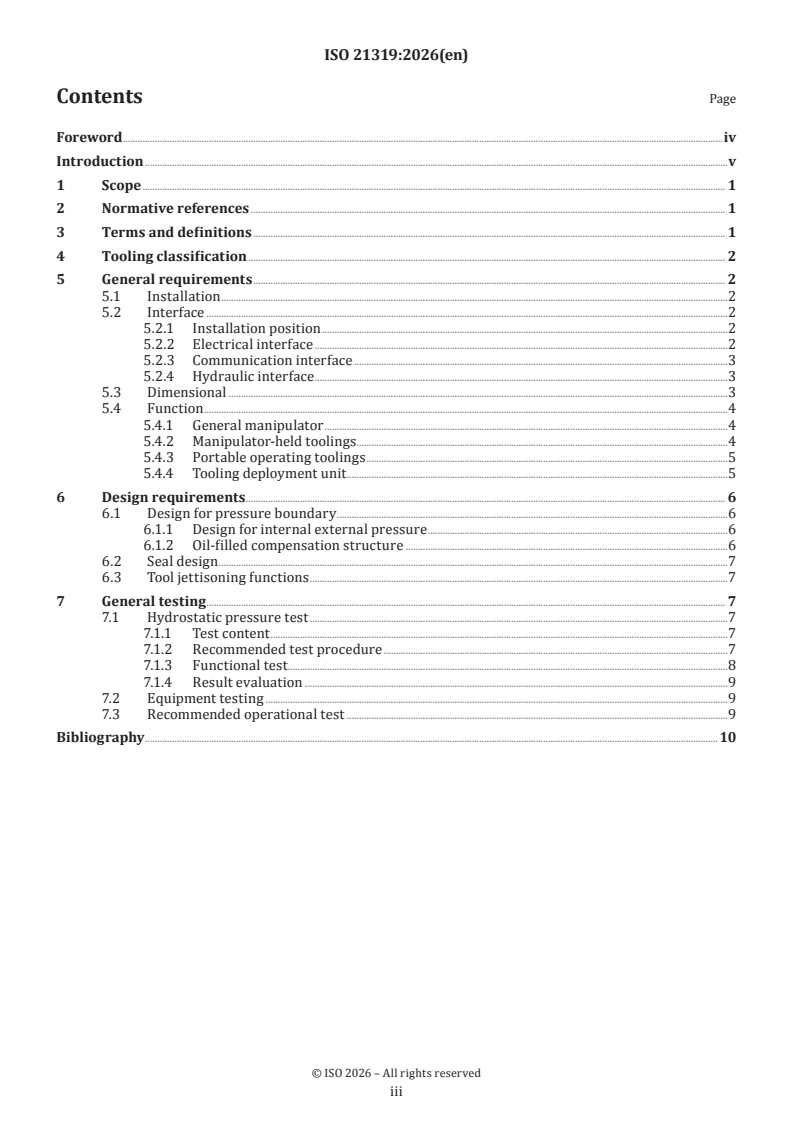
Contents Page
Foreword .iv
Introduction .v
1 Scope . 1
2 Normative references . 1
3 Terms and definitions . 1
4 Tooling classification . 2
5 General requirements . 2
5.1 Installation .2
5.2 Interface .2
5.2.1 Installation position .2
5.2.2 Electrical interface .2
5.2.3 Communication interface .3
5.2.4 Hydraulic interface .3
5.3 Dimensional .3
5.4 Function .4
5.4.1 General manipulator .4
5.4.2 Manipulator-held toolings . . .4
5.4.3 Portable operating toolings .5
5.4.4 Tooling deployment unit .5
6 Design requirements . 6
6.1 Design for pressure boundary .6
6.1.1 Design for internal external pressure .6
6.1.2 Oil-filled compensation structure .6
6.2 Seal design .7
6.3 Tool jettisoning functions .7
7 General testing . 7
7.1 Hydrostatic pressure test .7
7.1.1 Test content .7
7.1.2 Recommended test procedure .7
7.1.3 Functional test.8
7.1.4 Result evaluation .9
7.2 Equipment testing .9
7.3 Recommended operational test .9
Bibliography .10
iii
Foreword
ISO (the International Organization for Standardization) is a worldwide federation of national standards
bodies (ISO member bodies). The work of preparing International Standards is normally carried out through
ISO technical committees. Each member body interested in a subject for which a technical committee
has been established has the right to be represented on that committee. International organizations,
governmental and non-governmental, in liaison with ISO, also take part in the work. ISO collaborates closely
with the International Electrotechnical Commission (IEC) on all matters of electrotechnical standardization.
The procedures used to develop this document and those intended for its further maintenance are described
in the ISO/IEC Directives, Part 1. In particular, the different approval criteria needed for the different types
of ISO document should be noted. This document was drafted in accordance with the editorial rules of the
ISO/IEC Directives, Part 2 (see www.iso.org/directives).
ISO draws attention to the possibility that the implementation of this document may involve the use of (a)
patent(s). ISO takes no position concerning the evidence, validity or applicability of any claimed patent
rights in respect thereof. As of the date of publication of this document, ISO had not received notice of (a)
patent(s) which may be required to implement this document. However, implementers are cautioned that
this may not represent the latest information, which may be obtained from the patent database available at
www.iso.org/patents. ISO shall not be held responsible for identifying any or all such patent rights.
Any trade name used in this document is information given for the convenience of users and does not
constitute an endorsement.
For an explanation of the voluntary nature of standards, the meaning of ISO specific terms and expressions
related to conformity assessment, as well as information about ISO's adherence to the World Trade
Organization (WTO) principles in the Technical Barriers to Trade (TBT), see www.iso.org/iso/foreword.html.
This document was prepared by Technical Committee ISO/TC 8, Ships and marine technology, Subcommittee
SC 13, Marine technology.
Any feedback or questions on this document should be directed to the user’s national standards body. A
complete listing of these bodies can be found at www.iso.org/members.html.
iv
Introduction
This document specifies the general requirements for toolings used with submersibles, including
requirements for their functionality, installation, interfaces, weight, and dimensions. It also covers tool
design requirements, general performance requirements, general testing and inspection methods. The
purpose of this document is to establish unified common requirements, thereby ensuring that the basic
requirements for toolings installed on submersibles are consistently maintained on a global scale.
v
International Standard ISO 21319:2026(en)
Marine technology — Toolings for submersibles —
Technology requirements
1 Scope
This document specifies the classification, general requirements, design requirements, general
characteristics, general testing and inspection methods for submersible toolings.
This document applies to the design, manufacture, inspection, and post-acceptance of submersible toolings.
2 Normative references
There are no normative references in this document.
3 Terms and definitions
For the purposes of this document, the following terms and definitions apply.
ISO and IEC maintain terminology databases for use in standardization at the following addresses:
— ISO Online browsing platform: available at https:// www .iso .org/ obp
— IEC Electropedia: available at https:// www .electropedia .org/
3.1
submersible
type of powered vessel that can travel or manoeuvre underwater, or both
3.2
tooling
types of devices, equipment and combinations of tools involved in underwater sampling, rescue, scientific
experiments and special operations carried out on a submersible (3.1)
3.3
manipulator
device having one or more degrees of freedom for grasping or carrying objects or toolings by remote control
or by a fixed procedure
Note 1 to entry: The maximum working depth is expressed in metres.
3.4
maximum working pressure
p
maximum pressure in which a system (pressure vessel, supporting controls, and instrumentation) is
operated
3.5
test pressure
p
t
specified amount of pressure applied during a test of a submersible’s structural integrity
4 Tooling classification
It is recommended that toolings used with submersibles be classified into the following categories based on
their application purposes:
a) general manipulator;
b) manipulator-held toolings;
c) portable operating toolings;
d) tool deployment unit.
5 General requirements
5.1 Installation
1)
The following installation requirements for toolings of human-occupied submersibles shall apply.
a) The manipulator shall generally be installed on the bottom frame structure at the forward part of the
bow. It shall be arranged within the field of view of personnel in the human-occupied cabin, or mounted
at a position equipped with a camera.
b) Other toolings shall be centrally installed on the sampling basket; this arrangement shall facilitate
monitoring and operation by personnel.
c) The manipulator for non-human-occupied submersibles shall generally be installed on the bow frame
structure.
d) Other toolings for non-human-occupied submersibles shall be installed within the range of video
surveillance; generally, no dedicated sampling basket is required.
5.2 Interface
5.2.1 Installation position
The following installation position requirements for toolings of human-occupied submersibles shall apply.
a) The connection interface between the toolings and the human-occupied submersible shall reserve
sufficient operating space to facilitate routine maintenance and disassembly operations.
b) When the metal materials of the installation contact surfaces between the toolings and the human-
occupied submersible are inconsistent, isolation measures shall be adopted to mitigate electrochemical
corrosion.
c) During installation of the toolings, fasteners shall be equipped with necessary anti-loosening measures.
d) For vibration-generating toolings, vibration isolation measures shall be considered at their connection
positions; additionally, the reliability of the connections shall be enhanced to prevent slippage.
5.2.2 Electrical interface
The following electrical interface requirements for toolings of human-occupied submersibles shall apply.
a) The toolings shall ensure that their electrical interfaces are compatible with those of the human-
occupied submersible.
1) This document uses the inclusive terms "human-occupied submersible" and "non-human-occupied submersible" in
place of the terms "manned submersible" and "unmanned submersible".
b) The watertight electrical connecto
...