

ISO 21321:2026
(Main)Ships and marine technology — Human-occupied submersibles — Manoeuvring tests
General Information
- Abstract
This document specifies the general requirements, test items and methods for conducting manoeuvring tests on human-occupied submersibles. It is applicable to manoeuvring tests for all human-occupied submersibles operating in the sea and inland waterway areas. It can also be used as a reference for manoeuvring tests on other types of submersibles operating in pools, lakes and seas.
- Status
- Published
- Publication Date
- 28-Apr-2026
- Technical Committee
- ISO/TC 8/SC 13 - Marine technology
- Drafting Committee
- ISO/TC 8/SC 13 - Marine technology
- Current Stage
- 6060 - International Standard published
- Start Date
- 29-Apr-2026
- Due Date
- 27-Jul-2026
- Completion Date
- 29-Apr-2026

Overview
ISO 21321:2026 is an international standard developed by ISO’s Technical Committee for Ships and Marine Technology. Titled “Ships and marine technology - Human-occupied submersibles - Manoeuvring tests,” this standard provides comprehensive requirements, test items, and methodologies for conducting manoeuvring tests of human-occupied submersibles. The standard covers submersibles operating in sea and inland waterways and can also serve as a reference for tests in pools, lakes, and other aquatic environments. The guidance set forth in ISO 21321:2026 aims to harmonize practices in assessing manoeuvrability performance, enhance safety protocols, and support design and operational decisions across the global marine sector.
Key Topics
- General Requirements: ISO 21321:2026 outlines necessary support systems such as support vessels, suitable instrumentation (e.g., doppler velocity log, depth gauge, altimeter), and environmental conditions for safe and effective testing.
- Test Types: The standard describes various manoeuvring tests, including:
- Unpowered and powered submerging/surfacing tests
- Auto-depth and auto-heading control tests
- Triple-direction (longitudinal, lateral, vertical) speed tests
- Stopping distance and turning tests
- Auto-altitude and hovering tests
- Testing Conditions: Emphasis is placed on safety, environmental monitoring (e.g., water temperature, salinity, depth), pre-dive checks, and establishing emergency operating procedures.
- Performance Measurement: Parameters such as descent/ascent rate, thruster performance, pitch/roll/yaw angles, and duration of specific movements are systematically recorded and analyzed.
- Documentation: The standard stresses the importance of thorough and auditable record-keeping during testing to support verifiable results.
Applications
ISO 21321:2026 is a critical reference for a broad range of stakeholders involved in the design, manufacture, and operation of human-occupied submersibles. Its practical applications include:
- Submersible Manufacturers: Establishing compliant development protocols that ensure reliable manoeuvrability and operational safety for new human-occupied submersibles.
- Operators and Owners: Verifying submersible performance before initial deployment or after major refits, supporting operational planning and crew training.
- Testing Facilities: Serving as an authoritative guide for conducting and documenting performance trials in controlled or open water environments.
- Safety Auditors and Inspectors: Assessing compliance with international benchmarks to ensure crew and vessel safety.
- Research Institutions: Standardizing manoeuvring assessments to enable comparative analysis and facilitate innovation in submersible technology.
These applications support not only regulatory compliance but also continuous improvement in vessel performance, system integration, and crew safety-all essential factors in the expanding field of underwater exploration, research, and commercial operation.
Related Standards
- ISO 5411: Ships and marine technology - Terms and definitions for underwater vehicles (provides important terminology used in ISO 21321).
- ISO/TC 8 Standards: A range of standards covering ships and marine technology, supporting related testing, design, and operational procedures.
- IEC Standards: If applicable, for instruments or subsystems used on human-occupied submersibles.
Implementation of ISO 21321:2026, in conjunction with these related standards, helps organizations ensure robust, consistent, and world-class approaches to the testing and operation of human-occupied submersibles. This harmonization is vital for advancing safety, technology integration, and environmental stewardship in marine and underwater industries.
Get Certified
Connect with accredited certification bodies for this standard

DNV
DNV is an independent assurance and risk management provider.

Lloyd's Register
Lloyd's Register is a global professional services organisation specialising in engineering and technology.

FSC International
Forest Stewardship Council certification.
Sponsored listings
Frequently Asked Questions
ISO 21321:2026 is a standard published by the International Organization for Standardization (ISO). Its full title is "Ships and marine technology — Human-occupied submersibles — Manoeuvring tests". This standard covers: This document specifies the general requirements, test items and methods for conducting manoeuvring tests on human-occupied submersibles. It is applicable to manoeuvring tests for all human-occupied submersibles operating in the sea and inland waterway areas. It can also be used as a reference for manoeuvring tests on other types of submersibles operating in pools, lakes and seas.
This document specifies the general requirements, test items and methods for conducting manoeuvring tests on human-occupied submersibles. It is applicable to manoeuvring tests for all human-occupied submersibles operating in the sea and inland waterway areas. It can also be used as a reference for manoeuvring tests on other types of submersibles operating in pools, lakes and seas.
ISO 21321:2026 is classified under the following ICS (International Classification for Standards) categories: 47.080 - Small craft. The ICS classification helps identify the subject area and facilitates finding related standards.
ISO 21321:2026 is available in PDF format for immediate download after purchase. The document can be added to your cart and obtained through the secure checkout process. Digital delivery ensures instant access to the complete standard document.
Standards Content (Sample)
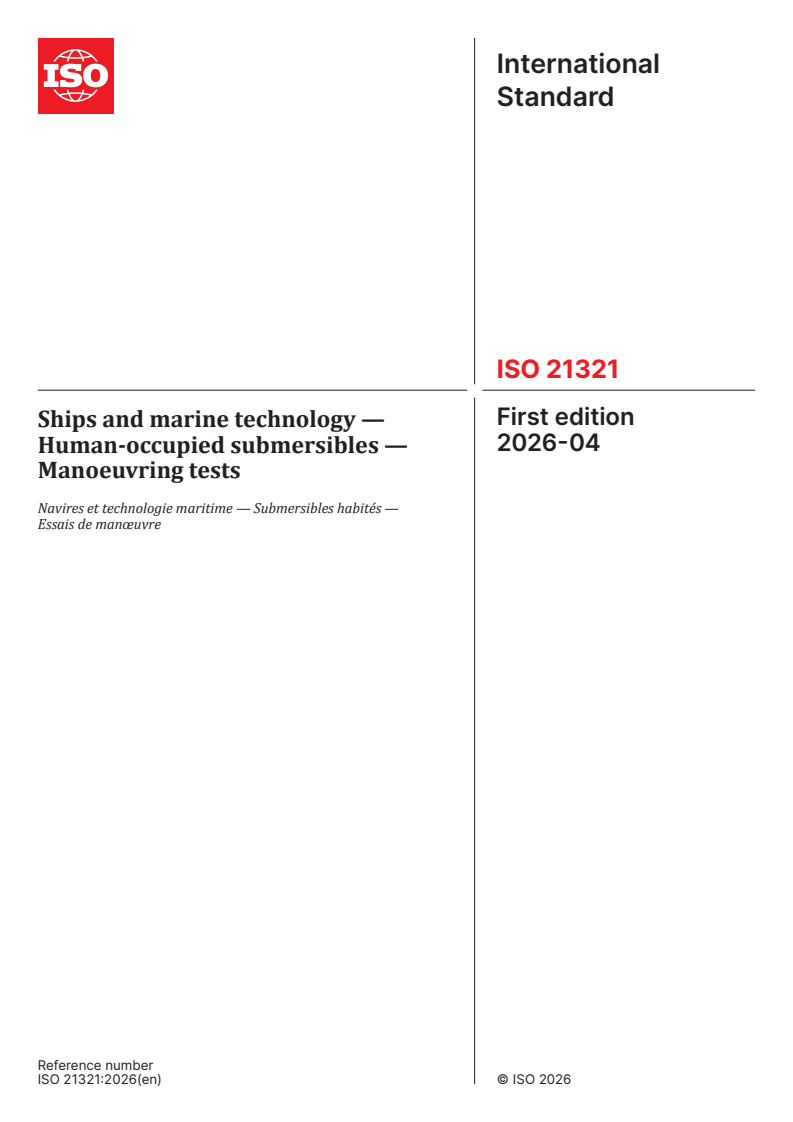
International
Standard
ISO 21321
First edition
Ships and marine technology —
2026-04
Human-occupied submersibles —
Manoeuvring tests
Navires et technologie maritime — Submersibles habités —
Essais de manœuvre
Reference number
© ISO 2026
All rights reserved. Unless otherwise specified, or required in the context of its implementation, no part of this publication may
be reproduced or utilized otherwise in any form or by any means, electronic or mechanical, including photocopying, or posting on
the internet or an intranet, without prior written permission. Permission can be requested from either ISO at the address below
or ISO’s member body in the country of the requester.
ISO copyright office
CP 401 • Ch. de Blandonnet 8
CH-1214 Vernier, Geneva
Phone: +41 22 749 01 11
Email: copyright@iso.org
Website: www.iso.org
Published in Switzerland
ii
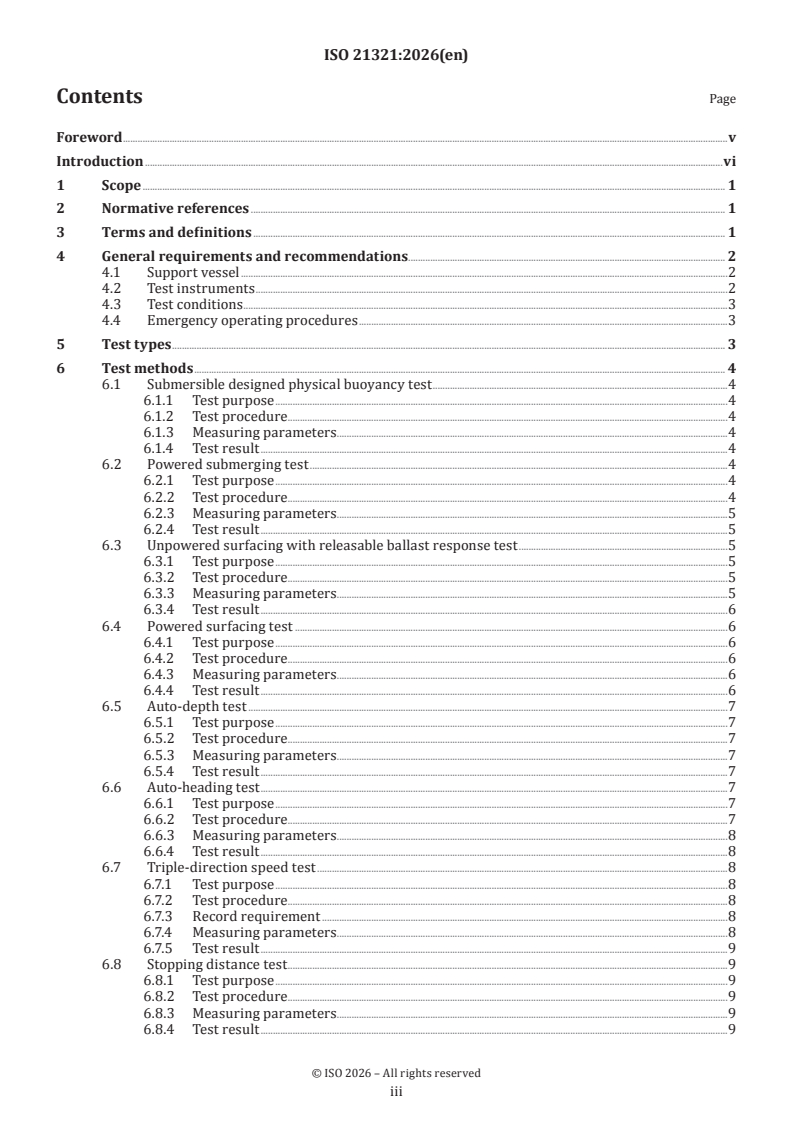
Contents Page
Foreword .v
Introduction .vi
1 Scope . 1
2 Normative references . 1
3 Terms and definitions . 1
4 General requirements and recommendations. 2
4.1 Support vessel .2
4.2 Test instruments .2
4.3 Test conditions .3
4.4 Emergency operating procedures .3
5 Test types . 3
6 Test methods . 4
6.1 Submersible designed physical buoyancy test .4
6.1.1 Test purpose .4
6.1.2 Test procedure.4
6.1.3 Measuring parameters .4
6.1.4 Test result .4
6.2 Powered submerging test .4
6.2.1 Test purpose .4
6.2.2 Test procedure.4
6.2.3 Measuring parameters .5
6.2.4 Test result .5
6.3 Unpowered surfacing with releasable ballast response test .5
6.3.1 Test purpose .5
6.3.2 Test procedure.5
6.3.3 Measuring parameters .5
6.3.4 Test result .6
6.4 Powered surfacing test .6
6.4.1 Test purpose .6
6.4.2 Test procedure.6
6.4.3 Measuring parameters .6
6.4.4 Test result .6
6.5 Auto-depth test .7
6.5.1 Test purpose .7
6.5.2 Test procedure.7
6.5.3 Measuring parameters .7
6.5.4 Test result .7
6.6 Auto-heading test .7
6.6.1 Test purpose .7
6.6.2 Test procedure.7
6.6.3 Measuring parameters . .8
6.6.4 Test result .8
6.7 Triple-direction speed test .8
6.7.1 Test purpose .8
6.7.2 Test procedure.8
6.7.3 Record requirement .8
6.7.4 Measuring parameters . .8
6.7.5 Test result .9
6.8 Stopping distance test .9
6.8.1 Test purpose .9
6.8.2 Test procedure.9
6.8.3 Measuring parameters .9
6.8.4 Test result .9
iii
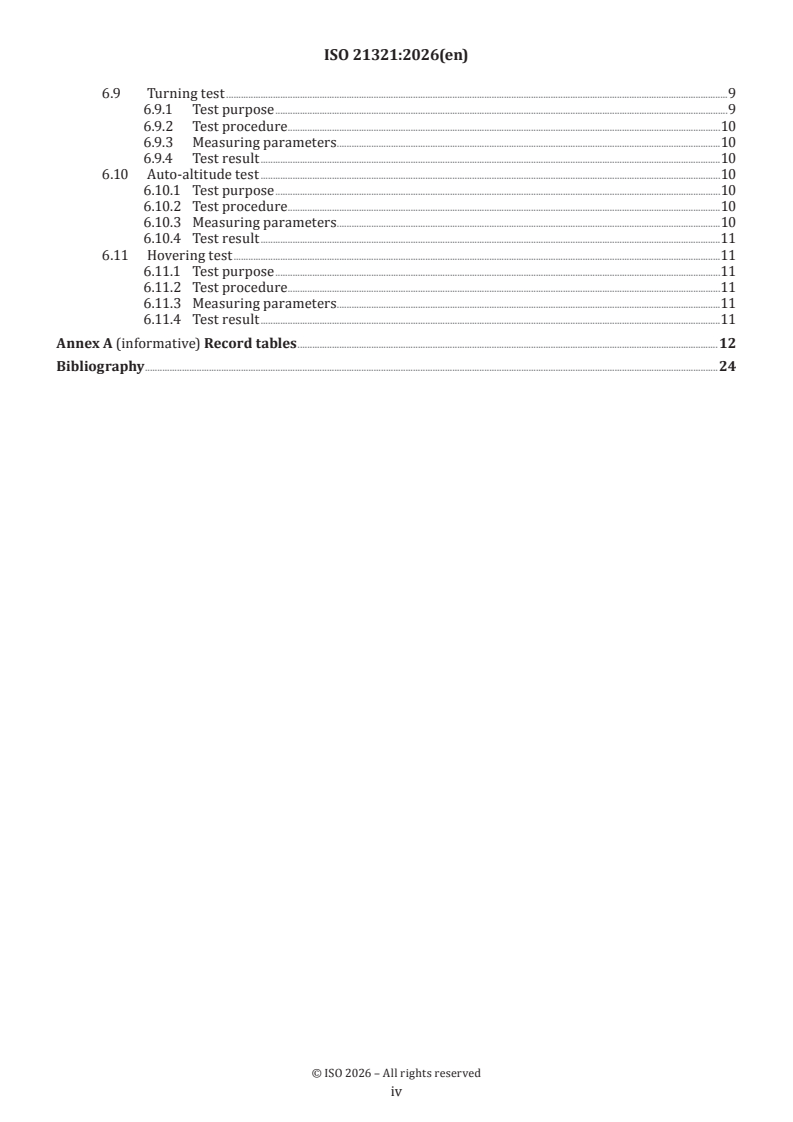
6.9 Turning test .9
6.9.1 Test purpose .9
6.9.2 Test procedure.10
6.9.3 Measuring parameters .10
6.9.4 Test result .10
6.10 Auto-altitude test .10
6.10.1 Test purpose .10
6.10.2 Test procedure.10
6.10.3 Measuring parameters .10
6.10.4 Test result .11
6.11 Hovering test .11
6.11.1 Test purpose .11
6.11.2 Test procedure.11
6.11.3 Measuring parameters .11
6.11.4 Test result .11
Annex A (informative) Record tables .12
Bibliography .24
iv
Foreword
ISO (the International Organization for Standardization) is a worldwide federation of national standards
bodies (ISO member bodies). The work of preparing International Standards is normally carried out through
ISO technical committees. Each member body interested in a subject for which a technical committee
has been established has the right to be represented on that committee. International organizations,
governmental and non-governmental, in liaison with ISO, also take part in the work. ISO collaborates closely
with the International Electrotechnical Commission (IEC) on all matters of electrotechnical standardization.
The procedures used to develop this document and those intended for its further maintenance are described
in the ISO/IEC Directives, Part 1. In particular, the different approval criteria needed for the different types
of ISO document should be noted. This document was drafted in accordance with the editorial rules of the
ISO/IEC Directives, Part 2 (see www.iso.org/directives).
ISO draws attention to the possibility that the implementation of this document may involve the use of (a)
patent(s). ISO takes no position concerning the evidence, validity or applicability of any claimed patent
rights in respect thereof. As of the date of publication of this document, ISO had not received notice of (a)
patent(s) which may be required to implement this document. However, implementers are cautioned that
this may not represent the latest information, which may be obtained from the patent database available at
www.iso.org/patents. ISO shall not be held responsible for identifying any or all such patent rights.
Any trade name used in this document is information given for the convenience of users and does not
constitute an endorsement.
For an explanation of the voluntary nature of standards, the meaning of ISO specific terms and expressions
related to conformity assessment, as well as information about ISO's adherence to the World Trade
Organization (WTO) principles in the Technical Barriers to Trade (TBT), see www.iso.org/iso/foreword.html.
This document was prepared by Technical Committee ISO/TC 8, Ships and marine technology, Subcommittee
SC 13, Marine technology.
Any feedback or questions on this document should be directed to the user’s national standards body. A
complete listing of these bodies can be found at www.iso.org/members.html.
v
Introduction
1)
As global marine technology continues to develop, human-occupied submersibles are being utilized in an
increasing number of fields. A standardized manoeuvring test for human-occupied submersibles may be
employed to provide a common approach to the analysis and assessment of the manoeuvrability performance
of newly built submersibles. The output of such a common approach can provide useful information for the
design, development and selection of navigation, power management and other ancillary systems used in
the subsequent completion of the submersible’s manufacture.
To meet the operating safety requirements, it is essential that the manoeuvring test is conducted within
the designed safe operating envelope of the submersible including environmental, depth and endurance
parameters. The measurement of manoeuvring performance is expected to be accurate and verifiable
against an appropriately considered set of performance expectations. However, at the time of publication
of this document, there is no International Standard that covers this element of submersible design and
development in the industry. Therefore, the aim of this document is to provide standardized requirements
for the submersible manufacturing and operating community.
1) This document uses the inclusive term "human-occupied submersible" in place of the term "manned submersible".
vi
International Standard ISO 21321:2026(en)
Ships and marine technology — Human-occupied
submersibles — Manoeuvring tests
1 Scope
This document specifies the general requirements, test items and methods for conducting manoeuvring
tests on human-occupied submersibles.
It is applicable to manoeuvring tests for all human-occupied submersibles operating in the sea and inland
waterway areas.
It can also be used as a reference for manoeuvring tests on other types of submersibles operating in pools,
lakes and seas.
2 Normative references
There are no normative references in this document.
3 Terms and definitions
For the purposes of this document, the following terms and definitions apply.
ISO and IEC maintain terminology databases for use in standardization at the following addresses:
— ISO Online browsing platform: available at https:// www .iso .org/ obp
— IEC Electropedia: available at https:// www .electropedia .org/
3.1
human-occupied submersible
submersible that encloses one or more persons within its pressure hull, fitted with one or more available
surface accesses, or underwater pressurized or non-pressurized accesses
[SOURCE: ISO 5411:2024, 3.1.2, modified — the term has been modified from "manned submersible" to the
inclusive term "human-occupied submersible".]
3.2
unpowered surfacing
free rising movement of a human-occupied submersible (3.1) which occurs without the use of propulsion or
operation of the submersible's ballast system
3.3
unpowered submerging
free sinking movement of a human-occupied submersible (3.1) which occurs without the use of propulsion or
operation of the submersible's ballast system
3.4
auto-depth keeping
computer-controlled mode to maintain the designated depth relative to the surface
[SOURCE: ISO 5411:2024, 3.9.6]
3.5
auto-heading control
computer-controlled mode to maintain the designated heading relative to the seabed
[SOURCE: ISO 5411:2024, 3.9.4]
3.6
auto-height keeping
computer-controlled mode to maintain the designated height above the seabed
[SOURCE: ISO 5411:2024, 3.9.7]
3.7
stopping distance
distance from slow down to stop with the use of propulsion, when a human-occupied submersible (3.1) travels
at an initial speed
3.8
design maximum safe operating depth
maximum water depth at which the submersible is permitted to operate repeatedly and normally throughout
its entire design life
4 General requirements and recommendations
4.1 Support vessel
For all submersible trial activities undertaken in open water such as the sea or an inland lake, a trial support
surface vessel should be available to ensure the safe conduct of the trial programmes and meet any relevant
requirements. If required, the support vessel should be capable of safely launching and recovering the
submersible in the safe operating envelope of the submersible system. It can be necessary for the support
vessel to be capable of dynamic positioning or mooring, thereby enabling the safe launch and recovery to be
conducted in the environmental conditions in which the trials will take place. The vessel should be capable
of dealing with any foreseeable emergency likely to be encountered during the trial programmes. The vessel
should also have a robust communication capability such that the submersible’s crew can communicate with
the support vessel at all times during the trials and testing activities.
4.2 Test instruments
Test instruments include but are not limited to:
a) doppler velocity log;
b) depth gauge;
c) altimeter;
d) motion sensor;
e) conductivity, temperature and depth (CTD) sensor;
f) positioning system.
NOTE Test instruments can be subject to approval by national authorities for use in the testing process.
Test instruments should be valid for use in the testing regime and as required by the testing protocol.
Test instruments should be installed in a suitable location to achieve the objective of the test process and not
adversely affected by movement, moisture, vibration or external environmental conditions during the test.
4.3 Test conditions
The test shall be conducted in a designated sea or inland waterway area where the water depth should be
less than the design maximum safe operating depth of the human-occupied submersible. The specified test
depth should not be affected by surface waves and appropriate safety precautions shall be implemented.
This should include a suitably considered plan for recovery of a disabled submersible from the seabed or
bottom of the inland waterway and establishing a safe depth which the submersible should not cross without
approval.
The temperature, salinity, dept
...