

ISO 8548-5:2003
(Main)Prosthetics and orthotics — Limb deficiencies — Part 5: Description of the clinical condition of the person who has had an amputation
General Information
- Abstract
ISO 8548-5:2003 establishes a method of describing those attributes of a person who has had an amputation which may affect their rehabilitation.
- Status
- Published
- Publication Date
- 10-Jul-2003
- Technical Committee
- ISO/TC 168 - Prosthetics and orthotics
- Drafting Committee
- ISO/TC 168/WG 1 - Nomenclature and classification
- Current Stage
- 9060 - Close of review
- Completion Date
- 04-Jun-2031
Buy Documents
ISO 8548-5:2003 - Prosthetics and orthotics — Limb deficiencies — Part 5: Description of the clinical condition of the person who has had an amputation Released:7/11/2003
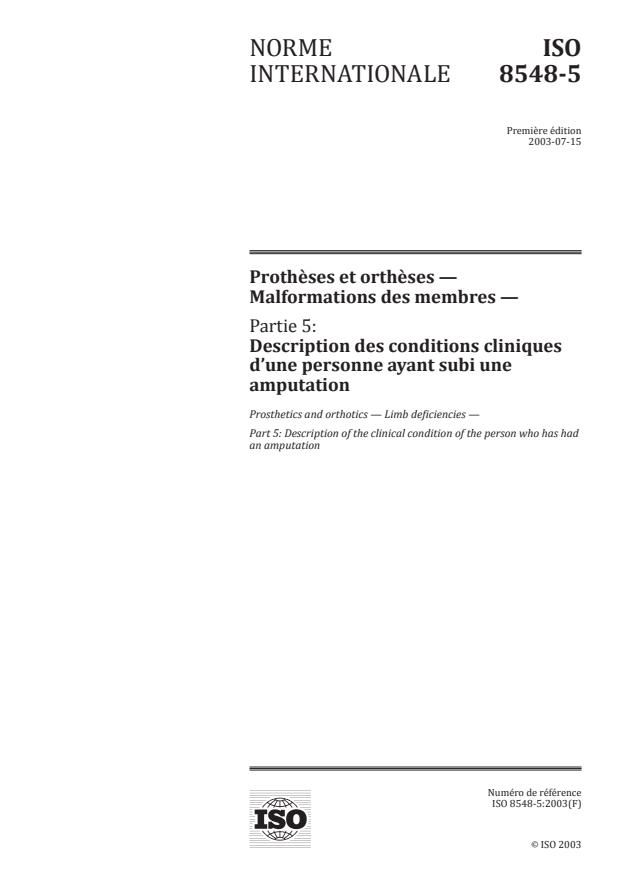
ISO 8548-5:2003 - Protheses et ortheses — Malformations des membres — Partie 5: Description des conditions cliniques d'une personne ayant subi une amputation Released:6/20/2017
Overview
ISO 8548-5:2003 is an international standard developed by the International Organization for Standardization (ISO) focused on prosthetics and orthotics for limb deficiencies. This part, Part 5: Description of the clinical condition of the person who has had an amputation, establishes a standardized method to describe the key attributes of individuals with amputations that may affect their rehabilitation process. By providing a structured approach, ISO 8548-5:2003 aids clinicians, researchers, and healthcare providers in recording, comparing, and analyzing clinical information, supporting improved rehabilitation outcomes.
Key Topics
- Personal Factors: The standard emphasizes the importance of documenting demographic details such as age, gender, height, and body mass. It also includes relevant social, environmental, and medical history aspects that may influence rehabilitation.
- Musculoskeletal System Condition: Detailed descriptions of the amputation stump condition and the state of any remaining limbs are required, referencing related ISO standards for consistency.
- General Clinical Condition: The document outlines assessment requirements for any disorders affecting the cardiovascular, respiratory, neurological, sensory, nutritional, or mental systems, which can impact the success of rehabilitation.
- Motivation and Perceived Needs: Clinicians are encouraged to record their assessment of the patient's motivation and perceived needs, recognizing the important effect of these factors on recovery and adaptation.
Applications
ISO 8548-5:2003 is designed for multiple practical applications in the fields of prosthetics, orthotics, and rehabilitation medicine:
- Clinical Assessment: Enables multidisciplinary teams to record essential information in a consistent and comprehensive way, improving the quality of patient care and treatment planning.
- Rehabilitation Planning: Facilitates detailed evaluations that consider not only the surgical and prosthetic aspects but also broader health and psychosocial factors.
- Data Analysis & Reporting: Supports the creation of standardized reports for both individual cases and larger studies, benefiting clinical research, epidemiology, and health service evaluations.
- International Comparability: Promotes a common language and framework, making it easier to compare clinical practices and outcomes across borders and healthcare systems.
- Policy Development: Informs government health officials and regulatory bodies with unified data needed for policy-making, resource allocation, and program evaluation.
Related Standards
The ISO 8548 series addresses various aspects of limb deficiencies and amputation, each part supporting specific documentation and clinical needs:
- ISO 8548-1: Method of describing limb deficiencies present at birth
- ISO 8548-2: Method of describing lower limb amputation stumps
- ISO 8548-3: Method of describing upper limb amputation stumps
- ISO 8548-4: Description of causal conditions leading to amputation
- ISO 8549-1: Vocabulary - General terms for external limb prostheses and orthoses
- ISO 8549-2: Vocabulary - Terms relating to external limb prostheses and wearers
Conclusion
Using ISO 8548-5:2003 ensures a holistic and standardized approach to describing the clinical conditions of people with limb amputations, greatly enhancing the effectiveness of prosthetics and orthotics services. Reliable documentation supports better rehabilitation outcomes and contributes to greater consistency and quality in healthcare worldwide.
Relevant keywords: prosthetics and orthotics, limb deficiencies, amputation rehabilitation, clinical assessment, ISO 8548-5, healthcare documentation, standardization, patient assessment, rehabilitation planning, international standards.
Buy Documents
ISO 8548-5:2003 - Prosthetics and orthotics — Limb deficiencies — Part 5: Description of the clinical condition of the person who has had an amputation Released:7/11/2003
ISO 8548-5:2003 - Protheses et ortheses — Malformations des membres — Partie 5: Description des conditions cliniques d'une personne ayant subi une amputation Released:6/20/2017
Get Certified
Connect with accredited certification bodies for this standard

BSI Group
BSI (British Standards Institution) is the business standards company that helps organizations make excellence a habit.

TÜV Rheinland
TÜV Rheinland is a leading international provider of technical services.

TÜV SÜD
TÜV SÜD is a trusted partner of choice for safety, security and sustainability solutions.
Sponsored listings
Frequently Asked Questions
ISO 8548-5:2003 is a standard published by the International Organization for Standardization (ISO). Its full title is "Prosthetics and orthotics — Limb deficiencies — Part 5: Description of the clinical condition of the person who has had an amputation". This standard covers: ISO 8548-5:2003 establishes a method of describing those attributes of a person who has had an amputation which may affect their rehabilitation.
ISO 8548-5:2003 establishes a method of describing those attributes of a person who has had an amputation which may affect their rehabilitation.
ISO 8548-5:2003 is classified under the following ICS (International Classification for Standards) categories: 11.040.40 - Implants for surgery, prosthetics and orthotics. The ICS classification helps identify the subject area and facilitates finding related standards.
ISO 8548-5:2003 is available in PDF format for immediate download after purchase. The document can be added to your cart and obtained through the secure checkout process. Digital delivery ensures instant access to the complete standard document.
Standards Content (Sample)
INTERNATIONAL ISO
STANDARD 8548-5
First edition
2003-07-15
Prosthetics and orthotics — Limb
deficiencies —
Part 5:
Description of the clinical condition of
the person who has had an amputation
Prothèses et orthèses — Malformations des membres —
Partie 5: Description des conditions cliniques d'une personne ayant subi
une amputation
Reference number
©
ISO 2003
PDF disclaimer
This PDF file may contain embedded typefaces. In accordance with Adobe's licensing policy, this file may be printed or viewed but
shall not be edited unless the typefaces which are embedded are licensed to and installed on the computer performing the editing. In
downloading this file, parties accept therein the responsibility of not infringing Adobe's licensing policy. The ISO Central Secretariat
accepts no liability in this area.
Adobe is a trademark of Adobe Systems Incorporated.
Details of the software products used to create this PDF file can be found in the General Info relative to the file; the PDF-creation
parameters were optimized for printing. Every care has been taken to ensure that the file is suitable for use by ISO member bodies. In
the unlikely event that a problem relating to it is found, please inform the Central Secretariat at the address given below.
© ISO 2003
All rights reserved. Unless otherwise specified, no part of this publication may be reproduced or utilized in any form or by any means,
electronic or mechanical, including photocopying and microfilm, without permission in writing from either ISO at the address below or
ISO's member body in the country of the requester.
ISO copyright office
Case postale 56 • CH-1211 Geneva 20
Tel. + 41 22 749 01 11
Fax + 41 22 749 09 47
E-mail copyright@iso.org
Web www.iso.org
Published in Switzerland
ii © ISO 2003 — All rights reserved
Foreword
ISO (the International Organization for Standardization) is a worldwide federation of national standards bodies
(ISO member bodies). The work of preparing International Standards is normally carried out through ISO
technical committees. Each member body interested in a subject for which a technical committee has been
established has the right to be represented on that committee. International organizations, governmental and
non-governmental, in liaison with ISO, also take part in the work. ISO collaborates closely with the
International Electrotechnical Commission (IEC) on all matters of electrotechnical standardization.
International Standards are drafted in accordance with the rules given in the ISO/IEC Directives, Part 2.
The main task of technical committees is to prepare International Standards. Draft International Standards
adopted by the technical committees are circulated to the member bodies for voting. Publication as an
International Standard requires approval by at least 75 % of the member bodies casting a vote.
Attention is drawn to the possibility that some of the elements of this document may be the subject of patent
rights. ISO shall not be held responsible for identifying any or all such patent rights.
ISO 8548-5 was prepared by Technical Committee ISO/TC 168, Prosthetics and orthotics.
ISO 8548 consists of the following parts, under the general title Prosthetics and orthotics — Limb deficiencies:
Part 1: Method of describing limb deficiencies present at birth
Part 2: Method of describing lower limb amputation stumps
Part 3: Method of describing upper limb amputation stumps
Part 4: Description of causal conditions leading to amputation
Part 5: Description of the clinical condition of the person who has had an amputation
Introduction
The rehabilitation of the person who has had an amputation depends not only on the surgery performed but
also on the causes and pathological condition for which amputation was performed, and on other clinical
conditions and attributes of the person. The various members of the clinic teams in different countries develop
their own nomenclature to record this information. Hence there is a need for an international system to allow
comparisons of clinical practice.
The system is designed to meet the needs of the members of the clinic team in assessing the person and
evaluating treatment. Such
...
NORME ISO
INTERNATIONALE 8548-5
Première édition
2003-07-15
Prothèses et orthèses —
Malformations des membres —
Partie 5:
Description des conditions cliniques
d’une personne ayant subi une
amputation
Prosthetics and orthotics — Limb deficiencies —
Part 5: Description of the clinical condition of the person who has had
an amputation
Numéro de référence
©
ISO 2003
DOCUMENT PROTÉGÉ PAR COPYRIGHT
© ISO 2003, Publié en Suisse
Droits de reproduction réservés. Sauf indication contraire, aucune partie de cette publication ne peut être reproduite ni utilisée
sous quelque forme que ce soit et par aucun procédé, électronique ou mécanique, y compris la photocopie, l’affichage sur
l’internet ou sur un Intranet, sans autorisation écrite préalable. Les demandes d’autorisation peuvent être adressées à l’ISO à
l’adresse ci-après ou au comité membre de l’ISO dans le pays du demandeur.
ISO copyright office
Ch. de Blandonnet 8 • CP 401
CH-1214 Vernier, Geneva, Switzerland
Tel. +41 22 749 01 11
Fax +41 22 749 09 47
copyright@iso.org
www.iso.org
ii © ISO 2003 – Tous droits réservés
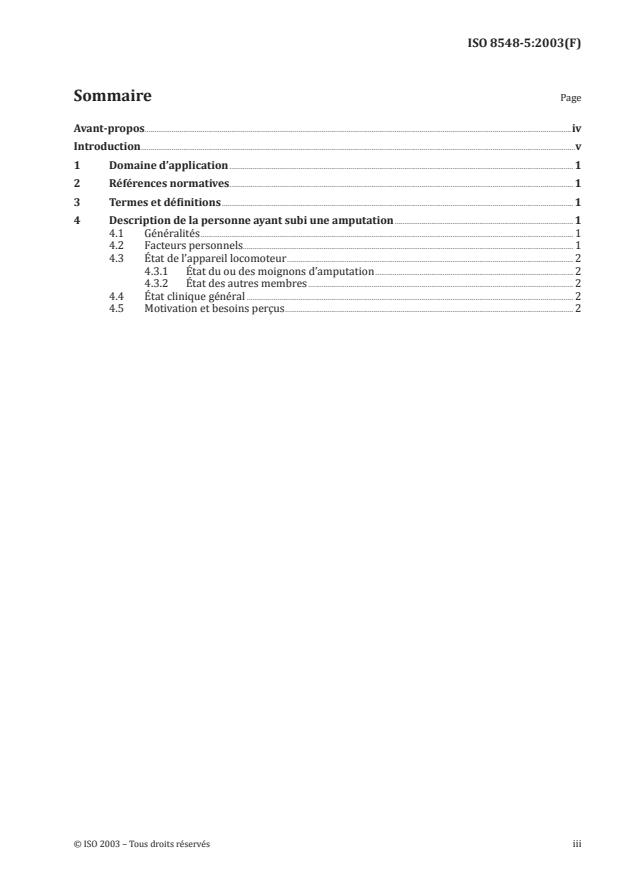
Sommaire Page
Avant-propos .iv
Introduction .v
1 Domaine d’application . 1
2 Références normatives . 1
3 Termes et définitions . 1
4 Description de la personne ayant subi une amputation . 1
4.1 Généralités . 1
4.2 Facteurs personnels. 1
4.3 État de l’appareil locomoteur . 2
4.3.1 État du ou des moignons d’amputation . 2
4.3.2 État des autres membres . 2
4.4 État clinique général . 2
4.5 Motivation et besoins perçus . 2
Avant-propos
L’ISO (Organisation internationale de normalisation) est une fédération mondiale d’organismes
nationaux de normalisation (comités membres de l’ISO). L’élaboration des Normes internationales est
en général confiée aux comités techniques de l’ISO. Chaque comité membre intéressé par une étude
a le droit de faire partie du comité technique créé à cet effet. Les organisations internationales,
gouvernementales et non gouvernementales, en liaison avec l’ISO participent également aux travaux.
L’ISO collabore étroitement avec la Commission électrotechnique internationale (IEC) en ce qui
concerne la normalisation électrotechnique.
Les Normes internationales sont rédigées conformément aux règles de rédaction données dans les
Directives ISO/IEC, Partie 2.
La tâche principale des comités techniques est d’élaborer les Normes internationales. Les projets de
Normes internationales adoptés par les comités techniques sont soumis aux comités membres pour
vote. Leur publication comme Normes internationales requiert l’approbation de 75 % au moins des
comités membres votants.
L’attention est appelée sur le fait que certains des éléments du présent document peuvent faire l’objet de
droits de propriété intellectuelle ou de droits analogues. L’ISO ne saurait être tenue pour responsable
de ne pas avoir identifié de tels droits de propriété et averti de leur existence.
L’ISO 8548-5 a été élaborée par le comité technique ISO/TC 168, Prothèses et orthèses.
L’ISO 8548 comprend les parties suivantes, présentées sous le titre général Prothèses et orthèses —
Malformations des membres:
— Partie 1: Méthode de description des malformations congénitales des membres
— Partie 2: Méthode de description des moignons d’amputation des membres inférieurs
— Partie 3: Méthode de description des moignons d’amputation des membres supérieurs
— Partie 4: Description des causes qui conduisent à l’amputat
...