


ISO 13940
(Main)Health informatics — System of concepts to support continuity of care
General Information
- Abstract
This document defines the requirements for a system of concepts for different aspects of the provision of care encompassing social care as well as clinical care. The focus of this document is continuity of care. This document defines requirements for a system of concept definitions needed to describe health and care businesses. Concept systems conforming to this document can be used to support the development of: logical reference models within the information viewpoint as a common basis for semantic interoperability on international, national or local levels; information systems; information for specified types of care processes. This document does not specify how to perform specific care processes. This document does not cover research processes in the context of social and clinical care, welfare and educational processes.
- Status
- Not Published
- Technical Committee
- ISO/TC 215 - Health informatics
- Drafting Committee
- ISO/TC 215/WG 3 - Semantic content
- Current Stage
- 6000 - International Standard under publication
- Start Date
- 10-Jun-2026
- Completion Date
- 01-Aug-2026
Buy Documents
ISO/FDIS 13940 - Health informatics — System of concepts to support continuity of care
REDLINE ISO/FDIS 13940 - Health informatics — System of concepts to support continuity of care
Overview
ISO 13940: Health informatics - System of concepts to support continuity of care is an international standard developed by ISO/TC 215, which specifies requirements for a conceptual system to define care processes necessary to achieve continuity of care in the health sector. This standard addresses both clinical and social care, supporting seamless patient management and communication across varied care settings. The framework provided by ISO 13940 enables consistent conceptual understanding and semantic interoperability, facilitating accurate information exchange within and between healthcare organizations, and supporting development and integration of health information systems.
Key Topics
- Continuity of Care: Emphasis on a coherent and interconnected series of care events over time, encompassing clinical and social care processes, enabling patients to experience coordinated and uninterrupted services.
- Concept System Alignment: Provides rigorous definitions for fundamental concepts such as health, care, health state, care actors, activities, and events, drawing on principles from upper-level ontologies (e.g., DOLCE).
- Semantic Interoperability: Supports the creation of logical reference models for health information systems to ensure data and processes are interpreted consistently at organizational, national, and international levels.
- Care Process Modelling: Enables the description and modelling of care processes, actors, resources, planning, responsibilities, and mandates through standardized terms and clear relationships.
- Integration of Clinical and Social Care: Reflects WHO’s broad definition of health and supports transitions and referrals between various care settings, including primary care, specialist services, community and home-based care, and long-term care.
Applications
ISO 13940 supports a wide range of practical applications in health informatics, such as:
- Development of Health Information Systems: Provides a conceptual foundation for designing robust information models that underpin electronic health records (EHR) and integrated care systems.
- Semantic Interoperability: Assists in harmonizing terminology between different healthcare IT systems, paving the way for accurate and meaningful data exchange and reducing miscommunication.
- Care Process Improvement: Facilitates clear definition and documentation of clinical and social care processes, enabling organizations to optimize workflows and enhance patient care coordination.
- Business Analysis and Policy Creation: Offers a standardized vocabulary for analyzing organizational structures, designing care pathways, and supporting evidence-based policy development in the health sector.
- Secondary Use of Care Data: Establishes a semantic foundation for using care data in research, analytics, and knowledge management without ambiguity, ensuring consistency and traceability.
Related Standards
Implementers of ISO 13940 should consider alignment with other key health informatics standards, including:
- ISO 13606-1: Electronic health record communication - Reference model for EHR architecture
- HL7/FHIR: Fast Healthcare Interoperability Resources standard for electronic exchange of healthcare information
- ISO/IEC 21838-3: Information technology - Top-level ontologies (for alignment of upper-level concepts)
- ISO 12967-1: Health informatics - Service architecture
- UNI/TR 11802:2020: Technical report providing a concept system for continuity of care, especially in the Italian context
Adoption of ISO 13940 ensures stakeholders, from care professionals to IT solution providers, can refer to a shared, internationally recognized system of health informatics concepts. This enhances semantic clarity, streamlines integration efforts, and ultimately supports safer and more effective continuity of care for individuals receiving both clinical and social support.
Relations
- Effective Date
- 12-Feb-2026
- Effective Date
- 18-Jan-2025
Buy Documents
ISO/FDIS 13940 - Health informatics — System of concepts to support continuity of care
REDLINE ISO/FDIS 13940 - Health informatics — System of concepts to support continuity of care
Get Certified
Connect with accredited certification bodies for this standard

BSI Group
BSI (British Standards Institution) is the business standards company that helps organizations make excellence a habit.

NYCE
Mexican standards and certification body.
Sponsored listings
Frequently Asked Questions
ISO 13940 is a draft published by the International Organization for Standardization (ISO). Its full title is "Health informatics — System of concepts to support continuity of care". This standard covers: This document defines the requirements for a system of concepts for different aspects of the provision of care encompassing social care as well as clinical care. The focus of this document is continuity of care. This document defines requirements for a system of concept definitions needed to describe health and care businesses. Concept systems conforming to this document can be used to support the development of: logical reference models within the information viewpoint as a common basis for semantic interoperability on international, national or local levels; information systems; information for specified types of care processes. This document does not specify how to perform specific care processes. This document does not cover research processes in the context of social and clinical care, welfare and educational processes.
This document defines the requirements for a system of concepts for different aspects of the provision of care encompassing social care as well as clinical care. The focus of this document is continuity of care. This document defines requirements for a system of concept definitions needed to describe health and care businesses. Concept systems conforming to this document can be used to support the development of: logical reference models within the information viewpoint as a common basis for semantic interoperability on international, national or local levels; information systems; information for specified types of care processes. This document does not specify how to perform specific care processes. This document does not cover research processes in the context of social and clinical care, welfare and educational processes.
ISO 13940 is classified under the following ICS (International Classification for Standards) categories: 35.240.80 - IT applications in health care technology. The ICS classification helps identify the subject area and facilitates finding related standards.
ISO 13940 has the following relationships with other standards: It is inter standard links to FprEN ISO 13940, ISO 13940:2015. Understanding these relationships helps ensure you are using the most current and applicable version of the standard.
ISO 13940 is available in PDF format for immediate download after purchase. The document can be added to your cart and obtained through the secure checkout process. Digital delivery ensures instant access to the complete standard document.
Standards Content (Sample)
FINAL DRAFT
International
Standard
ISO/FDIS 13940
ISO/TC 215
Health informatics — System of
Secretariat: ANSI
concepts to support continuity of
Voting begins on:
care
2026-04-14
Informatique de santé — Système de concepts en appui de la
Voting terminates on:
continuité des soins
2026-06-09
RECIPIENTS OF THIS DRAFT ARE INVITED TO SUBMIT,
WITH THEIR COMMENTS, NOTIFICATION OF ANY
RELEVANT PATENT RIGHTS OF WHICH THEY ARE AWARE
AND TO PROVIDE SUPPOR TING DOCUMENTATION.
IN ADDITION TO THEIR EVALUATION AS
BEING ACCEPTABLE FOR INDUSTRIAL, TECHNO
ISO/CEN PARALLEL PROCESSING LOGICAL, COMMERCIAL AND USER PURPOSES, DRAFT
INTERNATIONAL STANDARDS MAY ON OCCASION HAVE
TO BE CONSIDERED IN THE LIGHT OF THEIR POTENTIAL
TO BECOME STAN DARDS TO WHICH REFERENCE MAY BE
MADE IN NATIONAL REGULATIONS.
Reference number
ISO/FDIS 13940:2026(en) © ISO 2026
FINAL DRAFT
ISO/FDIS 13940:2026(en)
International
Standard
ISO/FDIS 13940
ISO/TC 215
Health informatics — System of
Secretariat: ANSI
concepts to support continuity of
Voting begins on:
care
Informatique de santé — Système de concepts en appui de la
Voting terminates on:
continuité des soins
RECIPIENTS OF THIS DRAFT ARE INVITED TO SUBMIT,
WITH THEIR COMMENTS, NOTIFICATION OF ANY
RELEVANT PATENT RIGHTS OF WHICH THEY ARE AWARE
AND TO PROVIDE SUPPOR TING DOCUMENTATION.
© ISO 2026
IN ADDITION TO THEIR EVALUATION AS
All rights reserved. Unless otherwise specified, or required in the context of its implementation, no part of this publication may
BEING ACCEPTABLE FOR INDUSTRIAL, TECHNO
ISO/CEN PARALLEL PROCESSING
LOGICAL, COMMERCIAL AND USER PURPOSES, DRAFT
be reproduced or utilized otherwise in any form or by any means, electronic or mechanical, including photocopying, or posting on
INTERNATIONAL STANDARDS MAY ON OCCASION HAVE
the internet or an intranet, without prior written permission. Permission can be requested from either ISO at the address below
TO BE CONSIDERED IN THE LIGHT OF THEIR POTENTIAL
or ISO’s member body in the country of the requester.
TO BECOME STAN DARDS TO WHICH REFERENCE MAY BE
MADE IN NATIONAL REGULATIONS.
ISO copyright office
CP 401 • Ch. de Blandonnet 8
CH-1214 Vernier, Geneva
Phone: +41 22 749 01 11
Email: copyright@iso.org
Website: www.iso.org
Published in Switzerland Reference number
ISO/FDIS 13940:2026(en) © ISO 2026
ii
ISO/FDIS 13940:2026(en)
Contents Page
Foreword .ix
Introduction .x
1 Scope . 1
2 Normative references . 1
3 Terms and definitions . 1
3.1 General terms .1
3.2 Health matters .4
3.3 Actors, performers and resources .18
3.4 Activities . 33
3.5 Care processes .43
3.6 Time. 49
3.7 Plans and events . 58
3.8 Mandates . 65
3.9 Health records . 73
4 Abbreviated terms .86
5 Health and care .86
5.1 General . 86
5.2 Explanations and comments . 86
5.2.1 Health state . 86
5.2.2 Health matter . 87
5.2.3 Health condition . 87
5.2.4 Health issue . 87
5.2.5 Health problem . 87
5.2.6 Health thread. 87
5.2.7 Potential health condition . 87
5.2.8 Observed condition . 87
5.2.9 Considered condition. 87
5.2.10 Vulnerability . 87
5.2.11 Social environment . 88
5.2.12 Social determinant of health . 88
5.2.13 Health need . 88
5.3 Representation of the relationships between concepts related to health state . 88
5.4 Normative statements .91
5.4.1 Relationships of health state .91
5.4.2 Relationships of health matter . 92
5.4.3 Relationships of clinical matter . 92
5.4.4 Relationships of social matter . 92
5.4.5 Relationships of health condition . 92
5.4.6 Relationships of health issue . 93
5.4.7 Relationships of social issue. 93
5.4.8 Relationships of clinical issue . 93
5.4.9 Relationships of health problem . 93
5.4.10 Relationships of health thread . 93
5.4.11 Relationships of health problem list . 94
5.4.12 Relationships of potential health condition . 94
5.4.13 Relationships of observed condition . 94
5.4.14 Relationships of considered condition . 94
5.4.15 Relationships of professionally assessed condition . 95
5.4.16 Relationships of vulnerability . 95
5.4.17 Relationships of excluded condition . 95
5.4.18 Relationships of working diagnosis . 95
5.4.19 Relationships of prognostic condition . 95
5.4.20 Relationships of resultant condition . 96
iii
ISO/FDIS 13940:2026(en)
5.4.21 Relationships of target condition . 96
5.4.22 Relationships of risk condition . 96
5.4.23 Relationships of social environment . 96
5.4.24 Relationships of health need . . 96
5.4.25 Relationships of social need . 97
5.4.26 Relationships of clinical need . 97
6 Actors and resources .97
6.1 General . 97
6.2 Explanations and comments . 97
6.2.1 Care actor . 97
6.2.2 Subject of care . 97
6.2.3 Care organization . 97
6.2.4 Care third party . 97
6.2.5 Care personnel . 98
6.2.6 Care employment . 98
6.2.7 Care professional entitlement . 98
6.2.8 Care professional . 98
6.2.9 Subject of care proxy . 98
6.2.10 Care performer . 98
6.2.11 Prescriber . 98
6.2.12 Care resource . 98
6.2.13 Point of care . 98
6.2.14 Care funds . 99
6.3 Representation of the relationships between concepts related to care actors . 99
6.4 Normative statements . 101
6.4.1 Relationships of care actor . 101
6.4.2 Relationships of subject of care . . 102
6.4.3 Relationships of care provider . 103
6.4.4 Relationships of care third party . 103
6.4.5 Relationships of care organization . 103
6.4.6 Relationships of care employment . 104
6.4.7 Relationships of care personnel . 104
6.4.8 Relationships of care professional entitlement. 104
6.4.9 Relationships of care professional . 104
6.4.10 Relationships of other carer . 105
6.4.11 Relationships of care supporting organization . . 105
6.4.12 Relationships of subject of care proxy . 105
6.4.13 Relationships of care performer . 106
6.4.14 Relationships of self-care performer . 106
6.4.15 Relationships of third party care performer . 106
6.4.16 Relationships of prescriber . 106
6.4.17 Relationships of care resource . 106
6.4.18 Relationships of point of care. 107
6.4.19 Relationships of medical device . 107
6.4.20 Relationships of automatic medical device . 107
6.4.21 Relationships of medicinal product . 107
6.4.22 Relationships of care funds . . 107
6.4.23 Relationships of facility . 107
7 Activities .108
7.1 General . 108
7.2 Explanations and comments . 108
7.2.1 Care activity . 108
7.2.2 Care activities bundle . 108
7.2.3 Care investigation . 108
7.2.4 Care treatment . 108
7.2.5 Health condition assessment . 108
7.2.6 Care needs assessment . 108
7.2.7 Care activity management . 108
iv
ISO/FDIS 13940:2026(en)
7.2.8 Care evaluation . 108
7.3 Representation of the relationships between concepts related to care activities . 109
7.4 Normative statements .110
7.4.1 Relationships of care activity.110
7.4.2 Relationships of care provider activity . 111
7.4.3 Relationships of social care . 111
7.4.4 Relationships of automated care . 112
7.4.5 Relationships of self-care . 112
7.4.6 Relationships of prescribed self-care. 112
7.4.7 Relationships of care third party activity . 112
7.4.8 Relationships of prescribed third party activity . 112
7.4.9 Relationships of care service offering . 113
7.4.10 Relationships of care activities bundle . 113
7.4.11 Relationships of care service . 113
7.4.12 Relationships of care service directory . 113
7.4.13 Relationships of care investigation .114
7.4.14 Relationships of care treatment .114
7.4.15 Relationships of care assessment .114
7.4.16 Relationships of health condition assessment .114
7.4.17 Relationships of care needs assessment .114
7.4.18 Relationships of needed care activity .114
7.4.19 Relationships of care activity management . 115
7.4.20 Relationships of care evaluation . 115
8 Processes .115
8.1 General . 115
8.2 Explanations and comments . 115
8.2.1 Care process . 115
8.2.2 Continuity of care process . 115
8.2.3 Request for care . 115
8.2.4 Reason for request for care .116
8.2.5 Care process evaluation .116
8.3 Representation of the relationships between concepts related to care processes .116
8.4 Normative statements .117
8.4.1 Relationships of care process .117
8.4.2 Relationships of continuity of care process . 118
8.4.3 Relationships of input health state . 118
8.4.4 Relationships of output health state . 118
8.4.5 Relationships of request for care .119
8.4.6 Relationships of initial request for care .119
8.4.7 Relationships of referral .119
8.4.8 Relationships of request for service .119
8.4.9 Relationships of reason for request for care . 120
8.4.10 Relationships of care process evaluation . 120
9 Events, time .120
9.1 General . 120
9.2 Explanations and comments . 120
9.2.1 Health related period . 120
9.2.2 Health condition period . 120
9.2.3 Care activity period . 120
9.2.4 Mandated period of care . 120
9.2.5 Indirect care activity period . 121
9.2.6 Prescribed self-care period . 121
9.2.7 Care contact . 121
9.2.8 Initial contact . 121
9.2.9 Encounter . . 121
9.2.10 Care appointment . 121
9.2.11 Episode of care . 121
9.2.12 Care activity delay . 121
v
ISO/FDIS 13940:2026(en)
9.2.13 Health approach . 121
9.3 Representation of the relationships between concepts related to time . 121
9.4 Normative statements . 122
9.4.1 Relationships of health related period. 122
9.4.2 Relationships of health condition period. 122
9.4.3 Relationships of care activity period . 123
9.4.4 Relationships of mandated period of care . 123
9.4.5 Relationships of indirect care activity period . 123
9.4.6 Relationships of prescribed self-care period . 123
9.4.7 Relationships of care contact . 123
9.4.8 Relationships of initial contact . 124
9.4.9 Relationships of encounter . 124
9.4.10 Relationships of care appointment . 124
9.4.11 Relationships of episode of care . 124
9.4.12 Relationships of episodes of care bundle. 125
9.4.13 Relationships of care activity delay. 125
9.4.14 Relationships of health condition delay . 125
9.4.15 Relationships of resource delay . 125
9.4.16 Relationships of subject of care preference delay . 125
9.4.17 Relationships of health approach . 125
10 Planning care and knowledge resources .126
10.1 General . 126
10.2 Explanations and comments . 126
10.2.1 Care planning . 126
10.2.2 Care goal . 126
10.2.3 Intended outcome . 126
10.2.4 Core care plan . 126
10.2.5 Care pathway . 126
10.2.6 Unintended event . 126
10.3 Representation of the relationships between concepts related to planning care . 126
10.4 Normative statements . 127
10.4.1 Relationships of care planning . 127
10.4.2 Relationships of care goal .128
10.4.3 Relationships of intended outcome . .128
10.4.4 Relationships of care guideline . 128
10.4.5 Relationships of protocol .128
10.4.6 Relationships of care pathway . 129
10.4.7 Relationships of care plan .129
10.4.8 Relationships of core care plan . 129
10.4.9 Relationships of social care plan . 130
10.4.10 Relationships of clinical care plan . 130
10.4.11 Relationships of integrated care plan . 130
10.4.12 Relationships of unintended event . 130
10.4.13 Relationships of adverse event . 130
10.4.14 Relationships of adverse event management . 130
11 Responsibility .130
11.1 General . 130
11.2 Explanations and comments . 131
11.2.1 Care mandate . 131
11.2.2 Care commitment . 131
11.2.3 Objection, subject of care desire . 131
11.2.4 Proxy mandate . 131
11.2.5 Care period mandate . 131
11.2.6 Continuity facilitator mandate . 131
11.2.7 Mandate to export personal information . 131
11.3 Representation of the relationships between concepts related to responsibility and
mandates . 132
11.4 Normative statements . 133
vi
ISO/FDIS 13940:2026(en)
11.4.1 Relationships of care mandate . 133
11.4.2 Relationships of care commitment .
...
ISO/FDIS 13940:2026(en)
ISO/TC 215
Secretariat: ANSI
Date: 2026-02-2403-31
Health informatics — System of concepts to support continuity of
care
Informatique de santé — Système de concepts en appui de la continuité des soins
FDIS stage
TThhiis drs draafftt i is s susubbmmiitttteed d ttoo aa ppaarraallellell vvoottee i inn IISSOO,, CCEEN.N.
ISO/FDIS 13940:2026(en)
All rights reserved. Unless otherwise specified, or required in the context of its implementation, no part of this publication
may be reproduced or utilized otherwise in any form or by any means, electronic or mechanical, including photocopying,
or posting on the internet or an intranet, without prior written permission. Permission can be requested from either ISO
at the address below or ISO’s member body in the country of the requester.
ISO copyright office
CP 401 • Ch. de Blandonnet 8
CH-1214 Vernier, Geneva
Phone: + 41 22 749 01 11
E-mail: copyright@iso.org
Website: www.iso.org
Published in Switzerland
ii
ISO/DISFDIS 13940:20252026(en)
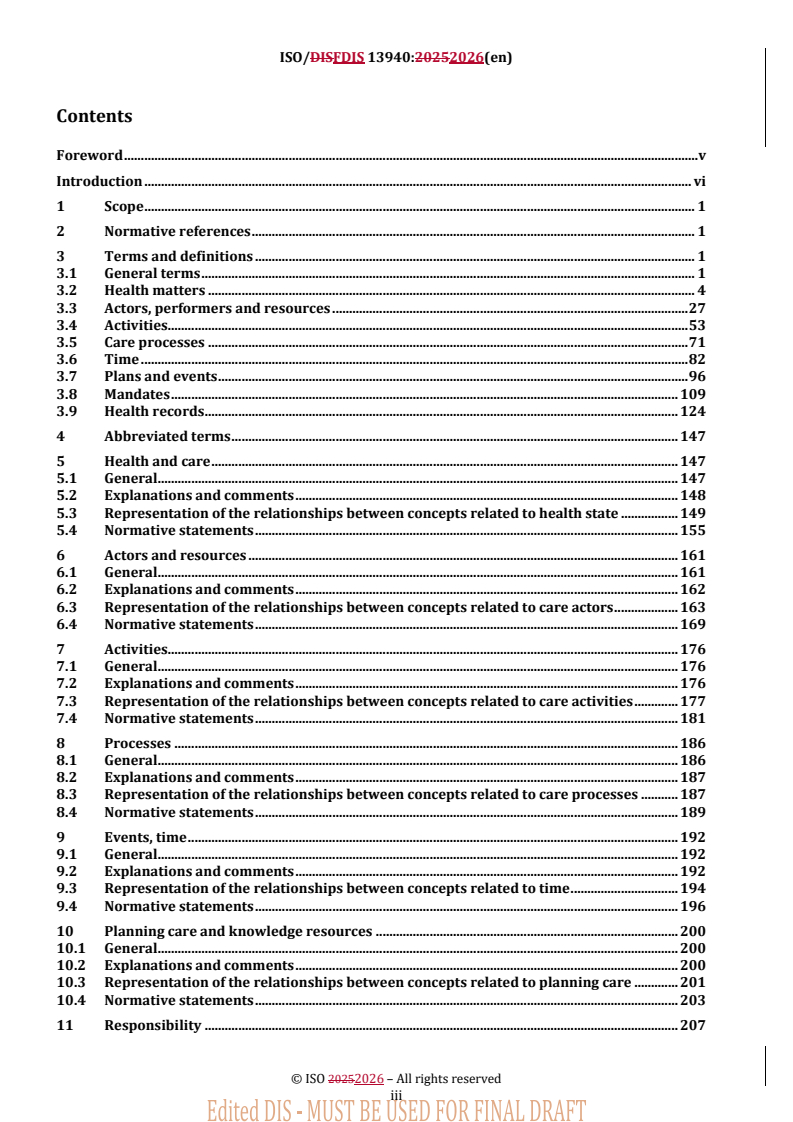
Contents
Foreword . v
Introduction . vi
1 Scope . 1
2 Normative references . 1
3 Terms and definitions . 1
3.1 General terms . 1
3.2 Health matters . 4
3.3 Actors, performers and resources . 27
3.4 Activities. 53
3.5 Care processes . 71
3.6 Time . 82
3.7 Plans and events . 96
3.8 Mandates . 109
3.9 Health records . 124
4 Abbreviated terms . 147
5 Health and care . 147
5.1 General . 147
5.2 Explanations and comments . 148
5.3 Representation of the relationships between concepts related to health state . 149
5.4 Normative statements . 155
6 Actors and resources . 161
6.1 General . 161
6.2 Explanations and comments . 162
6.3 Representation of the relationships between concepts related to care actors . 163
6.4 Normative statements . 169
7 Activities. 176
7.1 General . 176
7.2 Explanations and comments . 176
7.3 Representation of the relationships between concepts related to care activities . 177
7.4 Normative statements . 181
8 Processes . 186
8.1 General . 186
8.2 Explanations and comments . 187
8.3 Representation of the relationships between concepts related to care processes . 187
8.4 Normative statements . 189
9 Events, time . 192
9.1 General . 192
9.2 Explanations and comments . 192
9.3 Representation of the relationships between concepts related to time . 194
9.4 Normative statements . 196
10 Planning care and knowledge resources . 200
10.1 General . 200
10.2 Explanations and comments . 200
10.3 Representation of the relationships between concepts related to planning care . 201
10.4 Normative statements . 203
11 Responsibility . 207
iii
ISO/FDIS 13940:2026(en)
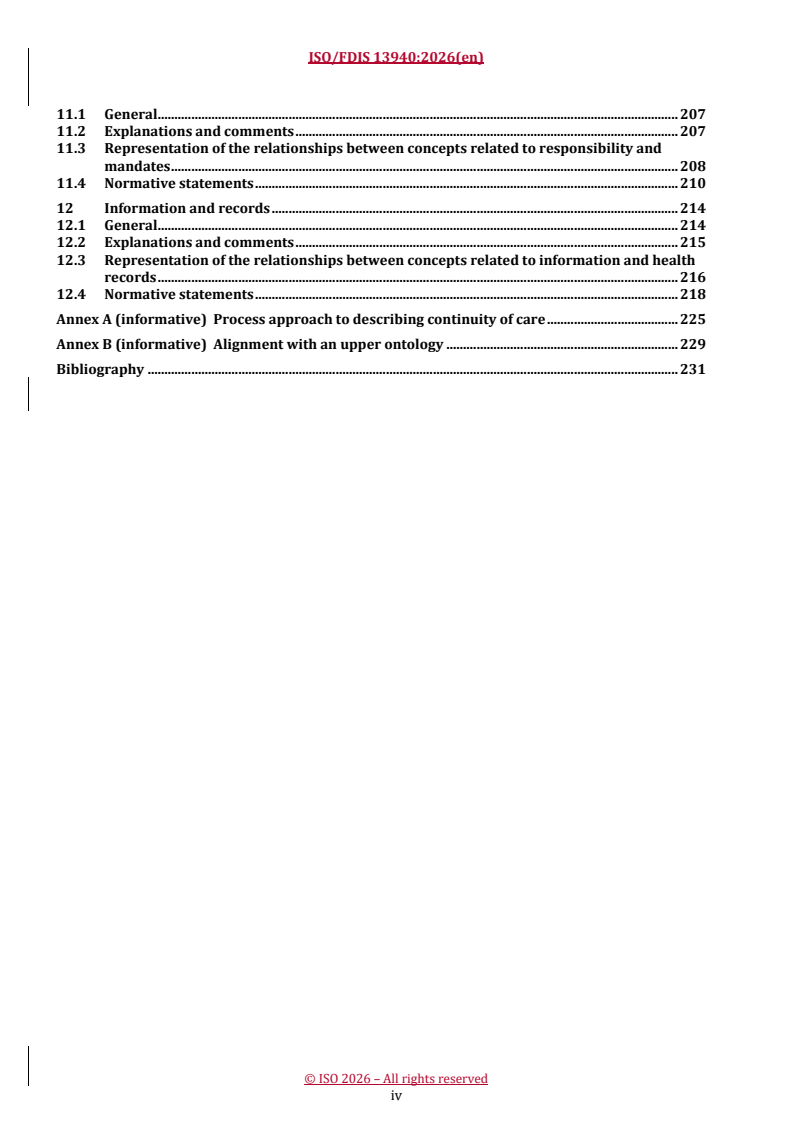
11.1 General . 207
11.2 Explanations and comments . 207
11.3 Representation of the relationships between concepts related to responsibility and
mandates . 208
11.4 Normative statements . 210
12 Information and records . 214
12.1 General . 214
12.2 Explanations and comments . 215
12.3 Representation of the relationships between concepts related to information and health
records . 216
12.4 Normative statements . 218
Annex A (informative) Process approach to describing continuity of care . 225
Annex B (informative) Alignment with an upper ontology . 229
Bibliography . 231
iv
ISO/DISFDIS 13940:20252026(en)
Foreword
ISO (the International Organization for Standardization) is a worldwide federation of national standards
bodies (ISO member bodies). The work of preparing International Standards is normally carried out through
ISO technical committees. Each member body interested in a subject for which a technical committee has been
established has the right to be represented on that committee. International organizations, governmental and
non-governmental, in liaison with ISO, also take part in the work. ISO collaborates closely with the
International Electrotechnical Commission (IEC) on all matters of electrotechnical standardization.
The procedures used to develop this document and those intended for its further maintenance are described
in the ISO/IEC Directives, Part 1. In particular, the different approval criteria needed for the different types of
ISO documentdocuments should be noted. This document was drafted in accordance with the editorial rules
of the ISO/IEC Directives, Part 2 (see www.iso.org/directives).
ISO draws attention to the possibility that the implementation of this document may involve the use of (a)
patent(s). ISO takes no position concerning the evidence, validity or applicability of any claimed patent rights
in respect thereof. As of the date of publication of this document, ISO had not received notice of (a) patent(s)
which may be required to implement this document. However, implementers are cautioned that this may not
represent the latest information, which may be obtained from the patent database available at
www.iso.org/patents. ISO shall not be held responsible for identifying any or all such patent rights.
Any trade name used in this document is information given for the convenience of users and does not
constitute an endorsement.
For an explanation of the voluntary nature of standards, the meaning of ISO specific terms and expressions
related to conformity assessment, as well as information about ISO'sISO’s adherence to the World Trade
Organization (WTO) principles in the Technical Barriers to Trade (TBT), see www.iso.org/iso/foreword.html.
This document was prepared by Technical Committee ISO/TC 215, Health informatics, in collaboration with
the European Committee for Standardization (CEN) Technical Committee CEN/TC 251, Health informatics, in
accordance with the Agreement on technical cooperation between ISO and CEN (Vienna Agreement).
This second edition cancels and replaces the first edition (ISO 13940:2015), which has been technically
revised.
The main changes are as follows:
— all concepts have been moved into Clause 3Clause 3;;
— — content has been added to make it more explicit that continuity of care includes social care and related
concepts.
— — concepts have been aligned to ISO/IEC 21838-3:202320232023.
Any feedback or questions on this document should be directed to the user’s national standards body. A
complete listing of these bodies can be found at www.iso.org/members.html.
v
ISO/FDIS 13940:2026(en)
Introduction
0.1 0.1 General
Continuity of care is an important prerequisite for ensuring that a subject of care receives effective and
efficient care and the best possible outcomes over the course of any health condition, be it an injury, illness or
social issue. Within any context, achieving continuity of care requires an ability to understand and define care
processes, their interactions and sequencing within and across organizational boundaries and to
communicate information about them unambiguously using an agreed system of concepts within a shared
semantic framework. The purpose of this document is to define the requirements for a system of concepts and
the semantics needed to support the definition of care processes and the continuity of care.
This document does not seek to define or standardise specific processes used in the delivery of care. Instances
of such standardisation can be found in some other standards documents, for instancesuch as ISO 12967-1.
In addition to supporting the continuity of care, the system of concepts in this document provides a rigorous
semantic foundation for other purposes including the use of care data for secondary use and knowledge
management in the health sector, and standardized definitions for use in health informatics standards,
enterprise modelling and the formulation of health policies.
Figure 1Figure 1 illustrates the way in which care processes are supported by and interact with a hierarchy of
other processes within and across organizations (including business, policy and technical processes) in order
to operate. The system of concepts specified in this document therefore includes concepts related to the
physical and financial resources needed to support care processes.
vi
ISO/DISFDIS 13940:20252026(en)
vii
ISO/FDIS 13940:2026(en)
Figure 1— Architecture of the concept areas
0.2 0.2 Aims forof this document
The primary aim forof this document is to provide a comprehensive, conceptual basis for content and context
in care services, be theyincluding social services, clinical services or integrated services that seamlessly
engage across both thesesocial and clinical contexts. This document provides a foundation for interoperability
at all levels in care organizations, between care organizations, and for the development of information systems
in care.
0.3 0.3 'Health'‘Health’ as a concept
In this document, health is defined with reference to the World Health Organization’s (WHO) declaration of
health from 1948: “. a state of complete physical, mental and social well-being and not merely the absence of
[31] [33]
disease or infirmity”. ”. In 1986 WHO made two amendments to the above definition: “resource for
everyday life, not the objective of living” and “health is a positive concept emphasizing social and personal
resources, as well as physical capacities”. The second amendment emphasizes the importance of social aspects
in the context of health.
0.4 0.4 Care, clinical care and social care
Both clinical care and social care have the objective of influencing, restoring and maintaining health as defined
by WHO. In this document the term “care” is used to stress the common characteristics and objectives of both
clinical care and social care. It is a common misunderstanding that healthcare is restricted to clinical action
viii
ISO/DISFDIS 13940:20252026(en)
against physical and mental health problems. This does not align with the WHO description of health, which
includes social aspects of care.
A key objective of this document is to support smooth transition between social care and clinical care including
referral between any or all primary care, home care, community-based care, secondary and tertiary hospital
care, specialist care services, and long-term institutional care.
[40][38,39],[41]
In 2016 and 2017, two scientific papers on the integration of social and clinical care were published.
Based on these papers, a working group was launched at the UNINFO, the branch of the Italian National
Unification (UNI) Standardizationstandardization body that tackles Informationinformation and
Communications Technologycommunications technology (ICT) activities. The task of the working group was
to use the previous edition of this document (ISO 13940:2015) to establish a concept system not only for
continuity of care in social care but also to ensure collaboration and continuity of care within, between and
across the provision of both social care and clinical care. This resulted in technical report UNI/TR 11802:2020.
[30]
.This document (i.e. the second edition of ISO 13940) extends the system of concepts for the continuity of
care to more explicitly support the continuity of care across social care and clinical care building on the
contributions made in UNI/TR 11802:2020.
A generic model of the continuity of care process indicating the cyclic nature of care activities typically
involved in delivering care to a subject of care is provided in Annex AAnnex A.
0.5 0.5 Intended users forof this document
All parties interested in the interoperability issues in clinical care and social care are intended users of this
document. This includes, but is not limited to, care professionals and teams, social care personnel, subjects of
care, care managers, care funding organizations and all types of care providers and local care teams.
This system of concepts is relevant across all care information and the development and use of care
information systems. It can also be used for business analysis as a basis for organizational decisions and more
widely in development that is not inherently tied to the use of information systems.
0.6 0.6 Alignment with ontological principles
In this second editiondocument, all upper-level concepts and their definitions have been aligned with the
DOLCE high level descriptive ontology for linguistic and cognitive engineering as defined in ISO/IEC 21838-
3:2023, which has been built on ISO/IEC 21838-1:2021.
0.7 0.7 Description and display of concepts
In this document the concepts are listeddefined in Clause 3Clause 3. They, where they are listed in logical
order and grouped in subclauses according to the kinds of concepts. Concepts are illustrated withaccompanied
by UML diagrams illustratingthat illustrate their relationship to immediately related concepts.
Clauses 5Clauses 5 to 1212 provide additional description of the concepts and extensive UML diagrams
showing relations between the concepts listed in Clause 3Clause 3. The large models include associations that
are illustrated as undirected, describing conceptual relationships rather than data access paths.
Examples are provided wherever they are considered relevant and necessary.
The purpose of using concept model diagrams in this document is to highlight the relationships between
concepts. Consequently, in conformance with ISO 24156:2014-1, no attributes are shown in the concept
classes. Characteristics are shown as related concepts. Attributes of classes in an information model represent
related concepts. They can be added during implementation and still be conformant to this document.
ix
ISO/FDIS 13940:2026(en)
In the diagrams used in this document, a generalization denotes an “is--a” relationship in which a specific
concept is a kind of a more general concept. This relationship implies that the specific concept conforms to all
characteristics defined for the more general concept. This is illustrated by a line from the specific concept to
the more general concept with an open arrow at the more general concept.
The relation of this system of concepts to an upper ontology is described in Annex BAnnex B. Some ontological
elements are needed for understanding of the conceptual structure of this document but are not part of the
concept system supporting continuity of care. Consequently, elements from the upper ontology may appear
in model diagrams even if they are not explicitly defined in the terms and definitions.
0.8 0.8 Relationship of this standard to other relevant standards
— — Appropriate terminology has been aligned with ISO 13606-1:2019 and HL7/FHIR.
— — ISO/IEC 21838-3:2023 [85] has been aused as guidance in the modelling work.
x
DRAFT International Standard ISO/DIS 13940:2025(en)
Health informatics — System of concepts to support continuity of care
1 Scope
This document defines the requirements for a system of concepts for different aspects of the provision of care
encompassing social care as well as clinical care. The focus of thethis document is continuity of care.
This document defines requirements for a system of concept definitions needed to describe health and care
businesses. Concept1 §oncept systems conforming to this document can be used to support the
development of:
— — logical reference models within the information viewpoint as a common basis for semantic
interoperability on international, national or local levels;
— — information systems;
— — information for specified types of care processes.
This document does not specify how to perform specific care processes. This document does not cover
research processes in the context of social and clinical care, welfare and educational processes.
2 Normative references
There are no normative references in this document.
3 Terms and definitions
For the purposes of this document, the following terms and definitions apply.
ISO and IEC maintain terminology databases for use in standardization at the following addresses:
— ISO Online browsing platform: available at https://www.iso.org/obp
— — IEC Electropedia: available at https://www.electropedia.org/
3.1 General terms
3.1.1 3.1.1
knowledge
maintained, processed, and interpreted information (3.1.3)
[SOURCE: ISO 5127:2017, 3.1.1.17]
3.1.2 3.1.2
health
state of complete physical, mental and social well-being
Note 1 to entry:. : The definition is drawn from the WHO description of health: a state of complete physical, mental and
social well-being and not merely the absence of disease or infirmity.
ISO/FDIS 13940:2026(en)
3.1.3 3.1.3
information
meaningful data
Note 1 to entry: Facts, events, things, processes, and ideas, including concepts, are examples of objects.
Note 2 to entry: Information is something that is meaningful. Data might be regarded as information once its meaning is
revealed.
[SOURCE: ISO 9000:2015, 3.1.38.2]
3.1.4 3.1.4
party
person (3.1.10) or group performing a role (3.1.20) in relation to the business of a specific community or
domain
[SOURCE: ISO 8459:2009, 2.33]
3.1.5 3.1.5
process model
representation of a process
3.1.6 3.1.6
continuity of care
coherent and interconnected series of care (3.1.19) events (3.1.7) over time
3.1.7 3.1.7
event
situation considered to occur at a time point
[SOURCE: ISO 12381:2019, 3.6]
3.1.8 3.1.8
appointment
arrangement to meet someone at a particular time and place
3.1.9 3.1.9
mandate
commission to act
EXAMPLE 1 A request for care means that an individual asks for help by care provider. But it is combined with the
authorisation for the care provider to access the necessary care resources (3.3.17) including documentation and deliver
those services requested by the individual. Such a request contains a mandate given to the care provider to provide care.
Note 1 to entry: A mandate is assigned by someone or as the consequence of legislation. It is always an obligation to do
something together with the associated authority to do that. If a mission is given to somebody, this actor needs authority
to perform what is necessary to fulfil the mission.
3.1.10 3.1.10
person
individual human being
[SOURCE: ISO/TS 23164:2025, 3.10.2, modified — the word “individual” was added in the definition; the
example and note to entry were removed.]
ISO/FDIS 13940:2026(en)
3.1.11 3.1.11
commitment
obligation by one or more of the participants in an act to comply with a rule or perform a contract
Note 1 to entry: The enterprise object(s) participating in an action of commitment may be parties or agents acting on
behalf of a party or parties. In the case of an action of commitment by an agent, the principal becomes obligated.
[SOURCE: ISO 12967-1:2020, 3.7.2]
3.1.12 3.1.12
organization
person (3.1.10) or group of people that has its own functions with responsibilities, authorities and
relationships to achieve its objectives
Note 1 to entry: Groupings or subdivisions of organizations may also be considered as organizations where there is need
to identify them in this way for purposes of information interchange.
Note 2 to entry: In this document, this definition applies to any kind of organization, whatever their legal status.
[SOURCE: ISO 9000:2015, 3.2.1, modified — Notes 1 and 2 to entry were removed and new notes to entry have
been added.]
3.1.13 3.1.13
resource
asset that is utilized or consumed during the execution of activities
EXAMPLE 1 Time, personnel, human skills and knowledge, equipment, services, supplies, facilities, technology, data,
money.
EXAMPLE 2 Capital equipment, tools.
EXAMPLE 3 Utilities such as power, water, fuel and communication infrastructures.
Note 1 to entry: Resources may be reusable, renewable or consumable.
Note 2 to entry: Resources are used, consumed or renewed during activities as part of a process.
[SOURCE: ISO/IEC/IEEE 15288:2023, 3.37, modified — ExamplesIn the definition, “process” was changed to
“activities”; examples were added,; the original Note 1 to entry was removed and a new Note 2 to entry was
added.]
3.1.14 3.1.14
social determinant of health
condition in which a subject of care (3.3.2) is born, grows, lives, works and ages including their access to power,
money and resources (3.1.13)
Note 1 to entry: Adapted from Reference [35]World Health Organization. Division of Health Promotion, Education, and
[33]
Communication. (1998). Health promotion glossary .
3.1.15 3.1.15
risk
combination of the probability of occurrence of harm and the severity of that harm
Note 1 to entry: The probability of occurrence includes the exposure to a hazardous situation and the possibility to avoid
or limit the harm.
[SOURCE: ISO/IEC Guide 63:2019, 3.10]
ISO/FDIS 13940:2026(en)
3.1.16 3.1.16
data
set of values of qualitative or quantitative variables
[SOURCE: ISO 5405:2024, 3.11
3.1.17]
3.1.17
data repository
identifiable data (3.1.16) storage facility
[SOURCE: ISO 10303-22:1998, 3.3.11, modified — the preferred term "“repository"” was changed to "“data
repository”]”.]
3.1.18 3.1.18
information model
formal model of a bounded set of facts, concepts or instructions to meet a specified requirement
[SOURCE: ISO 13584-102:2006, 3.16]
3.1.19 3.1.19
care
provision of accommodations, comfort and treatment to an individual subject of care (3.3.2)
3.1.20 3.1.20
role
set of competencies or performances, or both, that are associated with a task
[SOURCE: ISO 22600-2:2014, 3.33]
3.2 Health matters
3.2.1 3.2.1
health state
overall level of health (3.1.2) of a subject of care (3.3.2)
Note 1 to entry: Health is aspirational.
Note 2 to entry: The underlying health state is present, even if not observed. For example, the subject of care having a
cancer before it gives symptoms.
Note 3 to entry: See Figure 2Figure 2
ISO/FDIS 13940:2026(en)
Figure 2— Health state (UML Representationrepresentation)
3.2.2 3.2.2
health matter
circumstance contributing to the health state (3.2.1) of a person (3.1.10)
Note 1 to entry: This can be a matter which calls for care intervention, e.g. a medical statement, and immunisation, a
treatment, but it can also be a matter which the person can manage alone, e.g. by means of self-care activities, or needs
no management.
Note 2 to entry: See Figure 3Figure 3.
ISO/FDIS 13940:2026(en)
Figure 3— Health matter (UML Representationrepresentation)
ISO/FDIS 13940:2026(en)
3.2.3 3.2.3
clinical care
care activity (3.4.1) concerned with physical or mental health needs (3.2.25)
Note 1 to entry: See Figure 4Figure 4.
Figure 4— Clinical care (UML Representationrepresentation)
3.2.4 3.2.4
clinical matter
health matter (3.2.2) concerned with the body or mind
Note 1 to entry: See Figure 5Figure 5.
ISO/FDIS 13940:2026(en)
Figure 5— Clinical matter (UML Representationrepresentation)
3.2.5 3.2.5
social matter
health matter (3.2.2) concerning how a subject of care (3.3.2) lives in their social environment (3.2.24)
Note 1 to entry: See Figure 6Figure 6.
ISO/FDIS 13940:2026(en)
Figure 6— Social matter (UML Representationrepresentation)
3.2.6 3.2.6
health condition
aspect of a health state (3.2.1)
Note 1 to entry: See Figure 7Figure 7.
ISO/FDIS 13940:2026(en)
Figure 7— Health condition (UML Representationrepresentation)
3.2.7 3.2.7
health issue
health condition (3.2.6) motivating care (3.1.19)
EXAMPLE 1 Loss of weight, heart attack, drug addiction, injury, dermatitis, requirement for a health certificate,
inability to prepare meals, suitability for immunisation
Note 1 to entry: A health issue.
ISO/FDIS 13940:2026(en)
Note 2 to entry: See Figure 8Figure 8.
ISO/FDIS 13940:2026(en)
Figure 8— Health issue (UML Representationrepresentation)
ISO/FDIS 13940:2026(en)
3.2.8 3.2.8
social issue
health issue (3.2.7) that is a social matter (3.2.5)
Note 1 to entry: See Figure 9Figure 9.
Figure 9— Social issue (UML Representationrepresentation)
3.2.9 3.2.9
clinical issue
health issue (3.2.7(3.2.7)) that is a clinical matter (3.2.4)
Note 1 to entry: See Figure 10Figure 10.
Figure 10— Clinical issue (UML Representationrepresentation)
3.2.10 3.2.10
health problem
health issue (3.2.7(3.2.7)) considered by a care actor (3.3.1(3.3.1)) to be a problem
ISO/FDIS 13940:2026(en)
Note 1 to entry: Health problems can be single observations but are usually more compound as a summary of several
observations. Single observations are often criteria for the more compound health condition (3.2.6) considered to be a
health problem.
Note 2 to entry: See Figure 11Figure 11.
Figure 11— Health problem (UML Representationrepresentation)
3.2.11 3.2.11
health thread
defined association between health matters (3.2.2) as determined by one or more care actors (3.3.1)
EXAMPLE 1 A low back pain, known for many years by the subject of care's care’s general practitioner (GP,), treated
several times by the physiotherapist who labelled it a scoliosis and currently a candidate for a specific orthopaedic
intervention.
EXAMPLE 2 Type 2 diabetes treated by a GP, a nurse, an endocrinologist and a vascular surgeon.
EXAMPLE 3 The health conditions (3.2.6) included in a care process (3.5.1.).
Note 1 to entry: A health thread reconciles a range of health matters reflecting the variety of scopes of care actors,
particularly of care providers (3.3.3.).
Note 2 to entry: A health thread may be established by a team (e.g. a coordination committee).
Note 3 to entry: A health thread can be built step-by-step, by allowing each care professional (3.3.9) to add their
perspective into a common health thread.
Note 4 to entry: Under the responsibility of a designated care actor, a health thread linking several health matters can
describe an episodes of care bundle (3.6.12), for instance, a partial or comprehensive synthesis of care actor-related
episodes of care (3.6.11.).
Note 5 to entry: A collective decision (before, during or after the care interventions) may define a health thread and so
the idea of the 'episode'“episode” accepted by all the care professionals involved.
Note 6 to entry: A health thread may be considered an aggregation of health matters and/or health threads, or both.
Note 7 to entry: See Figure 12Figure 12.
ISO/FDIS 13940:2026(en)
Figure 12— Health thread (UML Representationrepresentation)
3.2.12 3.2.12
health problem list
care problem list
health thread (3.2.11(3.2.11)) linking a set of health problems (3.2.10(3.2.10))
Note 1 to entry: See Figure 13Figure 13.
ISO/FDIS 13940:2026(en)
Figure 13— Health problem list (UML Representationrepresentation)
3.2.13 3.2.13
potential health condition
possible future or current health condition (3.2.6) described by a care actor (3.3.1)
Note 1 to entry: A potential health condition is not yet observed, but represents an imagined, possible observation of
aspects of a current or future health state (3.2.1.).
Note 2 to entry: A potential health condition can only be fully supported using one of its specializations.
Note 3 to entry: See Figure 14Figure 14.
ISO/FDIS 13940:2026(en)
Figure 14— Potential health condition (UML Representationrepresentation)
3.2.14 3.2.14
observed condition
health condition (3.2.6) observed by a care actor (3.3.1)
EXAMPLE 1 A blood pressure, a swelling in the abdomen, tachycardia, body weight, lung infiltration on x-ray, a
haemoglobin value, pale skin.
Note 1 to entry: Care professionals (3.3.9) and subjects of care (3.3.2) are examples of care actors that can perceive the
observed aspect of a health state.
Note 2 to entry: An observed condition is a health issue (3.2.7) and as such is a representation of aspects of the health
state.
Note 3 to entry: See Figure 15Figure 15.
ISO/FDIS 13940:2026(en)
Figure 15— Observed condition (UML Representationrepresentation)
3.2.15 3.2.15
considered condition
considered health condition
potential health condition (3.2.13) considered by a care actor based on one or more observed conditions
(3.2.14)
Note 1 to entry: A request for care (3.5.5) normally includes a health condition (3.2.6) or symptom observed by the subject
of care (3.3.2) and also a question about what the reason for that symptom might be. It is the potential health condition
in this question (the health condition behind the symptom) that is called a considered condition.
Note 2 to entry: A referral within a continuity of care process (3.5.2) is normally motivated by one or several observed
conditions or professionally assessed conditions (3.2.16.). However, the referral also normally includes a question that the
ISO/FDIS 13940:2026(en)
care investigation (3.4.13) is supposed to get an answer to. The question formulated as a potential condition is a
considered condition.
Note 3 to entry: A considered condition remains considered until the associated observed conditions are changed or
completed. Care investigation or care treatment can result in new observations that can verify or not verify the
considered condition. When a considered condition is verified, it becomes an observed condition or professionally
assessed condition that may be a working diagnosis. If a considered condition is discounted, it is transformed into an
excluded condition (3.2.18.).
Note 4 to entry: See Figure 16Figure 16.
Figure 16— Considered condition (UML Representationrepresentation)
3.2.16 3.2.16
professionally assessed condition
observed condition (3.2.14) assessed by a care professional (3.3.9)
Note 1 to entry: See Figure 17Figure 17.
ISO/FDIS 13940:2026(en)
Figure 17— Professionally assessed condition (UML Representationrepresentation)
3.2.17 3.2.17
vulnerability
health condition (3.2.6) that is an exposure to the risk (3.1.15) of harm
EXAMPLE 1 Released from prison.
EXAMPLE 2 Drug addiction.
EXAMPLE 3 Loss of employment.
EXAMPLE 4 Lives up a steep flight of stairs leading to increased risk of falls.
EXAMPLE 5 Immunosuppressed leading to risk of infection.
Note 1 to entry: In the perspective of health carehealthcare and wellbeing, the term “vulnerable condition” is often used
to label frail citizens and/or socio-economic and education conditions (e.g. housing, job, disability)), or both, that
motivate certain interventions in social care (3.4.3,), generally addressing a target population (e.g. older persons,
children, families, homeless, refugees).
Note 2 to entry: The potential harm is a risk condition.
Note 3 to entry: See Figure 18Figure 18.
ISO/FDIS 13940:2026(en)
Figure 18— Vulnerability (UML Representationrepresentation)
3.2.18 3.2.18
excluded condition
discounted condition
non-verified condition
ruled out condition
ruled out considered condition
considered condition (3.2.15(3.2.15)) that one or more care professionals (3.3.9) have determined not to be
consistent with the known observed conditions (3.2.14)
Note 1 to entry: See Figure 19Figure 19.
Figure 19— Excluded condition (UML Representationrepresentation)
3.2.19 3.2.19
working diagnosis
working hypothesis
Professionallyprofessionally assessed condition (3.2.16(3.2.16)) that one or more care professionals (3.3.9) have
determined to be the most consistent with observed conditions (3.2.14)
ISO/FDIS 13940:2026(en)
Note 1 to entry: A working diagnosis is used as a label for the considered condition (3.2.15) that one or more care
professionals assess as the most probable health condition (3.2.6) and that could be concluded after further observations.
The basis for such assessments is the already observed conditions.
Note 2 to entry: Different care professionals may make different interpretations and assessments of the observed
conditions and thereby come to different conclusions and different working.
Note 3 to entry: A working diagnosis is often identified in the continuity of care process (3.5.2) as a summary after the
planned care investigations (3.4.13investigation) are completed. A working diagnosis in this stage is often called a
diagnosis. An excluded condition (3.2.18) could correspondingly be called a negation of a working diagnosis.
Note 4 to entry: See Figure 20Figure 20.
Figure 20— Working diagnosis (UML Representationrepresentation)
3.2.20 3.2.20
prognostic condition
potential health condition (3.2.13) representing the expected course of a health state (3.2.1) as assessed by
care professionals (3.3.9)
Note 1 to entry: See Figure 21Figure 21.
Figure 21— Prognostic condition (UML Representationrepresentation)
ISO/FDIS 13940:2026(en)
3.2.21 3.2.21
resultant condition
health condition (3.2.6) representing an output health state (3.5.4)
EXAMPLE 1 Care process (3.5.1) result, care activity (3.4.1) result.
Note 1 to entry: A resultant condition can represent the output health state after a single care activity, a bundle of care
investigations and/or care treatments, or both, in a care process, or the outcome after a complete continuity of care
process (3.5.2.).
Note 2 to entry: See Figure 22Figure 22.
Figure 22— Resultant condition (UML Representationrepresentation)
3.2.22 3.2.22
target condition
target health condition
potential health condition (3.2.13) representing either intended outcomes (3.7.3) or care goals (3.7.2)
EXAMPLE 1 The target condition for a worker that arrived at the Emergency Roomemergency room with a broken
arm is to be fully functional for work in the shortest period.
EXAMPLE 2 The target condition of a newly diagnosed diabetic adolescent boy is maintenance of his HbA1c at less
than 48 mmol/mol. ([HbA1c is a lab test that shows the average level of blood sugar (glucose) over the previous 3 months;
it shows how well diabetes is being controlled).].
Note 1 to entry: Assessment of needs for care activities (3.4.1) includes identification of intended outcomes or care goals.
These inform decisions about relevant activities to create or update the care plan (3.7.7.).
Note 2 to entry: See Figure 23Figure 23.
ISO/FDIS 13940:2026(en)
Figure 23— Target condition (UML Representationrepresentation)
3.2.23 3.2.23
risk condition
risk health condition
health condition (3.2.6) representing a potential undesired future health state (3.2.1)
Note 1 to entry: While a risk (3.1.15) is defined as the combination of a probability of an event and its consequences, the
risk condition deals only with the consequences.
Note 2 to entry: A risk condition can be a result of a current vulnerability (3.2.17.).
Note 3 to entry: See Figure 24Figure 24.
Figure 24— Risk condition (UML Representationrepresentation)
ISO/FDIS 13940:2026(en)
3.2.24 3.2.24
social environment
milieu
immediate physical and social setting in which a person (3.1.10
...