

ISO 8036:2015
(Main)Microscopes — Immersion liquids for light microscopy
General Information
- Abstract
ISO 8036:2015 describes the characteristics of immersion liquids used in microscopy. It classifies immersion liquids according to their field of application and specifies requirements and test methods for each type. ISO 8036:2015 further specifies a system of designation for immersion liquids, the information to be included on container labels, and the information to be supplied in technical data sheets.
- Status
- Published
- Publication Date
- 03-Jun-2015
- Technical Committee
- ISO/TC 172/SC 5 - Microscopes and endoscopes
- Drafting Committee
- ISO/TC 172/SC 5 - Microscopes and endoscopes
- Current Stage
- 9092 - International Standard to be revised
- Start Date
- 15-Jan-2026
- Completion Date
- 29-Aug-2026
Buy Documents
ISO 8036:2015 - Microscopes -- Immersion liquids for light microscopy
REDLINE ISO 8036:2015 - Microscopes -- Immersion liquids for light microscopy
ISO 8036:2015 - Microscopes — Immersion liquids for light microscopy/4/2015
REDLINE ISO 8036:2015 - Microscopes — Immersion liquids for light microscopy/4/2015
Overview
ISO 8036:2015 is the International Standard that defines the characteristics, classifications, and quality requirements for immersion liquids used in light microscopy. It provides a systematic framework to ensure that immersion liquids-whether oils or glycerol-meet stringent optical and physical criteria to optimize microscope imaging performance. This standard offers critical guidance on selecting, labeling, and testing immersion liquids to support high-quality microscope observations, including fluorescence microscopy applications.
Key Topics
Classification of Immersion Liquids
ISO 8036:2015 categorizes immersion liquids into three types based on application:- Type N: General use immersion oil for standard light microscopy.
- Type F: Specialized immersion oil designed for fluorescence microscopy, with enhanced spectral properties.
- Type G: Spectrally pure glycerol for glycerol immersion techniques.
Optical Properties
- Refractive Index: Measured at 546.07 nm wavelength and 23°C to ensure optimal light transmission and minimal distortion.
- Abbe Number: Indicates the dispersive power of the liquid to reduce chromatic aberrations in microscopy.
- Transmittance: Extended spectral range requirements per type to suit various microscopy methods, including near-ultraviolet and near-infrared ranges.
- Autofluorescence: Quantified against quinine sulfate standard to minimize fluorescence background noise critical in fluorescence microscopy.
Physical Characteristics
- Viscosity: Assessed at 23°C to guarantee proper flow and handling in microscopy setups.
- Density: Measured for consistency and compatibility with microscope objectives.
Minimum Quality Requirements
The standard imposes limits on refractive index tolerances, spectral transmittance, autofluorescence levels, and viscosity to align immersion liquids with microscopy performance needs.Labeling and Designation
Containers must clearly display product name, ISO designation, refractive index, Abbe number, batch number, and safety information. A standardized nomenclature ensures clear identification.Technical Data Sheets
Manufacturers are required to provide detailed technical data sheets containing chemical composition, optical and physical properties, handling instructions, and safety measures, promoting transparency and trustworthiness.
Applications
ISO 8036:2015 immersion liquids are essential for various microscopy techniques, enhancing image clarity and resolution by matching the refractive index between the microscope lens and sample. Key uses include:
- Brightfield and Phase Contrast Microscopy: Using Type N immersion oils to improve numerical aperture and resolution in biological and material specimens.
- Fluorescence Microscopy: Employing Type F oils with low autofluorescence and extended transmittance into UV and IR ranges to maximize fluorescence signal detection.
- Glycerol Immersion Techniques: Utilizing Type G spectrally pure glycerol where water-based immersion is preferable, often in live cell or aqueous sample imaging.
- High-Precision Optical Research: Ensuring immersion liquids comply with strict optical property requirements to maintain instrument calibration and repeatability.
Related Standards
ISO 8036:2015 references and aligns with important complementary ISO standards to ensure measurement accuracy and compatibility in microscopy:
- ISO 2592: Methods for determining flash and fire points of liquids, ensuring safe handling of immersion oils.
- ISO 8255-1 and ISO 8255-2: Cover glass specifications, crucial for maintaining consistent optical interfaces when using immersion liquids.
Collectively, these standards foster a comprehensive approach to quality and safety in microscopy accessories and consumables.
Keywords: ISO 8036, immersion liquids, immersion oil, light microscopy, fluorescence microscopy, immersion oil classification, refractive index, Abbe number, autofluorescence, microscopy standards, glycerol immersion, optical properties, viscosity, transmittance, microscopy immersion liquid requirements, container labeling, technical data sheet.
Relations
- Effective Date
- 11-Oct-2014
Buy Documents
ISO 8036:2015 - Microscopes -- Immersion liquids for light microscopy
REDLINE ISO 8036:2015 - Microscopes -- Immersion liquids for light microscopy
ISO 8036:2015 - Microscopes — Immersion liquids for light microscopy/4/2015
REDLINE ISO 8036:2015 - Microscopes — Immersion liquids for light microscopy/4/2015
Frequently Asked Questions
ISO 8036:2015 is a standard published by the International Organization for Standardization (ISO). Its full title is "Microscopes — Immersion liquids for light microscopy". This standard covers: ISO 8036:2015 describes the characteristics of immersion liquids used in microscopy. It classifies immersion liquids according to their field of application and specifies requirements and test methods for each type. ISO 8036:2015 further specifies a system of designation for immersion liquids, the information to be included on container labels, and the information to be supplied in technical data sheets.
ISO 8036:2015 describes the characteristics of immersion liquids used in microscopy. It classifies immersion liquids according to their field of application and specifies requirements and test methods for each type. ISO 8036:2015 further specifies a system of designation for immersion liquids, the information to be included on container labels, and the information to be supplied in technical data sheets.
ISO 8036:2015 is classified under the following ICS (International Classification for Standards) categories: 37.020 - Optical equipment. The ICS classification helps identify the subject area and facilitates finding related standards.
ISO 8036:2015 has the following relationships with other standards: It is inter standard links to ISO 8036:2006. Understanding these relationships helps ensure you are using the most current and applicable version of the standard.
ISO 8036:2015 is available in PDF format for immediate download after purchase. The document can be added to your cart and obtained through the secure checkout process. Digital delivery ensures instant access to the complete standard document.
Standards Content (Sample)
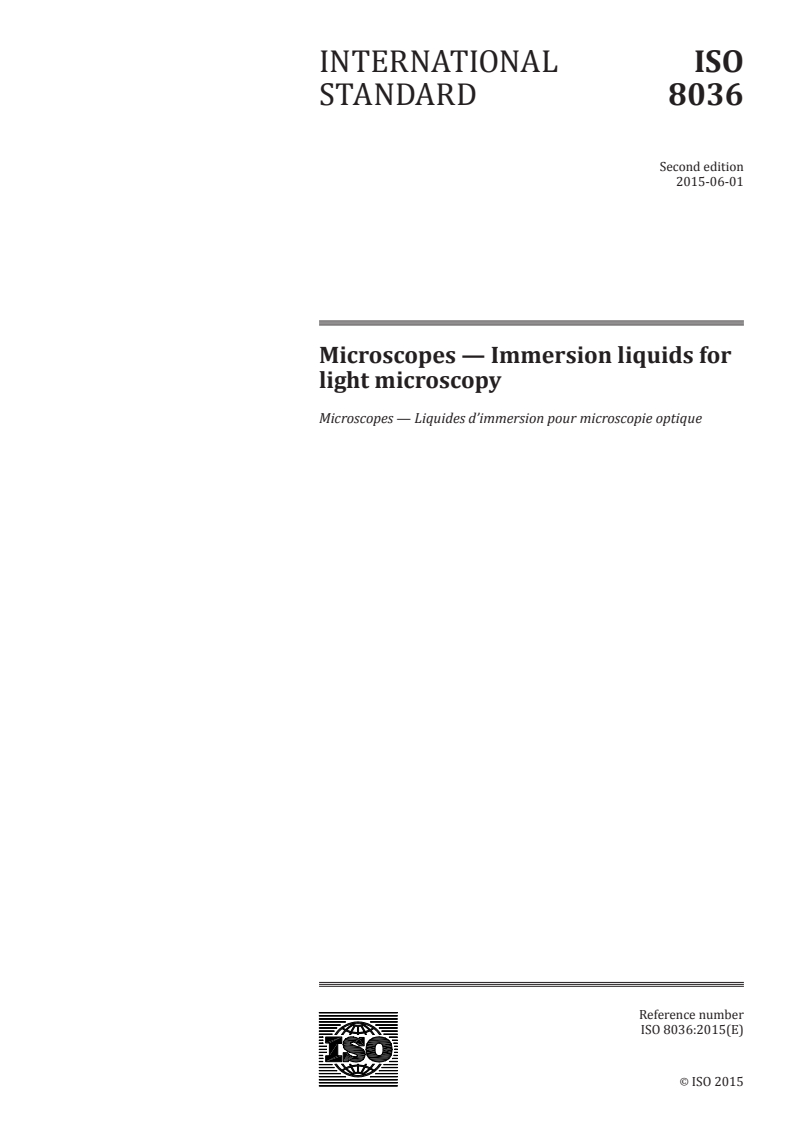
INTERNATIONAL ISO
STANDARD 8036
Second edition
2015-06-01
Microscopes — Immersion liquids for
light microscopy
Microscopes — Liquides d’immersion pour microscopie optique
Reference number
©
ISO 2015
© ISO 2015, Published in Switzerland
All rights reserved. Unless otherwise specified, no part of this publication may be reproduced or utilized otherwise in any form
or by any means, electronic or mechanical, including photocopying, or posting on the internet or an intranet, without prior
written permission. Permission can be requested from either ISO at the address below or ISO’s member body in the country of
the requester.
ISO copyright office
Ch. de Blandonnet 8 • CP 401
CH-1214 Vernier, Geneva, Switzerland
Tel. +41 22 749 01 11
Fax +41 22 749 09 47
copyright@iso.org
www.iso.org
ii © ISO 2015 – All rights reserved
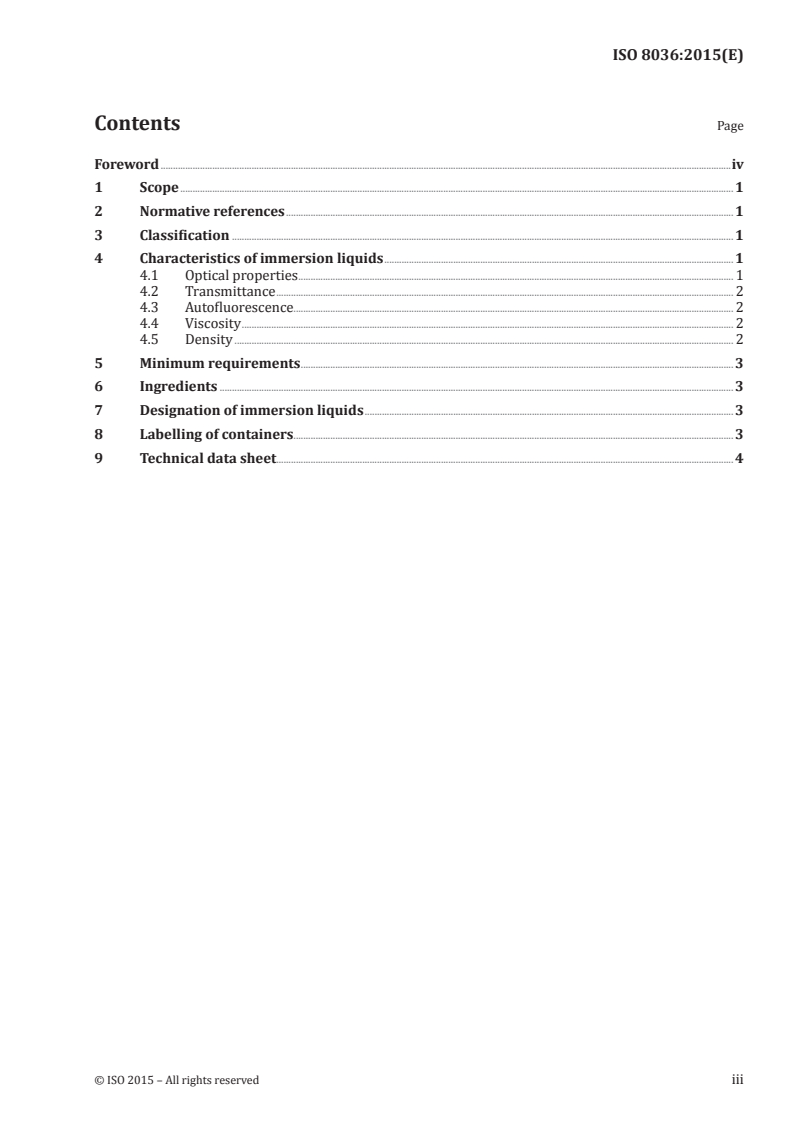
Contents Page
Foreword .iv
1 Scope . 1
2 Normative references . 1
3 Classification . 1
4 Characteristics of immersion liquids . 1
4.1 Optical properties . 1
4.2 Transmittance . 2
4.3 Autofluorescence. 2
4.4 Viscosity . 2
4.5 Density . 2
5 Minimum requirements . 3
6 Ingredients . 3
7 Designation of immersion liquids . 3
8 Labelling of containers. 3
9 Technical data sheet. 4
Foreword
ISO (the International Organization for Standardization) is a worldwide federation of national standards
bodies (ISO member bodies). The work of preparing International Standards is normally carried out
through ISO technical committees. Each member body interested in a subject for which a technical
committee has been established has the right to be represented on that committee. International
organizations, governmental and non-governmental, in liaison with ISO, also take part in the work.
ISO collaborates closely with the International Electrotechnical Commission (IEC) on all matters of
electrotechnical standardization.
The procedures used to develop this document and those intended for its further maintenance are
described in the ISO/IEC Directives, Part 1. In particular the different approval criteria needed for the
different types of ISO documents should be noted. This document was drafted in accordance with the
editorial rules of the ISO/IEC Directives, Part 2 (see www.iso.org/directives).
Attention is drawn to the possibility that some of the elements of this document may be the subject of
patent rights. ISO shall not be held responsible for identifying any or all such patent rights. Details of any
patent rights identified during the development of the document will be in the Introduction and/or on
the ISO list of patent declarations received (see www.iso.org/patents).
Any trade name used in this document is information given for the convenience of users and does not
constitute an endorsement.
For an explanation on the meaning of ISO specific terms and expressions related to conformity
assessment, as well as information about ISO’s adherence to the WTO principles in the Technical Barriers
to Trade (TBT), see the following URL: Foreword — Supplementary information.
The committee responsible for this document is ISO/TC 172, Optics and photonics, SC 5, Microscopes
and endoscopes.
This second edition cancels and replaces the first edition (ISO 8036:2006), where in Clause 6, the outdated
reference to the EU Directive 91/155/EEC and its Amendments 93/112/EC and 01/58/EC were removed.
iv © ISO 2015 – All rights reserved
INTERNATIONAL STANDARD ISO 8036:2015(E)
Microscopes — Immersion liquids for light microscopy
1 Scope
This International Standard describes the characteristics of immersion liquids used in microscopy. It
classifies immersion liquids according to their field of application and specifies requirements and test
methods for each type.
This International Standard further specifies a system of designation for immersion liquids, the
information to be included on container labels, and the information to be supplied in technical data sheets.
2 Normative references
The following documents, in whole or in part, are normatively referenced in this document and are
indispensable for its application. For dated references, only the edition cited applies. For undated
references, the latest edition of the referenced document (including any amendments) applies.
ISO 2592, Determination of flash and fire points — Cleveland open cup method
ISO 8255-1, Microscopes — Cover glasses — Part 1: Dimensional tolerances, thickness and optical properties
ISO 8255-2, Microscopes — Cover glasses — Part 2: Quality of materials, standards of finish and mode of
packaging
3 Classification
Depending on their field of application, immersion liquids are classified as follows:
— type N: immersion oil for general use in light microscopy;
— type F: immersion oil which meets the requirements of fluorescence microscopy;
— type G: spectrally pure glycerol (commonly known as glycerine) for glyce
...
INTERNATIONAL ISO
STANDARD 8036
Redline version
compares Second edition to
First edition
Microscopes — Immersion liquids for
light microscopy
Microscopes — Liquides d’immersion pour microscopie optique
Reference number
ISO 8036:redline:2015(E)
©
ISO 2015
ISO 8036:redline:2015(E)
IMPORTANT — PLEASE NOTE
This is a mark-up copy and uses the following colour coding:
Text example 1 — indicates added text (in green)
— indicates removed text (in red)
Text example 2
— indicates added graphic figure
— indicates removed graphic figure
1.x . — Heading numbers containg modifications are highlighted in yellow in
the Table of Contents
All changes in this document have yet to reach concensus by vote and as such should only
be used internally for review purposes.
DISCLAIMER
This Redline version provides you with a quick and easy way to compare the main changes
between this edition of the standard and its previous edition. It doesn’t capture all single
changes such as punctuation but highlights the modifications providing customers with
the most valuable information. Therefore it is important to note that this Redline version is
not the official ISO standard and that the users must consult with the clean version of the
standard, which is the official standard, for implementation purposes.
© ISO 2015, Published in Switzerland
All rights reserved. Unless otherwise specified, no part of this publication may be reproduced or utilized otherwise in any form
or by any means, electronic or mechanical, including photocopying, or posting on the internet or an intranet, without prior
written permission. Permission can be requested from either ISO at the address below or ISO’s member body in the country of
the requester.
ISO copyright office
Ch. de Blandonnet 8 • CP 401
CH-1214 Vernier, Geneva, Switzerland
Tel. +41 22 749 01 11
Fax +41 22 749 09 47
copyright@iso.org
www.iso.org
ii © ISO 2015 – All rights reserved
ISO 8036:redline:2015(E)
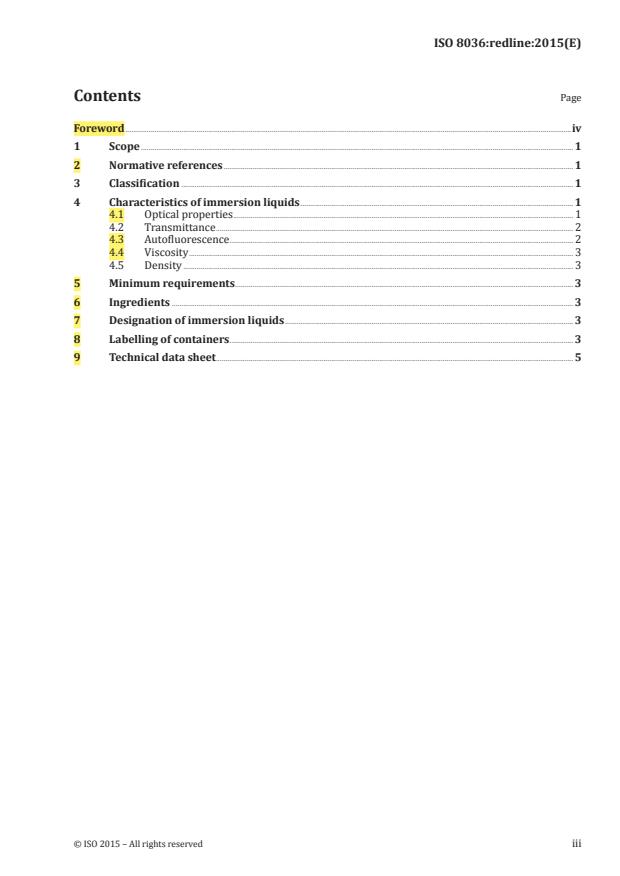
Contents Page
Foreword .iv
1 Scope . 1
2 Normative references . 1
3 Classification . 1
4 Characteristics of immersion liquids . 1
4.1 Optical properties . 1
4.2 Transmittance . 2
4.3 Autofluorescence. 2
4.4 Viscosity . 3
4.5 Density . 3
5 Minimum requirements . 3
6 Ingredients . 3
7 Designation of immersion liquids . 3
8 Labelling of containers. 3
9 Technical data sheet. 5
ISO 8036:redline:2015(E)
Foreword
ISO (the International Organization for Standardization) is a worldwide federation of national standards
bodies (ISO member bodies). The work of preparing International Standards is normally carried out
through ISO technical committees. Each member body interested in a subject for which a technical
committee has been established has the right to be represented on that committee. International
organizations, governmental and non-governmental, in liaison with ISO, also take part in the work.
ISO collaborates closely with the International Electrotechnical Commission (IEC) on all matters of
electrotechnical standardization.
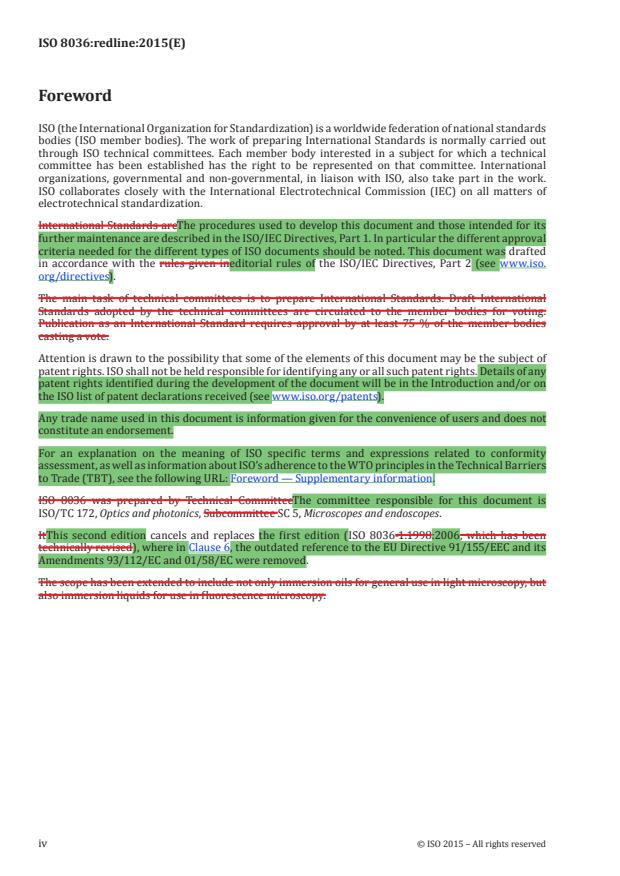
International Standards areThe procedures used to develop this document and those intended for its
further maintenance are described in the ISO/IEC Directives, Part 1. In particular the different approval
criteria needed for the different types of ISO documents should be noted. This document was drafted
in accordance with the rules given ineditorial rules of the ISO/IEC Directives, Part 2 (see www.iso.
org/directives).
The main task of technical committees is to prepare International Standards. Draft International
Standards adopted by the technical committees are circulated to the member bodies for voting.
Publication as an International Standard requires approval by at least 75 % of the member bodies
casting a vote.
Attention is drawn to the possibility that some of the elements of this document may be the subject of
patent rights. ISO shall not be held responsible for identifying any or all such patent rights. Details of any
patent rights identified during the development of the document will be in the Introduction and/or on
the ISO list of patent declarations received (see www.iso.org/patents).
Any trade name used in this document is information given for the convenience of users and does not
constitute an endorsement.
For an explanation on the meaning of ISO specific terms and expressions related to conformity
assessment, as well as information about ISO’s adherence to the WTO principles in the Technical Barriers
to Trade (TBT), see the following URL: Foreword — Supplementary information.
ISO 8036 was prepared by Technical CommitteeThe committee responsible for this document is
ISO/TC 172, Optics and photonics, Subcommittee SC 5, Microscopes and endoscopes.
ItThis second edition cancels and replaces the first edition (ISO 8036-1:1998:2006, which has been
technically revised), where in Clause 6, the outdated reference to the EU Directive 91/155/EEC and its
Amendments 93/112/EC and 01/58/EC were removed.
The scope has been extended to include not only immersion oils for general use in light microscopy, but
also immersion liquids for use in fluorescence microscopy.
iv © ISO 2015 – All rights reserved
INTERNATIONAL STANDARD ISO 8036:redline:2015(E)
Microscopes — Immersion liquids for light microscopy
1 Scope
This International Standard describes the characteristics of immersion liquids used in microscopy. It
classifies immersion liquids according to their field of application and specifies requirements and test
methods for each type.
This International Standard further specifies a system of designation for immersion liquids, the
information to be included on container labels, and the information to be supplied in technical data
sheets.
2 Normative references
The following referenced documentsdocuments, in whole or in part, are normatively referenced in this
document and are indispensable for the application of this documentits application. For dated references,
only the edition cited applies. For undated references, the latest edition of the referenced document
(including any amendments) applies.
ISO 2592, Determination of flash and fire points — Cleveland open cup method
ISO 8255-1, Optics and optical instruments — Microscopes — Cover glasses — Part 1: Dimensional
tolerances, thickness and optical properties
ISO 8255-2, Optics and optical instruments — Microscopes — Cover glasses — Part 2: Quality of materials,
standards of finish and mode of packaging
3 Classification
Depending on their field of application, immersion liquids are classified as follows:
— type N
...
INTERNATIONAL ISO
STANDARD 8036
Second edition
2015-06-01
Microscopes — Immersion liquids for
light microscopy
Microscopes — Liquides d’immersion pour microscopie optique
Reference number
©
ISO 2015
© ISO 2015, Published in Switzerland
All rights reserved. Unless otherwise specified, no part of this publication may be reproduced or utilized otherwise in any form
or by any means, electronic or mechanical, including photocopying, or posting on the internet or an intranet, without prior
written permission. Permission can be requested from either ISO at the address below or ISO’s member body in the country of
the requester.
ISO copyright office
Ch. de Blandonnet 8 • CP 401
CH-1214 Vernier, Geneva, Switzerland
Tel. +41 22 749 01 11
Fax +41 22 749 09 47
copyright@iso.org
www.iso.org
ii © ISO 2015 – All rights reserved
Contents Page
Foreword .iv
1 Scope . 1
2 Normative references . 1
3 Classification . 1
4 Characteristics of immersion liquids . 1
4.1 Optical properties . 1
4.2 Transmittance . 2
4.3 Autofluorescence. 2
4.4 Viscosity . 2
4.5 Density . 2
5 Minimum requirements . 3
6 Ingredients . 3
7 Designation of immersion liquids . 3
8 Labelling of containers. 3
9 Technical data sheet. 4
Foreword
ISO (the International Organization for Standardization) is a worldwide federation of national standards
bodies (ISO member bodies). The work of preparing International Standards is normally carried out
through ISO technical committees. Each member body interested in a subject for which a technical
committee has been established has the right to be represented on that committee. International
organizations, governmental and non-governmental, in liaison with ISO, also take part in the work.
ISO collaborates closely with the International Electrotechnical Commission (IEC) on all matters of
electrotechnical standardization.
The procedures used to develop this document and those intended for its further maintenance are
described in the ISO/IEC Directives, Part 1. In particular the different approval criteria needed for the
different types of ISO documents should be noted. This document was drafted in accordance with the
editorial rules of the ISO/IEC Directives, Part 2 (see www.iso.org/directives).
Attention is drawn to the possibility that some of the elements of this document may be the subject of
patent rights. ISO shall not be held responsible for identifying any or all such patent rights. Details of any
patent rights identified during the development of the document will be in the Introduction and/or on
the ISO list of patent declarations received (see www.iso.org/patents).
Any trade name used in this document is information given for the convenience of users and does not
constitute an endorsement.
For an explanation on the meaning of ISO specific terms and expressions related to conformity
assessment, as well as information about ISO’s adherence to the WTO principles in the Technical Barriers
to Trade (TBT), see the following URL: Foreword — Supplementary information.
The committee responsible for this document is ISO/TC 172, Optics and photonics, SC 5, Microscopes
and endoscopes.
This second edition cancels and replaces the first edition (ISO 8036:2006), where in Clause 6, the outdated
reference to the EU Directive 91/155/EEC and its Amendments 93/112/EC and 01/58/EC were removed.
iv © ISO 2015 – All rights reserved
INTERNATIONAL STANDARD ISO 8036:2015(E)
Microscopes — Immersion liquids for light microscopy
1 Scope
This International Standard describes the characteristics of immersion liquids used in microscopy. It
classifies immersion liquids according to their field of application and specifies requirements and test
methods for each type.
This International Standard further specifies a system of designation for immersion liquids, the
information to be included on container labels, and the information to be supplied in technical data sheets.
2 Normative references
The following documents, in whole or in part, are normatively referenced in this document and are
indispensable for its application. For dated references, only the edition cited applies. For undated
references, the latest edition of the referenced document (including any amendments) applies.
ISO 2592, Determination of flash and fire points — Cleveland open cup method
ISO 8255-1, Microscopes — Cover glasses — Part 1: Dimensional tolerances, thickness and optical properties
ISO 8255-2, Microscopes — Cover glasses — Part 2: Quality of materials, standards of finish and mode of
packaging
3 Classification
Depending on their field of application, immersion liquids are classified as follows:
— type N: immersion oil for general use in light microscopy;
— type F: immersion oil which meets the requirements of fluorescence microscopy;
— type G: spectrally pure glycerol (commonly known as glycerine) for glyce
...
INTERNATIONAL ISO
STANDARD 8036
Redline version
compares Second edition to
First edition
Microscopes — Immersion liquids for
light microscopy
Microscopes — Liquides d’immersion pour microscopie optique
Reference number
ISO 8036:redline:2015(E)
©
ISO 2015
ISO 8036:redline:2015(E)
IMPORTANT — PLEASE NOTE
This is a mark-up copy and uses the following colour coding:
Text example 1 — indicates added text (in green)
— indicates removed text (in red)
Text example 2
— indicates added graphic figure
— indicates removed graphic figure
1.x . — Heading numbers containg modifications are highlighted in yellow in
the Table of Contents
All changes in this document have yet to reach concensus by vote and as such should only
be used internally for review purposes.
DISCLAIMER
This Redline version provides you with a quick and easy way to compare the main changes
between this edition of the standard and its previous edition. It doesn’t capture all single
changes such as punctuation but highlights the modifications providing customers with
the most valuable information. Therefore it is important to note that this Redline version is
not the official ISO standard and that the users must consult with the clean version of the
standard, which is the official standard, for implementation purposes.
© ISO 2015, Published in Switzerland
All rights reserved. Unless otherwise specified, no part of this publication may be reproduced or utilized otherwise in any form
or by any means, electronic or mechanical, including photocopying, or posting on the internet or an intranet, without prior
written permission. Permission can be requested from either ISO at the address below or ISO’s member body in the country of
the requester.
ISO copyright office
Ch. de Blandonnet 8 • CP 401
CH-1214 Vernier, Geneva, Switzerland
Tel. +41 22 749 01 11
Fax +41 22 749 09 47
copyright@iso.org
www.iso.org
ii © ISO 2015 – All rights reserved
ISO 8036:redline:2015(E)
Contents Page
Foreword .iv
1 Scope . 1
2 Normative references . 1
3 Classification . 1
4 Characteristics of immersion liquids . 1
4.1 Optical properties . 1
4.2 Transmittance . 2
4.3 Autofluorescence. 2
4.4 Viscosity . 3
4.5 Density . 3
5 Minimum requirements . 3
6 Ingredients . 3
7 Designation of immersion liquids . 3
8 Labelling of containers. 3
9 Technical data sheet. 5
ISO 8036:redline:2015(E)
Foreword
ISO (the International Organization for Standardization) is a worldwide federation of national standards
bodies (ISO member bodies). The work of preparing International Standards is normally carried out
through ISO technical committees. Each member body interested in a subject for which a technical
committee has been established has the right to be represented on that committee. International
organizations, governmental and non-governmental, in liaison with ISO, also take part in the work.
ISO collaborates closely with the International Electrotechnical Commission (IEC) on all matters of
electrotechnical standardization.
International Standards areThe procedures used to develop this document and those intended for its
further maintenance are described in the ISO/IEC Directives, Part 1. In particular the different approval
criteria needed for the different types of ISO documents should be noted. This document was drafted
in accordance with the rules given ineditorial rules of the ISO/IEC Directives, Part 2 (see www.iso.
org/directives).
The main task of technical committees is to prepare International Standards. Draft International
Standards adopted by the technical committees are circulated to the member bodies for voting.
Publication as an International Standard requires approval by at least 75 % of the member bodies
casting a vote.
Attention is drawn to the possibility that some of the elements of this document may be the subject of
patent rights. ISO shall not be held responsible for identifying any or all such patent rights. Details of any
patent rights identified during the development of the document will be in the Introduction and/or on
the ISO list of patent declarations received (see www.iso.org/patents).
Any trade name used in this document is information given for the convenience of users and does not
constitute an endorsement.
For an explanation on the meaning of ISO specific terms and expressions related to conformity
assessment, as well as information about ISO’s adherence to the WTO principles in the Technical Barriers
to Trade (TBT), see the following URL: Foreword — Supplementary information.
ISO 8036 was prepared by Technical CommitteeThe committee responsible for this document is
ISO/TC 172, Optics and photonics, Subcommittee SC 5, Microscopes and endoscopes.
ItThis second edition cancels and replaces the first edition (ISO 8036-1:1998:2006, which has been
technically revised), where in Clause 6, the outdated reference to the EU Directive 91/155/EEC and its
Amendments 93/112/EC and 01/58/EC were removed.
The scope has been extended to include not only immersion oils for general use in light microscopy, but
also immersion liquids for use in fluorescence microscopy.
iv © ISO 2015 – All rights reserved
INTERNATIONAL STANDARD ISO 8036:redline:2015(E)
Microscopes — Immersion liquids for light microscopy
1 Scope
This International Standard describes the characteristics of immersion liquids used in microscopy. It
classifies immersion liquids according to their field of application and specifies requirements and test
methods for each type.
This International Standard further specifies a system of designation for immersion liquids, the
information to be included on container labels, and the information to be supplied in technical data
sheets.
2 Normative references
The following referenced documentsdocuments, in whole or in part, are normatively referenced in this
document and are indispensable for the application of this documentits application. For dated references,
only the edition cited applies. For undated references, the latest edition of the referenced document
(including any amendments) applies.
ISO 2592, Determination of flash and fire points — Cleveland open cup method
ISO 8255-1, Optics and optical instruments — Microscopes — Cover glasses — Part 1: Dimensional
tolerances, thickness and optical properties
ISO 8255-2, Optics and optical instruments — Microscopes — Cover glasses — Part 2: Quality of materials,
standards of finish and mode of packaging
3 Classification
Depending on their field of application, immersion liquids are classified as follows:
— type N
...