


ISO 21976:2018
(Main)Packaging - Tamper verification features for medicinal product packaging
Packaging - Tamper verification features for medicinal product packaging
This document specifies requirements and provides guidance for the application, use and check of tamper verification features to the packaging of medicinal products.
Emballage — Témoins d'effraction pour emballages de médicaments
Le présent document définit les exigences et fournit des recommandations pour l'application, l'utilisation et le contrôle des témoins d'effraction sur les emballages de médicaments. Les principes du présent document peuvent être appliqués dans d'autres secteurs, selon le cas.
General Information
Overview
Standard Reference: ISO 21976:2018
Title: Packaging - Tamper verification features for medicinal product packaging (ISO)
ISO 21976:2018 specifies requirements and provides guidance for the application, use and check of tamper verification features on packaging of medicinal products. It supports harmonized implementation worldwide to indicate whether outer or immediate packaging has been opened or tampered with - reducing risk from adulteration and entry of falsified medicinal products into the supply chain.
Key topics and requirements
- Purpose and scope
- Defines the role of tamper verification features as indicators of opening or tampering (not a full prevention measure).
- Intended primarily for medicinal product packaging but principles can apply to other sectors.
- General requirements
- Tamper verification features must indicate unauthorized opening or manipulation while not compromising statutory information (including tactile markings).
- Application can affect opening force; design should balance verification with usability and regulatory labeling.
- Categories covered
- The standard details descriptions, criteria and verification guidance for a range of packaging types, including:
- Folding boxes (glued and specially constructed)
- Sealing labels and tapes
- Film wrappers and sleeves
- Breakable or tear-away closures
- Container inner seals or membranes
- Display blister packs and flexible packaging
- Blow–fill–seal (BFS) containers
- New and emerging technologies
- The standard details descriptions, criteria and verification guidance for a range of packaging types, including:
- Verification and checking
- Provides guidance on how to check tamper verification features (inspection and verification practices are specified per category).
- Emphasizes objective evidence and conformity with specified criteria.
Practical applications and users
Who uses ISO 21976:2018:
- Pharmaceutical manufacturers and marketing/manufacturing authorization holders designing or approving packaging.
- Packaging designers and converters developing tamper-evident closures, labels, sleeves and seals.
- Quality assurance / regulatory teams ensuring packaging meets tamper-verification requirements and does not obscure mandatory information.
- Contract packagers and supply chain managers implementing and checking tamper features during packaging and distribution.
- Regulators and inspectors evaluating compliance with tamper-verification expectations and related legislation (e.g., Falsified Medicines Directive contexts).
Benefits and uses:
- Improves patient safety by making tampering easier to detect.
- Harmonizes expectations across markets for tamper-evident packaging design and verification.
- Supports procurement and supplier specification for compliant packaging solutions.
Related standards
- EN 16679:2014 (reference used in development)
- ISO 11615, ISO 21067-1 and ISO 9000 (terminology and related packaging/quality references)
Keywords: ISO 21976:2018, tamper verification, tamper-evident packaging, medicinal product packaging, packaging standards, falsified medicines, tamper verification features.
Standards Content (Sample)
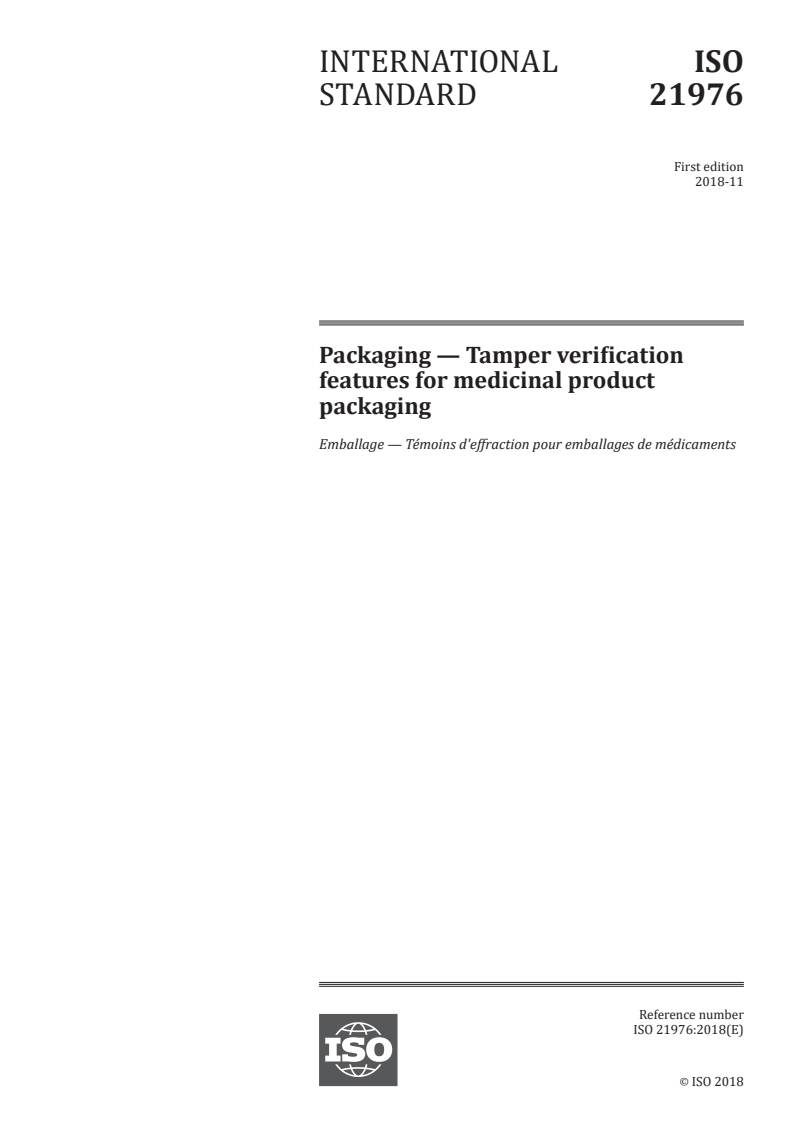
INTERNATIONAL ISO
STANDARD 21976
First edition
2018-11
Packaging — Tamper verification
features for medicinal product
packaging
Emballage — Témoins d'effraction pour emballages de médicaments
Reference number
©
ISO 2018
© ISO 2018
All rights reserved. Unless otherwise specified, or required in the context of its implementation, no part of this publication may
be reproduced or utilized otherwise in any form or by any means, electronic or mechanical, including photocopying, or posting
on the internet or an intranet, without prior written permission. Permission can be requested from either ISO at the address
below or ISO’s member body in the country of the requester.
ISO copyright office
CP 401 • Ch. de Blandonnet 8
CH-1214 Vernier, Geneva
Phone: +41 22 749 01 11
Fax: +41 22 749 09 47
Email: copyright@iso.org
Website: www.iso.org
Published in Switzerland
ii © ISO 2018 – All rights reserved
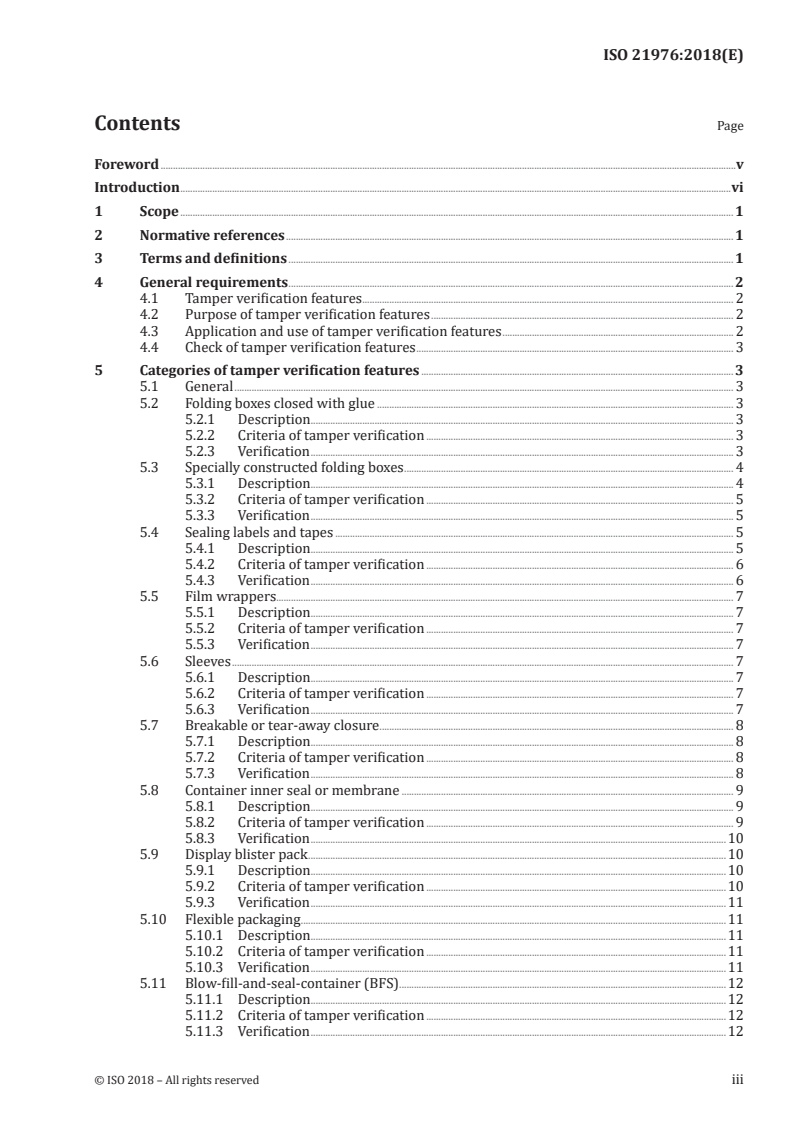
Contents Page
Foreword .v
Introduction .vi
1 Scope . 1
2 Normative references . 1
3 Terms and definitions . 1
4 General requirements . 2
4.1 Tamper verification features . 2
4.2 Purpose of tamper verification features . 2
4.3 Application and use of tamper verification features . 2
4.4 Check of tamper verification features . 3
5 Categories of tamper verification features . 3
5.1 General . 3
5.2 Folding boxes closed with glue . 3
5.2.1 Description . . . 3
5.2.2 Criteria of tamper verification . 3
5.2.3 Verification . 3
5.3 Specially constructed folding boxes . 4
5.3.1 Description . . . 4
5.3.2 Criteria of tamper verification . 5
5.3.3 Verification . 5
5.4 Sealing labels and tapes . 5
5.4.1 Description . . . 5
5.4.2 Criteria of tamper verification . 6
5.4.3 Verification . 6
5.5 Film wrappers. 7
5.5.1 Description . . . 7
5.5.2 Criteria of tamper verification . 7
5.5.3 Verification . 7
5.6 Sleeves . 7
5.6.1 Description . . . 7
5.6.2 Criteria of tamper verification . 7
5.6.3 Verification . 7
5.7 Breakable or tear-away closure . 8
5.7.1 Description . . . 8
5.7.2 Criteria of tamper verification . 8
5.7.3 Verification . 8
5.8 Container inner seal or membrane . 9
5.8.1 Description . . . 9
5.8.2 Criteria of tamper verification . 9
5.8.3 Verification .10
5.9 Display blister pack .10
5.9.1 Description . . .10
5.9.2 Criteria of tamper verification .10
5.9.3 Verification .11
5.10 Flexible packaging .11
5.10.1 Description . . .11
5.10.2 Criteria of tamper verification .11
5.10.3 Verification .11
5.11 Blow-fill-and-seal-container (BFS) . .12
5.11.1 Description . . .12
5.11.2 Criteria of tamper verification .12
5.11.3 Verification .12
5.12 New and emerging technologies .13
Annex A (informative) Additional information regarding tamper verification features .14
Bibliography .15
iv © ISO 2018 – All rights reserved
Foreword
ISO (the International Organization for Standardization) is a worldwide federation of national standards
bodies (ISO member bodies). The work of preparing International Standards is normally carried out
through ISO technical committees. Each member body interested in a subject for which a technical
committee has been established has the right to be represented on that committee. International
organizations, governmental and non-governmental, in liaison with ISO, also take part in the work.
ISO collaborates closely with the International Electrotechnical Commission (IEC) on all matters of
electrotechnical standardization.
The procedures used to develop this document and those intended for its further maintenance are
described in the ISO/IEC Directives, Part 1. In particular, the different approval criteria needed for the
different types of ISO documents should be noted. This document was drafted in accordance with the
editorial rules of the ISO/IEC Directives, Part 2 (see www .iso .org/directives).
Attention is drawn to the possibility that some of the elements of this document may be the subject of
patent rights. ISO shall not be held responsible for identifying any or all such patent rights. Details of
any patent rights identified during the development of the document will be in the Introduction and/or
on the ISO list of patent declarations received (see www .iso .org/patents).
Any trade name used in this document is information given for the convenience of users and does not
constitute an endorsement.
For an explanation of the voluntary nature of standards, the meaning of ISO specific terms and
expressions related to conformity assessment, as well as information about ISO's adherence to the
World Trade Organization (WTO) principles in the Technical Barriers to Trade (TBT) see www .iso
.org/iso/foreword .html.
This document was prepared by Technical Committee ISO/TC 122, Packaging.
Any feedback or questions on this document should be directed to the user’s national standards body. A
complete listing of these bodies can be found at www .iso .org/members .html.
Introduction
Requirements for tamper verification features on medicinal product packaging are emerging and
expanding globally to reduce risk and improve patient safety.
This document is to support the harmonization and implementation of tamper verification features to
the packaging of medicinal products worldwide.
The knowledge and experience gained in EN 16679:2014 has been used for developing this document.
The background for the creation of a European Standard for tamper verification features for medicinal
[6]
product packaging (EN 16679) was the European Directive 2001/83/EC , as amended by Directive
[7]
2011/62/EU , the latter commonly referred to as the “Falsified Medicines Directive” (FMD).
The packaging of medicinal products placed on the market and incorporating tamper verification
features in accordance with this document meets, as an example but not limited to, the requirements
[6] [7]
of Directive 2001/83/EC as amended by Directive 2011/62/EU . Article 54(o) of the Directive
stipulates, that on the outer packaging of certain medicinal products or, where there is no outer
packaging, on the immediate packaging must appear, among others, “a device allowing verification of
whether the outer packaging has been tampered with”.
vi © ISO 2018 – All rights reserved
INTERNATIONAL STANDARD ISO 21976:2018(E)
Packaging — Tamper verification features for medicinal
product packaging
1 Scope
This document specifies requirements and provides guidance for the application, use and check of
tamper verification features to the packaging of medicinal products.
The principles in this document can be applied in other sectors, as appropriate.
2 Normative references
There are no normative references in this document.
3 Terms and definitions
For the purposes of this document, the following terms and definitions apply.
ISO and IEC maintain terminological databases for use in standardization at the following addresses:
— ISO Online browsing platform: available at https: //www .iso .org/obp
— IEC Electropedia: available at http: //www .electropedia .org/
3.1
falsified medicinal product
medicinal products (3.6) that deliberately/fraudulently misrepresent their identity, composition or
source
[17]
[SOURCE: WHO, Definitions of Substandard and Falsified (SF) Medical Products, 2017 ]
3.2
finished product
authorized medicinal product (3.6) which has undergone all stages of production including packaging in
its final container as it is dispensed, sold or otherwise supplied
3.3
immediate packaging
primary packaging
container or other form of packaging directly in contact with the medicinal product (3.6)
3.4
manufacturing authorization holder
natural or legal person or entity that is authorized for total or partial manufacture
Note 1 to entry: This includes replacement of safety and tamper verification features (3.9) (in accordance with
[6] [7]
Directive 2001/83/EC , Article 47a(1)(b) as amended by Directive 2011/62/EU ).
3.5
marketing authorization holder
natural or legal person or entity responsible for placing the medicinal product (3.6) on the market
3.6
medicinal product
substance or combination of substances that may be administered to human beings (or animals) for
treating or preventing disease, with the aim/purpose to making a medical diagnosis or to restore,
correct or modify physiological functions
[SOURCE: ISO 11615:2017, 3.1.50, modified — “Pharmaceutical product” has been replaced by
“substance” in the definition. The Notes to entry have been deleted.]
3.7
outer packaging
secondary packaging
packaging designed to contain one or more primary packagings together with any protective materials
where required
[SOURCE: ISO 21067-1:2016, 2.2.4, modified — “Outer packaging” has been added as an admitted term.]
3.8
tampering
unauthorized attempt to open, manipulate or re-use the packaging or elements of it
3.9
tamper verification feature
characteristic(s) allowing verification (3.10) of whether the outer packaging (3.7) of medicinal products
(3.6) or, where there is no outer packaging, the immediate packaging has been opened or tampered with
Note 1 to entry: Tamper verification features may be referred to as “anti-tampering devices”.
3.10
verification
confirmation, through the provision of objective evidence, that specified requirements have been
fulfilled
[SOURCE: ISO 9000:2015, 3.8.12, modified — The Notes to entry have been deleted.]
4 General requirements
4.1 Tamper verification features
Tamper verification features shall be applied to packaging of medicinal products as required, or may be
applied for other situations.
4.2 Purpose of tamper verification features
Tamper verification features should provide an indication that the packaging of a finished product
has been opened or tampered with, i.e. indicating a possible adulteration or unauthorized attempt to
open the packaging or entry of falsified medicinal products into the legitimate supply chain. Tamper
verification features limit the ability to replace the contents of genuine packs.
Tamper verification features are only one element of possible safety features against falsification and
do not, by themselves, prevent falsification of medicinal products.
4.3 Application and use of tamper verification features
The application of tamper verific
...
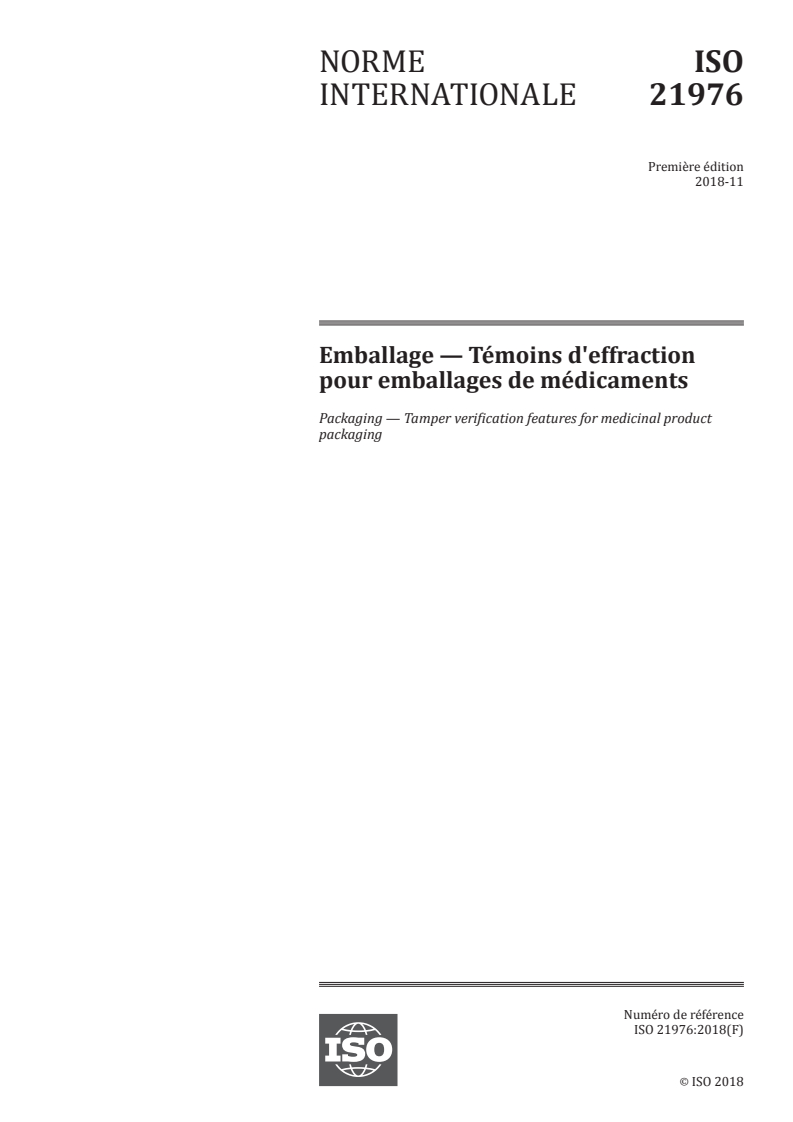
NORME ISO
INTERNATIONALE 21976
Première édition
2018-11
Emballage — Témoins d'effraction
pour emballages de médicaments
Packaging — Tamper verification features for medicinal product
packaging
Numéro de référence
©
ISO 2018
DOCUMENT PROTÉGÉ PAR COPYRIGHT
© ISO 2018
Tous droits réservés. Sauf prescription différente ou nécessité dans le contexte de sa mise en œuvre, aucune partie de cette
publication ne peut être reproduite ni utilisée sous quelque forme que ce soit et par aucun procédé, électronique ou mécanique,
y compris la photocopie, ou la diffusion sur l’internet ou sur un intranet, sans autorisation écrite préalable. Une autorisation peut
être demandée à l’ISO à l’adresse ci-après ou au comité membre de l’ISO dans le pays du demandeur.
ISO copyright office
Case postale 401 • Ch. de Blandonnet 8
CH-1214 Vernier, Genève
Tél.: +41 22 749 01 11
E-mail: copyright@iso.org
Web: www.iso.org
Publié en Suisse
ii © ISO 2018 – Tous droits réservés
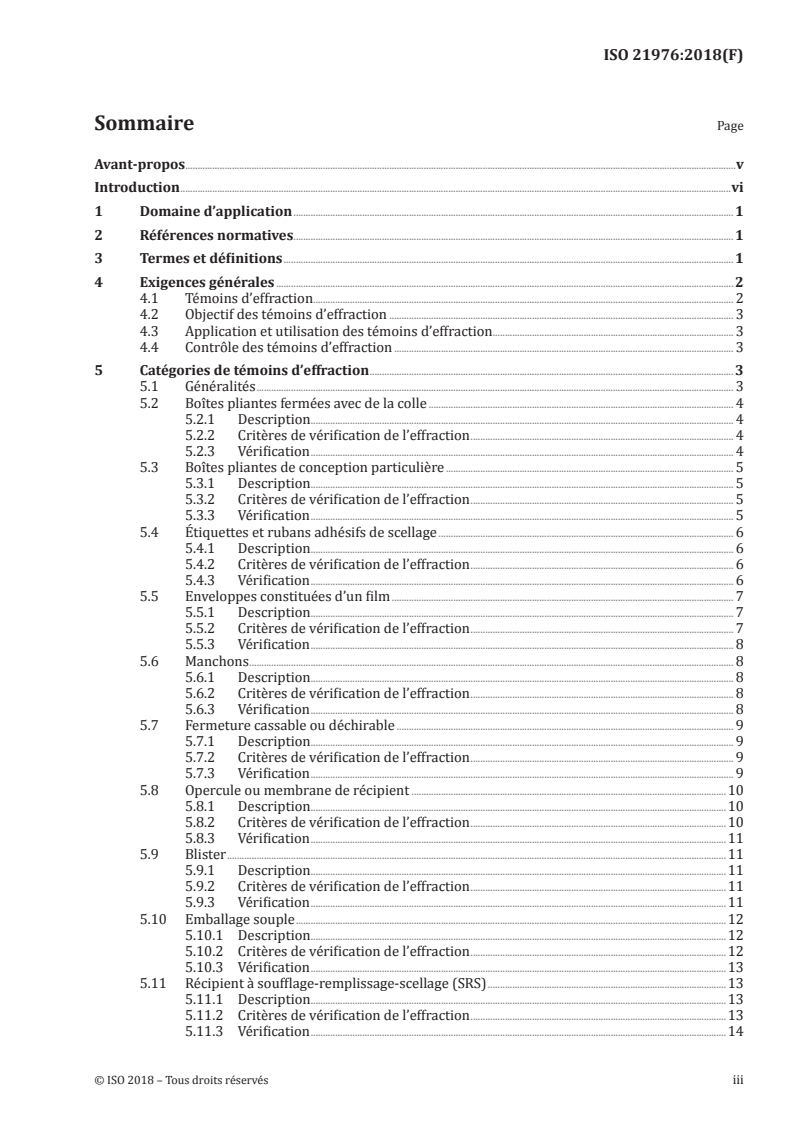
Sommaire Page
Avant-propos .v
Introduction .vi
1 Domaine d’application . 1
2 Références normatives . 1
3 Termes et définitions . 1
4 Exigences générales . 2
4.1 Témoins d’effraction . . 2
4.2 Objectif des témoins d’effraction . 3
4.3 Application et utilisation des témoins d’effraction. 3
4.4 Contrôle des témoins d’effraction . 3
5 Catégories de témoins d’effraction . 3
5.1 Généralités . 3
5.2 Boîtes pliantes fermées avec de la colle . 4
5.2.1 Description . . . 4
5.2.2 Critères de vérification de l’effraction . 4
5.2.3 Vérification . 4
5.3 Boîtes pliantes de conception particulière . 5
5.3.1 Description . . . 5
5.3.2 Critères de vérification de l’effraction . 5
5.3.3 Vérification . 5
5.4 Étiquettes et rubans adhésifs de scellage . 6
5.4.1 Description . . . 6
5.4.2 Critères de vérification de l’effraction . 6
5.4.3 Vérification . 6
5.5 Enveloppes constituées d’un film . 7
5.5.1 Description . . . 7
5.5.2 Critères de vérification de l’effraction . 7
5.5.3 Vérification . 8
5.6 Manchons . 8
5.6.1 Description . . . 8
5.6.2 Critères de vérification de l’effraction . 8
5.6.3 Vérification . 8
5.7 Fermeture cassable ou déchirable . 9
5.7.1 Description . . . 9
5.7.2 Critères de vérification de l’effraction . 9
5.7.3 Vérification . 9
5.8 Opercule ou membrane de récipient .10
5.8.1 Description . . .10
5.8.2 Critères de vérification de l’effraction .10
5.8.3 Vérification .11
5.9 Blister .11
5.9.1 Description . . .11
5.9.2 Critères de vérification de l’effraction .11
5.9.3 Vérification .11
5.10 Emballage souple .12
5.10.1 Description . . .12
5.10.2 Critères de vérification de l’effraction .12
5.10.3 Vérification .13
5.11 Récipient à soufflage-remplissage-scellage (SRS) .13
5.11.1 Description . . .13
5.11.2 Critères de vérification de l’effraction .13
5.11.3 Vérification .14
5.12 Techniques nouvelles et émergentes .14
Annexe A (informative) Informations supplémentaires concernant les témoins d’effraction .15
Bibliographie .16
iv © ISO 2018 – Tous droits réservés
Avant-propos
L’ISO (Organisation internationale de normalisation) est une fédération mondiale d’organismes
nationaux de normalisation (comités membres de l’ISO). L’élaboration des Normes internationales est
en général confiée aux comités techniques de l’ISO. Chaque comité membre intéressé par une étude
a le droit de faire partie du comité technique créé à cet effet. Les organisations internationales,
gouvernementales et non gouvernementales, en liaison avec l’ISO participent également aux travaux.
L’ISO collabore étroitement avec la Commission électrotechnique internationale (IEC) en ce qui
concerne la normalisation électrotechnique.
Les procédures utilisées pour élaborer le présent document et celles destinées à sa mise à jour sont
décrites dans les Directives ISO/IEC, Partie 1. Il convient, en particulier de prendre note des différents
critères d’approbation requis pour les différents types de documents ISO. Le présent document a été
rédigé conformément aux règles de rédaction données dans les Directives ISO/IEC, Partie 2 (voir www
.iso .org/ directives).
L’attention est attirée sur le fait que certains des éléments du présent document peuvent faire l’objet de
droits de propriété intellectuelle ou de droits analogues. L’ISO ne saurait être tenue pour responsable
de ne pas avoir identifié de tels droits de propriété et averti de leur existence. Les détails concernant
les références aux droits de propriété intellectuelle ou autres droits analogues identifiés lors de
l’élaboration du document sont indiqués dans l’Introduction et/ou dans la liste des déclarations de
brevets reçues par l’ISO (voir www .iso .org/ brevets).
Les appellations commerciales éventuellement mentionnées dans le présent document sont données
pour information, par souci de commodité, à l’intention des utilisateurs et ne sauraient constituer un
engagement.
Pour une explication de la nature volontaire des normes, la signification des termes et expressions
spécifiques de l’ISO liés à l’évaluation de la conformité, ou pour toute information au sujet de l’adhésion
de l’ISO aux principes de l’Organisation mondiale du commerce (OMC) concernant les obstacles
techniques au commerce (OTC), voir le lien suivant: www .iso .org/ iso/ fr/ avant -propos.
Le présent document a été élaboré par le comité technique ISO/TC 122, Emballages.
Il convient que l’utilisateur adresse tout retour d’information ou toute question concernant le présent
document à l’organisme national de normalisation de son pays. Une liste exhaustive desdits organismes
se trouve à l’adresse www .iso .org/ fr/ members .html.
Introduction
Ayant pour but de réduire les risques et renforcer la sécurité des patients, les exigences relatives aux
témoins d’effraction sur les emballages de médicaments connaissent une expansion internationale.
Le présent document vise à encourager l’harmonisation et l’intégration des témoins d’effraction aux
emballages de médicaments à travers le monde.
Les connaissances et l’expérience tirées de l’EN 16679:2014 ont servi à l’élaboration du présent document.
[6] [7]
La Directive européenne 2001/83/CE , modifiée par la Directive 2011/62/UE , communément
appelée la Directive sur les «médicaments falsifiés» (FMD, Falsified Medicines Directive), est à l’origine
de la création d’une Norme européenne sur les témoins d’effraction pour emballages de médicaments
(EN 16679).
Les emballages de médicaments commercialisés comportant des témoins d’effraction conformes au
[6]
présent document satisfont, notamment, aux exigences de la Directive 2001/83/CE , modifiée par la
[7]
Directive 2011/62/UE . Le point o) de l’Article 54 de la directive stipule que l’emballage extérieur ou,
à défaut d’emballage extérieur, le conditionnement primaire de certains médicaments doit comporter,
entre autres, «un dispositif permettant de vérifier si l’emballage extérieur a fait l’objet d’une effraction».
vi © ISO 2018 – Tous droits réservés
NORME INTERNATIONALE ISO 21976:2018(F)
Emballage — Témoins d'effraction pour emballages de
médicaments
1 Domaine d’application
Le présent document définit les exigences et fournit des recommandations pour l’application,
l’utilisation et le contrôle des témoins d’effraction sur les emballages de médicaments.
Les principes du présent document peuvent être appliqués dans d’autres secteurs, selon le cas.
2 Références normatives
Le présent document ne contient aucune référence normative.
3 Termes et définitions
Pour les besoins du présent document, les termes et définitions suivants s’appliquent.
L’ISO et l’IEC tiennent à jour des bases de données terminologiques destinées à être utilisées en
normalisation, consultables aux adresses suivantes:
— IEC Electropedia: disponible à l’adresse https:// www .iso .org/ obp;
— ISO Online browsing platform: disponible à l’adresse http:// www .electropedia .org/ .
3.1
médicament falsifié
médicament (3.6) qui indique, de manière délibérée/frauduleuse, une fausse identité, composition
ou source
[17]
[SOURCE: OMS, Definitions of Substandard et Falsified (SF) Medical Products, 2017 (disponible en
anglais seulement)]
3.2
produit fini
médicament (3.6) autorisé ayant été soumis à toutes les étapes de production, y compris l’emballage
dans son récipient final, tel que délivré, vendu ou fourni de toute autre manière
3.3
conditionnement primaire
emballage primaire
récipient, ou autre forme d’emballage, qui est en contact direct avec le médicament (3.6)
3.4
titulaire d’une autorisation de fabrication
personne, physique ou morale, ou organisme autorisé à effectuer la fabrication totale ou partielle
Note 1 à l'article: Cela comprend le remplacement des dispositifs de sécurité et des témoins d’effraction (3.9) [selon le
[6] [7]
point b) du paragraphe 1 de l’Article 47 bis de la Directive 2001/83/CE , modifiée par la Directive 2011/62/UE ].
3.5
titulaire d’une autorisation de mise sur le marché
personne, physique ou morale, ou organisme responsable de la mise sur le marché d’un médicament (3.6)
3.6
médicament
substance ou combinaison de substances pouvant être administrée aux êtres humains (ou aux animaux)
pour le traitement ou la prévention d’une maladie, avec l’objectif/l’intention d’établir un diagnostic
médical ou de rétablir, corriger ou modifier des fonctions physiologiques
[SOURCE: ISO 11615:2017, 3.1.50, modifiée — «produit pharmaceutique» a été remplacé par «substance»
dans la définition. Les Notes à l’article ont été supprimées.]
3.7
emballage extérieur
emballage secondaire
emballage conçu pour contenir un ou plusieurs emballages primaires ainsi que les matériaux
protecteurs nécessaires
[SOURCE: ISO 21067-1:2016, 2.2.4, modifiée — «emballage extérieur» a été ajouté comme terme
admissible.]
3.8
effraction
tentative non autorisée d’ouvrir, manipuler ou réutiliser l’emballage ou les éléments qui le composent
3.9
témoin d’effraction
un ou plusieurs moyens de vérification (3.10) de l’emballage extérieur (3.7) des médicaments (3.6) ou, à
défaut d’emballage extérieur, du conditionnement primaire permettant de savoir si celui-ci a été ouvert
ou a fait l’objet d’une effraction
Note 1 à l'article: Les témoins d’effraction peuvent être appelés «dispositifs anti-effraction».
3.10
vérification
confirmation par des preuves tangibles que les exigences spécifiées ont été satisfaites
[SOURCE: ISO 9000:2015, 3.8.12, modifiée — Les Notes à l’article ont été supprimées.]
4 Exigences générales
4.1 Témoins d’effraction
Des témoins d’effraction doivent être appliqués sur les emballages de médicaments lorsque des
exigences l’imposent ou peuvent être appliqués dans d’autres situations.
2 © ISO 2018 – Tous droits réservés
4.2 Objectif des témoins d’effraction
Il convient que les témoins d’effraction fournissent une indication de l’ouverture ou effraction de
l’emballage d’un produit fini, c’est-à-dire une indication d’une possible falsification, une tentative
non autorisée d’ouvrir l’emballage ou une introduction de médicaments falsifiés dans la chaîne
d’approvisionnement légale. Les témoins d’effraction réduisent la possibilité de remplacer le contenu de
boîtes authentiques.
Les témoins d’effraction ne constituent qu’un élément parmi les dispositifs de sécurité possibles contre
la falsification et n’empêchent pas à eux seuls la falsification de médicaments.
4.3 Application et utilisation des témoins d’effraction
L’application de témoins d’effraction ne doit pas compromettre la lisibilité des informations
réglementaires qui peuvent inclure des marques tactiles. Il convient que le texte réglementaire présent
sur l’emballage reste lisible après l’ouverture de la boîte.
L’application de témoins d’effraction peut augmenter la force physique nécessaire pour ouvrir
l’emballage.
Le conditionnement primaire des médicaments peut également être muni d’un témoin d’effraction.
Toutefois, cette mesure ne satisfait pas nécessairement à elle seule aux exigences des témoins
d’effraction dans certaines juridictions.
4.4 Contrôle des témoins d’effraction
Les témoins d’effraction doivent permettre d’effectuer un contrôle visuel afin de détecter leur présence
et toute preuve d’effraction (voir 5.2 à 5.11 pour obtenir de plus amples détails).
5 Catégories de témoins d’effraction
5.1 Généralités
Les techniques de vérif
...
Frequently Asked Questions
ISO 21976:2018 is a standard published by the International Organization for Standardization (ISO). Its full title is "Packaging - Tamper verification features for medicinal product packaging". This standard covers: This document specifies requirements and provides guidance for the application, use and check of tamper verification features to the packaging of medicinal products.
This document specifies requirements and provides guidance for the application, use and check of tamper verification features to the packaging of medicinal products.
ISO 21976:2018 is classified under the following ICS (International Classification for Standards) categories: 11.120.99 - Other standards related to pharmaceutics; 55.020 - Packaging and distribution of goods in general. The ICS classification helps identify the subject area and facilitates finding related standards.
You can purchase ISO 21976:2018 directly from iTeh Standards. The document is available in PDF format and is delivered instantly after payment. Add the standard to your cart and complete the secure checkout process. iTeh Standards is an authorized distributor of ISO standards.
Questions, Comments and Discussion
Ask us and Technical Secretary will try to provide an answer. You can facilitate discussion about the standard in here.
Loading comments...