

ISO/IEC 29110-5-5
(Main)Systems and software engineering — Life cycle profiles for very small entities (VSEs) — Part 5-5: Agile/DevOps guidelines
- Status
- Not Published
- Technical Committee
- ISO/IEC JTC 1/SC 7 - Software and systems engineering
- Current Stage
- 6000 - International Standard under publication
- Start Date
- 29-Aug-2026
- Completion Date
- 10-Oct-2026
Buy Documents

ISO/IEC FDIS 29110-5-5 - Systems and software engineering — Life cycle profiles for very small entities (VSEs) — Part 5-5: Agile/DevOps guidelines
REDLINE ISO/IEC FDIS 29110-5-5 - Systems and software engineering — Life cycle profiles for very small entities (VSEs) — Part 5-5: Agile/DevOps guidelines
ISO/IEC 29110-5-5 is an ISO guideline for very small entities (VSEs) that want to use Agile/DevOps to develop and support software. It describes how the ISO/IEC 29110 Basic profile can be carried out with agile events, DevOps practices, roles and work products. It is aimed at VSEs that do not develop safety-critical products.
What does ISO/IEC 29110-5-5 specify?
ISO/IEC 29110-5-5 specifies guidance for VSEs that want to reinforce an agile/DevOps environment for software development and support. The document is organized around the Basic profile processes, then expands them into named events, roles and work products that a small team can apply in practice.
The structure is straightforward:
- Clause 1 sets the scope.
- Clause 2 covers normative references.
- Clause 3 gives terms, definitions and abbreviated terms.
- Clause 4 explains naming, diagramming and definition conventions.
- Clause 5 gives the overview of the approach.
- Clause 6 describes the agile/DevOps software development and support process.
- Clause 7 lists role descriptions.
- Clause 8 lists work product descriptions.
| Annex | What it covers |
|---|---|
| Annex A | Examples of work product templates, including the burndown chart, product burnup, product backlog, user stories, operational requirement, task board and incident record |
| Annex B | Overview of popular agile methods such as Crystal, DSDM, XP, FDD, Lean software development and Scrum |
| Annex C | Extending agile practices into DevOps, including culture, principles, the three ways and automation |
| Annex D | Development of the guidelines for the reinforcement of an agile environment |
| Annex E | Mapping between ISO/IEC 29110-5-5 and ISO/IEC/IEEE 32675 |
| Annex F | Guidelines for the reinforcement of an agile/DevOps environment, including productivity, software quality and DevOps performance |
What are the key requirements of ISO/IEC 29110-5-5?
ISO/IEC 29110-5-5 is a guideline document, so its main content is a recommended way of working rather than a set of mandatory requirements. The practical core is the sequence of events, the roles that take part, and the work products that move between planning, development, deployment and support.
Process structure and events
Clause 5 frames ISO/IEC 29110-5-5 around the Basic profile and two processes: project management and software implementation and support. In practice, this matters because a VSE can use the document to organize work without designing its own life cycle from scratch.
Clause 6 breaks the work into eight events:
- project vision meeting
- estimation meeting
- sprint planning
- sprint
- daily scrum
- sprint review
- sprint retrospective
- software support
Each event contributes to named PM and SIS outcomes. That gives the team a common checklist for planning, building, reviewing and supporting the software.
Planning, estimation and tracking
ISO/IEC 29110-5-5 uses a shared planning model based on the mission statement, product backlog, sprint backlog, project plan and meeting records. Event 2, the estimation meeting, explicitly uses planning poker, so the team estimates work together instead of relying on a single estimate.
The document also uses a burndown chart and product burnup to track progress. In practice, that means the team should keep visible evidence of remaining work and completed work, then use it to decide whether the sprint is still achievable.
Sprint execution and technical work
Event 3, sprint planning, selects and organizes the work for the sprint. Event 4, sprint, covers the build-and-test flow, including building backlog items from product design and unit tests, applying unit tests, integrating continuously and moving successful items toward release.
Clause 6 also ties the sprint to DevOps practices such as repository strategy, automated build and test, and rollback. For a small team, this means code, tests and deployment steps are not separate activities - they are part of the same controlled flow.
Review, improvement and support
Event 6, sprint review, checks the work with the customer and the team. Event 7, sprint retrospective, captures improvements to people, relationships, process and tools. Event 8, software support, brings incident handling into the same work stream as development, so customer issues can feed back into current or future sprint work.
This is important in practice because support is not treated as an isolated helpdesk activity. The document keeps support, defects and change requests connected to the product backlog and the repository.
Roles and accountability
Clause 7 assigns the main roles used by the document: Customer, Product owner (PO), Scrum lead (SL), DevOps team (DOT) and DevOps specialist. Table 9 maps those roles to the Basic profile roles and lists the knowledge and competencies expected in each one.
The practical effect is clear accountability:
- the Customer and PO define and approve needs and acceptance criteria
- the SL facilitates Scrum and removes impediments
- the DOT carries out analysis, design, programming, testing and support
- the DevOps specialist supports automation, deployment and resilient infrastructure
Work products and their states
Clause 8 is important because it defines the work products and the states used to manage them. The document uses states such as initiated, selected, in process, implemented, tested, verified, validated, baselined, corrected, updated and done.
That matters because the state of a work product tells the team what can happen next. For example, a baselined item is a stable base for further work, while a done item has been built, tested, accepted and moved into production or a production-like environment.
Repository, traceability and delivery control
The project plan work product includes repository strategy, version control, backup and recovery, delivery instructions, metrics and risk handling. The document also calls for a project repository, project repository backup and change requests to control modifications.
In practice, this means the VSE should keep work products stored, versioned and recoverable, and should record changes rather than handling them informally.
What terms does ISO/IEC 29110-5-5 define?
ISO/IEC 29110-5-5 defines the terms that make the agile/DevOps workflow precise. The most useful ones for day-to-day use are:
- acceptance criteria - the agreed quality attribute that a story, feature, item or artefact must meet before it is complete.
- agile environment - the organizational culture, infrastructure and methods that support agile development.
- backlog - the ordered collection of features or stories, including functional and operational requirements, that guides the work.
- definition of done (DoD) - the statement of quality conditions that work must meet before it is ready for use; in DevOps it includes deployment to a production or production-like environment.
- product owner (PO) - the stakeholder accountable for defining and accepting outcomes and for managing the backlog.
- scrum lead (SL) - the person who facilitates Scrum within the team or project.
- repository - an organized, persistent data store used to retrieve data and work products.
- continuous integration - the technique of continually merging developers’ updates into a shared mainline to build and test the system.
Who uses ISO/IEC 29110-5-5?
ISO/IEC 29110-5-5 is for VSEs that develop and support software, including software used as stand-alone products or as components in larger systems. The document is intended for teams that want practical guidance for agile work, DevOps automation and ongoing support.
Typical users include:
- Customer and product owner roles that define needs, acceptance criteria and backlog priorities
- Scrum leads who facilitate sprint work, remove impediments and keep progress visible
- DevOps teams that perform analysis, design, coding, testing, deployment and support
- DevOps specialists who set up automation, repository handling, monitoring and rollback
- Quality managers or buyers who want a lightweight, structured way to organize software work in a small organization
Which standards are used with ISO/IEC 29110-5-5?
ISO/IEC 29110-5-5 is used together with a small set of standards that provide vocabulary, profile structure and DevOps context.
| Standard | What it contributes |
|---|---|
| ISO/IEC 29110-1-2 | Vocabulary, profile concepts and several definitions used by the document |
| ISO/IEC 29110-5-1-2 | The generic software Basic profile that this document adapts with agile/DevOps guidance |
| ISO/IEC/IEEE 32675:2022 | The DevOps process framework used for the mapping in Annex E |
| ISO/IEC/IEEE 12207:2017 | Software life cycle process concepts referenced in the profile background and vocabulary |
| ISO/IEC/IEEE 15288 and ISO/IEC/IEEE 15289 | System life cycle and documentation concepts named in the introduction as part of the profile foundation |
| ISO/IEC 33202:2024 | Core agile practices and the source of several agile-related definitions |
| ISO/IEC/IEEE 24774:2021 | Definitions of process purpose and process outcome |
What does the ISO/IEC 29110-5-5 document contain?
ISO/IEC 29110-5-5 contains two process views, event descriptions, role descriptions and work product descriptions. Clause 6 gives the detailed event-by-event guidance, including justifications, overviews and task lists, while Figures 2 and 3 show how the events map to project management and software implementation/support.
Tables 1 to 8 list the tasks for each event, Table 9 gives role descriptions, and Tables 10 to 26 describe the work products and their states. Annex A provides template-style examples for day-to-day artefacts, such as the product backlog, task board, burndown chart and incident record.
Annex B summarizes popular agile methods, Annex C explains DevOps culture, principles and automation, and Annex E shows how the document aligns with ISO/IEC/IEEE 32675. Annex F adds practical measures for productivity, software quality and DevOps performance, including code coverage, defect density, deployment frequency, mean lead time for changes, mean time to recovery and change failure rate.
Buy Documents
ISO/IEC FDIS 29110-5-5 - Systems and software engineering — Life cycle profiles for very small entities (VSEs) — Part 5-5: Agile/DevOps guidelines
REDLINE ISO/IEC FDIS 29110-5-5 - Systems and software engineering — Life cycle profiles for very small entities (VSEs) — Part 5-5: Agile/DevOps guidelines
Get Certified
Connect with accredited certification bodies for this standard

BSI Group
BSI (British Standards Institution) is the business standards company that helps organizations make excellence a habit.

BSCIC Certifications Pvt. Ltd.
Established 2006, accredited by NABCB, JAS-ANZ, EIAC, IAS. CDSCO Notified Body.

Intertek India Pvt. Ltd.
Delivers Assurance, Testing, Inspection & Certification since 1993 with 26 labs and 32 offices.
Sponsored listings
Frequently Asked Questions
ISO/IEC 29110-5-5 is a draft published by the International Organization for Standardization (ISO). Its full title is "Systems and software engineering — Life cycle profiles for very small entities (VSEs) — Part 5-5: Agile/DevOps guidelines". This standard covers: Systems and software engineering — Life cycle profiles for very small entities (VSEs) — Part 5-5: Agile/DevOps guidelines
Systems and software engineering — Life cycle profiles for very small entities (VSEs) — Part 5-5: Agile/DevOps guidelines
ISO/IEC 29110-5-5 is classified under the following ICS (International Classification for Standards) categories: 35.080 - Software. The ICS classification helps identify the subject area and facilitates finding related standards.
ISO/IEC 29110-5-5 is available in PDF format for immediate download after purchase. The document can be added to your cart and obtained through the secure checkout process. Digital delivery ensures instant access to the complete standard document.
Standards Content (Sample)
FINAL DRAFT
International
Standard
ISO/IEC
FDIS
29110-5-5
ISO/IEC JTC 1/SC 7
Systems and software
Secretariat: BIS
engineering — Life cycle profiles for
Voting begins on:
very small entities (VSEs) —
2026-07-03
Part 5-5:
Voting terminates on:
2026-08-28
Agile/DevOps guidelines
Ingénierie des systèmes et du logiciel — Profils de cycle de vie
pour très petits organismes (TPO) —
Partie 5-5: Lignes directrices Agile/DevOps
RECIPIENTS OF THIS DRAFT ARE INVITED TO SUBMIT,
WITH THEIR COMMENTS, NOTIFICATION OF ANY
RELEVANT PATENT RIGHTS OF WHICH THEY ARE AWARE
AND TO PROVIDE SUPPOR TING DOCUMENTATION.
IN ADDITION TO THEIR EVALUATION AS
BEING ACCEPTABLE FOR INDUSTRIAL, TECHNO
LOGICAL, COMMERCIAL AND USER PURPOSES, DRAFT
INTERNATIONAL STANDARDS MAY ON OCCASION HAVE
TO BE CONSIDERED IN THE LIGHT OF THEIR POTENTIAL
TO BECOME STAN DARDS TO WHICH REFERENCE MAY BE
MADE IN NATIONAL REGULATIONS.
Reference number
ISO/IEC FDIS 2911055:2026(en) © ISO/IEC 2026
FINAL DRAFT
ISO/IEC FDIS 29110-5-5:2026(en)
International
Standard
ISO/IEC
FDIS
29110-5-5
ISO/IEC JTC 1/SC 7
Systems and software
Secretariat: BIS
engineering — Life cycle profiles for
Voting begins on:
very small entities (VSEs) —
Part 5-5:
Voting terminates on:
Agile/DevOps guidelines
Ingénierie des systèmes et du logiciel — Profils de cycle de vie
pour très petits organismes (TPO) —
Partie 5-5: Lignes directrices Agile/DevOps
RECIPIENTS OF THIS DRAFT ARE INVITED TO SUBMIT,
WITH THEIR COMMENTS, NOTIFICATION OF ANY
RELEVANT PATENT RIGHTS OF WHICH THEY ARE AWARE
AND TO PROVIDE SUPPOR TING DOCUMENTATION.
© ISO/IEC 2026
IN ADDITION TO THEIR EVALUATION AS
All rights reserved. Unless otherwise specified, or required in the context of its implementation, no part of this publication may
BEING ACCEPTABLE FOR INDUSTRIAL, TECHNO
LOGICAL, COMMERCIAL AND USER PURPOSES, DRAFT
be reproduced or utilized otherwise in any form or by any means, electronic or mechanical, including photocopying, or posting on
INTERNATIONAL STANDARDS MAY ON OCCASION HAVE
the internet or an intranet, without prior written permission. Permission can be requested from either ISO at the address below
TO BE CONSIDERED IN THE LIGHT OF THEIR POTENTIAL
or ISO’s member body in the country of the requester.
TO BECOME STAN DARDS TO WHICH REFERENCE MAY BE
MADE IN NATIONAL REGULATIONS.
ISO copyright office
CP 401 • Ch. de Blandonnet 8
CH-1214 Vernier, Geneva
Phone: +41 22 749 01 11
Email: copyright@iso.org
Website: www.iso.org
Published in Switzerland Reference number
ISO/IEC FDIS 2911055:2026(en) © ISO/IEC 2026
© ISO/IEC 2026 – All rights reserved
ii
ISO/IEC FDIS 29110-5-5:2026(en)
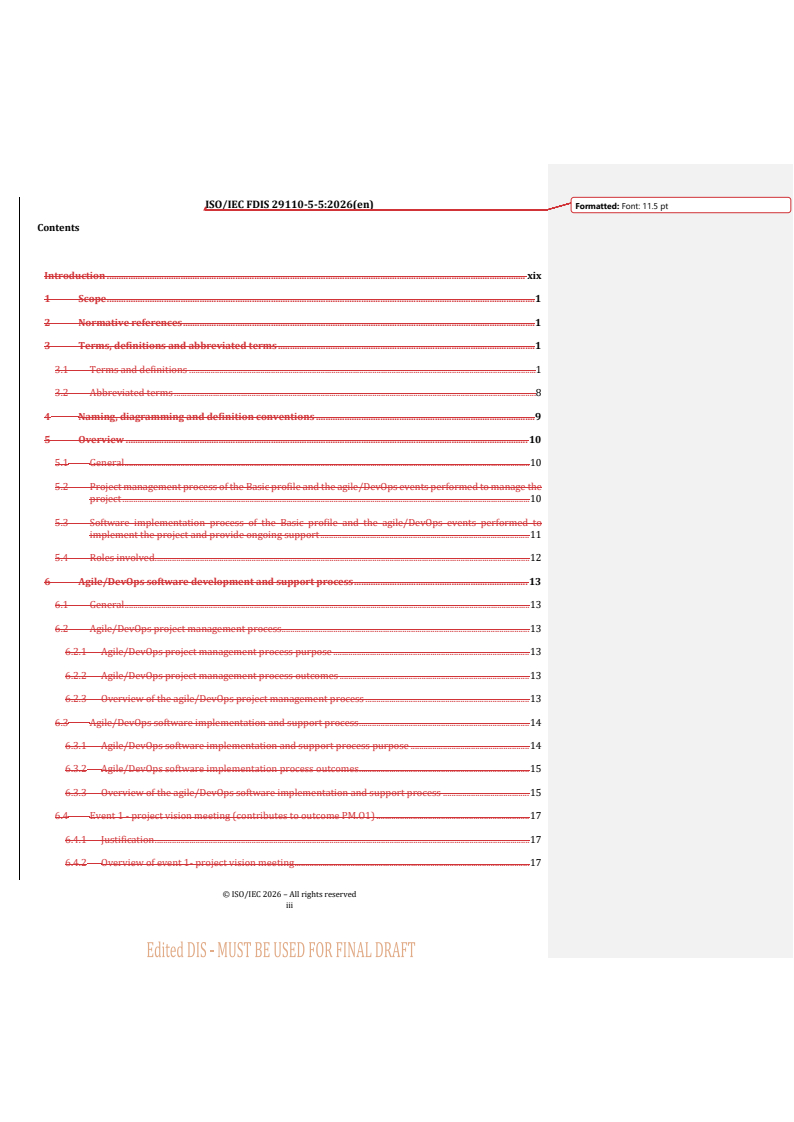
Contents Page
Foreword .v
Introduction .vi
1 Scope . 1
2 Normative references . 1
3 Terms, definitions and abbreviated terms . 1
3.1 Terms and definitions .1
3.2 Abbreviated terms .8
4 Naming, diagramming and definition conventions . 8
5 Overview . 9
5.1 General .9
5.2 Project management process of the Basic profile and the agile/DevOps events
performed to manage the project .10
5.3 Software implementation process of the Basic profile and the agile/DevOps events
performed to implement the project and provide ongoing support .10
5.4 Roles involved.11
6 Agile/DevOps software development and support process .11
6.1 General .11
6.2 Agile/DevOps project management process .11
6.2.1 Agile/DevOps project management process purpose.11
6.2.2 Agile/DevOps project management process outcomes . 12
6.2.3 Overview of the agile/DevOps project management process . 12
6.3 Agile/DevOps software implementation and support process . 13
6.3.1 Agile/DevOps software implementation and support process purpose. 13
6.3.2 Agile/DevOps software implementation process outcomes . 13
6.3.3 Overview of the agile/DevOps software implementation and support process .14
6.4 Event 1 - project vision meeting (contributes to outcome PM.O1) .16
6.4.1 Justification .16
6.4.2 Overview of event 1- project vision meeting .16
6.4.3 Tasks of event 1 - project vision meeting .16
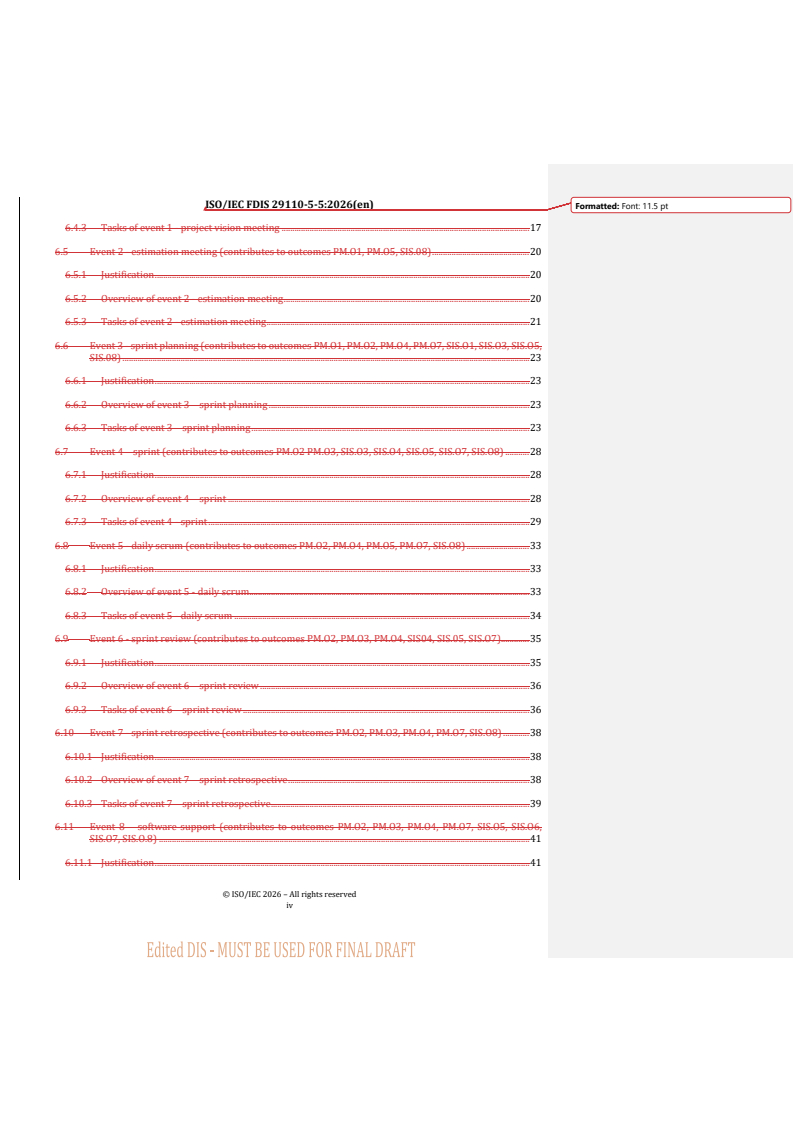
6.5 Event 2 - estimation meeting (contributes to outcomes PM.O1, PM.O5, SIS.08) .19
6.5.1 Justification .19
6.5.2 Overview of event 2 - estimation meeting .19
6.5.3 Tasks of event 2 - estimation meeting . 20
6.6 Event 3 - sprint planning (contributes to outcomes PM.O1, PM.O2, PM.O4, PM.O7, SIS.
O1, SIS.O3, SIS.O5, SIS.08) . 22
6.6.1 Justification . 22
6.6.2 Overview of event 3 – sprint planning . 22
6.6.3 Tasks of event 3 – sprint planning . 22
6.7 Event 4 – sprint (contributes to outcomes PM.O2 PM.O3, SIS.O3, SIS.O4, SIS.O5, SIS.O7,
SIS.O8) . 26
6.7.1 Justification . 26
6.7.2 Overview of event 4 – sprint . 26
6.7.3 Tasks of event 4 - sprint .27
6.8 Event 5 - daily scrum (contributes to outcomes PM.O2, PM.O4, PM.O5, PM.O7, SIS.O8) .31
6.8.1 Justification .31
6.8.2 Overview of event 5 - daily scrum .31
6.8.3 Tasks of event 5 - daily scrum .31
6.9 Event 6 - sprint review (contributes to outcomes PM.O2, PM.O3, PM.O4, SIS04, SIS.05,
SIS.O7) . 33
6.9.1 Justification . 33
6.9.2 Overview of event 6 – sprint review . 33
6.9.3 Tasks of event 6 – sprint review . 33
© ISO/IEC 2026 – All rights reserved
iii
ISO/IEC FDIS 29110-5-5:2026(en)
6.10 Event 7 - sprint retrospective (contributes to outcomes PM.O2, PM.O3, PM.O4, PM.O7,
SIS.O8) . 36
6.10.1 Justification . 36
6.10.2 Overview of event 7 – sprint retrospective . 36
6.10.3 Tasks of event 7 – sprint retrospective . 36
6.11 Event 8 – software support (contributes to outcomes PM.O2, PM.O3, PM.O4, PM.O7, SIS.
O5, SIS.O6, SIS.O7, SIS.O.8) . 38
6.11.1 Justification . 38
6.11.2 Overview of event 8 – software support . 38
6.11.3 Tasks of event 8 – software support . 40
7 Role descriptions . 41
8 Work product descriptions .43
Annex A (informative) Examples of work product templates .64
Annex B (informative) Overview of popular agile methods .69
Annex C (informative) Extending agile practices into DevOps to deliver development and
support .71
Annex D (informative) Development of guidelines for the reinforcement of an agile environment . 74
Annex E (informative) Mapping between ISO/IEC 29110-5-5 and ISO/IEC/IEEE 32675 .77
Annex F (informative) Guidelines for the reinforcement of an agile/DevOps environment .79
Bibliography .82
© ISO/IEC 2026 – All rights reserved
iv
ISO/IEC FDIS 29110-5-5:2026(en)
Foreword
ISO (the International Organization for Standardization) and IEC (the International Electrotechnical
Commission) form the specialized system for worldwide standardization. National bodies that are
members of ISO or IEC participate in the development of International Standards through technical
committees established by the respective organization to deal with particular fields of technical activity.
ISO and IEC technical committees collaborate in fields of mutual interest. Other international organizations,
governmental and non-governmental, in liaison with ISO and IEC, also take part in the work.
The procedures used to develop this document and those intended for its further maintenance are described
in the ISO/IEC Directives, Part 1. In particular, the different approval criteria required for the different types
of document should be noted. This document was drafted in accordance with the editorial rules of the ISO/
IEC Directives, Part 2 (see www.iso.org/directives or www.iec.ch/members_experts/refdocs).
ISO and IEC draw attention to the possibility that the implementation of this document may involve the
use of (a) patent(s). ISO and IEC take no position concerning the evidence, validity or applicability of any
claimed patent rights in respect thereof. As of the date of publication of this document, ISO and IEC had not
received notice of (a) patent(s) which may be required to implement this document. However, implementers
are cautioned that this may not represent the latest information, which may be obtained from the patent
database available at www.iso.org/patents and https://patents.iec.ch. ISO and IEC shall not be held
responsible for identifying any or all such patent rights.
Any trade name used in this document is information given for the convenience of users and does not
constitute an endorsement.
For an explanation of the voluntary nature of standards, the meaning of ISO specific terms and expressions
related to conformity assessment, as well as information about ISO's adherence to the World Trade
Organization (WTO) principles in the Technical Barriers to Trade (TBT) see www.iso.org/iso/foreword.html.
In the IEC, see www.iec.ch/understanding-standards.
This document was prepared by Joint Technical Committee ISO/IEC JTC 1, Information technology,
Subcommittee SC 7, Software and systems engineering.
A list of all parts in the ISO/IEC 29110 series can be found on the ISO website.
Any feedback or questions on this document should be directed to the user’s national standards body. A
complete listing of these bodies can be found at www.iso.org/members.html.
© ISO/IEC 2026 – All rights reserved
v
ISO/IEC FDIS 29110-5-5:2026(en)
Introduction
0.1 Introduction to theISO/IEC29110 series
For the purpose of the ISO/IEC 29110 series, a very small entity (VSE) is an enterprise, organization (e.g.
government agency, non-profit organization), department or project having up to 25 people. Since many
VSEs develop and/or maintain systems and the software components used in those systems, either as
independent products or incorporated in a larger system, a recognition of VSEs as suppliers of high-quality
products is required.
VSEs around the world are creating valuable products and services. According to the World Bank, small
.
and medium-sized enterprises (SMEs) account for about 90 % of enterprises worldwide According to the
Organisation for Economic Co-operation and Development (OECD), SMEs represent 99 % of all businesses
.
and generate about 60 % of employment Almost one person out of three is employed in a micro firm with
less than 10 employees. The European Union reports that micro firms, with fewer than 10 persons, account
for 93,5 % of all enterprises and small firms, with 10 to 49 employees, account for 5,5 % of all enterprises.
With such a large proportion of business activity carried out by VSEs, their participation in the economy
is key to United Nations Sustainable Development Goal 8 – to promote inclusive and sustainable economic
growth and decent work for all. The challenge facing governments is to provide a business environment that
supports the competitiveness of this large heterogeneous business population and that promotes a vibrant
entrepreneurial culture.
From studies and surveys conducted, the majority of International Standards do not address the needs of
VSEs. Implementation of and conformity with these standards is difficult, if not impossible.
Consequently, VSEs have no, or very limited, ways to be recognized as entities that produce quality systems/
system elements including software in their domain. Therefore, VSEs are excluded from some economic
activities.
It has been found that VSEs find it difficult to relate International Standards to their business needs and
to justify the effort required to apply standards to their business practices. Most VSEs find it helpful to
have specified procedures appropriate to their size when beginning agile projects, rather than attempting
to interpret and tailor the more flexible, high-level process requirements of ISO/IEC/IEEE. To address
some of these difficulties, a set of guidelines have been developed based on a set of VSEs characteristics.
The guidelines are based on subsets of appropriate standards processes, activities, tasks, and outcomes,
referred to as profiles. The purpose of a profile is to define a subset of International Standards relevant to
the VSEs' context, for example, processes, activities, tasks, and outcomes of ISO/IEC/IEEE 12207 for software
systems; and processes of ISO/IEC/IEEE 32675:2022 for DevOps practices; and processes, activities,
tasks, and outcomes of ISO/IEC/IEEE 15288 for systems and information products (documentation) of
ISO/IEC/IEEE 15289 for software and systems .
VSEs can achieve recognition through implementing a profile and by being audited against ISO/IEC 29110
specifications.
The ISO/IEC 29110 series can be applied at any phase of system or software development and support within
a life cycle. The ISO/IEC 29110 series is intended to be used by VSEs that do not have experience or expertise
in adapting or tailoring ISO/IEC/IEEE 12207, ISO/IEC/IEEE 32675, or ISO/IEC/IEEE 15288 standards to
the needs of a specific project. VSEs that have expertise in adapting or tailoring ISO/IEC/IEEE 12207 or
ISO/IEC/IEEE 15288 are encouraged to use those standards instead of the ISO/IEC 29110 series.
The ISO/IEC 29110 series is intended to be used with any life cycle such as: waterfall, iterative, incremental,
evolutionary or agile.
Systems, in the context of the ISO/IEC 29110 series, are typically composed of hardware and software
components.
The ISO/IEC 29110 series, targeted by audiences, has been developed to improve system or software and/
or service quality, and process performance. Figure 1 describes the ISO/IEC 29110 series and positions the
parts within the framework of reference.
© ISO/IEC 2026 – All rights reserved
vi
ISO/IEC FDIS 29110-5-5:2026(en)
Figure 1 — The ISO/IEC 29110 series
ISO/IEC 29110-1-1 introduces processes, life cycle and standardization concepts, the taxonomy (catalogue) of
ISO/IEC 29110 profiles and the ISO/IEC 29110 series. ISO/IEC 29110-1-1 also introduces the characteristics
and needs of a VSE, and clarifies the rationale for specific profiles, documents, standards and guidelines.
ISO/IEC 29110-1-2 defines the terms common to the ISO/IEC 29110 series. ISO/IEC 29110-1-1 and
ISO/IEC 29110-1-2 are targeted at VSEs and their customers, assessors, standards producers, tool vendors
and methodology vendors.
ISO/IEC 29110-2 introduces the concepts for systems and software engineering profiles for VSEs. It
establishes the logic behind the definition and application of profiles. For standardized profiles, it specifies
the elements common to all profiles (structure, requirements, conformity, and assessment). For domain-
specific profiles (not standardized and developed outside of the ISO process), it provides general guidance
adapted from the definition of standardized profiles. ISO/IEC 29110-2 is targeted at profile producers, tool
vendors and methodology vendors.
ISO/IEC 29110-3 defines certification schemes, assessment guidelines and compliance requirements for
process capability assessment, conformity assessments, and self-assessments for process improvements.
ISO/IEC 29110-3 also contains information that can be useful to developers of certification and assessment
methods and developers of certification and assessment tools. ISO/IEC 29110-3 is addressed to people who
have direct involvement with the assessment process, e.g. the auditor, certification and accreditation bodies
and the sponsor of the audit, who need guidance on ensuring that the requirements for performing an audit
have been met. ISO/IEC 29110-3 is targeted at VSEs and their customers, assessors and accreditation bodies.
ISO/IEC 29110-4 provides the specifications for all generic profiles of the Generic profile group that are
based on subsets of appropriate standards elements. ISO/IEC 29110-4 is targeted at VSEs, customers,
standards producers, tool vendors and methodology vendors.
© ISO/IEC 2026 – All rights reserved
vii
ISO/IEC FDIS 29110-5-5:2026(en)
ISO/IEC 29110-5 provides management, engineering and service delivery guidelines for profiles of the
Generic profile group. ISO/IEC 29110-5 is targeted at VSEs and their customers.
ISO/IEC 29110-6 provides the specifications for specific profiles based on subsets of appropriate standards
elements. ISO/IEC 29110-6 is targeted at VSEs, customers, standards producers, tool vendors and
methodology vendors.
ISO/IEC 29110-7 provides guidelines for each profile of the specific profile group. ISO/IEC 29110-7 is targeted
at VSEs and their customers.
If a new profile is needed, ISO/IEC 29110-4 or ISO/IEC 29110-6, ISO/IEC 29110-6, and/or ISO/IEC 29110-7,
ISO/IEC 29110-5 can be developed with minimal impact to existing documents.
0.2 Introduction to this document
This document aims to help VSEs that want to reinforce their agile/DevOps environment to develop and
support software products, or to add a DevOps approach to their agile approach with practices of the
ISO/IEC 29110 series.
A combined agile and DevOps approach focuses on speed and quality of software development combined
with continuous delivery of software into a production or production-like environment, optimizing the
software development, deployment and support process. It emphasizes a self-organizing, collaborative
culture that leverages automated processes and challenges non-value-added work. This can be perceived
to be in opposition to the requirements to follow processes and documentation requirements specified in
standards. However, this document provides a clear framework for a robust implementation of agile and
DevOps practices which can facilitate the use of the ISO/IEC 29110 Basic profile.
DevOps and agile are separate approaches and do not have to be implemented together. However, they are
complementary, and agile serves as an effective enabler for DevOps with its focus on small teams and high-
quality code. The most likely VSE implementation of DevOps is in combination with an agile approach, which
is the focus of this document.
Whilst DevOps focusses primarily on speed and quality, DevSecOps additionally focusses on integration
of security as a shared responsibility throughout the IT life cycle. This document can also be used for
DevSecOps guidance by highlighting the security focus when the DevOps approach is agreed.
This document provides examples of work product templates (see Annex A).
This document is based mainly on the scrum and XP agile methods (see Annex B) and on DevOps concepts
(see Annex C).
This document also aims to help VSEs that want to follow the two processes of the software Basic profile
of ISO/IEC 29110, as specified in ISO/IEC 29110-4-1, while performing their agile/DevOps practices (see
Annex B and C).
This document has been developed, using the management and engineering guidelines of the
ISO/IEC 29110-5-1-2 software Basic profile, by modifying and adding elements (e.g. task, work product, role)
for VSEs involved in the development and support of software using an agile and DevOps combined approach
(see Annex B and C). However, this document does not contain any requirements.
Using this document, VSEs can obtain the following benefits:
— project planning: by providing a set of events to enable the team to track the work and know what an
impediment can be and assign tasks to each member of the team;
— effort estimation: by providing estimation techniques for the sprint planning event;
— progress tracking: by providing tools (e.g. burndown chart, product backlog, daily scrum) to update and
track the work, the budget and the schedule until the project's closure;
— management of changes and artefacts: by providing a set of tasks to control the changes to the software
and management work products;
© ISO/IEC 2026 – All rights reserved
viii
ISO/IEC FDIS 29110-5-5:2026(en)
— clarity of each role: by providing a set of tasks for each role;
— agile risk management: by providing work products to identify and manage risks;
— reduced rework: by providing a set of tasks that minimize errors and handle the detection and correction
of defects effectively;
— closer alignment between development and operations: by including operations support needs in project
implementation to deliver an optimized end-to-end process;
— increased responsiveness to resolving customer issues which require development work: by integrating
support incident responses into project work, rather than separating them into a separate work stream.
© ISO/IEC 2026 – All rights reserved
ix
FINAL DRAFT International Standard ISO/IEC FDIS 29110-5-5:2026(en)
Systems and software engineering — Life cycle profiles for
very small entities (VSEs) —
Part 5-5:
Agile/DevOps guidelines
1 Scope
This document provides guidelines for very small entities (VSEs) who want to reinforce their agile/DevOps
environment to develop and support software using an agile approach with practices of the ISO/IEC 29110
series.
This document is applicable to VSEs that do not develop safety-critical products.
2 Normative references
The following documents are referred to in the text in such a way that some or all of their content constitutes
requirements of this document. For dated references, only the edition cited applies. For undated references,
the latest edition of the referenced document (including any amendments) applies.
ISO/IEC 29110-1-2, Systems and software engineering — Lifecycle profiles for Very Small Entities (VSEs) — Part
1-2: Vocabulary
3 Terms, definitions and abbreviated terms
3.1 Terms and definitions
For the purposes of this document, the terms and definitions given in ISO/IEC 29110-1-2 and the following
apply.
ISO and IEC maintain terminology databases for use in standardization at the following addresses:
— ISO Online browsing platform: available at https:// www .iso .org/ obp
— IEC Electropedia: available at https:// www .electropedia .org/
3.1.1
acceptance criteria
working agreement (3.1.6) on the required quality attribute that work meets before it completes a specified
story or feature (3.1.20), item or artefact
[SOURCE: ISO/IEC 29110-5-4, 3.1.1]
3.1.2
agile
approach to development, delivery and maintenance of products and services by enabling rapid response to
feedback
Note 1 to entry: The required specification for the software under development is elaborated with specific
requirements only when the work is started. This lean principle is meant to avoid waste of work and to provide an
agile team (3.1.5) with means of prioritizing their work.
© ISO/IEC 2026 – All rights reserved
ISO/IEC FDIS 29110-5-5:2026(en)
[SOURCE: ISO/IEC 33202:2024, 3.2, modified — In note 1 to entry, "need specification" has been replaced by
"required specification".]
3.1.3
agile development
development approach based on iterative development, frequent inspection and adaptation, and incremental
deliveries in which requirements and solutions evolve through collaboration in cross-functional teams and
through continuous stakeholder feedback
[SOURCE: ISO/IEC/IEEE 26515:2018, 3.1, modified — Note 1 to entry has been removed.]
3.1.4
agile environment
organizational culture, infrastructure (3.1.23), and methodologies that support agile development (3.1.3)
[SOURCE: ISO/IEC/IEEE 26515:2018, 3.2]
3.1.5
agile team
organization or team using agile development (3.1.3) methods and approaches
Note 1 to entry: Typically, with roles such as team lead, project manager, user or user representative, software and
information developers, and testers.
[SOURCE: ISO/IEC/IEEE 26515:2018, 3.3]
3.1.6
agreement
mutual acknowledgement of terms and conditions under which a working relationship is conducted
EXAMPLE Contract, memorandum of agreement.
[SOURCE: ISO/IEC/IEEE 12207:2017, 3.1.5]
3.1.7
backlog
collection of agile (3.1.2)features (3.1.20) or stories of both functional and operational requirements (3.1.26)
that are typically sorted in an order based on value priority
[SOURCE: ISO/IEC/IEEE 26515:2018, 3.4, modified — "nonfunctional requirements" has been replaced by
"operational requirements".]
3.1.8
baseline
formally approved version of a configuration item, regardless of media, formally designated and fixed at a
specific time during the configuration item’s life cycle
[SOURCE: ISO/IEC/IEEE 12207:2017, 3.1.11]
3.1.9
Basic profile
profile targeted at VSEs developing a single product by a single work team
[SOURCE: ISO/IEC 29110-1-2:2024, 4.14]
3.1.10
build
operational version of a system or component that incorporates a specified subset of the capabilities that the
final product will provide
[SOURCE: IEEE 828-2012, 2.1, IEEE dictionary]
© ISO/IEC 2026 – All rights reserved
ISO/IEC FDIS 29110-5-5:2026(en)
3.1.11
burndown chart
graph that represents the work remaining to do on a project
[SOURCE: ISO/IEC/IEEE 26511:2018, 3.1.6]
3.1.12
burnup chart
graphical representation of the work completed toward the release of a product
[SOURCE: Agile Practice Guide, Project Management Institute, 2017]
3.1.13
continuous integration
technique that continually merges artefacts, including source code updates from all developers on a team,
into a shared mainline to build and test the developed system
[SOURCE: ISO/IEC/IEEE 32675:2022, 3.1]
3.1.14
daily scrum
brief daily meeting in agile development (3.1.3) methods where team members share accomplishments from
the prior daily meeting, plans for the current day and identification of impediments
[SOURCE: ISO/IEC 29110-5-4, 3.1.29]
3.1.15
definition of done
DoD
statement on the required quality attributes that work meets before the work completes a specified life
cycle activity or task and is ready for use
Note 1 to entry: ‘Done’ in a DevOps (3.1.16) environment includes deployment into a production environment or a
production-like environment.
[SOURCE: ISO/IEC/IEEE 33202:2024, 3.13, modified — Note 1 to entry has been removed.]
3.1.16
DevOps
set of principles and practices which enable better communication and collaboration between relevant
stakeholders for the purpose of specifying, developing, and operating software and systems products and
services, and continuous improvements in all aspects of the life cycle
Note 1 to entry: DevOps uses lean principles to increase speed and quality of software delivery and may be regarded
as the logical continuation of the agile (3.1.2) software journey.
[SOURCE: ISO/IEC/IEEE 32675:2022, 3.1, modified — Note 1 to entry has been added.]
3.1.17
DevOps specialist
DS
DevOps engineer
individual with a wide-ranging knowledge of both development and operations including coding,
infrastructure (3.1.23) management, system administration and DevOps (3.1.16) tools
3.1.18
DevSecOps
DevOps (3.1.16) extended to include security capabilities as an essential and integral part of the development
and operations processes
Note 1 to entry: Whilst DevOps is focused on increasing speed and quality of software development and delivery, the
primary focus of DevSecOps is on securing the software development process by integrating security from the very
beginning of the life cycle and throughout the software development, testing and support life cycle.
© ISO/IEC 2026 – All rights reserved
ISO/IEC FDIS 29110-5-5:2026(en)
[SOURCE: ISO/IEC TS 23167:2020, 3.11, modified — Note 1 to entry has been added.]
3.1.19
event
ceremony
key meeting in which a set of tasks are performed to help the scrum lead (3.1.38), product owner (3.1.32), and
developer to organize, evaluate, and adjust the work to be done to develop a product
EXAMPLE Sprint (3.1.41) planning, daily scrum (3.1.14), sprint review and sprint retrospective.
[SOURCE: ISO/IEC 29110-5-4, 3.1.14]
3.1.20
feature
functional or operational distinguishing characteristic of a system
[SOURCE: ISO/IEC/IEEE 26515:2018, 3.7, modified — "nonfunctional" has been replaced by "operational";
the original note 1 to entry has been replaced by a new one.]
3.1.21
incident
anomalous or unexpected event, set of events, condition, or situation at any time during the life cycle of a
project, product, service, or system
[SOURCE: ISO/IEC 12207:2017, 3.1.23]
3.1.22
increment
tested, deliverable version of a software product (3.1.39) that provides new or modified capabilities
[SOURCE: ISO/IEC 33202:2024, 3.17]
3.1.23
infrastructure
facilities such as power and physical security of the data centre, networking, hardware, and software needed
to support the systems life cycle and maintain IT services
Note 1 to entry: Infrastructure does not include the associated people, processes, or documentation. In DevOps
(3.1.15), software defined infrastructure enables elasticity.
[SOURCE: ISO/IEC/IEEE 32675:2021, 3.1]
3.1.24
left-shift
prioritizing the involvement of relevant stakeholders in applying quality activities, security, privacy,
performance, verification, and validation earlier in the life cycle
[SOURCE: ISO/IEC/IEEE 32675:2021, 3.1]
3.1.25
measure
measure, noun
variable to which a value is assigned as the result of measurement
Note 1 to entry: The plural form “measures” is used to refer collectively to base measures, derived measures and
indicators.
[SOURCE: ISO/IEC/IEEE 15939:2017, 3.15]
© ISO/IEC 2026 – All rights reserved
ISO/IEC FDIS 29110-5-5:2026(en)
3.1.26
operational requirement
non-functional requirement
requirement which defines how well a product or the environment in which it is developed and deployed
performs
Note 1 to entry: Operational requirements include aspects such as performance, security, scalability, maintainability,
automation. They complement functional requirements which are expressed in agile (3.1.2) methodologies as user
stories (3.1.48).
3.1.27
pair programming
practice from eXtreme Programming (XP) that typically involves one developer writing source code
or configuring a system while a second developer observes the work to look for errors and to determine
whether the work completed is accurate and meets its requirements
Note 1 to entry: Pairs alternate roles periodically so a different developer writes code while the other developer
observes.
[SOURCE: ISO/IEC 29110-5-4, 3.1.17]
3.1.28
planning poker
team-based estimation approach whereby relative estimates of the effort required to develop and test each
user story (3.1.48) and operational requirement (3.1.27) are set via consensus
Note 1 to entry: The approach uses poker cards that are typically based on a Fibonacci sequence (i.e. 1, 2, 3, 5, 8, 13).
3.1.29
process purpose
high-level objective of performing the process and the likely outcomes of effective implementation of the
process
[SOURCE: ISO/IEC/IEEE 24774:2021, 3.12]
3.1.30
process outcome
observable result of the successful achievement of the process purpose (3.1.29)
[SOURCE: ISO/IEC/IEEE 24774:2021, 3.11]
3.1.31
product backlog
emergent, ordered list of what is needed to improve the product
Note 1 to entry: It is the single source of work undertaken by the agile team (3.1.5).
[SOURCE: ISO/IEC 29110-5-4, 3.1.19]
3.1.32
product owner
designated stakeholder accountable for defining and accepting outcomes of the work and managing backlog
(3.1.7), while aligning with the stakeholder needs
Note 1 to entry: A product owner is also the 'voice of the user' or the user representative on the team.
[SOURCE: ISO/IEC 33202:2024, 3.2, modified — Note 1 to entry has been added.]
© ISO/IEC 2026 – All rights reserved
ISO/IEC FDIS 29110-5-5:2026(en)
3.1.33
profile
subset of appropriate standards’ processes and their outcomes, activities and tasks combined to accomplish
a particular function
Note 1 to entry: The base standards used to develop profiles for VSEs are ISO/IEC/IEEE 12207, ISO/IEC/IEEE 15288
and ISO/IEC/IEEE 15289. With the addition of DevOps to the scope of the 29110 series, ISO/IEC/IEEE 32675 is
introduced as a base standard for this document.
[SOURCE: ISO/IEC 29110-1-2, 3.70]
3.1.34
repository
organized and persistent data storage that allows data retrieval
[SOURCE: ISO/IEC/IEEE 26511:2018, 3.1.24]
3.1.35
safety-critical product
software whose failure or malfunction can result in one (or more) of the following outcomes:
— death or serious injury to people
— loss or severe damage to equipment or property
— environmental harm
[SOURCE: ISO/IEC 23643:2020, 3.15, modified — EXAMPLE has been removed.]
3.1.36
self-organizing team
group composed of motivated individuals working together toward meeting a goal
Note 1 to entry: They have the ability and authority for decision-making. They manage their work and readily adapt to
changing demands.
Note 2 to entry: Principles of self-organizing teams are competency, collaboration, motivation, trust, respect and
continuity.
3.1.37
scrum
iterative project management framework used in agile development (3.1.3), in which a team agrees on
development items from product backlog (3.1.31) and produces them within a short duration of a few weeks
[SOURCE: ISO/IEC 29110-1-2:2024, 3.81]
3.1.38
scrum lead
person who facilitates the scrum (3.1.37) process within a team or project
[SOURCE: ISO/IEC/IEEE 24765:2017, 3.3638, modified — The term has been changed from "scrum master"
to "scrum lead".]
3.1.39
service level agreement
SLA
documented agreement between a service provider and a customer that identifies services and service
targets
[SOURCE: ISO/IEC 20110-1-2, 3.90]
© ISO/IEC 2026 – All rights reserved
ISO/IEC FDIS 29110-5-5:2026(en)
3.1.40
software product
set of computer programs, procedures, and possibly associated documentation and data
[SOURCE: ISO/IEC/IEEE 12207:2017, 3.1.54, modified – Note 1 to entry has been removed.]
3.1.41
sprint
short time frame, in which a set of software features (3.1.20) is developed, leading to a working product that
can be demonstrated to stakeholders
Note 1 to entry: In some organizations, a sprint is known as an iteration.
[SOURCE: ISO/IEC/IEEE 24765:2017, 3.3914]
3.1.42
sprint backlog
iteration backlog
sprint catalogue
set of backlog (3.1.7) items [e.g. user stories (3.1.48)] that are selected for inclusion in a given sprint (3.1.40)
[SOURCE: ISO/IEC 29110-5-4, 3.1.32]
3.1.43
story points
units of measure for expressing an estimate of the overall effort required to fully implement a product
backlog (3.1.31) item or any other piece of work
[SOURCE: ISO/IEC 29110-5-4, 3.1.33]
3.1.44
time-boxed
having a prescribed duration limit for a project task
[SOURCE: ISO/IEC 29110-5-4, 3.1.34]
3.1.45
task board
kanban board
scrum board
visual representation of an agile team's (3.1.5) progress within an iteration
[SOURCE: ISO/IEC 29110-5-4, 3.1.35]
3.1.46
technical debt
deferred cost of work not done at an earlier point in the product life cycle
[SOURCE: Software Extension to the PMBOK Guide Fifth Edition]
3.1.47
unit test
testing of individual routines and modules by the developer or an independent tester
[SOURCE: ISO/IEC/IEEE 24765:2017, 3.4429, definition 1]
3.1.48
user story
brief description of desired functionality
Note 1 to entry: A user story can describe the stakeholder roles, goals, benefits, and motivation.
© ISO/IEC 2026 – All rights reserved
ISO/IEC FDIS 29110-5-5:2026(en)
Note 2 to entry: Work items in the backlog (3.1.7) can also be referred in other ways like epics, features (3.1.20), items
or artefacts.
[SOURCE: ISO/IEC 33202:2024, 3.27, modified – In Note 2 to entry, "work" has been replaced by "work items";
"items or artefacts" has been added.]
3.1.49
velocity
rate of current work unit completion, measured as work units completed per fixed time period, such as
story points (3.1.43), delivered features (3.1.20), functions, function points, user stories (3.1.48), use cases, or
requirements completed in a given time
...
Style Definition: Comment Text
ISO/IEC FDIS 29110-5-5:2026(en)
Style Definition: ANNEX
ISO/IEC JTC 1/SC 7
Style Definition: List Continue 1 (-): Justified
Style Definition: List Continue 2 (-): Font: Arial
Secretariat: BIS
Style Definition: List Number 1 (-): Justified
Date: 2026-03-2706-17
Style Definition: Hashtag3
Style Definition: Mention3
Systems and software engineering — Life cycle profiles for very small entities (VSEs) — Part 5-
5: Agile/DevOps guidelines
Style Definition: Unresolved Mention2
Formatted: Font: Cambria
ISO/IEC FDIS 29110-5-5:2026(en)
Formatted: Font: 11.5 pt
© ISO/IEC 2026
Formatted: Font: Cambria, Pattern: Clear (Custom
Color(RGB(198,217,241)))
All rights reserved. Unless otherwise specified, or required in the context of its implementation, no part of
Formatted: Font: Cambria
this publication may be reproduced or utilized otherwise in any form or by any means, electronic or
Formatted: Font: Cambria, Pattern: Clear (Custom
mechanical, including photocopying, or posting on the internet or an intranet, without prior written
Color(RGB(242,219,219)))
permission. Permission can be requested from either ISO at the address below or ISO's member body in the
country of the requester.
Formatted: Font: Cambria
Formatted: Font: Cambria
ISO Copyright Office
CP 401 • CH-1214 Vernier, Geneva
Phone: + 41 22 749 01 11
Email: copyright@iso.org
Website: www.iso.org
Formatted: Font: Cambria
Formatted: Font: Cambria
Published in Switzerland.
Formatted: Font: Cambria
Formatted: Indent: Left: 0 cm, Adjust space between
Latin and Asian text, Adjust space between Asian text
and numbers
© ISO/IEC 2026 – All rights reserved
ii
ISO/IEC FDIS 29110-5-5:2026(en)
Formatted: Font: 11.5 pt
Contents
Introduction . xix
1 Scope . 1
2 Normative references . 1
3 Terms, definitions and abbreviated terms . 1
3.1 Terms and definitions . 1
3.2 Abbreviated terms .8
4 Naming, diagramming and definition conventions . 9
5 Overview . 10
5.1 General . 10
5.2 Project management process of the Basic profile and the agile/DevOps events performed to manage the
project . 10
5.3 Software implementation process of the Basic profile and the agile/DevOps events performed to
implement the project and provide ongoing support . 11
5.4 Roles involved . 12
6 Agile/DevOps software development and support process . 13
6.1 General . 13
6.2 Agile/DevOps project management process. 13
6.2.1 Agile/DevOps project management process purpose . 13
6.2.2 Agile/DevOps project management process outcomes . 13
6.2.3 Overview of the agile/DevOps project management process . 13
6.3 Agile/DevOps software implementation and support process . 14
6.3.1 Agile/DevOps software implementation and support process purpose . 14
6.3.2 Agile/DevOps software implementation process outcomes . 15
6.3.3 Overview of the agile/DevOps software implementation and support process . 15
6.4 Event 1 - project vision meeting (contributes to outcome PM.O1) . 17
6.4.1 Justification . 17
6.4.2 Overview of event 1- project vision meeting . 17
© ISO/IEC 2026 – All rights reserved
iii
ISO/IEC FDIS 29110-5-5:2026(en)
Formatted: Font: 11.5 pt
6.4.3 Tasks of event 1 - project vision meeting . 17
6.5 Event 2 - estimation meeting (contributes to outcomes PM.O1, PM.O5, SIS.08) . 20
6.5.1 Justification . 20
6.5.2 Overview of event 2 - estimation meeting . 20
6.5.3 Tasks of event 2 - estimation meeting . 21
6.6 Event 3 - sprint planning (contributes to outcomes PM.O1, PM.O2, PM.O4, PM.O7, SIS.O1, SIS.O3, SIS.O5,
SIS.08) . 23
6.6.1 Justification . 23
6.6.2 Overview of event 3 – sprint planning . 23
6.6.3 Tasks of event 3 – sprint planning . 23
6.7 Event 4 – sprint (contributes to outcomes PM.O2 PM.O3, SIS.O3, SIS.O4, SIS.O5, SIS.O7, SIS.O8) . 28
6.7.1 Justification . 28
6.7.2 Overview of event 4 – sprint . 28
6.7.3 Tasks of event 4 - sprint . 29
6.8 Event 5 - daily scrum (contributes to outcomes PM.O2, PM.O4, PM.O5, PM.O7, SIS.O8) . 33
6.8.1 Justification . 33
6.8.2 Overview of event 5 - daily scrum. 33
6.8.3 Tasks of event 5 - daily scrum . 34
6.9 Event 6 - sprint review (contributes to outcomes PM.O2, PM.O3, PM.O4, SIS04, SIS.05, SIS.O7) . 35
6.9.1 Justification . 35
6.9.2 Overview of event 6 – sprint review . 36
6.9.3 Tasks of event 6 – sprint review . 36
6.10 Event 7 - sprint retrospective (contributes to outcomes PM.O2, PM.O3, PM.O4, PM.O7, SIS.O8) . 38
6.10.1 Justification . 38
6.10.2 Overview of event 7 – sprint retrospective . 38
6.10.3 Tasks of event 7 – sprint retrospective . 39
6.11 Event 8 – software support (contributes to outcomes PM.O2, PM.O3, PM.O4, PM.O7, SIS.O5, SIS.O6,
SIS.O7, SIS.O.8) . 41
6.11.1 Justification . 41
© ISO/IEC 2026 – All rights reserved
iv
ISO/IEC FDIS 29110-5-5:2026(en)
Formatted: Font: 11.5 pt
6.11.2 Overview of event 8 – software support . 41
6.11.3 Tasks of event 8 – software support . 42
7 Role descriptions . 44
8 Work product descriptions . 46
Annex A (informative) Examples of work product templates . 70
A.1 Burndown chart . 70
A.2 Product burnup . 70
A.3 Product backlog . 71
A.4 User stories . 72
A.5 Operational requirement . 73
A.6 Task board . 73
A.7 Incident record . 74
Annex B (informative) Overview of popular agile methods . 75
B.1 Overview . 75
B.2 Crystal methodologies . 75
B.3 Dynamic software development method (DSDM) . 75
B.4 eXtreme programming (XP) . 76
B.5 Feature driven development (FDD) . 76
B.6 Lean software development . 76
B.7 Scrum . 76
Annex C (informative) Extending agile practices into DevOps to deliver development and support . 77
C.1 Overview . 77
C.2 DevOps culture and principles . 77
C.2.1 General . 77
C.2.2 First way - acceleration of flow . 77
C.2.3 Second way - amplify feedback loops . 77
C.2.4 Third way - continual experimentation and learning . 78
C.3 DevOps approach . 78
© ISO/IEC 2026 – All rights reserved
v
ISO/IEC FDIS 29110-5-5:2026(en)
Formatted: Font: 11.5 pt
C.4 DevOps automation . 78
Annex D (informative) Development of guidelines for the reinforcement of an agile environment . 80
Annex E (informative) Mapping between ISO/IEC 29110-5-5 and ISO/IEC/IEEE 32675 . 84
E.1 General . 84
E.2 Correspondence of events . 84
E.3 Summary . 85
Annex F (informative) Guidelines for the reinforcement of an agile/DevOps environment . 86
F.1 General . 86
F.2 Productivity . 86
F.3 Software quality . 86
F.4 DevOps performance . 87
Bibliography . 89
Foreword . xviii
Introduction . xix
Figure 1 — The ISO/IEC 29110 series . xx
1 Scope . 1
2 Normative references . 1
3 Terms, definitions and abbreviated terms . 1
3.1 Terms and definitions . 1
3.2 Abbreviated terms .8
4 Naming, diagramming and definition conventions . 9
5 Overview . 10
5.1 General . 10
5.2 Project management process of the Basic profile and the agile/DevOps events performed to manage the
project . 10
Figure 2 — Overview of the project management process of the Basic profile and the agile/DevOps events
............................................................................................................................................................................................ 11
5.3 Software implementation process of the Basic profile and the agile/DevOps events performed to
implement the project and provide ongoing support . 11
© ISO/IEC 2026 – All rights reserved
vi
ISO/IEC FDIS 29110-5-5:2026(en)
Formatted: Font: 11.5 pt
Figure 3 — Overview of the software implementation process of the Basic profile and the agile/DevOps
events . 12
5.4 Roles involved . 12
6 Agile/DevOps software development and support process . 13
6.1 General . 13
6.2 Agile/DevOps project management process. 13
6.2.1 Agile/DevOps project management process purpose . 13
6.2.2 Agile/DevOps project management process outcomes . 13
6.2.3 Overview of the agile/DevOps project management process . 13
Figure 4 — Overview of the agile/DevOps project management process . 14
6.3 Agile/DevOps software implementation and support process . 14
6.3.1 Agile/DevOps software implementation and support process purpose . 14
6.3.2 Agile/DevOps software implementation process outcomes . 15
6.3.3 Overview of the agile/DevOps software implementation and support process . 15
Figure 5 — Overview of the agile/DevOps software implementation and support process . 16
6.4 Event 1 - project vision meeting (contributes to outcome PM.O1) . 17
6.4.1 Justification . 17
6.4.2 Overview of event 1- project vision meeting . 17
Figure 6 — Overview of event 1 - project vision meeting . 17
6.4.3 Tasks of event 1 - project vision meeting . 17
Figure 7 — Tasks of event 1 - project vision meeting . 18
Table 1 — Event 1 - project vision meeting task list . 18
6.5 Event 2 - estimation meeting (contributes to outcomes PM.O1, PM.O5, SIS.08) . 20
6.5.1 Justification . 20
6.5.2 Overview of event 2 - estimation meeting . 20
Figure 8 — Overview of event 2 - estimation meeting . 21
6.5.3 Tasks of event 2 - estimation meeting . 21
Figure 9 — Tasks of event 2 - estimation meeting . 21
© ISO/IEC 2026 – All rights reserved
vii
ISO/IEC FDIS 29110-5-5:2026(en)
Formatted: Font: 11.5 pt
Table 2— Event 2 - estimation meeting task list . 21
6.6 Event 3 - sprint planning (contributes to outcomes PM.O1, PM.O2, PM.O4, PM.O7, SIS.O1, SIS.O3, SIS.O5,
SIS.08) . 23
6.6.1 Justification . 23
6.6.2 Overview of event 3 – sprint planning . 23
Figure 10 — Overview of event 3 - sprint planning . 23
6.6.3 Tasks of event 3 – sprint planning . 23
Figure 11 — Tasks of event 3 - sprint planning . 24
Table 3 — Event 3 - sprint planning task list . 25
6.7 Event 4 – sprint (contributes to outcomes PM.O2 PM.O3, SIS.O3, SIS.O4, SIS.O5, SIS.O7, SIS.O8) . 28
6.7.1 Justification . 28
6.7.2 Overview of event 4 – sprint . 28
Figure 12 — Overview of event 4 - sprint . 29
6.7.3 Tasks of event 4 - sprint . 29
Table 4 — Event 4 –sprint task list. 30
6.8 Event 5 - daily scrum (contributes to outcomes PM.O2, PM.O4, PM.O5, PM.O7, SIS.O8) . 33
6.8.1 Justification . 33
6.8.2 Overview of event 5 - daily scrum. 33
Figure 14 — Overview of event 5 - daily scrum . 34
6.8.3 Tasks of event 5 - daily scrum . 34
Figure 15 — Tasks of event 5 – daily scrum . 34
Table 5 — Event 5 - daily scrum task list . 34
6.9 Event 6 - sprint review (contributes to outcomes PM.O2, PM.O3, PM.O4, SIS04, SIS.05, SIS.O7) . 35
6.9.1 Justification . 35
6.9.2 Overview of event 6 – sprint review . 36
Figure 16 — Overview of event 6 - sprint review . 36
6.9.3 Tasks of event 6 – sprint review . 36
Figure 17 — Tasks of event 6 - sprint review . 37
© ISO/IEC 2026 – All rights reserved
viii
ISO/IEC FDIS 29110-5-5:2026(en)
Formatted: Font: 11.5 pt
Table 6 — Event 6 – sprint review task list . 37
6.10 Event 7 - sprint retrospective (contributes to outcomes PM.O2, PM.O3, PM.O4, PM.O7, SIS.O8) . 38
6.10.1 Justification . 38
6.10.2 Overview of event 7 – sprint retrospective . 38
Figure 18 — Overview of event 7 - sprint retrospective . 39
6.10.3 Tasks of event 7 – sprint retrospective . 39
Figure 19 — Tasks of event 7 - sprint retrospective . 40
Table 7 — Event 7 - sprint retrospective task list . 40
6.11 Event 8 – software support (contributes to outcomes PM.O2, PM.O3, PM.O4, PM.O7, SIS.O5, SIS.O6,
SIS.O7, SIS.O.8) . 41
6.11.1 Justification . 41
6.11.2 Overview of event 8 – software support . 41
Figure 20 — Overview of event 8 – software support . 41
Figure 21— Tasks of event 8 – software support . 42
6.11.3 Tasks of event 8 – software support . 42
Table 8 — Event 8 - software support list of tasks . 42
7 Role descriptions . 44
Table 9 — Role descriptions . 44
8 Work product descriptions . 46
Table 10 — Definition of states of work products . 46
Table 11 — Acceptance record description . 47
Table 12 — Burndown chart description . 48
Table 13 — Change request description . 49
Table 14 —Defects of the software component description. 49
Table 15 — DevOps approach template . 50
Table 16 — Documentation description . 51
Table 17 — Increment description . 51
Table 18 — Meeting record description . 52
© ISO/IEC 2026 – All rights reserved
ix
ISO/IEC FDIS 29110-5-5:2026(en)
Formatted: Font: 11.5 pt
Table 19 — Mission statement description . 53
Table 20 — Potential improvements description . 53
Table 21 — Product design description . 54
Table 22 — Project plan description . 55
Table 23 — Repository description . 57
Table 24 — Repository backup description . 58
Table 25 — Project risk description . 58
Table 26 — Software components description . 59
Table 27 — Software product description . 59
Table 28 — Sprint backlog description . 60
Table 29 — Task board description . 61
Table 30 — Test report description . 62
Table 31 — Traceability record description . 63
Table 32 —Acceptance test description . 63
Table 33 — User stories description . 65
Table 34 — Unit test description . 66
Table 35 — Verification record description . 67
Table 36 — Validation record description . 68
Annex A (informative) Examples of work product templates . 70
A.1 Burndown chart . 70
Figure A.1 — Simple burndown chart . 70
A.2 Product burnup . 70
Figure A.2 — Simple product burnup chart . 71
A.3 Product backlog . 71
Figure A.3 — Simple Product Backlog . 72
Table A.3 — Template for a description of a product backlog to be used in planning . 72
A.4 User stories . 72
Table A.6 — User story template . 72
© ISO/IEC 2026 – All rights reserved
x
ISO/IEC FDIS 29110-5-5:2026(en)
Formatted: Font: 11.5 pt
A.5 Operational requirement . 73
Table A.7 — Operational requirement template . 73
A.6 Task board . 73
Figure A.4 — Task board template . 74
A.7 Incident record . 74
Table A.8 — Incident template . 74
Annex B (informative) Overview of popular agile methods . 75
B.1 Overview . 75
B.2 Crystal methodologies . 75
B.3 Dynamic software development method (DSDM) . 75
B.4 eXtreme programming (XP) . 76
B.5 Feature driven development (FDD) . 76
B.6 Lean software development . 76
B.7 Scrum . 76
Annex C (informative) Extending agile practices into DevOps to deliver development and support . 77
C.1 Overview . 77
C.2 DevOps culture and principles . 77
C.2.1 General . 77
C.2.2 First way - acceleration of flow . 77
C.2.3 Second way - amplify feedback loops . 77
C.2.4 Third way - continual experimentation and learning . 78
C.3 DevOps approach . 78
C.4 DevOps automation . 78
Table C.1 — List of DevOps tool functions and features . 79
Annex D (informative) Development of guidelines for the reinforcement of an agile environment . 80
Table D.1— Correspondence between elements of the software Basic profile and Scrum . 80
Annex E (informative) Mapping between ISO/IEC 29110-5-5 and ISO/IEC/IEEE 32675 . 84
E.1 General . 84
© ISO/IEC 2026 – All rights reserved
xi
ISO/IEC FDIS 29110-5-5:2026(en)
Formatted: Font: 11.5 p
...