

ISO 13342:1995
(Main)Small craft — Static thrust measurement for outboard motors
General Information
- Abstract
Describes a method for measuring and declaring the forward and reverse thrust of outboard motors in a stationary situation to determine if start-in-gear protection is required.
- Status
- Published
- Publication Date
- 11-Oct-1995
- Technical Committee
- ISO/TC 188 - Small craft
- Drafting Committee
- ISO/TC 188 - Small craft
- Current Stage
- 9020 - International Standard under periodical review
- Start Date
- 15-Jul-2026
- Completion Date
- 15-Jul-2026
Buy Documents
ISO 13342:1995 - Small craft — Static thrust measurement for outboard motors Released:10/12/1995
ISO 13342:1995 - Navires de plaisance — Mesurage de la poussée statique des moteurs hors-bord Released:10/12/1995
ISO 13342:1995 - Navires de plaisance — Mesurage de la poussée statique des moteurs hors-bord Released:10/12/1995
Overview
ISO 13342:1995 is an international standard developed by the International Organization for Standardization (ISO) that specifies a standardized method for measuring the static thrust of outboard motors on small craft. This method focuses on accurately evaluating both forward and reverse thrust produced by outboard propulsion systems while stationary. The standard plays a critical role in determining the necessity of start-in-gear protection systems for safety compliance, as outlined in ISO 11547.
By providing a consistent procedure for thrust measurement, ISO 13342:1995 ensures manufacturers and regulatory bodies can rely on robust, reproducible data to validate motor performance and safety features.
Key Topics
Static Thrust Definition
Static thrust is defined as the horizontal force an outboard motor can produce while the vessel is stationary, measured in newtons.Test Conditions
- Conducted in still water between sea level and 250 m altitude
- Minimum water depth must be four times the propeller diameter
- Clear flow area of 3 meters in front of and behind the propeller, with no obstructions to prevent ventilation or cavitation effects
Test Equipment and Setup
- Thrust force measured with a calibrated gauge/transducer accurate to within ±2% of maximum thrust
- Motor must be representative of manufacturer’s production units and run-in as per manufacturer’s specifications
- Modifications allowed only when following a manufacturer’s approved modification kit
- Propeller shaft and measuring device aligned parallel to water surface within ±5 degrees
Data Declaration
- Forward and reverse thrust values at various throttle settings declared without correction factors
- Declaration includes propeller diameter, pitch, part number, and modification kit details if applicable
- Average values used for reverse thrust due to fluctuations caused by exhaust ventilation
Applications
ISO 13342:1995 serves multiple practical purposes in the maritime industry, particularly for:
Outboard Motor Manufacturers
Ensures consistent, verifiable thrust performance data for product declarations and compliance testing. Helps manufacturers determine if start-in-gear protection devices are necessary to meet safety regulations.Regulatory Agencies
Facilitates a standardized measurement approach enabling reliable safety certification and enforcement of propulsion system standards on small craft.Boat Builders and Designers
Assists in selecting appropriate outboard motors based on verified thrust capabilities, influencing vessel handling and propulsion system integration.Safety and Compliance Testing Facilities
Provides a clear, replicable method for testing thrust that supports compliance with related standards such as ISO 11547 for start-in-gear protection.
Related Standards
ISO 11547:1994 - Small craft - Start-in-gear protection
Defines requirements for protective systems preventing accidental engine engagement while in gear. ISO 13342 thrust measurements help determine when this protection must be implemented.IEC Standards for Electrotechnical Equipment
Given ISO’s collaboration with the International Electrotechnical Commission (IEC), related electrical safety and performance standards may complement the mechanical thrust testing specified in ISO 13342.Propulsion System Performance and Safety Standards
Other ISO and industry-specific standards for engine emissions, noise, and vibration assessments are relevant in comprehensive outboard motor evaluations.
Keywords: ISO 13342, static thrust measurement, outboard motors, small craft propulsion, start-in-gear protection, marine engine testing, thrust force measurement, propeller testing, maritime safety standards, ISO 11547 compliance.
Relations
- Effective Date
- 25-Aug-2026
Buy Documents
ISO 13342:1995 - Small craft — Static thrust measurement for outboard motors Released:10/12/1995
ISO 13342:1995 - Navires de plaisance — Mesurage de la poussée statique des moteurs hors-bord Released:10/12/1995
ISO 13342:1995 - Navires de plaisance — Mesurage de la poussée statique des moteurs hors-bord Released:10/12/1995
Get Certified
Connect with accredited certification bodies for this standard

DNV
DNV is an independent assurance and risk management provider.

Lloyd's Register
Lloyd's Register is a global professional services organisation specialising in engineering and technology.

FSC International
Forest Stewardship Council certification.
Sponsored listings
Frequently Asked Questions
ISO 13342:1995 is a standard published by the International Organization for Standardization (ISO). Its full title is "Small craft — Static thrust measurement for outboard motors". This standard covers: Describes a method for measuring and declaring the forward and reverse thrust of outboard motors in a stationary situation to determine if start-in-gear protection is required.
Describes a method for measuring and declaring the forward and reverse thrust of outboard motors in a stationary situation to determine if start-in-gear protection is required.
ISO 13342:1995 is classified under the following ICS (International Classification for Standards) categories: 47.080 - Small craft. The ICS classification helps identify the subject area and facilitates finding related standards.
ISO 13342:1995 has the following relationships with other standards: It is inter standard links to EN ISO 11547:2018. Understanding these relationships helps ensure you are using the most current and applicable version of the standard.
ISO 13342:1995 is available in PDF format for immediate download after purchase. The document can be added to your cart and obtained through the secure checkout process. Digital delivery ensures instant access to the complete standard document.
Standards Content (Sample)
INTERNATIONAL
STANDARD
First edition
1995-10-15
- Static thrust measurement for
Small traft
outboard motors
Navires de plakance - Mesurage de Ia poussee statique
des moteurs hors-bord
Reference number
Foreword
ISO (the International Organization for Standardization) is a worldwide
federation of national Standards bodies (ISO member bodies). The work of
preparing International Standards is normally carried out through ISO
technical committees. Esch member body interested in a subject for
which a technical committee has been established has the right to be
represented on that committee. International organizations, governmental
and non-governmental, in liaison with ISO, also take part in the work. ISO
collaborates closely with the International Electrotechnical Commission
(IEC) on all matters of electrotechnical standardization.
Draft International Standards adopted by the technical committees are
circulated to the member bodies for voting. Publication as an International
Standard requires approval by at least 75 % of the member bodies casting
a vote.
International Standard ISO 13342 was prepared by Technical Committee
ISO/TC 188, Small traft.
0 ISO 1995
All rights reserved. Unless otherwise specified, no part of this publication may be
reproduced or utilized in any form or by any means, electronie or mechanical, including
photocopying and microfilm, without Permission in writing from the publisher.
International Organization for Standardization
Case Postale 56 l CH-1 211 Geneve 20 l Switzerland
Printed in Switzerland
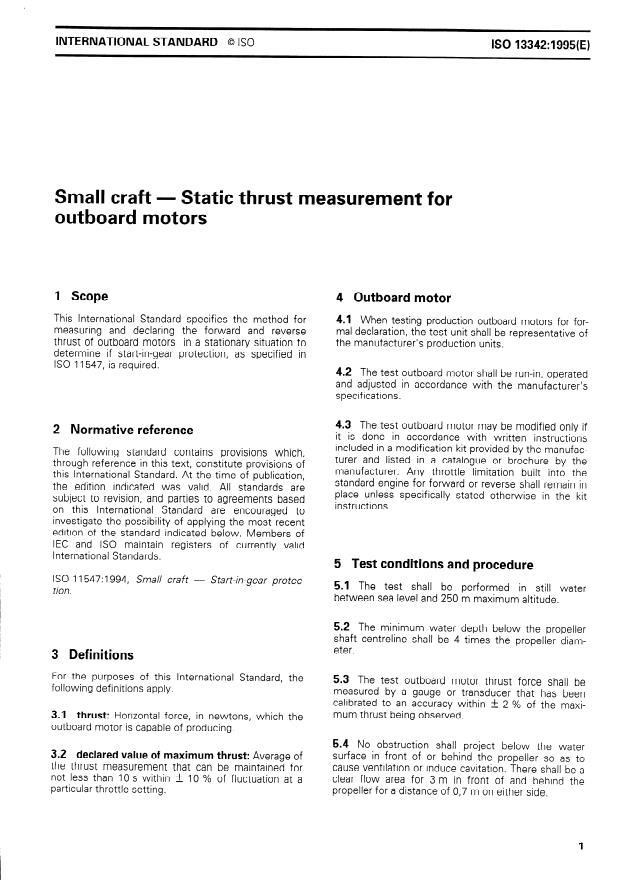
INTERNATIONAL STANDARD @ ISO ISO 13342:1995(E)
Small traft - Static thrust measurement for
outboard motors
1 Scope 4 Outboard motor
This International Standard specifies the method for 4.1 When testing production outboard motors for for-
mal declaration, the test unit shall be representative of
measuring and declaring the forward and reverse
the manufacturer ’s production units.
thrust of outboard motors in a stationary Situation to
determine if start-in-gear protection, as specified in
ISO 11547, is required.
4.2 The test outboard motor shall be run-in, operated
and adjusted in accordance with the manufacturer ’s
specifications.
4.3 The test outboard motor may be modified only if
2 Normative reference
it is done in accordance with written instructions
included in a modification kit provided by the manufac-
The following Standard contains provisions which,
turer and listed in a catalogue or brothure by the
through reference in this text, constitute provisions of
manufacturer. Any throttle limitation built into the
this International Standard. At the time of publication,
Standard engine for forward or reverse shall remain in
the edition indicated was valid. All Standards are
place unless specifically stated otherwise in the kit
subject to revision, and Parties to agreements based
instructions.
on this International Standard are
...
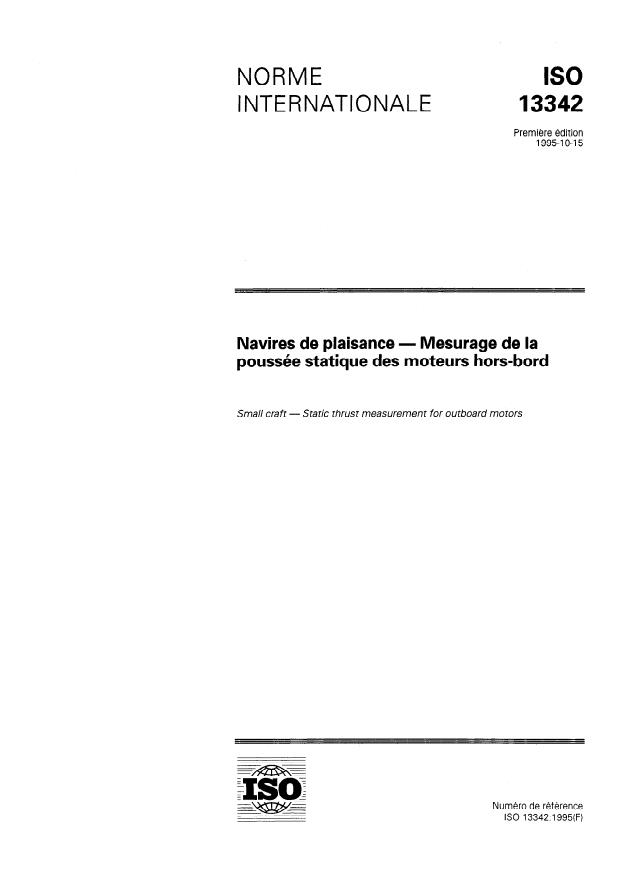
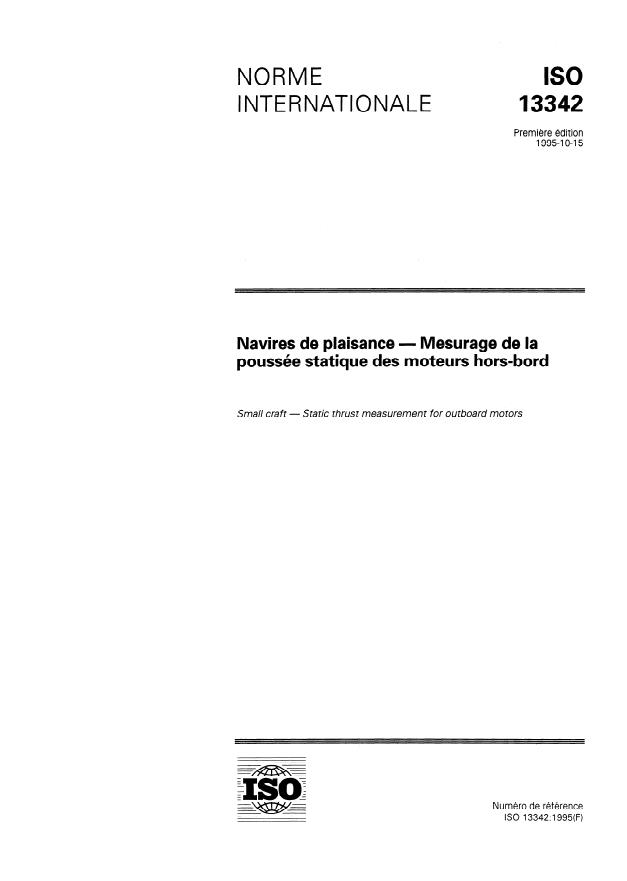
NORME ISO
INTERNATIONALE 13342
Première édition
1995-10-15
Navires de plaisance - Mesurage de la
poussée statique des moteurs hors-bord
Small craft - Static thrust measurement for outboard motors
Numéro de référence
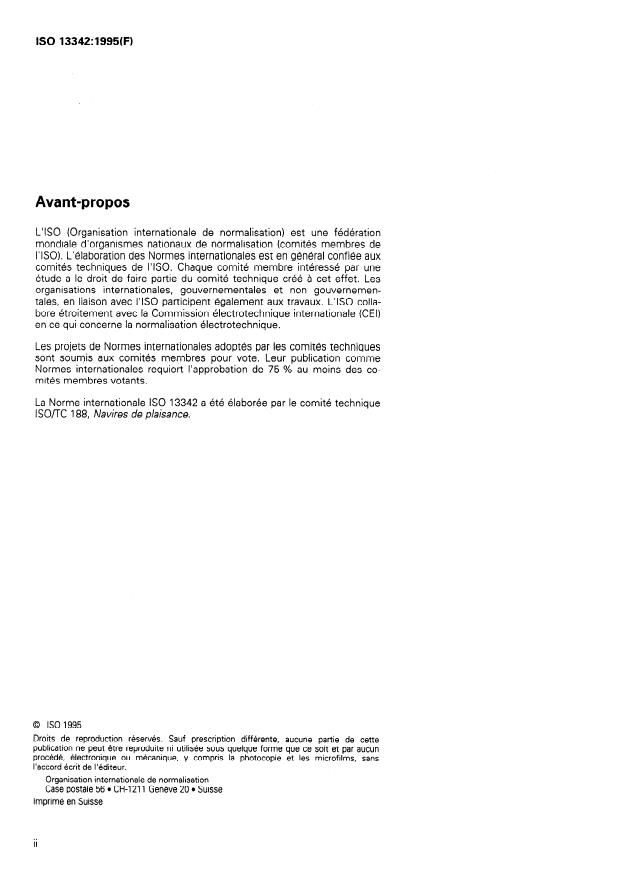
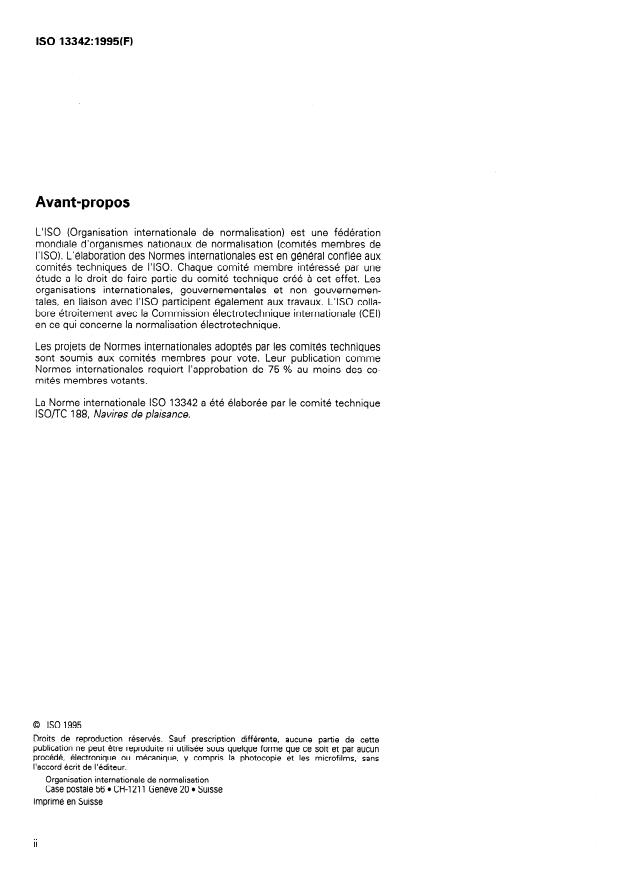
Avant-propos
L’ISO (Organisation internationale de normalisation) est une fédération
mondiale d’organismes nationaux de normalisation (comités membres de
I’ISO). L’élaboration des Normes internationales est en général confiée aux
comités techniques de I’ISO. Chaque comité membre intéressé par une
étude a le droit de faire partie du comité technique créé à cet effet. Les
organisations internationales, gouvernementales et non gouvernemen-
tales, en liaison avec 1’60 participent également aux travaux. L’ISO colla-
bore étroitement avec la Commission électrotechnique internationale (CEI)
en ce qui concerne la normalisation électrotechnique.
Les projets de Normes internationales adoptés par les comités techniques
sont soumis aux comités membres pour vote. Leur publication comme
Normes internationales requiert l’approbation de 75 % au moins des co-
mités membres votants.
La Norme internationale ISO 13342 a été élaborée par le comité technique
lSO/TC 188, Navires de plaisance.
0 rso 1995
Droits de reproduction réservés. Sauf prescription différente, aucune partie de cette
publication ne peut être reproduite ni utilisée sous quelque forme que ce soit et par aucun
procédé, électronique ou mécanique, y compris la photocopie et les microfilms, sans
l’accord écrit de l’éditeur.
Organisation internationale de normalisation
Case postale 56. CH-121 1 Genève 20 l Suisse
Imprimé en Suisse
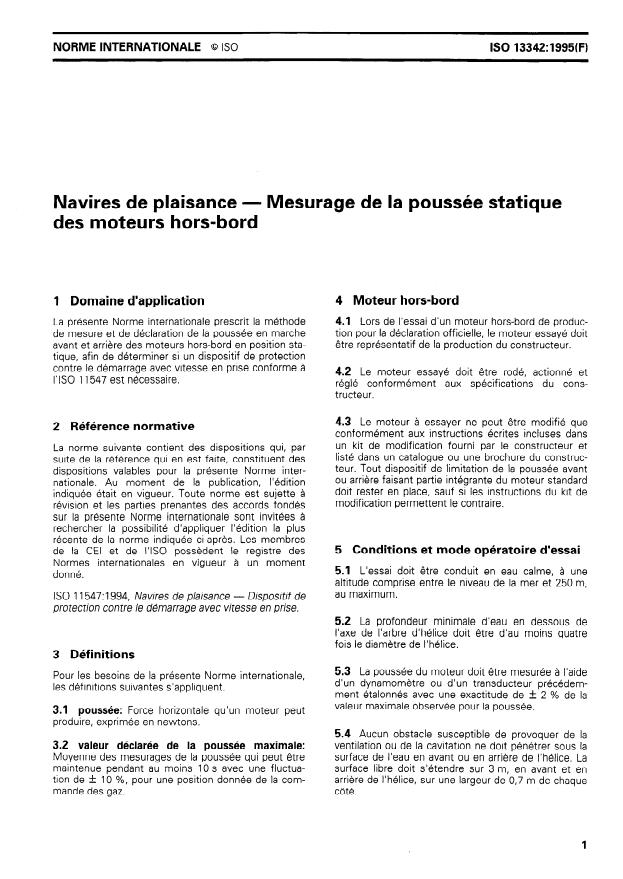
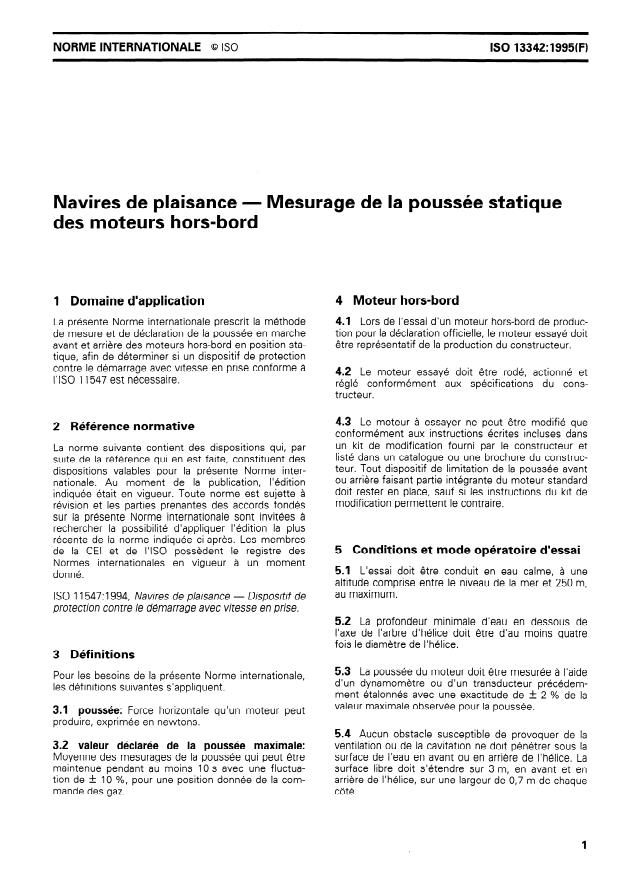
NORME INTERNATIONALE @ ISO
Navires de plaisance - Mesurage de la poussée statique
des moteurs hors-bord
4 Moteur hors-bord
1 Domaine d’application
4.1 Lors de l’essai d’un moteur hors-bord de produc-
La présente Norme internationale prescrit la méthode
tion pour la déclaration officielle, le moteur essayé doit
de mesure et de déclaration de la poussée en marche
être représentatif de la production du constructeur.
avant et arrière des moteurs hors-bord en position sta-
tique, afin de déterminer si un dispositif de protection
contre le démarrage avec vitesse en prise conforme à
4.2 Le moteur essayé doit être rodé, actionné et
I’ISO II 547 est nécessaire.
réglé conformément aux spécifications du cons-
tructeur.
4.3 Le moteur à essayer ne peut être modifié que
2 Référence normative
conformément aux instructions écrites incluses dans
un kit de modification fourni par le constructeur et
La norme suivante contient des dispositions qui, par
listé dans un catalogue ou une brochure du construc-
suite de la référence qui en est faite, constituent des
teur. Tout dispositif de limitation de la poussée avant
dispositions valables pour la présente Norme inter-
ou arrière faisant partie intégrante du moteur standard
nationale. Au moment de la publication, l’édition
doit rester en place, sauf si les instructions du kit de
indiquée était en vigueur. Toute norme est sujette à
modification permettent le contraire
...
NORME ISO
INTERNATIONALE 13342
Première édition
1995-10-15
Navires de plaisance - Mesurage de la
poussée statique des moteurs hors-bord
Small craft - Static thrust measurement for outboard motors
Numéro de référence
Avant-propos
L’ISO (Organisation internationale de normalisation) est une fédération
mondiale d’organismes nationaux de normalisation (comités membres de
I’ISO). L’élaboration des Normes internationales est en général confiée aux
comités techniques de I’ISO. Chaque comité membre intéressé par une
étude a le droit de faire partie du comité technique créé à cet effet. Les
organisations internationales, gouvernementales et non gouvernemen-
tales, en liaison avec 1’60 participent également aux travaux. L’ISO colla-
bore étroitement avec la Commission électrotechnique internationale (CEI)
en ce qui concerne la normalisation électrotechnique.
Les projets de Normes internationales adoptés par les comités techniques
sont soumis aux comités membres pour vote. Leur publication comme
Normes internationales requiert l’approbation de 75 % au moins des co-
mités membres votants.
La Norme internationale ISO 13342 a été élaborée par le comité technique
lSO/TC 188, Navires de plaisance.
0 rso 1995
Droits de reproduction réservés. Sauf prescription différente, aucune partie de cette
publication ne peut être reproduite ni utilisée sous quelque forme que ce soit et par aucun
procédé, électronique ou mécanique, y compris la photocopie et les microfilms, sans
l’accord écrit de l’éditeur.
Organisation internationale de normalisation
Case postale 56. CH-121 1 Genève 20 l Suisse
Imprimé en Suisse
NORME INTERNATIONALE @ ISO
Navires de plaisance - Mesurage de la poussée statique
des moteurs hors-bord
4 Moteur hors-bord
1 Domaine d’application
4.1 Lors de l’essai d’un moteur hors-bord de produc-
La présente Norme internationale prescrit la méthode
tion pour la déclaration officielle, le moteur essayé doit
de mesure et de déclaration de la poussée en marche
être représentatif de la production du constructeur.
avant et arrière des moteurs hors-bord en position sta-
tique, afin de déterminer si un dispositif de protection
contre le démarrage avec vitesse en prise conforme à
4.2 Le moteur essayé doit être rodé, actionné et
I’ISO II 547 est nécessaire.
réglé conformément aux spécifications du cons-
tructeur.
4.3 Le moteur à essayer ne peut être modifié que
2 Référence normative
conformément aux instructions écrites incluses dans
un kit de modification fourni par le constructeur et
La norme suivante contient des dispositions qui, par
listé dans un catalogue ou une brochure du construc-
suite de la référence qui en est faite, constituent des
teur. Tout dispositif de limitation de la poussée avant
dispositions valables pour la présente Norme inter-
ou arrière faisant partie intégrante du moteur standard
nationale. Au moment de la publication, l’édition
doit rester en place, sauf si les instructions du kit de
indiquée était en vigueur. Toute norme est sujette à
modification permettent le contraire
...