

ISO 20018-1
(Main)Fine bubble technology — Characterization of ultrafine bubbles — Part 1: Data correction to exclude particulate contaminants for evaluating size and concentration indices
- Abstract
This document specifies the evaluation method for size and concentration indices of ultrafine bubbles including the data correction to exclude particulate contaminants using the blank water.It is only applicable to ultrafine bubble dispersion (UFBD) in water.
- Status
- Not Published
- Technical Committee
- ISO/TC 281 - Fine bubble technology
- Drafting Committee
- ISO/TC 281/WG 2 - Fine bubble characterization and measurement
- Current Stage
- 6000 - International Standard under publication - 60 Publication
- Start Date
- 29-Oct-2026
Buy Documents
ISO/FDIS 20018-1 - Fine bubble technology — Characterization of ultrafine bubbles — Part 1: Data correction to exclude particulate contaminants for evaluating size and concentration indices

REDLINE ISO/FDIS 20018-1 - Fine bubble technology — Characterization of ultrafine bubbles — Part 1: Data correction to exclude particulate contaminants for evaluating size and concentration indices
ISO 20018-1 is an ISO standard for fine bubble technology that defines how to evaluate size and concentration indices for ultrafine bubbles in water. It also sets out how to prepare blank water and correct measurement data so particulate contaminants are excluded as far as possible. The document is aimed at people measuring ultrafine bubble dispersion in water, especially when the results will be used for quality, comparison, or accreditation work.
What does ISO 20018-1 specify?
ISO 20018-1 specifies an evaluation method for size and concentration indices of ultrafine bubbles in water, together with data correction using blank water to reduce the influence of particulate contaminants. ISO 20018-1 applies only to ultrafine bubble dispersion (UFBD) in water.
The document is organized into these main parts:
- Clause 1 - Scope
- Clause 2 - Normative references
- Clause 3 - Terms and definitions
- Clause 4 - Requirements
- Clause 5 - Data correction to exclude contaminants
- Clause 6 - Evaluation of size and concentration indices
- Clause 7 - Test report
| Annex | What it covers |
|---|---|
| Annex A | Example of correction on the stage of signal acquisition for ensemble methods |
| Annex B | Example of correction on the stage of calculating total concentration for counting methods |
What are the key requirements of ISO 20018-1?
ISO 20018-1 focuses on keeping contamination under control, choosing a suitable measurement method, and correcting the data before reporting size and concentration indices. In practice, the standard asks users to treat contamination as part of the measurement problem, not as an afterthought.
Sample, instruments, and environment
Clause 4 requires UFBD in water to be generated with clean test systems, clean water, and clean gas such as clean air, nitrogen, or oxygen. This matters because the cleaner the generation system, the less contamination the measurement has to correct later.
For high-accuracy work, the document recommends ISO Grade 1 water and ISO Class 5 air for generation. It also recommends ISO Class 7 air for the generation and measurement environment. The practical point is that users should control the surrounding conditions and record them, because temperature, pressure, and air cleanliness can affect the bubble dispersion and the result.
Clause 4 also notes that methods such as particle tracking analysis and laser diffraction can be used, but the sample concentration must stay within the measuring range of the instrument. That means the method choice and the sample dilution or preparation need to match the equipment.
Preparing blank water
Clause 5 states that blank water shall be prepared so that its contaminants are equivalent to those in the UFBD in water, while ultrafine bubbles are suppressed as much as possible. This is the basis for the correction method.
For an ultrafine bubble generating system, the document gives two ways to obtain blank water: turn off the ultrafine bubble generating function, or take water just before the component that generates ultrafine bubbles. For an ultrafine bubble generating device, the device such as a nozzle or showerhead is removed, and the device should be thoroughly cleaned first. If raw water cannot be obtained by these routes, the standard allows blank water to be taken by eliminating ultrafine bubbles from the UFBD in water in line with ISO 24261-1 and ISO 24261-2.
If none of those options work, raw water can be used as blank water, but the test system must be cleaned thoroughly and the blank water should be introduced just before the test system. In practice, the document gives several ways to create a baseline that represents contamination without adding the bubble signal.
Confirming the blank water is suitable
Clause 5.3 requires a comparative measurement: measure the number concentration of the generated UFBD in water, measure the number concentration of particulate contaminants in the blank water, and compare the two results. The number concentration of particulate contaminants in the blank water shall be less than 50 % of the number concentration of the UFBD in water including contaminants. This tells the user whether the blank water is clean enough to support meaningful correction.
Correcting the data
Clause 5.4 covers correction on the stage of signal acquisition for ensemble methods. The signal from the blank water is used as a baseline, and corresponding signal values are subtracted before particle size distribution is calculated. The practical effect is that instruments such as laser diffraction can derive corrected size and concentration information from the same corrected signal.
Clause 5.5 covers correction on the stage of calculating total concentration for counting methods. This correction is used with methods that produce number concentration data. For users, this means the correction is applied after counting rather than at the signal stage.
Deriving size and concentration indices
Clause 6 says that when signal-acquisition correction cannot be used, the measured particle size distribution shall be corrected with blank-water data before representative size indices are calculated. The document mentions mean diameter, modal diameter, and median diameter as examples. It also notes that negative values created by simple subtraction are treated as zero, and that modal diameter can be unstable, while mean diameter is often more stable in practice.
For concentration, Clause 6.2 states that the corrected particle size distribution is used to derive a concentration index for a specified bubble size range when needed. For total concentration, particle size-distribution correction is not necessary. This distinction matters because some users need a concentration over a defined size band, while others need an overall count.
What terms does ISO 20018-1 define?
ISO 20018-1 uses these key terms in its measurement approach:
- Blank water - water used for data correction; it should contain contaminants equivalent to the UFBD in water being evaluated, while ultrafine bubbles are suppressed as much as possible.
- UFB - ultrafine bubble, the bubble type addressed by the document.
- UFBD - ultrafine bubble dispersion in water, the sample type covered by the standard.
- Size index - the size result used to characterize the bubble population, such as a representative diameter derived from measured data.
- Concentration index - the concentration result used to characterize the bubble population, either over a size range or as a total count.
- Ensemble methods - measurement methods that work from a collective signal, such as laser diffraction.
- Counting methods - measurement methods that count individual particles or bubbles to obtain concentration data.
Who uses ISO 20018-1?
ISO 20018-1 is used by laboratories, equipment makers, and operators working with fine bubble technology. The introduction links the topic to cleaning, water treatment, agriculture, aquaculture, and biomedical fields, so the standard is relevant wherever UFBD performance needs to be measured and compared.
In practice, users include measurement engineers, quality managers, and organizations involved in accreditation or product verification. They use the document to prepare blank water, select or confirm the measuring method, correct contaminated data, and report results in a consistent way.
Which standards are used with ISO 20018-1?
ISO 20018-1 cites several standards that support the work around it:
| Standard | Contribution |
|---|---|
| ISO 20480-1 | Supplies the shared terminology used in the document |
| ISO 24261-1:2020 | Provides the evaluation procedure for elimination-based sample characterization |
| ISO 24261-2:2021 | Provides fine bubble elimination techniques used to prepare blank water |
| ISO 20298-1 | Is named for sampling and sample preparation information in the test report |
| ISO 13320 | Is named as a technique-specific measurement standard for the chosen method |
| ISO 19430 | Is named as another technique-specific measurement standard for the chosen method |
| ISO 3696 | Supports the water purity reference used when high accuracy is needed |
| ISO 14644-1 | Supports the air cleanliness classes referenced for clean environments |
| ISO 20480-2 | Provides categorization of fine bubble attributes |
| ISO 23015 | Provides a measurement technique matrix for fine bubble characterization |
What does the ISO 20018-1 document contain?
ISO 20018-1 contains procedure-driven guidance, not just definitions. Figures 1 to 9 explain the correction concept, blank-water preparation routes, and the way corrected data are used to derive size and concentration indices.
Annex A gives a worked example for ensemble methods using the laser diffraction method, showing the blank-water signal, the uncorrected signal, and the corrected signal. Annex B gives a worked example for counting methods using particle tracking analysis (PTA), and it includes Table B.1 to illustrate the correction of total concentration data.
Clause 7 sets out what the test report should include, such as the system or device used, water and gas purity, measuring instrument details, software version, size distribution, representative indices, operators, laboratory, and test date and time. That makes the document useful not only for measurement, but also for documenting results in a way that can be checked later.
Buy Documents
ISO/FDIS 20018-1 - Fine bubble technology — Characterization of ultrafine bubbles — Part 1: Data correction to exclude particulate contaminants for evaluating size and concentration indices
REDLINE ISO/FDIS 20018-1 - Fine bubble technology — Characterization of ultrafine bubbles — Part 1: Data correction to exclude particulate contaminants for evaluating size and concentration indices
Frequently Asked Questions
ISO 20018-1 is a draft published by the International Organization for Standardization (ISO). Its full title is "Fine bubble technology — Characterization of ultrafine bubbles — Part 1: Data correction to exclude particulate contaminants for evaluating size and concentration indices". This standard covers: This document specifies the evaluation method for size and concentration indices of ultrafine bubbles including the data correction to exclude particulate contaminants using the blank water.It is only applicable to ultrafine bubble dispersion (UFBD) in water.
This document specifies the evaluation method for size and concentration indices of ultrafine bubbles including the data correction to exclude particulate contaminants using the blank water.It is only applicable to ultrafine bubble dispersion (UFBD) in water.
ISO 20018-1 is classified under the following ICS (International Classification for Standards) categories: 07.030 - Physics. Chemistry. The ICS classification helps identify the subject area and facilitates finding related standards.
ISO 20018-1 is available in PDF format for immediate download after purchase. The document can be added to your cart and obtained through the secure checkout process. Digital delivery ensures instant access to the complete standard document.
Standards Content (Sample)
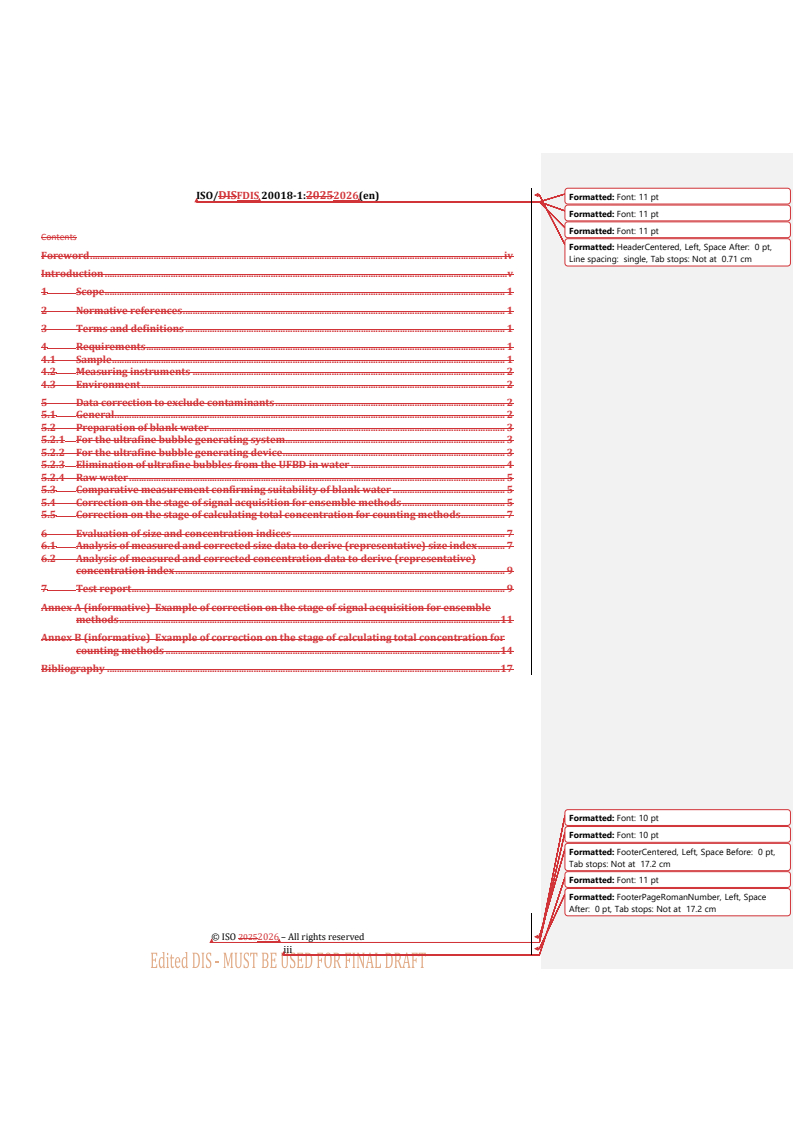
Contents
- Introduction
- 1 Scope
- 2 Normative references
- 3 Terms and definitions
- 3.1 blank water
- 4 Requirements
- 4.1 Sample
- 4.2 Measuring instruments
- 4.3 Environment
- 5 Data correction to exclude contaminants
- 5.1 General
- 2 UFBD in water
- 5.2 Preparation of blank water
- 2 UFB generating system
- 3 UFB generating function
- 7 UFB generating device
- 8 UFBD in water
- 5.3 Comparative measurement confirming suitability of blank water
- 5.4 Correction on the stage of signal acquisition for ensemble methods
- 5.5 Correction on the stage of calculating total concentration for counting methods
- 6 Evaluation of size and concentration indices
- 6.1 Analysis of measured and corrected size data to derive (representative) size index
- 6.2 Analysis of measured and corrected concentration data to derive (representative)
- 7 Test report
- Annex A
- Annex B
- Bibliography
Introduction
Fine bubble technology has seen growth in its application to markets such as cleaning, water treatment, agriculture, aquaculture and biomedical fields. Now the methods to evaluate the characteristics of fine bubbles such as the size and concentration indices have become necessary to clarify the performances of fine bubble generating systems used for various applications.
Since the ultrafine bubble dispersion (UFBD) usually contains contaminants, however, it is difficult to extract the data for the size and concentration of ultrafine bubbles from the UFBD. Therefore, on the premise that the UFBD contains contaminants, the measurement results are commonly called size and concentration indices. To minimize the influence of contamination on the measurement results of UFBD, the data correction using of blank water is promising.
FINAL DRAFT International Standard ISO/FDIS 20018-1:2026(en) Fine bubble technology — Characterization of ultrafine bubbles — Part 1:
Data correction to exclude particulate contaminants for evaluating size and concentration indices
1 Scope
This document specifies the evaluation method for size and concentration indices of ultrafine bubbles (UFBs) in water including the data correction to exclude the influence of particulate contaminants using blank water. Furthermore, the procedure to prepare the blank water is also described in this document. This document is only applicable to ultrafine bubble dispersion (UFBD) in water.
2 Normative references
The following documents are referred to in the text in such a way that some or all of their content constitutes requirements of this document. For dated references, only the edition cited applies. For undated references, the latest edition of the referenced document (including any amendments) applies. ISO 20480-1, Fine bubble technology — General principles for usage and measurement of fine bubbles — Part 1:
Terminology
3 Terms and definitions
For the purposes of this document, the terms and definitions given in ISO 20480-1 and the following apply. ISO and IEC maintain terminological databases for use in standardization at the following addresses:
- ISO Online browsing platform: available at https:// www .iso .org/ obp
- IEC Electropedia: available at https:// www .electropedia .org/
3.1 blank water
water used for data collection of size and concentration indices, which contain the contaminants equivalent to the ultrafine bubble dispersion (UFBD) in water to be evaluated, and the generation of ultrafine bubbles is suppressed as much as possible
4 Requirements
4.1 Sample
To reduce the influence of particulate contaminants and to keep the accuracy of measurement, UFBD in water shall be generated using clean test systems with clean water and clean gas such as clean air, nitrogen or oxygen.
If the measurement accuracy of size and concentration indices is very important (for example, in the case of application to the accreditation of fine bubble business), the water purity level of ISO Grade 1 (see
ISO/FDIS 20018-1:2026(en) ISO 3696:1987) and the air cleanliness of ISO Class 5 (see ISO 14644-1:2015) should be used for the water and the air used to generate the UFBD.
4.2 Measuring instruments
Several measurement techniques such as particle tracking analysis method, laser diffraction method and others can be used to evaluate the size and concentration indices for ultrafine bubbles in the UFBD in water. The measuring range of concentration is very dependent on respective measurement instruments. In order to keep the accuracy of measurement results, the concentration of the sample including the ultrafine bubbles and contaminants shall sufficiently be within the measuring range of concentration.
4.3 Environment
Air cleanliness should be considered for the measurement to prevent mingling of impurities. Ambient temperature and atmospheric pressure should be stable to maintain the stability of characteristics of ultrafine bubbles in water.
Air cleanliness, ambient temperature and atmospheric pressure depend on the local environment and can vary. However, as they are important settings and can influence the evaluation process, they should be recorded prior to any evaluation occurring.
If the measurement accuracy of size and concentration indices is very important, (for example, in the case of application to the accreditation of fine bubble business), the air cleanliness of ISO Class 7 (see ISO 14644-1:2015) should be used as the environment for generation and measurement of the UFBD in water.
ISO/FDIS 20018-1:2026(en)
5 Data correction to exclude contaminants
5.1 General
Key 1 raw water
2 UFBD in water
3 blank water 4 corrected data of the UFBD in water 5 generation of UFB 6 taking the blabk water 7 data correction UFB (ultrafine bubble) contaminant (solid/liquid particle) Figure 1 — Data correction to exclude contaminants Figure 1 shows the basic concept of the data correction to exclude the influence of particulate contaminants using blank water.
Appropriate blank water shall be prepared to perform size and concentration correction for UFBD using blank water. The contaminants contained in blank water should be equivalent to the contaminants contained in UFBD in water, and it shall suppress the existence of ultrafine bubbles as much as possible. Clause 5.2 describes how to prepare the blank water.
5.2 Preparation of blank water
5.2.1 For the ultrafine bubble generating system
For the general ultrafine bubble generating systems, there are two possible methods, method A and method B, to prepare the blank water as shown in Figure 2. Method A is the best way but its possibility strongly depends on the specification of each ultrafine bubble generating system. - Method A: Turn off the ultrafine bubble generating function and take the blank water. - Method B: Take the blank water just before the component which generates ultrafine bubbles.
ISO/FDIS 20018-1:2026(en) Key 1 raw water
2 UFB generating system
3 UFB generating function
a Turn off the UFB generating function and take the blank water. b Take the blank water just before the component which generate UFBs. Figure 2 — Preparation of blank water for the ultrafine bubble generating system
...
Contents
- Introduction
- 1 Scope
- 2 Normative references
- 4 Requirements
- 4.1 Sample
- 4.2 Measuring instruments
- 4.3 Environment
- 5 Data correction to exclude contaminants
- 5.1 General
- 2 UFBD in water stops: Not at 0.7 cm + 1.4 cm + 2.1 cm + 2.8 cm +
- 8 UFB (ultrafine bubble)
- 2 UFBD in water
- 5.2 Preparation of blank water
- 2 UFB generating system
- 3 UFB generating function
- 2 UFB generating system
- 3 UFB generating function
- 7 UFB generating device
- 8 UFBD in water
- 9 Blank water
- 7 UFB generating device
- 8 UFBD in water
- 6 UFB
- 5.3 Comparative measurement confirming suitability of blank water
- 5.4 Correction on the stage of signal acquisition for ensemble methods
- 5.5 Correction on the stage of calculating total concentration for counting methods
- 6 Evaluation of size and concentration indices
- 6.1 Analysis of measured and corrected size data to derive (representative) size index
- 1 Particle size distribution of UFB and contaminants
- 2 Particle size distribution of contaminants in blank water
- 3 Corrected particle size distribution
- 6.2 Analysis of measured and corrected concentration data to derive (representative)
- 7 Test report
- Annex A Formatted: Font: Bold
- Annex B Formatted: Font: Bold
- Bibliography
Introduction
Formatted: HeaderCentered, Left, Space After: 0 pt, Line spacing: single, Tab stops: Not at 0.71 cm Fine bubble technology has seen growth in its application to markets such as cleaning, water treatment, agriculture, aquaculture and biomedical fields. Now the methods to evaluate the characteristics of fine bubbles such as the size and concentration indices have become necessary to clarify the performances of fine bubble generating systems used for various applications.
Since the ultrafine bubble dispersion (UFBD) usually contains contaminants, however, it is difficult to extract the data for the size and concentration of ultrafine bubbles from the UFBD. Therefore, on the premise that the UFBD contains contaminants, the measurement results are commonly called size and concentration indices. To minimize the influence of contamination on the measurement results of UFBD, the data correction using of blank water is promising. Formatted: Font: 10 pt Formatted: Font: 10 pt Formatted: FooterCentered, Left, Space Before: 0 pt, Tab stops: Not at 17.2 cm Formatted: Font: 11 pt Formatted: FooterPageRomanNumber, Left, Space After: 0 pt, Tab stops: Not at 17.2 cm
DRAFT International Standard ISO/DIS 20018-1:2025(en)
Fine bubble technology — Characterization of ultrafine bubbles—
Formatted: Main Title 2, None, Adjust space between Part 1:
Latin and Asian text, Adjust space between Asian text Data correction to exclude particulate contaminants for evaluating and numbers size and concentration indices Formatted: Left: 1.5 cm, Right: 1.5 cm, Top: 1.4 cm, Bottom: 1 cm
1 Scope
Formatted: Adjust space between Latin and Asian text, Adjust space between Asian text and numbers This document specifies the evaluation method for size and concentration indices of ultrafine bubbles (UFBs) in water including the data correction to exclude the influence of particulate contaminants using blank water. Furthermore, the procedure to prepare the blank water is also described in this document. This document is only applicable to ultrafine bubble dispersion (UFBD) in water.
2 Normative references
The following documents are referred to in the text in such a way that some or all of their content constitutes requirements of this document. For dated references, only the edition cited applies. For undated references, the latest edition of the referenced document (including any amendments) applies. Formatted: Default Paragraph Font ISO 20480--1, Fine bubble technology — General principles for usage and measurement of fine bubbles — Formatted: Default Paragraph Font Part 1: Terminology Formatted: Default Paragraph Font ISO 24261-1:2020, Fine bubble technology — Elimination method for sample characterization — Part 1:
Formatted: Default Paragraph Font Evaluation procedure Formatted: Adjust space between Latin and Asian text, Adjust space between Asian text and numbers, Tab ISO 24261-2:2021, Fine bubble technology — Elimination method for sample characterization — Part 2: Fine stops: Not at 0.7 cm + 1.4 cm + 2.1 cm + 2.8 cm + bubble elimination techniques 3.5 cm + 4.2 cm + 4.9 cm + 5.6 cm + 6.3 cm + 7 cm 3 Terms and definitions Formatted: Adjust space between Latin and Asian text, Adjust space between Asian text and numbers For the purposes of this document, the terms and definitions given in ISO 20480-1 and the following apply. Formatted: Default Paragraph Font Formatted: Default Paragraph Font ISO and IEC maintain terminological databases for use in standardization at the following addresses:
Formatted: Default Paragraph Font - — ISO Online browsing platform: available at https://www.iso.org/obphttps://www.iso.org/obp Formatted: Adjust space between Latin and Asian text, Adjust space between Asian text and numbers, Tab - — IEC Electropedia: available at https://www.electropedia.org/https://www.electropedia.org/ stops: Not at 0.7 cm + 1.4 cm + 2.1 cm + 2.8 cm + 3.5 cm + 4.2 cm + 4.9 cm + 5.6 cm + 6.3 cm + 7 cm 3.1 3.1 Formatted: TermNum2, Adjust space between Latin blank water and Asian text, Adjust space between Asian text and water used for data correctioncollection of size and concentration indices, which contain the contaminants numbers equivalent to the ultrafine bubble dispersion (UFBD) in water to be evaluated, and the generation of ultrafine Formatted: Font: 11 pt bubbles is suppressed as much as possible Formatted: Footer, Left, Space After: 0 pt, Line spacing: single, Tab stops: Not at 17.2 cm
ISO/CDFDIS 20018-1:2026(en) Formatted: HeaderCentered
4 Requirements
4.1 Sample
Formatted: Adjust space between Latin and Asian text, Adjust space between Asian text and numbers, Tab To reduce the influence of particulate contaminants and to keep the accuracy of measurement, UFBD in water stops: Not at 0.71 cm shall be generated using clean test systems with clean water and clean gas such as clean air, nitrogen or Formatted: Adjust space between Latin and Asian text, oxygen.
Adjust space between Asian text and numbers If the measurement accuracy of size and concentration indices is very important (for example, in the case of application to the accreditation of fine bubble business), the water purity level of ISO Grade 1 (see ISO Formatted: Default Paragraph Font 3696:1987) and the air cleanliness of ISO Class 5 (see ISO 14644-1:2015) are recommendedshould be used Formatted: Default Paragraph Font for the water and the air used to generate the UFBD.
Formatted: Default Paragraph Font
4.2 Measuring instruments
Formatted: Default Paragraph Font Formatted: Adjust space between Latin and Asian text, Several measurement techniques such as particle tracking analysis method, laser diffraction method and Adjust space between Asian text and numbers, Tab others can be used to evaluate the size and concentration indices for ultrafine bubbles in the UFBD in water. stops: Not at 0.71 cm The measuring range of concentration is very dependent on respective measurement instruments. In order to Formatted: Adjust space between Latin and Asian text, Adjust space between Asian text and numbers keep the accuracy of measurement results, the concentration of the sample including the ultrafine bubbles and contaminants shall sufficiently be within the measuring range of concentration.
4.3 Environment
Formatted: Adjust space between Latin and Asian text, Adjust space between Asian text and numbers, Tab Air cleanliness should be considered for the measurement to prevent mingling of impurities. Ambient stops: Not at 0.71 cm temperature and atmospheric pressure should be stable to maintain the stability of characteristics of ultrafine Formatted: Adjust space between Latin and Asian text, bubbles in water.
Adjust space between Asian text and numbers Air cleanliness, ambient temperature and atmospheric pressure depend on the local environment and can vary. However, as they are important settings and can influence the evaluation process, they should be recorded prior to any evaluation occurring.
If the measurement accuracy of size and concentration indices is very important, (for example, in the case of application to the accreditation of fine bubble business), the air cleanliness of ISO Class 7 (see ISO 14644- Formatted: Default Paragraph Font 1:2015) is recommendedshould be used as the environment for generation and measurement of the UFBD in Formatted: Default Paragraph Font water.
Formatted: Default Paragraph Font Formatted: FooterCentered, Left
ISO/DISFDIS 20018-1:20252026(en) Formatted: Font: 11 pt Formatted: Font: 11 pt Formatted: Font: 11 pt
5 Data correction to exclude contaminants
Formatted: HeaderCentered, Left, Space After: 0 pt, Line spacing: single, Tab stops: Not at 0.71 cm
5.1 General
Formatted: Adjust space between Latin and Asian text, Adjust space between Asian text and numbers, Tab stops: Not at 0.71 cm
Key Formatted: Adjust space between Latin and Asian text, 1 raw water Adjust space between Asian text and numbers, Tab
2 UFBD in water stops: Not at 0.7 cm + 1.4 cm + 2.1 cm + 2.8 cm +
3.5 cm + 4.2 cm + 4.9 cm + 5.6 cm + 6.3 cm + 7 cm 3 blank water 4 corrected data of the UFBD in water 5 generation of UFB 6 taking the blabk water 7 data correction
8 UFB (ultrafine bubble)
9 contaminant (solid/liquid particle) 1 raw water Formatted: Font: 10 pt
2 UFBD in water
Formatted: Font: 10 pt 3 blank water 4 corrected data of the UFBD in water Formatted: FooterCentered, Left, Space Before: 0 pt, Line spacing: single, Tab stops: Not at 17.2 cm 5 generation of UFB 6 taking the blabk water Formatted: Font: 11 pt
ISO/CDFDIS 20018-1:2026(en) Formatted: HeaderCentered 7 data correction UFB (ultrafine bubble)
contaminant (solid/liquid particle)
Figure 1 — Data correction to exclude contaminants Formatted: None, Adjust space between Latin and Asian text, Adjust space between Asian text and numbers Figure 1Figure 1 shows the basic concept of the data correction to exclude the influence of particulate Formatted: Adjust space between Latin and Asian text, contaminants using blank water.
Adjust space between Asian text and numbers Appropriate blank water shall be prepared to perform size and concentration correction for UFBD using blank water. The contaminants contained in blank water should be equivalent to the contaminants contained in UFBD in water, and it is necessary toshall suppress the existence of ultrafine bubbles as much as possible.Clause 5.2 Clause 5.2 describes how to prepare the blank water.
5.2 Preparation of blank water
Formatted: Adjust space between Latin and Asian text, Adjust space between Asian text and numbers, Tab
5.2.1 For the ultrafine bubble generating system
stops: Not at 0.71 cm Formatted: Adjust space between Latin and Asian text, For the general ultrafine bubble generating systems, there are two possible methods, method A and method Adjust space between Asian text and numbers, Tab B, to prepare the blank water as shown in Figure 2.Figure 2. Method A is the best way but its possibility stops: Not at 0.71 cm + 0.99 cm + 1.27 cm strongly depends on the specification of each ultrafine bubble generating system. Formatted: Adjust space between Latin and Asian text, Adjust space between Asian text and numbers - — Method A: Turn off the ultrafine bubble generating function and take the blank water. Formatted: List Continue 1, Adjust space between Latin - — Method B: Take the blank water just before the component which generates ultrafine bubbles. and Asian text, Adjust space between Asian text and numbers, Tab stops: Not at 0.7 cm + 1.4 cm + 2.1 cm + 2.8 cm + 3.5 cm + 4.2 cm + 4.9 cm + 5.6 cm + 6.3 cm + 7 cm
Formatted: Adjust space between Latin and Asian text, Key Adjust space between Asian text and numbers, Tab 1 raw water stops: Not at 0.7 cm + 1.4 cm + 2.1 cm + 2.8 cm + 3.5 cm + 4.2 cm + 4.9 cm + 5.6 cm + 6.3 cm + 7 cm
2 UFB generating system
Formatted: FooterCentered, Left
ISO/DISFDIS 20018-1:20252026(en) Formatted: Font: 11 pt Formatted: Font: 11 pt Formatted: Font: 11 pt
3 UFB generating function
Formatted: HeaderCentered, Left, Space After: 0 pt, a Turn off the UFB generating function and take the blank water. Line spacing: single, Tab stops: Not at 0.71 cm b Take the blank water just before the component which generate UFBs. 1 raw water
2 UFB generating system
3 UFB generating function
a Turn off the UFB generating function and take the blank water. b Take the blank water just before the component which generate UFBs. Figure 2 — Preparation of blank water for the ultrafine bubble generating system Formatted: None, Adjust space between Latin and Asian text, Adjust space between Asian text and numbers
5.2.2 For the ultrafine bubble generating device
Formatted: Adjust space between Latin and Asian text, The preparation of blank water for the ultrafine bubble generating device is very simple. It involves only the Adjust space between Asian text and numbers, Tab removal of the ultrafine bubble generating device such as the nozzle and the showerhead device from the test stops: Not at 0.71 cm + 0.99 cm + 1.27 cm system to evaluate the size and concentration indices of UFBD as shown in Figure 3.Figure 3. Formatted: Adjust space between Latin and Asian text, Adjust space between Asian text and numbers It is very important that the device should be thoroughly cleaned before the test to prevent the generation of contaminants from the inside of ultrafine bubble generating device. Formatted: Font: 10 pt Formatted: Font: 10 pt Formatted: FooterCentered, Left, Space Before: 0 pt, Line spacing: single, Tab stops: Not at 17.2 cm Formatted: Font: 11 pt
ISO/CDFDIS 20018-1:2026(en) Formatted: HeaderCentered
Formatted: FooterCentered, Left
ISO/DISFDIS 20018-1:20252026(en) Formatted: Font: 11 pt Formatted: Font: 11 pt Formatted: Font: 11 pt Formatted: HeaderCentered, Left, Space After: 0 pt, Line spacing: single, Tab stops: Not at 0.71 cm
Key Formatted: Adjust space between Latin and Asian text, 1 raw water storage tank Adjust space between Asian text and numbers, Tab 2 pump stops: Not at 0.7 cm + 1.4 cm + 2.1 cm + 2.8 cm + 3.5 cm + 4.2 cm + 4.9 cm + 5.6 cm + 6.3 cm + 7 cm 3 water pressure meter 4 retention container 5 over flow 6 pipet
7 UFB generating device
8 UFBD in water
9 Blank water
1 raw water storage tank 2 pump 3 water pressure meter 4 retention container 5 over flow 6 pipet
7 UFB generating device
Formatted: None, Adjust space between Latin and
8 UFBD in water
Asian text, Adjust space between Asian text and 9 blank water numbers Formatted: Font: 10 pt Figure 3 — Preparation of blank water for the ultrafine bubble generating device Formatted: Font: 10 pt Formatted: FooterCentered, Left, Space Before: 0 pt, Line spacing: single, Tab stops: Not at 17.2 cm Formatted: Font: 11 pt
ISO/CDFDIS 20018-1:2026(en) Formatted: HeaderCentered
...