


ISO 8070:1987
(Main)Dried milk — Determination of sodium and potassium contents — Flame emission spectrometric method
Dried milk — Determination of sodium and potassium contents — Flame emission spectrometric method
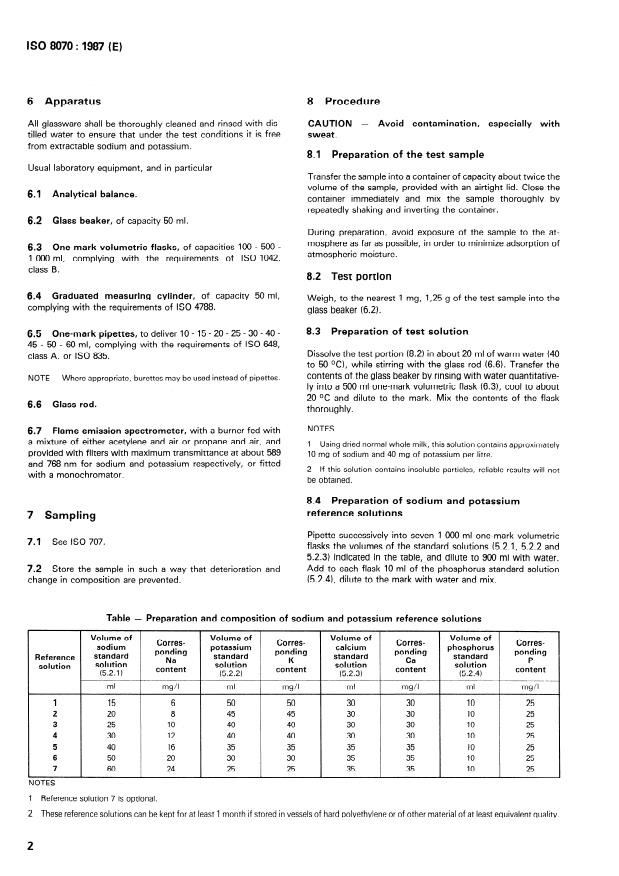
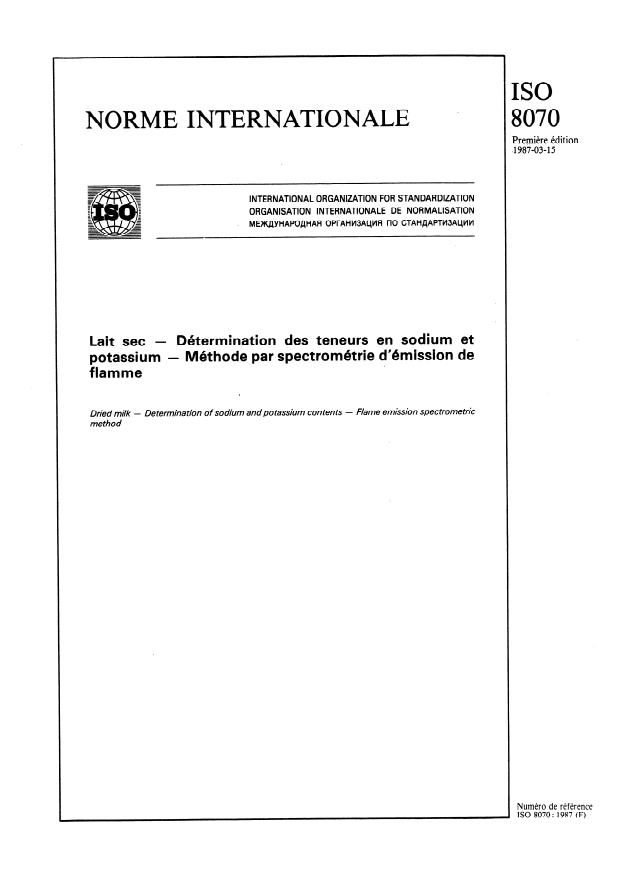
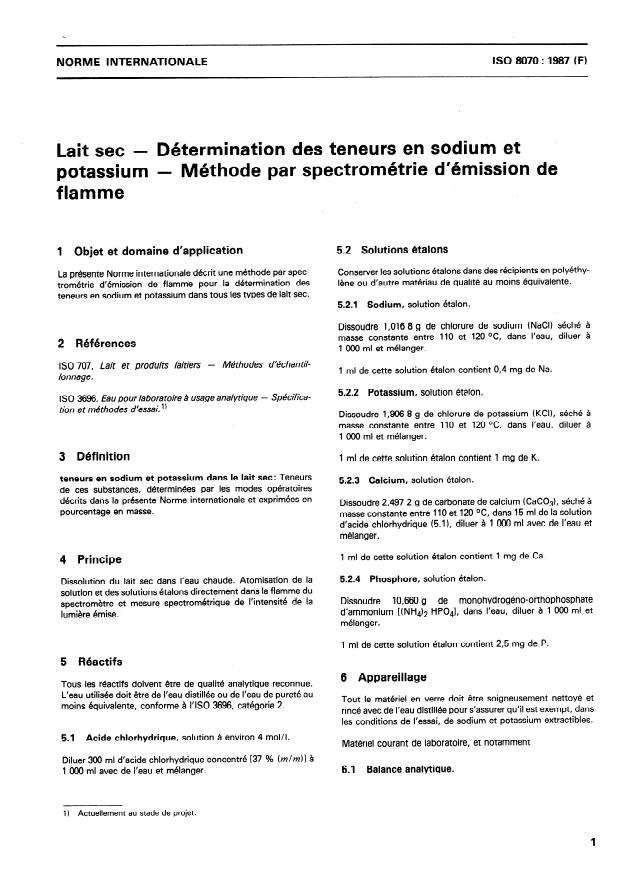
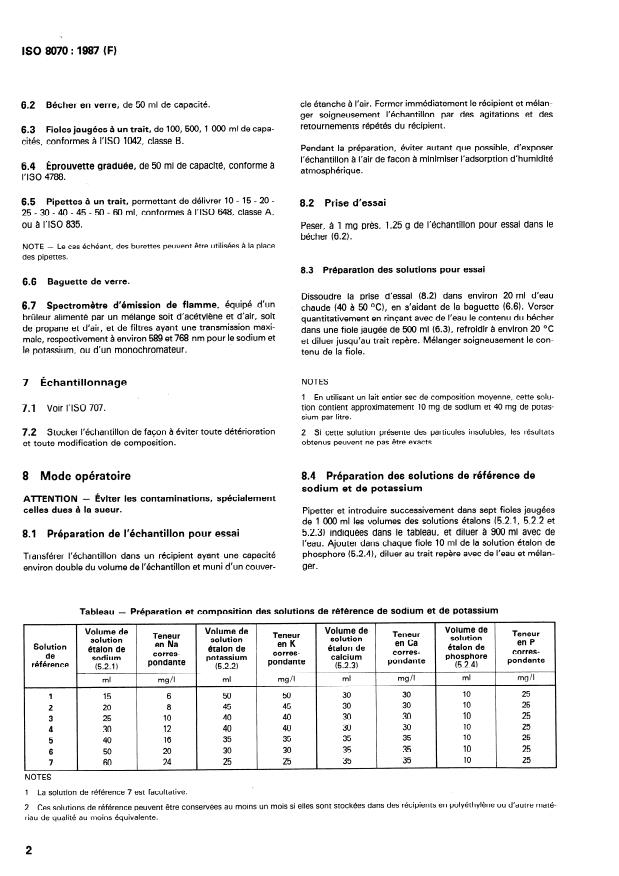
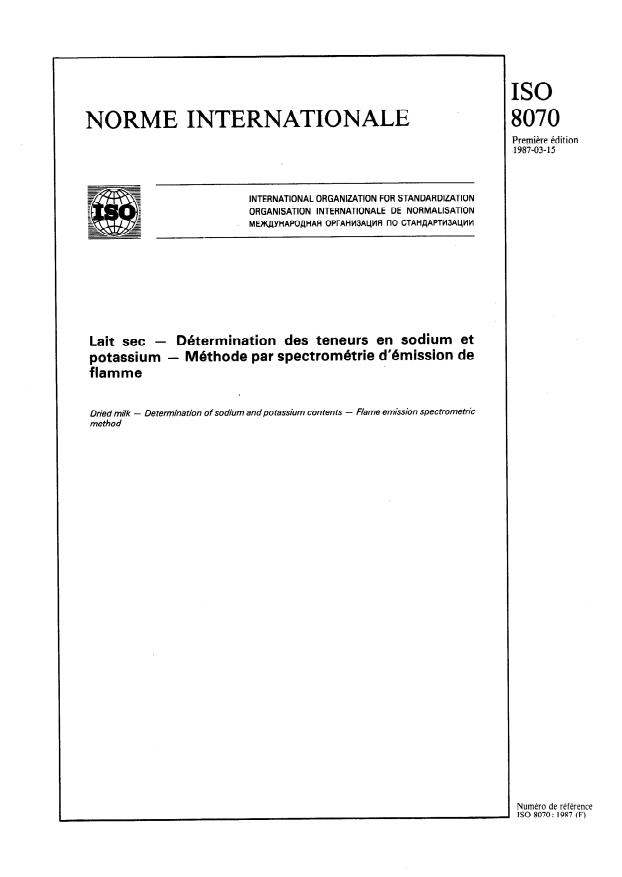
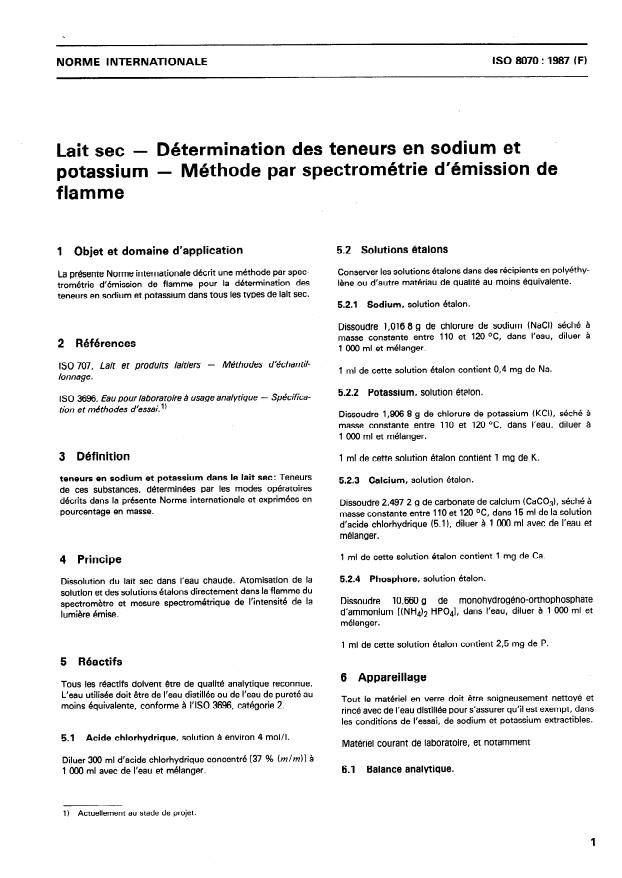
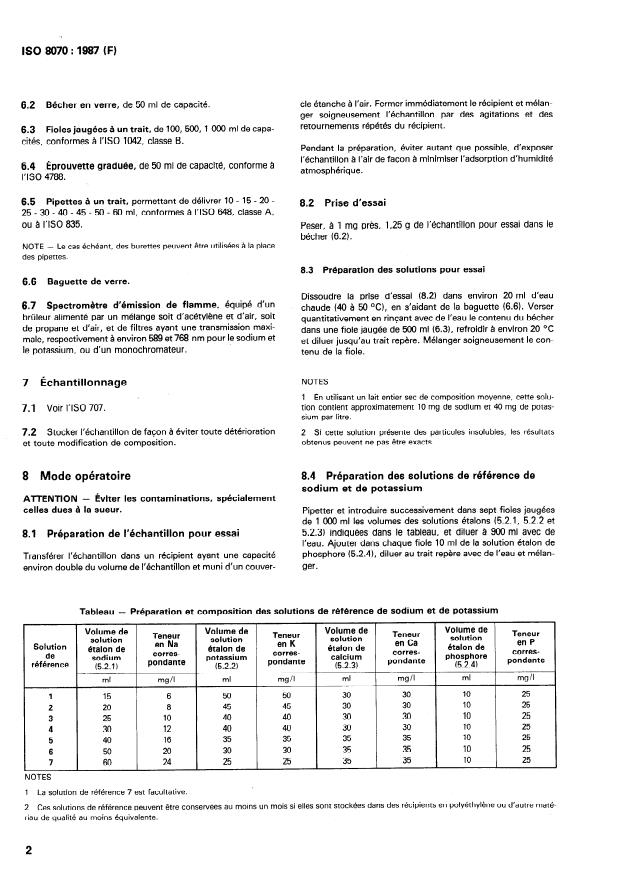
Covers all types of dried milk. The sampling shall be made as specified in ISO 707. A table gives information as to preparating and composition of 7 different sodium and potassium reference solutions.
Lait sec — Détermination des teneurs en sodium et potassium — Méthode par spectrométrie d'émission de flamme
General Information
- Status
- Withdrawn
- Publication Date
- 11-Mar-1987
- Withdrawal Date
- 11-Mar-1987
- Technical Committee
- ISO/TC 34/SC 5 - Milk and milk products
- Drafting Committee
- ISO/TC 34/SC 5 - Milk and milk products
- Current Stage
- 9599 - Withdrawal of International Standard
- Start Date
- 06-Aug-2007
- Completion Date
- 14-Feb-2026
Relations
- Effective Date
- 15-Apr-2008
Buy Documents
ISO 8070:1987 - Dried milk -- Determination of sodium and potassium contents -- Flame emission spectrometric method
ISO 8070:1987 - Lait sec -- Détermination des teneurs en sodium et potassium -- Méthode par spectrométrie d'émission de flamme
ISO 8070:1987 - Lait sec -- Détermination des teneurs en sodium et potassium -- Méthode par spectrométrie d'émission de flamme
Get Certified
Connect with accredited certification bodies for this standard

BSI Group
BSI (British Standards Institution) is the business standards company that helps organizations make excellence a habit.

Bureau Veritas
Bureau Veritas is a world leader in laboratory testing, inspection and certification services.

DNV
DNV is an independent assurance and risk management provider.
Sponsored listings
Frequently Asked Questions
ISO 8070:1987 is a standard published by the International Organization for Standardization (ISO). Its full title is "Dried milk — Determination of sodium and potassium contents — Flame emission spectrometric method". This standard covers: Covers all types of dried milk. The sampling shall be made as specified in ISO 707. A table gives information as to preparating and composition of 7 different sodium and potassium reference solutions.
Covers all types of dried milk. The sampling shall be made as specified in ISO 707. A table gives information as to preparating and composition of 7 different sodium and potassium reference solutions.
ISO 8070:1987 is classified under the following ICS (International Classification for Standards) categories: 67.100.10 - Milk and processed milk products. The ICS classification helps identify the subject area and facilitates finding related standards.
ISO 8070:1987 has the following relationships with other standards: It is inter standard links to ISO 8070:2007. Understanding these relationships helps ensure you are using the most current and applicable version of the standard.
ISO 8070:1987 is available in PDF format for immediate download after purchase. The document can be added to your cart and obtained through the secure checkout process. Digital delivery ensures instant access to the complete standard document.
Standards Content (Sample)
IS0
INTERNATIONAL STANDARD -
First edition
1987-03-U
INTERNATIONAL ORGANIZATION FOR STANDARDIZATION
ORGANISATION INTERNATIONALE DE NORMALISATION
MEXAYHAPOAHAR OPTAHM3A~VlFl f-IO CTAH~APTM3A~MM
.
Dried milk - Determination of sodium and potassium
contents - Flame emission spectrometric method
Lait set - D&termination des teneurs en sodium et potassium - MWode par spectromktrk
d%mission de ffamme
Reference number
IS0 8070 : 1987 (E)
Foreword
IS0 (the International Organization for Standardization) is a worldwide federation of
national standards bodies (IS0 member bodies). The work of preparing International
Standards is normally carried out through IS0 technical committees. Each member
body interested in a subject for which a technical committee has been established has
the right to be represented on that committee. International organizations, govern-
mental and non-governmental, in liaison with ISO, also take part in the work.
Draft International Standards adopted by the technical committees are circulated to
the member bodies for approval before their acceptance as International Standards by
the IS0 Council. They are approved in accordance with IS0 procedures requiring at
least 75 % approval by the member bodies voting.
International Standard IS0 8070 was prepared by Technical Committee lSO/TC 34,
Agricultural food products.
NOTE - The method specified in this International Standard has been developed jointly with the
International Dairy Federation (IDF) and the Association of Official Analytical Chemists (AOAC)
and will also be published by these organizations.
Users should note that all International Standards undergo revision from time to time
and that any reference made herein to any other International Standard implies its
latest edition, unless otherwise stated.
0 International Organization for Standardization, 1987
Printed in Switzerland
INTERNATIONAL STANDARD IS0 8070 : 1987 (E)
Dried milk - Determination of sodium and potassium
contents - Flame emission spectrometric method
5.2 Standard solutions
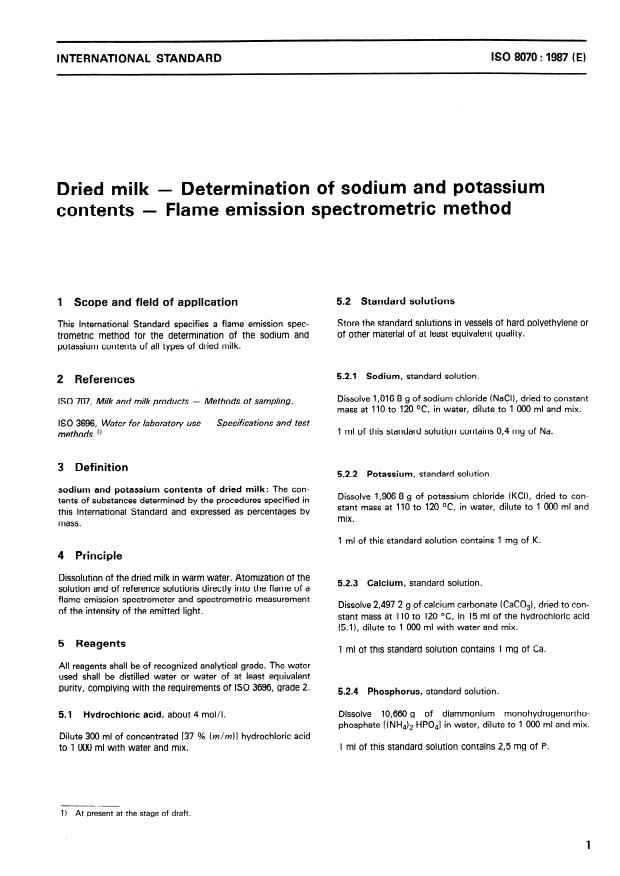
1 Scope and field of application
This International Standard specifies a flame emission spec- Store the standard solutions in vessels of hard polyethylene or
of other material of at least equivalent quality.
trometric method for the determination of the sodium and
potassium contents of all types of dried milk.
52.1 Sodium, standard solution.
2 References
Dissolve 1,016 8 g of sodium chloride (NaCI), dried to constant
IS0 707, Milk and milk products - Methods of sampling.
mass at 110 to 120 OC, in water, dilute to 1 000 ml and mix.
IS0 3696, Water for laboratory use - Specifications and test
1 ml of this standard solution contains 0,4 mg of Na.
methods. 1 )
3 Definition
5.2.2 Potassium, standard solution.
sodium and potassium contents of dried milk: The con-
Dissolve 1,906 8 g of potassium chloride (KCI), dried to con-
tents of substances determined by the procedures specified in
stant mass at 110 to 120 OC, in water, dilute to 1 000 ml and
this International Standard and expressed as percentages by
mix.
mass.
1 ml of this standard solution contains 1 mg of K.
4 Principle
Dissolution of the dried milk in warm water. Atomization of the
5.2.3 Calcium, standard solution.
solution and of reference solutions directly into the flame of a
flame emission spectrometer and spectrometric measurement
Dissolve 2,497 2 g of calcium carbonate (CaCO$ dried to con-
of the intensity of the emitted light.
stant mass at 110 to 120 OC, in 15 ml of the hydrochloric acid
(5.11, dilute to 1 000 ml with water and mix.
5 Reagents
1 ml of this standard solution contains 1 mg of Ca.
All reagents shall be of recognized analytical grade. The water
used shall be distilled water or water of at least equivalent
purity, complying with the requirements of IS0 3696, grade 2.
5.2.4 Phosphorus, standard solution.
Dissolve 10,660 g of diammonium monohydrogenortho-
5.1 Hydrochloric acid, about 4 mol/l.
phosphate [(NH& HP041 in water, dilute to 1 000 ml and mix.
Dilute 300 ml of concentrated [37 % (m/m)] hydrochloric acid
to 1 000 ml with water and mix. 1 ml of this standard solution contains 2,5 mg of P.
- ---
1) At present at the stage of draft.
IS0 8070: 1987 (E)
6 Apparatus 8 Procedure
Avoid contamination, especially with
All glassware shall be thoroughly cleaned and rinsed with dis- CAUTION -
tilled water to ensure that under the test conditions it is free sweat.
from extractable sodium and potassium.
8.1 Preparation of the test sample
Usual laboratory equipment, and in particular
Transfer the sample into a container of capacity about twice the
volume of the sample, provided with an airtight lid. Close the
6.1 Analytical balance.
container immediately and mix the sample thoroughly by
repeatedly shaking and inverting the container.
6.2 Glass beaker, of capacity 50 ml.
During preparation, avoid exposure of the sample to the at-
mosphere as far as possible, in order to minimize adsorption of
100 - 500 -
6.3 One-mark volumetric flasks, of capacities
atmospheric moisture.
1 000 ml, complying with the requirements of IS0 1042,
class B.
8.2 Test portion
6.4 Graduated measuring cylinder, of capacity 50 ml,
Weigh, to the nearest I mg, I,25 g of the test sample into the
complying with the requirements of IS0 4788.
glass beaker (6.2).
8.3 Preparation of test solution
6.5 One-mark pipettes, to deliver 10 - 15 - 20 - 25 - 30 - 40 -
45 - 50 - 60 ml, complying with the requirements of IS0 648,
Dissolve the test portion (8.2) in about 20 ml of warm water (40
class A, or IS0 835.
to 50 OC), while stirring with the glass rod (6.6). Transfer the
contents of the glass beaker by rinsing with water quantitative-
NOTE - Where appropriate, burettes may be used instead of pipettes.
ly into a 500 ml one-mark volumetric flask (6.31, cool to about
20 OC and dilute to the mark. Mix t
...
ISO
NORME INTERNATIONALE
Première édition
sl98%03-15
INTERNATIONAL ORGANIZATION FOR STANDARDIZATION
ORGANISATION INTERNATIONALE DE NORMALISATION
. ME>KCIYHAPOAHAFI OPTAHM3A~MR Il0 CTAHjJAPTM3A~Wl
Détermination des teneurs en sodium et
Lait sec -
Méthode par spectrométrie d’émission de
potassium -
flamme
De termina tion of sodium and potassium contents - Flame emission spectrometric
Dried mi& -
method
Numéro de référence
ISO 8070 : 1987 (F)
Avant-propos
L’ISO (Organisation internationale de normalisation) est une fédération mondiale
d’organismes nationaux de normalisation (comités membres de I’ISO). L’élaboration
des Normes internationales est normalement confiée aux comités techniques de I’ISO.
Chaque comité membre intéressé par une étude a le droit de faire partie du comité
technique créé à cet effet. Les organisations internationales, gouvernementales et non
gouvernementales, en liaison avec I’ISO participent également aux travaux.
Les projets de Normes internationales adoptés par les comités techniques sont soumis
aux comités membres pour approbation, avant leur acceptation comme Normes inter-
nationales par le Conseil de I’ISO. Les Normes internationales sont approuvées confor-
mément aux procédures de I’ISO qui requièrent l’approbation de 75 % au moins des
comités membres votants.
La Norme internationale ISO 8070 a été élaborée par le comité technique ISO/TC 34,
Produits agricoles afimen taires.
La méthode spécifiée dans la présente Norme internationale a été élaborée conjointe-
NOTE -
ment avec la Fédération internationale de laiterie (FIL) et l’Association des chimistes analytiques
officiels (AOAC) et sera également publiée par ces organisations.
L’attention des utilisateurs est attirée sur le fait que toutes les Normes internationales
sont de temps en temps soumises à révision et que toute référence faite à une autre
Norme internationale dans le présent document implique qu’il s’agit, sauf indication
contraire, de la dernière édition.
Organisation internationale de normalisation, 1987
Imprimé en Suisse
NORME INTERNATIONALE
ISO 8070: 1987 (FI
Détermination des teneurs en sodium et
Lait sec -
Méthode par spectrométrie d’émission de
potassium -
flamme
5.2 Solutions étalons
1 Objet et domaine d’application
Conserver les solutions étalons dans des récipients en polyéthy-
La présente Norme internationale décrit une méthode par spec-
Iene ou d’autre matériau de qualité au moins équivalente.
trométrie d’émission de flamme pour la détermination des
teneurs en sodium et potassium dans tous les types de lait sec.
5.2.1 Sodium, solution étalon.
Dissoudre 1,016 8 g de chlorure de sodium (NaCI) séché à
masse constante entre 110 et 120 OC, dans l’eau, diluer à
2 Références
1 000 ml et mélanger.
ISO 707, Lait et produits laitiers - Méthodes d’échantil-
1 ml de cette solution étalon contient 0,4 mg de Na.
lonnage.
5.2.2 Potassium, solution étalon.
ISO 3636, Eau pour laboratoire à usage analytique - Spécifica-
tion et méthodes d’essai. l)
Dissoudre 1,306 8 g de chlorure de potassium (KCI), séché à
masse constante entre 110 et 120 OC, dans l’eau, diluer à
1 000 ml et mélanger.
3 Définition
1 ml de cette solution étalon contient 1 mg de K.
teneurs en sodium et potassium dans le lait sec: Teneurs
5.2.3 Calcium, solution étalon.
de ces substances, déterminées par les modes opératoires
décrits dans la présente Norme internationale et exprimées en
Dissoudre 2,437 2 g de carbonate de calcium (CaCO$ séché à
pourcentage en masse.
masse constante entre 110 et 120 OC, dans 15 ml de la solution
d’acide chlorhydrique (5.11, diluer à 1 000 ml avec de l’eau et
mélanger.
1 ml de cette solution étalon contient 1 mg de Ca.
4 Principe
5.2.4 Phosphore, solution étalon.
Dissolution du lait sec dans l’eau chaude. Atomisation de la
solution et des solutions étalons directement dans la flamme du
Dissoudre 10,660 g de monohydrogéno-otthophosphate
spectromètre et mesure spectrométrique de l’intensité de la
d’ammonium [(NH& HPOJ, dans l’eau, diluer à 1 000 ml et
lumiere émise.
mélanger.
1 ml de cette solution étalon contient 2,5 mg de P.
5 Réactifs
6 Appareillage
Tous les reactifs doivent être de qualité analytique reconnue.
L’eau utilisée doit être de l’eau distillée ou de l’eau de pureté au
Tout le matériel en verre doit être soigneusement nettoyé et
moins équivalente, conforme à I’ISO 3696, catégorie 2.
rincé avec de l’eau distillée pour s’assurer qu’il est exempt, dans
les conditions de l’essai, de sodium et potassium extractibles.
5.1 Acide chlorhydrique, solution à environ 4 mol/l.
Matériel courant de laboratoire, et notamment
Diluer 300 ml d’acide chlorhydrique concentré 137 % (mlm)l à
1 000 ml avec de l’eau et mélanger. 6.1 Balance analytique.
1) Actuellement au stade de projet.
ISO 8070: 1987 (FI
cle étanche à l’air. Fermer immédiatement le récipient et mélan-
6.2 Bécher en verre, de 50 ml de capacité.
ger soigneusement l’échantillon par des agitations et des
retournements répétés du récipient.
6.3 Fioles jaugées à un trait, de 100,500, 1 000 ml de capa-
cités, conformes à I’ISO 1042, classe B.
Pendant la préparation, éviter autant que possible, d’exposer
l’échantillon à l’air de facon à minimiser I’adsorption d’humidité
,
6.4 Éprouvette graduée, de 50 ml de capacité, conforme à
atmosphérique.
I’ISO 4788.
6.5 Pipettes à un trait, permettant de délivrer 10 - 15 - 20 -
8.2 Prise d’essai
25 - 30 - 40 - 45 - 50 - 60 ml, conformes à I’ISO 648, classe A,
ou à I’ISO 835.
Peser, à 1 mg près, 1,25 g de l’échantillon pour essai dans le
bécher (6.2).
NOTE - Le cas échéant, des burettes peuvent être utilisées à la place
des pipettes.
8.3 Préparation des solutions pour essai
6.6 Baguette de verre.
Dissoudre la prise d’essai (8.2) dans environ 20 ml d’eau
6.7 Spectromètre d’émission de flamme, équipé d’un
chaude (40 à 50 OC), en s’aidant de la baguette (6.6). Verser
brûleur alimenté par un mélange soit d’acétylène et d’air, soit
quantitativement en rincant avec de l’eau le contenu du bécher
de propane et d’air, et de filtres ayant une transmission maxi-
dans une fiole jaugée de 500 ml (6.31, refroidir à environ 20 OC
male, respectivement à environ 589 et 768 nm pour le sodium et
et diluer jusqu’au trait repère. Mélanger soigneusement le con-
le potassium, ou d’
...
ISO
NORME INTERNATIONALE
Première édition
sl98%03-15
INTERNATIONAL ORGANIZATION FOR STANDARDIZATION
ORGANISATION INTERNATIONALE DE NORMALISATION
. ME>KCIYHAPOAHAFI OPTAHM3A~MR Il0 CTAHjJAPTM3A~Wl
Détermination des teneurs en sodium et
Lait sec -
Méthode par spectrométrie d’émission de
potassium -
flamme
De termina tion of sodium and potassium contents - Flame emission spectrometric
Dried mi& -
method
Numéro de référence
ISO 8070 : 1987 (F)
Avant-propos
L’ISO (Organisation internationale de normalisation) est une fédération mondiale
d’organismes nationaux de normalisation (comités membres de I’ISO). L’élaboration
des Normes internationales est normalement confiée aux comités techniques de I’ISO.
Chaque comité membre intéressé par une étude a le droit de faire partie du comité
technique créé à cet effet. Les organisations internationales, gouvernementales et non
gouvernementales, en liaison avec I’ISO participent également aux travaux.
Les projets de Normes internationales adoptés par les comités techniques sont soumis
aux comités membres pour approbation, avant leur acceptation comme Normes inter-
nationales par le Conseil de I’ISO. Les Normes internationales sont approuvées confor-
mément aux procédures de I’ISO qui requièrent l’approbation de 75 % au moins des
comités membres votants.
La Norme internationale ISO 8070 a été élaborée par le comité technique ISO/TC 34,
Produits agricoles afimen taires.
La méthode spécifiée dans la présente Norme internationale a été élaborée conjointe-
NOTE -
ment avec la Fédération internationale de laiterie (FIL) et l’Association des chimistes analytiques
officiels (AOAC) et sera également publiée par ces organisations.
L’attention des utilisateurs est attirée sur le fait que toutes les Normes internationales
sont de temps en temps soumises à révision et que toute référence faite à une autre
Norme internationale dans le présent document implique qu’il s’agit, sauf indication
contraire, de la dernière édition.
Organisation internationale de normalisation, 1987
Imprimé en Suisse
NORME INTERNATIONALE
ISO 8070: 1987 (FI
Détermination des teneurs en sodium et
Lait sec -
Méthode par spectrométrie d’émission de
potassium -
flamme
5.2 Solutions étalons
1 Objet et domaine d’application
Conserver les solutions étalons dans des récipients en polyéthy-
La présente Norme internationale décrit une méthode par spec-
Iene ou d’autre matériau de qualité au moins équivalente.
trométrie d’émission de flamme pour la détermination des
teneurs en sodium et potassium dans tous les types de lait sec.
5.2.1 Sodium, solution étalon.
Dissoudre 1,016 8 g de chlorure de sodium (NaCI) séché à
masse constante entre 110 et 120 OC, dans l’eau, diluer à
2 Références
1 000 ml et mélanger.
ISO 707, Lait et produits laitiers - Méthodes d’échantil-
1 ml de cette solution étalon contient 0,4 mg de Na.
lonnage.
5.2.2 Potassium, solution étalon.
ISO 3636, Eau pour laboratoire à usage analytique - Spécifica-
tion et méthodes d’essai. l)
Dissoudre 1,306 8 g de chlorure de potassium (KCI), séché à
masse constante entre 110 et 120 OC, dans l’eau, diluer à
1 000 ml et mélanger.
3 Définition
1 ml de cette solution étalon contient 1 mg de K.
teneurs en sodium et potassium dans le lait sec: Teneurs
5.2.3 Calcium, solution étalon.
de ces substances, déterminées par les modes opératoires
décrits dans la présente Norme internationale et exprimées en
Dissoudre 2,437 2 g de carbonate de calcium (CaCO$ séché à
pourcentage en masse.
masse constante entre 110 et 120 OC, dans 15 ml de la solution
d’acide chlorhydrique (5.11, diluer à 1 000 ml avec de l’eau et
mélanger.
1 ml de cette solution étalon contient 1 mg de Ca.
4 Principe
5.2.4 Phosphore, solution étalon.
Dissolution du lait sec dans l’eau chaude. Atomisation de la
solution et des solutions étalons directement dans la flamme du
Dissoudre 10,660 g de monohydrogéno-otthophosphate
spectromètre et mesure spectrométrique de l’intensité de la
d’ammonium [(NH& HPOJ, dans l’eau, diluer à 1 000 ml et
lumiere émise.
mélanger.
1 ml de cette solution étalon contient 2,5 mg de P.
5 Réactifs
6 Appareillage
Tous les reactifs doivent être de qualité analytique reconnue.
L’eau utilisée doit être de l’eau distillée ou de l’eau de pureté au
Tout le matériel en verre doit être soigneusement nettoyé et
moins équivalente, conforme à I’ISO 3696, catégorie 2.
rincé avec de l’eau distillée pour s’assurer qu’il est exempt, dans
les conditions de l’essai, de sodium et potassium extractibles.
5.1 Acide chlorhydrique, solution à environ 4 mol/l.
Matériel courant de laboratoire, et notamment
Diluer 300 ml d’acide chlorhydrique concentré 137 % (mlm)l à
1 000 ml avec de l’eau et mélanger. 6.1 Balance analytique.
1) Actuellement au stade de projet.
ISO 8070: 1987 (FI
cle étanche à l’air. Fermer immédiatement le récipient et mélan-
6.2 Bécher en verre, de 50 ml de capacité.
ger soigneusement l’échantillon par des agitations et des
retournements répétés du récipient.
6.3 Fioles jaugées à un trait, de 100,500, 1 000 ml de capa-
cités, conformes à I’ISO 1042, classe B.
Pendant la préparation, éviter autant que possible, d’exposer
l’échantillon à l’air de facon à minimiser I’adsorption d’humidité
,
6.4 Éprouvette graduée, de 50 ml de capacité, conforme à
atmosphérique.
I’ISO 4788.
6.5 Pipettes à un trait, permettant de délivrer 10 - 15 - 20 -
8.2 Prise d’essai
25 - 30 - 40 - 45 - 50 - 60 ml, conformes à I’ISO 648, classe A,
ou à I’ISO 835.
Peser, à 1 mg près, 1,25 g de l’échantillon pour essai dans le
bécher (6.2).
NOTE - Le cas échéant, des burettes peuvent être utilisées à la place
des pipettes.
8.3 Préparation des solutions pour essai
6.6 Baguette de verre.
Dissoudre la prise d’essai (8.2) dans environ 20 ml d’eau
6.7 Spectromètre d’émission de flamme, équipé d’un
chaude (40 à 50 OC), en s’aidant de la baguette (6.6). Verser
brûleur alimenté par un mélange soit d’acétylène et d’air, soit
quantitativement en rincant avec de l’eau le contenu du bécher
de propane et d’air, et de filtres ayant une transmission maxi-
dans une fiole jaugée de 500 ml (6.31, refroidir à environ 20 OC
male, respectivement à environ 589 et 768 nm pour le sodium et
et diluer jusqu’au trait repère. Mélanger soigneusement le con-
le potassium, ou d’
...
Questions, Comments and Discussion
Ask us and Technical Secretary will try to provide an answer. You can facilitate discussion about the standard in here.
Loading comments...