

ISO/DTS 19844-1
(Main)Health informatics — Identification of medicinal products (IDMP) — Part 1: Implementation of ISO 11238 (general)
- Status
- Not Published
- Technical Committee
- ISO/TC 215 - Health informatics
- Drafting Committee
- ISO/TC 215/WG 6 - Pharmacy and medicines business
- Current Stage
- 5092 - FDIS referred back to TC or SC
- Start Date
- 29-Jun-2026
- Completion Date
- 10-Oct-2026
Buy Documents
ISO/DTS 19844-1 - Health informatics — Identification of medicinal products (IDMP) — Part 1: Implementation of ISO 11238 (general)/12/2026
REDLINE ISO/DTS 19844-1 - Health informatics — Identification of medicinal products (IDMP) — Part 1: Implementation of ISO 11238 (general)/12/2026
ISO/DTS 19844-1 is an ISO technical specification in the Health informatics IDMP series. It provides requirements and recommendations for implementing ISO 11238 for substances in medicinal product data exchange. It is written for regulators, pharmaceutical companies, non-commercial sponsors and other stakeholders that need to define substances and use Substance IDs consistently.
What does ISO/DTS 19844-1 specify?
ISO/DTS 19844-1 specifies how to implement ISO 11238 for the scientific definition and identification of substances. It focuses on what a substance is, how to classify it, how to request and choose a Substance ID, and which fields are needed to describe different substance types.
The document is organized into clauses on scope, references, terms, symbols, substance modeling, Substance ID selection, and substance definitional and minimum fields.
| Annex | What it covers |
|---|---|
| Annex A | Advanced Therapies and Advanced Vaccines, including genes, modified viruses, cells and tissues as substances |
The scope includes the data elements needed to describe Substances and Specified Substances Groups 1 to 4 and the logical use of those data elements as defined in ISO 11238. It excludes business processes for data management, specific database design, normative messaging standards, controlled vocabulary maintenance, the choice of a specific global identifier system, and nomenclature standards.
What are the key requirements of ISO/DTS 19844-1?
Substance type and substance definition
ISO/DTS 19844-1 requires substances to be defined by what they are, not by how they are made or used. That matters in practice because the same product name can map to different scientific entities, so the defining attributes have to be captured in a consistent way.
Clause 5 says substances are represented either as a Substance or, when more detail is needed, through Specified Substance levels. The document uses five single-substance types - chemical, protein, nucleic acid, polymer and structurally diverse - plus mixture.
Clause 5.2.2 requires the substance type to be determined using the decision tree in Figure 4. In practical terms, the submitter has to classify the material first, because the rest of the record depends on that choice.
Substance IDs and alternative definitions
Clause 5.2.3 requires every substance to have a unique Substance ID that is non-semantic, non-chronological, fixed-length and checked for integrity. Once assigned, the ID stays with the substance even if the definition is later refined, so new information updates the record rather than creating a different identifier.
Clause 5.2.4 allows an optional alternative definition for special cases such as PEGylated proteins or drug-polymer conjugates. This helps systems capture completeness without changing the primary definition used for identification.
Choosing the right identifier
Clause 6 says users should check the public Substance ID list before asking for a new one, and should choose the most specific identifier that matches the actual material. For example, the text notes that bacterial products should be mapped as specifically as the strain where possible, and biologically derived structurally diverse material should be mapped at least to species level when that can be done.
Clause 6.1 also highlights that salt and solvate forms can lead to different identifiers, and that INN and USAN may not point to the same substance form. In practice, this means the identifier must match the exact material used in the product formulation and strength basis.
Clause 6.2 requires at least one name or company code with each request, and asks submitters to flag what is public and what is confidential. The maintenance organization can then issue an ID when the provided information is enough to define the substance unambiguously.
Minimum fields and substance-specific definitional fields
Clause 7 and Tables 5 to 12 define the mandatory, conditional and optional fields for each substance type. This is the implementation checklist: if a field is mandatory, it has to be captured; if it is conditional, it depends on the situation and regional rules.
For proteins, the document defines four levels of granularity - L0 to L3 - ranging from type and target to full sequence, disulfide and glyco details. That matters because a partially known protein can still be entered at an earlier level, then refined later when more data is available.
For nucleic acids, the record captures sequence type, subunit sequence, sugar and linkage details, and relevant modifications. For polymers, the record captures polymer class, geometry, connectivity, starting material where relevant, repeat units, properties and molecular weight-related information. For structurally diverse substances and mixtures, the tables focus on source material, organism, part, fraction, constituents, modifications and related attributes needed to define complex biological materials.
Specified Substance Group 1 is used for multi-substance materials, polymorphs, vaccines, herbal and allergenic extracts, and related physical or characteristic details. In practice, this is where the document captures what is present in the material beyond the base Substance definition.
What terms does ISO/DTS 19844-1 define?
- Substance - Any matter with discrete existence, defined by its scientific identity rather than its use or manufacture.
- Specified Substance - A more detailed substance record that adds information such as constituent substances, proportions, physical state or purity.
- Substance ID - The unique identifier permanently associated with one substance.
- IDMP - Identification of Medicinal Products, the ISO family that supports regulated medicinal product information exchange.
- SSG1 - Specified Substance Group 1, used for multi-substance materials, physical state, polymorphs, vaccines, herbal and allergenic extracts, and detailed glycosylation.
- SSG2 - Specified Substance Group 2, used for manufacturer and manufacturing-process information, including critical process version information.
- SSG3 - Specified Substance Group 3, used for grade, purity and pharmacopoeial or in-house specifications.
- SSG4 - Specified Substance Group 4, used for detailed analytical and manufacturing information.
Who uses ISO/DTS 19844-1?
ISO/DTS 19844-1 is used by medicines regulatory agencies, pharmaceutical companies and non-commercial sponsors that create, review or exchange substance data. It is also relevant to data stewards, regulatory affairs teams, pharmacovigilance teams and system implementers who maintain substance registries or map local substance records to public identifiers.
In practice, these users rely on the document to define substances consistently, request Substance IDs, select the right identifier for a product, and exchange substance information across organizations and regions. The introduction also links the standard to development, registration, life-cycle management, pharmacovigilance and risk management.
What changed in ISO/DTS 19844-1 from the previous edition?
ISO/DTS 19844-1 cancels and replaces the third edition of ISO/TS 19844:2018. The foreword says the main changes are the split of ISO/TS 19844 into a series of documents and the addition of minimum fields and definitional fields per substance information.
Which standards are used with ISO/DTS 19844-1?
- ISO 11238 - The core standard for data elements and structures for the unique identification and exchange of regulated information on substances.
- ISO 11615 - The IDMP standard for regulated medicinal product information, which connects substance identifiers to medicinal product data.
- ISO/TS 19844 - The earlier technical specification named in the normative references and background text for substance implementation guidance.
- ISO 11616 - Named in the introduction as part of the IDMP group for regulated pharmaceutical product information.
- ISO 11239 - Named in the introduction as part of the IDMP group for dose forms, units of presentation, routes of administration and packaging.
- ISO 11240 - Named in the introduction as part of the IDMP group for units of measurement.
- ISO/TS 19844-2 to ISO/TS 19844-12 - The other parts of the series named in the foreword as accompanying documents.
What does the ISO/DTS 19844-1 document contain?
ISO/DTS 19844-1 contains the substance model, the decision tree for substance type, and the guidance for choosing and requesting a Substance ID. It also contains summary tables of mandatory and conditional fields by substance type, including separate field sets for chemicals, proteins, nucleic acids, polymers, structurally diverse substances, mixtures and Specified Substance Group 1.
The document includes a conformance example table, figures showing the substance and specified-substance relationships, and tables that break down sequence, modification, source material, organism, molecular weight and structural representation details. It also gives a preliminary informative annex on advanced therapies and advanced vaccines, with examples such as genes, modified viruses, cells, tissues, gene therapy products and recombinant viral vectors.
Relations
- Effective Date
- 12-Feb-2026
- Effective Date
- 06-Jul-2024
- Effective Date
- 07-Sep-2024
Buy Documents
ISO/DTS 19844-1 - Health informatics — Identification of medicinal products (IDMP) — Part 1: Implementation of ISO 11238 (general)/12/2026
REDLINE ISO/DTS 19844-1 - Health informatics — Identification of medicinal products (IDMP) — Part 1: Implementation of ISO 11238 (general)/12/2026
Get Certified
Connect with accredited certification bodies for this standard

BSI Group
BSI (British Standards Institution) is the business standards company that helps organizations make excellence a habit.

NYCE
Mexican standards and certification body.
Sponsored listings
Frequently Asked Questions
ISO/DTS 19844-1 is a draft published by the International Organization for Standardization (ISO). Its full title is "Health informatics — Identification of medicinal products (IDMP) — Part 1: Implementation of ISO 11238 (general)". This standard covers: Health informatics — Identification of medicinal products (IDMP) — Part 1: Implementation of ISO 11238 (general)
Health informatics — Identification of medicinal products (IDMP) — Part 1: Implementation of ISO 11238 (general)
ISO/DTS 19844-1 is classified under the following ICS (International Classification for Standards) categories: 35.240.80 - IT applications in health care technology. The ICS classification helps identify the subject area and facilitates finding related standards.
ISO/DTS 19844-1 has the following relationships with other standards: It is inter standard links to FprCEN ISO/TS 19844-1, ISO 4717:2024, ISO/TS 19844:2018. Understanding these relationships helps ensure you are using the most current and applicable version of the standard.
ISO/DTS 19844-1 is available in PDF format for immediate download after purchase. The document can be added to your cart and obtained through the secure checkout process. Digital delivery ensures instant access to the complete standard document.
Standards Content (Sample)
FINAL DRAFT
Technical
Specification
ISO/TC 215
Health informatics — Identification
Secretariat: ANSI
of medicinal products (IDMP) —
Voting begins on:
2026-02-26
Part 1:
Implementation of ISO 11238
Voting terminates on:
2026-05-21
(general)
RECIPIENTS OF THIS DRAFT ARE INVITED TO SUBMIT,
WITH THEIR COMMENTS, NOTIFICATION OF ANY
RELEVANT PATENT RIGHTS OF WHICH THEY ARE AWARE
AND TO PROVIDE SUPPOR TING DOCUMENTATION.
IN ADDITION TO THEIR EVALUATION AS
BEING ACCEPTABLE FOR INDUSTRIAL, TECHNO-
ISO/CEN PARALLEL PROCESSING LOGICAL, COMMERCIAL AND USER PURPOSES, DRAFT
INTERNATIONAL STANDARDS MAY ON OCCASION HAVE
TO BE CONSIDERED IN THE LIGHT OF THEIR POTENTIAL
TO BECOME STAN DARDS TO WHICH REFERENCE MAY BE
MADE IN NATIONAL REGULATIONS.
Reference number
FINAL DRAFT
Technical
Specification
ISO/TC 215
Health informatics — Identification
Secretariat: ANSI
of medicinal products (IDMP) —
Voting begins on:
Part 1:
Implementation of ISO 11238
Voting terminates on:
(general)
RECIPIENTS OF THIS DRAFT ARE INVITED TO SUBMIT,
WITH THEIR COMMENTS, NOTIFICATION OF ANY
RELEVANT PATENT RIGHTS OF WHICH THEY ARE AWARE
AND TO PROVIDE SUPPOR TING DOCUMENTATION.
© ISO 2026
IN ADDITION TO THEIR EVALUATION AS
All rights reserved. Unless otherwise specified, or required in the context of its implementation, no part of this publication may
BEING ACCEPTABLE FOR INDUSTRIAL, TECHNO-
ISO/CEN PARALLEL PROCESSING
LOGICAL, COMMERCIAL AND USER PURPOSES, DRAFT
be reproduced or utilized otherwise in any form or by any means, electronic or mechanical, including photocopying, or posting on
INTERNATIONAL STANDARDS MAY ON OCCASION HAVE
the internet or an intranet, without prior written permission. Permission can be requested from either ISO at the address below
TO BE CONSIDERED IN THE LIGHT OF THEIR POTENTIAL
or ISO’s member body in the country of the requester.
TO BECOME STAN DARDS TO WHICH REFERENCE MAY BE
MADE IN NATIONAL REGULATIONS.
ISO copyright office
CP 401 • Ch. de Blandonnet 8
CH-1214 Vernier, Geneva
Phone: +41 22 749 01 11
Email: copyright@iso.org
Website: www.iso.org
Published in Switzerland Reference number
ii
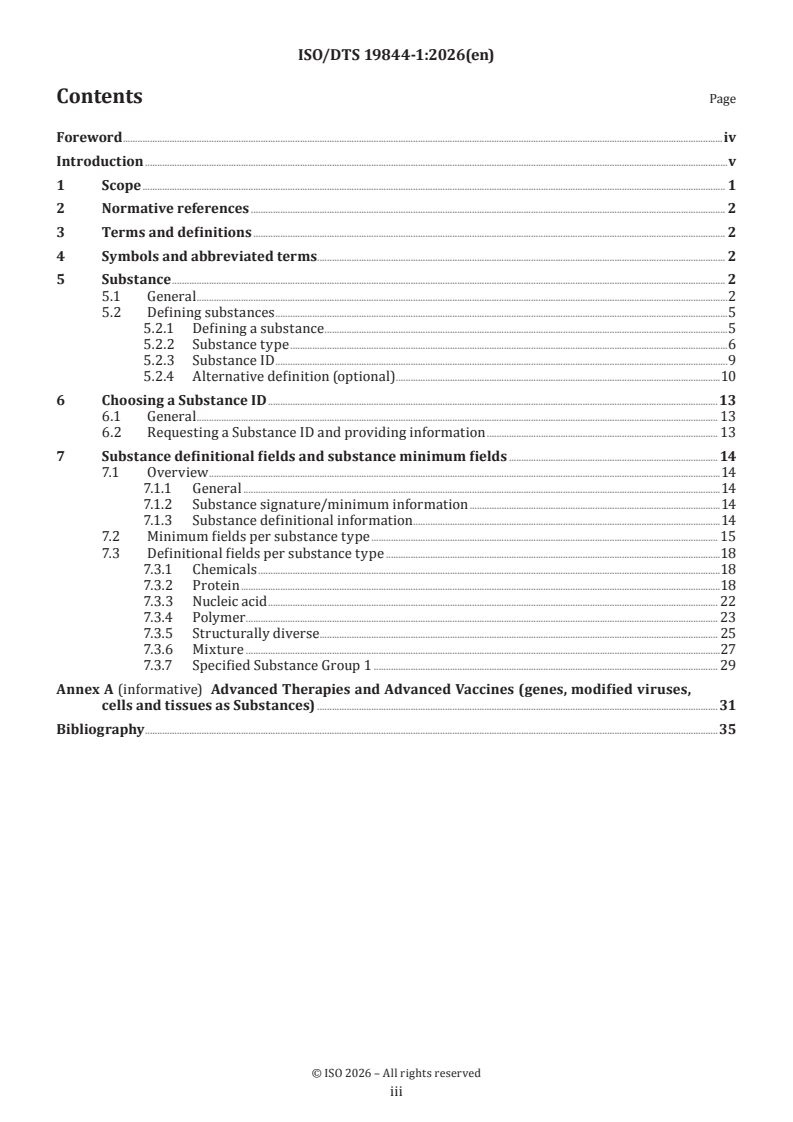
Contents Page
Foreword .iv
Introduction .v
1 Scope . 1
2 Normative references . 2
3 Terms and definitions . 2
4 Symbols and abbreviated terms. 2
5 Substance . 2
5.1 General .2
5.2 Defining substances .5
5.2.1 Defining a substance .5
5.2.2 Substance type .6
5.2.3 Substance ID .9
5.2.4 Alternative definition (optional) .10
6 Choosing a Substance ID .13
6.1 General . 13
6.2 Requesting a Substance ID and providing information . 13
7 Substance definitional fields and substance minimum fields . 14
7.1 Overview .14
7.1.1 General .14
7.1.2 Substance signature/minimum information .14
7.1.3 Substance definitional information .14
7.2 Minimum fields per substance type . 15
7.3 Definitional fields per substance type .18
7.3.1 Chemicals .18
7.3.2 Protein .18
7.3.3 Nucleic acid . 22
7.3.4 Polymer . 23
7.3.5 Structurally diverse . 25
7.3.6 Mixture .27
7.3.7 Specified Substance Group 1 . 29
Annex A (informative) Advanced Therapies and Advanced Vaccines (genes, modified viruses,
cells and tissues as Substances) .31
Bibliography .35
iii
Foreword
ISO (the International Organization for Standardization) is a worldwide federation of national standards
bodies (ISO member bodies). The work of preparing International Standards is normally carried out through
ISO technical committees. Each member body interested in a subject for which a technical committee
has been established has the right to be represented on that committee. International organizations,
governmental and non-governmental, in liaison with ISO, also take part in the work. ISO collaborates closely
with the International Electrotechnical Commission (IEC) on all matters of electrotechnical standardization.
The procedures used to develop this document and those intended for its further maintenance are described
in the ISO/IEC Directives, Part 1. In particular, the different approval criteria needed for the different types
of ISO document should be noted. This document was drafted in accordance with the editorial rules of the
ISO/IEC Directives, Part 2 (see www.iso.org/directives).
ISO draws attention to the possibility that the implementation of this document may involve the use of (a)
patent(s). ISO takes no position concerning the evidence, validity or applicability of any claimed patent
rights in respect thereof. As of the date of publication of this document, ISO had not received notice of (a)
patent(s) which may be required to implement this document. However, implementers are cautioned that
this may not represent the latest information, which may be obtained from the patent database available at
www.iso.org/patents. ISO shall not be held responsible for identifying any or all such patent rights.
Any trade name used in this document is information given for the convenience of users and does not
constitute an endorsement.
For an explanation of the voluntary nature of standards, the meaning of ISO specific terms and expressions
related to conformity assessment, as well as information about ISO’s adherence to the World Trade
Organization (WTO) principles in the Technical Barriers to Trade (TBT), see www.iso.org/iso/foreword.html.
This document was prepared by Technical Committee ISO/TC 215, Health informatics, in collaboration with
the European Committee for Standardization (CEN) Technical Committee CEN/TC 251, Health informatics, in
accordance with the Agreement on technical cooperation between ISO and CEN (Vienna Agreement).
This first edition of ISO/TS 19844-1, together with ISO/TS 19844-2, ISO/TS 19844-3, ISO/TS 19844-4,
ISO/TS 19844-5, ISO/TS 19844-6, ISO/TS 19844-7, ISO/TS 19844-8, ISO/TS 19844-9, ISO/TS 19844-10,
ISO/TS 19844-11 and ISO/TS 19844-12, cancels and replaces ISO/TS 19844:2018, which has been technically
revised.
The main changes compared to the previous edition are as follows:
— split of 19844 into a series of documents;
— addition of “minimum fields” and “definitional fields” per substance information.
A list of all parts in the ISO/TS 19844 series can be found on the ISO website.
Any feedback or questions on this document should be directed to the user’s national standards body. A
complete listing of these bodies can be found at www.iso.org/members.html.
iv
Introduction
The objectives of the standards on the Identification of Medicinal Products (IDMP) are to support the
activities of medicines regulatory agencies worldwide by jurisdiction. These include a variety of regulatory
activities related to development, registration and life cycle management of medicinal products as well as
pharmacovigilance and risk management.
Due to the lack of a common and harmonized approach to define substances, regulators and pharmaceutical
industry are faced with the inability to:
— effectively exchange medicinal substance information in a structured and efficient way;
— ensure data consistency and evaluate/compare information across regions, which especially impairs
pharmacovigilance and compliance activities;
— develop consistent terminology for use throughout the healthcare community.
The ISO standards on IDMP, developed in response to a worldwide demand for guidance on the
implementation of internationally harmonized specifications for medicinal products, address the issues
outlined above by developing harmonized standards that build on the regulatory and technical processes
already established and to support the population and maintenance of existing systems/applications with
fully reliable regulatory medicinal product information.
Harmonized standards will stimulate vendors to develop “off-the-shelf” tools (that are interoperable due to
the standard itself). Harmonized standards will also help to maximize forward compatibility of data and
minimize the complexities of backward compatibility.
The ISO standards on IDMP consist of ISO International Standards and their supporting technical
[1]
specification. In addition to ISO 11238 , the other standards in this group are:
[2]
— ISO 11615 , Health informatics — Identification of medicinal products — Data elements and structures for
the unique identification and exchange of regulated medicinal product information;
[3]
— ISO 11616 , Health informatics — Identification of medicinal products — Data elements and structures for
the unique identification and exchange of regulated pharmaceutical product information;
[4]
— ISO 11239 , Health informatics — Identification of medicinal products — Data elements and structures
for the unique identification and exchange of regulated information on pharmaceutical dose forms, units of
presentation, routes of administration and packaging;
[5]
— ISO 11240 , Health informatics — Identification of medicinal products — Data elements and structures
for the unique identification and exchange of units of measurement.
[1]
This document provides requirements and recommendations for implementing ISO 11238 . This
document is intended to assist stakeholders (including pharmaceutical companies, regulatory authorities
and non-commercial sponsors) in sharing information that allows substances to be defined unambiguously.
It also provides guidance to help identify the correct Substance ID from a public data source that provides
identified Substance and Specified Substance information. It is anticipated that an extensive list of substance
identifiers, as well as the definitional elements upon which the ID was based, will be provided. This document
is not intended to be a guide for a maintenance organization. The maintenance organization may also create
alternative methods to submit information consistent with the ISO model.
For the purposes of this document, all conformance corresponds to the necessary requirements to uniquely
[1] [6]
and unambiguously identify a substance. In the context of ISO 11238 and ISO/TS 19844 , conformance
is expressed based on the following terminology: Mandatory, Conditional and Optional.
— Mandatory: refers to data elements that are required and shall therefore be implemented.
— Conditional: refers to data elements that are subject to business rules and can become required by:
— data rules;
v
— process rules;
— regional rules.
— Optional: refers to data elements that are informative but not definitional.
The description on whether a data element is conditional by data, by process or by regional rule is out of
scope of this document and will be defined within regional implementation guides. When there is no
information in the conformance table row (see Table 1) (e.g. information on business rule is not provided),
users need to refer to the regional implementation guide.
Regional implementation may also dictate that clauses tagged conditional or optional in the ISO standard
are mandatory elements on regional requirements. Therefore, if a subclause is identified as ‘optional’ but
is implemented in a specific region, conformance on data elements described within that subclause is
applicable.
A systematic approach is being followed to describe classes and elements. Table 1 is an example table for
class and elements description.
Table 1 — Example table for class and element description
User guidance
Example(s)
Conformance
Data type
Values allowed
Business rule(s)
vi
FINAL DRAFT Technical Specification ISO/DTS 19844-1:2026(en)
Health informatics — Identification of medicinal products
(IDMP) —
Part 1:
Implementation of ISO 11238 (general)
1 Scope
[1]
This document provides requirements and recommendations for the implementation of ISO 11238 . This
document defines substances based on their scientific identity (i.e. what they are) rather than on their use or
method of production.
[1]
ISO 11238 provides the conceptual framework for defining Substances and Specified Substances and for
[1]
assigning unique identifiers in the context of the ISO standards on IDMP. ISO 11238 describes general
concepts for defining and distinguishing substances and a high-level model for the structuring of information
for substances. This document provides detailed explanations of each type or grouping of substance
[1]
information, an element-by-element description for the implementation of ISO 11238 , and examples for a
variety of Substances and Specified Substances.
This document covers:
— the data elements necessary for describing Substances and Specified Substances Groups 1 to 4;
— the data elements necessary for the unique definition of Substances and Specified Substances Groups 1;
[1]
— the logical use of data elements as defined in ISO 11238 .
This document does not cover:
— business processes for data management;
— implementation of a specific data information system (e.g. a relational database schema);
— normative messaging standards for substances;
— the maintenance of controlled vocabularies;
— the specific global identifier system to be used;
— nomenclature standards for substances.
This document does not cover Substances and Specified Substances Groups 1 to 4 business rules for:
— determining necessary data elements;
[1]
— distinguishing and defining material types according to ISO 11238 ;
— triggering the assignment of identifiers.
Due to their inherent complexity, the specific case of Advanceed Therapies will be addresses in future
versions of this document. An overview of Advanceed Therapies is available in Annex A.
2 Normative references
The following documents are referred to in the text in such a way that some or all of their content constitutes
requirements of this document. For dated references, only the edition cited applies. For undated references,
the latest edition of the referenced document (including any amendments) applies.
ISO 11238, Health informatics — Identification of medicinal products — Data elements and structures for the
unique identification and exchange of regulated information on substances
3 Terms and definitions
No terms and definitions are listed in this document.
ISO and IEC maintain terminology databases for use in standardization at the following addresses:
— ISO Online browsing platform: available at https://www.iso.org/obp
— IEC Electropedia: available at https://www.electropedia.org/
4 Symbols and abbreviated terms
[1] [6]
NOTE Only general abbreviations are listed. They are used either within ISO 11238 or ISO/TS 19844 since
these documents are regarded as inseparable.
1)
CAS Chemical Abstracts Service number
INN International Nonproprietary Name [also consider as rINN (recommended International
2)
Nonproprietary Name) or pINN (proposed International Nonproprietary Name)]
3)
JAN Japanese Accepted Name
4)
USAN United States Adopted Name
5 Substance
5.1 General
All medicinal products consist of substances; these substances can be active ingredients, excipients,
or packaging materials. The substances shall be described in accordance with ISO 11238. There are
[1]
two fundamental levels of information described in ISO 11238 , a “Substance level" and a “Specified
Substance level”. Both levels are included in the more generic concept of an ingredient. At the Substance
level, substances are defined based on inherent attributes rather than use or method of manufacture. At the
Specified Substance level, four separate groups of elements provide additional information.
In order to define or distinguish material either at a Substance or Specified Substance level, a number of
attributes should be taken into consideration:
— For chemicals, the molecular structure is captured at the Substance level.
— For proteins, the amino acid sequence, sites and type of glycosylation, and the presence of modifications
and position of disulfide bonds are captured at the Substance level.
1) https://www.cas.org/about-us
2) http://www.who.int/medicines/services/inn/en/
3) https://moldb.nihs.go.jp/jan/En
4) https://www.ama-assn.org/about/united-states-adopted-names-council
— For nucleic acids, the sequence, type of sugar and linkage and modifications are captured at the Substance
level.
— For other polymers, the monomers used to synthesize the polymer, the structural repeat units, the
molecular weight and/or a property related to molecular weight (e.g. viscosity), the source of naturally
derived polymers and any modifications that irreversibly alter the molecular structure are captured at
the Substance level.
— For structurally diverse material, taxonomic, anatomical and fractionation information, properties
related to the underlying molecular structure of the material, and modifications that alter the underlying
molecular structure are captured at the Substance level.
— A Mixture consists of a simple combination of Single Substances that are either isolated together or
are the result of the same synthetic process. This applies also to a homologous group of structurally
diverse single substances used to prepare an allergen extract. The biological source of the mixture is
also captured where relevant at the substance level. Proportions are not captured at the substance level.
It should be noted that a mixture description should only include the substances that are generally or
consistently present in the material. This excludes impurities and degradants.
Other attributes will be specific to the Specified Substance levels:
— constituent substances in a multi-substance material;
— proportions of constituent substances in a multi-substance material;
— physical state;
— grade or purity of material.
There are four groups of elements that are used to further define and specify Substances. Specified
Substances are always composed of at least one substance.
Specified Substance Group 1 (SSG1) is typically used to define:
— multi-substance materials consisting of multiple substances, which are not defined as mixture;
— defining information regarding homeopathic, plasma derived, vaccines substances, herbal and allergenic
extracts;
— physical state, including polymorphic forms;
— detailed glycosylation information.
Specified Substance Group 2 (SSG2) is typically used to define:
— manufacturer, manufacturing process and critical process version number. In some cases extended
manufacturing information are used to provide information regarding herbal and allergenic extracts when
multiple extraction methods with different solvent compositions are used or a stepwise manufacturing
process is in place describing an extraction method followed by a general modification process of the
extract, e.g. modified allergen extract, modified vaccines by multiple modification processes.
Specified Substance Group 3 (SSG3) is typically used to define:
— grade or level of purity (Pharmacopoeial Specifications) and in-house specification used to cover a set of
specifications of all approved manufacturers for the substance.
Specified Substance Group 4 is typically used to define:
— detailed specification information including analytical information to be used in tests;
— detailed manufacturing information.
Figure 1 — High-level Substance-Specified Substance information model
EXAMPLE In Figure 1, the Substance class is parent of the classes Specified Substance Group 1 (SSG1), Specified
Substance Group 2 (SSG2) and Specified Substance Group 3 (SSG3). Similarly, SSG1 is a parent of SSG2 and SSG3. For
Triamcinolone acetonide, Figure 2 shows the relationships of Substance and Specified Substance Groups.
Figure 2 — Parent Substance and Specified Substances Groups relationships of Triamcinolone
acetonide
5.2 Defining substances
5.2.1 Defining a substance
A substance is any matter that has discrete existence, whose origin can be biological, mineral or chemical.
Substances can be single well-defined chemical entities containing a definite molecular structure, synthetic
(e.g. isomeric mixtures) or naturally-occurring (e.g. conjugated oestrogens) mixtures of chemicals, or
materials derived from plants, animals, micro-organisms or inorganic matrices that are not definable by
a single or limited number of molecular structures. Substances can contain active moieties, salts, solvates,
(non)-stoichiometric complexes or mixtures of compounds that are isolated or synthesised/obtained or
produced in a process together. Materials that are combined from multiple sources to form a product are not
considered to be substances.
A substance is generally defined by what it is, and not by how it is made or used. Substance definitions are
typically based on the immutable properties of a given material. These properties include the molecular
structure, or structures of a given material, taxonomic, anatomical or fractionation information for material
that cannot be represented by molecular structures. Purity, physical form, and method of production are
typically not considered when defining substances.
In addition to defining information, there is also information that is essential to validate the defining
information; this additional information should be submitted if available. Validation can be performed based
on relevant provided documents (e.g. regulatory dossier) or information available in recognised source (e.g.
pharmacopoeias).
[1]
The primary goal of ISO 11238 is to define all substances present in regulated products unambiguously.
Once a substance has been defined, a unique identifier will be assigned that is permanently associated with
that substance. This document describes the necessary information for this registration process. Reference
information, names, codes and IDs that can be associated with a substance are also described. This document
is not comprehensive in regards to reference and definitional information. Other substance attributes can
be associated for both reference and definitional information as new scientific standards or information
becomes available.
Substances that are mixed together to form a product, even if there are physical interactions between the
Substances, will be described as a Specified Substance or a product.
A high level overview of the information model for the Substance class is provided with Figure 3.
EXAMPLE 1 FD&C Blue No. 1 Aluminium Lake is not defined as a mixture substance but rather as two separate
substances FD&C Blue No. 1 and aluminium oxide. Also, simethicone is not a substance because it contains two
substances, namely dimethicone and silicon dioxide. These materials would be described as Group 1 Specified
Substances.
Conversely, if new covalent bonds and/or simple salts or solvates are formed, separate Substance IDs for each
molecular entity are assigned.
EXAMPLE 2 Fluticasone propionate would have a separate ID from fluticasone; atorvastatin calcium trihydrate
would have a separate ID from atorvastatin calcium anhydrous.
Differences at the Specified Substance level trigger a new Specified Substance ID.
EXAMPLE 3 Insulin Human Crystalline and Insulin Human Amorphous have different Specified Substances Group 1
IDs and map to the substance Human Insulin.
Figure 3 — High-level information model for substances
5.2.2 Substance type
At the basic level, all material present in medicinal products will either be described as a Substance and/or
a Specified Substance Group 1.
Additional information, such as manufacturer and grade and manufacturing information on a given material
will be associated with Specified Substance Groups 2 to 4.
Substances shall be defined using one of the five types of single substances or a mixture. Mixtures consist
of a combination of related single substances where the source material and essential properties are also
captured but proportions are not.
Mixtures also describe extracts of homologous groups of substances and in this case the proportions of the
multi-substance starting materials are captured.
For the purposes of definition, all single substances are of one of the following types:
— (simple) chemical;
— protein;
— nucleic acid;
— polymer;
— structurally diverse.
Each of these different types of single substances has distinct elements essential for substance definition.
Some special materials can appear to have elements from multiple types of single substances, e.g. PEGylated
proteins, drugs covalently linked to polymeric matrices or proteins, to fully define the substance. Each of
these complex materials will be described according to a single substance type, although it is possible for the
same material to be described by using two substance types, of which only one is the primary/predominant
one, with the other related to it as an alternative definition. For more details on this specific relationship,
see 5.2.4.
Most other polymers will be described as single substances with the definition based on the structural
repeat unit and a representation of the average molecular weight of the polymer as well as the biological
source for biopolymers or polymers derived from biological matrices.
[1]
Substances can also be a mixture of single substances. Mixture is defined in ISO 11238 as a type of
polydisperse substance that is a combination of single substances isolated together or produced in the same
synthetic process. Mixtures consist of a combination of related single substances where the source material
and essential properties could be captured with proportions at the Specified Substance Group 1 information
level, if applicable. For mixtures in which multiple related substances are isolated together from a single
source, the source will be a defining element.
EXAMPLE 1 Starches are typically a mixture of the two distinct polymers amylose and amylopectin. Corn, wheat,
potato and tapioca starches are all distinct substances distinguished by the source.
Additional information, such as manufacturer, grade, and manufacturing information on a given material
will be associated with Specified Substances Groups 2 to 4.
The first step in defining a material is to determine whether the material can be defined as a Single
Substance, a Mixture or a Specified Substance Group 1. A mixture is a substance that cannot be defined
using a single set of substance elements or structural representations. Racemic mixtures, most polymers
and structurally diverse substances, although inherently mixtures, can be defined using a single set of
elements and therefore are not described as mixtures. Material that contains multiple substances that
are not synthesised or isolated together and are not related or not derived from homologous groups of
substances will be described as Specified Substance Group 1. Specified Substance Group 1 also includes
crystalline polymorphs, substances in varied physical states along with the capture of additional properties
regarding sterility or the presence of endotoxin.
EXAMPLE 2 Specified Substance Group 1 include simethicone, adjuvanted vaccine antigens, isophane insulins and
additional herbal and allergenic extract information not captured at the Substance level.
EXAMPLE 3 Mixtures are substances such as Gentamicin sulfate, USP or Gentamicin sulfate, Ph.Eur. which consists
of mixtures of distinct but related individual aminoglycosides. In USP Gentamicin sulfate is described as a mixture of
Gentamicin C1A sulfate, Gentamicin C1 sulfate, and Gentamicin C2 sulfate. In Ph.Eur. it is described as a mixture of five
components, Gentamicin C1, C1a, C2, C2a, and C2b, which are typically isolated together from a bacterial culture.
At the substance level, all related substances typically present at a level greater than 1% shall be listed as
components of the mixture regardless of whether the substance is listed in a given pharmacopoeia.
Figure 4 shows a decision tree or process by which the type of substance is determined. Monodisperse
substances are substances that can be described as a single molecular entity. Polydisperse substances
are substances that typically have multiple molecular entities that are too numerous or too diverse to be
captured as a mixture (e.g. cells or tissues) or where the production of the substance inherently results in
polydispersity (e.g. polymers).
Key
a
Multi-substance material: Multiple-Substances and/or Specified Substances of diverse origin.
b
Mixture: Type of polydisperse substance that is either a combination of single substances isolated together
or synthesised/obtained or produced in the same process or an extract of a homologous group of substances
(multi-substance starting material) resulting from the same synthetic process.
Figure 4 — Decision tree or process by which the type of substance is determined
Table 2 summarises the requirements for Substance type class.
Table 2 — Substance type
User guidance The Substance type shall be defined in accordance with the decision tree depicted in
Figure 4, supported by the supporting information in 5.2.2.
Example(s) Chemical, Protein, Nucleic acid, Polymer, Structurally Diverse, Mixture
Conformance MANDATORY
Data type CD
Values allowed Chemical, Protein, Nucleic Acid, Polymer, Structurally Diverse, Mixture, Specified Substance
Group 1, Specified Substance Group 2, Specified Substance Group 3
Business rules For each substance type, a qualification is possible, e.g. Structurally Diverse (Plasma-de-
rived), Structurally Diverse (Herbal Substance), Structurally Diverse (Herbal Drug), Struc-
turally Diverse (Allergen Substance), Polymer (Biopolymer), Protein (Recombinant), Protein
(Naturally-derived), Protein (Allergen, Naturally-derived), Chemical (Mineral, naturally oc-
curring substance), Mixture (Homologous Group of Allergen Source Material). In these cases,
the qualifier shall also be captured at the Substance Name Type attribute of the respective
[6]
ISO/TS 19844 clause, and shall always be coupled with the substance name.
For example:
Substance Type: Structurally Diverse
Substance Name Type: Plasma-derived
Substance Name: Human Albumin, Plasma-derived
In all these cases, a new ID shall be issued, that is, “Human Albumin, Plasma-derived” shall
have a distinct identifier from “Human Albumin, Recombinant”.
5.2.3 Substance ID
Every substance shall be identified by a unique identifier (ID). An ID will be generated following the initial
submission of substance data. The ID shall be unique to each substance, non-semantic, non-chronological,
and of fixed length with an integrity check. Once an ID is assigned to a given physical or concept (see Note
below) material, the ID will not change. Changes or additions to defining information result in a new version
of the substance definition but would not result in a new Substance ID. Although an effort should always
be made to obtain the complete information prior to assignment, there will be instances where additional
definitional information on a given substance is transmitted after the assignment. When incorrect or
incomplete information are transmitted and used to define a substance, the existing substance information
will be updated but the unique Substance ID will not change.
EXAMPLE 1 Glucose, when a solid crystalline material, can exist with an alpha or beta pyranose structure in an
anhydrous state, or as a monohydrate with an alpha pyranose structure. In a medicinal product where a specific and
identified form of glucose exists, the ID specific to the structure is used. Glucose in a liquid or an amorphous solid state
uses the Substance ID that does not specify the specific form.
Both Substances and Specified Substances shall be identified with an ID. IDs will be released to the public if
the substance is in a licensed medicinal product. The IDs for substances in the investigational stage will only
be released if an official name exists or a company code is associated with defining information and is found
together in at least one single reference that is from a reputable source in the public domain (i.e. scientific
journal, presentations or posters at scientific conferences, company publication, patent or published patent
application, public databases such as STN from CAS). Substance IDs shall always be issued to the requester if
sufficient information is provided to unambiguously define the substance.
NOTE The notion of ‘conceptual material’ has been introduced by the EU and US jurisdictional implementations
(EU-SRS and GSRS databases) to allow the assignment of identifiers to lesser defined substances during e.g. their early
development stage where only very few information of the material is known. In addition, it is used to define further
aspects of a substance used in a medicinal product by using Specified Substance Group 1 elements. The status of a
[1]
conceptual material does not comply to the definitional information according to ISO 11238 for each substance
type. As soon the definitional information is provided in due time, the “conceptual material” can be upgraded to
[1]
“physical” material in compliance with the definitional rules of that substance type according to ISO 11238 and to
this document.
EXAMPLE 2 A description of a chemical substance by name without an unambiguous structure is a concept
material.
EXAMPLE 3 A description of a protein substance by name without a sequence is a concept material.
EXAMPLE 4 A description of a polymer substance by name without a structural repeat unit is a concept material.
EXAMPLE 5 A description of a nucleic acid substance by name without a sequence, sugar and linkage is a concept
material.
EXAMPLE 6 A description of a structurally diverse substance by name without proper taxonomic information and
without description of at least one major constituent, allergen.
EXAMPLE 7 A description of a mixture substance consisting of at least one of the above mentioned criteria is a
concept material.
Table 3 summarises the requirements for Substance ID class.
Table 3 — Substance ID
User guidance ID to be used in all electronic submissions to identify a substance. Generated when sufficient
information is available to unambiguously define a substance. ID will be permanently asso-
ciated with a given substance and each substance at the substance level shall have one and
a
only one ID.
b
Example(s) UNII Code, EV-Code, Global Substance ID (DEVTYS543H)
Conformance MANDATORY
Data type II
Values allowed Value can be a code associated with a preferred term, or a specific type of data. If a code is
transmitted, the preferred term associated with that code should also be transmitted.
Business rule(s) All substances shall be identified by a single ID.
The conformance is mandatory in all cases. The only exception is at the time of the very first
c
submission where the ID is requested.
a
If a unique Substance ID has been assigned, this Substance ID is specified based on the Substance Name controlled vocabulary.
In the absence of a unique Substance ID, e.g. for the initial submission of the substance, this data element is not mandatory.
b
Global Substance ID corresponds to the ISO IDMP identifier of a Substance intended to be used globally.
c
The ID shall only be released to the public if the defining information is in the public domain or if a company that provides the
defining information requests public release or releases the code in public marketing materials. An ID will always be issued to an
organisation that requests an ID and supplies the information necessary to define a substance. A flag to control the release of the
ID to the general public is part of the Reference Source information 5.4. Defining information found in patents will usually not be
sufficient to release the ID to the public.
5.2.4 Alternative definition (optional)
As mentioned in 5.2.1, single substances are (simple) chemicals, proteins, nucleic acids, polymers and
structurally diverse substances. Each of these different types of single substances has distinct elements
essential for its unique and univocal identification. Although some special materials, such as PEGylated
proteins, drugs covalently linked to polymeric matrices or proteins, shall be defined using the data structures
of a single substance, for their complete description it is sometimes necessary to use some elements coming
from different types of single substances in order to capture the full information related to them.
NOTE 1 Proteins modified with a polymer or drug can be described as a protein with the polymer or drug captured
as a modification.
NOTE 2 Drugs covalently linked to a polymer can be described as a polymer with the drug either captured as an
end-group or as structural modification.
NOTE 3 Structurally diverse substances such as vaccines containing a protein fraction, can be defined using the
data structures from the structurally diverse information model enhanced by particular elements of the protein or
polymer information model.
NOTE 4 Specific use case: peptides where two substances are linked each other in a special way and this relationship
provides the inheritance of those; many systems deal with them as chemicals, and others as sequences. From these
two descriptions only one is the primary/predominant definition used for peptides’ identification (the data structures
from the protein model) and the other one, the alternative definition, can only be used to capture optional chemical
information for completeness.
Figure 5 shows a snapshot of a Structurally diverse substance on the left (Primary definition) and a partial
overview of the Polymer definition at t
...
ISO/TC 215
ISO/CD TS 19844-1.2(en)
Secretariat: ANSI
Date: 2026-02-11
Health informatics — Identification of medicinal products (IDMP) —
Part 1:
Implementation guidelines forof ISO 11238: General (general)
TTTTTTThhhhhhhiiiiiiisssssss dr dr dr dr d dr drraaaaaaafffffffttttttt i i i i i iisssssss sususususususubbbbbbbmmmmmmmiiiiiiitttttttttttttteeeeeeedd d d d d d tttttttooooooo a aaaaaa pppppppaaaaaaarrrrrrraaaaaaallellellellellellellel l l l l l l vvvvvvvooooooottttttteeeeeee i i i i i i innnnnnn IIIIIIISSSSSSSOOOOOOO,,,,,,, CCCCCCCEEEEEEEN.N.N.N.N.N.N.
ISO/CD TSDTS 19844-1.2:2025:2026(en)
All rights reserved. Unless otherwise specified, or required in the context of its implementation, no part of this publication
may be reproduced or utilized otherwise in any form or by any means, electronic or mechanical, including photocopying,
or posting on the internet or an intranet, without prior written permission. Permission can be requested from either ISO
at the address below or ISO’s member body in the country of the requester.
ISO copyright office
CP 401 • Ch. de Blandonnet 8
CH-1214 Vernier, Geneva
Phone: + 41 22 749 01 11
E-mail: copyright@iso.org
Website: www.iso.org
Published in Switzerland
ii
ISO/CD TSDTS 19844-1.2:2025:2026(en)
Contents
Foreword . iv
Introduction . v
1 Scope . 1
2 Normative references . 2
3 Terms and definitions . 2
4 Symbols and abbreviated terms . 2
5 Substance . 3
5.1 General . 3
5.2 Defining substances . 6
6 Choosing a Substance ID . 14
6.1 General . 14
6.2 Requesting a Substance ID and providing information . 15
7 Substance definitional fields and substance minimum fields . 16
7.1 Overview . 16
7.2 Minimum fields per substance type . 17
7.3 Definitional fields per substance type . 21
Annex A (informative) Advanced Therapies and Advanced Vaccines (genes, modified viruses,
cells and tissues as Substances) . 35
Bibliography . 40
iii
ISO/CD TSDTS 19844-1.2:2025:2026(en)
Foreword
ISO (the International Organization for Standardization) is a worldwide federation of national standards
bodies (ISO member bodies). The work of preparing International Standards is normally carried out through
ISO technical committees. Each member body interested in a subject for which a technical committee has been
established has the right to be represented on that committee. International organizations, governmental and
non-governmental, in liaison with ISO, also take part in the work. ISO collaborates closely with the
International Electrotechnical Commission (IEC) on all matters of electrotechnical standardization.
The procedures used to develop this document and those intended for its further maintenance are described
in the ISO/IEC Directives, Part 1. In particular, the different approval criteria needed for the different types of
ISO documentsdocument should be noted. This document was drafted in accordance with the editorial rules
of the ISO/IEC Directives, Part 2 (see www.iso.org/directives).
Attention is drawnISO draws attention to the possibility that some of the elementsimplementation of this
document may beinvolve the subjectuse of (a) patent(s). ISO takes no position concerning the evidence,
validity or applicability of any claimed patent rights in respect thereof. As of the date of publication of this
document, ISO had not received notice of (a) patent(s) which may be required to implement this document.
However, implementers are cautioned that this may not represent the latest information, which may be
obtained from the patent database available at www.iso.org/patents. ISO shall not be held responsible for
identifying any or all such patent rights. Details of any patent rights identified during the development of the
document will be in the Introduction and/or on the ISO list of patent declarations received (see ).
Any trade name used in this document is information given for the convenience of users and does not
constitute an endorsement.
For an explanation onof the voluntary nature of standards, the meaning of ISO specific terms and expressions
related to conformity assessment, as well as information about ISO'sISO’s adherence to the World Trade
Organization (WTO) principles in the Technical Barriers to Trade (TBT)), see the following URL:
www.iso.org/iso/foreword.html.
This document was prepared by Technical Committee ISO/TC 215, Health informatics., in collaboration with
the European Committee for Standardization (CEN) Technical Committee CEN/TC 251, Health informatics, in
accordance with the Agreement on technical cooperation between ISO and CEN (Vienna Agreement).
This first edition of ISO/TS 19844-1, together with ISO/TS 19844-2 to , ISO/TS 19844-3, ISO/TS 19844-4,
ISO/TS 19844-5, ISO/TS 19844-6, ISO/TS 19844-7, ISO/TS 19844-8, ISO/TS 19844-9, ISO/TS 19844-10,
ISO/TS 19844-11 and ISO/TS 19844-12, cancels and replaces the third edition ISO/TS 19844:2018, which has
been technically revised.
The main changes compared to the previous edition are as follows:
— Splitsplit of 19844 into a series of documents,;
— Additionaddition of Minimum“minimum fields” and Definitional“definitional fields” per substance
information.
A list of all parts in the ISO/TS 19844 series can be found on the ISO website.
Any feedback or questions on this document should be directed to the user’s national standards body. A
complete listing of these bodies can be found at www.iso.org/members.html.
iv
ISO/CD TSDTS 19844-1.2:2025:2026(en)
Introduction
The objectives of the standard series forstandards on the Identification of Medicinal Products (IDMP) are to
support the activities of medicines regulatory agencies worldwide by jurisdiction. These include a variety of
regulatory activities related to development, registration and life cycle management of medicinal products as
well as pharmacovigilance and risk management.
Due to the lack of a common and harmonized approach to define substances, regulators and pharmaceutical
industry are faced with the inability to:
— effectively exchange medicinal substance information in a structured and efficient way;
— ensure data consistency and evaluate/compare information across regions, which especially impairs
pharmacovigilance and compliance activities;
— develop consistent terminology for use throughout the healthcare community.
The ISO standards on IDMP series, developed in response to a worldwide demand for guidance on the
implementation of internationally harmonized specifications for medicinal products, address the issues
outlined above by developing harmonized standards that build on the regulatory and technical processes
already established and to support the population and maintenance of existing systems/applications with
fully reliable regulatory medicinal product information.
Harmonized standards will stimulate vendors to develop “off-the-shelf” tools (that are interoperable due to
the standard itself). Harmonized standards will also help to maximisemaximize forward compatibility of data
and minimiseminimize the complexities of backward compatibility.
The ISO standards on IDMP series consist in a group of ISO standards International Standards and their
supporting technical specification. In addition to ISO 11238 [1],, the other standards in this group are:
— ISO 11615 [2],, Health informatics — Identification of medicinal products — Data elements and structures
for the unique identification and exchange of regulated medicinal product information.;
— ISO 11616 [3],, Health informatics — Identification of medicinal products — Data elements and structures
for the unique identification and exchange of regulated pharmaceutical product information.;
— ISO 11239 [4],, Health informatics — Identification of medicinal products — Data elements and structures
for the unique identification and exchange of regulated information on pharmaceutical dose forms, units of
presentation, routes of administration and packaging.;
— ISO 11240 [5],, Health informatics — Identification of medicinal products — Data elements and structures
for the unique identification and exchange of units of measurement.
This document provides guidelinesrequirements and recommendations for implementing the ISO 11238
[1]standard. This technical specificationdocument is intended to assist stakeholders (including
pharmaceutical companies, regulatory authorities and non-commercial sponsors) in sharing information that
allows substances to be defined unambiguously. It also provides guidance to help identify the correct
Substance ID from a public data source that provides identified Substance and Specified Substance
information. It is anticipated that an extensive list of substance identifiers, as well as the definitional elements
upon which the ID was based, will be provided. This document is not intended to be a guide for a maintenance
organization. The maintenance organization may also create alternative methods to submit information
consistent with the ISO model.
For the purposes of this document, all conformance correspondcorresponds to the necessary requirements to
uniquely and unambiguously identify a substance. In the context of ISO 11238 [1] and ISO/TS 19844 [6],
v
ISO/CD TSDTS 19844-1.2:2025:2026(en)
Conformance will be, conformance is expressed based on the following terminology: Mandatory, Conditional
and Optional.
— Mandatory: refers to data elements that are required and shall therefore be implemented.
— Conditional: refers to data elements that are subject to business rules and can become required by:
— data rules;
— process rules;
— regional rules.
— Optional: refers to data elements that are informative but not definitional.
The description on whether a data element is conditional by data, by process or by regional rule is out of scope
of this document and will be defined within regional implementation guides. When there is no information in
the conformance table row (see Table 1) (e.g. information on business rule is not provided), pleaseusers need
to refer to the regional implementation guide.
Regional implementation may also dictate that clauses tagged conditional or optional in the ISO standard are
mandatory elements on regional requirements. Therefore, if a subclause is identified as ‘optional’ but is
implemented in a specific region, conformance on data elements described within that subclause is applicable.
A systematic approach is being followed to describe classes and elements. Table 1 is an example table for class
and elements description.
Table 1 — Example table for class and element description
User Guidanceguidance
Example(s)
Conformance
Data Typetype
Values Allowedallowed
Business Rulerule(s)
vi
ISO/CD TSDTS 19844-1.2:2025:2026(en)
Health informatics — Identification of medicinal products (IDMP) —
Part 1:
Implementation guidelines forof ISO 11238: General (general)
1 Scope
This document is used inprovides requirements and recommendations for the implementation of ISO 11238
[1]. This document defines substances based on their scientific identity (i.e. what they are) rather than on
their use or method of production.
ISO 11238 [1] provides the conceptual framework for defining Substances and Specified Substances and for
assigning unique identifiers in the context of the ISO IDMP standards on IDMP. ISO 11238 [1] describes general
concepts for defining and distinguishing substances and a high-level model for the structuring of information
for substances. This document provides detailed explanations of each type or grouping of substance
information, an element-by-element description for the implementation of ISO 11238 [1],, and examples for a
variety of Substances and Specified Substances.
In current edition of the document, the previous version is split into a series of documents. This first edition
of this document addresses the following:
TheThis document covers:
— the data elements necessary for describing Substances and Specified Substances Groups 1 to 4;
— Thethe data elements necessary for the unique definition of Substances and Specified Substances Groups
1;
— Thethe logical use of data elements as defined in ISO 11238 [1];.
This document does not address the followingcover:
— Businessbusiness processes for data management;
— Implementationimplementation of a specific data information system (e.g. a relational database schema);
— Normativenormative messaging standards for substances;
— Thethe maintenance of controlled vocabularies;
— Thethe specific global identifier system that shouldto be used;
— Nomenclaturenomenclature standards for substances.
This document does not address the following, which may be addressed in the other documents of the series:
cover Substances and Specified Substances Groups 1 to 4 business rules for:
— determining necessary data elements,;
— distinguishing and defining material types according to ISO 11238 [1],;
— triggering the assignment of identifiers.
ISO/CD TSDTS 19844-1.2:2025:2026(en)
Due to their inherent complexity, the specific case of Advanceed Therapies will be addresses in future versions
of this document. An overview of Advanceed Therapies is available in Annex Athe informative .
2 Normative references
The following documents are referred to in the text in such a way that some or all of their content constitutes
requirements of this document. For dated references, only the edition cited applies. For undated references,
the latest edition of the referenced document (including any amendments) applies.
ISO 11238, Health informatics — Identification of medicinal products — Data elements and structures for the
unique identification and exchange of regulated information on substances
ISO 11615, Health informatics — Identification of medicinal products — Data elements and structures for the
unique identification and exchange of regulated medicinal product information
ISO/TS 19844, Health informatics — Identification of medicinal products (IDMP) — Implementation guidelines
for ISO 11238 for data elements and structures for the unique identification and exchange of regulated
information on substances
3 Terms and definitions
No terms and definitions are listed in this document.
ISO and IEC maintain terminologicalterminology databases for use in standardization at the following
addresses:
IEC Electropedia: available at — ISO Online browsing platform: available at https://www.iso.org/obp
— IEC Electropedia: available at https://www.electropedia.org/
4 Symbols and abbreviated terms
NoteNOTE Only general abbreviations are listed. They are used either within ISO 11238 [1] or ISO/TS 19844 [6] since
these documents are regarded as inseparable.
1)
CAS Chemical Abstracts Service number
INN International Nonproprietary Name [also consider as rINN (recommended International
2)
Nonproprietary Name) or pINN (proposed International Nonproprietary Name)]
3)
JAN Japanese Accepted Name
4)
USAN United States Adopted Name
1)
https://www.cas.org/about-us
2)
http://www.who.int/medicines/services/inn/en/
3)
https://moldb.nihs.go.jp/jan/En
4)
https://www.ama-assn.org/about/united-states-adopted-names-council
ISO/CD TSDTS 19844-1.2:2025:2026(en)
5 Substance
5.1 General
All medicinal products consist of substances; these substances can be active ingredients, excipients, or
packaging materials. The detailed description of substances in ISO 19844 shall be described in accordance
with ISO 11238. There are two fundamental levels of information described in ISO 11238 [1],, a “Substance
level" and a “Specified Substance level”. Both levels are included in the more generic concept of an ingredient.
At the Substance level, substances are defined based on inherent attributes rather than use or method of
manufacture. At the Specified Substance level, four separate groups of elements provide additional
information.
In order to define or distinguish material either at a Substance or Specified Substance level, a number of
attributes should be taken into consideration:
— For chemicals, the molecular structure is captured at the substanceSubstance level;.
— For proteins, the amino acid sequence, sites and type of glycosylation, and the presence of modifications
and position of disulfide bonds are captured at the substanceSubstance level;.
— For nucleic acids, the sequence, type of sugar and linkage and modifications are captured at the Substance
level;.
— For other polymers, the monomers used to synthesisesynthesize the polymer, the structural repeat units,
the molecular weight and/or a property related to molecular weight (e.g. viscosity), the source of naturally
derived polymers and any modifications that irreversibly alter the molecular structure are captured at the
substanceSubstance level;.
— For structurally diverse material, taxonomic, anatomical and fractionation information, properties related
to the underlying molecular structure of the material, and modifications that alter the underlying
molecular structure are captured at the substanceSubstance level;.
— A Mixture consists of a simple combination of Single Substances that are either isolated together or are the
result of the same synthetic process. This applies also to a homologous group of structurally diverse single
substances used to prepare an allergen extract. The biological source of the mixture is also captured where
relevant at the substance level. Proportions are not captured at the Substancesubstance level. It should be
noted that a Mixturemixture description should only include the substances that are generally or
consistently present in the material. This excludes impurities and degradants.
Other attributes will be specific to the Specified Substance levels:
— Constituentconstituent substances in a multi-substance material;
— Proportionsproportions of constituent substances in a multi-substance material;
— Physicalphysical state;
— Gradegrade or purity of material.
There are four groups of elements that are used to further define and specify Substances. Specified Substances
are always composed of at least one substance.
Specified Substance Group 1 (SSG1) is typically used to define:
— Multimulti-substance materials consisting of multiple substances, which are not defined as mixture;
ISO/CD TSDTS 19844-1.2:2025:2026(en)
— Definingdefining information regarding homeopathic-,, plasma derived-,, vaccines substances, herbal and
allergenic extracts;
— Physicalphysical state, including polymorphic forms;
— Detaileddetailed glycosylation information.
Specified Substance Group 2 (SSG2) is typically used to define:
— Manufacturermanufacturer, manufacturing process and critical process version number as well as in. In
some cases extended manufacturing information are used to provide information regarding herbal and
allergenic extracts when multiple extraction methods with different solvent compositions are used or a
stepwise manufacturing process is in place describing an extraction method followed by a general
modification process of the extract, e.g. modified allergen extract, modified vaccines by multiple
modification processes.
Specified Substance Group 3 (SSG3) is typically used to define:
— Gradegrade or level of purity (Pharmacopoeial Specifications) and Inin-house specification used to cover
a set of specifications of all approved manufacturers for the substance.
Specified Substance Group 4 is typically used to define:
— Detaileddetailed specification information including analytical information to be used in tests;
— Detaileddetailed manufacturing information.
ISO/CD TSDTS 19844-1.2:2025:2026(en)
Figure 1 — High-level Substance-Specified Substance information model
ExampleEXAMPLE In Figure 1,, the Substance class is parent of the classes Specified Substance Group 1
(SSG1), Specified Substance Group 2 (SSG2) and Specified Substance Group 3 (SSG3). Similarly, SSG1 is a parent of SSG2
and SSG3. For Triamcinolone acetonide, Figure 2 shows the relationships of Substance and Specified Substance Groups.
Figure 2 — Parent Substance and Specified Substances Groups relationships of Triamcinolone
acetonide
ISO/CD TSDTS 19844-1.2:2025:2026(en)
5.2 Defining substances
5.2.1 Defining a substance
A substance is any matter that has discrete existence, whose origin can be biological, mineral or chemical.
Substances can be single well-defined chemical entities containing a definite molecular structure, synthetic
(e.g. isomeric mixtures) or naturally-occurring (e.g. conjugated oestrogens) mixtures of chemicals, or
materials derived from plants, animals, micro-organisms or inorganic matrices that are not definable by a
single or limited number of molecular structures. Substances can contain active moieties, salts, solvates, (non)-
stoichiometric complexes or mixtures of compounds that are isolated or synthesised/obtained or produced in
a process together. Materials that are combined from multiple sources to form a product are not considered
to be substances.
A substance is generally defined by what it is, and not by how it is made or used. Substance definitions are
typically based on the immutable properties of a given material. These properties include the molecular
structure, or structures of a given material, taxonomic, anatomical or fractionation information for material
that cannot be represented by molecular structures. Purity, physical form, and method of production are
typically not considered when defining substances.
In addition to defining information, there is also information that is essential to validate the defining
information and; this additional information should be submitted if available. Validation can be performed
based on relevant provided documents (e.g. regulatory dossier) or information available in recognised source
(e.g. pharmacopoeias).
The primary goal of ISO 11238 [1] is to define all substances present in regulated products unambiguously.
Once a substance has been defined, a unique identifier will be assigned that is permanently associated with
that substance. This document describes the necessary information for this registration process. Reference
information, names, codes and IDs that can be associated with a substance are also described. TheThis
document is not comprehensive in regards to reference and definitional information. Other substance
attributes can be associated for both reference and definitional information as new scientific standards or
information becomes available.
Substances that are mixed together to form a product, even if there are physical interactions between the
Substances, will be described as a Specified Substance or a product.
A high level overview of the information model for the Substance class is provided with Figure 3.
ExampleEXAMPLE 1 FD&C Blue No. 1 Aluminium Lake is not defined as a mixture substance but rather as
two separate substances FD&C Blue No. 1 and aluminium oxide. Also, simethicone is not a substance because it contains
two substances, namely dimethicone and silicon dioxide. These materials would be described as Group 1 Specified
Substances.
Conversely, if new covalent bonds and/or simple salts or solvates are formed, separate Substance IDs for each molecular
entity are assigned.
ExampleEXAMPLE 2 Fluticasone propionate would have a separate ID from fluticasone; atorvastatin calcium
trihydrate would have a separate ID from atorvastatin calcium anhydrous.
Differences at the Specified Substance level should trigger a new Specified Substance ID.
ExampleEXAMPLE 3 Insulin Human Crystalline and Insulin Human Amorphous have different Specified
Substances Group 1 IDs and map to the substance Human Insulin.
ISO/CD TSDTS 19844-1.2:2025:2026(en)
Figure 3 — High-level information model for substances
5.2.2 Substance type
At the basic level, all material present in medicinal products will either be described as a Substance and/or a
Specified Substance Group 1.
Additional information, such as manufacturer and grade and manufacturing information on a given material
will be associated with Specified Substance Groups 2 to 4.
Substances shall be defined using one of the five types of single substances or a mixture. Mixtures consist of a
combination of related single substances where the source material and essential properties are also captured
but proportions are not.
Mixtures also describe extracts of homologous groups of substances and in this case the proportions of the
multi-substance starting materials are captured.
For the purposes of definition, all single substances are of one of the following types:
— (simple) chemical;
— protein;
— nucleic acid;
— polymer;
ISO/CD TSDTS 19844-1.2:2025:2026(en)
— structurally diverse.
Each of these different types of single substances has distinct elements essential for substance definition.
Some special materials can appear to have elements from multiple types of single substances, e.g. PEGylated
proteins, drugs covalently linked to polymeric matrices or proteins, etc., to fully define the substance. Each of
these complex materials will be described according to a single substance type, although it is possible for the
same material to be described by using two substance types, of which, only one is the primary/predominant
one, with the other related to it as an alternative definition. For more details on this specific relationship, see
5.2.4clause .
Most other polymers will be described as single substances with the definition based on the structural repeat
unit and a representation of the average molecular weight of the polymer as well as the biological source for
biopolymers or polymers derived from biological matrices.
Substances can also be a mixture of single substances. Mixture is defined in the ISO 11238 [1] as a type of
polydisperse substance that is a combination of single substances isolated together or produced in the same
synthetic process. Mixtures consist of a combination of related single substances where the source material
and essential properties could be captured with proportions at the Specified Substance Group 1 information
level, if applicable. For mixtures in which multiple related substances are isolated together from a single
source, the source will be a defining element.
ExampleEXAMPLE 1 Starches are typically a mixture of the two distinct polymers amylose and amylopectin.
Corn, wheat, potato and tapioca starches are all distinct substances distinguished by the source.
Additional information, such as manufacturer, grade, and manufacturing information on a given material will
be associated with Specified Substances Groups 2 -to 4.
The first step in defining a material is to determine whether the material can be defined as a Single Substance,
a Mixture or a Specified Substance Group 1. A mixture is a substance that cannot be defined using a single set
of substance elements or structural representations. Racemic mixtures, most polymers and structurally
diverse substances, although inherently mixtures, can be defined using a single set of elements and therefore
are not described as mixtures. Material that contains multiple substances that are not synthesised or isolated
together and are not related or not derived from homologous groups of substances will be described as
Specified Substance Group 1. Specified Substance Group 1 also includes crystalline polymorphs, substances in
varied physical states along with the capture of additional properties regarding sterility or the presence of
endotoxin.
ExampleEXAMPLE 2 Specified Substance Group 1 include simethicone, adjuvanted vaccine antigens,
isophane insulins and additional herbal and allergenic extract information not captured at the Substance level.
ExampleEXAMPLE 3 Mixtures are substances likesuch as Gentamicin sulfate, USP or Gentamicin sulfate,
Ph.Eur. which consists of mixtures of distinct but related individual aminoglycosides. In USP Gentamicin sulfate is
described as a mixture of Gentamicin C1A sulfate, Gentamicin C1 sulfate, and Gentamicin C2 sulfate. In Ph.Eur. it is
described as a mixture of five components, Gentamicin C1, C1a, C2, C2a, and C2b respectively, which are typically isolated
together from a bacterial culture.
At the substance level, all related substances typically present at a level greater than 1% shall be listed as
components of the mixture regardless of whether the substance is listed in a given pharmacopoeia.
Figure 4 shows a decision tree or process by which the type of substance is determined. Monodisperse
substances are substances that can be described as a single molecular entity. Polydisperse substances are
substances that typically have multiple molecular entities that are too numerous or too diverse to be captured
as a mixture (e.g. cells or tissues) or where the production of the substance inherently results in polydispersity
(e.g. polymers).
ISO/CD TSDTS 19844-1.2:2025:2026(en)
Key
a
Multi-substance material: Multiple-Substances and/or Specified Substances of diverse origin.
b
Mixture: Type of polydisperse substance that is either a combination of single substances isolated together or
synthesised/obtained or produced in the same process or an extract of a homologous group of substances (multi-substance
starting material) resulting from the same synthetic process.
Figure 4 — Decision tree or process by which the type of substance is determined
Table 2 summarises the requirements for Substance type class.
Table 2 — Substance type
User The Substance type shall be defined in accordance with the decision tree depicted in Figure
Guidanceguidance 4,, supported withby the supporting information in 5.2.2clause .
Example(s) Chemical, Protein, Nucleic acid, Polymer, Structurally Diverse, Mixture
Conformance MANDATORY
Data Typetype CD
Values Chemical, Protein, Nucleic Acid, Polymer, Structurally Diverse, Mixture, Specified Substance
Allowedallowed Group 1, Specified Substance Group 2, Specified Substance Group 3
Business For each substance type, a qualification is possible, e.g. Structurally Diverse (Plasma-
Rulesrules derived), Structurally Diverse (Herbal Substance), Structurally Diverse (Herbal Drug),
Structurally Diverse (Allergen Substance), Polymer (Biopolymer), Protein (Recombinant),
Protein (Naturally-derived), Protein (Allergen, Naturally-derived), Chemical (Mineral,
naturally occurring substance), Mixture (Homologous Group of Allergen Source Material),
etc.). In these cases, the qualifier shall also be captured at the Substance Name Type attribute
of the respective ISO/TS 19844 [6]technical specification subclause clause, and shall always
be coupled with the substance name.
ExampleFor example:
Substance Type: Structurally Diverse
Substance Name Type: Plasma-derived
Substance Name: Human Albumin, Plasma-derived
ISO/CD TSDTS 19844-1.2:2025:2026(en)
In all these cases, a new ID shall be issued, that is, 'Human“Human Albumin, Plasma-
derived'derived” shall have a distinct identifier from 'Human“Human Albumin,
Recombinant'.Recombinant”.
5.2.3 Substance ID
Every substance shall be identified by a unique identifier (ID). An ID will be generated following the initial
submission of substance data. The ID shall be unique to each substance, non-semantic, non-chronological, and
of fixed length with an integrity check. Once an ID is assigned to a given physical or concept (see Note below)
material, the ID will not change. Changes or additions to defining information result in a new version of the
substance definition but would not result in a new Substance ID. Although an effort should always be made to
obtain the complete information prior to assignment, there will be instances where additional definitional
information on a given substance is transmitted after the assignment. When incorrect or incomplete
information are transmitted and used to define a substance, the existing substance information will be
updated but the unique substanceSubstance ID will not change.
ExampleEXAMPLE 1 Glucose, when a solid crystalline material, can exist with an alpha or beta pyranose
structure in an anhydrous state, or as a monohydrate with an alpha pyranose structure. In a medicinal product where a
specific and identified form of glucose exists, the ID specific to the structure is used. Glucose in a liquid or an amorphous
solid state uses the Substance ID that does not specify the specific form.
Both Substances and Specified Substances shall be identified with an ID. IDs will be released to the public if
the substance is in a licensed medicinal product. The IDs for substances in the investigational stage will only
be released if an official name exists or a company code is associated with defining information and is found
together in at least one single reference that is from a reputable source in the public domain (i.e. scientific
journal, presentations or posters at scientific conferences, company publication, patent or published patent
application, public databases such as STN from CAS). Substance IDs shall always be issued to the requester if
sufficient information is provided to unambiguously define the substance.
NoteNOTE The notion of ‘conceptual material’ has been introduced by the EU and US jurisdictional implementations
(EU-SRS and GSRS databases) to allow the assignment of identifiers to lesser defined substances during, e.g.,. their early
development stage where only very few information of the material is known. In addition, it is used to define further
aspects of a substance used in a medicinal product by using Specified Substance Group 1 elements. The status of a
conceptual material does not comply to the definitional information according to the ISO 11238 [1]standard for each
substance type. As soon the definitional information is provided in due time, the ‘“conceptual material’material” can be
upgraded to “physical” material in compliance with the definitional rules of that substance type according to the ISO
11238 [1]standard and the ISO/TS 19844 technical specification (to this document).
ExampleEXAMPLE 2 A description of a chemical substance by name, without an unambiguous structure is a
concept material.
ExampleEXAMPLE 3 A description of a protein substance by name, without a sequence is a concept material.
ExampleEXAMPLE 4 A description of a polymer substance by name, without a structural repeat unit is a
concept material.
ExampleEXAMPLE 5 A description of a nucleic acid substance by name, without a sequence, sugar and
linkage is a concept material.
ExampleEXAMPLE 6 A description of a structurally diverse substance by name, without proper taxonomic
information and without description of at least one major constituent, allergen.
ExampleEXAMPLE 7 A description of a mixture substance consisting of at least one of the above mentioned
criteria is a concept material.
Table 3 summarises the requirements for Substance ID class.
ISO/CD TSDTS 19844-1.2:2025:2026(en)
Table 3 — Substance ID
User guidance ID to be used in all electronic submissions to identify a substance. Generated when sufficient
information is available to unambiguously define a substance. ID will be permanently
associated with a given substance and each substance at the substance level shall have one
a
and only one ID.
b
Example(s) UNII Code, EV-Code, Global Substance ID (DEVTYS543H)
Conformance MANDATORY
Data type II
Values allowed Value couldcan be a code associated with a preferred term, or a specific type of data. If a
code is transmitted, the preferred term associated with that code should also be transmitted.
Business rule(s) All substances shall be identified by a single ID.
The conformance is mandatory in all cases. The only exception is at the time of the very first
c
submission where the ID is requested.
a
If a unique “Substance ID” has been assigned, this “Substance ID” is specified based on the Substance Name controlled
vocabulary. In the absence of a unique “Substance ID”,, e.g. for the initial submission of the substance, this data element is not
mandatory.
b
Global Substance ID is correspondingcorresponds to the ISO IDMP identifier of a Substance intended to be used globally.
c
The ID shall only be released to the public if the defining information is in the public domain or if a company that provides the
defining information requests public release or releases the code in public marketing materials. An ID will always be issued to an
organisation that requests an ID and supplies the information necessary to define a substance. A flag to control the release of the
ID to the general public is part of the Reference Source information 5.4. Defining information found in patents will usually not be
sufficient to release the ID to the public.
5.2.4 Alternative definition (Optionaloptional)
As mentioned in 5.2.1the subclause 5.2.1,, single substances are (simple) chemicals, proteins, nucleic acids,
polymers and structurally diverse substances. Each of these different types of single substances has distinct
elements essential for its unique and univocal identification. Nevertheless,Although some special materials,
such as PEGylated proteins, drugs covalently linked to polymeric matrices or proteins, etc., although they shall
be defined using the data structures of a single substance, for their complete description appearsit is
sometimes the need of usingnecessary to use some elements coming from different types of single substances
in order to allow capturingcapture the full information related to them.
NoteNOTE 1 Proteins modified with a polymer or drug can be described as a protein with the polymer or drug
captured as a modification.
NoteNOTE 2 Drugs covalently linked to a polymer can be described as a polymer with the drug either captured as an
end-group or as structural modification.
NoteNOTE 3 Structurally diverse substances such as vaccines containing a protein fraction, can be defined using the
data structures from the structurally diverse information model enhanced by particular elements of the protein or
polymer information model.
NoteNOTE 4 Specific use case: peptides where two substances are linked each other in a special way and this
relationship provides the inheritance of those:; many systems deal with them as chemicals, and others as sequences.
From these two descriptions only one is the primary/predominant definition used for peptides’ identification (the data
structures from the protein model) and the other one, the alternative definition, can only be used to capture optional
chemical information for completeness.
Figure 5 shows a snapshot of a Structurally diverse substance on the left (Primary definition) and a partial
overview of the Polymer definition at the right (alternative definition) taken from the EU-SRS/GSRS databases.
Figure 6 shows a snapshot of the same organism with a different fraction of the structurally diverse primary
definition and alternative (protein) definition.
ISO/CD TSDTS 19844-1.2:2025:2026(en)
Figure 5 — Snapshots of a structurally diverse substance on the left (primary definition) and partial
5)
overview of polymer definition (alternative definition) at the right
Figure 6 — Primary (structurally diverse) definition on the left and alternative (protein) definition
6)
of an organism (,,) at the right
a) Structurally diverse substance (primary
b) Partial overview of polymer definition
definition)
(alternative definition)
Figure 5 — Snapshots of substance class
5)
Primary (structurally diverse) definition and alternative (polymer) definition of a fraction
,,)
6)
Primary (structurally diverse) definition and alternative (protein) definition of a
fraction(,,)
ISO/CD TSDTS 19844-1.2:2025:2026(en)
a) Primary (structurally diverse) definition
b) Alternative (protein) definition of an
organism (,,)
Figure 6 — Snapshots of substance class
Figure 7 provides a snapshot of the structurally diverse record N. meningiditis, Serogroup A, Strain C1,
Oligosaccharide, spacer modified description.
In order to capture the complete information, Figure 8 represents the structure of the repeat units of the N.
meningiditis, Polysaccharide (oligosaccharide) covalently coupled to the spacer and conjugated to the carrier
protein as a separate record which has a relationship to the N. Neisserianeisseria Polysaccharide structurally
diverse definition record.
Figure 7 — Snapsh
...