

ISO 8115-3:2022
(Main)Cotton bales — Part 3: Packaging and labelling
General Information
- Abstract
This document specifies details for packaging and labelling of cotton bales.
- Status
- Published
- Publication Date
- 24-Mar-2022
- Current Stage
- 6060 - International Standard published
- Start Date
- 25-Mar-2022
- Due Date
- 15-Mar-2022
- Completion Date
- 25-Mar-2022


Overview
ISO 8115-3:2022 is the third part of the ISO 8115 series, focusing on the packaging and labelling of cotton bales. Published by the International Organization for Standardization (ISO), this standard outlines clear guidelines to ensure the safe handling, identification, and traceability of cotton bales during storage, transportation, and trade. Complying with ISO 8115-3:2022 helps stakeholders across the cotton supply chain adhere to best practices concerning protective wrapping, strapping, label placement, and data readability.
Key Topics
Protective Wrapping
- Cotton bales must be completely covered with protective wrapping made from fabric (woven or knitted), preferably cotton.
- Man-made fibers (except polypropylene) are acceptable; jute and similar materials are discouraged.
- While plastic film can be used, it is not ideal for moisture balance. If used, it should not be transparent or white.
- Alternative materials may be allowed if specified by the buyer.
Strapping
- Strapping should be applied within the wrapping using rustproof steel or synthetic materials (except polypropylene).
- Bands must be arranged for compatibility with automatic opening equipment, with all locks aligned on one side.
- Recommended spacing (free space of 300 mm to 350 mm) for sample extraction, if required.
- The number of hoops should correspond to bale length, ensuring secure transport and handling.
Labelling
- Each cotton bale must be marked with information that matches shipping and delivery documents; ink must not bleed through packaging.
- Required label data include:
- Bale number (unique identifier)
- Gin number and/or name
- Optional data may include:
- Compressor details, shipper, mass, country of origin, harvest year, quality metrics, or buyer-specified information.
- Labels must be robustly attached at a consistent, accessible location on each bale within a consignment.
- Human-readable and, optionally, machine-readable (barcode, QR code, RFID) data are encouraged for automated processing.
Applications
The guidelines in ISO 8115-3:2022 are vital for cotton producers, gin operators, textile manufacturers, exporters, importers, and logistics providers. By standardizing packaging and labelling, this ISO standard enhances:
- Cargo safety - Proper wrapping and strapping ensure bales are protected and secure during transit.
- Traceability - Standardized labelling streamlines identification, tracking, and inventory management along the supply chain.
- Automation - Machine-readable options support modern, automated bale handling and data capture systems.
- Regulatory compliance - Adherence supports smooth customs clearance, import-export documentation, and trade.
- Buyer requirements - Allows for configurable packaging or labelling details, accommodating diverse buyer specifications.
Implementation of ISO 8115-3:2022 simplifies logistics, reduces damage and loss, and supports international trade of cotton bales through harmonized best practices.
Related Standards
For comprehensive cotton bale management and textile logistics, organizations may also reference:
- ISO 8115-1: Cotton bales - Dimensions and density (referenced for bale strapping requirements)
- ISO 8115-2: Cotton bales - Marking of bales
- ISO 7000: Graphical symbols for use on equipment – Provides symbol standardization for labelling
- ISO/IEC 19762: Automatic identification and data capture techniques – General terms relating to machine-readable labelling
- Other parts of ISO 8115 series: For further requirements relating to cotton bale handling and quality
Following ISO 8115-3:2022 ensures reliable, efficient, and globally recognized packaging and labelling of cotton bales, supporting safe logistics, effective quality control, and international market access.
Relations
- Effective Date
- 23-Apr-2020
Get Certified
Connect with accredited certification bodies for this standard

Control Union Certifications
Global certification for agriculture and sustainability.

Hohenstein Institut
Textile testing and certification.

Bureau Veritas Bangladesh
Bureau Veritas certification services in Bangladesh.
Sponsored listings
Frequently Asked Questions
ISO 8115-3:2022 is a standard published by the International Organization for Standardization (ISO). Its full title is "Cotton bales — Part 3: Packaging and labelling". This standard covers: This document specifies details for packaging and labelling of cotton bales.
This document specifies details for packaging and labelling of cotton bales.
ISO 8115-3:2022 is classified under the following ICS (International Classification for Standards) categories: 59.060.10 - Natural fibres. The ICS classification helps identify the subject area and facilitates finding related standards.
ISO 8115-3:2022 has the following relationships with other standards: It is inter standard links to ISO 8115-3:1995. Understanding these relationships helps ensure you are using the most current and applicable version of the standard.
ISO 8115-3:2022 is available in PDF format for immediate download after purchase. The document can be added to your cart and obtained through the secure checkout process. Digital delivery ensures instant access to the complete standard document.
Standards Content (Sample)
INTERNATIONAL ISO
STANDARD 8115-3
Second edition
2022-03
Cotton bales —
Part 3:
Packaging and labelling
Balles de coton —
Partie 3: Emballage et étiquetage
Reference number
© ISO 2022
All rights reserved. Unless otherwise specified, or required in the context of its implementation, no part of this publication may
be reproduced or utilized otherwise in any form or by any means, electronic or mechanical, including photocopying, or posting on
the internet or an intranet, without prior written permission. Permission can be requested from either ISO at the address below
or ISO’s member body in the country of the requester.
ISO copyright office
CP 401 • Ch. de Blandonnet 8
CH-1214 Vernier, Geneva
Phone: +41 22 749 01 11
Email: copyright@iso.org
Website: www.iso.org
Published in Switzerland
ii
Contents Page
Foreword .iv
1 Scope . 1
2 Normative references . 1
3 Terms and definitions . 1
4 Protective wrapping . 1
5 Strapping . 1
6 Labelling . 2
6.1 General . 2
6.2 Label information . 2
6.3 Readibility . 2
iii
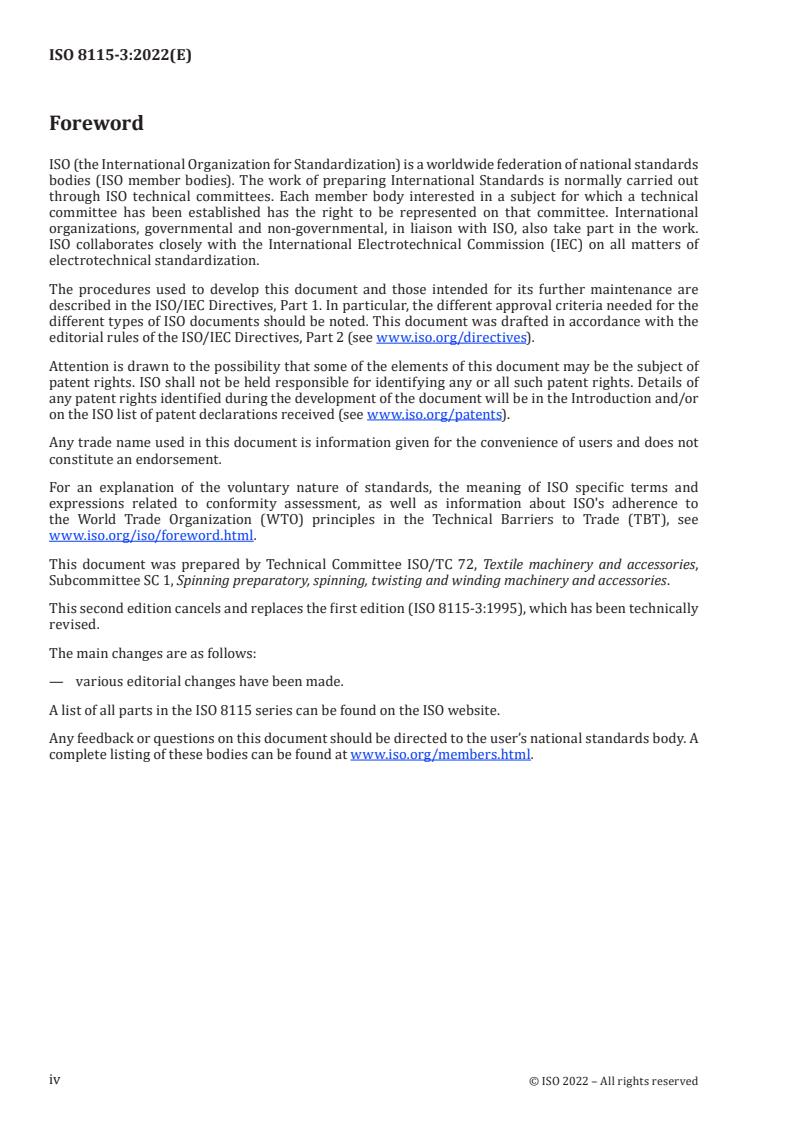
Foreword
ISO (the International Organization for Standardization) is a worldwide federation of national standards
bodies (ISO member bodies). The work of preparing International Standards is normally carried out
through ISO technical committees. Each member body interested in a subject for which a technical
committee has been established has the right to be represented on that committee. International
organizations, governmental and non-governmental, in liaison with ISO, also take part in the work.
ISO collaborates closely with the International Electrotechnical Commission (IEC) on all matters of
electrotechnical standardization.
The procedures used to develop this document and those intended for its further maintenance are
described in the ISO/IEC Directives, Part 1. In particular, the different approval criteria needed for the
different types of ISO documents should be noted. This document was drafted in accordance with the
editorial rules of the ISO/IEC Directives, Part 2 (see www.iso.org/directives).
Attention is drawn to the possibility that some of the elements of this document may be the subject of
patent rights. ISO shall not be held responsible for identifying any or all such patent rights. Details of
any patent rights identified during the development of the document will be in the Introduction and/or
on the ISO list of patent declarations received (see www.iso.org/patents).
Any trade name used in this document is information given for the convenience of users and does not
constitute an endorsement.
For an expla
...