

ISO 11785:2026
(Main)Radio frequency identification of animals — Technical concept
General Information
- Abstract
This document specifies how a transponder is activated and how the stored information is transferred to a transceiver.
- Status
- Published
- Publication Date
- 19-Mar-2026
- Technical Committee
- ISO/TC 23/SC 19 - Agricultural electronics
- Drafting Committee
- ISO/TC 23/SC 19/WG 3 - Identification
- Current Stage
- 6060 - International Standard published
- Start Date
- 20-Mar-2026
- Due Date
- 02-Jun-2026
- Completion Date
- 20-Mar-2026


Overview
ISO 11785:2026 - Radio Frequency Identification of Animals - Technical Concept is an internationally recognized standard by ISO that defines the technical framework for radio frequency identification (RFID) of animals. This standard specifies the activation process for animal identification transponders and the transfer of information from the transponder to an external transceiver. ISO 11785:2026 ensures consistent and interoperable methods for electronic animal identification, facilitating reliable tracking, management, and traceability in agriculture and related industries.
ISO 11785 operates in conjunction with ISO 11784, which defines the structure and content of the identification codes stored within RFID transponders. Adhering to ISO 11785 helps users achieve compliance with regulatory requirements and enhances the efficiency of animal management systems.
Key Topics
- Transponder Activation: Defines how a transceiver emits an electromagnetic activation field that powers and activates the animal-mounted RFID transponder.
- Information Transfer: Outlines how stored data is transferred from the transponder to the transceiver, forming the basis for reliable animal identification.
- Communication Modes:
- Full Duplex (FDX): Information is transmitted while the transceiver continues to send the activation field.
- Half Duplex (HDX): Transmission occurs after the activation field ceases, enabling efficient signal handling.
- Modulation and Encoding: Specifies detailed methods such as amplitude modulation (AM), frequency shift keying (FSK), phase shift keying (PSK), and appropriate encoding techniques, ensuring robust communication.
- Error Detection: Incorporates cyclic redundancy check (CRC) methodologies to minimize errors in data transmission.
- Synchronization: Addresses protocols for coordinating multiple transceivers, both stationary and mobile, to avoid signal interference.
- Telegram Structure: Details the format, including headers, identification codes, error detection codes, and trailer bits, for both FDX and HDX communication.
Applications
ISO 11785:2026 plays a vital role in a range of animal identification and tracking systems, especially within agriculture, livestock management, wildlife research, and animal health regulation:
- Livestock Management: Enables efficient electronic identification for cattle, sheep, pigs, and other farm animals-an essential tool for health monitoring, breeding programs, and inventory management.
- Traceability and Biosecurity: Supports real-time tracking across supply chains, aiding in disease control and compliance with food safety regulations.
- Wildlife Research: Facilitates non-intrusive data collection on movement, behavior, and population management through electronic tagging.
- Regulatory Compliance: Many governmental agencies require ISO-compliant RFID systems for animal traceability in export, import, and domestic trade scenarios.
- Efficient Data Collection: Automatic data transfer reduces manual labor and errors in recording animal information, improving the integrity of agricultural records.
Related Standards
- ISO 11784: Defines the structure and information content of the animal identification code used in ISO 11785-compliant RFID transponders.
- ISO 24631-7: Specifies synchronization methods for ISO 11785 identification systems, crucial for multi-transceiver environments.
- CCITT Recommendation G.706: Referenced for frame alignment and CRC procedures, reinforcing error detection protocols.
- Other RFID Standards: ISO/IEC 18000 series, which covers broader RFID applications and technologies, often referenced where integration with animal identification is required.
Summary
ISO 11785:2026 is essential for organizations implementing RFID-based animal identification systems. By adhering to standardized activation and data transfer protocols, users can ensure high reliability, interoperability, and regulatory compliance for electronic animal tracking and management. Widespread adoption of ISO 11785 supports traceability, food safety, and operational efficiency across agricultural and research sectors, making it a cornerstone standard in animal identification technology.
Relations
- Effective Date
- 07-Jan-2025
Get Certified
Connect with accredited certification bodies for this standard

Control Union Certifications
Global certification for agriculture and sustainability.

ECOCERT
Organic and sustainability certification.

FSC International
Forest Stewardship Council certification.
Sponsored listings
Frequently Asked Questions
ISO 11785:2026 is a standard published by the International Organization for Standardization (ISO). Its full title is "Radio frequency identification of animals — Technical concept". This standard covers: This document specifies how a transponder is activated and how the stored information is transferred to a transceiver.
This document specifies how a transponder is activated and how the stored information is transferred to a transceiver.
ISO 11785:2026 is classified under the following ICS (International Classification for Standards) categories: 65.040.99 - Other standards related to farm buildings and installations. The ICS classification helps identify the subject area and facilitates finding related standards.
ISO 11785:2026 has the following relationships with other standards: It is inter standard links to ISO 11785:1996. Understanding these relationships helps ensure you are using the most current and applicable version of the standard.
ISO 11785:2026 is available in PDF format for immediate download after purchase. The document can be added to your cart and obtained through the secure checkout process. Digital delivery ensures instant access to the complete standard document.
Standards Content (Sample)
International
Standard
ISO 11785
Second edition
Radio frequency identification of
2026-03
animals — Technical concept
Identification des animaux par radiofréquence — Concept
technique
Reference number
© ISO 2026
All rights reserved. Unless otherwise specified, or required in the context of its implementation, no part of this publication may
be reproduced or utilized otherwise in any form or by any means, electronic or mechanical, including photocopying, or posting on
the internet or an intranet, without prior written permission. Permission can be requested from either ISO at the address below
or ISO’s member body in the country of the requester.
ISO copyright office
CP 401 • Ch. de Blandonnet 8
CH-1214 Vernier, Geneva
Phone: +41 22 749 01 11
Email: copyright@iso.org
Website: www.iso.org
Published in Switzerland
ii
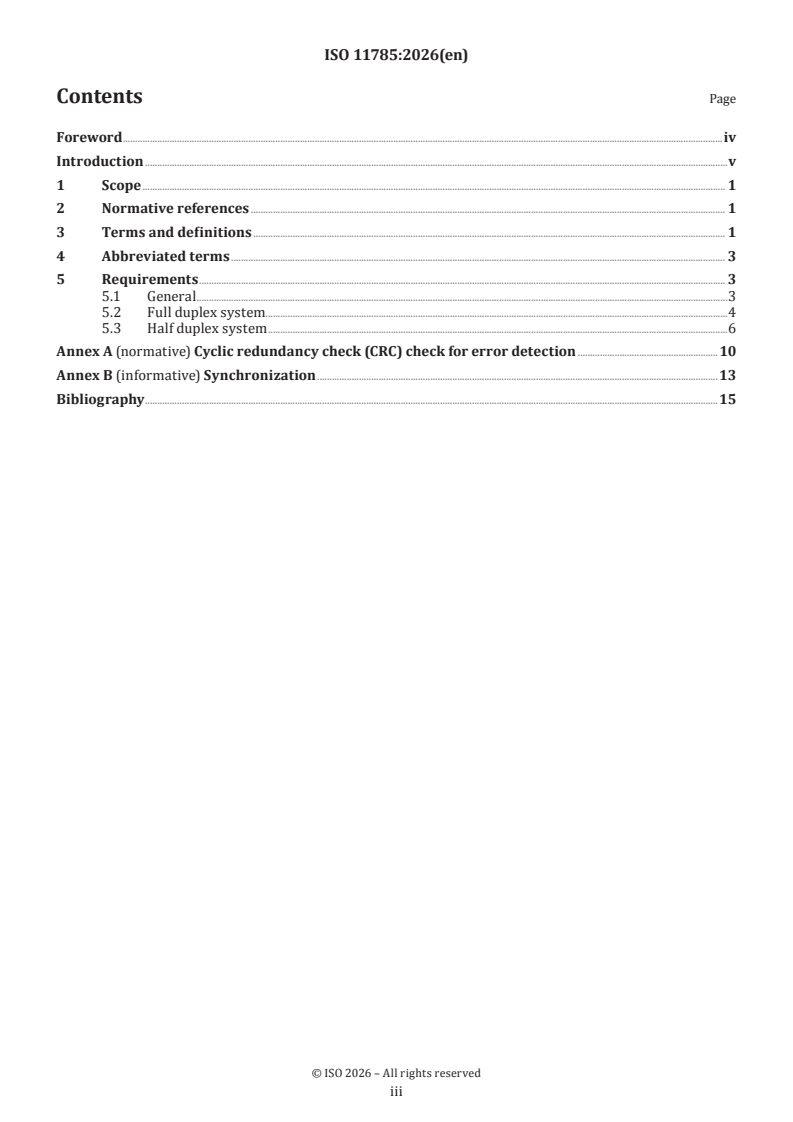
Contents Page
Foreword .iv
Introduction .v
1 Scope . 1
2 Normative references . 1
3 Terms and definitions . 1
4 Abbreviated terms . 3
5 Requirements . 3
5.1 General .3
5.2 Full duplex system . .4
5.3 Half duplex system .6
Annex A (normative) Cyclic redundancy check (CRC) check for error detection .10
Annex B (informative) Synchronization .13
Bibliography .15
iii
Foreword
ISO (the International Organization for Standardization) is a worldwide federation of national standards
bodies (ISO member bodies). The work of preparing International Standards is normally carried out through
ISO technical committees. Each member body interested in a subject for which a technical committee
has been established has the right to be represented on that committee. International organizations,
governmental and non-governmental, in liaison with ISO, also take part in the work. ISO collaborates closely
with the International Electrotechnical Commission (IEC) on all matters of electrotechnical standardization.
The procedures used to develop this document and those intended for its further maintenance are described
in the ISO/IEC Directives, Part 1. In particular, the different approval criteria needed for the different types
of ISO documents should be noted. This document was drafted in accordance with the editorial rules of the
ISO/IEC Directives, Part 2 (see www.iso.org/directives).
ISO draws attention to the possibility that the implementation of this document may involve the use of (a)
patent(s). ISO takes no position concerning the evidence, validity or applicability of any claimed patent
rights in respect thereof. As of the date of publication of this document, ISO had received notice of (a)
patent(s) which may be required to implement this document. However, implementers are cautioned that
this may not represent the latest information, which may be obtained from the patent database available at
www.iso.org/patents. ISO shall not be held responsible for identifying any or all such patent rights.
Any trade name used in this document is information given for the convenience of users and does not
constitute an endorsement.
For an explanation of the voluntary nature of standards, the meaning of ISO specific terms and expressions
related to conformity assessment, as well as information about ISO's adherence to the World Trade
Organization (WTO) principles in the Technical Barriers to Trade (TBT), see www.iso.org/iso/foreword.html.
This document was prepared by Technical Committee ISO/TC 23, Tractors and machinery for agriculture and
forestry, Subcommittee SC 19, Agricultural electronics.
This second edition cancels and replaces the first edition (ISO 11785:1996), which has been technically
revised. It also incorporates the Technical Corrigendum ISO 11785:1996/Cor. 1:2008.
The main changes are as follows.
— The annex integration of the installed base (former Annex A) has been removed. Subsequent annexes
have been relabelled.
Any feedback or questions on this document should be directed to the user’s national standards body. A
complete listing of these bodies can be found at www.iso.org/members.html.
iv
Introduction
The technical concept of animal identification described is based upon the principle of radio-frequency
identification (RFID). ISO 11785 is applicable in connection with ISO 11784 which describes the structure
and the information content of the codes stored in the transponder.
v
International Standard ISO 11785:2026(en)
Radio frequency identification of animals — Technical
concept
1 Scope
This document specifies how a transponder is activated and how the stored information is transferred to a
transceiver.
2 Normative references
The following documents are referred to in the text in such a way that some or all of their content constitutes
requirements of this document. For dated references, only the edition cited applies. For undated references,
the latest edition of the referenced document (including any amendments) applies.
ISO 11784, Radio frequency identification of animals — Code structure
ISO 24631-7, Radiofrequency identification of animals — Part 7: Synchronization of ISO 11785 identification
systems
3 Terms and definitions
For the purposes of this document, the following terms and definitions apply.
ISO and IEC maintain terminology databases for use in standardization at the following addresses:
— ISO Online browsing platform: available at https:// www .iso .org/ obp
— IEC Electropedia: available at https:// www .electropedia .org/
3.1
activation field
electromagnetic field transmitted by a transceiver to energize and/or activate a transponder
3.2
activation frequency
frequency of the activation field
3.4
bit rate
number of bits transmitted per second
3.5
differential bi-phase encoding
DBP
method of encoding in which data bit 0 is represented by a mid-bit transition, data bit 1 is represented by no
transition, and there is always a transition in between two bits
3.6
encoding
one to one relationship between basic information elements and modulation patterns
3.7
error detection code
bits that contain information which can be used to detect errors
3.8
frequency shift keying
FSK
binary information is superimposed onto a carrier electromagnetic field by shifting between discrete
frequencies of the field
3.9
full duplex
method of information exchange in which the information is communicated while the transceiver transmits
the activation field
3.10
half duplex
method of information exchange in which the information is communicated after the transceiver has
stopped transmitting the activation field
3.11
header
bits transmitted before the useful information, uniquely identifying the start of a page, which may also be
used for synchronization of the transponder and the transceiver
3.12
identification code
64 bits of the identification telegram which are specified in ISO 11784
3.13
identification telegram
total identification message (header, identification code, error detection code and trailer), possibly
repeatedly transmitted by the transponder upon activation
3.14
mobile transceiver
transceiver that is not connected to other transceivers when these are in its vicinity to synchronize
activation periods and pauses
3.15
modulation
method of superimposing information onto an electromagnetic field by means of varying a specific
parameter of the field
3.16
non-return to zero encoding
NRZ
method of encoding in which data bit 1 is a high signal and data bit 0 is a low signal
3.17
page
coherent part of the communicated information
3.18
phase shift keying
PSK
binary information is superimposed onto a carrier electromagnetic field by introducing discrete phase
shifts of the field
3.19
stationary transceiver
transceiver that is connected to other transceivers when these are in its vicinity to synchronize activation
periods and pauses
3.20
trailer
bits transmitted after the error detection code; the content of which is dependent upon the value of the flag
for an additional data block which is specified in ISO 11784
3.21
transceiver
device used to communicate with a transponder
3.22
transponder
device which transmits its stored information when activated by a transceiver and may be able to store new
information
4 Abbreviated terms
AM amplitude modulation
BCC block control character
CRC cyclic redundancy check
DBP differential bi-phase encoding
FDX full duplex
FSK frequency shift keying
HDX half duplex
LSB least significant bits
MSB most significant bits
NRZ non-return to zero encoding
PSK phase shift keying
RFID radio-frequency identification
5 Requirements
5.1 General
The system shall be defined in such a way that the FDX and HDX transponders can be read by one transceiver.
A stationary transceiver shall activate transponders using an activation field with an activation frequency
-3
of (134,2 ± 13,42 × 10 ) kHz. The activation period shall be 50 ms. If an FDX signal is received during
activation but is not validated, the activation period shall be extended until be identification telegram is
validated, but not longer than 100 ms. Consecutively, there shall be a pause in the activation signal. If an HDX
signal is received the pause shall last for 20 ms. If no HDX signal is detected within 3 ms after a 3 dB decay
of the activation field, activation shall be resumed. For synchronization reasons, each tenth activation cycle
shall have a fixed pattern of 50 ms activation and 20 ms pause (see Annex B). Synchronization of ISO 11785
identification systems shall be in accordance with ISO 24631-7.
A mobile transceiver shall be able to detect the presence of additional active transceivers through the
reception of activation signals. If no activation signal is detected within 30 ms, the mobile transceiver is
out of reach of other active transceivers and shall use the activation protocol defined above for a stationary
transceiver. If the mobile transceiver does detect an activation signal it shall wait for the rising edge of the
next activation signal and shall activate during a fixed period of 50 m
...