

ISO 4625-3:2026
(Main)Binders for paints and varnishes — Determination of softening point — Part 3: Cup method (without a ball)
- Abstract
This document specifies the cup method (without ball) for determining the softening point of resins (including rosin) and can, under user-defined conditions, give results comparable to those obtained by ISO 4625-1 and ISO 4625-2.
- Status
- Published
- Publication Date
- 18-May-2026
- Technical Committee
- ISO/TC 35 - Paints and varnishes
- Drafting Committee
- ISO/TC 35 - Paints and varnishes
- Current Stage
- 6060 - International Standard published
- Start Date
- 19-May-2026
- Due Date
- 08-Jul-2027
- Completion Date
- 19-May-2026

ISO 4625-3:2026 is an International Standard from ISO for measuring the softening point of resins, including rosin, by the cup method without a ball. It is written for laboratories and other users who need a defined test method for binders for paints and varnishes and who may want results that can be compared, under agreed conditions, with ISO 4625-1 and ISO 4625-2.
What does ISO 4625-3:2026 specify?
ISO 4625-3:2026 specifies the cup method without a ball for determining the softening point of resins. Clause 1 says the method can, under user-defined conditions, give results comparable to ISO 4625-1 and ISO 4625-2.
The document is organized into clauses 1 to 12, plus one informative annex. The main parts cover scope, normative references, terms and definitions, principle, apparatus, calibration, sample preparation, procedure, expression of results, precision and bias, and test report requirements. Annex A gives the interlaboratory comparison details used for the precision statement.
What are the key requirements of ISO 4625-3:2026?
ISO 4625-3:2026 requires a fixed, closely defined heating procedure so that results are comparable. Clause 4 explains why this matters: resins soften over a range, so the reported temperature only has meaning when the method is controlled in the same way each time.
Apparatus and calibration
Clause 5 specifies a softening point apparatus with a control unit, measuring cell, cartridge assembly, and accessories. The central processor shall provide a linear temperature increase from 25 °C to 375 °C, and the measuring cell shall heat at a linear rate with stated accuracy and detect the softening point with a precision of 0,1 °C. In practice, this means the instrument must control heating and detect flow consistently, or the result is not reliable.
Clause 6 uses benzoic acid as a primary standard for calibration, and Clause 7 allows a secondary standard with a melting point near that of the sample. The document stresses that the instrument should first conform to benzoic acid before a secondary standard is used. In practice, this helps the user check whether the instrument is behaving correctly near the temperature range of interest.
Sample preparation
Clause 8 requires the resin to be melted carefully in a disposable aluminium dish, homogenized without entraining air, and kept to no more than 60 °C above the expected softening point. The molten resin is then poured into two sample cups, allowed to cool, and trimmed so the surface is clean and free of air bubbles. This matters because trapped air or poor filling can change how the sample flows.
Test procedure and reporting
Clause 9 says the starting temperature is set below the expected softening point and the sample is heated at the specified rate until flow triggers the detector. The heating rate is user-defined, and 1,0 °C/min is described as typical for resins. If a comparison with ISO 4625-1 or ISO 4625-2 is needed, the heating rate for that correlation shall be determined for each resin type.
Clause 10 requires the mean of two determinations to be rounded to the nearest 0,5 °C. Clause 12 requires the test report to identify the product, cite ISO 4625-3:2026, state the heating rate, report the result, list deviations and anomalies, and give the test date. Clause 11 provides precision information from an interlaboratory comparison and makes no bias statement.
What terms does ISO 4625-3:2026 define?
- Softening point - the temperature at which the sample in the cup flows downward 19 mm under the test conditions.
- Primary standard - the reference material used for calibration in Clause 6, here benzoic acid.
- Secondary standard - a material used in Clause 7 to check the instrument near the sample range after primary calibration has been confirmed.
- Central processor - the unit that controls the heating program and temperature increase.
- Measuring cell - the part that heats the sample cup assembly and detects the softening point.
- Sample cup assembly - the cup and upper portion that hold the test sample during measurement.
- Repeatability - the closeness of agreement between two results under the same laboratory conditions.
- Reproducibility - the closeness of agreement between results from different laboratories.
Who uses ISO 4625-3:2026?
ISO 4625-3:2026 is used by laboratories that test resin softening point, especially in the paints and varnishes field. It is relevant to quality control, incoming inspection, product development, and supplier/customer testing where a defined softening point method is needed. It also matters to buyers and technical reviewers who need to specify or compare resin test results.
Which standards are used with ISO 4625-3:2026?
- ISO 4618 - provides the vocabulary used by the document.
- ISO 4625-1 - the ring-and-ball method, used as a comparison point when users want correlation between methods.
- ISO 4625-2 - the cup-and-ball method, also used for comparison and correlation with this part.
What does the ISO 4625-3:2026 document contain?
ISO 4625-3:2026 contains a figure of the sample cup, a secondary-standard list for instrument checks, and a worked precision basis from an interlaboratory comparison. It also sets out the calibration sequence, the sample preparation steps, the heating and detection procedure, and the cleaning actions needed after each test. Annex A describes the interlaboratory comparison used to estimate precision, including the resin samples and the types of determinations studied.
Frequently Asked Questions
ISO 4625-3:2026 is a standard published by the International Organization for Standardization (ISO). Its full title is "Binders for paints and varnishes — Determination of softening point — Part 3: Cup method (without a ball)". This standard covers: This document specifies the cup method (without ball) for determining the softening point of resins (including rosin) and can, under user-defined conditions, give results comparable to those obtained by ISO 4625-1 and ISO 4625-2.
This document specifies the cup method (without ball) for determining the softening point of resins (including rosin) and can, under user-defined conditions, give results comparable to those obtained by ISO 4625-1 and ISO 4625-2.
ISO 4625-3:2026 is classified under the following ICS (International Classification for Standards) categories: 87.060.20 - Binders. The ICS classification helps identify the subject area and facilitates finding related standards.
ISO 4625-3:2026 is available in PDF format for immediate download after purchase. The document can be added to your cart and obtained through the secure checkout process. Digital delivery ensures instant access to the complete standard document.
Standards Content (Sample)
International
Standard
ISO 4625-3
First edition
Binders for paints and varnishes —
2026-05
Determination of softening point —
Part 3:
Cup method (without a ball)
Liants pour peintures et vernis — Détermination du point de
ramollissement —
Partie 3: Méthode de la coupe (sans bille)
Reference number
© ISO 2026
All rights reserved. Unless otherwise specified, or required in the context of its implementation, no part of this publication may
be reproduced or utilized otherwise in any form or by any means, electronic or mechanical, including photocopying, or posting on
the internet or an intranet, without prior written permission. Permission can be requested from either ISO at the address below
or ISO’s member body in the country of the requester.
ISO copyright office
CP 401 • Ch. de Blandonnet 8
CH-1214 Vernier, Geneva
Phone: +41 22 749 01 11
Email: copyright@iso.org
Website: www.iso.org
Published in Switzerland
ii
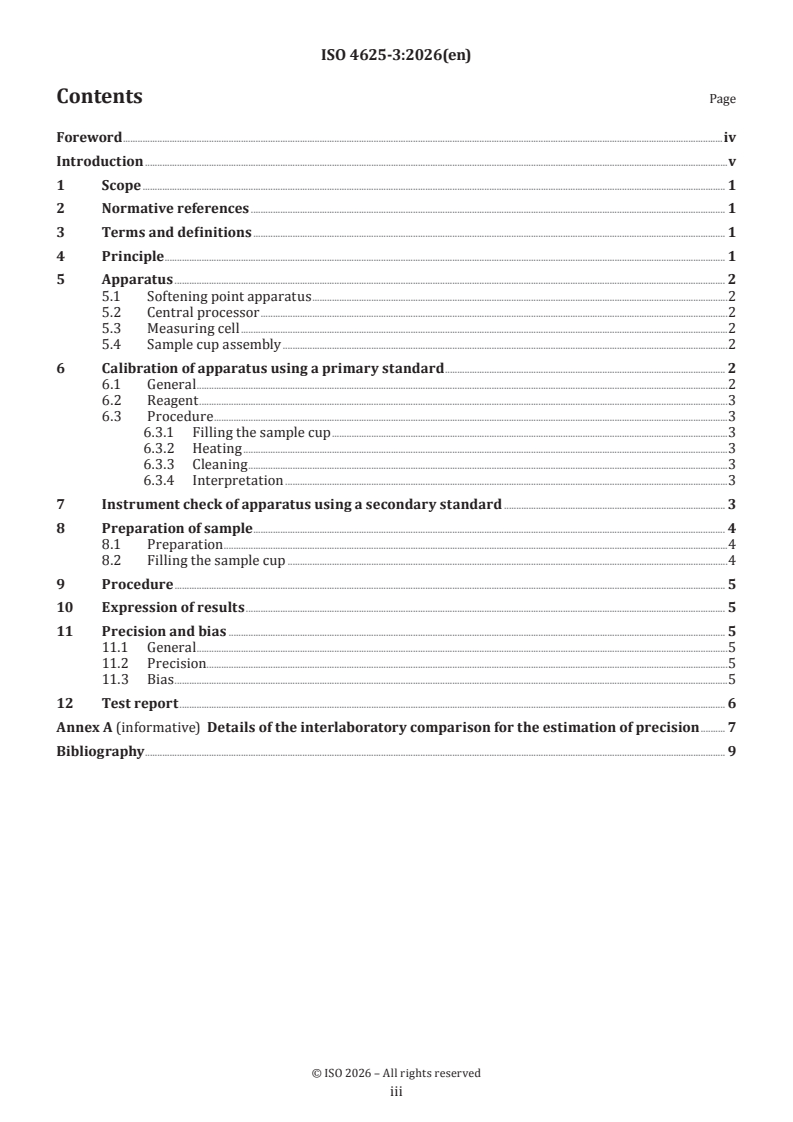
Contents Page
Foreword .iv
Introduction .v
1 Scope . 1
2 Normative references . 1
3 Terms and definitions . 1
4 Principle . 1
5 Apparatus . 2
5.1 Softening point apparatus .2
5.2 Central processor .2
5.3 Measuring cell .2
5.4 Sample cup assembly .2
6 Calibration of apparatus using a primary standard . 2
6.1 General .2
6.2 Reagent .3
6.3 Procedure .3
6.3.1 Filling the sample cup .3
6.3.2 Heating .3
6.3.3 Cleaning .3
6.3.4 Interpretation .3
7 Instrument check of apparatus using a secondary standard . 3
8 Preparation of sample . 4
8.1 Preparation .4
8.2 Filling the sample cup .4
9 Procedure . 5
10 Expression of results . 5
11 Precision and bias . 5
11.1 General .5
11.2 Precision . . .5
11.3 Bias .5
12 Test report . 6
Annex A (informative) Details of the interlaboratory comparison for the estimation of precision . 7
Bibliography . 9
iii
Foreword
ISO (the International Organization for Standardization) is a worldwide federation of national standards
bodies (ISO member bodies). The work of preparing International Standards is normally carried out through
ISO technical committees. Each member body interested in a subject for which a technical committee
has been established has the right to be represented on that committee. International organizations,
governmental and non-governmental, in liaison with ISO, also take part in the work. ISO collaborates closely
with the International Electrotechnical Commission (IEC) on all matters of electrotechnical standardization.
The procedures used to develop this document and those intended for its further maintenance are described
in the ISO/IEC Directives, Part 1. In particular, the different approval criteria needed for the different types
of ISO document should be noted. This document was drafted in accordance with the editorial rules of the
ISO/IEC Directives, Part 2 (see www.iso.org/directives).
ISO draws attention to the possibility that the implementation of this document may involve the use of (a)
patent(s). ISO takes no position concerning the evidence, validity or applicability of any claimed patent
rights in respect thereof. As of the date of publication of this document, ISO had not received notice of (a)
patent(s) which may be required to implement this document. However, implementers are cautioned that
this may not represent the latest information, which may be obtained from the patent database available at
www.iso.org/patents. ISO shall not be held responsible for identifying any or all such patent rights.
Any trade name used in this document is information given for the convenience of users and does not
constitute an endorsement.
For an explanation of the voluntary nature of standards, the meaning of ISO specific terms and expressions
related to conformity assessment, as well as information about ISO's adherence to the World Trade
Organization (WTO) principles in the Technical Barriers to Trade (TBT), see www.iso.org/iso/foreword.html.
This document was prepared by Technical Committee ISO/TC 35, Paints and varnishes.
A list of all parts in the ISO 4625 series can be found on the ISO website.
Any feedback or questions on this document should be directed to the user’s national standards body. A
complete listing of these bodies can be found at www.iso.org/members.html.
iv
Introduction
The ISO 4625 series describes three widely used procedures for the measurement of the softening point of
rosin-based resins:
— ISO 4625-1 covers the ring-and-ball method which was the principal standard for many years;
— ISO 4625-2 covers the Mettler cup-and-ball method;
— this document adds a new method, the Mettler method without the ball.
ISO 4625-2 and this document are both called Mettler cup-and-ball methods. Although the recommended
testing conditions differ, the only difference between the equipment is that this document does not require
use of a ball. ISO 4625-2 is the most widely used in the US and the method described in this document is
most widely used in Europe. These methods are less time consuming than the ring-and-ball manual method
and the equipment is less expensive than the ring-and-ball automated method.
As a consequence of the thermoplastic nature of the test resins, the softening points obtained using the
recommended test conditions for all three methods are not the generally the same. Consequently, the test
method and the testing conditions used should be noted in the final report.
v
International Standard ISO 4625-3:2026(en)
Binders for paints and varnishes — Determination of
softening point —
Part 3:
Cup method (without a ball)
1 Scope
This document specifies the cup method (without ball) for determining the softening point of resins
(including rosin) and can, under user-defined conditions, give results comparable to those obtained by
ISO 4625-1 and ISO 4625-2.
2 Normative references
The following documents are referred to in the text in such a way that some or all of their content constitutes
requirements of this document. For dated references, only the edition cited applies. For undated references,
the latest edition of the referenced document (including any amendments) applies.
ISO 4618, Paints and varnishes — Vocabulary
3 Terms and definitions
For the purposes of this document, the terms and definitions given in ISO 4618 and the following apply.
ISO and IEC maintain terminology databases for use in standardization at the following addresses:
— ISO Online browsing platform: available at https:// www .iso .org/ obp
— IEC Electropedia: available at https:// www .electropedia .org/
3.1
softening point
temperature at which the sample, suspended in a cylindrical cup with a 6,35 mm hole in the bottom and
without a stainless-steel ball, flows downward a distance of 19 mm, as the sample is heated at linear rate in
air
4 Principle
In general, with materials of these types, softening does not take place at a definite temperature. As the
temperature rises, these materials gradually change from brittle or exceedingly thick and slow-flowing
materials to softer and less viscous liquids. For this reason, the determination of the softening point shall be
made by a fixed, arbitrary, and closely defined method if the results obtained are intended to be comparable.
The disc of the test sample is placed in a cup and heated at a specified rate. The softening sample is forced
by its own weight downwards. The temperature at which
...