


ISO/IEC TR 19583-1:2019
(Main)Information technology — Concepts and usage of metadata — Part 1: Metadata concepts
Information technology — Concepts and usage of metadata — Part 1: Metadata concepts
This document describes the basic concept of metadata, and its relationship to both data and metamodels.
Technologies de l'information — Concepts et utilisation des métadonnées — Partie 1: Concepts liés aux métadonnées
General Information
- Status
- Published
- Publication Date
- 25-Jul-2019
- Technical Committee
- ISO/IEC JTC 1/SC 32 - Data management and interchange
- Drafting Committee
- ISO/IEC JTC 1/SC 32/WG 2 - MetaData
- Current Stage
- 6060 - International Standard published
- Start Date
- 26-Jul-2019
- Completion Date
- 30-Jun-2018
Overview
ISO/IEC TR 19583-1:2019 is an international standard technical report developed by ISO and IEC that introduces the fundamental concepts of metadata within the context of information technology. The document offers a broad perspective on how metadata defines and describes data and elaborates its vital relationship to metamodels. This standard serves as a foundational reference for professionals in data management, IT systems development, library sciences, and anyone responsible for the governance, interoperability, or documentation of data resources.
Metadata, described as "data that describes other data," enables organizations to structure, discover, identify, and manage data efficiently. ISO/IEC TR 19583-1:2019 details the nature of metadata and provides a framework for understanding its various forms-including structural, descriptive, and administrative metadata-and the critical role they play in data management practices.
Key Topics
Definition and Context of Metadata:
This standard clarifies what constitutes metadata and distinguishes its various forms depending on context and use, such as structural, descriptive, and administrative metadata.Structural Metadata:
Focuses on the organizational aspects of data-like database schemas, table definitions, data constraints, and relationships-which are crucial for data integrity, interoperability, and system development.Descriptive Metadata:
Supports efficient information discovery and identification, commonly used in libraries, archives, and web content management. Examples include the Dublin Core Metadata Element Set for documents and web pages.Administrative Metadata:
Deals with data management, such as tracking data creation, user access, and data lifecycle details, critical for governance and multimedia resource handling.Relationship to Metamodels:
Establishes the layered connection between data, metadata, and metamodels, explaining how conceptual, logical, and physical data models underpin metadata registries and repositories, enabling advanced data governance and harmonization.
Applications
ISO/IEC TR 19583-1:2019 has practical applications across a wide range of sectors and use cases:
Enterprise Data Management:
Organizations use this standard to classify, register, and manage enterprise-wide data resources. Understanding metadata helps in building data dictionaries, repositories, and registries, which are crucial for maintaining data quality and consistency.Systems Development and Interoperability:
Metadata defined by this standard supports system analysts and developers in designing interoperable IT systems, aligning with frameworks like ISO/IEC 11179 and ISO/IEC 19763 for greater data integration and exchange.Library and Document Management:
The principles set forth guide librarians and archivists in cataloguing, discovering, and connecting content, using descriptive metadata standards for digital assets.Multimedia and Content Management:
Administrative and embedded metadata are used to manage and process multimedia files, supporting search, access, and usability of images, videos, and audio files.Information Governance and Compliance:
By implementing structured metadata, organizations can enhance their compliance, data auditability, and stewardship programs, ensuring data traceability and proper access controls.
Related Standards
ISO/IEC 11179 series:
Focuses on metadata registries (MDR) and standardizes how metadata is structured, registered, and managed.ISO/IEC 19763 series:
Defines the metamodel framework for interoperability, critical for complex systems integration.ISO 15836 (Dublin Core):
A widely used descriptive metadata schema for diverse information resources.IEEE 1484.12.1:
Standard for Learning Object Metadata, relevant for educational and e-learning metadata management.ISO/IEC 10027:1990:
Introduces the Information Resource Dictionary System (IRDS) framework, further detailing data, metadata, and their interrelations.
By adhering to ISO/IEC TR 19583-1:2019, organizations create a reliable foundation for metadata usage, supporting effective data management, system interoperability, and long-term information resource value.
Buy Documents

ISO/IEC TR 19583-1:2019 - Information technology -- Concepts and usage of metadata

ISO/IEC TR 19583-1:2019 - Information technology — Concepts and usage of metadata — Part 1: Metadata concepts/26/2019
Get Certified
Connect with accredited certification bodies for this standard

BSI Group
BSI (British Standards Institution) is the business standards company that helps organizations make excellence a habit.

NYCE
Mexican standards and certification body.
Sponsored listings
Frequently Asked Questions
ISO/IEC TR 19583-1:2019 is a technical report published by the International Organization for Standardization (ISO). Its full title is "Information technology — Concepts and usage of metadata — Part 1: Metadata concepts". This standard covers: This document describes the basic concept of metadata, and its relationship to both data and metamodels.
This document describes the basic concept of metadata, and its relationship to both data and metamodels.
ISO/IEC TR 19583-1:2019 is classified under the following ICS (International Classification for Standards) categories: 35.040.50 - Automatic identification and data capture techniques. The ICS classification helps identify the subject area and facilitates finding related standards.
ISO/IEC TR 19583-1:2019 is available in PDF format for immediate download after purchase. The document can be added to your cart and obtained through the secure checkout process. Digital delivery ensures instant access to the complete standard document.
Standards Content (Sample)
TECHNICAL ISO/IEC TR
REPORT 19583-1
First edition
2019-07
Information technology — Concepts
and usage of metadata —
Part 1:
Metadata concepts
Technologies de l'information — Concepts et utilisation des
métadonnées —
Partie 1: Concepts liés aux métadonnées
Reference number
©
ISO/IEC 2019
© ISO/IEC 2019
All rights reserved. Unless otherwise specified, or required in the context of its implementation, no part of this publication may
be reproduced or utilized otherwise in any form or by any means, electronic or mechanical, including photocopying, or posting
on the internet or an intranet, without prior written permission. Permission can be requested from either ISO at the address
below or ISO’s member body in the country of the requester.
ISO copyright office
CP 401 • Ch. de Blandonnet 8
CH-1214 Vernier, Geneva
Phone: +41 22 749 01 11
Fax: +41 22 749 09 47
Email: copyright@iso.org
Website: www.iso.org
Published in Switzerland
ii © ISO/IEC 2019 – All rights reserved
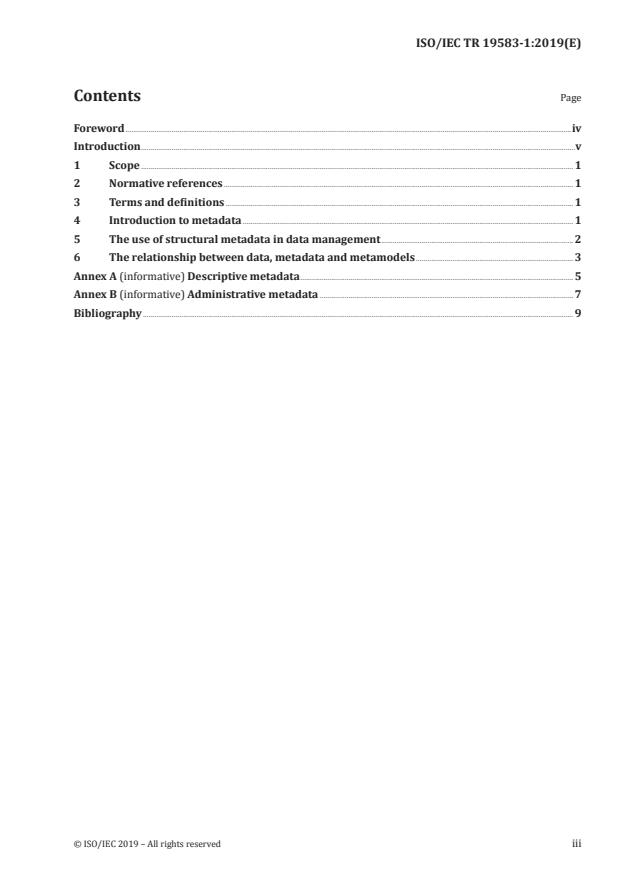
Contents Page
Foreword .iv
Introduction .v
1 Scope . 1
2 Normative references . 1
3 Terms and definitions . 1
4 Introduction to metadata . 1
5 The use of structural metadata in data management . 2
6 The relationship between data, metadata and metamodels . 3
Annex A (informative) Descriptive metadata . 5
Annex B (informative) Administrative metadata . 7
Bibliography . 9
© ISO/IEC 2019 – All rights reserved iii
Foreword
ISO (the International Organization for Standardization) and IEC (the International Electrotechnical
Commission) form the specialized system for worldwide standardization. National bodies that
are members of ISO or IEC participate in the development of International Standards through
technical committees established by the respective organization to deal with particular fields of
technical activity. ISO and IEC technical committees collaborate in fields of mutual interest. Other
international organizations, governmental and non-governmental, in liaison with ISO and IEC, also
take part in the work.
The procedures used to develop this document and those intended for its further maintenance are
described in the ISO/IEC Directives, Part 1. In particular, the different approval criteria needed for
the different types of document should be noted. This document was drafted in accordance with the
editorial rules of the ISO/IEC Directives, Part 2 (see www .iso .org/directives).
Attention is drawn to the possibility that some of the elements of this document may be the subject
of patent rights. ISO and IEC shall not be held responsible for identifying any or all such patent
rights. Details of any patent rights identified during the development of the document will be in the
Introduction and/or on the ISO list of patent declarations received (see www .iso .org/patents) or the IEC
list of patent declarations received (see http: //patents .iec .ch).
Any trade name used in this document is information given for the convenience of users and does not
constitute an endorsement.
For an explanation of the voluntary nature of standards, the meaning of ISO specific terms and
expressions related to conformity assessment, as well as information about ISO's adherence to the
World Trade Organization (WTO) principles in the Technical Barriers to Trade (TBT) see www .iso
.org/iso/foreword .html.
This document was prepared by Joint Technical Committee ISO/IEC JTC 1, Information technology,
Subcommittee SC 32, Data management and interchange.
A list of all parts in the ISO/IEC 19583 series can be found on the ISO website.
Any feedback or questions on this document should be directed to the user’s national standards body. A
complete listing of these bodies can be found at www .iso .org/members .html.
iv © ISO/IEC 2019 – All rights reserved
Introduction
This document describes the concept of metadata, particularly in respect of its use within the data
management speciality in information technology.
[2] [4]
The ISO/IEC 11179 and ISO/IEC 19763 series describe the structure for registering information
about metadata that is used and/or held elsewhere.
The ISO/IEC 11179 series defines metadata as “data that defines and describes other data”. There are,
however, many other definitions of metadata that are used more generally, for example, the US National
Information Standards Organization (NISO) defines metadata as "structured information which
describes, explains, locates, or otherwise makes it easier to retrieve, use, or manage an information
resource”.
Metadata is, therefore, just data, but data which has the specific purpose of defining or describing other
data. Metadata is normally used within a particular context, which is the set of circumstances, purposes
or perspectives within which any particular item of data is used as metadata. Metadata can, therefore,
be considered to be data about data within some context.
The definitions above, by themselves, do not say how metadata arises, where it comes from, how it is
used, or how it is managed (although the ISO/IEC 11179 series describes the facilities for registering
and managing structured metadata). For those reasons, this document has been developed to provide a
broader view of metadata and the associated concept of the metamodel.
These concepts of metadata and metamodels are important when trying to understand exactly
what is being registered within the registries whose structure is specified in the ISO/IEC 11179 and
ISO/IEC 19763 series.
© ISO/IEC 2019 – All rights reserved v
TECHNICAL REPORT ISO/IEC TR 19583-1:2019(E)
Information technology — Concepts and usage of
metadata —
Part 1:
Metadata concepts
1 Scope
This document describes the basic concept of metadata, and its relationship to both data and
metamodels.
2 Normative references
There are no normative references in this document.
3 Terms and definitions
ISO and IEC maintain terminological databases for use in standardization at the following addresses:
— ISO Online browsing platform: available at https: //www .iso .org/obp
— IEC Electropedia: available at http: //www .electropedia .org/
4 Introduction to metadata
Metadata is defined as “data that defines and describes other data”. This is a very broad definition of
metadata leaving room for confusion. It is often said that one person’s metadata is another person’s
data. Whether any piece of data is seen as metadata or just data depends on the context. These contexts
can be classified into three distinct groups:
— structural metadata: the metadata used by those responsible for the management of data in
information systems to describe the ‘containers’ of data, for example, the tables and columns in a
database managed using the SQL database language;
— descriptive metadata: the metadata used for the discovery and identification of content, such as
by librarians, and the metadata that helps to further describe other data, such as metadata that a
scientist has observed about continuous or systematically produced data;
— administrative metadata: the metadata associated with data values, such as metadata describing
when and who created the data, who can edit and manage the data, and any other information about
the data that is deemed useful, including metadata that describes multimedia data.
The focus of this document is the first of these groups: the structural metadata used within data
management. The use of descriptive metadata is explained in Annex A and the use of administrative
metadata is explained in Annex B.
For any data to be useful or shareable the meaning of the data (the semantics), the data type and format
of the data (the syntax) and the relationship of the data to other data (the structure) must be known. All
of this information about data is metadata.
Metadata is independent of the systems that produce the data. Metadata is usually defined before
systems are built, either as part of the systems development of an individual system or as part of an
© ISO/IEC 2019 – All rights reserved 1
enterprise-wide data management initiative. However, metadata can be recorded after the data has
been created in less formal systems as part of a data documentation initiative. The only significant
difference between single-system metadata and enterprise-wide metadata is the scope of the metadata,
although there might be differences around the degree of formality applied to its creation.
5 The use of structural metadata in data management
The traditional data management view of metadata is that it describes the types of data stored in a
database and also describes how that data is to be managed. Examples of such metadata are:
— table and column definitions for a database schema managed by an SQL database management system;
— definitions of any constraints used for validating the data to be placed in the database;
— rules for accessing the data in the database;
— rules for maintaining the quality of the data in the database;
— predicted volumes for the data in the database.
A more comprehensive view of metadata within the data management community is that metadata
[6]
is defined very early in the systems development lifecycle . Conceptual data models and the data
definitions derived from them can, therefore, be considered as metadata. The relationships shown on a
conceptual data model can also be considered as metadata.
At the enterprise level, other information about data can be viewed as metadata. Details of the
ownership and source of data definitions can be viewed as metadata, as can any other information
that helps business users and system developers with understanding what data is recorded in the
enterprise’s databases, and where it is recorded.
Metadata may be held on paper or electronically, or both. In addition to the diagrams of the data models
for the system, paper-based metadata can include glossaries of business terms that support the use of
the data, descriptions of the information systems owned by the enterprise, and descriptions of the data
held by each system. Metadata that is held electronically may be stored in the information technology
systems, for example, in the system tables, where this metadata supports the creation and management
of the data held in the individual systems. Metadata may also be held electronically within a data
warehouse to describe the schemas of the operational systems that feed the data warehouse to assist
with the transformation and loading of that data into the data warehouse.
Metadata may also be held electronically in stand-alone systems to support interoperability by
enabling the common understanding of data that is shared between separate systems. These stand-
alone systems are often called data dictionaries, repositories or registries. Such stand-alone systems
will each have its own database. The structure of that database will be represented in a series of data
models that together describe what information about the metadata is to be held and how it is to be
held. The relationships between the information may also be described in the models.
These data models can be produced at three levels:
— The conceptual model, or computation independent model, is a model that specifies what
information is to be held by the system (i.e., the data dictionary, repository or registry). Note that
with a conceptual model there is no assumption that the final system will be using any information
technology; its implementation could be paper-based.
— The logical model, or platform independent model, is the model that begins to consider how the
information is to be held in an information technology-based system. For example, a logical model
can be developed on the assumption that the system will have a database managed using the SQL
database language.
— The physical model, or platform specific model, is the model that specifies how the information
is to be held in the particular implementation selected for the system. For example, at this level
consideration should be given to such details as the naming and allocation of tables to tablespaces.
2 © ISO/IEC 2019 – All rights reserved
Each of these models (conceptual, logical and physical) for a data dictionary, repository or registry is
known as a metamodel – a model of a model.
Metamodels need not only be used to describe the requirements to hold information about metadata.
It is often useful for repositories and registries to hold information about other resources that are
important to an enterprise, such as the processes supported by
...
TECHNICAL ISO/IEC TR
REPORT 19583-1
First edition
2019-07
Information technology — Concepts
and usage of metadata —
Part 1:
Metadata concepts
Technologies de l'information — Concepts et utilisation des
métadonnées —
Partie 1: Concepts liés aux métadonnées
Reference number
©
ISO/IEC 2019
© ISO/IEC 2019
All rights reserved. Unless otherwise specified, or required in the context of its implementation, no part of this publication may
be reproduced or utilized otherwise in any form or by any means, electronic or mechanical, including photocopying, or posting
on the internet or an intranet, without prior written permission. Permission can be requested from either ISO at the address
below or ISO’s member body in the country of the requester.
ISO copyright office
CP 401 • Ch. de Blandonnet 8
CH-1214 Vernier, Geneva
Phone: +41 22 749 01 11
Fax: +41 22 749 09 47
Email: copyright@iso.org
Website: www.iso.org
Published in Switzerland
ii © ISO/IEC 2019 – All rights reserved
Contents Page
Foreword .iv
Introduction .v
1 Scope . 1
2 Normative references . 1
3 Terms and definitions . 1
4 Introduction to metadata . 1
5 The use of structural metadata in data management . 2
6 The relationship between data, metadata and metamodels . 3
Annex A (informative) Descriptive metadata . 5
Annex B (informative) Administrative metadata . 7
Bibliography . 9
© ISO/IEC 2019 – All rights reserved iii
Foreword
ISO (the International Organization for Standardization) and IEC (the International Electrotechnical
Commission) form the specialized system for worldwide standardization. National bodies that
are members of ISO or IEC participate in the development of International Standards through
technical committees established by the respective organization to deal with particular fields of
technical activity. ISO and IEC technical committees collaborate in fields of mutual interest. Other
international organizations, governmental and non-governmental, in liaison with ISO and IEC, also
take part in the work.
The procedures used to develop this document and those intended for its further maintenance are
described in the ISO/IEC Directives, Part 1. In particular, the different approval criteria needed for
the different types of document should be noted. This document was drafted in accordance with the
editorial rules of the ISO/IEC Directives, Part 2 (see www .iso .org/directives).
Attention is drawn to the possibility that some of the elements of this document may be the subject
of patent rights. ISO and IEC shall not be held responsible for identifying any or all such patent
rights. Details of any patent rights identified during the development of the document will be in the
Introduction and/or on the ISO list of patent declarations received (see www .iso .org/patents) or the IEC
list of patent declarations received (see http: //patents .iec .ch).
Any trade name used in this document is information given for the convenience of users and does not
constitute an endorsement.
For an explanation of the voluntary nature of standards, the meaning of ISO specific terms and
expressions related to conformity assessment, as well as information about ISO's adherence to the
World Trade Organization (WTO) principles in the Technical Barriers to Trade (TBT) see www .iso
.org/iso/foreword .html.
This document was prepared by Joint Technical Committee ISO/IEC JTC 1, Information technology,
Subcommittee SC 32, Data management and interchange.
A list of all parts in the ISO/IEC 19583 series can be found on the ISO website.
Any feedback or questions on this document should be directed to the user’s national standards body. A
complete listing of these bodies can be found at www .iso .org/members .html.
iv © ISO/IEC 2019 – All rights reserved
Introduction
This document describes the concept of metadata, particularly in respect of its use within the data
management speciality in information technology.
[2] [4]
The ISO/IEC 11179 and ISO/IEC 19763 series describe the structure for registering information
about metadata that is used and/or held elsewhere.
The ISO/IEC 11179 series defines metadata as “data that defines and describes other data”. There are,
however, many other definitions of metadata that are used more generally, for example, the US National
Information Standards Organization (NISO) defines metadata as "structured information which
describes, explains, locates, or otherwise makes it easier to retrieve, use, or manage an information
resource”.
Metadata is, therefore, just data, but data which has the specific purpose of defining or describing other
data. Metadata is normally used within a particular context, which is the set of circumstances, purposes
or perspectives within which any particular item of data is used as metadata. Metadata can, therefore,
be considered to be data about data within some context.
The definitions above, by themselves, do not say how metadata arises, where it comes from, how it is
used, or how it is managed (although the ISO/IEC 11179 series describes the facilities for registering
and managing structured metadata). For those reasons, this document has been developed to provide a
broader view of metadata and the associated concept of the metamodel.
These concepts of metadata and metamodels are important when trying to understand exactly
what is being registered within the registries whose structure is specified in the ISO/IEC 11179 and
ISO/IEC 19763 series.
© ISO/IEC 2019 – All rights reserved v
TECHNICAL REPORT ISO/IEC TR 19583-1:2019(E)
Information technology — Concepts and usage of
metadata —
Part 1:
Metadata concepts
1 Scope
This document describes the basic concept of metadata, and its relationship to both data and
metamodels.
2 Normative references
There are no normative references in this document.
3 Terms and definitions
ISO and IEC maintain terminological databases for use in standardization at the following addresses:
— ISO Online browsing platform: available at https: //www .iso .org/obp
— IEC Electropedia: available at http: //www .electropedia .org/
4 Introduction to metadata
Metadata is defined as “data that defines and describes other data”. This is a very broad definition of
metadata leaving room for confusion. It is often said that one person’s metadata is another person’s
data. Whether any piece of data is seen as metadata or just data depends on the context. These contexts
can be classified into three distinct groups:
— structural metadata: the metadata used by those responsible for the management of data in
information systems to describe the ‘containers’ of data, for example, the tables and columns in a
database managed using the SQL database language;
— descriptive metadata: the metadata used for the discovery and identification of content, such as
by librarians, and the metadata that helps to further describe other data, such as metadata that a
scientist has observed about continuous or systematically produced data;
— administrative metadata: the metadata associated with data values, such as metadata describing
when and who created the data, who can edit and manage the data, and any other information about
the data that is deemed useful, including metadata that describes multimedia data.
The focus of this document is the first of these groups: the structural metadata used within data
management. The use of descriptive metadata is explained in Annex A and the use of administrative
metadata is explained in Annex B.
For any data to be useful or shareable the meaning of the data (the semantics), the data type and format
of the data (the syntax) and the relationship of the data to other data (the structure) must be known. All
of this information about data is metadata.
Metadata is independent of the systems that produce the data. Metadata is usually defined before
systems are built, either as part of the systems development of an individual system or as part of an
© ISO/IEC 2019 – All rights reserved 1
enterprise-wide data management initiative. However, metadata can be recorded after the data has
been created in less formal systems as part of a data documentation initiative. The only significant
difference between single-system metadata and enterprise-wide metadata is the scope of the metadata,
although there might be differences around the degree of formality applied to its creation.
5 The use of structural metadata in data management
The traditional data management view of metadata is that it describes the types of data stored in a
database and also describes how that data is to be managed. Examples of such metadata are:
— table and column definitions for a database schema managed by an SQL database management system;
— definitions of any constraints used for validating the data to be placed in the database;
— rules for accessing the data in the database;
— rules for maintaining the quality of the data in the database;
— predicted volumes for the data in the database.
A more comprehensive view of metadata within the data management community is that metadata
[6]
is defined very early in the systems development lifecycle . Conceptual data models and the data
definitions derived from them can, therefore, be considered as metadata. The relationships shown on a
conceptual data model can also be considered as metadata.
At the enterprise level, other information about data can be viewed as metadata. Details of the
ownership and source of data definitions can be viewed as metadata, as can any other information
that helps business users and system developers with understanding what data is recorded in the
enterprise’s databases, and where it is recorded.
Metadata may be held on paper or electronically, or both. In addition to the diagrams of the data models
for the system, paper-based metadata can include glossaries of business terms that support the use of
the data, descriptions of the information systems owned by the enterprise, and descriptions of the data
held by each system. Metadata that is held electronically may be stored in the information technology
systems, for example, in the system tables, where this metadata supports the creation and management
of the data held in the individual systems. Metadata may also be held electronically within a data
warehouse to describe the schemas of the operational systems that feed the data warehouse to assist
with the transformation and loading of that data into the data warehouse.
Metadata may also be held electronically in stand-alone systems to support interoperability by
enabling the common understanding of data that is shared between separate systems. These stand-
alone systems are often called data dictionaries, repositories or registries. Such stand-alone systems
will each have its own database. The structure of that database will be represented in a series of data
models that together describe what information about the metadata is to be held and how it is to be
held. The relationships between the information may also be described in the models.
These data models can be produced at three levels:
— The conceptual model, or computation independent model, is a model that specifies what
information is to be held by the system (i.e., the data dictionary, repository or registry). Note that
with a conceptual model there is no assumption that the final system will be using any information
technology; its implementation could be paper-based.
— The logical model, or platform independent model, is the model that begins to consider how the
information is to be held in an information technology-based system. For example, a logical model
can be developed on the assumption that the system will have a database managed using the SQL
database language.
— The physical model, or platform specific model, is the model that specifies how the information
is to be held in the particular implementation selected for the system. For example, at this level
consideration should be given to such details as the naming and allocation of tables to tablespaces.
2 © ISO/IEC 2019 – All rights reserved
Each of these models (conceptual, logical and physical) for a data dictionary, repository or registry is
known as a metamodel – a model of a model.
Metamodels need not only be used to describe the requirements to hold information about metadata.
It is often useful for repositories and registries to hold information about other resources that are
important to an enterprise, such as the processes supported by
...
Questions, Comments and Discussion
Ask us and Technical Secretary will try to provide an answer. You can facilitate discussion about the standard in here.
Loading comments...