

ISO 19916-4:2026
(Main)Glass in building — Vacuum insulating glass — Part 4: Pendulum impact testing and classification
General Information
- Abstract
This document specifies a method to evaluate, by means of impactors described in ISO 29584:2015, safe breakage characteristics of vacuum insulating glass (VIG) products intended to reduce cutting and piercing injuries to persons through accidental impact. This document does not specify the intended use of the products, but provides a method of classification in terms of the performance of the products being tested. The impact energy used for the various levels of classification are designed to provide the intended user or the legislator with the information to assist in defining the level of safety and protection required relative to the intended location at which the selected safety glass is to be used. The products to which this document is applicable are: VIG without further processing (Group 2); VIG processed into a laminated glass (Group 1); VIG backed with an adhesive (safety) film (Group 1). Insulating glass units incorporating VIG are excluded from this document.
- Status
- Published
- Publication Date
- 07-May-2026
- Technical Committee
- ISO/TC 160 - Glass in building
- Drafting Committee
- ISO/TC 160 - Glass in building
- Current Stage
- 6060 - International Standard published
- Start Date
- 08-May-2026
- Due Date
- 27-Apr-2026
- Completion Date
- 08-May-2026

Overview
ISO 19916-4:2026, titled Glass in building - Vacuum insulating glass - Part 4: Pendulum impact testing and classification, is an international standard developed by ISO/TC 160 (Glass in Building). This standard provides a methodology for evaluating the safety characteristics of vacuum insulating glass (VIG) when subjected to accidental human impact. By utilizing specific impactors referenced in ISO 29584:2015, it defines criteria to classify VIG products based on their breakage performance, helping to minimize the risk of cutting and piercing injuries. The standard is focused on performance classification rather than specifying intended applications, enabling users, architects, and regulatory authorities to make informed choices about safety glass in various settings.
Key Topics
- Applicability: Covers VIG without further processing (Group 2), VIG laminated glass, and VIG with safety film backing (Group 1). Insulating glass units with VIG are excluded.
- Test Methodology: Specifies pendulum impact testing procedures, specimen preparation, and test apparatus requirements aligned with ISO 29584:2015.
- Mode of Breakage:
- Type A: Standard fracture with large, sharp fragments
- Type B: Cracking, but fragments remain held together (laminated/film-backed)
- Type C: Disintegration into many small, relatively harmless pieces (tempered)
- Performance Classification: Outlines a three-level drop height class system, correlating impact energy with safety performance. Classification aids in choosing appropriate glass for different locations.
- Reporting and Documentation: Details specific information that must be included in test reports for full traceability and transparency.
- Fragmentation Testing: For tempered glass panes that do not break during impact tests, an additional fragmentation test is required to verify breakage pattern compliance.
Applications
ISO 19916-4:2026 is essential for:
- Building safety planning: Architects, specifiers, and contractors use this standard to select VIG products that meet safety criteria for areas prone to accidental impact, such as doors, windows, partitions, and glass walls.
- Regulatory compliance: Legislators and building code officials reference these classifications to establish minimum safety requirements for glass installations in public and private buildings.
- Product development and quality assurance: Glass manufacturers and processors utilize the testing methodology and classification system to ensure their VIG products offer consistent and verifiable safety performance.
- Risk assessment: Facility managers and safety consultants rely on standardized test results to evaluate the suitability and risk profile of VIG in various environments, helping to reduce liability and enhance occupant protection.
Related Standards
- ISO 29584:2015: Glass in building - Pendulum impact testing and classification of safety glass. Provides fundamental test methods referenced throughout ISO 19916-4.
- ISO 19916-1: Glass in building - Vacuum insulating glass - Part 1: Basic specification of products and evaluation methods for thermal and sound insulating performance. Establishes terminology and essential criteria for VIG products used in buildings.
- ISO 12540:2017: Glass in building - Tempered soda lime silicate safety glass. Specifies requirements and test procedures for tempered glass, including fragmentation testing referenced in ISO 19916-4.
Keywords: vacuum insulating glass, VIG, pendulum impact testing, glass safety classification, building glass standard, ISO 19916-4, breakage mode, glazing safety, impact-resistant glass, tempered laminated glass, safety glazing in buildings.
Frequently Asked Questions
ISO 19916-4:2026 is a standard published by the International Organization for Standardization (ISO). Its full title is "Glass in building — Vacuum insulating glass — Part 4: Pendulum impact testing and classification". This standard covers: This document specifies a method to evaluate, by means of impactors described in ISO 29584:2015, safe breakage characteristics of vacuum insulating glass (VIG) products intended to reduce cutting and piercing injuries to persons through accidental impact. This document does not specify the intended use of the products, but provides a method of classification in terms of the performance of the products being tested. The impact energy used for the various levels of classification are designed to provide the intended user or the legislator with the information to assist in defining the level of safety and protection required relative to the intended location at which the selected safety glass is to be used. The products to which this document is applicable are: VIG without further processing (Group 2); VIG processed into a laminated glass (Group 1); VIG backed with an adhesive (safety) film (Group 1). Insulating glass units incorporating VIG are excluded from this document.
This document specifies a method to evaluate, by means of impactors described in ISO 29584:2015, safe breakage characteristics of vacuum insulating glass (VIG) products intended to reduce cutting and piercing injuries to persons through accidental impact. This document does not specify the intended use of the products, but provides a method of classification in terms of the performance of the products being tested. The impact energy used for the various levels of classification are designed to provide the intended user or the legislator with the information to assist in defining the level of safety and protection required relative to the intended location at which the selected safety glass is to be used. The products to which this document is applicable are: VIG without further processing (Group 2); VIG processed into a laminated glass (Group 1); VIG backed with an adhesive (safety) film (Group 1). Insulating glass units incorporating VIG are excluded from this document.
ISO 19916-4:2026 is classified under the following ICS (International Classification for Standards) categories: 81.040.20 - Glass in building. The ICS classification helps identify the subject area and facilitates finding related standards.
ISO 19916-4:2026 is available in PDF format for immediate download after purchase. The document can be added to your cart and obtained through the secure checkout process. Digital delivery ensures instant access to the complete standard document.
Standards Content (Sample)
International
Standard
ISO 19916-4
First edition
Glass in building — Vacuum
2026-05
insulating glass —
Part 4:
Pendulum impact testing and
classification
Verre dans la construction — Vitrage isolant à lame de vide —
Partie 4: Essai de choc au pendule et classification
Reference number
© ISO 2026
All rights reserved. Unless otherwise specified, or required in the context of its implementation, no part of this publication may
be reproduced or utilized otherwise in any form or by any means, electronic or mechanical, including photocopying, or posting on
the internet or an intranet, without prior written permission. Permission can be requested from either ISO at the address below
or ISO’s member body in the country of the requester.
ISO copyright office
CP 401 • Ch. de Blandonnet 8
CH-1214 Vernier, Geneva
Phone: +41 22 749 01 11
Email: copyright@iso.org
Website: www.iso.org
Published in Switzerland
ii
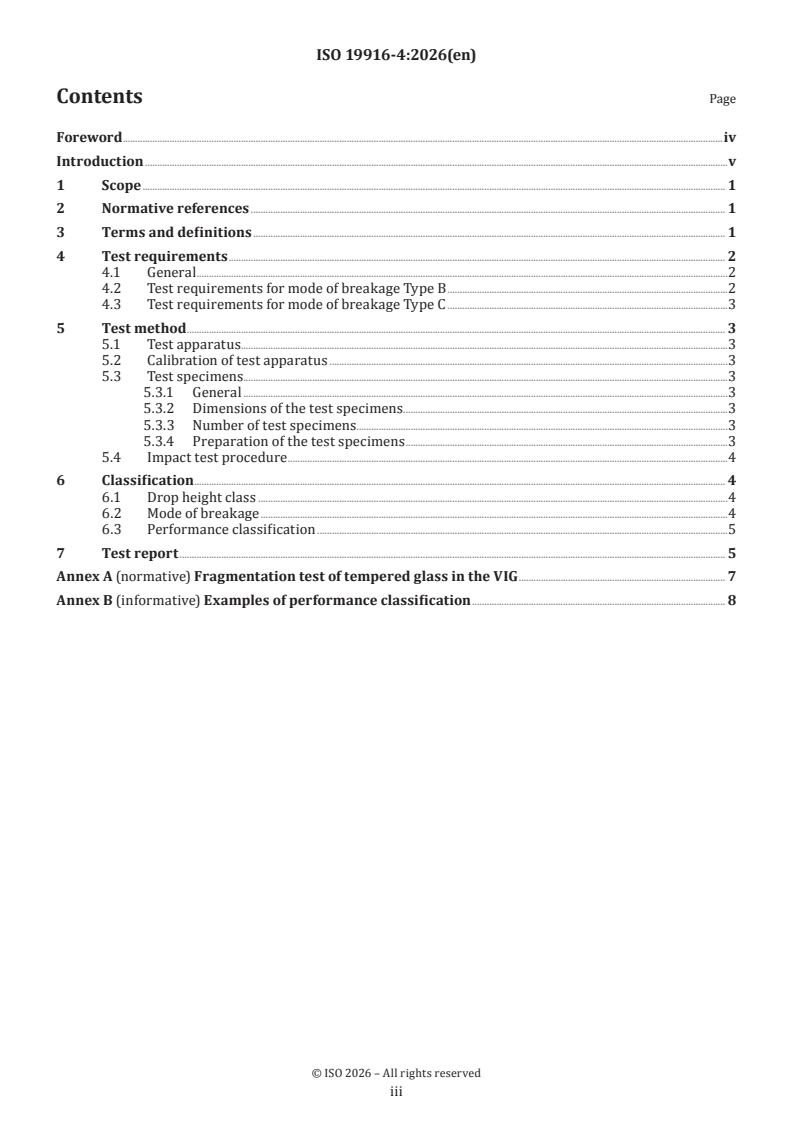
Contents Page
Foreword .iv
Introduction .v
1 Scope . 1
2 Normative references . 1
3 Terms and definitions . 1
4 Test requirements . 2
4.1 General .2
4.2 Test requirements for mode of breakage Type B .2
4.3 Test requirements for mode of breakage Type C .3
5 Test method . 3
5.1 Test apparatus.3
5.2 Calibration of test apparatus .3
5.3 Test specimens.3
5.3.1 General .3
5.3.2 Dimensions of the test specimens .3
5.3.3 Number of test specimens . . .3
5.3.4 Preparation of the test specimens .3
5.4 Impact test procedure .4
6 Classification . 4
6.1 Drop height class .4
6.2 Mode of breakage .4
6.3 Performance classification .5
7 Test report . 5
Annex A (normative) Fragmentation test of tempered glass in the VIG . 7
Annex B (informative) Examples of performance classification . 8
iii
Foreword
ISO (the International Organization for Standardization) is a worldwide federation of national standards
bodies (ISO member bodies). The work of preparing International Standards is normally carried out through
ISO technical committees. Each member body interested in a subject for which a technical committee
has been established has the right to be represented on that committee. International organizations,
governmental and non-governmental, in liaison with ISO, also take part in the work. ISO collaborates closely
with the International Electrotechnical Commission (IEC) on all matters of electrotechnical standardization.
The procedures used to develop this document and those intended for its further maintenance are described
in the ISO/IEC Directives, Part 1. In particular, the different approval criteria needed for the different types
of ISO documents should be noted. This document was drafted in accordance with the editorial rules of the
ISO/IEC Directives, Part 2 (see www.iso.org/directives).
ISO draws attention to the possibility that the implementation of this document may involve the use of (a)
patent(s). ISO takes no position concerning the evidence, validity or applicability of any claimed patent
rights in respect thereof. As of the date of publication of this document, ISO had not received notice of (a)
patent(s) which may be required to implement this document. However, implementers are cautioned that
this may not represent the latest information, which may be obtained from the patent database available at
www.iso.org/patents. ISO shall not be held responsible for identifying any or all such patent rights.
Any trade name used in this document is information given for the convenience of users and does not
constitute an endorsement.
For an explanation of the voluntary nature of standards, the meaning of ISO specific terms and expressions
related to conformity assessment, as well as information about ISO’s adherence to the World Trade
Organization (WTO) principles in the Technical Barriers to Trade (TBT), see www.iso.org/iso/foreword.html.
This document was prepared by Technical Committee ISO/TC 160, Glass in building.
A list of all parts in the ISO 19916 series can be found on the ISO website.
Any feedback or questions on this document should be directed to the user’s national standards body. A
complete listing of these bodies can be found at www.iso.org/members.html.
iv
Introduction
Accidental human impact with glass panes can be a source of injury. The classification of glass in terms
of its ability to withstand impact and the consequences of the glass breaking under such impact has been
considered in many countries. The use of a soft body impactor to represent a human body has enabled
regulators, code officials and other control organizations to specify glazing that reduces the risk of cutting
and piercing injuries.
This document is based on relevant parts of the test and classification methods described in ISO 29584:2015.
ISO 29584:2015 cannot be directly applied to vacuum insulating glass. In this document, vacuum insulating
glass is categorised into two groups: Group 1 (with laminated glass or film-backed glass) in which no shear
or opening can occur, and Group 2 (without laminated glass or film-backed glass) in which disintegration
can occur when broken after impact. Performance classification is given for Group 1 as two panes separated
by a vacuum layer and for Group 2 as the complete vacuum insulating glass.
v
International Standard ISO 19916-4:2026(en)
Glass in building — Vacuum insulating glass —
Part 4:
Pendulum impact testing and classification
1 Scope
This document specifies a method to evaluate, by means of impactors described in ISO 29584:2015, safe
breakage characteristics of vacuum insulating glass (VIG) products intended to reduce cutting and piercing
injuries to persons through accidental impact.
This document does not specify the intended use of the products, but provides a method of classification
in terms of the performance of the products being tested. The impact energy used for the various levels of
classification are designed to provide the intended user or the legislator with the information to assist in
defining the level of safety and protection required relative to the intended location at which the selected
safety glass is to be used.
The products to which this document is applicable are:
— VIG without further processing (Group 2);
— VIG processed into a laminated glass (Group 1);
— VIG backed with an adhesive (safety) film (Group 1).
Insulating glass units incorporating VIG are excluded from this document.
2 Normative references
The following documents are referred to in the text in such a way that some or all of their content constitutes
requirements of this document. For dated references, only the edition cited applies. For undated references,
the latest edition of the referenced document (including any amendments) applies.
ISO 19916-1, Glass in building — Vacuum insulating glass — Part 1: Basic specification of products and
evaluation methods for thermal and sound insulating performance
ISO 29584:2015, Glass in building — Pendulum impact testing and classification of safety glass
ISO 12540:2017, Glass in building — Tempered soda lime silicate safety glass
3 Terms and definitions
For the purposes of this document, the terms and definitions given in ISO 19916-1, ISO 29548:2015 and the
following apply.
ISO and IEC maintain terminology databases for use in standardization at the following addresses:
— ISO Online browsing platform: available at https:// www .iso .org/ obp
— IEC Electropedia: available at https:// www .electropedia .org/
3.1
ply
sheet of monolithic glass
Note 1 to entry: See Figure 1.
3.2
pane
glass component separated by vacuum layer in vacuum insulating glass (VIG)
Note 1 to entry: See Figure 1.
a) Vacuum insulating glass (VIG) without further b) VIG processed into a laminated glass
processing
Key
1 pane
2 ply
3 vacuum layer
4 pillar
5 edge seal
6 interlayer
Figure 1 — Examples for ply and pane
4 Test requirements
4.1 General
When tested by the method given in Clause 5, each test specimen shall either not break or shall break as
defined in either 4.2 or 4.3.
4.2 Test requirements for mode of breakage Type B
Numerous cracks appear, but no shear or opening is allowed within the test specimen through which
a (76 ± 1) mm diameter sphere can pass when a maximum force of 25 N is applied (in accordance with
ISO 29584:2015, Annex C).
Additionally, if particles are detached from the test specimen up to 3 min after impact, they shall, in total,
weigh no more than the mass equivalent to 10 000 mm of the original test specimen.
The largest single particle shall weigh no more than the mass equivalent to 4 400 mm of the original test
specimen.
The mass equivalent shall be determined using the measured thickness of the ply from which the glass
particles originate.
4.3 Test requirements for mode of breakage Type C
Disintegration occurs, and the 10 largest crack-free particles of each broken ply collected within 5 min
after impact shall weigh no more than the mass equivalent to 6 500 mm of the original test specimen. The
particles shall be selected only from the portion of the original test specimen exposed in the test frame. Only
the exposed area of any particle retained in the test frame shall be taken into account in determining the
mass equivalent.
The mass equivalent shall be determined using the measured thickness of the ply from which the glass
particles originate.
5 Test method
5.1 Test apparatus
It shall be in accordance with ISO 29584:2015, 5.1.
5.2 Calibration of test apparatus
It shall be in accordance with ISO 29584:2015, 5.2.
5.3 Test specimens
5.3.1 General
Each test specimen shall be representative of the normal production of the type of product submitted f
...